The History of Money & Banking: The Bankers Who Wore Swords
By Kurt Wuckert Jr.
It is Friday morning, October 13, 1307. The sun is not yet up over France. King Philip IV has sealed the same orders in his private chamber twice, once to each regional governor. The letters are marked to be opened at dawn, simultaneously, across every province where the Order of the Poor Fellow-Soldiers of Christ and of the Temple of Solomon holds property. When those seals break, no one sleeps in again.
By breakfast time, every Templar in France is arrested.
Not captured in battle. Not cornered by political rivals. Arrested in their own commanderies, in their own beds, by soldiers acting on the king's paper. The charges are ready. The trials are prepared. The torture schedules are written. The most powerful bank in the world was arrested before breakfast.¹
How that happened is the story of where modern banking came from, and why bankers learned to hide from kings in the first place.
Watch the video if you prefer to watch rather than read!
The Founding: When Poverty Was a Business Model (1119-1139)
Let's start with a paradox that is not actually a paradox once you understand how money works.
In 1119, at the aftermath of the First Crusade, a knight named Hugues de Payens stood before the Patriarch of Jerusalem with an idea that sounded pious and ran on an entirely different logic. He proposed to establish an order of knights sworn to poverty, radical, absolute poverty. No personal property. No inheritance. Nothing. Every coin, every horse, every relic belonged to the Order; the knight himself owned nothing but his vow.²
The Patriarch liked it: the Crusader states needed protection, and pilgrims to Jerusalem were being robbed on the roads. An army of monks-with-swords, bound by sacred vow to own nothing, could not be corrupted by personal greed or family wealth, and they would protect the faithful out of pure devotion.
It sounded like heaven, and for roughly a decade, almost nobody cared.
The order that would one day hold the treasuries of kings spent its first ten years poor, obscure, and small: nine knights, give or take, living off charity in a borrowed wing of a captured mosque. There is no surviving record of them doing much of anything in those years. Organizations like that die quietly all the time, and history does not remember them because there's no propaganda wing working for the legitimately poor and humble in the world.
What saved the Templars was not a battle, but an endorsement.
Bernard of Clairvaux was the most influential churchman alive, a Cistercian abbot whose letters could make popes and unmake princes, and he happened to be connected by family and friendship to the Templar founders. Around the early 1130s he wrote a treatise for them: In Praise of the New Knighthood (De laude novae militiae). In it he solved the theological problem that had kept pious donors at arm's length, the awkward fact that monks were not supposed to kill people. Bernard recast the knight-monk as a new species of holiness: the old knighthood murdered for vanity, the new knighthood fought for Christ, and a warrior who died doing it died a martyr.
It was, in modern terms, the greatest brand repositioning in Christendom, executed for free by the one man whose word settled arguments in nearly every hall of power!
The institutional upgrade had already begun. At the Council of Troyes in 1129, the Church gave the order its Latin Rule, a written constitution drafted under Bernard's influence: how the brothers ate, dressed, prayed, fought, and held property. Nine ragged knights walked into Troyes, and an institution walked out, with bylaws, a hierarchy, and the explicit blessing of the Church.
Then the donations came: land in France, England, Spain, and Portugal; rents, mills, vineyards, whole estates. Noble families sent their sons, and the sons brought their inheritances with them. Within a generation the poor knights of the Temple held property in nearly every kingdom in Western Europe.
Notice what happened there, because the pattern repeats for the next seven centuries. Before the Templars had gold, they had legitimacy: a papal-adjacent endorsement, a written constitution, a sacred story about themselves. Legitimacy was the first capital the order ever accumulated, and it compounded exactly the way capital always does.
A poverty-bound organization with no personal owners, no individual shareholders, and no individual claims on assets is a perfect vehicle for accumulating capital. Because the money does not belong to anyone, which is to say, it belongs to everyone in the Order equally, in perpetuity, it can grow without the normal constraints of inheritance taxes, widow settlements, or family feuds over dead men's estates.³
By 1139, when Pope Innocent II granted the Order of the Temple its own papal bull, Omne Datum Optimum, that theoretical advantage had become a structural, institutional fact. The Pope's letter gave the Templars four things that would compound into empire:
First, they were exempt from tithes and taxes to local bishops, so what they earned stayed in the order.⁴
Second, they answered only to the Pope. Not to kings. Not to local nobles. Not to anyone but Rome, and Rome was far away.⁵
Third, they could own land in perpetuity and could not be dispossessed: their property was sacred, protected by the Church, and could not be seized for debt or warfare or political revenge.⁶
Fourth, they could move goods and money across Christendom under ecclesiastical protection. A merchant traveling alone faced bandits; a Templar caravan faced anyone who wanted to die excommunicate.⁷
Two knights, one horse was how the Order had started, so poor that they had to share mounts and beg for coins. But their poverty was less a constraint than a regulatory quirk. An ordinary knight of ordinary wealth paid taxes to his bishop, owed service to his lord, and had his property divided among his heirs. A Templar paid nothing, owed nothing to anyone but Rome, and had his property guaranteed to grow in perpetuity. The vow of poverty made the organization nearly immortal.⁸
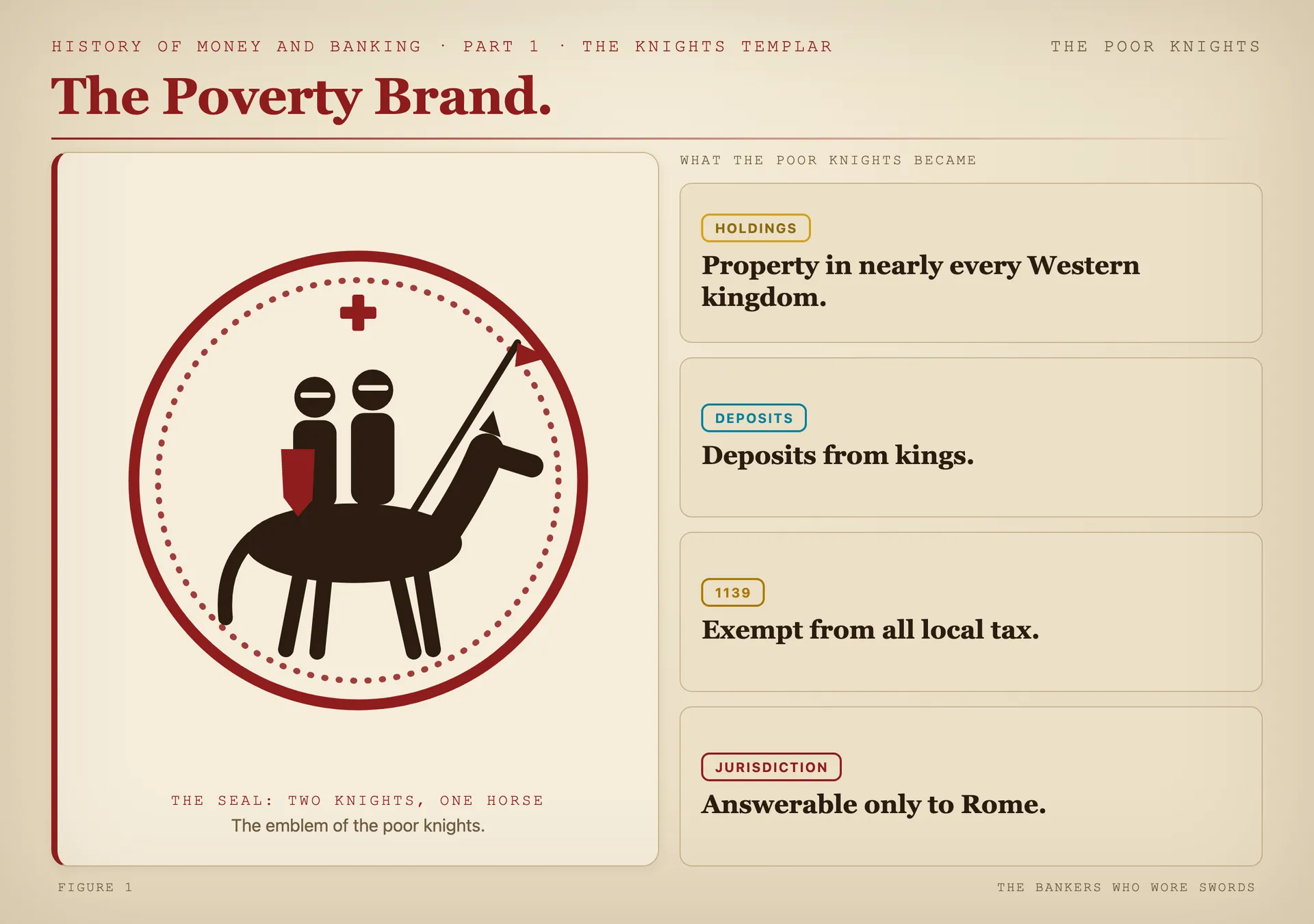
The poverty brand and what it bought: the seal advertised two knights too poor for two horses, while the order behind it accumulated property in nearly every Western kingdom. The contrast was the point.
By 1150, they had castles. By 1180, they had banks!
The Machine: How the Temple Became the First International Settlement Layer (1150-1306)
Walk with me into a Templar commandery in, let's say, London, in the year 1220. You are a merchant, English, wealthy, nervous about travel. You need to move a thousand pounds of silver to the Fair at Champagne: three hundred miles of forests, rivers, and mountains, with bandits everywhere. Your guards can fight, but they cannot fight an organized ambush in a place that will never be reported.
A Templar approaches you and tells you this: Give me your silver, and I will give you a letter. You travel to Champagne with your guards carrying paper instead of treasure. In Champagne, you go to the Templar commandery, hand them the letter, and they give you silver on the other end. Same amount, full value, no loss of exchange.
This is a letter of credit, and it is the birth of international banking.⁹
- Deposit. Hand your silver to the commandery in London; a clerk records the sum.
- Carry paper. Travel with a document instead of treasure; robbery now yields a robber nothing.
- Present. At the commandery in Champagne, hand over the letter for verification against the order's records.
- Withdraw. Receive your silver on the other end, full value, from coin already sitting there.
Now, the popular version of this story comes with a flourish. The notes, it says, were encrypted: a geometric cipher built from fragments of the Templar cross, each letter hiding inside a piece of the cross pattée. And that cipher is real enough to have a name. Open nearly any book on codes and you will find it listed, right there, as the Templar cipher.³³
Here is its birth certificate. No medieval source attributes any such cipher to the order. The family it belongs to, the pigpen family of geometric substitutions, is documented from 1531, and it flourishes two centuries after that in Masonic lodges, where 18th-century neo-Templar rites borrowed the old order's name and dressed their alphabet in it. The "Templar" label is a gift from admirers born four hundred years too late. No encrypted Templar letter of credit survives. Not one.
So the cipher on the notes is a legend. What is documented is stranger, and honestly better. The security was the network itself: the ledgers, the seals, the closed chapters, the men sworn to silence. What a merchant bought was information integrity, meaning who had deposited what, and where, verified against records no outsider ever saw. The note was data, and the data was money.
An order that kept its books that close kept everything close; the statutes required it. Chapters met behind closed doors. Receptions happened behind closed doors. And the central archive that held all of it passed to Cyprus after the fall of the Holy Land, and it has never been found. What was in it is a question, not a myth. What do you keep in an archive you guard like that?
But here is the genius part, the thing that made the Templar Order as powerful as a kingdom: The Templars do not move your silver. They cannot move it. Moving physical treasure over three hundred miles takes time and guards and losses to robbery and accident. So what they do instead is this: They hold your silver in London, and they hold an equal amount in Champagne already, because dozens of other merchants are making the same bet, sending silver in the opposite direction, from Champagne back to London.
The Templars are not moving your money; they are offsetting flows of money that happen naturally in trade. The silver you give them in London stays in London. The silver you receive in Champagne comes from some other merchant who sent it there two months ago. The Templars are keeping a ledger of debts, and as long as the ledger balances, no one has to move actual treasure at all.¹⁰
This is called netting, and it is the basis of modern financial settlement. In 1220, no one but the Templars knew how to do it at scale!
They had discovered something that would not be named formally until the 20th century, that a sufficiently sophisticated bookkeeping system can make physical money almost irrelevant. As long as credit exists, and trust exists, the actual metal can stay home.
What moves is information: ledgers, letters of credit, trust.
And trust is expensive...
When a merchant handed a Templar his silver, what he was paying for was not the movement of goods. He was paying for the Templar Order's ability to guarantee that the other end of the transaction would hold true, that when he presented his letter in Champagne, the silver would be there. That is a service. That is a product. That is money.
The trust architecture
What made a Templar letter good from London to Jerusalem: a uniformed, celibate, sworn network under one rule-set, external to every kingdom, whose collateral was its own incorruptibility. The first international settlement layer. Its single point of failure: it all rested on the Pope's protection and the king's forbearance.
The Templars called these fees "expenses of transport," even though they transported nothing. They kept records, they had procedures, and they had standardized documents and trained men to read them. They had architecture, a global network of commanderies positioned at every major trade junction in Christendom. They had something that no merchant had ever had before: information advantage. They knew what was moving where. They knew the price of credit in London versus Champagne. They knew who was creditworthy and who was about to default. They knew, in other words, the future shape of trade months before it happened.¹¹
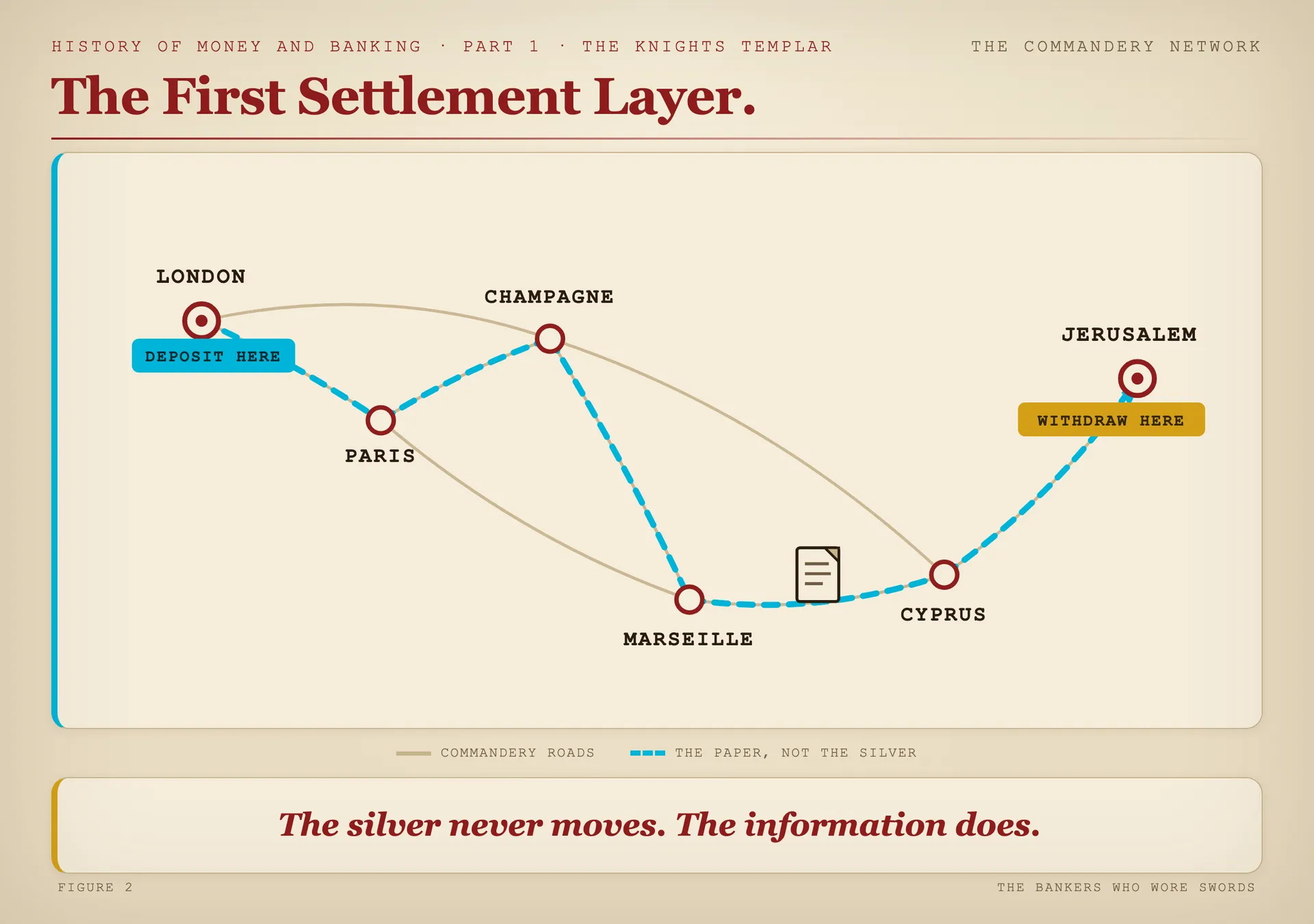
The Templar commandery network spanned from London to Jerusalem. Merchants deposited silver at one location and withdrew it at another through letters of credit, while the Templars offset flows and held the actual treasure in place. No physical silver needed to cross dangerous roads. Source: Mitchell, M. (1993). A History of the Letter of Credit. Oxford University Press.
This is called arbitrage, moving prices to where the information advantage lies, and the Templars invented it. But they invented it while the Church said that profit on money itself was a sin.
The sin of usury.
The Catholic Church taught that lending money and charging interest was immoral. It was theft. Theft by time. If you lend me a hundred coins and demand back one hundred and ten coins, you are charging me for time itself, and time belongs to God. Only God can charge for time. A man who charges for time is a man who thinks he owns a piece of eternity, and that is the definition of the sin that reaches toward damnation.¹²
This teaching was absolute canon law, and violation meant excommunication, which, in the understanding of everyone in Medieval Christendom, meant damnation in the afterlife.
But merchants needed credit; long-distance trade could not happen without it. So what occurred over two centuries was a financial engineering project, the invention of ways to charge interest without calling it interest.
The Templars became the masters of this art.
They charged "fees." They charged for "administrative costs" and "transport expenses" and "risk adjustment" and "currency exchange." None of these things were strictly usury, because none of them were literally the lending of money at a marked-up rate. They were descriptions of real costs and real services. Most of them were performed. And if they were also priced in a way that generated exactly the profit margin the market would bear, well, that was good accounting.¹³
They also pioneered the technique called "rent for use." A merchant with capital could avoid the usury ban by lending not money, but land. The borrower would pay "rent" on the land each year, which was profit on the loan, and at the end of the loan, the lender got the land back. This was not usury, this was fair rent. The mechanism was not actually all that different from charging interest, but the vocabulary was different, and in medieval law, vocabulary was law.¹⁴
By 1250, the Templar Order was the largest financial institution in Christendom, holding deposits from kings and bishops and nobles and merchants. They made loans to fund crusades and construct cathedrals, and they held collateral, land, jewels, relics, deeds, worth more than the annual revenue of France.¹⁵ They issued letters of credit that circulated as a form of money in their own right. They had branch operations in London, Paris, Cyprus, Jerusalem, and a dozen trading posts across the Mediterranean.
They had become something the medieval world had never seen before: a bank that was also a military force, an institution that could say "no" to a king and actually have the power to make it stick.
They were exempt from everyone except the one man who would eventually abandon them.
The king.
The Purpose Fades: Why the Crusader States Stopped Mattering More Than Money (1187-1306)
The beginning of the end has a date, 1187, though no one knew it yet.
Saladin's army, unified under his command for the first time, crushed the Crusader forces at the Horns of Hattin. The victory was so complete, the defeat so absolute, that it broke something in the medieval imagination that would take a century to repair. Jerusalem fell within months, and the great fortresses of the Crusader states began to crumble.¹⁶
The Templars had been founded to protect the pilgrimage routes to Jerusalem, sworn to war against the infidel. They were the most advanced military technology in Christendom, mounted knights in armor, disciplined, coordinated, operating from fortified positions and supplied by a sophisticated logistics chain that no feudal lord could match. They were supposed to be, in theory, unstoppable.
They were stopped. Over and over. For a hundred years, the Crusader states lost territory while the Templars fought harder, built more castles, recruited more knights, and kept losing. By 1291, when Acre fell, the last major Crusader stronghold, it was clear that the military objective had failed.¹⁷
The Order did not disappear; it was far too rich, far too entrenched, far too useful to the financial system. But the ideological cover began to wear thin. The Templars were no longer, primarily, soldiers in a holy war. They were bankers who happened to wear swords, knights who invested in money, military men who had become investors in their own survival.
This matters because in 1296, a king named Philip IV of France looked at his treasury and saw a problem.
Philip was spending money faster than he could take it in; the kingdom was hemorrhaging silver. Military campaigns were expensive. Court was expensive. Building was expensive. The nobles expected gifts. The Church expected tithes. The machinery of government required grease.¹⁸ But Philip's income from traditional sources, taxes on land, income from royal demesnes, fees from justice, was not growing fast enough to cover his ambitions.
In 1303, he decided to solve this problem by force. The Pope, Boniface VIII, had issued a bull called Unam Sanctam asserting papal supremacy over kings. Philip responded by sending his legal counsel, Guillaume de Nogaret, to the town of Anagni, where the Pope was staying. Nogaret's men seized Boniface in his own bedchamber, imprisoned him, and only released him when the threat to his life became undeniable. The message was clear: The king could take what he wanted, and the Church could not stop him.¹⁹
It was the end of the medieval assumption that the Church was above the king. Kings would take what they needed. Kings would take it from anywhere. Kings would use the law as their justification, but if the law was not strong enough, they would use force.
In 1306, Philip took this lesson and applied it to the Jews.
The Jews of France had been lending money in a manner that was technically legal but commercially vicious. They charged interest openly, because as non-Christians they were not bound by the canon law against usury. They were rich, but they were vulnerable. No one could accuse the king of violating religious law if he seized their property, because he could claim he was confiscating the proceeds of usury. So on July 22, 1306, Philip ordered the arrest of every Jew in France, the seizure of every coin they held, and the expulsion of the entire population.²⁰
He did this partly out of greed. Partly out of religious conformity. And partly because he was practicing. He was testing the machinery. He was seeing if he could move fast enough, hit hard enough, and hold the narrative long enough to seize wealth before anyone could mount a legal defense.
A year later, he used the same machine on the Templars. But he used it with a difference: He used it on people who had no king's protection, no civic rights, and no way to fight back in the legal system he had just bent to his will.
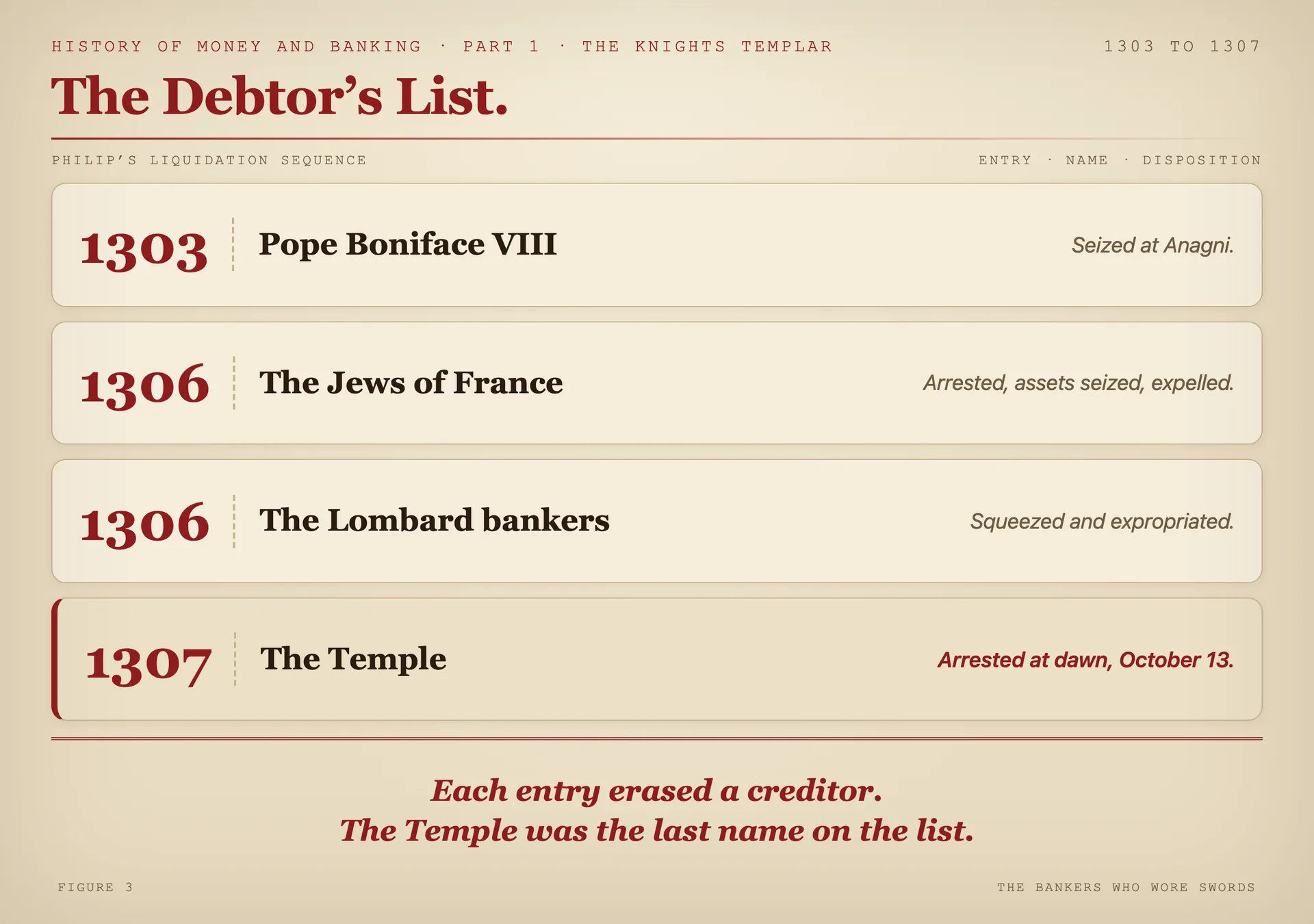
Philip's liquidations, entered the way he thought of them: as a ledger. Each entry erased a creditor and funded the next.
The Temple Falls: October 13 and What Came After (1307-1312)
The charges were ready.
Before the arrests happened, the interrogators had already written down what the Templars would confess to. The theology of the accusations was a collage of half-remembered heresies and full-blown fabrications. The Templars, the charges claimed, worshiped a mysterious head called Baphomet. They practiced obscene rites. They denied Christ. They had fallen into error through oriental influences and had become corrupted by contact with Islamic mysticism.²¹
The charges were absurd. They were also unstoppable.
Philip's strategy was systematic: after the arrests on October 13, the Templars were moved to separate prisons, isolated from each other, and subjected to interrogation that did not stop.²² The records from Paris show that the interrogators used standard medieval torture, the rack, the water cure, the fire, but also something more sophisticated: they wore prisoners down through sleep deprivation and psychological pressure. Tell us you worship Baphomet. Tell us you deny Christ. Tell us you desecrate the cross. Confess, and the pain stops. Resist, and it continues. There are no other options.
Within days, confessions began to arrive at the palace.
The geography of confession tells a story too.
In Paris, where the Inquisitor was present, where the torture was concentrated and systematic, and where the Templars had no hope of rescue, almost every knight confessed to the major charges, idol worship, denial of Christ, obscene rituals. The confessions were extraordinarily detailed, which is how historians can tell they were fabricated. Under genuine torture, witnesses usually confess to whatever will stop the pain. They tell you what you want to hear, but they tend to get the details wrong, and they tend to contradict each other. The Paris confessions were too consistent. They had been trained into existence.²³
In other regions, the story was different: in Aquitaine, where the torture was less systematic, confessions were fewer and lower quality. In Cyprus, where the Templar Order still held military power and could threaten to resist, the local bishop refused to torture the prisoners at all. Instead, he conducted a legitimate legal inquiry. The Templars testified that the charges were false, that they had never denied Christ, never worshiped idols, never desecrated anything. They were found not guilty.²⁴
Philip had a problem: The Templars in his prisons had confessed; the Templars beyond his direct reach had not. The solution was obvious and terrible. Under Philip's pressure, Clement summoned a general council to the city of Vienne; it finally convened in October 1311, with the Order's fate at the top of the agenda. The evidence would be the confessions from Paris. The verdict would be imposed from above, regardless of what the other investigations found.
Enter the Chinon Parchment.
In 1308, before the Council of Vienne had convened, Pope Clement V, who owed his position in part to Philip's influence, had received delegations of Templars. These were men of high rank, leaders of the Order who had recanted their confessions, and they told the Pope that the charges were false. That the confessions had been extracted by torture. That they had lied under duress and wished to recant before God.
Clement received them. Clement listened. Clement then wrote a private letter, the Chinon Parchment, indicating that he had absolved them of their heresy charges. That he found them innocent.²⁵
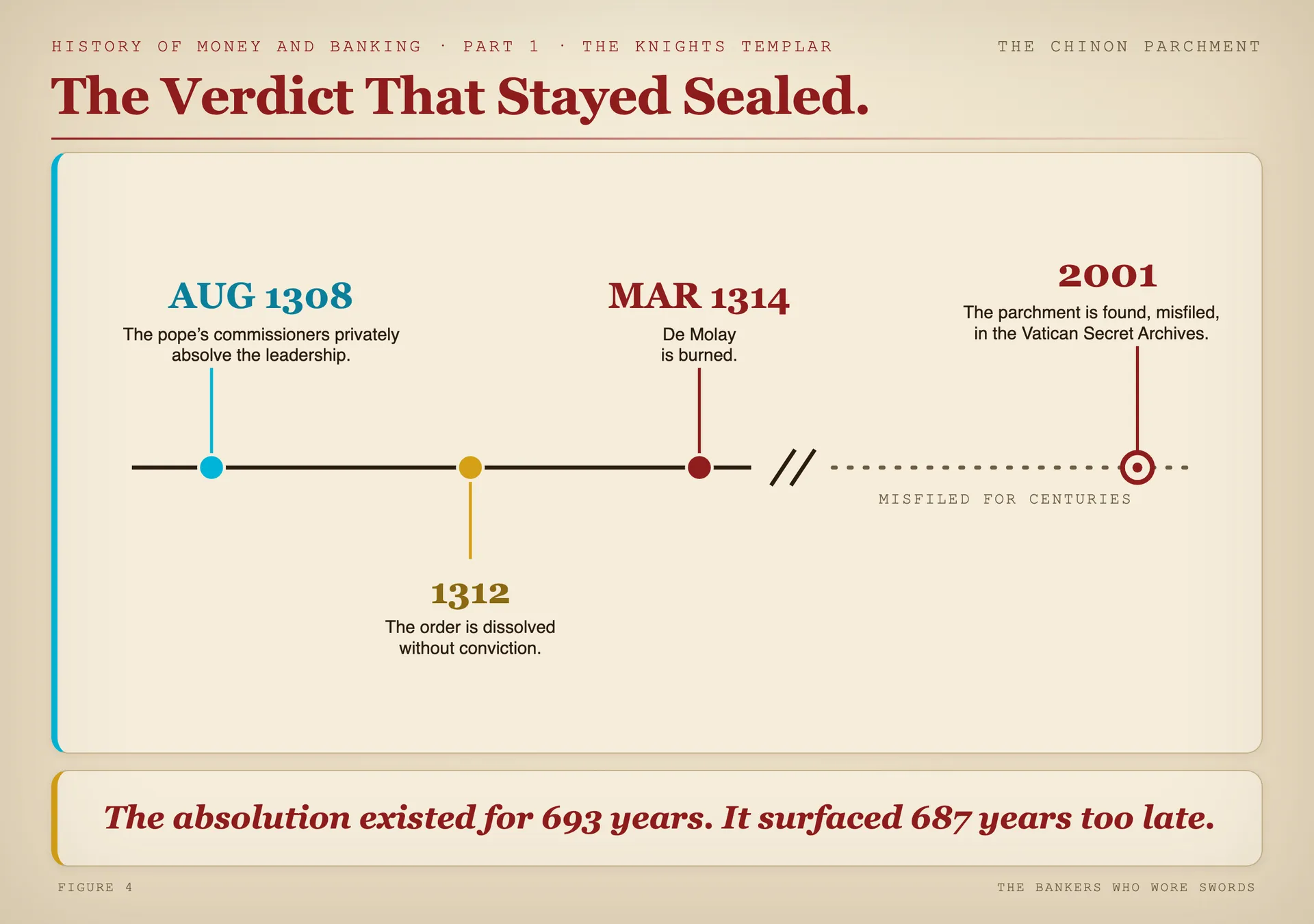
Dated August 1308, the Chinon Parchment records Pope Clement V's own commissioners absolving the Templar leadership of heresy charges. The document remained sealed in Vatican archives for nearly 700 years, emerging only in 2001, far too late to save anyone. It proves the Pope privately concluded the charges were false while publicly allowing the persecution to continue. Source: Frale, B. (2001). The Templars and the Shroud of Christ. Palgrave Macmillan.
He then let Philip's prosecution continue without obstruction.
This is not the behavior of a Pope who believed the charges, but the behavior of a Pope who understood the political situation: Philip was a king who could visit Anagni; the Templars were bankers who could not. The Pope had made his choice.
The Templars did not see the Chinon Parchment for seven hundred years. It was hidden in the Vatican archives and did not surface publicly until 2001, when French historians were allowed to examine it.²⁶ For seven centuries, the Church's public position was that the Templars had been tried, found guilty, and dissolved. The Church's private position, that they were innocent and had been absolved, remained a secret.
By 1312, the Council of Vienne had formally dissolved the Order. The Templars' property would be transferred to the Knights Hospitaller, and the Order itself would cease to exist as a legal entity. The soldiers who had guarded pilgrims, the bankers who had created international settlement, the one institution that had balanced the power of kings, all of it, terminated, on paper, by a vote that had been arranged in advance.
The Fire: The Story of the Last Master and the Legends That Followed (1314)
On March 18, 1314, Jacques de Molay, the last Grand Master of the Temple, was brought to a small island in the Seine River called the Île aux Juifs, in the shadow of Notre-Dame. The sentence of life imprisonment had been converted, by Philip's wish, into execution by fire.
De Molay was seventy years old and had been in prison for seven years. He had confessed under torture, then recanted. He had appeared before Clement and the papal cardinals and been absolved. He had been brought back to Paris and imprisoned again. He had spent seven years waiting for an appeal that never came, for a rescue that never arrived, for clemency that was never granted.
As the flames rose around him, something happened that created the first legend of what would become centuries of legend.
According to contemporary witnesses, De Molay called out to God. And here the record starts to blur. Some accounts say he called out a curse. Some say he called out a summons. Some say he asked God to summon both Philip and Clement to answer for what they had done.²⁷
What we know for certain is this: Clement V died first, in April 1314, barely a month after the fire, and Philip IV followed in November, eight months after the execution, at forty-six. Their deaths were medically ordinary for the age: Clement had been ill for years, and Philip's final illness followed a hunting accident. But the timing was close enough that a legend could take root.
[LEGEND] A curse was spoken at the pyre, and it came true. The earliest surviving versions appear in chronicles written in the decades after the event: an eyewitness verse chronicler recorded de Molay's defiance at the stake, and within a generation the story had grown into a formal summons, pope and king called to answer before God within the year. The fully-formed "cursed kings" saga is far younger than that; it owes most of its modern shape to Maurice Druon's 1955 novel cycle Les Rois maudits.²⁸ It took written form slowly, spreading by word of mouth, by retelling, by the way people remember things that confirm their sense of justice, that wrongdoing is punished, that the universe has a conscience, that you cannot burn a man innocent and walk away clean.
The legend is satisfying. It is also not what the record shows. Philip did not die of a curse; the chronicles describe a final illness that followed a hunting accident. Clement had been sick for years, and his death in April 1314 surprised nobody who had watched his health fail.²⁹ Neither death was mysterious. Both were ordinary.
But the timing mattered. The speed with which both men died, within months of De Molay's execution, meant that the narrative of justice was available, that a story could be told where the universe corrected itself. And across the next century, that story took on weight.
While we are separating documents from legends, let us deal with the goat.
Here is what the 1307 trial records actually allege: under torture, some Templars described venerating an idol, a head, sometimes bearded, sometimes not, in one deposition a cat. The name "Baphomet" appears in a handful of these depositions, and the most plausible reading, held by mainstream scholars for over a century, is that it is a mangled form of "Mahomet," the medieval French rendering of Muhammad. The accusation, in other words, was crypto-Islam, the all-purpose slander of the Crusading age. Nobody in 1307 describes a goat. Not one deposition, not one charge sheet, not one chronicle.
[LEGEND, dated 1856] The goat arrives five and a half centuries later. In 1856 the French occultist Eliphas Levi published Dogme et rituel de la haute magie, and in it he included his own drawing: a winged, goat-headed, androgynous figure he chose to call Baphomet. Levi invented the image. He borrowed a name from the trial records and attached it to an icon of his own design, and that icon, not anything from 1307, is what every album cover, horror movie, and statue controversy has been reproducing ever since. Pop culture remembers Levi's drawing and quietly backdates it onto the trial. The five-and-a-half-century gap between the tortured answer and the engraving is the entire story.
And about those tortured answers: the depositions are real documents, but what they describe was never corroborated by a single physical object. Philip's agents inventoried every Templar house in France, room by room, because they were looking for assets. Men cataloging candlesticks would have noticed an idol.
They found none.
The story of the curse became the anchor point for a wider set of legends, some of them involving the Templars' supposed hidden treasure. [LEGEND] The Templars had concealed a vast sum, gold, relics, sacred objects, before the arrests. The Fleet at La Rochelle, according to some accounts, escaped to Scotland, and the treasure went with them. The origin of this legend is unclear; no contemporary source documents any fleet slipping out of La Rochelle that night, and the story surfaces only centuries later in Templar-mystery literature.³⁰ But the record does hold something here, and what it holds is a hole. The order had ships; La Rochelle was one of its ports. What happened to those ships after October 1307 is simply not in the record, anywhere. That hole is real, and every one of these legends sails through it.³⁹ No wonder the legend persisted. Every century that could not find the treasure invented a better hiding place.
[LEGEND] The Templars had conducted excavations beneath the Temple of Solomon and found something: artifacts, relics, documents, knowledge. The legend holds that they spent decades digging beneath Jerusalem and discovered something so profound that it threatened the Church. The chronicles of the Crusader period do not document any such excavations.³¹ What can be dated is the modern shape of the story: its fullest form arrives in a 1992 bestseller by the journalist Graham Hancock, who argued the nine founders were tunneling for the Ark of the Covenant itself and chased the trail all the way to Ethiopia.³⁴ Strip the bestseller away, though, and the ingredients are still sitting there: nine knights, nine years with no surviving record of their daily work, quarters directly on top of the most storied foundation on earth. What they did down there, nobody wrote down. Or if someone did, we have never found it.
This particular legend attaches easily because the order practically wrote it themselves.
Their headquarters sat on the Temple Mount, in the captured al-Aqsa complex, which the Crusaders called the Temple of Solomon. Their full legal name advertised the address: the Poor Fellow-Soldiers of Christ and of the Temple of Solomon. Nine knights, nine quiet years, living on top of the most storied basement in the Western world. The story writes itself, which is exactly why it should be handled with gloves: stories that write themselves are usually writing fiction.
The excavation narratives belong to nineteenth and twentieth century esoteric literature, not to any chronicle. No Crusader-era source describes the Templars digging, finding, or hiding anything under that rock. And frankly, they did not need to find an artifact for the location to matter: what a place means can outweigh whatever is buried under it, and no place on earth has ever meant more per square foot!
Here is the mystery that is actually real: we genuinely know almost nothing about the order's first nine years. The record is nearly silent: no chronicles of their daily work, no membership rolls, no accounts. That silence is a fact, one of the few we have from the period.
And silence is a vacuum. Every one of those legends rushed in to fill it. Some of the legends could be true, and I wish I could confirm them.
[LEGEND] The Templar curse followed the survivors. The movement of Freemasonry, centuries later, is sometimes attributed to Templars who survived the purge. The paper trail here is unusually good, though it points in an awkward direction: the first connections between Templars and Freemasonry appear in 18th-century Masonic documents, texts written long after the Templars were dead, by men who were building ritual narratives.³² The serious version of the continuity case has been argued at book length, and soberly.³⁶ What no one has produced is a document from the four missing centuries in between. Until someone does, that gap is the whole question.
While we are at it, one more, and this one is my favorite, because it is a legend about a legend.
You have probably heard that our fear of Friday the 13th descends from that dawn in October 1307. It is a tidy story. It is also not documented. [LEGEND, twentieth-century origin] Friday-the-13th superstition does not appear in the folklore record until the nineteenth century, when older and separate anxieties about Fridays and about the number thirteen finally merged into one dread. The explicit link to the Templar arrests shows up later still, in twentieth-century popular books, most visibly in the wave of Templar-mystery bestsellers.
So the superstition is younger than the steam engine, and the Templar explanation for it is younger than the airplane! The date was real. The dread came later, went looking for an origin story worthy of itself, and borrowed the best one available.
Legends do that.
Other legends involve the Templars' supposed influence after death. [LEGEND] The order survived underground, its members scattered across Europe, continuing their work in secret. [LEGEND] They influenced the founding of banks. They shaped the development of finance. They left traces in symbols, architecture, and financial practices. These legends are not utterly baseless: the Templars did in fact pioneer banking practices that became the foundation of European banking. What no document supports is the underground order itself: four centuries of silence separate the Templars from their claimed heirs, and the question of where the men, the money, and the methods actually went has never been fully answered.
Of course, if they were good at staying underground, perhaps we wouldn't know.
[LEGEND, later romantic and Masonic writing] The escaped Templars fled to Scotland and turned the tide at Bannockburn in 1314, charging out of the mist to save Robert the Bruce. The intervention story belongs to romantic and Masonic literature written centuries afterward.³⁵ But notice what makes it durable: Scotland in 1314 sat beyond Philip's reach and under excommunication, exactly where a rational fugitive would go. What is missing is any contemporary trace of them there, and no account of the battle puts knights of the Temple on that field. Is that the absence of a record, or a record of absence? The field does not say.
[LEGEND, 1980s] Rosslyn Chapel, outside Edinburgh, holds Templar secrets in its carvings. The chapel was built in the 1440s, about one hundred thirty years after the order was dissolved, and the theories about its carvings date to the popular literature of the 1980s, the same books that fed The Da Vinci Code.³⁷ Two things remain true anyway. The carvings really are strange, and nobody has fully explained them. And the argued connection runs through the Sinclair family that built the place, which keeps one question standing: what did those masons think they were carving?
[LEGEND, twentieth-century graft on a 1795 story] The treasure sits at the bottom of the Money Pit on Oak Island, Nova Scotia. The Oak Island story begins in 1795 as a local dig by three teenagers, and the Templar connection was grafted on in the twentieth century, once the pit had swallowed enough money to need a legend worthy of the expense.³⁸ Two centuries of digging have produced neither treasure nor an explanation for the engineering the early diggers reported. The pit has kept both secrets, if it has any.
[LEGEND, modern, no medieval documentation] Fleeing Templars founded what became Switzerland, which is why the Swiss are good at banking and fond of crosses. There is no medieval documentation for this, and the story as we have it is modern. You can see why it finds believers: fugitives need mountains, and a banking talent that sophisticated had to come from somewhere. Where the Swiss learned it is a fair question. Whether Templars taught them is an undocumented one.
[LEGEND, proposed 2009, disputed] The Templars secretly kept the Shroud of Turin for a century, which explains the shroud's missing years and the "head" the knights confessed to venerating. This one at least comes from a credentialed source: Vatican archives researcher Barbara Frale proposed it in 2009.⁴⁰ Other scholars dispute her reading of the evidence, and it remains a modern hypothesis, not an established custody record.
Look at the pattern. Scotland in the romantic age, when Britain was inventing its medieval past. Nova Scotia once the New World needed old-world mysteries. Switzerland once Swiss banking needed explaining. Each century that lost the treasure invented a hiding place closer to home.
The treasure never moves. The audience does. But that argument has a limit: proving how a story spread is not the same as proving it empty.
I do not believe or disbelieve these legends. Freemasons really did have secret knowledge, and today we call most of it "geometry" and "architecture" just like the Templars kept their methodology on how to profit from finance secrets, while the same practices happen in the open every day on Wall Street and in the City of London today. But they are part of the story, part of how we remember what happened. And understanding why people needed these legends, why the image of a hidden, surviving, plotting Templar order was more satisfying than the simple fact that an institution was destroyed and its people dispersed, that tells you something about what actually died in 1314.
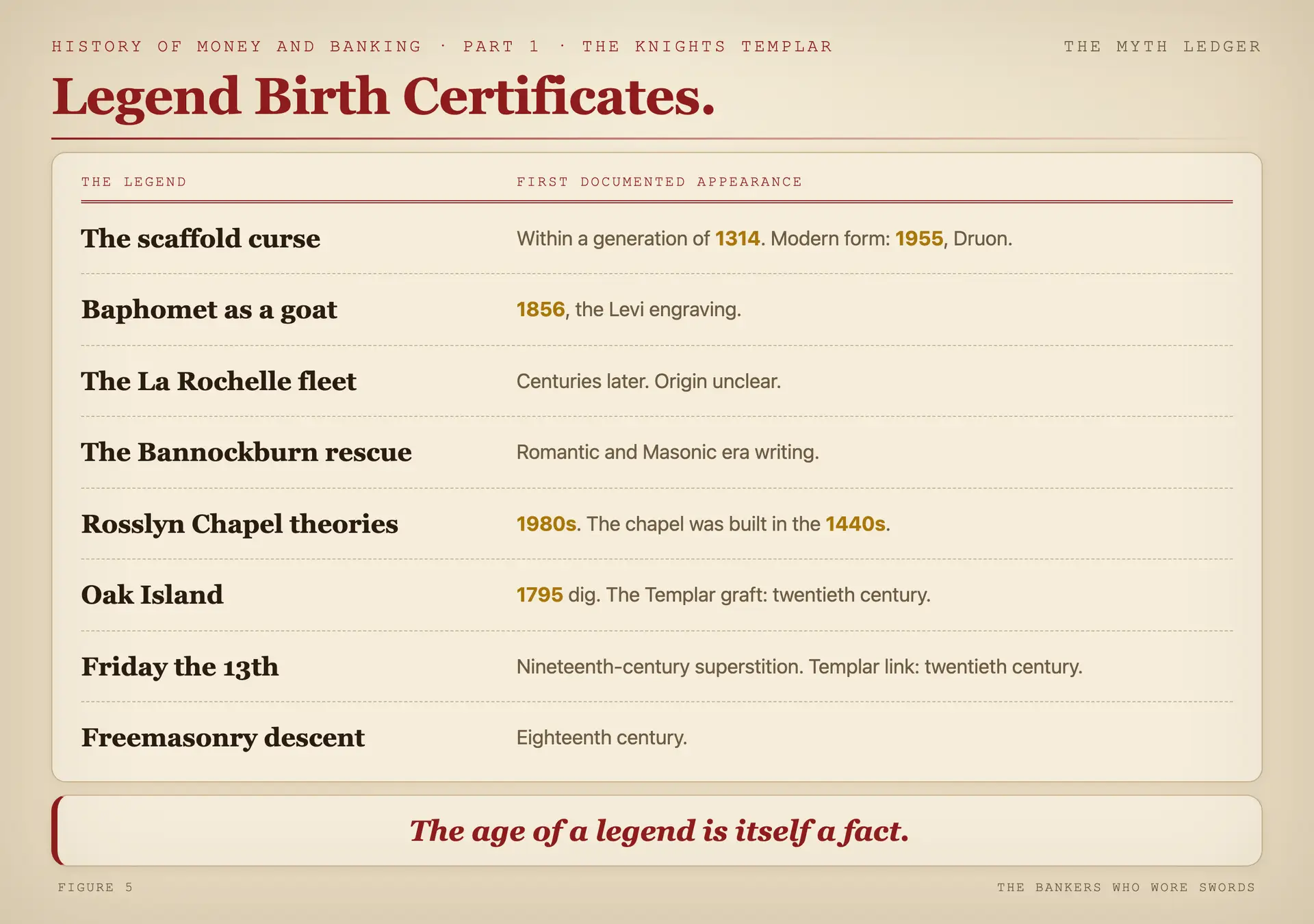
The full inventory, with birth certificates. Not one of these stories is medieval.
What Burned (And What Did Not): The Architecture That Survived Demolition (1314-1500)
When the Templar Order was formally dissolved, the question became: What happens to the financial system they built?
The answer is: Nothing happens. It continues.
The Templars had designed an architecture so fundamental to how money moved that you could not kill it by killing the Templars. The architecture was embedded in every commandery that became a Hospitaller property. It was embedded in the practices that merchants had learned. It was embedded in the letters of credit and the deposit systems and the international settlement layers that had become the standard way business was conducted.
More importantly: The techniques the Templars invented, the regulatory arbitrage, the fees-instead-of-interest, the offset-and-netting systems, the use of trust as a financial product, these techniques did not belong to the Templars; they belonged to anyone clever enough to use them.
What died in 1314 was not banking. Banking was just getting started.
What died was the idea that an institution could be more powerful than a king if it had enough money and enough legitimacy. It is the verdict that was never guilty, but the sentence was carried out anyway, a kind of institutional death that declares you innocent after killing you.
The Templars had shown that money, properly structured, could resist state power, that a private institution with international reach, backed by religious authority and maintained through sophisticated finance, could answer only to God and its own rules. They had shown that you could build something that the king could not touch.
Philip proved the inverse: That if the king wanted to touch it badly enough, religious authority could be bent, legal procedures could be rewritten, and force could accomplish what the law would not permit.
The lesson was not lost on subsequent bankers. The lesson was that you must never, ever put yourself in a position where the king can see all your wealth at once. You must never be so visible, so centralized, so obviously powerful that removing you becomes a politically obvious solution. You must distribute your assets. You must operate through family networks, through shell entities, through jurisdictions where you have protectors. You must hide.
The modern banking system is, in part, a direct consequence of what happened on October 13, 1307. It is shaped by the memory of what happened when a king decided that a bank had become too powerful. It is built on the principle that you do not let all your assets sit in one place under one name. You move them. You spread them. You create structures inside structures, so that even if someone seizes the outer layer, the inner machinery keeps running.
The Templars were the last bank to believe that legitimacy alone would protect them.
Legitimacy, in the end, belongs to whoever can enforce it. And the king can enforce it.
Who is the king today?
The Questions That Follow (Part 1 of a Longer Conversation)
Here are the questions you should be asking, because they are the questions the Templars should have asked, and didn't:
What happens when the king owes the bank more money than he can pay?
What happens when an institution gets so large that removing it destabilizes the entire financial system?
What happens when the king's power and the bank's power reach parity, and then one of them has to back down?
These are not academic questions. These are the questions that repeat. Monarch after monarch faces them. Institution after institution faces them. And the answers vary depending on who you are, where you sit, and what leverage you have.
The Templars lost because they were vulnerable in a specific way: They were centralized. They were visible. They were a single juridical entity, a unified Order, that could be targeted as a whole. They also lost because the legitimacy they relied on, papal protection, could be withdrawn. The Pope could have fought Philip. He chose not to, and the institutional protection dissolved.
But history after the Templars is partly a story of institutions learning from this lesson. Learning to decentralize. Learning to make themselves harder to kill. Learning to distribute their power so that taking down any single piece does not threaten the whole.
It is also a story of kings learning that you cannot simply seize financial institutions without destroying the credit system that makes kingdoms possible. Kings need bankers more than bankers need kings, in the long term. But bankers need more than one king, they need many, in different places, so that the loss of one is survivable.
What we are about to explore, in the next parts of this series, is how this lesson propagated. How banking became decentralized. How merchants and financial houses learned to work across borders and jurisdictions in ways that made them resilient to state capture. How the fall of the Templars became the birth of the merchant banks, the great family dynasties, the banking houses that would not be public corporations with a single name.
The Templars were the first. But they were only the first.
The next installments will follow the families who learned the Templars' lesson and built banks you could not behead. The Medici are coming. The Rothschilds are coming. We will discuss the Dutch and British, Jekyll Island and even take journeys to the ancient Sumerians and China before we wrap on the History of Money and Banking. Eventually, we will also connect them to the history of computers and technology. The Templars showed us that information is value, and some day, I think you will agree with me that "data is money."
Be good to each other. And stay curious.
Kurt Wuckert Jr. is the Chief Bitcoin Historian, founder of GorillaPool and Open Protocol Labs, and host of Kurt's Podcast. He writes weekly on Bitcoin, geopolitics, faith, and the long fight for human sovereignty at kurtwuckertjr.com. Catch him live every Tuesday at 2 PM EST.
Footnotes
¹ On the coordinated arrests of October 13, 1307: Malcolm Barber, The Trial of the Templars, 2nd ed., Cambridge University Press, 2006.
² On Hugues de Payens and the founding, c. 1119: Malcolm Barber, The New Knighthood: A History of the Order of the Temple, Cambridge University Press, 1994.
³ Barber, The New Knighthood, on the order's corporate structure and capital accumulation.
⁴ Innocent II, Omne Datum Optimum (1139); translation in Malcolm Barber and Keith Bate, The Templars: Selected Sources, Manchester University Press, 2002.
⁵ Omne Datum Optimum (1139), on direct papal jurisdiction.
⁶ Omne Datum Optimum (1139); see also Helen Nicholson, The Knights Templar: A New History, Sutton Publishing, 2001.
⁷ Nicholson, The Knights Templar, on the order's privileges and protections.
⁸ Barber, The New Knighthood, on donation-driven growth and the order's exemptions.
⁹ On Templar letters of credit: Nicholson, The Knights Templar; on medieval credit instruments generally, Raymond de Roover, "The Organization of Trade," in The Cambridge Economic History of Europe, vol. III, Cambridge University Press, 1963.
¹⁰ Peter Spufford, Money and Its Use in Medieval Europe, Cambridge University Press, 1988.
¹¹ Barber, The New Knighthood, on the commandery network as financial infrastructure.
¹² Thomas Aquinas, Summa Theologiae II-II, q. 78, on usury; the standard statement of the medieval doctrine.
¹³ Nicholson, The Knights Templar, on Templar financial services and fee structures.
¹⁴ John T. Noonan, The Scholastic Analysis of Usury, Harvard University Press, 1957, on rent and census constructions used to work around the usury ban.
¹⁵ Barber, The New Knighthood, on the scale of Templar holdings at their peak. Scholarly estimates are ranges, not inventories; precision beyond that is false.
¹⁶ Christopher Tyerman, God's War: A New History of the Crusades, Harvard University Press, 2006, on Hattin (1187) and its aftermath.
¹⁷ Tyerman, God's War, on the fall of Acre (1291).
¹⁸ Joseph R. Strayer, The Reign of Philip the Fair, Princeton University Press, 1980, on the crown's fiscal crisis.
¹⁹ Strayer, The Reign of Philip the Fair, on Anagni (1303) and Guillaume de Nogaret's role as the king's lawyer.
²⁰ William Chester Jordan, The French Monarchy and the Jews, University of Pennsylvania Press, 1989, on the expulsion of 1306 and the seizure of assets.
²¹ Barber, The Trial of the Templars, on the articles of accusation.
²² Barber, The Trial of the Templars, on the interrogations of October and November 1307.
²³ Barber, The Trial of the Templars, on the pattern of the Paris confessions.
²⁴ Barber, The Trial of the Templars, and Nicholson, The Knights Templar, on the proceedings outside France: England, Aragon, and Cyprus.
²⁵ Barbara Frale, "The Chinon Chart: Papal Absolution to the Last Templar, Master Jacques de Molay," Journal of Medieval History 30 (2004).
²⁶ Frale, "The Chinon Chart." The parchment sat misfiled in the Vatican Secret Archives until Frale identified it in 2001.
²⁷ On the execution of March 18, 1314: Sophia Menache, Clement V, Cambridge University Press, 1998; the eyewitness verse chronicle of Geoffroi de Paris is the closest contemporary account.
²⁸ [LEGEND, origin dated] Early versions: Geoffroi de Paris (c. 1314) records de Molay's defiance; the "summons within the year" appears in chronicles within a generation. The modern "cursed kings" form owes its shape to Maurice Druon, Les Rois maudits, 1955 onward.
²⁹ Menache, Clement V, and Strayer, The Reign of Philip the Fair, on the deaths of Clement (April 1314) and Philip (November 1314).
³⁰ [LEGEND, origin unclear] No contemporary source documents a fleet escaping La Rochelle; the story appears in Templar-mystery literature centuries after the event.
³¹ [LEGEND, origin unclear] No medieval chronicle documents Templar excavations beneath the Temple Mount; the digging narratives belong to modern esoterica.
³² David Stevenson, The Origins of Freemasonry: Scotland's Century, Cambridge University Press, 1988. Stevenson documents Freemasonry's origin in Scottish stonemasons' lodges; the Masonic-Templar genealogy first appears in the 18th century.
³³ On the "Templar cipher": the geometric substitution built from fragments of the cross pattée appears throughout modern cipher literature, but no medieval source attributes it to the order. The pigpen family it belongs to is documented from Cornelius Agrippa's "nine chambers" (De occulta philosophia, 1531) and flourishes in 18th-century Masonic use, where neo-Templar rites adopted the order's name. On the order's actual documented financial operations: Léopold Delisle, Mémoire sur les opérations financières des Templiers, Mémoires de l'Institut national de France, t. 33, 1889. On the central archive's transfer to Cyprus and its loss (presumed destroyed in the Ottoman conquest of 1571): Barber, The New Knighthood.
³⁴ Graham Hancock, The Sign and the Seal: The Quest for the Lost Ark of the Covenant, Heinemann, 1992. A journalist's case that the founders excavated the Temple Mount in search of the Ark; cited here as the fullest modern form of the excavation legend, without documentary support in the medieval record.
³⁵ Michael Baigent and Richard Leigh, The Temple and the Lodge, Jonathan Cape, London, 1989 (some first-edition records give 1988). Argues Templar survivors fought at Bannockburn; no contemporary account of the battle corroborates the intervention.
³⁶ John J. Robinson, Born in Blood: The Lost Secrets of Freemasonry, M. Evans and Company, New York, 1989, the most soberly argued of the continuity cases; Christopher Knight and Robert Lomas, The Hiram Key, Century, London, 1996, and The Second Messiah, Century, London, 1997. For the documented origin of Freemasonry, see note 32.
³⁷ Christopher Knight and Robert Lomas, The Hiram Key, Century, London, 1996, argue Rosslyn was built as a vault for scrolls excavated from the Temple Mount; Andrew Sinclair, The Sword and the Grail, Crown Publishers, New York, 1992, argues the Sinclair-family inheritance, written by a St. Clair descendant with Cambridge credentials.
³⁸ Steven Sora, The Lost Treasure of the Knights Templar: Solving the Oak Island Mystery, Destiny Books, Rochester VT, 1999. The wider transatlantic-survival literature: Sinclair, The Sword and the Grail (the claimed 1398 voyage, resting on the Zeno Narrative, itself generally dated as a 16th-century fabrication); Richard Nielsen and Scott F. Wolter, The Kensington Rune Stone: Compelling New Evidence, Lake Superior Agate Publishing, 2006, and Scott F. Wolter, The Hooked X: Key to the Secret History of North America, North Star Press, 2009, a forensic geologist's case for a 14th-century Templar presence in North America; mainstream runology dates the stone to the 19th century.
³⁹ David Hatcher Childress, Pirates and the Lost Templar Fleet, Adventures Unlimited Press, 2003. The documented kernel is only the gap itself: the order's ships at La Rochelle disappear from the record after October 1307.
⁴⁰ Barbara Frale, The Templars and the Shroud of Christ, Maverick House, 2011 (Italian original: I Templari e la sindone di Cristo, Il Mulino, 2009). Disputed at book length: Andrea Nicolotti, I templari e la Sindone: Storia di un falso, Salerno Editrice, 2011.