Why Whoop is the Best Fitness Tracker for Jiu-Jitsu
By Kurt Wuckert Jr.
Affiliate DisclosureThis article may contain affiliate links. If you use them, Kurt may earn a small commission at no extra cost to you.
Who This Is For
I learned this the hard way after years of trying to blend "I want data" with "I want to train like I mean it." Grappling does not care about your gadgets, it cares about pressure, friction, and awkward angles.
Jiu-Jitsu athletes who train hard and do not want a cracked screen or a ripped-off watch
Lifters who do not want to wear a ring under a barbell
Guys who prefer a mechanical watch daily and do not want a second device on the wrist
Busy dads and entrepreneurs who need clear recovery feedback, not more noise
Anyone who wants a tracker that survives real training, not just treadmill life
Why I Like the Whoop!
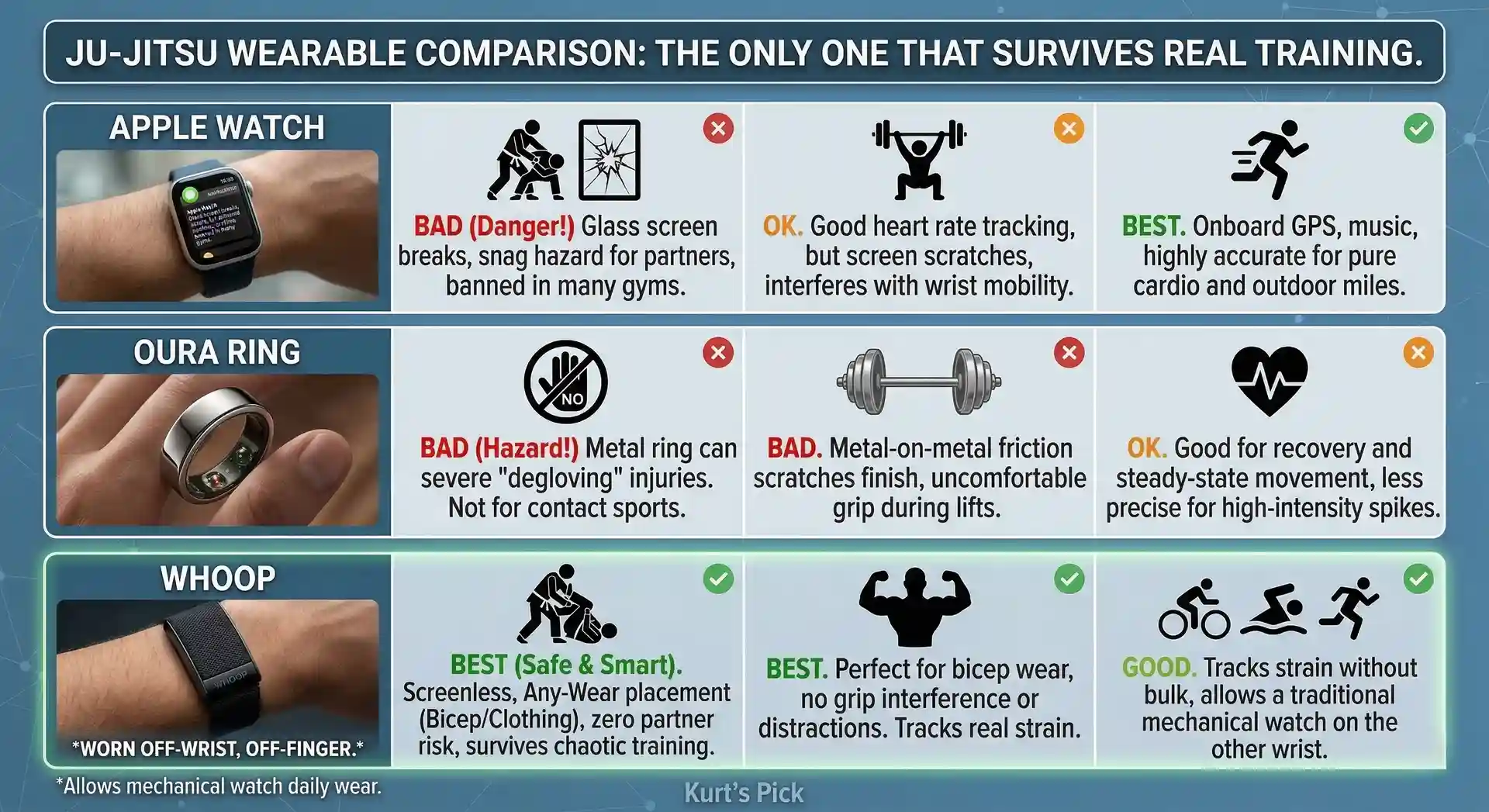
Most wearables were designed for jogging, desk life, and controlled workouts. Jiu-Jitsu is not controlled. It is clinching, grip fighting, torque, and somebody's shoulder pinning your face into the mat while you try to breathe through your nose and remember you have a family. That is why ring-based trackers and wrist-based smartwatches are a poor match for grappling. Even if you ignore the safety issue, they are uncomfortable, they can snag, and they can injure someone else. On top of that, screen devices are basically asking to get smashed the first time you fight with any seriousness.
The Placement Solution
Whoop solves the "placement problem" better than anything I have used because it is designed to be worn beyond the wrist. Their bicep band and clothing-based options exist specifically for situations where your wrist is a terrible idea, which is most of Jiu-Jitsu. Whoop explicitly supports off-wrist wear through options like the bicep band and their Any-Wear approach, which is exactly what grapplers need when training gets physical and chaotic.
The second reason I like Whoop for Jiu-Jitsu is psychological. It is screenless. That matters because it isn't going to tell me my business partner sent me a meme while I'm choking a training partner. Whoop stays quiet, collects the data, and gets out of your way. Sleep and recovery are already hard enough for a busy dad. I do not need another glowing rectangle in my life. Also, I wear a mechanical watch most days because I think a real man should have a real watch on his wrist. I like craftsmanship, I like tradition, and I like not feeling like a cyborg, especially since my daily life is primarily in tech. My watch is a reminder that people used to build incredible things without software, and that there is at least one thing in life that can be purchased that doesn't have built-in, planned obsolescence. Whoop lets me keep the watch and the fitness tracker without the "double-wrist" look.
Finally, the platform itself has matured into more than "how many calories did I burn." Whoop has leaned into recovery, sleep quality, and longer-term health context, with newer platform features that tie together training load, sleep consistency, and broader health metrics. If you want to go deeper, their newer ecosystem also points toward more advanced health signals over time, which is where wearables are heading as a category.
Is Whoop perfect? No. No wearable is. Sleep staging and recovery metrics are improving across the industry, but they are still estimates, and you should treat them like a dashboard, not like Scripture. A scoping review in npj Digital Medicine makes the point clearly that wearable performance varies widely by device and method, especially when you get into sleep staging. That does not mean the data is useless. It means the goal is trend awareness and better decisions, not obsession. Nature
What I Actually Do in Real Life
I am 40, I have three kids, I'm an officer in three companies, and I work a tech schedule where sitting is the default unless I intentionally break out of it. Some weeks I train like a professional. Some weeks I am just trying to keep my head above water and still show up.
Here is what "real life" looks like when I am doing it right enough:
- 3 days/week Jiu-Jitsu Training
- 2 days/week Strength Sessions
- 1 day/week Recovery Movement
- Jiu-Jitsu 3 days/week (hard rounds at least 1 to 2 of those days)
- Strength 2 days/week (simple compounds, 5 to 20 reps, close to failure, add weight over time)
- One "get healthy" day where I do light movement and mobility because my body is beat up
- Sleep focus because a tired dad eats like a raccoon and trains like a sloth
Every day, I wear Whoop on a bicep band or tucked in tight via clothing placement. It stays out of the chaos, it does not get ripped off, and it does not distract me. Then I use the data the way an adult should, I look at daily and weekly trends. If recovery is crushed, I still train, but I get more strategic. If everything is green, I push. Whoop is how I track sleep, strain, and recovery without guessing. Get a FREE Whoop 5.0 and 1 Month FREE: https://join.whoop.com/8258E885
- Can I just wear an Apple Watch to Jiu-Jitsu?
- No way! It can get torn off, cracked, or become a hazard to your partner. Grappling is not friendly to wrist devices.
- What makes Whoop different for grappling specifically?
- Placement. Whoop is built to be worn off the wrist, including the bicep and clothing-based options, and it has no screen to break or distract you. whoop.com+1
- Is the data "accurate" enough to matter?
- It is accurate enough for trends and behavior changes, which is the whole point. Do not treat wearables like medical devices unless they are explicitly cleared and used that way. Use the metrics to guide consistency, sleep discipline, and training decisions.
- What metrics should a Jiu-Jitsu athlete actually care about?
- Sleep consistency, recovery trends, and training load across the week. HRV can be useful as a readiness signal when interpreted in context, not in isolation, and I love to know when I have definitely done enough rounds and should start to wind down. MDPI
- Will Whoop make me train less?
- It can if you let it scare you. I use it to train smarter, not to avoid hard work. Some of the best progress I have made came from pushing when I was capable, then backing off before I got hurt.
- Do I need the newest model to benefit?
- Not necessarily. The habit is the power, consistent tracking, consistent sleep effort, consistent training. Newer features can be nice, but the basics win.
- What if I already use Oura and love it?
- Cool, it is a solid tool for sleep and recovery context. The main issue is whether it fits your training reality. If you cannot wear it safely during lifting and grappling, it is not the best all-day solution for a serious Jiu-Jitsu schedule.
- Should I change training based on one bad recovery score?
- No. Look for patterns across the week. If you have one bad night, train anyway, but be honest about intensity, volume, and stress.
- Is Whoop good for lifting too?
- Yes, especially for tracking overall workload and recovery. For lifting progress, the real scoreboard is still reps, sets, and weight on the bar over time. I also don't like a wrist or finger wearable because it interferes with my grip and/or can be fragile.
- Train three Jiu-Jitsu sessions and write down how each one felt afterward
- Wear your tracker in a way that survives hard rounds, not a way that looks cool
- Check your weekly trend lines, not your minute-by-minute emotions
- Pick two strength sessions and push one main lift close to failure in the 5 to 20 rep range
- Protect sleep with a consistent bedtime three nights this week
- Decide what "better recovery" means for you, more sleep, less late eating, fewer extra sessions, or smarter intensity
- Take a picture and tag me on X (https://x.com/kurtwuckertjr) or Instagram (https://www.instagram.com/kurtwuckertjr/) so I can see your progress!