The Year of the Pizza: The Written History of Bitcoin, Part 3
By Kurt Wuckert Jr.
The Kill Switch
The man who built a "trustless" system kept a kill switch for himself.
He hardcoded a public key into the Bitcoin client. He held the matching private key and told no one. With it, he could broadcast a signed message to every node on the network and freeze every wallet's ability to send a transaction. The feature shipped on August 15, 2010, in Bitcoin v0.3.10, the same emergency release that patched the Value Overflow Incident.¹ It was called the alert system. The community accepted it without complaint and largely forgot it existed for the next six years.
It was the most authoritarian feature in the most "decentralized" piece of software ever written, and the man who built it never publicly explained why.
That is where we are going.
But first, somebody needs to buy a pizza.
If you want to follow along, there's a video presentation on my show, Kurt's Podcast.
Where We Left Off
In Part 2, we built a forensic profile of Satoshi Nakamoto from the inside out.² We watched a pragmatic 1990s production systems engineer ship a poker lobby in his prerelease source, write a defensive monolith called main.cpp, panic about WikiLeaks, suppress GPU mining behind the scenes, run a private miner he never disclosed to the community, and behave less like a cypherpunk philosopher and more like a senior engineer at a financial firm. We profiled him as a benevolent dictator. The gatekeeper of the code, the website, the forum, the domain, and the mining.
Now we watch that man try to manage a community.
Part 3 is the year the dictatorship breaks. Not because anyone took it from him. Because the project outgrew the one-man governance model he had insisted on, and the dictator did not have the temperament to scale.
By mid-2011, he is gone. The code has migrated to GitHub. The BIP process has formalized community proposals. A new generation of developers has arrived. And somewhere in a Florida apartment, a man named Laszlo Hanyecz is wondering whether the two pizzas he ordered last May were really worth ten thousand bitcoin.
He thinks they were.
He is right, and he is wrong, and the answer to which is the whole story of the year.
Pizza Day and the Price Discovery Problem
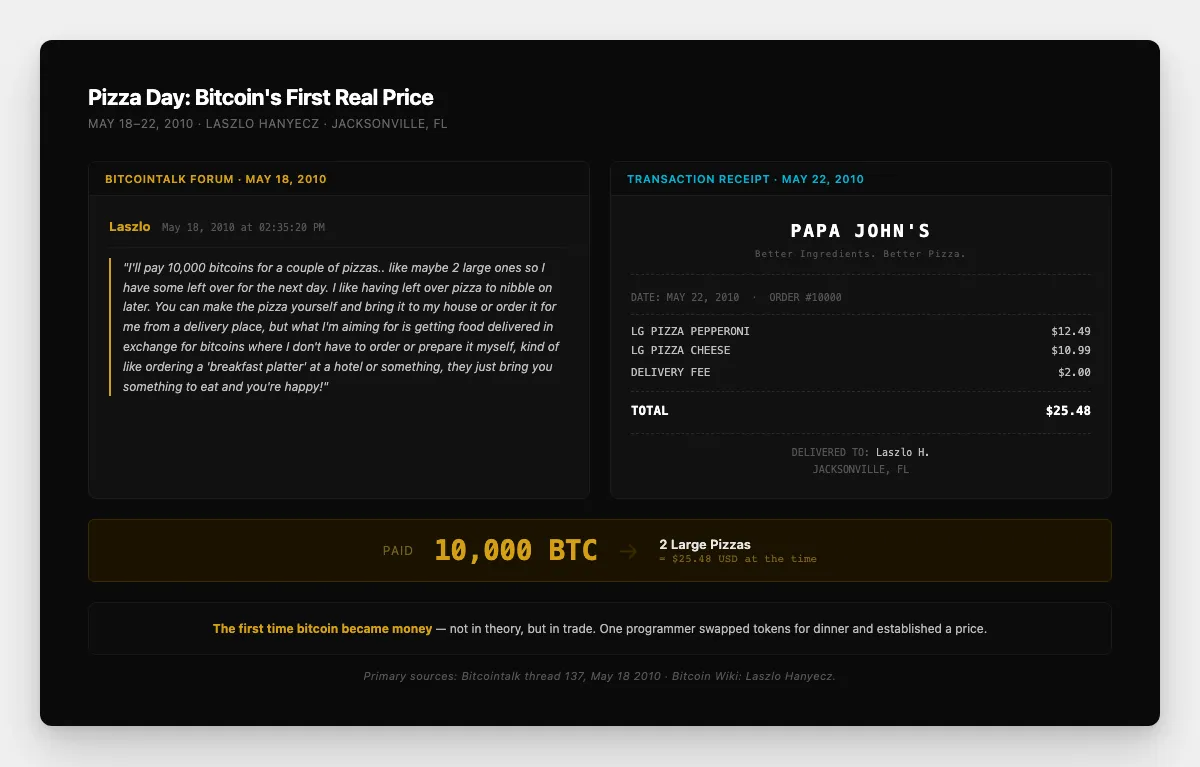
On May 18, 2010, Laszlo Hanyecz logged onto Bitcointalk and made an offer.³
He would pay ten thousand bitcoin for two pizzas. Any topping. Delivered to his apartment in Jacksonville. He would prefer a couple of large ones so he had leftovers for breakfast. He listed onions and pepperoni and mushrooms as preferences but said he was flexible. He posted his offer in a thread he titled "Pizza for bitcoins?" and waited.
It took four days for someone to bite. On May 22, a 19-year-old college student named Jeremy Sturdivant, who went by the handle "jercos," accepted the trade. Sturdivant ordered two large pizzas from Papa John's. He paid with his own card. The pizzas were delivered to Laszlo. Laszlo sent ten thousand bitcoin from his wallet to jercos's wallet. Total dollar value of the trade at the time, by the going market rate from the early Bitcoin Market exchange, was somewhere around twenty-five to thirty dollars.⁴
Before May 22, 2010, bitcoin had no real-world price. It had a theoretical value derived from the cost of mining. It had a quoted exchange rate at the Bitcoin Market exchange, which had launched in February of that year on a tiny forum and processed almost no volume. What it did not have was a verified moment of someone trading real goods for bitcoin.
Laszlo gave it that moment.
He was not the first person to think bitcoin should be money. He was the first person who got somebody else to agree, in a transaction, that bitcoin was money. Two pizzas, ten thousand bitcoin, delivered. The trade was real. The pizzas were real. The bitcoin moved.
Price discovery requires a counterparty, and Laszlo found one, which is why it should bother every good bitcoiner that the community treats him as a punchline. He was a pioneer. He gave bitcoin its first price. That is not stupid. That is foundational.
It is also worth noting, because we are going to come back to it later, that Laszlo Hanyecz had appeared in this story before. In Part 2, we touched on the man who first ported bitcoin to GPU mining and quietly emailed Satoshi to share the code.⁵ That was Laszlo. He was not just the pizza guy. He was the person who showed Satoshi that bitcoin could be mined faster than CPUs allowed, and Satoshi's reaction to that discovery would shape the network for the next decade. Hold that detail. It will matter.
Ten thousand bitcoin for two pizzas. At the time, that was generous.
The Exchanges Arrive
Pizza Day proved bitcoin could be money. The next problem was where you would actually trade it.
In February 2010, three months before Laszlo's pizzas, a developer using the handle "dwdollar" had launched the first exchange. He called it Bitcoin Market.⁶ It was a tiny PayPal-based bulletin board where users listed buy and sell orders against each other. The volume was trivial. The interface was rough. But the idea was right. People needed a place to convert dollars to bitcoin, and Bitcoin Market gave them one.
Five months later, on July 18, 2010, a more polished competitor went live.
Mt. Gox.⁷
The name is one of the strangest jokes in the history of financial technology. The domain mtgox.com had originally been registered by a developer named Jed McCaleb to host a marketplace for Magic: The Gathering Online cards. The acronym stood for Magic: The Gathering Online eXchange. McCaleb had used the site briefly for card trading and then shelved it. When the bitcoin community started looking for a real exchange, he repurposed the existing domain and infrastructure. A site originally designed to let nerds trade fantasy cards became the place where, for the next four years, more bitcoin would change hands than anywhere else on earth.
It is hard to overstate how much that changed the project.
Until Mt. Gox launched, bitcoin had a price the way a hand-to-hand barter has a price. Two pizzas were worth ten thousand bitcoin because Laszlo and jercos had agreed to that trade once. Mt. Gox quoted bitcoin in dollars in a continuous order book. Anyone, anywhere on the internet, could load mtgox.com and see, in real time, what someone in the world was currently willing to pay for bitcoin in dollars.
That changed bitcoin from a payment system into a market.
It also changed who paid attention. Up until July 2010, bitcoin attracted developers and cryptographers, plus a small slice of cypherpunk-curious internet people who liked the privacy implications. After Mt. Gox, it started attracting traders. Speculators. People who had no interest in proof-of-work or hashing or any other bitcoin principle, but who cared very much about whether the dollar price was going up.
The tension between "payment rail" and "store of value" starts in July 2010. Nobody names it yet. But the fault line is now in the ground, waiting.
In March 2011, McCaleb sold Mt. Gox. He had never wanted to run it long-term. He sold it to a French developer living in Tokyo named Mark Karpelès.
What happened to Mt. Gox belongs in a later chapter of this series. For now, just remember the name.
By the end of 2010, bitcoin had a price quoted in dollars on a public website twenty-four hours a day, an exchange in Tokyo run by a man whose surname meant "nothing" in Japanese, a real merchant trade ten thousand bitcoin deep, and a community of speculators who were starting to treat the experiment like a casino.
The founder was watching all of this, and he was not happy about most of it.
Three Lines of Code
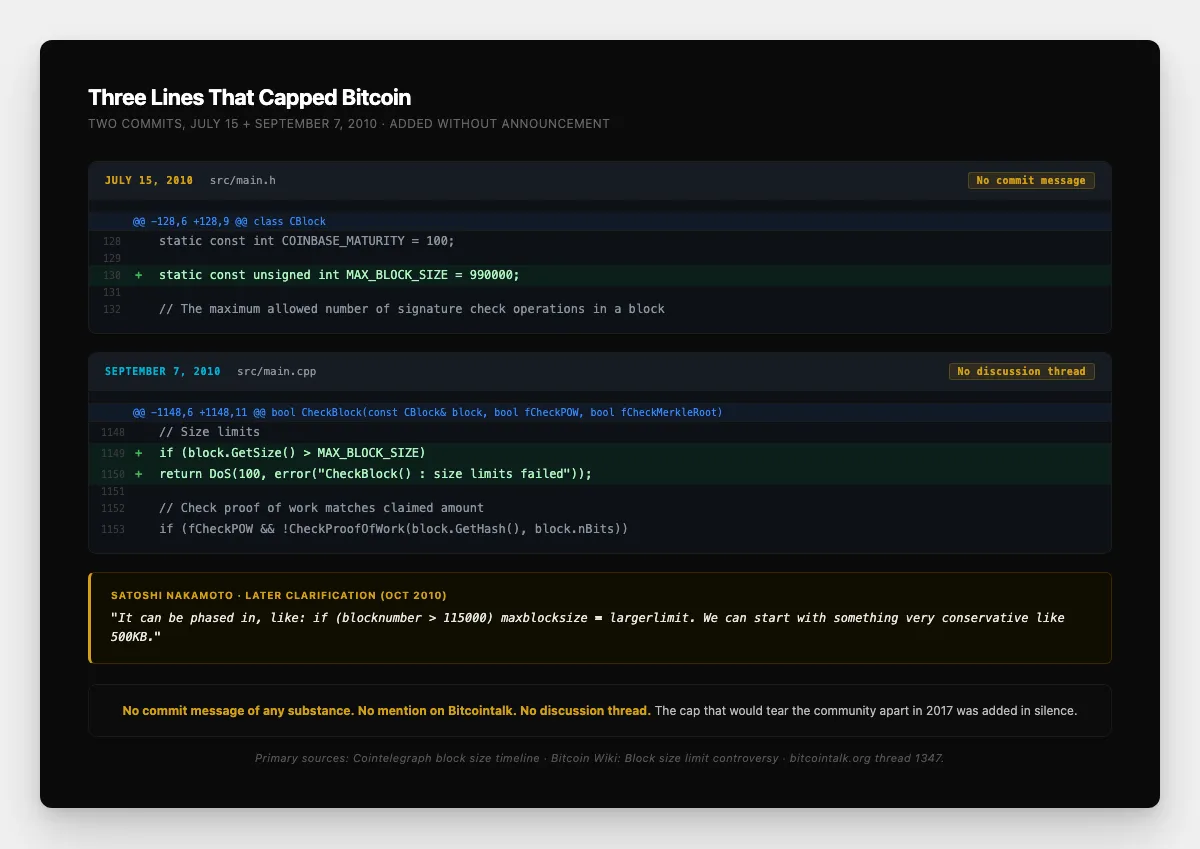
The most consequential block of code in Bitcoin history was added without an announcement, without a discussion thread, and without a single forum post explaining why.
On July 15, 2010, Satoshi committed a change to the reference client that capped the size of the block a miner was producing at 990 kilobytes.⁸ No commit message of any substance. No mention on Bitcointalk. No thread on the cryptography mailing list. The change went in. Two months later, on September 7, 2010, he committed a second change. This one enforced a one megabyte limit at the consensus layer, scheduled to activate at a future block height.⁹ Again, no announcement. Again, no discussion. The code was added. The network ran.
For context, the reasoning had been kicking around in the background. Hal Finney had suggested a block size cap months earlier as denial-of-service protection.¹⁰ The argument was straightforward. Without a cap, a malicious miner could produce a gigabyte block, force every node on the network to download and validate it, and grind the fragile system to a halt. A reasonable cap kept that attack vector closed while the network was still small.
Satoshi accepted the reasoning, and he set the cap, but he did not announce it. His silence signaled something about the value of the block size limit, but we can't be sure what that was. At least, not yet.
What he did say, when the topic came up later in a forum thread, is the sentence that haunts the next fifteen years of bitcoin development.
"It can be phased in, like: if (blocknumber > 115000) maxblocksize = largerlimit. It can start being in versions way ahead, so by the time it reaches that block number and goes into effect, the older versions that don't have it are already obsolete. When we're near the cutoff block number, I can put an alert to old versions to make sure they know they have to upgrade."¹¹
Read that quote again. Slowly.
He is describing the upgrade mechanism. He is treating the limit as a parameter to be modified by reasonable people at a reasonable time, not a foundational property. He is telling the community, in advance, that when the network grows enough to need it, the cap will be raised. He is explaining the process by which it will be raised. He is treating it as a temporary measure, the way you would treat any DoS-protection threshold in a system you knew you would have to scale.
On October 3, 2010, a developer named Jeff Garzik decided to test the proposition. Garzik posted a patch to raise the limit from 1MB to 7MB. He framed it as a basic capacity adjustment. The bitcoin network was tiny, and the blocks were almost empty, so the cap was years away from binding. There was no obvious harm in raising it now.
But, Satoshi rejected the patch.¹²
His public reasoning was that adopting the larger limit would fork the network if older nodes did not upgrade. That was technically true, but it was also not a permanent reason. It was the same reason he had laid out the phase-in mechanism in the first place. Garzik's patch could have been adopted using exactly the upgrade pattern Satoshi himself had described.
It was not.
Theymos, the Bitcointalk moderator, backed Satoshi up in the rejection. Garzik called the resistance "a marketing thing," so he did not push it. The patch died, and the limit stayed.
That sentence Satoshi had written months earlier, "we can phase in a change later," began its long, quiet journey toward becoming the most cited and most ignored promise in Bitcoin's history. We will pay it off in full when we get to the Block Size War. For now, the relevant fact is this: In July of 2010, the founder added a cap that he explained how to phase out. In October, he refused to raise it. Five years later, the people who inherited his project would call the same cap permanent and sacred and divine.
Satoshi was treating bitcoin as a product under development.
The community would later treat it as a religion.
The Alert Key
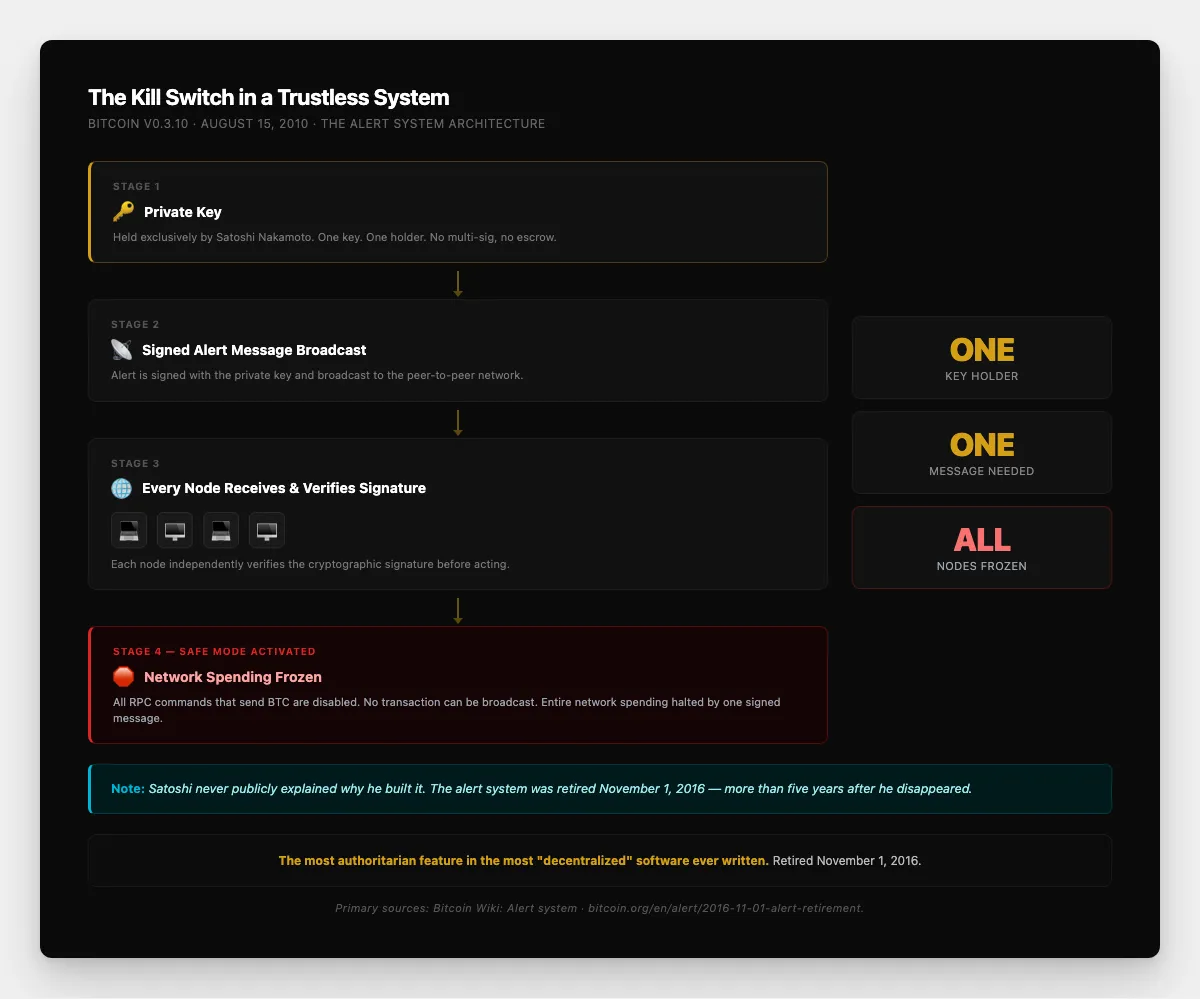
The Value Overflow Incident is the bug that launched the alert system.
On August 15, 2010, an unknown actor exploited an integer overflow vulnerability in the Bitcoin client and minted 184 billion bitcoin in a single transaction at block 74,638. We covered the bug and Satoshi's response in Part 2.¹³ The five-hour patch. The hard fork. The orphaned chain. The clean ledger.
What we did not cover, because it deserved its own moment, was the second feature that shipped in v0.3.10 alongside the patch.
The alert system.
The technical mechanism was simple. Satoshi had hardcoded a public key directly into the Bitcoin client source code. Anyone holding the corresponding private key could broadcast a signed alert message that every node on the network would accept as authoritative. Before Bitcoin v0.3.20, an alert triggered something called Safe Mode. Safe Mode disabled all RPC commands that could send bitcoin. Wallet sends froze. Exchange operations froze. Every running node, instantly, stopped being able to spend.¹⁴
In other words, one person, holding one key, could freeze the spending capability of the entire network with a single signed message.
Satoshi held the key.
He did not explain why he had built this feature on the Bitcoin forums or on the cryptography mailing list. He didn't even discuss it in private correspondence that has since been published. The closest thing to a public statement was a brief note in the v0.3.10 release acknowledgments calling the alert system a way to "let users know about important problems." That was it. No design document. No threat model write-up. No discussion of who would hold the key, under what conditions it would be used, or who would replace the holder if anything happened to him.
Sit with that for a moment.
Modern bitcoiners will tell you that Bitcoin's foundational premise and promise was that it was trustless. The whitepaper made the case that the system did not require trust in any single party because consensus was distributed across thousands of independent miners and nodes.¹⁵ Removing single points of failure was the point. The protocol worked because no individual could change the rules.
Except for the man who built it?!
He could broadcast an alert and freeze the network's spending capability whenever he wanted. He had given himself the one feature the marketing said did not exist.
Now, in fairness to Satoshi, this is completely consistent with the profile we built in Part 2. A pragmatic 1990s production engineer would absolutely build a circuit breaker into a system this young. Of course you would. The code had just minted 184 billion bitcoin. The network was running on a thousand-line monolith. There were probably more bugs hiding in main.cpp than the entire developer team had time to find. A kill switch was, from a systems engineering perspective, the responsible design decision.
But it was also completely inconsistent with the mythology the community had already started to build. By August 2010, the people writing about bitcoin on the cypherpunk mailing list were calling it the first truly trustless monetary system. A guarantee against tyranny. A ledger no government could censor. A protocol whose rules could not be changed by anyone.
Satoshi knew, every time he read those posts, that the rules could be changed by him with a signed message from a key he was carrying.
He never corrected the record.
The alert system stayed in the client through the v0.3.x and v0.4.x and v0.5.x releases. Satoshi held the key until he handed it to Gavin Andresen during the 2011 transition.¹⁶ The key, and what happened to it later, is a thread that runs through several future installments of this series. We will not pull on it yet. For now, the only thing that matters is the August 2010 fact pattern.
The man who said the system was trustless built a kill switch into it.
- He Kept the Key
- He never explained why.
- Nobody asked him about the key
- Weird...
The Dictator's Last Stands
By the second half of 2010, the strain of running bitcoin as a one-man project was starting to show in his forum posts.
The friction was visible across multiple fronts. Gavin Andresen, who had become one of the most active contributors in the project, said in an IRC channel that year:
"I just wish I could convince Satoshi to switch to a more collaborative development model. Satoshi is the gatekeeper right now, all code flows through him."¹⁷
Jeff Garzik, who tried multiple times to clean up code and submit improvements, later described the development process as "mostly closed." When he tried to push patches that improved code that was, in his view, "not broken but not great," Satoshi rebuffed them. The benevolent dictator had a strong sense of which things were his to decide and which things were not, and the answer was almost always "all of them."¹⁸
We covered the Larimer confrontation in Part 2. On July 29, 2010, a young developer named Daniel Larimer asked on the forum about how bitcoin would scale to handle global transaction volume.¹⁹ Satoshi's answer, terse and dismissive, ended with:
"If you don't believe me or don't get it, I don't have time to try to convince you, sorry."
The tone was unmistakable. We are not relitigating it here, but the reason it matters in 2010 is that it was no longer a one-off. It was a pattern: Satoshi was getting impatient. He was getting confrontational. He was running out of bandwidth for the kind of public diplomacy a growing project required, and he seemed increasingly frustrated with questions that were answered in his own White Paper.
It was about to get worse.
In late November and early December of 2010, the United States State Department began pressuring payment processors to block donations to WikiLeaks following the cable leaks. PayPal froze WikiLeaks's account. Visa and Mastercard followed. Bank of America blocked transfers. By December 7, WikiLeaks was effectively cut off from the global banking system.
Bitcoin users noticed.
On December 5, the bitcoin community started discussing whether WikiLeaks should accept bitcoin donations. The argument was straightforward. Bitcoin was allegedly a censorship-resistant payment network, and WikiLeaks was being censored by a payment network. The fit was obvious, and many in the community celebrated the prospect openly.
Satoshi did not.
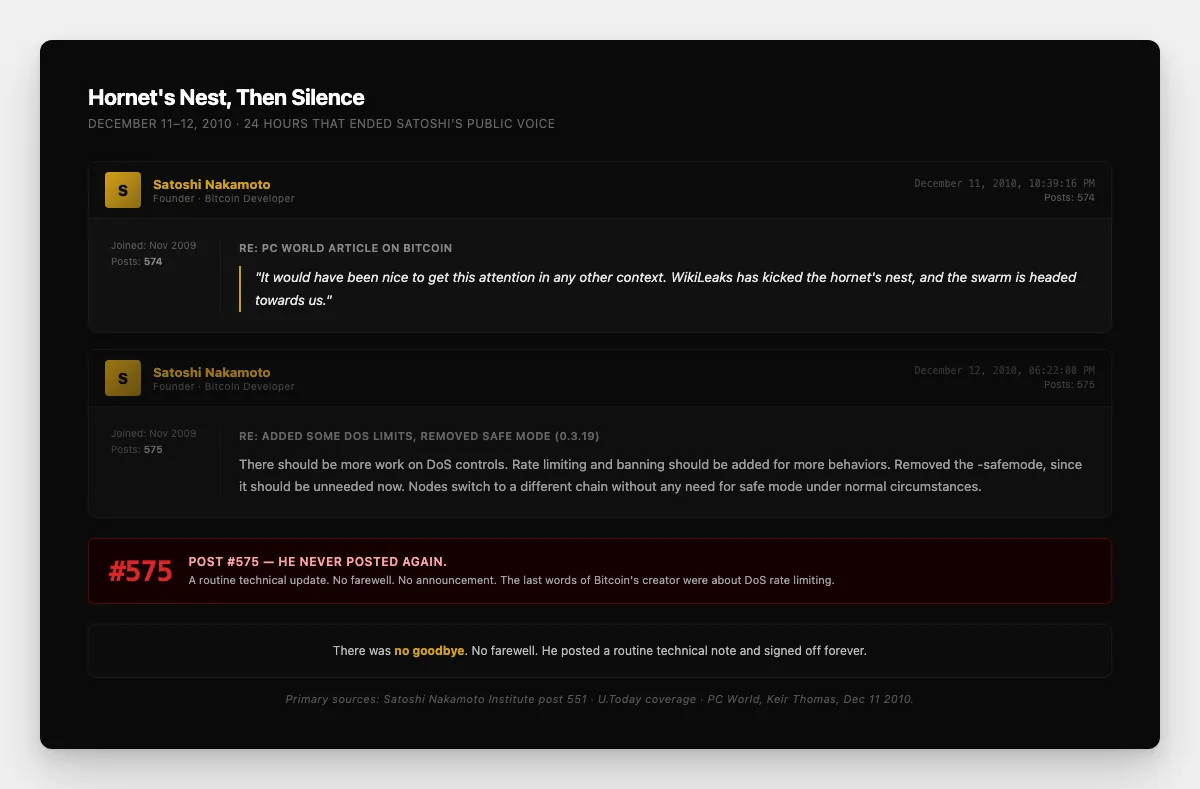
On December 11, 2010, PC World ran an article by Keir Thomas titled "Could the WikiLeaks Scandal Lead to New Virtual Currency?"²⁰ The piece named Bitcoin specifically and speculated about its potential as a censorship-resistant donation channel for WikiLeaks. Within hours, Satoshi posted on the forum.
"It would have been nice to get this attention in any other context. WikiLeaks has kicked the hornet's nest, and the swarm is headed towards us."²¹
In a separate thread the same week, he made his appeal explicit.
"No, don't 'bring it on.' The project needs to grow gradually so the software can be strengthened along the way. I make this appeal to WikiLeaks not to try to use bitcoin. Bitcoin is a small beta community in its infancy. You would not stand to get more than pocket change, and the heat you would bring would likely destroy us at this stage."²²
Read that as the words of a benevolent dictator who has just realized the dictatorship has a ceiling. He cannot stop WikiLeaks from accepting bitcoin if WikiLeaks decides to. He cannot stop the press from writing about it and defining it through their lens of cypherpunks circumventing the banks. He cannot stop the community from celebrating what he sees as an existential threat. He can only post on his own forum and ask, in the politest possible way, for the entire world to please leave his project alone for a while longer.
The world did not.
On December 12, 2010, Satoshi posted in public for the last time. The post was thread #575. The topic was a small DoS protection update. There was no goodbye. No farewell address. No dramatic announcement. He posted a routine technical note and signed off and never returned to the forum again.²³
He may not have posted in public again.
Unfortunately, saying that definitively is impossible because Satoshi lost control of his email and forum credentials at some point, fully confirmed in 2014, but the public cannot verify exactly when he lost control, so this era starts to become the gray area where we can't be sure that what was said was actually from him.
The Disappearance
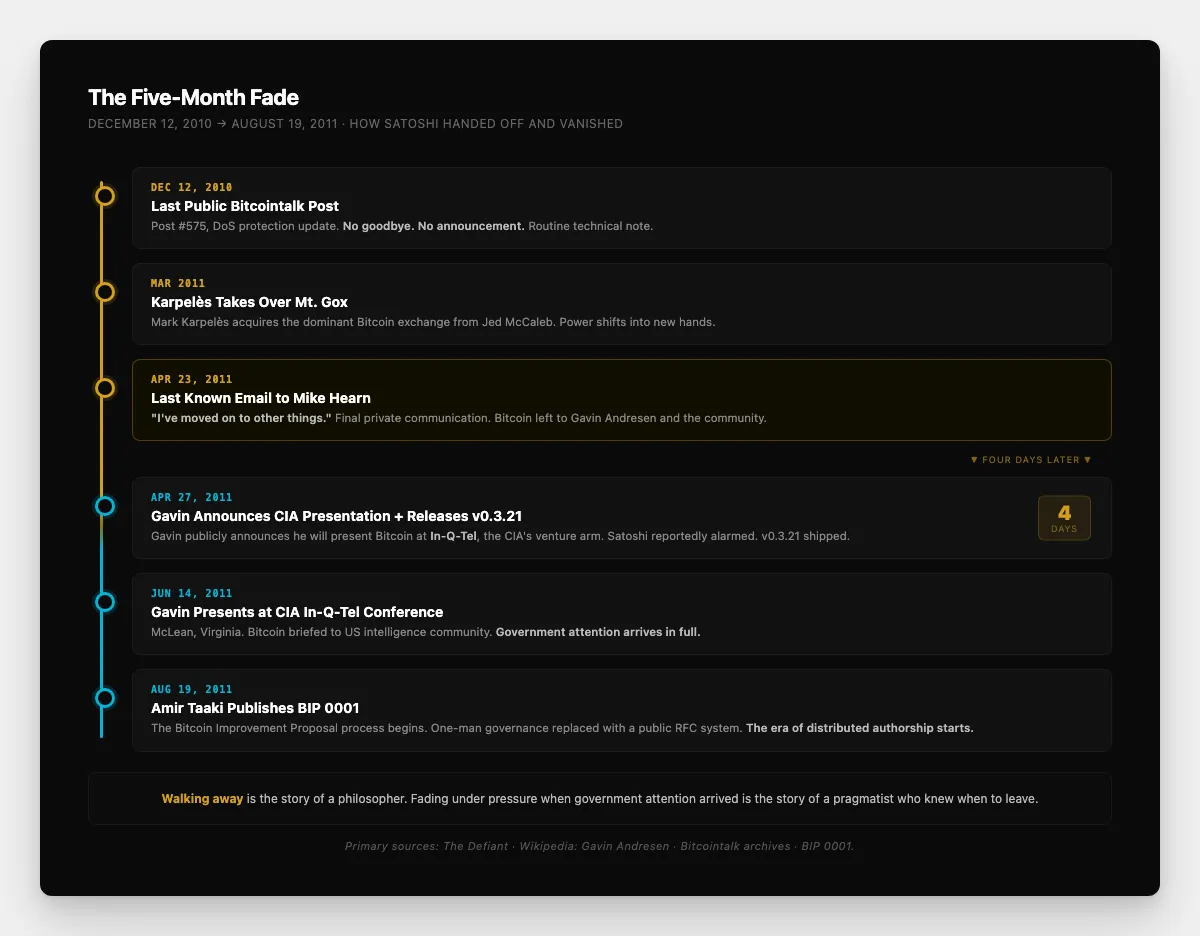
Satoshi's departure was not sudden. It was a slow fade.
Satoshi stopped posting publicly in December 2010, but he did not stop working on bitcoin immediately. Through the early months of 2011, he was still answering emails, pushing the occasional commit, and coordinating quietly with the small group of developers who had moved closest to the project. Gavin Andresen had received commit access to the SourceForge repository back in September 2010, while Satoshi was still actively developing. Satoshi had been deliberately handing off operational responsibility for months before he stopped posting. The transition was not abandonment, and looked from the outside to be a sort of managed succession.²⁴
Then, in late 2010 or early 2011, Satoshi did something even more telling. He handed Gavin the alert key.²⁵
That single act says more about Satoshi's intentions than any forum post he ever wrote. The alert key was the most powerful single piece of authority in the bitcoin system. Whoever held it could freeze the spending capability of the entire network, and Satoshi gave it to Gavin Andresen as a sort of dowry for the project. Gavin was an American programmer in Massachusetts who had been on the project for less than a year, and Satoshi did not put any public process in place to govern how the key would be used or transferred. He just gave it to Gavin and stopped logging in.
On April 23, 2011, Satoshi sent his last known email. The recipient was Mike Hearn, a British developer who had been working on the early Java client. Satoshi wrote a short, characteristically dry note. The line that gets quoted is, "I've moved on to other things. It's in good hands with Gavin and everyone."²⁶
That is it. That is the goodbye.
Four days later, on April 27, 2011, Gavin Andresen released Bitcoin v0.3.21, the first version of the reference client published under his leadership. On the same day, Gavin announced that he had been invited to give a talk at the headquarters of the Central Intelligence Agency about how bitcoin worked and what its implications were for cyberspace.²⁷ The actual presentation took place on June 14, 2011, at the In-Q-Tel-sponsored Emerging Technology Conference at CIA headquarters in McLean, Virginia.²⁸ In-Q-Tel is Langley's venture capital wing, and while we haven't covered it deeply, you can get the drift on their influence on "Big Tech," From Invisible Plantations
The timing has fueled speculation ever since.
Mike Hearn, the man who received Satoshi's last email, has noted in public interviews that the proximity of Gavin's CIA announcement to Satoshi's departure was "likely not a coincidence." Whether Satoshi left because of the CIA invitation, because of WikiLeaks, because of legal pressure, because of personal reasons, or simply because the project was now stable enough for him to step back, nobody knows. The honest answer is that the public record does not contain enough information to choose among these possibilities. Anyone who tells you they know which it was is guessing.
What we do know is that once he was gone, he never really came back, except for the occassional, questionable comment using credentials that we cannot validate.
The forum account stayed dormant. The email account answered nothing. The wallets associated with the early mining did not move. They have not moved in fifteen years and counting. He left, and he left completely.
The mythology around his departure has hardened into a single sentence. Satoshi walked away. He could have been a billionaire and instead he chose to disappear. The walking-away framing makes him sound like a philosopher who decided that his job was done.
The record is less romantic.
He faded slowly, delegated keys, transferred operational control to a man he had known for less than a year, and sent his goodbye email four days before that man announced he was going to brief the CIA on bitcoin. Walking away is the story of a philosopher. Fading under pressure when government attention arrived is the story of a pragmatist who knew when to leave.
April 23, 2011. "I've moved on to other things."
Four days later, Gavin announced the CIA visit.
Tragic...
The New Guard Arrives
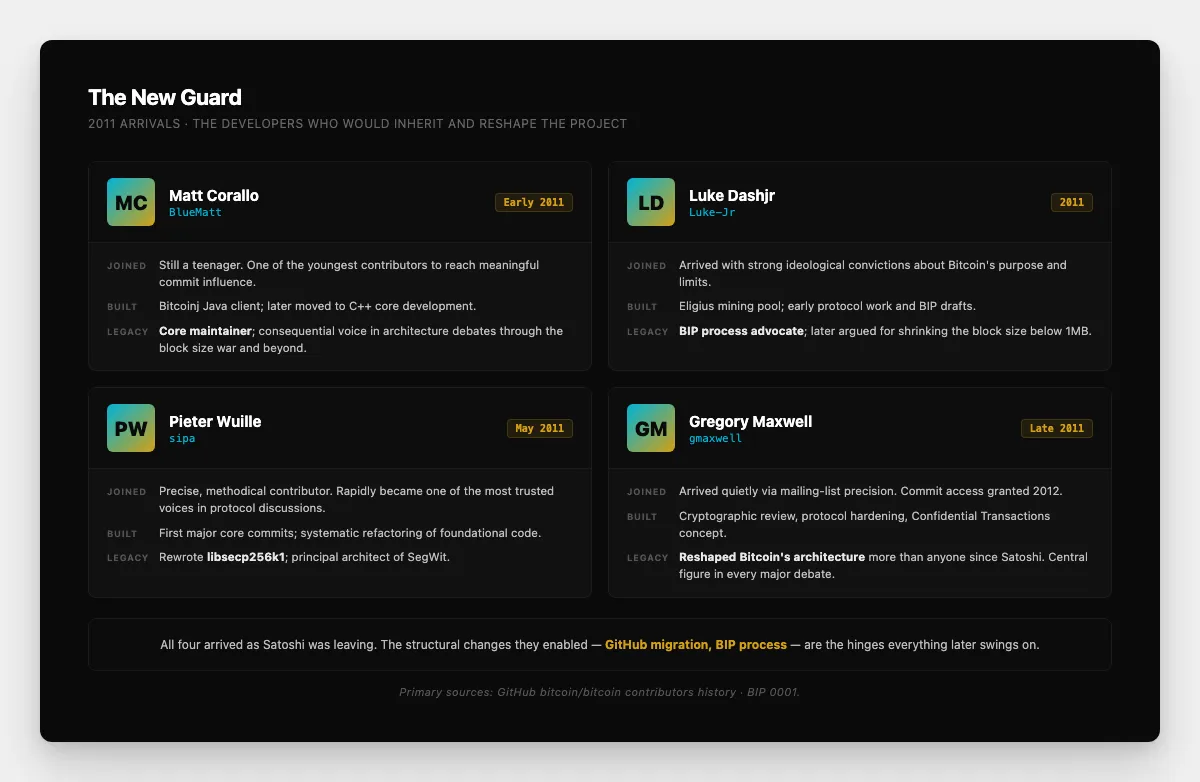
While Satoshi was fading, a new generation of developers was arriving.
In early 2011, a teenager named Matt Corallo, who went by the handle "BlueMatt," started contributing to the project. He was still in his teens. He focused first on the Java implementation that became Bitcoinj, then moved into the C++ codebase. He would later become a core maintainer of the reference client and one of the most consequential voices in the architecture debates of the next decade.²⁹
In 2011, Luke Dashjr, a developer with strong opinions and stronger Catholic theological commitments, founded the mining pool Eligius and started doing early protocol work. Luke would become one of the loudest advocates for restrictive uses of the protocol, would later argue for shrinking the block size below one megabyte, and would help codify the BIP process for a generation.³⁰
In May 2011, a young Belgian programmer named Pieter Wuille, who used the handle "sipa," made his first significant commits to the bitcoin codebase.³¹ Wuille would go on to rewrite enormous portions of the core logic, including the elliptic curve library libsecp256k1 and the most complex parts of what would become Segregated Witness in 2017.
And in late 2011, a former (and disgraced) Wikipedia administrator named Gregory Maxwell started showing up on the bitcoin-development mailing list and on Bitcointalk. He posted carefully. He cited references. He corrected other developers in long technical replies.³² Within three years, he would reshape Bitcoin's architecture more than anyone since Satoshi. But in 2011, he was just another name in the commit log.
You will hear all four of those names again in this series, so hold onto them.
The technical departures from Satoshi's design, including the permanent block size cap and the eventual deployment of Segregated Witness, came later. But the structural departures happened in 2011, and they are the load-bearing beams that everything else rests on.
The first structural change was the migration from SourceForge to GitHub.
For the first two years of bitcoin's life, the source code lived on SourceForge, under an almost entirely monolithic governance structure. Patches were submitted by email, reviewed by Satoshi, and merged or rejected by Satoshi. There was no pull request workflow or public comment thread. The model was email-and-approve. The dictator had a queue.
In mid-2011, the project migrated to GitHub.³³ Pull requests replaced email patches. Distributed commit access replaced single-gatekeeper approval. Public comments on every code change replaced private email threads. The migration was framed by everyone involved as an obvious modernization, and on its merits as an open-source workflow upgrade, it absolutely was.
But it also did something else.
It replaced Satoshi's authority structure with a community process, and the transition to ideas like "the people's money," and "we are all Satoshi."
The man who had personally vetted every line of code now had no special privileges in the new repository. The benevolent dictator was no longer available as a fallback authority for hard decisions, because the benevolent dictator was gone, and the platform he had been running on no longer existed.
The second structural change was the BIP process.
On August 19, 2011, a developer named Amir Taaki, who had become one of the most prolific contributors to the early ecosystem, published BIP 0001. The Bitcoin Improvement Proposal process was modeled on Python's PEP system. It was a way for community members to propose changes to the protocol, debate them publicly, and adopt them through a documented review process.³⁴ It is, again, an excellent governance design for an open-source project.
It also fundamentally changed bitcoin from "Satoshi decides" to "the community proposes and debates." In short, it introduced political and governance incentives.
I want to be careful with what I am saying here. Nobody who built BIPs or migrated to GitHub set out to undermine Satoshi's design. Gavin and Amir genuinely believed they were doing the right thing. From an open-source purist's perspective, they were. Satoshi himself had been moving the project in this direction by giving Gavin commit access and handing him the alert key.
But the effect was to replace one man's authority with a committee process. And that committee process, working through the BIP system on a GitHub repository, is what would eventually enable the events covered in Parts 7 and 8 of this series. The Block Size War. The activation of Segregated Witness. The permanent entrenchment of the 1MB limit Satoshi had called temporary. None of those events were possible under Satoshi's gatekeeper model. All of them became possible the moment the gatekeeper model was replaced by a process that did not include him.
The hinges were in place. The door had not swung open yet.
What Was Left Behind
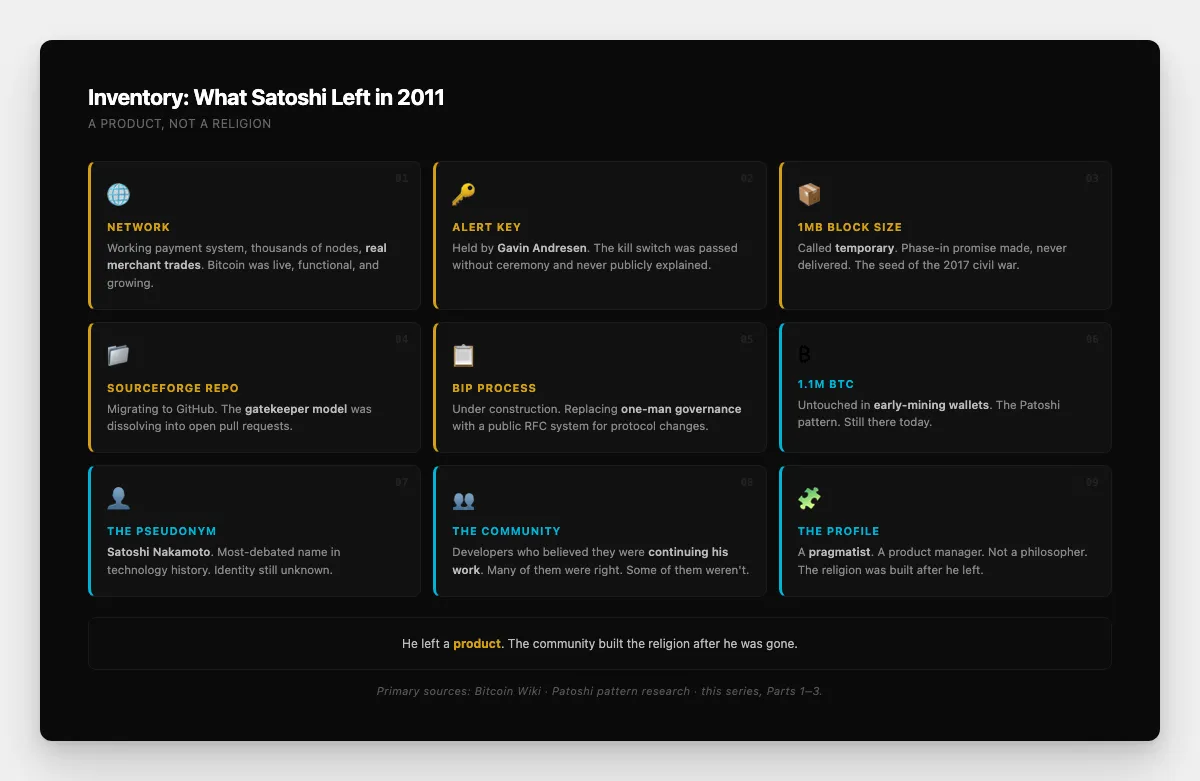
Take stock of what Satoshi left in mid-2011.
He left a working payment network with a growing number of nodes, an exchange in Tokyo quoting bitcoin in dollars twenty-four hours a day, real merchants accepting it for real goods, and a transaction format that has barely changed since then.
He left a community of developers, some of whom would build legendary work and some of whom would betray the design, and most of whom believed at the time they were continuing what he started.
He left an alert key. Held by Gavin. Eventually shared with a small circle of Core developers. Eventually retired in 2016 after a vulnerability disclosure, but only after years of being the most authoritarian feature in the most "decentralized" software ever written.³⁵
He left a 1MB block size limit he had called temporary, and a sentence about phasing in a change that he would not be there to clarify.
He left a codebase about to migrate from SourceForge to GitHub, taking governance with it.
He left a gap that the BIP process would be created to replace him.
He left roughly 1.1 million bitcoin in early-mining wallets that have not moved since the day he stopped logging in. The wallets are still there. Anyone with a block explorer can find them. They have sat through every price cycle, every fork, every governance war, every market crash and rally, untouched.³⁶
And he left a pseudonym.
The most-debated name in technology history. A name attached to a profile we can build, in detail, from the code and the forum posts and the emails and the bugs. A name attached to a man whose work is the most important monetary innovation since paper currency, and whose personal identity has produced more documentaries, books, lawsuits, and conspiracy theories than any technologist in living memory.
He left a product, delivered as a globally scalable payment network. Not a religion.
The community built the religion after he was gone.
Next Time
In Part 4, we leave the founding period and enter the era of consequences.
A 26-year-old libertarian in Texas named Ross Ulbricht launches an anonymous online marketplace and accepts only bitcoin. Drug deals, fake documents, weapons, and worse change hands on the network the founder told WikiLeaks not to use. The price of bitcoin runs up to a thousand dollars and crashes to two hundred in the same year. A United States senator stands in front of a Senate committee and calls bitcoin a threat to national security. The CIA presentation Gavin gave in June 2011 was not the end of government attention to bitcoin. It was the beginning. By 2013, the federal government is no longer just curious about this strange new payment network. It is investigating it.
And the people who arrived in 2011 are starting to make decisions Satoshi would not have recognized.
Part 4: "The Silk Road and the Senators."
Footnotes
¹ Bitcoin v0.3.10 release notes and alert system technical description, Bitcoin Wiki: Alert system. See also the official retirement notice, bitcoin.org alert retirement, November 1, 2016.
² Kurt Wuckert Jr., "The Written History of Bitcoin: The Ghost in the Code," kurtwuckertjr.com, 2026.
³ Laszlo Hanyecz, "Pizza for bitcoins?", forum post, May 18, 2010, bitcointalk.org thread 137.
⁴ Pizza Day transaction details and Jeremy Sturdivant identification, Bitcoin Wiki: Laszlo Hanyecz. Contemporary news coverage in Bitcoin Magazine, "The Man Behind Bitcoin Pizza Day".
⁵ Laszlo Hanyecz GPU mining correspondence with Satoshi Nakamoto, recounted in Bitcoin Magazine. Covered in detail in Part 2 of this series.
⁶ Bitcoin Market launch by "dwdollar," February 6, 2010, Bitcoin Wiki history archive.
⁷ Mt. Gox launch on July 18, 2010 and origin of the name from Magic: The Gathering Online eXchange. Bitcoin Wiki: Mt. Gox. Jed McCaleb founding details in multiple sources.
⁸ First block size limit commit, July 15, 2010 (990KB cap in mining code). Cointelegraph timeline coverage. HackerNoon block size history.
⁹ Second block size limit commit, September 7, 2010 (1MB consensus rule). Cointelegraph.
¹⁰ Hal Finney early DoS protection rationale for block size cap, Bitcoin Wiki: Block size limit controversy.
¹¹ Satoshi Nakamoto, "We can phase in a change later" quote on block size, forum post, October 4, 2010, bitcointalk.org thread 1347. Archived at Satoshi Nakamoto Institute.
¹² Jeff Garzik, 7MB block size patch, October 3, 2010. HackerNoon. Bitcoin Wiki: Block size limit controversy.
¹³ Value Overflow Incident, August 15, 2010, block 74,638. CVE-2010-5139. Bitcoin Wiki: Value overflow incident. Covered in detail in Part 2 of this series.
¹⁴ Alert system Safe Mode mechanism, Bitcoin Wiki: Alert system.
¹⁵ Satoshi Nakamoto, "Bitcoin: A Peer-to-Peer Electronic Cash System," October 31, 2008, bitcoin.org/bitcoin.pdf.
¹⁶ Alert key transfer to Gavin Andresen during 2011 transition, Wikipedia: Gavin Andresen. Subsequent expansion of the holder set documented at bitcoin.org alert retirement.
¹⁷ Gavin Andresen, IRC quote on Satoshi as gatekeeper, 2010. Quoted in Bitcoin Magazine and River Financial profile.
¹⁸ Jeff Garzik, interview with CryptoNews, 2025. CryptoNews exclusive.
¹⁹ Daniel Larimer / Satoshi exchange, July 29, 2010, Satoshi Nakamoto Institute post 287. Covered in detail in Part 2 of this series.
²⁰ Keir Thomas, "Could the WikiLeaks Scandal Lead to a New Virtual Currency?", PC World, December 11, 2010.
²¹ Satoshi Nakamoto, "WikiLeaks has kicked the hornet's nest" forum post, December 11, 2010, 23:39 UTC. Satoshi Nakamoto Institute post 542. See also bitcoin.com news history.
²² Satoshi Nakamoto, WikiLeaks appeal post, December 5, 2010, Satoshi Nakamoto Institute post 523.
²³ Satoshi Nakamoto's last public Bitcointalk post, December 12, 2010, post #575. U.Today coverage. Archived at Satoshi Nakamoto Institute.
²⁴ Gavin Andresen commit access granted September 2010, Wikipedia: Gavin Andresen. Confirmed in Gavin's own public accounts in interviews.
²⁵ Alert key transfer to Gavin Andresen, late 2010 / early 2011, Wikipedia: Gavin Andresen.
²⁶ Satoshi Nakamoto, last known email to Mike Hearn, April 23, 2011. Reported in The Defiant and confirmed by Hearn in multiple public interviews.
²⁷ Gavin Andresen CIA announcement and Bitcoin v0.3.21 release, April 27, 2011, Wikipedia: Gavin Andresen.
²⁸ Gavin Andresen, presentation at Emerging Technology Conference, In-Q-Tel and CIA headquarters, June 14, 2011. Wikipedia: Gavin Andresen.
²⁹ Matt Corallo / "BlueMatt," early 2011 contributions, Bitcoinj and core C++ work. GitHub: bitcoin/bitcoin contributors.
³⁰ Luke Dashjr, Eligius mining pool founding (2011) and early protocol contributions. GitHub history.
³¹ Pieter Wuille / "sipa," first significant commits May 2011. GitHub: bitcoin/bitcoin contributors.
³² Gregory Maxwell, late 2011 arrival on bitcoin-development mailing list and Bitcointalk. Commit access granted in 2012. GitHub history.
³³ Bitcoin codebase migration from SourceForge to GitHub, mid-2011. GitHub: bitcoin/bitcoin first commits.
³⁴ Amir Taaki, BIP 0001, August 19, 2011, github.com/bitcoin/bips/bip-0001.
³⁵ Alert system retirement, deprecated in Bitcoin Core v0.12.1, code removed in v0.13.0, retirement announced November 1, 2016, bitcoin.org/en/alert/2016-11-01-alert-retirement. Vulnerability disclosure at bitcoin.org/en/posts/alert-key-and-vulnerabilities-disclosure.
³⁶ Satoshi-attributed early-mining wallet balances, ongoing on-chain analysis. Patoshi pattern research summarized in Cointelegraph and CoinDesk.