Beyond Fraud: Tether's Secret Plan to Replace the Fed
By Kurt Wuckert Jr.
Update (March 24, 2026) Tether responds to this article. Details at the bottom:
I keep thinking about Jekyll Island because we are watching something remarkably similar happen in real time, except this time, the architects are not even bothering to hide on an island. They are doing it on the blockchain, in Lugano, and inside the U.S. Department of Commerce.
The company is Tether. The currency is USDT. And the goal goes far beyond issuing the world's most popular stablecoin. The goal is to replace the existing central banking infrastructure with a private one that they control, a Tetheral Reserve Bank.
Before you dismiss that as hyperbole, let me walk you through who these people are, what they have already been convicted of, and what they are building right now with $141 billion in United States Treasury bonds.
Watch the Livestream Walk-Through Here:
The poker cheats who built a stablecoin empire
Every institution is shaped by the people who build it. So who built Tether? And who built Bitfinex, the exchange that shares its parent company?
Start with the man who founded Bitfinex itself.
- Raphael Nicolle A French IT worker who operated under the Bitcoin Talk username "unclescrooge." In 2012, before building Bitfinex, Nicolle actively invested in and promoted multiple Ponzi schemes on Bitcoin Talk forums, including Trendon Shavers' Bitcoin Savings & Trust, for which Shavers was sentenced to 18 months in federal prison. Nicolle attempted to start his own scheme, posting an offer of "2% return per week" through supposed Bitcoin arbitrage.³² He built Bitfinex using code copied from Bitcoinica, a defunct exchange plagued by security breaches. Vitalik Buterin publicly called the early Bitfinex a "bucket shop." That is the foundation.
- Stuart Hoegner Stuart Hoegner, served as Tether's General Counsel from 2014 until his quiet retirement in January 2025. Before joining the world's largest stablecoin issuer, Stuart Hoegner was the Director of Compliance at Excapsa Software, the parent company of Ultimate Bet, an online poker platform.
Stuart Hoegner left Tether just days after EU MiCA stablecoin regulations took effect, 2 but that wasn't the first time he ran off at just the right time to avoid legal trouble!
Ultimate Bet was caught running one of the most brazen cheating schemes in the history of online gambling.3 From roughly 2003 to 2007, insiders used a "God Mode" software exploit that allowed them to see their opponents' hole cards in real time. The Kahnawake Gaming Commission identified 1994 World Series of Poker champion Russ Hamilton as "the main person responsible." Victims were defrauded of an estimated $22 million to $50 million.4 Hamilton admitted to the fraud on a secretly recorded audio tape released publicly in 2013.
Hoegner was the compliance director. The man whose job it was to catch exactly this kind of fraud. He has not been charged with any crime in connection with the scandal, and whether he had knowledge of the cheating is disputed. But the question practically asks itself: what does it say about your institution when the person overseeing compliance at the world's most-used stablecoin previously oversaw compliance at one of the biggest cheating operations in gambling history?
Where there is smoke, there is fire.
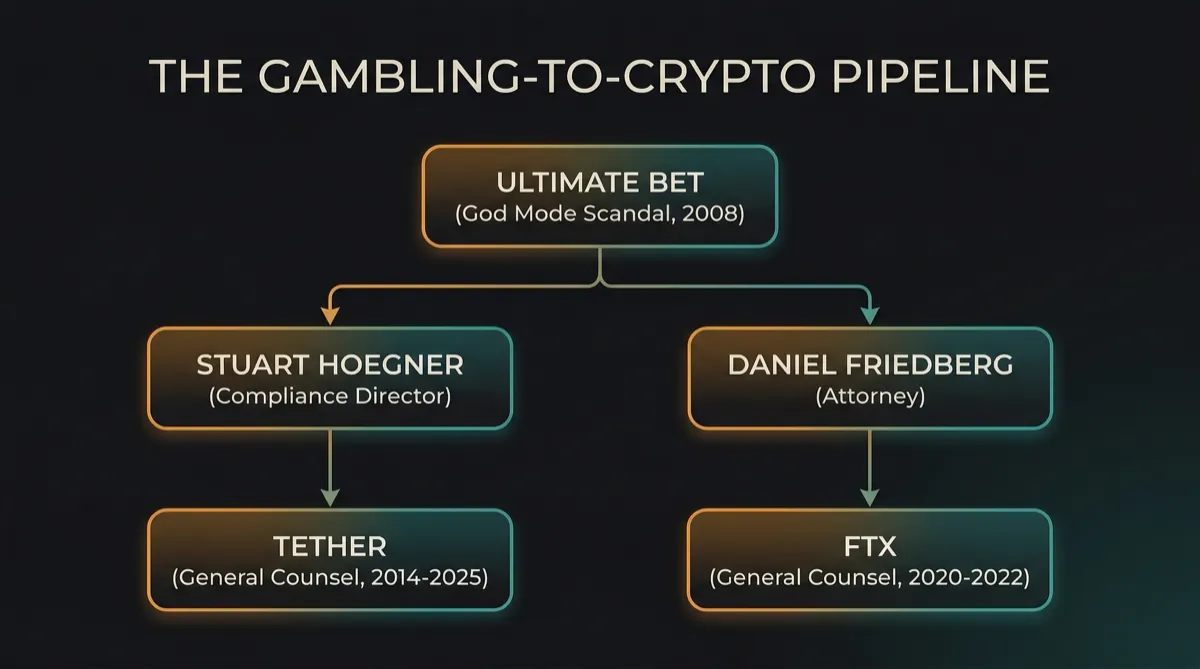
It gets worse. Daniel Friedberg, who worked at the same company during the same period as Hoegner, was caught on those same 2013 audio tapes apparently discussing a cover-up strategy for the Hamilton fraud. Friedberg later became the Chief Regulatory Officer at FTX.⁵ Two of the biggest fraud cases in internet history, Ultimate Bet and FTX, share a common compliance and legal DNA with Tether.
That is the beginning of an ever-increasing pattern...
The child actor and the predator's money
Then there is Brock Pierce, who co-founded Tether in 2014 with Reeve Collins and Craig Sellars.
Pierce's pre-crypto career is the kind of story that makes you wonder how anyone in this industry performs due diligence. As a child actor in Disney's Mighty Ducks franchise, Pierce went on to co-found the Digital Entertainment Network (DEN) in Los Angeles with Marc Collins-Rector. In 2000, three former DEN employees sued Collins-Rector and Pierce, alleging that teenage boys were drugged and sexually assaulted at DEN parties. Collins-Rector was indicted by a federal grand jury on charges of transporting minors across state lines for sex, fled to Spain, was arrested by Interpol, extradited, and pleaded guilty to eight counts of child enticement.⁶ The charges against Pierce were voluntarily dismissed without compensation, and he was never criminally charged. Pierce has consistently maintained his innocence.
But the DOJ Epstein files released in early 2026 paint a far more troubling picture.
There are over 1,800 references to "Brock Pierce" in those documents.⁷ Pierce attended a conference on Epstein's island, Little Saint James, in 2011. He helped Epstein invest $3 million in Coinbase's 2014 Series C through a U.S. Virgin Islands LLC.⁸ He introduced Epstein to Steve Bannon. He asked Epstein for "dirt" on attorney Jeff Herman, who represented Epstein's victims.
And then there is the email. The Kyiv Independent, investigating newly released DOJ documents, reported an email in which a man identified as Pierce told Epstein about "a boat...full of amazing Ukraine's finest" available for him.⁹ Pierce had previously sent Epstein photographs of women during trips to Moscow, Kiev, and Odessa. These are documented communications from the DOJ file, sourced directly from federal evidence.
Pierce claims he had no involvement with Tether after 2015, when he transferred his 100% ownership stake for zero consideration.¹⁰ Perhaps. But Tether was founded on the rolodex and reputation of a man who spent nearly a decade in Jeffrey Epstein's orbit. That is the soil this company grew out of.
The hack they turned into a feature
On August 2, 2016, hackers stole 119,754 BTC from Bitfinex, the cryptocurrency exchange operated by iFinex Inc., the same parent company that controls Tether. At the time, the stolen bitcoin was worth approximately $72 million. By 2021, that same bitcoin exceeded $7 billion in value.¹¹
What Bitfinex did next was extraordinary. Rather than declaring bankruptcy or limiting losses to the accounts that were actually hacked, the exchange imposed a universal 36% haircut on every single customer account, including those that had not been compromised. In exchange for this forced confiscation, customers received BFX tokens at a rate of one token per one dollar of loss. Bitfinex later claimed to have redeemed all tokens at face value or converted them into equity in iFinex within eight months.¹²
The hacker, Ilya "Dutch" Lichtenstein, was arrested in February 2022 alongside his wife, rapper Heather "Razzlekhan" Morgan, after the DOJ recovered over 94,000 BTC. Both pleaded guilty to conspiracy to commit money laundering. Lichtenstein received five years. Morgan got eighteen months.¹¹
The Bitfinex hack matters because of the corporate culture it revealed. A company that forces every customer to absorb a 36% loss because of its own security failure, then converts that loss into equity in itself, is running a confidence game with other people's money.
Fractional reserve, fully exposed
In October 2021, the Commodity Futures Trading Commission filed and settled charges against Tether. The CFTC's finding was devastating: Tether's USDT was fully backed by fiat reserves for only 27.6% of the days in a 26-month sample period between 2016 and 2018.¹³ For nearly three-quarters of that time, Tether was operating as a fractional reserve stablecoin while explicitly promising 1 backing. The fine was $41 million. Bitfinex paid an additional $1.5 million for operating illegal off-exchange commodity transactions.
The New York Attorney General's investigation, which began in 2018 and became public in April 2019, uncovered something even more alarming. When Bitfinex's payment processor, Crypto Capital Corp, lost access to approximately $850 million, Bitfinex quietly transferred $625 to $900 million of Tether's reserves to cover its own shortfall, without telling anyone.¹⁴
The settlement: $18.5 million, a ban on operating in New York, and mandatory quarterly reporting on reserve composition for two years. No admission of wrongdoing. Crypto Capital Corp's founder, Ivan Manuel Molina Lee, was separately arrested in Poland on charges of laundering $350 million for Colombian drug cartels.¹⁵
Devasini himself reportedly summarized the company's banking philosophy in a verbal conversation: "We're not criminals, but now we have to learn to bank like criminals."³⁴ That quote, reported by Bitfinexed, captures the entire corporate culture in eleven words.
A 2020 peer-reviewed study by finance professors John Griffin (University of Texas at Austin) and Amin Shams (Ohio State University), published in the Journal of Finance, found that roughly half of Bitcoin's entire 2017 price rise could be traced to periods of heavy Tether issuance, with just 1% of hours accounting for 50% of the price increase, and that the pattern was "consistent with the supply-driven hypothesis" of market manipulation rather than organic demand.
Bitfinex's own order books told a similar story. An anonymous trader tracked by the pseudonymous researcher Bitfinexed and nicknamed "Spoofy" routinely placed $20 to $60 million in fake buy or sell orders on Bitfinex, then canceled them before execution to move the price.³⁵ Spoofing is illegal under Dodd-Frank. Bitfinex's trade engine also allowed wash trading by design: users could buy from and sell to their own orders. Potter acknowledged in public that there might be "legitimate reasons" for a trader to wash trade on the exchange he ran.³⁵ In one documented incident, 24,000 BTC were wash traded in a single event around the August 2017 BCH distribution.
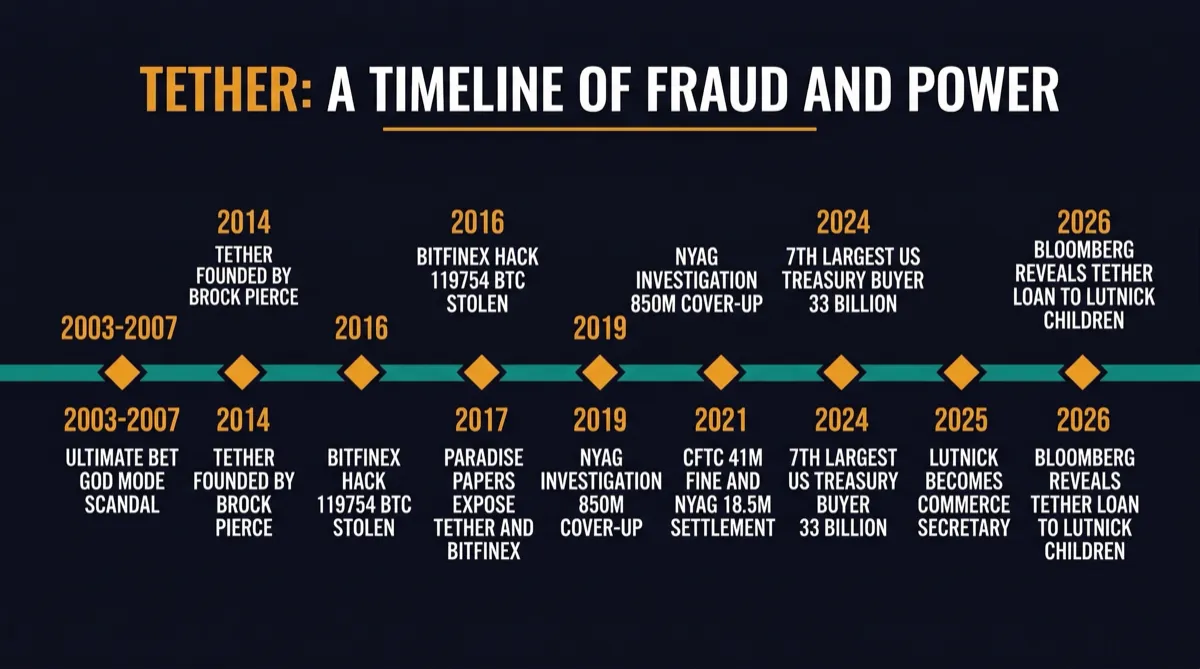
So the company that was supposed to be the stable backbone of the cryptocurrency economy was, for most of its operating history, lying about its reserves. It was secretly bailing out its own sister exchange with customer funds. Its payment processor was laundering cartel money. Its own auditor was later sanctioned by the SEC. And the total penalty for all of this was less than $60 million against a company that now holds over $140 billion in assets.
Eleven years. No audit.
Tether has been issuing USDT since 2014. As of March 2026, there are approximately $145 billion USDT tokens in circulation. In over eleven years of operation, Tether has never received a full, independent audit from a recognized accounting firm.¹⁶
Their former auditor, Friedman LLP, was fined $1.5 million by the SEC for what the Commission called "serial violations of federal securities laws." The Big Four accounting firms have all declined to audit Tether's main books. Former SEC enforcement attorney John Reed Stark has called Tether's quarterly attestations "unverified snapshots" that carry none of the rigor or liability of a proper audit.
Paolo Ardoino, who became Tether's CEO in December 2023, has said the audit process is "too complex." In March 2025, Tether hired a new CFO and declared a Big Four audit its "top priority."¹⁶
They have been saying some version of this for eleven years, while collecting $13 billion annually in interest on reserves they refuse to let anyone independently verify.
If you had $145 billion in reserves, and your business model depended entirely on public trust in those reserves, and you had been caught lying about those reserves by two separate federal regulators, why would you spend eleven years refusing to prove you are solvent?
Building the Tetheral Reserve Bank
Now we arrive at the thesis.
Most critics of Tether focus on the fraud: the unbacked tokens, the secret bailouts, the mob-adjacent executives, the gambling cheats, the Epstein connections. All of that is real and documented. All of it is, at this point, old news. The fraud was the startup phase. What Tether is building now is something far more ambitious.
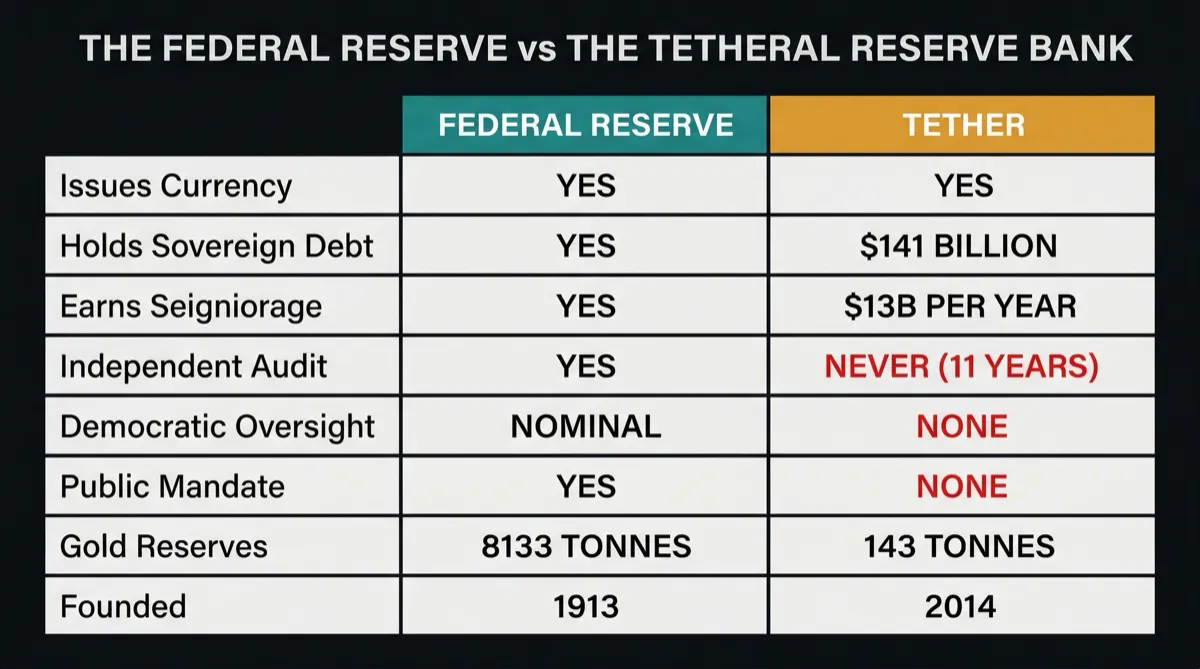
Tether is building a private central bank, and they are doing it with $141 billion of the United States government's own debt as their foundation.
As of Q4 2025, Tether holds approximately $141 billion in U.S. Treasury securities, including direct holdings and reverse repurchase agreements.¹⁷ In 2024, Tether was the seventh largest net buyer of U.S. Treasuries globally, purchasing $33.1 billion worth and surpassing the sovereign purchases of Canada, Mexico, Norway, and Germany.¹⁸ Tether holds more U.S. government debt than the governments of the United Arab Emirates, Australia, and South Korea.
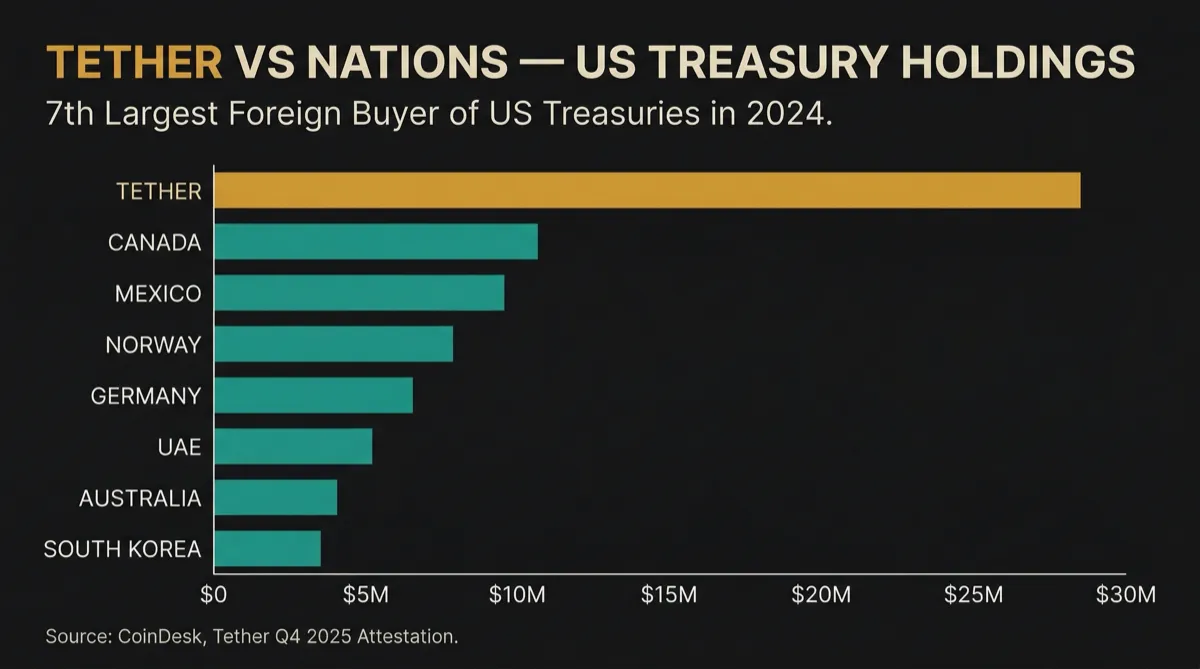
Tether reported $13 billion in net profit for 2024. Nearly $5 billion in Q2 2025 alone.¹⁷ That is more profitable than most major banks. The mechanism is elegant and ruthless: Tether issues USDT, collects dollars, buys Treasury bills through Cantor Fitzgerald, earns interest, and shares none of the yield with USDT holders. The spread between Tether's cost of issuance (nearly zero) and the yield on short-term Treasuries is pure seigniorage. That is the profit a government earns by issuing currency. Except Tether is not a government.
Ardoino himself has said Tether is "on track to become a gold central bank." They own 143 tonnes of gold as of Q4 2025, stored in a Swiss nuclear bunker.¹⁹ They allocate up to 15% of quarterly profits to bitcoin purchases. They have invested over $2 billion in bitcoin mining infrastructure across 15 sites, with the declared ambition of becoming the world's largest bitcoin miner. They purchased a $100 million stake in Nasdaq-listed miner Bitdeer.²⁰ They acquired mining assets from their own subsidiary, Northern Data, through entities controlled by Giancarlo Devasini and Ardoino, with no regulatory disclosure required.²¹
Read those numbers again. One hundred and forty-one billion dollars in U.S. government debt. Thirteen billion dollars in annual profit. One hundred and forty-three tonnes of gold. Billions in bitcoin mining hardware. A globally accepted digital currency with $145 billion in circulation. No audit. No democratic mandate. No sovereign backstop. No elected oversight.
In December 2025, the Federal Reserve itself published a research paper analyzing the systemic risks of a stablecoin bank run, drawing lessons from the Silicon Valley Bank collapse.²² The Fed understands the risk. If Tether faced a mass redemption event, the forced liquidation of $140 billion in short-term Treasuries could destabilize U.S. government debt markets. Tether has made itself too big to confront. That is not an accident. That is the strategy.
The Lutnick entanglement
If Tether is building a private central bank, Howard Lutnick is its inside man in the United States government.
Lutnick was the CEO of Cantor Fitzgerald for the whole of Tether's malfeasances until early 2025. The firm is one of the primary dealers in U.S. Cantor Fitzgerald is also the custodian of Tether's entire Treasury bond portfolio, a relationship that brings Cantor tens of millions of dollars in revenue annually.
That alone would be a conflict of interest. But it gets far more tangled.
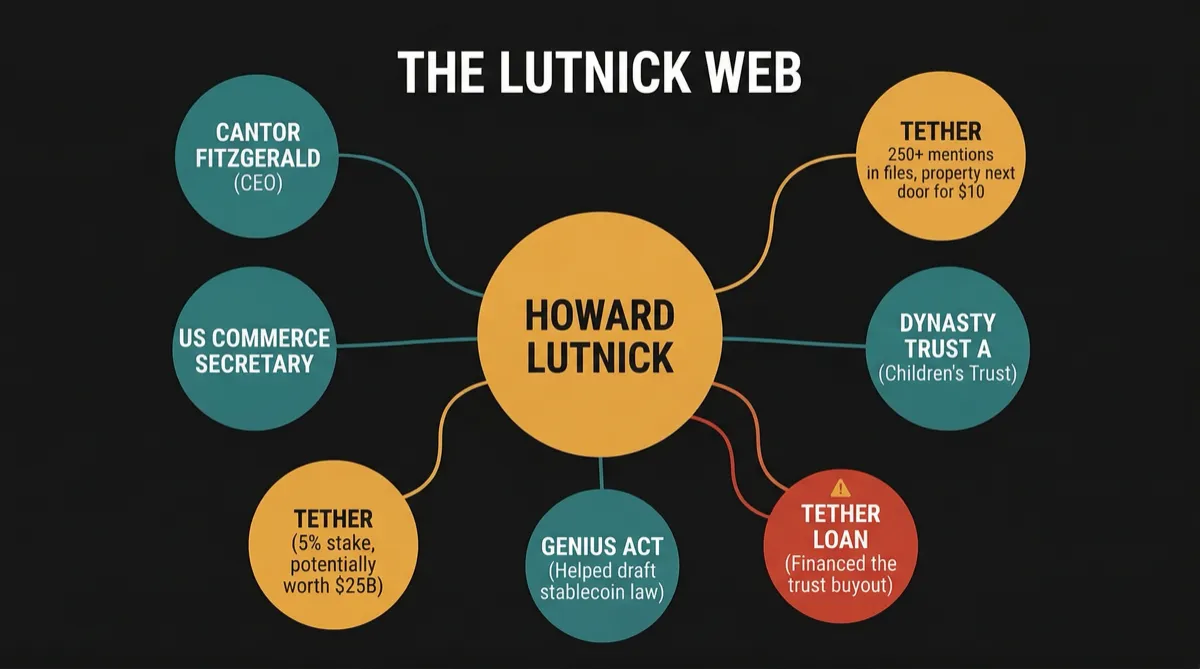
Cantor Fitzgerald negotiated a 5% equity stake in Tether via a convertible bond. At Tether's target valuation of $500 billion, that stake would be worth $25 billion, greater than all of Cantor Fitzgerald's other assets combined.²³ Tether's controlling shareholder, Giancarlo Devasini, told investor Cory Swan directly that Lutnick got his stake "bloody cheap."²⁴
When Lutnick was appointed Commerce Secretary, he was required to divest his ownership of Cantor Fitzgerald. So in October 2024, he transferred the company to trusts benefiting his four children. And here is where it becomes truly extraordinary: at the same moment, one of those trusts, "Dynasty Trust A," borrowed an undisclosed sum from Tether, secured by the very convertible bonds representing Cantor's equity stake in Tether.²⁵ A UCC-1 financing statement filed in New York State on October 7, 2024, documents the loan.
Ethics professor Kathleen Clark summarized it plainly: "This transaction, which was supposed to theoretically eliminate a conflict of interest, actually creates a new one."²⁵ Tether financed the divestiture that was supposed to free Lutnick from Tether's orbit. The Commerce Secretary's family now owes its fortune to the solvency and success of an unaudited, offshore stablecoin issuer that he is in a position to regulate.
And Lutnick did regulate. He participated in drafting the GENIUS Act, the stablecoin legislation that gave Tether a three-year grace period from full compliance. He served on the Presidential Digital Asset Task Force, which promoted stablecoin development in a market where Tether holds roughly 65% market share.²⁶ During his Senate confirmation, Lutnick said, "I absolutely agree with you, Tether should be audited." No audit has materialized.
Lutnick's son Brandon, age 28, was appointed chairman and CEO of Cantor Fitzgerald in February 2025. Brandon had previously worked with Tether in Lugano, Switzerland, and has publicly described a "blossoming friendship" with Ardoino. In April 2025, Cantor Fitzgerald, Tether, Bitfinex, and SoftBank jointly launched a bitcoin acquisition company together.
The newly released DOJ documents contain over 250 references to Howard Lutnick.²⁷ According to reporting by Mario Nawfal, the files reveal that Lutnick purchased the property at 11 East 71st Street in Manhattan through a trust for $10, directly adjacent to Epstein's infamous townhouse, which Les Wexner and Epstein owned.²⁸
Whether the Epstein connections are directly relevant to Tether's operations is a question I cannot definitively answer. But the pattern of relationships is impossible to ignore. Tether's co-founder had an eight-year documented relationship with Epstein. Tether's financial custodian, the man whose family now controls the company that holds $140 billion of Tether's Treasury bonds, appears 250 times in the Epstein files. Two of the people most responsible for Tether's current position in the global financial system had deep, documented ties to the most notorious sex trafficking network in modern American history.
Where there is smoke, there is fire. And there is a lot of smoke.
The self-dealing machine
Even setting aside the Epstein connections, Tether's internal dealings would make a Gilded Age robber baron blush.
Devasini, Tether's CFO and controlling shareholder, was a plastic surgeon in Turin, Italy, before pivoting to technology. In 1996, he faced legal action for selling pirated Microsoft software and settled for approximately 100 million Italian lira.²⁹ Investigative journalist Zeke Faux, in his book Number Go Up, investigated claims that Devasini's company transacted with a man later convicted of "missing trader fraud" with reported connections to organized crime in Europe.²⁹ Those connections remain alleged, not proven. But the documented transactions exist.
The Northern Data deal is the cleanest example of Tether's corporate governance, or lack thereof. Northern Data AG, a German company majority-owned by Tether, sold its bitcoin mining subsidiary Peak Mining in a deal valued at up to $200 million. The buyers, according to British Virgin Islands corporate records reported by the Financial Times, included Highland Group Mining Inc. and Appalachian Energy LLC, entities controlled by Devasini and Ardoino.²¹ Northern Data is listed on a German market segment that does not require disclosure of related-party transactions. Tether's own executives were on both sides of a $200 million deal, and there was no legal obligation to tell anyone.
Subsequently, Rumble, the video platform that also has Tether financial connections, announced a $767 million bid to acquire all of Northern Data. The pattern: Tether executives buy a Tether subsidiary's assets at undisclosed prices, and then another Tether-connected entity acquires the parent.
The Paradise Papers, published by the ICIJ in 2017, had already revealed the shell game. Documents from offshore service provider Appleby showed that Devasini and former CSO Philip Potter were the beneficial owners of Tether Holdings Limited in the British Virgin Islands, directly contradicting years of insistence that Bitfinex and Tether were separate operations.³⁰ Before his departure, Potter had admitted openly on a podcast that Bitfinex dealt with banking problems by playing shell games: "We've had banking hiccups in the past, we've always been able to route around it or deal with it, open up new accounts, or what have you... shift to a new corporate entity, lots of cat and mouse tricks."³³ Potter quietly resigned from both companies in June 2018, six months after they received CFTC subpoenas. He had also been running a personal bitcoin arbitrage hedge fund while serving as CSO of the exchange his hedge fund traded on. Potter was previously fired from a Wall Street job earlier in his career, as reported by the New York Times.
The new Jekyll Island
So what are we actually looking at?
A small group of private actors, principally Devasini, Ardoino, and the Lutnick family, have positioned a private, unaudited, offshore company to function structurally like a central bank. Tether issues globally accepted currency. It holds sovereign debt as reserves on a scale that rivals medium-sized nations. It earns seigniorage that in a traditional system would flow to a sovereign government. It is vertically integrating into bitcoin mining, gold storage, energy infrastructure, and media through its Rumble connection. Its financial custodian is now run by the children of the U.S. Commerce Secretary, who helped write the law that gave Tether a regulatory grace period. And President Trump's January 2025 executive order banning a U.S. Central Bank Digital Currency while endorsing private stablecoins effectively handed Tether government sanction to continue expanding this role.
The IMF has noted that Tether and USDC together hold more U.S. Treasuries than Saudi Arabia. The European Central Bank has warned that dollar-pegged stablecoins risk "digital dollarization" that could undermine monetary sovereignty in emerging markets. Oxford's Journal of International Economic Law published a 2025 paper analyzing stablecoins as instruments of dollar hegemony that operate outside the oversight frameworks applied to traditional financial institutions.³¹
I am not a defender of the existing central banking system. The Federal Reserve is itself a private cartel with a public mandate, created in secret, operated for the benefit of its member banks, and directly responsible for the destruction of 98% of the dollar's purchasing power since 1913. I have written extensively about the monetary system's structural problems, and I believe bitcoin was designed precisely to provide an alternative to central bank monopoly over money.
Tether is a private company run by people who have been caught lying about their reserves, who emerged from the online gambling fraud world, whose founder spent years in Jeffrey Epstein's orbit, whose financial custodian's family owes its fortune to Tether's solvency, and who have never submitted to a single independent audit in over eleven years of operation. Bitcoin is governed by proof of work and open competition. Tether is governed by Giancarlo Devasini.
The existing central banking system is brutal and inflationary, designed to serve the financial elite at the expense of ordinary people. But at least the Federal Reserve publishes audited financial statements. At least there is a nominal democratic mechanism for governance of the Fed, however captured it may be. At least the chairman of the Federal Reserve cannot secretly loan money to his children's trust fund.
What Tether is building is a central bank with none of the accountability: a monetary authority answerable to no electorate, no legislature, no auditor, and no nation-state. A Jekyll Island where the bankers skipped the step of pretending to be public servants.
They are staging a quiet, methodical coup against the global monetary system, and they are doing it to become the new center of control themselves, with $141 billion in U.S. government debt as leverage and the U.S. Commerce Secretary's family on the payroll.
And so far, nobody has stopped them.
Update March 24, 2026
Within hours of this article's publication, Tether issued a response on X:
Tether announces Big Four audit engagement. Tether published a press release stating it has entered a formal engagement with an unnamed Big Four accounting firm to conduct its first full independent financial statement audit. The company did not disclose which firm, did not provide a completion date, and did not explain why the firm's name is being withheld. CEO Paolo Ardoino called it "the biggest ever inaugural audit in the history of financial markets." CFO Simon McWilliams, hired in early 2025 specifically to prepare for this process, said the firm "was selected through a competitive process." Tether also noted it plans to move listed securities "in the coming days" as part of reserve optimization. If completed and published, this would be the first independent audit in Tether's eleven-year history. The operative word is "if." Tether has announced audit plans before. Friedman LLP was engaged and then quietly dropped in 2018. A Big Four audit was declared the "top priority" in March 2025. We are now twelve months past that declaration with a new announcement but still no audit. The pattern is familiar: announce the audit when pressure mounts, then let the timeline slip until the news cycle moves on. I will update this article when an actual audit report is published.
The CLARITY Act stablecoin yield compromise. Senators Thom Tillis and Angela Alsobrooks reached a compromise on stablecoin yield provisions within the CLARITY Act, with draft text circulated to industry leaders on March 24, 2026. The legislation prohibits digital asset service providers (exchanges, brokers, and their affiliates) from offering yield on stablecoin balances, whether directly or indirectly. It does permit "activity-based rewards" tied to loyalty programs, promotions, subscriptions, and transactions. A Senate Banking Committee markup is targeted for the second half of April. The bill's DeFi provisions and ethics language barring senior officials from personally profiting from crypto assets remain unresolved. That ethics language is worth watching. If enacted as drafted, it would apply directly to the kind of arrangement between the Commerce Secretary's family trusts and Tether documented in this article. Whether it survives committee markup with Lutnick's allies on the Banking Committee is another question entirely.
Footnotes
¹ "The Meeting at Jekyll Island," Federal Reserve History. https://www.federalreservehistory.org/essays/jekyll-island-conference
² "Tether General Counsel Stuart Hoegner Retires After MiCA Regulations," CoinTelegraph, January 2025. https://cointelegraph.com/news/tether-legal-chief-stuart-hoegner-retired-after-mica-regulations
³ "FTX Collapse, Tether Operations Linked to Online-Poker Cheating Scandals," poker.org. https://www.poker.org/ftx-collapse-tether-operations-have-links-to-infamous-online-poker-cheating-scandals/
⁴ "The Ultimate Bet Scandal," PokerNews, 2022. https://www.pokernews.com/news/2022/11/ultimate-bet-scandal-42623.htm
⁵ "FTX, Daniel Friedberg, Stu Hoegner and (the Other) Black Friday," CoinGeek. https://coingeek.com/ftx-daniel-friedberg-stu-hoegner-and-the-other-black-friday/
⁶ "Marc Collins-Rector," Wikipedia. https://en.wikipedia.org/wiki/Marc_Collins-Rector
⁷ "Brock Pierce's Dark and Disturbing Friendship with Jeffrey Epstein," Protos, February 2026. https://protos.com/brock-pierces-dark-and-disturbing-friendship-with-jeffrey-epstein/
⁸ "Epstein's Crypto Ties: Documents Reveal Early Coinbase Investment," Fortune, February 6, 2026. https://fortune.com/2026/02/06/jeffrey-epstein-files-coinbase-blockstream-michael-saylor-brock-pierce/
⁹ Protos, ibid. See also "Epstein Emails Reference Bitcoin Meeting With Brock Pierce," Yahoo Finance. The "boat in Antigua" email was reported by The Kyiv Independent's investigation of DOJ files.
¹⁰ "Brock Pierce: Cryptocurrency Pioneer Has Had No Involvement With Tether Since 2015," PR Newswire, October 2021. https://www.prnewswire.com/news-releases/brock-pierce-cryptocurrency-pioneer-has-had-no-involvement-with-tether-since-2015-301392246.html
¹¹ "Bitfinex Hacker Sentenced for Money Laundering Conspiracy," U.S. Department of Justice, November 2024. https://www.justice.gov/archives/opa/pr/bitfinex-hacker-sentenced-money-laundering-conspiracy-involving-billions-stolen
¹² "2016 Security Breach FAQ," Bitfinex Support. https://support.bitfinex.com/hc/en-us/articles/4417401349657-2016-Security-Breach-Bitcoin-Recovery-Frequently-Asked-Questions-FAQ
¹³ "CFTC Orders Tether and Bitfinex to Pay Fines Totaling $42.5 Million," CFTC, October 15, 2021. https://www.cftc.gov/PressRoom/PressReleases/8450-21
¹⁴ "Attorney General James Ends Virtual Currency Trading Platform Bitfinex's Illegal Activities in New York," NYAG, February 23, 2021. https://ag.ny.gov/press-release/2021/attorney-general-james-ends-virtual-currency-trading-platform-bitfinexs-illegal
¹⁵ "Crypto Capital President Arrested," CoinTelegraph. https://cointelegraph.com/news/head-of-crypto-capital-arrested-in-connection-with-money-laundering
¹⁶ "Every Time Tether Was Going to Get an Audit," Protos. https://protos.com/every-time-tether-was-going-to-get-an-audit/
¹⁷ "Tether Q2 2025 Attestation Report," Tether. https://tether.io/news/tether-issues-20b-in-usdt-ytd-becomes-one-of-largest-u-s-debt-holders-with-127b-in-treasuries-net-profit-4-9b-in-q2-2025-attestation-report/
¹⁸ "Tether Ranks Among Top Foreign Buyers of U.S. Treasuries in 2024," CoinDesk, March 2025. https://www.coindesk.com/business/2025/03/20/tether-ranks-among-top-foreign-buyers-of-u-s-treasuries-in-2024-firm-says
¹⁹ "Why Tether Is Acting More Like a Central Bank Than a Stablecoin," CoinTelegraph. https://cointelegraph.com/features/why-tether-is-acting-more-like-a-central-bank-than-a-stablecoin
²⁰ "Tether Acquires $100 Million Stake in Bitcoin Miner Bitdeer," Bloomberg, May 2024.
²¹ "Tether-Backed Northern Data Sold Bitcoin Mining Arm to Companies Run by Tether's Own Executives," The Block. https://www.theblock.co/post/383439/tether-backed-northern-data-sold-bitcoin-mining-arm-to-companies-run-by-tethers-own-executives-ft
²² "In the Shadow of Bank Run: Lessons from the Silicon Valley Bank Failure and Its Impact on Stablecoins," Federal Reserve, December 2025. https://www.federalreserve.gov/econres/notes/feds-notes/in-the-shadow-of-bank-run-lessons-from-the-silicon-valley-bank-failure-and-its-impact-on-stablecoins-20251217.html
²³ "Lutnick's Cantor Eyes a $25 Billion Fortune on Tether Fundraise," Bloomberg, October 2025. https://www.bloomberg.com/news/articles/2025-10-16/lutnicks-cantor-eyes-a-25-billion-fortune-on-tether-fundraise
²⁴ @CorySwan, X post quoting Giancarlo Devasini, March 18, 2026. https://x.com/CorySwan/status/2034371146741944354
²⁵ "As Lutnick Sold Cantor to His Children, Tether Gave Them a Loan," Bloomberg, March 18, 2026. https://www.bloomberg.com/news/features/2026-03-18/tether-made-loan-to-lutnick-s-children-as-they-bought-his-assets
²⁶ Senator Elizabeth Warren, letter to Howard Lutnick regarding Tether conflicts of interest. https://www.warren.senate.gov/imo/media/doc/letter_to_lutnick.pdf
²⁷ "Howard Lutnick's Epstein Island Visit Puts Spotlight on His Past Crypto Ties," Gizmodo. https://gizmodo.com/howard-lutnicks-epstein-island-visit-puts-spotlight-on-his-past-crypto-ties-2000720867
²⁸ @MarioNawfal, X post regarding Lutnick/Epstein property purchase, February 2026. https://x.com/MarioNawfal/status/2024285796761817243
²⁹ "Tether Executives Have Brushed Shoulders with Crime Since Its Inception," Protos. https://protos.com/tether-executives-have-brushed-shoulders-with-crime-since-its-inception/
³⁰ Tether Holdings Limited, ICIJ Offshore Leaks Database. https://offshoreleaks.icij.org/nodes/82024464
³¹ "Stablecoins and the US Treasury Market," Oxford Academic, Journal of International Economic Law, 2025. https://academic.oup.com/jiel/advance-article/doi/10.1093/jiel/jgaf050/8439773
³² "Raphael Nicolle and the Founding of Bitfinex," Bennett Tomlin, January 2021. https://bennettftomlin.com/2021/01/15/raphael-nicolle-and-the-founding-of-bitfinex/
³³ Phil Potter, podcast interview discussing Bitfinex banking arrangements, cited by Bitfinexed, "The Mystery of the Bitfinex/Tether Bank," Medium, 2017.
³⁴ Giancarlo Devasini, verbal statement reported by Bitfinexed, "The Curious Tale of Tethers," Medium, 2017.
³⁵ Bitfinexed, "Meet Spoofy: How a Single Entity on Bitfinex Manipulated the Price of Bitcoin," Medium, 2017. See also Bitfinexed reporting on Bitfinex wash trading mechanics and Phil Potter's acknowledgment of wash trading on the platform.