History of Money and Banking, Part 2. Ancient Money From Prehistory
By Kurt Wuckert Jr.
There is a workbench in a museum conservation lab, and on it sits a hollow ball of clay the size of a fist.
Somebody sealed it by hand more than five thousand years ago at Susa, in what is now southwestern Iran. Before the clay dried, cylinder seals were rolled across its skin: small carved stone barrels that leave a repeating band of figures, a signature you cannot fake without owning the stone. The people who rolled them had names. Nobody has spoken those names since before the alphabet existed.
Archaeologists call these clay envelopes bullae, and they date to the fourth millennium BC (dates in this series follow the conventional middle chronology).¹
A conservator can crack one open, or scan it: museums have done both, and X-ray and CT imaging can now read a bulla without breaking a seal that has held for more than five thousand years.
So what is inside?
Small clay shapes. Cones. Spheres. A cylinder.
Not treasure. Not scripture. A count of something: sheep, jars of oil, measures of grain. Sealed so the count could not be altered. Kept so it could be produced later and checked against the real sheep and the real jars. In the reading most scholars accept, the model developed by archaeologist Denise Schmandt-Besserat, that sealed count is a transaction held in trust: an obligation. A debt, witnessed and tamper-proofed.²
The first thing humanity ever locked in a vault was a promise.
That sealed ball is where the story of money actually starts. Everything you were taught about where it starts instead, the barter village, the seashells, the tidy crawl from swapping chickens to minting coins, traces back to a guess made in a Scottish study in 1776. The record does not start with a guess.
It starts here, and it starts complicated. Far more complicated than you might have been taught.
Part 1 of this series, The History of Money & Banking: The Bankers Who Wore Swords, closed by promising to "take journeys to the ancient Sumerians." This is that trip. We are going back more than four thousand years before the Templars, to find out where their ledger came from.
Watch the video if you prefer to watch rather than read!
The Guess (Athens, ~350 BC; Scotland, 1776)
Every myth has a paper trail. This one is shorter than you think.
The earliest attested version of the barter-origin story belongs to Aristotle, writing in Athens in roughly 350 BC. In Book I of the Politics, he looks at the trading habits of what Benjamin Jowett's translation calls the "barbarous nations" of his own day, and he promotes what he sees into a stage theory of all human history: first men bartered necessities, then coin was discovered, then commerce grew out of coin. In Jowett's rendering: "When the use of coin had once been discovered, out of the barter of necessary articles arose the other art of wealth getting, namely, retail trade."³
He observes contemporaries he considers primitive, and he projects them backward onto everybody's ancestors. No excavation. No document. No artifact. An anecdote about the neighbors, promoted to official prehistory out of near total ignorance of history: a data integrity problem...
That was Athens. The guess got its modern tenure twenty-one centuries later, in a Scottish study.
Adam Smith, The Wealth of Nations, 1776, Book I, chapter 4. Read his verbs closely, because Smith hedges his own story and almost nobody notices. "In the rude ages of society, cattle are said to have been the common instrument of commerce."⁴ Are said to have been. Said by whom? He does not tell us. A little further on: "it is not uncommon, I am told, for a workman to carry nails instead of money to the baker's shop or the ale-house."⁵
"I am told."
By whom, sir?
The founding text of modern economics sources its origin story to hearsay and admits it in plain sight. Smith was honest enough to flag his own uncertainty. His readers spent the next two and a half centuries deleting the flags.
Neither Aristotle nor Smith cites an artifact. The method is identical across the two thousand years between them: take a contemporary anecdote about "less developed" neighbors, project it backward as universal prehistory, and teach it as natural history. Theory dressed as observation, repeated until it hardened into common sense.
That is the entire evidentiary basis. When a textbook opens with the barter village, the chain of citations bottoms out here: a philosopher watching foreigners trade, and an economist repeating what he had been told. Two anecdotes, two thousand years apart, and a civilization's worth of confidence built on top of them.
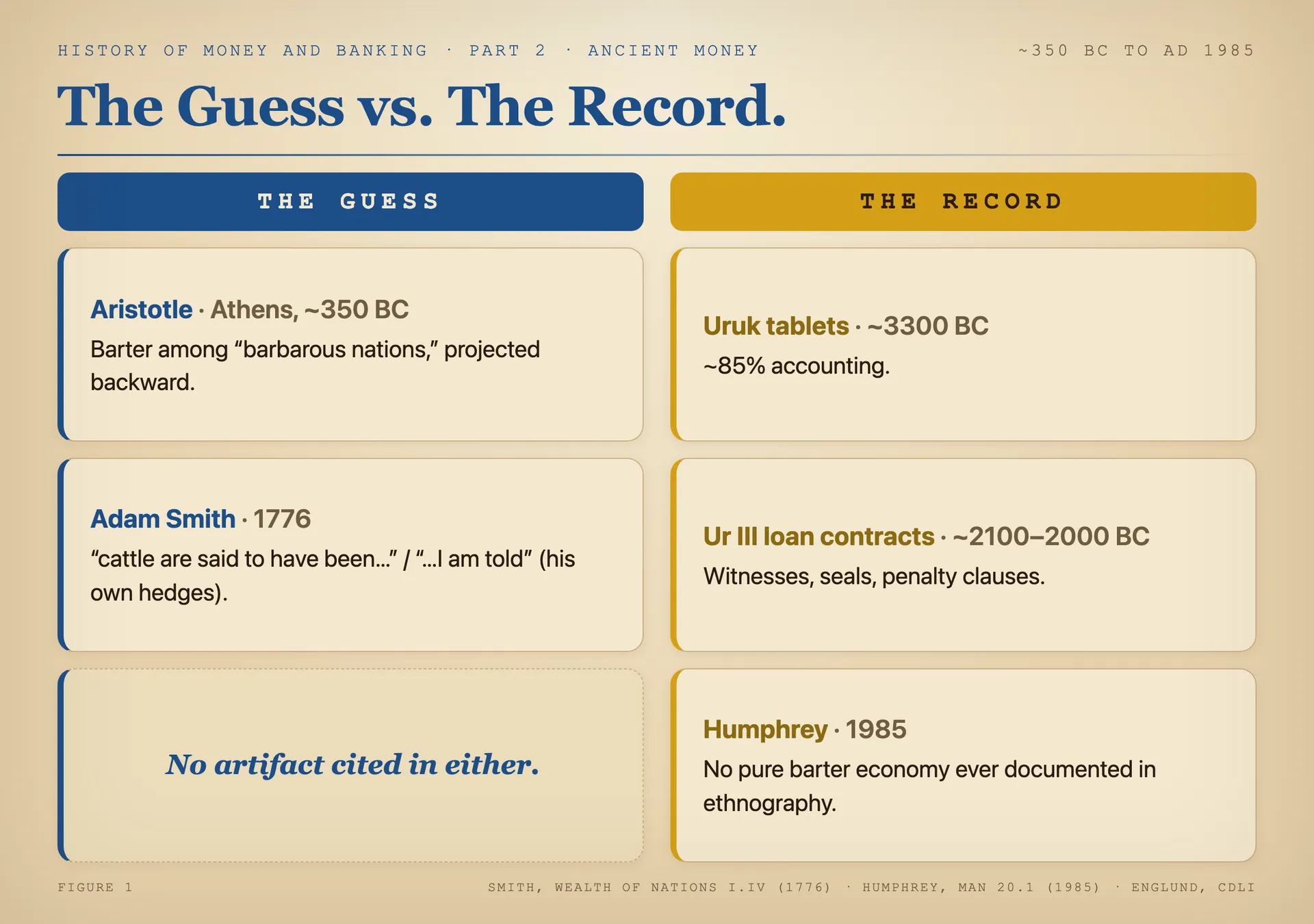
Smith's own verbs confess it: "are said to have been," "I am told." The origin story of money is sourced to rumor.
So what happened when somebody finally went looking for the barter village?
Caroline Humphrey went looking. She is a Cambridge anthropologist, and anthropologists have one advantage over philosophers and economists: they go and watch. In 1985 she surveyed the ethnographic record, the accumulated field documentation of actual economies, and published her verdict in the journal Man:
No example of a barter economy, pure and simple, has ever been described, let alone the emergence from it of money; all available ethnography suggests that there never has been such a thing.⁶
Read her title, too: "Barter and Economic Disintegration." Where barter does show up in the ethnographic record, it often follows the breakdown of a money economy.⁷ The textbook sequence, running in reverse. Barter is less the seed that money grows from, and more what people fall back on when money dies.
And she was not the earliest attested arrival at that destination. A. Mitchell Innes, a British diplomat writing in the Banking Law Journal in 1913 and 1914, got there from monetary history instead of anthropology: credit and debt records precede coinage.⁸ Not a radical. A diplomat, publishing in a bankers' trade journal, telling bankers their ledgers were older than their coins.
David Graeber hauled the argument in front of a mass audience with Debt: The First 5,000 Years in 2011, and he deserves his due for that. He also has serious critics: economist Julio Huato challenged his framing in a peer-reviewed critique.⁹ Good. That is how the process is supposed to work. But notice what the live fight is about. Nobody in that fight is defending the barter village. The fight is over what replaces it.
And to be fair to the schoolbook: shells really were money. Sometimes. In specific, documented places, on specific terms, and the specifics are the whole point.
Cowrie shells lie in Shang-era royal tombs at Yinxu, roughly 1600-1046 BC: imported shells, already a long-distance trade good by the time they went into the ground. In the Western Zhou period they were imitated in bronze, shell money bridging into metal money inside one documented tradition.¹⁰
Wampum was legislated legal tender in Massachusetts Bay from 1637, at a rate the colony's General Court wrote down: it "shall passe at 6 a penny for any sume under 12d." The arrangement lasted until 1661, and counterfeiting killed it: dyed shells, stone, glass.¹¹ A shell currency, destroyed by forgery, inside English colonial law.
As an aside, did you know that when the English arrived at Plymouth in the 1620's, the first Native man to walk into their settlement greeted them with something along the lines of "Welcome, Englishmen" before he asked them if they had any beer? His name was Samoset, and the colonists wrote the whole exchange down themselves in Mourt's Relation, 1622.
It's a smaller, older world than we've often been taught on many fronts...
Anyhow, real monies lived richly in their own documented worlds, and the anthropologist George Dalton wrote the classic corrective on how to treat them: as structurally different institutions serving socially bounded purposes, contemporaneous economies documented in their own right, not preserved specimens of a stage everyone's ancestors passed through.¹²
A 17th-century shell economy is not a time machine into Sumer.
The story you were taught runs simple to complex: barter, then shells, then coins, then credit, then banks. The record shows that sequence nowhere. Wherever the record actually opens, it opens complex, and when the oldest written record of all opens, it opens with paperwork we will read together shortly. And put 1776 in your pocket as well, because the year itself has a payoff waiting at the end of this article.
Nobody has ever found the barter village. We keep teaching it anyway.
The Stones That Shouldn't Exist (~9600 BC)
Before we can walk into Sumer, we have to stop at a hilltop in southeastern Turkey, because what came out of that hill breaks the other half of the myth.
The barter story needs a certain kind of prehistory underneath it: small, simple, disorganized. Scattered bands scraping by, waiting thousands of years for markets and cities to teach them coordination. That is the savage floor the guess is built on.
Which is why the stones matter.
Klaus Schmidt began excavating Göbekli Tepe in the mid-1990s, and what emerged are monumental enclosures of T-shaped limestone pillars, some around 5.5 meters tall, carved with foxes, boars, snakes, and scorpions. The oldest exposed enclosures date to roughly 9600-8800 BC.¹³
People quarried those pillars, moved them, and raised them, with coordinated labor, before there is good evidence of full agriculture at the site.¹⁴ Hunter-gatherers did this. The people we were taught to picture as small bands chasing dinner ran quarries and work crews and raised a monument complex.
Schmidt directed the dig from 1996 until his death in 2014, and he put his thesis in the very title of his excavation report: "Zuerst kam der Tempel, dann die Stadt." First came the temple, then the city.¹⁵
That title flips the schoolbook order of operations and pushes organized culture back in time almost 12,000 years, which is a coup against what passed for settled thought until very recently. Settlement was assumed to come first, and monuments were supposed to be what settled people eventually built with their surplus. Schmidt spent eighteen years arguing from the dirt that the order ran the other way.
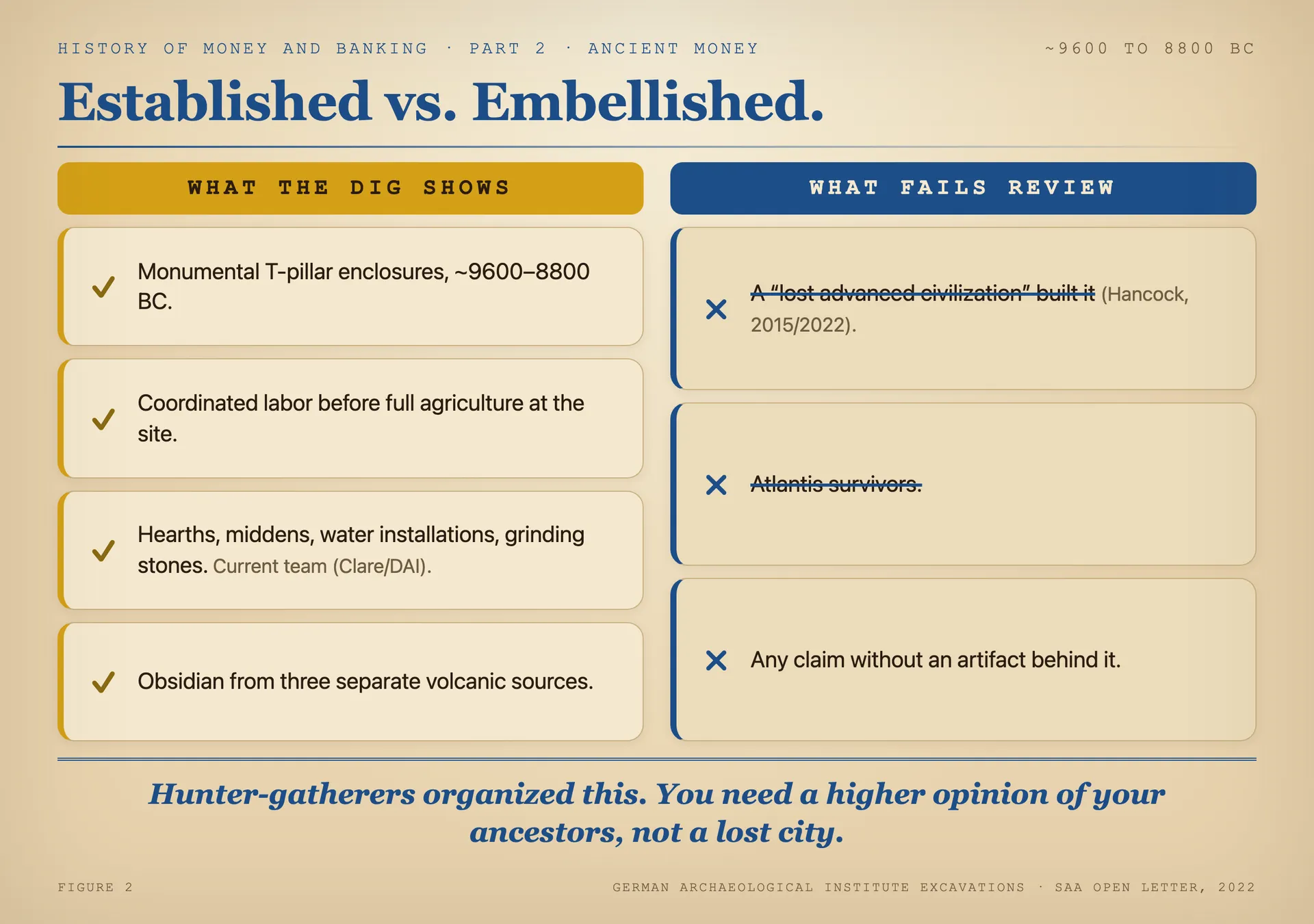
Raised by people with no farms and no cities: the coordination came first.
The picture has kept improving since Schmidt. Under Lee Clare, the German Archaeological Institute team now working the site has found hearths, middens, water-collection installations, and grinding stones: domestic life running alongside the monuments.¹⁶ The site was more than a temple: a place where people lived and worked. Schmidt's slogan got complicated by his own successors, and that is not a scandal. That is science doing its job.
The "lost advanced civilization" framing popularized by Graham Hancock, in Magicians of the Gods in 2015 and the 2022 Netflix series, has no artifact behind it, and archaeologists have said so loudly and on the record.¹⁷ The irony is that the claim insults the real achievement. Right now, best evidence suggests that, somehow, hunter-gatherers organized this. You do not need a lost Atlantis to explain Göbekli Tepe. You need a higher opinion of your own ancestors, who may someday include Atlanteans, if we have the will to keep searching and digging.
Organization. Coordination. Surplus management. Common purpose. Roughly 11,600 years ago, before farming was established at the site, before cities, before writing.¹⁸ The assumption the barter myth quietly rests on, a barbaric and simple prehistory, is precisely the thing these stones refute. One more detail here earns its keep when this story reaches the trade roads: even the obsidian in Göbekli Tepe's dirt came from three separate volcanic sources.¹⁹
I need to stop the tour here and tell you why I care about clay in the first place, because the reason is personal before it is academic.
I had a teacher named Doug Baldwin. Mr. B. He taught me at Christian Liberty Academy from around the time I was eight years old, and by third grade he had our class learning Koine Greek. Third graders, working through Greek. He called me and my closest friends his "Little Inklings," after the Oxford literary group, and if you had seen his classroom you would have understood the reference instantly: teetering piles of books, Greek and Latin and Hebrew on the board, Enya playing during tests, a print of the School of Athens on the wall.
And on a shelf, a clay talisman dedicated to the god Ba'al.
He had dug it out of an Indiana farm field as a boy. A Canaanite idol in Indiana dirt. How did it get there? As far as I know, he never answered that question. He may never have been able to.
Mr. B was an expert in Canaanite antiquities, and he spent years giving tours at the world-renowned Oriental Institute of the University of Chicago, the institution renamed in April 2023 as the Institute for the Study of Ancient Cultures, ISAC, its museum now the ISAC Museum.²⁰ He marched our class through that museum once, and gave private tours to his favorite students on several occasions, tours that ran three, maybe four hours each time, past the great Persian bull head excavated at Persepolis. There is a photograph of him speaking in front of that bull. I think about that photograph more than I expected to.
He collapsed in his own classroom on the morning of April 24, 2023. Four days later I wrote an obituary tribute to him, and the details in this passage come from that piece and from my own memory of the man.²¹
Everything I bring to this series came out of that room. The languages on the board. The tours that ran long because the material deserved it. The refusal to talk down to eight-year-olds, on the theory that if you hand a kid the real thing, the kid will rise to it. And the conviction that a piece of fired clay can keep asking its question long after everyone who knew the answer is gone.
The pagan idol of storms, and the eternal enemy of the God of Israel, sat on his shelf for thirty years, asking its one question.
Remember the bull of Persepolis, because it walks back into this story when we reach Persia, and it brings the Institute's basement with it.
Back to the record, then. Between the pillars at Göbekli Tepe and the sealed ball of clay on that museum workbench lie roughly six thousand years. The next time this story comes into focus, it is at Susa: cones, spheres, a cylinder. Somebody's sheep. Somebody's jars of oil. Somebody's promise, sealed under a signature and waiting to be checked.
The First Words Are a Receipt (~3300-1600 BC)
If you want to be your own historian, go find the oldest surviving evidence of an idea and read what it actually says.
The oldest coherent writing on earth comes from Uruk, in southern Iraq, ~3300 BC: proto-cuneiform tablets from the phase scholars call Uruk IV. Roughly 85 percent of that corpus is economic record-keeping.²² In the very earliest phase, under 1 percent is anything else, and that sliver is not poetry but word lists for training the next generation of scribes.
The earliest texts we can call literature, the Instructions of Shuruppak and the Zame Hymns, arrive roughly seven hundred years later, ~2600-2500 BC, on tablets from Fara and Tell Abu Salabikh.²³ Nothing we can point to and call a prayer or a poem predates ~2600 BC. Grain receipts go back to ~3300 BC.
The receipts run seven hundred years deeper than the poems.
And some of the earliest tablets carry a name, or something shaped like one: Kushim, an administrator of barley and beer. Kushim is often cited as the earliest personal name on record, and Sumerologists still argue about whether Kushim was a person or a job title.²⁴
The first name in history may belong to an accountant, and we are not even sure he wasn't a job description.
Now, back to that sealed clay envelope on the museum workbench. It has a name, and it has a theory attached.
The archaeologist Denise Schmandt-Besserat built the theory, and it runs like this. From ~8000 BC, people across the Near East counted with small clay tokens. When a deal needed securing, the tokens went inside a hollow clay envelope, a bulla, and the parties rolled their seals across its wet skin. Tamper-evident, but unreadable: you cannot check the count without breaking the seal. So scribes began pressing the tokens into the wet surface before sealing them inside, and now the outside of the envelope tells you what the inside holds. Then comes the realization that pays for everything: if the impressions carry the whole message, the tokens are dead weight. Flatten the envelope. Keep the marks. The flat tablet is born, and writing with it.²⁵
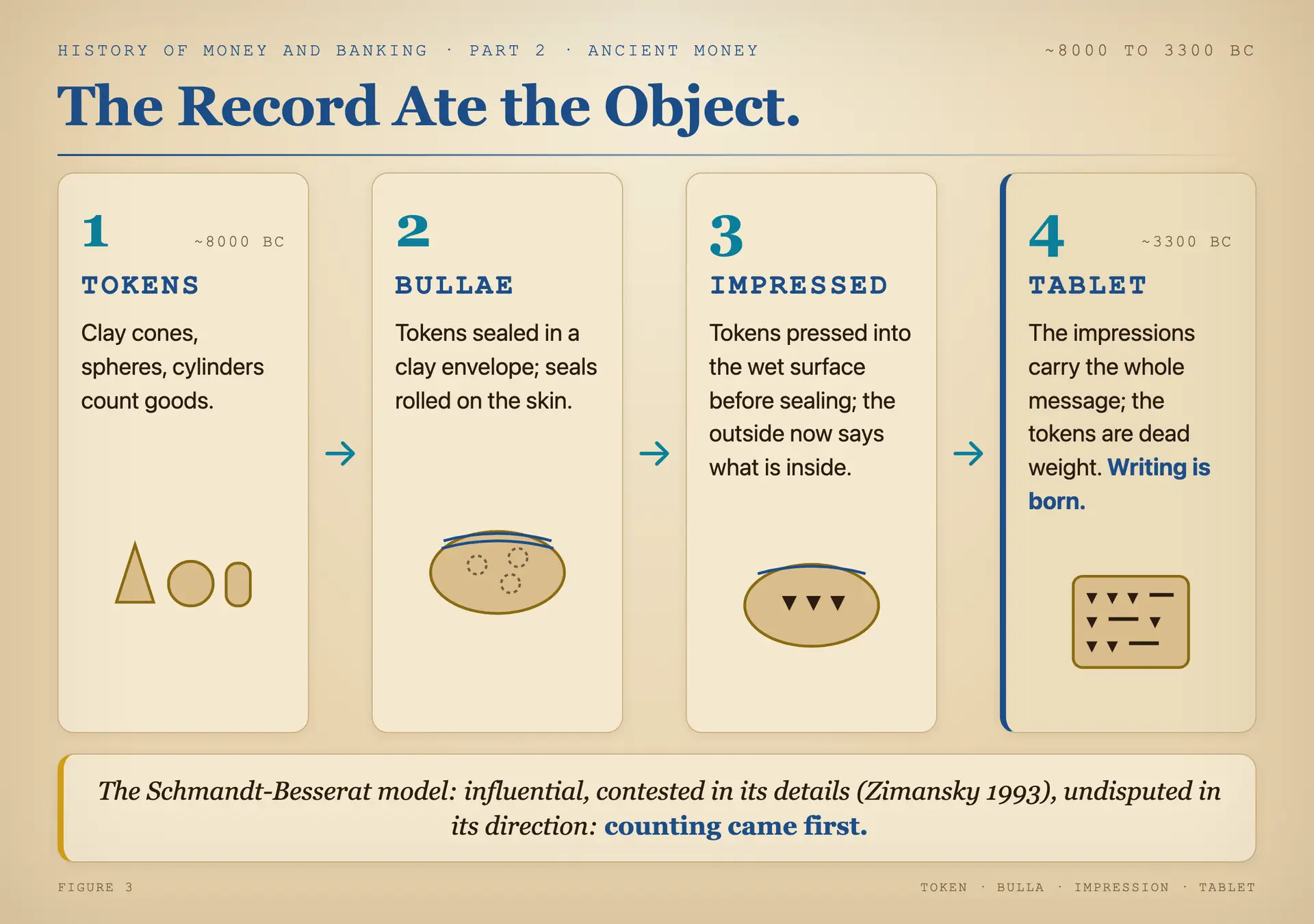
The impressions made the tokens redundant: the record ate the object, and writing was what remained.
Her model is influential, and it is contested. Reviewers led by Paul Zimansky worked through the catalog and found the one-to-one mapping from token shapes to written signs demonstrable mainly for the numbers, not for the rest of the system.²⁶ The details are argued. The direction is not: counting came first, and writing grew out of the counting.
Fast-forward a thousand years, and the receipts have grown a curious set of historical teeth.
Two loan contracts from the Ur III period (~2112-2004 BC), translated by the Assyriologist Steven Garfinkle. The first is friendly:
"Lu-šaga received 12 1/2 gín of silver without interest from Lu-Suen on the first day of the 3rd month. He swore in the name of the king to return it in the 4th month. Witnesses. Year. Seal: Lu-šaga, the scribe."²⁷
The second is business:
"Šu-ašli received 25 gín of silver from Azida. He will return the silver in its entirety in month 8 in Nippur. If he does not return it, he will weigh out 2 gur of barley for each shekel of silver after the harvest. Witnesses. Date. Seal: Šu-ašli, the silversmith, son of Šarrum-bani."²⁸
Read that second tablet like a banker's mundane, procedural term sheet. Principal: 25 gín of silver. Term: month 8. Venue: Nippur. Default clause: a barley penalty per shekel, indexed to the harvest. Witnesses on record. A personal seal. A silversmith's IOU with a default provision, four thousand years old.
And the paperwork came in flavors. Interest-free loans and interest-bearing loans were distinct, named categories. There were antichretic loans, where pledged labor stood in for interest. There was collateral, there were guarantors, and repayment was scheduled to income events like the harvest rather than to arbitrary dates: the ancestor of amortization.²⁹ One major creditor even advanced his own brother Naharum a massive harvest loan, 23 gur of barley, roughly 6,900 liters, to hire harvest labor.³⁰ Family, but papered.
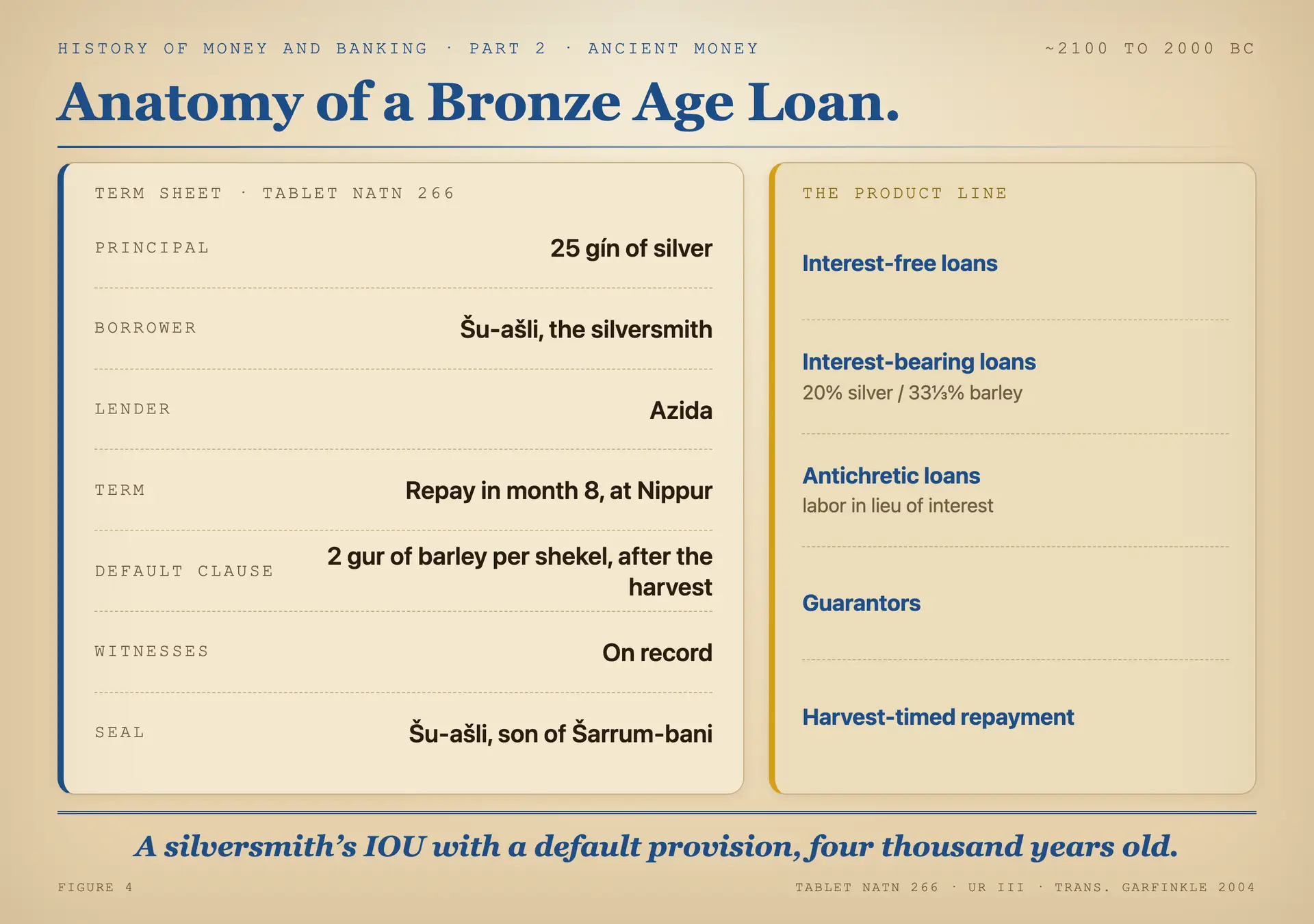
Principal, term, venue, penalty clause, witnesses, seal: the anatomy of your mortgage, excavated.
Interest even lived inside the language. The Sumerian word máš means a young goat, and it also means interest: the increment "born" from the principal the way the herd births its offspring. Akkadian used ṣibtu, from waṣābu, "to add": in the economist Michael Hudson's rendering, "that which is added."³¹
And the rates barely moved. The standard pair, 33⅓ percent on barley and 20 percent on silver, recurs from Ur III (~2100-2000 BC) through Eshnunna (~1770 BC) to Hammurabi (~1754 BC) on the tablets we can read. Hudson argues the stability ran far longer, because the rate was never a market price in the first place. One shekel per mina per month. One sixtieth. The simplest fraction a sexagesimal accounting system can compute.³²
The interest rate came out of the arithmetic, not out of supply and demand.
Ok, so by ~2000 BC we have principal, terms, collateral, guarantors, witnesses, and penalty clauses. What about regulators? Already there.
The Laws of Ur-Namma, ~2100 BC, are the earliest law collection on record, and they already read in places like financial statute: fines denominated in silver shekels, and a provision governing interest on barley loans. The tablets are damaged, and scholars have renumbered the provisions more than once, so I will cite the content and skip the paragraph numbers.³³
The Laws of Eshnunna, ~1770 BC, issued under King Dadusha a generation before Hammurabi, open with something better than a preamble. They open with a price schedule: barley, oils, lard, wool, copper, and salt, each pegged to the silver shekel. The first thing the statute does is publish prices! And §18A caps interest by law, in Martha Roth's translation: "Per 1 shekel of silver, interest accrues at the rate of 36 barleycorns (=20 percent); per 300 silas of grain... 100 silas (=33 percent)". Thirty-six barleycorns is not grain; it is a weight of silver, the smallest denomination in the system.³⁴
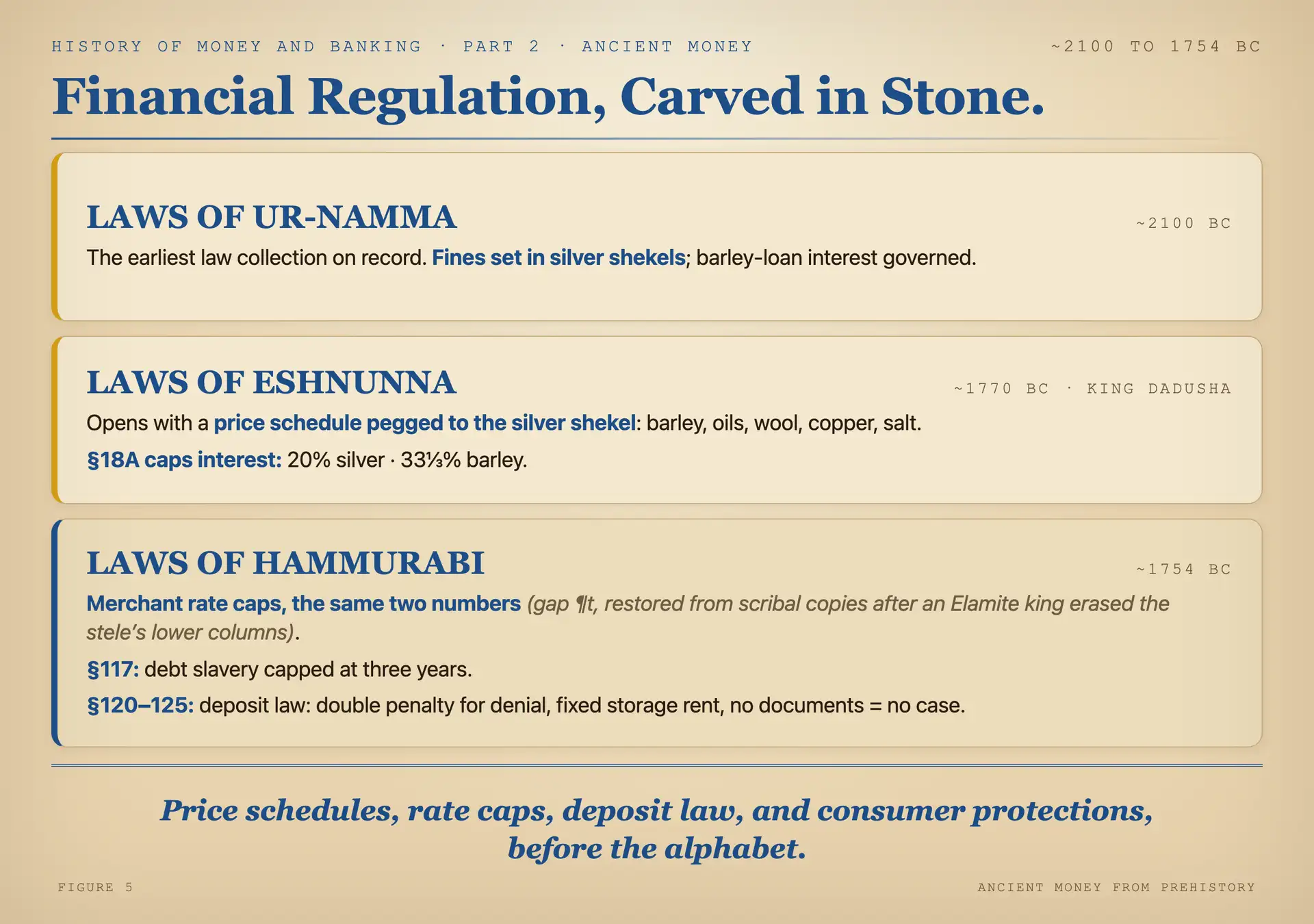
Price schedules and rate caps carved into statute: financial regulation is older than the alphabet.
Then Hammurabi, ~1754 BC. The famous stele in the Louvre is missing its lower columns: an Elamite king, Shutruk-Nahhunte, hauled the stone to Susa as war booty in the ~12th century BC and had the bottom columns polished blank for his own inscription. Editors rebuilt the missing laws from scribal copies, and the rebuilt provisions carry letters instead of numbers.
Even the law code had its ledger edited by a conqueror. The audacity of it all!
In the rebuilt provision editors call gap ¶t, the merchant rate caps survive, again in Roth's translation: "If a merchant gives grain or silver as an interest-bearing loan, he shall take 100 silas of grain per kur as interest (=33%); if he gives silver as an interest-bearing loan, he shall take 36 barleycorns per shekel of silver as interest (=20%)."³⁵ Same two numbers. The caps held.
On the undamaged stone, §117 puts a statutory cap on debt slavery: a person sold or bonded for a family debt serves three years, and "their release shall be secured in the fourth year".³⁶
And §120 through §125 amount to deposit law in all but name. Deny or lose grain stored in your warehouse, and you owe the depositor double. Storage rent is fixed at 5 sila per kor per year. A silver deposit requires witnesses and a written contract, and an undocumented deposit has no legal remedy. No paper, no case.³⁷
Bailment, warehouse receipts, and documentation requirements, ~3,800 years ago.
If you thought the Bronze Age was primitive, oppressive, and unsophisticated, buckle in to learn about the reset button on interest. Debt forgiveness.
Enmetena of Lagash, ~2400 BC, issued a decree built on the Sumerian term ama-gi, literally "return to the mother": debt-bonded family members restored to their households, obligations canceled. Ama-gi is often cited as the earliest recorded word associated with freedom, and the scholar most responsible for that framing, Samuel Noah Kramer, hedged it himself: "we still do not know why this figure of speech came to be used for 'freedom'".³⁸
On the current evidence, the oldest recorded word tied to freedom is a debt-amnesty term. Not free speech: the ledger letting your family go home.
Urukagina, also at Lagash, ~2350 BC: debts canceled, officials restrained from seizures.³⁹
Then the practice got institutionalized. Old Babylonian kings issued mīšarum edicts, "justice" edicts, proclaiming andurārum: release. Agrarian and consumer debts annulled by royal decree. The best preserved is the Edict of Ammisaduqa, ~1646 BC, and it does not stop at canceling debts. It orders the debt tablets surrendered and physically broken. It also carries anti-evasion clauses, because, in the words of its editor J.J. Finkelstein, the edict "anticipate[s] a certain amount of skullduggery and fraud aimed at circumventing" it.⁴⁰
Kings knew creditors would game the amnesty, and they legislated for it. In ~1646 BC.
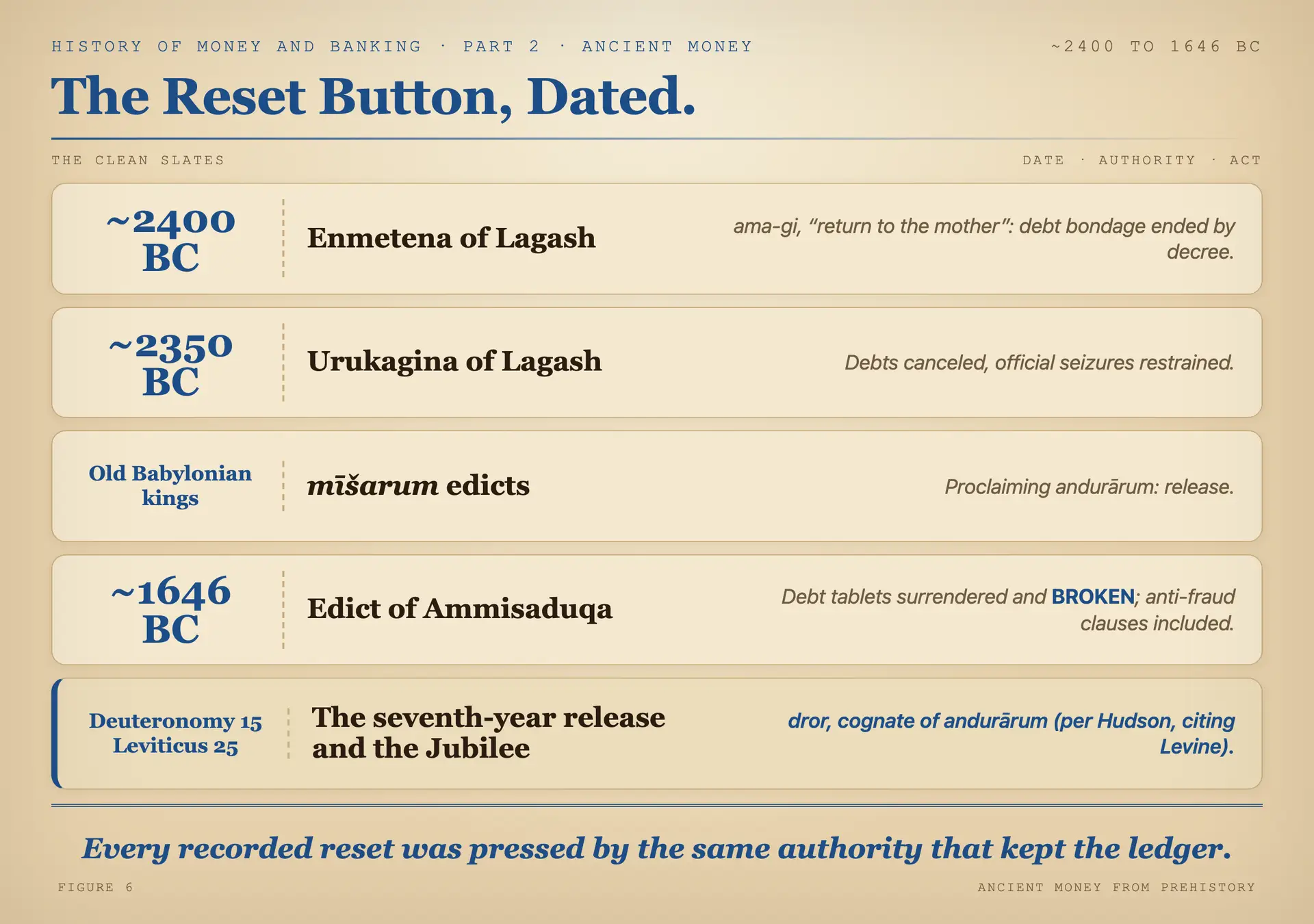
The amnesty was never a riot. Every recorded reset was pressed by the same authority that kept the ledger.
The modern framing belongs to the economist Michael Hudson: the recurring cancellations were a designed stability valve, protecting the crown's tax and labor base from being swallowed whole by private creditors.⁴¹ Not mercy. Maintenance.
Where did all of this run? There was no local bank, so the processes ran through the temples and the palaces. Grain and silver were stored there, lent from there, accounted for there. The standardized weights and measures lived there. The trusted ledger-keeper worked there, under divine authority. Hudson calls these institutions the origin of banking outright. Most Assyriologists reach for cooler words, institutional household, redistributive center, creditor institution, because temples and palaces mostly lent to their own dependents rather than intermediating public deposits.⁴² Pick whichever label you like, but remember the picture itself, grain and silver under a god's roof, because the closing argument of this article stands on it, and so does the rest of this series.
One more thing before we leave the tablets. Every one of these instruments, the loans, the fines, the rate caps, the deposits, runs on silver, and almost nobody ever hands that silver across a counter. That untouched silver turns out to be stranger than the loans, and it gets the next stretch of this story to itself.
Four thousand years before the credit score, the ledger already knew your name, and what that name was worth.
Money Without Coins (~2600-500 BC)
So what is a shekel?
Not a coin. A weight: ~8.3-8.4 grams of silver, and a unit of account. Nobody minted it. Everybody used it. Prices, wages, fines, and debts were denominated in shekels for over a thousand years before any coin existed anywhere on earth. The Assyriologist Marvin Powell described Mesopotamian money as "substance oriented," and observed that "coins, when they finally appear are weighed like any other valuable metal."⁴³
The scale mattered. The stamp, when it finally showed up, did not.
Barley was the everyday cheap money; silver was the dear standard. The Ur III accounting peg tied them together: 1 shekel of silver to 1 gur of barley, 300 sila. That was the official reference rate, and real transactions ranged from ~200 to ~600 sila per shekel.⁴⁴ A posted peg with a market wobbling around it. If that arrangement sounds familiar, it should.
An official rate in the statute, a real rate in the field, and accounts kept in both. That is not barter fumbling toward money so much as a unit of account doing its job across economically significant time.
Keep two milestones separate here, because careless histories smear them together. Writing as accounting starts ~3300 BC at Uruk. Silver's earliest attested use as payment is ~2600 BC, in the Fara-period texts.⁴⁵ The bookkeeping is roughly seven centuries older than the money.
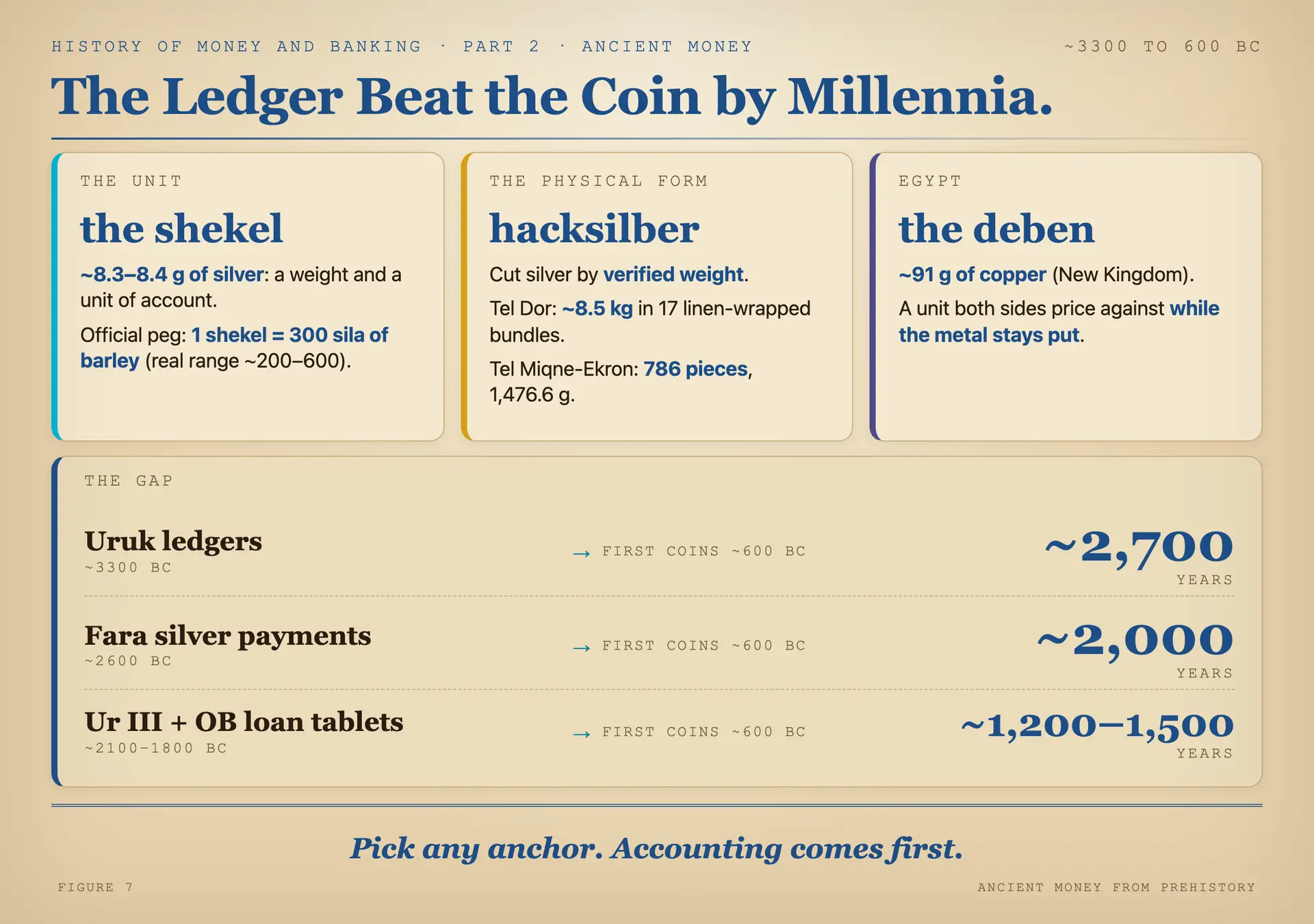
A thousand years of prices, wages, and fines, denominated in a unit no mint ever struck.
Now the argument. The unit was state-declared. Taxes and rents were reckoned in silver, which manufactured standing demand for it. Eshnunna's opening paragraphs are a normative declaration of what things cost, not a survey of what they happened to cost. Temple ration ledgers moved grain as recorded claims, not as sacks changing hands. And when silver did circulate, it circulated as hacksilber: cut fragments passing by verified weight across the Iron Age Levant. At Tel Dor, ~8.5 kilograms of fragmented silver turned up in a clay jar, packed in 17 linen-wrapped bundles. At Tel Miqne-Ekron, 786 pieces weighing 1,476.6 grams, functioning by weight as small change. The Hacksilber Project's current corpus counts 36 such hoards across the region, ~1200-586 BC.⁴⁶
Look at what is missing from that picture. No mint. No sovereign's face. No stamp doing the work a stamp is supposed to do. The silver passed by weight and seal, and the books did the rest.
This is distinctly fiat-like lubrication for trade. Currency of trust in the record. Validity rested on authority, record, and standard, not on commodity romance like sound money advocates would ask you to believe. It was not fiat in the modern unbacked-paper sense, because there was always metal or grain "standard" underneath, and the heavy lifting was done by that standard and the ledger.
Egypt makes the same point from the other direction, because Egypt barely bothered handing over the metal at all. The New Kingdom unit was the deben, a copper weight of ~91 grams split into ten kite, and it worked as a unit of account for barter: both sides price their goods in deben until the piles balance, and the copper itself rarely changes hands.⁴⁷ The state paid its workers in rations and kept the score in a ledger.
And we know the day the ledger failed. Year 29 of Ramesses III, ~1157 BC: the grain rations owed to the royal tomb-builders at Deir el-Medina fell into arrears, and the workmen put down their tools and sat down at the mortuary temples, saying they were hungry. The scribe Amennakhte's account survives on the Turin Strike Papyrus, and it is the first labor strike on record,⁴⁸ long before anyone had come up with the term "union" or "leftist." Look at the trigger. Not a currency collapse: Egypt had no domestic coinage for another eight centuries. A failure of logistics and bookkeeping. The men cutting the king's tomb went unpaid because the paperwork slipped, and the king's own project stopped cold.
The money was the ledger, and the ledger was the money, and when the ledger broke, the labor stopped.
Ok, quick score check. We have loans with witnesses and seals, statutory rate caps, deposit law, royal debt amnesties, a silver standard, a reference peg, and a labor strike over accounts payable. What we do not have, anywhere in the story so far, is a single coin.
Here they come, late. The first coins on record are Lydian electrum, anchored by the temple-foundation deposit at the Artemision in Ephesus, and even that anchor drifts: scholars date the deposit anywhere from ~600 BC to the 570s BC.⁴⁹ Herodotus wrote, in G.C. Macaulay's translation, that the Lydians were "the first of men, so far as we know, who struck and used coin of gold or silver". That is an ancient historian's claim about events well before his own lifetime, and the archaeology behind it is anonymous lumps of punch-marked electrum.⁵⁰ Croesus followed with refined gold and silver coins at a fixed ratio, ~550s BC. Persia's daric arrived shortly after ~515 BC, and we date it by a beautiful piece of negative evidence: the Apadana foundation deposit at Persepolis contains Croeseids and no Persian royal coinage.⁵¹ We know roughly when the daric was born by the hoard it missed.
Now run the subtraction. From Uruk's first ledgers, ~3300 BC, to Lydia's first coins, ~600 BC: roughly 2,700 years. From the first silver payments on record at Fara, ~2600 BC: roughly 2,000 years. From the Ur III and Old Babylonian loan tablets, ~2100-1800 BC: roughly 1,200 to 1,500 years. Choose any anchor you like. The order of monetary history never flips.
The system is old. The coin is a "new" feature release in a much more ancient technology.
The coin did not precede the loan, the interest rate, the deposit, the rate cap, or the amnesty; every one of those predates it by centuries or millennia on the tablets we have already read. The coin arrived into a financial system that had been running, litigating, and auditing itself for ages. And per Powell, the first thing people did with the new coins was put them on the scale.
The coin is the receipt. The ledger itself was always the money.
The Roads the Record Built (~9500-1300 BC)
Everything in this story so far has been about the record. So here is the correction the archaeology insists on: trade is older than the record. Much older.
Nobody wrote the first trade routes down. They left them lying on the ground instead, and the cargo outlived the languages of everyone who carried it across the ancient world, and probably mostly in places where it has been, so far, lost to history.
We know what we know because volcanoes sign their work. Obsidian, the black glass that made the sharpest blades of the Stone Age, carries a trace-element fingerprint unique to the outcrop that erupted it. Since Colin Renfrew, J.E. Dixon, and J.R. Cann published the classic sourcing studies in 1968, archaeologists have been matching blades to volcanoes the way detectives match bullets to barrels.⁵² The blades at Çatalhöyük trace back to specific Cappadocian volcanoes. Neolithic obsidian moved hundreds of kilometers, hand to hand, through people who never wrote anything down and never knew they were leaving a trail.
And remember those Anatolian stones that shouldn't exist? Göbekli Tepe's obsidian comes from three separate volcanic sources: Bingöl A, Bingöl B, and East Göllü Dağ.⁵³ Somebody was running procurement networks across Anatolia before agriculture, before cities, before writing.
So the alleged T-pillar temple on the hill was plugged into supply chains. Big ones!
The blue stone tells the same story at longer range. Lapis lazuli came out of the Sar-i-Sang mines of Badakhshan, in what is now Afghanistan, and crossed roughly 3,000 km to reach Mesopotamia and Egypt. At Naqada, a predynastic Egyptian grave held lapis beads strung with an imported Mesopotamian cylinder seal.⁵⁴ Look at that grave again. The stone and the administrative technology traveled together, on one string. Either the seal passed through a dozen pairs of hands or one very determined trader carried it the whole way; either way, the tool for certifying transactions had itself become cargo.
But sourcing science has a ceiling. It can prove that goods moved. It cannot tell you who moved them, on what terms, at what margin, or what their wives thought about it. For that, you need the traders' own words.
At one mound in central Anatolia, we have them.
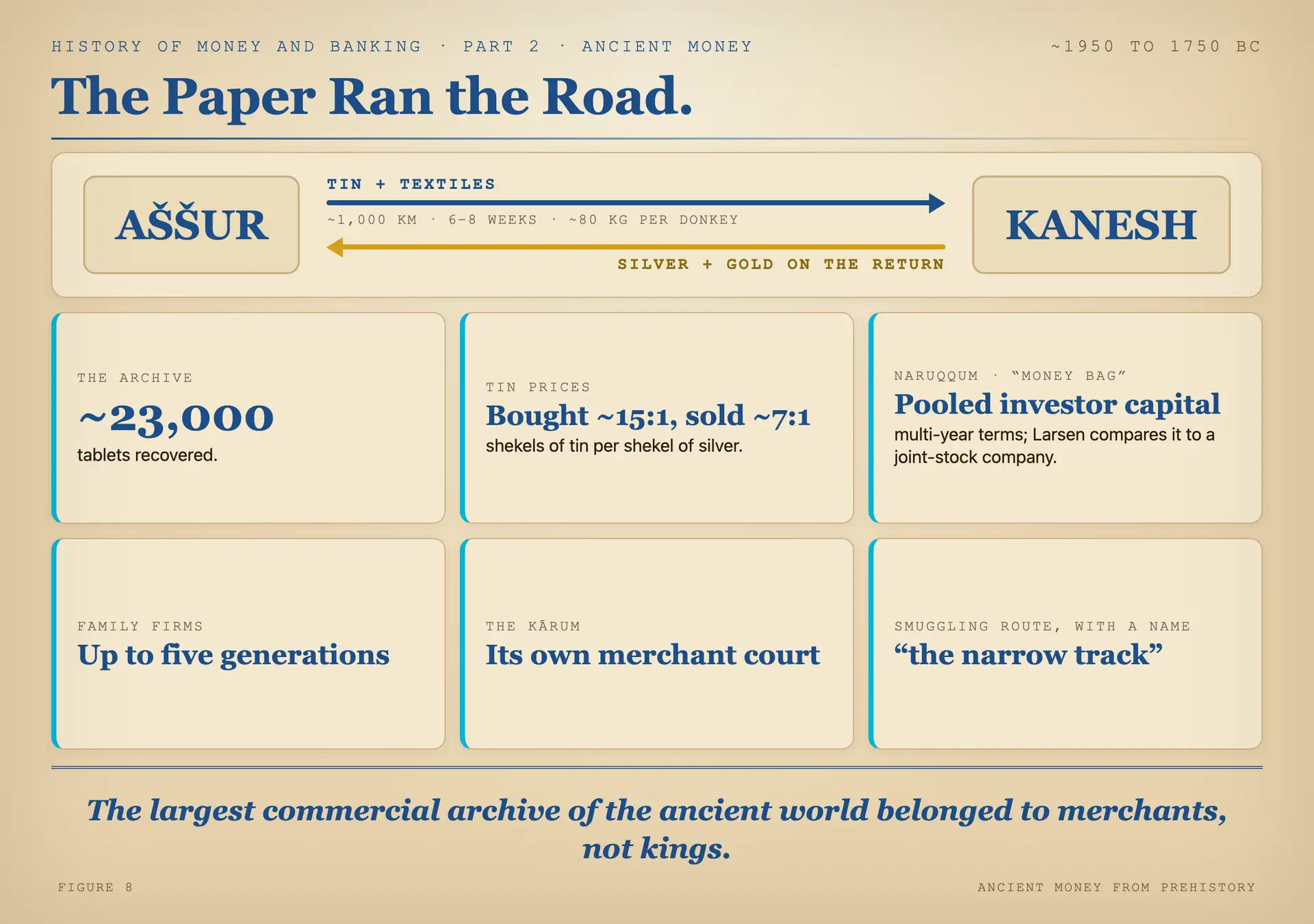
The largest commercial archive of the ancient world belonged to merchant families, not kings: the money answered to whoever kept the books.
Kültepe, ancient Kanesh, ~1950-1750 BC. Out of the ruins of its merchant quarter, the kārum, excavators have recovered roughly 23,000 cuneiform tablets; publication is ongoing and the counts vary.⁵⁵ They are not royal propaganda and they are not temple hymns. They are the private business archive of Assyrian merchant families, the largest commercial archive of the ancient world, and for the first time in this story, we get to read the mail.
Caravan accounts. Loan contracts. Marriage contracts. Letters between husbands and wives, brothers and partners, arguing about freight and margins. The ancient world usually speaks to us in the voice of kings and priests, because kings and priests controlled the durable media.
Kanesh talks like a commercial trade show.
A king lies in stone, for an audience of gods and posterity. A merchant writing to his partner about a late shipment only lies in the ways that get audited, which is far more useful to us.
The business worked like this: Tin and textiles were hauled roughly 1,000 km overland from the city of Aššur, six to eight weeks by donkey caravan, roughly 80 kg to the animal.⁵⁶ At the far end, the donkeys themselves were sold off. Even the truck was inventory. Silver and gold flowed back down the same road to Aššur, and the circuit turned again.
The margins justified all of it. Tin bought at around 15 shekels of tin per shekel of silver in Aššur sold at around 7 in Anatolia.⁵⁷
Money doubled on the metal alone, before the textile markup.
That is the kind of spread that gets a civilization to take paperwork seriously.
Ever read a commercial term sheet? They did! To fund these ventures, the merchants built an instrument called the naruqqum, literally "money bag": investors back in Aššur, women among them, pooled capital to bankroll a trader's operations in Anatolia for a term of years, with profits distributed at the end.⁵⁸ Mogens Trolle Larsen, the historian who knows this archive best, compares the structure to a joint-stock company. His comparison, not mine, and he has read more of these tablets than almost anyone alive.
The capital stayed in Aššur. The risk walked to Anatolia. The contract ran for years, the books were kept the whole way, and the payout came at the end, split among investors who never saddled a donkey.
It does not stop there. The firms ran working-capital loans, the be'ūlātum. They wrote agency and commission contracts. Carriers worked for hire. Family firms spanned as many as five generations. And the kārum kept its own merchant assembly, which enforced contracts and levied fines: a commercial court the traders ran themselves.⁵⁹
Bronze Age Anatolia had capital pooling, employment contracts, and commercial arbitration. It also had, inevitably, tax evasion.
The caravans paid duties along the road, and the caravans dodged. A merchant named Buzazu instructed his people to move tin "via the narrow track" if the road was clear, and if not, to make small packets of it and slip it into Kanesh "concealed in their underwear"; the translation is the British Museum's, from its publication of the letter.⁶⁰ The tablets name the smuggling route. The narrow track: tax evasion with its own toponym.
Four thousand years before the offshore account, the compliance arms race was already running at full speed.
The tablets hold the home front too. Back in Aššur, the wives ran the production side of the export machine, and they wrote to their husbands constantly. Lamassi, wife of the merchant Pušu-kēn, wove the very textiles he was selling a thousand kilometers away, and told him so: "I try my best to make and send textiles to you!" in Cécile Michel's translation.⁶¹
And one letter I will paraphrase rather than quote, because we know her plea only through translators. Taram-Kubi wrote to her husband Innaya, too many seasons gone in Anatolia. Come home to Aššur, she urged him. Come look on your god and your hearth. Let me see you again, while I still live.⁶²
Four thousand years, and it still lands like a modern drama, or an account of real wives who miss their traveling husbands.
The road split families, and the contracts kept up: a merchant might hold a wife in Aššur and a second, legally distinct wife in Anatolia, the arrangements written down like everything else.⁶³ The archive does not blush.
Kanesh is the best-lit room, not the whole house. The Palermo Stone records, under the pharaoh Sneferu ~2600 BC, the bringing of forty ships of cedar; whether the ships were laden with cedar or built of it is a live translation dispute, and Egyptologists still argue it.⁶⁴ Sargon of Akkad boasted, in a text that survives through a later scribal copy, that ships of Meluhha, Magan, and Dilmun tied up at the quay of his capital.⁶⁵ That is the Indus Valley, Oman, and Bahrain in one sentence of royal bragging.
And one drowned hull says the rest. Off Uluburun, ~1320 ±15 BC, a Late Bronze Age ship went down carrying ten tons of Cypriot copper, a ton of tin, some 175 glass ingots in cobalt blue, turquoise, and lavender, plus ebony, ivory, and resin in Canaanite jars.⁶⁶ One ship, drawing on the products of at least seven identified cultures, sitting on the seafloor like a core sample of an entire world economy.
So stand all the way back, on a mountaintop, if you must, and look at the map. The first trade routes on record radiate out of this one region, and I do not believe that is because these people out-traded everyone else on earth. People traded everywhere. The difference is that the record itself was invented here. Writing grew out of the accounting this trade demanded: the tokens became sealed envelopes became tablets, precisely so a donkey load of tin could be trusted at the far end of a six-week road. The ledger did not follow the trade; the ledger is how the trade scaled.
We can read their smuggling routes and their shipping complaints. Trade this old only has a history where someone kept the books.
The Neighbors' Books (~800-486 BC)
Ok, so we have covered the inventors of the ledger and one Assyrian trading post that ran on it. What about everyone around them? Well, the whole neighborhood kept books too. Different gods, different kings, same instinct: write it down.
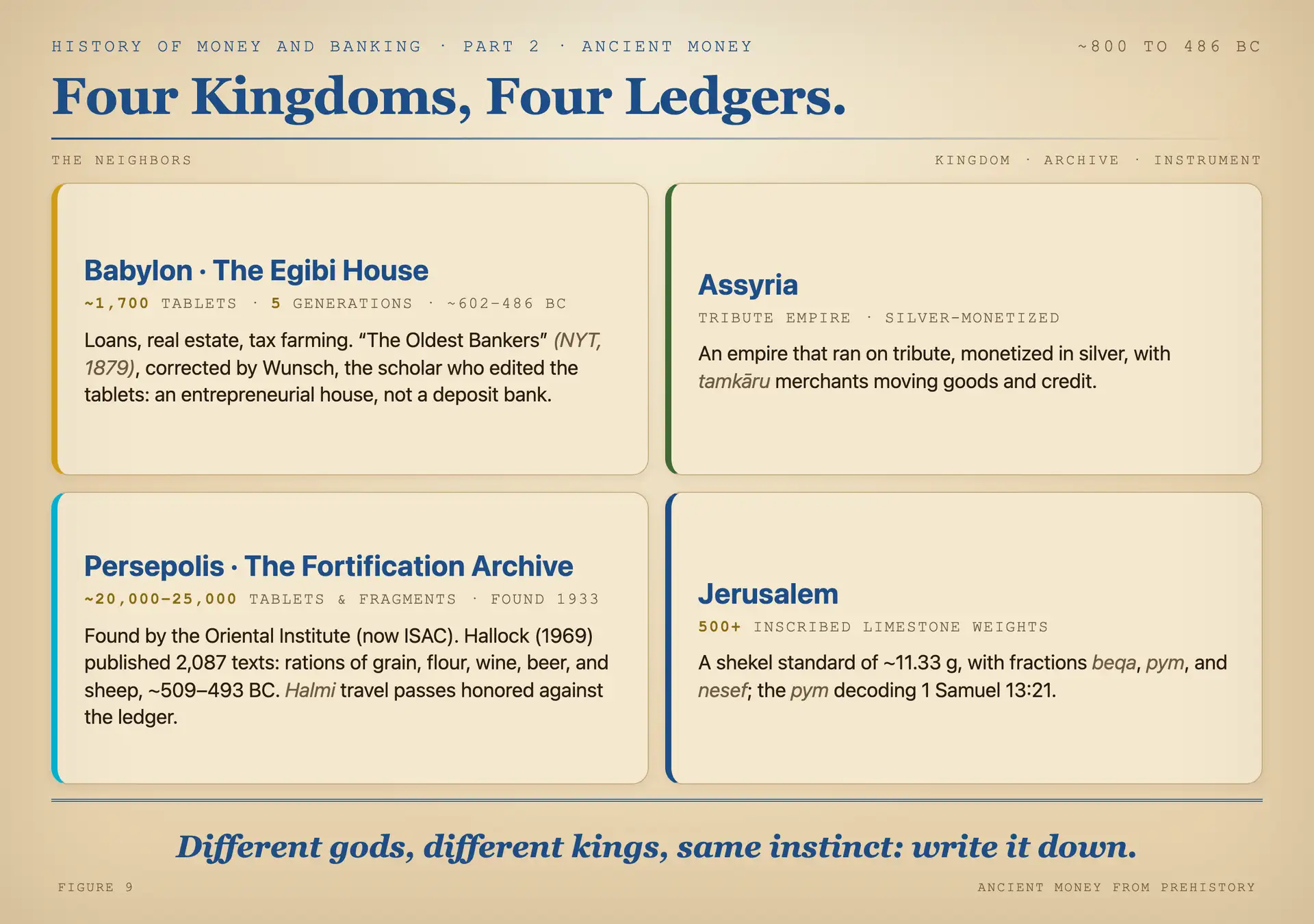
Babylon's family ledgers, Assyria's silver, Persepolis's receipts, Jerusalem's weights: four different systems, and every one of them was a record before it was anything else.
Start in Babylon, with the Egibi family: roughly 1,700 tablets covering five generations of one house, ~602-486 BC.⁶⁷ Deposits accepted. Loans extended. Real estate traded. Taxes farmed. Marriages arranged. All of it on clay, all of it filed, and enough of it dug up to reconstruct the family business across a century.
In 1879, the New York Times introduced them to the modern world under the headline "Egibi & Co.: The Oldest Bankers."⁶⁸ Tremendous headline. Mostly wrong. Cornelia Wunsch, the scholar who actually edited the largest share of the tablets, corrects it: the Egibi were an entrepreneurial house trading on their own account, not deposit bankers lending out other people's money.
I love it when this happens. The 1879 version was better journalism than history, and the tablets are better history than the headline: a private house, running its own capital, keeping its own books while the kingdoms around it changed hands. Even our oldest banking legend turns out to be a better story when you read the primary record. And a family house whose ledgers outlived empires is a happening worth remembering, because this series meets it again when the echo of it rhymes in Renaissance Florence.
Assyria gets one breath: an empire of tribute and requisition, heavily monetized in silver, its merchants (the tamkāru) moving goods and extending credit under imperial protection.⁶⁹
Persia gets more, because Persia is personal for me.
In March 1933, in two small rooms inside a bastion of the Persepolis fortification wall, Ernst Herzfeld's expedition, digging for the Oriental Institute of the University of Chicago, hit an archive.
Not gold. Paperwork.
Herzfeld estimated as many as 30,000 tablets and fragments. They were crated into 2,353 numbered boxes and shipped to Chicago, where roughly 20,000 to 25,000 tablets and fragments are held and studied today.⁷⁰ Richard Hallock's foundational 1969 edition published 2,087 of the Elamite texts.⁷¹
And what did the empire of Cyrus and Darius write down and seal in a fortress wall? Grocery receipts. Sixteen regnal years of Darius I, ~509-493 BC: rations of grain, flour, wine, beer, and sheep, issued to workers, officials, and travelers.⁷² A traveler on the royal roads carried a halmi, a sealed authorization entitling the bearer to rations at stations along the way: a passport that was also a meal ticket, honored against the ledger. Show the seal, eat the meal, and somewhere a scribe debits the station's account.
An empire running on receipts as currency.
And yes: this is the same institution where my favorite teacher, Mr. B, gave his tours. The Oriental Institute is the Institute for the Study of Ancient Cultures now, and the great Persian bull he lectured in front of was excavated at Persepolis by the same expedition tradition that crated up an empire's paperwork.
The bull was the postcard. The archive is the point.
Two precision notes before we move. The separate Persepolis Treasury Archive records silver payments made in lieu of rations; the fortification tablets are the ration ledger proper. And Darius did strike coins: the gold daric, minted from ~515 BC, coinage as royal prerogative. But the archive shows the interior of the empire still running on rations and records, not coins. The daric existed; the day-to-day empire ran on clay.
Then south, to Jerusalem.
From the ground: more than 500 inscribed limestone weights of Iron Age II Judah, roughly the 8th to the early 6th century BC, a homogeneous system centered on a shekel of ~11.33 grams, with named fractions: the beqa, the pym, the nesef.⁷³ The pym is so obscure that its archaeological recovery decoded an odd verse in 1 Samuel 13. And a beqa weight was sifted out of First Temple-period fill from beneath Robinson's Arch at the Western Wall.⁷⁴ The standard in the text and the standard in the dirt agree.
That is the part archaeology can weigh against the Hebrew Old Testament. The part it cannot weigh is what the text asks the ledger to do.
Torah legislates the ledger, and then legislates its erasure. Deuteronomy 15, in the NRSVUE translation: "Every seventh year you shall grant a remission of debts. And this is the manner of the remission: every creditor shall remit the claim that is held against a neighbor, not exacting it, because the LORD's remission has been proclaimed."⁷⁵
And Leviticus 25, on the fiftieth year, again NRSVUE: "you shall hallow the fiftieth year, and you shall proclaim liberty throughout the land to all its inhabitants. It shall be a Jubilee for you: you shall return, every one of you, to your property and every one of you to your family."⁷⁶
The economist Michael Hudson, citing the Assyriologist and biblical scholar Baruch Levine, traces dror, the Jubilee's word for liberty, back to Akkadian andurārum, the Mesopotamian clean-slate proclamation.⁷⁷ The reset button we met in Sumer flowed through Babylon into the Torah. Whether the Jubilee was ever actually practiced in Israel's history is its own open scholarly question; the historical books never narrate one, but it is recorded in Scripture.
As for the temple's vault: 1 Kings records Shishak of Egypt carrying off "the treasures of the house of the LORD" in the fifth year of Rehoboam, ~925 BC. Egypt kept its own record. Shoshenq I's great relief at Karnak commemorates the campaign, but Jerusalem is absent from the surviving name-rings, and scholars genuinely disagree about how far the relief corroborates the raid: Kenneth Kitchen reads tribute without a siege, Israel Finkelstein reads later construction.⁷⁸ I am not going to settle from my desk what Egyptology cannot settle from the wall, but the shape of history fits what we now know just from this article, and it fits better the more you care to look.
Every temple in this story has a vault under it.
Data as Money (The Whole Run)
Time for me to step out from behind the exhibits one last time.
We opened this story with a sealed clay ball on a museum workbench, and I told you it was money. Cones and spheres inside a tamper-proof shell: a count somebody needed to prove later. Now walk the whole hall with me, because every glass case filled with antiquities holds the same object wearing the marks of the values of different ancient cultures, but they are the same nonetheless.
The bulla was information under seal. The shekel was a standard under authority. The loan tablet was enforceable memory. The clean slate was the authority editing its own ledger in public. Kanesh was a network trusting its own paper across a thousand kilometers of bad road. Persepolis was an empire running on receipts.
What is that object?
Data.
Bits of data transacted over space and time by people who were very comfortable with abstractions of value.
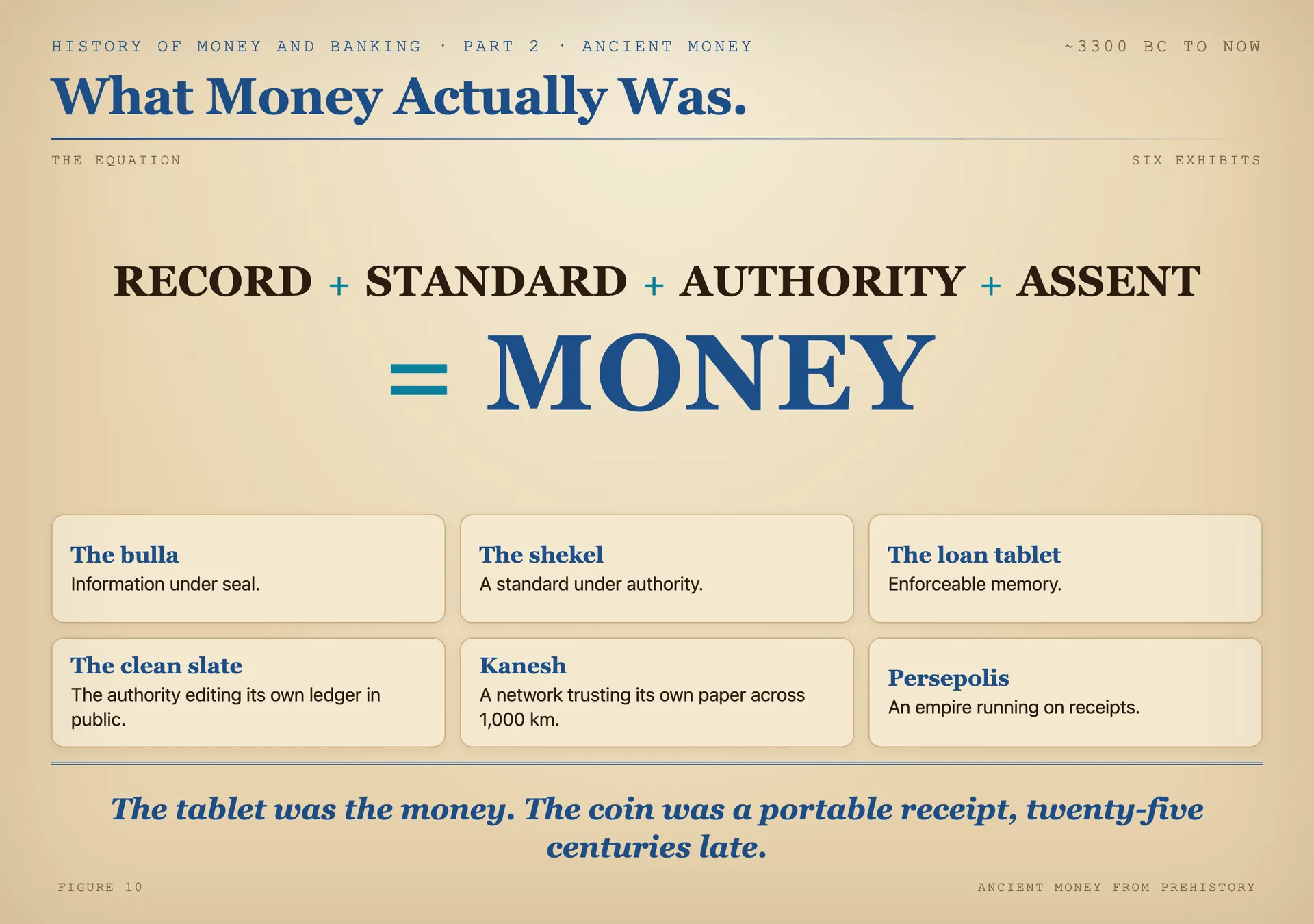
Strip the metal out of the story and what remains is what money actually was: a record, a standard, and an authority everybody agreed to believe.
Not one of those things is a lump of metal. Every one of them is a record, kept to a standard, enforced by an authority, and believed by everyone who had to transact against it. Silver showed up by weight when the books needed settling. The books did the daily work.
We usually tell this story backwards, with trinkets or coinage as the invention and the ledger as the afterthought to keep track of physical holdings.
On the evidence, it ran the other way around for at least twenty-five hundred years.
And now 1776 comes back out of the pocket I asked you to put it in earlier in this exposition. The year the modern economy got its founding text from Adam Smith is the year the barter myth went to print inside it. The machine and its origin story shipped together, and the story has outlived every fact-check since.
Money, when it truly works, is information under authority: a record, a standard, and common assent. The tablet WAS the money. The coin was a portable receipt that arrived twenty-five centuries into the story. The first writing humans ever pressed into clay was a ledger, and the newest form of money is a ledger too: distributed in bits, recorded in multiplicate, and abstracted as tiny signed contracts that are further abstracted as "coins."
Amazing...
The trust architecture, ancient edition
A declared standard (the shekel, the deben). A kept record (the tablet, the ration ledger). An enforcing authority (the temple, the palace, the code). Common assent, renewed every time a seal was pressed. That is what money was for its first three thousand years on record. The metal was the least interesting part.
And notice where the books were kept. The first banks in this story were temples: grain and silver stored under divine authority, standardized weights kept in the sanctuary, the ledger trusted because the god was watching. The sanctuary was the security model. Four thousand years after Uruk, the knights of Part 1 ran the money of Europe from an order literally named for the Temple of Solomon, headquartered on the Temple Mount. When Part 1 said of the Templar credit notes that "the note was data, and the data was money," it was quoting a truth the clay had already known for four millennia.
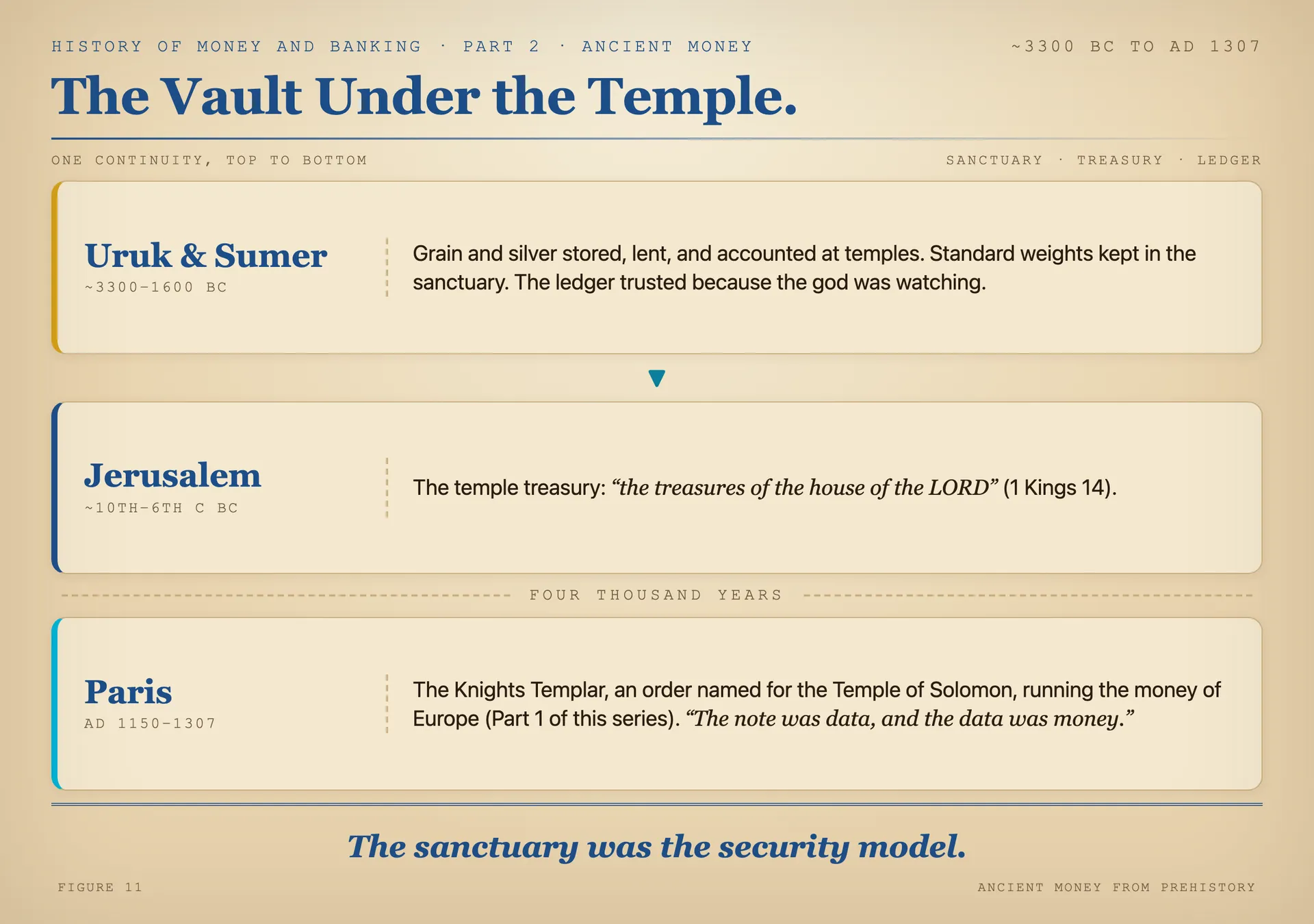
The first banks were temples because a ledger is only as good as the authority guarding it, and nothing outranked the god.
So the standing questions of this series come home from the ancient world, so far back that we don't truly know the origin. Who keeps the record? Who certifies the weight? What happens when the authority's ledger fails? The tomb-builders sat down at Deir el-Medina until they were paid.
That is what happens.
And what happens when the authority rewrites the ledger in its own favor? The clean slates were one answer, proclaimed in the open...
Later in this series come the kings who rewrote their coins instead, and did not proclaim anything.
Soon, the tables come out. The Greek trapezitai, the "table-men" of the Athenian agora, take deposits and change coins in the open air.⁷⁹ And Rome will strike its silver inside the temple of Juno Moneta, the goddess whose epithet, perhaps from the mint established there around 269 BC, gives us the very word "money."⁸⁰
The temple keeps the vault for another two thousand years, and somewhere between the fall of Rome, debasement of stones on Yap, and the establishment of the Federal Reserve Board, we will debate Keynes vs Hayek, but we have already learned that debt, credit and promises have been money since those promises were molded in clay.
Be good to each other. And stay curious.
Kurt Wuckert Jr. is the Chief Bitcoin Historian, founder of GorillaPool and Open Protocol Labs, and host of Kurt's Podcast. He writes weekly on Bitcoin, geopolitics, faith, and the long fight for human sovereignty at kurtwuckertjr.com. Catch him live every Tuesday at 2 PM EST.
Footnotes
¹ Denise Schmandt-Besserat, Before Writing, Vol. 1: From Counting to Cuneiform, University of Texas Press, 1992; the token-and-bulla accounting model.
² Denise Schmandt-Besserat, Before Writing, Vol. 1: From Counting to Cuneiform, University of Texas Press, 1992; the token-and-bulla accounting model.
³ Aristotle, Politics, Book I, Part IX, trans. Benjamin Jowett.
⁴ Adam Smith, An Inquiry into the Nature and Causes of the Wealth of Nations, 1776, Book I, ch. IV.
⁵ Adam Smith, An Inquiry into the Nature and Causes of the Wealth of Nations, 1776, Book I, ch. IV.
⁶ Caroline Humphrey, "Barter and Economic Disintegration," Man (n.s.) 20, no. 1, March 1985, p. 48.
⁷ Caroline Humphrey, "Barter and Economic Disintegration," Man (n.s.) 20, no. 1, March 1985.
⁸ A. Mitchell Innes, "What is Money?", Banking Law Journal, May 1913; "The Credit Theory of Money," Banking Law Journal 31, 1914, pp. 151-168.
⁹ David Graeber, Debt: The First 5,000 Years, Melville House, 2011, ch. 2; Julio Huato, "Graeber's Debt: When a Wealth of Facts Confronts a Poverty of Theory," Science & Society 79(2), 2015.
¹⁰ Archaeological finds at Yinxu, Anyang; bronze imitation cowries (tong bei) attested from the Western Zhou period.
¹¹ Massachusetts Bay Colony General Court records, 1637-1661; Federal Reserve Bank of Boston, "History of Colonial Money."
¹² George Dalton, "Primitive Money," American Anthropologist 67(1), 1965, pp. 44-65.
¹³ Göbekli Tepe Layer III (PPNA) radiocarbon dating, ~9600-8800 cal BC; German Archaeological Institute excavations.
¹⁴ Göbekli Tepe Layer III (PPNA) radiocarbon dating, ~9600-8800 cal BC; German Archaeological Institute excavations.
¹⁵ Klaus Schmidt, "Zuerst kam der Tempel, dann die Stadt," Istanbuler Mitteilungen 50, 2000, pp. 5-41.
¹⁶ German Archaeological Institute, Göbekli Tepe project research under Lee Clare; "Tepe Telegrams" project reports.
¹⁷ Society for American Archaeology open letter on Ancient Apocalypse, 2022.
¹⁸ Göbekli Tepe Layer III (PPNA) radiocarbon dating, ~9600-8800 cal BC; German Archaeological Institute excavations.
¹⁹ Obsidian sourcing at Göbekli Tepe: Bingöl A, Bingöl B, and East Göllü Dağ outcrops; McMaster Archaeological XRF Laboratory.
²⁰ University of Chicago News, "Oriental Institute changes name to the Institute for the Study of Ancient Cultures, West Asia & North Africa," April 4, 2023.
²¹ Kurt Wuckert Jr., "A tribute to Doug Baldwin: inspiring educator, guiding light, and champion of the Christian faith," Medium, April 28, 2023.
²² Robert K. Englund, proto-cuneiform corpus analysis, Cuneiform Digital Library Initiative; Hans J. Nissen, Peter Damerow, and Robert K. Englund, Archaic Bookkeeping: Early Writing and Techniques of Economic Administration in the Ancient Near East, University of Chicago Press, 1993.
²³ Early Dynastic IIIa literary tablets from Fara and Tell Abu Salabikh, ~2600-2500 BC; R.D. Biggs, Oriental Institute publications.
²⁴ The "Kushim" tablets, Uruk period, ~3200 BC; the personal-name reading is debated among Sumerologists.
²⁵ Denise Schmandt-Besserat, Before Writing, University of Texas Press, 1992; How Writing Came About, 1996.
²⁶ Paul Zimansky, review of Before Writing, Journal of Field Archaeology 20.4, 1993, pp. 513-517.
²⁷ Tablet TMHC NF 1/2 31, trans. Steven J. Garfinkle, "Shepherds, Merchants, and Credit: Some Observations on Lending Practices in Ur III Mesopotamia," Journal of the Economic and Social History of the Orient 47.1, 2004, p. 4.
²⁸ Tablet NATN 266, trans. Garfinkle, JESHO 47.1, 2004, pp. 4-5.
²⁹ Garfinkle, JESHO 47.1, 2004, on Ur III loan typology: customary, interest-free, and antichretic loans.
³⁰ Tablet ZA 93/2 4, discussed in Garfinkle, JESHO 47.1, 2004.
³¹ Michael Hudson, "How Interest Rates Were Set, 2500 BC-1000 AD," Journal of the Economic and Social History of the Orient 43, 2000, pp. 132-161.
³² Hudson, JESHO 43, 2000; Ur III rates per Garfinkle 2004, p. 6, citing Marc Van De Mieroop.
³³ Laws of Ur-Namma, ~2100 BC; provision numbering varies across editions (Roth 1997; Civil 2011).
³⁴ Laws of Eshnunna §1-2 and §18A, trans. Martha T. Roth, Law Collections from Mesopotamia and Asia Minor, 2nd ed., 1997.
³⁵ Laws of Hammurabi, gap ¶t, trans. Roth 1997, p. 97; quoted in Garfinkle, JESHO 47.1, 2004, p. 14.
³⁶ Laws of Hammurabi §117, trans. Roth 1997.
³⁷ Laws of Hammurabi §120-125, per Roth 1997.
³⁸ Enmetena of Lagash inscription, ~2400 BC, per Maurice Lambert's 1972 identification of the decree as a debt cancellation; Samuel Noah Kramer, The Sumerians: Their History, Culture, and Character, 1963.
³⁹ Urukagina reform inscriptions, Lagash, ~2350 BC.
⁴⁰ J.J. Finkelstein, "The Edict of Ammiṣaduqa: A New Text," Revue d'Assyriologie 63, 1969, pp. 45-64, at p. 58.
⁴¹ Michael Hudson, ...and forgive them their debts, ISLET, 2018.
⁴² Hudson, "Palatial Credit: Origins of Money and Interest," 2018; on the more cautious mainstream framing of temple and palace credit, e.g., Marc Van De Mieroop's institutional-economy scholarship.
⁴³ Marvin A. Powell, "Money in Mesopotamia," Journal of the Economic and Social History of the Orient 39.3, 1996, pp. 224-242.
⁴⁴ Eric L. Cripps, "The Structure of Prices in the Neo-Sumerian Economy (I)," Cuneiform Digital Library Journal 2017, analyzing 157 price attestations.
⁴⁵ Salvatore Monaco and Francesco Pomponio, "The Use of Silver in Mesopotamian Texts from Archaic to Old-Akkadian Periods," Rivista di storia economica, 2009.
⁴⁶ Ephraim Stern on the Tel Dor hoard; Seymour Gitin and Amir Golani on the Tel Miqne-Ekron hoards; in Miriam S. Balmuth, ed., Hacksilber to Coinage, American Numismatic Society, 2001; Cisjordan Corpus per the Hacksilber Project (dir. Christine Thompson).
⁴⁷ New Kingdom deben ~91 g; deben/kite price data from Deir el-Medina ostraca, per Jac. J. Janssen, Commodity Prices from the Ramessid Period, Brill, 1975.
⁴⁸ Turin Strike Papyrus (Museo Egizio, Turin); William F. Edgerton, "The Strikes in Ramses III's Twenty-Ninth Year," Journal of Near Eastern Studies 10.3, 1951, pp. 137-145.
⁴⁹ The Artemision foundation deposit at Ephesus; dating debated between ~600 BC (older scholarship) and the 570s BC (Karwiese; Kroll).
⁵⁰ Herodotus, Histories 1.94, trans. G.C. Macaulay; presented as an ancient claim, not settled numismatics.
⁵¹ Croeseid bimetallic coinage, ~550s BC; daric/siglos dating via the Apadana deposit (c. 519-510 BC), which contains Croeseids but no Persian royal coinage.
⁵² Colin Renfrew, J.E. Dixon, and J.R. Cann, obsidian trace-element sourcing studies, from 1968; Çatalhöyük sourcing per Carter et al., Archaeometry 49.2, 2007.
⁵³ McMaster Archaeological XRF Laboratory, Göbekli Tepe obsidian sourcing: Bingöl A, Bingöl B, East Göllü Dağ.
⁵⁴ Badakhshan lapis road; Naqada Grave T29, lapis beads with imported Mesopotamian cylinder seal.
⁵⁵ The Old Assyrian merchant archives of Kültepe (kārum Kanesh); tablet counts per Cécile Michel and the UNESCO Memory of the World nomination, 2014.
⁵⁶ Aššur-Kanesh caravan circuit: ~1,000 km, 6-8 weeks, ~80 kg loads; Metropolitan Museum of Art Old Assyrian caravan-account object notes; Archaeology Magazine, March/April 2018.
⁵⁷ Old Assyrian tin exchange rates, ~15 at Aššur vs ~7 in Anatolia; Belleten 83/298, 2019.
⁵⁸ The naruqqum investment contract; Mogens Trolle Larsen, Ancient Kanesh: A Merchant Colony in Bronze Age Anatolia, Cambridge University Press, 2015.
⁵⁹ Old Assyrian commercial instruments and the kārum assembly; Larsen 2015; Klaas R. Veenhof's Old Assyrian studies.
⁶⁰ Old Assyrian letter of Buzazu, trans. per Mathilde Touillon-Ricci, "Trade and contraband in ancient Assyria," British Museum blog, April 2, 2018.
⁶¹ Letter of Lamassi to Pušu-kēn, trans. Cécile Michel; per Archaeology Magazine, "Assyrian Women of Letters," Nov/Dec 2023.
⁶² Letter of Taram-Kubi to Innaya, Old Assyrian correspondence; per Cécile Michel's published translations.
⁶³ Old Assyrian marriage and divorce contracts; Klaas R. Veenhof, "Two Marriage Documents from Kültepe," Archivum Anatolicum, 1998.
⁶⁴ Palermo Stone, royal annals, reign of Sneferu, ~2600 BC; the cargo-vs-hull translation ambiguity is noted in Egyptological literature.
⁶⁵ Sargon of Akkad inscription, known from an Old Babylonian copy; Douglas Frayne, The Royal Inscriptions of Mesopotamia: Sargonic and Gutian Periods (RIME 2), 1993.
⁶⁶ Uluburun shipwreck excavation, Institute of Nautical Archaeology (excavation directed by Cemal Pulak), 1984-1994; radiocarbon dating ~1320 ±15 BC.
⁶⁷ The Egibi family archive, Neo-Babylonian Babylon, ~602-486 BC, ~1,700 tablets.
⁶⁸ "Egibi & Co.: The Oldest Bankers," New York Times, 1879; the corrective per Cornelia Wunsch's editions and studies of the Egibi archive.
⁶⁹ Karen Radner, "Money in the Neo-Assyrian Empire," in J.G. Dercksen, ed., Trade and Finance in Ancient Mesopotamia, NINO, 1999, pp. 127-157.
⁷⁰ Persepolis Fortification Archive: discovered March 1933, Ernst Herzfeld, Oriental Institute expedition; holdings estimates per ISAC, the Institute for the Study of Ancient Cultures.
⁷¹ Richard T. Hallock, Persepolis Fortification Tablets, Oriental Institute Publications 92, University of Chicago Press, 1969.
⁷² Fortification texts, regnal years 13-28 of Darius I; halmi travel authorizations; Persepolis Fortification Archive Project, directed by Matthew W. Stolper.
⁷³ Judean inscribed shekel weights, Iron Age II; >500 known, shekel standard ~11.33 g; beqa, pym, and nesef denominations.
⁷⁴ Beqa weight from Temple Mount Sifting Project wet-sifting of fill from beneath Robinson's Arch, Jerusalem, reported 2018.
⁷⁵ Deuteronomy 15, NRSVUE.
⁷⁶ Leviticus 25, NRSVUE.
⁷⁷ Michael Hudson, "The New Economic Archaeology of Debt," 2002, citing Baruch Levine on dror/andurārum.
⁷⁸ 1 Kings 14; Bubastite Portal relief of Shoshenq I, Karnak, ~925 BC; Jerusalem absent from surviving name-rings; positions per Kenneth Kitchen and Israel Finkelstein.
⁷⁹ The Athenian trapezitai; Raymond Bogaert, Banques et banquiers dans les cités grecques, Sijthoff, 1968.
⁸⁰ The Temple of Juno Moneta on the Capitoline; the Roman mint perhaps established there ~269 BC (Platner & Ashby, A Topographical Dictionary of Ancient Rome, 1929); moneta as the root of "money."