Did Hodlonaut Finally Agree With Me on Bitcoin Core?!
By Kurt Wuckert Jr.
Hodlonaut and I have a history of, what I would call, professional friction. I've never hated the guy, but I do passionately disagree with a lot of his worldview and his conclusions about Bitcoin. Unfortunately for our relationship, agreement about Bitcoin is, for him, the binary filter of whether or not the person on the other side of the conversation is an objectively good or bad person, so I don't expect we will ever have that handshake or a meeting of the minds. Oh well.
That said, I do think he is authentic in how he actually feels about Bitcoin and the governance of Bitcoin Core. And when I read his latest piece, The Lever on Citadel21, I realized something that is going to make him deeply uncomfortable.
We agree.
I have written and streamed about these exact governance issues inside BTC for nearly a decade. His article contains whole paragraphs that read like they were lifted directly from things I published at CoinGeek between 2020 and 2026. I am not exaggerating, and I am about to put the receipts on the table.
So let's talk about where he's right, and where I still think he's lost.
What "The Lever" Actually Says
For readers who have not yet seen the piece, here is the executive summary of what Hodlonaut documented.
He argues that an informal network around three institutions, Brink, Chaincode, and Optech, quietly captured Bitcoin Core through funding, mentorship, and merge access. By 2025, three of seven Core maintainers were Brink-funded. One of them was merging 56% of all annual changes. That is not a co-op. That is a desk.
He documents specific incidents:
The Luke Dashjr removal campaign in April 2021, where John Newbery, Greg Maxwell, Matt Corallo, and David Harding coordinated to push out the sole BIP editor over a Taproot-related pretext.
Jon Atack's ostracism after he raised a valid technical objection to a PR. He went from a top-five global Core contributor to near silence.
The Gloria Zhao versus Vasil Dimov asymmetry, where Zhao's maintainer nomination merged in six days over substantive NACKs, while Dimov's structurally identical nomination stalled for five months in unexplained silence and was then killed via private consultation.
John Newbery taking credit for a critical addrman bugfix that Atack actually discovered and diagnosed in IRC.
A class of "untouchables" forming inside Core, where contributors learn very quickly which developers cannot be criticized, and the cost of breaking that rule is your career.
Hodlonaut's central claim is that this capture works through social mechanisms, not formal policy. There is no rule to attack. There is no document to repeal. The whole machine runs on silence, ostracism, mentorship loops, and private consultation. He quotes Michael Folkson directly: "We've lost Core as an open source project."
Read the article. The receipts are real and the sourcing is good.
Now let me show you what I wrote between 2020 and 2026, because this is where it gets uncomfortable for him.
Where He Is Right (And Where I Got There First)
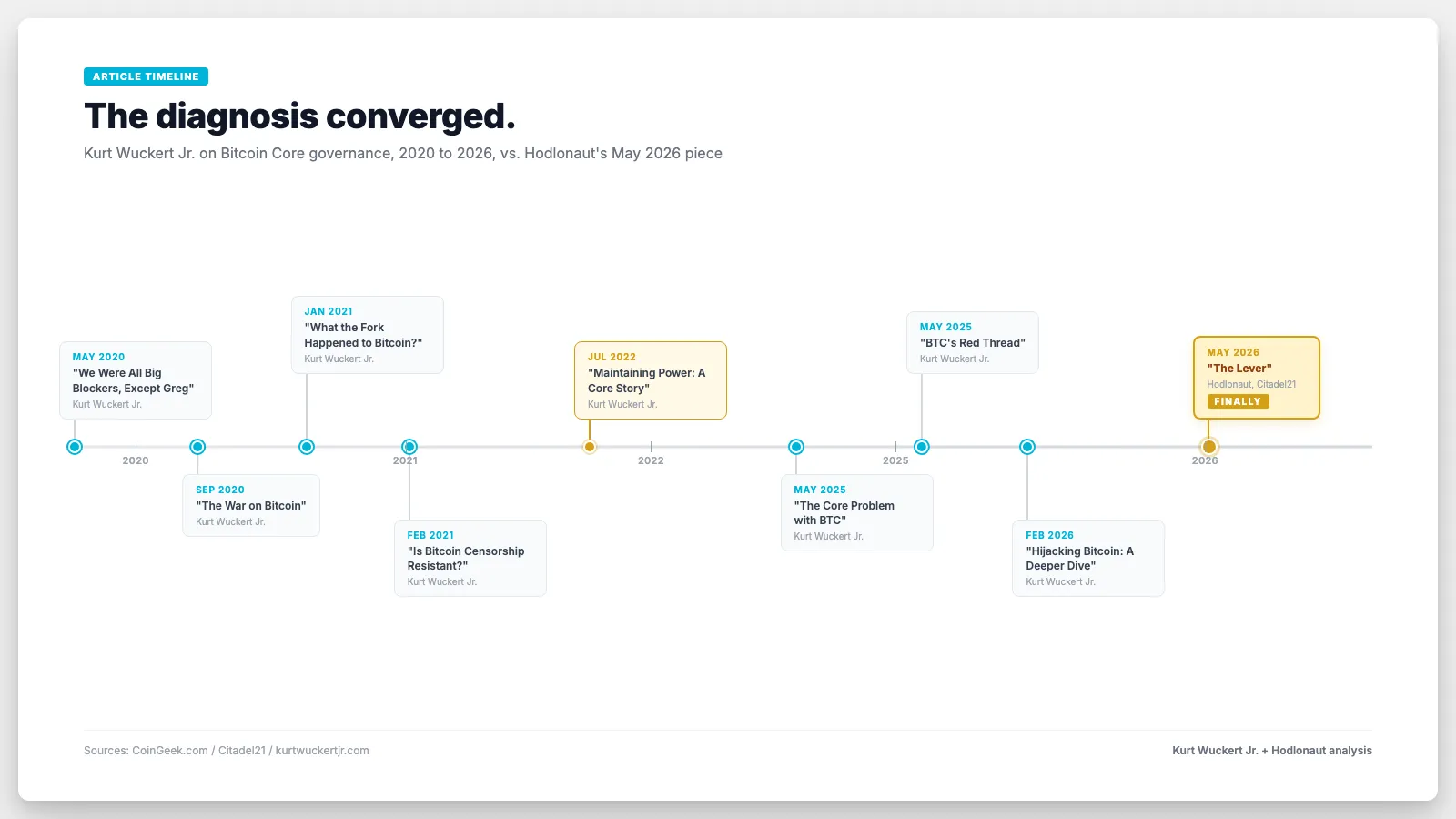
In May 2020, in Bitcoin History Part 2: 'We Were All Big Blockers, Except Greg', I traced the ideological capture of Core back to one man, Greg Maxwell, and one alliance, with Peter Todd. Mike Hearn put it on record. Maxwell openly believed Bitcoin should not work the way Satoshi designed it, and he positioned himself at the merge layer anyway. That was the seed of the politburo Hodlonaut is now mapping six years later.
In September 2020, in The War on Bitcoin, I documented the censorship infrastructure that Hodlonaut's piece treats as ambient background noise. Theymos running r/bitcoin like a Soviet broadcast booth. Bitcointalk shutting down dissent. Bitcoin XT and Bitcoin Classic nodes getting DDoSed off the network. That was the ground-level enforcement layer for the social capture he just discovered. It was not subtle. It was not accidental. It was a campaign.
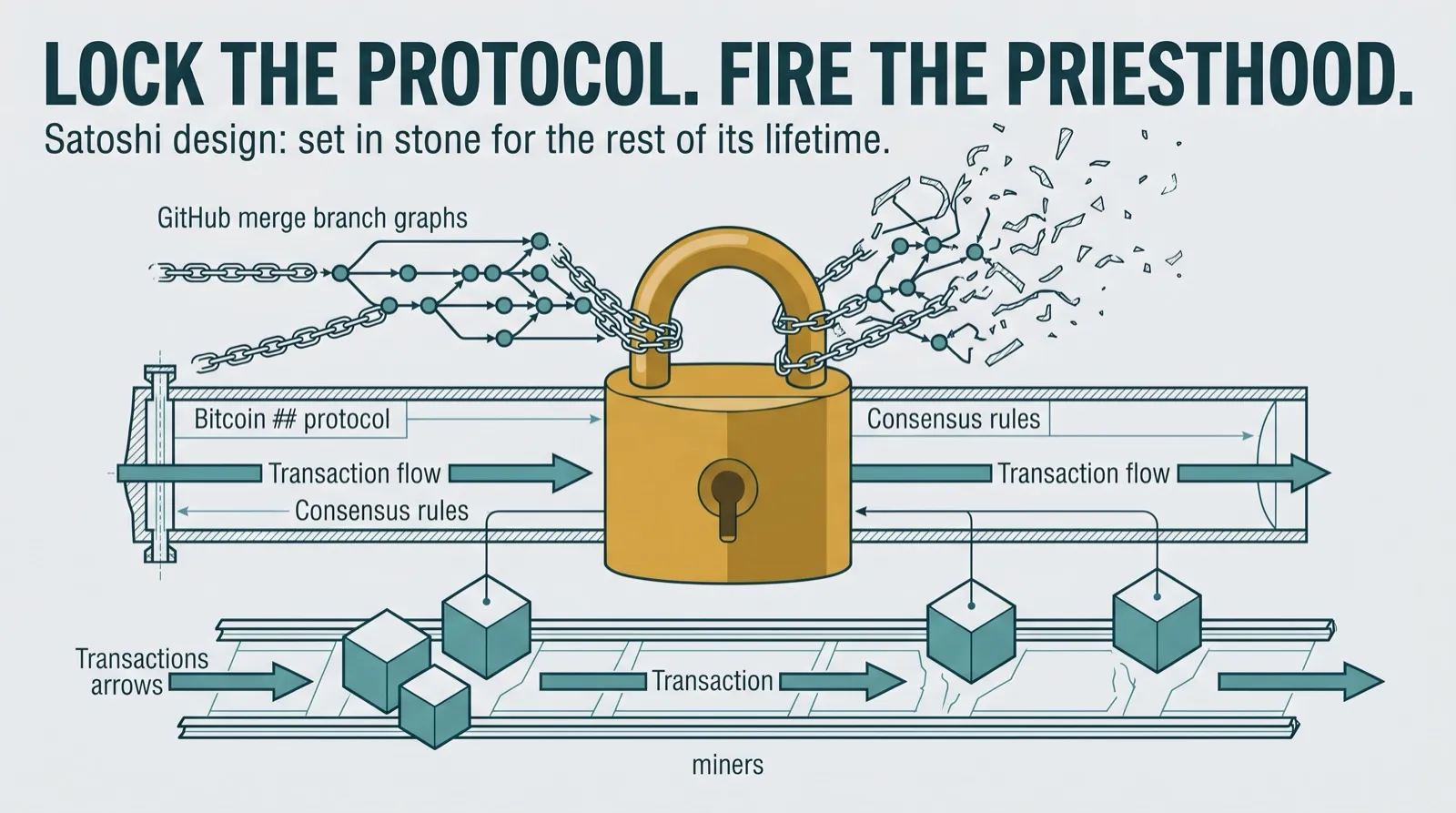
In January 2021, in What the Fork Happened to Bitcoin?, I argued that Bitcoin Core developers had illegitimately seized protocol control after Satoshi's departure and used soft forks to fundamentally alter the design. I cited Satoshi directly: "The nature of Bitcoin is such that once version 0.1 was released, the core design was set in stone for the rest of its lifetime." The fork to BSV was framed as a restoration of immutable rules. Lock the protocol, fire the priesthood. We will come back to that in a minute.
In February 2021, in Is Bitcoin Censorship Resistant?, I covered the 2013 chain reorganization, where Pieter Wuille and Luke Dashjr overruled Gavin Andresen and forced miners to abandon the longest chain. That was the first demonstrable proof on the public ledger that Core developers, not miners and not Nakamoto consensus, held ultimate governance power inside BTC. Wuille went on to co-found Blockstream. Dashjr went on to be the very BIP editor that the Brink crew tried to remove eight years later. The pattern was already visible in the chain data. People just refused to look.

Then in July 2022, the same month Gloria Zhao was added as a Core maintainer, I published Maintaining Power: A Core Story. I did not write that piece in 2026 looking backward with hindsight. I wrote it at the moment it happened. I called out, in real time, that adding Zhao would put three of seven maintainers under Brink funding, and that this was a structural concentration that should worry anyone who claimed to care about decentralization. I quoted the relevant pull request thread directly: "If this pull request is merged, there will be 7 maintainers and 3 funded by Brink. It would be better if maintainers were from different parts of the world and funded by different organizations." Hodlonaut's piece, three and a half years later, treats that exact event as a tipping point. I treated it as one when it was happening.
By May 2025, in The Core Problem with BTC, I had moved from observation to diagnosis. I wrote that Bitcoin Core's "policy changes begin life as GitHub pull requests, vetted by a small cohort of developers and eventually merged into the reference implementation." I called them invisible developer councils. Hodlonaut's word for the same machine is "lever." Same mechanism, different vocabulary.
Two weeks later, in BTC's Red Thread, I named the layer above the maintainers. The small blockers who appeared to have won the block size war were not actually in charge. "Their so-called power was performative, tolerated so long as it served the interests of the real elite: the intelligentsia of the protocol, conveniently backed by old-world money, by the way." That is the funding layer Hodlonaut hints at when he talks about Brink and Chaincode but never quite names directly. The maintainers are the lever. The hand on the lever is not theirs.
And in February 2026, just months before he published The Lever, I wrote Hijacking Bitcoin: A Deeper Dive, in which I made the cleanest version of the argument: "The rhetoric of 'decentralization' was used as a shield to justify a highly centralized control over the protocol's direction." That sentence is the one-line summary of his entire article.
So when Hodlonaut writes that informal social mechanisms can capture an open-source project more effectively than any formal conspiracy, he is right. He is also six years late to the conversation. The receipts are public, dated, and timestamped. The diagnosis converged. The man does not have to like me to be reading from the same chart I have been pointing at since 2020.
Where He Is Still Wrong
Here is the part he will not enjoy.
The Lever is a brilliant diagnostic. It is also a dead end. He documents the disease in extraordinary detail and then offers no medicine. Folkson gets the closest, with the line about needing to "route around this small group," but Hodlonaut himself stops at the warning: if you accept this as normal, it becomes irreversible.
Why won't he prescribe a cure? Because the cure breaks his religion.
The cure is exactly what I wrote in 2021. You have to lock the protocol.
As long as Core is a moving target, as long as a small group of developers controls a GitHub repository that the rest of the world treats as the rulebook, the social capture will reconstitute itself no matter who is sitting in the maintainer chairs. Get rid of Newbery, three more Brinks will sprout. Replace fanquake, the merge bottleneck just moves. You do not solve a politburo by changing politburo members. You solve it by deleting the politburo.
That is what BSV did. The protocol is locked. The set of consensus rules is fixed. The miners are the source of truth on which transactions are valid, and the developers are reduced to what Satoshi always said they should be, which is implementers and tooling builders. They do not get a vote on what Bitcoin is. They get to write software that follows the rules Bitcoin has at a fundamental, atomic level.
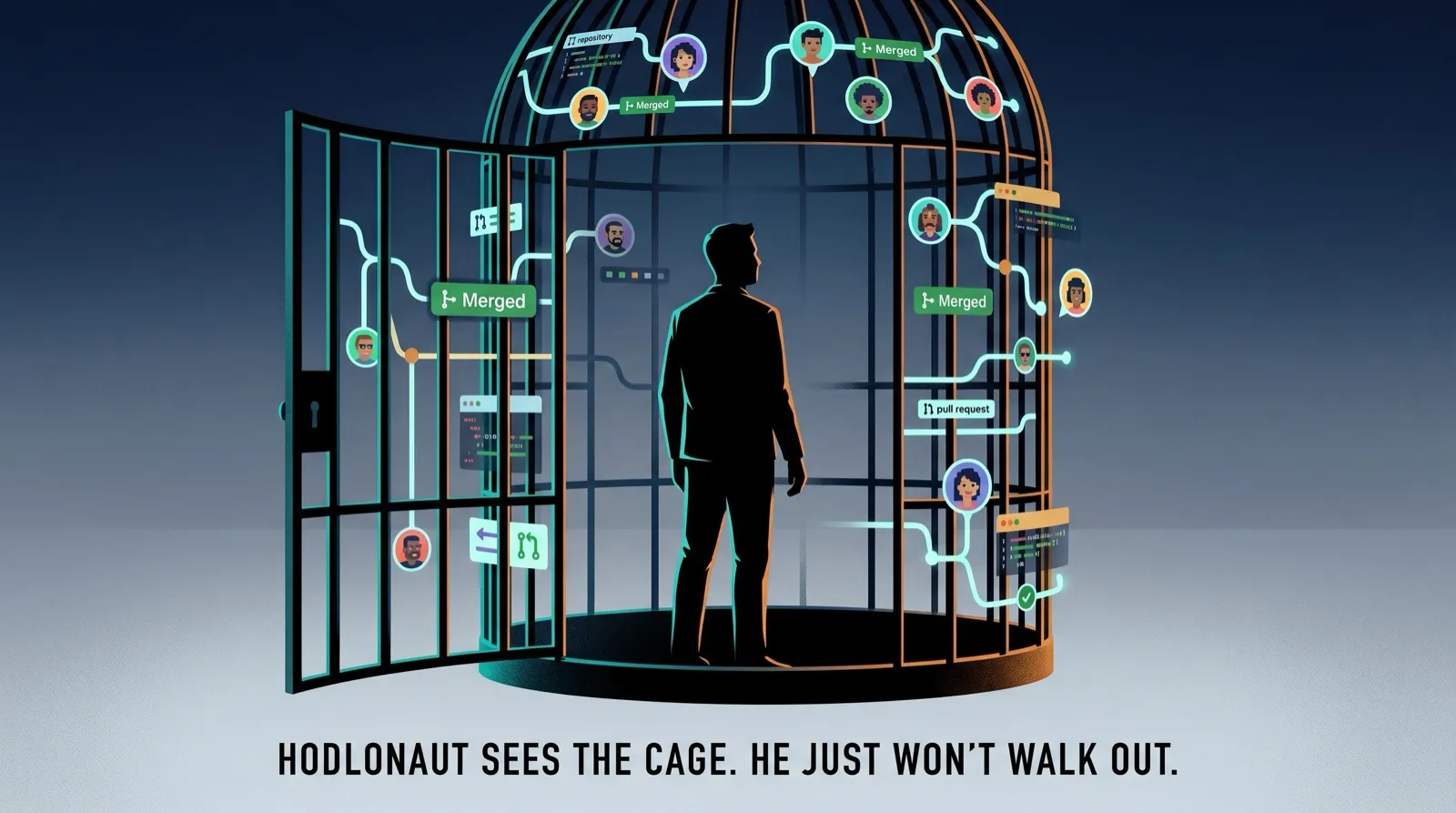
This is the move Hodlonaut cannot make, because it requires admitting that the side he chose in the block size war was not just wrong on scaling. They were wrong on governance, wrong on the nature of the protocol, and wrong about who Bitcoin was even for. He can document the cage in beautiful prose. He just won't walk out of it.
BTC, as it currently exists, is a museum exhibit of communist social engineering tactics used to undermine "the commons" in the name of "the plebs" while actually creating deeply cruel and corrupt hierarchies. It is a slowly mutating reference client steered by a narrow funding network with a captive media layer. You can write about that for the next decade and it will not change a thing, because the lever he is documenting is not a bug. It is the only thing keeping his version of Bitcoin coherent. Take the lever away and the whole story falls apart, because BTC has spent a decade quietly inverting Satoshi's design and the politburo is the only thing holding the inversion together.
The Handshake That Will Not Happen
I do not expect this article to repair anything between us. Hodlonaut filters human beings through a Bitcoin-position lens, and as long as I am BSV-aligned, I am on the wrong side of his binary. That is his choice, and I am long past trying to change it.
But I would like him, and the readers of his piece who showed up here through curiosity, to understand one thing.
The diagnosis you just put out at Citadel21 is not new. It is not original. It is not the first sober look at Core's social capture. It is the version of an argument I, and a lot of other people he refuses to read, were making in public, with our names attached, while his side was busy DDoSing dissenting nodes, banning developers from r/bitcoin, and treating "I disagree with the roadmap" as grounds for character assassination in 2015.
If he ever wants the handshake, I can assure him that it won't come with any hostility on my end. I really am just a guy who loves bitcoin, and our disagreements about the details never needed to become hostile between us.
The cure is the only conversation left.
Be good to each other. And lock your protocols.
Kurt Wuckert Jr. is the Chief Bitcoin Historian of the entire universe, founder of GorillaPool, bOpen and Open Protocol Labs, and host of Kurt's Podcast. He has been talking about Bitcoin governance, scaling, and protocol design in public since 2013.
Tags: Bitcoin Core, Bitcoin governance, Hodlonaut, BSV, Blockstream, Brink, Luke Dashjr, Greg Maxwell, block size war, protocol capture