Finding Satoshi: Not Even a Fresh GuesS!?
By Kurt Wuckert Jr.
The Verdict That Cannot Be Tested
William D. Cohan is a financial-scandal writer. His previous subjects are Lazard, Bear Stearns, and General Electric, and his bestseller Power Failure: The Rise and Fall of an American Icon is a forensic deep dive into Jack Welch's GE.¹² His reporting career lives inside banking, law, and corporate governance, which means Bitcoin sits outside his beat, and until this project he had never written a word about cryptography or peer-to-peer networking. That is the resume of the man whose new documentary Finding Satoshi premiered on April 22, 2026 at findingsatoshi.com, after four years of production and with early-access distribution tied to Coinbase.³
The film lands on a single verdict, delivered on camera by private investigator Tyler Maroney of Quest Research and Investigations: "If we take all of the circumstantial evidence, all of the empirical evidence, and all of the eyewitness testimony, the conclusion is that Hal Finney and Len Sassaman collaborated to create Bitcoin."⁴ Sassaman took his own life on July 3, 2011. Finney died of complications from ALS in August 2014. The film's central claim is that two deceased men jointly built the most consequential monetary protocol of the last fifty years, and that neither of them ever said so publicly while alive.
I want to be careful with my tone here. Hal Finney was one of the most decent people this industry has ever produced. Len Sassaman was a serious cryptographer whose contributions to remailer systems and privacy research are load-bearing in the history of computer security, and both men should be remembered for their important contributions to the world. My argument in what follows is with Cohan and Maroney's verdict, never with the men the film names. The film is a story that could not be told if either of them were alive to answer it, and the structural convenience of that arrangement is the problem I am writing to expose for anyone still trying to take the Satoshi question seriously.
The Case the Film Builds
Let me steel-man the documentary, first, because in many regards, it was quite good. The investigators interviewed Michael Saylor, Fred Ehrsam, Joseph Lubin, Brian Armstrong, Bjarne Stroustrup, Phil Zimmermann, Alyssa Blackburn, Jameson Lopp, Jon Callas, Will Price, Fran Finney, Meredith Patterson, and Bram Cohen.⁵ The evidence chain has eleven strands and I will not pretend any of them is trivial.
The film's strongest case for Hal Finney as the coder comes from Will Price, his colleague at PGP Corp. for fifteen years, who told the filmmakers that the structure of Reusable Proofs of Work, which Finney built in 2004, is "as close to Bitcoin as anything could possibly be."⁶ Price claims Finney made no commits to the PGP source tree between October 2008 and January 2009, the exact window during which Bitcoin was being finalized. Bjarne Stroustrup, the creator of C++, assessed the Bitcoin code as written by "a reasonably good C++ programmer for the time."⁷ Finney lived in Temple City, California, the same small town where Dorian Prentice Satoshi Nakamoto was later misidentified by Newsweek, a coincidence Maroney has said the filmmakers knew about and excluded only because they decided not to lean on it.⁸
The case for Sassaman is different in kind. It rests on Alyssa Blackburn's digital-rhythm analysis of Satoshi's mining cadence and mailing-list timestamps, which she argues narrows the candidate pool to only Finney and Sassaman on timezone grounds.⁹ Meredith Patterson, Sassaman's widow, confirms on camera that Finney and Sassaman were friends and were "definitely" in touch in 2008.¹⁰ Will Price tells the filmmakers the Bitcoin whitepaper has the precision of "someone who writes whitepapers, and that's not Hal."⁶ Sassaman wrote whitepapers and held a research position at the Computer Security and Industrial Cryptography group at KU Leuven. The film's pitch is that Finney was the coder, Sassaman was the academic stylist, and the two of them divided Satoshi between them.
Maroney delivers the verdict in one sentence on camera, and Brian Armstrong, CEO of Coinbase, calls it the most thoughtful take on the Satoshi question he has ever seen.¹¹ The rest of this piece walks through why the verdict collapses against the primary sources the film does not show its audience.
Dead Men Tell No Signatures
I don't necessarily agree with this premise, but the BTC community has solidly posited that there is one test that resolves the Satoshi question and only one. Satoshi Nakamoto controlled roughly 1.1 million BTC mined in the first months of the network. Those coins sit in addresses with known public keys.¹² Any person who is Satoshi can, in under ten minutes, sign a short message using the private key of one of those addresses, publish the signature, and end the debate forever. Satoshi explained this capability in the whitepaper. He built the mechanism. He left the keys as the only legitimate proof of authorship available for a system whose entire security model depends on them.¹³
Hal Finney died on August 28, 2014. Len Sassaman died on July 3, 2011. Neither man signed such a message while alive. No such signature has surfaced since their deaths, in their estates, in their correspondence, in their published work, or in any of the cryptographic archives their friends and widows have access to. The 1.1 million coins traced to Satoshi have never moved since the last of them was mined in early 2010, and not one key has ever been produced by anyone claiming or being claimed to hold it.
The Finney estate deepens the problem. During Hal's final year of ALS, an attacker ran a months-long extortion campaign against the family, demanded a ransom of 1,000 BTC, and capped it with a swatting call that put an armed SWAT team outside the home of a man who could no longer stand without assistance.³⁷ In the years since Hal's death, Fran Finney has spoken publicly about the financial strain of his care, has led the Running Bitcoin Challenge to fund ALS research, and has never once moved, sold, or signed against a coin that could have answered any of it.³⁸ If Hal Finney controlled 1.1 million BTC, either directly or through a will or trust for his wife, Fran would have had every medical, moral, and practical reason to reach for those keys during the extortion, during the SWAT raid itself, and during every year of widowhood that followed. Either no such keys exist in Hal Finney's estate, which is the plainer reading, or we are being asked to believe that Hal left his beloved wife to face armed officers and mounting medical bills while holding a billion-dollar inheritance she either cannot access or will not touch, and that reading does not match any version of Hal Finney I have ever encountered in the record.
This is the feature of Finding Satoshi that separates it from every previous Satoshi theory. Every other candidate has at least been asked to produce the signature, and has declined, stalled, deflected, or gotten caught lying about having done so. Dorian Nakamoto was a retraction waiting to happen the moment he held a press conference. Craig Wright has been through two trials and a UK High Court judgment.¹⁴ Adam Back went on the record with a clean denial.¹⁵ Those candidates live, which means the test is still available, while Cohan's candidates do not, which means the test is gone forever. The film's thesis is the first Satoshi theory in which unfalsifiability is a feature rather than a bug, and you are being asked to accept a conclusion precisely because the two named authors can no longer contradict it.
Jameson Lopp appears in the film making this point almost by accident. He offered the filmmakers evidence that Finney could not have been Satoshi on temporal grounds, because Finney was provably running a ten-kilometer race at a moment when Satoshi was emailing Mike Hearn. Lopp concluded that a secret among many people is hard to keep, "unless they're all dead." Maroney took that sentence, which was offered as a disqualifier, and turned it into the load-bearing beam of the film.¹⁶ That is the moment in the documentary where journalism ends and narrative construction begins, because a verdict you cannot test against the named subjects stops functioning as a verdict and starts functioning as a story whose convenience for its authors is the story itself.
The Email Archive Cohan Does Not Show You
In November 2008, between the publication of the Bitcoin whitepaper on October 31 and the release of version 0.1 on January 9, 2009, Satoshi Nakamoto handed the pre-release Bitcoin source code to two people for independent security review. One was Hal Finney. The other was Ray "Bear" Dillinger. Their review unfolded in public on the Metzdowd cryptography mailing list, in private email to Satoshi, and on the Bitcoin forums (now archived at BitcoinTalk), and the full trail is preserved today in the Metzdowd archive and in the WSJ Finney-Nakamoto email corpus that the Wall Street Journal obtained and published in 2014.¹⁷ ¹⁸
Dillinger's own account of that review is on the record at BitcoinTalk. He wrote: "Hal and I were essentially giving it a last-minute looking over to see if we thought there was any way to attack it."¹⁹ Two reviewers. Separate accounts. Distinct technical concerns. The emails document Satoshi's version bumps from 0.1.2 to 0.1.3 in direct response to bugs Finney raised. The same archive contains Finney, on the Metzdowd list, questioning Satoshi's mining-incentive design and proposing what would later be called the block-size limit as a mitigation.²⁰ The Dillinger thread and the WSJ PDF are in the public domain and anyone with an afternoon can walk through them.
Here is the problem this creates for Finding Satoshi. If Hal Finney was Satoshi, then Finney wrote private emails to Dillinger in November 2008 pretending to be an unnamed Japanese cryptographer, wrote separate emails to himself pretending to be an auditor, bumped version numbers of his own code in response to bugs a third party filed against a codebase he had supposedly designed alone, let Dillinger publish an independent account of the review on a public forum years later, and did all of this for no audience and no strategic payoff that any cypherpunk would recognize.
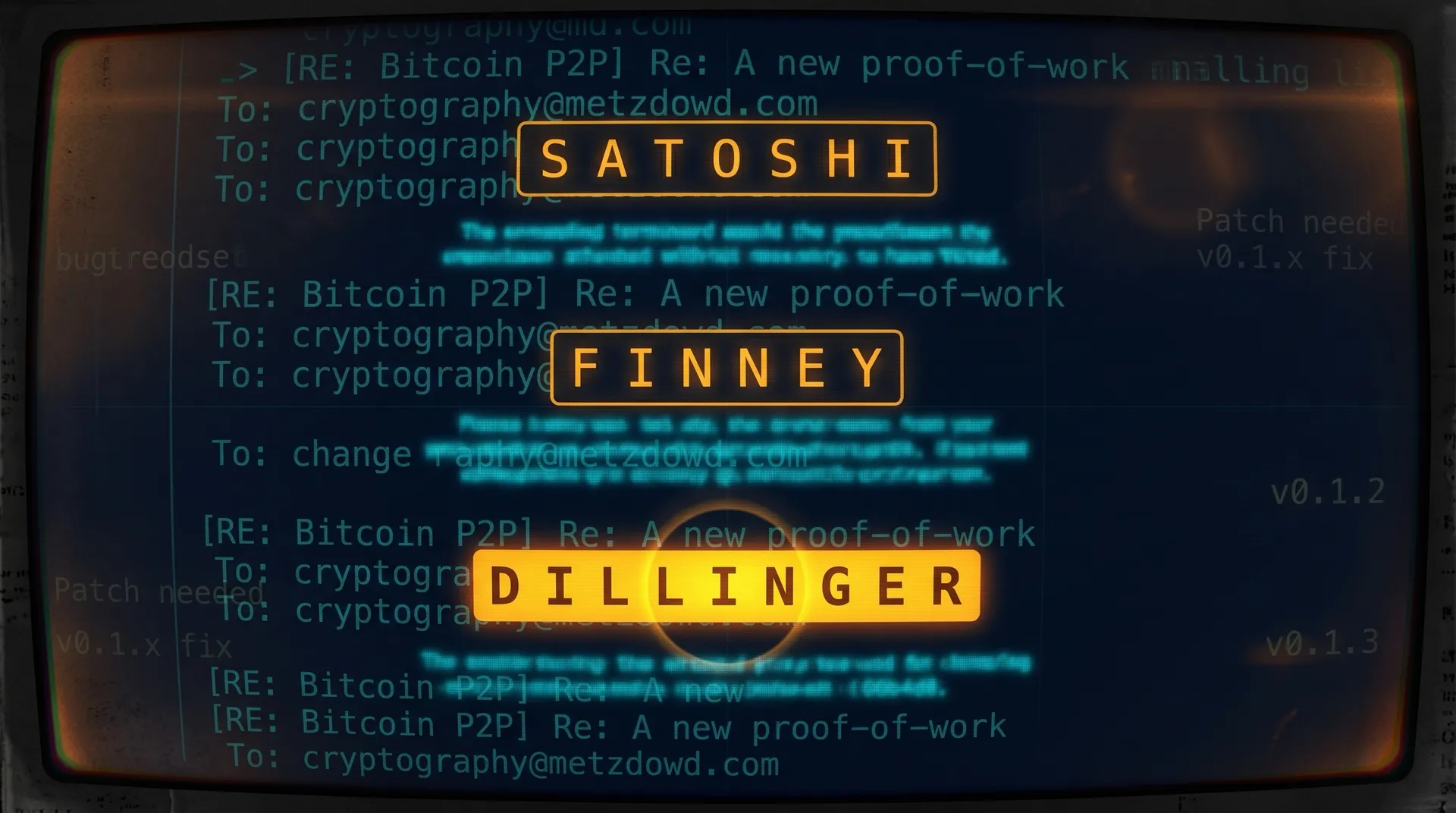
No prior Satoshi theory has had to dispose of a named, living, on-the-record third-party witness whose contemporaneous emails are preserved on two separate public archives. Cohan's film omits him. Ray "Bear" Dillinger does not appear in the runtime, the Metzdowd thread never makes the broadcast cut, and the WSJ PDF goes unmentioned. A documentary that spent four years on this question and concluded that Finney was the coding half of Satoshi did not find time for the one document that makes the coding half deeply, wildly implausible.
Hal Finney's own farewell post on BitcoinTalk settles the remaining ambiguity with the plain language of a dying man who knew he was dying. "I mined block 70-something, and I was the recipient of the first bitcoin transaction, when Satoshi sent ten coins to me as a test. I carried on an email conversation with Satoshi over the next few days, mostly me reporting bugs and him fixing them."²¹ He signed off with "I'm comfortable with my legacy." Those are the words of Bitcoin's first tester taking quiet pride in being exactly that, and any reading of the Finney half of Finding Satoshi that survives the Dillinger correspondence asks you to treat that final public statement as a lie Hal Finney carried to his grave. I do not think Hal Finney lied, and I do not think a filmmaker should be asking you to accept, without evidence, that he did.
Sassaman Called Bitcoin Bunk
Len Sassaman was a serious cryptographer. His remailer work, his contributions to Mixmaster, and his doctoral research at the COSIC group under Bart Preneel at KU Leuven are on the record and do not need defending from me.²² He was also one of the most consistent public critics of Bitcoin's design during its first two years, and everything that follows in this section comes directly from the words Sassaman himself published on his public @lensassaman Twitter feed under his own name.
On December 7, 2010, on his public Twitter feed, Sassaman wrote: "I haven't analyzed BitCoin, but the impression of multiple digital cash experts I've talked to is that it's bunk."²³
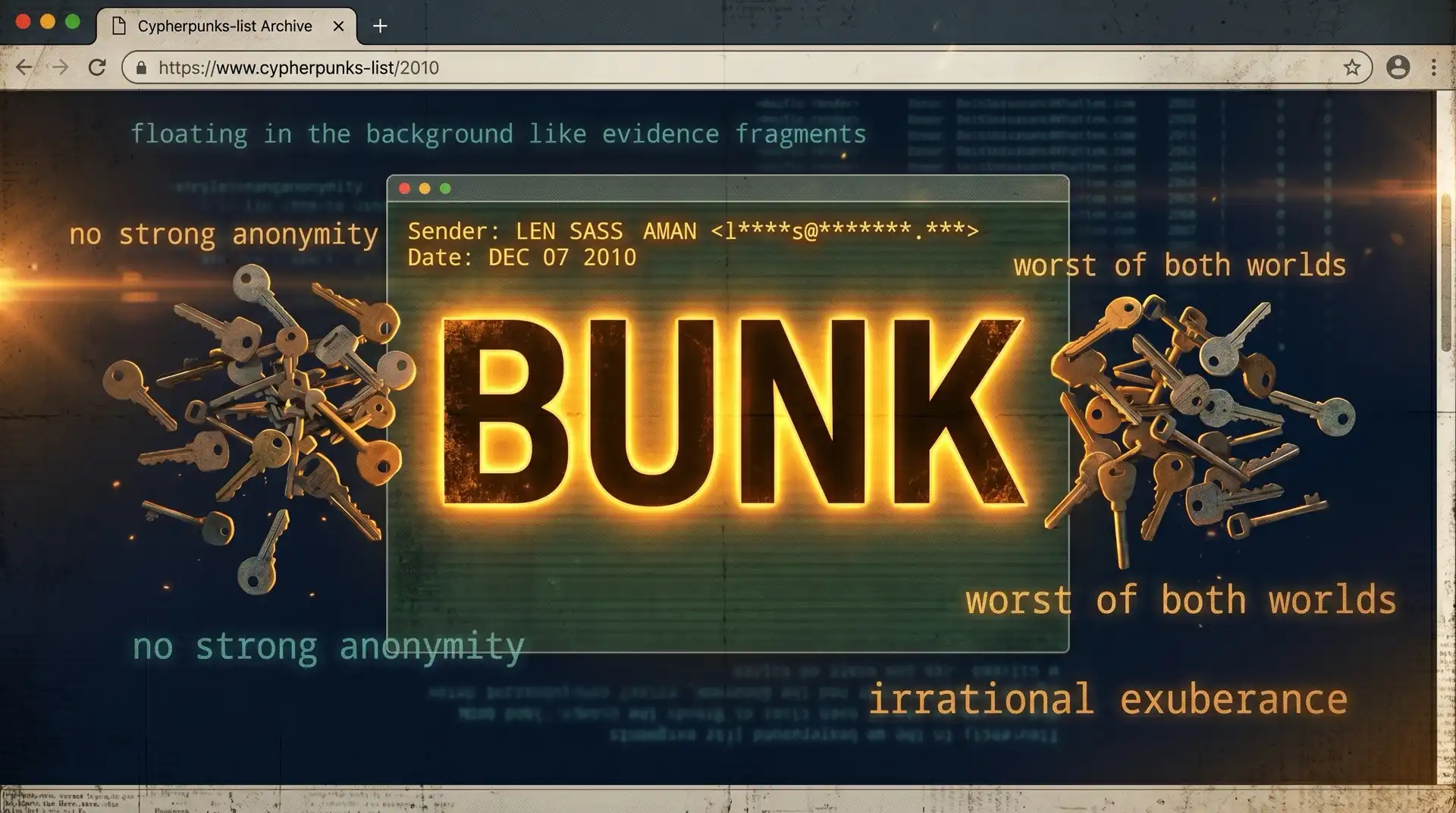
On June 15, 2011, six months into Bitcoin's first real price run, he wrote: "This big Bitcoin heist shows Bitcoin suffers from the worst of both worlds: no strong anonymity, yet no fraud reversal protection."²⁴ Five days later, on June 20, 2011, he closed the trilogy with a third verdict: "The question is, though, just how much of Bitcoin's success is due to irrational exuberance? I think most of it."²⁵ Three posts, three separate days, three distinct contexts, all of them on record under Sassaman's own name on public archives anyone can read today.
@maradydd I haven't analyzed BitCoin, but the impression of multiple digital cash experts I've talked to is that it's bunk.
— Len Sassaman (@lensassaman) December 7, 2010
This big Bitcoin heist shows Bitcoin suffers from the worst of both worlds: no strong anonymity, yet no fraud reversal protection.
— Len Sassaman (@lensassaman) June 15, 2011
@mentalguy The question is, though, just how much of Bitcoin's success is due to irrational exuberance? I think most of it.
— Len Sassaman (@lensassaman) June 20, 2011
Those are the words of a man who did not design the thing he was criticizing. Bram Cohen explains this inconvenience on camera by proposing that Satoshi Nakamoto and Len Sassaman were two pseudonyms of the same person, and that the public disagreement was a decoy. Cohen's exact framing is that "you don't make all your pseudonyms agree with each other about everything, or everyone's going to know who your pseudonyms are."²⁶ Leave aside the question of whether this is a falsifiable claim. Ask instead whether it is a claim that anyone who knew Sassaman would make about his actual public writing career. The answer on the record comes from Sassaman's widow, Meredith Patterson, who is herself a credentialed computer security researcher with a publication record on formal language theory. On February 23, 2021, responding on Twitter to a historical piece about her husband's mental health and contributions, Patterson wrote plainly: "It's a very well-researched and respectful article, but to the best of my knowledge, Len was not Satoshi. Worth reading for the history and the conclusions about mental health, though."²⁷ That tweet has sat on Patterson's public Twitter feed for over five years and remains a matter of public record any journalist can verify in under thirty seconds.
Let me stack the chronology. Sassaman died on July 3, 2011. Satoshi Nakamoto's last authenticated public post is dated March 7, 2014, on the P2P Foundation forum, under the headline "I am not Dorian Nakamoto."²⁸ A man who died in July 2011 did not compose a rebuttal to a February 2014 Newsweek cover story. The film's solution to this problem is that Hal Finney, already deep into the motor-neuron decline of ALS, finished the posthumous Sassaman half of Satoshi from a wheelchair in Santa Barbara, three years after Sassaman himself had taken his own life, and did so while losing the ability to breathe without assistance. The ask here is that you accept a fan-fiction chronology in which two men who can no longer object performed a coordinated ghost-posting operation from their respective deathbeds.
The Meredith Patterson tweet is the piece of evidence the film could not gracefully include. Cohan leans heavily on Fran Finney's warmth and her willingness to sit with the filmmakers. She is a delight on camera, and he is entitled to that material, but he is not entitled to present the resulting picture as "eyewitness testimony" while omitting the widow on the other side of the alleged collaboration, who has said in plain English that her husband was not Satoshi.
Satoshi's Vision vs. Finney and Sassaman's Careers
This is the part of the argument the film cannot rebut, because the evidence is in Satoshi's own primary sources and in Finney's and Sassaman's own primary sources, and the documents disagree with the documentary.
Satoshi's whitepaper describes a peer-to-peer electronic cash system, with a proof-of-work chain, a fixed issuance schedule, and a scaling model explicitly built around specialized hardware. In his April 2010 email to Mike Hearn, preserved at the Nakamoto Studies Institute and referenced throughout the Satoshi archives, he wrote that "the current system where every user is a network node is not the intended configuration for large scale. That would be like every Usenet user runs their own NNTP server. The design supports letting users just be users."²⁹ He explicitly told the forum in the same period that Bitcoin could already scale past Visa "with existing hardware," and that it "never really hits a scale ceiling."³⁰ That is the author of Bitcoin, in writing, defending the industrialization of mining, defending server farms, and rejecting the smallblocker, we-must-all-run-nodes ideology in the same breath.
Now place Hal Finney's public positions next to that. On January 27, 2009, two weeks after running the first non-genesis node on the network, Finney tweeted that he was "thinking about how to reduce CO2 emissions from a widespread Bitcoin implementation."³¹ On January 21, 2009, he was already publicly sketching ways to "add more anonymity to bitcoin."³² In my most recent article, it was made painfully clear that Satoshi disliked the premise of anonymity and explicitly sought to remove it as a concept in bitcoin. On the Metzdowd cryptography list in November 2008, Finney floated a consensus-enforced block-size limit, a concept Satoshi had not built into the protocol.³³ Finney favored altruistic miners, worried about climate impact, wanted more privacy, and wanted a ceiling on throughput. Satoshi's writings are the almost exact inverse: industrial mining, unbounded on-chain scaling, pseudonymous but transparent ledger, no apology for energy use. Those read as two different engineers with two different priors, one of whom published a whitepaper defending industrialization and the other of whom wrote an independent audit arguing for the opposite design.
Looking at ways to add more anonymity to bitcoin
— halfin (@halfin) January 21, 2009
Thinking about how to reduce CO2 emissions from a widespread Bitcoin implementation.
— halfin (@halfin) January 27, 2009
Sassaman's mismatch is sharper still. His entire academic and professional identity was built around obfuscation and remailers, and the Mixmaster protocol he co-authored exists specifically to make message provenance untraceable.²² Bitcoin's public ledger does the exact opposite by etching every transaction into a chain intended to be replicable across every node in the network. Sassaman's June 15, 2011 post captured his verdict on the design philosophy: Bitcoin is "the worst of both worlds: no strong anonymity, yet no fraud reversal protection."²⁴ If Len Sassaman had written Bitcoin, it would have been an anonymity system with built-in mixing, stealth addresses, and strong coin-join primitives at Layer 1, rather than the transparent UTXO chain Satoshi actually shipped, where every output is an accountant's dream.
Notice the pattern now. Every time the mainstream press nominates a new Satoshi candidate, the candidate turns out to be one of the most visible people in the historical record arguing against Satoshi's stated design for Bitcoin. The recently covered Adam Back has spent twelve years at Blockstream constraining on-chain capacity, reversing a 2015 tweet in which he himself supported a 2MB, 4MB, 8MB scaling path, walking away from the 2016 Hong Kong Agreement and the 2017 New York Agreement, and building Lightning and Liquid as off-chain replacements for the block-space Satoshi wanted industrial miners to compete over.³⁴ Nick Szabo's Bit Gold had no block chain and no mining reward, and Szabo later told Business Insider that "Bitcoin won't ever do anything well beyond implementing a currency," which is a strange thing to say if you wrote Bitcoin Script.³⁵ Hal Finney argued for altruistic miners and against the CO2 footprint of industrial mining. Len Sassaman called the system bunk on his public Twitter feed and predicted its collapse six months before his death.
The mainstream's candidate pool consists almost entirely of people who reshaped BTC after Satoshi left, rather than the people who built Bitcoin in the first place. I have been making this argument for years, most recently in my piece on the New York Times Carreyrou profile of Adam Back, and in the earlier series on the wider block-size war.³⁶ Finding Satoshi is the genre's purest distillation, because the Times chose a candidate who capped blocks at Blockstream while Cohan chose two candidates who can no longer defend their own disagreements with Satoshi, owing to the small matter that both of them are dead.
It's a very well-researched and respectful article, but to the best of my knowledge, Len was not Satoshi. Worth reading for the history and the conclusions about mental health, though.
— Meredith L. Patterson (@maradydd) February 23, 2021
BTC Was Hijacked and Everyone Knows It. My long-form breakdown of how the people who campaigned against Satoshi's scaling vision ended up with editorial control of Satoshi's brand, and why the pattern of Satoshi candidates follows that takeover rather than preceding it.
What Cohan Is Actually Doing
A financial-scandal journalist with no prior Bitcoin reporting spent four years building a documentary with a Hollywood producer, a private-investigations firm, and a crypto-exchange early-access partner. Its conclusion is that the two most beloved deceased figures in the cypherpunk pantheon secretly built Bitcoin together, and that the absence of evidence is itself evidence, because dead men take secrets with them. That is the thesis, and I want to say clearly what it accomplishes for the people who funded it.
It retires the question. If you are Coinbase, if you are Michael Saylor, if you are the cohort of institutional Bitcoin holders whose business models depend on Satoshi never returning to refute the BTC roadmap, a film that declares the author to be two deceased men is the best possible outcome you could have paid for. There is no Satoshi left to object to the fee market, the Lightning Network, the 1MB-then-4MB-weight-unit cap, Blockstream's business model, or the Bitcoin treasury company SPAC structures currently going public on the back of a narrative that Satoshi approves of all of it.
A dead Satoshi approves of everything, and a dead Satoshi's coins cannot move except into the hands of whoever writes the next documentary.
Compare the restraint of Fran Finney, who in the film itself says that when she asked her husband whether he was Satoshi, "he just laughed and said no." Compare Meredith Patterson, who wrote that to the best of her knowledge, Len was not Satoshi. Compare Finney's own farewell, in which he took quiet pride in being the second miner on the network and the recipient of the first test transaction. The people closest to the named suspects, both while they were alive and after, have been almost uniformly consistent in saying what the film refuses to accept. Cohan's response to this chorus is to reinterpret their plain denials as "non-denials," which is a rhetorical move investigative journalism is supposed to catch rather than make.
The film will land as the most-watched Satoshi property in a decade (so far...)
It will also be, for anyone who reads primary sources, a case study in what happens when a reporter who has never covered Bitcoin is given four years and a set of interview subjects carefully selected to deliver a pre-shaped conclusion: the conclusion is unfalsifiable by construction, the named suspects are incapable of objecting, and the parties with the strongest financial interest in retiring the Satoshi question get the retirement they paid for.
The Simplest Tests
There are two simpler standards than stylometry, digital rhythm analysis, eyewitness hearsay, or deathbed interpretation.
1: On the one hand, Satoshi's own words, his original source code, and nearly four years' worth of Q&A among allies and critics are all public information. Therefore, any Satoshi Nakamoto candidate should, at the very least, believe that bitcoin, in its original design, was a fundamentally good idea. His opinions on why it is a good idea are public, and written in clear, direct and plain English, and it is an exercise in subterfuge to constantly float public critics of bitcoin as potential "Satoshis."
2: On the other hand, Satoshi Nakamoto left the one mechanism that every cryptographer alive would accept as proof of control of Satoshi's keys: a signed message from a 2009 or 2010 block-reward address. In all likelihood, barring unfortunate circumstances that culminate in the loss of keys, a living person claiming to be Satoshi can produce it. The 1.1 million coins sit in addresses with known public keys, and the signatures they secure are verifiable on any node in the network. Hal Finney and Len Sassaman never produced such a signature while alive, and no one else ever accused, nominated, or crowned has produced one in public since. The one guy who did private signings with Satoshi's keys for other cypherpunk legends has been memory-holed into oblivion, so I won't comment on that here.
In short, Finding Satoshi is a creative writing exercise with an $18 price tag and a beautiful poster, and Hal Finney's and Len Sassaman's own words remain the best record of who they actually were; good men who didn't engineer bitcoin.
Be good to each other. And the next time somebody hands you a documentary that claims the dead guys did it, politely ask them to come back with serious evidence.
Kurt Wuckert Jr. is a journalist, podcaster, and the Chief Bitcoin Historian of the universe. He has been reporting on Bitcoin since 2013 and broadcasts live every Tuesday at 2 PM Eastern. More at kurtwuckertjr.com.
Footnotes
¹ William D. Cohan's background as a financial-scandal journalist is documented in his publisher's author bio and in the public record of his four New York Times bestsellers. Cohan is a former M&A investment banker at Lazard Frères, Merrill Lynch, and JPMorgan Chase, and has written extensively for Vanity Fair, The New York Times, The Atlantic, and Bloomberg Opinion. See author bio at Penguin Random House: penguinrandomhouse.com/authors/73897/william-d-cohan.
² William D. Cohan, Power Failure: The Rise and Fall of an American Icon, Doubleday, November 2022. Cohan's study of Jack Welch and General Electric. ISBN 978-0-385-54705-3. See penguinrandomhouse.com/books/609226/power-failure-by-william-d-cohan.
³ Finding Satoshi, directed by Tucker Tooley, produced by Matthew Miele, Jordan Fried, and Happy Walters, William D. Cohan executive producer, released April 22, 2026. Distributed via findingsatoshi.com with early-access tie-ins through Coinbase. The Block's April 2026 coverage of the documentary's premiere and thesis is the most comprehensive public writeup.
⁴ Tyler Maroney of Quest Research and Investigations, on-camera verdict in Finding Satoshi, transcribed from the film's public trailer and the Block's review. Maroney's full sentence: "If we take all of the circumstantial evidence, all of the empirical evidence, and all of the eyewitness testimony, the conclusion is that Hal Finney and Len Sassaman collaborated to create Bitcoin."
⁵ Finding Satoshi interview roster, compiled from the film's credits and from the Block's April 2026 writeup of the documentary premiere.
⁶ Will Price, PGP Corp. co-founder, on-camera testimony in Finding Satoshi. Price spent roughly fifteen years working alongside Hal Finney at PGP Corporation and is one of the film's primary technical witnesses.
⁷ Bjarne Stroustrup, creator of C++, on-camera assessment of the Bitcoin code in Finding Satoshi. Stroustrup characterizes Satoshi as "a reasonably good C++ programmer for the time," which the film interprets as consistent with Finney's language profile.
⁸ Tyler Maroney has publicly acknowledged that the Temple City geographical overlap between Finney and Dorian Prentice Satoshi Nakamoto was known to the filmmakers and was excluded from the film's final cut, noting that the detail "can be used to strengthen our case." See the Block's April 2026 coverage.
⁹ Alyssa Blackburn, Baylor College of Medicine, "Digital Rhythm" analysis presented on-camera in Finding Satoshi. Blackburn's methodology analyzes early Bitcoin mining and mailing-list timestamps across 64 participants. For prior art on stylometric and timestamp-based authorship attribution, see the academic literature cited in my earlier rebuttal of the New York Times Carreyrou piece.
¹⁰ Meredith L. Patterson, widow of Len Sassaman, on-camera in Finding Satoshi. Patterson confirms that Finney and Sassaman were friends and were in touch in 2008. She does not endorse the film's conclusion. See her February 23, 2021 public denial at footnote 27.
¹¹ Brian Armstrong, Coinbase CEO and co-founder, endorsement quoted in the Block's coverage of Finding Satoshi: "It's the most thoughtful take on this subject I've ever seen out there, and I suspect you got to the right answer."
¹² Sergio Demian Lerner, "The Well Deserved Fortune of Satoshi Nakamoto, Bitcoin creator, Visible Proof," Bitslog, April 17, 2013: bitslog.com/2013/04/17/the-well-deserved-fortune-of-satoshi-nakamoto. Lerner's analysis is the first public estimate of Satoshi's coin holdings based on the distinctive "Patoshi" mining pattern.
¹³ Satoshi Nakamoto, "Bitcoin: A Peer-to-Peer Electronic Cash System," October 31, 2008. bitcoin.org/bitcoin.pdf. Section 2 of the whitepaper describes the digital-signature chain-of-ownership model that every Satoshi-era address can use to prove authorship.
¹⁴ Crypto Open Patent Alliance v. Wright, [2024] EWHC 1198 (Ch), judgment by Mr. Justice Mellor. See judiciary.uk/judgments/crypto-open-patent-alliance-v-wright.
¹⁵ Adam Back (@adam3us), Twitter/X, denial dated 2026: "I am not Satoshi Nakamoto." twitter.com/adam3us/status/2041811857732768148.
¹⁶ Jameson Lopp, Casa CSO, on-camera in Finding Satoshi. Lopp's exact framing: "From the very simple fact that it's not possible to be in two places at the same time, it's highly unlikely that Satoshi and Hal were the same person… One possible explanation is that Satoshi was a group of people. Whether Hal was like 'in on it' will, I think, never really be able to prove. But Occam's razor, it's difficult to keep secrets amongst multiple people. Unless they're all dead."
¹⁷ Metzdowd cryptography mailing list, November 2008 archive. The original Satoshi Nakamoto whitepaper announcement and the subsequent pre-release review thread are archived at metzdowd.com/pipermail/cryptography/2008-November/014815.html.
¹⁸ The Wall Street Journal Finney-Nakamoto email archive, published as a public PDF in connection with Andy Greenberg's March 2014 Forbes reporting and the Journal's contemporaneous coverage: wsj.com/public/resources/documents/finneynakamotoemails.pdf. The PDF contains the direct Finney-Satoshi correspondence from late 2008 and early 2009, including bug reports and Satoshi's version bumps.
¹⁹ Ray "Bear" Dillinger, BitcoinTalk forum: bitcointalk.org/index.php?topic=382374.0. Dillinger's account of the November 2008 pre-release review alongside Hal Finney, quoted verbatim.
²⁰ Finney's block-size-limit proposal, archived on the Metzdowd cryptography list: mail-archive.com/cryptography@metzdowd.com/msg10001.html. Finney's design preference for a consensus cap on block size predates the later small-block ideological movement and was a point of documented disagreement with Satoshi's stated scaling model.
²¹ Hal Finney, "Bitcoin and me (Hal Finney)," BitcoinTalk, March 19, 2013: bitcointalk.org/index.php?topic=155054.0. Finney's public farewell to the community, written as ALS progressed. He explicitly refers to Satoshi as a separate person throughout and closes with the line "I'm comfortable with my legacy."
²² COSIC (Computer Security and Industrial Cryptography), KU Leuven, historical research-group roster. Sassaman's PhD research was conducted under Bart Preneel. See also en.wikipedia.org/wiki/COSIC. On the Mixmaster remailer protocol and Sassaman's contributions, see Sassaman and Ulf Möller, "Mixmaster Protocol Version 2," IETF draft: tools.ietf.org/html/draft-sassaman-mixmaster-03.
²³ Len Sassaman (@lensassaman), Twitter, December 7, 2010, replying to his wife @maradydd: "I haven't analyzed BitCoin, but the impression of multiple digital cash experts I've talked to is that it's bunk." Archived via the Wayback Machine.
²⁴ Len Sassaman (@lensassaman), Twitter, June 15, 2011: "This big Bitcoin heist shows Bitcoin suffers from the worst of both worlds: no strong anonymity, yet no fraud reversal protection." Archived via the Wayback Machine. See also the companion tweet from the same day: "How much cash would you have to have sitting on your computer before it was worth breaking into? Maybe Bitcoin will answer that question."
²⁵ Len Sassaman (@lensassaman), Twitter, June 20, 2011: "The question is, though, just how much of Bitcoin's success is due to irrational exuberance? I think most of it." Archived via the Wayback Machine.
²⁶ Bram Cohen, BitTorrent creator, on-camera in Finding Satoshi. Cohen offers the pseudonym-coordination theory as the film's explanation for Sassaman's public Bitcoin criticism.
²⁷ Meredith L. Patterson (@maradydd), Twitter/X, February 23, 2021: "It's a very well-researched and respectful article, but to the best of my knowledge, Len was not Satoshi. Worth reading for the history and the conclusions about mental health, though." twitter.com/maradydd/status/1364325186372304904.
²⁸ Satoshi Nakamoto, "I am not Dorian Nakamoto," P2P Foundation forum, March 7, 2014. The post remains the last authenticated Satoshi-associated public communication in the historical record.
²⁹ Satoshi Nakamoto, email to Mike Hearn, April 2009, preserved at the Nakamoto Studies Institute: nakamotostudies.org/emails/satoshi-reply-to-mike-hearn-8. The email contains the Usenet-and-NNTP analogy for Bitcoin's scaling architecture and explicitly rejects the every-user-runs-a-full-node model.
³⁰ Satoshi Nakamoto, "Re: Scalability," BitcoinTalk forum, April 14, 2010: bitcointalk.org/index.php?topic=532.msg6306#msg6306. The forum reply in which Satoshi states that Bitcoin can already scale past Visa "with existing hardware for a fraction of the cost."
³¹ Hal Finney (@halfin), Twitter, January 27, 2009: "Thinking about how to reduce CO2 emissions from a widespread Bitcoin implementation." Archived on the Wayback Machine and cross-cited throughout early Bitcoin historiography.
³² Hal Finney (@halfin), Twitter, January 21, 2009: "Looking at ways to add more anonymity to bitcoin." Archived on the Wayback Machine.
³³ Finney's contemporaneous discussion of a consensus-enforced cap on block size is preserved in the Metzdowd archive and in the cryptography-list mail-archive linked in footnote 20.
³⁴ Adam Back (@adam3us), Twitter/X, August 26, 2015: "Strongly agree. My suggestion 2MB now, then 4MB in 2 years and 8MB in 4years then re-asses." twitter.com/adam3us/status/636410827969421312. Back subsequently reversed this position and became the loudest institutional voice against the same scaling path.
³⁵ Nick Szabo, interview with Business Insider, April 2014: "Ethereum has vast potential, whereas Bitcoin won't ever do anything well beyond implementing a currency." See businessinsider.com/nick-szabo-bitcoin-2014-4. Szabo's later public dispute with Dr. Craig Wright over Bitcoin Script's Turing-completeness is further evidence that he was unfamiliar with capabilities that the shipped Bitcoin protocol already exposed.
³⁶ See Kurt Wuckert Jr., "John Carreyrou Spent a Year Hunting Satoshi Nakamoto and Found a Hyphen," kurtwuckertjr.com, April 8, 2026, kurtwuckertjr.com/post/carreyrou-adam-back-satoshi-nakamoto-rebuttal; and "BTC Was Hijacked and Everyone Knows It," kurtwuckertjr.com, kurtwuckertjr.com/post/btc-was-hijacked-everyone-knows-it.
³⁷ Andy Greenberg, "Nakamoto's Neighbor: My Hunt For Bitcoin's Creator Led To A Paralyzed Crypto Genius," Forbes, March 25, 2014, and follow-on reporting of the 2014 swatting and 1,000-BTC extortion campaign against the Finney household. See also contemporaneous coverage at ccn.com/bitcoin-extortionist-swatting-cryptographers and the Hal Finney Wikipedia entry, en.wikipedia.org/wiki/Hal_Finney_(computer_scientist), which summarizes Fran Finney's account of the incident.
³⁸ Fran Finney's post-2014 advocacy is documented by the ALS Network's Running Bitcoin Challenge, an annual fundraiser launched on the anniversary of Hal's "Running bitcoin" tweet. See alsnetwork.org/running-bitcoin-challenge and the ALS Network's coverage of Fran's role at alsnetwork.org/legendary-bitcoin-pioneer-and-activist-inspires-runners-around-the-world-to-defeat-als-in-second-annual-running-bitcoin-challenge.