Lessons From the American Revolution: They Pledged Their Sacred Honor. What Have You Pledged?
By Kurt Wuckert Jr.
America was never going to win on the math. It won because a few thousand freezing men decided a cause was worth more than their own survival. Two and a half centuries later, most of us won't even keep a promise that gets inconvenient.
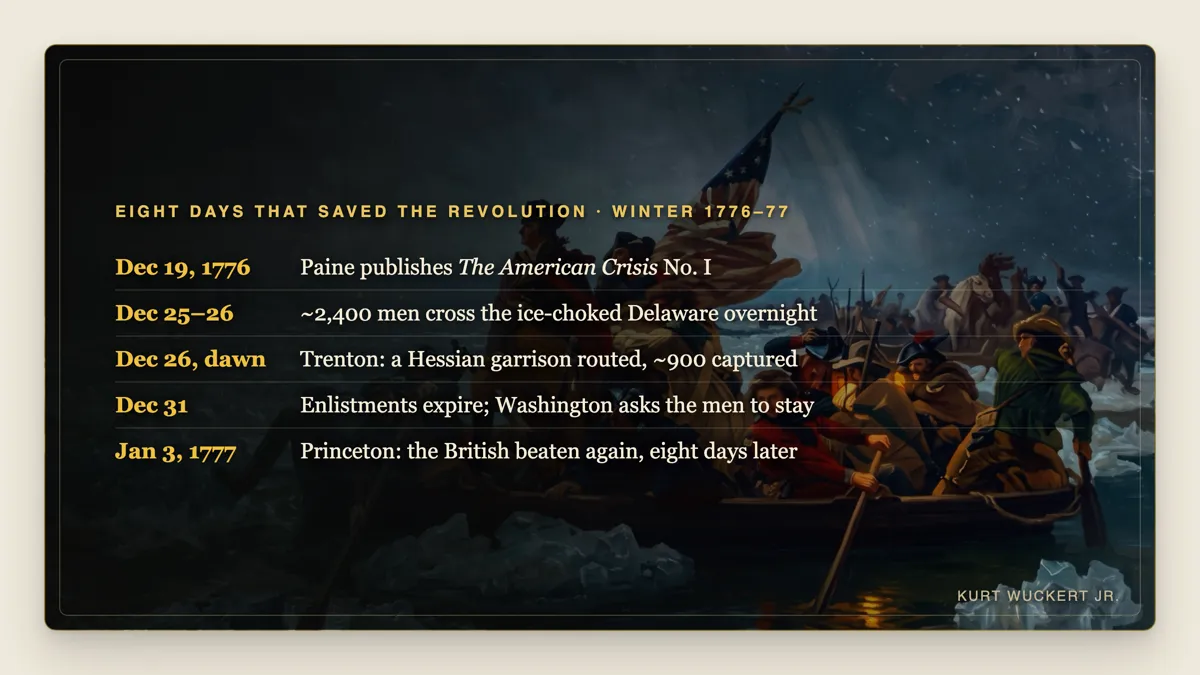
In the last week of December 1776, the American cause was a corpse that hadn't finished falling over. Washington's army had been beaten out of New York and run backward across New Jersey until the Delaware River was the only thing standing between it and the end of the revolution. What remained was a few thousand starving, freezing, unpaid men, and at midnight on December 31 most of their enlistments would simply lapse. The empire on the far side of the line had the largest navy in the world, a professional army, and the treasury of London underwriting all of it. The colonists had militia, a handful of cannons, and a currency so debased that "not worth a Continental" became an insult that outlived the war.
That same week, on December 19, Thomas Paine put the first installment of The American Crisis into print. Its opening sentence is one a lot of us were once made to memorize: "These are the times that try men's souls. The summer soldier and the sunshine patriot will, in this crisis, shrink from the service of their country; but he that stands by it now, deserves the love and thanks of man and woman." Tradition says Washington had the essay read to the men before the boats pushed off. I can't prove that from the record, so treat it as the legend it probably is, but it's a banger!
What we can document is what those men did once the reading, real or not, was finished.
On Christmas night, Washington put roughly 2,400 of them into boats and shoved off across the ice-choked Delaware. They covered about ten miles through the sleet and fell on the Hessian garrison at Trenton at dawn on December 26, taking some nine hundred professional soldiers prisoner inside of two hours. Five days after that, with the enlistments running out, he rode out in front of men who were legally free to walk home and asked them for six more weeks. Most of them gave it to him. On January 3, 1777, eight days past Trenton, they whipped the British a second time at Princeton. A cause that should have frozen solid in the snow was on its feet again.
They didn't have the numbers. They had conviction.
The colonies did not win the war because the odds finally swung their way. The odds stayed ugly for years. The French alliance had not been signed. The win at Saratoga that would eventually drag France into the fight had not happened. Nothing was waiting on the dark side of that river except well-armed German mercenaries and the brutal cold, and those men rowed across it regardless. They rowed because they had already answered the only question that mattered: whether the cause was worth dying for, and they had answered it long before anyone could promise them they would live.
That is the whole machine, and we have forgotten how it runs. Real conviction has nothing to do with calling the outcome. It is a verdict you reach before the report comes in, and then refuse to reopen when the news turns against you. The summer soldier waits to see who is ahead and signs on with the winners. The man Paine was needling picked the right side first and staked his body on it, knowing full well the wager might never pay, and that the losses would be paid in blood, should they fail. One of them is a spectator. The other one is the reason you were born in a free country.
Independence Day has curdled into a long weekend of grilling, and very few of us have earned the holiday. Those men staked their lives on a promise to people they would never meet. Statistically, the average American in the 21st century cannot be trusted to keep a New Year's resolution past the second week of January. But these first Americans crossed a frozen river on conviction. We renegotiate the gym the morning it rains.
This is not a political column, or a specific criticism of anyone. I don't care which party you voted for or what you value in your private life. But I am talking to the men who feel a tug on their hearts to be a hero, and I'm talking about the thing the men in that boat had that most of us have quietly stopped carrying.
The river you're refusing to cross
You will probably never be asked to die for your country. Good. But you are asked, every single day, to hold the line on commitments that don't pay off on a quarterly schedule, and most of us are folding on every one of them.
Start with marriage, because the casualty numbers there are worse than any battlefield of the Revolution. We treat the most serious vow a man can make as a subscription he can cancel when the service dips. He stood at an altar and gave his word in front of God and witnesses, and then the feeling faded the way feelings always do, and he decided the word didn't bind him anymore. That isn't growth or self-care. It's desertion. A vow that only holds while it's enjoyable was never a vow. It was a mood.
Look at your children. The most valuable thing you will ever build is a human being, and it is built with ten thousand boring, unglamorous nights when you'd rather be doing literally anything else. The man who optimizes for the short term outsources his kids to a screen so he can have some peace, and then wonders in fifteen years why a stranger lives in his house. You don't get those nights back. There is no second crossing.
Look at your own body. You were handed one machine for the whole campaign, and the modern man runs his into the ground for cheap dopamine, then acts surprised when it fails him at fifty. Discipline of the body is not vanity. It is the most basic form of keeping your word to your future self, and if you can't keep a promise to the one person you can't avoid, why would anyone believe the promises you make to them?
Look at your faith, if you have any left. We've turned even God into a consumer relationship, in when it's comforting, out when it asks something hard. Look at your work, which we've reduced to the minimum effort that won't get us fired. Look at your word, the plain currency of being a man, which most of us now spend like that worthless Continental paper, printing promises we have no intention of honoring because we've decided that "I'll be there" is a vibe and not a contract.
Every one of those is a river. Every one of them is cold. And the easy path, the one the whole culture is built to sell you, is to stay on the warm bank and tell yourself a story about why you don't really have to get in the boat.
The founders' own words
Now go read what the men we're celebrating actually believed, because the watered-down version you got in public school robs the holiday of its weight.
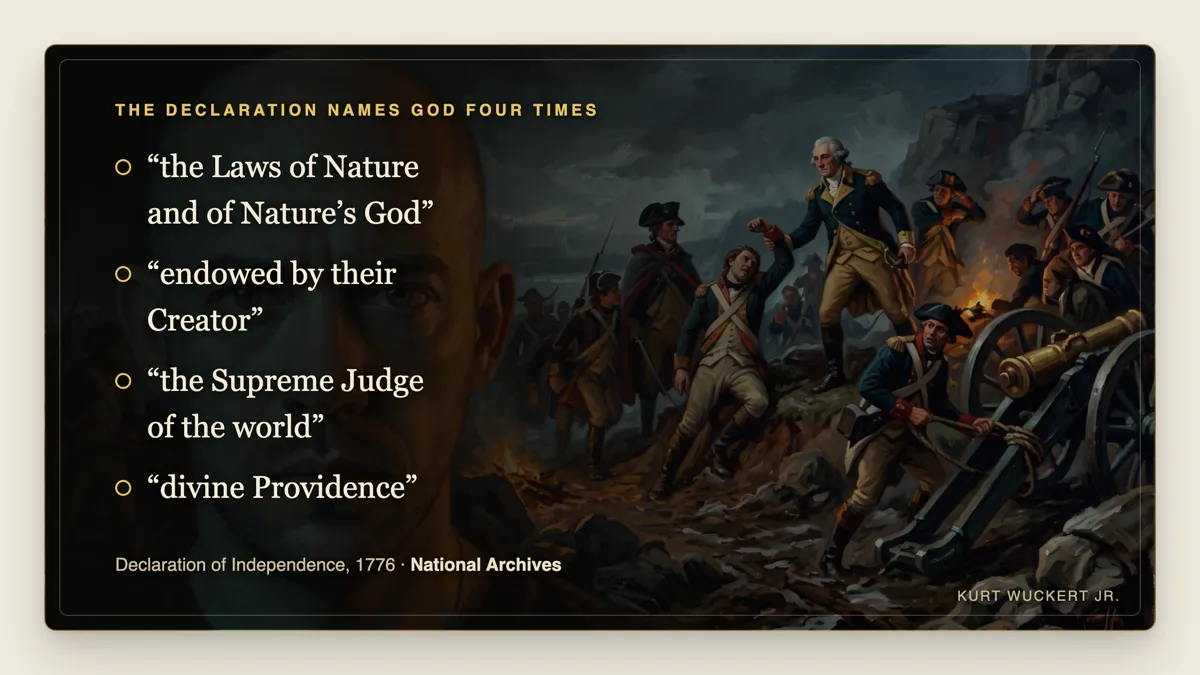
People love to point out that the Declaration of Independence never names Jesus. That's technically true, but only if you read it with malicious specificity. It refers to God exactly four times, and every reference is broad: "the Laws of Nature and of Nature's God," rights "endowed by their Creator," an appeal "to the Supreme Judge of the world," and "a firm reliance on the protection of divine Providence." From that, a certain kind of person concludes the founders were basically secular deists who'd be embarrassed by a church. That reading falls apart the second you stop reading the federal documents and start reading what those same men wrote at home.
The Declaration and the Constitution were national documents written for thirteen squabbling states that included Anglicans, Congregationalists, Presbyterians, Quakers, Lutherans, Baptists, and a Catholic or two. I'd argue, and I want to be plain that this is my argument and not a settled fact, that the brilliance of "Nature's God" and "the Supreme Judge of the world" is that a population soaked in scripture would hear those words, correctly, as the God of the Bible, while the words stayed broad enough not to crown one denomination king and reignite the exact religious wars they had fled Europe to escape. That is not God-neutral language. It is God-unifying language, written by men who assumed a deep Christian faith among peers the way you might assume the floor is there when you get out of bed.
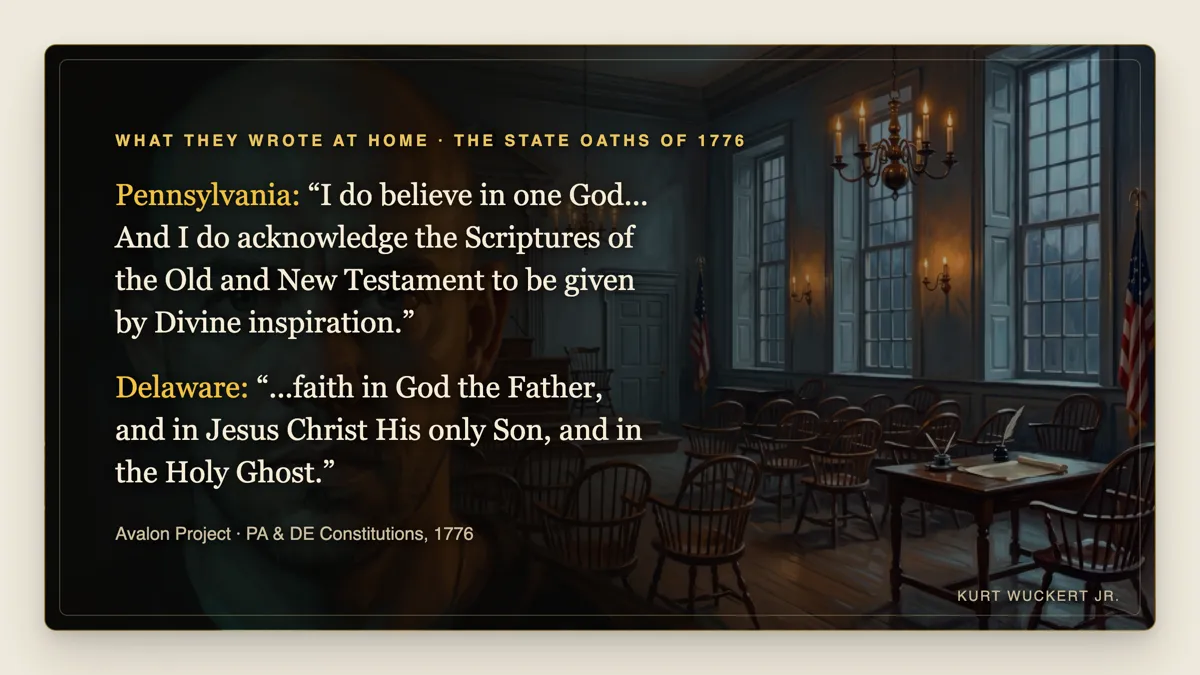
You want proof of what they actually believed? Read the state constitutions they wrote the same decade, where they weren't trying to hold a fragile union together. Almost every one of the original states kept a religious test for office. Several made you a Protestant outright. Others simply required you to be a Christian, or to believe in God and the divine inspiration of the Bible. Pennsylvania made every officeholder declare, in the 1776 constitution, "I do believe in one God, the creator and governor of the universe, the rewarder of the good and the punisher of the wicked. And I do acknowledge the Scriptures of the Old and New Testament to be given by Divine inspiration." Delaware went all the way. Its 1776 constitution made you "profess faith in God the Father, and in Jesus Christ His only Son, and in the Holy Ghost." That is the Trinity, written into the law, by the founding generation, in plain ink.
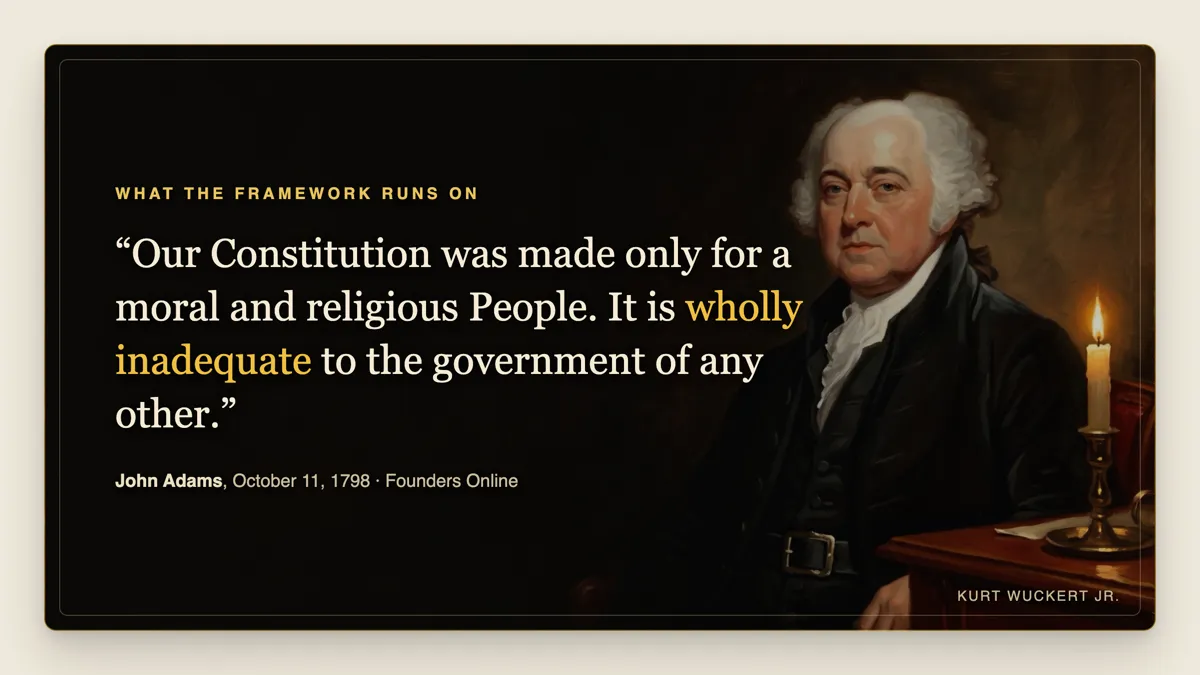
In fairness, Virginia and New York went the other direction and didn't impose a religious test at all, so this wasn't uniform, but the pattern is unmistakable. These were not secular men who tolerated religion. They were overwhelmingly Christian men who built a deliberately non-sectarian federal frame on top of a Christian people, because they understood the frame only works if the people are good. John Adams said it flat out in 1798: "Our Constitution was made only for a moral and religious People. It is wholly inadequate to the government of any other." He wasn't being poetic. He was telling you the machine has a fuel requirement, and the fuel is the character of the men running it.
The culture they lived in proves the point harder than any single quote. When the political scientist Donald Lutz cataloged the writings of the founding era, the single most-cited source was the Bible, and the most-cited book in it was Deuteronomy, Moses laying out how a free people should govern themselves. A lot of that came from reprinted sermons, and when you isolate the men actually drafting the Constitution they also leaned hard on Montesquieu, Blackstone, and Locke. But that's the whole point of this essay. A Christian people. A structurally restrained government built for them. The same instinct that put "Proclaim LIBERTY throughout all the Land unto all the Inhabitants thereof," a line straight out of Leviticus, on the Liberty Bell.
And the one fact that should reframe the whole "wall of separation" argument about church and state you've been fed: that phrase isn't in the Constitution or any other founding document. It comes from a private letter Thomas Jefferson wrote in 1802 reassuring the Danbury Baptists that the federal government would never come after their church. The same Jefferson, the most skeptical founder of them all, spent those years attending Christian worship services held inside the U.S. Capitol. The wall was built to protect the church from the state, not to scrub God out of public life. We got that exactly backwards.
Get in the boat
This is where that frozen river runs straight into your living room.
The signers ended the Declaration by pledging to each other "our Lives, our Fortunes and our sacred Honor." Note that middle word. Sacred. They considered their honor, which is to say their word, a holy thing, something you do not trade away for comfort or safety or a better quarter. Most of them paid for it. Some lost their fortunes, some lost their sons, some lost their lives, and not one of them got to read the end of the story before he signed away his life as collateral.
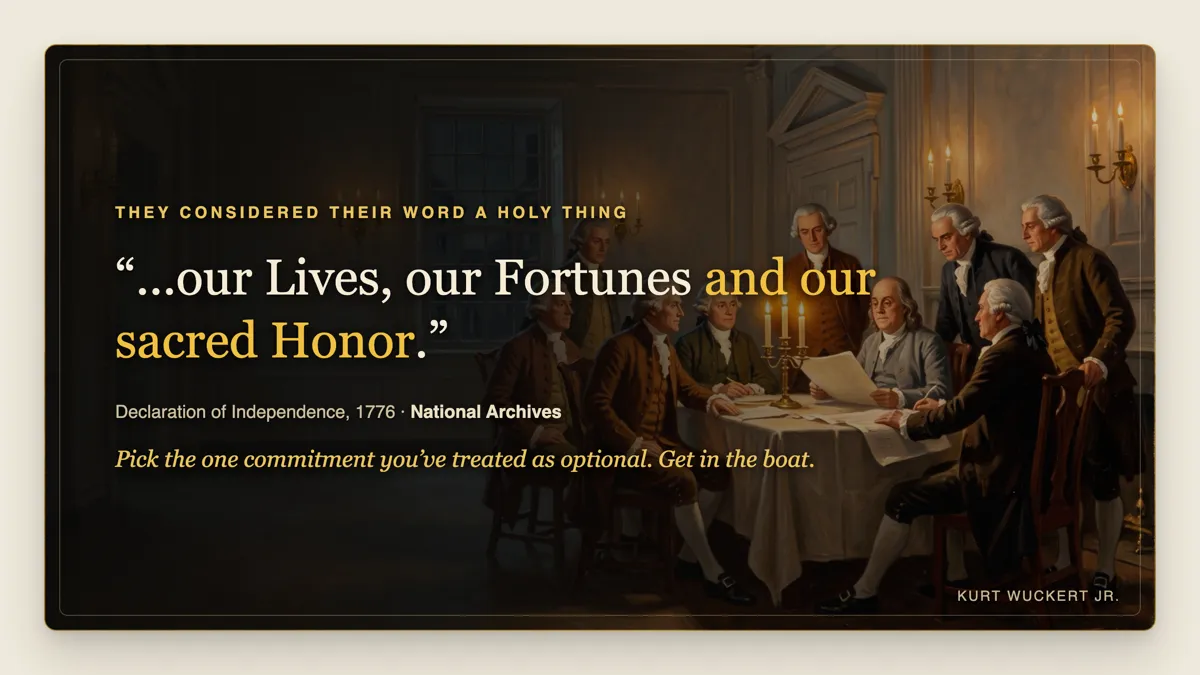
We've inherited the liberty they bled for and kept almost none of the seriousness that produced it. We took the freedom and dropped the honor. And a man who treats his own word as disposable has no business celebrating men who treated theirs as sacred.
So this Fourth of July, before the fireworks, do the audit. Pick the one commitment you've been quietly treating as optional, the marriage you've checked out of, the kid you keep promising and disappointing, the body you're wrecking, the faith you abandoned the moment it cost you, the word you give and break without a second thought. That's your Delaware. It's cold and you don't want to cross it and there's no guarantee on the far bank. Get in the boat anyway. Cross it on conviction, because it's right, not because it's winning.
Then send this to a brother who's gone soft, because the men in that boat didn't cross alone, and neither should you.
The Revolution wasn't won by men who waited for good odds. It was won by men who decided what was true and then refused to flinch. That kind of man is rarer now than he's ever been. Be one of them.
Happy Independence Day. Be good to each other. And get in the boat.
Kurt Wuckert Jr. is the Chief Bitcoin Historian, founder of GorillaPool and Open Protocol Labs, and host of Kurt's Podcast. He writes weekly on Bitcoin, geopolitics, faith, and the long fight for human sovereignty at kurtwuckertjr.com. Catch him live every Tuesday at 2 PM EST.
Tags: American Revolution, Independence Day, Fourth of July, Thomas Paine, The American Crisis, Washington crossing the Delaware, founding fathers, Christian nation, John Adams, sacred honor, masculinity, conviction, commitment, faith and liberty