America's 250th Birthday: A Eulogy for Independence and a Blueprint to Get It Back
By Kurt Wuckert Jr.
The men who bought this country deserve every firework we own. The government wearing her name deserves none of them.
America turns 250 years old today, and I intend to celebrate her the way a man celebrates a mother he loved: with meat on the fire, children in the yard, and the solemnity to recognize that the lady in the casket is not merely sleeping.
The independence declared on July 4, 1776 and won at gunpoint by 1783 survived, by the calendar, exactly 2,009 days.
Everything since has been the long, polite story of a people trading a revolution for a government, one reasonable-sounding installment at a time, until the nation that told the most powerful king on earth to pound sand became a nation that files a permission slip to collect rainwater. We did not lose our independence in a war; we surrendered it in committee, and today, on the semiquincentennial, the receipts go on the table.
The republic as declared and won lasted 2,009 days. You are living in what replaced it.
First, the toast
Before the autopsy, the men get their due, because they earned it in a currency we barely remember.
On April 19, 1775, on the road between Lexington and Concord, 49 colonists were shot dead by their own legal government for the crime of stockpiling the means to resist it. Over the next eight years roughly 25,000 Americans died out of a population of about 2.5 million, one in every hundred souls on the continent, which scaled against the America of today is well over three million dead. The federal government closed the beaches in 2020 over odds that made up a fraction of that.
They pledged their lives against those odds on purpose, in writing, with their names attached!
At Valley Forge in the winter of 1777 and 1778, somewhere between 1,700 and 2,000 of Washington's men died of disease in camp, a toll worse than any battle of the war. Washington himself wrote to the president of Congress on December 23, 1777 that he had, by that day's field return, "no less than 2898 Men now in Camp unfit for duty, because they are barefoot and otherwise naked."
And since convenient, propagandistic lies are where authoritarianism always starts, we are going to start with two corrections to the folklore that I actually intended to lean on in this part of the story! The famous (and one of my favorite) line about tracking the army "by their blood upon the rough frozen ground" is not a Washington quote; it comes from Private Joseph Plumb Martin's memoir, written in 1830, and the vivid old soldier deserves his own byline. The viral essay about the signers of the Declaration, the one claiming five were tortured as traitors and nine died of their wounds, is mostly fabrication: only two signers were wounded in action and none died of war wounds. The documented reality needs no embellishment, because Richard Stockton was captured and came out of British custody with his health broken, and Francis Lewis lost his home and then his wife, who died soon after her release from British imprisonment.
The truth is heavy enough, so we need to become the kind of people who print the truth.
I wrote about what those men carried, and what we dropped, in Lessons From the American Revolution. Today's question is different. Today's question is what happened to the thing they bought with their blood?
The 2,009 days nobody taught you about
In March 1783, with the peace not yet signed and Congress stiffing the army on its back pay, a circle of officers at Newburgh floated the obvious move: turn the Continental Army around and point it at the politicians. It is the oldest play in the history of republics, and it has worked on nearly every republic that ever existed. Washington killed it with a pair of glasses. Standing before his officers on March 15, 1783, fumbling with a letter, he said, as two officers present recorded it: "Gentlemen, you will permit me to put on my spectacles, for, I have grown not only gray, but almost blind in the service of my country."
Grown men wept, and the coup died in its crib.
On September 3, 1783, Britain signed the Treaty of Paris, and its first article did not acknowledge one nation: it acknowledged thirteen free, sovereign and independent states, and it named every one of them, one by one, like a roll call.
And then Washington did the single most un-human thing in the political history of the world: on December 23, 1783, the most powerful man on the continent walked into the Maryland State House, handed his commission back to a civilian Congress, and went home to his farm. The story goes that George III, hearing what Washington intended, said it would make him the greatest man in the world. That anecdote reaches us secondhand through the painter Benjamin West years after the fact, so hold it loosely, but the resignation itself is nailed to the record. No Caesar. No Cromwell. A free league of free states, and a general who went home.
It would not be allowed to last.
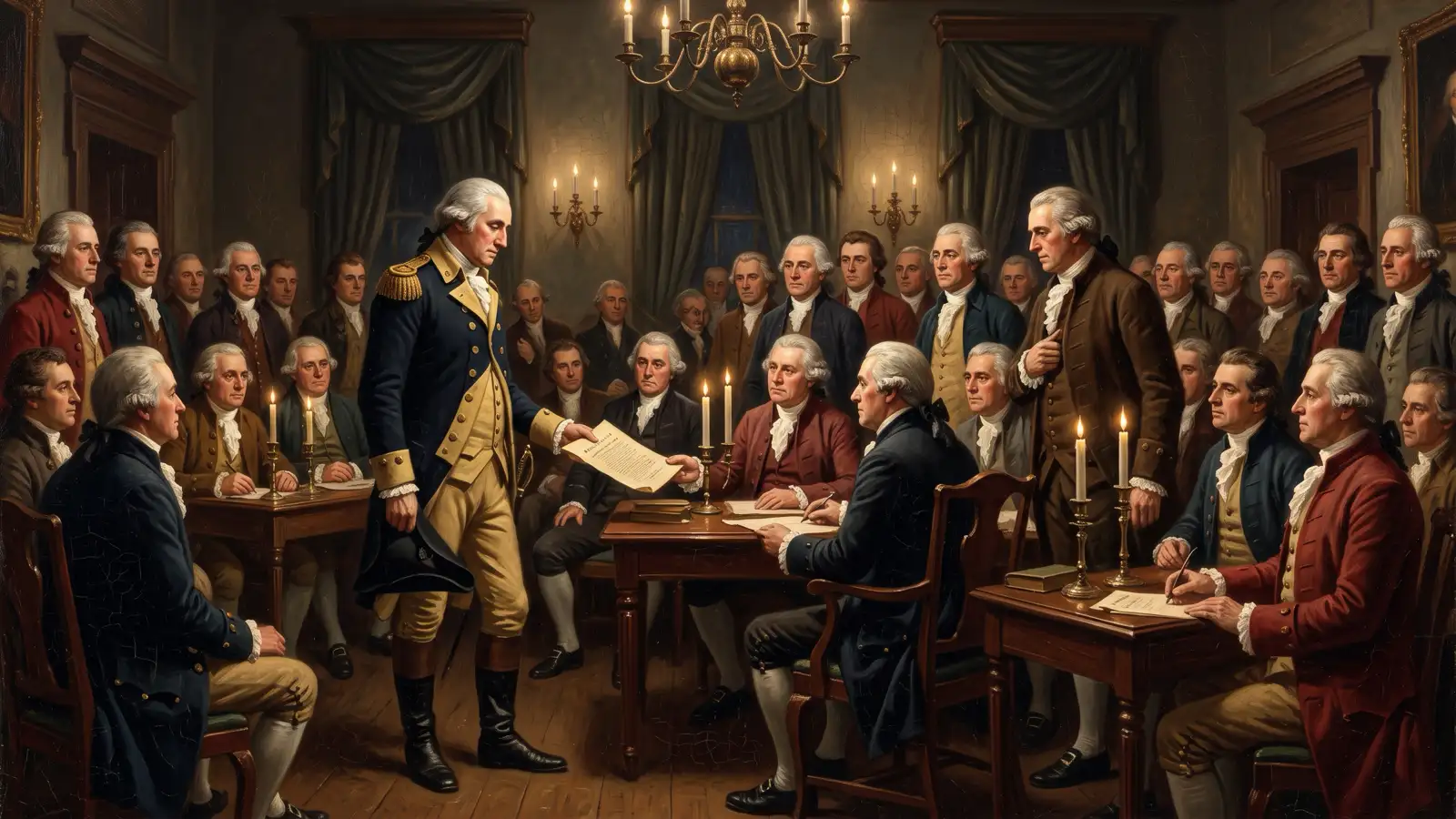
December 23, 1783: the most powerful man on the continent gives the power back and rides home. Every empire in history said this moment was impossible. Source: U.S. House of Representatives Archives
What governed those states? The Articles of Confederation, in force since March 1, 1781: a compact in which the states "severally enter into a firm league of friendship with each other."
No federal taxman. No federal court reaching into your barn. No president at all. And one iron lock on the door, Article XIII: no alteration to the compact unless agreed in Congress "and be afterwards confirmed by the legislatures of every State." Unanimity, or nothing.
"Public school" taught you that arrangement was a failure: "too weak," couldn't tax, couldn't regulate, cue Shays' Rebellion, thank heaven wise men gathered in Philadelphia. That story is the winners' press release, and it has been repeated for so long that nobody notices it is an argument made by a group of oppressors. It is not a fact.
Weakness was the feature. It was the purposeful design.
A general government too feeble to tax you, conscript you, or inflate your money was not the bug the textbooks describe; it was the entire point of the preceding eight years of corpses.
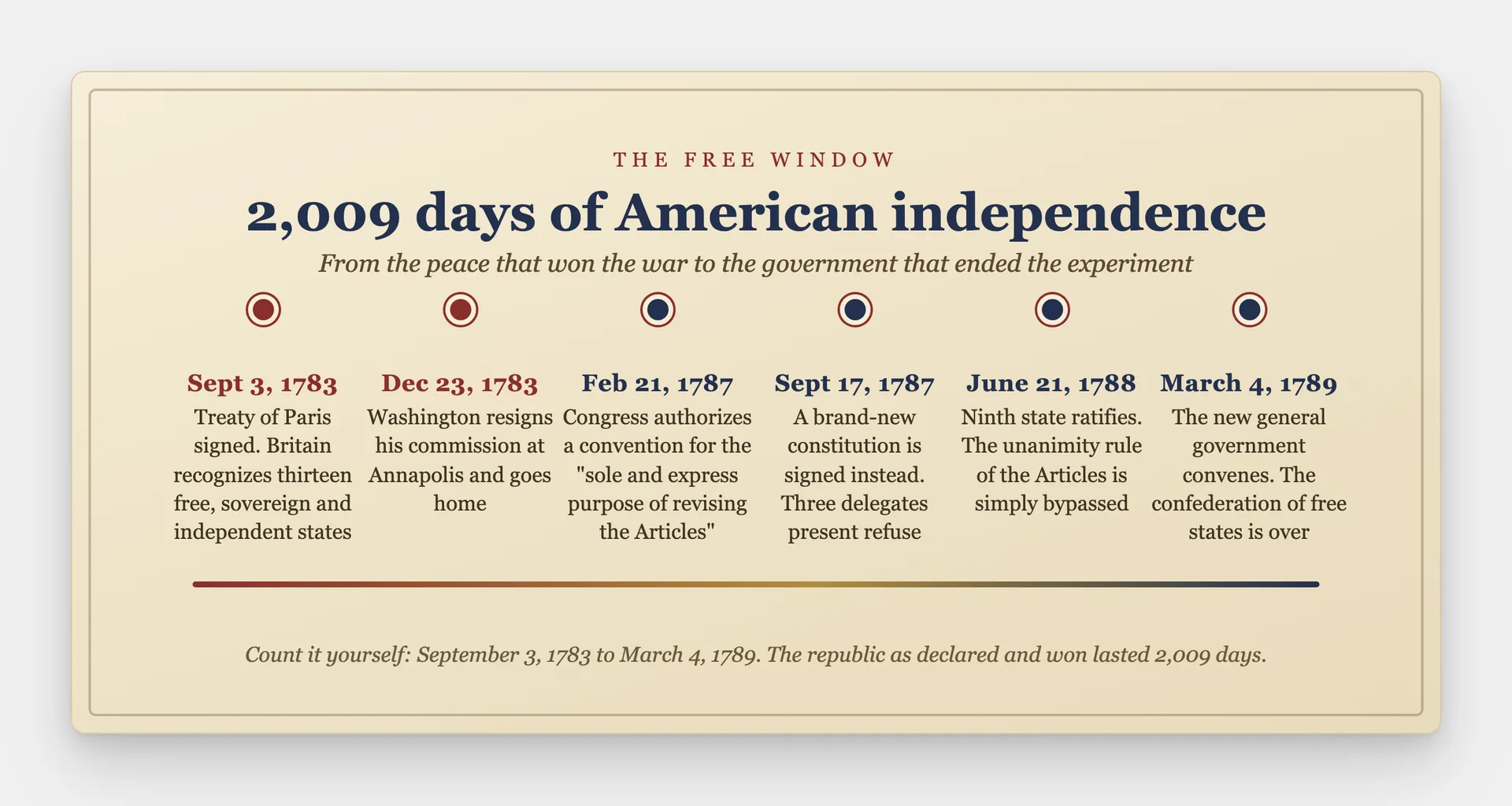
The whole experiment, end to end. Count the days yourself. Source: National Archives
A coup with immaculate manners
On February 21, 1787, the Confederation Congress authorized a convention at Philadelphia under a mandate of very specific words, and those words are the crime scene. The delegates were to meet "for the sole and express purpose of revising the Articles of Confederation" and reporting amendments back to Congress and the state legislatures for confirmation.
Patrick Henry, the finest orator the Revolution ever produced and the man who had staked his neck on treason against a real king, was elected a delegate and refused to go. Tradition says he explained that he "smelt a rat in Philadelphia, tending toward the monarchy." That quote surfaces decades later in William Wirt's 1817 biography.
One of the convention's first orders of business, adopted May 29, 1787, was a secrecy rule: "That nothing spoken in the house be printed, or otherwise published or communicated without leave." Windows shuttered, sentries posted, and the men sent to repair the Articles began, in a locked room, writing a new national government instead.
Two of New York's three delegates, Robert Yates and John Lansing Jr., watched it happen and walked out in July rather than lend it their names. Their letter to Governor George Clinton, dated December 21, 1787, is the whistleblower report of the founding era. They wrote that they had been "reduced to the disagreeable alternative, of either exceeding the powers delegated to us, and giving our assent to measures which we conceive destructive to the political happiness of the citizens of the United States, or opposing our opinion to that of a body of respectable men." And they were explicit about the stakes: "we should have been equally opposed to any system, however modified, which had in object the consolidation of the United States into one government."
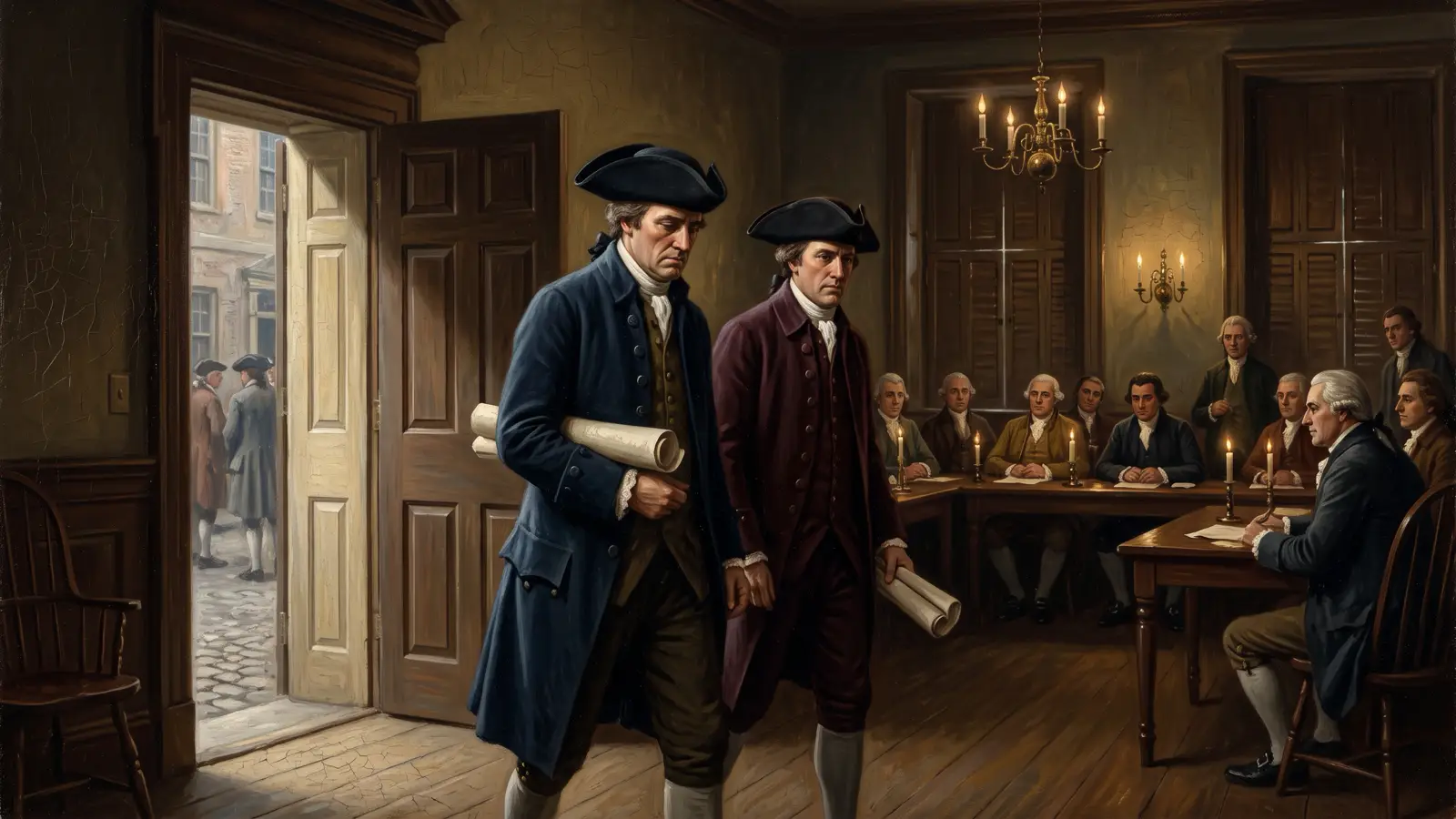
Yates and Lansing quit the room rather than exceed the mandate. Luther Martin followed in September and told the Maryland legislature exactly why. Source: ConSource, Yates and Lansing to Gov. Clinton
Luther Martin of Maryland, Attorney General of his state, left in early September and then published everything in his "Genuine Information," telling his legislature the new ratification scheme was "directly in violation of the mode prescribed by the articles of confederation for the alteration of our federal government" and that he "thought it a duty to give a decided negative."
Even inside the room, the honest men gagged. George Mason of Virginia, the man whose Virginia Declaration of Rights had supplied half the vocabulary of American liberty, declared on August 31, as Madison's own notes record, that "he would sooner chop off his right hand than put it to the Constitution as it now stands." On September 17, 1787, Mason, Elbridge Gerry, and Edmund Randolph stood in the room and refused to sign. Mason's written objections open with six words that should be carved over every courthouse door: "There is no Declaration of Rights."
Now the mechanism, which is truly a confession.
They needed nine, and they got nine when New Hampshire ratified 57 to 47 on June 21, 1788. But look at the margins in the states that actually had the argument.
The margin of legitimacy
Massachusetts: 187 to 168. Virginia: 89 to 79. New York: 30 to 27. The continental edifice you were taught to treat as holy writ carried its three toughest rooms by a combined 32 votes.
Rhode Island never even sent delegates. When the new constitution was put to her people in a March 1788 referendum, they rejected it 237 to 2,708. That is not a typo, and it was not close! Two years later, with the new Congress preparing to treat her as a foreign country and tariff her into starvation, Rhode Island "freely" ratified by 34 to 32 [checks notes] on May 29, 1790, the most enthusiastic two-vote margin economic strangulation ever purchased. North Carolina held out too, voting 184 to 84 at Hillsborough in 1788 to ratify nothing at all, and only came aboard 194 to 77 at Fayetteville on November 21, 1789, after the price of her sovereignty had been named.
They never taught you those vote counts, did they?
On the convention's last day, delegate James McHenry jotted an exchange in his diary: "A lady asked Dr. Franklin Well Doctor what have we got a republic or a monarchy. 'A republic,' replied the Doctor, 'if you can keep it.'" One diary, secondhand or first, and the lady herself could not recall it decades later, though the Library of Congress historian who studied the entry calls it entirely reasonable to believe.
I believe it too, mostly because of what the answer concedes: Franklin did not say you have a republic. He named the terms of the lease.
The devil's bargain that got it ratified
So how did a consolidation this naked get through even nine conventions?
It didn't.
It was failing on its merits in the big states, and its authors knew it, so they cut a deal.
Massachusetts pioneered the trade in February 1788, ratify now and we promise amendments after, a package brokered by John Hancock, owner of the largest signature on the parchment we celebrate today, and Samuel Adams, the old lion of the resistance, to peel off just enough skeptics. Virginia and New York followed the same script with their own lists of demanded amendments attached like ransom notes.
The Constitution did not survive ratification because Americans trusted it; it survived because its opponents were promised a leash for it.
Understand how little its architects wanted that leash. Alexander Hamilton spent Federalist No. 84 arguing that "bills of rights, in the sense and to the extent in which they are contended for, are not only unnecessary in the proposed Constitution, but would even be dangerous." James Madison came around for the most honest reason in politics: he was about to lose an election. Facing James Monroe for a House seat and needing the Baptists of his district, who remembered exactly who had jailed their preachers, Madison put it in writing to Baptist elder George Eve on January 2, 1789: amendments "will be not only safe, but may serve the double purpose of satisfying the minds of well meaning opponents, and of providing additional guards in favour of liberty." He won, he delivered, and on December 15, 1791 ten of the twelve proposed amendments became the Bill of Rights.
Credit where the deal earned it: every liberty an American still enjoys in 2026 shelters under that parchment. The speech you're reading, the rifle in your safe, the warrant they theoretically need. The Anti-Federalists lost the war but their ransom note is the only part of the settlement still fighting for you.
But the deal was devilish: the Bill of Rights is what made the coup swallowable. It answered Mason's first objection, "there is no Declaration of Rights," and left his real one, consolidation, standing. It wrapped a national government in ten promises and persuaded a suspicious people to sign, while the one question that mattered, who is finally sovereign, the states that created the compact or the creature they created, was left deliberately, fatally unanswered. Virginia and New York both ratified while asserting the right to resume their delegated powers, and the Federalists pocketed the ratifications and never conceded the assertion. That unpaid balance sat in the national ledger for seventy years, accruing interest.
The bill came due at Fort Sumter.
The war that turned states into departments
Between 1861 and 1865 the question got its answer, and the answer was written in roughly 750,000 corpses, the figure demographic historian J. David Hacker established in 2011, a fifth higher than the 620,000 your textbook offered. And before anyone reaches for the bait: the war's one unambiguous mercy, the emancipation of four million human beings from literal plantations, was right, overdue, and paid for in blood worth spending, but it also distracts from the full scope of the tragedy that we call "The Civil War."
On April 27, 1861, Lincoln suspended habeas corpus by executive order along the Philadelphia rail corridor. When Chief Justice Taney ruled in Ex parte Merryman that only Congress could do that, Lincoln ignored him, which established the useful precedent that the Constitution means whatever the executive can survive asserting. That September, roughly a third of the Maryland General Assembly was arrested by federal military order to prevent a vote the administration feared losing. James McPherson, the war's most celebrated historian and no Confederate apologist, wrote that the arrests "seemed excessive and unjustified by any reasonable military necessity."
Elections you might lose, canceled by soldiers: remember that trick, because the century ahead loved it.
The money changed hands the same way. The Legal Tender Act of February 25, 1862 printed the first federal fiat paper since the Continental. Exactly one year later, February 25, 1863, the National Currency Act nationalized banking by a single vote in the Senate, 23 to 21! The Enrollment Act of March 3, 1863 introduced federal conscription, and New York burned for four July days over it. The Revenue Acts of 1861 and 1862 delivered the first federal income tax, the 1861 version on paper and the 1862 version actually collected, along with a brand-new revenue bureau you now know as the IRS.
And in 1869 the Supreme Court, in Texas v. White, poured the concrete: "The Constitution, in all its provisions, looks to an indestructible Union, composed of indestructible States."
A compact you cannot leave is not a compact. It is custody.
The states walked into 1861 as parties to an agreement and walked out as departments of an administration, and no amendment ever voted on made it so. Bayonets did, and then five "justices" notarized the bayonets.
How to lose a revolution on installment
Ok, so we have covered the free window, the coup that closed it, the deal that sold it, and the war that buried it. What remains is the invoice: the itemized schedule by which every remaining battle the founders won was quietly refunded.
1913 alone repealed half the American Revolution. The 16th Amendment, ratified February 3, made the income tax permanent, converting "no taxation without representation" into taxation with a form number. The 17th Amendment, ratified April 8, took senators away from the state legislatures, deleting the states' last structural voice inside the government they had supposedly created. And on December 23, 1913, the Federal Reserve Act handed the money power to a banking cartel wearing a government nameplate (ask sometime who actually owns the shares of the regional Reserve Banks). I traced that machine's full lineage, from the Bank of England in 1694 to the CBDC push of this decade, in Invisible Plantations, and I will not repeat the whole indictment here.
Either way, 1913 laid three foundation stones of the plantation state in one calendar year!
Then the schedule accelerated. In 1917 the Espionage Act made speech a felony again, and Eugene Debs, a four-time presidential candidate, drew ten years in federal prison for an anti-war speech in Canton, Ohio. In 1933, Executive Order 6102 ordered Americans to surrender their gold to the Federal Reserve on pain of a $10,000 fine, ten years in prison, or both: the money in your own pocket, criminalized by signature. In 1942, Wickard v. Filburn ruled that wheat a farmer grew on his own land to feed his own animals was "interstate commerce," which meant everything was, which meant the government of enumerated powers now had exactly one enumerated power with no edges. In 1971 Nixon cut the dollar's last tie to gold. In 2001 the PATRIOT Act sailed through the Senate 98 to 1 (Russ Feingold, the one), building the surveillance architecture that would have made Orwell scream, if he could have read it. In 2008, Congress authorized $700 billion for the banks in a single October bill, and in 2020 it moved $2.2 trillion in one more while you were locked in your house to "stop the spread!"
Add up where the installments land. As of July 2, 2026, the national debt stands at $39.37 trillion. The federal government spends about 23 percent of everything this country produces, versus the 2 to 3 percent it consumed in 1900. The 2024 Federal Register, the rulebook nobody voted on, ran 106,109 pages, the largest in history. And the government's own Administrative Conference admits it cannot produce an authoritative count of how many federal agencies exist. The empire that cannot count its own limbs claims the authority to count everything of yours, and tax you for it, or punish you for not being able to account for your own assets.
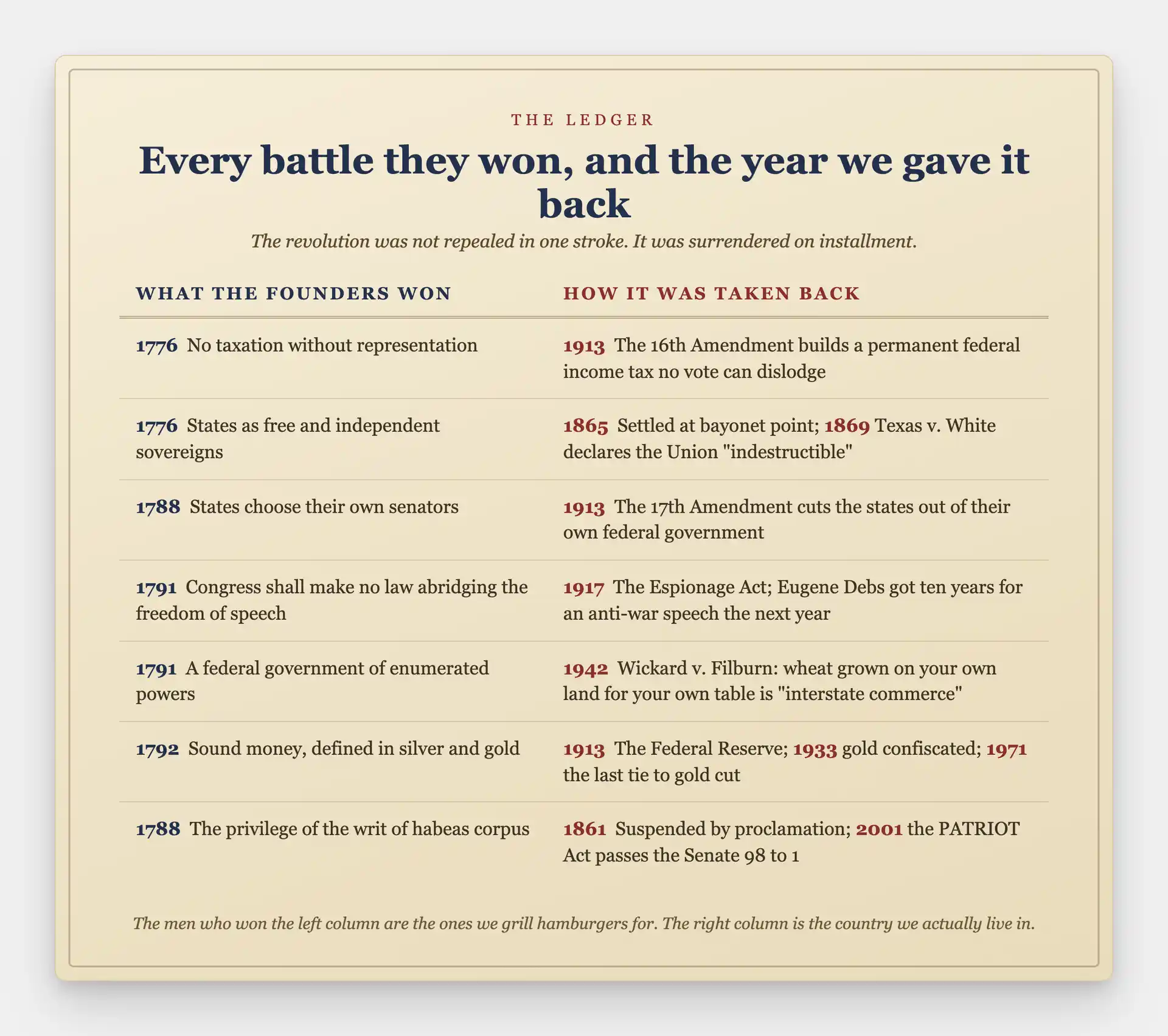
The revolution was not repealed in one stroke. It was surrendered on installment, and every line item is documented. Source: National Archives, Milestone Documents
They kept the flag. They kept the anthem. They kept the fireworks. And they're all delightful, in principle.
They repealed everything the fireworks were for, and they did nearly all of it with proper procedure, recorded votes, and a judiciary ready to notarize whatever survived.
Welcome back to the plantation
Jeremy Bentham, the English philosopher who never met a human variable he would not optimize, published his panopticon in 1791, the same year the Bill of Rights was ratified: a prison built so the inmates, never knowing when they are watched, guard themselves. He wanted to build it out of brick; we built it out of glass and put one in every pocket, including your eight-year-old's.
And we prepared the inmates deliberately. Horace Mann, the Massachusetts schools chief who fell in love with Prussia's "school" method, imported that model precisely because it manufactured obedient subjects at scale; Massachusetts made attendance compulsory in 1852, Mississippi finally fell in line in 1918, and by 1980 a federal Department of Education stood over all of it. Look at the architecture: rows, bells, permission slips to speak, permission slips to use the toilet, thirteen years of rehearsing compliance for the factory or the cubicle... It is a feedlot for minds, and calling it "education" is the most successful branding operation in American history.
This is the plantation model I have been documenting for years, and it needs no whips. The modern version is centrally planned authority deep-fried in a neoliberal batter of benefits, subsidies, and dopamine, engineered so the livestock never wander and mostly never want to. The overseer became a case worker. The company store became the credit system. The cotton rows became desk rows.
The sad part is that this should have been predictable to a Christian people. The prophet Samuel warned Israel exactly how this ends when they begged him for a king:
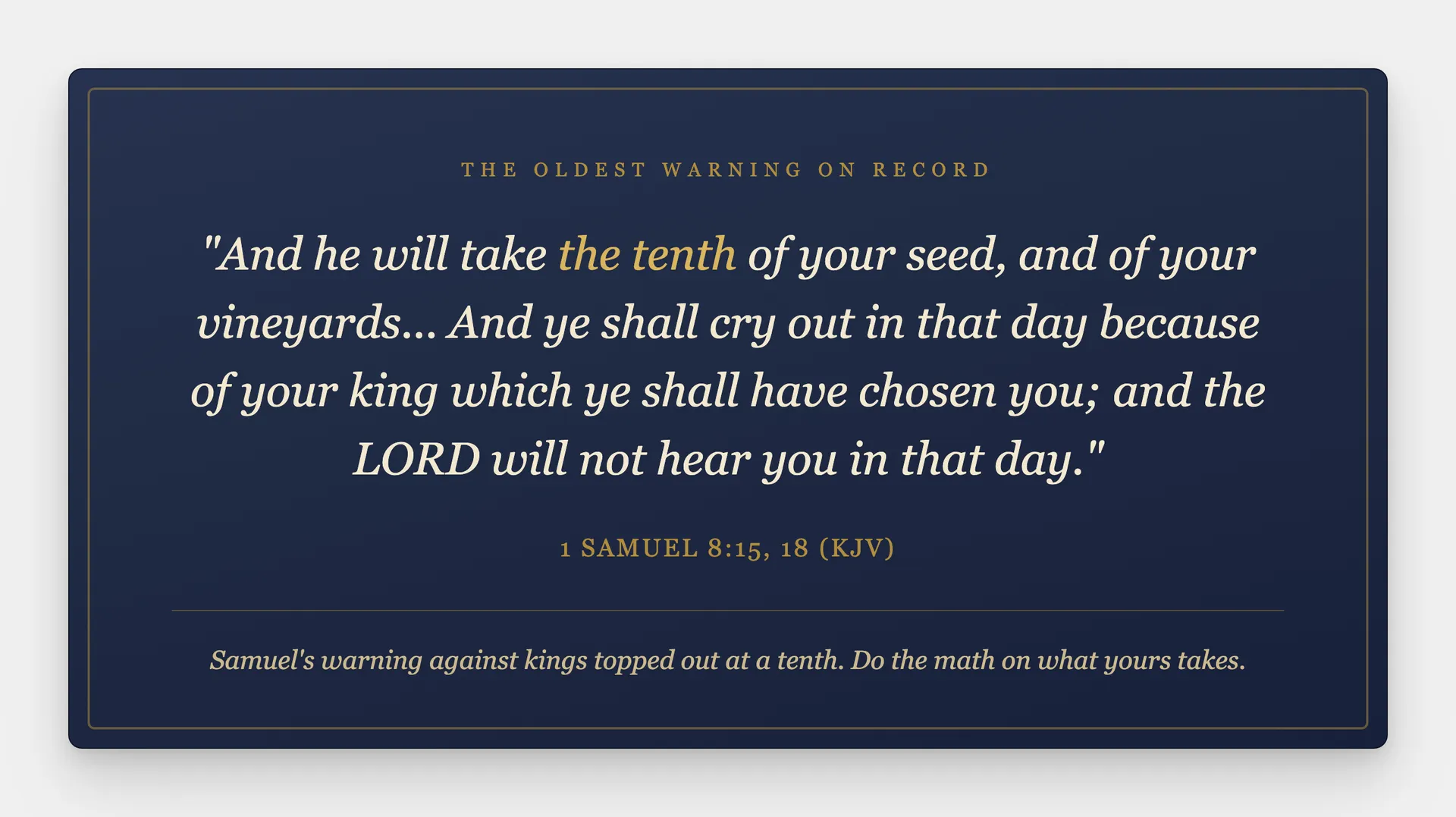
The prophet's ceiling was ten percent. Tally your income tax, payroll tax, property tax, sales tax, and the inflation tax, and ask who owns whom. Source: 1 Samuel 8, KJV
"And he will take the tenth of your seed, and of your vineyards, and give to his officers, and to his servants," the prophet warned, and the people demanded the king anyway, and verse 18 is the epitaph: "And ye shall cry out in that day because of your king which ye shall have chosen you; and the LORD will not hear you in that day."
And if you think this will wrap up with a cute little bow, I'm sorry to say there is no political solution to this. None. The plantation holds elections for overseer every four years and counts on you to mistake them for the harvest. Both parties bid on the same debt, feed the same agencies, and genuflect to the same Federal Reserve, and I suspect no ballot ever printed will un-ring 1789.
If your entire plan for your grandchildren fits inside a voting booth, you do not have a plan. You have a coping mechanism.
So what do we do, then?
We secede in place.
We stop petitioning the plantation for a better overseer and start building the things the plantation cannot digest. None of what follows is novel: it is older than the republic, it built the republic, and it is the only thing that has ever rebuilt anything.
- Crown the right King. Worship Jesus as King: not as a private therapeutic option but as the actual sovereign over every square inch, which is precisely the claim I laid out in Christ's Dominion Over Everything. A man who kneels to the King cannot also kneel to the state, and the state knows it, which is why the state hates Him.
- Build a large, strong family. Marry. Stay. Have the third kid, and the fifth. The regime's entire dependency model assumes atomized, childless, exhausted consumers; a big Godly family is a competing sovereignty it cannot tax into existence or propagandize away. "As arrows are in the hand of a mighty man; so are children of the youth," says Psalm 127. Arrows are munitions. Build the quiver!
- Take your children off the feedlot. Educate them outside the panopticon. Roughly 3.4 million American kids were homeschooled in 2024-25, about six percent of the school-age population, up from around 2.5 million before the lockdowns showed every parent the curriculum on a webcam. Fittingly, nobody can count them precisely, because no federal system tracks them. Good: being uncountable should be every American's goal.
- Teach your neighbors to do the same. Sovereignty that stops at your fence line dies with you. The founders had committees of correspondence; you have a dinner table, a church pew, and a group chat. Use them like the munitions they are.
Until you are doing those four things, you have no business celebrating independence from anything.
Independence is not a holiday you attend. It is a posture you either hold under load or you do not.
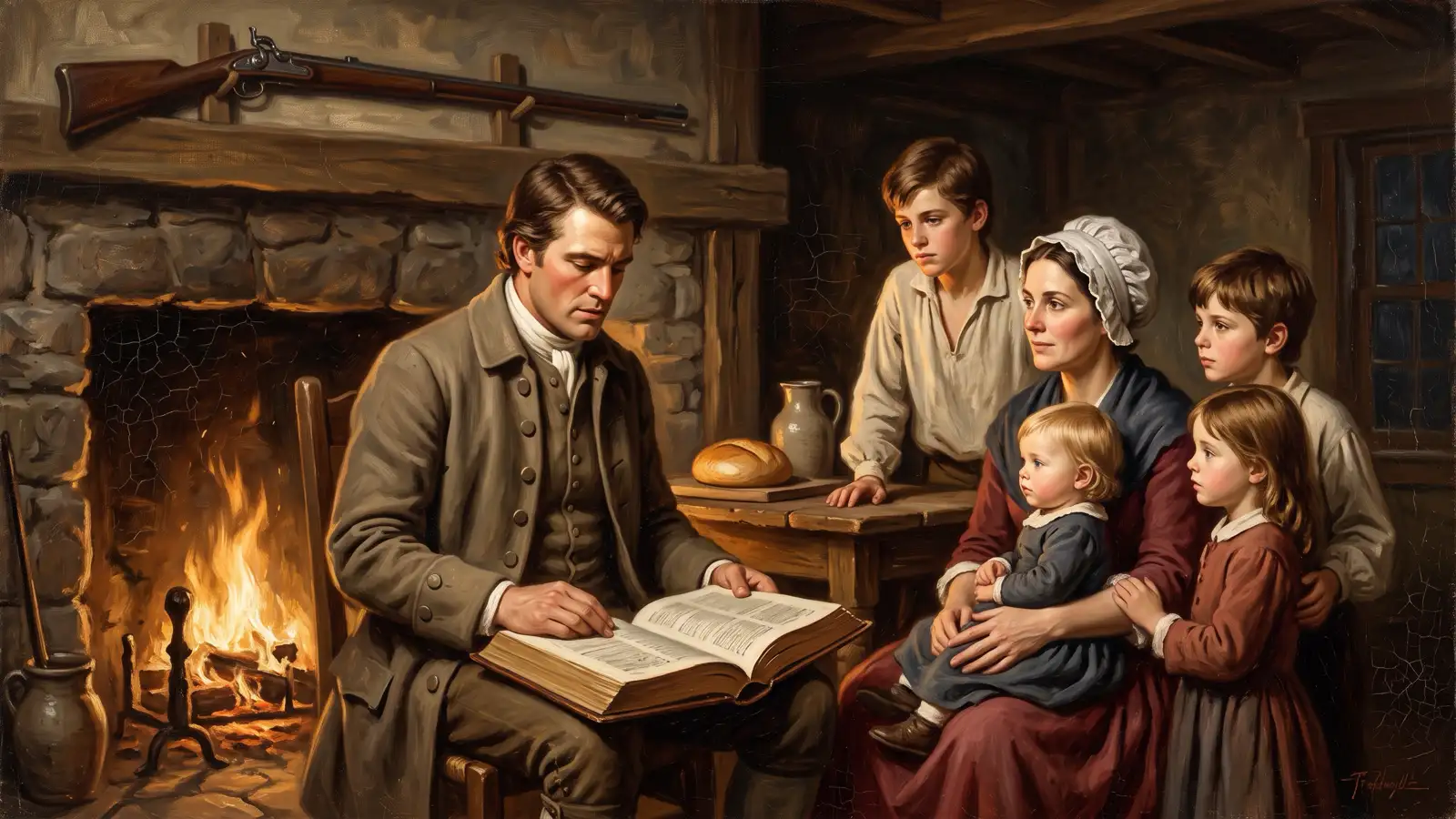
The counter-revolution does not start in Washington. It starts here, at a table the regime cannot subpoena, in a curriculum it cannot see. Source: NHERI homeschool research
So light the fireworks tonight. I mean that! Light them for the 49 dead on the Lexington road, for the 2,898 barefoot at Valley Forge, for the New Yorkers who walked out of a locked room in Philadelphia rather than sign, for a general who gave the sword back, and for a bell in Philadelphia still wearing Leviticus on its lip: "Proclaim LIBERTY throughout all the Land unto all the Inhabitants thereof."
Just know what you are toasting. It is not the government; the government is the thing the toast indicts.
The plantation has one weakness: the gate is not locked. It never was.
It is a 250-year-old dare, still on the table.
The men of 1776 did not ask permission to be free, and the King we crown does not lose. Take the dare.
Be good to each other. And teach your neighbors to do the same.
Kurt Wuckert Jr. is the Chief Bitcoin Historian, founder of GorillaPool and Open Protocol Labs, and host of Kurt's Podcast. He writes weekly on Bitcoin, geopolitics, faith, and the long fight for human sovereignty at kurtwuckertjr.com. Catch him live every Tuesday at 2 PM EST.