The Written History of Bitcoin, Part 1: The Ghost at the Conference (2008-2009)
By Kurt Wuckert Jr.
A Name on a Badge
In the last installment, we left thirty years of cryptographic work sitting on a table, waiting for someone to put it together. DigiCash had died in bankruptcy. Hashcash had shipped but never became money. b-money and Bit Gold existed as theories on paper. The cypherpunks had built the tools and written the manifestos, but nobody had yet built the system.
To watch the preamble, about the men and women who contributed to bitcoin, watch the stream.
Three years before that system appeared, someone walked into a hacker conference in the Netherlands wearing a name badge that read...
"...Satoshi Nakamoto."
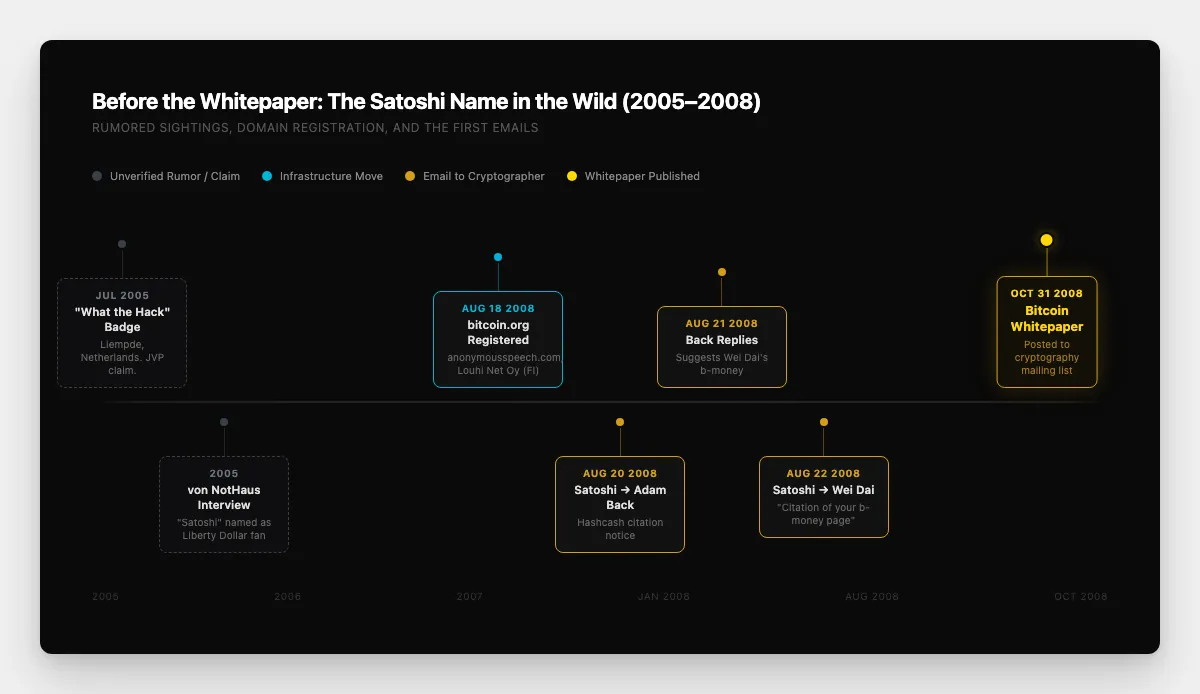
The conference was called "What the Hack." It ran from July 28 through July 31, 2005, in Liempde, a village near the town of Boxtel in the southern Netherlands. Thousands of hackers, cryptographers, privacy activists, and network engineers camped in tents for four days of talks on surveillance and cryptography.¹ Bitcoin did not exist. The whitepaper would not be published for another three years. The name "Satoshi Nakamoto" meant nothing to anyone in the crowd.
A man named Joseph Vaughn-Perling, who ran in alternative currency circles and had connections to Bernard von NotHaus and the Liberty Dollar movement, later claimed he encountered someone wearing that name on a badge at the conference.² In a separate recorded interview from 2005, von NotHaus himself mentioned that a mutual friend had told him "Satoshi Nakamoto" was a fan of the Liberty Dollar.³
Two data points from years before Bitcoin was announced to the world. Neither proves the identity of anyone, but file them away.
To follow this article on video, watch here.
The First Move
Fast forward about three years to the summer of 2008. The United States is in the opening weeks of the worst financial crisis since 1929. Bear Stearns has collapsed. Fannie Mae and Freddie Mac have been taken into conservatorship. Lehman Brothers is six weeks from insolvency. Inside the machinery of the banking system, people who have spent their careers running the world are discovering that the control panel has fewer working switches than they thought.
On August 18, 2008, someone registers the domain bitcoin.org. The registration runs through anonymousspeech.com, an anonymous domain registration service. The WHOIS records show Louhi Net Oy, a Finnish hosting company, as the registrant organization.⁴
Whoever registered the domain already has a project name. The word "bitcoin" is locked in. Nothing has been announced yet, nothing has been published yet, and the person who is about to announce it has decided what it will be called and has paid money to keep his own name off the paperwork.
Two days later, on August 20, 2008, an email arrives in the inbox of Adam Back, the British cryptographer who invented Hashcash a decade earlier. The sender calls himself Satoshi Nakamoto. The email informs Back that Hashcash is cited in an upcoming paper and invites him to read a draft.⁵
He does not ask many questions. He does not offer to collaborate. He suggests Satoshi look into Wei Dai's b-money. And then, by his own later admission, he sets the project aside and does not read the whitepaper.⁶
The first cryptographer Satoshi approaches about bitcoin barely responds.
The Email to Wei Dai
On August 22, 2008, at 4 PM, Satoshi emails Wei Dai. The subject line reads: "Citation of your b-money page."⁷
The opening line is direct:
"I'm getting ready to release a paper that expands on your ideas into a complete working system. Adam Back (hashcash.org) noticed the similarity and pointed me to your site."
Satoshi asks Dai for the publication year of the b-money page for the citation. He offers to share a pre-release draft. He includes the paper's abstract, which describes "a peer-to-peer electronic cash system" that solves double-spending through proof of work.
Dai responds with the date. He notes that b-money was announced on the cypherpunks mailing list in 1998. He will hear from Satoshi again in January 2009 when bitcoin v0.1 is released, in an email that opens: "Hi Wei, I just wanted to let you know, I got bitcoin.org launched. Announcing it tomorrow. Bitcoin v0.1 released."⁸
Something to notice about these August emails. Satoshi is not pretending to be a lone genius. He is crediting the people whose ideas he built on. He contacts Back first and Dai second. When Back points him to Dai, he follows up immediately. He asks for the publication year because he wants the citation to be accurate. He is a builder who understands that he is standing on other people's work, and he is transparent about it.
The tone is not cypherpunk manifesto. It is not hacker mystique. It is the tone of a competent, academically postured engineer sending courtesy emails to colleagues he has not yet met.
October 31, 2008
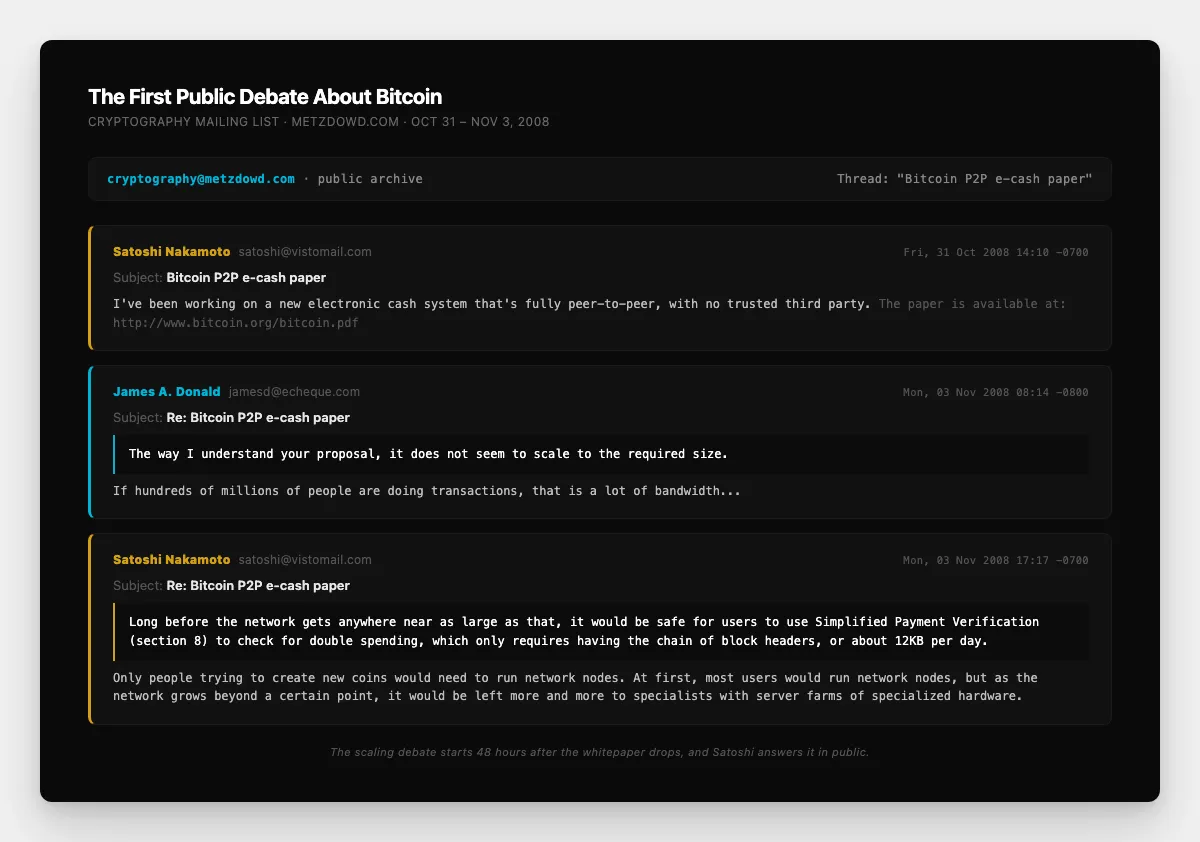
At 14 Eastern time on October 31, 2008, Satoshi posts to the cryptography mailing list hosted at metzdowd.com. The subject line reads: "Bitcoin P2P e-cash paper."⁹
The opening line of the post reads:
"I've been working on a new electronic cash system that's fully peer-to-peer, with no trusted third party."
Below the opening, Satoshi posts a link to a nine-page PDF hosted at bitcoin.org/bitcoin.pdf. He summarizes the paper's main properties: double spending is prevented without a mint, participants can be anonymous, proof-of-work secures the network, and nodes vote with their CPU power.
The whitepaper drops on Halloween, during the worst financial crisis in eighty years. The Chancellor of the Exchequer in the United Kingdom is, at that moment, preparing the second round of bailouts for the British banking system. Two months later, a headline about that second bailout will be written into the first block of a network that is, at this moment, still a nine-page PDF on a mailing list read by a few hundred people.
The paper draws attention from a small but serious audience. Hal Finney reads it and replies that he thinks the idea "has real promise."¹⁰ Ray Dillinger reviews the code later and posts a detailed analysis. And James A. Donald, a longtime cypherpunk who has spent years thinking about secure digital cash, responds within days with a critique that will echo loudly for the next decade.
Act I, Day Two: The Scaling Debate Starts
On November 3, 2008, James Donald replies to the whitepaper.¹¹ His response opens politely, then delivers the punch:
"The way I understand your proposal, it does not seem to scale to the required size."
Donald's concern is not that bitcoin is a bad idea. His concern is that the model of every node maintaining a complete record of every transaction will collapse under global demand. If "hundreds of millions of people" are transacting, the bandwidth and storage requirements will be prohibitive. Donald articulates the classic distributed-systems objection: you cannot have a world-scale payment network where every participant keeps a full copy of every transaction ever made.
It is November 3, 2008. The paper has been public for three days. The first public conversation about bitcoin is already a scaling argument.
Satoshi responds, and the response reveals everything about the design.
He directs Donald to Section 8 of the whitepaper, which describes Simplified Payment Verification. In Satoshi's words:
"Long before the network gets anywhere near as large as that, it would be safe for users to use Simplified Payment Verification (section 8) to check for double spending, which only requires having the chain of block headers, or about 12KB per day."¹²
It will chafe the current intelligentsia of bitcoin abrasively, but this is not a throwaway line. This is the architectural answer to the scaling question. Users do not have to run a node. They do not have to download the entire blockchain. They verify their own transactions using short proofs derived from the block headers and Merkle paths. Twelve kilobytes per day. A mobile phone in 2008 can handle that without noticing.
Donald pushes back, and Satoshi keeps going. A few exchanges later, he does the actual math.
The Visa Calculation
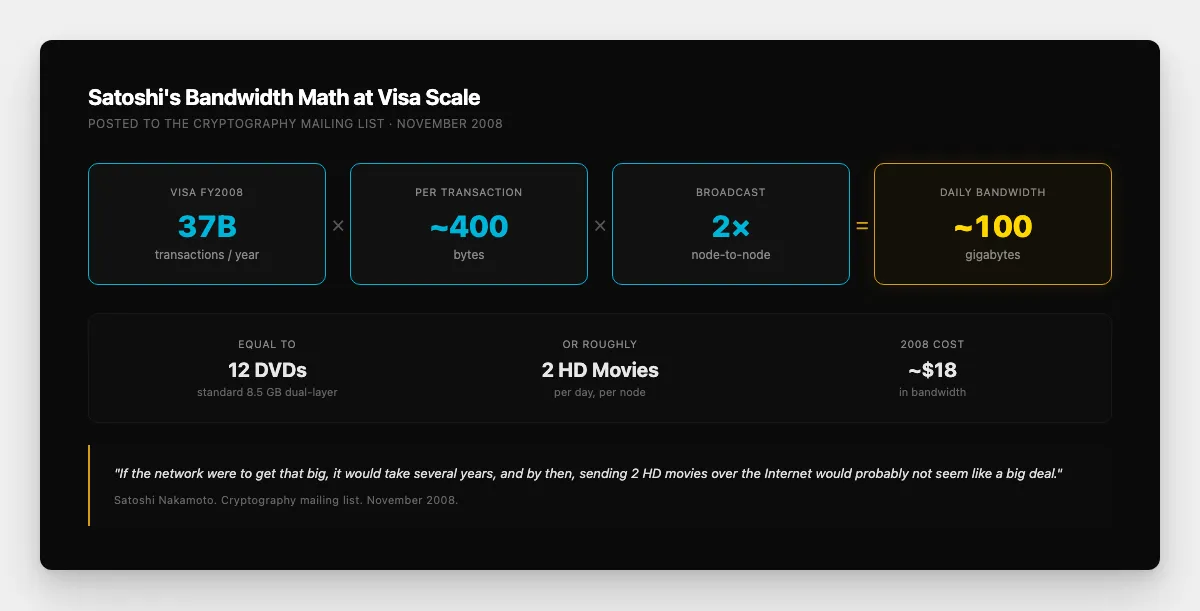
Satoshi walks through the bandwidth math in public on the mailing list.¹³
Visa processed 37 billion transactions in fiscal year 2008. Call that 100 million transactions per day. At roughly 400 bytes per transaction, broadcast twice across the network, that works out to about 100 gigabytes of daily bandwidth.
One hundred gigabytes. The size of twelve DVDs. Or two HD movies. Or, at the bandwidth prices of 2008, about 18 dollars.
Satoshi then writes a sentence that every subsequent scaling argument on the bitcoin network has had to either contend with or ignore:
No Big Deal!
"If the network were to get that big, it would take several years, and by then, sending 2 HD movies over the Internet would probably not seem like a big deal."
Read that paragraph twice.
Satoshi is doing three things simultaneously in this calculation.
- Math He is demonstrating that the math works at Visa-scale throughput.
- Scalable Vision He is telegraphing that the network is designed to grow to that size, not to stay small.
- Moore's Law He is predicting, correctly, that in a few years the bandwidth cost he is describing will be so cheap that nobody will care.
Donald's position, the implicit thesis that everyone must verify everything themselves, is the philosophical root of a movement that will dominate bitcoin politics from 2014 on, but Satoshi rejects it in 2008. In plain English, in the first public debate about the project he just launched, with the math laid out on the mailing list.
The primary sources are archived. They have not moved. You can read them today at satoshi.nakamotoinstitute.org. Whatever conclusions the reader draws, the record is the record.
Genesis
Two months pass. Satoshi keeps working. On January 3, 2009, at 18:15 UTC, a computer somewhere in the world mines the first block of a new network.¹⁴
Embedded in the coinbase parameter, in hexadecimal that decodes to plain ASCII text, is a single line:
"The Times 03/Jan/2009 Chancellor on brink of second bailout for banks."
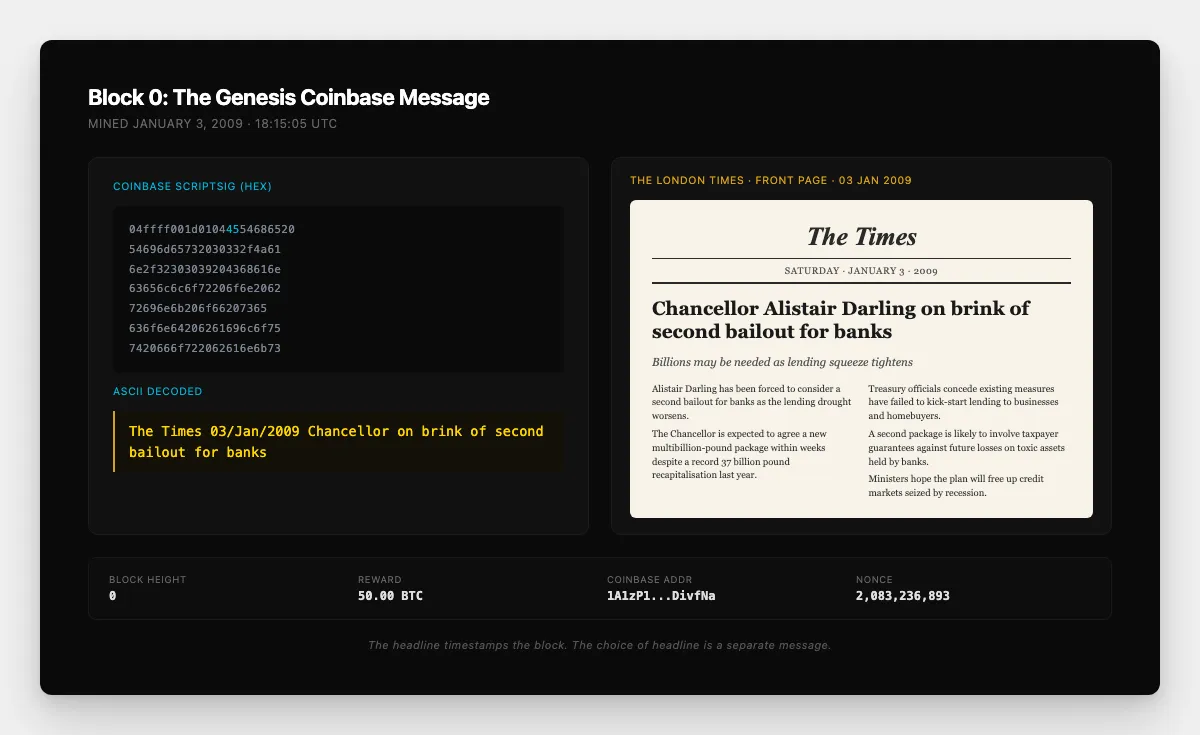
The line does two things. It proves the block was not mined earlier than the newspaper's publication date, calling back to Satoshi's favorite citation, Haber and Stornetta, because the headline it quotes could not exist before that morning. An external, public attestation as a timestamp. And it is also potentially a political message. Satoshi has chosen, out of every possible piece of text that could be inscribed into the foundational block of the system, to quote a headline about banks getting bailed out a second time.
Resist the urge to over-interpret. Satoshi did not leave an essay. He left a single headline from a single newspaper on a single morning. What the reader takes from it is the reader's business. The headline is the record.
Six days later, on January 9, 2009, Satoshi announces bitcoin v0.1 on the cryptography mailing list.¹⁵ The software is released for Windows. The source code is C++. The person who wrote it, compiled it, and posted it is, as far as anyone on the mailing list knows, a single individual, and the programming grammar's consistency is a hint at that theory. The announcement is brief. It says a new electronic cash system is now running, that it is decentralized, and that there is no central authority.
Three days after that, on January 12, 2009, Satoshi sends 10 bitcoins to Hal Finney.¹⁶ The transaction is recorded in block 170. It is the first person-to-person bitcoin transaction in history. Finney had downloaded and run the software the moment it was released. He had been mining since day one. He later wrote:
"When Satoshi announced the first release of the software, I grabbed it right away."¹⁷
Finney is the bridge. He had built RPOW in 2004, the first reusable proof-of-work system, which failed commercially but proved many of the concepts bitcoin would later use. He is one of the few people on the mailing list who understands, immediately, what Satoshi has just released. He grabs the software, he mines, and he is the first recipient of the first transaction sent on the first peer-to-peer electronic cash system that actually works.
A few weeks later, Finney will post a message on the forum that reads, in part, "Imagine that Bitcoin is successful and becomes the dominant payment system in use throughout the world." He was not speaking theoretically. He had tested the software. He understood what it could become.
There is another exchange with Finney from this same period that reveals something important about Satoshi's design philosophy. On the cryptography mailing list in November 2008, Finney suggests that bitcoin's security model could work like SETI@Home or other distributed computing projects, where participants volunteer spare computing power for the common good. The implication is that miners might run the network out of altruism, the way people donate CPU cycles to search for extraterrestrial signals or fold proteins.
Satoshi does not agree. His response, dated November 14, 2008, reframes the entire incentive model:
"It's very attractive to the libertarian viewpoint if we can explain it properly. I'm better with code than with words though."²⁵ᵃ
That word, "libertarian," is doing specific work. Satoshi is not describing a political party. He is describing an economic architecture. Bitcoin's security does not depend on participants being generous. It depends on participants being self-interested. Miners compete for block rewards. The protocol channels that competition into honest behavior through proof of work. If you try to cheat, you waste your own electricity and earn nothing. If you play by the rules, you get paid. The system works precisely because it does not require altruism. Finney, who came from the cypherpunk tradition of building tools for the public good, was thinking about bitcoin through that lens. Satoshi corrects him. The incentive is economic. The architecture is competitive.
The Second Developer
For the first five months of the network's life, Satoshi is the only developer. He writes code. He responds to bug reports on the mailing list. He releases patches. He owns the domain. He hosts the website. He is, as far as the infrastructure is concerned, the entire project.
In May 2009, a Finnish university student named Martti Malmi, using the handle "Sirius," sends Satoshi an email offering to help.¹⁸ Malmi has been reading the mailing list archives and the bitcoin.org website. He wants to contribute.
What happens next is the moment the project stops being one person.
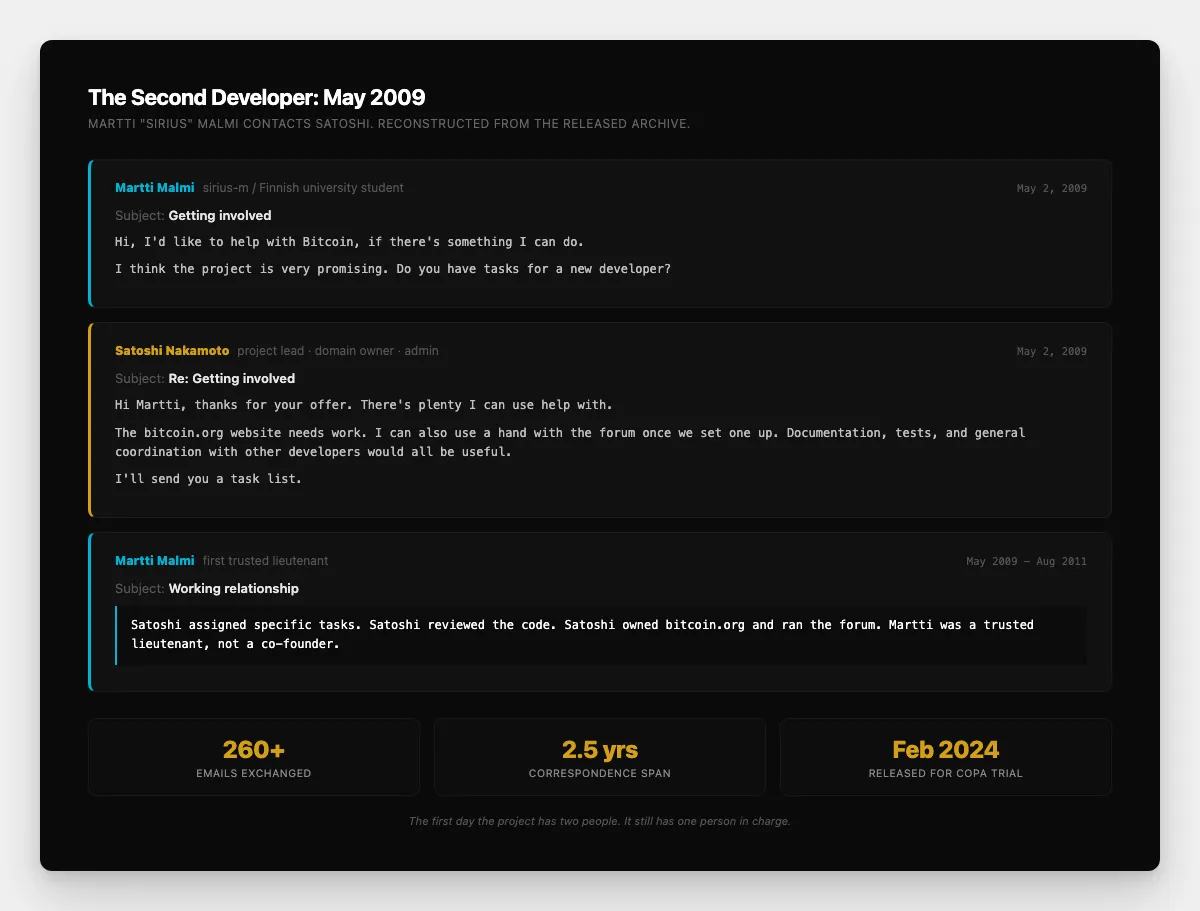
Over the next two and a half years, Satoshi and Malmi will exchange more than 260 emails. The correspondence was released publicly in February 2024, entered into the evidence record for the COPA trial in the United Kingdom.¹⁹ The emails are the most detailed operational record we have of how Satoshi ran the project.
The relationship is not the peer-to-peer collaboration of a modern open-source project. Satoshi assigns specific tasks. Satoshi reviews Malmi's code. Satoshi owns the domain, runs the server, and controls the forum.
Malmi is a trusted lieutenant. He is not a co-founder.
The emails show the dynamic in Satoshi's own words. The first task he assigns Malmi is writing an FAQ for the website. Satoshi explains: "What the site needs most at the moment is writing. I'm better at code than words. If you can write a FAQ, I can give you a compilation of my replies to questions in e-mail and forums for facts and details and ideas."²⁰ᵃ
It is a specific assignment with specific deliverables. Satoshi is the project lead. Malmi is the recruit. The content will be based on Satoshi's prior answers, curated and compiled by Satoshi, organized and written by Malmi. This is not a collaborative brainstorm. It is delegation.
Satoshi's editorial control extends to messaging. When Malmi drafts bitcoin.org copy that describes bitcoin as anonymous and positions it as an investment, Satoshi pushes back. On the anonymity language: "Also, 'anonymous' sounds a bit shady. I think the people who want anonymous will still figure it out without us trumpeting it."²⁰ᵇ He removes the word from the site. On the investment framing: "I'm uncomfortable with explicitly saying 'consider it an investment'... That's a dangerous thing to say and you should delete that bullet point."²⁰ᶜ
Two corrections in two emails.
- Private But... According to its founder, Bitcoin is not anonymous.
- Valuable, but... Bitcoin is not an investment. It is electronic cash.
Satoshi is not just writing code. He is curating the narrative, line by line, on a website he owns, administered by a developer he recruited, for a project where every decision runs through him.
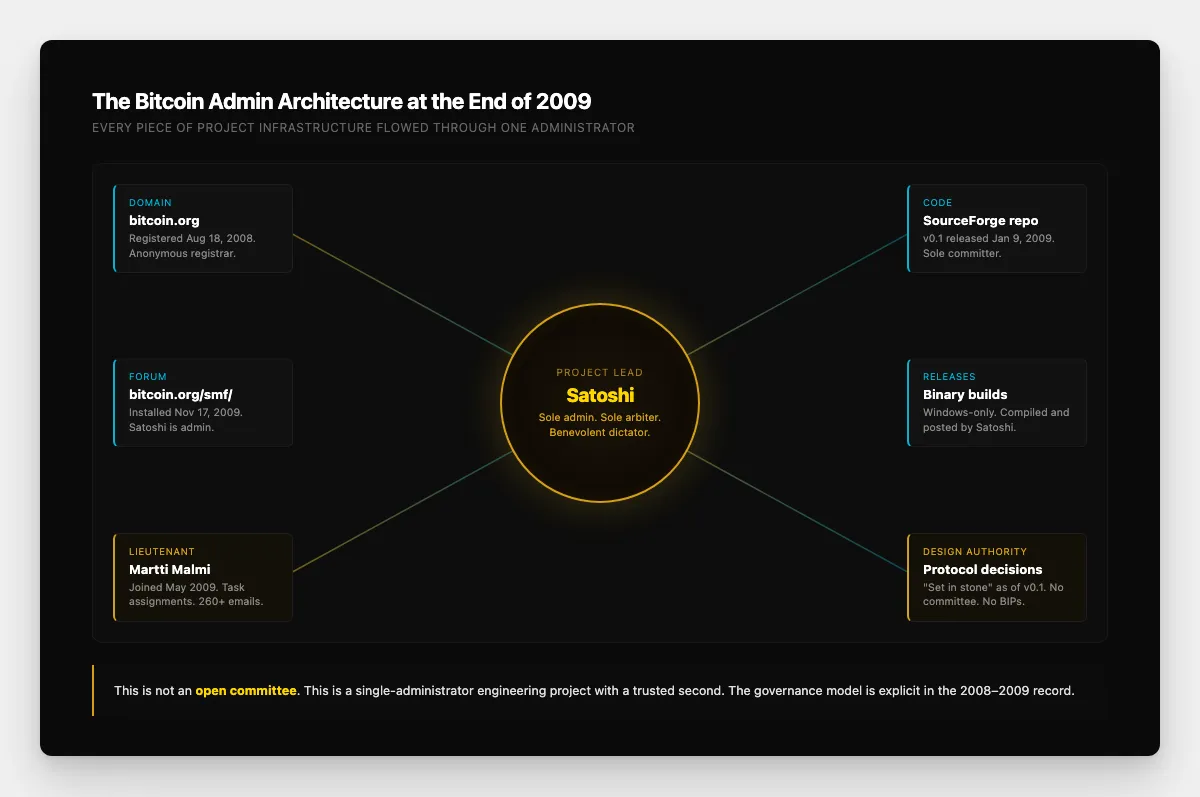
In November 2009, Satoshi installs a Simple Machines Forum at bitcoin.org/smf/, giving the project a dedicated discussion space outside the cryptography mailing list.²⁰ The forum runs on Satoshi's domain, on infrastructure Satoshi controls. Every user registration, every post, every moderation decision flows through a system where Satoshi is the administrator.
Satoshi is controlling. This matters.
Every piece of infrastructure bitcoin has at the end of 2009 runs through one person's administrative control. The codebase, the website, the forum, the domain registration, the software releases. Satoshi is the benevolent dictator of a commercial payment system, and he is actively recruiting a small, trusted group of contributors under his direction. This is not an open committee. It is not a community project. It is an engineering effort with a clear chain of command, and the name at the top of that chain is Satoshi Nakamoto.
The forum will eventually be migrated to a different domain, and the administrative control will change hands. That story is in a later installment.
The Design Philosophy in His Own Words
By the spring and summer of 2010, Satoshi is posting regularly on the bitcoin.org forum. His forum posts, preserved in full at the Satoshi Nakamoto Institute and elsewhere, form the single largest body of his direct writing. Most of what the world thinks it knows about "what Satoshi intended" comes from these posts, and from the James Donald mailing list debate we just walked through.
The echoes of the Donald exchange land in 2010, and they land loudly.
On June 17, 2010, in a forum thread about the bitcoin scripting system, Satoshi writes:
"The nature of Bitcoin is such that once version 0.1 was released, the core design was set in stone for the rest of its lifetime."²¹
Read it twice. Version 0.1 was released on January 9, 2009. In Satoshi's own words, the core design is locked as of that release. Not up for committee. Not subject to the amendment process of a foundation. Locked.
On July 14, 2010, he writes about how the network will evolve as it grows:
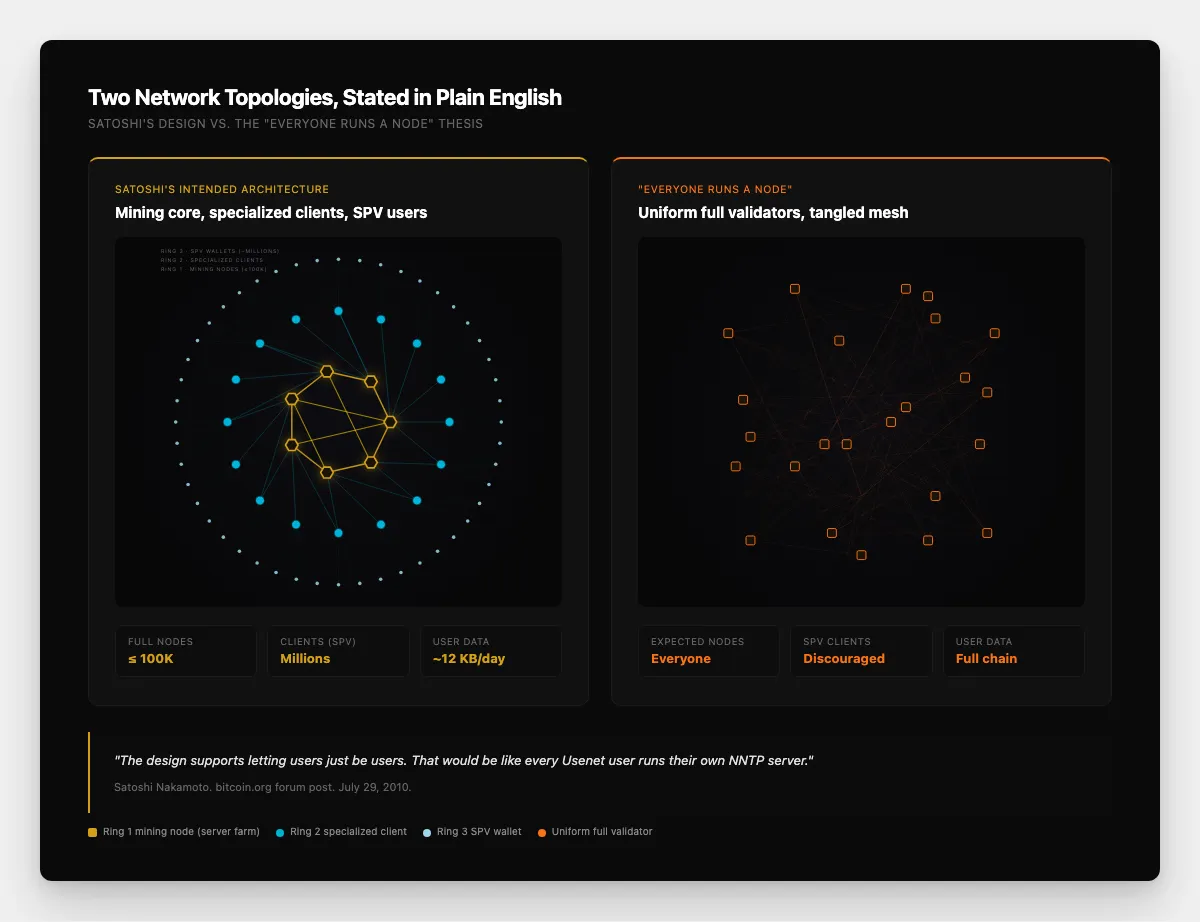
"At first, most users would run network nodes, but as the network grows beyond a certain point, it would be left more and more to specialists with server farms of specialized hardware. A server farm would only need to have one node on the network and the rest of the LAN connects with that one node."²²
And in the same thread:
"I anticipate there will never be more than 100K nodes, probably less. It will reach an equilibrium where it's not worth it for more nodes to join in. The rest will be lightweight clients, which could be millions."²³
Two weeks later, on July 29, 2010, he writes the line that ties the whole architecture together:
"The design supports letting users just be users. The more burden it is to run a node, the fewer nodes there will be. Those few will be big server farms. The rest will be client users who only do transactions and don't generate."²⁴
In the same post, he makes the analogy explicit:
"That would be like every Usenet user runs their own NNTP server."
Satoshi is describing a network topology where mining is a professional, specialized, industrial activity. Server farms with specialized hardware. A small number of operators running the heavy infrastructure. Millions of regular users connecting with lightweight clients, verifying their own transactions through Simplified Payment Verification, never running a full node. The comparison he reaches for to describe the architecture he is rejecting is Usenet. Running your own node, he is saying, should be like running your own NNTP server in 1995: possible if you really want to, unnecessary for any normal user.
These are not my words. They are his. The citations are in the footnotes.
The observations from the 2008-2009 record, held up against the quotes from the months that follow, all point the same direction. Users should be users. Miners will be professionals. The protocol is locked. The governance model is a single administrator running a project with a few trusted lieutenants. The name at the top of every piece of infrastructure belongs to one person, and the design he is describing is commercial and industrial, built to handle Visa-scale throughput.
What the Record Does Not Say
It is worth noting what is absent from the record during this period. Nothing in Satoshi's 2008 emails, the mailing list debate, the whitepaper, the early forum posts, or the Malmi correspondence suggests bitcoin was designed as a tool for anonymous black-market transactions. Satoshi deletes "anonymous." The word "darknet" does not appear. The word "dark web" does not appear. He never mentions "sound money," Mises or Rothbard.
In fact, when the Mises question comes to him directly in 2010, his answer is remarkable for what it avoids. A Bitcointalk thread titled "Bitcoin does NOT violate Mises' Regression Theorem" invites Satoshi to weigh in on whether bitcoin satisfies the Austrian economics requirement that money must originate from a commodity with prior use-value.²⁵ᵇ
Satoshi's reply, dated August 27, 2010, never uses the names Mises or Rothbard. He does not invoke "sound money." Instead, he proposes a thought experiment:
"...imagine there was a base metal as scarce as gold but with the following properties:
- boring grey in colour
- not a good conductor of electricity
- not particularly strong, but not ductile or easily malleable either
- not useful for any practical or ornamental purpose
and one special, magical property:
- can be transported over a communications channel
If it somehow acquired any value at all for whatever reason, then anyone wanting to transfer wealth over a long distance could buy some, transmit it, and have the recipient sell it."
- Satoshi Nakamoto
https://bitcointalk.org/index.php?topic=583.msg11405#msg11405
Satoshi argues that even if this metal had zero commodity value, people would acquire it for its utility as a transfer mechanism: "If it somehow acquired any value at all for whatever reason, then anyone wanting to transfer wealth over a long distance could buy some, transmit it, and have the recipient sell it."²⁵ᶜ
He does not need to name Mises to dismantle the argument. He uses logic to show that digital transportability changes the rules. Bitcoin's value, in Satoshi's framing, is not that it resembles gold. It is that it can move across the planet instantly. The intrinsic value is the network itself.
The language Satoshi uses is very consistently "electronic cash," "payment system," "commerce on the Internet," and "Visa." When WikiLeaks begins soliciting bitcoin donations in late 2010, Satoshi writes on the forum, "No, don't 'bring it on.' The project needs to grow gradually so the software can be strengthened along the way. I make this appeal to WikiLeaks not to try to use bitcoin."²⁵
Satoshi is not a cypherpunk ideologue in the Tim May mold. He cites the cypherpunk work, he uses the cypherpunk tools, and he is clearly building in a tradition descended from Chaum and Dai and Szabo. But his communications are the communications of an engineer building a commercial payment network, not of a revolutionary arming the resistance. Whatever the later retrofitting of his motives by people who did not know him, the record is the record. You can read it.
Where We Are at the End of 2009
At the end of 2009, bitcoin exists. A handful of people are mining on CPUs. The price is effectively zero. The forum has a few dozen members. The software launched on Windows in January and, thanks to Malmi's work on v0.2, shipped with Linux support by December.²⁵ᵈ Satoshi is actively writing code, responding to users, and running every piece of the project that has any administrative weight attached to it.
This is a working prototype of a system that will, over the next fifteen years, become one of the most argued-about pieces of technology in human history. And the person who built it has, in his own public words, already stated the design philosophy that every subsequent fight will either extend or betray.
He wrote it in August 2008 in emails to Adam Back and Wei Dai.
He wrote it in November 2008 to James Donald on the cryptography mailing list.
He wrote it in January 2009 in the coinbase of block zero.
He wrote it in May 2009 in his first correspondence with Martti Malmi.
He wrote it in June and July 2010 in the forum posts that followed.
The record is public. The sources are archived. The reader can check every citation in the footnotes.
Next Time
In the next installment, bitcoin gets its first price. Someone pays 10,000 BTC for two pizzas. The first major exploit hits the network when a transaction creates 184 billion bitcoin out of nothing, and Satoshi has to ship a patch in a matter of hours. Gavin Andresen walks into the project. A lawyer in Argentina registers bitcoin.org's first subdomain for a local exchange. And somewhere in the code, in a quiet check-in that almost nobody noticed at the time, Satoshi adds a single line limiting block sizes to one megabyte. He calls it temporary. He says it will come out later.
It never came out on the BTC network.
That fight is coming.
Footnotes
¹ What the Hack 2005, outdoor hacker conference held July 28-31, 2005 in Liempde, Netherlands, Wikipedia entry.
² Archived post by Joseph Vaughn-Perling describing the 2005 conference encounter, archive.is mirror, accessed 2024.
³ Bernard von NotHaus, 2005 interview referencing "Satoshi Nakamoto" as a Liberty Dollar supporter, YouTube recording at timecode 7, 2005.
⁴ bitcoin.org WHOIS registration history, showing August 18, 2008 registration via anonymousspeech.com (operated by Michael Weber) with Louhi Net Oy as registrant organization, NamePros discussion archive, 2008.
⁵ Adam Back, complete email correspondence with Satoshi Nakamoto (five emails, August 20-21, 2008), released as evidence in the COPA trial, Bitcoin Magazine documentation, February 2024.
⁶ Adam Back, public acknowledgment that he did not read the whitepaper when Satoshi sent it, referenced throughout the COPA trial evidence release and in the Bitcoin Magazine coverage, February 2024.
⁷ Satoshi Nakamoto to Wei Dai, "Citation of your b-money page," August 22, 2008, 4 PM, archived at gwern.net.
⁸ Satoshi Nakamoto to Wei Dai, follow-up email announcing the release of Bitcoin v0.1, January 10, 2009, archived at gwern.net.
⁹ Satoshi Nakamoto, "Bitcoin P2P e-cash paper," cryptography mailing list at metzdowd.com, October 31, 2008, Satoshi Nakamoto Institute archive.
¹⁰ Hal Finney, reply to the whitepaper announcement on the cryptography mailing list, November 2008, Satoshi Nakamoto Institute archive.
¹¹ James A. Donald, reply to the whitepaper announcement, cryptography mailing list, November 3, 2008, Satoshi Nakamoto Institute archive.
¹² Satoshi Nakamoto, response to James A. Donald regarding Simplified Payment Verification, cryptography mailing list, November 3, 2008, Satoshi Nakamoto Institute archive.
¹³ Satoshi Nakamoto, bandwidth calculation at Visa scale in response to Donald, cryptography mailing list, November 2008, Satoshi Nakamoto Institute archive.
¹⁴ Bitcoin genesis block documentation, including the decoded coinbase message and the January 3, 2009 timestamp, Bitcoin Wiki Genesis block entry.
¹⁵ Satoshi Nakamoto, "Bitcoin v0.1 released," cryptography mailing list, January 9, 2009, Satoshi Nakamoto Institute archive.
¹⁶ Block 170, recording the first person-to-person bitcoin transaction from Satoshi to Hal Finney on January 12, 2009, Blockchain.com block explorer.
¹⁷ Hal Finney, "Bitcoin and me," forum post, March 19, 2013, bitcointalk.org thread 155054.
¹⁸ Martti Malmi, complete Satoshi correspondence, released for the COPA trial, February 2024, mmalmi.github.io/satoshi.
¹⁹ COPA trial evidence release, Martti Malmi email archive, February 2024. Context and analysis available at Bitcoin Magazine.
²⁰ Wiki documentation of the bitcoin.org/smf/ forum installation and its eventual migration to bitcointalk.org, Bitcoin Wiki BitcoinTalk entry.
²⁰ᵃ Satoshi Nakamoto to Martti Malmi, email regarding FAQ writing assignment, May-June 2009, Malmi-Satoshi correspondence archive.
²⁰ᵇ Satoshi Nakamoto to Martti Malmi, email regarding removal of "anonymous" from bitcoin.org copy, 2009, Malmi-Satoshi correspondence archive.
²⁰ᶜ Satoshi Nakamoto to Martti Malmi, email regarding removal of "investment" framing from bitcoin.org, 2009, Malmi-Satoshi correspondence archive.
²¹ Satoshi Nakamoto, forum post on the locked core design, June 17, 2010, Satoshi Nakamoto Institute post 126.
²² Satoshi Nakamoto, forum post on network equilibrium and specialized mining, July 14, 2010, Satoshi Nakamoto Institute post 193.
²³ Satoshi Nakamoto, forum post on node counts at equilibrium, July 14, 2010, Satoshi Nakamoto Institute post 193.
²⁴ Satoshi Nakamoto, "The design supports letting users just be users," forum post, July 29, 2010, Satoshi Nakamoto Institute post 274.
²⁵ Satoshi Nakamoto, forum post responding to WikiLeaks publicity, December 2010, Satoshi Nakamoto Institute post 551.
²⁵ᵃ Satoshi Nakamoto, email to Hal Finney on the cryptography mailing list regarding libertarian incentive design, November 14, 2008, Satoshi Nakamoto Institute archive.
²⁵ᵇ Bitcointalk forum thread, "Bitcoin does NOT violate Mises' Regression Theorem," Topic 583, Satoshi Nakamoto Institute thread archive.
²⁵ᶜ Satoshi Nakamoto, reply in "Bitcoin does NOT violate Mises' Regression Theorem," August 27, 2010, Satoshi Nakamoto Institute post 428.
²⁵ᵈ Bitcoin v0.2 release notes, December 16, 2009. Linux version by Martti Malmi. Satoshi thanked "Martti (Sirius-m) for all his development work." Satoshi Nakamoto Institute archive.
Be good to each other. And pay attention to what people say when they think nobody's listening.