John Carreyrou Spent a Year Hunting Satoshi Nakamoto and Found a Hyphen
By Kurt Wuckert Jr.
The Case the Times Built
John Carreyrou is a serious reporter. He is the man who broke Theranos when nobody else wanted to believe a young, attractive, Stanford dropout in a black turtleneck was running a fraud.¹ That is why I took it seriously when I heard the New York Times had put him on Satoshi Nakamoto. I read every word of his April 8 piece the morning it went live.² Then I read it again. Then I went and pulled the citations. And what I found is that the most famous investigative reporter in American business journalism spent a year of his life hunting the inventor of Bitcoin and came back with a handful of hyphenation errors and a guy who coughed in the wrong direction in a hotel room in San Salvador.
The headline candidate is (sigh...) Adam Back. Carreyrou and his co-author Dylan Freedman say Back is "the closest match" to Satoshi in three independent writing analyses, that Back shared 67 of Satoshi's 325 hyphenation mistakes against a next-closest total of 38, that Back anticipated almost every piece of Bitcoin's design in Cypherpunks list posts between 1997 and 1999, that Back went silent the moment Satoshi appeared and came back to life six weeks after Satoshi vanished, and that in a hotel room in El Salvador this January, Back briefly responded to a Satoshi quote "as if he had written it himself."²
The Times does not claim certainty. The piece is careful, on that front, which is sort of commendable. Florian Cafiero, the computational linguist the Times hired, told them his own result was "inconclusive."² There is no cryptographic proof anywhere in the article. No private key. No attestations of knowledge from people who would know. No signed message from one of Satoshi's known early addresses. No verified email from a wallet the network agrees belonged to the founder. The closest thing to a confession is a sentence fragment Carreyrou heard through a microphone and decided to interpret generously.
I am going to do something the Times would not do with its own reporting. I am going to take the stylometry seriously for about ninety seconds, then dismantle the rest of the case using the only evidence that matters when you are trying to identify the author of Bitcoin: what Bitcoin was designed to do, and what Adam Back has spent the last twelve or so years trying to prevent it from doing.
The Case the Times Built (Continued)
Let's give Carreyrou credit for the work. He read 134,308 posts across the Cypherpunks, Cryptography, and Hashcash mailing lists.² He found that Adam Back, on the Cypherpunks list between April 1997 and April 1999, publicly proposed an electronic cash system with five attributes that map one-for-one onto Bitcoin: privacy for both sides of a transaction, distribution across independent nodes, built-in scarcity, trustlessness, and a publicly verifiable protocol.³ Back suggested combining Hashcash with Wei Dai's b-money.⁴ Back wrote about Byzantine fault tolerance. Back wrote about timestamping to prevent double-spending. Back even pre-emptively made Satoshi's eventual defense of Bitcoin's energy use, arguing in 1999 that "as long as the wastage is lower than the costs of fiat money it's a win."³
None of that is in dispute. In fact, none of that is even novel information. Back was a known and popular Cypherpunk. He was early. He was technically brilliant on a few key aspects that went into bitcoin. He "invented" (look at Cynthia Dwork and Moni Naor's 1992 paper on pricing via processing for a chuckle) Hashcash in 1997, a denial-of-service counter-measure that is cited as reference [8] in the Bitcoin whitepaper.⁵ Satoshi emailed him in August 2008 to confirm the citation, and Back produced those emails more than fifteen years later during the Wright v. Crypto Open Patent Alliance trial in London in the spring of 2024.⁶

Blockstream Mining's own marketing copy, which to this day claims that their CEO "invented the algorithm that Bitcoin mining is based on, proof of work." It is a load-bearing fiction. The actual proof-of-work primitive was published in 1992 by Cynthia Dwork and Moni Naor, five years before Hashcash, and Back himself cites them as prior art in his own 2002 paper. Source: blockstream.com/mining
The Times then layers on the writing analysis. Back and Satoshi both double-space after periods. Both confuse "it's" and "its." Both put "also" at the end of sentences. Both alternate between "cheque" and "check," between "e-mail" and "email," between "off-line" and "offline."² Both hyphenate "proof-of-work" when the 1999 academic literature that coined the term does not.⁷ Both used the phrase "partial pre-image" in reference to Hashcash. Both used the phrase "burning the money" to mean destroying a coin in a situation where most cryptographers would have said "invalidate" or "spend to an unspendable script."
Carreyrou ran this through an AI model tuned to the New York Times stylebook and through sequential filters, and ended up with one name. It was a clean narrative built on top of a method that the Times' own expert had already called inconclusive, and I will show you why the cleanness is the tell.
Stylometry Is a Parlor Trick When the Suspect Has Read the Corpus

There is a problem at the heart of the NYT's method that Carreyrou himself flagged and then walked past. It is this: Adam Back has been publicly studying Satoshi Nakamoto's writing, line by line, for more than a decade.
Back joined BitcoinTalk in April 2013, the same day an Argentine researcher named Sergio Demian Lerner published the analysis that first estimated Satoshi's coin hoard.⁸ From that day forward, Back has been one of the most prolific commentators on anything Satoshi wrote. He has quoted from Satoshi's posts. He has argued about which emails are authentic. In 2020, on his own public account, he explained why Satoshi's writing looked the way it looked
That could be why Satoshi's writing style is concise and focussed. Minimise emotive flourishes, extraneous adjectives and off topic chit-chat to reduce stylometry risk.
— Adam Back (@adam3us) May 26, 2020
Back himself told the world he was thinking about how to beat stylometry, and the Times quotes him doing it, and then uses a stylometric match as its centerpiece.
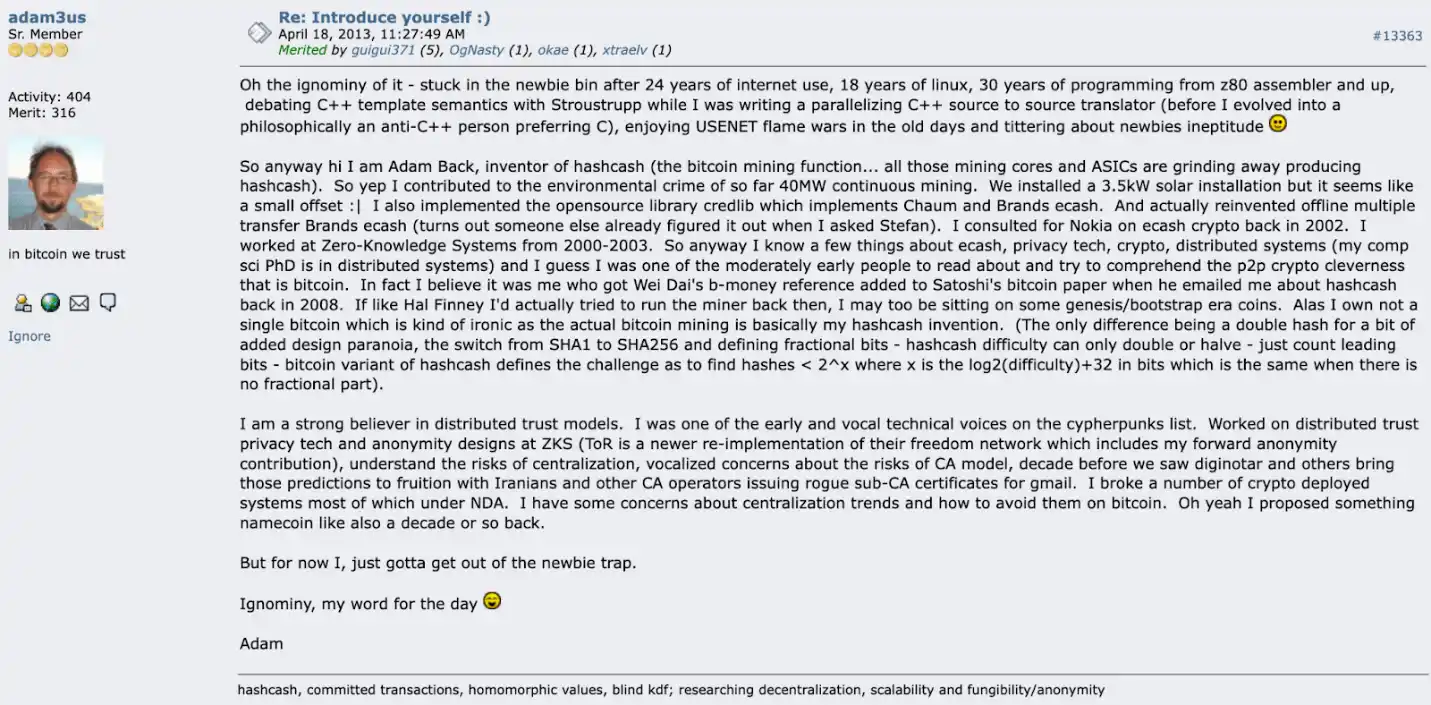
Adam Back's very first BitcoinTalk post, dated April 21, 2013. In his own words: "I did not take much interest in the ensuing library credit which implements Chaum and Brands ecash. And actually I remember seeing the ecash papers figured it out when I asked Stefan." He goes on to describe contributing to "the environmental crime of so far 40MW continuous mining" and running a node that "implements Chaum and Brands." This is the man the Times now wants you to believe was quietly running Bitcoin under a pseudonym the entire time. Source: bitcointalk.org
This is like building a fingerprint case against a man who has spent twelve years in a glove shop running his hands over every sample on the wall. Of course the prints match, because the suspect has been working in the glove shop for twelve straight years, and the only surprise would be if any of the fingerprints on the wall still looked unfamiliar to him.
Cafiero, the linguist, saw this. When he ran his first analysis, Back came out on top, but with Hal Finney a fraction of a hair behind. When Cafiero adjusted the distance calculation, Back fell and other candidates moved ahead. Cafiero called his own result "inconclusive" in plain English.² Carreyrou kept going. Dylan Freedman, his partner, then designed a different method based on Carreyrou's personal reporting instincts, which is to say, a method built after the reporter had already decided who the suspect was. That is called confirmation bias, and in any other investigation we would call it by its name.
The 67-of-325 hyphenation errors is the number the Times will put on its dust jacket. But think about what the number actually says: Back has been writing publicly on the internet since 1995. Satoshi wrote for about 30 months in total. Back has tens of thousands of posts in the corpus. Satoshi has a few hundred emails and forum posts and one whitepaper. The set of Back's writing is two orders of magnitude larger than Satoshi's. A larger set of writing will always contain more shared idiosyncrasies than a smaller set, simply as a matter of arithmetic. And every one of Back's posts after 2013 was written by a man who had Satoshi's corpus open in another tab.
That leaves you with 67 hyphenation matches that prove Adam Back reads carefully and writes in the same broad British-technical register as Satoshi. He is exactly what the Cypherpunk list archives already told us he was: a talented British cryptographer who thinks about money the way people who went to good schools in England in the 1990s tend to think about money.
Satoshi's Vision vs. Back's Career

The scaling war was not a technical disagreement. It was a business decision, and the business decision was made by the people who needed Bitcoin to stop working as money.
Here is what the New York Times never did, but what I have been focused on for over a decade: The history of bitcoin and Satoshi Nakamoto.
I am going to put Satoshi's stated vision next to Adam Back's stated career. Then ask which one of those two men actually believes in the other.
On April 14, 2010, a user on the Bitcoin Forum, now archived on BitcoinTalk, asked whether Bitcoin could ever scale to the size of the Visa network. Satoshi replied in the thread himself:
"The existing Visa credit card network processes about 15 million Internet purchases per day worldwide. Bitcoin can already scale much larger than that with existing hardware for a fraction of the cost. It never really hits a scale ceiling, although it does get more expensive at very extreme sizes."⁹
Satoshi followed with a list of the ways the protocol would cope with growth. He wrote about light clients, about pruning, about the fact that full nodes would eventually be run by "specialist hardware." He referenced the bandwidth required to run Bitcoin at VISA scale and compared it to an ordinary business's server load. He walked through the math eagerly, like a man who had already thought about the scaling problem for years and considered it a feature of the design rather than a constraint he was hoping nobody would notice.
In a separate exchange with Mike Hearn, also preserved in the Satoshi Nakamoto Institute archives, Satoshi wrote:
"The current system where every user is a network node is not the intended configuration for large scale. That would be like every Usenet user runs their own NNTP server."¹⁰
Read those two quotes together. Satoshi wanted Bitcoin to handle more transactions than VISA. Satoshi explicitly said that running a full node from your apartment was not the point. Satoshi compared the idea that every user should run a node to the idea that every AOL user should run their own email server, and he said it with a dismissive shrug.
Now look at Adam Back's twelve years at Blockstream, where the scaling problem Satoshi treated as a feature has been treated as an existential threat that must be managed by somebody charging fees at a choke point.
In August 2015, when a proposal to increase Bitcoin's block size was the hottest fight in the industry, Adam Back himself tweeted: "Strongly agree. My suggestion 2MB now, then 4MB in 2 years and 8MB in 4years then re-asses."¹¹
Strongly agree. My suggestion 2MB now, then 4MB in 2 years and 8MB in 4years then re-asses.
— Adam Back (@adam3us) August 26, 2015
Two months later, Back reversed. By late 2015 he was the loudest voice on the small-block side, arguing that any meaningful block-size increase would force hobbyists to choose "between operating a node and watching YouTube at the same time."¹² That is the man who, according to the Times, is the same mind that wrote "it never really hits a scale ceiling." I don't buy it for one moment. For a fuller accounting of how the scaling war was won by the people who wanted Bitcoin to stop being money, see my earlier piece BTC Was Hijacked and Everyone Knows It.
In February 2016, Blockstream co-founders and most of the major mining pools signed the Hong Kong Agreement, a public commitment to activate Segregated Witness alongside a two-megabyte hard-fork block increase.¹³ In May 2017, Back's Blockstream-employed Bitcoin Core developers signed the New York Agreement, another public commitment to activate SegWit alongside a two-megabyte hard-fork.¹⁴ In September 2017, Blockstream's CSO posted the famous Reddit statement walking away from that commitment. The SegWit activation went through exactly as Blockstream wanted, and the block-size increase that had been signed by 58 companies representing roughly 83 percent of global hashing power quietly died in committee.¹⁵
In every case where Adam Back had a choice between honoring Satoshi's stated design goal versus protecting Blockstream's business, he chose Blockstream. That choice is in the public record of his own tweets and his own company's statements, and you can reconstruct the timeline yourself with nothing more than an afternoon and a browser pointed at the Wayback Machine.
Carreyrou's NYT piece treats Back's 2015 intervention on the Bitcoin-dev mailing list as further evidence that Back is Satoshi, because a Satoshi email appeared on the same mailing list warning that big-block proposals were "dangerous" and calling Gavin Andresen and Mike Hearn "reckless."² Carreyrou does not consider the obvious alternative: that the Satoshi email was not Satoshi at all. Other Satoshi email accounts had already been hacked by 2015. The community at the time was deeply suspicious of the message. Carreyrou waves that suspicion away because "no other emails from that account have surfaced." An absence of contradicting messages from a possibly compromised address proves nothing about authenticity, and any reporter who has spent a career separating documents from spin should know the difference between a gap in the record and a verification.
The simpler story is this. Adam Back is a British cryptographer who genuinely believed in peer-to-peer electronic cash in the late 1990s, invented an interesting piece of the puzzle in Hashcash, and genuinely missed the boat when Satoshi actually shipped it in 2008 because he did not think it would work. When Bitcoin's price went vertical in 2013, Back came back to reinsert himself into the story. He built Blockstream, hired the Bitcoin Core developers out from under their employers, with money raised in part by Jeffrey Epstein's orbit, and otherwise entirely by the traditional finance industry, and has spent the last decade making Bitcoin not be the thing Satoshi said it was. That is a story about ambition and regret and the lucrative business of rewriting history. It is not a story about Satoshi Nakamoto reappearing under his real name to take back the reins of his creation.
I have walked through the Epstein-to-Bitcoin-Core funding pipeline in detail in The Invisible Plantations and in the video below, so I will keep the next section focused on what the Times left out rather than rehashing what I have already documented.
Jeffrey Epstein Hijacking Bitcoin: Deep Dive. Kurt Wuckert Jr. walks through the donor network that bankrolled Bitcoin Core's developer corps and the institutional laundering of Bitcoin's early political capture.
The Financial Web the Times Would Not Pull On
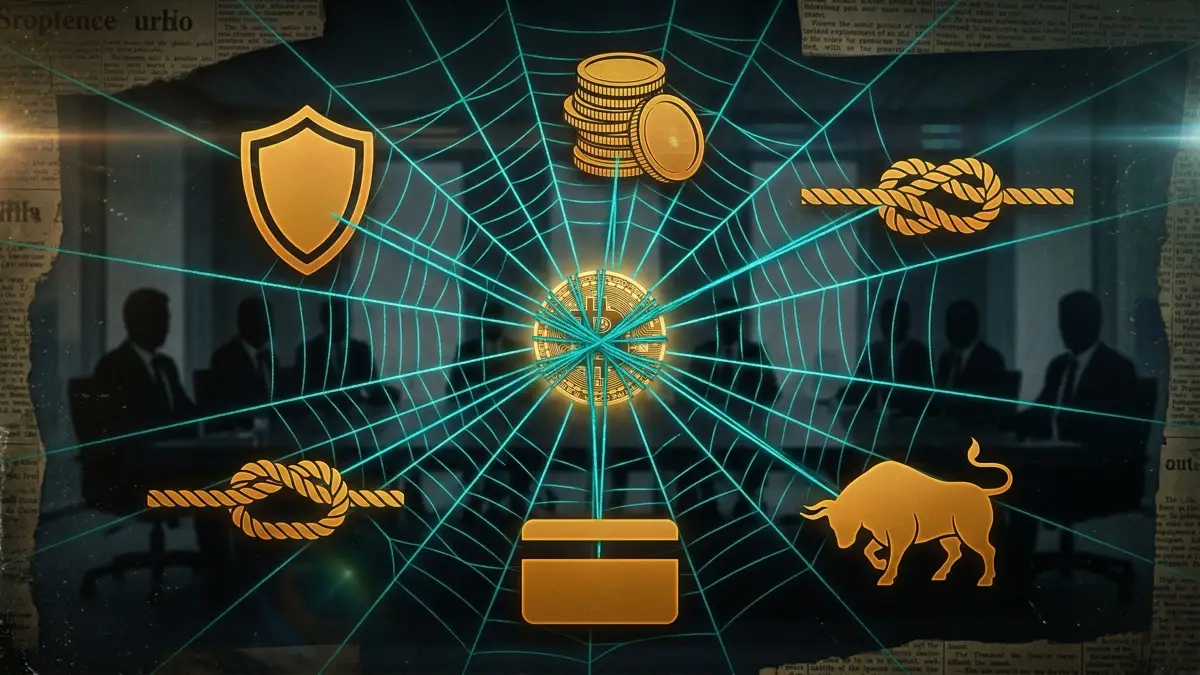
This is the picture the Times chose not to print, and it is the single most relevant piece of context for why Adam Back's name is being typeset in Sunday business-section font this week.
The most telling omission in Carreyrou's 12,000 words is the money. He mentions in passing that Blockstream has raised about a billion dollars and hit a $3.2 billion valuation.² He mentions that Back is in the process of merging a Bitcoin treasury company with a publicly traded shell built by Cantor Fitzgerald, the firm formerly led by Commerce Secretary Howard Lutnick.² He even gestures at the legal consequence: under U.S. securities law, Back will soon be obligated to disclose material information to investors, and if he is actually Satoshi, a dormant 1.1 million BTC stash worth north of $100 billion is the most material fact in the history of material facts.
Tether's Secret: From Stablecoin to Shadow Bank. The Cantor Fitzgerald / Howard Lutnick / Tether axis is the reason a Bitcoin treasury company is suddenly a politically useful vehicle in the spring of 2026, and it is also the reason a New York Times stylometry piece lands on Adam Back specifically, this week, rather than on any of the other candidates the piece ran through the same analysis.
That should have been the beginning of an investigation, not an aside. Because if you look at who has funded Blockstream over the last decade, you start to see why the Satoshi question is a gift to Adam Back regardless of how it resolves.
Blockstream's $55 million Series A in February 2016 was co-led by AXA Strategic Ventures, the venture arm of the French insurance giant then chaired by Henri de Castries, who was simultaneously serving on the Bilderberg Group steering committee.¹⁶ Other investors across Blockstream's funding history have included Digital Currency Group, Barry Silbert's conglomerate backed by MasterCard and New York Life that also owned CoinDesk at the time;¹⁷ Digital Garage, the Japanese venture firm whose CEO Joi Ito ran the MIT Media Lab during the period Ronan Farrow later reported it was accepting undisclosed donations from Jeffrey Epstein;¹⁸ and iFinex, the parent of Tether, whose participation in Blockstream's capital structure was confirmed in their investor disclosures and contemporary financial reporting.¹⁹

A visualization of the financial dependencies surrounding Blockstream and Bitcoin Core: BainCapital, MasterCard, New York Life, Tether, Bitfinex, Digital Currency Group, and AXA all hovering above a marionette rig with Adam Back and Gregory Maxwell on the strings. This is not a conspiracy chart. Every single logo in this image is a publicly disclosed investor, counterparty, or downstream beneficiary of the Blockstream capital structure and the Bitcoin Core developer funding pipeline.
That last one matters more than any of the others: Tether's dollar-pegged token is the lubricant of the crypto market. In 2020, a peer-reviewed paper in the Journal of Finance by John Griffin and Amin Shams found that Tether issuance preceded Bitcoin price movements in a pattern consistent with market manipulation.²⁰ In 2021, the New York Attorney General settled with iFinex and Tether after a multi-year investigation that resulted in an $18.5 million penalty and a finding that Tether's reserves had been misrepresented to the public.²¹ The deeper structural story of how Tether slid from "dollar-pegged stablecoin" into "shadow central bank buying Treasuries through a former Commerce Secretary's brokerage" is one I have traced in Beyond Fraud: Tether's Secret Plan to Replace the Fed.
The man the Times now wants to crown as Satoshi runs a company whose investors include the parent of a stablecoin that has been sanctioned for lying about its reserves and that academic research has linked to Bitcoin's own price formation. That is the center of the story, and Carreyrou skipped it entirely by the time he finished walking readers through the stylometry and the hotel-room body language.
He also skipped the Hashcash paternity question that I hinted to earlier in the article. Back's Hashcash paper was published in 2002 and cites proof-of-work prior art from Cynthia Dwork and Moni Naor's 1992 CRYPTO paper on "pricing via processing".²² Ari Juels and John Brainard's 1999 client-puzzle paper explicitly proposed a hash-based challenge construction for denial-of-service resistance.²³ Tuomas Aura, Pekka Nikander, and Jussipekka Leiwo extended it in 2000.²⁴ None of this diminishes Hashcash, but it does puncture the idea that Adam Back is the sole mind who invented the proof-of-work primitive that Bitcoin uses. He was one contributor among several. That matters when you are building a narrative around Back being the one brilliant British cryptographer who could have written the whitepaper.
And finally, Carreyrou skipped Lightning Network. The whole case for small blocks was that a separate network marketed as a "second layer" would carry Bitcoin's payments traffic. The Lightning Network whitepaper was published by Joseph Poon and Thaddeus Dryja in January 2016.²⁵ A decade later, Lightning handles a rounding error of on-chain Bitcoin's settlement volume, requires 24/7 liveness, demands pre-funded channels, and is centralizing around hub nodes and custodial wallets at the same time its advocates insist decentralization is the whole reason the layer exists. That is what Adam Back built in place of the scaling path Satoshi described in 2010, and it is the single clearest answer to the question of whether the author of Bitcoin would actually recognize the Bitcoin that Adam Back has spent twelve years shaping.
The Hyphen vs. The Ledger
Let me stack what Carreyrou has against what a real investigation into Satoshi's identity would require.
Carreyrou has: 67 shared hyphenation errors out of 325, an overlap that shrinks or grows depending on which distance metric you pick. He has British idioms and American idioms that Back has used in the same years. He has a 27-year-old quote from Back on a cypherpunks list about libertarianism that sounds like a 17-year-old quote from Satoshi on an email list about libertarianism. He has a few technical concepts Back wrote about in 1997 that also show up in the whitepaper in 2008. He has Back's behavior during and after the block-size war, which Carreyrou interprets as Satoshi sneaking back into the room. And he has a single sentence fragment from a hotel-room interview that Carreyrou says sounded like a slip.
The ledger has: nothing. No signed message from Satoshi's early wallets. No movement of a single coin. No cryptographic proof of any kind. Not even a verified email chain from an address that Satoshi actually used. Not only does Back not have people vouching for him that they know from first hand experience that he was Satoshi; rather he explicitly has people like Jeffrey Epstein's friend Austin Hill saying he is definitely not Satoshi Nakamoto:
Adam Back is not Satoshi Nakamoto.
— Austin Hill (@austinhill)
The entire weight of the New York Times piece hangs on circumstantial evidence and a reporter's instinct about body language. That instinct is famously what Carreyrou has going for him. It is also famously what Elizabeth Holmes's defenders said about Ken Auletta before Carreyrou actually got the documents on Theranos. Body language is a feeling, and a feeling is not how you identify the author of the most consequential monetary protocol since the gold standard.
Adam Back could settle this in under ten minutes, and to his credit, he is at least trying to do just that.
I am not Satoshi Nakamoto.
— Adam Back (@adam3us)
If he was Satoshi, he could cryptographically sign a message using one of the private keys associated with the earliest Satoshi blocks, or he could email the Times from one of Satoshi's email accounts. Satoshi has never done that. Neither has anyone else who has ever claimed, hinted at, or been accused of being Satoshi. The Times notes in passing that this is the only thing that would constitute proof. Then the Times moves on, because the Times knew before it started reporting that nobody was going to sign that message or any other useful act of evidence. The entire genre of Satoshi detective journalism exists in the gap between what would actually resolve the question and what makes for an interesting feature in the Sunday business section.
The One Test Back Keeps Refusing

As established by the small blocker cabal, especially in the context of "Faketoshi," the only piece of evidence that would actually resolve the Satoshi question is a signed message from an early wallet. Twelve years in, no candidate for Satoshi, Back included, has ever produced one.
There is a simpler standard than stylometry, and I have been applying it since the first time anyone suggested Adam Back might be Satoshi. A man's work tells you who he is, and the work Adam Back has done over the twelve years since Bitcoin stopped being an obscure cypherpunk hobby is the clearest available record of what Back actually believes Bitcoin is for.
Satoshi Nakamoto built a global peer-to-peer electronic cash system, wrote forum posts enthusing about its capacity to scale past VISA, and then walked away without ever selling a single coin. Adam Back built a company that depends on Bitcoin not scaling, sat on the developer side of the Tulip Trading litigation that argued in court that Bitcoin developers owed no fiduciary duty to coin holders,²⁶ accepted funding from one of the most compromised stablecoin operators on the planet, and is in the process of going public on a SPAC shell run by a former U.S. Commerce Secretary.
Those two men do not share a career or a set of economic incentives or an iota of cultural values. They do not have the same relationship with the monetary protocol that one of them invented and the other one has been trying to tame for twelve years. They can be fluent in the same technical dialect, they can share a grammatical tic or fifty, they can both be British Commonwealth writers with fifty other members of the cypherpunk diaspora, and none of that will bridge the gap between a man who wrote "Bitcoin can already scale much larger than that" and a man who says your node will crash if it tries too hard to be a payment network.
When Carreyrou walked Adam Back through his evidence in that hotel room in San Salvador, Back denied it more than six times. Carreyrou treats the denials as suspicious. I read them differently. I read them as a man answering a question he has been answering for twelve years, with the same answer, because the answer is the same. He is not Satoshi. He is not the author of Bitcoin. He is the man who has been trying to own its story ever since its price made that story lucrative.
What You Are Actually Watching
The New York Times does a service by putting a real reporter on this question. And Carreyrou's reporting on Back's career, his Cypherpunk roots, his Blockstream funding, and his pending SPAC disclosure is genuinely useful. What the Times then did with that reporting is the problem. They dressed a set of interesting facts about one of Bitcoin's most commercially successful figures in a Theranos-shaped narrative and sold the package as the solution to the biggest mystery in the history of money, when it should have been the beginning of a real investigation into who benefits from the narrative.
It is a prestige piece timed, whether by accident or design, to run exactly as Adam Back prepares to become the CEO of a publicly traded Bitcoin treasury company.²⁷ The reputational updraft from a New York Times article insinuating that you might be Satoshi Nakamoto is enormous, and the legal liability is zero, because the Times never says it outright and Back can keep denying it from a stage while every retail investor in the room calls him Nakamoto-sama under their breath.
Bitcoin Treasury Companies Are Going to Zero. My live breakdown of why the SPAC-to-BTC-treasury trade is a reflexive unwind waiting to happen, and why a Satoshi halo is the most valuable non-financial asset a CEO in this category can acquire in 2026.
I wrote a version of this argument several years ago, when Back's profile inside Bitcoin Core first made the "maybe Adam is Satoshi" theory fashionable. I am writing the same argument again today because the facts have not changed. What changed is that a very serious reporter at a very serious newspaper decided the hyphen was enough.
It isn't.
Be good to each other. And when somebody tells you a hyphen is a smoking gun, ask to see the gun.
Kurt Wuckert Jr. is a journalist, podcaster, and the Chief Bitcoin Historian of the universe. He has been reporting on Bitcoin since 2013 and broadcasts live every Tuesday at 2 PM Eastern. More at kurtwuckertjr.com.
Footnotes
¹ Carreyrou's original Theranos reporting: John Carreyrou, "Hot Startup Theranos Has Struggled With Its Blood-Test Technology," The Wall Street Journal, October 16, 2015, wsj.com/articles/theranos-has-struggled-with-blood-tests-1444881901.
² John Carreyrou with Dylan Freedman, "Who Is Satoshi Nakamoto? My Quest to Unmask Bitcoin's Creator," The New York Times, April 8, 2026, nytimes.com/2026/04/08/business/bitcoin-satoshi-nakamoto-identity-adam-back.html.
³ Cypherpunks mailing list archives, Adam Back posts from April 30, 1997 ("electronic cash entirely disconnected from modern banking"), August 1997 ("distributed banking system" / Byzantine Generals discussion), December 6, 1998 (b-money response to Wei Dai), April 17, 1999 (timestamping and energy cost), mirrored at cypherpunks.venona.com and mailing-list-archive.cryptoanarchy.wiki.
⁴ Wei Dai, "b-money," November 1998, weidai.com/bmoney.txt. Cited as reference [1] in the Bitcoin whitepaper.
⁵ Satoshi Nakamoto, "Bitcoin: A Peer-to-Peer Electronic Cash System," October 31, 2008, bitcoin.org/bitcoin.pdf. Reference [8] in the paper is Adam Back, "Hashcash - a denial of service counter-measure," 2002, hashcash.org/papers/hashcash.pdf.
⁶ Wright v. Crypto Open Patent Alliance Ltd, [2024] EWHC 1198 (Ch); judgment and disclosed exhibits available via Bailii, bailii.org/ew/cases/EWHC/Ch/2024/1198.html. Adam Back's 2008 email exchanges with Satoshi were entered as exhibits during the trial.
⁷ Markus Jakobsson and Ari Juels, "Proofs of Work and Bread Pudding Protocols," Secure Information Networks, 1999, link.springer.com/chapter/10.1007/978-0-387-35568-9_18. The term "proof of work" is used in the paper without hyphenation when the phrase functions as a compound noun.
⁸ Adam Back BitcoinTalk profile, joined April 17, 2013, bitcointalk.org/index.php?action=profile;u=134069. Sergio Demian Lerner, "The Well Deserved Fortune of Satoshi Nakamoto," Bitslog, April 17, 2013, bitslog.com/2013/04/17/the-well-deserved-fortune-of-satoshi-nakamoto-visible-proof.
⁹ Satoshi Nakamoto, "Re: Scalability," BitcoinTalk, April 14, 2010, bitcointalk.org/index.php?topic=532.msg6306#msg6306. Full quote preserved at the Satoshi Nakamoto Institute: satoshi.nakamotoinstitute.org/posts/bitcointalk/103.
¹⁰ Satoshi Nakamoto to Mike Hearn, email dated April 2009, preserved in the Satoshi Nakamoto Institute email archive: satoshi.nakamotoinstitute.org/emails.
¹¹ Adam Back (@adam3us), Twitter/X, August 26, 2015: "Strongly agree. My suggestion 2MB now, then 4MB in 2 years and 8MB in 4years then re-asses." twitter.com/adam3us/status/636410827969421312. Archived at web.archive.org.
¹² Morgen E. Peck, "The Uproar Over Bitcoin XT, Explained," IEEE Spectrum, August 19, 2015, spectrum.ieee.org/the-uproar-over-bitcoin-xt. Back is quoted arguing that larger blocks would force users to "choose between operating a node and watching YouTube."
¹³ Bitcoin Roundtable, "Bitcoin Roundtable Consensus," Medium, February 21, 2016, medium.com/@bitcoinroundtable/bitcoin-roundtable-consensus-266d475a61ff. Signatories include Adam Back, Gregory Maxwell, and representatives of the major mining pools.
¹⁴ Digital Currency Group et al., "Bitcoin Scaling Agreement at Consensus 2017," May 23, 2017, medium.com/@DCGco/bitcoin-scaling-agreement-at-consensus-2017-133521fe9a77. The so-called New York Agreement was signed by 58 companies representing roughly 83 percent of hashing power at the time.
¹⁵ Samson Mow on behalf of Blockstream, "It is time to call off NYA/SegWit2x and work towards real solutions," Reddit r/Bitcoin, October 2017, reddit.com/r/Bitcoin/comments/72ryef.
¹⁶ "Blockstream Closes $55 Million Series A Financing," PR Newswire / Blockstream press release, February 2, 2016, prnewswire.com/news-releases/blockstream-closes-55-million-series-a-financing-300214020.html. The round was co-led by AXA Strategic Ventures, Digital Garage, and Horizons Ventures. Henri de Castries served on the Bilderberg Steering Committee through 2016, per the group's published membership list, bilderbergmeetings.org/background/steering-committee.
¹⁷ "Blockstream Closes $55 Million Series A Financing," PR Newswire, February 2, 2016, prnewswire.com. Digital Currency Group is listed as a participating investor. DCG subsidiary holdings in MasterCard and New York Life disclosed in Barry Silbert's 2021 letter to investors.
¹⁸ Ronan Farrow, "How an Élite University Research Center Concealed Its Relationship with Jeffrey Epstein," The New Yorker, September 6, 2019, newyorker.com/news/news-desk/how-an-elite-university-research-center-concealed-its-relationship-with-jeffrey-epstein. Digital Garage's Joichi Ito, the MIT Media Lab director who took Epstein's donations, was also an early backer of Blockstream through Digital Garage's venture arm.
¹⁹ iFinex Inc. investor letter, 2018, disclosing Blockstream as a portfolio company alongside Tether Holdings. Excerpt quoted in Jemima Kelly, "Tether's latest 'attestation' doesn't prove anything," Financial Times, June 20, 2018, ft.com/content/ec6be2ca-7459-11e8-aa31-31da4279a601.
²⁰ John M. Griffin and Amin Shams, "Is Bitcoin Really Untethered?" Journal of Finance, Vol. 75, Issue 4 (August 2020): 1913–1964, onlinelibrary.wiley.com/doi/10.1111/jofi.12903. Full preprint: papers.ssrn.com/sol3/papers.cfm?abstract_id=3195066.
²¹ New York State Office of the Attorney General, "Attorney General James Ends Virtual Currency Trading Platform Bitfinex's Illegal Activities in New York," press release, February 23, 2021, ag.ny.gov/press-release/2021/attorney-general-james-ends-virtual-currency-trading-platform-bitfinexs-illegal.
²² Cynthia Dwork and Moni Naor, "Pricing via Processing, Or, Combatting Junk Mail," Advances in Cryptology – CRYPTO '92, Springer LNCS 740. Direct PDF via Moni Naor's Weizmann Institute page: wisdom.weizmann.ac.il/~naor/PAPERS/pvp.pdf. Springer record: link.springer.com/chapter/10.1007/3-540-48071-4_10. This paper predates Hashcash by five years and is the primary source on the proof-of-work primitive that Bitcoin uses.
²³ Ari Juels and John Brainard, "Client Puzzles: A Cryptographic Defense Against Connection Depletion Attacks," Proceedings of NDSS 1999, arijuels.com/wp-content/uploads/2013/09/JB99.pdf.
²⁴ Tuomas Aura, Pekka Nikander, Jussipekka Leiwo, "DOS-Resistant Authentication with Client Puzzles," Security Protocols Workshop 2000, Springer LNCS 2133, link.springer.com/chapter/10.1007/3-540-44810-1_22.
²⁵ Joseph Poon and Thaddeus Dryja, "The Bitcoin Lightning Network: Scalable Off-Chain Instant Payments," Draft 0.5.9.2, January 14, 2016, lightning.network/lightning-network-paper.pdf.
²⁶ Tulip Trading Limited v. Bitcoin Association for BSV & Ors, [2023] EWCA Civ 83, bailii.org/ew/cases/EWCA/Civ/2023/83.html. The Court of Appeal allowed the case to proceed to trial on the question of whether Bitcoin developers owe fiduciary or tortious duties to coin holders. Defendants in the case included developers associated with Blockstream and Bitcoin Core, who argued throughout the litigation that no such duty exists. The position of Back's faction was that the protocol's developers should not be required to assist in recovering lost or stolen coins, regardless of who owns them.
²⁷ Carreyrou (note 2) reports that Back's "Bitcoin Standard Treasury Company" is merging with a publicly traded shell originated by Cantor Fitzgerald. Cantor Fitzgerald's Bitcoin-custody business and its former chairman Howard Lutnick (now U.S. Commerce Secretary in the current administration) are documented in Lutnick's public appearances at the Bitcoin 2024 conference and subsequent Commerce Department disclosures.
²⁸ Adam Back (@adam3us), Twitter/X, May 26, 2020, twitter.com/adam3us/status/1265375566909366277. The original quoted tweet: "That could be why Satoshi's writing style is concise and focussed. Minimise emotive flourishes, extraneous adjectives and off topic chit-chat to reduce stylometry risk." This is the tweet Carreyrou quoted in the New York Times stylometry piece without acknowledging that Back was explicitly describing a method for defeating the very analysis Carreyrou would later run against him.