9/11 and the Money: The Day the Surveillance State Was Born
By Kurt Wuckert Jr.
Tuesday, September 11, 2001. The Ritz-Carlton on 22nd Street in Washington, D.C., a short walk west of the White House.
The Carlyle Group, a private-equity firm, is holding its annual investor conference. Its chairman is Frank Carlucci, Reagan's Defense Secretary; its senior counselor is James Baker, the first President Bush's Secretary of State; John Major chairs its European arm. And the first President Bush himself advises the firm and, the Guardian reported, is paid in stakes in its deals.¹
George H.W. Bush had attended. By the time the first plane hit, he was gone. Dan Briody, who wrote the book on Carlyle in 2003, put it in one sentence: "George Bush Sr. was also at the conference, but left before the terror attacks."² The record gives no hour.
Who was the adviser? Three generations of Bushes were Skull and Bones at Yale (Prescott 1917, George H.W. 1948, George W. 1968); asked on Meet the Press on February 8, 2004, the President said, "It's so secret we can't talk about it."³ The elder Bush ran the CIA from January 1976 to January 1977; since 1999 its headquarters has carried his name.⁴ An FBI memo of November 29, 1963 records a Kennedy assassination briefing "orally furnished to Mr. George Bush of the Central Intelligence Agency"; when Joseph McBride printed it in The Nation on July 16, 1988, the agency said it meant a different George Bush, who then swore it was not him.⁵ George de Mohrenschildt, who knew Oswald, kept "BUSH, GEORGE H. W. (POPPY)" in his address book and wrote to Director Bush for help on September 5, 1976.⁶ The reading that these add up is McBride's (1988) and Russ Baker's (Family of Secrets, 2009); Bush and the CIA held that his relationship with the agency began in 1976. Either way, no former president had lived closer to the intelligence services.
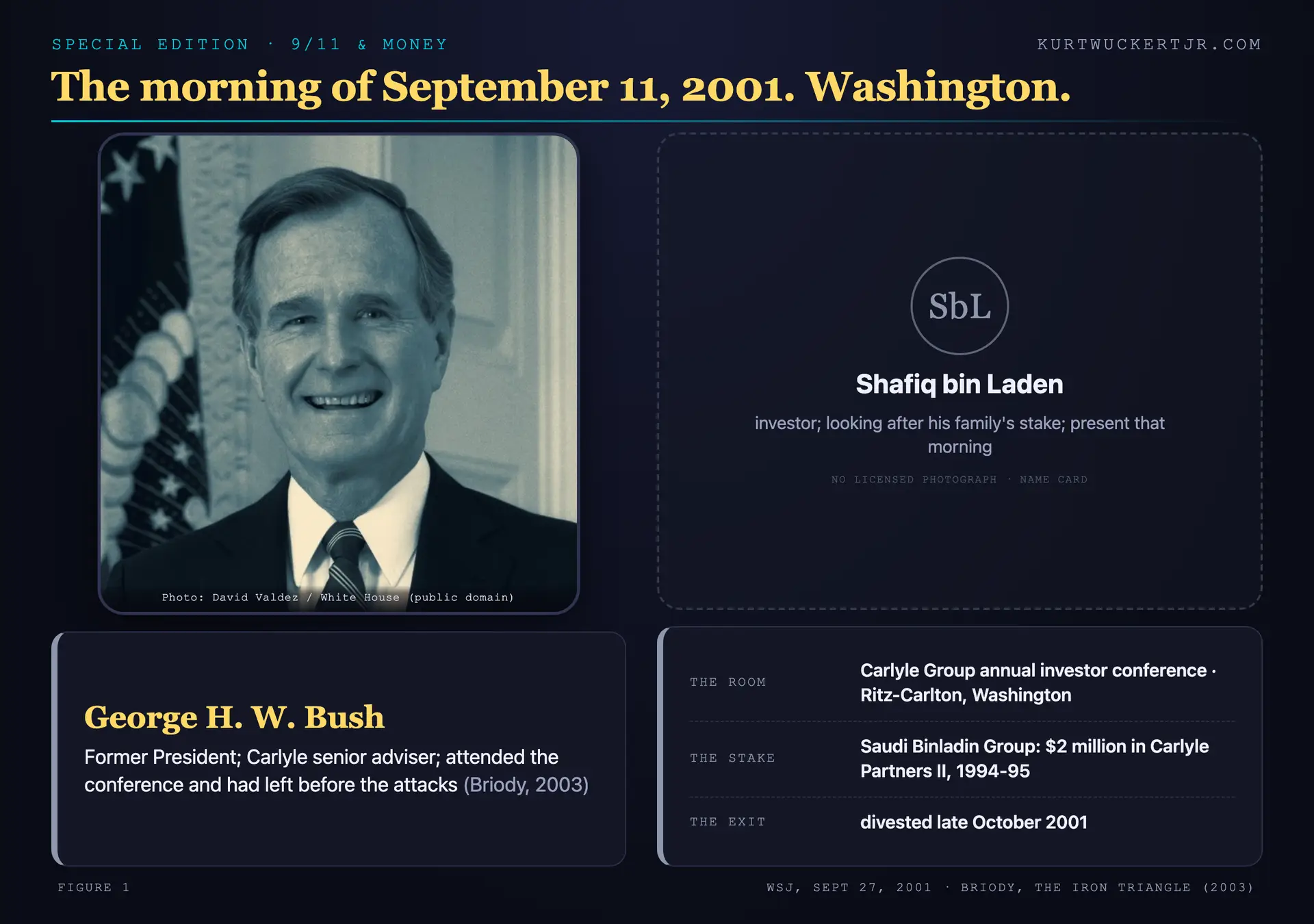
What did he make of the morning he had just left?
Either way, the money was still in the chairs after he left, and one of them was held by a curious investor...
That morning, at Carlyle, was one Shafiq bin Laden, in Briody's words "looking after the investments of his family."⁷ The Saudi Binladin Group had about two million dollars in Carlyle Partners II, dating to 1994 or 1995.⁸ Two million in a fund of $1.3 billion. A rounding error, six or seven years old. Remember it anyway, because it will come back again with a Times headline attached.
At 8 a.m., American Airlines Flight 11 hit the North Tower of the World Trade Center.⁹ Within hours, the half-brother of the man in that conference room would be the most wanted human being on earth, and the family name of the former president who had addressed it would be the name on the war that would define the next decade or two, depending on how you calculate it.
The money was in the room before the planes were in the air.
Part 2 of The History of Money & Banking ended in Uruk, with the oldest ledgers on earth; Part 12 of The Written History of Bitcoin ended in 2023, inside BlackRock's risk factors. This Special Edition sits between them: money on a Tuesday in September, who bet on it beforehand, the law forty-five days later, the war on the oldest banking city on earth, and a whitepaper seven years on that read like a reply.
The official record goes beside the best-documented theories. Where they cannot both be true, we say so. The questions go to the institutions that had the money, the intelligence and the classification stamp.
Two thousand nine hundred seventy-seven people were killed that morning, in New York, at the Pentagon, and in a field in Pennsylvania.¹⁰ One firm lost nearly everyone who had arrived at work.¹¹ Everything that follows is about money and paper.
None of my criticisms are about the victims, and my hope is that this look into converging histories honors them in some small way.
Watch the video if you prefer to watch rather than read!
- September 2000: PNAC publishes Rebuilding America's Defenses; page 51 asks for "a new Pearl Harbor."¹²
- September 6 to 10, 2001: put options on United's and American's parent companies surge at CBOE in Chicago.
- September 9: Ahmad Shah Massoud, who had come to Strasbourg in April to warn Europe, is killed by two men posing as journalists.¹³
- September 11: 8 a.m., American 11 hits the North Tower; 9, United 175 hits the South Tower; 9, American 77 hits the Pentagon; 10, United 93 crashes near Shanksville; 5 p.m., 7 World Trade Center collapses.
- September 11, 2 p.m.: Rumsfeld's aide writes: "Judge whether good enough hit S.H." and "Go massive. Sweep it all up. Things related and not."¹⁴
- September 17: the New York Stock Exchange reopens; the Fed cuts rates.¹⁵
- October 26: the USA PATRIOT Act is signed; Title III rewrites banking law.¹⁶
- March 2003: the United States invades Iraq; the President's letter to Congress cites September 11.¹⁷
- April 10 to 12, 2003: the Iraq Museum in Baghdad is looted.
- 2003 to 2004: nearly $12 billion in cash, roughly 360 tons, is flown into Baghdad on pallets.¹⁸
- November 2005: the CIA destroys ninety-two videotapes of its 2002 interrogations.¹⁹
- October 31, 2008: the Bitcoin whitepaper is posted; three weeks later NIST publishes its final report on 7 World Trade Center; the genesis block follows on January 3, 2009.
- July 15, 2016: the "28 pages" of the congressional Joint Inquiry are declassified.
- February 18, 2025: Howard Lutnick, Cantor Fitzgerald's chief on September 11, is confirmed as Secretary of Commerce.
A new Pearl Harbor
In September 2000 the Project for the New American Century, a Washington think tank, published a defense blueprint, Rebuilding America's Defenses. Page 51: "Further, the process of transformation, even if it brings revolutionary change, is likely to be a long one, absent some catastrophic and catalyzing event - like a new Pearl Harbor."²⁰
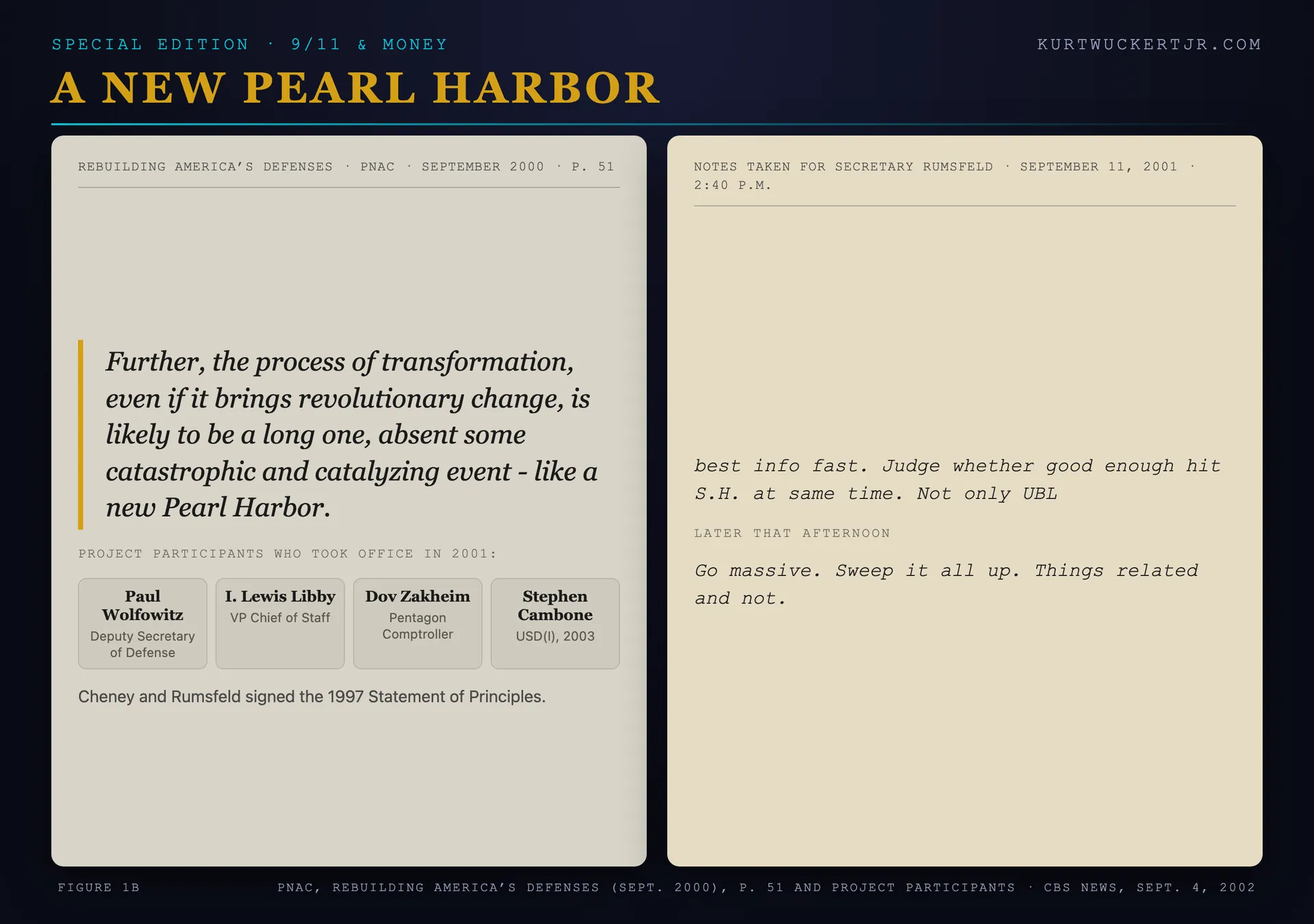
Page 51 of Rebuilding America's Defenses (September 2000) beside the notes taken for Donald Rumsfeld at 2 p.m. on September 11, 2001.
Thomas Donnelly wrote most of it; the participants list includes Paul Wolfowitz, I. Lewis "Scooter" Libby, Stephen Cambone and Dov Zakheim.²¹ Dick Cheney and Donald Rumsfeld did not sign it, but they had signed the group's Statement of Principles on June 3, 1997.²²
On September 11, 2001, Wolfowitz was Deputy Secretary of Defense, Libby was Vice President Cheney's chief of staff, Zakheim was the Pentagon's comptroller, and Cambone was the aide holding Secretary Rumsfeld's notepad that afternoon.²³
At 2 p.m., with the building still burning, Cambone wrote down what the Secretary wanted: "best info fast. Judge whether good enough hit S.H." and "at same time. Not only UBL". Later: "Go massive. Sweep it all up. Things related and not."²⁴ S.H. is Saddam Hussein; UBL is bin Laden. The Pentagon, releasing the notes under FOIA in February 2006, called them due diligence: no decision to attack Iraq was taken that day.
The next evening, by Richard Clarke's account in Against All Enemies (2004), the President asked him to go back over everything for a link to Saddam, which Rice later called a logical question, and Paul O'Neill, the Treasury Secretary, told 60 Minutes in January 2004 that Iraq was on the table at the first National Security Council meeting, January 30, 2001: "It was all about finding a way to do it."²⁵ The White House disputed him, and General Wesley Clark, on Democracy Now! (March 2, 2007), said he had been shown a memo describing plans to take out seven countries in five years, starting with Iraq and finishing with Iran: one named recollection, and the memo has never surfaced.²⁵
But why those countries?
Pretexts on paper have a precedent: on March 13, 1962 the Joint Chiefs of Staff sent the Secretary of Defense "Justification for US Military Intervention in Cuba," plans, in the National Security Archive's description, to "covertly engineer various pretexts" for an invasion, staged "Hijacking attempts against civil air" among them; the civilians said no.²⁶ Loose Change: Final Cut (2007) lays it beside 9/11 as precedent, and Northwoods is an official memo, not a theory.
The counter: "a new Pearl Harbor" is a forecasting cliché in defense writing, and the men who wrote it were arguing for budgets.
One page asked, in September 2000, for a catastrophic and catalyzing event. The other, written with the fires burning, ordered a case built against a country the Commission later cleared. Both are innocent only if the men who wrote the first had nothing to do with the second, and that afternoon they shared a building. An incentive, on the record, in the handwriting of the people who then acted on it. Who benefits when the pretext arrives on schedule, and who was already holding the pen?
They wrote down what they needed a year before they got it.
Is this real-world or exercise?
At 8:37 that morning, a controller at the FAA's Boston Center reached the Northeast Air Defense Sector, NEADS. The Commission Report prints the call on page 20: the military's first word of a hijacking.²⁶
"Hi. Boston Center TMU [Traffic Management Unit], we have a problem here. We have a hijacked aircraft headed towards New York, and we need you guys to, we need someone to scramble some F-16s or something up there, help us out."
"Is this real-world or exercise?"
"No, this is not an exercise, not a test."
NORAD was running an exercise that morning, and the Commission tells you in a footnote, note 116: "On 9/11, NORAD was scheduled to conduct a military exercise, Vigilant Guardian, which postulated a bomber attack from the former Soviet Union. ... According to General Eberhart, 'it took about 30 seconds' to make the adjustment to the real-world situation."²⁷
Thirty seconds.
The Commission found the exercise helped, because extra staff were at their consoles; Massimo Mazzucco's September 11: The New Pearl Harbor (2013) reads the overlap of exercises and attacks as design, not luck.²⁸
In June 2004 the Commission's staff issued Statement No. 17: the 9 notice NORAD had testified about "was not about American 77. It was notification that American 11 had not hit the World Trade Center and was heading for Washington, DC." The first notice on American 77 came at 9, and "it had come by chance."²⁹ A phantom plane, chased while the real one flew on unreported.
The truth came from the tapes, not the generals. "The real story is actually better than the one we told," a NORAD general admitted to Commission staff when the tapes contradicted his testimony, in Michael Bronner's 2006 Vanity Fair account.³⁰ Chairman Thomas Kean and vice chairman Lee Hamilton asked in Without Precedent (2006): "So why were air force jets scrambled from Langley at 9?"³¹ The Washington Post's Dan Eggen reported on August 2, 2006 that some staff and commissioners suspected a deliberate effort to mislead them and that the panel debated a criminal referral.³² It sent the matter instead to the inspectors general of Defense and Transportation: the accused departments' own.
Transportation had its own tape. That morning six New York Center controllers recorded their accounts; the department's inspector general found in May 2004 that the tape "was purposefully destroyed by a Federal Aviation Administration manager because he 'felt strongly' that it should not have been made," cut up and dropped in trash cans.³³ One tape, one manager, one strong feeling.
Kean and Hamilton also wrote that the Commission had been set up to fail;³⁴ its senior counsel John Farmer wrote in The Ground Truth (2009) that at some level of the government, at some point, there had been an agreement not to tell the truth about what happened.³⁵
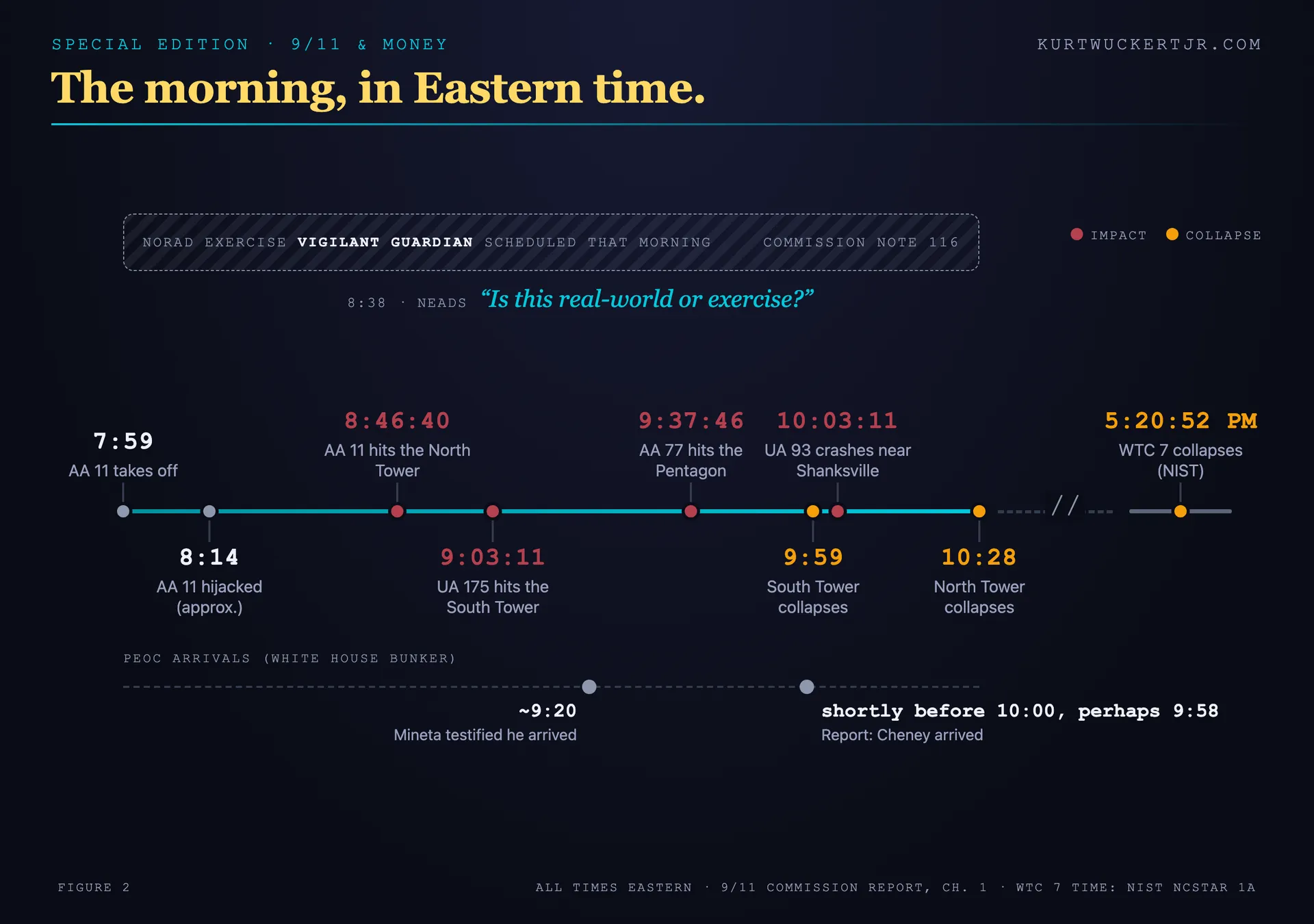
The morning as the Commission timed it, plus one row it did not draw: the Transportation Secretary's sworn arrival beside the Report's estimate for the Vice President's.
Now the bunker.
On May 23, 2003, Norman Mineta, the Secretary of Transportation, testified that he reached the Presidential Emergency Operations Center "at about 9 a.m." and heard a young man counting a plane down to the Vice President: "And when it got down to, 'The plane is 10 miles out,' the young man also said to the vice president, 'Do the orders still stand?' And the vice president turned and whipped his neck around and said, 'Of course the orders still stand. Have you heard anything to the contrary?'"³⁶
Commissioner Tim Roemer put that exchange at "about 9 or 9." Mineta never says the Vice President was already there; if his clock is right, Dick Cheney was in the bunker by about 9 or 9 and the orders, whatever they were, were standing.
A Cabinet secretary put the exchange at about 9; the Report printed 9 and never mentioned him. The military told a story its own tapes contradicted. A panel that debated a criminal referral sent the question to the accused departments' own inspectors, one of which had already found a manager shredding a tape. Honest mistakes scatter; these all fell the same way, toward less on the record. What was the script for, and who decided the Commission would not say?
The Air Force had a script that morning. Nobody agrees what it was for.
What they knew
On August 6, 2001 the President's Daily Brief was headed "Bin Ladin Determined To Strike in US," the first that year about an attack inside the country, and it said: "The FBI is conducting approximately 70 full field investigations throughout the US that it considers Bin Ladin-related." The counter is the President's own: "The President told us the August 6 report was historical in nature." No meeting was called.³⁸
Four weeks earlier, on July 10, George Tenet and Cofer Black had briefed Condoleezza Rice; the meeting is absent from the Report's narrative, and when Bob Woodward described it in 2006 as an urgent warning brushed aside, the White House answered that the information was "not new."³⁹
Foreign services were saying it too. Jordan's service intercepted a message, as John K. Cooley reported in the International Herald Tribune on May 21, 2002: "The text stated clearly that a major attack was planned inside the continental United States. It said aircraft would be used. ... The code name of the operation was mentioned: in Arabic, Al Ourush al Kabir, 'The Big Wedding.'" Senior Jordanian officials later backed away from their confirmations.⁴⁰ A secret Taliban emissary warned the American consul general in Peshawar in July 2001 that bin Laden was planning a huge attack on American soil (the Independent, September 7, 2002); the Taliban minister Muttawakil had told his aide: "The guests are going to destroy the guesthouse."⁴¹ Israeli officials told the Sunday Telegraph on September 16, 2001 that Mossad had warned the CIA and FBI in August of "a cell of as many of 200 terrorists" preparing a big operation.⁴² And a French intelligence note of January 5, 2001 was titled "Aircraft hijack plan by radical Islamists" (Le Monde, April 16, 2007); France prosecuted the journalist.⁴³
The CIA identified Khalid al Mihdhar and tracked him to Kuala Lumpur, where he arrived on January 5, 2000.⁴⁴ The Report: "The CIA did not try to register Mihdhar or Hazmi with the State Department's TIPOFF watchlist—either in January, when word arrived of Mihdhar's visa, or in March, when word came that Hazmi, too, had had a U.S. visa and a ticket to Los Angeles." None of it went to the FBI.⁴⁵ The Report calls this a missed operational opportunity.
Mihdhar and Nawaf al Hazmi flew to Los Angeles, moved to San Diego, and from May 2000 rented rooms from Abdussattar Shaikh, a paid FBI informant since 1994, who gave his handler their first names; the Bureau never asked for surnames, as Newsweek reported on September 9, 2002.⁴⁶ The Report never calls him an informant; it calls him a landlord who "has provided various accounts of how he first met them."⁴⁷ The two names went on a watchlist on August 24, 2001, after an FBI analyst re-read the cables on her own initiative.⁴⁸ Eighteen days out.
Richard Clarke, the White House counterterrorism chief that day, said in an August 11, 2011 interview: "There was an intentional and very high level decision in the CIA not to let the White House know."⁴⁹ His theory (Clarke, 2011) is a recruitment attempt; Tenet, Black and Richard Blee jointly called it baseless and denied any order to withhold.⁵⁰
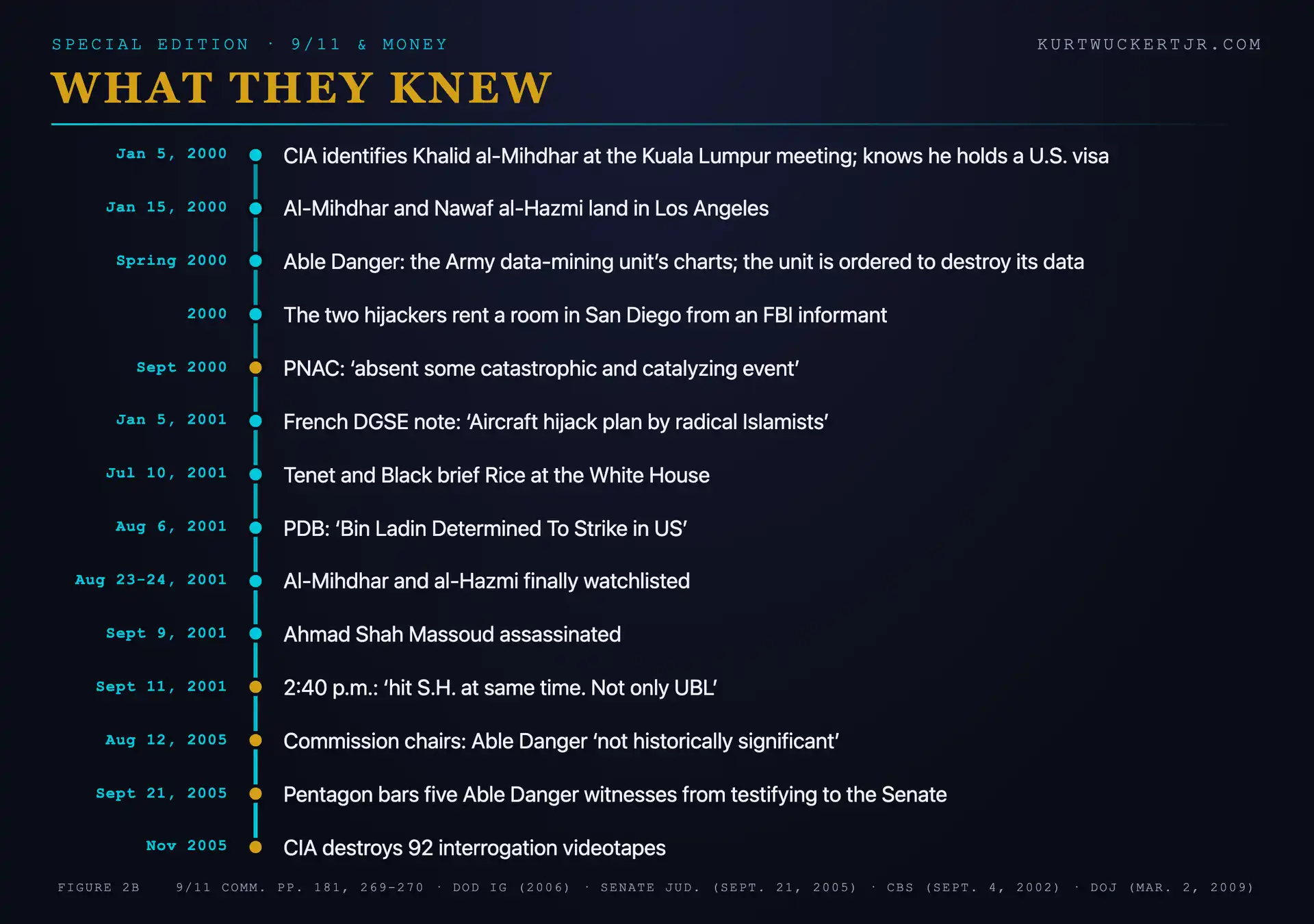
Three files that existed before the morning: the August 6 brief, the chain from Kuala Lumpur to the watchlist, and the chart a congressman says the Army built and shredded.
On June 27, 2005 Congressman Curt Weldon told the House about a program called Able Danger and a chart he said had Mohamed Atta on it before the attacks: "our military made a recommendation in September of 2000 to bring the FBI in to take out that cell, the cell of Mohammed Atta."⁵¹
Commission staff heard it twice, from Lt. Col. Anthony Shaffer in October 2003 and Capt. Scott Phillpott in July 2004.⁵² The Report does not mention Able Danger once. Kean and Hamilton answered on August 12, 2005 that their witness "could not describe what information had led to this supposed Atta identification," and that staff had found no documents.⁵³
On September 21, 2005 the Pentagon barred five witnesses from a Senate Judiciary hearing, Shaffer among them, his clearance revoked the day before; Chairman Arlen Specter: "That looks to me as if it may be obstruction of the Committee's activities, which is something we will have to determine."⁵⁴ Erik Kleinsmith, who had run the program's intelligence, did testify: "I along with CW3 Terri Stephens were forced to destroy all the data, charts, and other analytical products that we had not already passed on to SOCOM related to Able Danger." Under oversight procedures, he said, in spring 2000.⁵⁵
A year later the Pentagon's own inspector general answered, on September 18, 2006: "We did not substantiate those allegations. ..."⁵⁶ The Senate Intelligence Committee agreed that December, as NBC News reported.⁵⁷
Weldon has not moved. On The Tucker Carlson Show on April 14, 2025 he said of the Report, "...I don't believe anything that is in that. That's a bunch of garbage ... it's a lot of paper that has no substance," and, "The 9/11 Commission is a cover up. 1,000% cover up."⁵⁸ Weldon, in 2025, said the Commission "would not let me testify before the commission"; his August 10, 2005 letter to the chairs had put it in writing: staff "received not one but two briefings on Able Danger from former team members, yet did not pursue the matter."⁵⁹ His largest claim (Weldon, 2025): "I have confirmed that two of the hijackers that were on one of the planes in New York were working for the CIA... They were on the CIA payroll and that was confirmed to me by someone in writing from one of our agencies."⁶⁰
No agency has confirmed it, no such letter has surfaced, and the Senate Intelligence Committee's 2006 finding runs the other way.
Two days before the attacks, the loudest voice in Afghanistan went quiet. Ahmad Shah Massoud, the Northern Alliance commander, had come to Strasbourg that April to warn Europe about the Taliban and the Arabs fighting beside them.⁶¹ On September 9 two men "disguised as journalists" killed him, and the Report gives the reason through Khalid Sheikh Mohammed: "Atef hoped Massoud's death would also appease the Taliban when the 9/11 attacks happened."⁶² The Report says his alliance "had been able at various times to obtain assistance from Russia, Iran, and India," and Steve Coll's Ghost Wars (2004) describes the CIA's JAWBREAKER teams flying into his valley.⁶³ The man with the best intelligence on al Qaeda, and the most Western friends, was removed forty-eight hours before the West needed him most.
Where did bin Laden's war come from? Operation Cyclone armed the Afghan resistance through Pakistan's ISI, and Zbigniew Brzezinski, asked about it in January 1998, answered: "Some stirred-up Moslems or the liberation of Central Europe and the end of the cold war?"⁶⁴ Robin Cook, Britain's former foreign secretary, wrote in the Guardian the day after the July 2005 London bombings: "...Al-Qaida, literally "the database", was originally the computer file of the thousands of mujahideen who were recruited and trained with help from the CIA to defeat the Russians."⁶⁵ Le Figaro went further on October 31, 2001: bin Laden was treated at the American Hospital in Dubai that July, and "the local CIA representative" was "seen taking the main elevator of the hospital to go to Osama bin Laden's room";⁶⁶ the hospital "emphatically denied" he was a patient there, and Washington "also denied the story" (the Guardian, November 1, 2001).⁶⁷
Against all of it stands the Commission, which puts bin Laden's income at "about $1 million per year" and says nothing about agency money.⁶⁸ Dated claims against a dated silence.
The agency watched two hijackers arrive in Kuala Lumpur and kept their names off the list for nearly twenty months. The Bureau's informant rented them a room and was never asked their surnames. An Army program says it charted the cell in 2000 and was ordered to shred the chart; the department that ran it barred the witnesses and cleared itself. Each has an official explanation, and each explanation is the same word: failure. At what point does a pattern of failures that all break the same direction stop being failure?
Everyone who was supposed to know had been told. Then the paper went away.
Who bought the puts?
Chicago, one week later. Dave Carpenter of the AP filed the exchange's own numbers on September 18, 2001.
"On Sept. 6-7, when there was no significant news or stock price movement involving United, the Chicago exchange handled 4,744 put options for UAL stock compared with just 396 call options," Carpenter wrote. "On Sept. 10, an uneventful day for American, the volume was 748 calls and 4,516 puts, based on a check of option trading records." The exchange's chief spokeswoman, Lynne Howard, gave him one sentence: "As is usual, CBOE is conducting an investigation of trading prior to the news event."⁶⁹
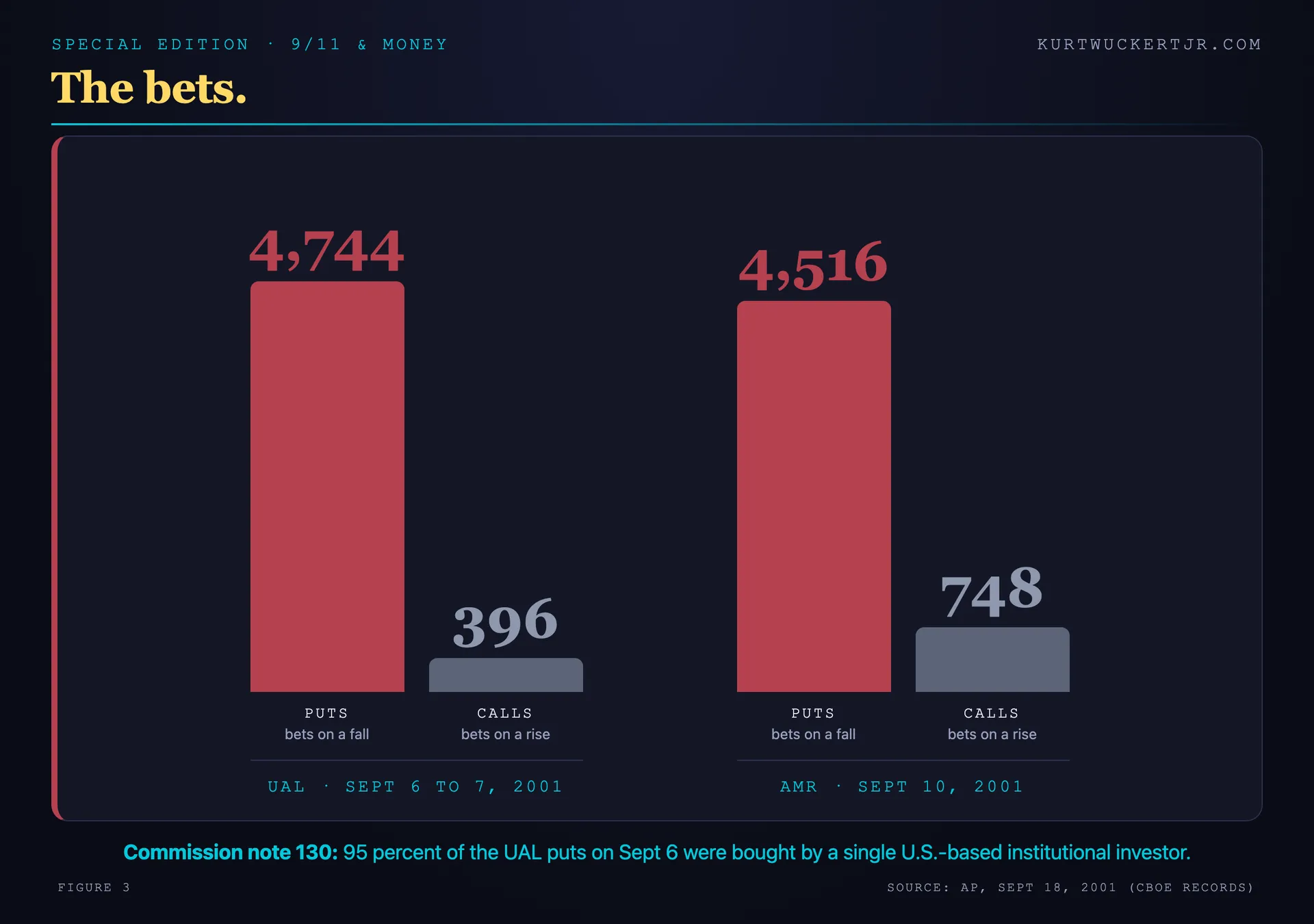
The Commission later wrote that one investor bought 95 percent of the United puts, and never said who. Source: AP, Sept. 18, 2001; Commission Report, note 130.
The San Francisco Chronicle then reported more than $2.5 million in United put profits uncollected, and a name: a source "identified Deutsche Banc Alex. Brown ... as the investment bank used to purchase at least some of the options."⁷⁰ The story also carried an ICT Herzliya estimate of about $16 million in insider gains across United, American, Morgan Stanley Dean Witter and Merrill Lynch.⁷¹
The buyer of 95 percent of the United puts also bought 115,000 American shares; the Commission calls that a trading strategy. It is also exactly what a professional with foreknowledge would buy to look like a hedge, and the Commission called it innocent without naming the buyer.
The academics did not sign. Allen Poteshman, Journal of Business, 2006: "there is evidence of unusual option market activity in the days leading up to September 11 that is consistent with investors trading on advance knowledge of the attacks."⁷³ Chesney, Crameri and Mancini, Journal of Empirical Finance, 2015: "In total 13 transactions satisfy our criteria of abnormal trade ..." across five airlines and four banks.⁷⁴ The SEC and the Commission were satisfied. Two peer-reviewed papers were not.
Then the drives. Reuters reported on December 17, 2001 that a German firm, Convar, was recovering the towers' final transactions, its director suspecting insider trades.⁷⁵ By Kevin Ryan's 2010 reading of a declassified memorandum, the FBI told the Commission in 2003 it knew of no such recovery and doubted any drive survived; both cannot be true.⁷⁶
And the bank. A.B. "Buzzy" Krongard chaired Alex. Brown, later Deutsche Banc Alex. Brown, then became CIA Executive Director on March 16, 2001.⁷⁷ Michael Ruppert's Crossing the Rubicon (2004) built its theory there: the desk that bought United puts sat one corporate generation from the CIA's third-ranking officer.⁷⁸
On the same page, the Commission admitted it could not trace the money that paid for the attacks, then added: "Ultimately the question is of little practical significance."⁷⁹ In a Money & Banking story, that is the loudest sentence on the page.
Someone made the right bet. We were told not to worry about who.
The name has never been released: not in the Report, not in the memo pried loose in 2010.⁸⁰ If it was innocent, what would printing the name have cost?
This is the kind of question that undermines trust across the entirety of the official narrative, and it's the sort of thing we need to demand from the government. And if we can't know, then we must assume that they are protecting a powerful insider with foreknowledge of the attacks!
So why don't we know the names of the people who shorted the airlines the week before the attack?
Who was in business with whom?
On October 26, 2001, Kurt Eichenwald's headline in The New York Times read: "Bin Laden Family Liquidates Holdings With Carlyle Group."⁸¹ A Carlyle executive said the sentence I keep coming back to: "This wasn't done because anyone thought they did anything wrong ... We felt and they felt that it was something that was causing more attention than it deserved ..."⁸²
That was the stake from the Ritz: $2 million in Carlyle Partners II since 1994 or 1995 (the Times says 1994; the Guardian 1995).⁸³ Carlyle said the family "were only in for $2 million"; a family financial representative told Briody "the number was much larger."⁸⁴
Bush Sr. spoke for the firm for stakes "believed to be" worth about $80,000 an appearance and, per the Guardian, "is understood to have visited the Binladins in Saudi Arabia twice on the firm's behalf."⁸⁵
Michael Moore ran this as a montage in Fahrenheit 9/11 (2004): Carlyle, James Bath, Harken.⁸⁶ It fits better in drawers, each holding a denial the montage skipped.
Drawer one. By 1976, Eric Boehlert reported in Salon on April 27, 2004, Salem bin Laden had made James Bath, George W. Bush's Air National Guard comrade, his "American business representative," with Saudi banker Khalid bin Mahfouz drawing up "a similar arrangement with him."⁸⁷ Bath later put $50,000 into Bush's Arbusto Energy; Charles (Bill) White told the CBC in 2003 it was bin Mahfouz and bin Laden money, and Craig Unger reported the same allegation in House of Bush, House of Saud (2004) and found no hard evidence for it.⁸⁸ Bath told Salon "100 percent of those funds were mine," and Salon found nothing to contradict him.⁸⁹
Drawer two. Harken Energy absorbed the younger Bush's failing oil company in 1986; in 1987 Saudi investor Abdullah Taha Bakhsh came in and his representative Talat Othman joined the board.⁹⁰ In June 1990 Bush sold 212,140 Harken shares, "netting $848,560," and "waited eight months before filing the required forms on the sale with the SEC."⁹¹ The SEC closed the inquiry in October 1993 with a letter that, as the Center for Public Integrity put it, must in no way be construed as indicating that the party had been exonerated; the Center found no proof the Bush name won Harken's 1990 Bahrain contract.⁹²
Not exonerated, and not charged. Filed.
Drawer three is a Senate document: Senators John Kerry and Hank Brown's December 1992 report on the Bank of Credit and Commerce International, shut down worldwide in 1991.⁹³ Its intelligence chapter records that the CIA's acting director, Richard Kerr, "acknowledged that the CIA had also used BCCI for certain intelligence-gathering operations."⁹⁴ Its accounting chapter names the banker from drawer one: BCCI hid over $500 million in lending by "parking" it with "the National Commercial Bank of Saudi Arabia controlled by Khalid bin Mahfouz ... who was later indicted in the United States in connection with his activities pertaining to BCCI and First American."⁹⁵ Bath's name is in neither chapter.
The Senate's closing line on the CIA is the sentence I would make every reader memorize: "One is left with the choice of accepting the official record, which requires an assessment that the other contacts between BCCI and U.S. intelligence figures and operations are coincidental, or of assuming that the full story of BCCI's relationship to the United States has been intentionally veiled by critical players on both sides of that relationship."⁹⁶
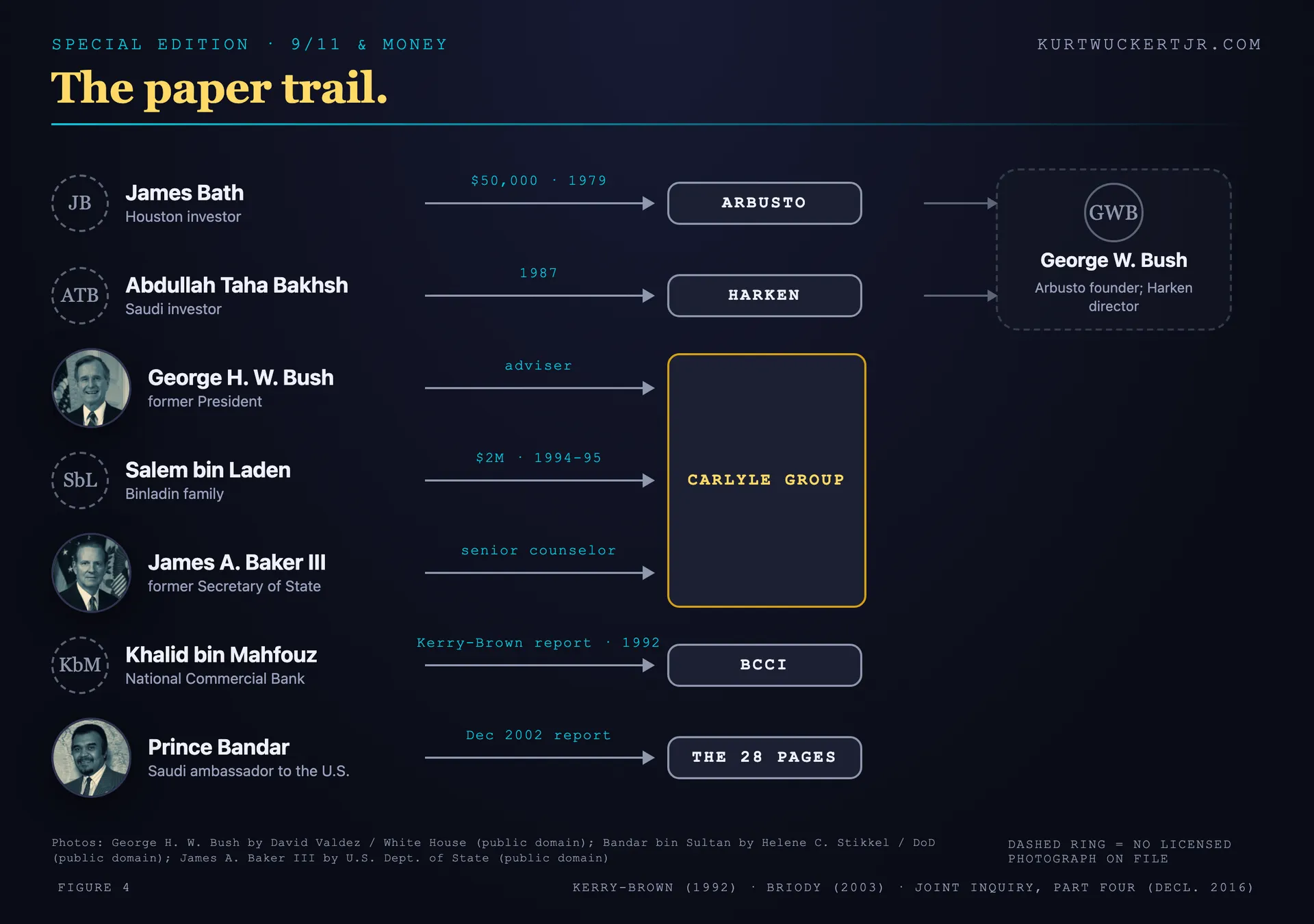
Four drawers, one cabinet: every arrow a document and a denial, none a charge. Source: NYT, Oct. 26, 2001; Salon, Apr. 27, 2004; CPI; Kerry-Brown (1992).
In November 2002, Michael Isikoff reported in Newsweek that about $3,500 a month flowed from Princess Haifa al-Faisal, Prince Bandar's wife, to the family of Osama Basnan, a San Diego associate of Omar al-Bayoumi, who had helped two hijackers settle there.⁹⁷ The Saudi embassy called it untrue and said she had given al-Bayoumi nothing.⁹⁸ The checks are in the 28 pages: Part Four of the congressional Joint Inquiry, blacked out in 2003, declassified July 15, 2016.
Finding 20: "While in the United States, some of the September 11 hijackers were in contact with, and received support or assistance from, individuals who may be connected to the Saudi Government."⁹⁹ Isikoff's checks are itemized: 31 cashier's checks totaling $74,000 from Prince Bandar's wife's Riggs account, a $2,000 monthly standing order since January 1999, a $15,000 check from Bandar in 1998, for "nursing services" the FBI found no evidence anyone performed.¹⁰⁰ The same pages quote a still-redacted July 2, 2002 memorandum calling this "incontrovertible evidence that there is support for these terrorists within the Saudi Government."¹⁰¹
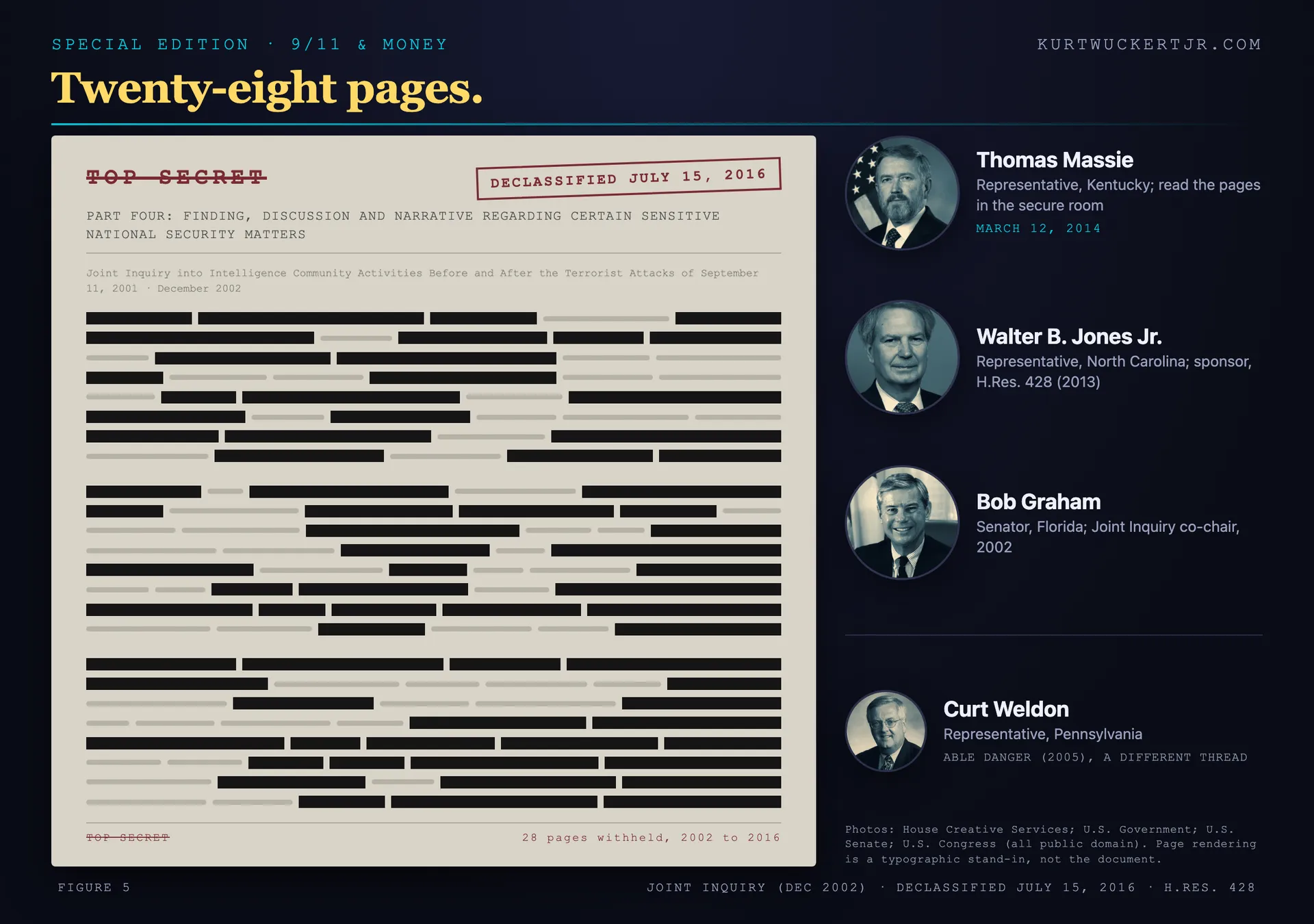
Fourteen years to read. What survived the black bars is quoted here. Source: HPSCI, declasspart4.pdf, July 15, 2016.
The Commission's 2004 sentence, usually quoted by half: "Saudi Arabia has long been considered the primary source of al Qaeda funding, but we have found no evidence that the Saudi government as an institution or senior Saudi officials individually funded the organization. (This conclusion does not exclude the likelihood that charities with significant Saudi government sponsorship diverted funds to al Qaeda.)"¹⁰² Its note 122 found no evidence Princess Haifa funded the conspiracy, directly or indirectly.¹⁰³ On al-Bayoumi: "It is certainly possible that he has dissembled about some aspects of his story, perhaps to counter suspicion. On the other hand, we have seen no credible evidence that he believed in violent extremism or knowingly aided extremist groups."¹⁰⁴
That was 2004. An FBI subfile, Operation Encore, worked al-Bayoumi from 2007; when Executive Order 14040 forced a declassification review in September 2021, the first release was a 2016 report from it.¹⁰⁵ Dan Christensen's Florida Bulldog read its language as treating al-Bayoumi as a paid contact of Saudi intelligence and the San Diego meeting as arranged, not accidental.¹⁰⁶
Incontrovertible evidence in 2002, no evidence in 2004, a paid contact of Saudi intelligence in 2016. One government, two men, three sentences that do not describe the same country. Either the agencies never compared notes, or one was writing for the public.
Congress overrode an Obama veto exactly once: the Justice Against Sponsors of Terrorism Act, September 28, 2016, 97 to 1 and 348 to 77, so the families could sue a foreign state.¹⁰⁷ In August 2025, Judge George Daniels refused to dismiss it, finding, as reported, reasonable evidence on the roles of al-Bayoumi, the Los Angeles consular official Fahad al-Thumairy, and the Kingdom; it is alive as I write.¹⁰⁸
Fourteen years is how long it takes to declassify twenty-eight pages about a friend.
Thomas Massie read them in 2014. As quoted by Truth In Media after the March 12, 2014 press conference with Representatives Walter Jones and Stephen Lynch: "As I read it, and we all had our own experience, I had to stop every couple of pages and just sort of try to absorb and try to rearrange my understanding of history."¹⁰⁹
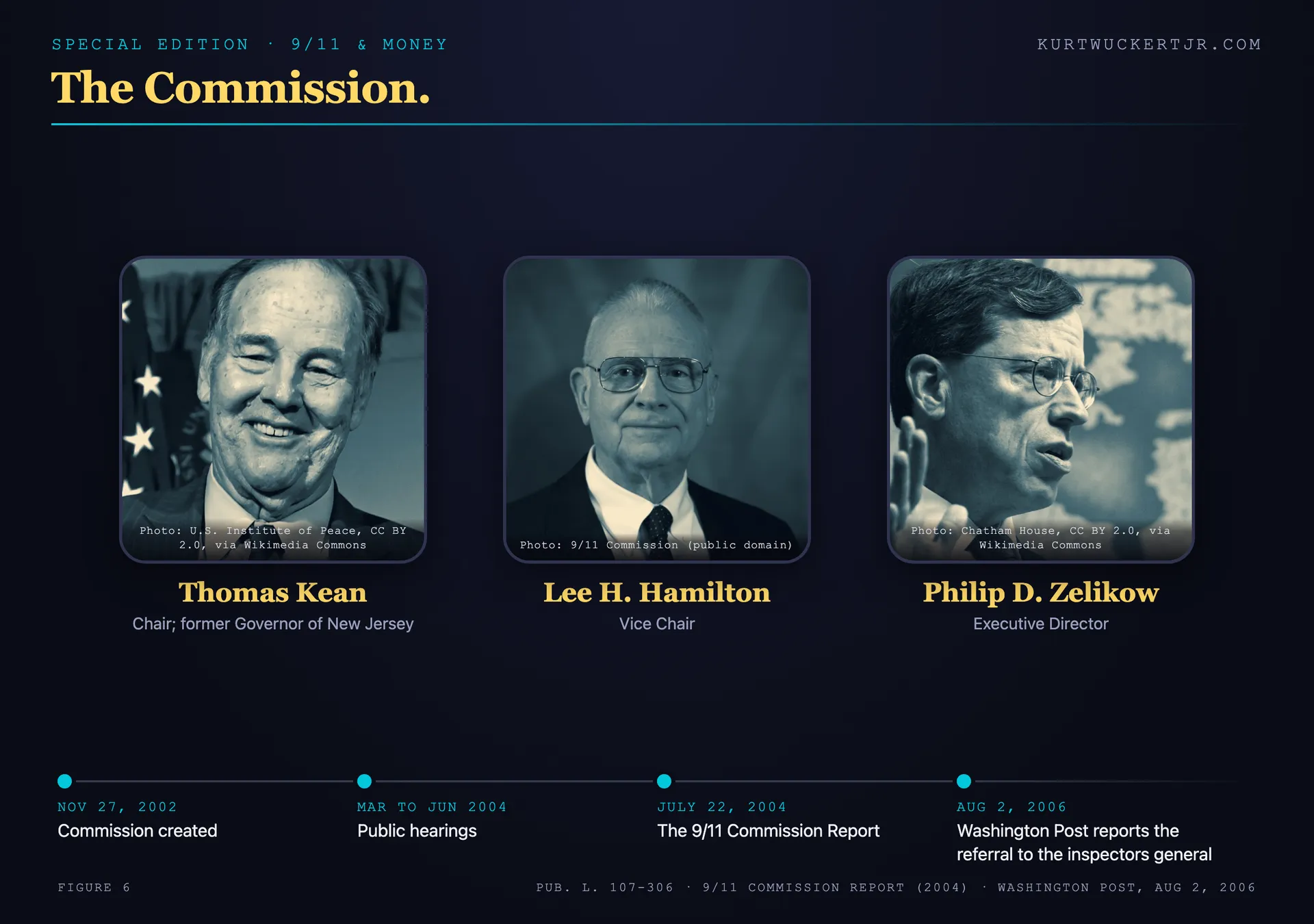
The record's footnotes about itself: limited access, borrowed interrogations, a referral never made. Source: Commission Report, p. 146; Newsweek, Mar. 13, 2009; Washington Post, Aug. 2, 2006.
Staff director Philip Zelikow had, per Philip Shenon's The Commission (2008), White House ties close enough that commissioners objected and he recused himself from part of the work.¹¹⁵ What guarded a commission investigating the executive branch from its own staff director?
Fahrenheit 9/11 (2004), drawing on Craig Unger's October 2003 Vanity Fair reporting, says planes were authorized at the highest levels to fly 142 Saudis, two dozen of them bin Ladens, out of a grounded country.¹¹⁶ The Commission: "After the airspace reopened, nine chartered flights with 160 people, mostly Saudi nationals, departed from the United States between September 14 and 24."¹¹⁷ Who approved it? "The FBI effectively approved the Saudi flights at the level of a section chief."¹¹⁸ Richard Clarke, who approved it at the White House, testified: "I would love to be able to tell you who did it, who brought this proposal to me, but I don't know."¹¹⁹ Open sky, a section chief's signature, an approver who cannot say. Then who asked him?
For now, hold the question tightly that the drawers leave open. The question is narrower and harder than "did the Bush family do it," which no official document supports: when the people holding the money, the intelligence and the classification stamp kept turning out to be business associates, who exactly was in a position to tell us so?
Fourteen years to declassify twenty-eight pages about a friend is not caution, it is a decision, and decisions have authors.
Whom was this one protecting?
The owner and the broker
On July 24, 2001, the Port Authority signed the World Trade Center to a private landlord for the first time: a 99-year lease to Larry Silverstein's company, valued at about $3.2 billion.¹²⁰
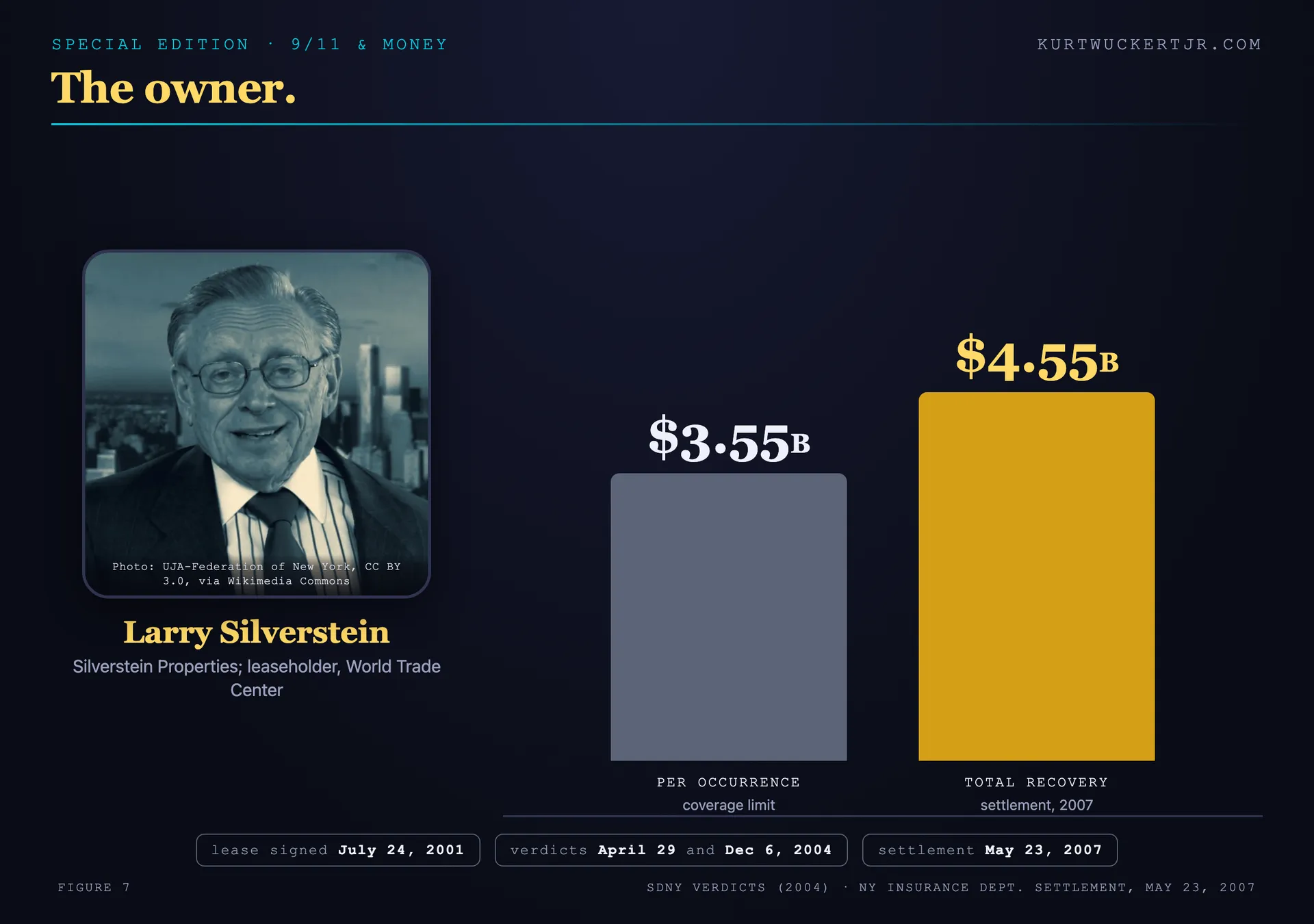
One event or two: a $1 billion question, and two juries split. Source: 345 F.3d 154 (2d Cir. 2003); WSJ, Apr. 30 and Dec. 7, 2004; JURIST, May 24, 2007.
The Authority's chairman, Lewis Eisenberg, became the Republican National Committee's finance chairman in 2002.¹²¹ Silverstein already owned 7 World Trade Center across Vesey Street, 47 stories housing the Secret Service's New York field office.¹²² Ariel Sharon, Benjamin Netanyahu and Ehud Barak each contacted him with condolences after the attacks, Haaretz reported on November 21, 2001, calling him a friend.¹²³
The insurance is public arithmetic. Coverage was capped at $3.55 billion per event; the question for two juries was whether two planes seventeen minutes apart were one event or two.¹²⁴ On April 29, 2004 one jury held ten insurers to one occurrence; on December 6 another found nine bound by a form making the attacks two, liable for up to double.¹²⁵ The trial judge, Michael Mukasey, became Attorney General of the United States in November 2007.¹²⁶ On May 24, 2007, the last seven insurers settled: $2 billion on top of about $2.55 billion paid.¹²⁷ Terrorism cover was standard paper in 2001; the complex had been bombed in 1993.
A billion dollars, decided by a form!
Cantor Fitzgerald occupied floors 101 through 105 of the North Tower, above where the first plane hit.¹³² Of its 960 New York employees, 658 were in the office that morning, and all 658 died.¹³³ No single employer lost more people that day. Howard Lutnick, the firm's chairman, was not in the building, for a reason he has told the same way for twenty-five years: "September 11th was my son Kyle's first day of kindergarten."¹³⁴ His brother was: "My brother Gary was 36, and he was in the building."¹³⁵
"We paid the employees through the 15th. So for four days we paid the employees who had died," he told CBS in 2011; then they stopped, and widows said so on television.¹³⁶ On September 19 the firm pledged the families 25 percent of profits for five years and ten years of health care; by 2011, about $180 million.¹³⁷
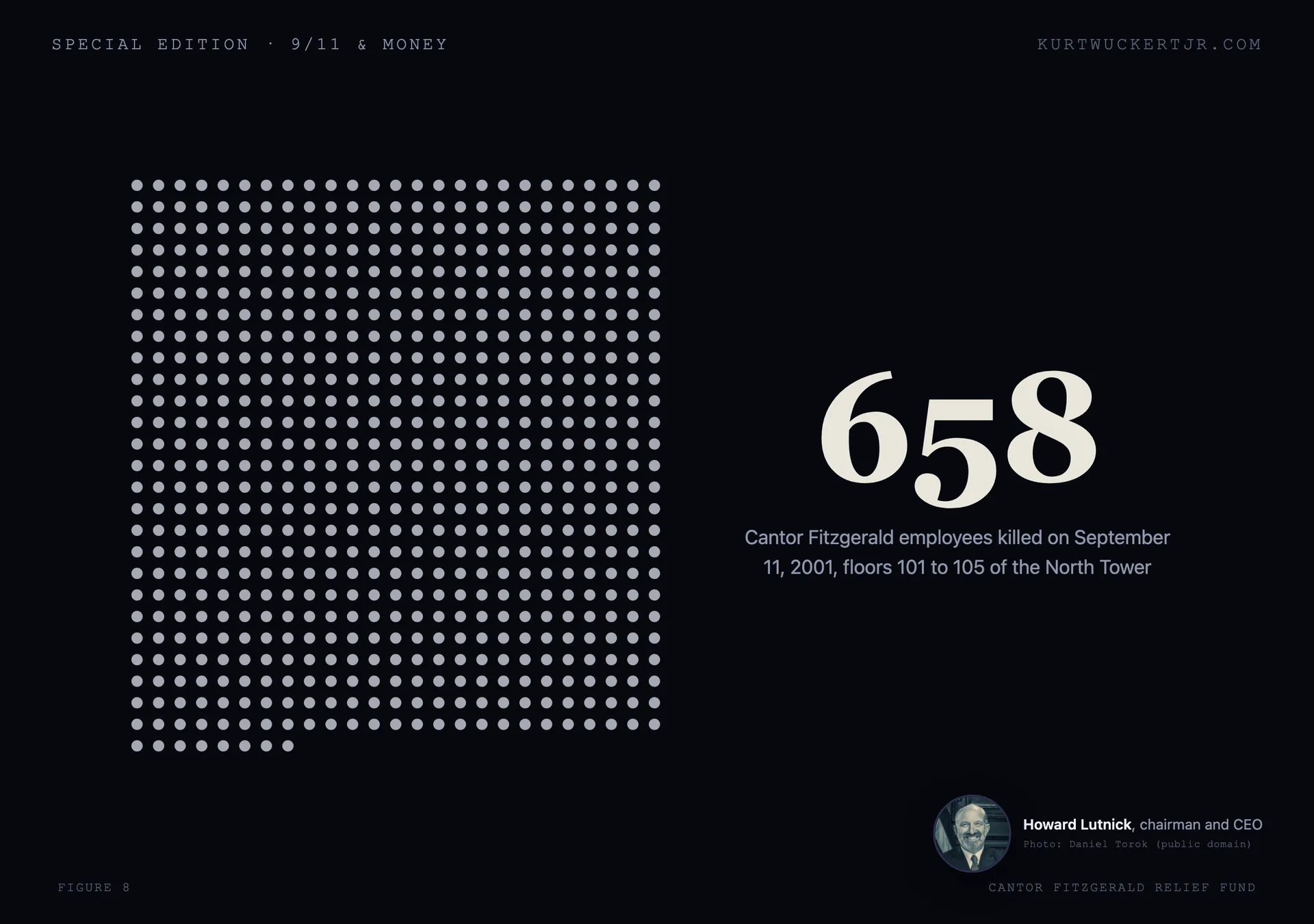
Six hundred fifty-eight of the names on the memorial worked for one firm on five floors. They are the reason this section is written slowly.
Lutnick returns near the end, and not for 9/11. Cantor custodies Tether's reserves, by his own account in January 2024, and holds a roughly five percent stake worth up to $600 million, the Wall Street Journal reported in November 2024.¹³⁸ On February 18, 2025, the Senate confirmed him Secretary of Commerce, 51 to 45.¹³⁹ Tether's purpose is in Beyond Fraud: Tether's Secret Plan to Replace the Fed.
The Justice Department's Epstein files show that on December 28, 2012 a company Lutnick signed for, CVAFH I, and one Epstein signed for, Southern Trust Company, Inc., bought into an ad-tech startup called Adfin.¹⁴⁰ Emails show a Christmas-week 2012 family lunch on Epstein's island four days before the deal; Epstein agreeing in 2017 to give $50,000 to a dinner honoring Lutnick, "hope pr is ok"; and a 2018 note about a museum expansion beside their adjoining Manhattan homes.¹⁴¹
Who the neighbor worked for is a dated theory of its own. Seymour Hersh's The Samson Option (1991) reported, via ex-Israeli intelligence official Ari Ben-Menashe, that Ghislaine Maxwell's father Robert was an Israeli intelligence asset; Maxwell called it an invention and sued, the publisher's corroboration proved to rest on a con man's forgeries, and there is no official finding.¹⁴² Ben-Menashe told Narativ (September 23, 2019) and MintPress News (October 2, 2019) that Epstein and Ghislaine Maxwell worked for Israeli military intelligence and "found a niche for themselves — blackmailing American and other political figures": no documents, a source Time called a "spinner of tangled yarns" in 1991, and no official finding.¹⁴³
Lutnick's dates differ. He told the New York Post in October 2025 that he and his wife cut ties in 2005 after a tour of Epstein's townhouse ("I will never be in the room with that disgusting person ever again"), and told House Oversight on May 6, 2026 that he met Epstein three times, including the 2012 island lunch, and had not known Epstein was in Adfin.¹⁴⁴
Lutnick has not been charged with, or accused by any authority of, any wrongdoing; what the record documents is a business and social association, and a dispute about how long it lasted. The Craziest Stuff You Haven't Heard About Epstein has the long version.
I only bring this all up because the influence, finance and intelligence industries are a lot more closely aligned than many are aware, so you can ponder it all in one place.
The building fell. The paperwork survived. It usually goes the other way.
The owner's file: a lease seven weeks before the attacks; a billion-dollar argument, won, that two planes were two events; a building across the street that fell with no plane in it; one televised sentence with two readings. If every reading of "pull it" is innocent, why did the innocent explanations take three years and two different men to arrive?
The building nobody flew into
Seven World Trade Center was forty-seven stories full of the government, and some of it was clandestine agencies. The SEC's Northeast Regional Office had floors 11 through 13; the Secret Service had 9 and 10; the city's Office of Emergency Management had its bunker on 23; and Salomon Smith Barney had most of the rest.¹⁴⁵ The CIA part surfaced when James Risen reported it in the Times on November 4, 2001: "The C.I.A.'s undercover New York station was in the 47-story building at 7 World Trade Center," operating "behind the false front of another federal organization."¹⁴⁶
Everyone in it got out...
The files did not. CIA and Secret Service personnel sifted a Staten Island landfill for "hard drives with classified information and intelligence reports"; and though the law requires agencies to report destroyed records to the National Archives, the AP found in 2011 that "none did."¹⁴⁷
Nobody flew a plane into 7 World Trade Center. It fell at 5:20 p.m., after burning for almost seven hours.¹⁴⁸
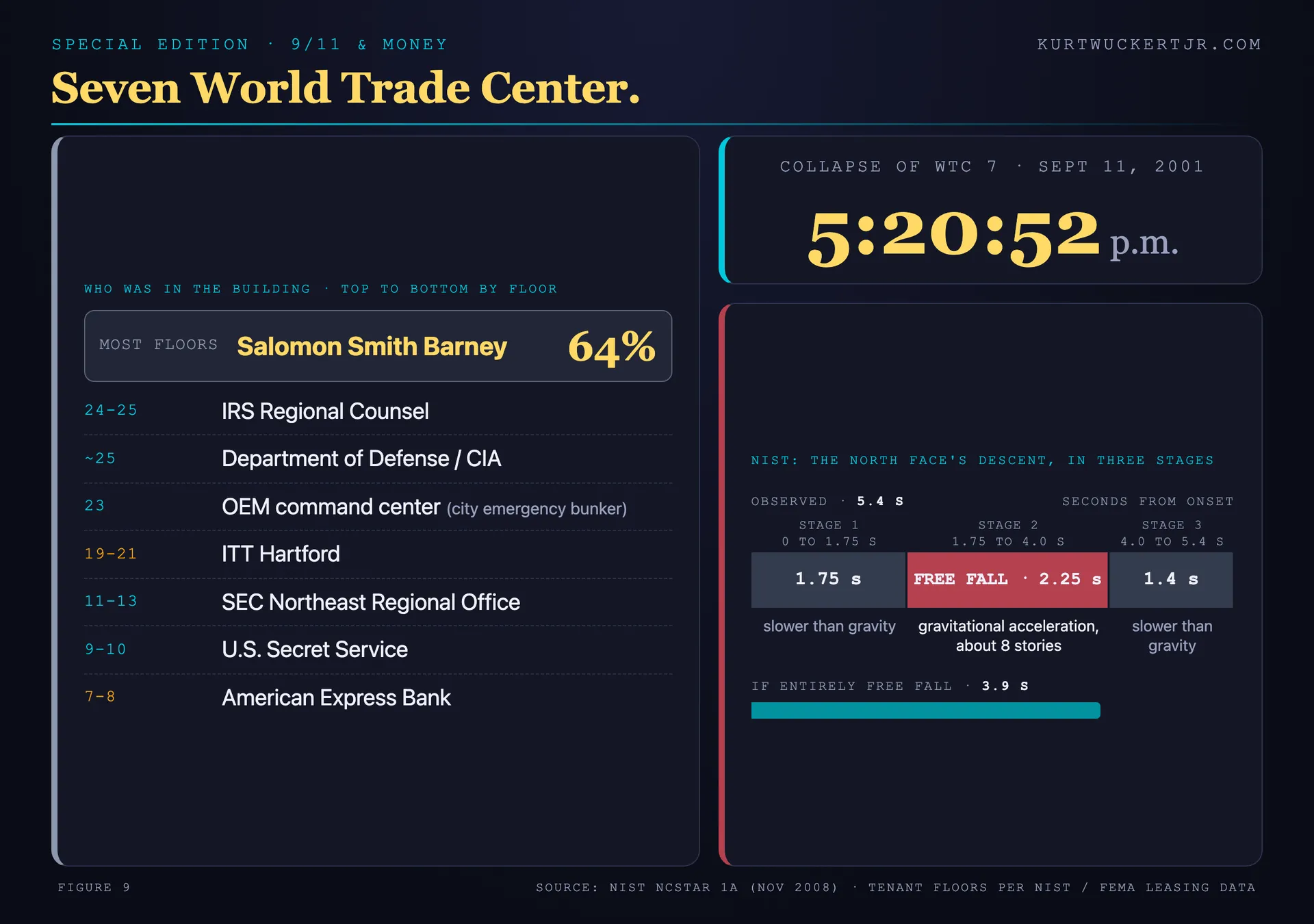
NIST's own numbers: 5.4 seconds observed, 2.25 at gravitational acceleration. Source: NIST NCSTAR 1A (Nov. 2008); tenant floors per NIST and FEMA.
NIST's final report, November 2008, is the government's account of how: "The heat from the uncontrolled fires caused steel floor beams and girders to thermally expand, leading to a chain of events that caused a key structural column to fail," Column 79.¹⁴⁹ Its Principal Findings record 2.25 seconds in which "the north face descended at gravitational acceleration," a drop of "approximately 8 stories".¹⁵⁰ Free fall, in a steel building, and it was not in the August 2008 draft.¹⁵¹
At NIST's briefing on August 26, 2008, physics teacher David Chandler had a question read into the record: the draft was "claiming 40 percent slower than free fall, based on a single data point. How can such a publicly visible, easily measurable quantity be set aside?"¹⁵² Shyam Sunder, the lead investigator, answered that "a free fall time would be an object that has no structural components below it."¹⁵³ Three months later the draft's 40 percent became the final report's 2.25 seconds at gravitational acceleration.¹⁵⁴
The measurement changed. The cause did not. NIST's FAQ: "NIST concluded that blast events inside the building did not occur and found no evidence supporting the existence of a blast event," and the smallest charge able to fail that column "would have resulted in a sound level of 130 decibels (dB) to 140 dB at a distance of at least half a mile."¹⁵⁵ NIST's towers FAQ is plainer: "NIST did not test for the residue of these compounds in the steel."¹⁵⁶ Nobody found what nobody tested for...
The chips have a paper: Niels Harrit and his co-authors, in The Open Chemical Physics Journal on April 3, 2009, reported chips that "exhibit large but narrow exotherms occurring at approximately 430˚C, far below the normal ignition temperature for conventional thermite".¹⁵⁷ Their conclusion, on the page: "The red portion of these chips is found to be an unreacted thermitic material and highly energetic."¹⁵⁸ The journal's editor, Marie-Paule Pileni, resigned, saying it ran without her approval, and James Millette's 2012 study found the chips consistent with epoxy primer paint.¹⁵⁹
The FDNY oral histories describe the towers, not 7; NIST's answer to all of them is a piston, floors forcing smoke and debris out the windows below.¹⁶⁰ Firefighter Richard Banaciski, Ladder 22, December 6, 2001: "It seemed like on television when they blow up these buildings. It seemed like it was going all the way around like a belt, all these explosions."¹⁶¹
Inside 7 WTC that morning, Barry Jennings of the city Housing Authority and Michael Hess, the city's Corporation Counsel, were trapped and both described an explosion; Hess, on the BBC in July 2008, blamed North Tower debris; Jennings, filmed by Dylan Avery in 2007, died August 19, 2008, two days before NIST announced its draft.¹⁶²
At 4 p.m., BBC World's Phil Hayton announced that the Salomon Brothers building had collapsed while Jane Standley reported live with 7 WTC behind her; it fell twenty-three minutes later.¹⁶³ BBC World News editor Richard Porter, 2007, blaming a Reuters wire: "We're not part of a conspiracy" and "We no longer have the original tapes of our 9/11 coverage (for reasons of cock-up, not conspiracy)."¹⁶⁴
Bill Manning wrote in Fire Engineering in January 2002 that crucial evidence was "on the slow boat to China, perhaps never to be seen again in America until you buy your next car."¹⁶⁵ On March 6, 2002, fire protection engineer Glenn Corbett told the House Science Committee: "Handling the collapse study as an assessment, rather than as an investigation, has allowed valuable evidence in the form of the towers' structural steel to be destroyed."¹⁶⁶ NIST says it "analyzed 236 pieces of steel that were obtained from the wreckage" and that this was sufficient.¹⁶⁷
The Pentagon has the same shape. In a sworn declaration of September 9, 2005, FBI Special Agent Jacqueline Maguire counted 85 potentially responsive videotapes, 56 showing neither the building, the crash site nor the impact; of the thirteen that showed the crash site, "twelve (12) videotapes only showed the Pentagon after the impact of Flight 77. I determined that only one videotape showed the impact of Flight 77 into the Pentagon on September 11, 2001."¹⁶⁸ The Pentagon's own May 16, 2006 release shows a thin white blur in one frame, and the Citgo and Doubletree tapes show no aircraft, though the engineers' report says the impact "destroyed or significantly impaired approximately 50 structural columns."¹⁶⁹
Why don't we have the footage of the Pentagon crash?
Dylan Avery's SEVEN (2020) rests on those 2.25 seconds and on J. Leroy Hulsey's University of Alaska Fairbanks study, final March 2020.¹⁷⁰ Its conclusion: "fire did not cause the collapse of WTC 7 on 9/11, contrary to the conclusions of NIST" and "the collapse of WTC 7 was a global failure involving the near-simultaneous failure of every column".¹⁷¹ Architects & Engineers for 9/11 Truth paid for it, $316,153; NIST rejected the group's request for correction in 2020.¹⁶⁹
And the 9/11 Commission Report? It mentions 7 WTC only as the address of the city's emergency bunker and never discusses its collapse.¹⁷²
The one building nobody flew into is the one whose fall the Report never mentions.
A measurement that changed after a physics teacher asked, and a cause that did not. A test never run, and a finding that nothing was found. A steel field shipped before the engineers arrived. A broadcaster announcing a collapse twenty-three minutes early, then losing the tape. Each is defensible alone. Together they are indefensible, and a pattern that always breaks toward less evidence is sloppy coordination or a whitewash. Why does the official record of the most documented day in American history have a 47-story hole in it, and who benefits from the hole staying open?
Where was the gold?
In late October 2001, trucks ran through the abandoned Downtown Hudson Tubes, hauling coins out of the basement of 4 World Trade Center, where the Bank of Nova Scotia kept a vault for Comex.¹⁷³ Four days after the attack, the New York Times counted what was down there: 379,036 ounces of gold and 30.2 million ounces of silver.¹⁷² By November 1 the Los Angeles Times valued it at about $200 million.¹⁷⁴
That is the record. The legend is $160 billion, sometimes $167 billion; it circulates in 9/11-truth material with no traceable author, earliest copy a web-archive snapshot from about 2003.¹⁷⁵
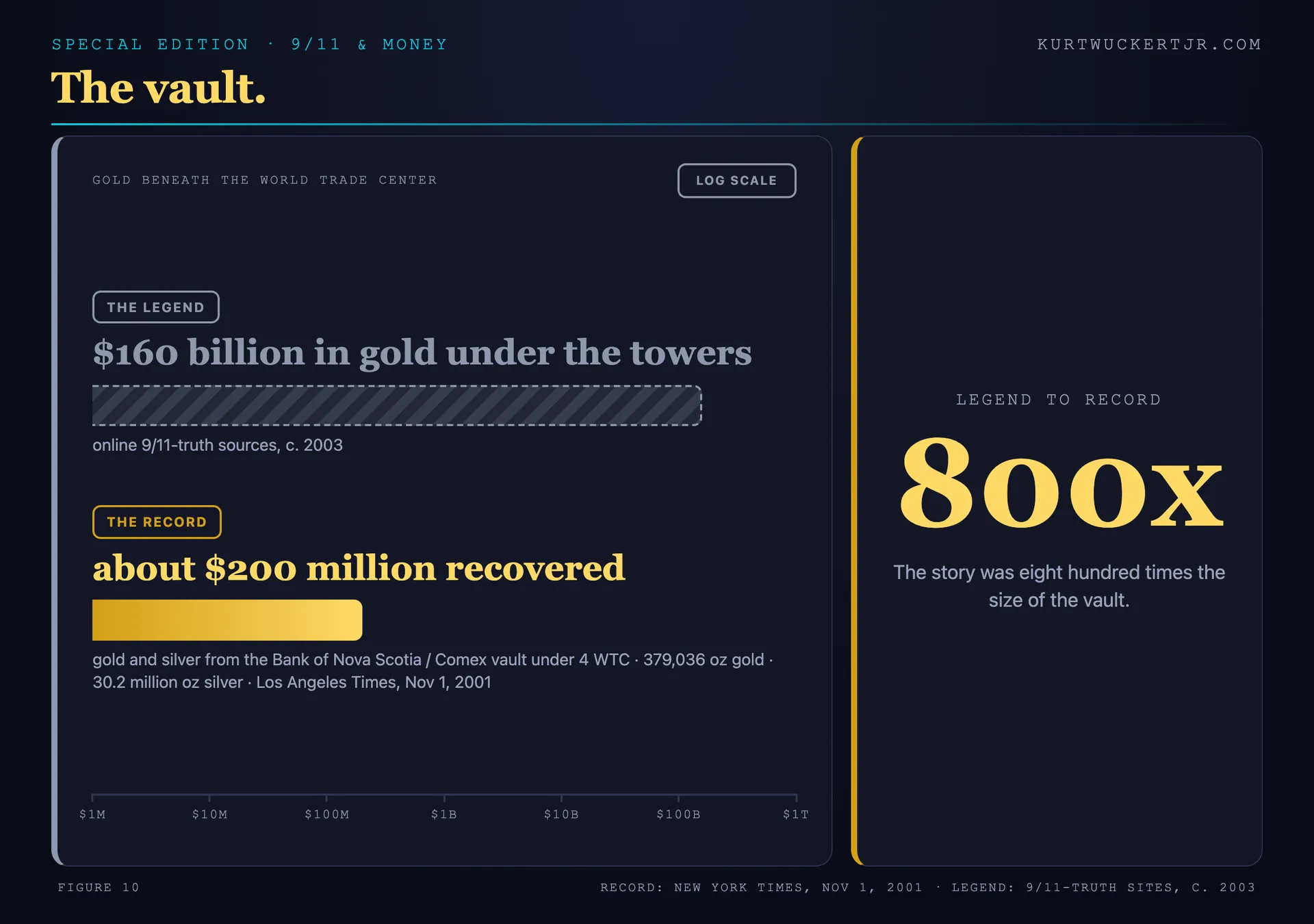
Source: Los Angeles Times, Nov. 1, 2001; The New York Times, Sept. 15, 2001.
Part 1 of Money & Banking was the Templars keeping kings' silver under temples; Part 2 opened on a sealed clay ball from Susa that comes back when this story reaches Baghdad.
One hundred sixty billion divided by two hundred million is eight hundred, and the receipt still shows a Comex vault emptied through an abandoned railway tunnel six weeks after the towers fell. Vaults under temples, then vaults under towers.
The legend was nearly a thousand times bigger than the gold.
The Fed opens the window
Here is where we get to the money. Not the financing of the attacks, but the monetary reflex and the surveillance law that arrived in 2001, one of which never changed back.
"The Federal Reserve System is open and operating. The discount window is available to meet liquidity needs."¹⁷⁶
That is the entire Federal Reserve press release of September 11, 2001. Seventeen words. Come and borrow.
They came. In the year before that week the discount window, the Fed's emergency counter, averaged about $200 million. On the night of September 11 it was $37 billion. On September 12, $46 billion.¹⁷⁷ Jeffrey Lacker of the Richmond Fed: "Banking system balances went from $13 billion on September 10 to over $120 billion on the 13th."¹⁷⁸
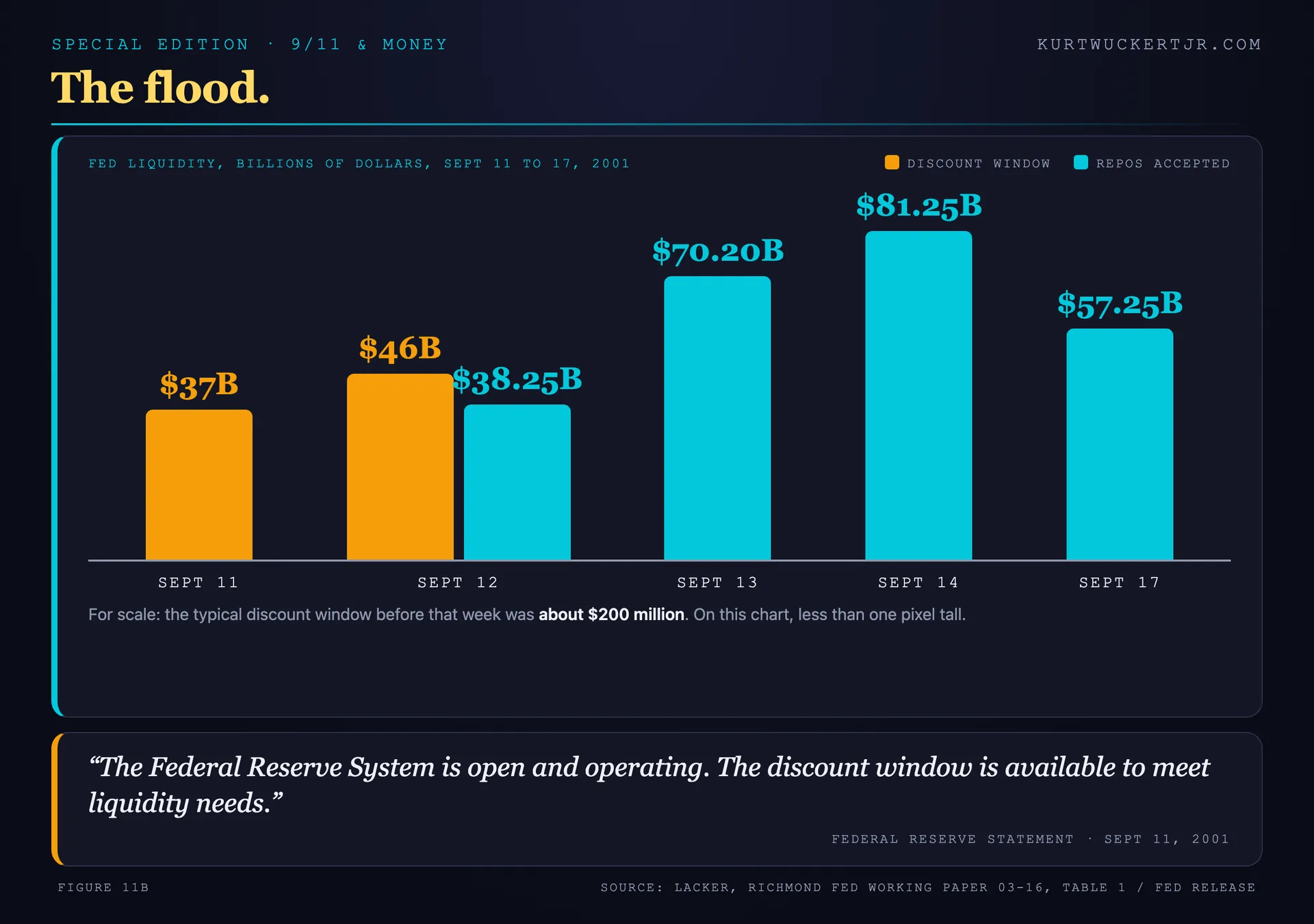
Source: Jeffrey M. Lacker, Federal Reserve Bank of Richmond Working Paper 03-16, Tables 1 and 2.
The New York Stock Exchange stayed dark until Monday, September 17,¹⁷⁹ and that morning the Federal Open Market Committee cut half a point to 3 percent and promised to "continue to supply unusually large volumes of liquidity to the financial markets, as needed, until more normal market functioning is restored."¹⁸⁰ Five days later the President signed the Air Transportation Safety and System Stabilization Act, whose Victim Compensation Fund paid families who gave up the right to sue the airlines.¹⁸¹
The 2008 desk and the 2020 desk ran the same play with more zeros: open the window, promise unusually large volumes, call it temporary.
The emergency never closed; it became procedure.
A central bank that can put $120 billion into the system by Thursday does not need a vote, and it did not ask for one.
Forty-five days
H.R. 3162 was introduced in the House on Tuesday, October 23, 2001.¹⁸² It passed the House on Wednesday, 357 to 66. It passed the Senate on Thursday, 98 to 1, the one being Russ Feingold of Wisconsin.¹⁸³ The President signed it on Friday, October 26.¹⁸⁴
Tuesday to Friday. Forty-five days from the attack to the signature.
Title III is the part that rewired your bank. It has two names: the heading calls it the "INTERNATIONAL MONEY LAUNDERING ABATEMENT AND ANTI-TERRORIST FINANCING ACT OF 2001"; Section 301 says it "may be cited as the 'International Money Laundering Abatement and Financial Anti-Terrorism Act of 2001'."¹⁸⁵ Same statute, two titles, a few inches apart!
Every quoted phrase below is from the enrolled statute.¹⁸⁶
- §311, special measures. Treasury may declare a foreign bank or jurisdiction "of primary money laundering concern" and cut it off. No judge is involved.
- §312, correspondent and private banking. Due diligence "reasonably designed to detect and report instances of money laundering through those accounts."
- §313, shell banks. No U.S. account for "a foreign bank that does not have a physical presence in any country."
- §314, information sharing. A bank pooling customer intelligence with the government "shall not be liable to any person under any law or regulation of the United States" for the disclosure.
- §319, interbank forfeiture. Foreign deposits with a U.S. correspondent "shall be deemed to have been deposited into the interbank account in the United States," so they can be seized here.
- §326, customer identification. Standards for "verifying the identity of any person seeking to open an account to the extent reasonable and practicable," which is KYC as federal statute.
- §351 and §352, SARs and AML programs. A bank that files a SAR is immune and "may not notify any person involved in the transaction that the transaction has been reported"; every institution must run an AML program.
- §356, broker-dealers. SAR rules extended to every SEC-registered broker and dealer.
- §358, the pipe to intelligence. Treasury "shall make information in a report filed under this subchapter available to" any "United States intelligence agency" on request, exempt from FOIA.
- §359, hawala. "an informal money transfer system" is now a regulated money transmitter.
- §361, FinCEN. The 1990 Treasury office "shall be a bureau in the Department of the Treasury."
- §365, cash. "more than $10,000 in coins or currency in 1 transaction (or 2 or more related transactions)" gets reported to FinCEN.
- §373, unlicensed money transmitting. An "unlicensed money transmitting business" now carries up to five years under 18 U.S.C. §1960.
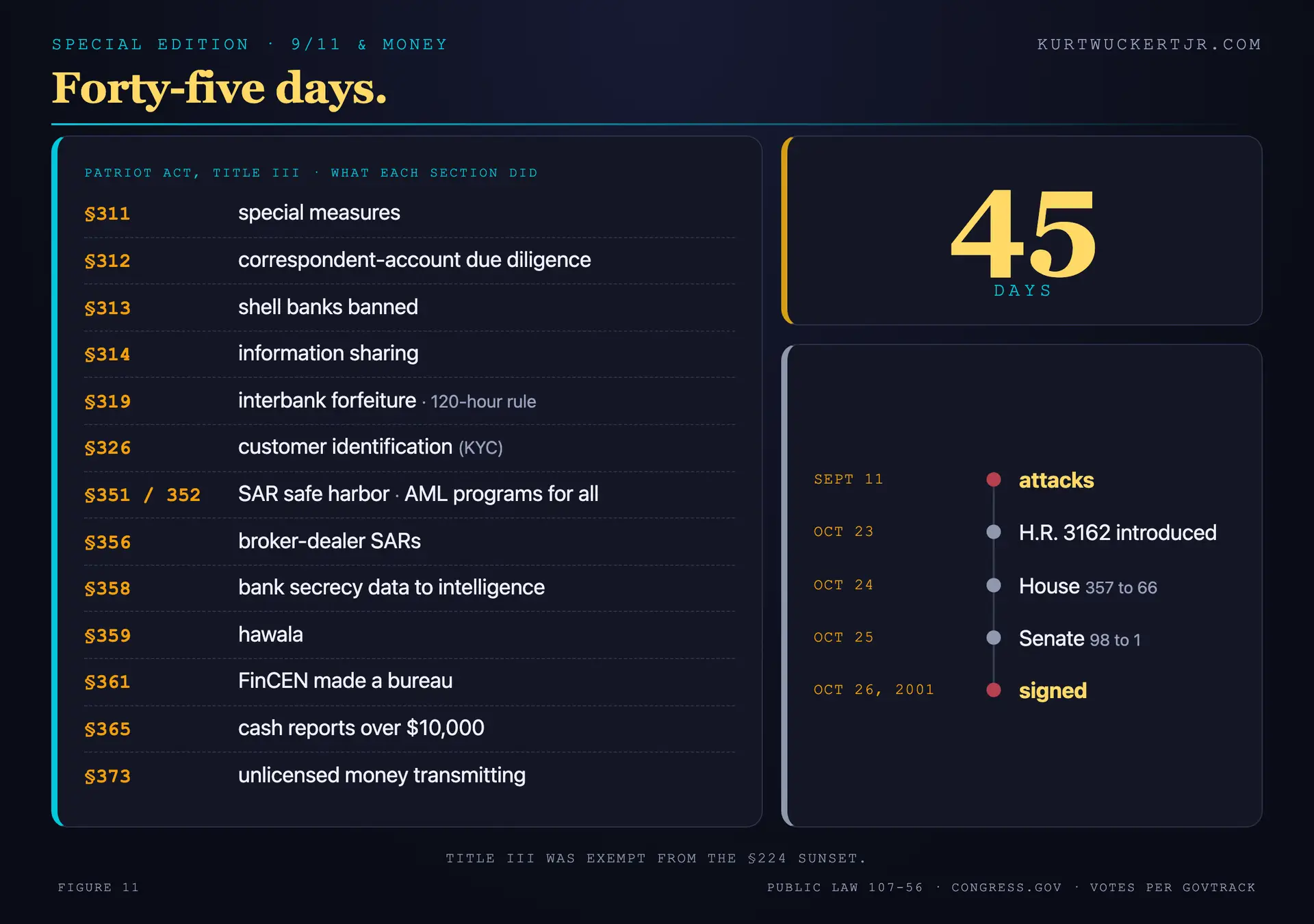
Four days on the calendar, forty-five from the attack. Source: Public Law 107-56; House roll call 398 and Senate vote 313.
Notice who does the work in every line. The bank does. Title III did not build a surveillance agency; it conscripted one. It deputized every teller in America, with immunity for reporting you and a penalty for warning you.
And it never expired. The sunset clause, §224, says "this title and the amendments made by this title" lapse on December 31, 2005; §224 sits inside Title II, and Title III is not named in it.¹⁸⁷ Title III got §303, under which it ends only if Congress passes a joint resolution declaring its provisions "shall no longer have the force of law."¹⁸⁸
Congress never did. The wiretap title had an expiration date. The bank rules just stayed.
The most consequential financial law of the century was passed before the fires were out.
When was it written?
Dozens of sections of dense banking law, introduced on a Tuesday and passed by Thursday. So who wrote it, and when?
Ron Paul voted no, one of three House Republicans who did, and told Insight on the News weeks later: "It's my understanding the bill wasn't printed before the vote — at least I couldn't get it." And: "Maybe a handful of staffers actually read it, but the bill definitely was not available to members before the vote."¹⁸⁶ In Fahrenheit 9/11 (2004), John Conyers tells Michael Moore that members do not read most bills.¹⁸⁹
A Critical Timeline
- March 9, 2000. Rep. Jim Leach introduces H.R. 3886, the International Counter-Money Laundering Act of 2000, giving Treasury "special measures" against suspect foreign jurisdictions; it clears the House Banking Committee and goes no further.¹⁹⁰
- February 5, 2001. Sen. Carl Levin's minority staff on the Permanent Subcommittee on Investigations publishes "Correspondent Banking: A Gateway to Money Laundering," and holds hearings in March.¹⁹¹
- August 3, 2001. Levin introduces S. 1371, the Money Laundering Abatement Act, with Grassley, Sarbanes, Kyl, DeWine and Bill Nelson; five weeks before the attack.¹⁹²
- September 26, 2001. Chairman Paul Sarbanes convenes a Senate Banking Committee hearing on "The International Money Laundering Abatement and Anti-Terrorist Financing Act of 2001." Fifteen days after the attack, and already carrying the exact words that would sit atop Title III.¹⁹³
- October 2001. Michael Oxley's H.R. 3004, the Financial Anti-Terrorism Act, is incorporated into H.R. 3162 as Title III.¹⁹⁴
Leach's bill from 2000 is the ancestor of §311. Levin's investigation is the spine of §312, §313 and §319. What arrived in H.R. 3162 on October 23 was a bill that had already failed once in 2000 and was sitting in committee in August 2001, with the word "terrorism" added to the front.
The machinery was on the shelf; the ordinary process had turned it away once and shelved it again. The attack did not write the bill; it changed the cost of voting against it. A crisis is a procurement event, and this order was filled from inventory.
Ninety-eight to one!
What it grew into
Three days after the signing, on October 29 and 30, 2001, FATF met in Washington and adopted Eight Special Recommendations on terrorist financing.¹⁹⁵ Title III was the world's template inside a week, and it turned every American into a subject of surveillance while the government's own evidence around 9/11 was being lost or destroyed.
On November 19, 2001, the Aviation and Transportation Security Act created the TSA.¹⁹⁶ As of 9/11, the Report says, "the FAA's 'no-fly' list contained the names of just 12 terrorist suspects (including 9/11 mastermind Khalid Sheikh Mohammed)."¹⁹⁷ By August 2013, per documents obtained by The Intercept, the Terrorist Screening Database held 680,000 people, and the no-fly list stood at "an all-time high of 47,000."¹⁹⁸ Twelve names to forty-seven thousand, nearly four thousandfold, and not a trial among them!
On June 23, 2006, Eric Lichtblau and James Risen reported in the New York Times that Treasury had been pulling records out of SWIFT, the Belgian cooperative behind most international bank transfers, under administrative subpoenas rather than warrants.¹⁹⁹ The program had a name, the Terrorist Finance Tracking Program, and the public learned it existed from a newspaper. Section 358 had opened the pipe.
That is the regime: a name at the counter, a report you will never see, and a subpoena on the wire. A list that grows four thousandfold without a trial is less a security measure than a census of suspicion.
And then the money went to war.
Uruk
On Thursday, April 10, 2003, the doors of the Iraq Museum in Baghdad were open and nobody was standing in them.
The staff had fled. Two days after American troops entered the city, and for three days running, people walked in and carried out the oldest civilization on earth. The early wire reports said 170,000 pieces. The Marine investigation led by Col. Matthew Bogdanos settled the count at about 15,000 objects.²⁰⁰ The Warka Vase, from Uruk, came back "in 14 pieces, after curators advertised an amnesty policy."²⁰¹ The Mask of Warka, a marble face from about 3100 BC, turned up that September in a plastic bag on a farm north of Baghdad.²⁰²
While the museum was still being emptied, on Friday, April 11, Donald Rumsfeld took questions at the Pentagon. As CNN reported the briefing, he said "Stuff happens," and, separately, "Freedom's untidy, and free people are free to make mistakes and commit crimes and do bad things."²⁰³
How did we get from a Tuesday in Manhattan to a Thursday in Baghdad? On paper, we did not.
The 9/11 Commission wrote, on page 66: "But to date we have seen no evidence that these or the earlier contacts ever developed into a collaborative operational relationship. Nor have we seen evidence indicating that Iraq cooperated with al Qaeda in developing or carrying out any attacks against the United States."²⁰⁴ That was 2004. The invasion was March 2003, and the President's letter to Congress of March 18, 2003 said the action was consistent with taking "the necessary actions against international terrorists and terrorist organizations, including those nations, organizations, or persons who planned, authorized, committed, or aided the terrorist attacks that occurred on September 11, 2001."²⁰⁵
One is the justification. The other is the finding. They do not agree, and the justification came first. A war sold on that Tuesday was fought against the country the Commission cleared.
The Pentagon was not surprised by the museum. McGuire Gibson met Pentagon officials in late January 2003 and handed them a disk of every known site; on April 8 he emailed again and was asked where the museum was, per the Washington Post of April 14, 2003.²⁰⁶ On January 24, 2003, the American Council for Cultural Policy, a collectors' group, had met Pentagon and State officials; its treasurer, William Pearlstein, called Iraq's antiquities law "retentionist," and its president, Ashton Hawkins, said "there had been no discussion of Iraqi law."²⁰⁷ The archaeologists brought a map. The collectors brought a wish list.
Then the city fell, and as Robert Fisk reported in The Independent in April 2003, American troops guarded the Oil Ministry while the museum went unguarded. The army guarded the oil and left the ledger of civilization to men with keys.
Men with keys is not a figure of speech. Bogdanos found "there had been not one but three thefts at the museum by three distinct groups": professionals, random looters, and insiders who emptied the basement.²⁰⁸ The basement doors were unlocked, not forced; seals went "from locked cabinets in an underground storage room"; the thieves dropped their keys in the dark and missed the cabinets of gold and silver coins. The American Scholar called it "an inside job," and Bogdanos concluded the men knew exactly what the room held.²⁰⁹ Donny George, then Iraq's Director of Antiquities, said it in June 2003: three groups, one of which arrived with glass cutters and knew what it wanted.²¹⁰
The theories arrived on schedule. Michael Salla argued in 2003 that a "Stargate" lies under Uruk and that it, not weapons, drove the invasion, via Zecharia Sitchin's reading of temple images as "a transportation device used by Anu."²¹¹ Bogdanos found no evidence that any American agency directed the theft or profited from it; the insiders with keys were Iraqi.²¹²
Nobody needs a stargate; at least, officially... A map handed over in January, a lobby that wanted the export law loosened, a guard on the oil and none on the seals, a basement opened with keys: incentives, on paper.
Now, about the name. In Part 2 of Money & Banking I took you to Uruk, in southern Iraq, where writing began around 3300 BC as accounting, and most of the earliest tablets are receipts. One theory names the country for that city; Wilhelm Eilers argued in 1983 for Middle Persian erāg, "lowlands."²¹³
The first receipts in human history were written in that country.
At a House Oversight hearing on February 6, 2007, Rep. Henry Waxman put the number at nearly $12 billion in U.S. currency taken out of Federal Reserve vaults and flown into Iraq.²¹⁵ "Who in their right mind would send 360 tons of cash into a war zone?"²¹⁶ A single June 2004 shipment of $2.4 billion was "the largest in the history of the Federal Reserve."²¹⁷ Paul Bremer, asked whether any of it reached the insurgency: "If there were evidence of that, I would certainly be concerned."²¹⁸
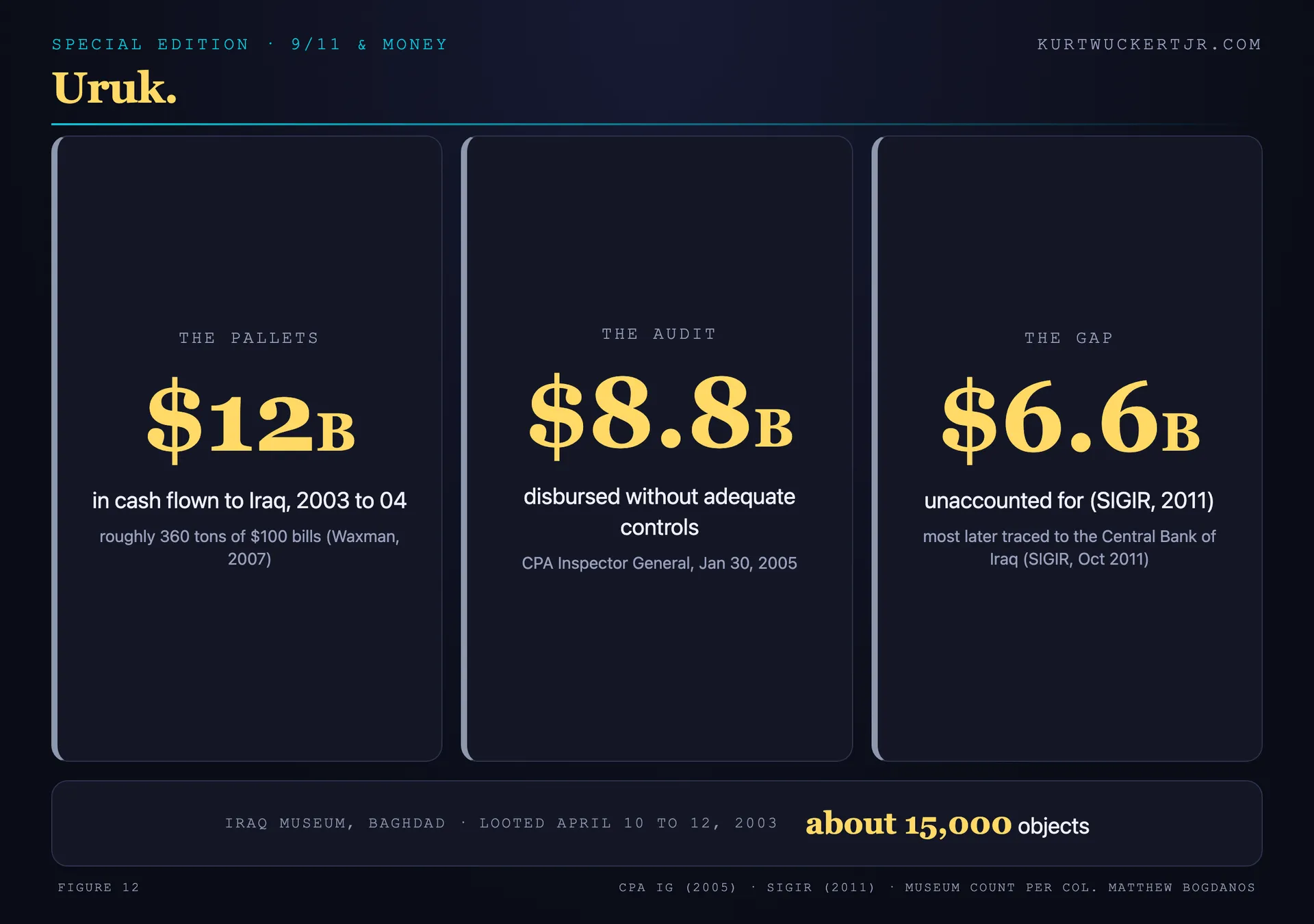
The money was Iraqi. The audits were American. The count moved every time somebody looked. Source: Rep. Henry Waxman, Feb. 6, 2007; CPA Inspector General, Jan. 30, 2005; SIGIR, June and October 2011; Col. Matthew Bogdanos.
The audits came in three waves; the first went viral and the last is true. On January 30, 2005, the CPA's Inspector General, Stuart Bowen, reported that $8.8 billion of DFI money had gone to Iraqi ministries without adequate controls.²¹⁹ In June 2011 Bowen said $6.6 billion could not be accounted for and, per NPR, that it "may be 'the largest theft of funds in national history.'"²²⁰ The next day he told Government Executive: "no one has said the money was stolen."²²¹ On October 26, 2011, SIGIR reported that almost all of it had been transferred to the Central Bank of Iraq's control, with about $217 million still in a palace vault.²²²
So the largest theft in national history turned out to be mostly a transfer to the central bank of the country whose money it was... Still: an occupying authority flew another nation's treasury into a war zone on pallets and could not produce the receipts, in the city that invented them.
Remember the clay ball at Susa: a count, sealed so it could not be altered, checked against the real sheep and the real grain. That was the whole invention: a promise you could audit. Kushim, the barley accountant whose name may be the oldest on earth, kept better books than the Coalition Provisional Authority!
What did the men with the keys know about what was in that basement, and who gave them the keys?
They invented the receipt here. Nobody kept one.
Seven years and five days later
On Friday, October 31, 2008, a message arrived on the Cryptography mailing list from a sender nobody there had heard of. Its first sentence: "I've been working on a new electronic cash system that's fully peer-to-peer, with no trusted third party."²²³
Title III had been law for seven years and five days of unprecedented financial surveillance on the American people.
Title III was signed on October 26, 2001.²²⁴ Its Section 326 became a bank-counter form on May 9, 2003.²²⁵ On April 24, 2007, a federal grand jury indicted E-Gold Ltd. under 18 U.S.C. §1960, the statute Section 373 of Title III had rewritten in 2001.²²⁶ E-Gold pleaded guilty on July 21, 2008; fifty-six days later Lehman Brothers filed for bankruptcy.²²⁷ Forty-six days after Lehman, the email. Sixty-four days later, the first block carried a headline: "The Times 03/Jan/2009 Chancellor on brink of second bailout for banks."²²⁸
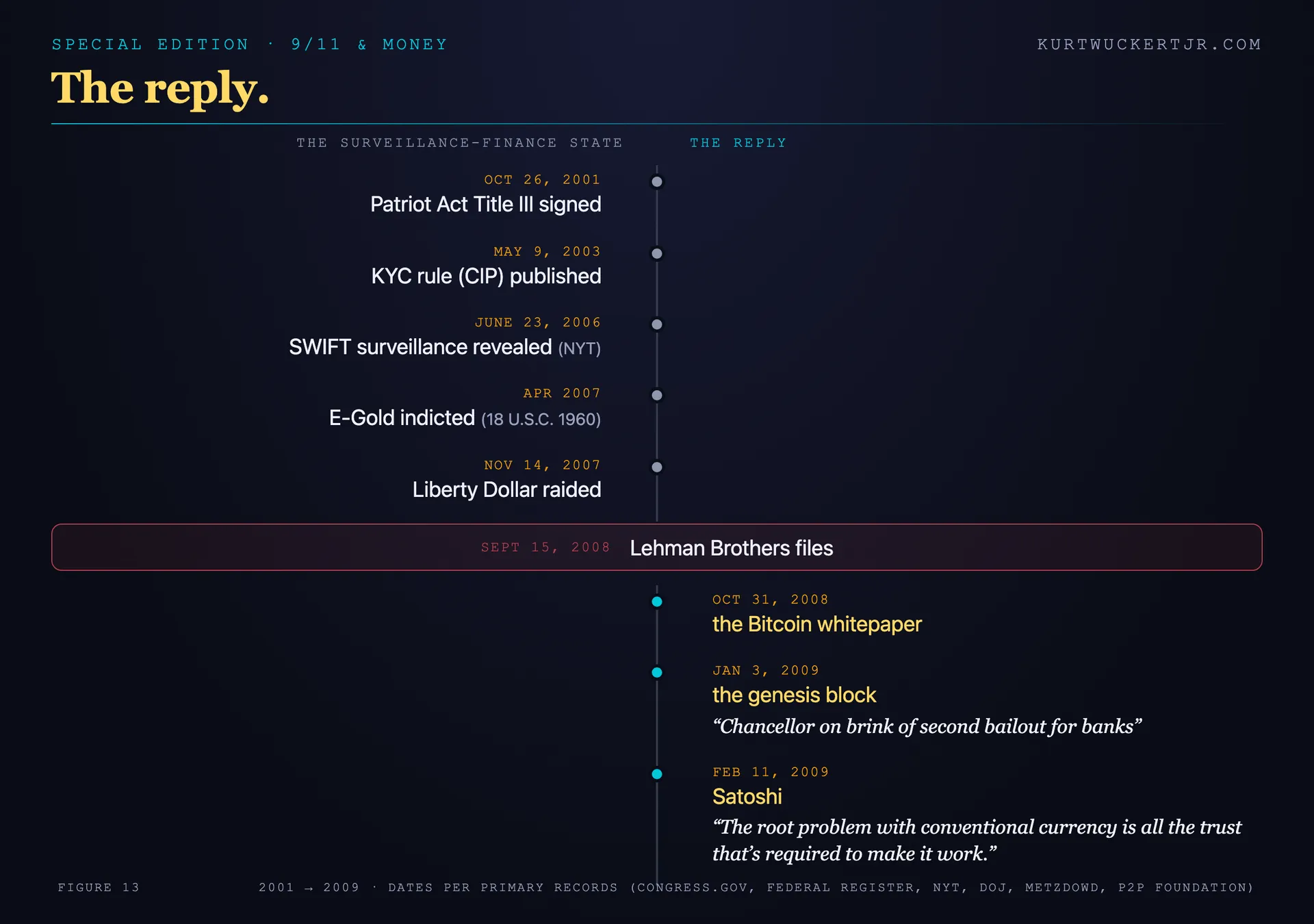
Seven years of a state building a surveillance apparatus for money; fifteen weeks of someone answering it. Nothing on the right ever cites the left. Source: congress.gov; Federal Register; DOJ; metzdowd.com; Bitcoin block 0.
In 1985 David Chaum had published "Security Without Identification: Transaction Systems to Make Big Brother Obsolete," a payment design in which organizations, "even colluding with the payment system provider who maintains the accounts, cannot trace the flow of money between accounts."²²⁹ Part 0 has the rest.
The whitepaper's abstract: "A purely peer-to-peer version of electronic cash would allow online payments to be sent directly from one party to another without going through a financial institution. Digital signatures provide part of the solution, but the main benefits are lost if a trusted third party is still required to prevent double-spending."²³⁰
Then Section 10: "The traditional banking model achieves a level of privacy by limiting access to information to the parties involved and the trusted third party. The necessity to announce all transactions publicly precludes this method, but privacy can still be maintained by breaking the flow of information in another place: by keeping public keys anonymous. The public can see that someone is sending an amount to someone else, but without information linking the transaction to anyone."²³¹
The trusted third party has to go, and it is what every Title III duty attaches to. What the protocol withholds is the name; Title III is a law about attaching names to money.
On November 6, 2008, James A. Donald told him, "You will not find a solution to political problems in cryptography." Satoshi's whole reply: "Yes, but we can win a major battle in the arms race and gain a new territory of freedom for several years. Governments are good at cutting off the heads of a centrally controlled networks like Napster, but pure P2P networks like Gnutella and Tor seem to be holding their own."²³²
February 11, 2009, on the P2P Foundation forum: "The root problem with conventional currency is all the trust that's required to make it work. The central bank must be trusted not to debase the currency, but the history of fiat currencies is full of breaches of that trust. Banks must be trusted to hold our money and transfer it electronically, but they lend it out in waves of credit bubbles with barely a fraction in reserve. We have to trust them with our privacy, trust them not to let identity thieves drain our accounts. Their massive overhead costs make micropayments impossible."²³³
Nobody can tell you Bitcoin was built as an answer to the Patriot Act. The documents say this much: Title III deputized every trusted third party, Sections 326, 352, 314 and 373, and the whitepaper removes the third party.²³⁵
Bitcoin, as a casual reply to the federal government, could not have been designed better.
Bitcoin started a revolution in a post-9/11 world, and the revolution was captured by insiders from Big Banks, Big Gov and Big Tech, who came through the front door with term sheets so it would never disrupt the apparatus of control they had just built. I put it this way in 2025: "the next time someone asks, 'was it the NSA, CIA, Silicon Valley, crypto-anarchists, or the Federal Reserve who hijacked Bitcoin?' You can just answer 'yes.'" It was a brilliant soft coup d'etat.²³⁶
On October 27, 2015, Barry Silbert launched Digital Currency Group, and TechCrunch reported that "the company has closed a round from Bain Capital Ventures, Transamerica Ventures, FirstMark Capital, MasterCard, and New York Life, among others."²³⁷ On February 3, 2016, Blockstream announced a $55 million Series A "co-led by Horizons Ventures, AXA Strategic Ventures, and Digital Garage."²³⁸ AXA's chief executive, Henri de Castries, chaired the Bilderberg Meetings' steering committee from 2012 to 2019.²³⁹ Coinbase's January 2015 round included the New York Stock Exchange and USAA, per Part 4B.²⁴⁰
The mechanism was the block-size war of 2015 to 2017. Small blocks push payments onto off-chain rails; every rail ends at a custodian; every custodian is a counter with a Section 326 form on it. The culture followed the money: "'We Accept Bitcoin' turned into 'Buy Bitcoin' and then degraded further to 'HODL' as the libertarians became content with wealth in exchange for their freedom."²⁴¹
Part 4B's caution stands: "The causal mechanism from 'invested in DCG' to 'steered Bitcoin's protocol direction' is not documented anywhere in the public record with specificity". What is documented is who paid, when, and what the network became.²⁴² In 2024: "BTC has been so deeply undermined that it is being used as a tool of control instead of a tool for freedom."²⁴³ In 2023: "The wolves are all the way in the hen house!"²⁴⁴
Now the people cited on both sides: three, and one statute.
Juan Zarate's biography at CSIS describes him as "the first-ever assistant secretary of the treasury for terrorist financing and financial crimes" and the author of Treasury's War (2013); a few lines down: "Since 2014, Mr. Zarate has served as an independent adviser to Coinbase, the largest virtual asset service provider in the United States."²⁴⁵
The man who wrote the chokepoint doctrine advises the biggest on-ramp.
Howard Lutnick's row is the firm: Cantor acts as custodian for Tether's reserves, by Lutnick's own account in January 2024, per Part 8B.²⁴⁶ The custodian of the biggest dollar token in the world has its chief in the cabinet.
Larry Summers is context: Treasury Secretary until January 2001, then a Digital Currency Group advisory seat (Wall Street Journal, April 2016) after a bitcoin breakfast at Jeffrey Epstein's townhouse; no wire between them.²⁴⁷
On November 21, 2023, Binance settled with FinCEN for $3.4 billion, "the largest penalty in U.S. Treasury and FinCEN history," and drew this from Secretary Yellen: "Its willful failures allowed money to flow to terrorists, cybercriminals, and child abusers through its platform."²⁴⁸ The charges rest on the Bank Secrecy Act as Title III amended it.²⁴⁹ The law caught up to the design by standing at the door!
FinCEN's guidance of March 18, 2013 made anyone who "accepts and transmits a convertible virtual currency" a money transmitter, and the guidance became a market.²⁵⁰ Chainalysis, founded in 2014, sells to the FBI, the DEA and IRS Criminal Investigation, and sits in Digital Currency Group's portfolio alongside Coinbase and Blockstream.²⁵¹
Jeffrey Epstein is dense on the Bitcoin side, a slice of Blockstream's 2014 seed round and about $3 million into Coinbase per Part 4B, and on the 9/11 side we found no record connecting him to that day. What is on record is the company he kept: Howard Lutnick next door; a business partnership with Ehud Barak (Haaretz, July 2019); three 2014 meetings on his calendar with William Burns, then deputy secretary of state and now CIA director, two of which Burns recalls (Wall Street Journal, April 2023); and Alexander Acosta's reported explanation to the Trump transition team that he had been told Epstein "belonged to intelligence" (Vicky Ward, Daily Beast, July 2019, a single-source account Acosta later said he would hesitate to take as fact).²⁵²
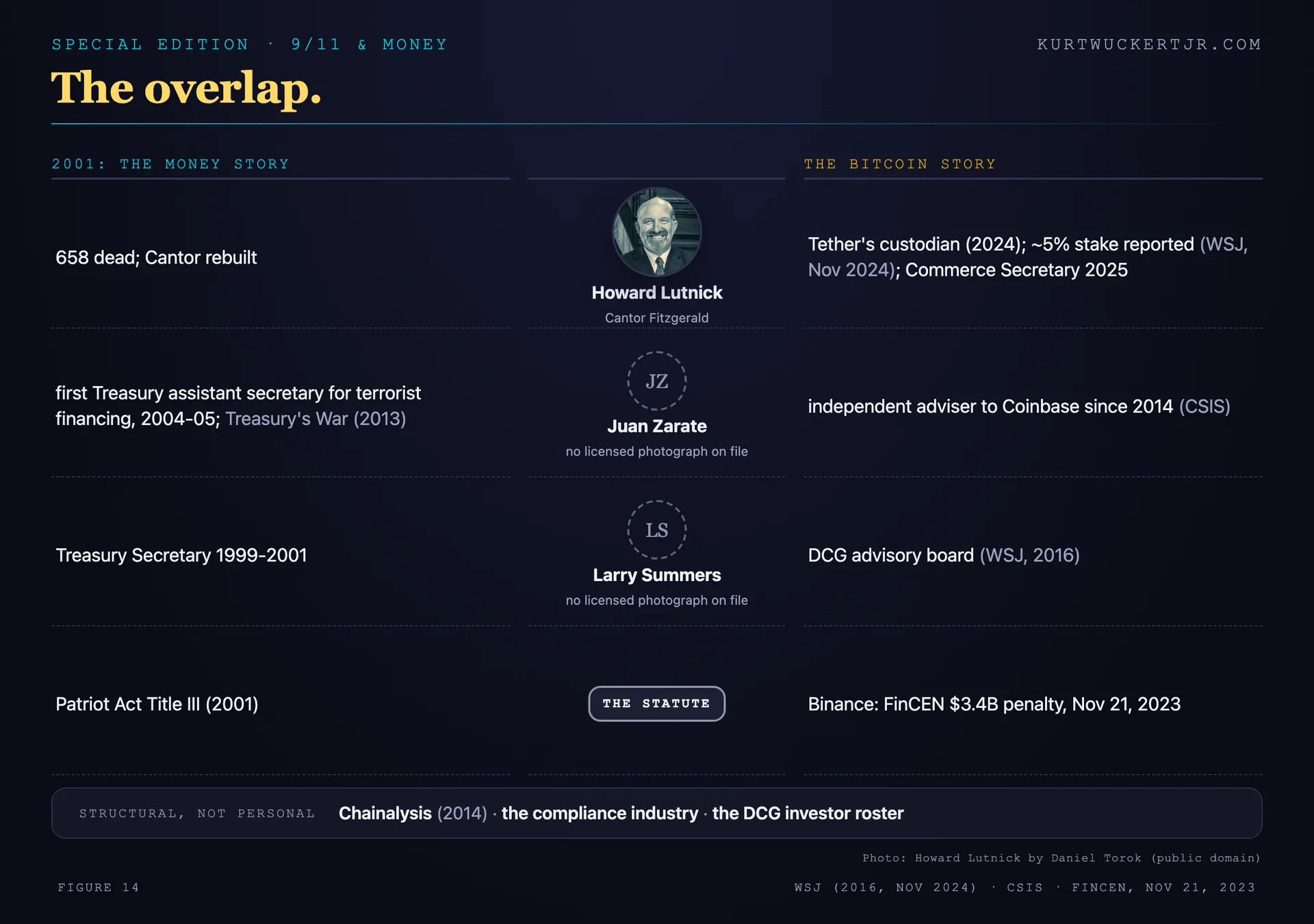
Three people and one statute are cited on both sides; everything else is an institution. Source: CSIS; Senate roll call vote 70 (Feb. 18, 2025); The Wall Street Journal; U.S. Treasury; DCG portfolio.
The people who built the cage and the people who sold the key kept turning up in the same rooms.
June 2019: the Financial Action Task Force's travel rule reaches virtual asset service providers; the names ride with the transfer. Section 326 with a passport.²⁵² January 10, 2024: the SEC approves the spot bitcoin ETPs, and the coin designed to need no custodian acquires the largest ones on earth (Part 11B).²⁵³ January 23, 2025: Executive Order 14178 bars federal agencies from a CBDC.²⁵⁴ July 11, 2026: the ban became statute, Public Law 119-101 §1101, the Federal Reserve "may not issue or create a central bank digital currency," sunsetting December 31, 2030.²⁵⁵ A ban with an expiration date is a pause with good PR.
So the state will not issue the surveillance coin, for now. It does not need to! Every regulated door into the coin built to have no doors runs on the 2001 law. The exit is sold through a trusted third party, and when the people who own the doors sell you the way out, you are not the customer.
Which side of the counter do you think you are standing on?
What we are allowed to know
One line at the end of the Commission's note 130 I have read more than any other: "These investigators have found that the apparently suspicious consistently proved innocuous."²⁵⁶
Eleven words. Now the ledger.
A Secretary put the exchange at about 9; the Report printed 9 and never mentioned him. A think tank asked for a new Pearl Harbor in 2000; that afternoon a defense secretary ordered the Iraq case built; the Commission cleared Iraq. The CIA watched two hijackers in Kuala Lumpur; an FBI informant housed them; nobody watchlisted them until August. Somebody bought the puts; the Commission never named him. Twenty-eight pages about a friend took fourteen years to declassify. The building nobody flew into fell at free fall for 2.25 seconds; the Report never discusses it.
None of these is proof, but together they are not coincidence either. They are what it looks like when institutions protect themselves and each other. I make a similar argument about how Bitcoin was hijacked.
Who was the investor in note 130? Who decided the Commission would not say what the script was for? Whom were the twenty-eight pages protecting? When was Title III written? The documents answered that one: before.
The 2,977 killed that morning were people, and their names are cut into the memorial downtown. The questions go to the institutions and the paper, the only things that can still answer.
For the Written History: every identity fight still ahead in this series has a birthday, October 26, 2001. Part 13 opens on the January 2024 ETF week, then the London courtroom and the Identity Issue; Part 12 left both on the calendar. The 2001 law is in the room for both.
For Money & Banking: the first banks in Part 2 were temples, and the knights of Part 1 ran Europe's money from an order named for one. Part 3 brings out the tables: Greek trapezitai, and Rome striking silver in the temple of Juno Moneta, whose epithet gives us "money."
Footnotes
¹ Oliver Burkeman and Julian Borger, "The Carlyle Group: The Ex-presidents' Club," The Guardian, October 31, 2001 (reproduced at thirdworldtraveler.com), https://thirdworldtraveler.com/Bush_Gang/Carlyle_ExPresidentsClub.html
² Dan Briody, "Heady times for Carlyle in the wake of chaos and grief that gripped a nation," 2003 (reproduced at ratical.org), https://ratical.org/ratville/CAH/CarlyleHead1.html
³ Alexandra Robbins, Secrets of the Tomb, Little, Brown, 2002 ; "Interview With Tim Russert Broadcast on NBC's 'Meet the Press'," February 8, 2004, The American Presidency Project, https://www.presidency.ucsb.edu/documents/interview-with-tim-russert-broadcast-nbcs-meet-the-press
⁴ George H.W. Bush Presidential Library, "Director of Central Intelligence (1976-1977)," https://www.bush41library.gov/galleries/director-central-intelligence-1976-1977
⁵ J. Edgar Hoover, memorandum to the Director, Bureau of Intelligence and Research, Department of State, "Assassination of President John F. Kennedy November 22, 1963," November 29, 1963 (reproduced in Russ Baker, "Bush and the JFK Hit, Part 1," WhoWhatWhy, https://whowhatwhy.org/politics/government-integrity/part-1-mr-george-bush-of-the-central-intelligence-agency/); and Joseph McBride, The Nation, July 16, 1988; and Affidavit of George William Bush, September 21, 1988, https://aarclibrary.org/notices/Affidavit_of_George_William_Bush_880921.pdf
⁶ Russ Baker, "Bush and the JFK Hit, Part 5: The Mysterious Mr. de Mohrenschildt," WhoWhatWhy, https://whowhatwhy.org/politics/government-integrity/bush-and-the-jfk-hit-part-5-the-mysterious-mr-de-mohrenschildt/; and George H.W. Bush Presidential Library, correspondence, September 5 and September 28, 1976 (scan at https://embed.documentcloud.org/documents/4145147/annotations/385245/)
⁷ Dan Briody, "Heady times for Carlyle in the wake of chaos and grief that gripped a nation," as cited in note 2.
⁸ Oliver Burkeman and Julian Borger, "The Carlyle Group: The Ex-presidents' Club," as cited in note 1.
⁹ National Commission on Terrorist Attacks Upon the United States, "The 9/11 Commission Report," chapter 1, July 22, 2004, https://www.9-11commission.gov/report/911Report.pdf
¹⁰ National September 11 Memorial & Museum, "9/11 FAQs," https://www.911memorial.org/911-faqs, accessed September 7, 2026
¹¹ Today.com, "Cantor Fitzgerald CEO remembers the 658 employees who died on 9/11," September 2021, https://www.today.com/video/cantor-fitzgerald-ceo-remembers-the-658-employees-who-died-on-9-11-120758853617; and Wikipedia, "Howard Lutnick," https://en.wikipedia.org/wiki/Howard_Lutnick, accessed September 7, 2026
¹² Project for the New American Century, "Rebuilding America's Defenses: Strategies, Forces, and Resources For a New Century," September 2000, p. 51, https://archive.org/details/RebuildingAmericasDefenses
¹³ The 9/11 Commission Report, p. 251
¹⁴ David Martin, "Plans For Iraq Attack Began On 9/11," CBS News, September 4, 2002, https://www.cbsnews.com/news/plans-for-iraq-attack-began-on-9-11/ ; "See Actual Notes From Rumsfeld-9/11 Meeting," Truthdig, February 27, 2006, https://www.truthdig.com/articles/see-actual-notes-from-rumsfeld-911-meeting/
¹⁵ Board of Governors of the Federal Reserve System, "Press Release," September 17, 2001, https://www.federalreserve.gov/boarddocs/press/general/2001/20010917/default.htm
¹⁶ 107th Congress, "Public Law 107-56, USA PATRIOT Act," October 26, 2001, https://www.congress.gov/107/plaws/publ56/PLAW-107publ56.pdf
¹⁷ George W. Bush, "Letter to Congressional Leaders Reporting on the Commencement of Military Operations Against Iraq," The American Presidency Project, March 18, 2003, https://georgewbush-whitehouse.archives.gov/news/releases/2003/03/20030319-1.html
¹⁸ Rep. Henry A. Waxman, opening statement, House Committee on Oversight and Government Reform hearing on cash transfers to the Coalition Provisional Authority, February 6, 2007, as excerpted in Democracy Now, "Billions Over Baghdad," September 12, 2007, https://www.democracynow.org/2007/9/12/billions_over_baghdad_how_did_9b
¹⁹ Alex Abdo, "Twisted Logic and the New Book by the CIA Spy Who Destroyed Torture Tapes," ACLU, April 25, 2012, https://www.aclu.org/news/national-security/twisted-logic-and-new-book-cia-spy-who-destroyed-torture-tapes; and AP, "CIA Destroyed 92 Tapes of Interrogations, Documents Show," Fox News, March 2, 2009, https://www.foxnews.com/politics/cia-destroyed-92-tapes-of-interrogations-documents-show.amp
²⁰ Project for the New American Century, "Rebuilding America's Defenses: Strategies, Forces, and Resources For a New Century," as cited in note 12.
²¹ Project for the New American Century, "Rebuilding America's Defenses," September 2000, "Project Participants" page, https://archive.org/details/RebuildingAmericasDefenses
²² Project for the New American Century, "Statement of Principles," June 3, 1997 (signer list as compiled at https://en.wikipedia.org/wiki/Project_for_the_New_American_Century)
²³ individual DoD biographies; roster at https://en.wikipedia.org/wiki/Project_for_the_New_American_Century
²⁴ David Martin, "Plans For Iraq Attack Began On 9/11," as cited in note 14.
²⁵ Richard A. Clarke, Against All Enemies: Inside America's War on Terror, Free Press, 2004, pp. 30-32; "Bush Aides Deny He Ignored Qaeda," CBS News, March 22, 2004, https://www.cbsnews.com/news/bush-aides-deny-he-ignored-qaeda/; "War Of Words Over War Plan," CBS News, January 2004, https://www.cbsnews.com/news/war-of-words-over-war-plan/; and "Gen. Wesley Clark Weighs Presidential Bid," Democracy Now!, March 2, 2007, https://www.democracynow.org/2007/3/2/gen_wesley_clark_weighs_presidential_bid; and Joint Chiefs of Staff, "Justification for US Military Intervention in Cuba," March 13, 1962, National Security Archive (GWU) ; David Ruppe, "U.S. Military Wanted to Provoke War With Cuba," ABC News, May 1, 2001, https://abcnews.go.com/U.S./story?id=92662
²⁶ National Commission on Terrorist Attacks Upon the United States, "The 9/11 Commission Report," chapter 1, p. 20, July 22, 2004, https://www.9-11commission.gov/report/911Report.pdf
²⁷ National Commission on Terrorist Attacks Upon the United States, "The 9/11 Commission Report," notes to chapter 1, note 116, July 22, 2004, https://www.9-11commission.gov/report/911Report_Notes.pdf
²⁸ Massimo Mazzucco, "September 11: The New Pearl Harbor," 2013, https://archive.org/details/september_11_the_new_pearl_harbor
²⁹ National Commission on Terrorist Attacks Upon the United States, "Staff Statement No. 17: Improvising a Homeland Defense," June 17, 2004, https://www.9-11commission.gov/staff_statements/staff_statement_17.pdf
³⁰ Michael Bronner, "9/11 Live: The NORAD Tapes," Vanity Fair, August 2006, https://www.vanityfair.com/news/2006/08/norad200608
³¹ Thomas H. Kean and Lee H. Hamilton, Without Precedent: The Inside Story of the 9/11 Commission, Knopf, 2006, pp. 258-259
³² Dan Eggen, "9/11 Panel Suspected Deception by Pentagon," The Washington Post, August 2, 2006, https://www.washingtonpost.com/wp-dyn/content/article/2006/08/01/AR2006080101300_pf.html
³³ "9/11 air traffic controller statements destroyed," Reporters Committee for Freedom of the Press, May 10, 2004, https://www.rcfp.org/911-air-traffic-controller-statements-destroyed/
³⁴ Thomas H. Kean and Lee H. Hamilton, "Without Precedent: The Inside Story of the 9/11 Commission," Knopf, 2006 (as summarized by Kirkus Reviews), https://www.kirkusreviews.com/book-reviews/thomas-h-kean/without-precedent/
³⁵ John Farmer, "The Ground Truth: The Story Behind America's Defense on 9/11," Riverhead, 2009, https://openlibrary.org/search?q=the+ground+truth+john+farmer
³⁶ National Commission on Terrorist Attacks Upon the United States, "Public Hearing, May 23, 2003 (testimony of Norman Mineta)," May 23, 2003, https://www.9-11commission.gov/archive/hearing2/9-11Commission_Hearing_2003-05-23.htm
³⁷ National Commission on Terrorist Attacks Upon the United States, "The 9/11 Commission Report," chapter 1, p. 40, July 22, 2004, https://www.9-11commission.gov/report/911Report.pdf; and National Commission on Terrorist Attacks Upon the United States, "The 9/11 Commission Report," notes to chapter 1, note 213, July 22, 2004, https://www.9-11commission.gov/report/911Report_Notes.pdf
³⁸ The 9/11 Commission Report, ch. 8, pp. 260-262, https://www.9-11commission.gov/report/911Report.pdf
³⁹ White House, "The Rest of the Story: The Rice-Tenet Meeting," October 3, 2006, https://georgewbush-whitehouse.archives.gov/news/releases/2006/10/text/20061003-2.html ; Bob Woodward, State of Denial, Simon & Schuster, 2006
⁴⁰ John K. Cooley, "The U.S. Ignored Foreign Warnings, Too," International Herald Tribune, May 21, 2002, https://911timeline.s3.amazonaws.com/2002/iht052102.html
⁴¹ Kate Clark, "Revealed: The Taliban Minister, the US Envoy and the Warning of September 11 That Was Ignored," The Independent, September 7, 2002, https://911timeline.s3.amazonaws.com/2002/independent090702.html
⁴² David Wastell and Philip Jacobson, "Israeli Security Issued Urgent Warning to CIA of Large-scale Terror Attacks," The Sunday Telegraph, September 16, 2001, https://911timeline.s3.amazonaws.com/2001/telegraph091601.html
⁴³ "France Knew Of Hijack Plot Before 9/11," CBS News, April 2007, https://cbsnews.com/news/france-knew-of-hijack-plot-before-9-11 ; "French journalist investigated over intelligence leaks," Committee to Protect Journalists, December 2007, https://cpj.org/2007/12/french-journalist-investigated-over-intelligence-l/
⁴⁴ The 9/11 Commission Report, ch. 6, p. 181
⁴⁵ The 9/11 Commission Report, ch. 6, pp. 181-182
⁴⁶ Newsweek, September 9, 2002 ; "Hijackers Lived With FBI Informant," CBS News, https://www.cbsnews.com/news/hijackers-lived-with-fbi-informant/
⁴⁷ The 9/11 Commission Report, Notes to ch. 7, n. 28, p. 517
⁴⁸ The 9/11 Commission Report, ch. 8, pp. 269-270
⁴⁹ Ray Nowosielski and John Duffy, interview with Richard Clarke, "Who Is Rich Blee?," released August 11, 2011, transcribed at https://911truth.org/white-house-terror-chief-alleges-cia-911-malfeasance-cover-up/
⁵⁰ Joint Statement from George J. Tenet, Cofer Black and Richard Blee, August 3, 2011, https://www.scribd.com/doc/92775288/Joint-Statement-from-George-J-Tenet-Cofer-Black-and-Richard-Blee-8-3-11
⁵¹ Rep. Curt Weldon, floor remarks, Congressional Record H5243-H5250, June 27, 2005, https://irp.fas.org/congress/2005_cr/s062705.html
⁵² "'Able Danger' Could Rewrite History," Fox News, August 12, 2005, https://www.foxnews.com/story/able-danger-could-rewrite-history
⁵³ "9/11 commissioners defend intel omission," NBC News, August 13, 2005, https://www.nbcnews.com/news/amp/wbna8932844
⁵⁴ Senate Judiciary Committee, "Able Danger and Intelligence Information Sharing," hearing, September 21, 2005, https://irp.fas.org/congress/2005_hr/shrg109-311.html
⁵⁵ Statement of Erik Kleinsmith, Senate Judiciary Committee, September 21, 2005, https://irp.fas.org/congress/2005_hr/092105kleinsmith.html
⁵⁶ Department of Defense Office of Inspector General, "Alleged Misconduct by Senior DoD Officials Concerning the Able Danger Program and Lieutenant Colonel Anthony A. Shaffer, U.S. Army Reserve," Case H05L97905217, September 18, 2006, https://web.archive.org/web/2020/https://irp.fas.org/agency/dod/ig-abledanger.pdf
⁵⁷ "Senate inquiry dismisses Weldon's 9/11 charges," NBC News, December 2006, https://www.nbcnews.com/id/wbna16361124
⁵⁸ Curt Weldon, interviewed by Tucker Carlson, "Rep. Curt Weldon: It's Time to Finally Tell the Truth About 9-11," The Tucker Carlson Show (YouTube), April 14, 2025, https://www.youtube.com/watch?v=8SWoEGXk-V8
⁵⁹ Curt Weldon, interviewed by Tucker Carlson, "Rep. Curt Weldon: It's Time to Finally Tell the Truth About 9-11," The Tucker Carlson Show (YouTube), April 14, 2025, https://www.youtube.com/watch?v=8SWoEGXk-V8; and "'Able Danger' Could Rewrite History," Fox News, August 12, 2005, https://www.foxnews.com/story/able-danger-could-rewrite-history
⁶⁰ Curt Weldon, interviewed by Tucker Carlson, "Rep. Curt Weldon: It's Time to Finally Tell the Truth About 9-11," as cited in note 58.
⁶¹ European Parliament, press release on President Fontaine's invitation to Massoud, April 2, 2001, https://www.europarl.europa.eu/former_ep_presidents/president-fontaine/press/en/cp0146.htm
⁶² The 9/11 Commission Report, as cited in note 13.
⁶³ The 9/11 Commission Report, ch. 4, the February 1999 Massoud passage ; Steve Coll, Ghost Wars, Penguin, 2004
⁶⁴ "Interview with Zbigniew Brzezinski," Le Nouvel Observateur, January 15-21, 1998, p. 76, English translation at https://www.marxists.org/history/afghanistan/archive/brzezinski/1998/interview.htm
⁶⁵ Robin Cook, "The struggle against terrorism cannot be won by military means," The Guardian, July 8, 2005, https://www.theguardian.com/uk/2005/jul/08/july7.development
⁶⁶ Alexandra Richard, "La CIA aurait rencontré Ben Laden en juillet," Le Figaro, October 31, 2001, English text at https://911timeline.s3.amazonaws.com/2001/lefigaro103101.html
⁶⁷ Anthony Sampson, "CIA Agent Alleged to Have Met Bin Laden in July," The Guardian, November 1, 2001, https://911timeline.s3.amazonaws.com/2001/guardian110101.html
⁶⁸ The 9/11 Commission Report, ch. 5, "A Money Trail?," p. 170
⁶⁹ Dave Carpenter, "Options exchange probing reports of unusual trading before attacks," Associated Press, September 18, 2001 (Tahoe Daily Tribune, September 19), https://www.tahoedailytribune.com/news/options-exchange-probing-reports-of-unusual-trading-before-attacks/
⁷⁰ Christian Berthelsen and Scott Winokur, "Suspicious profits sit uncollected / Airline investors seem to be lying low," San Francisco Chronicle, September 29, 2001, https://sfgate.com/news/article/suspicious-profits-sit-uncollected-airline-2874054.php
⁷¹ Christian Berthelsen and Scott Winokur, "Suspicious profits sit uncollected," San Francisco Chronicle, September 29, 2001, https://sfgate.com/news/article/suspicious-profits-sit-uncollected-airline-2874054.php
⁷² National Commission on Terrorist Attacks Upon the United States, "The 9/11 Commission Report," notes to chapter 5, note 130, p. 499, July 22, 2004, https://www.9-11commission.gov/report/911Report_Notes.pdf
⁷³ Allen M. Poteshman, "Unusual Option Market Activity and the Terrorist Attacks of September 11, 2001," Journal of Business, vol. 79, no. 4, pp. 1703-1726, July 2006, https://911truth.org/wp-content/uploads/Poteshman_Puts.pdf
⁷⁴ Marc Chesney, Remo Crameri and Loriano Mancini, "Detecting abnormal trading activities in option markets," Journal of Empirical Finance, vol. 33, pp. 263-275, 2015, https://marcchesney.com/site/assets/files/1/detecting_abnormal_trading_activities_m__chesney-_r__crameri-_l__mancini_-_j__of_empirical_finance_-_komplet.pdf
⁷⁵ Erik Kirschbaum, "German Firm Probes Final World Trade Center Deals," Reuters (via Fox News), December 17, 2001, https://www.foxnews.com/story/german-firm-probes-final-world-trade-center-deals
⁷⁶ Kevin Ryan, "Evidence for Informed Trading on the Attacks of September 11," 911truth.org, November 26, 2010, https://911truth.org/informed-trading-evidence-september-11/
⁷⁷ Wikipedia, "A. B. Krongard," https://en.wikipedia.org/wiki/A._B._Krongard, accessed September 7, 2026
⁷⁸ Michael C. Ruppert, Crossing the Rubicon: The Decline of the American Empire at the End of the Age of Oil, New Society Publishers, 2004; and Lars Schall, "Re: Deutsche Bank, Alex. Brown and 9/11 Insider Trading," Foreign Policy Journal, February 23, 2013, https://www.foreignpolicyjournal.com/2013/02/23/re-deutsche-bank-alex-brown-and-911-insider-trading/
⁷⁹ National Commission on Terrorist Attacks Upon the United States, "The 9/11 Commission Report," as cited in note 9.
⁸⁰ National Security Archive, "Document Friday: Terrorist Insider Trading? The SEC's Pre-September 11, 2001 Trading Review," Unredacted, April 30, 2010, https://unredacted.com/2010/04/30/document-friday-terrorist-insider-trading-the-secs-pre-september-11-2001-trading-review/
⁸¹ Kurt Eichenwald, "Bin Laden Family Liquidates Holdings With Carlyle Group," The New York Times, October 26, 2001, https://www.nytimes.com/2001/10/26/business/bin-laden-family-liquidates-holdings-with-carlyle-group.html
⁸² Kurt Eichenwald, "Bin Laden Family Liquidates Holdings With Carlyle Group," as cited in note 81.
⁸³ Kurt Eichenwald, "Bin Laden Family Liquidates Holdings With Carlyle Group," The New York Times, October 26, 2001, https://www.nytimes.com/2001/10/26/business/bin-laden-family-liquidates-holdings-with-carlyle-group.html; and Oliver Burkeman and Julian Borger, "The ex-presidents' club," The Guardian, October 31, 2001, https://www.theguardian.com/world/2001/oct/31/september11.usa4
⁸⁴ Dan Briody, "Heady times for Carlyle in the wake of chaos and grief that gripped a nation," May 8, 2003, https://ratical.org/ratville/CAH/CarlyleHead1.html
⁸⁵ Oliver Burkeman and Julian Borger, "The ex-presidents' club," The Guardian, October 31, 2001, https://www.theguardian.com/world/2001/oct/31/september11.usa4
⁸⁶ Michael Moore (dir.), Fahrenheit 9/11, Lionsgate, 2004; and Dave Kopel, "Fifty-nine Deceits in Fahrenheit 9/11," Independence Institute, July 1, 2004 (rev. October 2, 2004), https://davekopel.org/redirect/Terror/Fiftysix-Deceits-in-Fahrenheit-911.htm
⁸⁷ Eric Boehlert, "Mystery man," Salon, April 27, 2004, https://www.salon.com/news/feature/2004/04/27/james_bath
⁸⁸ "James R. Bath," Wikipedia, https://en.wikipedia.org/wiki/James_R._Bath, accessed September 7, 2026; and "James R. Bath," Wikipedia (citing the 2003 CBC interview), https://en.wikipedia.org/wiki/James_R._Bath; and Craig Unger, House of Bush, House of Saud, Scribner, 2004, accessed September 7, 2026
⁸⁹ Eric Boehlert, "Mystery man," as cited in note 87.
⁹⁰ "Harken Energy," Wikipedia, https://en.wikipedia.org/wiki/Harken_Energy, accessed September 7, 2026
⁹¹ Center for Public Integrity, "A brief history of Bush, Harken and the SEC," as cited in note 92.
⁹² Center for Public Integrity, "A brief history of Bush, Harken and the SEC," https://publicintegrity.org/environment/a-brief-history-of-bush-harken-and-the-sec/, accessed September 7, 2026
⁹³ John Kerry and Hank Brown, "The BCCI Affair," Senate Print 102-140, U.S. Senate Committee on Foreign Relations, December 1992 (FAS-hosted draft), https://irp.fas.org/congress/1992_rpt/bcci/11intel.htm
⁹⁴ John Kerry and Hank Brown, "The BCCI Affair," ch. 11, "BCCI, The CIA and Foreign Intelligence," Senate Print 102-140, December 1992, https://irp.fas.org/congress/1992_rpt/bcci/11intel.htm
⁹⁵ John Kerry and Hank Brown, "The BCCI Affair," ch. 10, "BCCI and Its Accountants," Senate Print 102-140, December 1992, https://irp.fas.org/congress/1992_rpt/bcci/10accounta.htm
⁹⁶ John Kerry and Hank Brown, "The BCCI Affair," as cited in note 93.
⁹⁷ Michael Isikoff, "9-11 Hijackers: A Saudi Money Trail?," Newsweek, November 21, 2002, https://www.newsweek.com/9-11-hijackers-saudi-money-trail-142439
⁹⁸ "Lawmakers say FBI is being soft on Saudi terror link," The Washington Times, November 24, 2002, https://web.archive.org/web/20021128193437/http://www.washingtontimes.com/national/20021124-10975876.htm
⁹⁹ Joint Inquiry into Intelligence Community Activities Before and After the Terrorist Attacks of September 11, 2001, Part Four (declassified July 15, 2016), U.S. House Permanent Select Committee on Intelligence, December 2002, https://intelligence.house.gov/UploadedFiles/declasspart4.pdf
¹⁰⁰ Joint Inquiry into Intelligence Community Activities Before and After the Terrorist Attacks of September 11, 2001, Part Four, pp. 426-427 (original pagination), December 2002 (declassified July 15, 2016), https://intelligence.house.gov/UploadedFiles/declasspart4.pdf
¹⁰¹ Joint Inquiry into Intelligence Community Activities Before and After the Terrorist Attacks of September 11, 2001, Part Four, p. 421 (original pagination), December 2002 (declassified July 15, 2016), https://intelligence.house.gov/UploadedFiles/declasspart4.pdf
¹⁰² National Commission on Terrorist Attacks Upon the United States, The 9/11 Commission Report, p. 171, July 22, 2004, https://www.9-11commission.gov/report/911Report.pdf
¹⁰³ The 9/11 Commission Report, notes to chapter 5, note 122, July 22, 2004, https://govinfo.library.unt.edu/911/report/911Report_Notes.pdf
¹⁰⁴ The 9/11 Commission Report, p. 218, July 22, 2004, https://www.9-11commission.gov/report/911Report.pdf
¹⁰⁵ Executive Order 14040, "Declassification Reviews of Certain Documents Concerning the Terrorist Attacks of September 11, 2001," Federal Register, September 9, 2021, https://www.federalregister.gov/documents/2021/09/09/2021-19578/declassification-reviews-of-certain-documents-concerning-the-terrorist-attacks-of-september-11-2001; and Dan Christensen, "FBI declassifies, releases Operation Encore document," Florida Bulldog, September 2021, https://www.floridabulldog.org/2021/09/fbi-declassifies-releases-operation-encore-document/
¹⁰⁶ Dan Christensen, "FBI declassifies, releases Operation Encore document," Florida Bulldog, September 2021, https://www.floridabulldog.org/2021/09/fbi-declassifies-releases-operation-encore-document/
¹⁰⁷ American Society of International Law, "US Congress Votes to Override Veto of 9/11 Victims Bill," September 28, 2016, https://www.asil.org/blogs/us-congress-votes-override-veto-911-victims-bill-september-28-2016; and Congressional Record, September 28, 2016, https://www.congress.gov/crec/2016/09/28/modified/CREC-2016-09-28-pt1-PgH6023-2.htm
¹⁰⁸ ABC News, "25 years after 9/11, victims' families hope newly uncovered records..." September 3, 2026, https://abcnews.com/US/25-years-911-victims-hope-newly-uncovered-records/story?id=136031868
¹⁰⁹ "Rep. Massie On Shocking 9/11 Documents: 'It Challenges You To Re-Think Everything,'" Truth In Media (archived), March 2014, https://web.archive.org/web/20140801000000/https://truthinmedia.com/rep-massie-on-shocking-911-documents-it-challenges-you-to-re-think-everything/; and 28pages.org, "Video: Rep. Massie on the Experience of Reading the 28 Pages," July 17, 2014, https://28pages.org/2014/07/17/video-rep-massie-on-the-experience-of-reading-the-28-pages/
¹¹⁰ The 9/11 Commission Report, p. 146, July 22, 2004, https://www.9-11commission.gov/report/911Report.pdf
¹¹¹ "The 9/11 Commission's Blind Spot," Newsweek, March 13, 2009, https://www.newsweek.com/911-commissions-blind-spot-76531
¹¹² Alex Abdo, "Twisted Logic and the New Book by the CIA Spy Who Destroyed Torture Tapes," as cited in note 19.
¹¹³ Thomas H. Kean and Lee H. Hamilton, "Stonewalled by the C.I.A.," The New York Times, January 2, 2008, https://www.nytimes.com/2008/01/02/opinion/02kean.html
¹¹⁴ Carrie Johnson, "No Charges In Destruction Of CIA Interrogation Tapes," NPR, November 9, 2010, https://www.npr.org/2010/11/09/131184938/no-charges-in-destruction-of-cia-interrogation-tapes; and AP, "Ex-spy: Destroying CIA tapes purged 'ugly visuals'," Fox News, April 24, 2012, https://www.foxnews.com/us/ex-spy-destroying-cia-tapes-purged-ugly-visuals
¹¹⁵ Philip Shenon, The Commission: The Uncensored History of the 9/11 Investigation, Twelve, 2008
¹¹⁶ Michael Moore (dir.), Fahrenheit 9/11, Lionsgate, 2004; narration as transcribed at http://www.aaronsw.com/weblog/001375; and Craig Unger, "Saving the Saudis," Vanity Fair, October 2003, https://www.vanityfair.com/news/2003/10/saving-the-saudis-200310
¹¹⁷ The 9/11 Commission Report, p. 329, July 22, 2004, https://govinfo.library.unt.edu/911/report/911Report_Ch10.pdf; and notes to chapter 10, note 25, https://govinfo.library.unt.edu/911/report/911Report_Notes.pdf
¹¹⁸ The 9/11 Commission Report, notes to chapter 10, note 27, July 22, 2004, https://govinfo.library.unt.edu/911/report/911Report_Notes.pdf
¹¹⁹ The 9/11 Commission Report, as cited in note 118.
¹²⁰ CNN, "Westfield's WTC lease," September 12, 2001, https://www.cnn.com/2001/BUSINESS/asia/09/12/aust.westfield.biz/index.html; and "Larry Silverstein," Wikipedia, https://en.wikipedia.org/wiki/Larry_Silverstein, accessed September 7, 2026
¹²¹ Port Authority of New York and New Jersey, press release, December 13, 2001 (cited at https://en.wikipedia.org/wiki/Lewis_Eisenberg)
¹²² "List of tenants in 7 World Trade Center (1987-2001)," Wikipedia (citing NIST NCSTAR 1A and CoStar leasing data), https://en.wikipedia.org/wiki/List_of_tenants_in_7_World_Trade_Center_(1987%E2%80%932001), accessed September 7, 2026
¹²³ Haaretz, "Up in Smoke," November 21, 2001, https://www.haaretz.com/2001-11-21/ty-article/up-in-smoke/0000017f-dc11-d856-a37f-fdd16fb20000
¹²⁴ "Larry Silverstein," Wikipedia (citing Forbes, July 23, 2003), https://en.wikipedia.org/wiki/Larry_Silverstein, accessed September 7, 2026
¹²⁵ "Larry Silverstein," Wikipedia (citing The Wall Street Journal, April 30, 2004, p. A1, and December 7, 2004, p. A11), https://en.wikipedia.org/wiki/Larry_Silverstein, accessed September 7, 2026
¹²⁶ "A Washington Outsider With Many Sides," The New York Times, September 18, 2007 (cited at https://en.wikipedia.org/wiki/Michael_Mukasey)
¹²⁷ JURIST, "World Trade Center insurance settlement reached," May 24, 2007, https://www.jurist.org/news/2007/05/world-trade-center-insurance-settlement/; and Gothamist, "WTC Insurance Payout Totals $4.55 Billion," May 24, 2007, https://gothamist.com/news/wtc-insurance-payout-totals-455-billion
¹²⁸ PBS, America Rebuilds, September 2002; clip and transcription at Internet Archive, https://archive.org/details/larrysilversteinpullbuilding7
¹²⁹ Dara McQuillan (Silverstein Properties), statement of September 9, 2005, as reproduced by the U.S. Department of State, "9/11 Revealed?," September 16, 2005, https://web.archive.org/web/20061227015253/http://usinfo.state.gov/media/Archive/2005/Sep/16-241966.html; and U.S. Department of State, "9/11 Revealed?," September 16, 2005, https://web.archive.org/web/20061227015253/http://usinfo.state.gov/media/Archive/2005/Sep/16-241966.html
¹³⁰ Daniel Nigro, statement released September 23, 2007, as reproduced at Metabunk, https://www.metabunk.org/threads/fdny-chief-daniel-nigros-statement-on-wtc7.2366/
¹³¹ Dylan Avery (dir.), Loose Change: 2nd Edition, 2005, and Loose Change: Final Cut, November 11, 2007, https://archive.org/details/LooseChangeFinalCut; and "Loose Change," Wikipedia, https://en.wikipedia.org/wiki/Loose_Change; and Architects & Engineers for 9/11 Truth, https://www.ae911truth.org/, accessed September 7, 2026
¹³² "Cantor Fitzgerald," Wikipedia, https://en.wikipedia.org/wiki/Cantor_Fitzgerald, accessed September 7, 2026
¹³³ CBS Evening News, "Cantor Fitzgerald CEO and the aftermath of 9/11," September 9, 2011, https://www.cbsnews.com/news/cantor-fitzgerald-ceo-and-the-aftermath-of-9-11/; and "Cantor Fitzgerald," Wikipedia, https://en.wikipedia.org/wiki/Cantor_Fitzgerald, accessed September 7, 2026
¹³⁴ CBS Evening News, "Cantor Fitzgerald CEO and the aftermath of 9/11," September 9, 2011, https://www.cbsnews.com/news/cantor-fitzgerald-ceo-and-the-aftermath-of-9-11/
¹³⁵ NPR, "CEO Howard Lutnick Remembers Sept. 11," September 11, 2016, https://www.npr.org/2016/09/11/493491879/ceo-howard-lutnick-remembers-sept-11-how-his-company-survived-after-great-person
¹³⁶ CBS Evening News, "Cantor Fitzgerald CEO and the aftermath of 9/11," September 9, 2011, https://www.cbsnews.com/news/cantor-fitzgerald-ceo-and-the-aftermath-of-9-11/; and Traders Magazine, "Cantor's Man Of Honor? CEO Vows to Pay Victims' Families," November 1, 2001, https://www.tradersmagazine.com/news/cantors-man-of-honor-ceo-vows-to-pay-victims-families/
¹³⁷ CBS Evening News, "Cantor Fitzgerald CEO and the aftermath of 9/11," as cited in note 133.
¹³⁸ Kurt Wuckert Jr., "The Written History of Bitcoin: The Biggest Frauds in Bitcoin," kurtwuckertjr.com, July 11, 2026, https://kurtwuckertjr.com/post/written-history-of-bitcoin-biggest-frauds; and "Tether (cryptocurrency)," Wikipedia, https://en.wikipedia.org/wiki/Tether_(cryptocurrency); and Cointelegraph, "Cantor Fitzgerald agreed to acquire 5% stake in Tether: report," November 24, 2024, https://cointelegraph.com/news/cantor-fitzgerald-agreed-to-acquire-5-percent-stake-in-tether-report, accessed September 7, 2026
¹³⁹ Ballotpedia News, "Howard Lutnick confirmed as secretary of commerce," February 19, 2025, https://news.ballotpedia.org/2025/02/19/howard-lutnick-confirmed-as-secretary-of-commerce/
¹⁴⁰ Graham Kates and Christiaan Ruetenik, "Lutnick and Epstein were in business together, Epstein files show," CBS News, updated February 7, 2026, https://www.cbsnews.com/news/howard-lutnick-jeffrey-epstein-in-business-together/
¹⁴¹ Graham Kates and Christiaan Ruetenik, "Lutnick and Epstein were in business together, Epstein files show," as cited in note 140.
¹⁴² Seymour M. Hersh, The Samson Option: Israel's Nuclear Arsenal and American Foreign Policy, Random House, 1991
¹⁴³ Whitney Webb, "Former Israeli Intel Official Claims Jeffrey Epstein, Ghislaine Maxwell Worked for Israel," MintPress News, October 2, 2019, https://www.mintpressnews.com/ari-ben-menashe-jeffrey-epstein-ghislaine-maxwell-israel-intelligence/262162/; and Zev Shalev, "The Secret Life of Jeffrey Epstein, Part 6," Narativ (YouTube), September 23, 2019, https://www.youtube.com/watch?v=TQFFwfU7Dd4
¹⁴⁴ Graham Kates and Christiaan Ruetenik, "Lutnick and Epstein were in business together, Epstein files show," as cited in note 126; and "Howard Lutnick," Wikipedia (citing The New York Times, February 10, 2026), https://en.wikipedia.org/wiki/Howard_Lutnick; and Graham Kates, "Lutnick testified he met Epstein three times," CBS News, May 13, 2026, https://www.cbsnews.com/news/howard-lutnick-jeffrey-epstein-testimony/, accessed September 7, 2026
¹⁴⁵ "List of tenants in 7 World Trade Center (1987-2001)," Wikipedia, as cited in note 106, accessed September 7, 2026
¹⁴⁶ James Risen, "Secret C.I.A. Site in New York Was Destroyed on Sept. 11," The New York Times, November 4, 2001, mirrored at https://wtc7.net/lcache/wtc7.htm
¹⁴⁷ Associated Press, "Mystery surrounds loss of records, art on 9/11," CBS News, September 1, 2011, https://www.cbsnews.com/news/mystery-surrounds-loss-of-records-art-on-9-11/
¹⁴⁸ National Institute of Standards and Technology, "FAQs: NIST WTC 7 Investigation," as cited in note 151.
¹⁴⁹ National Institute of Standards and Technology, "FAQs: NIST WTC 7 Investigation," as cited in note 151.
¹⁵⁰ National Institute of Standards and Technology, NCSTAR 1A, Final Report on the Collapse of World Trade Center Building 7, §3.6 and Principal Findings, November 2008, https://tsapps.nist.gov/publication/get_pdf.cfm?pub_id=861610
¹⁵¹ National Institute of Standards and Technology, NCSTAR 1A, Principal Findings, November 2008, https://tsapps.nist.gov/publication/get_pdf.cfm?pub_id=861610; and NIST, "FAQs: NIST WTC 7 Investigation," updated April 5, 2022, https://www.nist.gov/world-trade-center-investigation/study-faqs/wtc-7-investigation
¹⁵² NIST, "WTC 7 Technical Briefing," transcript, August 26, 2008, https://web.archive.org/web/20100613090238/https:/911speakout.org/NIST_Tech_Briefing_Transcript.pdf
¹⁵³ NIST, "WTC 7 Technical Briefing," as cited in note 152.
¹⁵⁴ NIST, "FAQs - NIST WTC 7 Investigation," updated September 10, 2021, https://www.nist.gov/world-trade-center-investigation/study-faqs/wtc-7-investigation ; NIST NCSTAR 1A, Final Report on the Collapse of World Trade Center Building 7, November 2008 (the 2.25 s / eight stories), https://ws680.nist.gov/publication/get_pdf.cfm?pub_id=861610
¹⁵⁵ National Institute of Standards and Technology, "FAQs: NIST WTC 7 Investigation," as cited in note 151.
¹⁵⁶ NIST, "FAQs - NIST WTC Towers Investigation," updated September 10, 2021, https://www.nist.gov/el/faqs-nist-wtc-towers-investigation
¹⁵⁷ Niels H. Harrit et al., "Active Thermitic Material Discovered in Dust from the 9/11 World Trade Center Catastrophe," The Open Chemical Physics Journal 2 (2009): 7-31, https://benthamopen.com/ABSTRACT/TOCPJ-2-7 ; James R. Millette, "WTC Dust Signature Study," February 2012 (title as cited by secondary sources)
¹⁵⁸ Niels H. Harrit et al., "Active Thermitic Material Discovered in Dust from the 9/11 World Trade Center Catastrophe," The Open Chemical Physics Journal 2 (2009): 7-31, https://benthamopen.com/ABSTRACT/TOCPJ-2-7; Marie-Paule Pileni's resignation as reported by Videnskab.dk, April 28, 2009; James R. Millette, "WTC Dust Signature Study," February 2012
¹⁵⁹ Niels H. Harrit et al., "Active Thermitic Material Discovered in Dust from the 9/11 World Trade Center Catastrophe," as cited in note 158.
¹⁶⁰ NIST, "FAQs - NIST WTC Towers Investigation," as cited in note 156.
¹⁶¹ FDNY World Trade Center Task Force interviews, released August 12, 2005, http://www.nytimes.com/packages/html/nyregion/20050812_WTC_GRAPHIC/Gregory_Stephen.txt (also Banaciski_Richard.txt; Cruthers.txt)
¹⁶² BBC, "The Conspiracy Files: 9/11 — The Third Tower," July 6, 2008 ; Dylan Avery, interview with Barry Jennings, 2007, https://archive.org/details/BarryJennings
¹⁶³ Richard Porter, BBC News, The Editors blog, February 27 and March 2, 2007 ; Monique Curet, "A BBC reporting error is not proof the network was part of an 'inside job' on 9/11," Poynter, December 17, 2021, https://www.poynter.org/fact-checking/2021/a-bbc-reporting-error-is-not-proof-the-network-was-part-of-an-inside-job-on-9-11/
¹⁶⁴ Richard Porter, BBC News, The Editors blog, February 27 and March 2, 2007 ; Monique Curet, "A BBC reporting error is not proof the network was part of an 'inside job' on 9/11," as cited in note 163.
¹⁶⁵ Bill Manning, "$elling Out the Investigation," Fire Engineering, January 1, 2002, https://www.fireengineering.com/fire-prevention-protection/elling-out-the-investigation-9-11/
¹⁶⁶ House Committee on Science, "Learning From 9/11: Understanding the Collapse of the World Trade Center," hearing, March 6, 2002, https://commdocs.house.gov/committees/science/hsy77747.000/hsy77747_0.htm
¹⁶⁷ Laurie A. Shuster, "The investigations: The World Trade Center towers," Civil Engineering (ASCE), September 1, 2021, https://www.asce.org/publications-and-news/civil-engineering-source/civil-engineering-magazine/issues/magazine-issue/article/2021/09/the-investigations-the-world-trade-center-towers ; NIST, "FAQs - NIST WTC Towers Investigation," https://www.nist.gov/world-trade-center-investigation/study-faqs/wtc-towers-investigation
¹⁶⁸ Declaration of Jacqueline Maguire, Bingham v. U.S. Department of Justice and FBI, No. 05-cv-01184 (D.D.C.), September 9, 2005, http://www.judicialwatch.org/archive/2006/doubletreeaffadavit.pdf
¹⁶⁹ American Society of Civil Engineers, The Pentagon Building Performance Report, January 2003, as summarized in Laurie A. Shuster, "The investigations: The Pentagon," Civil Engineering (ASCE), September 1, 2021, https://www.asce.org/publications-and-news/civil-engineering-source/civil-engineering-magazine/issues/magazine-issue/article/2021/09/the-investigations-the-pentagon
¹⁷⁰ University of Alaska Fairbanks, Institute of Northern Engineering, "World Trade Center Building 7 Evaluation," https://ine.uaf.edu/wtc7; and UAF News, "Presentation to outline WTC 7 study findings," August 28, 2019, https://www.uaf.edu/news/archives/news-archives-2010-2021/presentation-to-outline-wtc-7-study-findings.php
¹⁷¹ J. Leroy Hulsey et al., "A Structural Reevaluation of the Collapse of World Trade Center 7," University of Alaska Fairbanks, Institute of Northern Engineering, March 2020, https://ine.uaf.edu/wtc7
¹⁷² Jonathan Fuerbringer, "After the Attacks: The Commodities; Hoard of Metals Sits Under Ruins Of Trade Center," The New York Times, Sept. 15, 2001, as cited in Wikipedia, "4 World Trade Center," https://en.wikipedia.org/wiki/4_World_Trade_Center, accessed September 7, 2026
¹⁷³ Wikipedia, "4 World Trade Center," citing Los Angeles Times, "Millions in Gold, Silver Recovered From Rubble," Nov. 1, 2001, https://en.wikipedia.org/wiki/4_World_Trade_Center, accessed September 7, 2026
¹⁷⁴ Los Angeles Times, "Millions in Gold, Silver Recovered From Rubble," Nov. 1, 2001, as cited in Wikipedia, "4 World Trade Center," https://en.wikipedia.org/wiki/4_World_Trade_Center, accessed September 7, 2026
¹⁷⁵ The $160 billion to $167 billion figure circulates in online 9/11-truth material with no traceable first author; the earliest snapshot located dates to about 2003 (911research.wtc7.net via the Internet Archive), https://web.archive.org/web/2003*/911research.wtc7.net
¹⁷⁶ Board of Governors of the Federal Reserve System, press release, Sept. 11, 2001, https://www.federalreserve.gov/boarddocs/press/general/2001/20010911/default.htm
¹⁷⁷ Jeffrey M. Lacker, "Payment System Disruptions and the Federal Reserve Following September 11, 2001," Federal Reserve Bank of Richmond Working Paper 03-16, Dec. 23, 2003, Table 1 and text, https://www.richmondfed.org/-/media/richmondfedorg/publications/research/working_papers/2003/pdf/wp03-16.pdf
¹⁷⁸ Lacker, Working Paper 03-16, text, https://www.richmondfed.org/-/media/richmondfedorg/publications/research/working_papers/2003/pdf/wp03-16.pdf
¹⁷⁹ Wikipedia, "Economic effects of the September 11 attacks," https://en.wikipedia.org/wiki/Economic_effects_of_the_September_11_attacks, accessed September 7, 2026
¹⁸⁰ Federal Open Market Committee statement, Sept. 17, 2001, https://www.federalreserve.gov/boarddocs/press/general/2001/20010917/default.htm
¹⁸¹ Department of the Treasury et al., "Customer Identification Programs for Banks, Savings Associations, Credit Unions and Certain Non-Federally Regulated Banks," Federal Register, FR Doc. 03-11019, May 9, 2003, https://www.federalregister.gov/d/03-11019; and Public Law 107-56, Title III, Secs. 311-373, https://www.congress.gov/107/plaws/publ56/PLAW-107publ56.htm
¹⁸² Congress.gov, "H.R. 3162: Uniting and Strengthening America by Providing Appropriate Tools Required to Intercept and Obstruct Terrorism (USA PATRIOT ACT) Act of 2001," https://www.congress.gov/bill/107th-congress/house-bill/3162
¹⁸³ GovTrack, House roll call 398, Oct. 24, 2001, https://www.govtrack.us/congress/votes/107-2001/h398; and Senate vote 313, Oct. 25, 2001, https://www.govtrack.us/congress/votes/107-2001/s313
¹⁸⁴ Public Law 107-56, Oct. 26, 2001, https://www.congress.gov/107/plaws/publ56/PLAW-107publ56.htm
¹⁸⁵ Public Law 107-56, Title III heading and Sec. 301, https://www.congress.gov/107/plaws/publ56/PLAW-107publ56.htm
¹⁸⁶ USA PATRIOT Act, Public Law 107-56, Title III, October 26, 2001, enrolled text at https://www.congress.gov/bill/107th-congress/house-bill/3162/text
¹⁸⁷ Public Law 107-56, Sec. 224, https://www.congress.gov/107/plaws/publ56/PLAW-107publ56.htm
¹⁸⁸ Public Law 107-56, Sec. 303, https://www.congress.gov/107/plaws/publ56/PLAW-107publ56.htm
¹⁸⁹ Michael Moore, Fahrenheit 9/11 (2004), Conyers segment, as transcribed at Wikiquote, "Fahrenheit 9/11," https://en.wikiquote.org/wiki/Fahrenheit_9/11
¹⁹⁰ H.R. 3886, 106th Congress, as introduced March 9, 2000, https://www.govinfo.gov/app/details/BILLS-106hr3886ih; and H. Rept. 106-728, https://congress.gov/106/crpt/hrpt728/CRPT-106hrpt728.pdf
¹⁹¹ U.S. Senate Permanent Subcommittee on Investigations, Minority Staff Report, "Correspondent Banking: A Gateway to Money Laundering," Feb. 5, 2001, https://www.hsgac.senate.gov/wp-content/uploads/imo/media/doc/REPORT-Correspondent%20Banking%20Report%20(March%202001).pdf
¹⁹² S. 1371, 107th Congress, introduced Aug. 3, 2001, https://www.govinfo.gov/app/details/BILLS-107s1371is
¹⁹³ U.S. Senate Committee on Banking, Housing, and Urban Affairs, markup notice, Sept. 26, 2001, https://www.banking.senate.gov/themes/banking/press_archive/prel01/1001mark.htm
¹⁹⁴ Congress.gov, H.R. 3162 legislative history note on H.R. 3004, https://www.congress.gov/bill/107th-congress/house-bill/3162
¹⁹⁵ Financial Action Task Force, "IX Special Recommendations," https://www.fatf-gafi.org/en/publications/Fatfrecommendations/Ixspecialrecommendations.html; and The White House, "Financial Response to Terrorism," https://georgewbush-whitehouse.archives.gov/news/releases/2001/09/financialresponse.html
¹⁹⁶ Aviation and Transportation Security Act, Pub. L. 107-71, Nov. 19, 2001, https://www.congress.gov/107/plaws/publ71/PLAW-107publ71.htm
¹⁹⁷ The 9/11 Commission Report, p. 83, https://www.govinfo.gov/content/pkg/GPO-911REPORT/pdf/GPO-911REPORT.pdf
¹⁹⁸ Jeremy Scahill and Ryan Devereaux, "Barack Obama's Secret Terrorist-Tracking System, by the Numbers," The Intercept, Aug. 5, 2014, https://theintercept.com/2014/08/05/watch-commander/
¹⁹⁹ Eric Lichtblau and James Risen, "Bank Data Is Sifted by U.S. in Secret to Block Terror," The New York Times, June 23, 2006, https://www.nytimes.com/2006/06/23/washington/23intel.html
²⁰⁰ Wikipedia, "Iraq Museum," https://en.wikipedia.org/wiki/Iraq_Museum; and Matthew Bogdanos with William Patrick, Thieves of Baghdad, Bloomsbury, 2005, accessed September 7, 2026
²⁰¹ "The Sack of Baghdad," The American Scholar, https://theamericanscholar.org/the-sack-of-baghdad/ ; Bogdanos, AJA 2005
²⁰² CNN, "Priceless Iraqi artifact recovered," Sept. 23, 2003, https://www.cnn.com/2003/WORLD/meast/09/23/sprj.nilaw.warka.mask/
²⁰³ CNN, "Rumsfeld on looting in Iraq: 'Stuff happens'," April 12, 2003, https://www.cnn.com/2003/US/04/11/sprj.irq.pentagon/
²⁰⁴ The 9/11 Commission Report, p. 66, https://www.govinfo.gov/content/pkg/GPO-911REPORT/pdf/GPO-911REPORT.pdf
²⁰⁵ George W. Bush, "Text of a Letter from the President to the Speaker of the House of Representatives and the President Pro Tempore of the Senate," March 18, 2003, https://georgewbush-whitehouse.archives.gov/news/releases/2003/03/20030319-1.html
²⁰⁶ Guy Gugliotta, "Pentagon Was Told Of Risk to Museums," The Washington Post, April 14, 2003, https://www.washingtonpost.com/archive/politics/2003/04/14/pentagon-was-told-of-risk-to-museums/79409f24-db08-4dd6-bd83-6d0f5136ecf9/ ; McGuire Gibson, "Diary," London Review of Books 31, no. 1 (2009), https://www.lrb.co.uk/the-paper/v31/n01/mcguire-gibson/diary
²⁰⁷ "International outrage as Iraq's National Museum is sacked by civilians," The Art Newspaper, May 1, 2003, https://www.theartnewspaper.com/2003/05/01/international-outrage-as-iraqs-national-museum-is-sacked-by-civilians ; "Did U.S. Antiques Collectors Have Plans to Loot Iraq Themselves?," Democracy Now!, April 15, 2003, https://www.democracynow.org/2003/4/15/did_u_s_antiques_collectors_have ; Andrew Lawler, "Impending War Stokes Battle Over Fate of Iraqi Antiquities," Science 299 (2003): 643
²⁰⁸ Matthew Bogdanos, "The Casualties of War: The Truth About the Iraq Museum," American Journal of Archaeology 109, no. 3 (July 2005): 477-526, https://ajaonline.org/newsletter/110/
²⁰⁹ "The Sack of Baghdad," The American Scholar, https://theamericanscholar.org/the-sack-of-baghdad/; and Matthew Bogdanos, "The Casualties of War: The Truth About the Iraq Museum," American Journal of Archaeology 109, no. 3 (July 2005): 477-526
²¹⁰ interview with Donny George, Executive Intelligence Review, July 25, 2003
²¹¹ Michael E. Salla, "An Exopolitical Perspective on the Preemptive War Against Iraq," 2003 (repost: https://douglass707.wixsite.com/psionic-warriors/single-post/2015/04/17/An-Exopolitical-Perspective-on-the-Preemptive-War-against) ; "US invaded Iraq over Saddam's 'alien portal': conspiracy theorist," The New Arab, July 29, 2019, https://www.newarab.com/news/us-invaded-iraq-over-saddams-alien-portal-conspiracy-theorist
²¹² Matthew Bogdanos with William Patrick, Thieves of Baghdad, Bloomsbury, 2005
²¹³ Wikipedia, "Iraq," Etymology, https://en.wikipedia.org/wiki/Iraq; and Wilhelm Eilers, "Iran and Mesopotamia," in The Cambridge History of Iran, vol. 3, Cambridge University Press, 1983, accessed September 7, 2026
²¹⁴ Office of the Inspector General, Coalition Provisional Authority, audit of Jan. 30, 2005, as reported by CNN and archived by Global Policy Forum, https://archive.globalpolicy.org/security/issues/iraq/dfi/2005/0130audit.htm
²¹⁵ Rep. Henry Waxman, opening statement, House Committee on Oversight and Government Reform, Feb. 6, 2007, as excerpted in Democracy Now, "Billions Over Baghdad," Sept. 12, 2007, https://www.democracynow.org/2007/9/12/billions_over_baghdad_how_did_9b
²¹⁶ CBS News, "Where Did All The Cash Go In Iraq?" (reprint of a New Republic column), March 6, 2007, https://www.cbsnews.com/news/where-did-all-the-cash-go-in-iraq/
²¹⁷ CBS News, "Where Did All The Cash Go In Iraq?", March 6, 2007, https://www.cbsnews.com/news/where-did-all-the-cash-go-in-iraq/
²¹⁸ L. Paul Bremer testimony, Feb. 6, 2007, via Democracy Now, https://www.democracynow.org/2007/9/12/billions_over_baghdad_how_did_9b
²¹⁹ CPA Inspector General audit, Jan. 30, 2005, via Global Policy Forum, https://archive.globalpolicy.org/security/issues/iraq/dfi/2005/0130audit.htm
²²⁰ Mark Memmott, "Report: $6.6B Meant For Iraq May Be 'Largest Theft' In U.S. History," NPR, June 13, 2011, https://www.npr.org/sections/thetwo-way/2011/06/13/137151762/report-6-6b-meant-for-iraq-may-be-largest-theft-in-u-s-history
²²¹ Charles S. Clark, "Auditor clarifies comment about missing cash in Iraq," Government Executive, June 14, 2011, https://www.govexec.com/defense/2011/06/auditor-clarifies-comment-about-missing-cash-in-iraq/34154/
²²² CNN, "Most of missing Iraq reconstruction funds accounted for, report says," Oct. 26, 2011, https://www.cnn.com/2011/10/26/politics/washington-iraq-war-billions/index.html
²²³ Satoshi Nakamoto, "Bitcoin P2P e-cash paper," Cryptography Mailing List (metzdowd.com), Oct 31, 2008, https://www.metzdowd.com/pipermail/cryptography/2008-October/014810.html
²²⁴ Public Law 107-56, USA PATRIOT Act, Title III, congress.gov, Oct 26, 2001, https://www.congress.gov/107/plaws/publ56/PLAW-107publ56.pdf
²²⁵ Department of the Treasury, OCC, Federal Reserve, FDIC, OTS and NCUA, "Customer Identification Programs for Banks, Savings Associations, Credit Unions and Certain Non-Federally Regulated Banks," Federal Register, May 9, 2003, FR Doc. 03-11019, https://www.govinfo.gov/content/pkg/FR-2003-05-09/html/03-11019.htm
²²⁶ U.S. Department of Justice, "Digital Currency Business E-Gold Indicted for Money Laundering and Illegal Money Transmitting," April 27, 2007, https://www.justice.gov/archive/opa/pr/2007/April/07_crm_301.html; and 18 U.S.C. §1960, "Prohibition of unlicensed money transmitting businesses," amendment notes (Pub. L. 107-56, §373), Legal Information Institute, Cornell Law School, https://www.law.cornell.edu/uscode/text/18/1960
²²⁷ U.S. Department of Justice, "Digital Currency Business E-Gold Pleads Guilty to Money Laundering and Illegal Money Transmitting Charges," July 21, 2008, https://www.justice.gov/archive/opa/pr/2008/July/08-crm-635.html; and "Bankruptcy of Lehman Brothers," Wikipedia, https://en.wikipedia.org/wiki/Bankruptcy_of_Lehman_Brothers, accessed September 7, 2026
²²⁸ Bitcoin block 0, coinbase scriptSig, timestamp 1231006505 (Jan 3, 2009, 18:15 UTC), decoded from https://blockchain.info/rawblock/000000000019d6689c085ae165831e934ff763ae46a2a6c172b3f1b60a8ce26f
²²⁹ David Chaum, "Security Without Identification: Transaction Systems to Make Big Brother Obsolete," Communications of the ACM 28, no. 10 (October 1985): 1030-1044, https://chaum.com/security-without-identification/
²³⁰ Satoshi Nakamoto, "Bitcoin: A Peer-to-Peer Electronic Cash System," Oct 31, 2008, abstract, https://bitcoin.org/bitcoin.pdf
²³¹ Satoshi Nakamoto, "Bitcoin: A Peer-to-Peer Electronic Cash System," Oct 31, 2008, Section 10, https://bitcoin.org/bitcoin.pdf
²³² Satoshi Nakamoto, "Re: Bitcoin P2P e-cash paper," Cryptography Mailing List (metzdowd.com), Nov 6, 2008, https://www.metzdowd.com/pipermail/cryptography/2008-November/014823.html; and Satoshi Nakamoto Institute, emails/cryptography/4, https://satoshi.nakamotoinstitute.org/emails/cryptography/4/
²³³ Satoshi Nakamoto, "Bitcoin open source implementation of P2P currency," P2P Foundation forum, Feb 11, 2009, https://satoshi.nakamotoinstitute.org/posts/p2pfoundation/1/
²³⁴ Satoshi Nakamoto Institute archive (forum_posts.json and emails.json; source repository github.com/NakamotoInstitute/nakamotoinstitute.org), full-corpus search performed Sept 7, 2026, https://satoshi.nakamotoinstitute.org/
²³⁵ Public Law 107-56, §§314, 326, 352, 373, congress.gov, https://www.congress.gov/107/plaws/publ56/PLAW-107publ56.pdf
²³⁶ Kurt Wuckert Jr., "Big Tech, Big Banks, and Big Gov," CoinGeek, July 15, 2025, https://coingeek.com/big-tech-big-banks-and-big-gov/
²³⁷ "Barry Silbert Launches Digital Currency Group With Funding From MasterCard, Others," TechCrunch, October 27, 2015, https://techcrunch.com/2015/10/27/barry-silbert-launches-digital-currency-group-with-funding-from-mastercard-others; and "Who is Digital Currency Group?," CoinGeek, May 9, 2022, https://coingeek.com/who-is-digital-currency-group/
²³⁸ Blockstream, "Blockstream Announces $55 Million Series A Investment Bringing Total Capital Raised to $76 Million," press release, February 3, 2016, https://blockstream.com/press-releases/2016-02-03-blockstream-announces-55-million-series-a-investment/ ; Kurt Wuckert Jr., "Follow The Money: The Written History of Bitcoin, Part 4B," kurtwuckertjr.com, May 2026, https://kurtwuckertjr.com/post/written-history-of-bitcoin-follow-the-money
²³⁹ Bilderberg Meetings, "Former Chairman," https://bilderbergmeetings.co.uk/chairman/ ; Part 4B (URL above)
²⁴⁰ Kurt Wuckert Jr., "Follow The Money: The Written History of Bitcoin, Part 4B," kurtwuckertjr.com, May 2026, https://kurtwuckertjr.com/post/written-history-of-bitcoin-follow-the-money
²⁴¹ Kurt Wuckert Jr., "The Mastercard Bitcoin conspiracy," CoinGeek, July 29, 2021, https://coingeek.com/the-mastercard-bitcoin-conspiracy/ ; "Maintaining power: A Core story," CoinGeek, July 20, 2022, https://coingeek.com/maintaining-power-a-core-story/ ; Kurt Wuckert Jr., "BTC's pacification of liberty," CoinGeek, June 1, 2021, https://coingeek.com/btcs-pacification-of-liberty/
²⁴² Kurt Wuckert Jr., "Follow The Money: The Written History of Bitcoin, Part 4B," as cited in note 240.
²⁴³ Kurt Wuckert Jr., "The hidden influence of venture capital on Bitcoin and the global economy," CoinGeek, July 23, 2024, https://coingeek.com/the-hidden-influence-of-venture-capital-on-bitcoin-and-the-global-economy/
²⁴⁴ Kurt Wuckert Jr., "It's a Bitcoin conspiracy," CoinGeek, March 27, 2023, https://coingeek.com/its-a-bitcoin-conspiracy/
²⁴⁵ Center for Strategic and International Studies, "Juan C. Zarate," biography, https://www.csis.org/people/juan-c-zarate, accessed September 7, 2026
²⁴⁶ Cointelegraph, "Cantor Fitzgerald agreed to acquire 5% stake in Tether: report," November 24, 2024, https://cointelegraph.com/news/cantor-fitzgerald-agreed-to-acquire-5-percent-stake-in-tether-report; and Kurt Wuckert Jr., "The Biggest Frauds in Bitcoin," kurtwuckertjr.com, July 11, 2026, https://kurtwuckertjr.com/post/written-history-of-bitcoin-biggest-frauds
²⁴⁷ The Wall Street Journal, "Bitcoin-Focused Investment Firm Brings On Western Union, Lawrence Summers," April 2016, as cited in "Digital Currency Group," Wikipedia, https://en.wikipedia.org/wiki/Digital_Currency_Group; and Kurt Wuckert Jr., "Follow the Money," kurtwuckertjr.com, May 18, 2026, https://kurtwuckertjr.com/post/written-history-of-bitcoin-follow-the-money, accessed September 7, 2026
²⁴⁸ U.S. Department of the Treasury, "U.S. Treasury Announces Largest Settlements in History with World's Largest Virtual Currency Exchange Binance for Violations of U.S. Anti-Money Laundering and Sanctions Laws," Nov 21, 2023, https://home.treasury.gov/news/press-releases/jy1925
²⁴⁹ FinCEN, Consent Order 2023-04, In the Matter of Binance Holdings Ltd., Nov 21, 2023, https://www.fincen.gov/system/files/enforcement_action/2023-11-21/FinCEN_Consent_Order_2023-04_FINAL508.pdf
²⁵⁰ FinCEN, FIN-2013-G001, "Application of FinCEN's Regulations to Persons Administering, Exchanging, or Using Virtual Currencies," March 18, 2013, https://www.fincen.gov/resources/statutes-regulations/guidance/application-fincens-regulations-persons-administering
²⁵¹ "Chainalysis," Wikipedia, https://en.wikipedia.org/wiki/Chainalysis; and Digital Currency Group, portfolio, https://dcg.co/portfolio/, accessed September 7, 2026
²⁵² "Financial Action Task Force," Wikipedia (June 2019 guidance extending Recommendation 16 to VASPs), https://en.wikipedia.org/wiki/Financial_Action_Task_Force, accessed September 7, 2026; and "Barak Says Considering Breaking Off Business Relations With Jeffrey Epstein," Haaretz, July 14, 2019, https://www.haaretz.com/israel-news/2019-07-14/ty-article/.premium/barak-says-considering-breaking-off-business-relations-with-jeffrey-epstein/0000017f-e161-d804-ad7f-f1fbb2ee0000; "Jeffrey Epstein's Private Calendar Reveals Prominent Names, Including CIA Chief, Goldman's Top Lawyer," The Wall Street Journal, April 30, 2023, https://www.wsj.com/articles/jeffrey-epstein-calendar-cia-director-goldman-sachs-noam-chomsky-c9f6a3ff; and Vicky Ward, "Jeffrey Epstein's Sick Story Played Out for Years in Plain Sight," The Daily Beast, July 9, 2019, https://www.thedailybeast.com/jeffrey-epsteins-sick-story-played-out-for-years-in-plain-sight/
²⁵³ Gary Gensler, "Statement on the Approval of Spot Bitcoin Exchange-Traded Products," U.S. Securities and Exchange Commission, Jan 10, 2024, https://www.sec.gov/newsroom/speeches-statements/gensler-statement-spot-bitcoin-011023
²⁵⁴ Executive Order 14178, "Strengthening American Leadership in Digital Financial Technology," Jan 23, 2025, 90 FR (Jan 31, 2025), FR Doc. 2025-02123, https://www.govinfo.gov/content/pkg/FR-2025-01-31/html/2025-02123.htm
²⁵⁵ Public Law 119-101, 21st Century ROAD to Housing Act, §1101 (inserting Federal Reserve Act §16A), July 11, 2026, https://www.govinfo.gov/content/pkg/PLAW-119publ101/html/PLAW-119publ101.htm
²⁵⁶ The 9/11 Commission Report, Notes to Chapter 5, note 130, Notes p. 499, https://govinfo.library.unt.edu/911/report/911Report_Notes.pdf
Be good to each other. And stay curious.