The Satanic History of Cryptography
By Kurt Wuckert Jr.
Christmas night, 1589. A man who has been gone for six years and three months comes home to his own house at Mortlake, on the Thames above London, and sleeps under his own roof for the first time since 1583.
He is sixty-two years old.
He landed at Gravesend on the second of December, and on the nineteenth the Queen received him at Richmond.¹ He has stood in front of the Holy Roman Emperor in Prague Castle and told him, to his face, that the angels of God had been talking to him for two and a half years, and he has been thrown out of that Emperor's lands by imperial decree, at the urging of the Pope's man in Prague.² In his own handwriting, he has years of conversations with angels.
And now he is standing in what is left of his library.
By his own count it held "neere 4000" books, a fourth part of them manuscripts, worth "well 2000" pounds: what one modern scholar calls his "country's largest and most valuable library."³ He catalogued it himself fifteen days before he rode away, and not long after he left, a mob broke in.
Nobody has ever fixed the day it happened, and his biographer put it flatly in 1909: "No date has ever been assigned to this action of the mob."⁴
The same biographer gave us the words for what he found when he walked in: "his ruined and rifled library, with its precious books and instruments."⁵ The greatest library in England, gutted while its owner was off taking dictation from heaven.
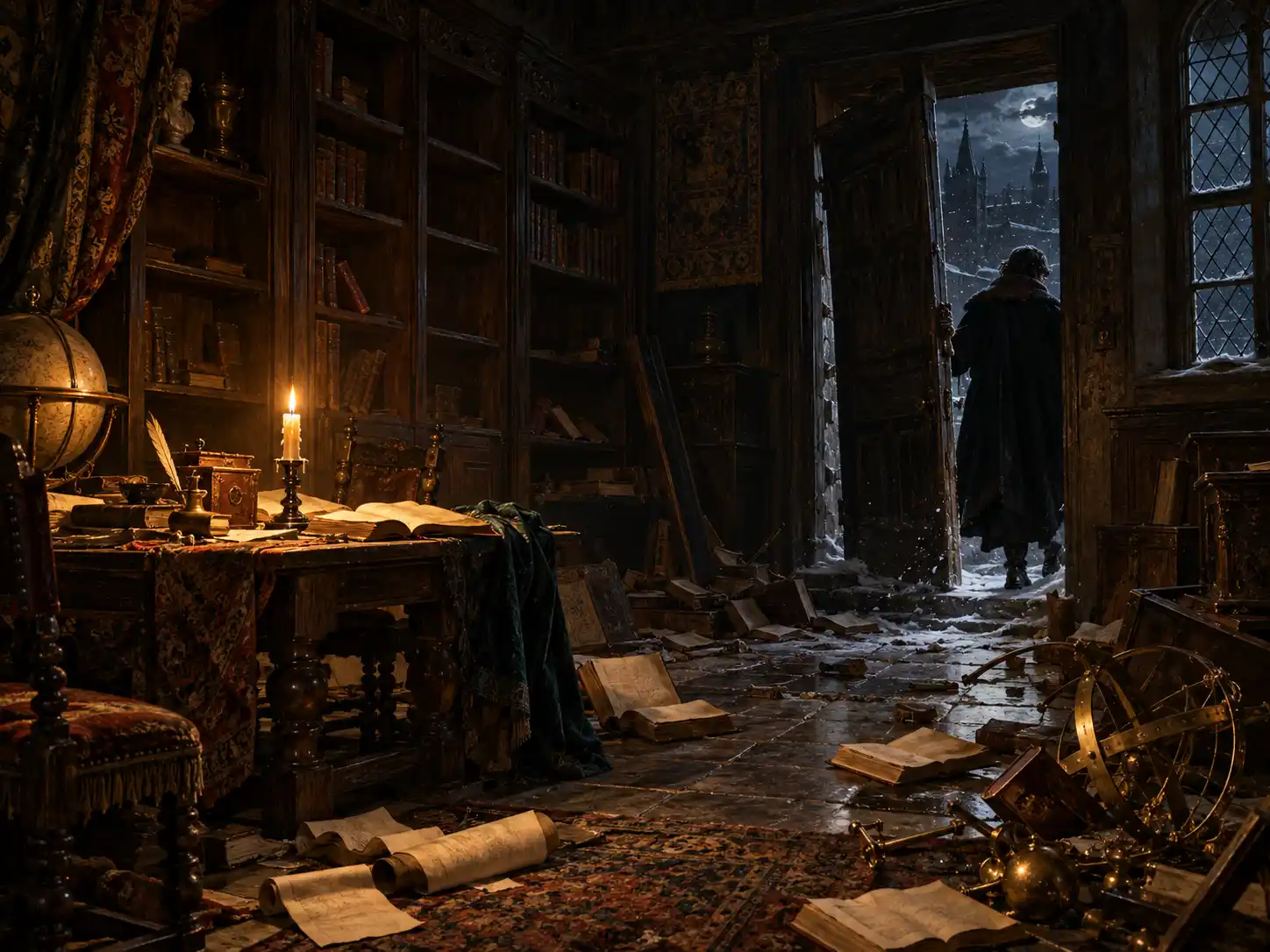
Simulated painting. Mortlake, Christmas 1589: the books and the instruments are what Dee's biographer says he found ruined and rifled, and the date of the break-in has never been fixed.
The angels had sent him to an Emperor. They had not told him what would be waiting when he came back.
This is the first episode of a series about secrets, and about the men who learned to hide words inside other words.
It starts with the strangest of them: a mathematician who copied half of the first book of European cryptography by hand in about ten days, and then spent years of his life taking dictation from the dark. The word that followed him his whole life was conjurer. Everything you have heard about him is in this article, and the episode that goes with it, told the way it has been told: the demon book, the crystal, the angel language, the Emperor, the covenant and the wives, the black mirror, the secret agent with a number for a name.
Watch the video if you prefer to watch rather than read!
This series ends where the Bitcoin story begins, with the cypherpunks, but it starts in a much stranger room.
Make search for one John Dee
He was born in London on 13 July 1527, and we know the date because he drew up his own horoscope and wrote it there.⁶ Of course he did.
Twenty-eight years later the Crown came looking for him, and in the spring of 1555, at Hampton Court, Queen Mary's Privy Council wrote this into its register:
"Calculing and conjuring..."
Who started it? A man named George Ferrys, who told the authorities that Dee's magic had struck two of his children, blinding one and killing the other, and that it was aimed at the Queen herself.⁹ Decades later Dee was still angry about it, writing that he had been jailed "upon the false information given in by one George Ferrys and Prideaux that I endeavoured by enchantments to destroy Queene Mary."¹⁰ The modern Oxford biography adds that the charge began with casting the horoscopes of the King, the Queen and the Princess Elizabeth, "and only later of conjuring and witchcraft."¹¹
So the paperwork started as astrology and ended as sorcery. Heck of an upgrade!
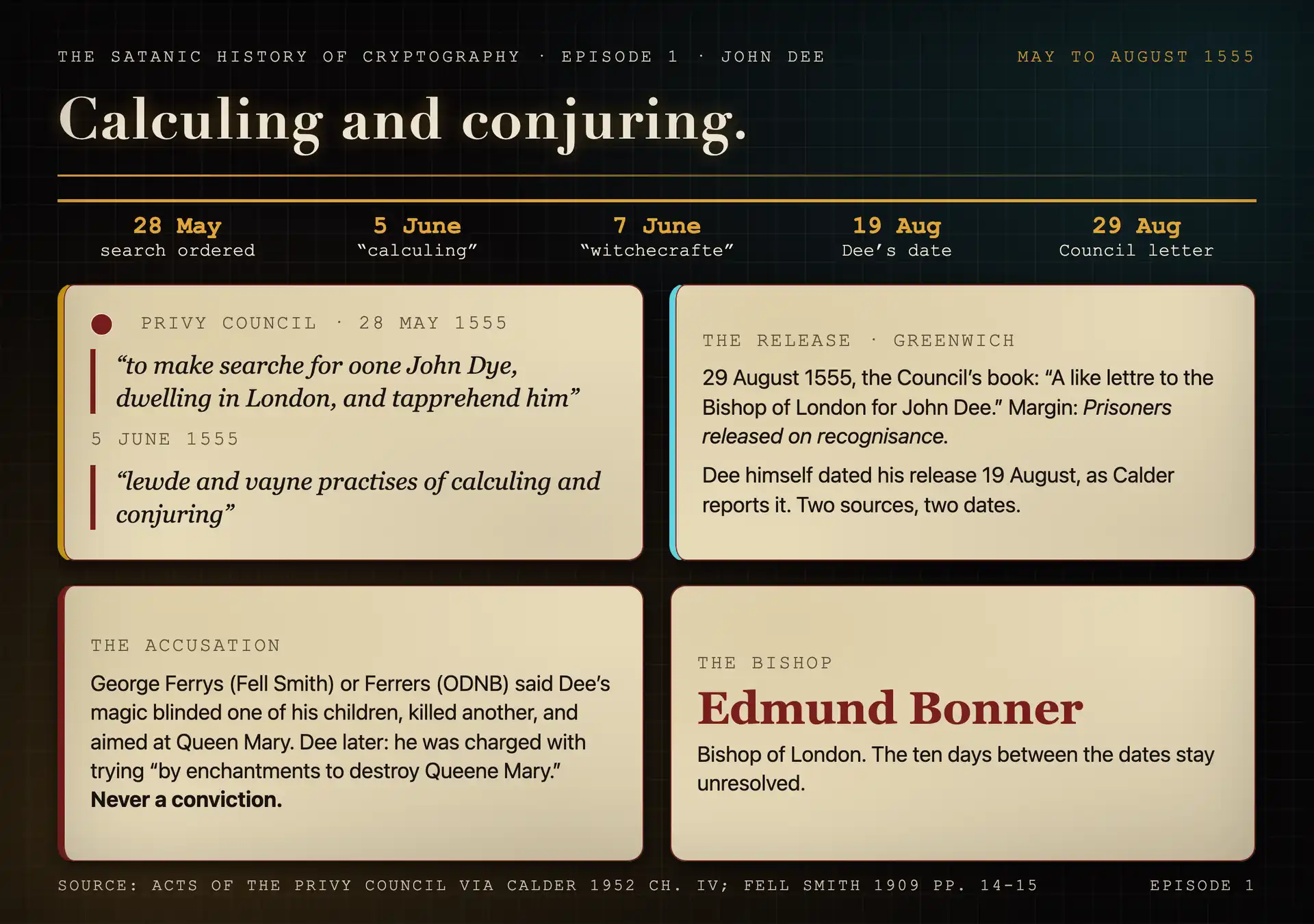
The arrest, in the Council's own spelling: the search for "oone John Dye" on 28 May, the "calculing and conjuring" of 5 June, and the release to the Bishop of London on 29 August 1555. Source: Acts of the Privy Council, New Series vol. 5 (1892), pp. 137, 143, 176.
He was examined and never convicted, and on 29 August 1555, at Greenwich, the register records "A like lettre to the Bishop of London for John Dee," in a run of entries the margin labels prisoners released on recognisance.¹² The Bishop of London that summer was Edmund Bonner, and Dee walked out of the Council's custody and into his.
They let him go. They never stopped calling him what they arrested him for.
That winter, on 15 January 1556 by his own reckoning of the year, the man the Crown had just questioned for sorcery petitioned that same Queen for a national library.¹³ Nobody built it, so he would build his own.
Then Mary died, and the wind changed.
At the command of Lord Robert Dudley, the new Queen's favorite, Dee wrote a paper on what the old astrologers called the election: the day the heavens favored for a coronation. His own note dates it "A. 1558," and Elizabeth was crowned at Westminster Abbey on 15 January 1559.¹⁴
Less than four years after the Council wrote down "conjuring," the man it had arrested was casting the stars for a Queen.
Ten days in Antwerp with a demon book
Antwerp, February 1563. A borrowed manuscript, and an Englishman copying it as fast as his hand will move. He dates his letters from the house of the printer Willem Silvius, at the sign of the Golden Angel.¹⁵
The book is called the Steganographia, and when you open it you find spirits with names and ranks, and conjurations: long paragraphs of strange words you speak to summon them, so a spirit can carry your message to a friend far away. An abbot named Johannes Trithemius wrote it around 1499 and 1500, a scholar named Carolus Bovillus saw it in 1504 and wrote five years later that the thing should be burned, and when it finally reached print in 1606 the Church had it on the Index of Prohibited Books by 1609.¹⁶
A book of demon-summoning, in other words, and Dee wanted it badly enough to copy it out by hand. What Trithemius really put between those covers is the reason this series starts with this man, and we will crack it open before this section is over.
He worked fast: in a letter home he said he had copied about half of it himself in "the most part of x dayes," and a Hungarian nobleman was writing out the rest.¹⁷ Picture the tally on the table edge: ten days, one tired Englishman, and a stack of demon names. The letter went to Sir William Cecil, the Queen's Secretary, on 16 February 1563.
Fit for a Prince, and he was asking Cecil to keep supporting his stay abroad, with the demon book as his proof of a trip well spent.
It worked: Dee later listed, among his papers, "Mr. Secretary Cecill, now Lord Treasurer, his testimonie by letter of my well bestowing of my tyme beyond the seas A. 1563, 28 May."²⁰
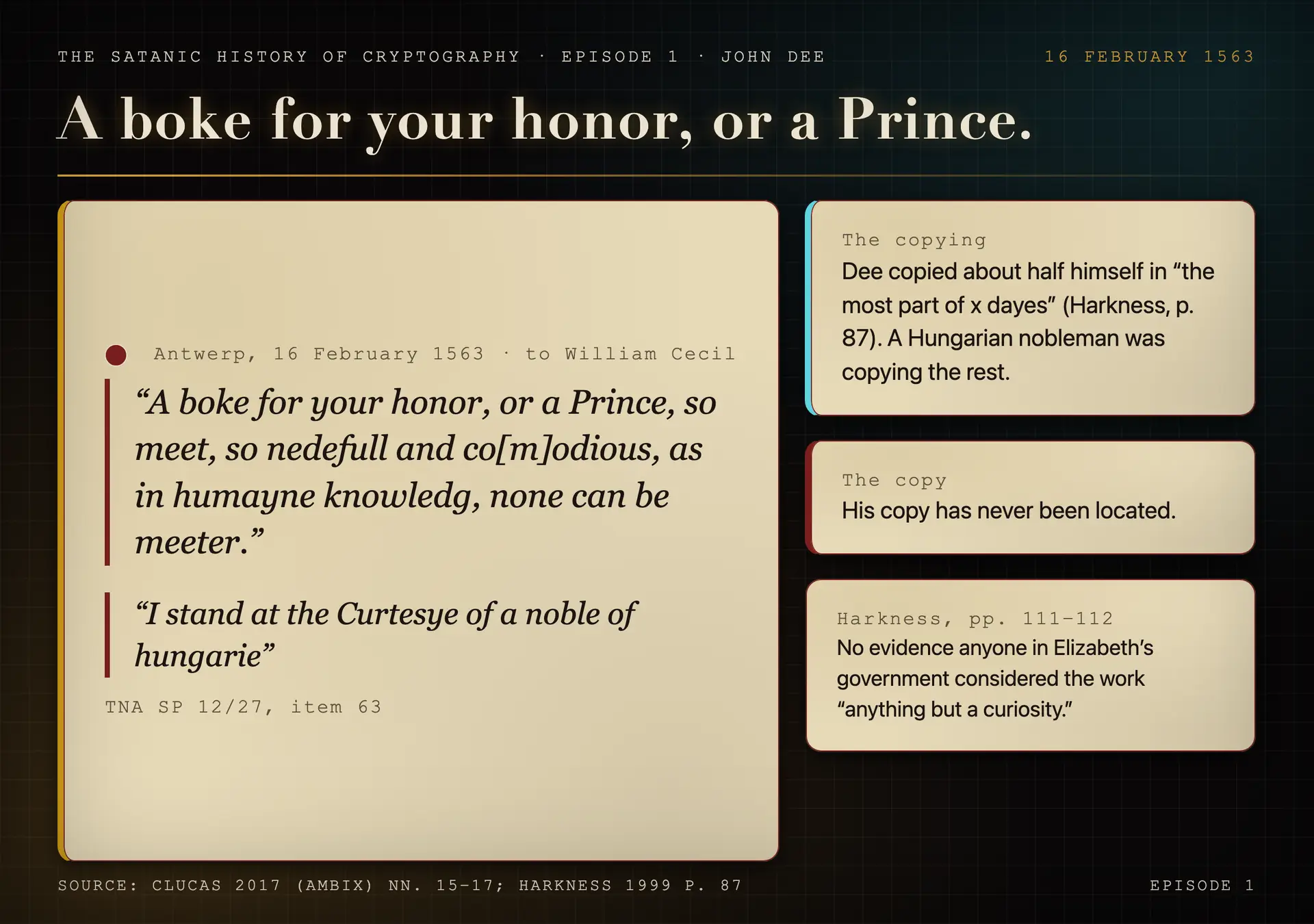
The pitch, in his own spelling: a book of spirits offered to the Queen's Secretary as fit "for your honor, or a Prince." Dee's own copy has never been found. Source: TNA SP 12/27 item 63, via Clucas, Ambix (2017); Harkness (1999), p. 87.
So what was the book?
The oldest party trick in computer security is hiding a file inside a picture, where nobody even knows to look. That trick has a name, and it is the title of this book.
The spirits were a costume, and under the costume the book had been a cipher manual all along.
In 1606 a companion volume called the Clavis, the key, explained the trick "in baldest cook-book fashion": "The incantations were actually encrypted instructions for concealing a secret message within the cover letters."²¹ The engine, in four moves:
- The spirit. Each chapter names a spirit. In the explanation Gustavus Selenus printed in 1624, the spirits mark which letters carry the secret, and the rest are to be held as dead.
- The conjuration. You get a paragraph of words that sounds like a summoning. Reeds quotes one that opens: "Padiel aporsy mesarpon omeuas peludyn malpreaxo."
- The rule. Take every other word, and inside each one take every other letter: aPoRsY gives P R Y, oMeUaS gives M U S, mAlPrEaXo gives A P E X.
- The message. Run them together and the demon's name-calling reads "primus apex." Everything else in the line was padding.
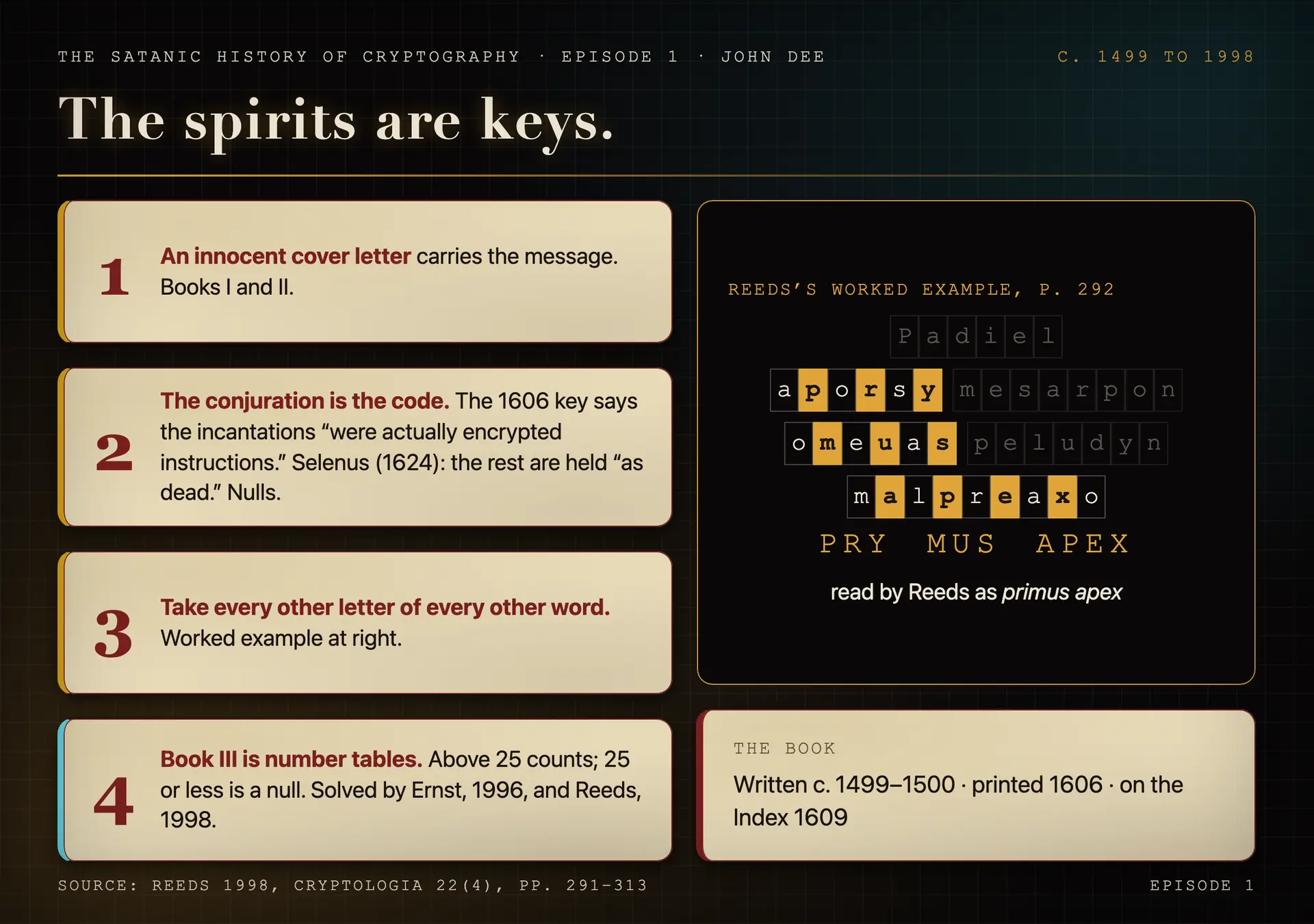
The demon book's engine: the spirit names the rule, the extra letters are nulls, and "Padiel aporsy mesarpon omeuas peludyn malpreaxo" gives up "primus apex." Source: Jim Reeds, Cryptologia 22(4), 1998, pp. 292-293.
Book III held out far longer, because its pages are planetary tables full of numbers that looked like pure astrology. They were a cipher too: numbers above twenty-five are read by their remainder against a reversed alphabet, and numbers of twenty-five or less are nulls. A man named W. E. Heidel claimed a solution in 1676, Thomas Ernst proved it in 1996, and the cryptologist Jim Reeds cracked it on his own in March 1998, reading plaintext three days after his photocopy arrived.
And what does the demon book say, once you break it? A Latin verse line, repeated, a line close to the Fifty-first Psalm, and German sentences, one of which, in Reeds's reading, warns that the bearer of this letter is a rogue and a thief.²²
Five hundred years of dread, and the secret is a warning about the mailman!
Reeds, with the plaintext in his hand, wrote that the Steganographia "stands unambiguously revealed as the first book-length treatment of cryptography in Europe."²³
He offered the Queen's minister a book of demon-summoning and called it fit for a Prince. He was right.
Dee owned the abbot's other book too. The Polygraphia, printed in 1518, is "the first printed work on cryptography," and Dee's own copy, a French edition printed at Paris in 1561, is shelved today at the Royal College of Physicians in London with twelve rotating paper discs for enciphering text that, in the College librarian's words, "still turn today."²⁴ Four and a half centuries on, you could still spin his cipher wheels...
He stayed in Antwerp, and the next winter he wrote a book of his own, the Monas Hieroglyphica, one strange glyph unfolded theorem by theorem, written between 13 and 25 January 1564, and in his dedication Dee said he had carried it in his mind for seven years and brought it forth in twelve days. He dedicated it to Maximilian, King of the Romans, whose son Rudolf would one day be Emperor. In Theorem XXIII he described how it came to him: "I am merely the quill which traces these characters."²⁵
Eighteen years later, someone else would be holding the quill.
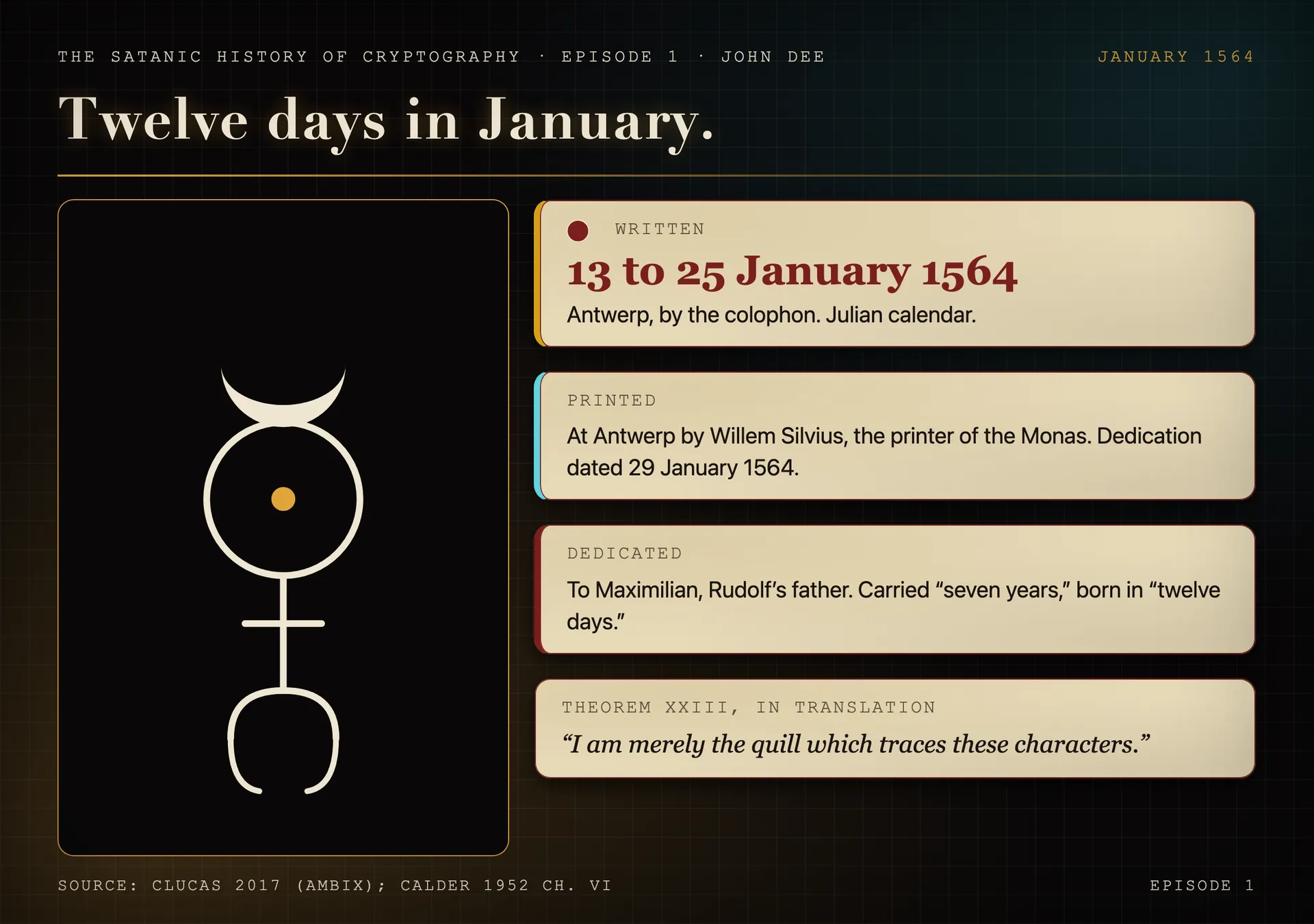
Twelve days in January 1564: the glyph Dee said he had carried for seven years, dedicated to the father of the Emperor he would one day face. Source: Monas Hieroglyphica (Antwerp, 1564), colophon and dedication; Clucas, Ambix (2017).
A library by the river
Windsor, November 1577. A comet hangs over England, and the Queen sends for the man in Mortlake.
Across "three divers daies," he wrote, the Queen "tooke pleasure to heare my opinion of the comet appearing A. 1577," and his diary has him speaking with "Mr. Secretary Walsingham" before he "declared to the Quene her title to Greenland, Estotiland and Friseland."²⁶
The conjurer of 1555 was now the man who told the Queen of England what she owned in the Arctic!
This was his best decade, and the house by the river had become the place you went when you needed to know something nobody else knew. He wrote of "yor Brytish Impire" in a manuscript dated 22 July 1576, and when Pope Gregory XIII reformed the calendar in 1582, Dee had a "playne discourse" finished by 25 March proposing an eleven-day correction for England; England sat on it until 1752.²⁷ One historian calls him an "intelligencer" in the broadest sense: a man who dealt in special knowledge.²⁸
And the old word followed him everywhere he went, so in 1570, in his preface to Henry Billingsley's English Euclid, he stopped teaching geometry long enough to plead his own case: "ought any honest Student, and Modest Christian Philosopher, be counted, & called a Coniurer?"²⁹ He named Pico della Mirandola and Trithemius, the demon-book abbot himself, as men slandered the same way. We watched this move once already, with the Templars: when the powerful want a man gone, they reach for heresy and the devil, and the word does the work.
Fifteen years after the Council let him go, he was still answering the charge in the preface to a geometry book.
On 23 January 1583 the Secretary of State came to the house by the river in person, when Sir Francis Walsingham sat down at Mortlake with Dee and Adrian Gilbert to talk about a north-west passage.³⁰ Walsingham's office reads other people's mail, and this series will be back inside it sooner than you think. Three years after that visit, Dee would write from Leipzig that he had been "pryed and peered into" by "Honourable Espies," a phrase that will follow him into an Emperor's court.³¹
Inside the house were the near four thousand books, and he read them with a pen in his hand. The ones that survive at the Royal College of Physicians are crowded with his notes in the margins, down to a little ship he sketched beside a page of Cicero.³² He read everything.
Almost everything...
On 17 January 1582, a title appears in his private diary: the Book of Soyga, a book of magic whose heart was a set of letter tables, thirty-six of them, each a square of thirty-six letters by thirty-six, row after row of letters with no words in them.³³
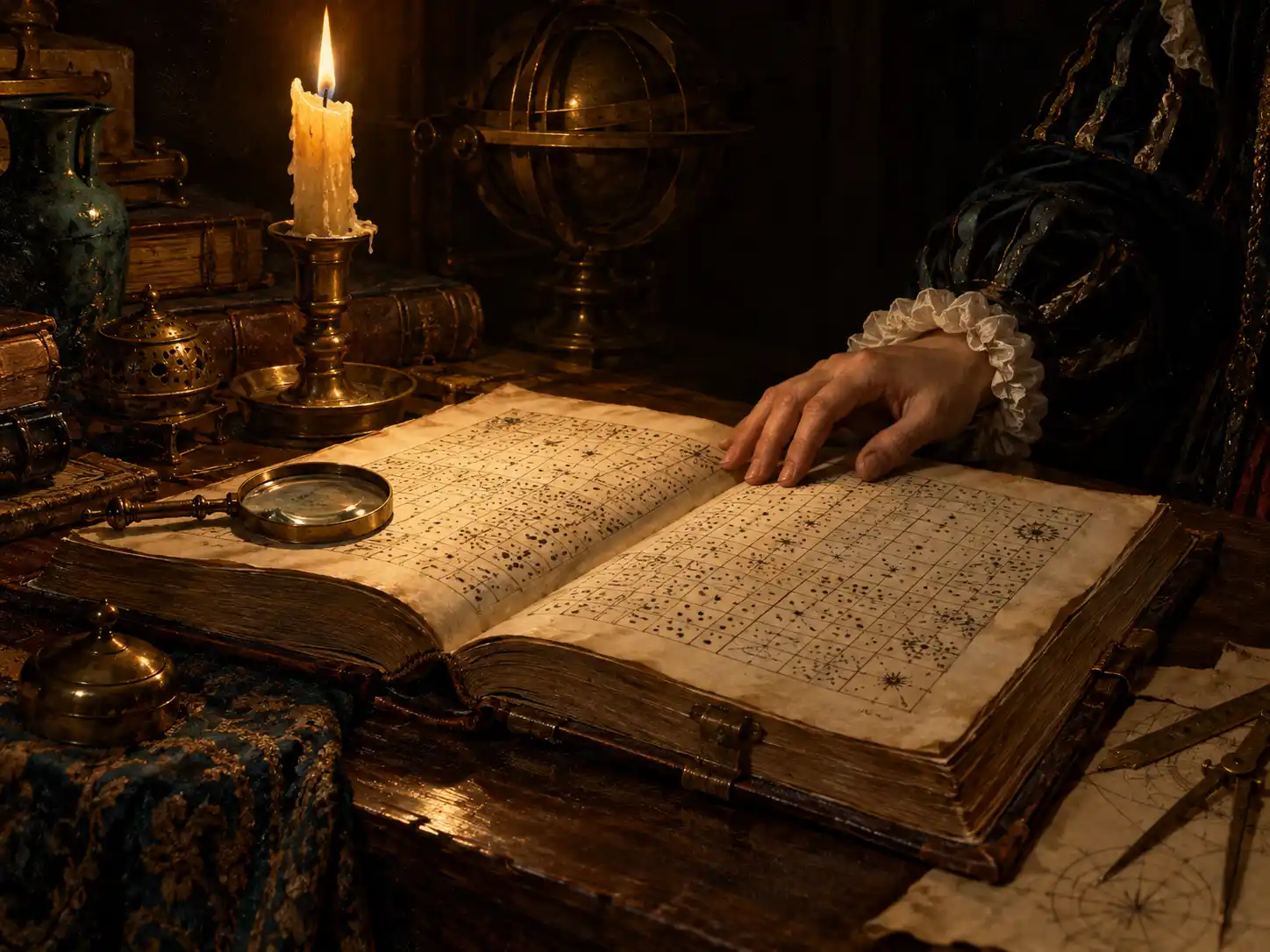
Simulated painting. The Book of Soyga: thirty-six tables of letters, each thirty-six squares a side, owned by the man who had copied a cipher manual in Antwerp and could not read this.
The man who copied the Steganographia in ten days, the man who owned the cipher wheels, sat in the greatest library in the country and stared at those squares.
He could not read them.³⁴
Of near four thousand books, this was the one that beat him. Seven weeks later a new man sat down at his crystal, and the first real question John Dee put to the other side was what the Book of Soyga meant.
Somebody has to look into the stone
Mortlake, the morning of 22 December 1581: John Dee has finished praying.
Now he needs someone to look, so he sits a man named Barnabas Saul before a ball of crystal and writes down exactly what he is doing: "I willed, the Skryer, (named Saul) to loke into my great Chrystaline Globe, yf God had sent his holy Angel Anael, or no"³⁵
That is the first conversation with the angels that survives on paper, and something in the glass answers: a shining figure writing in Hebrew letters, a white dog with a long head, dead men's skulls.³⁶
The eeriest thing about these diaries is how calm they are. The man who copied a cipher manual in ten days in Antwerp has found a new text to take down, and he takes it down like a court reporter.
Saul does not last, and on 6 March 1582 Dee writes: "March 6th, Barnabas Saul cam this day agayn abowt one of the clok and went to London the same afternone. He confessed that he neyther hard or saw any spirituall creature any more."³⁷
The crystal has gone dark. Two days later, a stranger comes to the house.
The man who called himself Talbot
On 8 March, "Mr. Clerkson and his frende" come to the house, and the next day the friend has a name, Mr. Talbot, who spends dinner telling Dee about Barnabas Saul's "nowghty dealing".³⁸
Who the stranger really was, and what he had already lost, comes out before this section closes; for now he is Talbot.
On Saturday 10 March 1582 Talbot asks Dee to work some magic, and Dee refuses in writing, like a legal filing: he is "not in the vulgarly accownted Magik, neyther studied, or exercised". Angels were another matter, so Dee fetches "my stone in the frame, (which was given me of a frende)", and within about a quarter of an hour a spirit in it speaks plainly and gives its name.³⁹
Uriel.
The last man said he saw nothing. The next man saw an angel inside a quarter of an hour.
And once the spirit has said who it is, the first thing Dee asks it about is the book he could not read: "Δ ys my boke, of Soyga, of any excellency?" Revealed to Adam in Paradise, comes the answer, and only Michael can interpret it. Dee adds a warning he had heard: "I was told, that after I could read that boke, I shold liue but two yeres and a half." And Uriel: "Thow shallt liue an Hundred and od yeres."⁴⁰
A hundred and odd years! Dee was fifty-four.
He never did read Soyga.
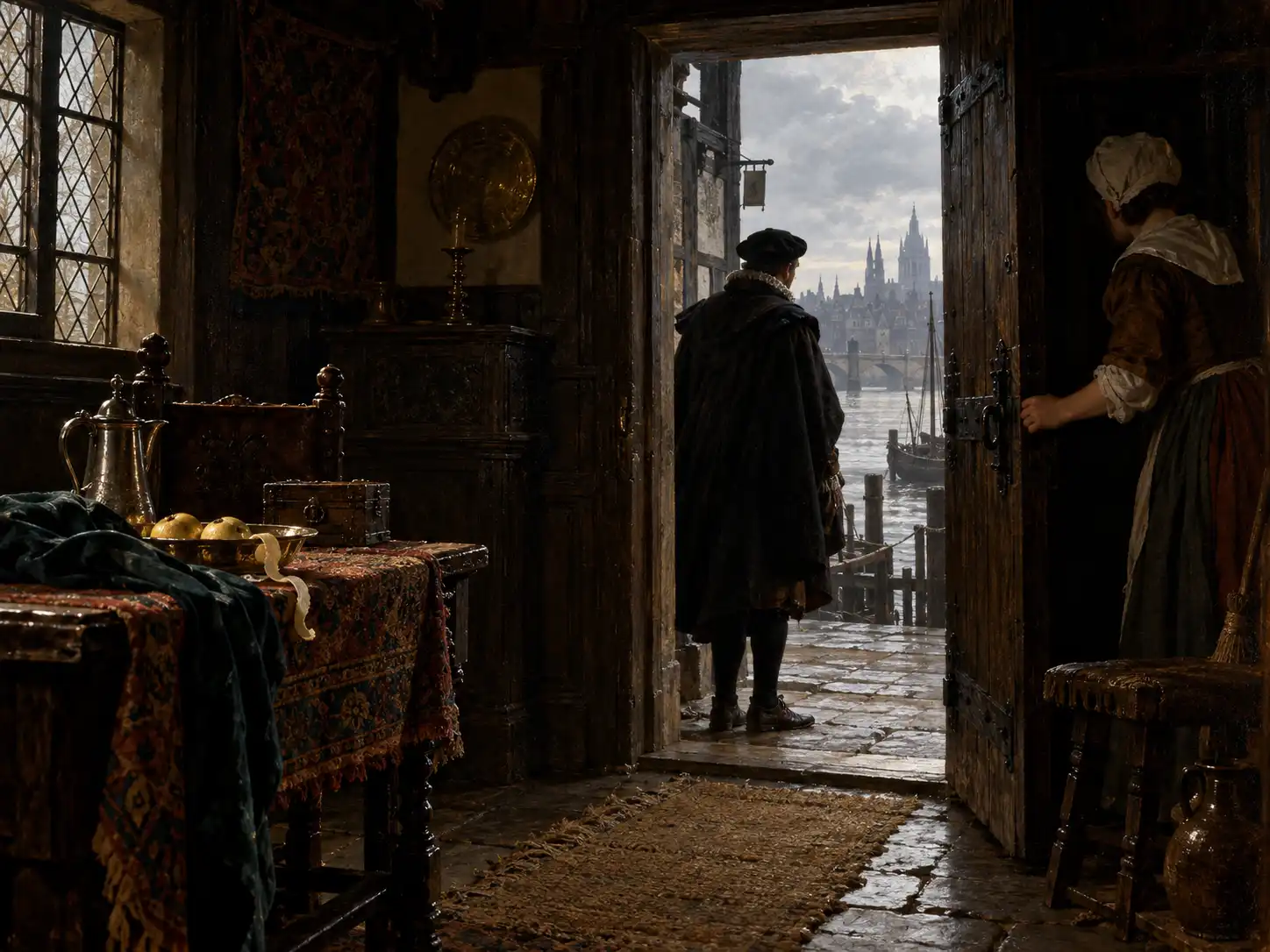
Simulated painting. Two days after the last scryer saw nothing, a stranger calling himself Talbot was at the door.
Dee went back over these pages later with a pen, and in the margin he noted that Talbot's coming was "to entrap me", as Talbot later confessed, and against one instruction from that first day: "This was not True Vriel: as may appere A 1583: Maij 5."⁴¹
So who was he?
His name was Edward Kelley, born at Worcester on 1 August 1555, at four in the afternoon, on Dee's own list of nativities.⁴² By November 1582 the diaries have quit calling him Talbot, and he is "E K" for the rest of this story.
The story goes that Kelley had lost both of his ears at Lancaster,⁴³ and later tellers gave him a black cap, always worn, pulled close over what was left.⁴⁴ Picture that cap bent over your crystal while the angels talk.
The story does not stop at the ears. One night at Walton-le-Dale in Lancashire, Kelley and a companion named Paul Waring asked which corpse had gone into the churchyard last, and were told a poor man, buried that same day. They dug him up and made him speak.⁴⁵
Three stones and a table of sweet wood
The angels were particular about furniture, and that first Talbot afternoon the spirit ordered a seal of pure wax: "This seal must be 9 ynches in diameter: The rowndnes must be 27 ynches, and somwhat more." Then the table: "The Table is to be made of swete wood: and to be of two Cubits high. with 4 feete: with 4 of the former seales vnder the 4 feet."⁴⁶
By Deborah Harkness's count, Dee worked with at least three shew-stones: the great crystal globe, the stone in the frame, and a third one that nobody gave him.⁴⁷
Wednesday 21 November 1582: "E K loked toward my west wyndow, and saw there first vppon the matts by my bokes a thing, (to his thinking) as big as an egg: most bright, clere, and glorious". Dee sees only a shadow on the floor, and reaches down: "I put my hand down vppon it, and I felt a thing cold and hard". Then the instruction: "Let no mortall hand towche it, but thine owne."⁴⁸
A stone on the floor, by the books, that only he could touch...
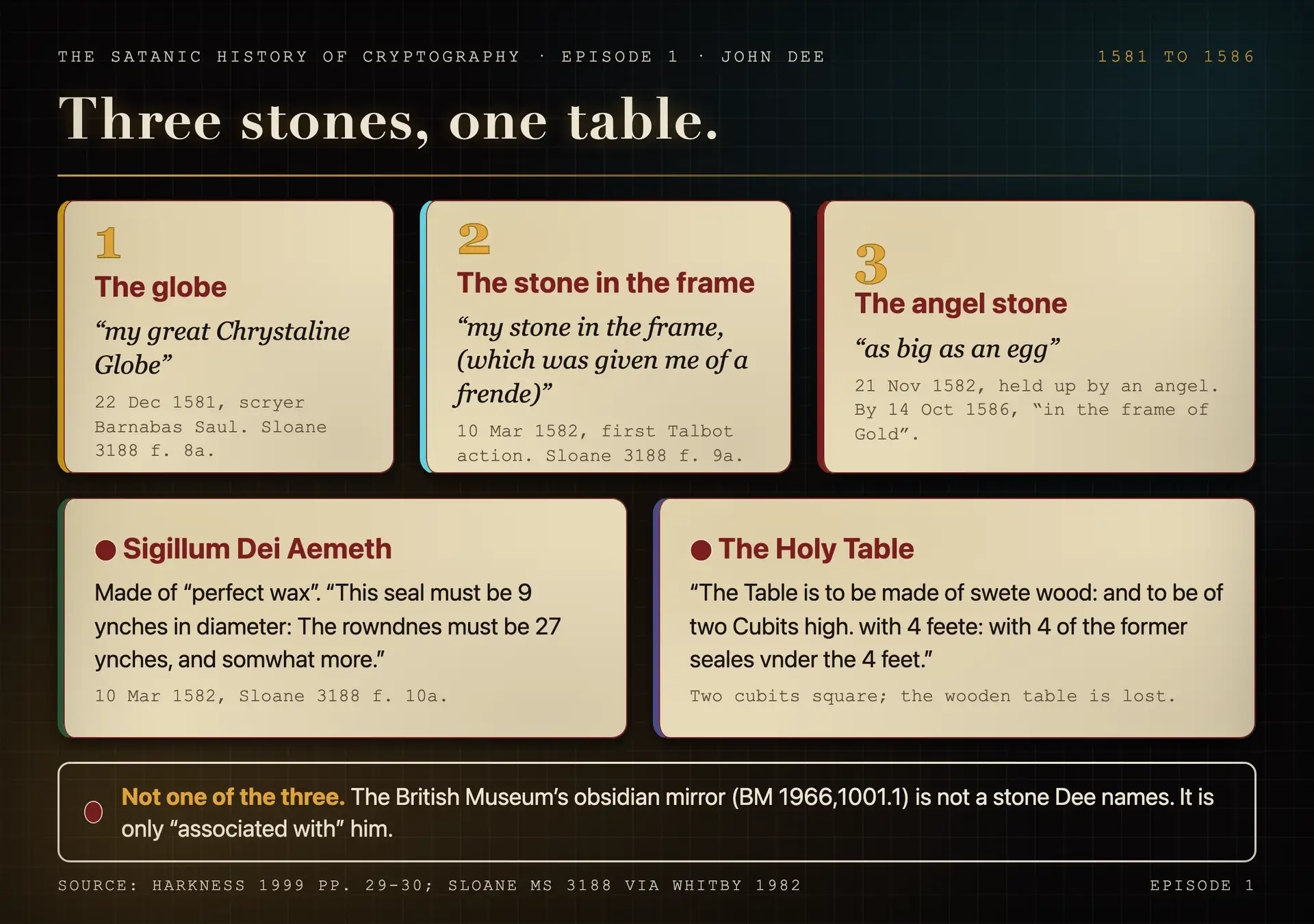
Three stones, one table; the wooden table is lost. Source: BL Sloane MS 3188 ff. 8a, 9a, 10a, 59b (Whitby 1982); Harkness 1999 p. 29.
Then the alphabet came: twenty-one letters plus one aspirated character, written right to left like Hebrew, and a book in that language, Liber Loagaeth, to be finished forty days after 29 March 1583.⁴⁹
Its pages are grids: Kelley's own transcription holds tables of letters forty-nine rows deep and forty-nine columns wide.⁵⁰ That is twenty-four hundred and one letters to a table.
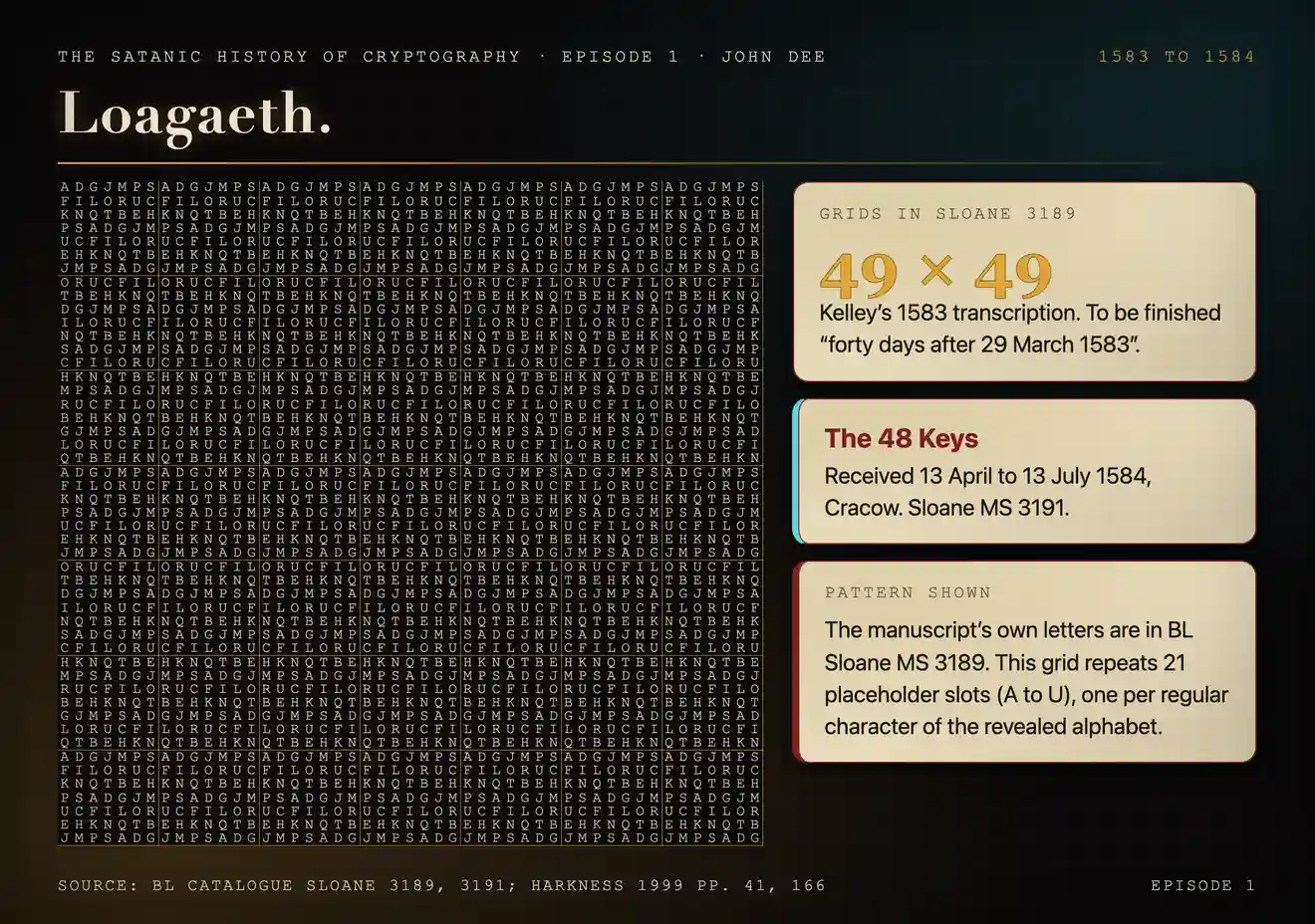
Forty-nine by forty-nine: what a cryptographer sees when he opens Dee's angel books. Source: BL Sloane MS 3189; Harkness 1999.
And somewhere in all of this a child walked into the room, and in May 1583 Dee wrote her down at length. First an unseen voice: "You shall be beaten if you tell." Then: "Suddenly, there seemed to come out of my Oratory a Spirituall creature, like a pretty girle of 7 or 9 yeares of age". She plays in and out behind his books, and asks: "Am not I a fine Maiden? Give me leave to play in your house; my Mother told me she would come and dwell here."⁵¹
Her name was Madimi, and a year later, in Prague, she seemed bigger than she had been.⁵²
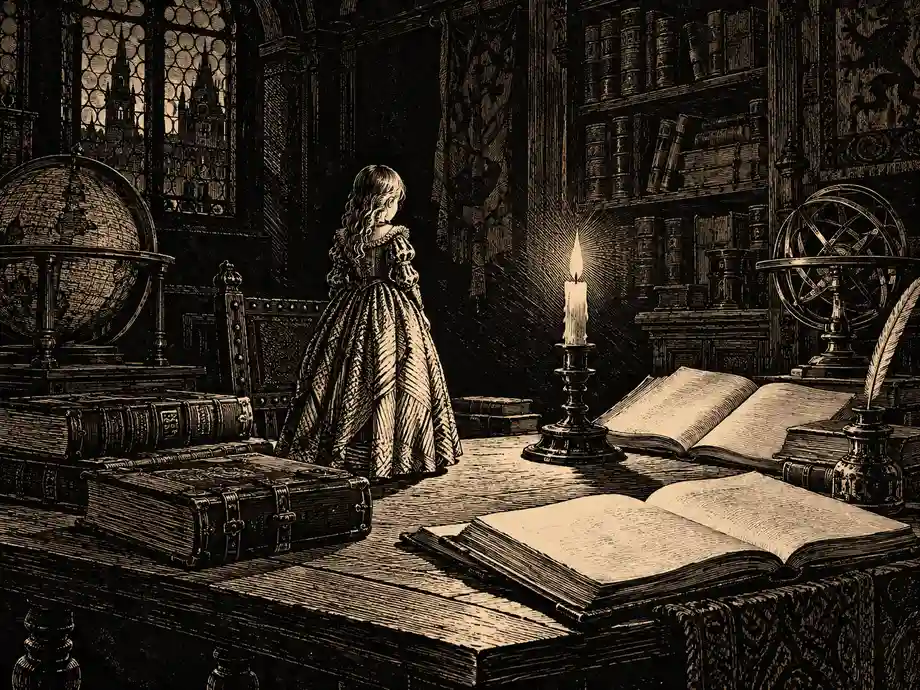
Simulated woodcut. Madimi in May 1583: a girl of seven or nine, playing behind the books, asking to stay.
Tell it to the Emperor
21 September 1583. Dee leaves Mortlake by the river with a Polish lord named Albert Laski, with Kelley, and with both households.⁵³ Behind him, on some day nobody ever fixed, the house will be broken open.
- 21 September 1583 : Leave Mortlake with Albert Laski.
- 13 March 1584 (Old Style) : The party reaches Cracow.
- 13 April to 13 July 1584 : The forty-eight Keys are received at Cracow.
- 3 September 1584 : Audience with Rudolf II.
- 27 May 1585 (the year inferred from the page's run of headings) : Audience with Stephen Báthory.
- April 1586 : Books burned, then found under an almond tree.
- 29 May 1586 : The Emperor's decree of banishment.
They reach Cracow on Friday, 13 March 1584, Old Style,⁵⁴ and at Cracow the angels stop talking in hints.
Thursday 12 April 1584. The spirit Nalvage announces forty-nine calls, "which are the Natural Keyes, to open those, not 49 but 48. (for One is not to be opened) Gates of understanding"⁵⁵
Forty-nine doors, forty-eight keys, and one door that stays shut.
Then the delivery itself, on Saturday 14 April: Nalvage sits beside a round table covered in letters, tells Kelley "Name that I point to", and strikes it so it whirls "with a great swiftnesse". The First Key arrives last word first, each word spelled in reverse and then named the right way round: "65 APGOB. Call it Bogpa." Two words are not spoken aloud at all: "He hummed twice, signifying two words more, which were not to be pronounced till they were read in practise."⁵⁶
Backwards, letter by letter, off a spinning table, to the man who copied the first great cipher book of Europe by hand. You can see why somebody, someday, was going to call this code.
But first, the Emperor.
A large hour with Rudolf
Prague Castle, Monday morning, 3 September 1584. Dee is led into the privy chamber of Rudolf II, Holy Roman Emperor, and finds him at a table "with a great Chest and Standish of Silver, before him, my Monas and Letters by him".
His own book, on the Emperor's desk!
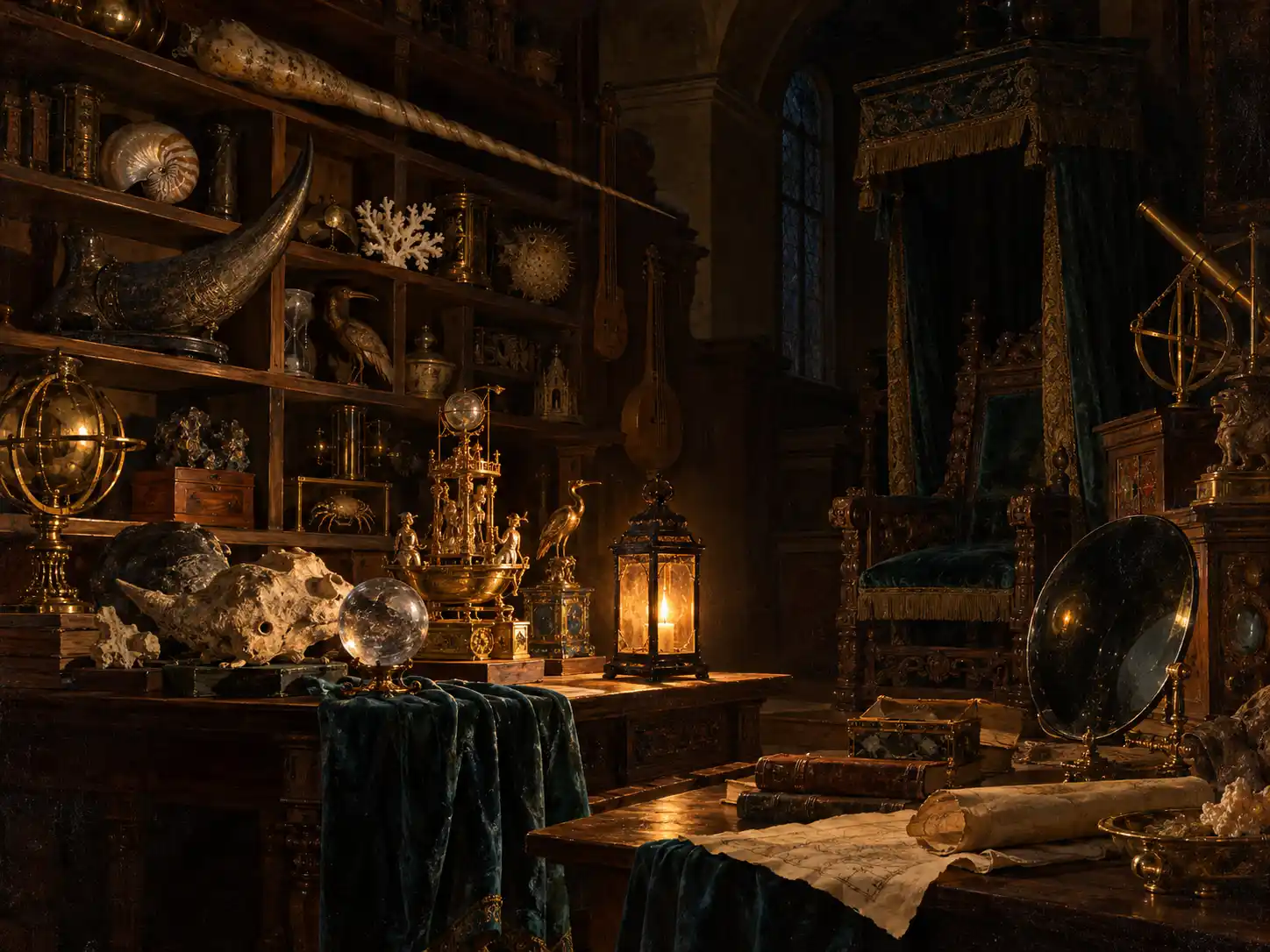
Simulated painting. Rudolf II heard out an Englishman who said an angel had sent him.
Dee told a Catholic Emperor that "His holy Angels, for these two years and a half, have used to inform me", and then he delivered the message.
"The Angel of the Lord hath appeared to me, and rebuketh you for your sins. If you will hear me, and believe me, you shall Triumph: If you will not hear me, The Lord, the God that made Heaven and Earth, (under whom you breath, and have your spirit) putteth his foot against your breast, and will throw you headlong down from your seat."
To his face. In his own castle!
Rudolf, by Dee's account, said he believed him, and "would not willingly have had me to kneel, so often as I did." Dee's last line on the day: "I had a large hour audience".⁵⁷
Maybe the longest hour of Rudolf's year...
The next spring, on Monday 27 May, Dee offered King Stephen Báthory of Poland twenty-four books of the actions; Casaubon's contents say the King "did not prove so credulous as was expected."⁵⁸
What was an English mathematician doing in all these courts?
The story goes that none of it was angels, that every spirit, every name, every prayer in those books was cryptography, a concealed history of something else. Caught, a harmless enthusiast would get gentler treatment than a real spy, so he wrote down angels.⁵⁹ His letters home to the Queen's spymaster, Sir Francis Walsingham, carried veiled reports from the courts of Europe.⁶⁰
And the story a man named Deacon told in 1968 goes further still: Dee was a secret agent to Elizabeth I, and he signed his letters to the Queen with a secret sign, two circles and what could be a long number seven.⁶¹ Zero, zero, seven. A novelist, they say, borrowed the number for his own spy.⁶²
007...
The real cipher war of that decade was in London, where in July 1586, while Dee was in Bohemia, Walsingham's decipherer, a man named Thomas Phelippes, was reading the secret letters of a captive queen, and that may be the next installment.
Back in Prague the angels were burning books: on 10 April 1586 Dee burned books of the actions at their command; on 30 April three turned up under an almond tree, the forty-eight Keys among them, the very books "which were so diligently burnt the tenth day of April last".⁶³
The Pope's men had no use for fire when paperwork would do.
Six days to get out
Dee had rebuffed the papal nuncio, Germanicus Malaspina, and on 14 May 1586, from Leipzig, he told Walsingham the nuncio "is gone to Rome with a flea in his eare", and added: "secretly they threaten us violent death, and openly they fawn upon us."⁶⁴
Then the next nuncio, the Bishop of Piacenza, went straight to the Emperor with a petition accusing Dee of "Nicromanciae".⁶⁵
Necromancy, the old charge, had come back in a new language, and Dee wrote the result in his own margin: "In Maio 29 Exilii Decretum contra nos exiit a Caesare Rod."⁶⁶ On 29 May the decree of exile went out against them from the Emperor Rudolf, the same Emperor who had not wanted Dee to kneel.
The order reached him the next day: "I received the Emperours commandment, I, my Companion, and all mine to depart within six dayes out of Prage".⁶⁷
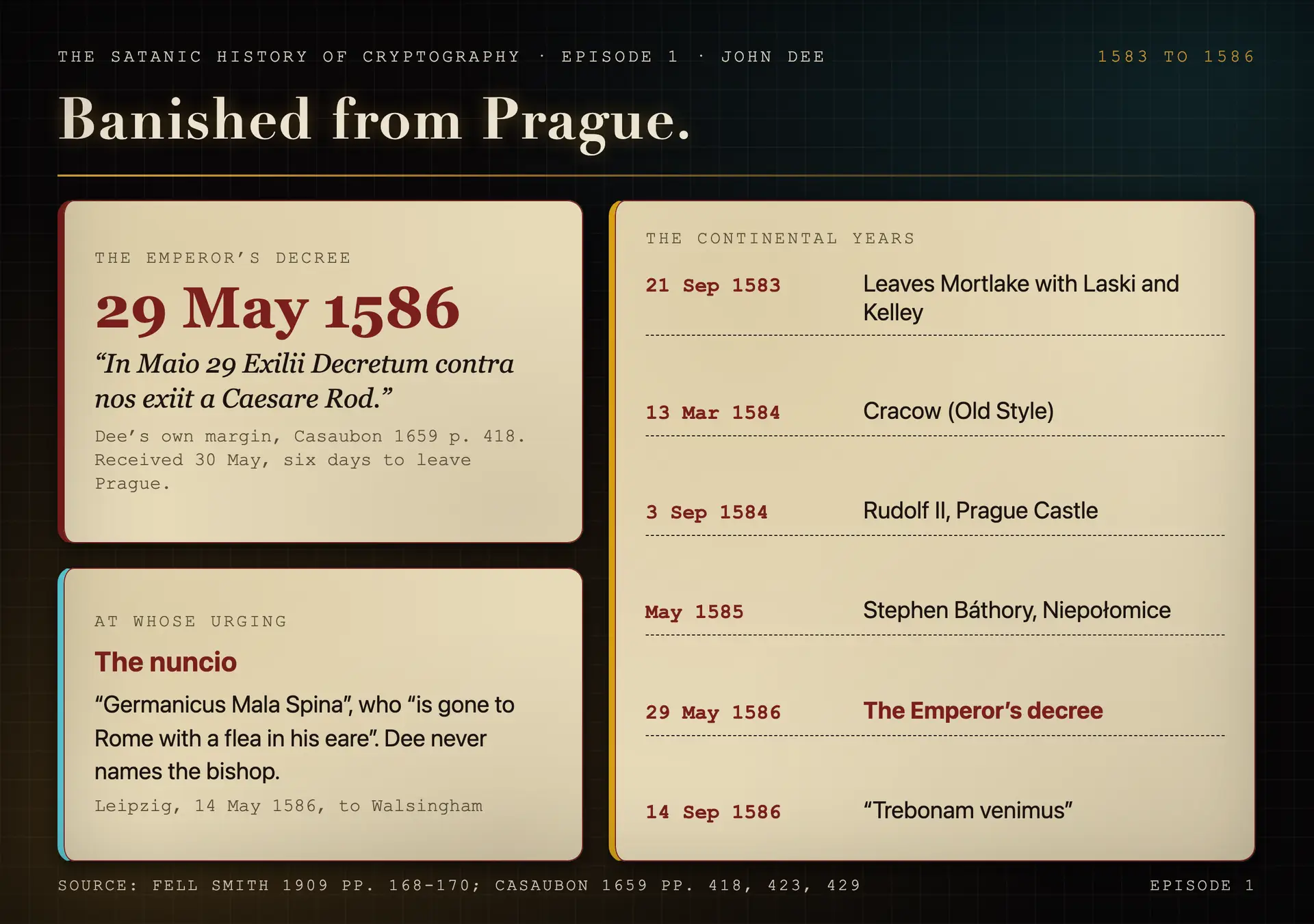
The Emperor's decree of banishment, 29 May 1586, at the nuncio's urging. Source: Casaubon 1659, pp. 418, 423-424, 429.
Six days.
And Dee had felt it coming, because in that same Leipzig letter he told Walsingham what the last two years had been like: "Imperial and Royal, by Honourable Espies; fawning about me and by others discoursed upon, pryed and peered into."⁶⁸
"Honourable Espies..."
Everybody in this story was watching the conjurer, and the conjurer was writing every one of them down.
All things between us to be common
Trebon, in the south of Bohemia, autumn 1586. The Emperor has thrown them out of Prague, and a Bohemian lord, Rosenberg, has taken them in at his seat.
On Tuesday 14 October, in a small chapel beside his bedroom, Dee rebuilds the angels' furniture and writes that he "had set up Mensam foederis, with the appurtenances, and had set the Angelical Stone in the frame of Gold on the Table, onely E. K. and I being in the goodly little Chappel next my Chamber."⁶⁹ Mensam foederis is the table of the covenant, and by spring that word would be spelled out in ink.
Early on Wednesday 15 April 1587, Dee brings his boy Arthur to the holy Table and sets the stone in front of him. Two days later Madimi is back, the little girl in the stone who has been growing up since Mortlake, and she tells Kelley something Dee only writes down the next day:
"Upon Mr. Kelly his great doubt bred unto me of Madimi her words yesterday, spoken to him, that we two had our two wives in such sort, as we might use them in common, it was agreed by us, to move the question, whether the sense were of Carnal use (contrary to the law of the Commandment) or of Spiritual love, and charitable care and unity of mindes, for advancing the service of God."
They ask, and the stone answers.
"Madimi openeth all her apparel, and her self all naked; and sheweth her shame also." Kelley's reply goes into the record word for word: "Fie on thee, Devil avoid hence with this filthiness." Then Madimi asks them what sin is, and the answer comes back, "To break the Commandement of God." She says: "Set that down, so."
Dee sets it down, and under it he writes his own answer: "The one is expresly against the Commandement of God: neither can I by any means consent to like of that Doctrine."⁷⁰
That is Saturday.
That night, in the margin, Dee notes the hour: "About 2 of the clock after midnight." He goes to his wife. "Jane, I see that there is no other remedy, but as hath been said of our cross-matching, so it must needs be done. Thereupon she fell a weeping and trembling for a quarter of an hour."
On Monday he is "utterly resolved to obey this new Doctrine," and he closes the entry "this 20. day of April, at night."⁷¹
He wrote down the night he gave in. He dated it.
Then the man who could see the angels tried to quit, and on 22 April Kelley put it in writing: he had "manifest occasion to think they were the servants of Sathan, and the children of darkness," and Jane had vowed to abstain "from the eating of fish and flesh" until God settled her mind. He signed off like a man resigning a commission: "I finally answer, that I will from this day forward meddle no more herein. 22. of April, 1587. By me EDWARD KELLY."⁷²
The scryer called them devils, in writing, and the man who could not see them stayed at the table.
Two days later Kelley was back at the stone anyway, "in a great fear and trembling," and the stone "heaved up an handful high." He saw "a man in the fire, with flaxen hair hanging down upon him, and is naked unto his Paps; and seemeth to have spots of blood upon him." Dee wrote one word in the margin: "Christus."⁷³
Nine days after that, the table of the covenant earned its name.
Over the name JOHN DEE, the covenant asks that whoever discloses it "should presently and immediately be strucken dead by thy Divine power."⁷⁵
Fifteen days is the whole distance from "expresly against the Commandement of God" to his signature at the bottom of the page.
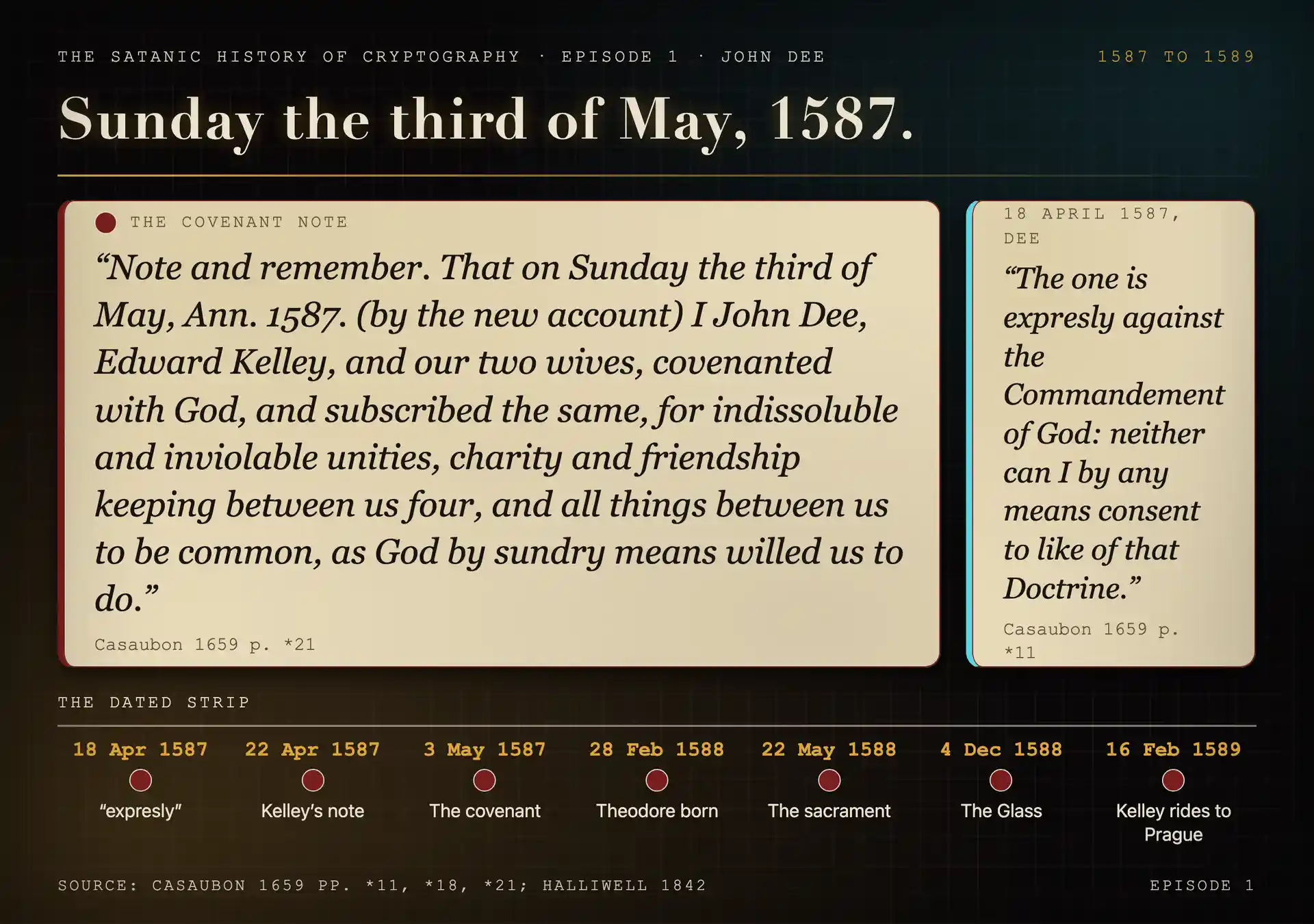
Fifteen days from the refusal to the signature, both in the same hand. Source: Dee's actions of April and May 1587 as printed in Casaubon, A True & Faithful Relation (1659), pp. *11-*21; the household dates from Halliwell's edition of the diary (1842).
On 20 May Kelley cut the covenant "into equal parts," and Madimi made it whole again "with her finger." Beside that sitting Dee wrote down what he had staked: "This was said because I had pawned my soul, upon my avouching the spiritual creatures which have dealt with us, to be of God and good."⁷⁶
On 12 December 1587 Kelley's lamp caught his "Extractiones Dunstani," his notes on the Book of St Dunstan, while "the very boke of Dunstan was but cast on the bed hard by from the table."⁷⁷ An angel brings that book up again twenty years from now, in London, to a very old man.
On 28 February 1588, a little before sunrise, a son is born at Trebon, and they baptize him Theodore. On 22 May Kelley's wife takes communion with them: "Mistris Kelly received the sacrament, and to me and my wife gave her hand in charity; and we rushed not from her."⁷⁸
On 4 December he gives away something precious: "Dec. 4th, I gave to Mr. Ed. Kelley my Glass, so highly and long estemed of our Quene." On 4 February 1589 "the powder, the bokes, the glas and the bone" go over too. On 16 February Kelley "rode toward Prage after none," and on 11 March Dee leaves Trebon.⁷⁹
That Glass went to Kelley at Trebon, and it matters again in a few minutes, when a black mirror with Dee's name on it turns up in a museum case.
The house by the river, again
He lands at Gravesend on 2 December 1589, and the Queen receives him at Richmond on the 19th. On Christmas Day he sleeps in his own house at Mortlake for the first time in six years and three months.⁸⁰
The library is broken, the diary keeps going anyway, and you can go and look at one object tied to this man today. In the British Museum, under registration 1966,1001.1, there is a disc of polished black obsidian a little over seven inches across: Aztec work, the stone confirmed by analysis as coming from Pachuca, in Hidalgo, Mexico.⁸¹ A mirror from a dead empire, on the far side of the world from Mortlake.
They say this is the glass he called the angels into. Its old label, in Horace Walpole's hand, says it plainly: "The Black Stone into which Dr Dee used to call his Spirits." Walpole's printed catalogue of 1774 adds that it was "used to deceive the mob by Dr. Dee, the conjurer."⁸² Two centuries on, they were still calling him the conjurer.
Every sitting from 1581 to 1587 is dated to the hour, and not one line of it describes a black mirror.⁸³ The glass the diary mentions went to Kelley at Trebon.
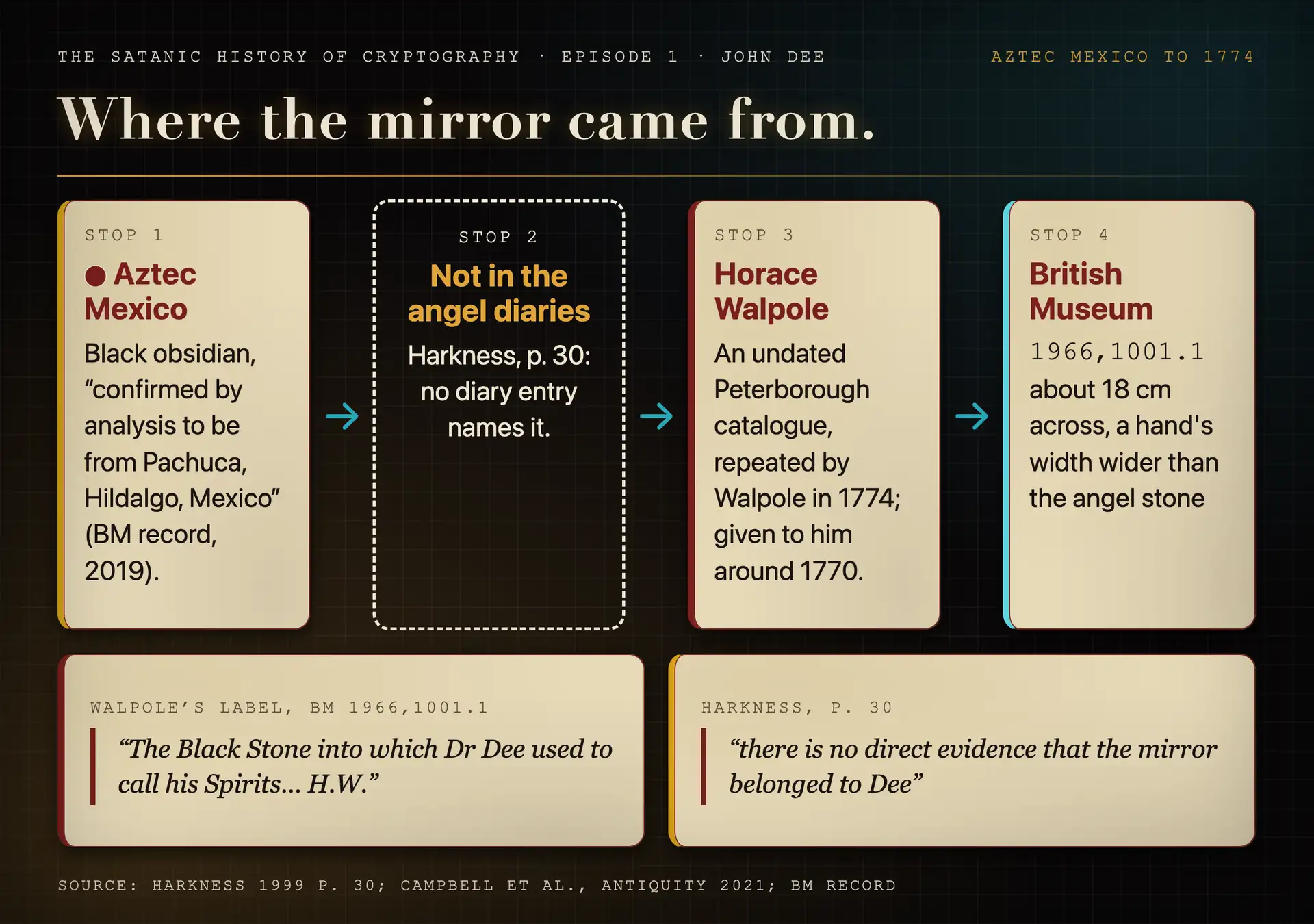
The mirror's road runs from an Aztec workshop to a London museum, and the stop where Dee should be is empty. Source: British Museum record 1966,1001.1; Campbell et al., Antiquity (2021); Walpole, Description of the Villa (1774), p. 110; Harkness (1999), p. 30.
Kelley, meanwhile, rises fast and falls hard: by January 1590 Dee is writing him down as "Sir Edward Kelly." In 1591 he is under arrest in Bohemia; in October 1593 the Emperor sets him at liberty; and on 25 November 1595 Dee writes down a rumour: "the newes that Sir Edward Kelley was slayne."⁸⁴
Court papers show Kelley alive in the middle of 1597.⁸⁵ He died trying to get over a wall, the tellers say, and they cannot agree on which wall. John Weever, in 1631, puts him on his own battlements: "he fell downe from the battlements, broke his legges, and bruised his body; of which hurts within a while after he departed this world."⁸⁶ Elias Ashmole, in 1652, has him "attempting to make his Escape out of a high Window, by the teering of his Sheetes, which were tyed together to let him downe," and then shrugs on the page: "And this is one report of his Death; others there are."⁸⁷ Late 1597 or early 1598, and nobody agrees on the day.
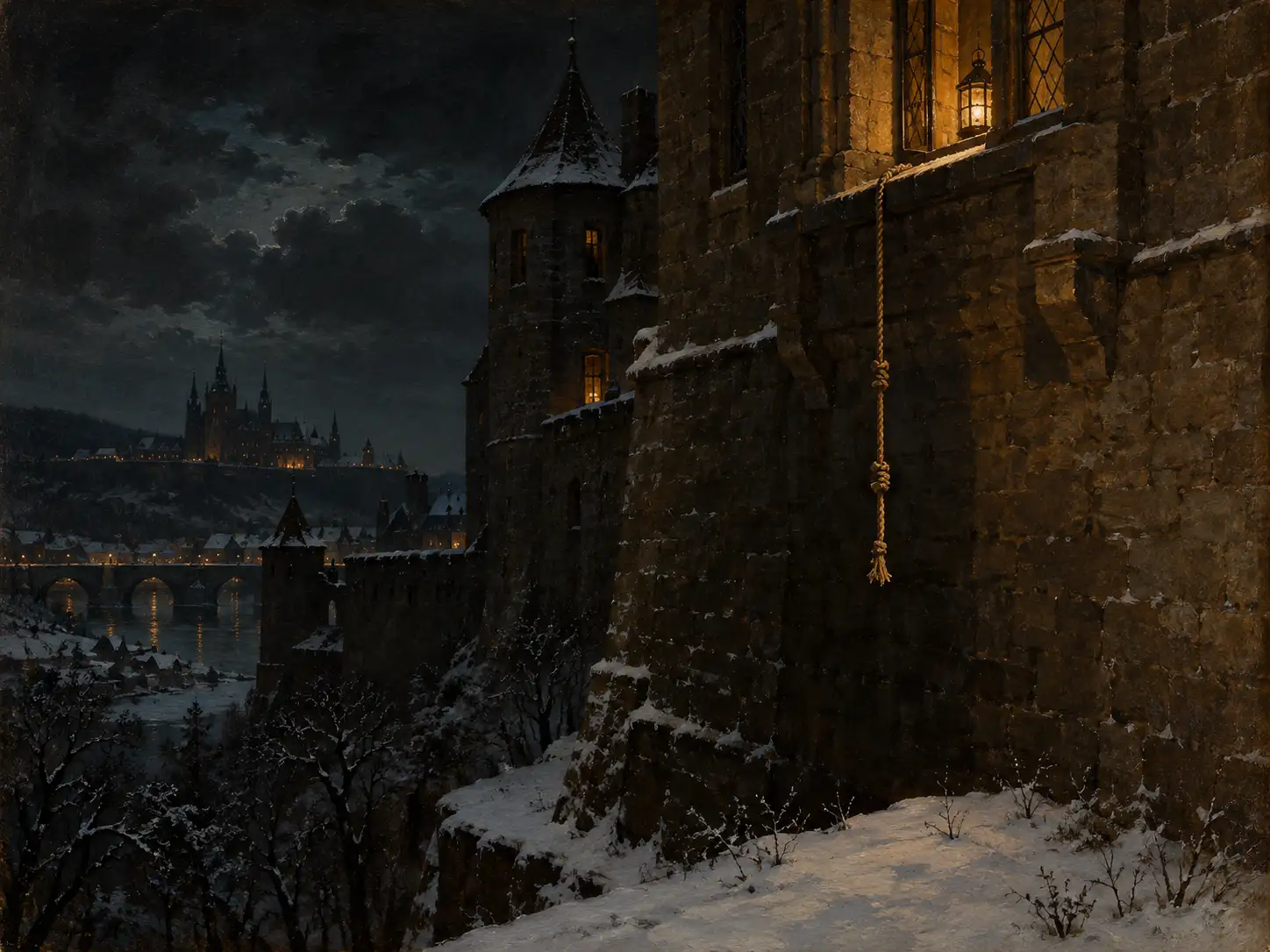
Simulated painting. Kelley's end as the seventeenth century told it, by two authors who could not agree on the wall.
Back in England, the word the Privy Council pinned on Dee in 1555 is still following him, and on 5 June 1604, at Greenwich, the old man petitions the new King, James.
Then he names his price if they can prove it: "Therefore he offereth himself willingly to the punishment of Death, yea eyther to be stoned to death, or to be buried quicke, or to be burned unmercifully."
A seventy-six-year-old man, offering to be buried alive to make a King stop calling him a conjurer! Three days later he sends verses to the Commons asking for an Act against slander.⁸⁹ James never answers him.
Jane Dee dies of plague at Manchester, where he has been Warden of Christ's College since 1595, and is buried on 23 March 1605 (some reckonings say 1604).⁹⁰
Two years later, a widower of seventy-nine sits down at the stone again, in London, 20 March 1607, "At Mrs. Goodman her house." The scryer now is a man named Bartholomew Hickman, and the angel is Raphael. On Friday 10 July Raphael makes a promise: "both for the Philosophers Stone, the book of S. Dunstans, the secret wisdom of that Jewel that was delivered." The book of Dunstan, the one that lay on Kelley's bed while his notes burned, twenty years and a whole life ago. On Monday 7 September comes the last action in print, and Dee asks about a buried treasure that might be raised without digging, and whether a Captain Langham will lend him a hundred pounds.⁹¹
He is asking the angels about a loan!
His last written diary entry is dated 19 December 1608, and tradition says he died at Mortlake that December.⁹² John Pontois, who inherited his books, drew a death's head in one of them beside 26 March 1609, at three in the morning; if that one man's note is right, he died in Bishopsgate Street, not Mortlake.⁹³ Nobody else wrote the day down.
"The parish registers for five years are missing, and the stone which Aubrey says marked his grave has long since disappeared."⁹⁴ John Aubrey went asking around 1672 and found Goodwife Faldo, about eighty, who had known Dee; she showed him a slab with the brass gone, and she told him "That the children dreaded him because he was accounted a conjurer." Aubrey's note on the grave: "A stone was on his grave, which is since removed."⁹⁵
The man who dated everything has no date.
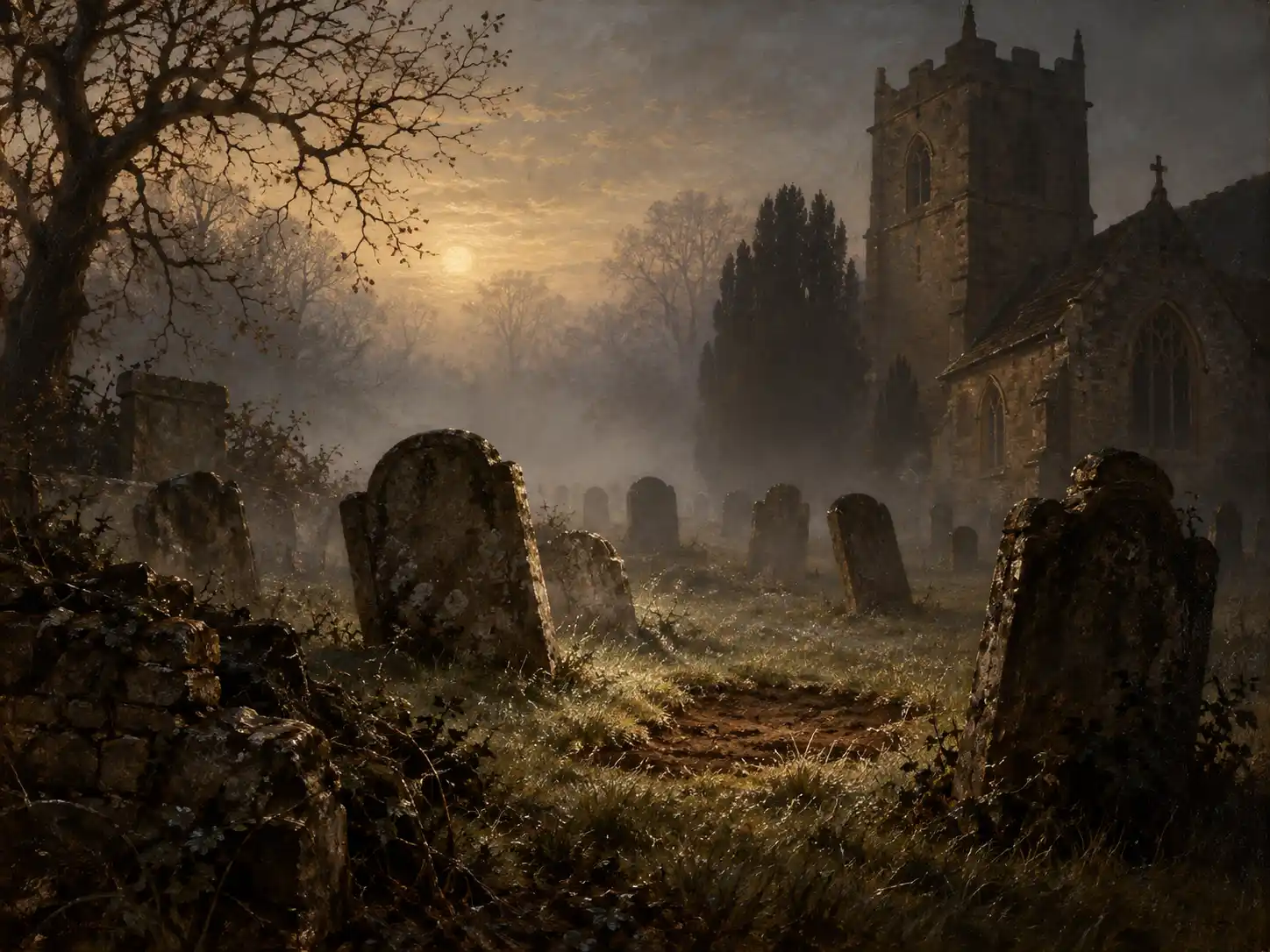
Simulated painting. No register, no brass, no stone: only an old woman's memory, written down half a century late.
Who wrote the legend?
London, 1659. A scholar named Meric Casaubon takes Dee's angel diaries, the ones you have been reading tonight, and puts them in print. He tells you where the manuscript had been, "buried in the Earth, how long, years or moneths, I know not," and he tells you what he thinks it is: Dee's "only (but great and dreadful) error being, that he mistook false lying Spirits for Angels of Light, the Divel of Hell (as we commonly term him) for the God of Heaven."⁹⁶
That is the moment the man stops belonging to himself, and if you read the Rothschild episode of Money and Banking, you have watched this move before: once the subject is dead, whoever writes the legend owns him.
About thirty years later Robert Hooke reads Casaubon's book and decides the angels were code all along, every name and every prayer: "all that which relates to the Spirits and Apparitions, together with their Names, Speeches, Shews, Noises, Clothing, Actions, and the Prayers and Doxologies, &c. are all Cryptography."⁹⁷ After Hooke, every generation adds a darker coat of paint.
- 1631, John Weever: Kelley's cropped ears, the corpse raised in a Lancashire churchyard, the fall from the battlements.
- 1652, Elias Ashmole: the elixir found in the ruins of Glastonbury, the knotted sheets.
- 1659, Meric Casaubon: the angel diaries in print, and devils dressed as angels.
- About 1691, Robert Hooke (printed 1705): the cipher in the angel-talk, and the spy.
- 1774, Horace Walpole: the black mirror, out of an older family catalogue.
- 1784 to 1791, Ebenezer Sibly: midnight, buried money, devils carrying Kelley off, the famous engraving.⁹⁸
- 1909, Charlotte Fell Smith: the first modern biography, and the black cap pulled over the ears.
- 1888 on, the Golden Dawn; 1909 to 1911, Aleister Crowley: the angels' language as a working system of magic.
- 1921, Wilfrid Voynich: the unreadable manuscript, placed in Dee's hands.
- 1968, Richard Deacon: the secret agent, and the number.
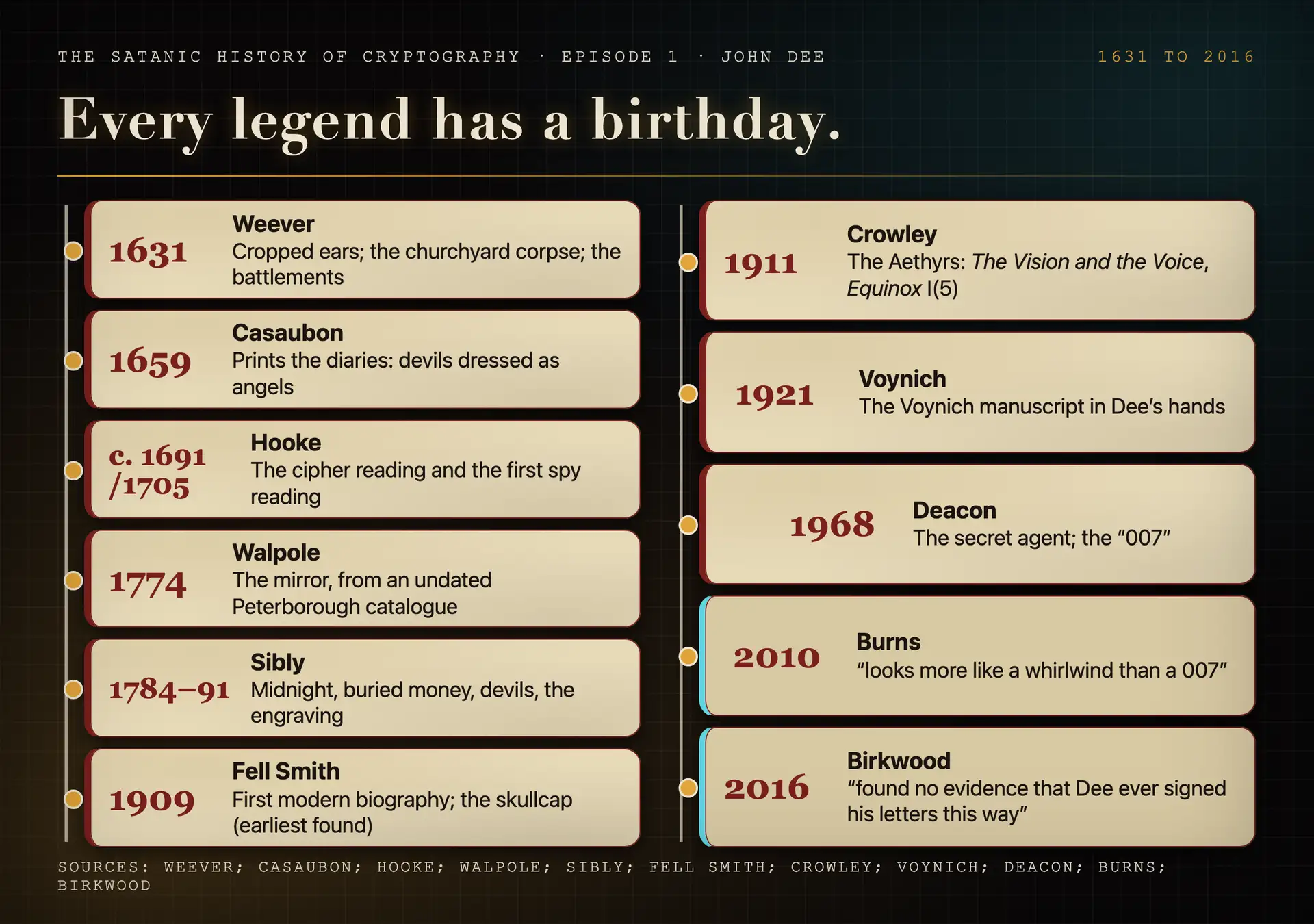
Every piece of the legend has a birthday and an author. Source: the printed works named on each card, cited in this episode's footnotes.
The occultists took the angels at their word, and in Algeria in November 1909 Aleister Crowley called the Aethyrs out of Dee's Keys with Victor Neuburg at his side, dating the visions the way Dee did: "AUMALE, ALGERIA. November 23, 1909." In The Equinox of March 1911 he corrected the dead men's homework: "Probably it was in this manner that Dee and Kelly were so often deceived."⁹⁹
Ten years later a book dealer named Wilfrid Voynich put a book nobody can read into Dee's hands, telling the College of Physicians of Philadelphia in 1921: "During one of his visits to Prague, Dee undoubtedly presented it to Emperor Rudolph II," and radiocarbon dating later put the parchment in the early fifteenth century, more than a century before Dee was born.¹⁰⁰ The man who begged the angels to read the Book of Soyga for him now has a second book in his story that nobody has read to this day...
And in 1968 the secret agent with the number arrived, the one you met in Prague, out of Richard Deacon's book.
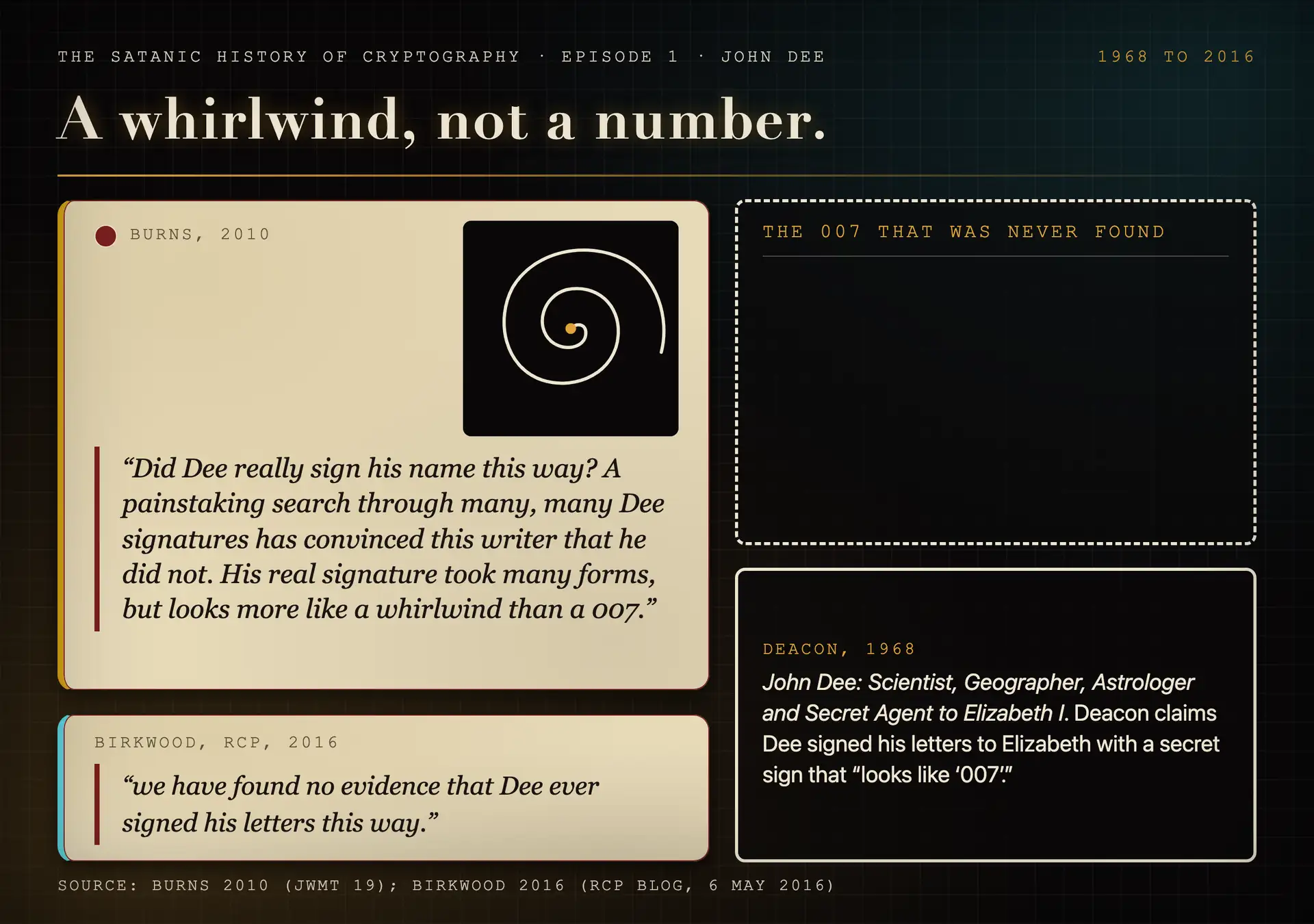
The box where the 007 should be, and it is still empty ninety seconds from now. Source: Teresa Burns, "A Golden Storm," JWMT 19 (2010); Katie Birkwood, Royal College of Physicians blog (2016).
In 2016 the Royal College of Physicians in London, which holds more than a hundred of his stolen books, put dozens of them on show, and one of them is his French Polygraphia, its twelve paper cipher discs still bound in, wheels for hiding words inside other words that, in the librarian's words, "still turn today."¹⁰¹
But is it true?
Okay, ninety seconds: The cipher in the angel-talk is Robert Hooke, about 1691. The secret agent and the 007 are Richard Deacon, 1968, a writer who also cited a Hooke book nobody can find, and two separate searches through Dee's signatures turned up no obvious "007" at all. Bummer, because that one was fun!
The mirror got its Dee label from an old family catalogue that Horace Walpole repeated in 1774. Kelley's cropped ears and the churchyard corpse are John Weever, 1631. The midnight, the buried money and the devils who carried Kelley off are Ebenezer Sibly, a century and a half after that. The novelist who borrowed the number is a story with no author at all. But. In 1555 the Privy Council arrested John Dee for "calculing and conjuring." In 1563 he copied a demon book that was really a cipher manual and pitched it to the Queen's minister as fit for a Prince. From 1581 to 1587 he wrote down, by the hour, what a scryer said the angels said. He told the Holy Roman Emperor to his face. He signed the covenant. He begged a King to clear his name. And in 1607, a widower of seventy-nine, he sat back down at the stone and kept writing in his own hand, because the angels were still talking to him...
Either way, Dee's contributions to statecraft, espionage and cryptography are as fascinating as they are important to history, and outside of the occultism, the ritual and the fuzzy memories that get repeated as "soft facts," we can thank him for a great deal: the preface he wrote for the first English Euclid in 1570; the imperial tracts of 1576 and 1577, where "British Empire" first appears on paper and where he argued the Crown toward a navy and a title to the northern seas; the calendar discourse of 1582, the right answer England sat on for 170 years; the petition of 1556 for a national library, and the private one he built when nobody listened; the north-west passage counsel that put Walsingham at his table; the Steganographia copied by hand and the Polygraphia with its cipher wheels, Europe's first two books of cryptography, carried to an English minister's desk; and the letters home from Leipzig and Prague, the honest kernel of the spy legend, a scholar writing down what he saw in foreign courts.¹⁰²
Next time: the same summer an Emperor threw Dee out of Prague, a man in London named Thomas Phelippes was reading the Queen of Scots' mail. Walsingham's real cipher office, letters carried out of Chartley in a casket "small enough to slip through the bung hole of a beer keg," the Babington cipher, and a postscript that Walsingham himself feared had "bred the jealousy." Episode 2 is the true spy story of 1586, the one the Dee legend borrowed.
Kurt Wuckert Jr. is the Chief Bitcoin Historian, founder of GorillaPool and Open Protocol Labs, and host of Kurt's Podcast. He writes weekly on Bitcoin, geopolitics, faith, and the long fight for human sovereignty at kurtwuckertjr.com. Catch him live every Tuesday at 2 PM EST.
Footnotes
¹ Charlotte Fell Smith, John Dee (1527-1608), Constable, London, 1909, pp. 218-219; and Dee's diary, December 1589, in The Private Diary of Dr. John Dee, ed. J. O. Halliwell, Camden Society, 1842.
² Dee's action of 3 September 1584 and his margin note and memorandum of May and July 1586, in Meric Casaubon, ed., A True & Faithful Relation, London, 1659, pp. 230-231, 418, 429.
³ Dee, note "of my late spoyled Mortlake library, A. 1583," in The Autobiographical Tracts of Dr. John Dee, ed. James Crossley, Chetham Society, 1851, ch. VII; and William H. Sherman, John Dee: The Politics of Reading and Writing in the English Renaissance, University of Massachusetts Press, 1995, Preface.
⁴ Fell Smith, John Dee (1527-1608), Constable, 1909, p. 127.
⁵ Fell Smith, John Dee (1527-1608), Constable, 1909, p. 219.
⁶ Fell Smith, John Dee (1527-1608), Constable, 1909, ch. I.
⁷ Acts of the Privy Council of England, New Series vol. 5 (1554-1556), ed. J. R. Dasent, HMSO, 1892, p. 137, "At Hampton Courte, the xxviij of Maye, 1555."
⁸ Acts of the Privy Council, NS vol. 5, ed. Dasent, 1892, p. 143, 5 June 1555.
⁹ Fell Smith, John Dee (1527-1608), Constable, 1909, pp. 14-15.
¹⁰ Dee, Compendious Rehearsall, ch. 5, p. 20, as quoted in I. R. F. Calder, John Dee Studied as an English Neoplatonist, PhD thesis, University of London, 1952, ch. IV.
¹¹ R. Julian Roberts, "Dee, John (1527-1609)", Oxford Dictionary of National Biography, 2004.
¹² Acts of the Privy Council, NS vol. 5, ed. Dasent, 1892, p. 176, 29 August 1555.
¹³ Fell Smith, John Dee (1527-1608), Constable, 1909 (the supplication to Queen Mary; Old Style, Dee's year beginning 1 January).
¹⁴ Dee, Compendious Rehearsall, in The Autobiographical Tracts of Dr. John Dee, ed. Crossley, Chetham Society, 1851; and Westminster Abbey, "Elizabeth I" (15 January 1559 Old Style; 25 January New Style).
¹⁵ Stephen Clucas, "The Royal Typographer and the Alchemist," Ambix 64(2), 2017, preprint, p. 3.
¹⁶ Jim Reeds, "Solved: The Ciphers in Book III of Trithemius's Steganographia," Cryptologia 22(4), October 1998, pp. 291-293, 312 (Bovillus's visit of 1504; his letter of 1509, printed 1510).
¹⁷ Dee's letter of 16 February 1563, as quoted in Deborah Harkness, John Dee's Conversations with Angels, Cambridge University Press, 1999, p. 87.
¹⁸ John Dee to Sir William Cecil, Antwerp, 16 February 1563 (1562/63 Old Style), The National Archives SP 12/27 item 63, as quoted in Clucas, Ambix 64(2), 2017, p. 3 n. 16.
¹⁹ Dee to Cecil, 16 February 1563, TNA SP 12/27/63, as quoted in Clucas, Ambix 64(2), 2017, p. 3 n. 17.
²⁰ Dee, Compendious Rehearsall (1592), in The Autobiographical Tracts of Dr. John Dee, ed. Crossley, Chetham Society, 1851.
²¹ Reeds, Cryptologia 22(4), 1998, pp. 292-293, with the worked example below; and Gustavus Selenus, Cryptomenytices (1624), as printed by Robert Hooke, Posthumous Works, London, 1705, p. 204.
²² Reeds, Cryptologia 22(4), 1998, pp. 308-313 (the Book III method, pp. 308-310; the plaintexts, pp. 310-312; Heidel 1676, Ernst 1996, and Reeds's photocopy of 2 March and plaintext of 5 March 1998, p. 313).
²³ Reeds, Cryptologia 22(4), 1998, abstract, p. 291.
²⁴ Reeds, Cryptologia 22(4), 1998, p. 291; and Katie Birkwood, "Code-making and code-breaking: John Dee and the art of cryptography", Royal College of Physicians, 6 May 2016 (the Polygraphie et universelle escriture cabalistique, Paris, 1561).
²⁵ Dee, Monas Hieroglyphica, Antwerp, Willem Silvius, 1564: colophon, dedication to Maximilian dated 29 January 1564, and Theorem XXIII, in J. W. Hamilton-Jones's translation, 1947.
²⁶ Dee, Compendious Rehearsall, in The Autobiographical Tracts of Dr. John Dee, ed. Crossley, Chetham Society, 1851; and Dee's diary, 22-28 November 1577 (Old Style), The Private Diary of Dr. John Dee, ed. Halliwell, Camden Society, 1842.
²⁷ Dee, Brytanici Imperii Limites, British Library Add MS 59681, 22 July 1576, and the calendar discourse of March 1582, both in Sherman, John Dee: The Politics of Reading and Writing, 1995, ch. 7 and p. 117.
²⁸ Sherman, John Dee: The Politics of Reading and Writing, 1995, Preface.
²⁹ Dee, "Mathematicall Praeface" to Henry Billingsley's Euclid, London, John Day, 1570 (dated 9 February 1570), section "Apologeticall," Project Gutenberg ebook 22062.
³⁰ Dee's diary, 23 January 1583 (Old Style; English civil year 1582), The Private Diary of Dr. John Dee, ed. Halliwell, Camden Society, 1842.
³¹ Dee to Walsingham, Leipzig, 14 May 1586, as quoted in Fell Smith, John Dee (1527-1608), Constable, 1909, p. 170.
³² Katie Birkwood, "Exhibiting the lost library of John Dee", Royal College of Physicians, 15 January 2016.
³³ Dee's diary, 17 January 1582 (Old Style), Bodleian Ashmole MS 487, an entry omitted from Halliwell's edition, cited in Harkness, John Dee's Conversations with Angels, 1999, p. 45 n. 140; and Jim Reeds, "John Dee and the Magic Tables in the Book of Soyga", 1998 preprint of the chapter in S. Clucas, ed., John Dee: Interdisciplinary Studies in English Renaissance Thought, Springer, 2006.
³⁴ Dee's own words at the crystal, BL Sloane MS 3188 f. 9a, 10 March 1582 (Old Style), transcribed in Christopher Whitby, John Dee's Actions with Spirits, PhD thesis, University of Birmingham, 1982, vol. II pp. 17-18.
³⁵ Dee, BL Sloane MS 3188 f. 8a, "Anno 1581. Decembris 22. Mane.", Actions with Spirits, vol. II, Christopher Whitby, Birmingham PhD, pp. 12-13, 1982 (Old Style).
³⁶ Sloane MS 3188 f. 8a, Actions with Spirits, vol. II, Whitby, pp. 13-16, 1982 (paraphrased).
³⁷ Dee, diary for 6 March 1582 (Old Style), The Private Diary of Dr. John Dee, ed. J. O. Halliwell, p. 14, 1842.
³⁸ Dee, diary for 8 and 9 March 1582, The Private Diary of Dr. John Dee, Halliwell, pp. 14-15, 1842.
³⁹ Dee, Sloane MS 3188 f. 9a, 10 March 1582, Actions with Spirits, vol. II, Whitby, pp. 16-17, 1982.
⁴⁰ Sloane MS 3188 f. 9a, Actions with Spirits, vol. II, Whitby, pp. 17-18, 1982 (Δ marks Dee).
⁴¹ Dee's later margins to Sloane MS 3188 ff. 9a-9b, Actions with Spirits, vol. II, Whitby, pp. 18-19, 1982.
⁴² Dee's nativity list, The Private Diary of Dr. John Dee, Halliwell, p. 1 and note, 1842.
⁴³ The ears: John Weever, Ancient Funerall Monuments, London, p. 45, 1631.
⁴⁴ The cap: Charlotte Fell Smith, John Dee (1527-1608), p. 88, 1909 (earliest found).
⁴⁵ The corpse at Walton-le-Dale: Weever, Ancient Funerall Monuments, London, pp. 45-46, 1631.
⁴⁶ Sloane MS 3188 f. 10a, Actions with Spirits, vol. II, Whitby, pp. 21-22, 1982.
⁴⁷ Deborah Harkness, John Dee's Conversations with Angels, p. 29, 1999.
⁴⁸ Sloane MS 3188 ff. 58a-59b, 21 November 1582, Actions with Spirits, vol. II, Whitby, pp. 217-218, 1982.
⁴⁹ Harkness, John Dee's Conversations with Angels, pp. 41, 166, 1999.
⁵⁰ Sloane MS 3189, British Library Archives and Manuscripts Catalogue, Kelley's 1583 transcription, grids from f. 10r.
⁵¹ A True & Faithful Relation, Casaubon, p. 1, 1659 (printed "Madini"); the name first appears in Sloane MS 3188 on 21 March 1582, per Peterson's note.
⁵² A True & Faithful Relation, Casaubon, 15 August 1584, 1659 (paraphrased).
⁵³ Dee, diary for 21 September 1583, The Private Diary of Dr. John Dee, Halliwell, 1842.
⁵⁴ A True & Faithful Relation, Casaubon, p. 72, 1659 ("Friday, Martii 13"; 23 March New Style).
⁵⁵ Nalvage, 12 April 1584, A True & Faithful Relation, Casaubon, p. 77, 1659; the Keys were "received at diverse times from 13 April to 13 July 1584 at Cracow", British Library, Sloane MS 3191.
⁵⁶ A True & Faithful Relation, Casaubon, pp. 82-84, 1659, 14 April 1584.
⁵⁷ Dee to Rudolf II, 3 September 1584, A True & Faithful Relation, Casaubon, pp. 230-231, 1659, checked against the page image.
⁵⁸ A True & Faithful Relation, Casaubon, p. 404 and prefatory contents, 1659 (year inferred from the weekday).
⁵⁹ Robert Hooke, "Of Dr. Dee's Book of Spirits", The Posthumous Works of Robert Hooke, ed. Richard Waller, London, pp. 205-207, 1705.
⁶⁰ The "supposition" as reported in Fell Smith, John Dee (1527-1608), pp. 168-169, 1909.
⁶¹ Richard Deacon (Donald McCormick), John Dee: Scientist, Geographer, Astrologer and Secret Agent to Elizabeth I, Muller, 1968, as described in University of Cambridge, The original 007?, 3 November 2008.
⁶² Katie Birkwood, Code-making and code-breaking: John Dee and the art of cryptography, Royal College of Physicians, 6 May 2016.
⁶³ A True & Faithful Relation, Casaubon, p. 418, "Pragae, Aprilis 30 ... 1586", 1659.
⁶⁴ Dee to Walsingham, "From Leipsich this 14 of May 1586", A True & Faithful Relation, Casaubon, p. 423, 1659.
⁶⁵ A True & Faithful Relation, Casaubon, pp. 424, 429, 1659.
⁶⁶ Dee's margin, A True & Faithful Relation, Casaubon, p. 418, 1659, checked against the page image.
⁶⁷ Dee's memorandum of July 1586, A True & Faithful Relation, Casaubon, p. 429, 1659.
⁶⁸ Dee to Walsingham, 14 May 1586, quoted in Fell Smith, John Dee (1527-1608), p. 170, 1909.
⁶⁹ Dee's action of 14 October 1586, Trebon, A True & Faithful Relation, ed. Meric Casaubon, London, 1659, p. 445.
⁷⁰ Dee's action of Saturday 18 April 1587, A True & Faithful Relation, ed. Meric Casaubon, London, 1659, pp. *9-*11, second pagination (the print reads "expresly").
⁷¹ Dee, night of 18-19 April and 20 April 1587, A True & Faithful Relation, Casaubon, 1659, pp. *13, *16.
⁷² Edward Kelley's signed note, 22 April 1587, A True & Faithful Relation, Casaubon, 1659, pp. *17-*18, margin "April 22. at night."
⁷³ Dee's action of Friday 24 April 1587, A True & Faithful Relation, Casaubon, 1659, p. *19.
⁷⁴ Dee's note of the covenant, 3 May 1587, A True & Faithful Relation, Casaubon, 1659, p. *21.
⁷⁵ The covenant text, A True & Faithful Relation, Casaubon, 1659, pp. *20-*21.
⁷⁶ Dee's action and margin, 20 May 1587, A True & Faithful Relation, Casaubon, 1659, pp. *22-*23.
⁷⁷ Dee's diary, 12 December 1587, The Private Diary of Dr. John Dee, ed. J. O. Halliwell, Camden Society, 1842, p. 25.
⁷⁸ Dee's diary, 28 February and 22 May 1588, The Private Diary of Dr. John Dee, Halliwell, 1842, p. 27.
⁷⁹ Dee's diary, 4 December 1588 to 11 March 1589, The Private Diary of Dr. John Dee, Halliwell, 1842, pp. 29-30.
⁸⁰ Charlotte Fell Smith, John Dee (1527-1608), Constable, 1909, pp. 218-219.
⁸¹ British Museum, Mirror, 1966,1001.1, collection record; and Campbell, Healey, Kuzmin and Glascock, The mirror, the magus and more, Antiquity 95(384), 2021.
⁸² Horace Walpole, A Description of the Villa of Horace Walpole, Strawberry-Hill, 1774, p. 110; and Walpole's label, BM 1966,1001.1.
⁸³ Deborah Harkness, John Dee's Conversations with Angels, Cambridge University Press, 1999, p. 30.
⁸⁴ Dee's diary, 23 January 1590 to 25 November 1595, The Private Diary of Dr. John Dee, Halliwell, 1842, pp. 33-54; and Fell Smith, 1909, pp. 208-209.
⁸⁵ Teresa Burns, A Golden Storm, Journal of the Western Mystery Tradition No. 19, 2010.
⁸⁶ John Weever, Ancient Funerall Monuments, London, 1631, p. 45.
⁸⁷ Elias Ashmole, Theatrum Chemicum Britannicum, London, 1652, p. 483.
⁸⁸ Dee's petition to James I, 5 June 1604, quoted in Fell Smith, John Dee (1527-1608), Constable, 1909, p. 293.
⁸⁹ Fell Smith, John Dee (1527-1608), 1909, pp. 294, 296.
⁹⁰ Fell Smith, John Dee (1527-1608), 1909, p. 297, and the Christ's College patent of 26 May 1595 as she cites it; and R. Julian Roberts, Dee, John (1527-1609), Oxford Dictionary of National Biography, 2004.
⁹¹ Dee's actions of 20 March, 10 July and 7 September 1607 (Julian), A True & Faithful Relation, Casaubon, 1659, pp. *32-*43.
⁹² Fell Smith, John Dee (1527-1608), 1909, p. 302.
⁹³ Roberts, Dee, John (1527-1609), ODNB, 2004.
⁹⁴ Fell Smith, John Dee (1527-1608), 1909, p. 303.
⁹⁵ John Aubrey, Brief Lives, ed. Andrew Clark, Oxford, 1898, vol. I, p. 213.
⁹⁶ Meric Casaubon, Preface, pp. 26, 44, A True & Faithful Relation, London, 1659.
⁹⁷ Robert Hooke, "Of Dr. Dee's Book of Spirits," Posthumous Works, ed. Richard Waller, London, 1705, p. 206.
⁹⁸ Ebenezer Sibly, A New and Complete Illustration of the Celestial Science of Astrology, Part IV, London, 1790 printing, pp. 1099-1100.
⁹⁹ Aleister Crowley, The Vision and the Voice, Special Supplement, The Equinox vol. I no. 5, London, March 1911.
¹⁰⁰ Wilfrid M. Voynich, "A Preliminary Sketch of the History of the Roger Bacon Cipher Manuscript," Transactions of the College of Physicians of Philadelphia, ser. 3 vol. 43, 1921, p. 430; and Mysterious Voynich Manuscript dates back to the 15th century, Medievalists.net, February 2011.
¹⁰¹ Katie Birkwood, Exhibiting the lost library of John Dee, Royal College of Physicians, 15 January 2016; and Birkwood, Code making and code breaking: John Dee and the art of cryptography, Royal College of Physicians, 6 May 2016.
¹⁰² Sherman, John Dee: The Politics of Reading and Writing, 1995, ch. 7 (Brytanici Imperii Limites, 1576; General and Rare Memorials, completed 1576, printed 1577, arguing for a navy) and p. 117 (the calendar discourse); Fell Smith, John Dee (1527-1608), 1909, ch. I (the 1556 supplication for a national library) and the diary for 23 January 1583; Birkwood, Royal College of Physicians, 6 May 2016 (the Polygraphie with its discs).
Be good to each other. And stay curious.