The House of the Red Shield: The Rothschilds, 1744 to Suez
By Kurt Wuckert Jr.
London, the morning of Tuesday, June 20, 1815.
The Royal Exchange is packed, and a heavy-set man in a black coat walks to the south-east corner and leans against his pillar. Everybody on the floor knows that pillar. Everybody knows the man.
His name is Nathan Rothschild, and this morning he does not say a word.
He looks like he just came from a funeral, and two days ago, somewhere in Belgium, Wellington and Napoleon met at a place called Waterloo, and nobody in this room knows who won. So the brokers watch his face, and then they watch his hands.
His hands start to sell.
He sells consols, the debt of the British Crown, the safest paper on earth, and he keeps selling. The men everyone knows to be his agents sell right beside him, and the floor does the math fast: if Rothschild is dumping the Crown's own paper, Rothschild knows, and Wellington has lost.
The market breaks.
And in the wreckage, quietly, men nobody is watching begin to buy. They buy everything the floor throws at them, and every one of them works for the man putting on a show at the pillar.¹
He knew before the King.
In Part 3, Athens and Rome fought over metal and learned the hard way that the stamp was worth more than the silver under it. Back in Part 1, I promised you the families who learned the Templars' lesson and built banks you could not behead, and I told you that some day you would agree with me that data is money.
This is the family. Its founder was born on a street in Frankfurt with gates the city locked every night, and within his sons' lifetime the family could tell governments what their own armies had done before the governments knew it. Everything you have ever heard about the Rothschilds is here, told the way it gets told: the treasure, the pigeons, the pillar, both sides of every war, the secret societies. At the end I will tell you which parts are true, which are probably false, which of the truths are worse than the legends.
That pillar comes back twice: once in Waterloo week, when the letter that actually reached Nathan lands on his desk, and once at the very end, when the man who first stood him there gets his name and his birthday.
Watch the video if you prefer to watch rather than read!
Livestream Tuesday at 2 PM EST; the embed fills in then.
The locked street
Frankfurt, a Sunday in the 1750s.
The gates at both ends of the Judengasse are shut. They were shut last night, they will be shut again tonight, and they are shut on every Christian holiday on the calendar. Inside, a boy is sorting his father's coins.
Emperor Frederick III ordered Frankfurt's Jews into this one street in 1458, and by the early 1460s they were walled in. The street runs about a quarter of a mile, no more than twelve feet wide and under ten in places, and in 1711 it held 3,024 people.²
The city wrote the rules into a statute called the Stättigkeit: five hundred families and no more, twelve weddings a year for the entire community, and yellow rings on the men until 1726. When a Christian called out "Jud, mach mores!" the Jew took off his hat and stepped aside. And in Count Corti's words: "The Jews were not allowed to acquire land, or to practise farming or handicrafts."³
Imagine asking the city council whether your son can get married this year, and hearing that the twelve slots are gone.
As an aside, did you know the street had already survived a pogrom? On 22 August 1614 a mob under a gingerbread baker named Vincenz Fettmilch plundered it for thirteen hours, and 1,380 Jews walked out the next day. In February 1616 they walked back in under the Emperor's protection, and Fettmilch was hanged.⁴ A century and a half later, the boy Goethe could still see a rioter's skull up on the bridge tower, because Frankfurt kept its receipts. Anyhow...
Houses (and families) there went by signs hung outside, and an ancestor, Isaak Elchanan, lived in "a small house" called zum Roten Schild, the House at the Red Shield, and turns up under that name in 1585. The name followed the family from house to house after that.⁵
For three generations they also answered to a second name, Bauer, and Bauer is German for farmer. Germans wore their trades as surnames, so we can assume the family's whole arc is written in its names: a farmer's name on a street where a Jew could not own a field to farm, then a red shield, then a coat of arms with five arrows, in the time it takes a name to stick.⁶
Later on, animals that represent the great empires will be added to the coat of arms, but we aren't there yet.
Mayer Amschel Rothschild was born on this street in 1744, and by ten he was changing coins for his father, a small money-changer. The family sent him to the yeshiva at Fürth, and then his father died in 1755 and his mother in 1756, and at about twelve the boy was done with school.⁷
He apprenticed at the Oppenheim bank in Hanover instead, learned rare coins, and came home to sell them. In June 1765 the privy purse accounts of Prince Wilhelm of Hesse record a payment of "38 gulden 30 kreuzer to Jew Meyer for medals."⁸
That is the first recorded line in the story of the biggest banking family of the nineteenth century: a prince's pocket money, spent on old coins. On 21 September 1769 Wilhelm named him "Crown Agent to the Principality of Hesse-Hanau," court factor as the title usually runs in English, and Mayer Amschel hung a shield with the prince's arms on his door.⁹
From 1771 he mailed princes printed catalogs of coins for sale, ten to sixteen pages apiece, each listing 2,500 to 5,000 gulden of stock.¹⁰ The Sears, Roebuck of the Holy Roman Empire!
His best customer was in the soldier business. Wilhelm's father "had in this way gradually transferred to England 12,000 Hessians," and in 1776 Wilhelm "sold to England" a regiment of his own.¹¹ Yes, those Hessians who fought against the Americans, in the year the American colonies declared independence.
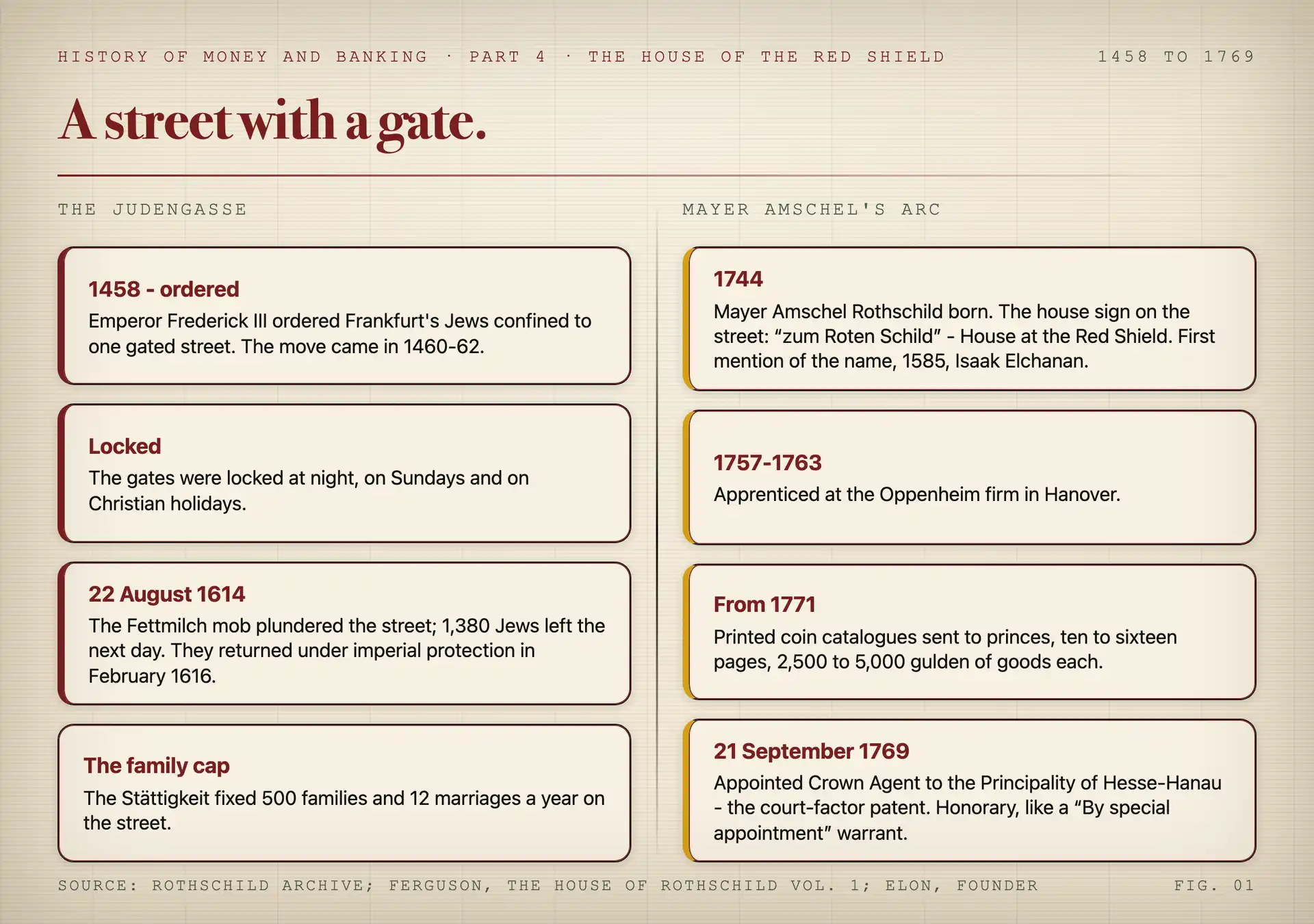
A quarter-mile street with a gate at each end and a quota on weddings produced a boy who sold coins to a prince who rented soldiers to a king. Source: The Rothschild Archive; Ferguson, vol. 1; Elon, Founder (1996).
The treasure and the sons
Kassel, 2 November 1806.
French troops under General Lagrange march into the Elector's capital, because Napoleon has decided to strike the House of Hesse-Kassel "out of the list of powers," and Wilhelm, Elector now, has already fled and left behind a palace full of chests.
So the chests go to Frankfurt, to the coin dealer, and Mayer Amschel digs a hole in a corner of his little garden and puts a prince's fortune in the ground. When the French come through, they take his own money, 40,000 thalers of it, and never think to dig. Years later the Elector comes home, and every coin is handed back to him, with interest, and in 1861 the family paid Moritz Oppenheim to paint the scene.
In the letters of those years the Elector is "Herr von Goldstein," Mayer Amschel is "Peter Arnoldi," and the prince's English investments have a code name of their own: "stock fish."¹² So much for the hole in the garden, because the prince's fortune was English stock under a code name, and the son in London was running it.
Nathan told his own version at a dinner in 1834: "The Prince of Hesse Cassel," said Rothschild, "gave my father his money; there was no time to be lost; he sent it to me. I had 600,000£ arrive unexpectedly by the post; and I put it to such good use, that the prince made me a present of all his wine and his linen."¹³
All his wine and his linen. Heck of a tip.
That dinner was at Ham House on 13 February 1834, and the anti-slavery MP Thomas Fowell Buxton wrote it all down the next day. Nathan told the table why he had left Frankfurt: "There was not," he said, "room enough for us all in that city." A great trader there had refused to show him his patterns. "This was on a Tuesday; I said to my father, 'I will go to England.' I could speak nothing but German. On the Thursday I started".¹⁴ I went to the 1848 first edition for that line; the version floating around online says "all of us," and the book says "us all."
Then came the postings, one son per city:
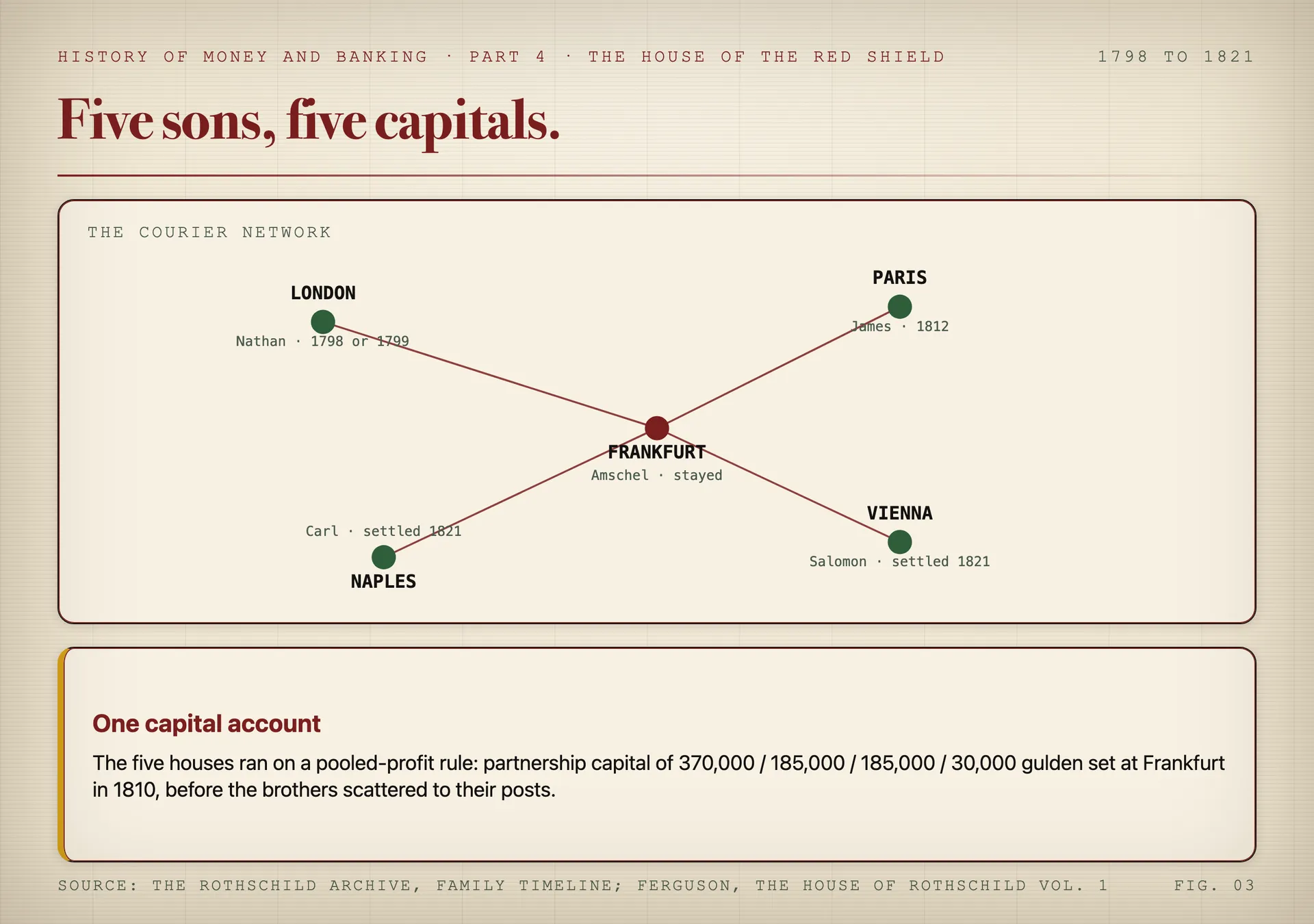
Five partners, five capitals, one family account. Source: The Rothschild Archive timeline; Ferguson, vol. 1.
On 27 September 1810 the father and three of those sons signed a partnership as Mayer Amschel Rothschild & Söhne. The firm had been worth 108,504 gulden in 1797, and by 1810 it was worth 800,000.¹⁵
A year later Frankfurt put a price on citizenship: in 1811 the community bought civil equality for 440,000 gulden, and Mayer Amschel raised 290,000 of it. The receipt lasted five years; the rights were rolled back in 1816.¹⁶
He never saw it. In September 1812 he fell ill after the Yom Kippur fast, rewrote his will on his deathbed, and died on the 19th.
He also sold his share to his sons for 190,000 gulden, far below its worth, and the sale "made it unnecessary on his death to declare to the officials the enormous value" of the firm.¹⁸ Any estate lawyer from the last 200 years would sign that.
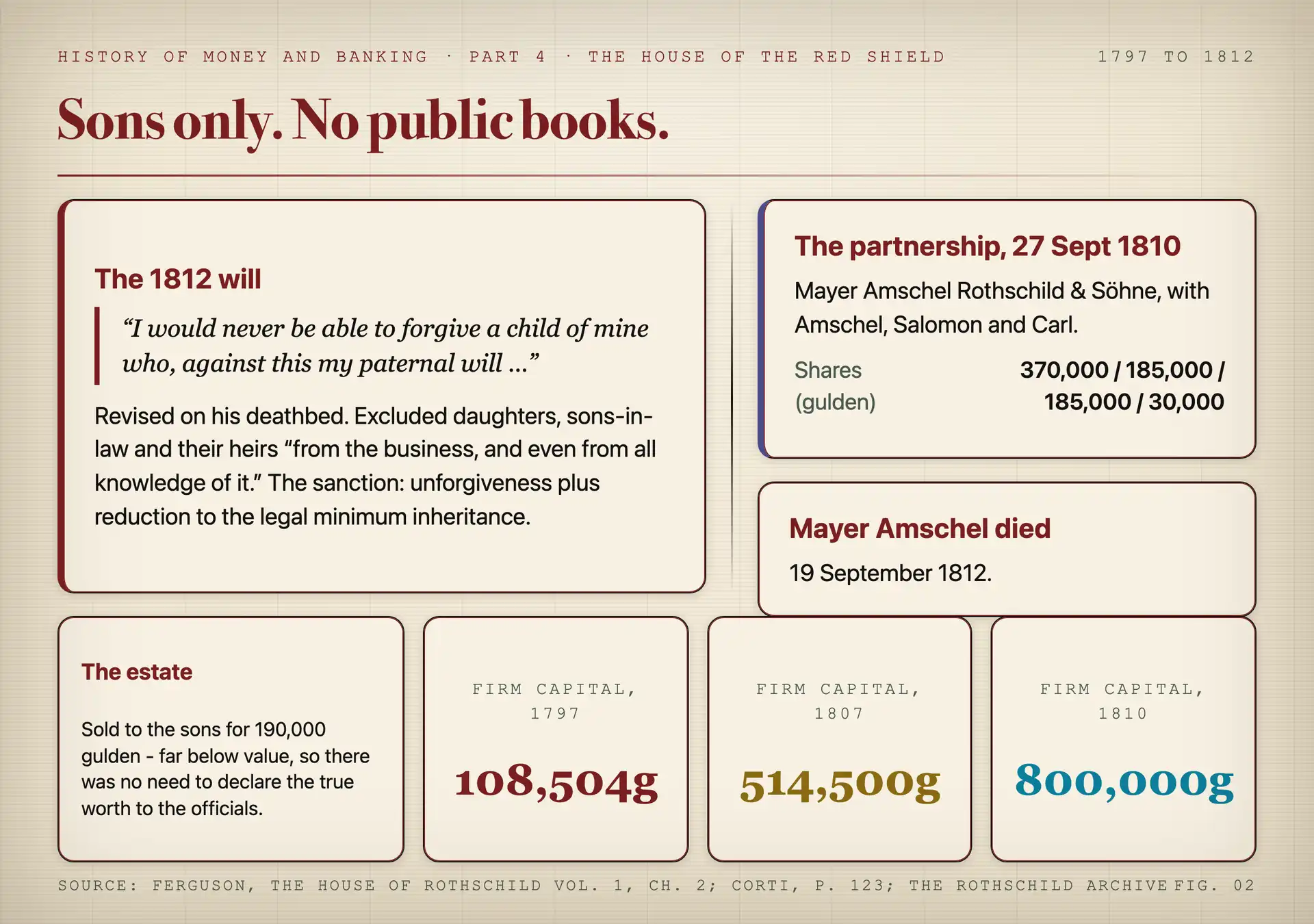
Sons only, no share for the daughters, no public figure for the officials, and a father who would never forgive the child who broke the rule. Source: Corti (1928), p. 123; Ferguson, vol. 1, ch. 2.
The family kept the money in the family the other way too, beginning on 11 July 1824, when James married his own niece Betty. Between 1824 and 1877, fifteen of the twenty-one marriages among Mayer Amschel's descendants were between his descendants.¹⁹
He built a bank you could not behead, and then he made sure nobody outside the family could read it.
His third son was already moving gold across a war.
The gold road
Helvoetsluys, on the Dutch coast, early 1814.
His Majesty's ships ride at anchor and wait for coin, and it comes in casks: French gold and French silver, gathered across Germany, France and Holland, bound for the Duke of Wellington's army. A banker in London has promised to find it, and he carries "all risks and losses" until every coin is aboard.²⁰
The road started earlier, from before March 1811, with Nathan in London and James in Paris running gold across the Channel in the middle of a war, and Napoleon's own treasury let it pass because his finance minister, Mollien, thought gold leaving Britain made Britain weaker.²¹
Nathan told the Buxton dinner how he got in the door: "When I was settled in London, the East India Company had 800,000 lbs. of gold to sell. I went to the sale, and bought it all. I knew the Duke of Wellington must have it. I had bought a great many of his bills at a discount. The Government sent for me, and said they must have it. When they had got it, they did not know how to get it to Portugal. I undertook all that, and I sent it through France; and that was the best business I ever did."²²
Through France, to pay the army fighting France!
On 11 January 1814 the Chancellor of the Exchequer, Nicholas Vansittart, made it official. He told the Commissary-in-Chief, John Charles Herries, to employ Nathan "in the most secret and confidential manner" to collect French coin "not exceeding in value £600,000," at a commission of 2 per cent.²³
The brothers' letters did the rest in code. Nathan became "Langbein." London became "Jerusalem." The bullion shipments across the Channel were "Rabbi Moses," and the cargo was "beer," "fish" or "children."²⁴ That is a heist, with the government as the client.
Herries wrote that year: "Rothschild of this place has executed the various services entrusted to him in this line admirably well, and though a Jew, we place a good deal of confidence in him."²⁵
"Though a Jew..." The man was moving the Crown's war money successfully through enemy country, and the compliment still came with an asterisk about ethnic and religious affiliations.
In 1815 Napoleon came back from Elba, and the gold road came back with him. By 20 October Nathan had supplied gold coin worth £2,136,916, packed in "884 boxes and 55 casks," and Herries's account with him for that one year came to £9,789,778.²⁶ Nearly ten million pounds, through one man's books, in one year!
The birds
Paris, 1846.
A clerk folds a slip of paper about eight centimeters by five into the little container on a pigeon's leg, and lets the bird go. Two slips like it, from 1846, still survive with the folds in them. Nathan's son Nathaniel explained the system that year: "I hope our feathered messengers will have brought you in due time our good prices." Then the code: "A B in our pigeon dispatches means: buy stock, the news is good; C D…means sell stock, the news is bad."²⁷ Two letters of the alphabet ran the whole thing; try getting that past a compliance department today.
The birds were the top layer, and under them the family archive holds over 20,000 letters the brothers wrote each other between 1811 and 1868, going back and forth almost daily. They wrote in Judendeutsch, German in Hebrew characters, their first language, and it kept prying eyes out: not a code in itself, the archivists say, but so few outsiders could read it that nobody could easily decipher the letters. Stack the codenames on top, and Metternich shows up in the correspondence simply as "Uncle."²⁸
Then the couriers: in December 1825 alone, the Paris house sent eighteen couriers to Calais, three to Saarbrücken, one to Brussels and one to Naples. In Frankfurt in 1814, Amschel had letters sent in a blue envelope when the exchange rate rose and a red one when it fell, "which saves half a day."²⁹ Half a day, for the color of an envelope!
In October 1830 France's ambassador in London, Talleyrand, put the gap in writing: "Le ministère anglais est toujours instruit par lui dix ou douze heures avant l'arrivée des dépêches de lord Stuart." London's ministers heard the news from Rothschild ten or twelve hours before their own ambassador's dispatches, on boats that belonged to the house, took no passengers, and sailed in any weather.³⁰
So what was the product, really?
Data.
In Part 2, the temple ledger already knew your name and what that name was worth. This family built a ledger that knew the news. Niall Ferguson, who read the family's own letters, says that before the telegraph spread news to everyone, the Rothschild network gave them an important advantage over their competitors.³¹ Data is money, and they were printing it by courier.
The machine had an expiration date, and one of the men who ended it was born in Kassel, the Elector's own city, in 1816, as Israel Beer Josaphat, and London knew him as Paul Julius Reuter. In April 1850 he contracted for forty trained pigeons to fly between Brussels and Aachen. The mail train took up to nine hours, the birds took under two, and they landed "Six or seven hours before the daily mail train arrived."³²
The same year, Reuter approached the London house looking for a client, and N M Rothschild & Sons became "early and effective patrons of Reuter's telegraph."³³ Once the wires crossed the Channel, James in Paris spent the 1850s complaining that the telegraph was ruining their business, because now anyone could get the news. By Ferguson's count the courier edge lasted about twenty years, from around 1815 to 1835.³⁴
Twenty years is a long time to be first.
Which takes us back to London, to a Tuesday in June of 1815, and a heavy man in a black coat leaning on a pillar, with the floor watching his hands and the prices already moving.
The news has not landed yet...
Now watch the floor
He sells.
Consols first, the three per cent debt of the British Crown, the paper every widow in England keeps in a drawer, and then more. A whisper runs down the Exchange faster than any courier ever rode: Rothschild knows, Blücher is beaten and Wellington is finished.
The floor breaks.
Prices slide all morning, and the heavy man by the pillar looks like he just buried his mother. Nobody watches the strangers: small men with unknown faces, buying every scrap of paper the panic throws on the floor.
When the official news lands, the paper is his, and the day is worth nearly a million sterling.
The long version has Nathan at Waterloo himself, watching the Guard go down, then paying a sailor in gold to cross a storm in an open boat, ahead of the British government. That is the legend, told for two hundred years.
Now the newspapers.
The battle ended on the evening of Sunday, June 18, 1815, and Wellington's dispatch left Brussels on Monday afternoon with Major Henry Percy, whose ship then sat becalmed in the Channel, so on Wednesday morning he climbed into a rowing boat with four sailors and rowed the last twenty miles to Broadstairs.³⁵
A man the papers called "Mr C of Dover" was faster: he was at Ghent on Monday when the news reached the exiled Louis XVIII, and his story was in print in London by Wednesday noon.³⁶
The King who knew first was French.
Nathan's news came on Wednesday afternoon, with no rider, no storm and no bird: a letter from Ghent. By evening an Edinburgh paper's London man was racing the night mail with a dispatch that reads like a stock tip with a battle attached: "Lord Wellington was joined on the 18th by 20,000 Prussians under Bülow and beat Bonaparte completely, taking nearly the whole of his artillery. Omnium is now up at 6." His source was "one who has seen a letter from Ghent, received by Rosschild, the great stockbroker whose information is invariably the best. He is now at the Foreign Office."³⁷
Soon after 11 that night, Percy's chaise crossed Westminster Bridge with captured French eagles hanging out of its windows, and Percy found the Cabinet at dinner in Grosvenor Square.³⁸ Hours, not days.
The Foreign Office heard it from a banker.
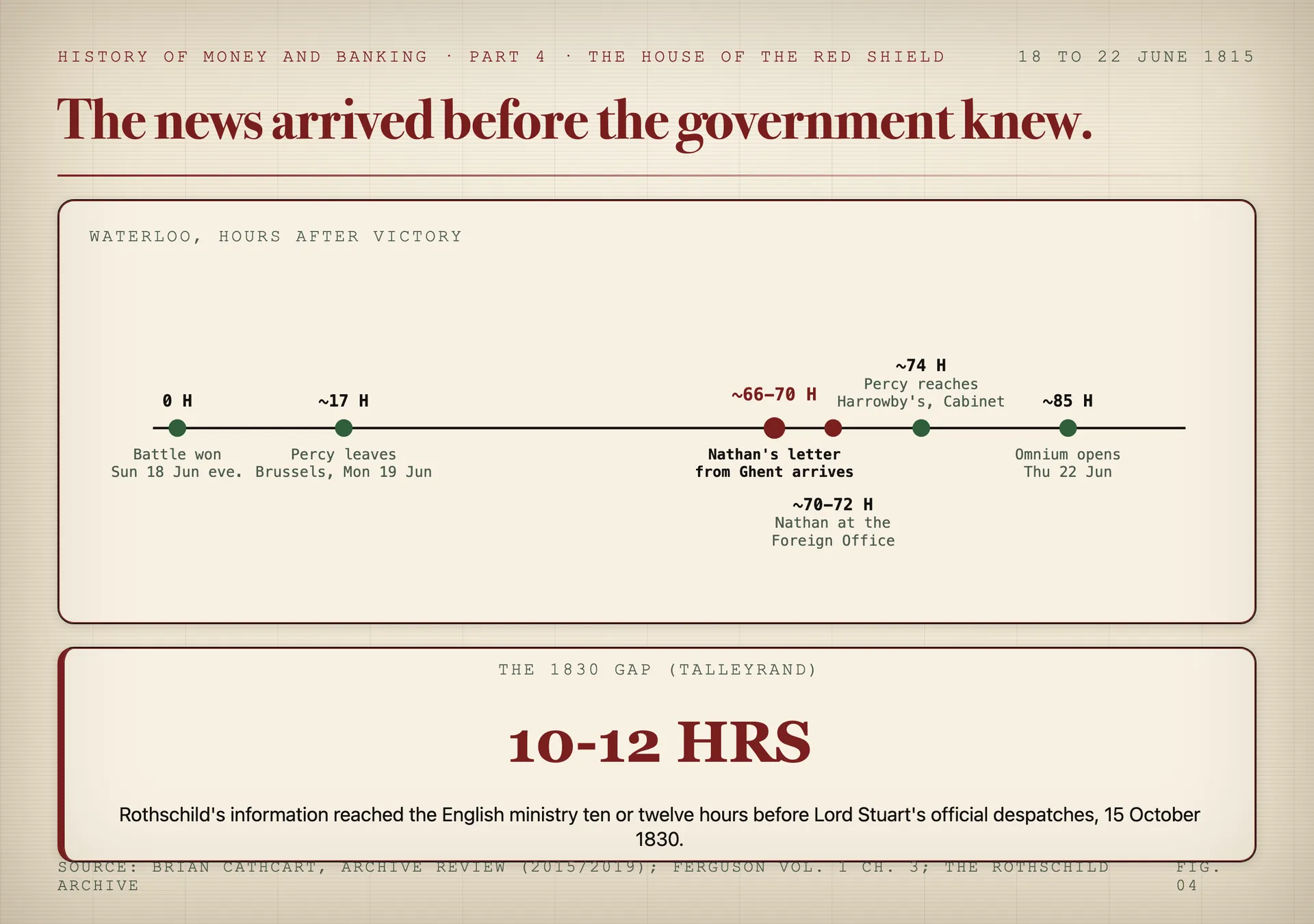
Hours, not days: the head start the record supports, and the only other measured lead, a French ambassador's ten or twelve hours. Source: Cathcart, Rothschild Archive Review; Talleyrand, Mémoires, vol. III; Ferguson, vol. 1.
Omnium, the new stock from that June's war loan, was "up," and its daily prices survive: the lows rose on Monday, rose on Tuesday, rose again on Wednesday.³⁹ It never slumped at all!
So the early news crashed nothing, and it barely paid. Victor Rothschild ran the numbers: the biggest possible purchase on June 20 at 56.5, sold a week later at 60.5, clears barely £7,000, and the family archive caps the whole campaign at "very considerably less than a million pounds, let alone 'millions.'"⁴⁰
Then he made the real trade. Late in 1815, on the advice of John Herries, the Commissary-in-Chief, Nathan bought consols at 61⅛ and 61½, plus £450,000 of Omnium at 107. His brothers begged him to sell, and he ignored them for a year. By the end of 1816 he held £1.2 million nominal, "very nearly equivalent to the entire capital of the firm," and his brother Amschel called it "stupid ... to invest one's whole fortune in one single security." By July 1817 consols were above 82, he held £1.6 million, and "It was at this point that Nathan began to sell, realising profits of more than £250,000."⁴¹
Two years, the whole capital of the firm on one security, and a quarter of a million pounds!
Salomon wrote to him, "Vansittart is a very fine man, insofar as he gave you a hint of a forthcoming funding operation."⁴² Vansittart was the Chancellor of the Exchequer, so the insider tip in this story is real: it came two years late, from the Treasury, and it said sell.
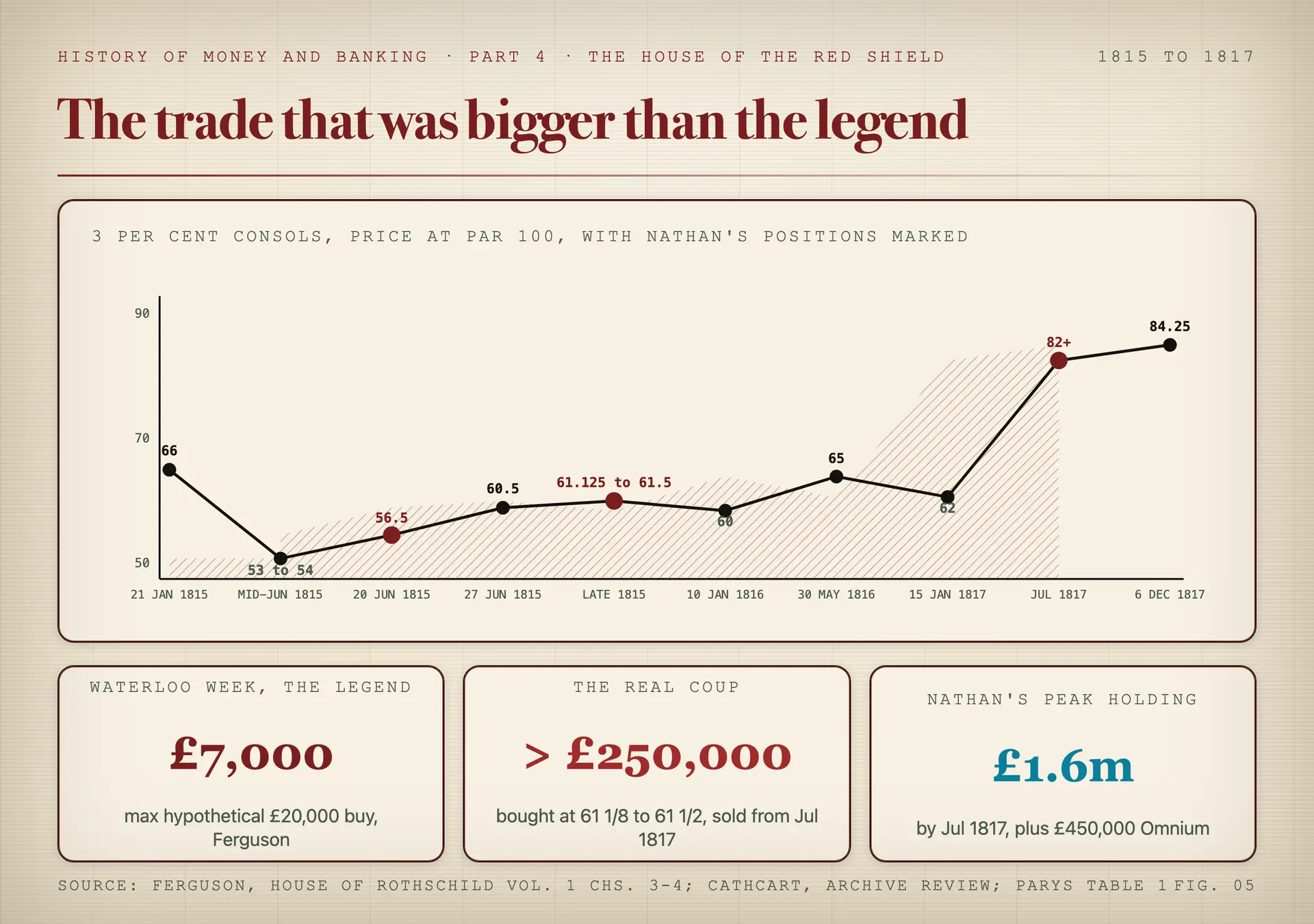
The legend's trade is the bump in June 1815. The real one is the long climb, worth more than £250,000. Source: Niall Ferguson, The House of Rothschild, vol. 1, chs. 3-4; Parys 2020, Table 1.
Six great powers, and one of them is a bank
Aix-la-Chapelle, autumn 1818. Salomon Rothschild is in town, and he hands Metternich's secretary, Friedrich von Gentz, 800 ducats. Gentz later called loans like that "donations pure and simple."⁴³
A French first minister counted the great powers of Europe that year and came up with six: "Britain, France, Russia, Prussia, Austria and Barings."⁴⁴ Barings, not Rothschilds.
Barings' French loans "paid interest in francs in Paris," so an English lender collected abroad and ate the exchange rate, and that same year Nathan sold Prussia's debt a different way.⁴⁵
- Pounds, not thalers. £5,000,000 at 5 per cent, denominated in sterling.
- Paid where the lender lives. Interest "payable in sterling in London and other financial centres."
- Six cities at once. London, Frankfurt, Berlin, Hamburg, Amsterdam and Vienna.
- A sinking fund. Bonds retired by purchase, or by drawing lots above par.
- Collateral. A special mortgage on the royal domains of Prussia.
- Priced to sell. The first tranche went out at 70 per cent of face value.
A foreign king borrowed English money from English widows, payable around the corner.
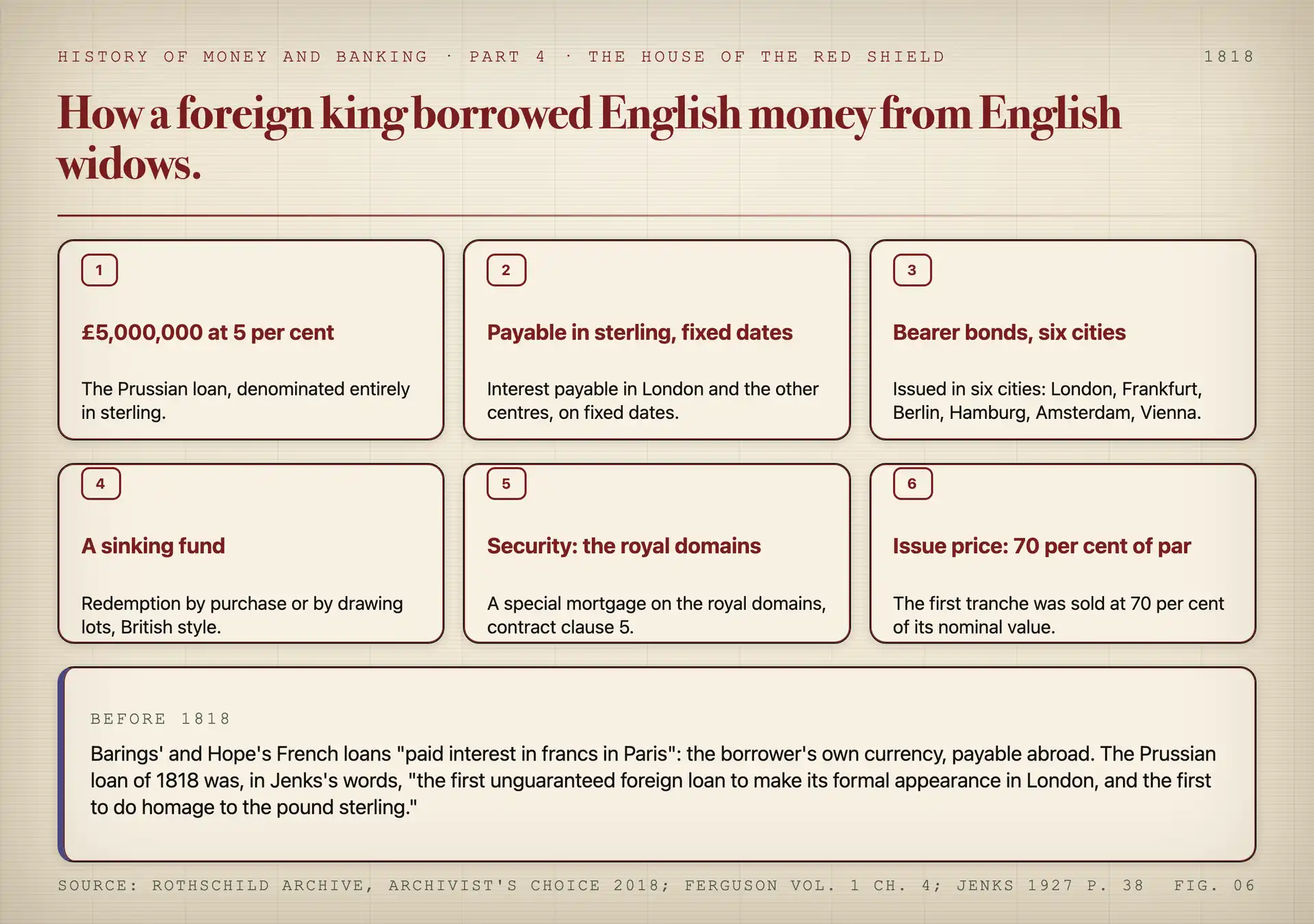
After 1818, the money traveled to the lender. Source: The Rothschild Archive, Prussian loan ledger, 1818; Ferguson, vol. 1, ch. 4.
Then every court wanted one: Austria, Naples, Russia, France, Brazil, until by 1859 the London house had issued fifty loans worth around £250 million, against fourteen and £66 million for Barings.⁴⁶
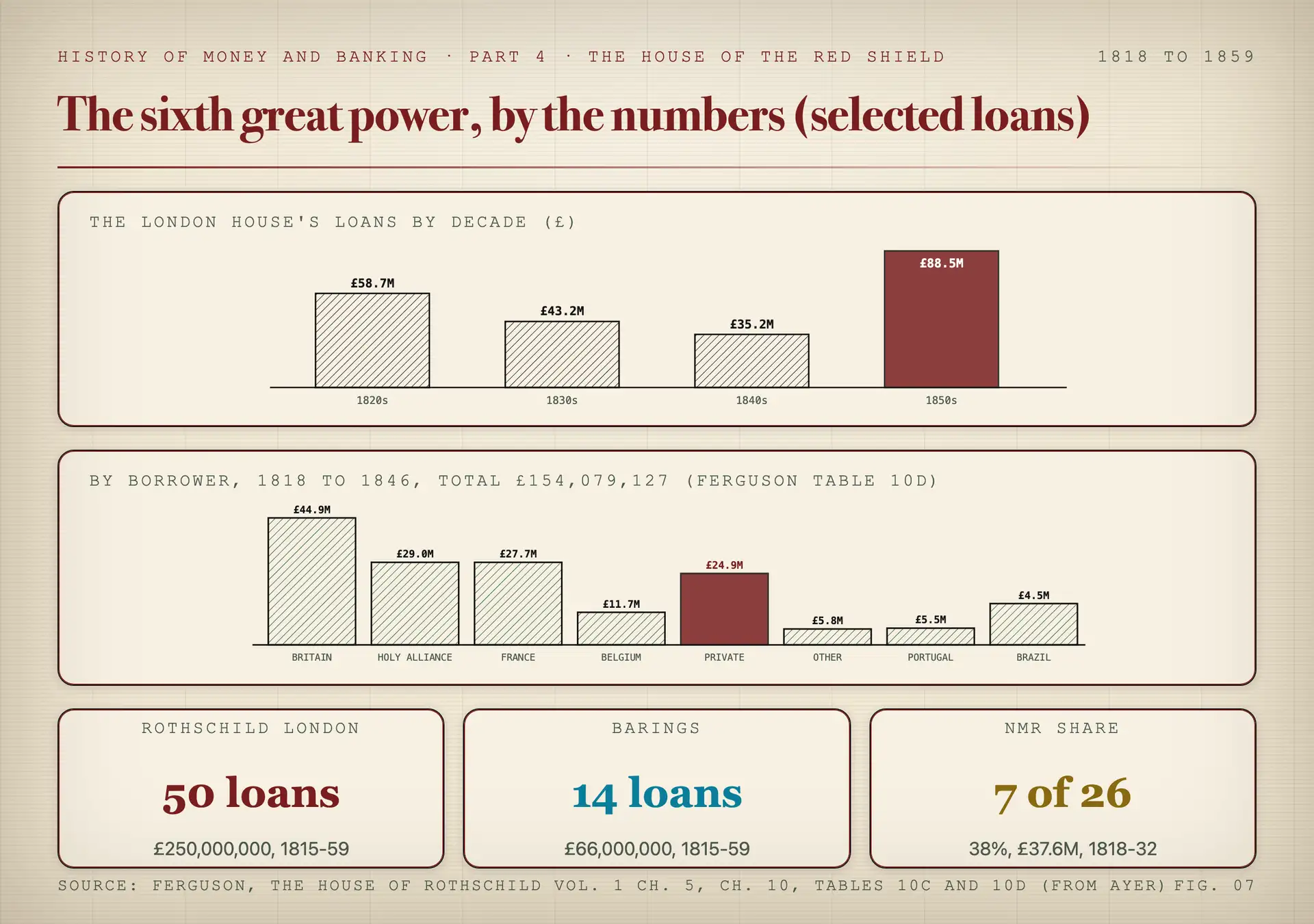
Fifty loans against fourteen. Source: Niall Ferguson, The House of Rothschild, vol. 1, chs. 5 and 10.
In 1820 the Bremen envoy Smidt wrote that the house had "actually achieved the position of a real Power," and that "Prussia would long ago have had to discard her constitution if the House of Rothschild had not made it possible for her to put off the evil day."⁴⁷
Holy Moly! A constitution, kept alive on a line of credit...
Vienna paid its respects too: in 1822 Metternich got a loan of 900,000 gulden agreed "just six days before" the brothers were made barons. The barony's arms carried five arrows where the 1817 grant had four, because Nathan in London had been left off.⁴⁸
Then came the winter the Bank of England ran out of gold.
December 1825. Seventy-three of 770 country banks have failed, and on Christmas Eve the Bank's reserve hits "just over a million pounds"; Nathan is already shipping in gold, "beginning with £300,000 of sovereigns."⁴⁹ Harriet Arbuthnot's journal says "Rothschild has made the most gigantic efforts to assist the Bank."⁵⁰
Half a century later, the same house would answer a Prime Minister's messenger in three words, and those three words are waiting for us at New Court in 1875.
That year, 1825, the brothers' combined capital stood at £4,082,000: nine times Barings, and more than the Banque de France. In Ferguson's verdict on the 1820s, "it was no longer Barings, but Rothschilds."⁵¹
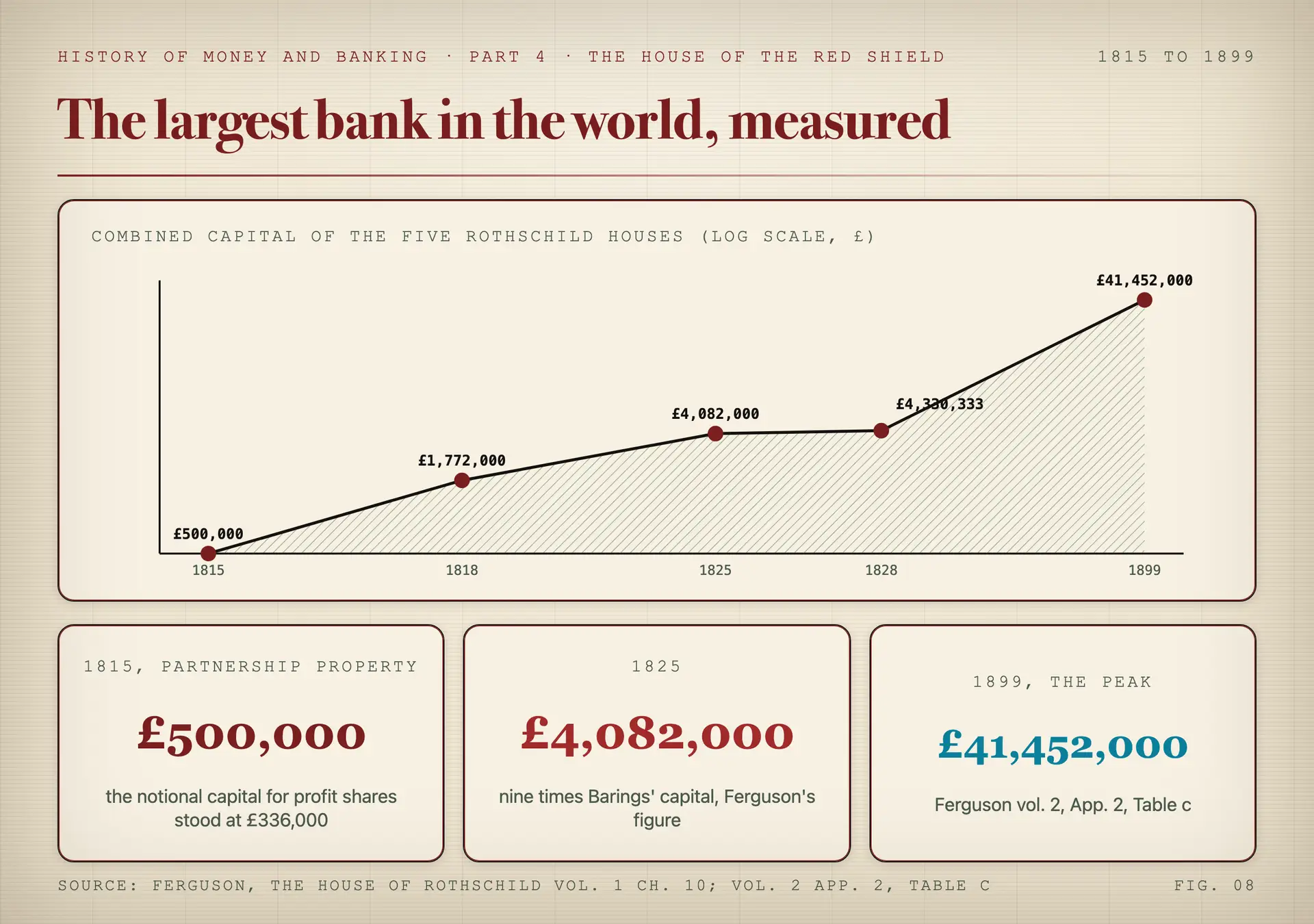
The real fortune shows up in the partnership books, a decade after Waterloo. Source: Niall Ferguson, The House of Rothschild, vol. 1, ch. 10 and vol. 2, Appendix 2.
And then they built railways: Salomon's Nordbahn, the first major steam railway in continental Europe, opened in 1837 after 27,490 applications for 4,000 public shares, and James's Nord line out of Paris opened in 1846.⁵²
A French minister had counted six great powers and put a bank at the end of the list. He just had the wrong bank.
Now for everything you've heard
The comment section: the brothers financed Napoleon and Wellington at the same time, so the house won whichever way the cannon pointed, and then they did it in every war since 1776. In the Civil War they lent to the Union through one door and the Confederacy through the other, and when Lincoln printed greenbacks rather than pay their rates, John Wilkes Booth settled the account.
Before all that, Mayer Amschel sat at a table in Frankfurt in 1773 with twelve rich men and a plan: pool the money and finance the revolutions of the world. Three years later, the Illuminati were born. The Protocols of the Elders of Zion are the minutes of the world plot, and in the canon the bankers behind it have a family name.
Then the line the legend puts in Mayer Amschel's mouth: "Permit me to issue and control the money of a nation, and I care not who makes its laws."
So of course they own the central banks, every one, the story goes, except three: Cuba, North Korea and Iran. The list used to be longer...
When John F. Kennedy signed Executive Order 11110 on June 4, 1963, handing the Treasury the power to issue silver certificates, the canon says he threatened the whole racket, and you know where he went in November.⁵³
The family is worth $500 trillion, or 80 per cent of the wealth on earth, depending on the meme.⁵⁴ In the canon, Hitler's grandmother was a servant girl in the house of Baron Rothschild in Vienna.
And the favorite photographs come from the Château de Ferrières on December 12, 1972, where Baron and Baroness Guy de Rothschild throw a surrealist dinner for 150, and the invitation has to be read in a mirror. The hostess comes as a stag at the kill, with towering antlers and jewels for tears, Salvador Dalí is wheeled in, and Audrey Hepburn wears a wicker birdcage.⁵⁵ The canon calls it an Illuminati ritual, and the party was very, very real!
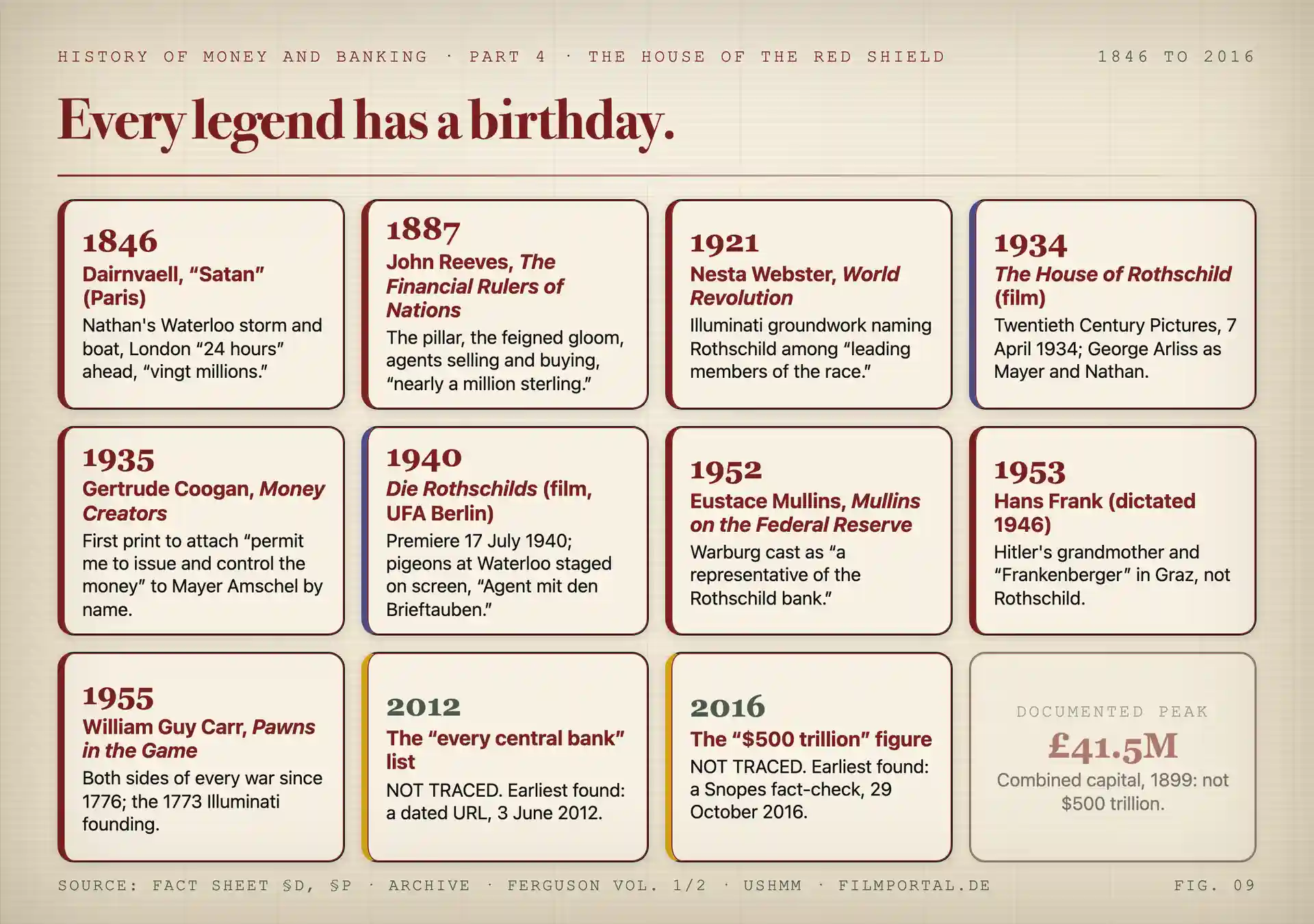
Not one of these legends was born in Mayer Amschel's lifetime. Source: the first printings as named on the figure; The Rothschild Archive; Cathcart 2015.
Every one of those stories has an author and a birthday.
The wild ones that are true
Monday, August 3, 1835, the House of Commons. The Chancellor, Thomas Spring Rice, rises to report on the loan that will pay the compensation for ending colonial slavery. He had invited competition, and Hansard records how that went: "it so happened that two out of three parties declined availing themselves of it, and he this day found that the only tender made was by the house of Rothschild and Co."⁵⁶
One bidder.
The Act of 1833 freed "more than 800,000 enslaved Africans" and paid £20 million "to slave-owners for the loss of their 'property,'" about 40 per cent of a year's government spending, while the freed "apprentices" worked on unpaid for up to six more years.⁵⁷ Fifteen million of it came through Nathan's loan, raised with Moses Montefiore, his brother-in-law twice over.⁵⁸ The owners were even paid interest on their compensation, backdated to August 1, 1834.⁵⁹
The slaveowners got their capital and their interest, the banker got his loan, and the British taxpayer got the bill. The 800,000 people at the bottom of the whole transaction got nothing.
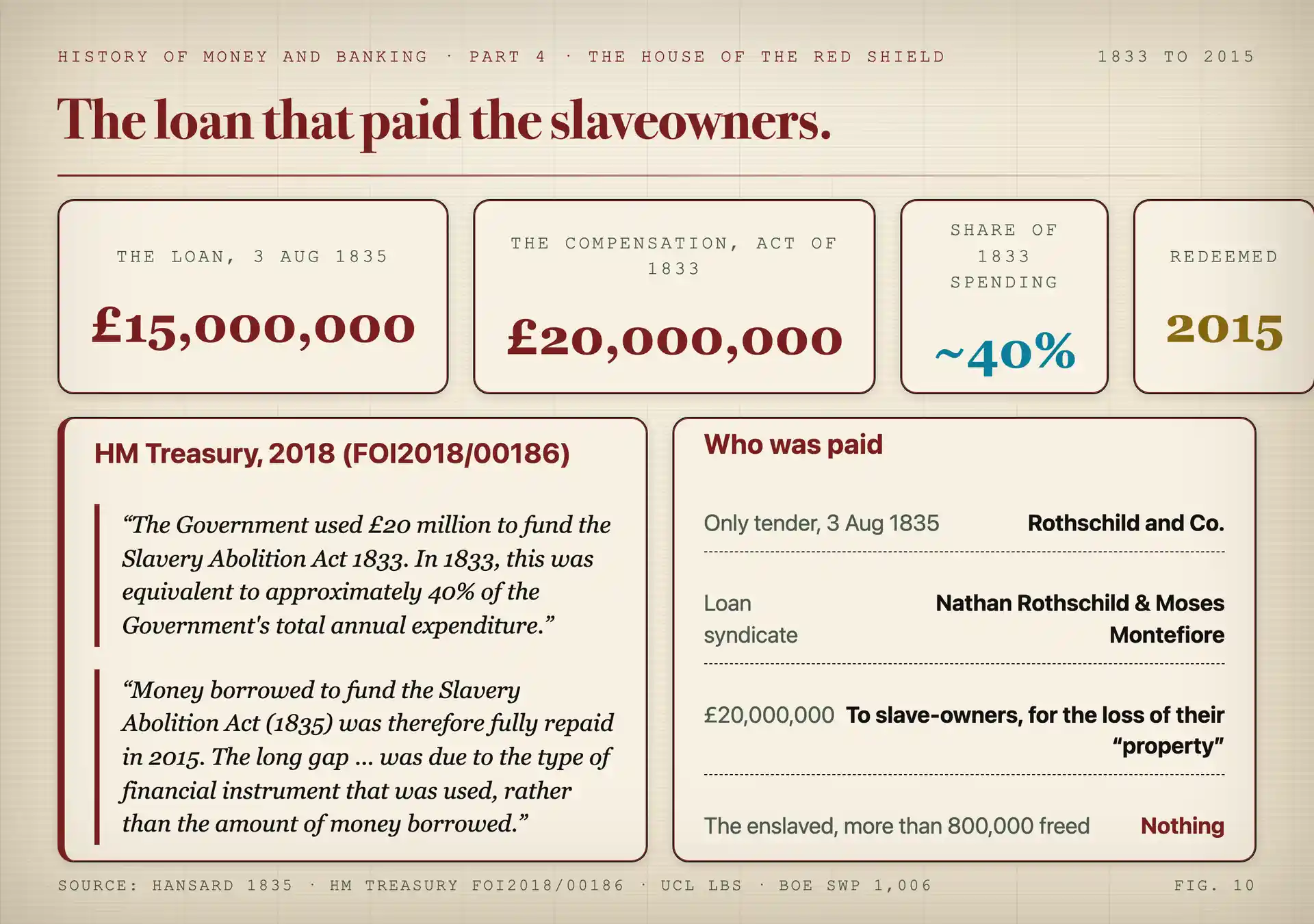
One tender, and not a penny to the people it freed. Source: Hansard, 3 August 1835; HM Treasury FOI2018/00186; Bank of England Staff Working Paper No. 1,006.
Forty years later, the same house put up the money for a canal.
Monday, November 15, 1875. A newspaper editor tips off the Foreign Secretary that the Khedive of Egypt is shopping his Suez Canal shares to the French, and two days later the Cabinet agrees in principle to buy. Disraeli sends his secretary, Montagu Corry, to New Court (the 17th or 18th by his biographer, the 23rd or 24th by Ferguson), and Corry told the scene for the rest of his life.⁶⁰
The Prime Minister wants £4,000,000, tomorrow, and Lionel de Rothschild eats a muscatel grape, throws out the skin, and asks, "What is your security?"
"The British Government."
"You shall have it."
On November 23 the Khedive offered the shares "for £4,000,000," the Cabinet said yes on the 24th, and by the 26th the shares sat in the British consulate: "The whole transaction had been completed in ten days." On the 24th, Disraeli wrote to the Queen.⁶¹
A low rate, he told the Queen, and the Commons got the invoice in February: 176,602 shares instead of 177,642, a price cut to £3,976,582, a commission of 2½ per cent worth £99,414, and 5 per cent interest that came to £52,485.⁶² Gladstone did the math out loud and decided the price of that money proved "we are an Oriental Potentate indeed."⁶³
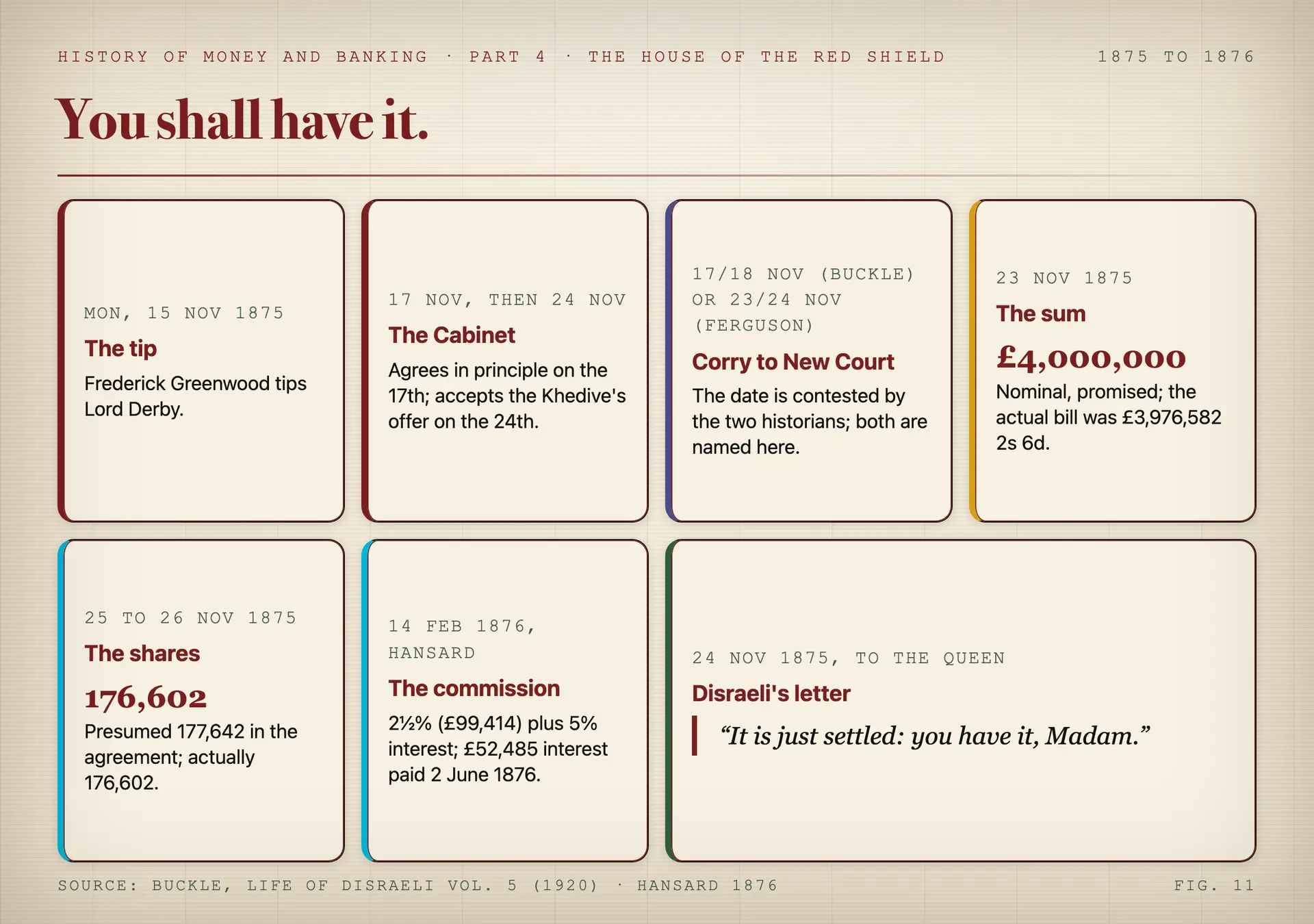
Ten days from an editor's tip to a British stake in the canal. Source: Buckle, Life of Disraeli, vol. 5; Hansard, February 1876.
The rest of the list reads like a dare.
In 1847, with Ireland starving, the Chancellor told the Commons "I must go into the market and borrow," Rothschilds and Barings split the underwriting of an £8 million loan, and Lionel's British Relief Association, with £1,000 from his bank, raised £470,041, and £391,700 of it went to Ireland.⁶⁴
From September 12, 1919, five bullion firms met at New Court to fix the price of gold, with the Rothschild man in the chair and a small Union Jack on every desk. When all the flags were down the price was fixed, and they did it over 15,000 times, until May 4, 2004.⁶⁵ Eighty-five years of the world's gold price, set with little paper flags!
Mercury: in 1835 Lionel won Spain's Almadén mercury contract "essentially by bribing Toreno and the Queen," and by 1838 it made 38 per cent of the London house's profits; copper: control of Rio Tinto in the late 1880s; diamonds: £750,000 advanced to De Beers in 1887 for a £100,000 commission.⁶⁶
One more thing about 1835.
The slaveowners were paid in the 1830s, but the debt did not go anywhere: it was rolled over into the government's gilt program, one generation of stock into the next, long after every man in that chamber was dead.⁶⁷
The loan that paid the slaveowners was still on the books when the iPhone 6 came out.
The dark turns
Vienna, March 1938. A banker sits in a cell at the Hotel Metropol, which is now the Gestapo's headquarters, and he is the most valuable prisoner in the building.
His name is Louis von Rothschild, and he runs the Vienna house that Salomon founded. The Germans have been in the city about a day when he tries to leave it, and they take his passport, and then they take him. He had seen some of it coming: before the Anschluss he moved the family's biggest Austrian asset, the Witkowitz ironworks, over to the Alliance Assurance company, where the London house still held control.
As Ferguson tells it, Himmler had some ornate French furniture sent to the cell, and Louis sent it straight back, complaining that it made the place look like a Cracow brothel.
On 30 March the bank itself, S. M. von Rothschild, went under compulsory administration, and in October 1939 it was sold to the German firm of Merck, Finck & Co. The Germans wanted Witkowitz too, a sale was agreed in July 1939 at £2.9 million, and the war arrived in time to give them the excuse never to pay it.⁶⁸
Louis walked out that same July, and the family archive puts the price at "$21,000,000, believed to have been the largest bail bond in history for any individual."⁶⁹ A bail bond, for a man charged with nothing except his last name.
And while he sat in the Metropol, Adolf Eichmann set up his Central Agency for Jewish Emigration inside the family's palace on Prinz-Eugen-Strasse. They took the man, they took the bank, and then they moved into the house to run the paperwork of getting rid of everybody else!
Hollywood got to the story first, in 1934, with The House of Rothschild, George Arliss playing both Mayer Amschel and Nathan, and one scene shows the family hiding its money and playing poor to fool a tax collector. Six years later Fritz Hippler's Der ewige Jude lifted that exact scene, English dialogue under German subtitles, and cut it into a Nazi film.⁷⁰ An American picture about a persecuted family became raw footage for the persecutors.
Goebbels wanted one of his own, and after his directive of November 1938 demanding strictly antisemitic pictures, Universum-Film in Berlin made Die Rothschilds, and it premiered at the Capitol on 17 July 1940. The cast list includes "Nathan Rothschilds Agent mit den Brieftauben," Nathan's agent with the carrier pigeons. Yes, those pigeons, the ones from the top of this story, flying across a movie screen in Berlin the summer Germany took Paris.
It was pulled that September, rewritten to hate the British harder, and re-released on 2 July 1941 as Die Rothschilds. Aktien auf Waterloo, "Shares on Waterloo," ending on a Star of David laid over a map of England.⁷¹ The Waterloo legend, now with a studio budget and a war to sell.
The name kept costing people.
Sarnano, in the mountains of the Marche, 29 November 1980. A surveyor named Nazzareno Venanzi has an aperitif with two women and tells them not to go up the mountain, because the snow is coming.
They go anyway.
One is Jeannette Bishop, a hairdresser's daughter from the Isle of Sheppey, and she married Evelyn de Rothschild on 30 September 1966 and divorced him in 1971. The other is Gabriella Guerin, who had cooked for the couple in London in the 1960s.⁷²
Then the snow came, and on 18 December a helicopter spotted their black Peugeot 104 near Ferrano di Acquacanina, locked, with the handbrake on, and nobody ever asked anyone for a ransom.⁷³ On 27 January 1982 two boar hunters found what was left of both women in the woods near Lago di Fiastra, and Jeannette's automatic watch had stopped on 12 December. In October 1989 the investigating judge, Alessandro Iacoboni, called it a double homicide by persons unknown, for reasons unknown.⁷⁴
One English theory had kidnappers chasing the name she no longer carried, and there was a precedent: a businessman named Rolf Schild was kidnapped in Sardinia in 1979 by men who mistook his name for Rothschild. The name was worth a kidnapping even when it was the wrong name.
Macerata's prosecutors reopened the file for double homicide in 2024, and by November 2025 it was heading for the archive with no suspect, and the chief prosecutor told Corriere he was convinced someone in those mountains knows.⁷⁵
Forty-five years of snow, and still nothing...
Then there is the one your uncle posts: the Rothschilds own the Federal Reserve, the story goes, and the banker who secretly wrote the Act, Paul Warburg, was "a representative of the Rothschild bank." Keep that name in your pocket, because this series is headed to Jekyll Island, Georgia, in November 1910, and Paul Warburg of Kuhn, Loeb is one of the six men at that table.⁷⁶
The last dark turn is recent, every line of it is on paper, and I have written about the strangest things in the Epstein files before.
17 September 2015. An email from "A. de Rothschild" lands in Jeffrey Epstein's inbox with the subject line "Fwd: Rothschild Name" and two words of cover: "First hand..."
Underneath is a private family letter Jacob, the fourth Baron Rothschild, had sent round that day to Evelyn, Hannah, Ariane, Benjamin and James, objecting to Paris Orléans renaming itself Rothschild & Co without a prefix. One line: "The good name of Rothschild has already been badly damaged by the open disagreement between the two French Rothschild groups."⁷⁷
The same month, a draft "Letter of Agreement" is addressed to Epstein as president of Southern Trust Company, Inc., in St. Thomas. It says he has "been collaborating with Ariane de Rothschild on behalf of herself, her family and Edmond de Rothschild Holding, S.A." on "risk analysis and estate planning matters" and "the application and use of certain algorithms."
The fee clause ties the money to a penalty: for work on the bank's open matters with the United States Department of Justice, Epstein's company would get $10,000,000 if the penalty landed between $75 million and $150 million, and $25,000,000 if it came in at $75 million or less. Then section 4(a): neither Epstein nor his company "has any authority to, nor shall you or STC, bind any member of the Rothschild Group," and neither is "serving in any fiduciary capacity whatsoever." The released copy is unsigned, and the day of September is blank.⁷⁸
December 2015, from an exhibit prosecutors built out of Deutsche Bank records: $10,000,000 on 17 December from Edmond de Rothschild (Suisse) SA in Geneva, and $14,999,980 on 21 December from Benjamin Edmond de Rothschild, both to Southern Trust Company.⁷⁹
$24,999,980, twenty dollars shy of the draft's top line.
Then, on 28 February 2016, Epstein wrote to Peter Thiel: "as you probably know I represent the Rothschilds. I was hoping to figure out a way for the bank that has 160 b in mgmt can do something in tech. best client list in the world , prehistoric products."⁸⁰ Thiel's reply in the same thread was about travel: "Certainly not in Saudi."
In February 2026 the bank told Reuters that Epstein had been a business acquaintance of Ariane de Rothschild from 2013 to 2019, that she had no knowledge of his conduct, and that she "unequivocally condemns his behaviour and the crimes which he committed."⁸¹
He said he represented them, money reached his company, and the draft that governed the money says he could act for none of them. What anybody knew is not in the documents.
Before and after
Picture a widow in Bath in 1790 with a few hundred pounds to put somewhere safe: she buys British consols at about 76⅞, yielding 3.90 percent, because lending to the King of Prussia is not on her menu. Foreign princes borrowed from Dutch private bankers, or from a Frankfurt house like Bethmann, which cut a 1778 loan of 20,000 gulden into twenty bonds of 1,000 gulden apiece, and the interest came to you abroad, in the borrower's money, if it came.⁸²
Now give her daughter the same money in 1850, and she can buy the King of Prussia's bonds in London, in pounds sterling, with the coupon paid in London. The 1818 Prussian loan, in Leland Jenks's phrase, was "the first to do homage to the pound sterling."⁸³
A king bowing to somebody else's currency, and the somebody was a widow in Bath!
The bills of exchange still did the settling, but now they cleared through London, and Nathan said so in 1832: "this country in general is the Bank for the whole world." Between 1815 and 1859 the London house brought out 50 loans worth about £250 million, against 14 loans and £66 million for Barings, while Barings' acceptances in 1850 ran £1.9 million to New Court's £540,000.⁸⁴ The Rothschilds took the bonds and Barings kept the bills.
And the new machine made kings liquid without making them honest: twenty-six foreign governments floated issues in London between 1818 and 1832, and by 1837 "only ten of these still paid."⁸⁵
Byron saw both houses in 1823, in the same breath: "Jew Rothschild, and his fellow Christian Baring," and then, "Every loan / Is not a merely speculative hit, / But seats a nation or upsets a throne."⁸⁶
By 1850 the machine had passed down a generation, most of the way: Lionel had run London since 1836 and Anselm ran Vienna, while James still held Paris, Amschel Frankfurt and Carl Naples. The founders built the thing, and the sons ran it like a utility.
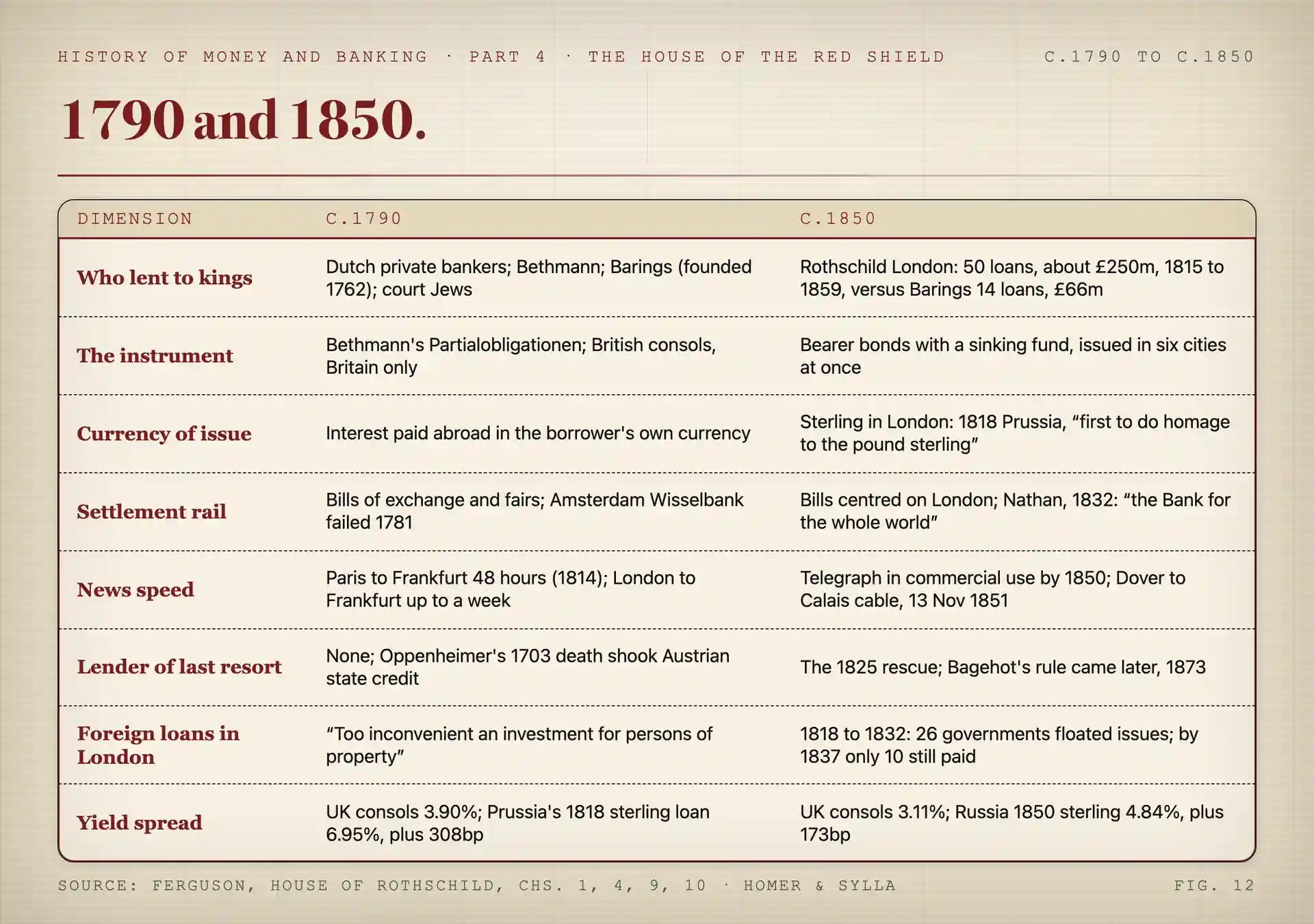
One working lifetime separates these two columns. In 1790 a foreign loan was a local deal paid abroad in the borrower's coin; by 1850 it was a sterling bond sold in six cities and paid in London, with the telegraph already in commercial use. Source: Homer and Sylla, A History of Interest Rates, 4th ed.; Ferguson, The House of Rothschild, vols. 1-2; Jenks 1927; IET Archives.
Part 3 of this series ended on metal and the stamp, on the day a mark on the coin started doing more work than the silver inside it. This generation took the stamp off the coin entirely: a bond is a promise with a family name printed on it, traded in six cities, and it is worth exactly what the name is worth.
Where are they now?
London, 2 November 1917. A messenger carries a letter from the Foreign Office to 148 Piccadilly.
It is addressed to Walter Rothschild, the second Baron, a zoologist, who receives it "in his capacity as unofficial leader of the British Jewish community," as the family archive puts it.⁸⁷ The War Cabinet had approved the wording at the end of October.
Sixty-seven words in the operative paragraph, and the salutation is a family name.⁸⁸
Why him? The historian Leonard Stein wrote that addressing it to Rothschild solved a protocol problem and "had the decisive advantage of associating the Declaration with the most potent name in Jewry."
The French branch had been building on the ground for thirty-five years already: Edmond de Rothschild funded colonies in Palestine from 1882, Rishon le Zion, Zikhron Ya'aqov and Rosh Pinna among them, and spent around £5.6 million on his settlements. James de Rothschild's bequest paid for the Knesset building, which opened in 1966. The Supreme Court building in Jerusalem, supported by the family foundation Yad Hanadiv, was inaugurated in 1992.⁸⁹
The houses you could not behead closed anyway, one at a time, for very different reasons.⁹⁰
Guy de Rothschild wrote the epitaph for the Paris house himself: "Juif sous Pétain, paria sous Mitterrand, cela suffit!" A Jew under Pétain, a pariah under Mitterrand, that's enough.⁹¹
Part 1 of this series promised you banks you could not behead, then France beheaded one, legally, with compensation, and inside five years the family had grown the head back under another name. London split on its own in 1980, when Jacob left New Court, in what Ferguson calls a serious rift inside the English family.
Two Rothschild banks carry the name today: Rothschild & Co, in Paris and London, reported net banking income of €2,535.3 million for 2023, and the Edmond de Rothschild Group, in Geneva, reported CHF 198 billion under management at the end of 2025, with Ariane de Rothschild as chief executive.⁹² Yes, that Rothschild & Co: the rename Jacob fought in 2015 went through anyway.
Evelyn de Rothschild died on 7 November 2022, Jacob died on 26 February 2024, aged 87, and The Guardian's obituary opened on his "ruthlessly successful business career."⁹³
In 1917 a government writes to a family: "Dear Lord Rothschild." In 2016 a man writes to Peter Thiel: "as you probably know I represent the Rothschilds." And the draft contract that paid him says he could not "bind any member of the Rothschild Group," while the one person it names as a "duly authorized representative" is Ariane de Rothschild, for the bank's holding company.⁹⁴
A foreign secretary wrote to a Rothschild. A century later, a convicted sex offender wrote that he represented them.
The bank in those papers is Edmond de Rothschild, in Geneva. Rothschild & Co, the Paris and London bank, does not appear anywhere in the Epstein record as a party.
But is it true?
I told all of that the way the people who left the record told it, full volume. I promised you which parts are true, and that some true parts are worse. So let's run the tape.
This stuff is true
- The street and the boy. The locked gates, the red shield, the court factor of 1769, and the Elector's fortune, managed as a stock account in code from London.
- The machine. Five sons in five cities, the Hebrew-script letters, the gold road to Wellington, and family pigeons from the 1820s on.
- Waterloo, the real version. A letter from Ghent on 21 June 1815, Nathan at the Foreign Office hours ahead of the Duke's dispatch, and the 1817 trade that cleared more than £250,000.
- The bonds. The 1818 sterling bond, the 1825 rescue, the slavery loan, Suez in ten days, the famine loan, and 85 years of the gold fix.
- The twentieth century. "Dear Lord Rothschild," Vienna 1938, Eichmann in the palace, and the Epstein papers exactly as they read.
This stuff is probably, but not provably, false
- Nathan at Waterloo, the storm, London a day ahead. A Paris pamphlet of 1846 by Georges Dairnvaell, who signed it "Satan."⁹⁵
- The pillar, the fake selling, the crash, the million. John Reeves, 1887, carried on by Balla in 1913 and Henry Ford's paper in 1920-22.
- The pigeons at Waterloo. Untraced; Corti wrote "some said" in 1928, and Goebbels's studio filmed them in 1940.
- The buried treasure. Friedrich von Gentz, in a Brockhaus encyclopaedia entry of 1827, as Ferguson traces it.
- "Permit me to issue and control the money of a nation." Gertrude Coogan printed it over his name in 1935; nothing from his lifetime says it.
- The Illuminati, and both sides of every war. William Guy Carr, 1955, on Nesta Webster's groundwork of 1921.
- The Protocols as a Rothschild plot. A Tsarist forgery of 1903, exposed in The Times in 1921; the Rothschild footnotes arrived in a 1934 English edition.
- The Fed, Warburg and every central bank. Eustace Mullins, 1952, expanded 1983; the central-bank list is untraced before 2012.
- Lincoln's warning and Kennedy's order. The Lincoln line first surfaces with the Knights of Labor in 1887; the Kennedy motive is Jim Marrs, 1989.
- $500 trillion. Untraced; the family's own peak capital was about £41.5 million, in 1899.
- Hitler's grandmother in a Rothschild house. Fritz Thyssen, 1941; even Hans Frank's version named a different family.
- The birdcage ball as a ritual. Vigilant Citizen, 2013; The New York Times covered it in 1972 as a costume dinner.
- The grape and "You shall have it." Montagu Corry's dinner story, first printed by Buckle in 1920, who said not to take it "as gospel."
- "Six great powers, and one of them is Barings." Attributed to the Duc de Richelieu in 1818; nothing from his lifetime carries it, Ferguson calls it probably apocryphal, and Philip Ziegler put it on a book cover in 1988.
Some lines are mine, and I own them. "He knew before the King" holds for the Prince Regent; a French king and a man from Dover knew before Nathan did. "A bank you could not behead," the heist and "data is money" are my readings. The iPhone 6 line checks out, by four and a half months.
And one bad legend is mine. In my Invisible Plantation series I wrote that Epstein "self-introduced as a representative of the Rothschilds" as early as 2011. The document is from 2016, it says "represent," and it is about a bank and "tech." I folded two true things into one false one. Consider it corrected.
But this one wild fact is true, and it begs a lot of questions.
On 3 August 1835 the Chancellor told the Commons that for the £15 million loan to pay Britain's slave-owners, "the only tender made was by the house of Rothschild and Co." The whole £20 million was, by the Treasury's own count, "approximately 40%" of the government's annual spending, and the more than 800,000 people it freed received nothing.⁹⁶ The Treasury says the debt was rolled into the gilt program and "fully repaid in 2015," the long gap "due to the type of financial instrument that was used, rather than the amount of money borrowed." In February 2018 it tweeted, "Millions of you helped end the slave trade through your taxes," and took it down the next day.⁹⁷
The owners got paid. The enslaved got nothing. The taxpayers paid until 2015.
And the family's impact and reach are undeniable.
Before them, a foreign loan was a local deal, paid abroad in the borrower's coin, on news that crawled. After them, a king could borrow in sterling in six cities, a family's couriers could beat a government to its own battle, and a merchant bank lent its name more than its money. They put a private family name at the top of a public promise, and a Foreign Secretary addressed a promise to that name.
The false legends, meanwhile, were written by named men, Dairnvaell in 1846, Reeves in 1887, Coogan in 1935, Mullins in 1952, Carr in 1955, and every one of them wrote for a purpose that was never the truth about a family of bankers. That is why the true history is the better story.
This family understood that data is money, and they understood both better than almost anyone. So they kept the data where they kept the money: in the family. The will shut the daughters and their husbands out of the business "and even from all knowledge of it." Fifteen of the twenty-one marriages stayed inside the bloodline. The letters went back and forth in a script few outsiders could read.
Look at who holds the permanent record. More than 20,000 of their letters sit in the family's own archive. Ferguson, whose history I have leaned on this whole article, built it out of the family's own letters. The family paid Moritz Oppenheim in 1861 to paint the treasure scene, and by Ferguson's account the family approved and paid for the 1827 encyclopaedia entry in which Gentz wrote the treasure legend down.
The legends are false, and the true record still has an owner. That is a custody problem. A flattering fact about very powerful people can be shaped by the hands that hold the archive. So can an ugly rumor. So can every theory that grew out of a leak, or an alleged leak, from family and associates. All of it comes downstream of the same vault, and none of it arrives sterile.
So the verdict is yours. You can take the official history as the truth, or you can decide that a history written out of a family's own archive is only as trustworthy as the family. That is a hard pill to swallow for anybody who just wants to know what happened.
The family still holds the key to its own record.
China's paper money is still coming, in its own installment later in this series.
Kurt Wuckert Jr. is the Chief Bitcoin Historian, founder of GorillaPool and Open Protocol Labs, and host of Kurt's Podcast. He writes weekly on Bitcoin, geopolitics, faith, and the long fight for human sovereignty at kurtwuckertjr.com. Catch him live every Tuesday at 2 PM EST.
Footnotes
¹ John Reeves, The Rothschilds: The Financial Rulers of Nations, Sampson Low, 1887, pp. 173-175.
² Niall Ferguson, The House of Rothschild: Money's Prophets 1798-1848, vol. 1, ch. 1, Viking, 1998; and Jewish Encyclopedia, Frankfort-on-the-Main, 1906.
³ Count Egon Caesar Corti, The Rise of the House of Rothschild, trans. Brian and Beatrix Lunn, Gollancz, 1928, p. 16; and Ferguson, vol. 1, ch. 1.
⁴ Jewish Encyclopedia, Fettmilch, Vincent, 1906.
⁵ The Rothschild Archive, The Rothschild name and arms; and Corti, 1928, p. 17.
⁶ Niall Ferguson, The House of Rothschild: Money's Prophets 1798-1848, vol. 1, ch. 1, Viking, 1998 (Naftali Herz's son, grandson and great-grandson "also used the name 'Bauer'"); and Amos Elon, Founder: Meyer Amschel Rothschild and His Time, Viking, 1996, p. 48.
⁷ The Rothschild Archive, Mayer Amschel Rothschild (1744-1812); and Corti, 1928, p. 18.
⁸ Amos Elon, Founder: Meyer Amschel Rothschild and His Time, HarperCollins, 1996, p. 64.
⁹ Corti, 1928, pp. 21-22; and Elon, Founder, 1996, pp. 65-66.
¹⁰ Ferguson, vol. 1, ch. 1; and Elon, Founder, 1996.
¹¹ Corti, 1928, p. 25.
¹² Ferguson, vol. 1, ch. 2, for the treasure story, its garden version and the code names; and vol. 1, Introduction and ch. 2, for Gentz's 1827 Brockhaus entry, which Ferguson says the family approved and paid for.
¹³ Thomas Fowell Buxton to Miss Buxton, 14 February 1834, in Memoirs of Sir Thomas Fowell Buxton, Baronet, John Murray, 1848, ch. XXI, p. 345.
¹⁴ Buxton, Memoirs, 1848, ch. XXI, pp. 343-344; 3rd ed., 1849, pp. 288-289.
¹⁵ The Rothschild Archive, Timeline and the five brothers' person pages; and Ferguson, vol. 1, ch. 2, from the firm's balance sheets.
¹⁶ Ferguson, vol. 1, ch. 2; and Jewish Encyclopedia, Frankfort-on-the-Main, 1906.
¹⁷ Corti, 1928, pp. 122-124; and Ferguson's translation of the will, vol. 1, ch. 2.
¹⁸ Corti, 1928, p. 123.
¹⁹ Ferguson, vol. 1, 1998.
²⁰ Vansittart to Herries, 11 January 1814, RAL XI/52/30, in Ferguson, vol. 1, ch. 3.
²¹ Ferguson, vol. 1, chs. 3-4.
²² Buxton, Memoirs, 1848, ch. XXI, p. 344; the 1849 edition reads "800,000l. worth of gold".
²³ The same letter, RAL XI/52/30.
²⁴ Ferguson, vol. 1, ch. 3.
²⁵ Herries to Sir George Burgman, 1814, in Ferguson, vol. 1, ch. 3.
²⁶ Ferguson, vol. 1, ch. 3.
²⁷ The Rothschild Archive FAQ, Rothschilds and pigeon post, capture of 28 January 2016; the slips are RAL XI/109/57.
²⁸ Vic Gray, Breaking the seal, Rothschild Archive Review 1999-2000, p. 13; and The Rothschild Archive, Telegraphic code books, February 2019, with Ferguson, vol. 1, Introduction and ch. 5.
²⁹ Ferguson, vol. 1, ch. 9.
³⁰ Talleyrand to Madame Adélaïde, 15 October 1830, Mémoires du prince de Talleyrand, vol. III, 1891.
³¹ Ferguson, vol. 1, Introduction.
³² Graham Storey, Reuters' Century 1851-1951, 1951, pp. 9-10; and The Baron, History.
³³ The Rothschild Archive, Telegraphic code books, Archivist's Choice, February 2019.
³⁴ Ferguson, vol. 1, ch. 9; and vol. 2, The World's Banker 1849-1999, ch. 2, Viking, 1999.
³⁵ Brian Cathcart, Victory, Sir! Victory!, London Historians, 5 September 2019.
³⁶ Brian Cathcart, Nathan Rothschild and the Battle of Waterloo, The Rothschild Archive Review, 2015.
³⁷ Caledonian Mercury, 24 June 1815 (written 21 June), quoted in Cathcart, Nathan Rothschild and the Battle of Waterloo, 2015, note 10.
³⁸ Cathcart, Victory, Sir! Victory!, 2019; and Niall Ferguson, The House of Rothschild, vol. 1, ch. 3, Viking, 1998.
³⁹ Wilfried Parys, David Ricardo, the Stock Exchange, and the Battle of Waterloo, University of Antwerp Working Paper 2020009, Table 4, 2020.
⁴⁰ Ferguson, The House of Rothschild, vol. 1, ch. 3; and The Rothschild Archive, Nathan Mayer Rothschild and the Waterloo Commission, accessed 2026.
⁴¹ Ferguson, The House of Rothschild, vol. 1, ch. 4.
⁴² Salomon Rothschild to Nathan Rothschild, 1817, quoted in Ferguson, The House of Rothschild, vol. 1, ch. 4.
⁴³ Ferguson, The House of Rothschild, vol. 1, ch. 5, from Gentz's diary.
⁴⁴ The Baring Archive, The Louisiana Purchase, accessed 2026.
⁴⁵ Ferguson, The House of Rothschild, vol. 1, ch. 4, and vol. 1, Introduction, for his verdict on the bond market; and The Rothschild Archive, Subscription ledger for the Prussian Government loan, 1818, March 2018.
⁴⁶ Ferguson, The House of Rothschild, vol. 1, chs. 4, 5 and 10.
⁴⁷ Smidt (Bremen), report of a conversation with Count Buol, 1820, in Egon Caesar Corti, The Rise of the House of Rothschild, Gollancz, 1928, p. 289.
⁴⁸ Ferguson, The House of Rothschild, vol. 1, ch. 5; and Corti, The Rise of the House of Rothschild, 1928, pp. 201, 302.
⁴⁹ Ferguson, The House of Rothschild, vol. 1, ch. 4.
⁵⁰ Harriet Arbuthnot, journal, 17 December 1825, quoted in Ferguson, The House of Rothschild, vol. 1, ch. 4.
⁵¹ Ferguson, The House of Rothschild, vol. 1, chs. 5 and 10.
⁵² The Rothschild Archive, Timeline, entry 1837; and Ferguson, The House of Rothschild, vol. 1, ch. 15.
⁵³ Executive Order 11110, 4 June 1963, text and history, Wikipedia, accessed 2026.
⁵⁴ Dan Evon, Rothschild Family Wealth, Snopes, 29 October 2016.
⁵⁵ "In the Rothschild Manner, a Simple Dinner for 150 Close Friends," The New York Times, 17 December 1972.
⁵⁶ HC Deb 3 August 1835 vol. 30, col. 17, Compensation, Abolition of Slavery, Hansard.
⁵⁷ Michael Anson and Michael D. Bennett, The collection of slavery compensation, 1835-43, Bank of England Staff Working Paper No. 1,006, 2022; and HM Treasury, FOI2018/00186, 31 January 2018.
⁵⁸ Melanie Aspey, Nathan Rothschild's Company, The Rothschild Archive Review, 2004; and Anson and Bennett, Bank of England Staff Working Paper No. 1,006, 2022.
⁵⁹ HC Deb 3 August 1835 vol. 30, cols. 22-23, Compensation, Abolition of Slavery, Hansard.
⁶⁰ G. E. Buckle, The Life of Benjamin Disraeli, vol. 5, Macmillan, 1920, pp. 440-447; and Ferguson, The House of Rothschild, vol. 2, ch. 9, Viking, 1999.
⁶¹ Buckle, The Life of Benjamin Disraeli, vol. 5, 1920, pp. 446-449.
⁶² Sir Stafford Northcote, HC Deb 14 February 1876 vol. 227, col. 267, Supply, The Suez Canal Shares, Hansard; and Ferguson, The House of Rothschild, vol. 2, ch. 9.
⁶³ W. E. Gladstone, HC Deb 21 February 1876 vol. 227, cols. 591-592, Resolution, Adjourned Debate, Hansard.
⁶⁴ HC Deb 22 February 1847, The Budget, Hansard; Ferguson, The House of Rothschild, vol. 1, ch. 16; and Christine Kinealy, Lionel de Rothschild and the Great Irish Famine, History Ireland.
⁶⁵ The Rothschild Archive, Flag from the Gold Fixing Room, New Court, 2004, Archivist's Choice, September 2019.
⁶⁶ Ferguson, The House of Rothschild, vol. 1, ch. 13; and vol. 2, chs. 5 and 11, Viking, 1999.
⁶⁷ HM Treasury, FOI2018/00186, 31 January 2018.
⁶⁸ Niall Ferguson, The House of Rothschild: The World's Banker 1849-1999 (1999), ch. 14.
⁶⁹ The Rothschild Archive, Louis Nathaniel von Rothschild (1882-1955), family database.
⁷⁰ United States Holocaust Memorial Museum, Der ewige Jude, shot list, Collections, irn1002475.
⁷¹ filmportal.de, Deutsches Filminstitut, Die Rothschilds (1940), production and cast record; and United States Holocaust Memorial Museum, Die Rothschilds, Film ID 982, irn1001972.
⁷² The Rothschild Archive, Evelyn Robert Adrian de Rothschild (1931-2022), family database; and KentOnline, How did Sheppey-born Jeanette May Bishop die in Italy in 1980; and Riccardo Bruno, interview with Gioia Guerin, Corriere della Sera, 22 November 2024.
⁷³ RAI, Chi l'ha visto?, La misteriosa fine della baronessa Rothschild, 12 April 2010.
⁷⁴ Riccardo Bruno, Testimoni e nuove piste, dopo 44 anni riparte l'indagine, Corriere della Sera, 2 November 2024.
⁷⁵ Riccardo Bruno, Viaggio sui Monti Sibillini 45 anni dopo, Corriere della Sera, 29 November 2025.
⁷⁶ Eustace Mullins, The Secrets of the Federal Reserve, 1983 expanded ed., p. 224; and Gary Richardson and Jessie Romero, The Meeting at Jekyll Island, Federal Reserve History, 4 December 2015.
⁷⁷ US Department of Justice, Epstein Library, EFTA00845904, Data Set 9, email of 17 September 2015.
⁷⁸ US Department of Justice, Epstein Library, EFTA00310331, Data Set 9, draft Letter of Agreement, September 2015, ss. 2(b) and 4(a).
⁷⁹ US Department of Justice, Epstein Library, EFTA00027019, Data Set 8, Exhibit A, "Leon Black / Rothschild Group Transactions."
⁸⁰ US Department of Justice, Epstein Library, EFTA00832976, Data Set 9, email thread of 28 February 2016; duplicate EFTA02470755, Data Set 11.
⁸¹ Ariane Luthi and Tommy Reggiori Wilkes, Epstein files show Swiss bank ties, Reuters, 5 February 2026.
⁸² Sidney Homer and Richard Sylla, A History of Interest Rates, 4th ed. (Wiley, 2005), Table 13, p. 158 and p. 172; and Niall Ferguson, The House of Rothschild: Money's Prophets 1798-1848 (1998), ch. 1.
⁸³ Leland H. Jenks, The Migration of British Capital to 1875 (Knopf, 1927), p. 38.
⁸⁴ Ferguson, Money's Prophets 1798-1848, ch. 10.
⁸⁵ Homer and Sylla, A History of Interest Rates, 4th ed., p. 199.
⁸⁶ Lord Byron, Don Juan. Cantos XII.-XIII.-and XIV. (London: John Hunt, 1823), Canto XII, stanzas V-VI, pp. 7-8.
⁸⁷ The Rothschild Archive, Timeline, 1917 entry; and Balfour 100, The Declaration.
⁸⁸ Avalon Project, Yale Law School, Balfour Declaration 1917; original, British Library Add MS 41178 A, f. 3.
⁸⁹ Ferguson, The World's Banker 1849-1999, ch. 8; and The Rothschild Archive, Timeline.
⁹⁰ The Rothschild Archive, Timeline; and Ferguson, The World's Banker 1849-1999, chs. 3-4, 12 and Epilogue; and Loi n° 82-155 du 11 février 1982 de nationalisation, Journal officiel, JORFTEXT000000503960.
⁹¹ The Rothschild Archive, Guy Edouard Alphonse Paul de Rothschild (1909-2007), quoting Contre bonne fortune (Paris: Belfond, 1983).
⁹² Rothschild & Co, Consolidated financial statements, 31 December 2023; and Edmond de Rothschild Group, 2025 results, 20 March 2026.
⁹³ Stephen Bates, Lord Rothschild obituary, The Guardian, 4 March 2024.
⁹⁴ US Department of Justice, Epstein Library, EFTA00310331, Data Set 9, s. 4; and EFTA00832976, 28 February 2016.
⁹⁵ "Satan" [Georges Dairnvaell], Histoire édifiante et curieuse de Rothschild Ier, roi des Juifs (Paris, 1846), pp. 11-12.
⁹⁶ HC Deb 3 August 1835, vol. 30, col. 17, Compensation, Abolition of Slavery, Hansard; and HM Treasury, FOI2018/00186, 31 January 2018.
⁹⁷ HM Treasury (@hmtreasury), #FridayFact, 9 February 2018, screen capture on Wikimedia Commons.

Be good to each other. And stay curious.