The Debt Machines: Athens, Rome, and a Coin in Jerusalem
By Kurt Wuckert Jr.
There is a wooden table in the Athenian agora, and the man standing behind it does not own it.
He does not own the bronze scales on it, the strongbox under it, or the wax tablet beside the scales. He does not even own himself. The silver stacked in front of him belongs to strangers, and his entire job is to know which coins are good.
His name is Pasion.
He will be freed, and he will take over the table, then the bank behind it, and he will lend to generals, to admirals, and to men shipping grain out of the Black Sea. Athens will make him a citizen, and when he dies around 370 BC he will be the richest banker in Greece, and the will he leaves hands the bank, and his widow Archippe, to the freedman counting coins beside him right now.¹
The estate was read out in open court: "For the real property of Pasio was about twenty talents, but in addition to this he had more than fifty talents in money of his own lent out at interest. Among these were eleven talents of the bank's deposits, profitably invested."²
The eleven talents sit inside the fifty, not on top of it.
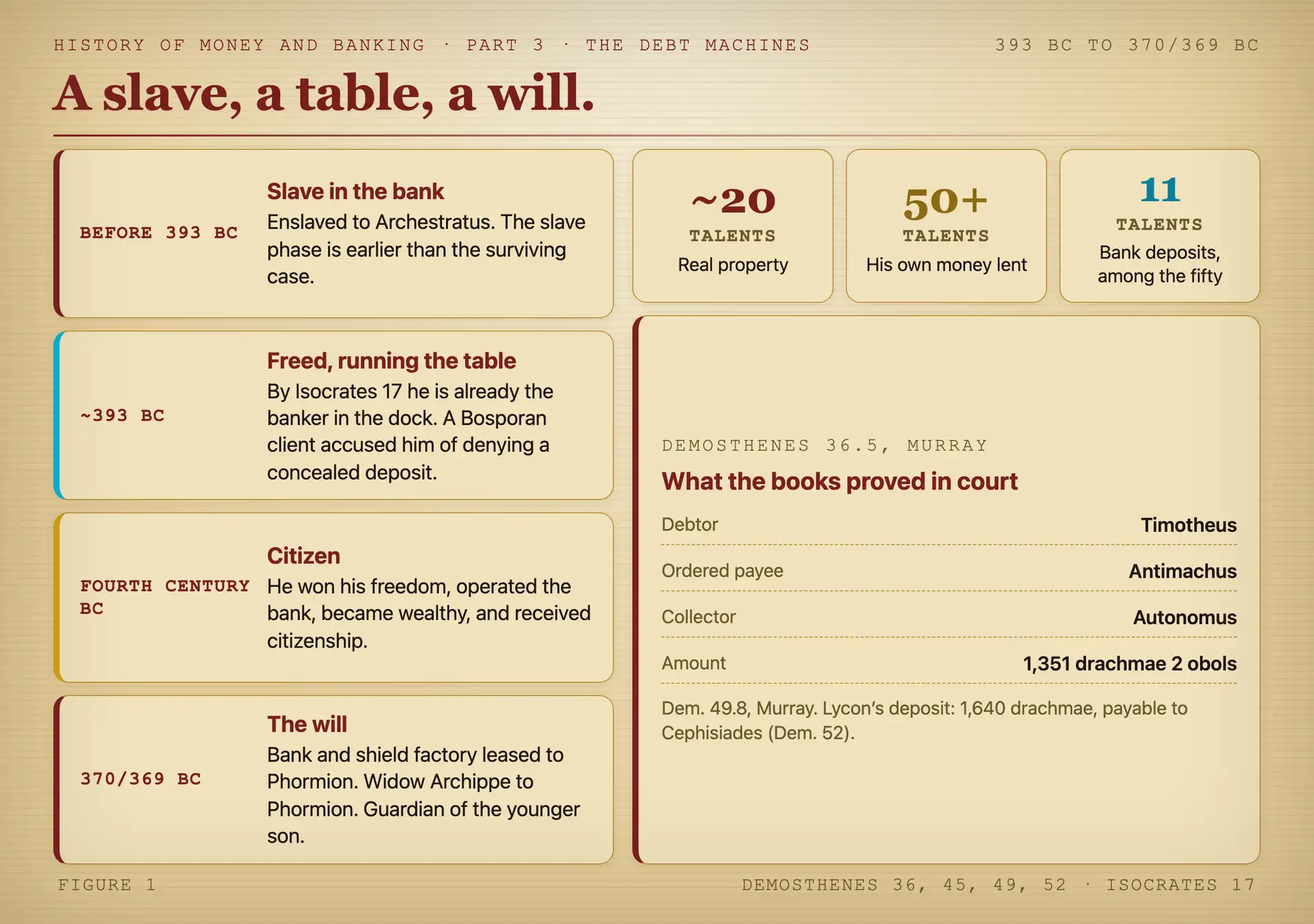
The least likely career in Athenian economic life, visible only because his heirs sued each other over the books. Source: Demosthenes 36, 45, 49, 52.
On the bank versus the shield factory Pasion also owned, a sentence that any banker from the last 2000 years understands at face value: "For that is a property which involves no risk, while the bank is a business yielding a hazardous revenue from money which belongs to others."³
Other people's money, put at risk, for a return, said out loud in a fourth-century courtroom by a man who thought it was his winning argument about a great business model.
The trade ran on trust and on books, in that order, and the books named everybody who owed money: "the bank recorded as debtor Timotheus, who had requested the loan, but made a memorandum in the name of Antimachus, to whom Timotheus had ordered the money to be paid, and also named Autonomus, whom Antimachus had sent to the bank to receive the money, the amount being one thousand three hundred and fifty-one drachmae two obols."⁴
Athens invented democracy, then invented the banker, and only one of them survived the century.
Part 2 of this series ended with the tables coming out: the trapezitai, the table-men of the Athenian agora, changing coins in the open air, and Rome about to strike its silver inside the temple of Juno Moneta. It ended on a promise: "Later in this series come the kings who rewrote their coins instead, and did not proclaim anything."
This is that story: two cities that worked out that the stamp is worth more than the metal, spent the discovery on the most beautiful objects human beings have ever made, and then spent it on everything else. Athens runs the cycle in a lifetime, and Rome takes three centuries and does it worse. Both end the same way: a government fixing prices it cannot pay, and an army that will not take its own coin.
And in the middle of it, in a temple courtyard a long way from either capital, a preaching carpenter is handed a silver coin with a god-king's face on it, and asks whose face it is.
We'll get to him.
Watch the video if you prefer to watch rather than read!
Livestream Tuesday at 2 PM EST; the embed fills in then.
The stamp
Dig under the temple of Artemis at Ephesus and you hit money.
Not a hoard. A scatter: small pale lumps in the fill under one of the largest buildings of the ancient world, some blank, some punch-marked, some carrying a struck type, and scholars have argued about the date of that fill for a century, with the range running from the later seventh century BC to the 570s and a ceiling around 560.⁵
Call it around 600 BC and keep walking, because the precise date matters a lot less than the metallurgic composition of the lumps.
It is electrum, a natural alloy of gold and silver that comes out of Lydian riverbeds already mixed, and the mix is not a fixed ratio. Natural electrum runs around 60 to 80 percent gold, and the coined pieces Georges Le Rider sampled run lower and wider, roughly 31 to 55 percent.⁶
So you can put a lump on a scale and learn exactly how heavy it is, and learn nothing at all about what it is worth, until somebody in Lydia put a mark on the lump, and from then on the mark said what it was worth.
Robert Wallace's reading, the influential one since 1987, is that regular weights struck onto irregular metal mean the issuer was fixing a value and standing behind it, so the stamp works as a guarantee of redemption.⁷ So the incentives become trust-based or social, and they hand power to an unexpected party: the man holding the die. If the mark sets the value, and the mark costs nothing to make, all the daylight between metal and money belongs to the mint, the minter or whoever is entrusted with a die.
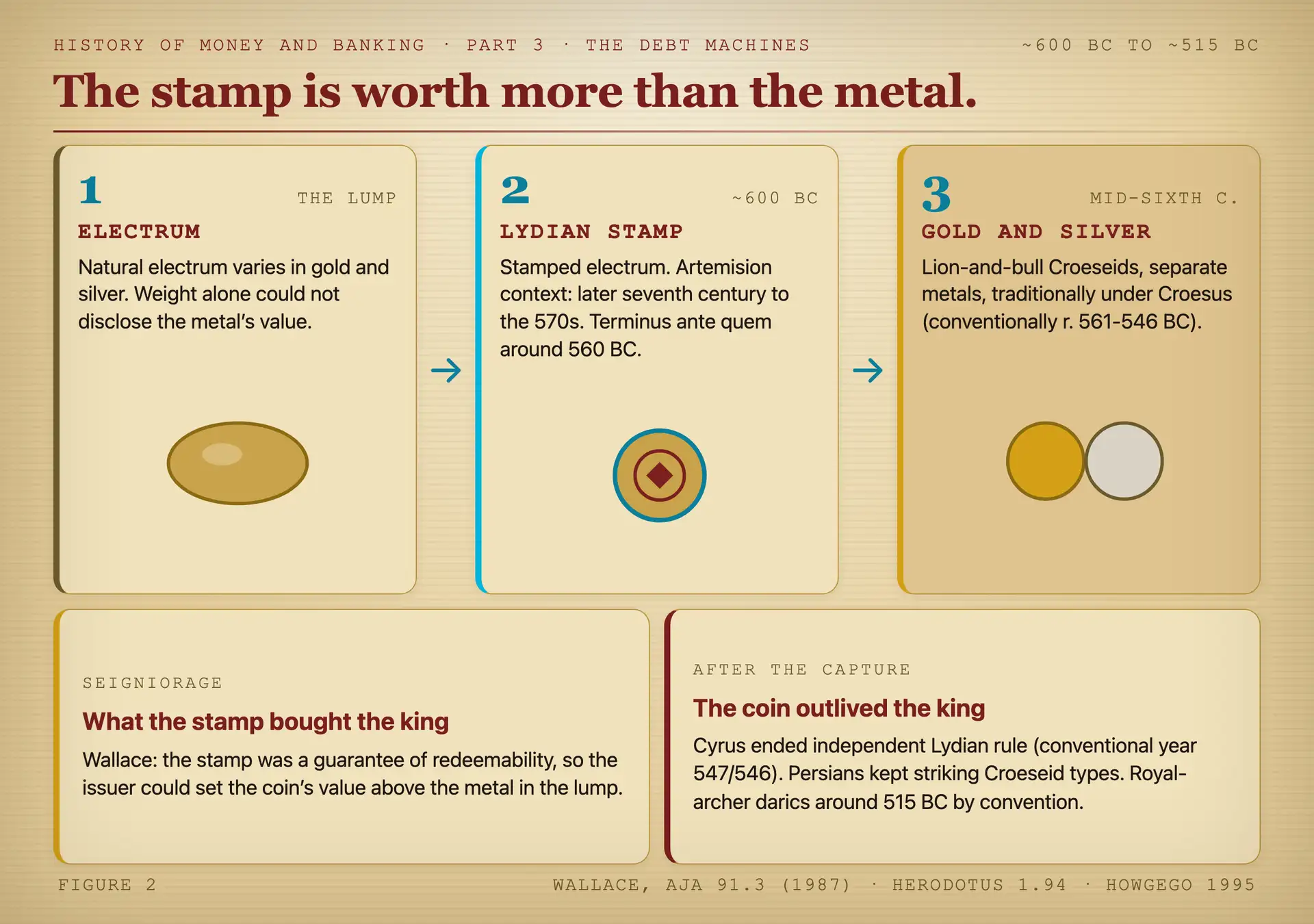
The alloy is the problem and the stamp is the answer, which makes the first monetary innovation also the first monetary exploit. Source: Wallace, AJA 91.3 (1987); Howgego 1995.
Herodotus, a century and a half later, gives Lydia the credit and hedges it like a modern reporter of ancient history: the Lydians were "the first of men, so far as we know, who struck and used coin of gold or silver".⁸
Lydia's next move was to quit fighting the alloy altogether, and simply get rid of it. By the middle of the sixth century BC, Sardis is striking separate coins in refined gold and refined silver, each carrying a lion and a bull facing each other, foreparts only.⁹ We call them Croeseids, after the king.
Croesus, the one from the proverb, ruled from about 561 BC, was rich enough that being rich became his name, and wanted to know whether to attack Persia, and the oracles told him that if he marched, "he should destroy a great empire".¹⁰
He marched. He destroyed a great empire. The problem: it was his empire.
Cyrus of Persia took Sardis in the 540s BC. They put the king on a pyre, where Croesus groaned and spoke the name of Solon three times, because the Athenian had told him years earlier to count no man happy until the end.¹¹
Cyrus heard the name and changed his mind, but the fire was already lit. So Croesus prayed: "So he with tears entreated the god, and suddenly, they say, after clear sky and calm weather clouds gathered and a storm burst, and it rained with a very violent shower, and the pyre was extinguished."¹²
Solon walks back into this story when we cross into Attica, and he comes with a law in his hand.
Dig under the audience hall Darius raised at Persepolis, into deposits laid between 519 and 510 BC, and you find Croeseids and Greek silver, and not one Persian royal archer.¹³ The dead king's design was the money of the men who killed him, until Darius put his own archer on the gold around 515 BC.
The conqueror kept the coin because the coin worked, and what worked was the trust and inertia of the mark on it far more than the gold under it.
The king died. The stamp didn't.
The jubilee and the silver
Two hundred miles west, Attica had a different money problem, and you could see it from the road, because the fields were full of stones.
They were horoi, boundary markers, and the ones that mattered announced that the field, or the crop, or the man working it, stood as security for a debt. The Aristotelian Constitution of the Athenians describes the mechanism: land in a few hands, the poor dependent on the rich, cultivators called hektemoroi who handed over a sixth, and loans made on the borrower's body.¹⁴
Default, and you did not lose the farm.
You became the farm.
In 594 BC the Athenians handed the whole thing to one man: Solon, poet, merchant, archon, and the only person both sides would accept. He canceled the debts, public and private, and he outlawed lending on the person, so no Athenian could pledge his own body against a loan again. He named it the seisachtheia, or the shaking off of burdens.¹⁵
We have the law, and we have the lawgiver's own verse about the law: the stones came up out of the fields, and the people who had been sold abroad came home.
There was a rumor, naturally. Plutarch says Solon told three friends what was coming, and the three borrowed heavily and bought land: "This brought Solon into great condemnation and odium, as if he had not been imposed upon with the rest, but were a party to the imposition."¹⁶ The first insider trade in history?
Maybe...
Solon had lent five talents himself, or fifteen by some accounts, and he was the first to forgive his own loan under his own law. His friends kept a nickname for life: chreocopidae, the debt-cutters. We don't know if it was the first, but it was insider trading, twenty-six centuries early, with a nickname attached because it really irked average people at the time!
And one more fact about Solon: when the city was his for the taking, and both factions expected him to take it, he would not be tyrant.¹⁷
A century on, Athens got lucky in the ground: in 483 BC the silver mines at Laurion opened a new seam at Maroneia and the treasury came up 100 talents ahead. A windfall, in a democracy, with an assembly voting on where it went, and the obvious motion was to split it.
A politician named Themistocles stood up and said no, and in Aristotle's telling he lent one talent each to the hundred richest men in Athens, every one to build a warship with it, and those hundred triremes fought at Salamis.¹⁸
Herodotus tells it with a bigger fleet and a canceled dividend: "The revenues from the mines at Laurium had brought great wealth into the Athenians' treasury, and when they were to receive each man ten drachmae for his share, then Themistocles persuaded the Athenians to make no such division, but out of the money to build two hundred ships for the war, that is, for the war with Aegina."¹⁹
Two hundred in Herodotus, a hundred in Aristotle. They did not agree on the headcount, but the outcome was the same either way: a vein of silver nobody knew existed in 484 BC bought a navy, and the citizens who could have taken cash got hulls instead.
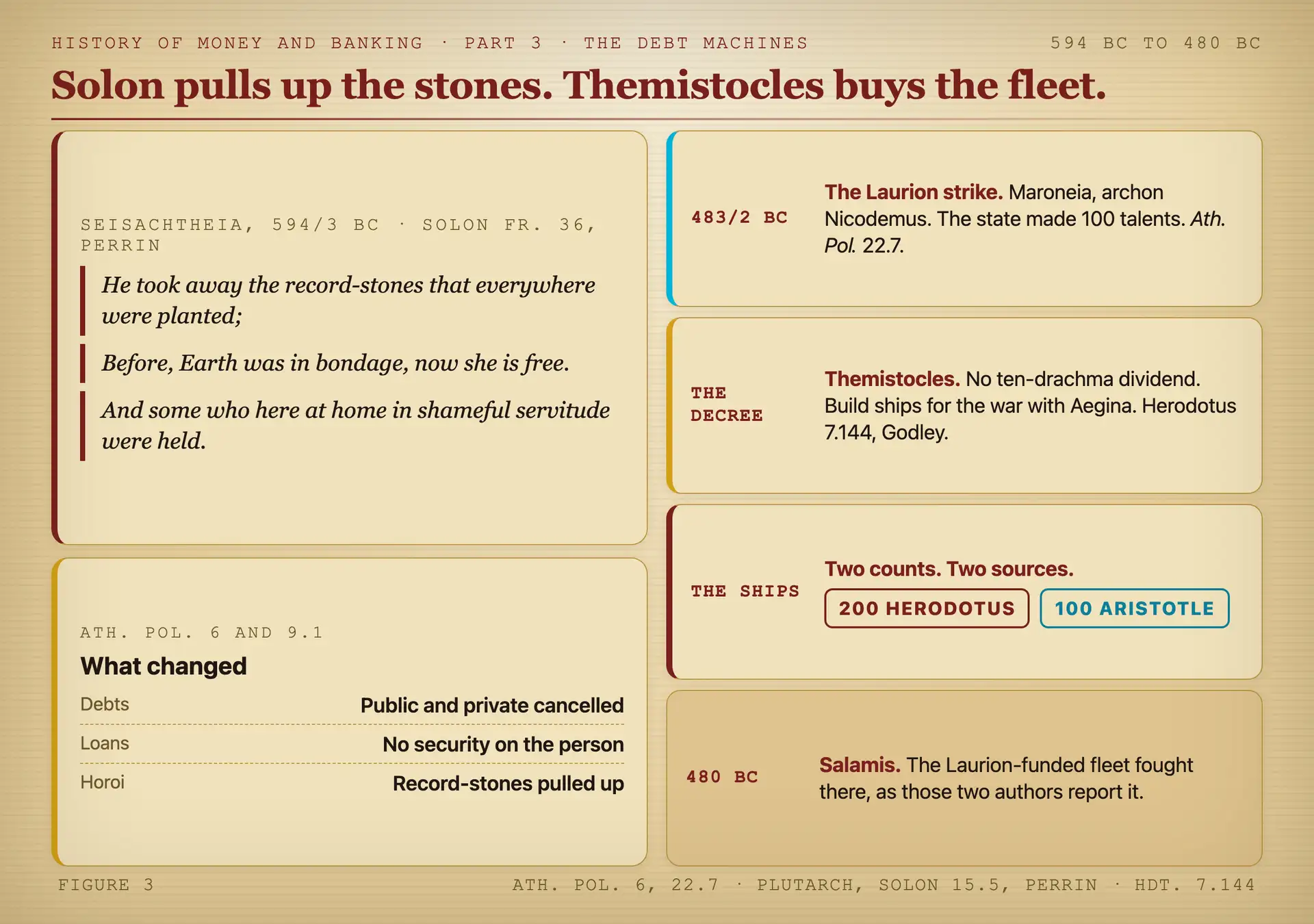
The two decisions that make everything after possible: erase the debts, then spend the windfall on ships instead of dividends. Source: Constitution of the Athenians 6, 9.1, 22.7 (Kenyon); Herodotus 7.144 (Godley); Plutarch, Solon 15 (Perrin).
In 480 BC the Persian fleet came into the strait at Salamis, where the water is narrow and their vast numbers stop helping, and the Athenian ships were waiting. Greece stayed Greek because of lucky mining and a desire for a big navy!
The owl empire
In 478 BC the Greek cities that had just survived Persia formed an alliance, and they did the responsible thing with the money: they put it on neutral ground, in a temple on a small sacred island.
Thucydides: "The tribute was first fixed at four hundred and sixty talents. The common treasury was at Delos, and the congresses were held in the temple."²⁰
Four hundred and sixty talents a year from cities that mostly wanted to be left alone, into a strongroom on Delos, guarded by the largest navy in the Greek world. Which was Athenian.
You may already know how this plays out.
In 454 BC the quota lists start being cut on the Athenian Acropolis, the sixtieth part of every ally's payment dedicated to Athena, year by year.²¹ Delos kept the temple, and Athens kept the money.
Seven years later they started building, and the Parthenon's accounts survive in fragments, inscribed year by year from 447/6 through 433/2 BC: quarrying, haulage, wages, and the sale of leftover stone.²² They carved the invoices for the most famous building on earth into the rock and left them outdoors, where the public could audit them.
Greece noticed what was being audited, and the charge, as Plutarch keeps it, is one of the great pieces of invective in any language: "And surely Hellas is insulted with a dire insult and manifestly subjected to tyranny when she sees that, with her own enforced contributions for the war, we are gilding and bedizening our city, which, for all the world like a wanton woman, adds to her wardrobe precious stones and costly statues and temples worth their millions."²³
Pericles answered it without denying a word. The allies give "not a horse do they furnish, not a ship, not a hoplite, but money simply; and this belongs, not to those who give it, but to those who take it, if only they furnish that for which they take it in pay."²⁴
You pay for protection. We provide protection. The money is ours. If only our politicians and bankers were so honest... Either way, it got the Parthenon built.
By 431 BC, with the war against Sparta starting, Pericles reads the city its own balance sheet: "an average revenue of six hundred talents of silver was drawn from the tribute of the allies; and there were still six thousand talents of coined silver in the Acropolis, out of nine thousand seven hundred that had once been there".²⁵ Six thousand talents in the room, down from nine thousand seven hundred, and the difference is standing over their heads in marble, protecting people who could have been contributing real money to the effort.
Then one more absurd, illiquid asset. Inside the Parthenon stands the gold and ivory Athena, the most expensive object in the Greek world, and Pericles reports her as a line item: "the statue contained forty talents of pure gold and it was all removable."²⁶
Easy to melt in theory, but difficult to melt politically.
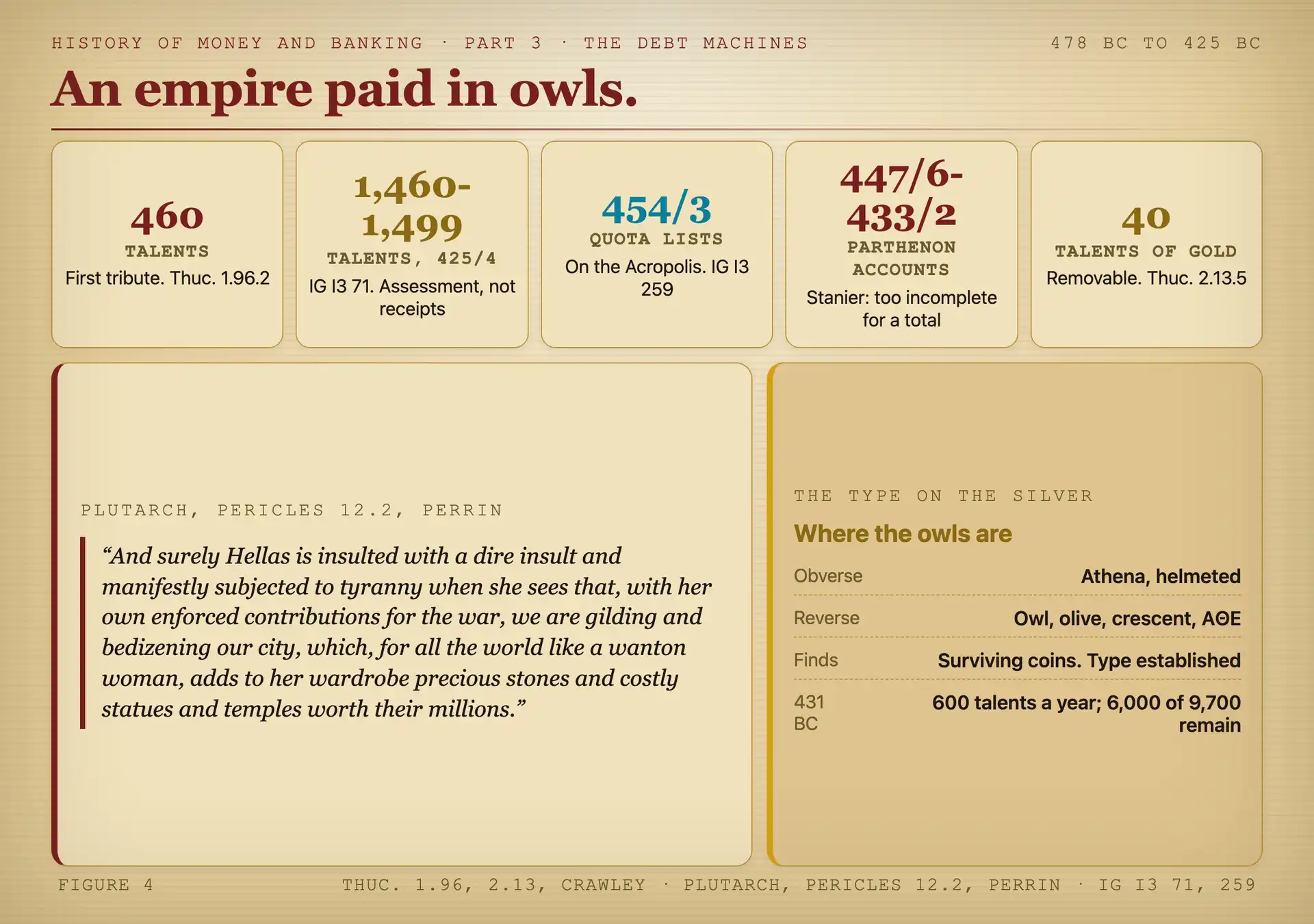
The goddess is a reserve, and Pericles says so in the same breath as the tribute totals. Source: Thucydides 2.13.3-5 (Crawley); Plutarch, Pericles 12 (Perrin).
The coin all of this ran on was the tetradrachm: Athena's helmeted head on the front, an owl, an olive sprig, a crescent and three letters on the back, ΑΘΕ. Heavy, blunt, everywhere. Owls come out of the ground from Egypt to Afghanistan, and the surest sign of how far they traveled is that people nowhere near Attica struck their own.²⁷
And then Athens wrote the empire's monetary law. The decree survives in fragments from several cities, and the commands are plain: allied cities use Athenian coins, Athenian weights and Athenian measures, foreign silver is brought in and converted, and officials who let it slide are punished.²⁸ Nobody asked the allies, which is what a decree is.
Inside the city, coin was doing something stranger: it was paying for citizenship itself. Aristotle says Pericles "was also the first to institute pay for service in the law-courts, as a bid for popular favour to counterbalance the wealth of Cimon," and when the great fleet sailed for Sicily in 415 BC, Thucydides gives the rate: "the treasury giving a drachma a day to each seaman".²⁹
Democracy ran on coin, and every public school civics lesson that told you it ran on virtue skipped the payroll.
One more thing was going on up on that rock, in a hand so bureaucratic it is funny: the treasurers of Athena and of the Other Gods were lending to the Athenian state. An account covering 426 through 423 BC records the loans, the repayments, and interest reckoned by the day at one drachma per five talents.³⁰
The temple was the bank. The city was the borrower. The goddess charged interest. It comes back in a different temple, in a different language, with a whip in the story.
The goddesses in the furnace
Go back to Pericles's line item and look at the last four words: not sacred, not untouchable, but REMOVABLE. The most expensive object in the Greek world, and the man who built the room around it tells the Assembly out loud that the gold comes off. Pericles was reading a reserve into the minutes, and the war he was budgeting for ran twenty-seven years.
In 415 BC Athens sent a fleet to Sicily, and two years later fleet, army and men were gone, and Thucydides wrote that few out of many returned.³¹ That same year Sparta stopped going home for the winter, fortified Decelea, fourteen miles out, and sat in Attica year round.
"They were deprived of their whole country: more than twenty thousand slaves had deserted, a great part of them artisans, and all their sheep and beasts of burden were lost."³²
Twenty thousand people walked out of an economy that ran on them, and Thucydides counts them beside the sheep. One of the coldest sentences in Greek.
Then Persia opened its purse on the other side. Sparta had been taking Persian money since 412 BC, and in 407 BC the prince Cyrus arrived with a different attitude, and Xenophon records the wage going "to four instead of three obols, as it hitherto had been," the arrears cleared and a month advanced.³³
One obol is the whole hinge, because rowing is rowing: same job, same water, and from 407 BC the Spartan bench pays a third more with next month in hand. Athens spent a century teaching the Mediterranean its coin was good, but Persia outbid it.
So Athens went looking for metal, and one pile was left untouched: the golden figures of Victory standing around the great statue in the Parthenon. The inventories the Athenians carved year after year are how we know: seven Nikai vanish from the records while one remains, and the stones later note the empty supports. The standard reconstruction puts the gold at about fourteen Attic talents, and Alec Blamire, on the same evidence, writes of "the eight golden Nikai" and ties the emergency to the hundred and ten ships sent to Conon at Mytilene.³⁴
In 407/406 BC gold coin appears at Athens for the first time, at Attic weight, Athena and her owl, struck by a city that had spent its whole monetary life insisting on silver.³⁵
They paid the fleet with the goddesses of victory.
And when the gold ran out, they did the other thing.
In 406/405 BC the coins leaving Athens were bronze with silver over the top. We have them. Plated drachms and tetradrachms survive, including a 1902 hoard at the center of the argument over whether the city issued them itself.³⁶
People noticed the copper under the silver, and in the spring of 405 BC a comic poet put it on stage in front of the voting population.
A monetary observation delivered as an insult to the audience,³⁷ and the whole theater got it: the good coin exists, everybody knows it exists, and nobody spends it.
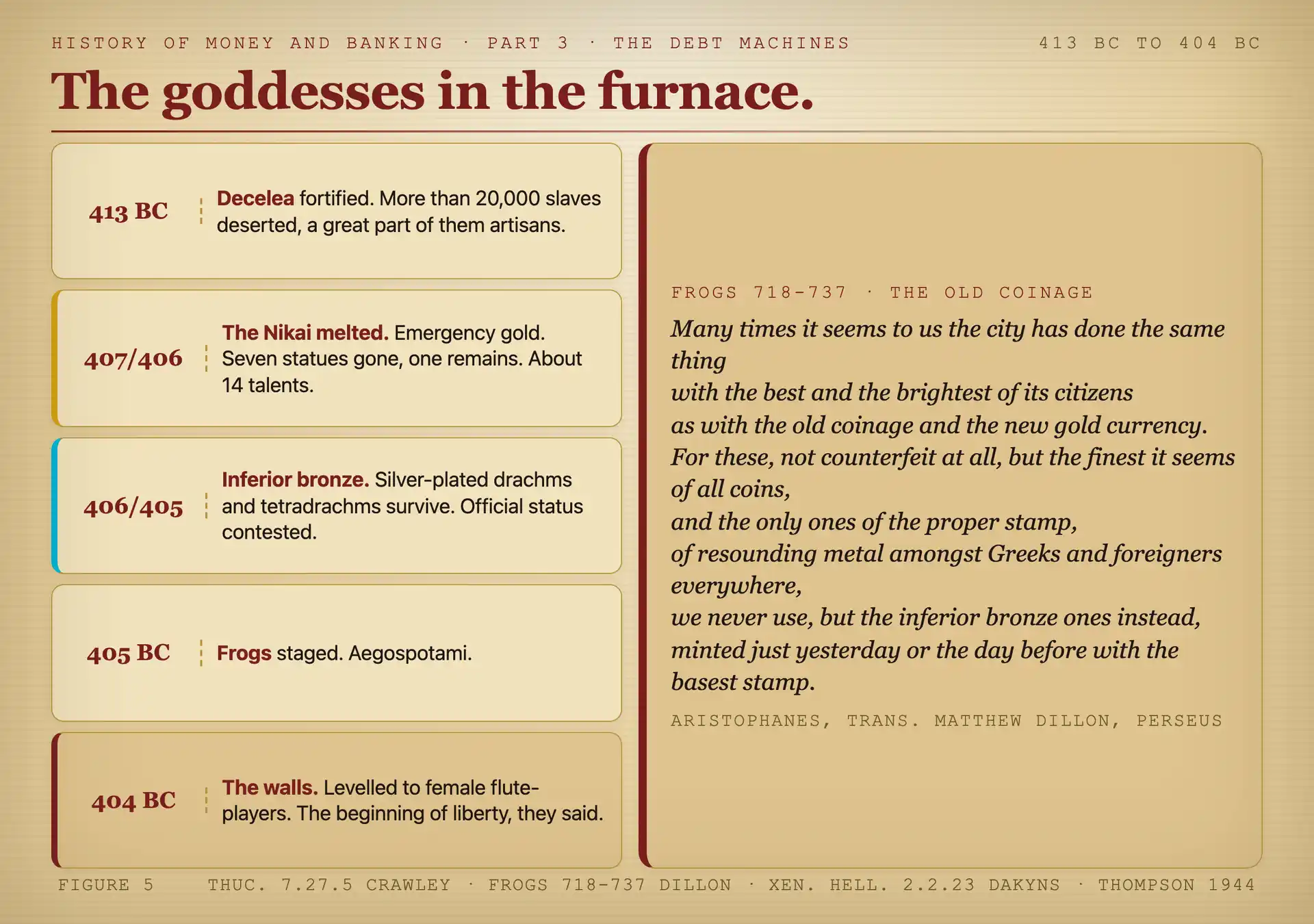
Gold coin and plated bronze arrive inside a twenty-four month window, and the comedy mocking them is staged in the third year. Athens reached bad money in the time it takes to build a fleet. Source: Kroll, Agora XXVI; Aristophanes, Frogs, trans. Dillon.
Aristophanes took the prize that spring, and months later Lysander caught the Athenian fleet on a beach at Aegospotami and took almost all of it in an afternoon. Blockade and hunger did the rest, and in 404 BC the city surrendered.
The terms required the Long Walls to come down, and Xenophon watched: "And so they fell to levelling the fortifications and walls with much enthusiasm, to the accompaniment of female flute-players, deeming that day the beginning of liberty to Greece."³⁸
Flute-players, at the demolition.
Nobody ever tells the next part, because it ruins the tragedy: Athens got its money back.
The coppers went out and the silver came back, and we know because Aristophanes was still working, since in the Ecclesiazusae an old man remembers landing on the wrong side of the announcement: "Those copper coins. / And a bad job for me / That coinage proved. I sold my grapes, and stuffed / My cheek with coppers; then I steered away / And went to purchase barley in the market; / When just as I was holding out my sack, / The herald cried, No copper coins allowed!"³⁹
A man with his sack open and his mouth full of worthless metal, hearing a crier announce that the state changed its mind: a currency reform in seven lines, told by a guy who sold grapes.
What came back with the silver was the table, not the empire, and the fourth-century city rebuilt itself out of the banks. When the richest banker in Greece died and left his bank and his widow to the freedman who counted his coins, the family went to law and stayed there twenty years,⁴⁰ which is how a clerk came to stand in an Athenian courtroom and read the Timotheus loan out loud, four names deep and carried to two obols.⁴¹
The empire is gone, the walls are rubble, the goddesses are coins somewhere in the Aegean, and what survives intact is the bookkeeping: other people's money, at risk, on a wooden table in the open air.
Rome is about to build the same machine at the scale of the entire Mediterranean.
Moneta
On the Arx, the northern hump of the Capitoline, stood a temple to Juno under a title nobody can translate: Moneta. Livy dates the dedication to 344 BC, and describing the site in his own lifetime he says what is there: ubi nunc aedes atque officina Monetae est. Where the temple and the workshop of Moneta now are.⁴²
The workshop, meaning the mint, because tradition puts the striking of Roman coin inside that temple from 269 BC, and the goddess's title went out on the metal and never came back: Moneta, moneda, monnaie, money. Every dollar in your pocket is named for a Roman goddess whose mint was in her own front room!
Rome came to silver late and struck it under pressure, and the denarius belongs to the worst emergency the Republic survived, the war against Hannibal, with the proof sitting in a Sicilian town Rome destroyed. The deposits sealed by the sack of Morgantina in 211 BC hold Roman silver of the denarius system and bronze of the sextantal standard.⁴³ A burned town makes a good clock, because everything under the ash was circulating before the fire.
And once the system ran, it made conquest portable: legions in Spain and Greece drew the same pay on the same standard, captured metal went into the furnace and came out Roman, and extraction came home as cash instead of cattle.⁴⁴
Then it paid a dividend. Rome had funded its wars with the tributum, a direct levy on citizens, and Cicero says that after Aemilius Paullus brought the Macedonian royal treasure into the treasury in 167 BC, Roman citizens stopped paying it.⁴⁵
Direct tax ended in Rome because somebody else's king got robbed, and a people taught that it does not pay for its own government is going to be very hard to tax once the kings run out.
Debt was the permanent domestic crisis. Rome had stopped taking the debtor's body as security in 326 BC, two and a half centuries after Solon,⁴⁶ and never stopped arguing about the rest of the ledger.
By 63 BC the argument had a slogan. Tabulae novae. New account books. Sallust builds his portrait of Catiline's conspiracy on indebted aristocrats, ruined veterans and dispossessed farmers, with Catiline dangling that promise at them.⁴⁷ Cicero, who beat them, never let anyone forget the other side of that transaction: "And what is the meaning of an abolition of debts, except that you buy a farm with my money; that you have the farm, and I have not my money?"⁴⁸
He is not wrong. That is what it means, and it is also what Solon did, and what every state in this story does when the alternative is a mob at the gate.
Fourteen years later a general crossed a river and answered the same question with an army behind him. Caesar came into Rome in 49 BC with the debtor class expecting the wipe. Suetonius says he refused it, then did something more interesting: "As to debts, he disappointed those who looked for their cancellation, which was often agitated, but finally decreed that the debtors should satisfy their creditors according to a valuation of their possessions at the price what they had paid for them before the civil war, deducting from the principal whatever interest had been paid in cash or pledged through bankers; an arrangement which wiped out about a fourth part of their indebtedness."⁴⁹
- Value the collateral at the prewar price.
- Deduct the interest already paid.
- Take the valuation away from the creditor. Dio says Caesar "ordered that securities should have a fixed valuation according to their worth, and he provided that arbiters for this purpose should be allotted to persons involved in such a dispute."
About a quarter of the debt in Rome ceased to exist, and nobody got to call it a cancellation.⁵⁰ A haircut dressed up as an accounting convention, and it taught Rome a lesson it never unlearned: pick the valuation date and you have picked the policy.
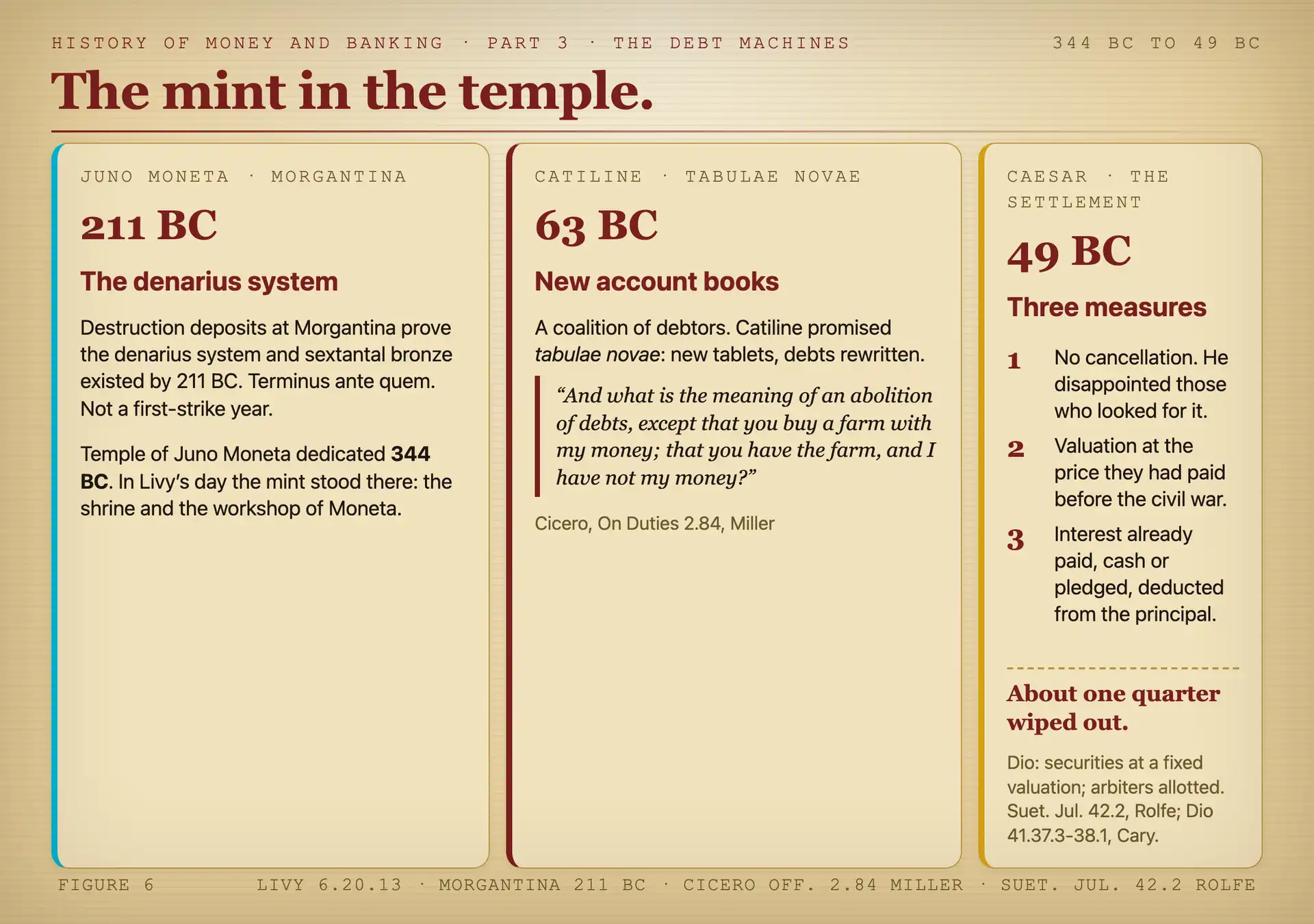
Rome's coinage was born in one war emergency and its debt law written in three more. Every Roman fix moves the loss from one party to another; none makes it go away. Source: Morgantina Studies II; Sallust, Catiline; Suetonius, Julius 42.2, trans. Rolfe.
Caesar was dead five years later, in 44 BC, and the wars ran until 31 BC, when his heir won at Actium and Egypt stopped being a kingdom. In 29 BC Octavian held a triumph over three days: the Pannonians and Dalmatians, then Actium, then Egypt, and Dio says the spoils of Egypt alone furnished all three processions, and that the Egyptian day beat the others for cost.⁵¹
Dio puts numbers on what the parade did to the credit market: "So vast an amount of money, in fact, circulated through all parts of the city alike, that the price of goods rose and loans for which the borrower had been glad to pay twelve per cent. could now be had for one third that rate."⁵² Twelve percent to four.
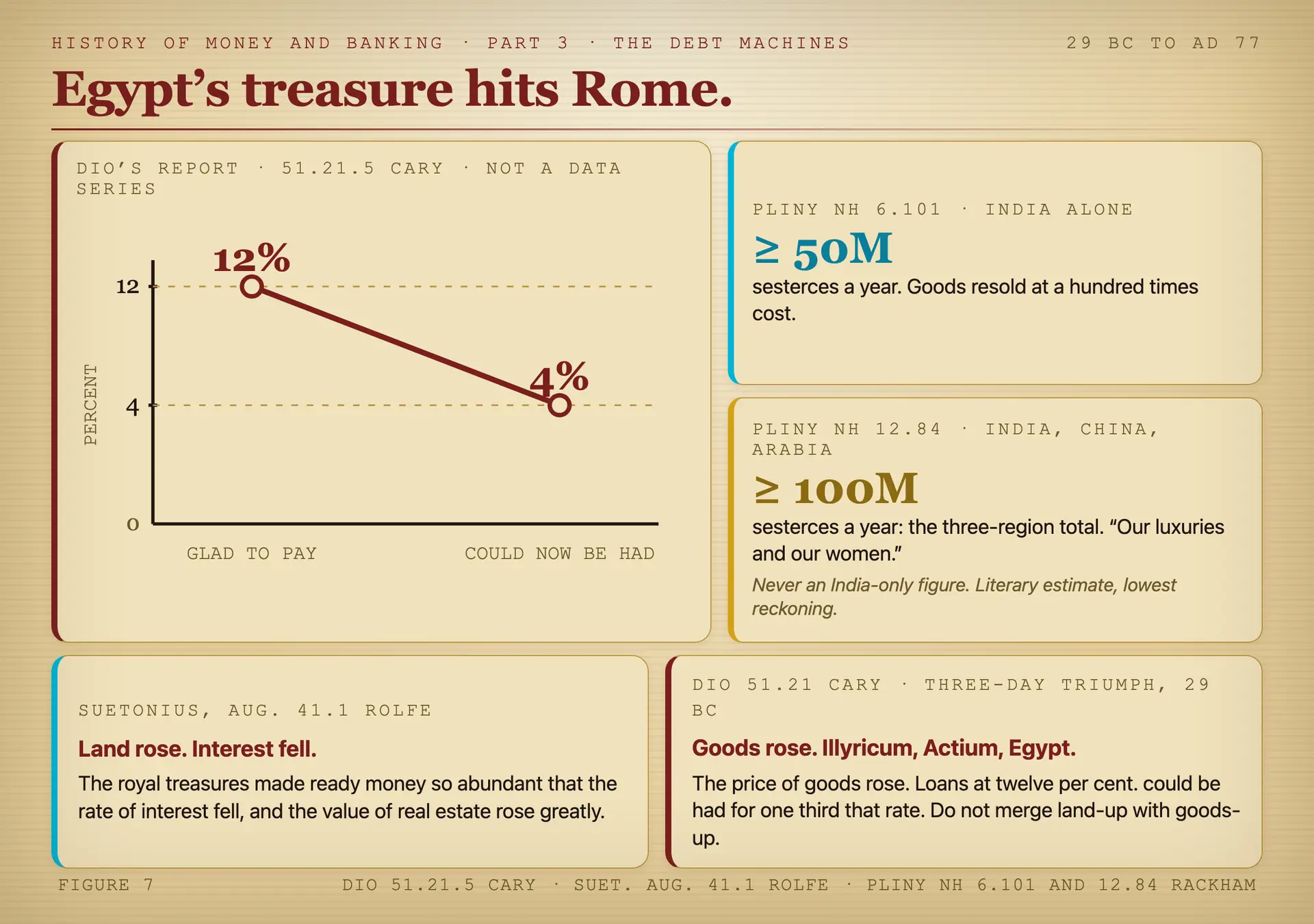
One conquest cut the reported cost of borrowing in Rome by two thirds, while the same flood of money pushed the price of goods up. Cheap credit and dear bread, same year, same cause. Source: Dio 51.21.5, trans. Cary; Pliny, NH 6.101 and 12.84.
A hostile takeover of the oldest state on earth, liquidated through a parade, and Roman borrowing got a third cheaper. Stimulus, two thousand years before anybody had a word for it!
Then the beneficiary wrote down where it went: "he so beautified it that he could justly boast that he had found it built of brick and left it in marble."⁵³ Brick to marble, the same way Athens went from tribute to the Parthenon inside a single lifetime.
The windfall bought something less photogenic and far more binding: in 6 AD Augustus founded a standing military treasury, put 170 million sesterces of his own money into it, and funded it from then on with a five percent tax on inheritances.⁵⁴ Fund a soldier's pension out of a treasure, and you have obligated every emperor after you to find one.
The treasure was already leaking, and Pliny complains that "in no year does India absorb less than fifty million sesterces of our empire's wealth, sending back merchandise to be sold with us at a hundred times its prime cost."⁵⁵ Elsewhere he widens the map and the figure together: "And by the lowest reckoning India, China and the Arabian peninsula take from our empire 100 million sesterces every year".⁵⁶
Two passages, two geographies. Pliny is moralizing about pepper and silk and his wife's jewelry, and he is also describing silver walking out of the empire in one direction, which a state usually notices about a century late.
Caesar left one more thing behind, and it is not in the triumph or the marble or the pension chest: a law fixing how much of a man's capital had to sit in Italian land instead of out on loan, the kind of rule everybody stops enforcing and nobody bothers to repeal. A generation later, with Egypt's treasure already spent on marble, a suspicious old emperor would let the informers dust it off and aim it at the money men of Rome.
The coin in the temple
It is the last week of his life, and he has been teaching in the Temple courts every day, out in the open, so a delegation walks up, and a young man named Mark recorded it for us: "And they sent to him some of the Pharisees and some of the Herodians, to trap him in his talk."⁵⁷
That pairing is a joke all by itself. The Pharisees were the party of scrupulous Torah observance, and plenty of them loathed the Roman levy on principle, while the Herodians were the client king's men who ate off Rome's table. On any ordinary day those two are arguing, and today they have one question between them, and it is a box with two lids.
"Teacher, we know that you are true and do not care about anyone's opinion. For you are not swayed by appearances, but truly teach the way of God. Is it lawful to pay taxes to Caesar, or not? Should we pay them, or should we not?"⁵⁸
Flattery first, then the blade. Say no, and the Herodians carry a sedition charge to Pilate, the Roman governor, before dinner. Say yes, and he has blessed the tribute in front of a Passover crowd already very bitter about it. Either answer ends him by sundown.
He does not have a denarius on him, which is telling. "Bring me a denarius and let me look at it." And they brought one. Inside the Temple precinct, with the legality of Roman tribute hanging in the air, the men who came to trap him reached into their own clothes and produced Caesar's money on demand.⁵⁹
Now look at the coin. The one everybody pictures is the denarius struck at Lugdunum under Tiberius, whose obverse reads TI CAESAR DIVI AVG F AVGVSTVS: Tiberius Caesar Augustus, son of the Divine Augustus, and the reverse reads PONTIF MAXIM, chief priest.⁶⁰
So the thing in his hand announces, in metal, that its maker is the son of a god and the high priest of the world. In the courtyard of the Temple of the God of Israel.
Handed over by the men testing his orthodoxy. This is the highest possible social pressure in the ancient world.
He asks one question, whose eikōn is this and whose epigraphē, whose image and whose inscription, and they answer honestly, which is their mistake. It is Caesar's.
And the verb he hands back is apodote, give it back, return it to the one whose mark is on it,⁶¹ which is a long way from "pay." It leaves the only question that matters: what has God's image on it?
"So God created man in his own image, in the image of God he created him; male and female he created them."⁶²
That is the dunk, the rib, the joke, and it is a hard triple.
He answers the tax question without answering the tax question. He takes the little silver claim of divine sonship and hands it back to its owner like a dirty plate: keep your god-king, it has your face on it, and he tells the men who carried Caesar's portrait into the sanctuary that the only thing in that courtyard stamped with God's image is the man holding the coin. Give the idol back to the idolater, and give yourself to God. Three targets, one line!
The early church saw it instantly: Tertullian was making the image-for-image move by about the year 200,⁶³ and Augustine preached it two centuries later.⁶⁴
And somewhere between Augustine and your inbox, a whole civilization decided this passage was about filing taxes on time. You have sat through that sermon: the preacher reads the first clause, says pay your taxes, and sits down. The man was handed imperial propaganda by his own enemies and used it to tell them their money was the least interesting thing in the most interesting place on earth!
Now here is how the money actually worked
Because the trap hidden within the joke only exists if there is a second currency in that courtyard, and there was. The law is old and the amount is fixed: "Each one who is numbered in the census shall give this: half a shekel according to the shekel of the sanctuary (the shekel is twenty gerahs), half a shekel as an offering to the LORD."⁶⁵ Matthew's Gospel calls it the two-drachma tax.⁶⁶
The Mishnah keeps the calendar. "On the fifteenth of Adar, money changers would sit at tables set up in the rest of the country, outside the Temple, to handle the collection of shekels. On the twenty-fifth of Adar, the money changers sat in the Temple."⁶⁷ Ten days in the country to get your affairs in order, and then the tables come inside.
And the coin the Temple wanted was neither Judean nor Roman, but the shekel of Tyre: about fourteen grams, commonly assayed near ninety-four to ninety-six percent silver, carrying Melqart-Heracles on the obverse and an eagle on a ship's prow under the legend "of Tyre, holy and inviolable."⁶⁸ The later rabbinic rule is blunt about it: every fixed sum named in the Torah is reckoned in Tyrian coinage.⁶⁹
The sacred silver of the God of Israel wore the face of a Phoenician god, because the metal was good. Purity of the alloy beat purity of the picture...
- The assessment. Half a shekel of the sanctuary, per man, per year, fixed by Exodus 30:13.
- The denomination. That half-shekel is one didrachma, the two-drachma tax.
- The wage. A denarius is one agreed day in a vineyard in Jesus's own parable, and a didrachma is conventionally two denarii. Two days of a working man's year, before he buys the animal.
- The pair. Two men settle with one stater, which the ESV calls a shekel: two didrachmas, one whole shekel.
- The premium. The changers took a kalbon. Rabbi Meir says one silver ma'a; the Rabbis say half a ma'a. At twenty-four ma'ah to the shekel, Meir's rate is about 4.17 percent of a whole shekel or 8.33 percent of a half-shekel; the sages' rate is about 2.08 percent, or 4.17 percent of a half.
- And change is not free. "One who gives the collection agent a sela, i.e., a whole shekel, and takes a shekel, i.e., a half-shekel, as change is obligated in two premiums."⁷⁰
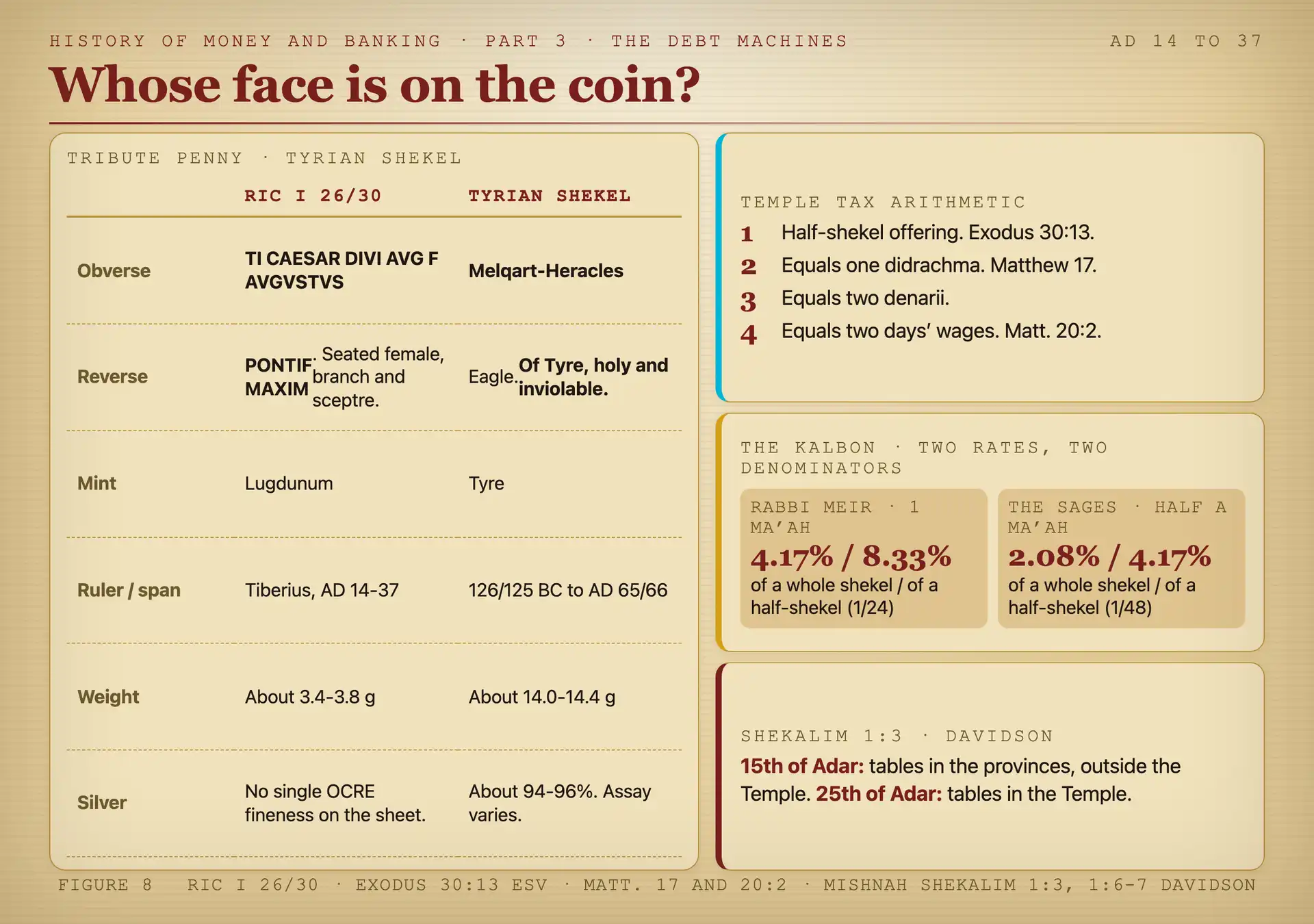
Two coins, two gods, one courtyard: the tribute penny carries Caesar's face, the Temple's standard carries Melqart's, and the tax cost a working man two days of wages plus a premium the rabbis never settled. Source: OCRE RIC I(2) Tiberius 26 and 30; Mishnah Shekalim, Davidson.
And that is only the tax, because the Temple was also where the region kept its money. Around 178 BC a Seleucid official came for it, and the account says the treasury "was full of untold sums of money, so that the amount of the funds could not be reckoned," some of it deposits belonging to widows and orphans.⁷¹ Crassus emptied it for his Parthian war in 54 BC, and when the chambers burned in 70 AD, Josephus reached for the word "immense" and refused to give a number at all.⁷² Vault, exchange window and sanctuary, all on one stone floor.
Who ran it? Annas son of Seth held the high priesthood, five of his sons held it after him, and Caiaphas was his son-in-law.⁷³ A family business with a sanctuary attached. Centuries later the Talmud remembered that house with its teeth showing: "Woe is me due to the High Priests of the house of Ḥanin."⁷⁴
So when a Galilean walks into the outer court and starts overturning furniture, he is not protesting retail markup. John tells it at a Passover: "And making a whip of cords, he drove them all out of the temple, with the sheep and oxen. And he poured out the coins of the money-changers and overturned their tables."⁷⁵ The other three put a Temple action in the final week, with a line stitched out of two prophets: "My house shall be called a house of prayer," and "you have made it a den of robbers."⁷⁶
Picture the floor: silver rolling on stone, doves going up, and a rabbi with a rope in his hand as he menaces the whole scene.
And "den of robbers" was not improvised, because Jeremiah was told to stand in the gate of the Temple and say it to the men walking in to worship, six hundred years earlier.⁷⁷ He quoted the eviction notice in the doorway where it was first served.
And in Rome, the same years
Now walk fifteen hundred miles west, into the reign of the man whose face was on that denarius. In 33 AD, informers in Rome went hunting through the loan books, and the weapon they picked up was a dead law of Julius Caesar's.
Tacitus says the accusers fell on the lenders "in defiance of a law passed by Caesar the Dictator defining the terms of lending money and of holding estates in Italy, a law long obsolete," and that so many senators were caught that the emperor gave the Senate time: "a year and six months were granted, within which every one was to settle his private accounts conformably to the requirements of the law."⁷⁸
The Senate's fix required creditors to put two-thirds of their capital into Italian land, and Suetonius adds that debtors were to pay down the same proportion immediately.⁷⁹ Everybody calling in loans at the same moment, to buy the same asset, in the same year.
Creditors hoarded whatever the trials had not swept into the vaults, forced sellers dumped land into a market with no bidders, and the men deepest in debt sold last and were wiped out first.
Then the state did the thing states do, and Tacitus has the terms: "The destruction of private wealth precipitated the fall of rank and reputation, till at last the emperor interposed his aid by distributing throughout the banks a hundred million sesterces, and allowing freedom to borrow without interest for three years, provided the borrower gave security to the State in land to double the amount."⁸⁰
Three years, zero interest, against land at double the loan. Suetonius counts it as one of only two generous things Tiberius ever did, forced out of him by public clamor.⁸¹ Dio tells it differently: the money goes to the public treasury for senators to lend out, with no term of years at all.⁸² Three ancient authors, three plumbing diagrams, one number.
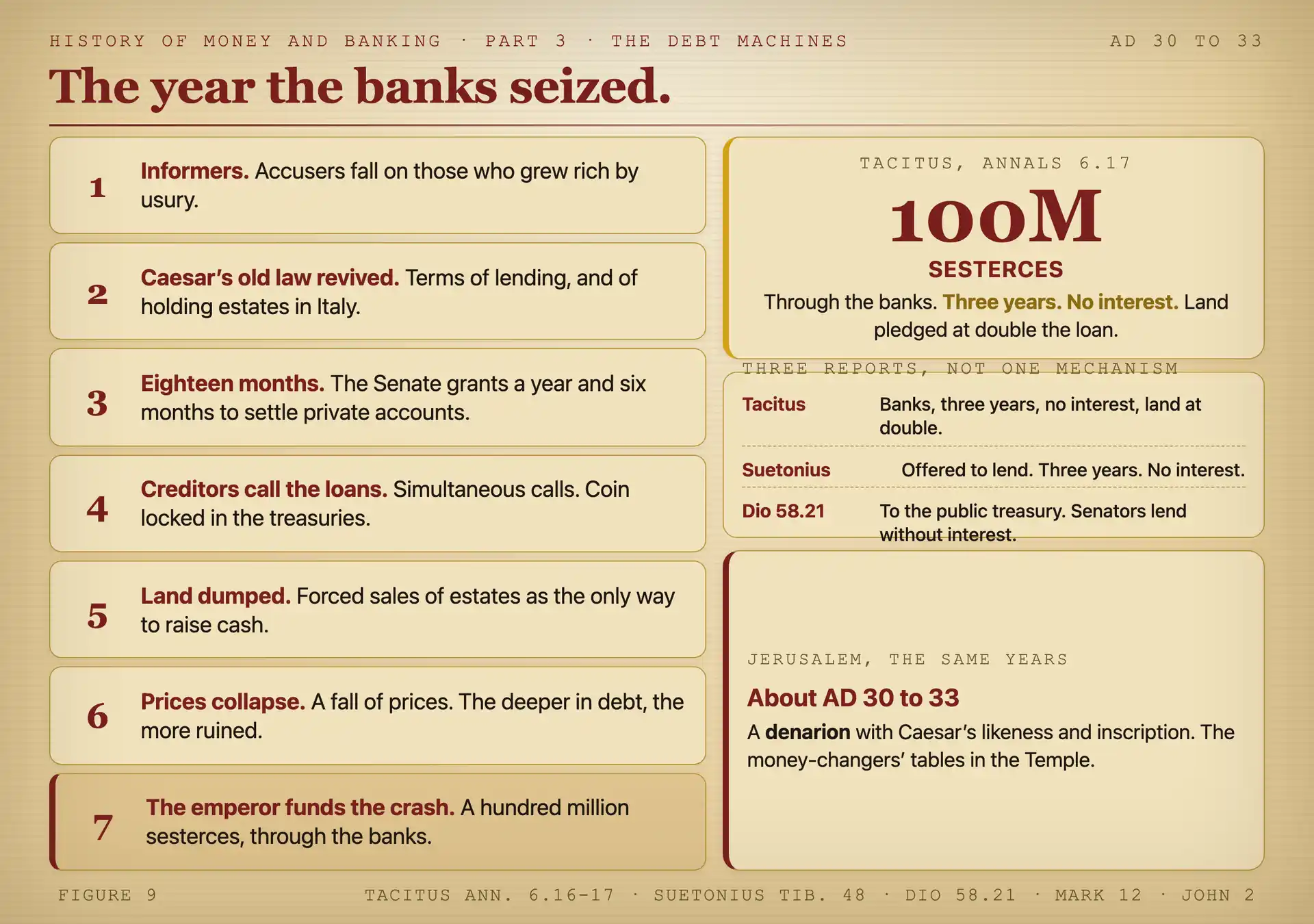
The first bank rescue in the Western record we can read step by step: an enforcement shock, a scramble into one asset, collapsing collateral, a state facility lent against land. Source: Tacitus, Annals 6.16-17; Suetonius, Tiberius 48; Dio 58.21.5.
Two cities, one decade, and the same money on both tables.
The silver wash
In 64 AD, Nero cut the coin, and he did it twice at once, which is how you get away with it. The weight standard fell from one eighty-fourth of a Roman pound to one ninety-sixth, so there was less coin in the coin, and the fineness fell, so there was less silver in the silver.⁸³
The cores find stages, not a ski slope: nobody announced a policy of decline, they just kept needing money, and one lever in the palace always worked.
Watch it work for two hundred years: Nero's pre-reform denarius comes out of the cores near ninety-seven to ninety-nine percent silver, and after 64 AD the issues run about eighty to ninety-three and a half. Vespasian runs eighty to ninety, Trajan falls toward eighty after the year 100, Hadrian sits at eighty to eighty-seven, Marcus Aurelius the philosopher king at seventy-five to eighty-two, and Commodus at seventy to seventy-six.⁸⁴
Then the army gets expensive and the floor gives out. Septimius Severus took the throne in 193 AD at the head of the legions and paid them like it, and published figures for his denarius spread across roughly forty-six to fifty-seven percent, his son Caracalla's about forty-eight to fifty-two.⁸⁵ In one lifetime, the coin of the richest state on earth went from nearly pure to roughly half.
And in 215 AD, Caracalla proved the government knew exactly what it was doing: he introduced a new coin, the antoninianus, tariffed it at two denarii, and put about one and a half denarii worth of silver in it.⁸⁶ The state wrote "two" on a coin worth one and a half and dared the empire to argue.
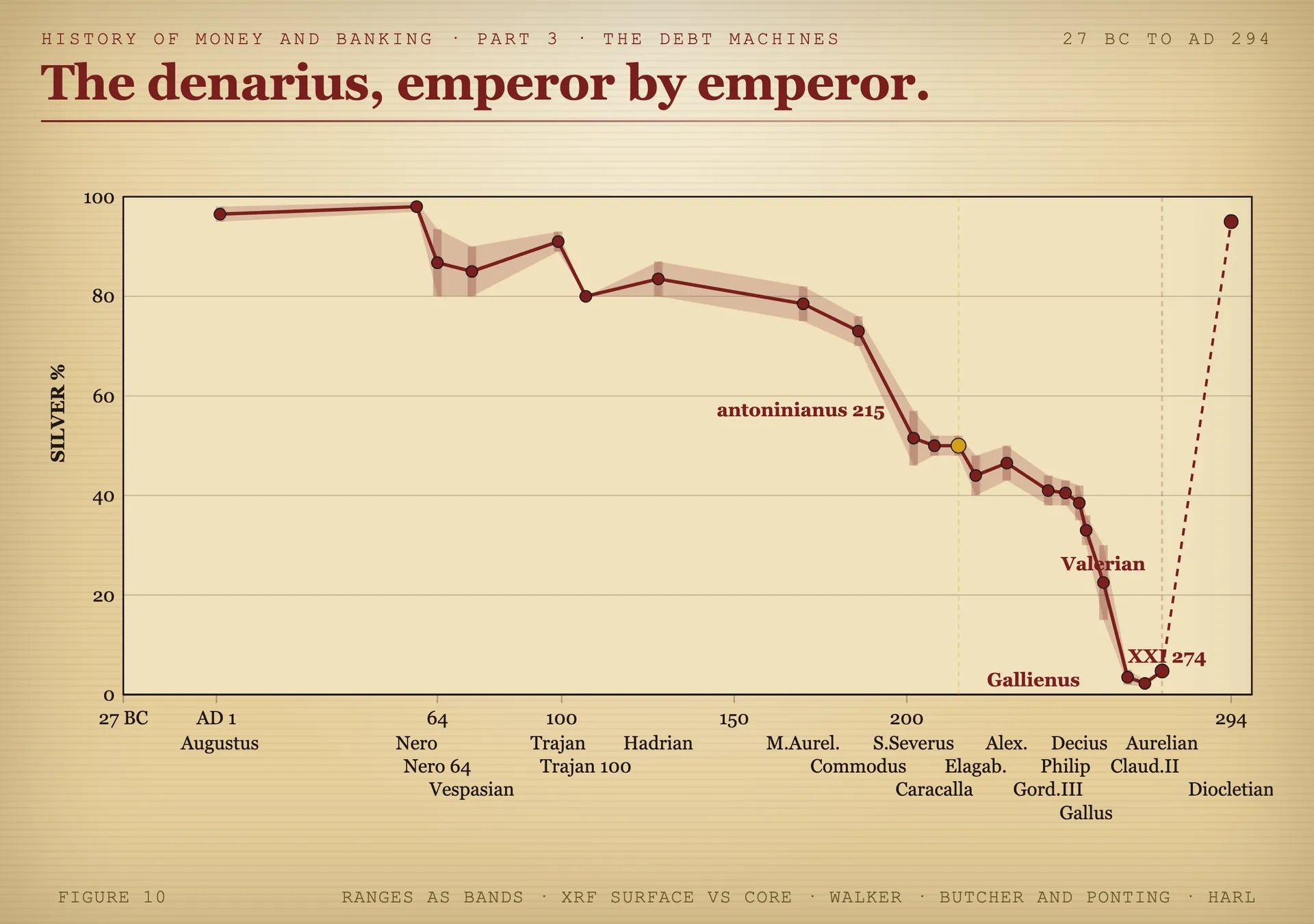
The spine of the story: the silver in Rome's everyday coin, emperor by emperor, plotted as ranges because ranges are what the evidence supports. Read the shape, not the smoothness. Source: Butcher and Ponting; Pense 1992; Harl and Walker; MER-RIC.
After 235 AD it stops being a policy and becomes weather, and historians conventionally count twenty-six emperors in the fifty years to 284 AD.⁸⁷
Gordian III runs thirty-eight to forty-four percent, Philip thirty-eight to forty-three, Decius thirty-five to forty-two, Trebonianus Gallus thirty to thirty-six, and Valerian anywhere from fifteen to thirty and still falling by mint and by year.⁸⁸ By the late 260s, under Gallienus, the coin the empire still called silver held roughly two to five percent silver, with a thin enriched skin on the outside so it would keep looking the part.⁸⁹ A bronze coin in a silver costume. Handle it enough and the costume comes off on your fingers.
Meanwhile the state quietly stopped trusting its own money, feeding and clothing the armies by requisition and tax in kind, which is what you build when the pay chest will not buy grain.⁹⁰
The tidy morality tale says prices chase the silver all the way down.
The prices did not follow.
Egypt's papyri are the closest thing the ancient world has to a price series, and wheat held its band: a second-century mean near 7.75 drachmas per artaba, a median and mode of eight, values clustering between six and sixteen up toward 270 AD.⁹¹
The silver went from ninety-something percent to two, and a farmer in the Fayum was still writing down numbers his grandfather would have recognized! Two hundred years of debasement, and the dam held.
Then, around and after 274 AD, it did not. The numbers break, hard. Donkeys sold for three hundred to eight hundred drachmas across 197 to 267, and go for thirty-eight hundred to six thousand by 277, while houses that traded up to seventy-four hundred drachmas through 271 sell for ninety thousand in 281.⁹² That is what a currency failing looks like from the inside: not a slope but a wall, and then nothing.
The edict
Pick up one of Aurelian's coins and turn it over, and down at the bottom of the reverse, in the thin strip of field the engraver kept back for the mint's own bookkeeping, there is a mark.
XXI. In the eastern mints, KA, which is the same number in Greek letters.⁹³ Twenty to one.
That is the state talking. Two centuries of quiet cuts, every one of them made in the dark at the furnace by men who did not announce anything. Now the ratio rides on the face of the money, where any grain dealer in Antioch can read it off with his thumb. Here is what is in this coin. Twenty parts of that, one part of this. Take it anyway... That is a confession with a marketing department attached.
Twenty years later, an emperor tried to put the metal back, and in 294 AD Diocletian issued the argenteus: about ninety-five percent silver, struck at ninety-six to the Roman pound, real money by any standard a Roman would have recognized.⁹⁴
Good coin! Correct instinct. He went back to the metal, and seven years later the same emperor was writing the prices of eggs.
A currency edict came first, and then, late in 301 AD, the big one: the Edict on Maximum Prices, cut into stone and set up in public, which is the only reason we still have it.⁹⁵ Its opening lines are some of the angriest a government has ever published about the people it governs, in a voice you will recognize.⁹⁶
Death, for selling above the list.
Two of its numbers show you the whole machine at once: a castrensis modius of wheat capped at 100 denarii, and an agricultural laborer capped at 25 denarii for a day's work with his food thrown in.⁹⁷ Four days in the field for a measure of grain, by law, on pain of death.
Lactantius was standing there, a Christian rhetorician writing under a persecuting emperor he hated with his whole chest, and he did not need to invent anything to make the passage land.⁹⁸
"He also, when by various extortions he had made all things exceedingly dear, attempted by an ordinance to limit their prices. Then much blood was shed for the veriest trifles; men were afraid to expose anything to sale, and the scarcity became more excessive and grievous than ever, until, in the end, the ordinance, after having proved destructive to multitudes, was from mere necessity abrogated."
The empire fixed the prices and the goods disappeared.
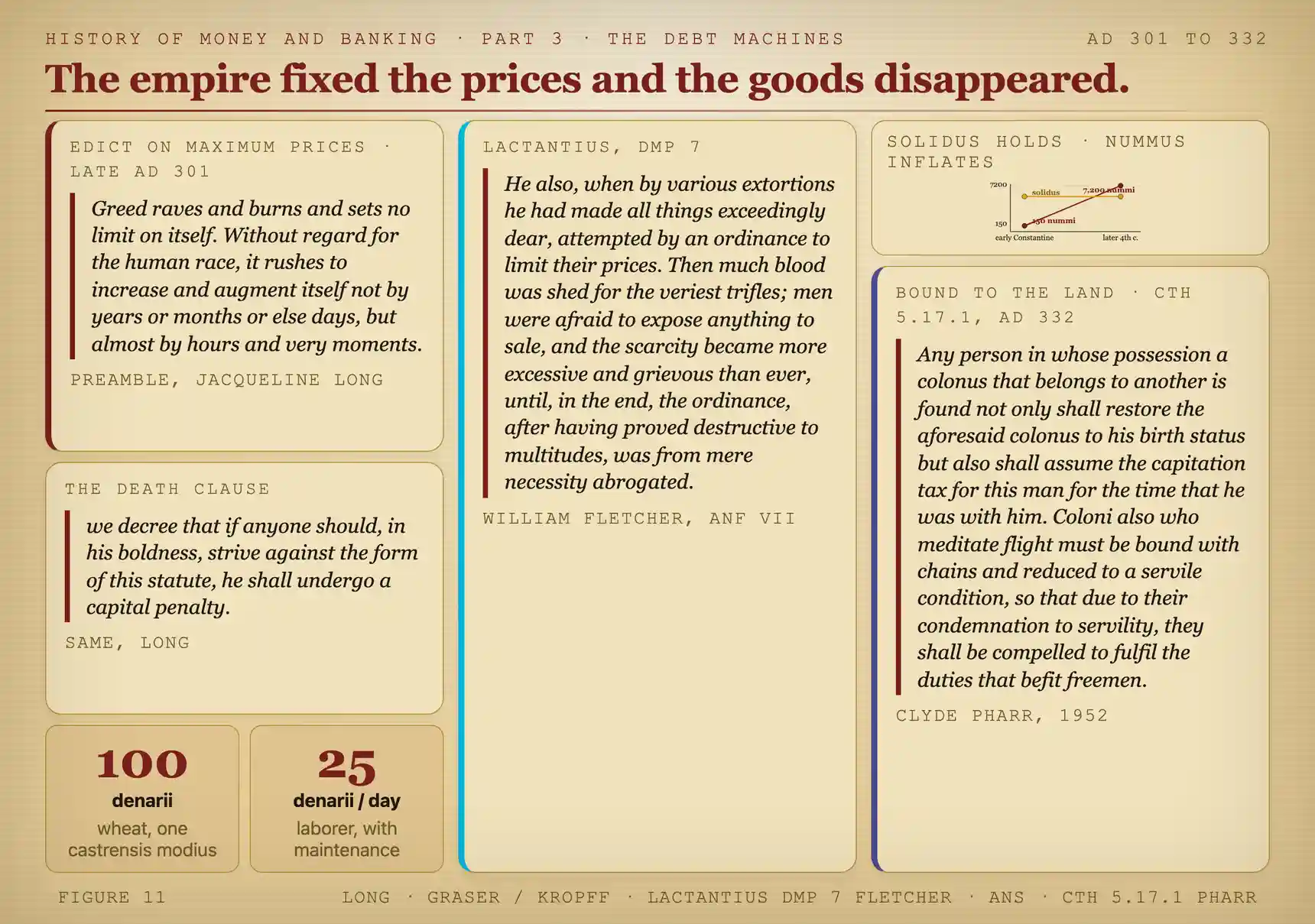
The edict is the moment the Roman state stops managing its money and starts managing its citizens instead: the law could reach the seller, and it could not reach the silver. Source: Edict on Maximum Prices, preamble, trans. Jacqueline Long; Lactantius, De Mortibus Persecutorum 7, trans. Fletcher; Codex Theodosianus 5.17.1, trans. Pharr, 1952.
The same chapter has the half that is not about market stalls at all. "There began to be fewer men who paid taxes than there were who received wages; so that the means of the husbandmen being exhausted by enormous impositions, the farms were abandoned, cultivated grounds became woodland, and universal dismay prevailed."⁹⁹ The farms went back to trees, and that detail comes back in about thirty years wearing chains.
Constantine walked away from the silver entirely, and around 309 or 310 AD, at Trier, he began striking a gold coin at seventy-two to the Roman pound, about 4.54 grams, and he held that standard.¹⁰⁰ The solidus. It outlives the empire that issued it and earns the nickname later historians hang on it, the dollar of the Middle Ages, by doing the one thing the denarius stopped doing: holding its weight.
Beautiful coin, honest weight, and now the only question that ever matters about hard money.
Who had one?
Soldiers paid in gold. Senators holding gold. Tax obligations increasingly reckoned in gold. And underneath that, the money the baker and the porter and the woman buying oil actually touched, which was copper, and which went the other way, fast, with the American Numismatic Society putting roughly 150 of the heavier bronze nummi to a solidus under Constantine, and roughly 7,200 of the reduced ones to a solidus later in the century.¹⁰¹
Two moneys, one that holds for the people who already hold things and one that evaporates for everyone else, which is a lot less a collapse and a lot more a sorting!
And in 332 AD, Constantine closed the loop on Lactantius's abandoned farms with a law that survives in the Theodosian Code, about the farm workers who leave.
"Any person in whose possession a colonus that belongs to another is found not only shall restore the aforesaid colonus to his birth status but also shall assume the capitation tax for this man for the time that he was with him. Coloni also who meditate flight must be bound with chains and reduced to a servile condition, so that due to their condemnation to servility, they shall be compelled to fulfil the duties that befit freemen."¹⁰²
That last clause is not even trying to hide the contradiction! The duties that befit freemen, enforced on a man in irons, because the tax head has to stay where the tax roll says it is.
One more thing before we leave Rome, because the Temple in Jerusalem still has a bill open.
Go back to 71 AD, when Titus comes home from Jerusalem and the Flavians throw the triumph.¹⁰³ The arch they raised for him still stands at the edge of the Forum with that procession carved into the passage wall, the Temple's lampstand and golden table and the trumpets going by on the shoulders of men.¹⁰⁴
Now the part I did not believe until I checked it.
Vespasian did not abolish the half-shekel.
"He also laid a tribute upon the Jews wheresoever they were, and enjoined every one of them to bring two drachmae every year into the Capitol, as they used to pay the same to the temple at Jerusalem."¹⁰⁵
Two drachmae is the didrachma, the same annual assessment, redirected to Jupiter on the Capitoline hill, so the tax did not stop, it just changed gods.
Render to Caesar the things that are Caesar's.
Two machines
Ok, so one machine runs underneath both of these cities.
It starts with a windfall that nobody earned: Laurion in 483 BC for Athens, and for Rome the Spanish mines, then Macedonian treasure, then Egypt in 30 BC, at which point interest falls, land goes up and everybody thinks they are living in a new kind of world.
Then the windfall gets institutionalized as tribute: 460 talents a year sailing to Delos and then to Athens, conquest turned into provinces, and in 167 BC the Roman citizen stops paying direct tax at all, because other people are paying it for him.
Then the money gets political. Athens pays its jurors and rowers out of the treasury, which is a genuinely good thing, and which also means the state now has a payroll that cannot be cut without the payroll voting, and Rome builds the same dependency at imperial scale, with grain and games on top.
Then the wars outlive the windfall, the same hinge both times: Athens after Sicily, and Rome after the Antonine peace ends and the frontier goes hot in both directions at once.
Then the state reaches for the stamp instead of the metal. Athens melts the golden Victories in 407 and issues bronze with a silver skin the year after that, and Rome does it slower and longer, from Nero's cut down to Gallienus, where the coin is bronze with a wash on it and everyone can see it.
Then the state attacks the symptom. Rome posts the maximum prices and threatens death, and Athens, to its credit, took the bad copper back out of circulation and put the silver back in.
Then the people leave. Twenty thousand walk out of Athens during the occupation of Decelea, artisans mostly, per Thucydides.¹⁰⁶ The Roman farms go to woodland, and the answer is a law with chains in it.
Athens ran that circuit in a single lifetime, and a man born in Athens the year the Parthenon's first stone was laid could have been standing at the Long Walls when the flute girls played them down.
Rome ran the same circuit over three centuries, on gold, with a bigger tax base and better roads, and the western end of it came about four centuries after Nero touched the denarius. Bigger machine, longer fuse, same sequence...
And both machines did the same thing to the men who tried to interrupt them. Solon canceled the debts, pulled the stones out of the fields, banned lending on a man's body, and refused the crown both sides were offering him, though Aristotle's Constitution says he could have put his fellow citizens under his feet.¹⁰⁷ Five centuries later Caesar refused the wholesale cancellation his own supporters were screaming for, credited interest already paid against the principal, and wiped out about a quarter of what was owed.¹⁰⁸
Touch the debts and you are a tyrant. Touch the coin and you are an administrator. That asymmetry is the whole business, and it has never once gone away.
It shows up again in 1307, when Philip IV's officers arrest the Templars across France on a Friday in October and go looking for the order's money, which is where Part 1 of this series opened.¹⁰⁹ It shows up in the Florentine families, who are still a few installments out. It is showing up on somebody's balance sheet this morning.
And the argument against all of it was already written, for laughs, in 405 BC, by a comic playwright watching his city pay for a war with plated coins.¹¹⁰ Every hard-money argument I have ever made about Bitcoin is sitting in that joke, twenty-four centuries early, and the crowd laughed because they already knew it!
That is the case, and now for the soft spots.
It's a great ancient story, but is it true?
I told all of that the way the people who left the record told it: confident, hot, no hand on your shoulder. Herodotus says Croesus did it, so Croesus did it, and that is a fine way to tell a story and a terrible way to audit one. So let's run the tape.
What's true
- The coins. Lydian electrum from the Artemision at Ephesus. Athenian owls from Egypt to Afghanistan. Silver-plated bronze out of the Athenian Agora that should not exist if a city only ever struck honest silver. Tiberius denarii reading TI CAESAR DIVI AVG F AVGVSTVS and PONTIF MAXIM. Tyrian shekels at about fourteen grams with Melqart on the face. Aurelian's XXI, Diocletian's argenteus, Constantine's solidus. And the metallurgy behind every fineness number above: Butcher and Ponting, Walker, Harl, Pense.
- The stones. The Athenian tribute lists. IG I3 369, the account showing Athena's treasury lending to the city at interest. The inventories recording seven golden Nikai gone off their supports and one still standing. The Parthenon building accounts. The Coinage Decree fragments. Copies of Diocletian's price edict, carved and set up in public. The Arch of Titus.
- The texts, by name. Herodotus. Thucydides. Aristotle's Constitution of the Athenians. Aristophanes. Demosthenes and Isocrates, who hand us the inside of an ancient bank because a family fought over it in court. Plutarch, Livy, Sallust, Cicero. Suetonius, Tacitus, Dio. Pliny. Josephus. The Mishnah and the Talmud. Lactantius. The Theodosian Code. And the Gospels, the only source here that puts a coin in a man's hand and makes him look at it.
What may or may not be
- Croesus's oracle, and his numbers. Herodotus is reporting, around 430 BC, on events a century before him, and a source that good is still not a ledger.
- Solon's friends buying land on the tip. Plutarch tells it, Plutarch himself flags it as a story people tell, and the sources cannot even agree whether the loan Solon himself forgave was five talents or fifteen.
- Two hundred triremes, or one hundred. Herodotus gives two hundred ships out of the Laurion silver; Aristotle's Constitution gives a hundred, built by a hundred rich men, and the second number is just as old.
- The Coinage Decree's date. The fragments are real, but the decade is a fight that has run since the 1930s, somewhere between the 450s and the 420s. Calling it the world's first currency union is a modern analogy; it was an imperial order, not a treaty between equals.
- Whether the Nikai "paid the fleet." The gold was authorized for melting, the emergency coinage exists, and 110 ships went out for Conon in the same window. No inscription hands a Nike-coin to a named rower. The payroll line is mine.
- Twelve percent to four. That is Dio, once, on the effect of Egypt's treasure hitting Rome. Suetonius says interest fell and land rose and gives no percentages at all.
- Which coin the tribute penny was. The Gospel says denarion and says whose face is on it. The Tiberius Lugdunum denarius is the familiar candidate and it fits, but the text gives no catalog number.
- One Temple cleansing or two. John puts it at the start, the other three in the last week. Most of the field reads one event that John relocated; a real minority reads two. I did not pick.
- The Bazaars of Annas. The rabbis put shops belonging to that family on the Mount of Olives. The move inside the Temple courts is a 1964 hypothesis, and it is a good one, and it is a hypothesis.
- The third-century prices. Dominic Rathbone's work on the Egyptian papyri shows wheat holding a narrow band deep into the third century, then breaking around and after 274. The break is solid. The multipliers people quote for it are not, and I did not print one.
- The Temple as "the region's bank." It held deposits, including money belonging to widows and orphans, and Crassus stripped it, which is enough for me to call it a bank, even though "Bank" is a word I am carrying in from two thousand years later.
- The AD 33 facility as a bailout. Tacitus has a hundred million sesterces going out through the banks, three years, no interest, on land at double value. Dio has it going to the treasury and lent by senators, with no term at all. Three authors, three mechanisms, one event, and "Bailout" is the word I hung on it.
- The aerarium militare's five percent tax. Augustus funded the soldiers' pension chest from an inheritance tax that the Res Gestae and Dio both report, and the five percent is their number as they report it, which is all anybody has.
- Aurelian's "twenty to one." The XXI mark is on the coin. Reading it as a precise five percent silver content, rather than a looser "good coin, do not ask" signal, is a numismatic convention, not a settled translation.
And then there is the pile of things that are simply not so, and every one of them has a birthday!
What's probably false
- That rain from Apollo put out Croesus's pyre. Herodotus tells it around 430 BC and credits it to what the Lydians say. Bacchylides had a rain-rescue cousin of the story in an ode written about 468 BC, and what we are looking at is a poet's ending for a king's life.
- That the Nabonidus Chronicle settles the fall of Sardis in 547 BC. The tablet is damaged at exactly the wrong sign. "Lydia" is one reading. Urartu is another.
- That Caesar canceled Rome's debts. He specifically refused to. Suetonius says he disappointed the people agitating for cancellation and settled for a valuation that cut about a quarter. The slogan survived because a cancellation fits in a sentence and a prewar valuation with an interest credit does not.
- That figural coins were banned from the Temple. The sacred standard for fixed payments was the Tyrian shekel, and the Tyrian shekel has the god Melqart on the front of it. They took it for the silver.
- That the changers charged a flat four percent. The Mishnah preserves an argument, Rabbi Meir against the Rabbis, and the percentage also depends on whether you divide by the whole shekel or the half. Anybody quoting one clean number has picked a side and not told you.
- That Josephus gives a figure for the Temple treasury in 70 AD. He says "an immense quantity of money." He does not count it. Somebody else counted it for him, much later.
- That the same tables and the same coins went on after 70 AD. The assessment was redirected to the Capitol. The payers, the collectors and the machinery all changed. That continuity is institutional and brutal, and it is not literal.
- That prices rose in lockstep with the silver. The papyri hold and then jump. Kyle Harper's summary is that scholars have come to the view that there was no continuous, linear inflation of nominal prices moving in tandem with the debasement.¹¹⁴ Any chart with two smooth lines lying on top of each other is smoothing something the papyri refuse to smooth.
- That Rome fell from debasement alone. It did not, and I just named five scholars who will tell you why, and debasement is one strand in a very thick rope.
- That Diocletian's edict failed instantly and identically everywhere. We have one furious Christian pamphlet and scattered enforcement evidence. Lactantius saw what he saw, in the markets he could see, and that is one witness and not a map of the empire.
- That Constantine invented serfdom. The law of 332 sits inside a much longer hardening of the colonate, one link in a chain other emperors had already been forging.
- That Thomas Gresham formulated Gresham's law. Aristophanes had the mechanism in 405 BC. Oresme wrote it up in the fourteenth century, Copernicus in 1526. Henry Dunning Macleod attached Gresham's name to it in 1858, and Gresham has been collecting the royalties ever since...¹¹⁵
And finally, the one I actually care about: that "render unto Caesar" is a sermon about paying your taxes.
It is half of a sentence, cut off before the good part, and it gets used this way constantly, in public, on the record. R. C. Sproul, in a sermon published 20 December 2015: "So, Jesus said, 'Pay your taxes.'"¹¹⁶ The Nebraska Legislature's Revenue Committee, 24 January 2014, where a senator brings the verse into a tax debate as scriptural instruction to pay up.¹¹⁷ A sermon titled "Render Unto Caesar," posted 30 January 2026, treating Matthew 22:21 as a straightforward obligation to the tax collector.¹¹⁸
Two thousand years of that. He was holding a coin with a dead man's face on it, in a courtyard where the money had to be swapped before God would take it, surrounded by people who had tried to get him killed with a tax question, and the line we kept was the easy half.
Give Caesar back his little picture, and then read the other half of the sentence, which is where the bill comes to you.
That's the ledger, and you now know which parts of this I would defend in a room full of classicists and which parts I would defend with a grin.
Next time, the whole thing changes shape. Everything in Sardis and Athens and Rome was a fight about metal: how much is in the coin, who gets to say, and what happens when the real answer is "less than yesterday."
Then a state on the other side of the world skips the argument entirely and goes straight to paper, printed by the government, spendable because the government says so and punishable if you refuse. China gets there roughly seven centuries before Europe, and discovers every single thing that can go wrong with it, in order, first.
Part 4: the state that skips the metal and prints the promise.
Kurt Wuckert Jr. is the Chief Bitcoin Historian, founder of GorillaPool and Open Protocol Labs, and host of Kurt's Podcast. He writes weekly on Bitcoin, geopolitics, faith, and the long fight for human sovereignty at kurtwuckertjr.com. Catch him live every Tuesday at 2 PM EST.
Footnotes
¹ Demosthenes, For Phormion 36.7-8, trans. A. T. Murray, Loeb, MIT mirror; and Jeremy Trevett, Apollodoros the Son of Pasion, Oxford, 1992.
² Demosthenes, For Phormion 36.5, Murray, MIT mirror.
³ Demosthenes, For Phormion 36.11, Murray, MIT mirror.
⁴ Demosthenes, Against Timotheus 49.8, Murray, ToposText.
⁵ Early electrum from the Artemision at Ephesus; chronology in Christopher Howgego, Ancient History from Coins, 1995; and van Alfen and Wartenberg, eds., White Gold, ANS, 2020.
⁶ Georges Le Rider, La naissance de la monnaie, Collège de France; illustrative samples.
⁷ Robert W. Wallace, "The Origin of Electrum Coinage," AJA 91.3, 1987, pp. 385-397.
⁸ Herodotus, Histories 1.94, trans. G. C. Macaulay, 1890, Lexundria.
⁹ The Croeseid coinage; Nicholas Cahill and John H. Kroll, "New Archaic Coin Finds at Sardis," AJA 109, 2005, pp. 589-617.
¹⁰ Herodotus, Histories 1.53, Macaulay, Lexundria.
¹¹ Herodotus, Histories 1.79-86, Macaulay, Lexundria; and the Sardis destruction horizon in Cahill and Kroll, AJA 109, 2005.
¹² Herodotus, Histories 1.87, Macaulay, Lexundria.
¹³ Croeseid types continued under Persia, and the Apadana deposits of 519-510 BC; Rüdiger Schmitt, "Daric," Encyclopaedia Iranica, 1994; and John H. Kroll, "Coins of Sardis,".
¹⁴ Aristotle (or the Aristotelian school), Constitution of the Athenians 2, trans. Frederic G. Kenyon, 1891, Fordham.
¹⁵ Constitution of the Athenians 6 and 9.1, Kenyon, Fordham.
¹⁶ Plutarch, Solon 15.7, Perrin, Lexundria.
¹⁷ Constitution of the Athenians 6.3, Kenyon, Fordham; and the verses of refusal in Plutarch, Solon 14, Dryden and Clough, MIT Classics.
¹⁸ Constitution of the Athenians 22.7, Kenyon, Fordham.
¹⁹ Herodotus, Histories 7.144.1, trans. A. D. Godley, Loeb vol. 3, 1922, Perseus.
²⁰ Thucydides 1.96.2, trans. Richard Crawley, 1874, Project Gutenberg.
²¹ IG I3 259, the first Athenian tribute quota list, 454/3 BC; Attic Inscriptions Online.
²² Parthenon building accounts, IG I3 436-451, 447/6 to 433/2 BC; Acropolis Museum.
²³ Plutarch, Pericles 12.2, trans. Bernadotte Perrin, Loeb, 1916, Perseus.
²⁴ Plutarch, Pericles 12.3, Perrin, Perseus.
²⁵ Thucydides 2.13.3, Crawley, Project Gutenberg.
²⁶ Thucydides 2.13.5, Crawley, Project Gutenberg.
²⁷ The Athenian owl tetradrachm, Acropolis Museum; and eastern imitations in Gentelli et al., "When is an owl not an owl?" JAS: Reports, 2026.
²⁸ The Athenian Coinage Decree, IG I3 1453, ed. Klaus Hallof, Inscriptiones Graecae.
²⁹ Constitution of the Athenians 27.3, Kenyon, Fordham; and Thucydides 6.31.3, Crawley, Project Gutenberg.
³⁰ IG I3 369, sacred-treasury loans of 426/425 to 423/422 BC; Attic Inscriptions Online.
³¹ Thucydides 7.87, trans. Crawley, Livius.
³² Thucydides 7.27.5, trans. Crawley, Perseus Digital Library.
³³ Xenophon, Hellenica 1.5.7, trans. H. G. Dakyns, Project Gutenberg.
³⁴ Dorothy Burr Thompson, "The Golden Nikai Reconsidered," Hesperia 13 (1944), 173-209; and Alec Blamire, "Athenian Finance, 454-404 B.C.," Hesperia 70 (2001), 99-126.
³⁵ John H. Kroll, The Athenian Agora XXVI: The Greek Coins (1993), ASCSA.
³⁶ Kroll, "Aristophanes' ponera chalkia: A Reply," GRBS 17 (1976), 329-341, Duke.
³⁷ Aristophanes, Frogs 718-737, trans. Matthew Dillon, Perseus.
³⁸ Xenophon, Hellenica 2.2.23, trans. Dakyns, Project Gutenberg.
³⁹ Aristophanes, Ecclesiazusae 815-822, trans. Benjamin Bickley Rogers, collected edition.
⁴⁰ Pasion's death is dated 370/369 BC by Jeremy Trevett, Apollodoros the Son of Pasion (Oxford, 1992); the bank and will cases are Demosthenes 36, 45, 46, 49 and 52.
⁴¹ Demosthenes, Against Timotheus 49.8, trans. A. T. Murray, ToposText.
⁴² Livy 6.20.13 and 7.28, via Platner and Ashby, A Topographical Dictionary of Ancient Rome, 1929, 289-290, who report the traditional 269 BC mint and the moneo derivation as uncertain.
⁴³ Buttrey, Erim, Groves and Holloway, Morgantina Studies II: The Coins (Princeton, 1989); the deposits give a terminus ante quem, not a first-strike year.
⁴⁴ The frame synthesizes the Morgantina evidence, the Spanish silver mines and the end of the citizen war tax.
⁴⁵ Cicero, On Duties 2.76, trans. Walter Miller, Loeb 1913, LacusCurtius.
⁴⁶ Livy 8.28.8, trans. Canon Roberts, Perseus; Varro gives 313 BC.
⁴⁷ Sallust, Catiline 14 and 20-21, trans. John Selby Watson, Project Gutenberg.
⁴⁸ Cicero, On Duties 2.84, trans. Miller, Loeb 1913, LacusCurtius.
⁴⁹ Suetonius, Julius 42.2, trans. J. C. Rolfe, Loeb 1913, LacusCurtius.
⁵⁰ Cassius Dio 41.37.3-38.1, trans. Cary, LacusCurtius; the proportion is Suetonius's estimate.
⁵¹ Cassius Dio 51.21, trans. Earnest Cary, Loeb 1917, LacusCurtius.
⁵² Cassius Dio 51.21.5, trans. Cary, Loeb 1917, LacusCurtius.
⁵³ Suetonius, Augustus 28.3, trans. Rolfe, Loeb 1913, LacusCurtius.
⁵⁴ Augustus, Res Gestae 17.2, trans. Shipley, for the 170 million; and Cassius Dio 55.25, trans. Cary, for the inheritance tax.
⁵⁵ Pliny, Natural History 6.101, trans. H. Rackham, via Wikisource.
⁵⁶ Pliny, Natural History 12.84, trans. Rackham, via Wikisource; 6.101's fifty million is India alone, the hundred million three regions.
⁵⁷ Mark 12:13, ESV, BibleGateway.
⁵⁸ Mark 12:14-15, ESV, BibleGateway; Luke 20:20 calls them spies.
⁵⁹ Mark 12:15-16, with Matthew 22:19 and Luke 20:24, ESV, BibleGateway.
⁶⁰ RIC I(2) Tiberius 26 and 30, Lugdunum, 14 to 37 AD, ANS OCRE.
⁶¹ Thayer on eikōn, epigraphē and apodote, Blue Letter Bible.
⁶² Genesis 1:26-27, ESV, BibleGateway.
⁶³ Tertullian, De Idololatria 15, trans. Thelwall, ANF vol. 3, Logos Library.
⁶⁴ Augustine, Sermon 113A.8, trans. Edmund Hill, Works of Saint Augustine III/4, PDF.
⁶⁵ Exodus 30:13, ESV, BibleGateway.
⁶⁶ Matthew 17:24-27, ESV, BibleGateway.
⁶⁷ Mishnah Shekalim 1:3, William Davidson Edition, Sefaria; compiled about 200 AD.
⁶⁸ Tyrian shekel weight, assays and types; Meshorer, A Treasury of Jewish Coins (2001), pp. 73 to 78.
⁶⁹ b. Bekhorot 50b:8, William Davidson Talmud, Sefaria; also m. Bekhorot 8:7.
⁷⁰ Mishnah Shekalim 1:6-7, William Davidson Edition, Sefaria; twenty-four ma'ah to the shekel is the conversion used for the percentages; Matthew 20:2 for the vineyard wage.
⁷¹ 2 Maccabees 3:6 and 3:10, NRSVUE, BibleGateway.
⁷² Josephus, Antiquities 14.105 (two thousand talents Pompey left, eight thousand talents of gold) and Jewish War 6.282, trans. Whiston, Lexundria.
⁷³ Josephus, Antiquities 18.26 and 20.198, trans. Whiston, CCEL; John 18:13, ESV.
⁷⁴ b. Pesahim 57a, William Davidson Edition, Sefaria.
⁷⁵ John 2:13-17, ESV, BibleGateway.
⁷⁶ Mark 11:15-17, with Matthew 21:12-13 and Luke 19:45-46, ESV, BibleGateway; quoting Isaiah 56:7 and Jeremiah 7:11.
⁷⁷ Jeremiah 7:2 and 7:11, ESV, BibleGateway.
⁷⁸ Tacitus, Annals 6.16, trans. Church and Brodribb, MIT Classics.
⁷⁹ Tacitus, Annals 6.17; and Suetonius, Tiberius 48.1, trans. Rolfe, LacusCurtius.
⁸⁰ Tacitus, Annals 6.17, Church and Brodribb, MIT Classics.
⁸¹ Suetonius, Tiberius 48.1, trans. Rolfe, Loeb 1913, LacusCurtius.
⁸² Cassius Dio 58.21.5, trans. Cary, Loeb, LacusCurtius; Dio carries no three-year term.
⁸³ Butcher and Ponting, The Metallurgy of Roman Silver Coinage (2014), Warwick.
⁸⁴ First and second century ranges from Butcher and Ponting's drilled cores and from Harl and Walker compilations; the methods are not interchangeable.
⁸⁵ Severus about 46 to 57 percent by method, Caracalla about 48 to 52; Harl and Walker, with Gitler and Butcher-Ponting at the low end.
⁸⁶ Harl, Coinage in the Roman Economy (1996); A. W. Pense, "The Decline and Fall of the Roman Denarius" (1992), ScienceDirect.
⁸⁷ "Twenty-six emperors" is a counting convention whose total moves with junior Caesars, usurpers and the breakaway courts, University of Oregon; Clifford Ando, Imperial Rome AD 193 to 284 (2012).
⁸⁸ Third-century ranges from Pense 1992 and Harl, ScienceDirect; single figures conceal variation by date and mint.
⁸⁹ Late Gallienus radiates, roughly 2 to 5 percent silver with surface enrichment; Pense 1992, ScienceDirect.
⁹⁰ The annona militaris, requisitions and taxes in kind.
⁹¹ Rathbone's Egyptian price data as rechecked by Monson, discussed in Kyle Harper, "People, Plagues, and Prices in the Roman World: The Evidence from Egypt," Journal of Economic History 76.3 (2016), Cambridge Core.
⁹² Rathbone 1996, pp. 332 to 333, reproduced in "The Crisis of the 3rd Century A.D.," Durham e-Theses.
⁹³ Aurelian's reformed radiates and the XXI / KA mint mark, MER-RIC, Monnaies de l'Empire Romain, Maison de l'Orient et de la Méditerranée.
⁹⁴ Diocletian's coinage reform of AD 294, the argenteus at about 95 percent fine and 1/96 of a Roman pound, MER-RIC, Monnaies de l'Empire Romain, Maison de l'Orient et de la Méditerranée.
⁹⁵ The Aphrodisias currency edict of AD 301, per Kenan Erim, Joyce Reynolds and Michael Crawford, "Diocletian's Currency Reform: A New Inscription," Journal of Roman Studies 61, 1971.
⁹⁶ Edict on Maximum Prices, preamble, trans. Jacqueline Long, text of the price edict, late AD 301.
⁹⁷ Wheat at 100 denarii per castrensis modius and a day laborer at 25 denarii with maintenance; standard reconstructions of the price list by Graser and Kropff. The preamble is the portion opened directly for this article.
⁹⁸ Lactantius, De Mortibus Persecutorum 7, trans. William Fletcher, Ante-Nicene Fathers vol. VII, New Advent, 1886.
⁹⁹ Lactantius, De Mortibus Persecutorum 7, trans. William Fletcher, Ante-Nicene Fathers vol. VII, New Advent, 1886.
¹⁰⁰ The solidus at 1/72 of a Roman pound, about 4.54 g, first struck at Trier about AD 309-310; Rory Naismith, Money and Coinage in the Middle Ages, Brill, 2018, p. 65.
¹⁰¹ Ratios of nummi to the solidus under Constantine and later in the fourth century, American Numismatic Society, "Rome: A Thousand Years of Monetary History".
¹⁰² Codex Theodosianus 5.17.1, AD 332, trans. Clyde Pharr, The Theodosian Code and Novels and the Sirmondian Constitutions, Princeton University Press, 1952.
¹⁰³ Josephus, Jewish War 7.148-149, trans. William Whiston, juchre.org, 1737.
¹⁰⁴ The spoils relief in the passageway of the Arch of Titus, Rome; Arch of Titus Digital Restoration Project, Yeshiva University.
¹⁰⁵ Josephus, Jewish War 7.218, trans. William Whiston, juchre.org, 1737.
¹⁰⁶ Thucydides, History of the Peloponnesian War 7.27.5, trans. Richard Crawley, Perseus Digital Library.
¹⁰⁷ Constitution of the Athenians 6.3, trans. Sir Frederic G. Kenyon, 1891, Fordham Ancient History Sourcebook.
¹⁰⁸ Suetonius, Life of Julius Caesar 42.2, trans. J. C. Rolfe, Loeb Classical Library, 1914, Lexundria.
¹⁰⁹ The arrests of 13 October 1307; Archives nationales, "Les Templiers".
¹¹⁰ Aristophanes, Frogs 718-737, trans. Matthew Dillon, Perseus Digital Library.
¹¹¹ Tertullian, De Idololatria 15, trans. S. Thelwall, Ante-Nicene Fathers vol. 3; and Augustine, Sermon 113A.8, trans. Edmund Hill, Works of Saint Augustine III/4.
¹¹² Kyle Harper, The Fate of Rome: Climate, Disease, and the End of an Empire, Princeton University Press, 2017, ch. 1.
¹¹³ Peter Heather, "A Few Questions for Peter Heather," OUPblog, July 2007.
¹¹⁴ Kyle Harper, "People, Plagues, and Prices in the Roman World: The Evidence from Egypt," Journal of Economic History 76.3, 2016.
¹¹⁵ Theodore E. Burton, The Law of Oresme, Copernicus, and Gresham, 1908; and Stanford Encyclopedia of Philosophy, "Nicole Oresme".
¹¹⁶ R. C. Sproul, "Render Unto Caesar," Ligonier Ministries, 20 December 2015.
¹¹⁷ Nebraska Legislature, Revenue Committee transcript, 24 January 2014, pp. 9-10.
¹¹⁸ Charles Payne, "Render Unto Caesar," SermonCentral, 30 January 2026.
Be good to each other. And stay curious.