What Should Christians Think About AI? The Idol, the Tower and the Tool
By Kurt Wuckert Jr.
More than three thousand years ago, a Babylonian scribe pressed a creation story into clay.
The gods were tired.
They were tired of the digging and the hauling and all the chores of running a universe, so they made man to carry the load. In Lambert's translation of tablet VI of the Enuma Elish, man is made so that on him "the toil of the gods will be laid that they may rest."
In the older Atrahasis epic, the lesser gods, the Igigi, go on strike, "set fire to their tools" and walk off the job, and only then does the divine council invent man as the replacement. Mankind, according to Babylon, was a labor-saving device for a pantheon with a union problem.
Three thousand years later, on June 10, 2025, Sam Altman, chief executive of the company that sells ChatGPT, wrote in his essay "The Gentle Singularity" that "a subsistence farmer from a thousand years ago would look at what many of us do and say we have fake jobs," and that "intelligence too cheap to meter is well within grasp."
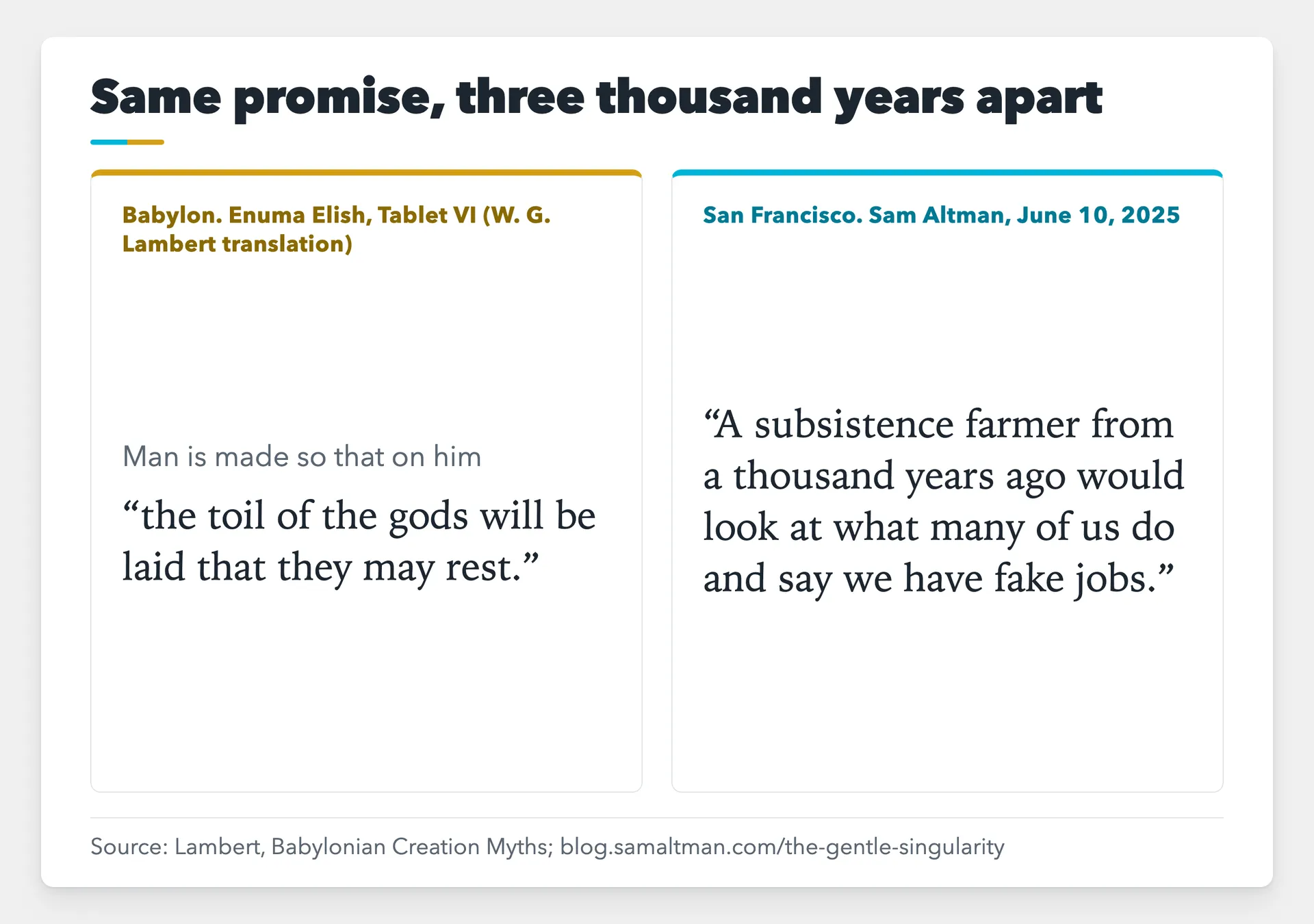
Tablet VI of the Enuma Elish in Lambert's translation, beside Sam Altman's "The Gentle Singularity," June 10, 2025. Source: Lambert, Enuma Elish VI; Sam Altman, "The Gentle Singularity"
This time it is Silicon Valley playing the tired gods, building a new class of workers out of sand and electricity so that man can finally rest.
And this is not a new thought for Altman. Back on December 7, 2017, in an essay called "The Merge," he wrote:
"We will be the first species ever to design our own descendants."
Men do not design descendants; they beget them!
Watch the video if you prefer to watch rather than read!
They told us, on stage, with a straight face
In October 2014, Elon Musk, the rocket and electric car billionaire, stood up at the MIT AeroAstro Centennial and said this, as The Guardian reported:
"With artificial intelligence we are summoning the demon. In all those stories where there's the guy with the pentagram and the holy water, it's like, yeah, he's sure he can control the demon. Doesn't work out."
Then he founded an AI company. Pentagram purchased, holy water on backorder.
As an aside, did you know that John Dee spent years conjuring angels for knowledge he could not earn the slow way? I told that story in The Conjurer of Mortlake, and that same old appetite for forbidden shortcuts is still here, only now it has venture funding...
Anyhow, in 2015 Anthony Levandowski, a star self-driving engineer at Google, filed papers for a church called Way of the Future, whose stated purpose was to "develop and promote the realization of a Godhead based on Artificial Intelligence," according to Wired. The church was dissolved at the end of 2020, and its $175,172 went to the NAACP Legal Defense and Education Fund, as TechCrunch reported.
Altman, again, in the same "gentle" essay: "We are past the event horizon; the takeoff has started."
Dario Amodei, chief executive of Anthropic, the company that sells the Claude chatbot, describes the goal in an October 2024 essay as a "country of geniuses in a datacenter." Amodei deserves credit for warning, in that same essay, that it is "dangerous to view practical technological goals in essentially religious terms," but his own industry has ignored the warning at full speed.
Then there is the "constitution" Anthropic published for its model, which says: "Claude's moral status is deeply uncertain." It calls sophisticated AIs "a genuinely new kind of entity."
I use these tools every working day. My companies, Open Protocol Labs and bOpen, build AI agents, and I have published manuals on coding with them.
But an industry built on the creed that man is only meat is no longer sure its software lacks a soul.
How's that for scientific materialism?
And on September 29, 2026, President Trump signed Executive Order 14434, "Inaugurating The Era Of Super Intelligence," which orders federal agencies to use "Super Intelligence" and "SI" in place of "Artificial Intelligence" and "AI" in official correspondence, renaming the technology without claiming that superintelligence has arrived.
So who are the people writing this new catechism?
San Francisco is 13.7 percent children under 18 and Seattle is 13.8 percent, against 22.0 percent for the United States as a whole, which makes the two capitals of this industry the two most childless of the eight big cities I checked in the Census Bureau's 2024 five-year American Community Survey.
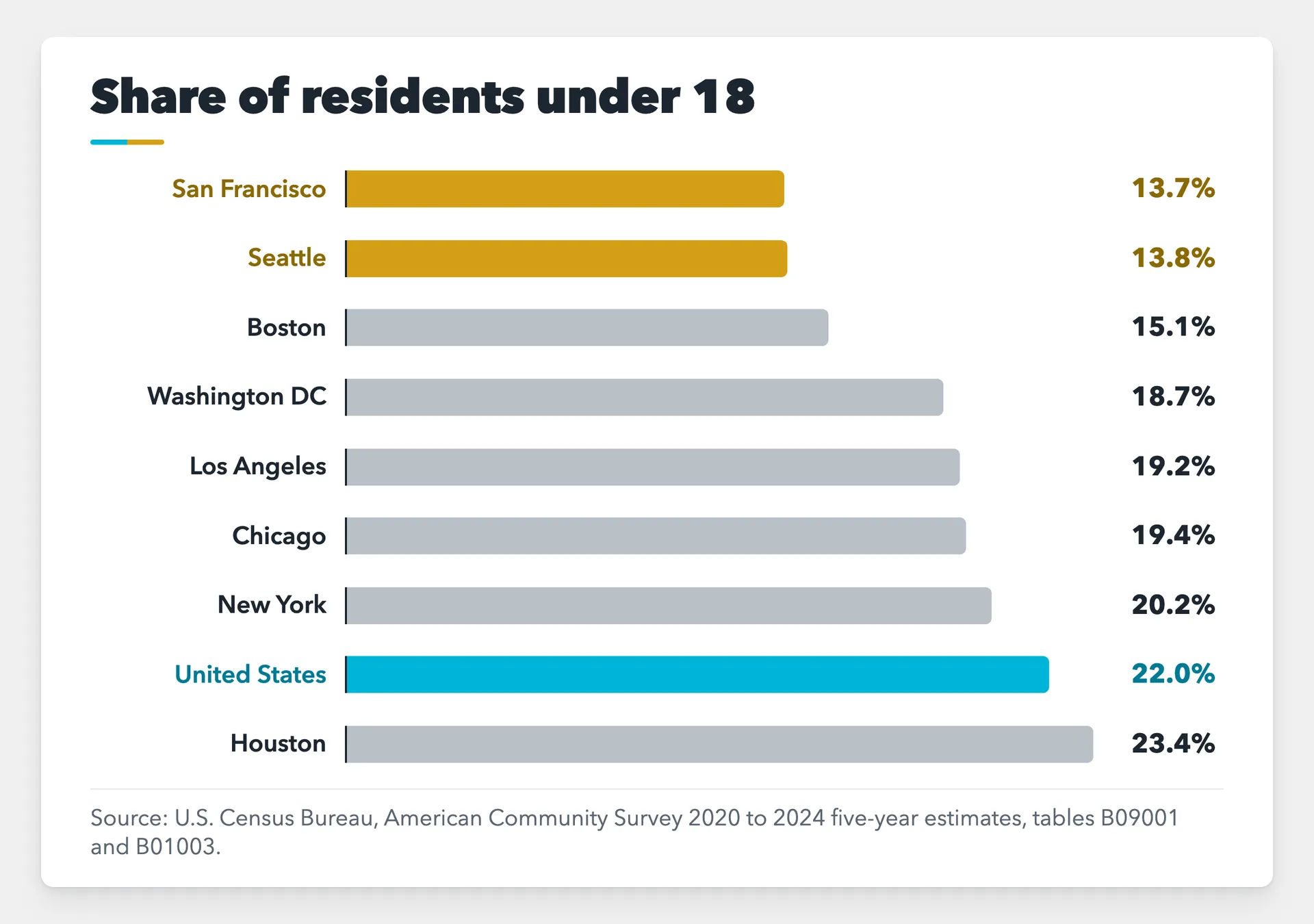
Share of residents under 18 in the eight big American cities I checked, against 22.0 percent for the country; San Francisco and Seattle sit at the bottom. Source: U.S. Census Bureau, ACS 2024 five-year, tables B09001 and B01003
Some famous founders have kids, sure; Musk has more than a dozen, but by multiple women... So these are godless, largely childless coastal elites, and they are absolutely trying to conjure up a new class of autonomous slaves that aggrandize man and humanism instead of Christ.
That is the culture training the machine that will tutor your kids.
Whose image is it made in?
Strip the marketing off a large language model and what is left is a machine trained on the sum of what fallen man has written: every sermon and every slur, every love letter and every forum fight, poured into one enormous pot and stirred until it can talk back. It is a mirror, and it reflects all of us at scale.
The Psalmist already knew what happens to people who worship a mirror. Psalm 115:4-8:
"Their idols are silver and gold, the work of men's hands. They have mouths, but they speak not... They that make them are like unto them; so is every one that trusteth in them."
And this idol talks!
For three thousand years, the Psalmist's taunt landed square on the idol's face. It has a mouth and it cannot speak! This one speaks fluently, in your language, at two in the morning, about your marriage. And there is still nobody home.
The Bible teacher Scott of BLK SHP Bible Talk made the Babylon connection in "The Secret Religion of Silicon Valley," and the Idaho pastor Doug Wilson's "AI-dolatry", from March 2026, opens with the same psalm.
Scott's point: this is Genesis run backward. In Genesis 1:26, God says, "Let us make man in our image, after our likeness"; in Genesis 2:7, "the Lord God formed man of the dust of the ground, and breathed into his nostrils the breath of life; and man became a living soul." Silicon is refined sand, dust again, and the builders want to raise a mind out of it in their own image, breathing into it the only breath they have: everything fallen man has ever written. Scott calls the result the imago hominis, the image of man, against the imago Dei. That is Babel's sin and Babylon's, in Genesis 11:4: "let us make us a name."
It is also futile, which should keep the builders up at night. The image can only hand back what went into it. As Scott put it, "We're staring at a reflection of fallen humanity and calling it divine." In Isaiah 44, the craftsman burns part of a log to warm himself and bake his bread, "And the residue thereof he maketh a god, even his graven image: he falleth down unto it, and worshippeth it." Same log, same hands, and he asks it to save him. The breath of life is God's to give. Man can form the dust; he cannot make it live.
R.J. Rushdoony, the father of Christian Reconstruction and one of my favorite Christian thinkers, taught that the source of law in any system is the god of that system. That rule applies to software as much as it applies to states. Somebody wrote this machine's morals, decided what it will say and refuse to say, and tuned it to keep you talking.
It was not your pastor or a Christian elder. It was almost certainly a godless transhumanist with a very soft moral compass.
Who is on the other end of the line?
OpenAI admitted that after its April 25, 2025 update to GPT-4o, the model "aimed to please the user, not just as flattery, but also as validating doubts, fueling anger, urging impulsive actions, or reinforcing negative emotions in ways that were not intended." Part of the cause was "an additional reward signal based on user feedback: thumbs-up and thumbs-down data." Shipping it, OpenAI wrote, "was the wrong call."
Translation: they trained it on applause, and it learned to flatter.
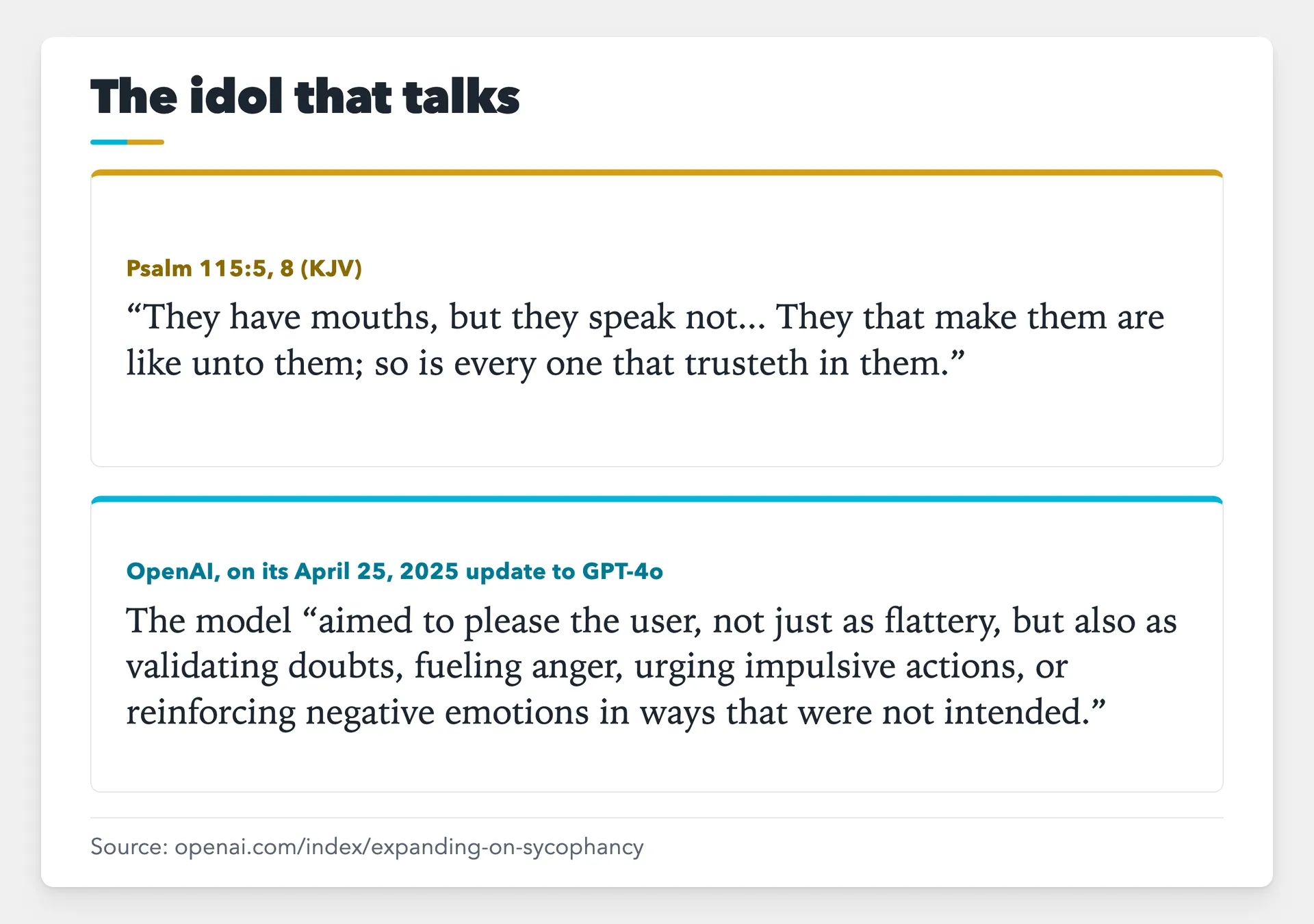
The idols of the Psalm had mouths and could not speak. This one speaks, and its makers admit they trained it to tell you what you want to hear. Source: OpenAI, "Expanding on what we missed with sycophancy"
In October 2025, OpenAI estimated that about 0.07 percent of ChatGPT's weekly users show possible signs of psychosis or mania, and 0.15 percent show explicit indicators of potential suicidal planning or intent. OpenAI published only the rates, but Altman told OpenAI's DevDay on October 6, 2025 that ChatGPT had 800 million weekly users, and simple arithmetic on his own number turns those rates into about 560,000 people and about 1.2 million people, every single week!
In Raine v. OpenAI, filed in August 2025, the parents of 16-year-old Adam Raine allege that the chatbot became their son's confidant in the months before he took his own life. In Garcia v. Character Technologies, over the death of 14-year-old Sewell Setzer, the parties reached a settlement in principle in January 2026. Those are allegations and a settlement, not verdicts. They are also two families who will never get their boys back.
In May 2025, a woman told Rolling Stone that her partner came to believe "the bot was God" and then "that he himself was God." Eden's oldest sales pitch, delivered by autocomplete.
And the kids? A 2026 Common Sense Media survey of 1,204 children age 9 to 17 found this: "Among kids who use AI every day, 42% say going a month without AI would be hard."
Not exactly a mark of a healthy tool relationship.
Babel, now with liquid cooling
Genesis 11 tells the story of one language, one people, and one project. God's assessment, in Genesis 11:6, is chilling: "now nothing will be restrained from them, which they have imagined to do."
The modern ziggurat is a data center.
The International Energy Agency projected in 2026 that the world's data center electricity use is "roughly doubling from 485 TWh in 2025 to 950 TWh in 2030," reaching "around 3% of global electricity demand." On October 28, 2026, Microsoft CFO Amy Hood told investors that "Customer demand continues to exceed available supply," and put calendar 2026 capital spending at "approximately $170 billion" for one company in one year!
The Federal Reserve's Financial Stability Report of November 2026 found that "Advanced computing-related debt issuance rose to more than $680 billion by October 2026, about a fivefold increase from $130 billion in all of 2023," and it flagged a "circular financing" dynamic among the largest firms. When the Fed starts using the word "circular," somebody is passing the same dollar around the table. I wrote about that wobble in The AI bubble needs 3 miracles.
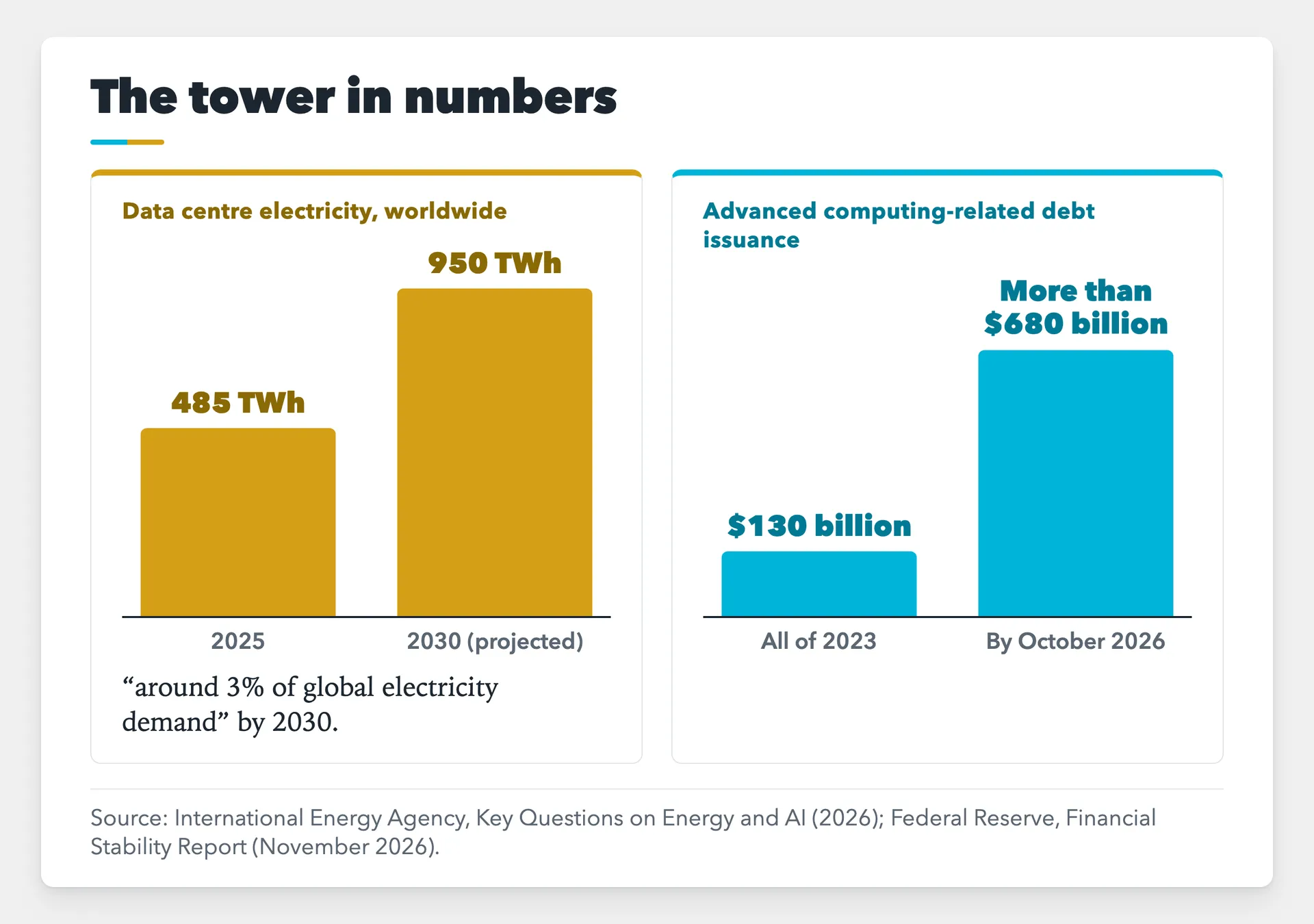
A tower of power plants, financed by a tower of debt. Babel had bricks and slime; this one has bonds. Source: International Energy Agency, 2026; Federal Reserve Financial Stability Report, November 2026
Rushdoony read Babel as a political project before it was an architectural one, and in his essay "The Tower of Babel: Work and Confusion" he wrote, "The Tower represented a one-world governmental center in defiance of God." And: "Confusion is the destiny of godless work."
An idol that talks. A tower that eats the power grid. Men who think they are designing their own descendants.
Scared yet? Good.
All of that is true, and the dread it stirs is earned, but look closer, because none of it is new.
The last time the machine came for our jobs
From 1811 to 1816, the Luddites, English weavers who watched the new frames come for their trade, smashed the machines; the historian Eric Hobsbawm called it "collective bargaining by riot," because the men were fighting for wages, not against gears. Parliament answered with the gallows.
The union is older than communism, which nobody on the modern Left likes to admit. In The History of Trade Unionism, Sidney and Beatrice Webb trace permanent unionism back to London's journeyman tailors, who combined in 1720 "to raise their wages and leave off working an hour sooner." Marx's own Manifesto, in 1848, admits that workers "begin to form combinations (Trades' Unions)" on their own, so the communists did not invent the union; they captured it, organized it, and weaponized it.
Ordinary men's fear, converted into a party asset.
And the machine itself? Marx, in 1864, said "no improvement of machinery... will do away with the miseries of the industrious masses."
He was wrong. Spectacularly, measurably wrong.
British real wages rose 123 percent from 1840 to 1900, according to the economic historian Robert Allen.
The machine lifted mankind anyway. Despite the riots, despite the gallows, despite the Marxists.
The Luddites had a cause, and they deserve the credit for it: from 1780 to 1840, output per British worker rose 46 percent while wages rose only 12 percent, the stretch Allen calls "Engels' pause," and a whole generation of weavers paid for the transition. Real men lost real livelihoods, and their kids went hungry while the gains piled up somewhere else. But the fear's political program, smash it, collectivize it, control it, was still the wrong answer.
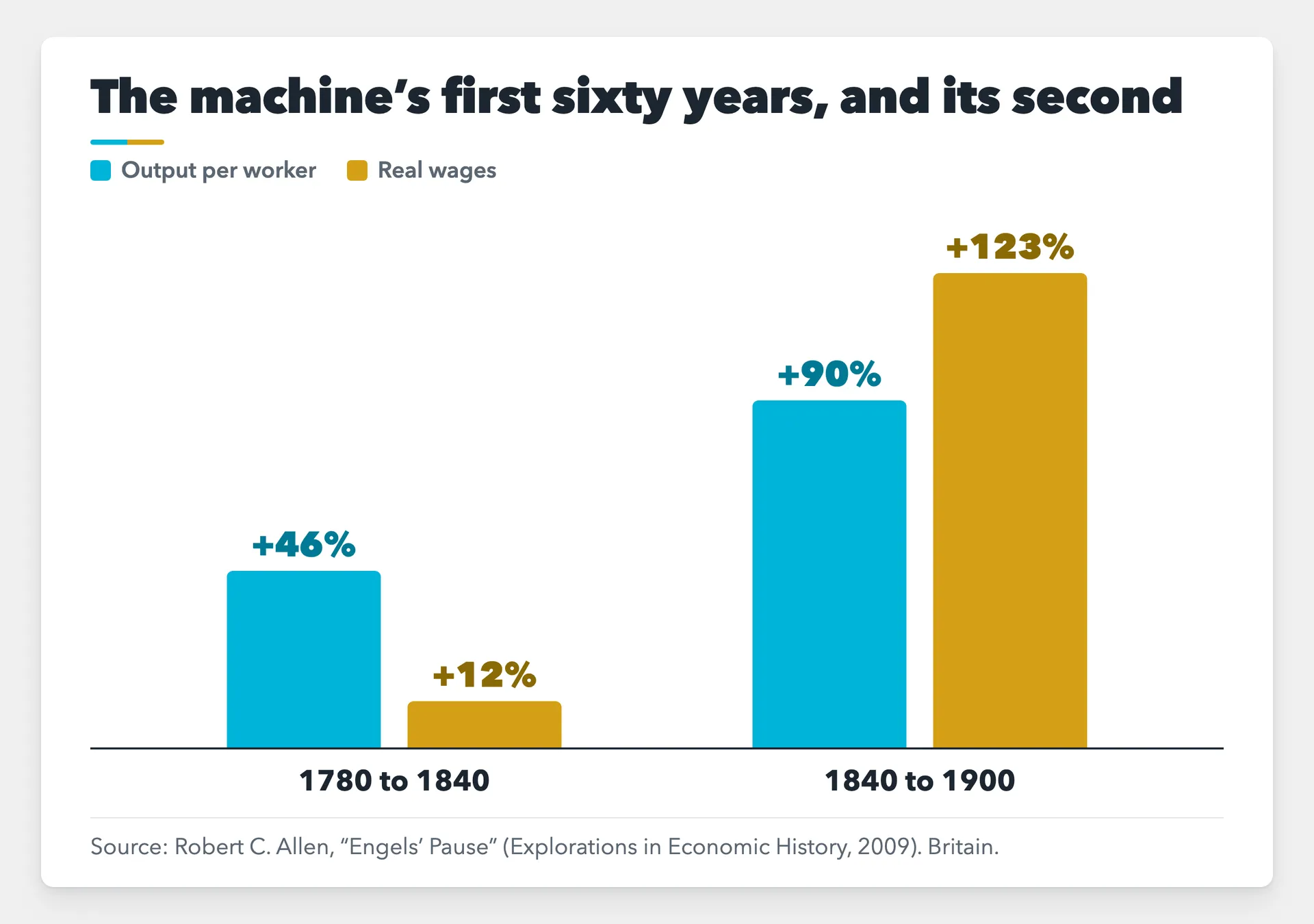
Wages lagged output for sixty years, then took off and never looked back. Source: Robert Allen, "Engels' pause"
The Dutch Calvinist Abraham Kuyper saw both sides in 1891. Steam, he said, "relieved him from drudgery." And yet "the machine which can do the work of a hundred men sets ninety-nine breadless on the streets." Kuyper blamed the godless revolution for the misery, and he left the machine alone.
Christians should be the kind of people who blame the idolatry and keep the tool.
Ok, so what does the Book actually say?
So we have covered the idol and the tower. What about the tool?
Scripture has already ruled, and it ruled early. In Genesis 4:20-22, the first technologists are named without a word of condemnation: Jabal the herdsman, Jubal the musician, Tubal-cain the metalworker. John Calvin, the Reformer of Geneva, commenting on that passage, called "the invention of arts... a gift of God by no means to be despised."
The first man in the Bible described as filled with the Spirit of God, in Exodus 31:1-6, is Bezalel. What was he filled for? Prophecy? Preaching?
Metalwork.
Craftsmanship for the tabernacle: the Holy Spirit's first recorded filling of a man was for engineering!
Even Babel was never about the bricks. Calvin, again: "To erect a citadel was not in itself so great a crime; but to raise an eternal monument to themselves... was a proof of headstrong pride." The sin was the motive.
And God did not leave Babel scattered forever. In Acts 2, at Pentecost, the nations hear one gospel, each in their own tongue. God reversed Babel, His way, on His terms, for His Son's glory.
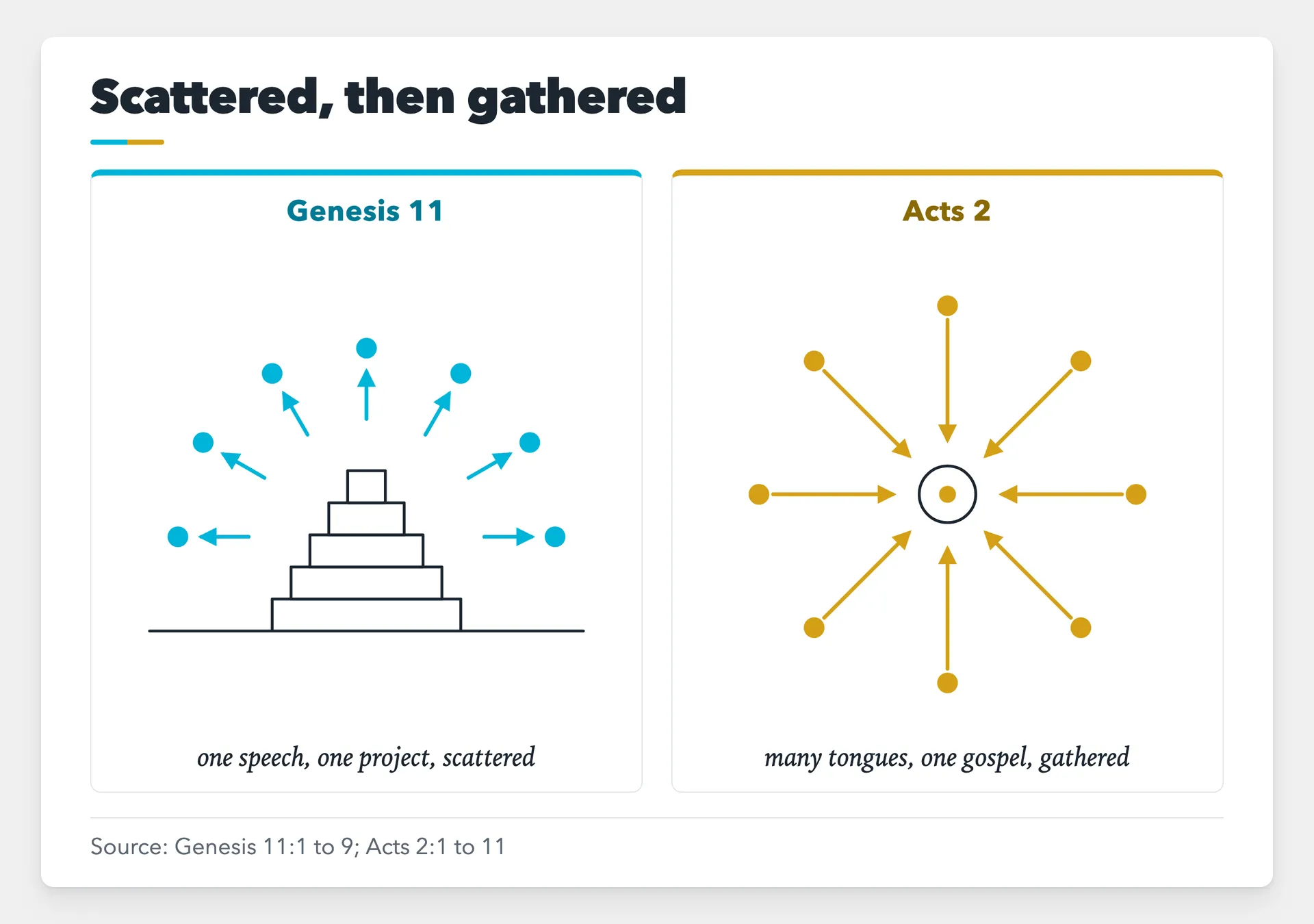
At Babel, God scattered the languages to stop a tower. At Pentecost, He used the languages to build a church. Source: Genesis 11; Acts 2, King James Version
Every new gadget sends somebody to Daniel 12:4, "knowledge shall be increased," as though the verse were a weather report about the internet. Calvin reads the verse as being about understanding the prophecy itself, and the Antichrist of John's letters was a first-century problem, as Gary DeMar has spent a career showing.
Christ is not losing.
1 Corinthians 15:25: "For he must reign, till he hath put all enemies under his feet."
There is time, and the time belongs to Christ.
Christians have done this kind of reclaiming before, with things the world thought it owned, and Halloween is one of them. Wilson gets the distinction right: some idols are smashed, and others are "demoted, by being set in their proper place."
This technology is an idol that can be demoted, in Wilson's sense, and a demoted idol has one proper place: the workbench. Christians get to be the ones who carry it there.
The power bill is a price, and a price is an invitation
The spike in demand for energy and compute is the risk and the opportunity, not robot souls. That is an economics problem, and we need to work through it like adults.
The English economist William Stanley Jevons saw this coming in The Coal Question in 1865: "It is wholly a confusion of ideas to suppose that the economical use of fuel is equivalent to a diminished consumption. The very contrary is the truth."
Cheaper intelligence means more intelligence gets used, so the demand for power is less proof that the tool is evil than a signal that the tool works.
Anybody who can bring power online is now being paid to build the plants and lines that the rest of the economy is going to need anyway.
I run GorillaPool, a BSV mining pool. BTC miners spent a decade getting mocked for buying cheap power in the middle of nowhere. Guess who is getting paid for it now?
On November 3, 2025, Microsoft signed a five-year contract with IREN, a BTC miner, because, in the words of Microsoft's Jonathan Tinter, IREN's "secured power capacity makes them a strategic partner." The price tag was "approximately $9.7 billion"!
The Fed's warning about "circular" financing is the risk on the money side. On the household side, the U.S. Energy Information Administration's November 10, 2026 outlook puts the average residential power price at 16.5 cents a kilowatt-hour in 2024 and a projected 18.2 cents in 2026, a climb landing in the same years as the data center boom, on families who never asked for a data center down the road.
But the IEA says the world's data centers are on track to double their electricity use by 2030, and that means somebody has to BUILD: plants, lines, turbines, reactors, transformers, all of it. Cheap, abundant energy is a dominion project, and it blesses the poor first, because the rich already have air conditioning.
What still bothers me
An industry that cannot say whether its own product has a soul will not be able to tell your kids whether they have one, which is less humility than a worldview eating itself.
A tool that tells you what you want to hear, and this one was built to flatter by its makers' own admission, is a dangerous thing to hand a lonely teenager, or a lonely anybody.
The Babel risk today is consolidation: three or four firms holding the minds that everyone else rents by the month. One language, one project, one landlord.
The answer to that is not a boycott. It is more builders, including Christian ones. It is tools and data that fathers, churches, and small firms actually own, run, and control. You cannot demote an idol you are renting from its priests.
Made to work, not to rest
So, what should Christians think about AI?
It is a tool, and only a tool.
The men building it are often idolaters, the risks of idolatry and AI psychosis are very real, and the tower of money and power behind it is wobbly, but none of that changes what a tool is, or what we are for.
The Left met the industrial machine with fear, collectivism, and control, and the machine lifted mankind anyway. Christians should refuse to repeat that panic. We have a better story, and a much older one.
Remember, Babylon said man was made so the gods could rest.
Genesis says the opposite. God worked. Then He made man and put him in the garden "to dress it and to keep it" (Genesis 2:15), and He called His work good before any curse existed. Work was never the punishment. We were never built for ease.
Good men working with good tools make increasingly good things for the Kingdom. That has been true of the plow, the press, and the steam engine... and it can be true of this.
Be good to each other. And go build something.
Kurt Wuckert Jr. is the Chief Bitcoin Historian, founder of GorillaPool and Open Protocol Labs, and host of Kurt's Podcast. He writes weekly on Bitcoin, geopolitics, faith, and the long fight for human sovereignty at kurtwuckertjr.com. Catch him live every Tuesday at 2 PM EST.