Halloween Is a Christian Holiday
By Kurt Wuckert Jr.
Wittenberg, the last day of October, 1517.
Tomorrow is the feast the Castle Church is named for: All Saints, the first of November.¹
A pardon comes with it. In 1398 Pope Boniface IX granted this church the Portiuncula indulgence for the days around All Saints, and it opens at first Vespers, this afternoon.²
So the town will be full. A chapter memo of 9 November 1513 says the crowds came twice a year, at Misericordias in the spring and at All Saints.³
They come for the pardon, and the Elector has relics to match: 5,005 pieces in Frederick the Wise's book of 1509, a hundred days of indulgence on each, and over seventeen thousand by the 1518 count.⁴ In June 1518 Frederick ran the math at the later rate: 127,799 years and 116 days.⁵ Somebody was keeping very careful books.
Relics and money were old friends by then; in the thirteenth century the Templars took relics as collateral, a story I told in The Bankers Who Wore Swords.
And this money has somewhere to go. Albrecht of Brandenburg, Archbishop of Mainz and Magdeburg, signed a bond to Jacob Fugger of Augsburg on 15 May 1514 for 29,000 Rhenish florins.⁶ On 28 May 1517 his indulgence commissaries ordered that Fugger hold one of the keys to every chest, and that after costs both halves pass through the Fuggers: the pope's half on to Rome, the archbishop's half against his debt.⁷ Remember that key, because it turns up again when this story gets back to Wittenberg with the receipts. Who gets a Christian's money, and on whose authority, is a question I chewed on in A Christian Response to Involuntary Taxation.
So tonight, on the eve of the saints, an Augustinian friar named Martin Luther writes to the Archbishop of Mainz, encloses ninety-five theses, and dates the letter by the feast: "From Wittenberg on the Vigil of All Saints, MDXVII."⁸ The door is a story Philip Melanchthon told in 1546, and the hammer is later still; Melanchthon spent 1517 in Tübingen.⁹ The letter is the fact.
The night the Reformation was born was Halloween. It was Halloween because of the saints. And it was about money.
Halloween is this month, and this is an article about a holiday half the church was taught to whisper. American Evangelical Christianity has a low-IQ relationship with Halloween, and I say that as family. For a thousand years of Western Christian history, the three days that begin on October 31 belonged to Christ and His saints. We are going to Rome in 609, to an emperor's court in 835, to a monastery in Burgundy around the year 1000, to English bell towers the bishops tried to silence, to a Shropshire doorstep with a soul cake, and to Minnesota in 1920.¹⁰ Then to an Assemblies of God church in Arvada, Colorado, selling Hell House kits in 1996 at $149 apiece: a walk through hell for the season.¹¹ In that version of October, the devil owns the night.
He's wrong, and the man who told him that has a name, and a desk in Dublin, in 1783.¹² So strap in.
Watch the video if you prefer to watch rather than read!
The martyrs had a feast first
Let's start at Nisibis. Ephrem's hymns, around 359, put the feast of the martyrs on the Ascension, which his editor Bickell worked out in 1866 as 13 May.¹³ The oldest Syriac martyrology, in a manuscript of 412, keeps all the martyrs on the Friday after Easter; the Greek churches, the Sunday after Pentecost.¹⁴
Spring and early summer, and not a November in the bunch.
Then Rome. Pope Boniface IV asked the Emperor Phocas for the Pantheon, the old temple of all the gods, and Bede says he "dedicated a church to the holy Mother of God, and to all Christ's martyrs, to the end that, the company of devils being expelled, the blessed company of the saints might have therein a perpetual memorial."¹⁵
Rome kept that dedication on 13 May, in 609 or 610, and Duchesne calls it the first known Roman temple turned into a church.¹⁶ Here is your baptized pagan building, and its feast was in May.
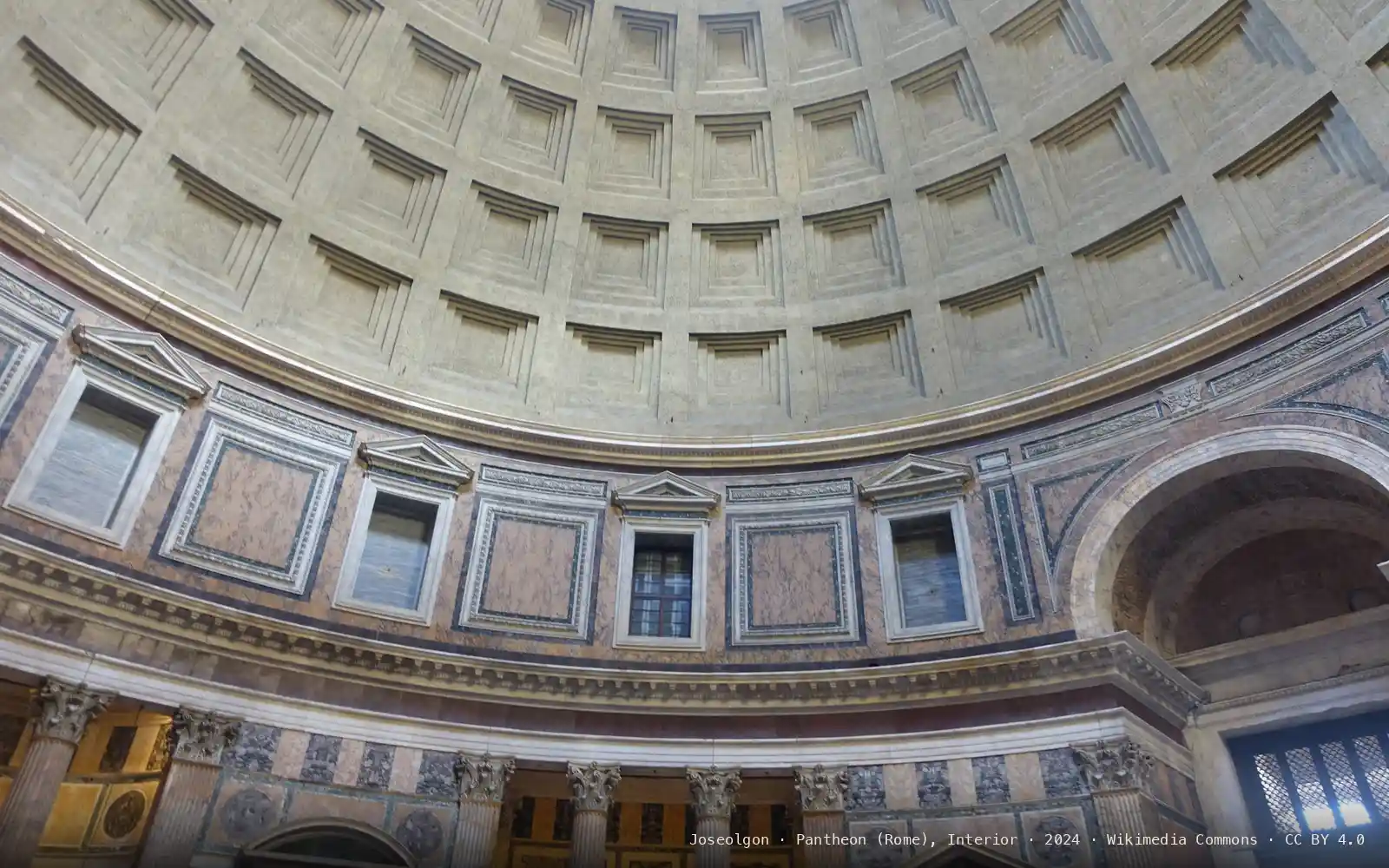
The Pantheon: the first Roman temple known to become a church, and its saints' feast fell in May.
The high church traditions still read Revelation 7 on All Saints' Day: "a great multitude that no one could number, from every nation, from all tribes and peoples and languages, standing before the throne and before the Lamb, clothed in white robes".¹⁷ Everybody, from everywhere, in white.
A ninth-century English martyrology pins the first of November on Boniface's Pantheon, wrongly, and hands us a keeper: "The pope commanded that this day should be observed every year among Christian nations with the same reverence as the first day of Christmas, that is the first day of Yule."¹⁸
Put that sentence in your pocket, figuratively of course, because it comes back out when the Puritans come for Christmas.
So who moved it to November?
The usual answer is a pope: Gregory III, who reigned from 731 to 741, built a chapel inside St Peter's for "relics of the holy apostles and of all the holy martyrs and confessors, the perfected righteous, who rest throughout the whole world" (literal).¹⁹ The entry gives no date and no November; the line that he fixed All Saints on the first of November is traced no earlier than Mershman's Catholic Encyclopedia article of 1907.²⁰
The first dated witness to the first of November that I can find is English. Alcuin, writing to Arno of Salzburg in a letter Froben dates to 799, asks him to keep the feast on the Kalends of November and to go before it "with three days of fasting, praying, singing Masses and giving alms for one another with sincere devotion" (literal).²¹ Fasting before the saints, already in 799.
If November came from the Celts, Ireland should show it first. The Félire Óengusso, an Irish calendar of saints from around 800, puts the feast in Rome of "the saints of the whole of Europe" on 20 April.²² Its stanza for the first of November calls the day samain and lists Irish saints, and "All-Saints' day" there is the translator Stokes's rendering.²³
Ireland, the Celtic heartland, kept its saints in April.
England and Germany kept November, so the date is English and German before it is Roman, which is good, I think. The historian Ronald Hutton, page 364, on the notion Frazer printed in 1906: "This makes nonsense of Frazer's notion that the November date was chosen because of 'Celtic' influence; rather, both 'Celtic' Europe and Rome followed a Germanic idea."²⁴
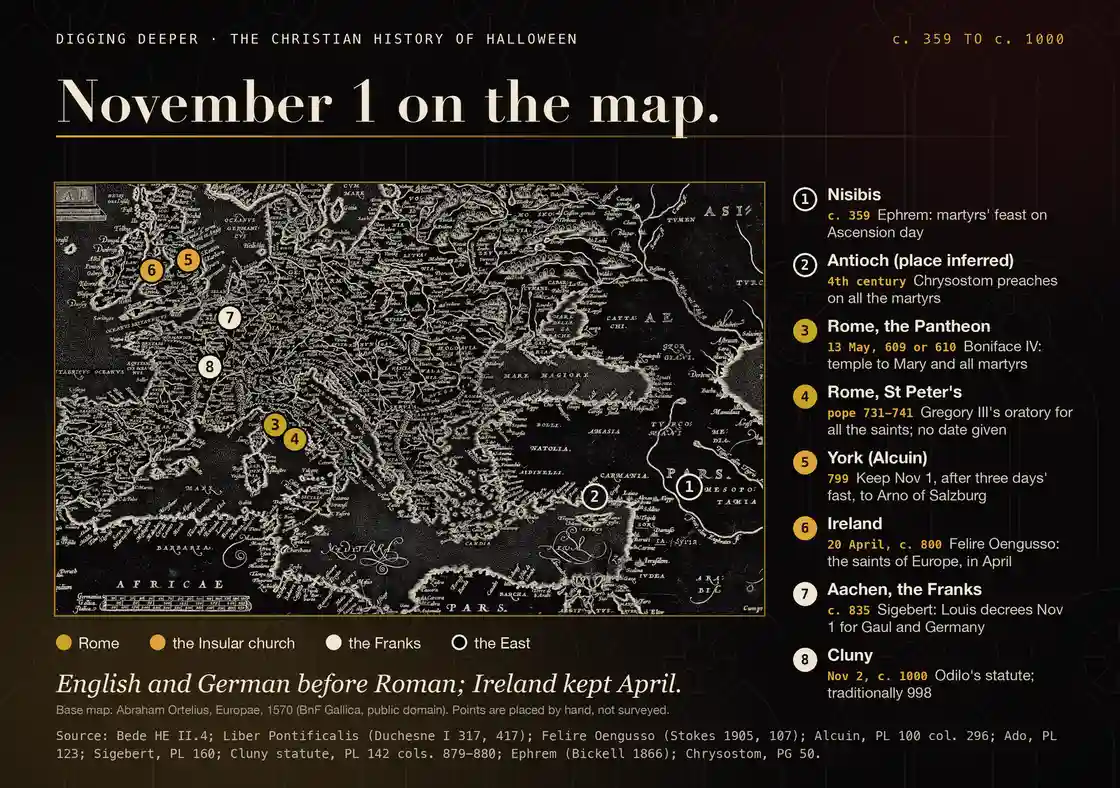
November 1 moves out from England and Germany; Ireland, the supposed source, keeps April. Source: PL 100; Hutton 1996 p. 364; PL 123; Stokes 1905.
The pope came late and followed: Ado of Vienne, writing in the 850s, says that at the urging of "Gregorio pontifice", no numeral and no year, the emperor Louis decreed the feast "in Galliis" for that day every year.²⁵ Gregory IV is how later tradition read Ado, and the year 835 comes from Sigebert of Gembloux, a chronicler who died in 1112.²⁶
Nobody in Aachen in 835 was thinking about Irish cattle.
So what reason did anybody give? The earliest writer I can find who says it moved, John Beleth, in the twelfth century, says food: "Because in that month there is not so great an abundance of food ... Gregory the lesser, the fourth of that name, moved these two feasts and ordered them held on the Kalends of November, when goods are more plentiful."²⁷ Sicard of Cremona, around 1200, credits the wrong pope, "Gregorius septimus", and gives no motive at all.²⁸
That is the one motive a medieval writer gives for November: the harvest, so the crowds can eat. Nobody in the chain gives Samhain, the dead or the Druids as the reason.²⁹ The great pagan takeover, as the medievals explained it, was a catering problem!
The feast itself was justified with much more simplicity. Aelfric, preaching around 990: "Holy doctors have counselled that the faithful church should celebrate and piously solemnize this day to the honour of ALL SAINTS; because they could not appoint a festival separately for each of them".³⁰ Too many saints, not enough days, and John Mirk was still saying the same thing four centuries later.
Which leaves the letter people cite for the claim that the Church baptized the pagan calendar, so here it is in full, in Sellar's 1907 translation.³¹
It is a letter about English temples and English oxen. In the same weeks, Gregory told King Æthelberht to "suppress the worship of idols; overthrow the structures of the temples" and told Mellitus to keep the well-built ones.³²
A Puritan pamphleteer will pick up its ideas and say the quiet part about All Saints out loud, as Puritans often do (did?), and we read him when this story reaches the war on Christmas.
Then the souls got their day
Here's a story the Middle Ages loved, as Jotsald told it in his life of Abbot Odilo of Cluny in the 1050s and Peter Damian told it again around 1063: a religious man coming home from Jerusalem is driven by a storm onto a rock in the sea, where a hermit tells him that he often hears the demons complaining, loudest of all about Cluny, whose prayers and alms keep pulling souls out of their hands.³³
Demons filing a formal complaint about a monastery's prayer schedule! I love the Middle Ages.
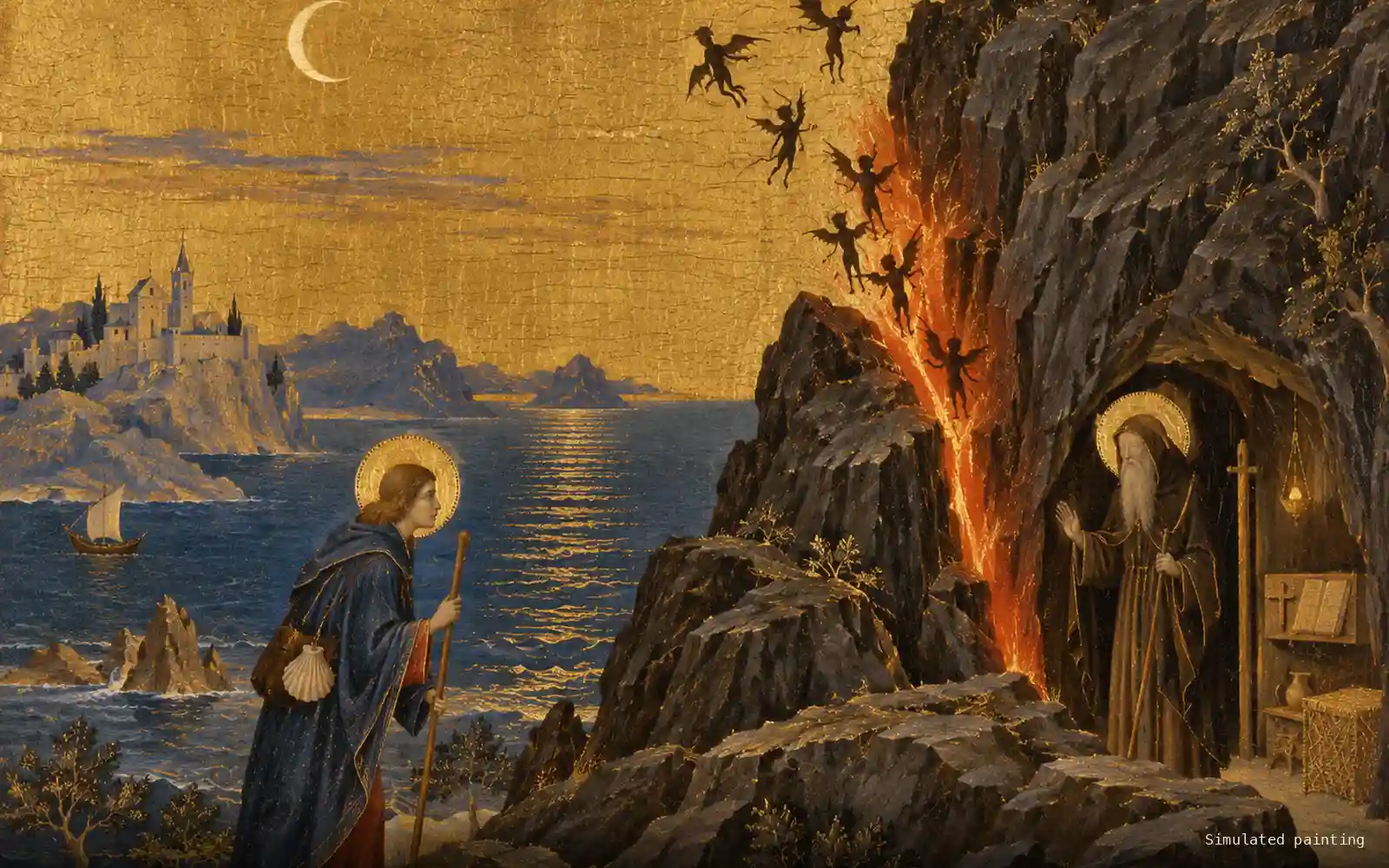
Simulated painting. Jotsald's pilgrim and hermit: the legend came after the decree.
What Odilo actually decreed is better than the legend: "Decreed by the most blessed Father Odilo ... that as All Saints is kept on the Kalends of November, so among us the commemoration of all the faithful departed, from the world's beginning to its end, be kept festively." (literal)³⁴ After the evening office on 1 November every bell rings and Vespers for the dead are sung; the next morning, the bells again.³⁵ The Christian feast of the dead begins with bells, at dusk, on All Saints' Day.
The statute has no year; it names "our dear emperor Henry", Henry II, emperor from 1014, so the text we have is no earlier than that, though tradition says 998.³⁶ Other churches took it up over two centuries, it settled on 2 November, and by about 1290 Durandus could write that the whole Church had approved it.³⁷
Around 1200, a bishop in Cremona wrote the whole season down in three sentences.³⁸
The day of affliction was a real fast: into the twentieth century, canon law kept fast and abstinence on the vigil of All Saints, beside Christmas Eve.³⁹ Halloween was kept like Christmas Eve, on an empty stomach.
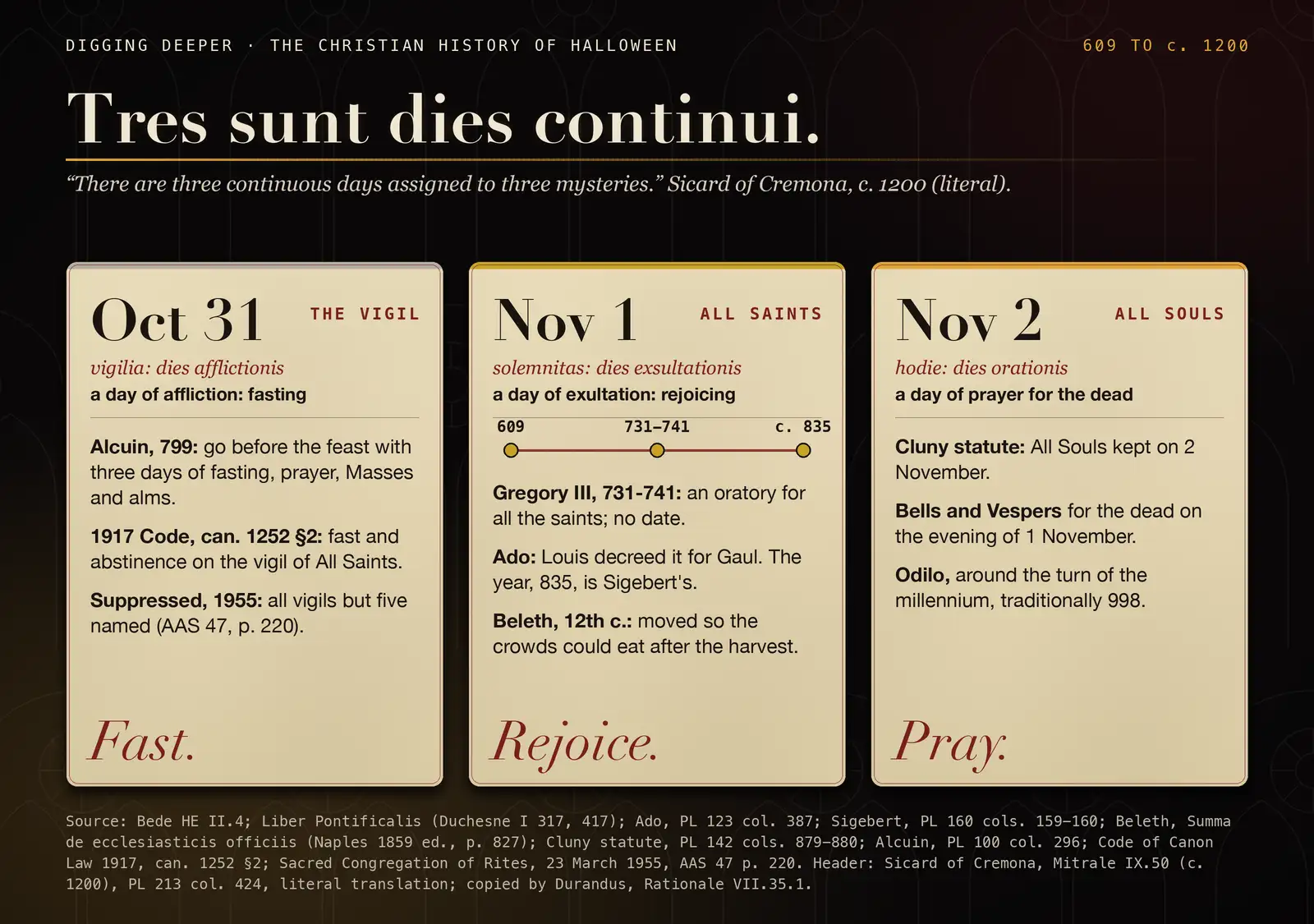
Fast, feast, and prayer for the dead. Source: Sicard, Mitrale IX.50, PL 213 col. 424.
Evangelical friends, here is what those days were for, directly from our Holy Scriptures: "we are surrounded by so great a cloud of witnesses"; "Blessed are those who mourn, for they shall be comforted."; "O death, where is your victory? O death, where is your sting?"⁴¹ Catholic and Anglican calendars add Wisdom 3:1, which your Bible may not carry: "But the souls of the righteous are in the hand of God, and no torment will ever touch them."⁴²
The third day carried purgatory, and the Reformers would fight over that one with bell ropes in their hands, which is where this story goes after the soul cakes, but that fight would not come for this generation. It would not come, in fact, until many generations after these three days were kept as a Holy holiday across Christendom. By the high Middle Ages, Hutton writes, both feasts had become above all a time to pray for dead friends and family.⁴³ John Mirk, around 1390, gave his parish the line: "God haue mercy on all crysten sowles!"⁴⁴
So on the thirty-first you fasted, on the first you stood with the multitude in white, and on the second, from the bells at dusk, you said your grandmother's name in church.
One feast, three days long, with Christ in the middle of it.
They rang the bells all night
Picture an English parish church around the year 1400, the week before the feast. The priest reads the notice out of John Mirk's sermon book, announces "a solen fest yn all holy chyrche", and gives the orders: "ȝe schull fast þe euen, and come to þe chyrch to þe fyrst euensong".⁴⁵
Fast the eve, first evensong, Matins, Mass, second evensong. He tells the Pantheon story, credits a later Pope Gregory with the day, and gives no motive, no Druids and no lord of the dead.
And it was a spectacle. Hutton gives us Henry VII's court in purple and black, parishes laying in candles and torches, the mayor of Bristol in the 1470s feasting his council before evensong, St Mary Woolnoth in 1539 paying five maidens to play harps by lamplight, and then "the ringing of church bells to comfort the souls in purgatory".⁴⁶
The bells rang all night.
There was bread, too. Brand quotes the 1511 print of Mirk's Festyvall: "We rede in olde tyme good people wolde on All hallowen daye bake brade and dele it for all crysten soules."⁴⁷ A hundred and seventy-five years later John Aubrey watched it in Shropshire, in 1686 or 1687: a heap of soul-cakes on the board on All Souls' Day, and a rhyme, "A Soule-cake, a Soule-cake, Have mercy on all Christen soules for a Soule-cake."⁴⁸
A cake for a prayer. The Protestants knew what they were looking at; Thomas Tollett, annotating Shakespeare, said souling "seems a remnant of Popish superstition to pray for departed souls, particularly those of friends."⁴⁹ Popish, he says, rightly and fairly, but not one word about pagans or the Satanism much of Christendom, today, associates with the day. As late as 1886, Charlotte Burne's Shropshire Folk-Lore records All Saints' Day as "Souling Day", and the Market Drayton soulers still singing "Three for Him who made us all" at the door.⁵⁰
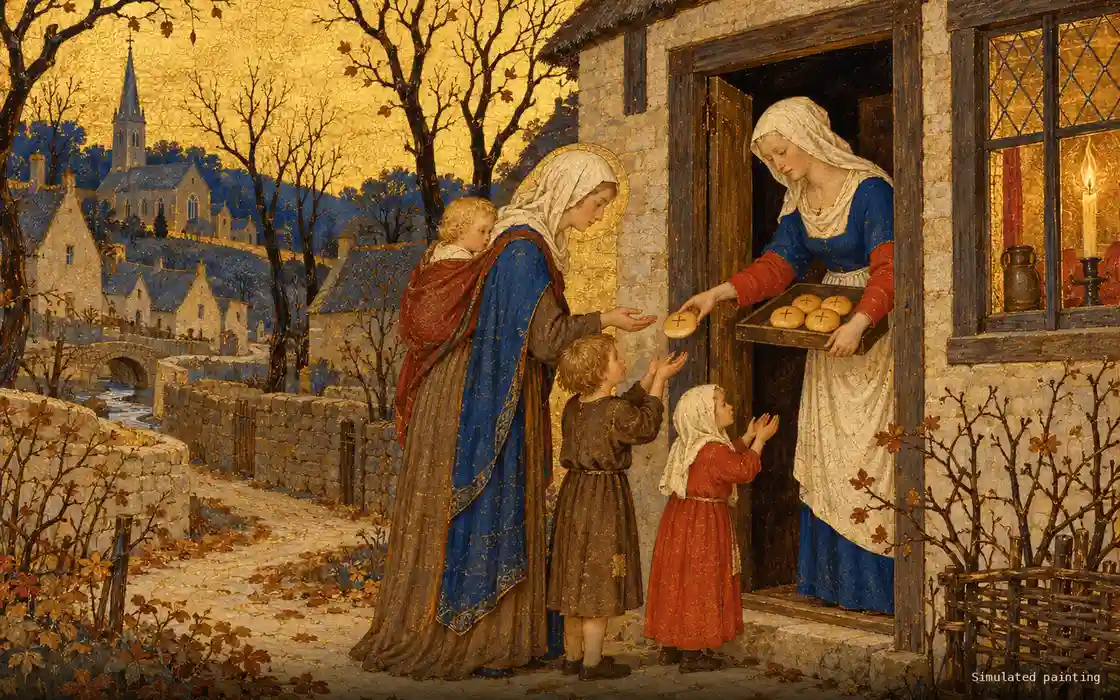
Simulated painting. The soulers at the door: bread for the poor, a prayer for the giver's dead in return.
Then came the Reformation, and the bells became a war.
In 1559 the Elizabethan settlement kept All Saints, abolished prayer for the dead, and walked into what Hutton calls "the longest and hardest struggle" of the reformers, the Hallowtide ringing; the 1559 Royal Injunctions themselves only silenced bells during the service.⁵¹ This is Elizabeth's England, the same England I was in last week with John Dee and his angels.
So the bishops went diocese by diocese, Parkhurst of Norwich in 1569: "that upon All Saints' day and other like times there be no ringing of bells after Evening Prayer, or any other superstitious ceremony used to the maintenance of popery, or praying for the dead".⁵² Archbishop Grindal's York injunctions of 1571 banned it after Evening Prayer on All Saints' day and on "the day next after, of late called All Souls' Day", and his Canterbury articles of 1576 hunt for any ringing "tending to the maintenance of popish purgatory".⁵³
"Of late called..." In 1571 the Archbishop of York still had to tell his province which day he meant.
And notice the reason: purgatory, prayer for the dead, popery. The word pagan is not in these injunctions either. I read that as men who knew whose night it was.
The parishes rang anyway. People were cited in church courts for it "all through the 1560s, in both villages and towns and in all regions", Hutton writes, and the last case on record is Hickling, in Nottinghamshire, on All Saints' Day 1587, where the men "used violence against the parson at that time to maintain their ringing".⁵⁴
They got violent with their own parson to keep ringing for their dead. Commitment to Christian tradition, for better or worse. <!-- lint:allow banned-pattern:31 (Kurt's own hand, 2026-10-19: the tag clause is his spoken deflator, not a machine verdict tag) -->
The bishops could not stop the bells. They could only haul the ringers into court.
Everything else we call Halloween shows up much later: the English Dialect Dictionary of 1900 files guisers under Christmas, New Year and harvest suppers, and cites Halloween "fause-faces" and "turnip lanthrons" from a Scottish book of 1890.⁵⁵
The carved turnip appears in 1640 as a figure of speech, then as a Hampshire boys' prank in 1839, and it is recorded as common in Ireland, Sutherland and Somerset by the late nineteenth century.⁵⁶ Stingy Jack first prints as "Jack o' the Lantern" in the Dublin Penny Journal in 1836, with no turnip, no coal and no Halloween, gets his name from Hercules Ellis in 1851, and the coal in the turnip is in no nineteenth-century print I have found.⁵⁷
- 1511 : Bread dealt "for all crysten soules" (Mirk).
- 1640 : A turnip "cut like a Death's-head", as a figure of speech (Howell).
- 1686 to 1687 : Soul-cakes and the rhyme in Shropshire (Aubrey).
- 1836 : "Jack o' the Lantern", no turnip, no Halloween (Dublin).
- 1866 : "The Vigil of All Saints'-Day" (Philadelphia).
- 1900 : Guisers filed under Christmas and New Year (EDD).
- 1917 to 1927 : "Trick or treat" (Canadian newspapers).
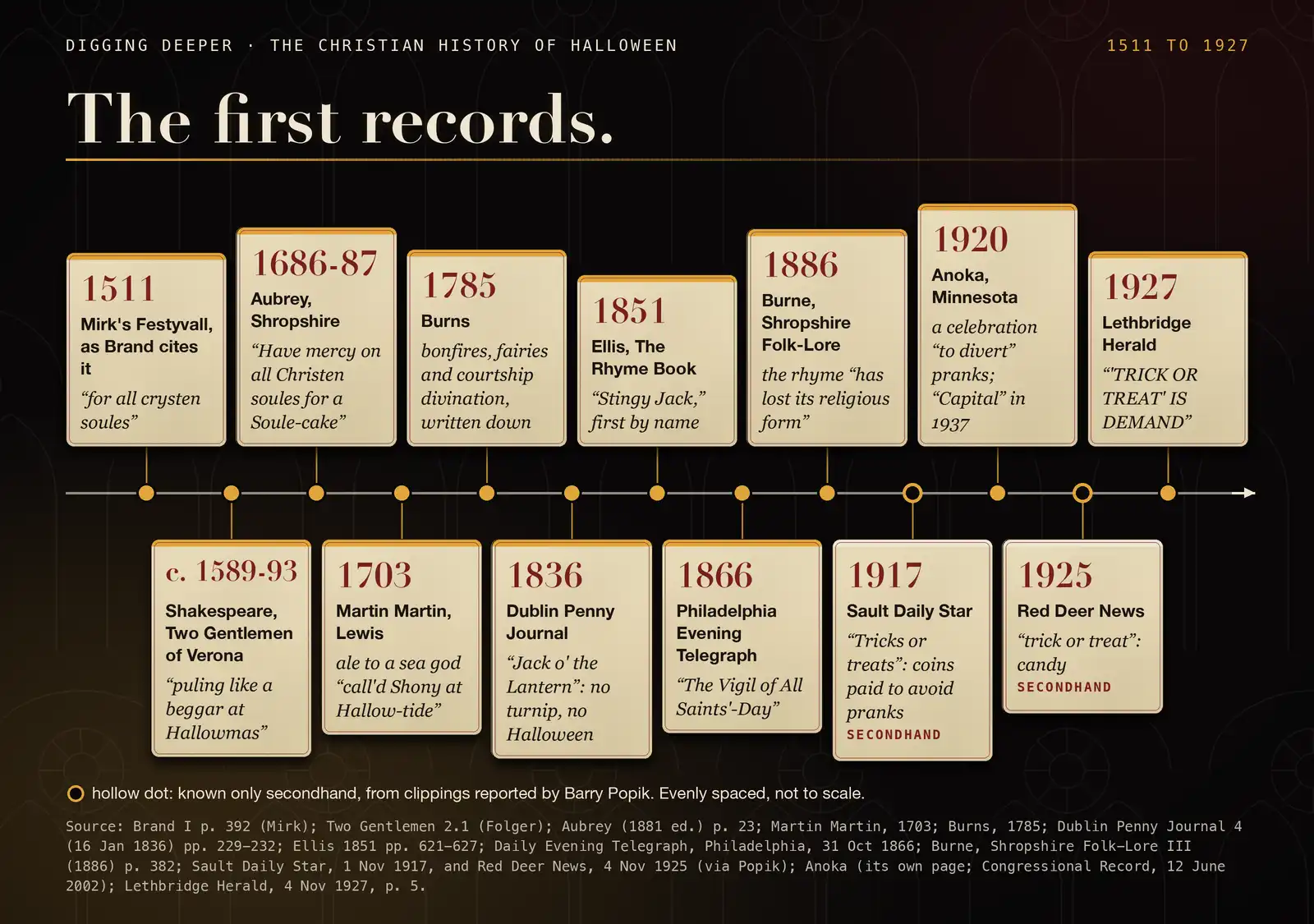
The prayer for the dead comes first; the mask, the lantern and the phrase arrive centuries later. Source: Brand 1849; Aubrey 1881; Wright 1900; Lethbridge Herald 1927.
The Irish and the Scots carried Halloween to America, where into the 1890s it still read as their festival, and on 31 October 1866 the Daily Evening Telegraph in Philadelphia ran its holiday piece under the headline "HALLOWEEN! The Vigil of All Saints'-Day."⁵⁸
The Vigil of All Saints'-Day! Half a century before trick or treat, an American paper put the saints in the headline.
The phrase turns up in Canadian papers between 1917, when the Sault Daily Star heard "'Tricks or treats' you could hear the gangs call out" for coins, and 1927, when the Lethbridge Herald reported children "demanding edible plunder by the word 'trick or treat'".⁵⁹ Anoka, Minnesota, staged a town Halloween celebration in 1920 "to divert its youngsters from Halloween pranks", and in 1937 proclaimed itself the Halloween Capital of the World.⁶⁰
Then came the candy, and the panic about the candy. The sociologist Joel Best has been "unable to find a substantiated report of a child being killed or seriously injured by a contaminated treat picked up in the course of trick-or-treating", and the one cyanide-candy killing on record was a Texas father in 1974, for "the proceeds from a life insurance policy on the life of Timothy."⁶¹
So the cakes and the prayer belong to the Christian feast of the dead, and I would put the begging there too; the pumpkin, the phrase, the parade and the candy are North American, and recent.
Back to the door, with the receipts
The 1509 relic book, illustrated by Lucas Cranach, counts 5,005 pieces in eight processional stations, at 100 days of indulgence apiece.⁶² It names one annual showing, in spring; the pardon Boniface IX attached in 1398 is the other draw on record, and a chapter memo of 9 November 1513 puts the crowds there twice a year, at Misericordias and All Saints.⁶³
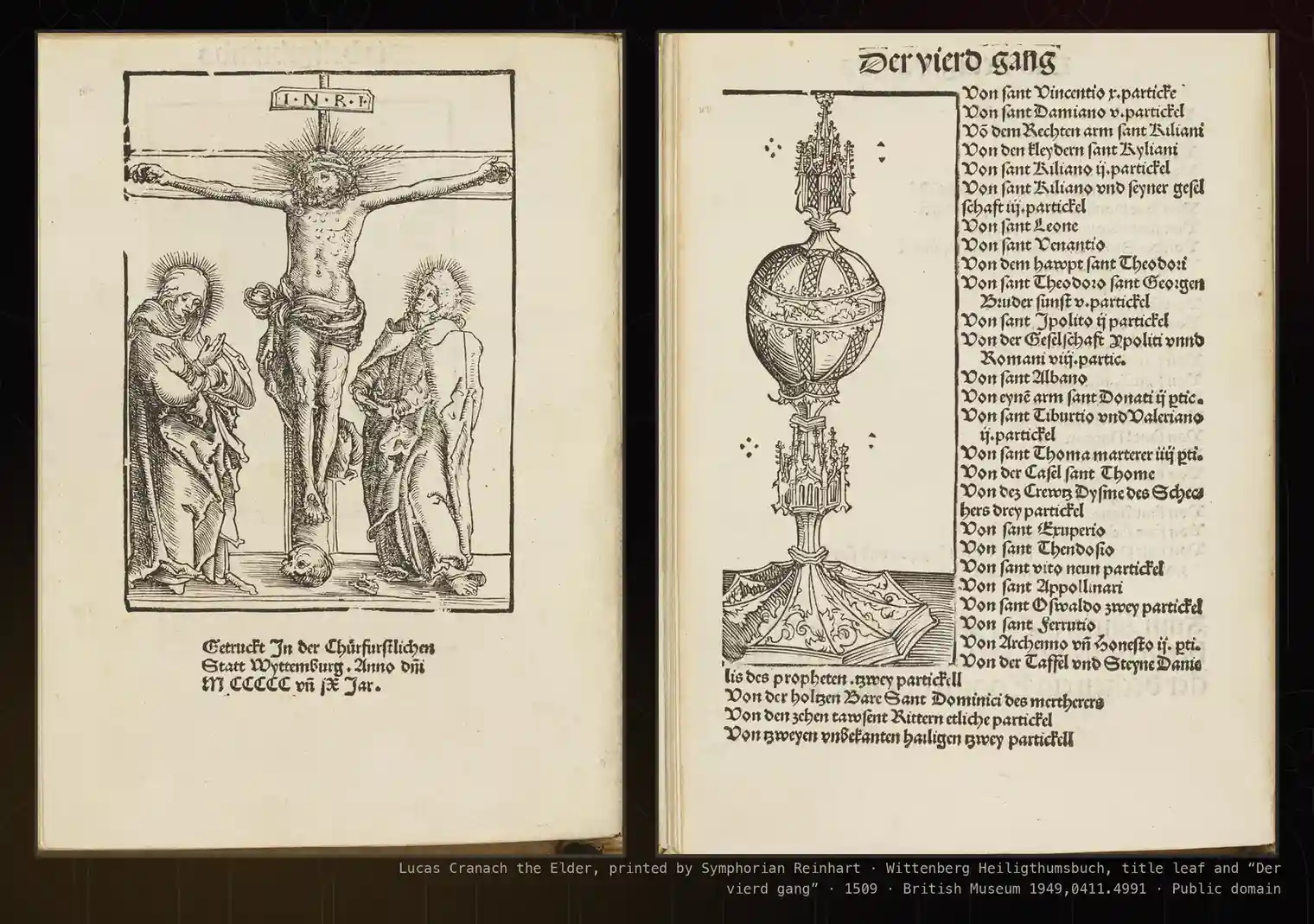
Cranach drew the inventory, and every piece carried its hundred days of indulgence. Source: Wittenberger Heiligtumsbuch, 1509.
Then it grew: Spalatin counted 17,443 pieces in 1518, Frederick put the total at 127,799 years and 116 days, and by 1520, at a new rate under Leo X's bull of 1516, the sum reached 18,970 pieces and 1,902,202 years and 270 days.⁶⁴ Nearly two million years of indulgence, kept in a church named for All Saints.
Now, the archbishop: Albrecht of Brandenburg already held Magdeburg and Halberstadt when he was postulated to Mainz on 9 March 1514, and Rome wanted 14,000 ducats for the pallium and the dues, plus a dispensation for holding three sees at once.⁶⁵
The haggle over that dispensation is the best document in the story. The envoys' report of June 1514 says the curia reminded them the apostles were twelve, "nicht bloß zehn", not just ten; Albrecht's man answered that there were no more than seven deadly sins; they settled at 10,000 ducats (Preserved Smith's 1911 version garbles it).⁶⁶
Dogmatic theology, priced by the head count.
On 15 May 1514 Albrecht signed a bond to Jacob Fugger for 29,000 Rhenish florins, and Schulte says it flat on the same page: "Ohne den Fugger ließ sich das Ziel nicht erreichen." Without the Fugger, the goal could not be reached.⁶⁷ That is the house from the Fuggers before the Rothschilds, underwriting an archbishop.
- The loan. Jacob Fugger fronts Albrecht's Roman bill: 29,000 Rhenish florins.
- The bull. Sacrosanctis, 31 March 1515: an eight-year St Peter's indulgence in Albrecht's provinces (the split was a side agreement).
- The preacher. Johann Tetzel takes the pulpit as subcommissary.
- The chest. An order of 28 May 1517: Jacob Fugger is to hold a key to every chest.
- The split. After costs, the papal half is to go through the Fuggers to Rome, and Albrecht's half to the Fuggers against his debt.
Every chest had more than one key, and one of them belonged to the bank.
Schulte calls the tale of a Fugger factor riding with Tetzel "irrig", wrong: the indulgence threw off too little profit, and he puts Albrecht's share at about 5,436 florins after the Emperor's cut, on premises he admits are "sehr locker".⁶⁸ All that machinery, and it barely paid. Maybe not the Fuggers' finest trade...
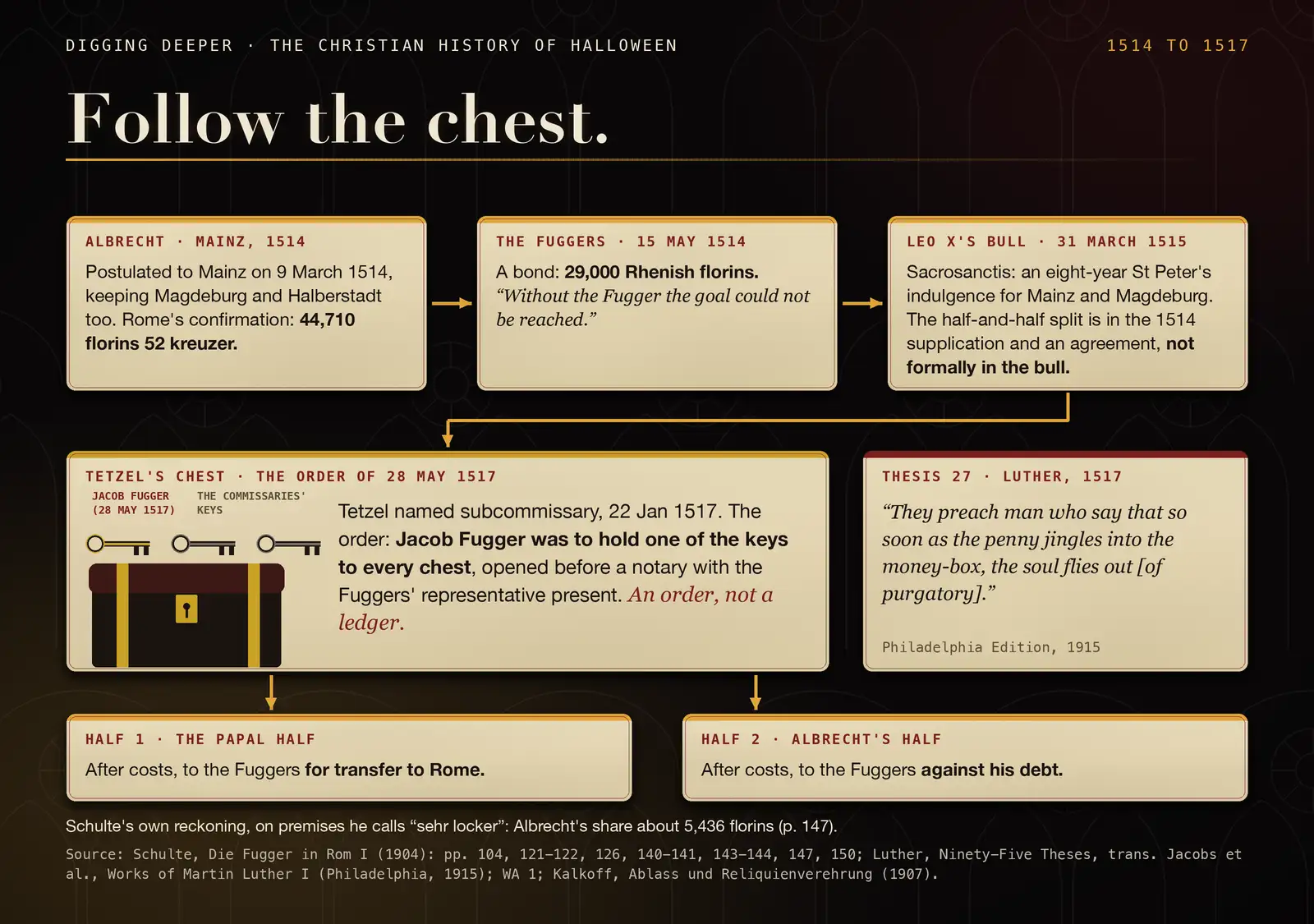
Follow the coin out of the chest: half to Rome by Fugger transfer, half to the Fuggers against the archbishop's loan. Source: Schulte, Die Fugger in Rom I (1904), pp. 104, 126, 143-144.
The sales manual was printed, too. Albrecht's Instructio summaria told the preachers that buyers for the dead needed neither contrition nor confession: "Nor is it necessary for those who contribute to the fund for this purpose to be contrite or to confess."⁶⁹ Luther's Thesis 86 relays the laity's question: "Why does not the pope, whose wealth is to-day greater than the riches of the richest, build just this one church of St. Peter with his own money, rather than with the money of poor believers?"⁷⁰
How's that for a question to mail to a man who owed the Fuggers 29,000 florins?
And the door? It is the story Philip Melanchthon told in 1546, after Luther was dead, and Melanchthon was in Tübingen in 1517: "affixit", he posted them, on the eve of All Saints, with no hammer and no nails.⁷³ In February 2007 Martin Treu noticed a 1540s note by Georg Rörer saying theses went up on the church doors, and Leppin and Wengert call the posting "a historically interesting, but in the final analysis unresolvable question."⁷⁴
By 1523 Frederick's relics were set out as altar ornament with no indulgence attached, and Luther lies buried in the Castle Church of All Saints.⁷⁵
The war on Christmas, 1647 edition
Now, the other holiday everyone calls pagan.
The Chronograph of 354 puts Christ's birth on 25 December, "VIII kal. Ian. natus Christus in Betleem Iudeae", and its civil calendar marks the same day "N INVICTI CM XXX", the birthday of the Unconquered, without ever saying "Sol".⁷⁶ Whether the date comes from the sun feast or from a calculation is a fight that is still going. Louis Duchesne, arguing for the calculation in 1889, threw out the Saturnalia ("il n'y a pas coïncidence"), then admitted in the very next sentence: "Une explication meilleure, c'est celle qui est suggérée par la fête du Natalis Invicti".⁷⁷
Then came the bans, and in December 1644 Parliament ordered Christmas, which fell on that month's fast day, kept as a fast, because the feast had been turned "into an extreame forgetfulnesse of him, by giving liberty to carnall and sensuall delights". The Directory of 1645 then ruled that "Festival dayes, vulgarly called Holy dayes, having no Warrant in the Word of God, are not to be continued."⁷⁸ On 24 December 1652 the Commons resolved "That no Observation shall be had on the 25th Day of December", and sat on Christmas Day.⁷⁹
Five shillings for a Christmas dinner! The royal commissioners leaned on the colony, and the law came off the books in 1681/2.
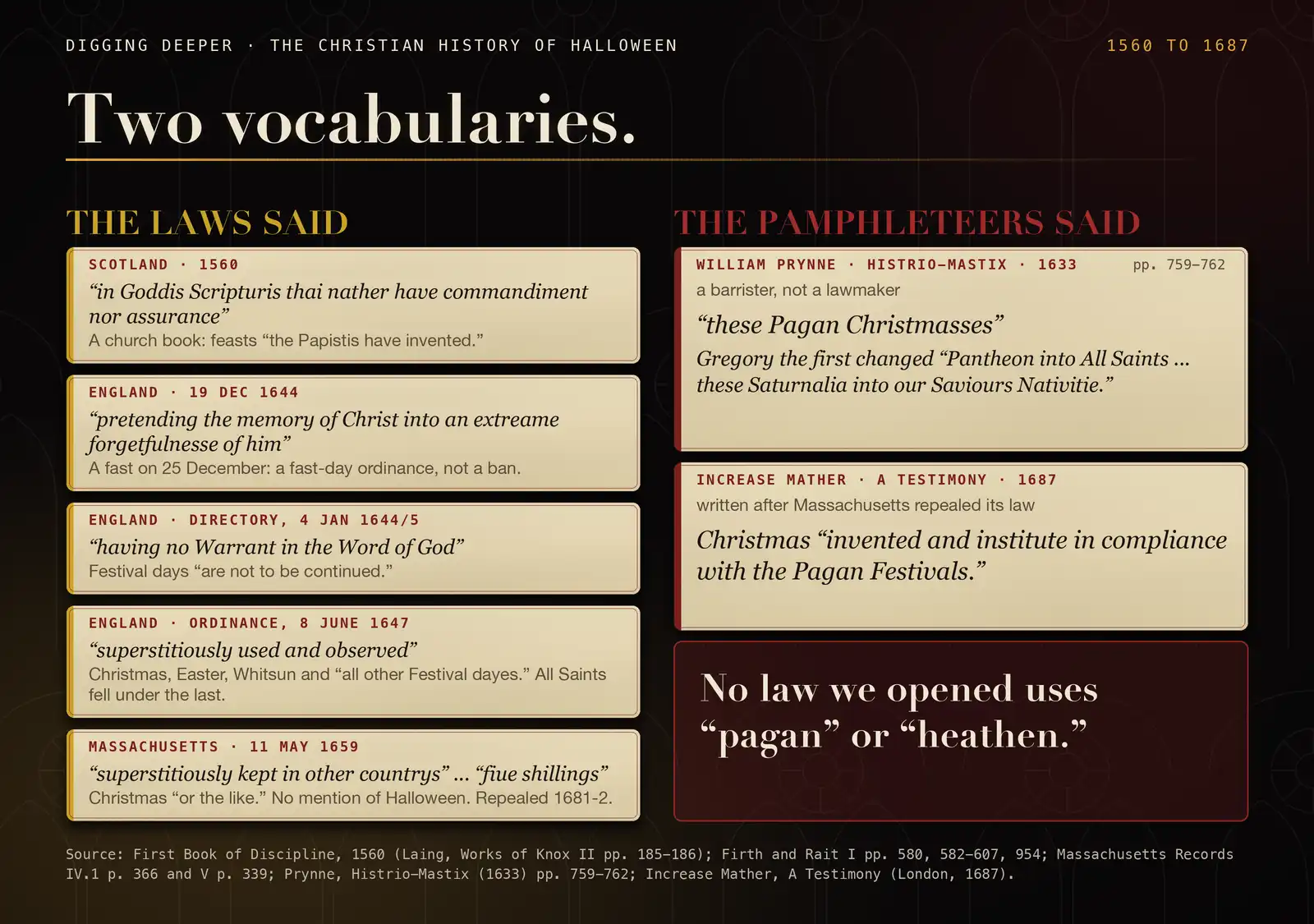
The laws said superstition; "pagan" lives only in the pamphlets. Source: Firth and Rait 1911; Shurtleff 1854; Prynne 1633; Mather 1687.
Now, the line goes that the Puritans banned Christmas because it was pagan.
[checks notes]
The laws said "superstitiously". The pamphleteers said "pagan": Prynne in 1633, Mather in 1687. And one of them said it about All Saints in the same sentence.⁸²
I promised you a Puritan who says the quiet part about All Saints out loud, and here he is: William Prynne, a barrister, in Histrio-Mastix in 1633, writing that Pope Gregory the First "had changed divers of the Pagan Festivalls into Christian: as Pantheon into All Saints; ... these Saturnalia into our Saviours Nativitie".⁸³
Pantheon into All Saints. There is your "the Church stole a pagan holiday" story, aimed at All Saints and Christmas in one breath, in a Puritan lawyer's hand, and not a Druid in sight.
In 1633 both feasts were still on the books. Elizabeth's list of holy days, added in 1561, names twenty-three feasts, with All Saints beside the Nativity.⁸⁴ And now that sentence comes back out of your pocket: more than seven centuries before Prynne, the Old English Martyrology had the pope ordering 1 November kept "with the same reverence as the first day of Christmas".⁸⁵ Christmas stayed the greater feast. But the two stood close enough that the man who came to abolish one reached for the other in the same sentence.
And the Protestants never gave up the night. On 12 August 1617 the Elector John George I of Saxony decreed a Reformation jubilee for 31 October and 2 November, the eve of All Saints and All Souls' Day, and from 1667 Johann Georg II made 31 October an annual Saxon feast.⁸⁶
So the Protestant feast of the Reformation sits on Halloween, on the vigil of the saints, the same night Luther dated his letter to the man with the Fugger loan.
So who told him? A man in Dublin, in 1783
I promised you the name behind the man in the demon mask too, so here he is.
Dublin, 1783. An antiquary named Charles Vallancey sits down to explain All Hallows' Eve to the Irish, and he needs a god for the job, so he builds one. He takes samhain, the Irish name for the first of November, runs it through some homemade Hebrew, and out comes a deity: "hence Samman was named BALSAB, or Dominus mortis, for Bal is lord, and Sab death."⁸⁷
That is the lord of the dead. Ronald Hutton and Nicholas Rogers both went looking in the early Irish texts for a god called Samhain or Saman, for a lord of the dead, or for a Druid sacrifice fixed to that night, and found none; the one poem that puts a sacrifice on a Samain eve is a Christian-era poem about an idol.⁸⁸
Then the scholars picked him up and gave him a university education. J. G. Frazer, in 1906, put it as a question, then said the facts seemed to countenance it: "May not then the institution of the feast of All Saints on that day have been the first attempt of the Church to give a colour of Christianity to the ancient heathen rite by substituting the saints for the souls of the dead as the true object of worship?"⁸⁹
By 1913, in a footnote that leaned on E. K. Chambers's Mediaeval Stage of 1903, the question had become a fact: "we can hardly doubt that the Saints, who have taken possession of the first of November, wrested it from the Souls of the Dead, the original proprietors."⁹⁰
Seven years and not one new document: Hutton points out that Frazer argued backwards from the medieval Christian feast and admitted, by implication, that he had no record of the pagan one.⁹¹
The reference books did the rest. The 1911 Britannica told its readers that on the eve of the festival "Saman, lord of death, called together the wicked souls," and Ruth Edna Kelley's Book of Hallowe'en wrote in 1919 that "In time the autumn festival of the Druids became the vigil of All Hallows."⁹²
In 1954 Gerald Gardner gave the new witch religion four festivals laid over the Gaelic quarter days, "Samhaim or Samhuin (November 1)" among them, following Margaret Murray, whose four-festival scheme leans on one Forfar confession from 1661.⁹³
So the witches' Samhain is in print by 1954, by way of a confession from 1661.
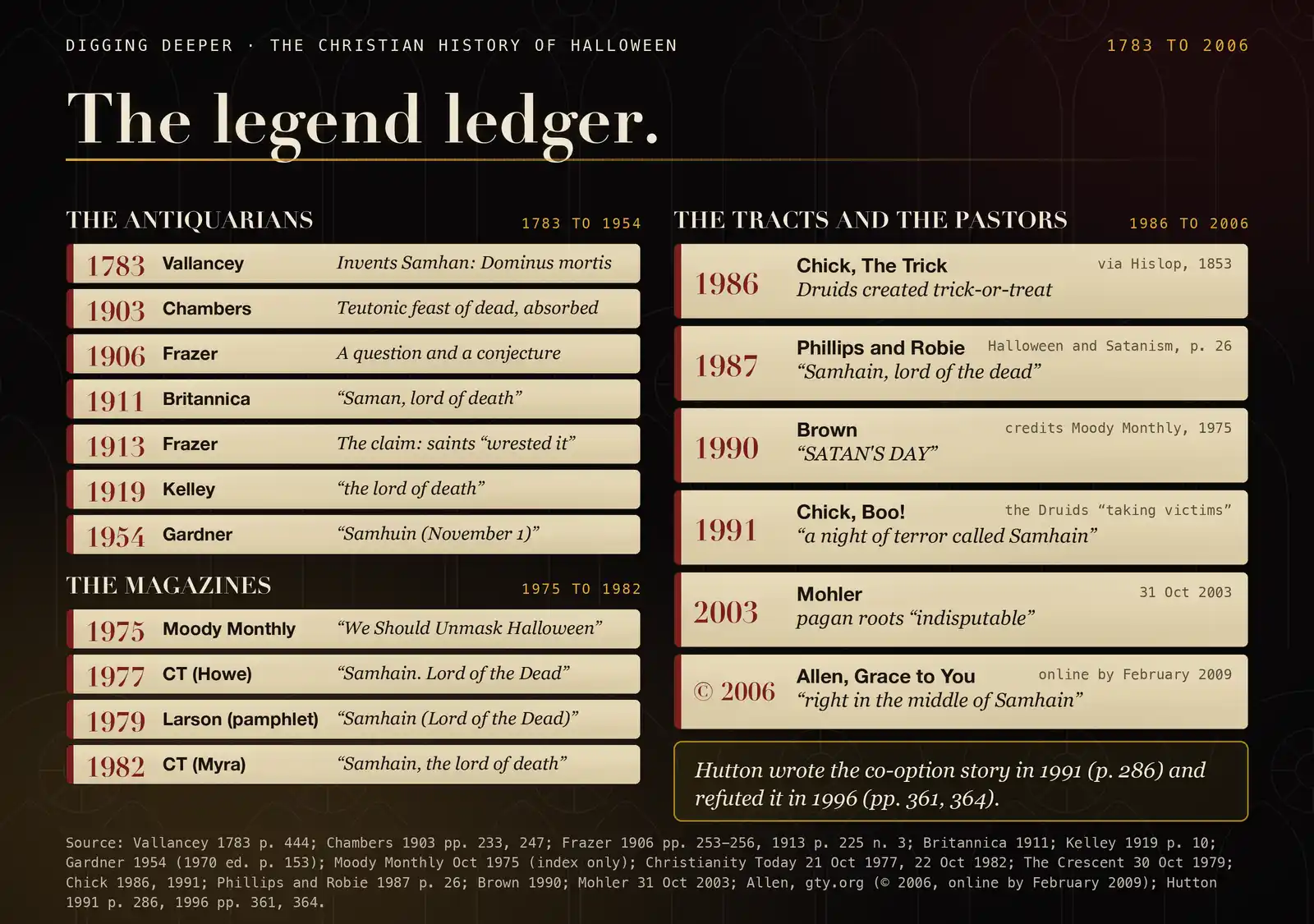
Every line of the "Church stole Samhain" story has a name and a year on it, and none of them is earlier than 1783. Source: Vallancey 1783; Frazer 1906, 1913; Britannica 1911; Kelley 1919; Gardner 1954; Christianity Today 1977, 1982; Phillips and Robie 1987; Chick 1986, 1991; Roberts 1996, per Christianity Today.
- 1783 Charles Vallancey invents "Baal-Samhan," Dominus mortis, in Dublin.
- 1903 E. K. Chambers has a Teutonic feast of the dead "absorbed."
- 1906 J. G. Frazer asks whether All Saints was the Church's "first attempt."
- 1911 The Britannica prints "Saman, lord of death."
- 1913 Frazer says the saints "wrested" the day.
- 1919 Ruth Edna Kelley's Book of Hallowe'en repeats it for American readers.
- 1954 Gerald Gardner puts Samhain on the witches' calendar.
- 1975 to 1982 Moody Monthly, Christianity Today, Bob Larson.
- 1986 Jack Chick's The Trick.
- 1987 Phillips and Robie, Halloween and Satanism.
- 1991 Chick's Boo!
- 1996 A Hell House kit from Arvada, Colorado.
Then the Christian magazines bought it
The story reached the pews through the respectable press years before any comic book got near them.
In October 1975 Moody Monthly ran an opinion column by Joy Sterling titled "We Should Unmask Halloween," a piece that is not online and that I could only find in the index.⁹⁴
Two years later Christianity Today printed a lord of the dead, the figure Vallancey had put in print in 1783, in a piece by John W. Howe: "This celebration honored one of their deities, Samhain. Lord of the Dead."⁹⁵
Howe dated the move "A.D. 834," said it was made to suit "the recently conquered German Saxons and the Norsemen of Scandinavia," and Scandinavia was not Christian in 834.⁹⁶
Not exactly a clean chain of custody.
Then the very same article turns around and asks, "How about an All Saints Party?", and reports that his Episcopal parish in Virginia had already thrown one the year before.⁹⁷
The right answer and the wrong history, in one column!
Bob Larson's pamphlet had "Samhain (Lord of the Dead)" on campus by 1979, and Christianity Today ran it again in 1982 under Harold Myra, who wrote that the Druids "believed Samhain, the lord of death, sent evil spirits abroad to attack humans," and also, God bless him, "Yes there are decidedly Christian ways in which we can celebrate Halloween."⁹⁸
The first Evangelical book I could find to carry it was Phil Phillips and Joan Hake Robie's Halloween and Satanism in 1987: the Druids kept "the Vigil of Samhain in honor of their god, Samhain, lord of the dead."⁹⁹
By 1990 David L. Brown, crediting the Moody column for changing his mind, was calling it "SATAN'S DAY" and telling readers the Pilgrims "banned celebrating Halloween in America," a law that turns up nowhere I looked: the Massachusetts Bay records from 1650 to 1686 never mention Halloween.¹⁰⁰
Then the magazine copy settled into the seminaries. In 2003 Al Mohler quoted Myra's lord of death and wrote, "Scholars dispute whether Samhain was celebrated as a festival of the dead, but the pagan roots of the festival are indisputable."¹⁰¹
By 29 October 2021 the line on The Briefing read, "Given the pagan roots, the specific pagan roots, and the attachment to the celebration of death and to the spirits of the dead, there is nothing that Christians can do to build upon this particular holiday," in the same broadcast where he said the average person on your block "has no idea that Halloween actually comes from All Hallows Eve and points to a Christian celebration."¹⁰²
He is right about the block. A good man quoting his own movement's magazine, and the lord of death in the magazine is the one Dublin printed first.
The tracts, the kit and the man on television
Then came the comics. Jack Chick's The Trick, copyrighted 1986, told children that "The trick-or-treat custom was created by the Druids," that the Druid's "treat" was a child or virgin for sacrifice, and that the house got "a jack-o-lantern with a lighted candle made of human fat."¹⁰³
Chick footnoted the Druid sacrifice to Alexander Hislop's The Two Babylons, page 232, and the footnote is honest: that page is Hislop's Druid passage, in an 1853 book against Rome that, in the editions I opened, never mentions Halloween, trick-or-treat or a jack-o'-lantern, so the candle of human fat is Chick's own.¹⁰⁴
Five years later Boo! opened with "October 31st was a night of terror called 'Samhain.' That night... the Druids went house to house, taking victims for human sacrifice."¹⁰⁵
Chick Publications still sells Boo! today as the tract that "reveals the truth about Halloween," and in it a boy asks, "Pastor, is Halloween really Satan's birthday?" and Chick's own pastor answers, "No, Joey. He was created in heaven, and his name was Lucifer."¹⁰⁶
The one place the tract literature argues with itself, and the pastor wins.
Liberty University had run Scaremare since 1972. In 1996 Keenan Roberts of Abundant Life Christian Center in Arvada, Colorado, an Assemblies of God church, was selling Hell House kits at $149, with a 263-page manual, a video and sound effects; sixty had sold, and Roberts called it "Romans 6:23 in contemporary packaging."¹⁰⁷
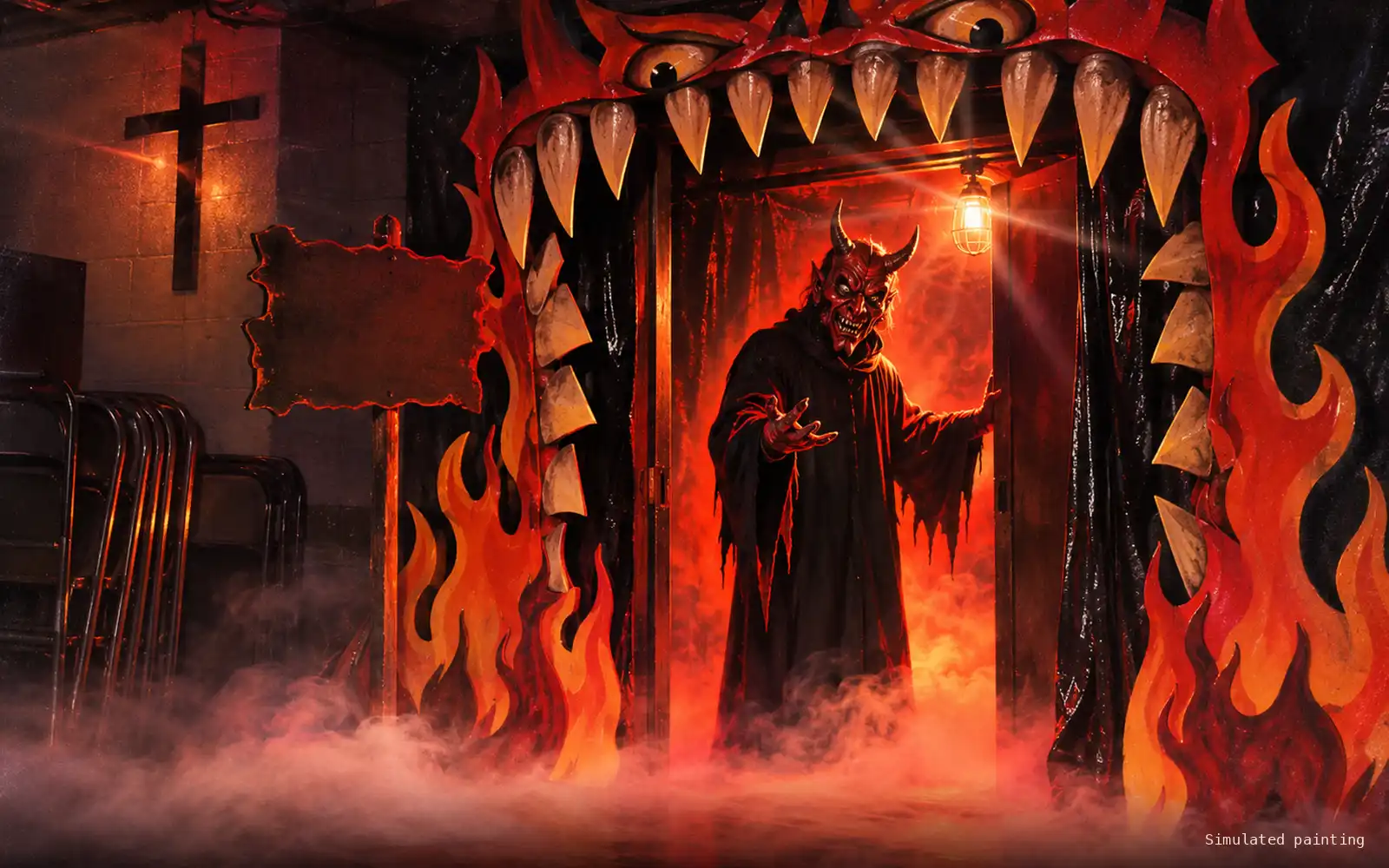
Simulated painting. The kit came with a 263-page manual, a video and sound effects, and it shipped from a church in Arvada for $149.
Television carried it to everybody else, and here is Pat Robertson in October 2015: "Well, it used to be known as All Saints Eve ... that's the day when millions of children and adults will be dressing up as devils, witches and goblins to celebrate Satan. They don't realize that's what they're doing."¹⁰⁸
Even Pat started with All Saints Eve!
The most quoted Satanist line of all, that Anton LaVey was glad "the Christian parents let their children worship the Devil at least one night out of the year," has never been found in anything LaVey wrote; the earliest print I can find is a paraphrase in a Dunkard Brethren church paper in 1982, with his name misspelled.¹⁰⁹
And the FBI's own investigator, Kenneth Lanning, wrote in January 1992 that for the alleged organized satanic cults abusing and murdering on a vast scale "there is little or no corroborative evidence."¹¹⁰
Where the story still prints, and who put the saints back
The panic cooled, and the history never did.
Grace to You carries a fair-minded piece by Travis Allen, © 2006 and online by February 2009, that says "Ultimately, Christian participation in Halloween is a matter of conscience before God," and also that "Pope Gregory IV reacted to the pagan challenge by moving the celebration of All Saints Day in the ninth century ... he set the date at November 1, right in the middle of Samhain."¹¹¹
Jon Bloom at Desiring God, 2014: "If his purpose was to subsume the Celts' Samhain festival, he certainly succeeded."¹¹²
Kind conclusions, sitting on Frazer's 1906 question. Meanwhile Clarissa Moll wrote at The Gospel Coalition in 2020 that "Halloween finds its sacred roots in All Saints' Day and All Souls' Day," and Jimmy Akin at Catholic Answers put the whole thing in one line: "a hallow is simply a saint."¹¹³
Even the polling carries it. In 2015 Lifeway asked American adults, "When you consider the pagan elements of Halloween, which is closer to your attitude?", and 21 percent said they avoid Halloween completely while 14 percent avoid "the pagan elements"; among self-identified evangelicals, 28 and 23 percent.¹¹⁴
The pollster wrote the legend into the question.
The Assemblies of God publishes no position paper on Halloween; its magazines ran pieces in 2002 and 2017, and one of its churches sold the kit.¹¹⁵
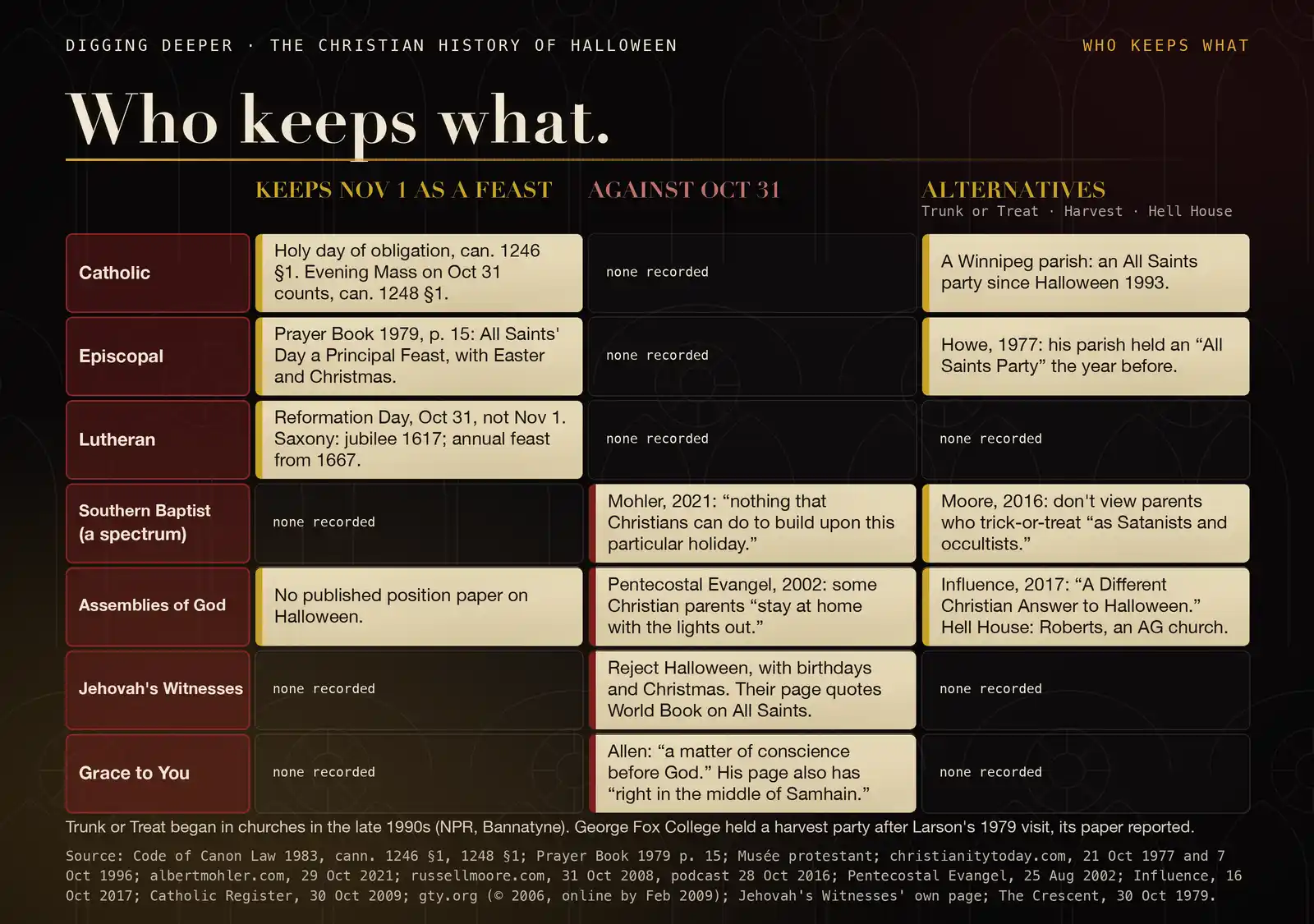
The older the calendar, the less anyone panics. Source: Code of Canon Law (1983), cann. 1246, 1248; Book of Common Prayer (1979) p. 15; Lifeway Research 2015, 2016, 2022.
The older churches never lost the thread. All Saints is a Catholic holy day of obligation that can be kept at Mass the evening before, in church on Halloween night, and the Episcopal Prayer Book of 1979 lists All Saints' Day among its seven Principal Feasts, beside Easter and Christmas.¹¹⁶
If Christ is Lord of everything, as I argued in Christ's Dominion Over Everything, He is Lord of the last night of October too, and nobody owes that night to a god invented in Dublin just a few generations ago.
The witness who could not have been there
Mike Warnke's The Satan Seller, published by Logos in 1973, made him the panic's star ex-Satanist, all the way to ABC's 20/20 in March 1985 and a "Mike Warnke Day" in Tennessee on 29 June 1988.¹¹⁷
The book never once mentions Halloween, Samhain or Druids.¹¹⁸
He did not need it to, and then Cornerstone, the Evangelical magazine of Jesus People USA, did the work and pinned down the window.
Inside that window they found a photograph of Mike dated 30 April 1966, and a college friend who wondered when Mike ever had time for a coven of fifteen hundred: "About the most exciting thing we used to do was play croquet."¹¹⁹
Warnke's answer, in Christianity Today that August: "I stand by my testimony of being delivered and set free by the power of Jesus Christ after being a Satanic high priest exactly as published in my book, The Satan Seller."¹²⁰
His wife Rose told Christianity Today that November that "there were only 13 people in the coven," and in the next breath: "There were 1,500 people who knew about the coven and who supported it in one way or another, but the true coven only contained 13 members."¹²¹
The man a generation of Christians trusted to tell them what Satanists did at Halloween could not have been where he said he was.
In 2002 Warnke wrote, "I never lied about my testimony and I never ran a fake ministry," and in the next breath, "let me hasten to add that all was not right in the Warnke world." Jon Trott wrote that he "has never admitted the truth about his alleged involvement with the occult."¹²²
The Church caught its own, in its own magazine, with its own footnotes.
Fair play
Okay, fair play time. Samhain was real: a Gaelic quarter day and royal assembly, "winter from Samuin to Beltaine," and Hutton grants a major pagan festival at the opening of November with "no evidence that it was connected with the dead," though "certainly a time when supernatural forces were especially to be guarded against or propitiated."¹²³ Burns wrote down the bonfires, fairies and courtship games in 1785; on Lewis men poured ale to a sea god "call'd Shony" at Hallowtide until the ministers stopped it; LaVey did name Halloween one of his "two major Satanic holidays" in 1969; parishes blended, as at every feast; and Hutton himself wrote the co-option story in 1991 and changed his mind by 1996.¹²⁴ But. The date is English and German by about 800, the only reason a medieval writer gives for November is the harvest, and the three days are Christian. The bells and the soul cakes were prayers for the dead, which makes me, admittedly, uncomfortable as a Reformed Christian. The costumes and the candy are nineteenth and twentieth century, and "trick or treat" turns up in Canadian papers between 1917 and 1927. The stolen-Samhain story was written by Vallancey in 1783 and Frazer in 1913, then sold by Christianity Today in 1977, a tract in 1986 and a kit from Arvada. The saints were there first, and my family will be celebrating the saints as we always do: with costumes for the family, laughing because Christ defeated death, and candy for the neighborhood kids.
Happy Hallowtide from the Wuckerts!
Next, we go back to The History of Money and Banking, and the bankers who held a key to every one of those indulgence chests.
Kurt Wuckert Jr. is the Chief Bitcoin Historian, founder of GorillaPool and Open Protocol Labs, and host of Kurt's Podcast. He writes weekly on Bitcoin, geopolitics, faith, and the long fight for human sovereignty at kurtwuckertjr.com. Catch him live every Tuesday at 2 PM EST.
Footnotes
¹ Erwin Iserloh, "Luthers Thesenanschlag: Tatsache oder Legende?", Aufsatz 4 (PDF), Wiesbaden, 1962, p. 61.
² Wittenberg relic book (Heiligtumsbuch) of 1509, preface, Wittemberger Heiligthumsbuch, facsimile Munich: Hirth, 1884; and Paul Kalkoff, Ablass und Reliquienverehrung an der Schlosskirche zu Wittenberg, Gotha, 1907, p. 7, with Iserloh 1962 n. 54 on first Vespers.
³ Chapter memorandum of 9 Nov 1513, reported by Kalkoff, Ablass und Reliquienverehrung, Gotha, 1907, pp. 51-52.
⁴ Heiligtumsbuch 1509, final leaf, Wittemberger Heiligthumsbuch, facsimile 1884; and Spalatin's register of 1518 (17,443 pieces), in Kalkoff, Ablass und Reliquienverehrung, 1907, p. 64.
⁵ Frederick to the Utrecht chapter, June 1518, as reported by Kalkoff, Ablass und Reliquienverehrung, 1907, p. 65.
⁶ Schulte, Die Fugger in Rom 1495-1523, vol. I, Leipzig: Duncker & Humblot, 1904, p. 104.
⁷ Order of the commissaries, 28 May 1517, in Schulte, Die Fugger in Rom, vol. I, 1904, pp. 143-144.
⁸ Luther to Albrecht of Mainz, Works of Martin Luther I, trans. Jacobs et al., Philadelphia: Holman, 1915, pp. 25-28; Latin in WA Br 1 no. 48 (not opened); Preserved Smith (1911) prints the dateline as "Wittenberg, October 31, 1517".
⁹ Philip Melanchthon, preface to Luther's Opera II, dated 1 June 1546, Corpus Reformatorum 6, cols. 161-162, Halle, 1839 ("affixit"; no hammer, no nails).
¹⁰ The places named are each sourced where the story reaches them: Bede HE II.4 (Rome); Ado, PL 123 and Sigebert, PL 160 (the emperor's court); the Cluny statute, PL 142 cols. 879-880 (Burgundy); Hutton, Stations of the Sun, pp. 371-374 (the bells); John Aubrey, Remaines of Gentilisme and Judaisme, MS 1686-87, ed. Britten, Folk-Lore Society, 1881, p. 23 (Shropshire); and Anoka Halloween, History, accessed 2026.
¹¹ "'Hell House' Kits Selling Nationally," Christianity Today, 7 Oct 1996.
¹² Charles Vallancey, "Of Allhallow Eve," Collectanea de Rebus Hibernicis III no. XII, vol. III, Dublin: Luke White, 1783, p. 444.
¹³ Bickell, ed., S. Ephraemi Syri Carmina Nisibena, Leipzig, 1866, prolegomena p. 23.
¹⁴ Wright's Syriac martyrology, reported in Bickell, Carmina Nisibena, 1866, Corrigenda; and Montfaucon's note in Migne, PG 50, 1862.
¹⁵ Bede, Ecclesiastical History II.4, trans. A. M. Sellar, Gutenberg 38326, 1907; and Liber Pontificalis, Life 69, ed. Duchesne, vol. I, 1886, p. 317.
¹⁶ Duchesne, Liber Pontificalis I, 1886, p. 317 n. 2; Sellar's note 189; no writer of the time gives the year, and Ronald Hutton, The Stations of the Sun, Oxford, 1996, p. 364 (search-index), gives 609.
¹⁷ Revelation 7:9, ESV; Roman Lectionary no. 667, USCCB readings for 1 Nov 2025.
¹⁸ Old English Martyrology, 1 November, trans. Herzfeld, An Old English Martyrology, EETS OS 116, 1900, pp. 198-199.
¹⁹ Liber Pontificalis, Life 92, ed. Duchesne, vol. I, 1886, p. 417; literal rendering of the Latin.
²⁰ Mershman, "All Saints' Day," Catholic Encyclopedia, vol. 1, 1907; not in the Liber Pontificalis.
²¹ Alcuin to Arno, Epistola XCI (Froben ep. 77), Migne, PL 100, col. 296, one Salzburg manuscript; with Hutton, The Stations of the Sun, 1996, p. 364 (search-index), on England and Germany by about 800.
²² Félire Óengusso, 20 April, ed. Stokes, The Martyrology of Oengus, HBS 29, 1905, p. 107.
²³ Stokes, Martyrology of Oengus, 1905, pp. 232-233 and glossary.
²⁴ Hutton, The Stations of the Sun, 1996, p. 364 (search-index); and Rogers, Halloween: From Pagan Ritual to Party Night, Oxford, 2002, p. 22 (search-index), who agrees.
²⁵ Ado of Vienne, Martyrologium, 1 November, Migne, PL 123, col. 387.
²⁶ Sigebert of Gembloux, Chronica s.a. 835, Migne, PL 160, cols. 159-160; and Ado, PL 123, col. 387.
²⁷ John Beleth, Summa de ecclesiasticis officiis c. 127, in Rationale divinorum officiorum, Naples: Dura, 1859, p. 827 (literal); copied by Durandus, Rationale VII.34.3, p. 699.
²⁸ Sicard of Cremona, Mitrale IX.24, Migne, PL 213, col. 414.
²⁹ The opened chain: Liber Pontificalis, Alcuin, the Old English Martyrology, Ado, Sigebert, Beleth, Sicard, Durandus, Aelfric, Mirk; Hutton, The Stations of the Sun, 1996, pp. 364-365 (search-index).
³⁰ Aelfric, Catholic Homilies I.36, ed. Thorpe, The Homilies of the Anglo-Saxon Church I, 1844, p. 539; and Mirk, Festial no. 64, EETS ES 96, 1905, p. 266.
³¹ Gregory the Great to Mellitus, Bede, HE I.30, trans. Sellar, Gutenberg 38326, 1907; transmitted date XV Kal. Iul. (17 June) 601, emended by Plummer and Sellar to 18 July 601 (Sellar n. 133).
³² Gregory to Æthelberht, 22 June 601, Bede, HE I.32, trans. Sellar, Gutenberg 38326, 1907.
³³ Jotsald, Vita Odilonis II.13, Migne, PL 142, cols. 926-927 (OCR column); and Peter Damian, Vita Odilonis, Migne, PL 144, cols. 935-938 (OCR column).
³⁴ Statutum S. Odilonis, Mabillon's text from an old Cluny manuscript, Migne, PL 142, cols. 879-880.
³⁵ Statutum S. Odilonis, PL 142, cols. 879-880.
³⁶ PL 142, cols. 879-880, with Mabillon's note; no opened source gives 998.
³⁷ Hutton, The Stations of the Sun, 1996, p. 364 (search-index); and Durandus, Rationale VII.35.2, Naples 1859, pp. 700-701.
³⁸ Sicard of Cremona, Mitrale IX.50, Migne, PL 213, col. 424; copied by Durandus, Rationale VII.35.1, Naples 1859, p. 700.
³⁹ Codex Iuris Canonici (1917), can. 1252 §2, 1918 ed.; and Alcuin, PL 100, col. 296.
⁴⁰ Sacred Congregation of Rites, Cum nostra hac aetate, 23 Mar 1955, AAS 47, p. 220, nos. 9 and 11.
⁴¹ Hebrews 12:1, ESV; and Matthew 5:4 and 1 Corinthians 15:55, ESV.
⁴² Wisdom 3:1, RSVCE, deuterocanonical.
⁴³ Hutton, The Stations of the Sun, 1996, p. 364 (search-index).
⁴⁴ John Mirk, Festial no. 65, "In Die Animarum," EETS ES 96, 1905, p. 269.
⁴⁵ John Mirk, All Hallows sermon, Mirk's Festial, ed. Theodor Erbe, EETS ES 96, p. 266, 1905.
⁴⁶ Ronald Hutton, The Stations of the Sun, Oxford University Press, p. 371 (search-index), 1996.
⁴⁷ Mirk, Festyvall (1511), quoted in John Brand, Observations on Popular Antiquities, ed. Henry Ellis, Bohn, vol. I p. 392, 1849.
⁴⁸ John Aubrey, Remaines of Gentilisme and Judaisme, ed. James Britten, Folk-Lore Society, p. 23, 1881 (written 1686-87).
⁴⁹ Tollett's note on Two Gentlemen of Verona, quoted in Brand, Popular Antiquities, ed. Ellis, vol. I p. 393, 1849.
⁵⁰ Charlotte S. Burne (ed.), Shropshire Folk-Lore, Part III, Trübner, pp. 381-383, 1886.
⁵¹ Hutton, The Stations of the Sun, pp. 371-372 (search-index), 1996; and Royal Injunctions no. 18, Documents Illustrative of English Church History, ed. Gee and Hardy, p. 426, 1896.
⁵² Parkhurst, Injunctions for Norwich, in W. H. Frere, Visitation Articles and Injunctions III, Alcuin Club, p. 209, 1910 (1569).
⁵³ Grindal, York Injunctions, in Frere, Visitation Articles III, p. 286, 1910 (1571); and Canterbury Articles no. 9, The Remains of Edmund Grindal, Parker Society, p. 160, 1843 (1576).
⁵⁴ Hutton, The Stations of the Sun, pp. 371-372 (search-index), 1996.
⁵⁵ Joseph Wright, The English Dialect Dictionary, vol. II s.v. GUISE and vol. III s.v. HALLOW (citing Service, Notandums p. 40), 1900.
⁵⁶ James Howell, Epistolae Ho-Elianae, ed. Jacobs, pp. 351-352 (1890); William Holloway, A General Dictionary of Provincialisms, 1839; and Hutton, Stations p. 382 (snippet), 1996.
⁵⁷ "E. W.", "Jack o' the Lantern", Dublin Penny Journal vol. 4, pp. 229-232, 16 January 1836; and Hercules Ellis, The Rhyme Book, pp. 621-627, 1851.
⁵⁸ Hutton, The Stations of the Sun, p. 383 (snippet), 1996; and The Daily Evening Telegraph, Philadelphia, Chronicling America sequence 8, 31 October 1866.
⁵⁹ Sault Daily Star, 1 November 1917, clipping via Barry Popik, in SooToday, 1 November 2022; and Lethbridge Herald, p. 5, 4 November 1927.
⁶⁰ City of Anoka, Halloween history, undated; and Congressional Record vol. 148, E1031 ("Anoka first proclaimed itself"), 12 June 2002.
⁶¹ Joel Best, Halloween Sadism: The Evidence, University of Delaware, p. 2, revised through 2025; and O'Bryan v. State, 591 S.W.2d 464, Tex. Crim. App., 1979.
⁶² Wittenberger Heiligtumsbuch, final leaf, 1509; and Paul Kalkoff, Ablass und Reliquienverehrung, pp. 10-11 n. 3, 1907.
⁶³ Wittenberger Heiligtumsbuch, leaf a iij, 1509; and Kalkoff, Ablass und Reliquienverehrung, pp. 7, 51-52, 1907.
⁶⁴ Kalkoff, Ablass und Reliquienverehrung, pp. 43, 64-66, 1907.
⁶⁵ Aloys Schulte, Die Fugger in Rom I, pp. 121-122 n. 2, 141, 1904; and Erwin Iserloh, Luthers Thesenanschlag, pp. 48-49, 1962.
⁶⁶ Schulte, Die Fugger in Rom I, pp. 115-117, 1904; and Preserved Smith, The Life and Letters of Martin Luther, pp. 38-39, 1911.
⁶⁷ Schulte, Die Fugger in Rom I, p. 104, 1904.
⁶⁸ Schulte, Die Fugger in Rom I, pp. 147, 185, 1904.
⁶⁹ Instructio summaria, trans. Smith, Life and Letters of Martin Luther, p. 39, 1911; Latin in Nikolaus Paulus, Johann Tetzel der Ablassprediger, p. 150 n. 1, 1899.
⁷⁰ Luther, Ninety-five Theses, no. 86, trans. Jacobs et al., Works of Martin Luther I, A. J. Holman, 1915.
⁷¹ Luther to Albrecht, trans. Smith, Life and Letters of Martin Luther, p. 43, 1911; WA Br 1 no. 48 not opened.
⁷² Luther, Ninety-five Theses, no. 27, trans. Jacobs et al., Works of Martin Luther I, Holman, 1915.
⁷³ Melanchthon, preface to Luther's Opera II, Corpus Reformatorum 6 cols. 161-162, Philippi Melanthonis Opera, 1 June 1546.
⁷⁴ Volker Leppin and Timothy J. Wengert, Lutheran Quarterly 29, pp. 377-378, 390, 2015.
⁷⁵ Kalkoff, Ablass und Reliquienverehrung, pp. 49-50, 115-116, 1907; burial per Leppin and Wengert, Lutheran Quarterly 29, p. 375, 2015.
⁷⁶ Chronograph of 354, Depositio martyrum and civil calendar, Pearse transcriptions after Mommsen, MGH Chron. Min. I pp. 71-72, 1892.
⁷⁷ Louis Duchesne, Origines du culte chrétien, Thorin, p. 250, 1889.
⁷⁸ C. H. Firth and R. S. Rait, Acts and Ordinances of the Interregnum I, p. 580 (fast-day ordinance of 19 December 1644) and pp. 582-607 (Directory, 4 January 1644/5), 1911.
⁷⁹ Journal of the House of Commons 7, pp. 234-235, 24 December 1652.
⁸⁰ Firth and Rait, Acts and Ordinances I, p. 954, 1911.
⁸¹ Nathaniel Shurtleff (ed.), Records of the Governor and Company of the Massachusetts Bay IV.1, p. 366, 1854; repeal in Records V p. 339 (15 February 1681/2).
⁸² Full-text searches of the 1560, 1644, 1645, 1647, 1652 and 1659 texts, and of Parkhurst's 1569 and Grindal's 1571 and 1576 injunctions, for "pagan" and "heathen" (none); William Prynne, Histrio-Mastix, EEBO-TCP A10187, p. 762, 1633; and Increase Mather, A Testimony against several Prophane and Superstitious Customs, ch. III arg. 6 ("in compliance with the Pagan Festivals"), London, 1687.
⁸³ Prynne, Histrio-Mastix, EEBO-TCP A10187, pp. 759-760, 1633.
⁸⁴ BCP 1559 Kalendar, "These to be observed for Holy dayes", Wohlers transcription, list added 1561.
⁸⁵ Old English Martyrology, 1 November, trans. George Herzfeld, An Old English Martyrology, EETS OS 116, p. 199, 1900 (text 9th century).
⁸⁶ Musée protestant, The founding jubilee of 1617 in Germany, after Carbonnier-Burkard, undated (decree dated Julian); and SSCM, Instrumenta vol. 5, citing Gerber, Historie der Kirchen-Ceremonien in Sachsen p. 227, 1732 (Gerber not opened).
⁸⁷ Charles Vallancey, "Of Allhallow Eve," Collectanea de Rebus Hibernicis III no. XII, Collectanea de Rebus Hibernicis, vol. III, Dublin: Luke White, 1783, p. 444 (page image).
⁸⁸ Ronald Hutton, The Stations of the Sun, Oxford University Press, 1996, pp. 361, 370 (search-index); and Nicholas Rogers, Halloween: From Pagan Ritual to Party Night, Oxford University Press, 2002, p. 19 (search-index).
⁸⁹ J. G. Frazer, Adonis, Attis, Osiris, London: Macmillan, 1906, pp. 253-255.
⁹⁰ J. G. Frazer, Balder the Beautiful I, The Golden Bough 3rd ed. pt. VII, London: Macmillan, 1913, p. 225 n. 3, citing Chambers at p. 223 n. 1; and E. K. Chambers, The Mediaeval Stage I, Oxford, 1903, pp. 233, 247; the 1922 abridgement lacks the sentence.
⁹¹ Hutton, The Stations of the Sun, 1996, pp. 363-365 (search-index).
⁹² Encyclopaedia Britannica, 11th ed., vol. 12, "Hallowe'en," Wikisource page image, 1910-11, pp. 857-858; and Ruth Edna Kelley, The Book of Hallowe'en, Boston: Lothrop, Lee and Shepard, 1919, p. 10 and ch. V.
⁹³ Gerald Gardner, Witchcraft Today, London: Rider, 1954, Arrow ed. 1970 p. 153; and Ronald Hutton, The Pagan Religions of the Ancient British Isles, Blackwell, 1991, p. 303 (search-index).
⁹⁴ Moody Monthly vol. 76 (October 1975) p. 83, "It Seems To Me," index, archive.org; the text is not online.
⁹⁵ John W. Howe, "What Is Happy about Halloween?," Christianity Today, 21 October 1977.
⁹⁶ Howe, Christianity Today, 21 October 1977; no source is cited in the article.
⁹⁷ Howe, Christianity Today, 21 October 1977 (Truro parish, Fairfax, Va.).
⁹⁸ Bob Larson, quoted in The Crescent, George Fox College, 30 October 1979; and Harold L. Myra, "Is Halloween a Witches' Brew?," Christianity Today, 22 October 1982.
⁹⁹ Phil Phillips and Joan Hake Robie, Halloween and Satanism, Lancaster, Pa.: Starburst, 1987, p. 26 (search-index).
¹⁰⁰ David L. Brown, "The Dark Side of Halloween," copyright 1990, Wayback capture, 2000; the Massachusetts court records never name Halloween (see the Christmas section).
¹⁰¹ Albert Mohler, "Christianity and the Dark Side: What About Halloween?," albertmohler.com, 31 October 2003 (date from page metadata and URL).
¹⁰² Albert Mohler, The Briefing, 29 October 2021, ministry transcript.
¹⁰³ Jack T. Chick, The Trick, © 1986 (online text a later printing).
¹⁰⁴ Alexander Hislop, The Two Babylons, Loizeaux, 1916, p. 232; editions checked: Partridge 1871, 1903, 1907; Loizeaux 1916, 1959; for the candle Chick footnotes his own tract Spellbound? (year not traced).
¹⁰⁵ Jack T. Chick, Boo!, © 1991.
¹⁰⁶ Chick, Boo!, © 1991; no earlier Halloween print of "Satan's birthday" was found; and chick.com/halloween, opened 19 October 2026.
¹⁰⁷ "Hell House Kits Selling Nationally," Christianity Today, 7 October 1996 (Roberts quoted 1996); and Scaremare, "About", Liberty, undated.
¹⁰⁸ Pat Robertson, The 700 Club, reported by TheBlaze, 30 October 2015.
¹⁰⁹ C. H. Shofstahl, "Hallow What?," The Bible Monitor, 15 October 1982, p. 13 (tagged "Selected"); see also Church of Satan, "Faked Quotes".
¹¹⁰ Kenneth V. Lanning, Investigator's Guide to Allegations of "Ritual" Child Abuse, FBI, January 1992, p. 1.
¹¹¹ Travis Allen, "Christians and Halloween," Grace to You, © 2006; earliest Wayback capture 23 February 2009.
¹¹² Jon Bloom, "The Light Shines on All Hallows' Eve," Desiring God, 30 October 2014.
¹¹³ Clarissa Moll, The Gospel Coalition, 26 October 2020; and Jimmy Akin, Catholic Answers, 31 October 2020.
¹¹⁴ Lifeway Research, 26 October 2015, 1,000 adults; the question stem is on slide 5 of the linked survey PDF, and it assumes the pagan elements.
¹¹⁵ ag.org Topics Index, Wayback CDX; Pentecostal Evangel, 25 August 2002; Influence, 16 October 2017; Christianity Today, 7 October 1996.
¹¹⁶ Code of Canon Law, 1983, cann. 1246 §1, 1248 §1; and Book of Common Prayer, 1979, "Calendar of the Church Year," p. 15.
¹¹⁷ Jon Trott and Mike Hertenstein, "Selling Satan," Cornerstone 21:98, 1992.
¹¹⁸ Mike Warnke, The Satan Seller, © 1972, Logos, 1973; two full-text checks.
¹¹⁹ Trott and Hertenstein, Cornerstone 21:98, 1992, epigraph and p. 8.
¹²⁰ Mike Warnke, quoted in Christianity Today, 17 August 1992.
¹²¹ Christianity Today, 9 November 1992.
¹²² Christianity Today Weblog, 1 February 2002.
¹²³ Kuno Meyer, trans., "The Wooing of Emer," CELT T301021, Archaeological Review 1, 1888, p. 232; A. H. Leahy, trans., Heroic Romances of Ireland I, 1905, p. 57; and Hutton, The Stations of the Sun, 1996, pp. 369-370 (search-index).
¹²⁴ Robert Burns, Poems and Songs, "Halloween," 1785, with his notes; Martin Martin, A Description of the Western Islands of Scotland, London, 1703, pp. 28-29; Anton Szandor LaVey, The Satanic Bible, Avon, 1969, "Religious Holidays" (page unverified); Hutton 1996 pp. 366-373; and Hutton, Pagan Religions, 1991, p. 286, against 1996 pp. 361, 364 (search-index).
Be good to each other. And stay curious.