Follow The Money: The Written History of Bitcoin, Part 4B
By Kurt Wuckert Jr.
The Document
On September 4, 2014, a limited liability company called Kyara Investments III was registered.¹
The operating agreement listed two parties. Joichi Ito, the director of the MIT Media Lab, at 50 percent. Southern Financial LLC, a shell entity controlled by Jeffrey Epstein, at the other 50 percent.²
If you want to follow along on video, watch it here:
Epstein contributed five hundred thousand and one dollars. Ito contributed two thousand.
The vehicle had one purpose.
It existed to hold equity in a private Canadian company called Blockstream Corporation. Blockstream was about to close a twenty-one million dollar seed round to hire most of the people who wrote Bitcoin's consensus code.³
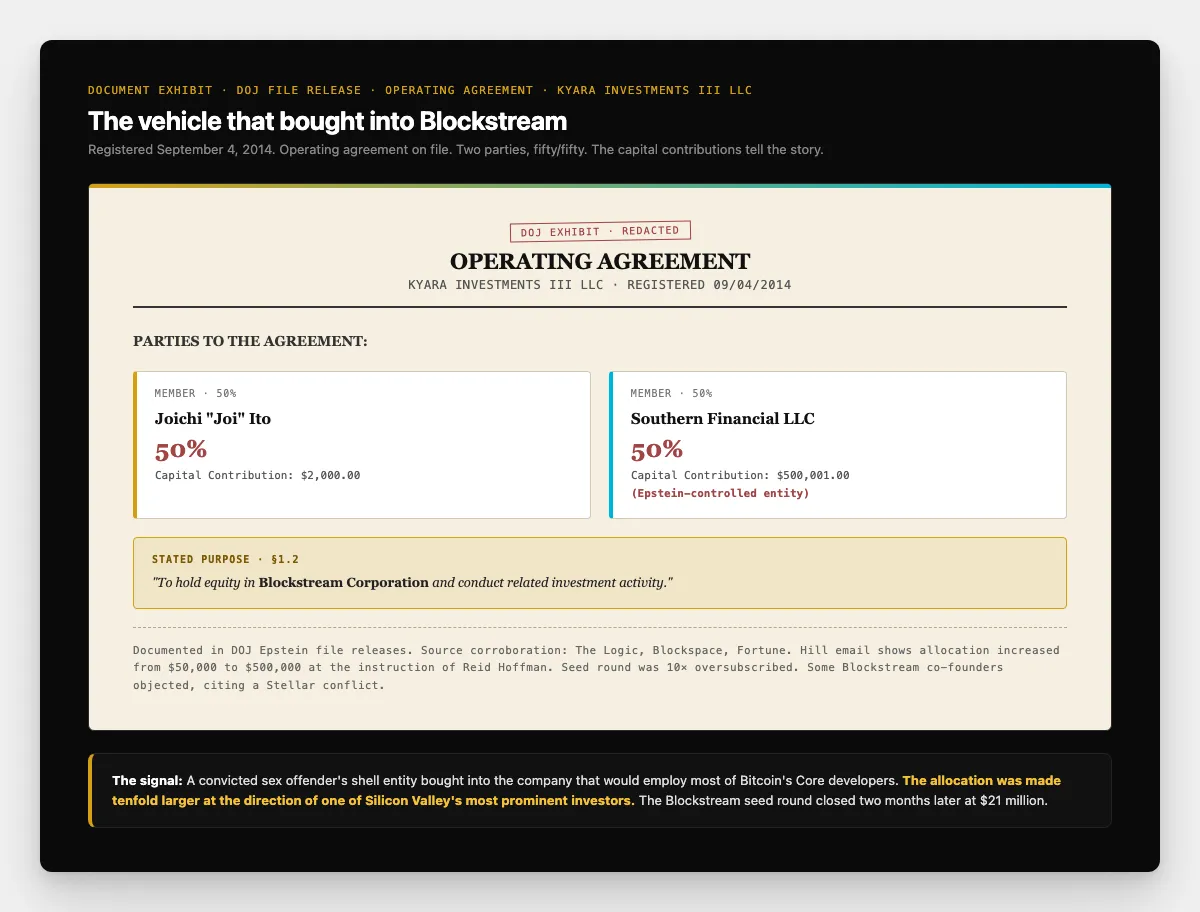
The man who told Austin Hill to increase Kyara's allocation from fifty thousand dollars to five hundred thousand dollars was Reid Hoffman.⁴
That is where this article starts. Not with a person, but with a document.
Why This Article Exists
Part 4 ended with a promise. The gatekeepers are coming.
Before we meet them in Part 5, I realize we have to understand who funded them, who introduced them, and what they wanted. This is that story. It reads like a conspiracy theory, and my critics will surely remind you of that criticism at every turn, but every claim is sourced to United States Department of Justice file releases, Securities and Exchange Commission filings, company press releases, court documents, or named investigative journalism. The footnotes are at the bottom. The receipts are real.
If you haven't read Part 4, start there. Everything below builds on the documented timeline of Brock Pierce, Jeffrey Epstein, and the shift from bitcoin-native angel capital to outside venture capital. Part 4 planted the seeds. This is where they grow.
This is a tangent in the chronology. Part 5 will deliver the Mt. Gox collapse, the Blockstream founding, and the opening shots of the block size war. But the reader who walks into Part 5 cold will ask a question this series has not yet answered.
Who are these people? Where did their money come from? And why did they care about bitcoin at all?
The Pipeline Begins
Part 4 introduced Brock Pierce. Child actor. Digital Entertainment Network co-founder. Convicted-sex-offender-adjacent in his early twenties. Bitcoin miner since 2009. Attendee of Al Seckel's Mindshift conference on Saint Thomas in early 2011, where he met Jeffrey Epstein for the first time.⁵
Pierce returned from Mindshift with one credential the older Silicon Valley figures who would later care about bitcoin did not yet have. He understood how the protocol worked, because he had been mining it before most of them had heard the word.
He also returned with one relationship.
Lesley Groff, Epstein's longtime assistant, identified Pierce in DOJ-released emails as a "scientist" Epstein "liked."⁶ The Manhattan townhouse breakfast was on the calendar by March 2011 and confirmed by September 2011.⁷ A December 2011 invitation to Epstein's private island, Little Saint James, was extended through Sarah Kellen.⁸ By 2012, Pierce was emailing Epstein from Eastern Europe describing a "great time with the girls."⁹
The press version of this is that Brock Pierce introduced Jeffrey Epstein to bitcoin.
That is not quite right.
Pierce did not introduce Epstein to bitcoin. Bitcoin was already in Epstein's inbox before Pierce's first breakfast. In June 2011, Epstein wrote to the venture capitalist Jason Calacanis asking to be connected to, in his own phrasing, "the bit coin guys."¹⁰ A month later, Epstein was emailing the British developer Amir Taaki directly.¹¹
Epstein was already there.
What Pierce did was different. Pierce introduced Epstein to the deal flow and to the movers and shakers who wanted entrance to the ruling class.
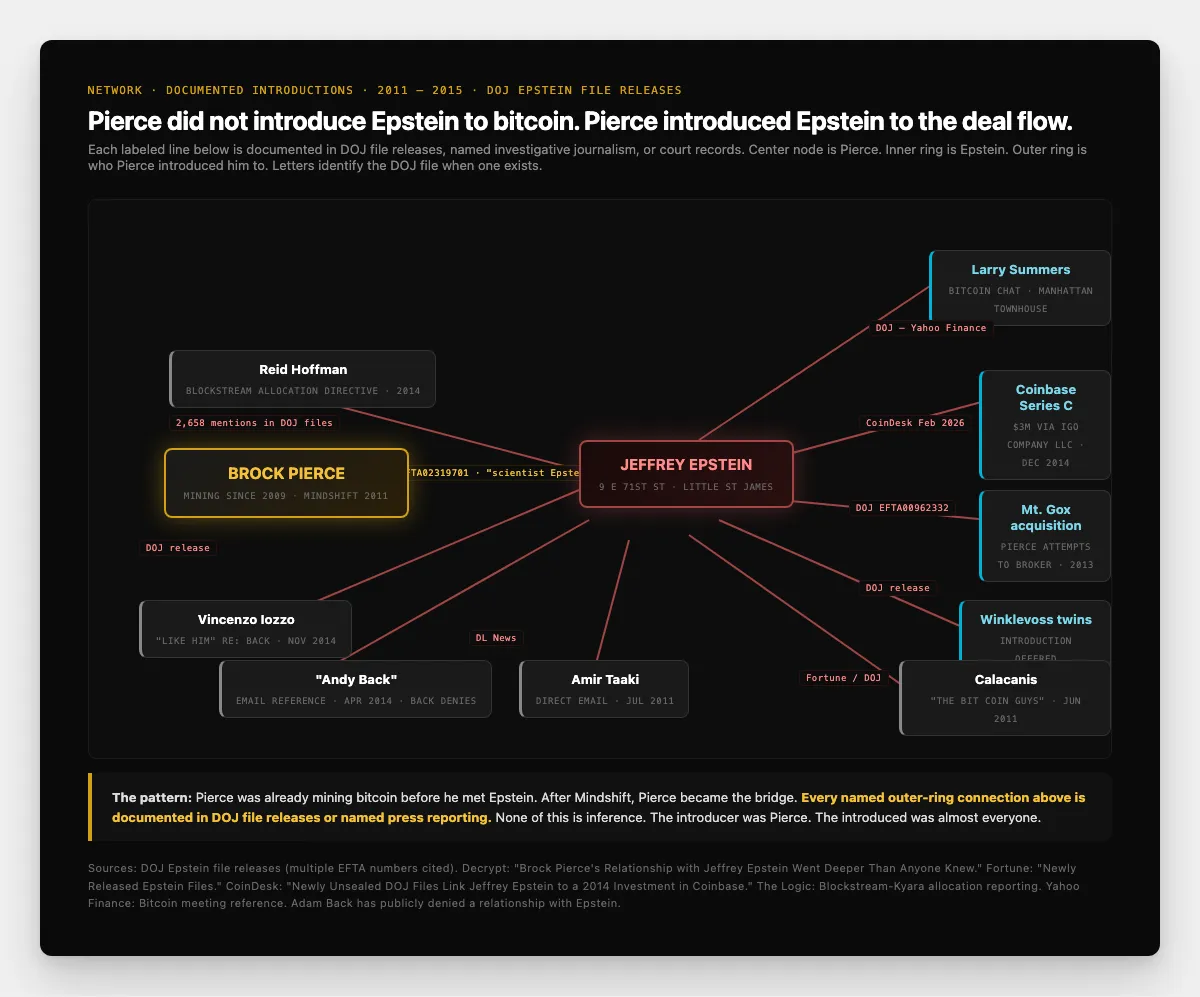
The documented introductions read like a deposition exhibit.
Pierce arranged the breakfast at Epstein's Manhattan townhouse where Epstein met Larry Summers, the former United States Treasury Secretary. The topic was bitcoin.¹² Pierce also tried to broker a Mt. Gox acquisition for Epstein in 2013, with DOJ file numbers EFTA00962332 and EFTA00991279 documenting the back-and-forth.¹³ He offered to broker an introduction to the Winklevoss twins.¹⁴ He coordinated Epstein's December 2014 investment of approximately three million dollars into Coinbase's Series C round, with the capital flowing through an Epstein-controlled USVI entity called IGO Company LLC.¹⁵
Pierce did not invest Epstein's money through Blockchain Capital. Blockchain Capital has stated, on the record to Decrypt, that the Coinbase investment was independent of the fund.¹⁶ The vehicle was IGO Company LLC, Epstein's own.
But Pierce was the introducer. The deal-man in the middle.
There was also a wider lattice. Epstein contacted Calacanis through ordinary venture-capital channels in June 2011. He wrote to Taaki, who replied politely and then publicly distanced himself.¹⁷ In April 2014, a DOJ-released email identified "Andy Back" as having been on Epstein's island, a reference to the cryptographer Adam Back; Back has publicly denied a relationship.¹⁸ In November 2014, the developer Vincenzo Iozzo asked Epstein about Back and Epstein replied that he liked him.¹⁹
But we'll trace one of those threads when we get to Digital Currency Group.
The introduction to Larry Summers was the one that mattered most.
Summers would later sit on the advisory board of Digital Currency Group, Barry Silbert's holding company. DCG was seeded by MasterCard, Western Union, CME Ventures, Bain Capital, and New York Life. The same Summers Pierce had introduced to Epstein at the Manhattan townhouse to discuss bitcoin would, within four years, be advising the holding company that owned Grayscale, CoinDesk, and Foundry.
The deal flow ran one way.
Tether
While Pierce was making introductions, he was also building.
In July 2014, in Santa Monica, California, Pierce co-founded a company called Realcoin alongside Reeve Collins and Craig Sellars.²⁰ The first hundred USDT were minted on the Omni Layer on October 6, 2014.²¹ On November 20, 2014, Realcoin was renamed.²²
It was called Tether.
For a deeper dive on Tether, you can head down this rabbit hole: Beyond Fraud, Tether's Secret Plan to Replace the Fed.
The conventional story of Tether is that Pierce founded it and walked away in 2015. The conventional story is incomplete.
The Paradise Papers, the trove of leaked offshore documents published by the International Consortium of Investigative Journalists in November 2017, showed that Giancarlo Devasini and Philip Potter incorporated Tether Holdings Limited in the British Virgin Islands in 2014.²³ At the time, Pierce was still nominally running the Realcoin side of the operation in California. Devasini and Potter were running the offshore corporate structure at the same time. In 2015, Pierce and Collins sold their stakes to Devasini and Potter.²⁴
Today, Tether is wholly owned by iFinex Incorporated, the same holding company that owns the exchange Bitfinex.²⁵ Hold that name.
Giancarlo Devasini is the chairman. A former plastic surgeon and electronics trader from Italy, he was elevated from chief financial officer to chairman in March 2025. He holds approximately 45 percent of iFinex.²⁶ Paolo Ardoino is the chief executive of Tether and chief technology officer of Bitfinex. Forbes estimated his net worth at thirty-eight billion dollars in April 2026.²⁷ Stuart Hoegner was the general counsel of both companies from 2014 until January 2025.²⁸
The same man who introduced Jeffrey Epstein to bitcoin's deal flow co-founded the stablecoin that, a decade later, would issue more dollar-pegged units than PayPal had on its balance sheet and prop up the price of BTC through every drawdown.
The loop does not close here. iFinex, Tether's parent, would later co-lead Blockstream's two-hundred-and-ten-million-dollar Series B. The same corporate entity that issues the dollar surrogate keeping BTC's price aloft also owns equity in the company that employs most of the developers who write BTC's consensus code.
We will get there.
Blockstream
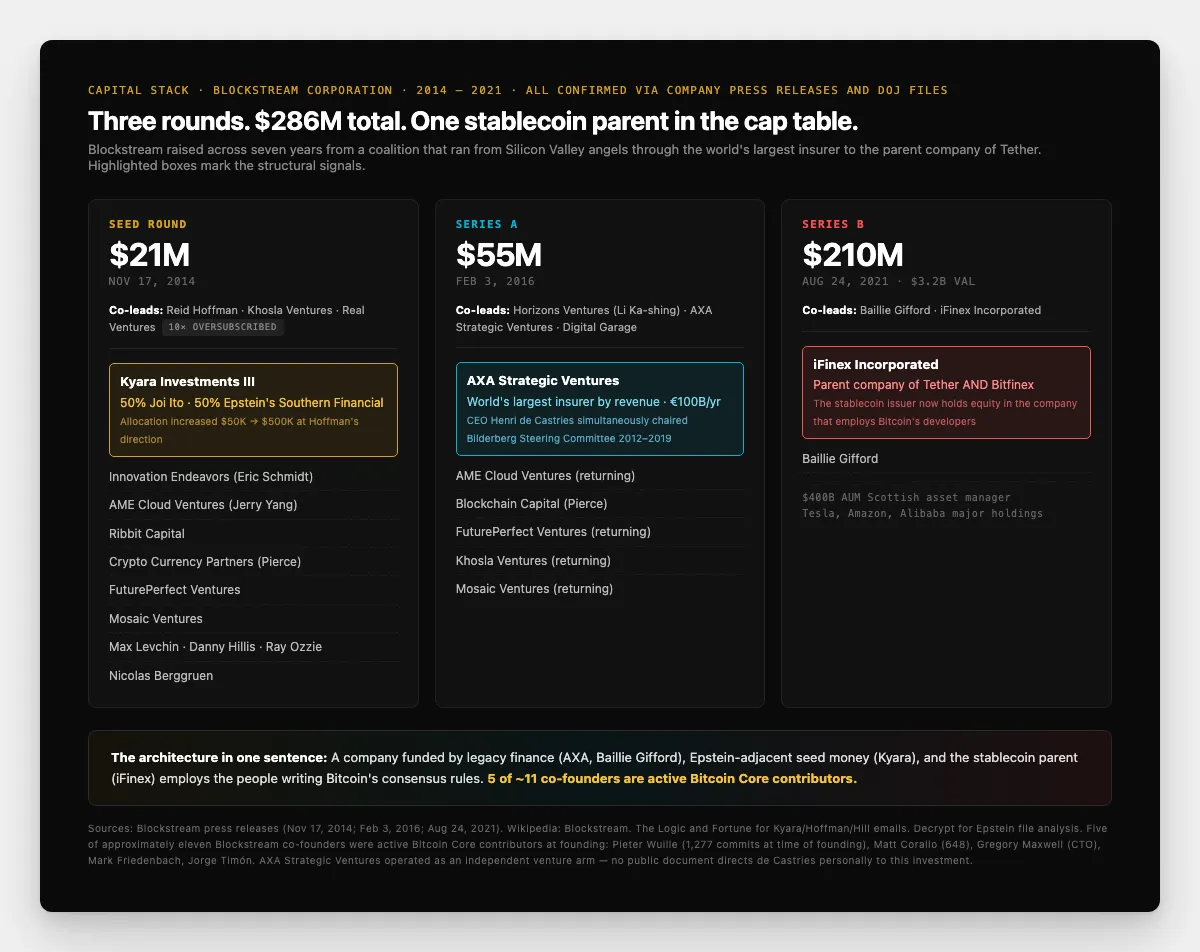
On November 17, 2014, Blockstream announced a seed round of twenty-one million dollars.²⁹
The press release named some of the investors. It did not name all of them.
The named list was already striking. Reid Hoffman, the LinkedIn co-founder and Greylock partner. Khosla Ventures, founded by the Sun Microsystems co-founder Vinod Khosla. Real Ventures. Innovation Endeavors, the venture fund of the former Google chairman Eric Schmidt. AME Cloud Ventures, the personal fund of the Yahoo co-founder Jerry Yang. Ribbit Capital, an early stage fintech specialist. Crypto Currency Partners, which was Pierce's vehicle through Blockchain Capital. FuturePerfect Ventures. Mosaic Ventures. The investors Max Levchin (PayPal), Danny Hillis (Thinking Machines), Ray Ozzie (Lotus and Microsoft), and Nicolas Berggruen (the German-born institutional investor and political philanthropist).³⁰
The unnamed list was where the story lived.
Kyara Investments III, the limited liability company from the cold open of this article, took an allocation in that round. Joichi Ito at 50 percent. Epstein's Southern Financial LLC at 50 percent. The investment was originally slotted at fifty thousand dollars. Reid Hoffman wrote to Blockstream co-founder Austin Hill and directed that the allocation be increased tenfold.³¹ Why was Hoffman so hungry for Epstein money in exchange for Blockstream equity?
Either way, Hill complied. The allocation rose to five hundred thousand dollars. Epstein contributed five hundred thousand and one dollars. Ito contributed two thousand.
The seed round was ten times oversubscribed. Blockstream did not need the money.³² The decision to make room for Kyara was an editorial choice, led by Hoffman and endorsed by Hill, which is telling. But I'm not exactly sure what it tells us...
It is worth recording, for intellectual honesty, what else the Hill email showed. According to DOJ files reported by The Logic and Fortune, Hill's correspondence also indicated that some Blockstream co-founders pushed back on the Kyara allocation, citing a different conflict. Nothing to do with Jeffrey's proclivities, though. Their concerns were related to the Stellar project, in which Ito had a separate involvement, so their money was tainted by altcoin curiosity; not the other stuff...³³ That being said, Hoffman's instruction overrode the internal dissent, and the money was accepted.
Blockstream later said Kyara divested some months after the round closed.
Reid Hoffman appears in DOJ-released Epstein files two thousand six hundred and fifty-eight times.³⁴ Hoffman has acknowledged the relationship and characterized it as a mistake.
That was the seed round.
The Series A came in February 2016. Fifty-five million dollars. The co-leads were Horizons Ventures, the personal vehicle of the Hong Kong billionaire Li Ka-shing. AXA Strategic Ventures, the venture arm of the world's largest insurance company. And Digital Garage, a Japanese technology incubator.³⁵
AXA was the headline.
At the time of the investment, the chief executive officer of AXA was Henri de Castries. AXA's reported numbers for that year are unambiguous. One hundred billion euros in revenue. Eight hundred and ninety-three billion euros in total assets. One and a half trillion euros in assets under management. Operations in fifty-one countries. Ninety-three million clients.³⁶
It was the largest insurance company in the world by revenue.
De Castries had been chief executive since May 2000. He had been chairman and chief executive in the unified role since approximately 2010. He would retire from AXA on September 1, 2016, seven months after the Blockstream investment closed.³⁷
But he also had a second job, and not an insignificant role either!
From 2012 to 2019, Henri de Castries simultaneously chaired the Bilderberg Group Steering Committee.³⁸
The dates overlap. The chairman of the world's largest insurance company, simultaneously chairman of the most exclusive private forum for Western political and financial elites, was at the top of the institutional structure that co-led Blockstream's Series A. We'll explain Bilderberg a little later.
The Blockstream Series B closed in August 2021 at a valuation of three and a quarter billion dollars.³⁹ Two hundred and ten million dollars. The co-leads were Baillie Gifford, the Scottish asset manager that manages roughly four hundred billion dollars including positions in Tesla and Amazon, and iFinex Incorporated, the parent company of Tether and Bitfinex.
The same iFinex.
The corporate entity that issues USDT and owns Bitfinex took co-lead of the round that pushed Blockstream's valuation past three billion dollars. The stablecoin company whose product keeps BTC's price functional during every drawdown is also a major equity owner of the company whose engineers maintain BTC's code.
That is one corporate structure controlling both ends of the lever.
Blockstream is incorporated in Canada. It announced eleven co-founders. Five of them were active Bitcoin Core contributors at the time. Pieter Wuille, with one thousand two hundred and seventy-seven commits at the time of founding. Matt Corallo, with six hundred and forty-eight. Gregory Maxwell, who would become chief technology officer. Mark Friedenbach. Jorge Timón. The other co-founders were Adam Back, who served as chief executive, Austin Hill, Jonathan Wilkins, Alex Fowler, Francesca Hall, and Erik Svenson.⁴⁰
A company funded by legacy finance (AXA, Baillie Gifford), Epstein-adjacent seed money (Kyara), and the stablecoin's parent company (iFinex) employed the people writing Bitcoin's rules.
That is the architecture that will lead us into the Bitcoin Civil War.
Digital Currency Group
In October 2015, in Stamford, Connecticut, a man named Barry Silbert founded a holding company called Digital Currency Group.⁴¹
Silbert had a track record. He had founded SecondMarket in 2004, a platform for trading shares in private companies. He sold it to Nasdaq in October 2015, the same month DCG launched. Silbert was thirty-nine years old. He was about to do for the crypto economy what SecondMarket had done for pre-IPO equity. He was going to build the institutional plumbing.
DCG's Round 1 closed in October 2015 with eleven investors. The names are a who's-who of the financial sector that Bitcoin's whitepaper had explicitly proposed to displace.⁴²
MasterCard.
Bain Capital Ventures.
New York Life, the mutual life insurance company with seven hundred and eighty-five billion dollars in investment assets, making its first-ever crypto investment.
Transamerica Ventures, the venture arm of the Dutch insurance giant Aegon.
CME Ventures, the venture arm of the Chicago Mercantile Exchange.
FirstMark Capital. RRE Ventures. Oak HC/FT. CIBC, the Canadian Imperial Bank of Commerce. Solon Mack Capital, the Mack family office out of Greenwich, Connecticut. Novel TMT.
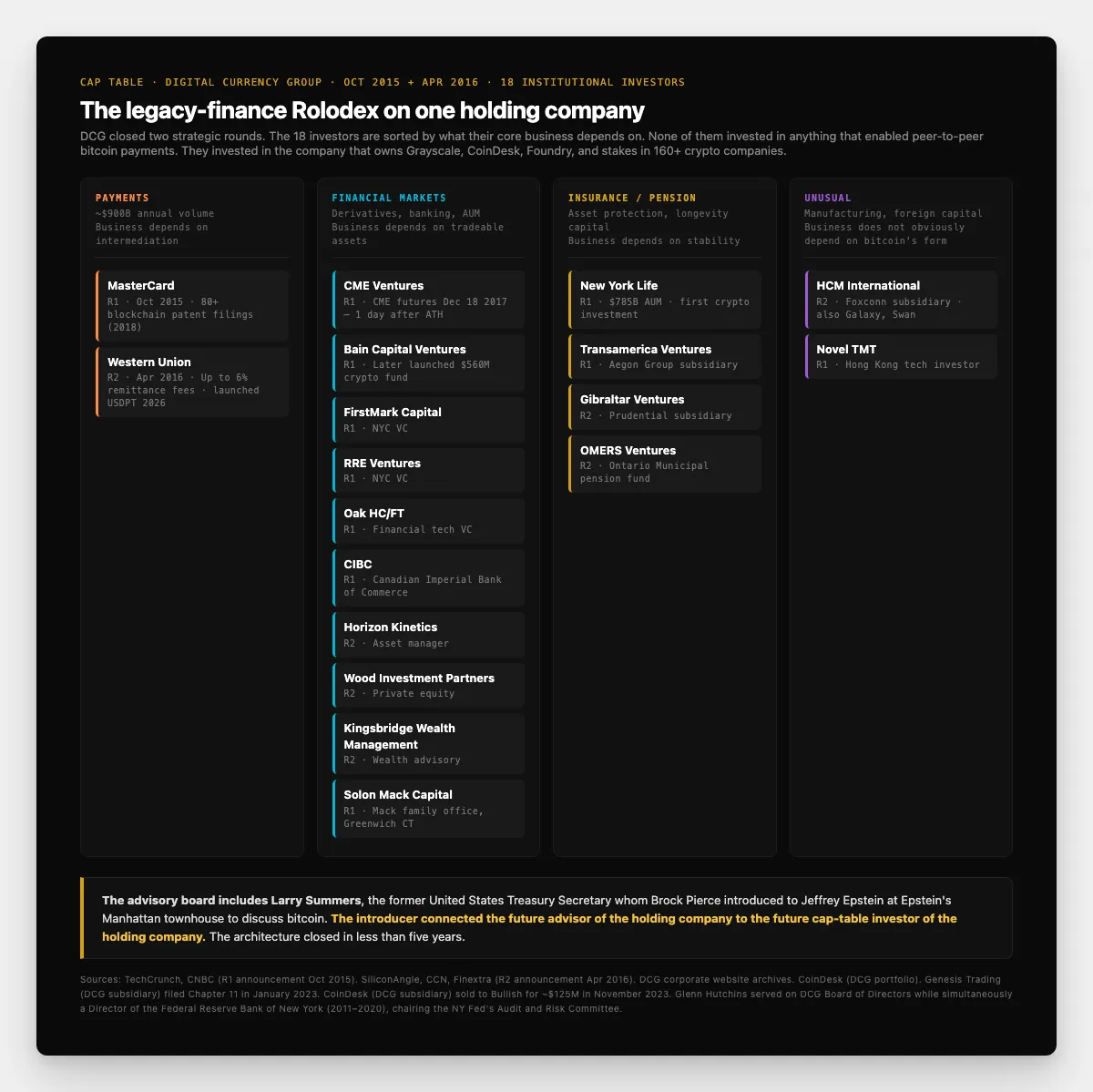
Round 2 closed in April 2016 with seven more.⁴³
Western Union. The remittance company whose business model depends on charging fees of up to six percent to move money across borders.
HCM International, the venture arm of Foxconn, the Taiwanese electronics manufacturer that assembles every iPhone.
Gibraltar Ventures, the financial-services-focused venture arm of Prudential.
OMERS Ventures, the venture arm of the Ontario Municipal Employees Retirement System pension fund.
Horizon Kinetics. Kingsbridge Wealth Management. Wood Investment Partners.
Eighteen institutions across two rounds. MasterCard, Western Union, CME, Bain, New York Life, Transamerica, Prudential, CIBC, and a pension fund. The dollar amounts were not disclosed in full but represent a rounding error against any of those companies' balance sheets.
The investments were also a statement.
DCG's subsidiaries by 2017 included Grayscale Investments, which would become the largest holder of BTC through the Grayscale Bitcoin Trust. CoinDesk, the most-read crypto news outlet. Genesis Trading, the prime brokerage. Foundry, which became one of the largest mining pools. And TradeBlock, a market-data company.⁴⁴
DCG's portfolio by 2023 included over one hundred and sixty companies. Coinbase. Kraken. Circle. Chainalysis. Ripple. Lightning Labs. BitPay. Chain. Xapo. BitGo. Dune Analytics. Elliptic. Etherscan.⁴⁵
Genesis declared bankruptcy in January 2023 with liabilities estimated at between one and ten billion dollars.⁴⁶ CoinDesk was sold to Bullish in November 2023 for approximately one hundred and twenty-five million dollars.⁴⁷
The advisory board included Larry Summers.⁴⁸
That was the same Larry Summers Brock Pierce had introduced to Jeffrey Epstein at Epstein's Manhattan townhouse to discuss bitcoin.
There is a second structural fact that is hard to read without a long pause. CoinDesk, the news outlet, was a wholly owned subsidiary of DCG. DCG also held equity in one hundred and sixty other crypto companies, many of which CoinDesk covered as the trade press of record. The reader is invited to consider which stories about DCG portfolio companies did not get written, and which were softened in editing, in the eight years before the outlet was sold.
Eleven of those eleven institutions in Round 1 would, in the years that followed, launch Bitcoin futures, Bitcoin custody, Bitcoin ETF products, or stablecoin pilots. None of them invested in anything that enabled direct peer-to-peer bitcoin payments.
They were not in the cash business.
They were in the asset business, and they were not interested in seeing that business disrupted.
The Investor Map
Step back and look at the cap tables side by side.
Coinbase's funding history reads like a map of the financialization of bitcoin.⁴⁹
The seed round in September 2012 was small. Y Combinator. IDG Ventures. Undisclosed amount.
The Series A in May 2013 was five million dollars. Union Square Ventures led. Ribbit Capital co-invested. SV Angel rounded it out.
The Series B in December 2013 was twenty-five million dollars. Andreessen Horowitz led. QueensBridge Venture Partners, the hip-hop investment fund co-founded by the rapper Nas, took a position.
The Series C in January 2015 was seventy-five million dollars. DFJ Growth led. The named investors included the New York Stock Exchange. The Spanish bank BBVA. The military-connected insurer USAA. Vikram Pandit, the former Citigroup chief executive. Tom Glocer, the former Thomson Reuters chief executive. And Ribbit Capital again.
The Series D in August 2017 was one hundred million dollars. IVP. Spark Capital. Greylock, Reid Hoffman's firm.
The Series E in October 2018 was three hundred million dollars. Tiger Global led.
Layered into this timeline, in December 2014, was the three million dollar investment from Epstein's IGO Company LLC, brokered by Pierce.
The Series C is the inflection point. The New York Stock Exchange, a major Spanish bank, a military insurance giant, and two former chief executives of Wall Street institutions invested in the company that would become the regulated on-ramp to bitcoin. The gatekeeper to the asset, owned by the institutions whose business depends on intermediation.
They were not buying bitcoin.
They were buying the entry door.
Lightning Labs's funding history is its own small map.⁵⁰
The seed round in March 2018 was two and a half million dollars. The lead was Digital Currency Group.
The Series A in February 2020 was ten million dollars. Ribbit Capital led. Craft Ventures, David Sacks's firm, co-invested. Jack Dorsey participated.
The Series B in April 2022 was seventy million dollars. Valor Equity led. NYDIG participated. The chief executive of Robinhood, Vlad Tenev, took a position.
Blockchain Capital, Pierce's fund, invested in Blockstream's seed round (through Crypto Currency Partners), in Blockstream's Series A in February 2016, and across the period in Coinbase, Kraken, Circle, Ethereum, OpenSea, Ripple, BitFury, and BitGo.⁵¹
Visa's positioning is its own structural argument. Visa invested in Chain Incorporated's thirty-million-dollar Series B in September 2015, alongside Nasdaq, Citi Ventures, Capital One, and Fiserv.⁵² It invested in Blockchain Capital Fund V, a three-hundred-million-dollar fund closed in June 2021.⁵³ Visa subsequently built its B2B Connect product on Chain's enterprise blockchain. B2B Connect is a private permissioned ledger that settles transactions through Visa, not peer-to-peer.
Visa did not invest in any project enabling direct peer-to-peer bitcoin payments, but it was paying for lots of noise around Bitcoin's signal.
That is also a position.
The Conflicts of Interest
This is the section that makes it a story, not a list. If you've made it this far, this is where it starts to pay off.
The investors in DCG and Blockstream represent the largest payment networks, the largest insurance companies, the largest derivatives exchanges, the largest banks, and the largest manufacturers in the Western world. They invested in a holding company that controlled the largest BTC asset manager (Grayscale), the most-read crypto news outlet (CoinDesk), and a top mining pool (Foundry). They invested in the protocol company that hired Bitcoin's most prolific Core developers.
Look at what each one's core business depends on.
Payments.
MasterCard processes roughly nine hundred billion dollars in payment volume per year. Its business model depends on being the intermediary between consumers and merchants and earning a percentage of every transaction. By 2018, MasterCard ranked third globally in blockchain patent filings with more than eighty filings on record, behind only Alibaba and IBM.⁵⁴ MasterCard filed for blockchain patents specifically aimed at routing blockchain payments through its card-network infrastructure. The strategic intent was unambiguous. Whatever happened on-chain, MasterCard intended to remain the rails.
MasterCard also launched a Crypto Partner Program with more than eighty-five partners and, as of 2026, was reported to be in talks to acquire stablecoin infrastructure.⁵⁵
Bitcoin as peer-to-peer cash eliminates MasterCard's role in any and all of it.
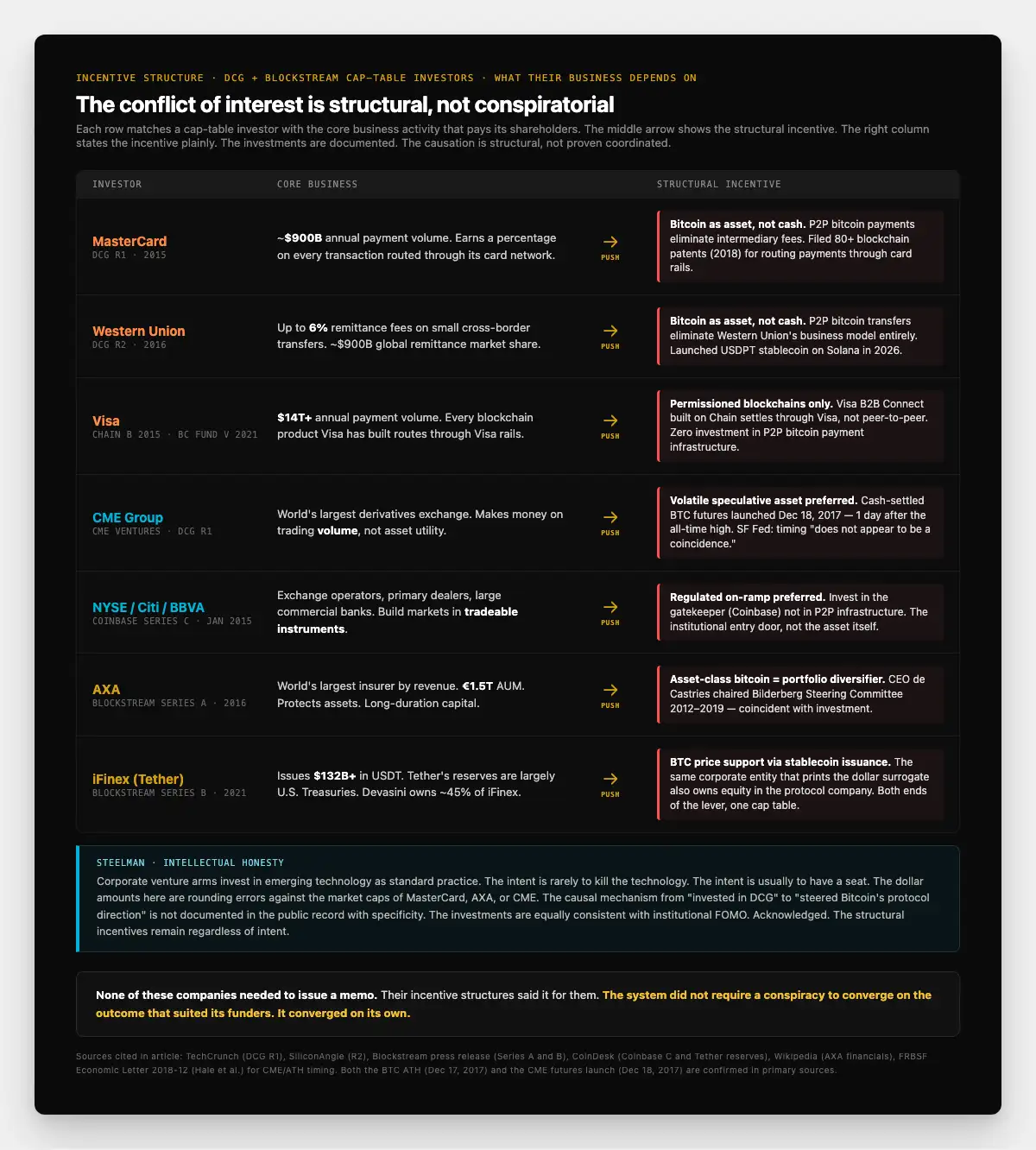
Western Union holds a meaningful share of the nine-hundred-billion-dollar global remittance market.⁵⁶ It charges fees up to six percent on small cross-border transfers. Bitcoin peer-to-peer transfers eliminate Western Union's business model entirely. El Salvador's 2021 Bitcoin Law was framed by its government, in part, as an alternative to Western Union for the country's remittance flows. In 2026, Western Union launched its own dollar-pegged stablecoin, USDPT, on the Solana network.⁵⁷
Western Union invested in DCG in 2016.
Visa's annual payment volume exceeds fourteen trillion dollars.⁵⁸ Its investments in blockchain infrastructure have built private settlement layers that route through Visa's network, never bypassing it.
Financial markets.
CME Group is the largest derivatives exchange in the world. Its Ventures arm invested in DCG in 2015. On December 18, 2017, CME launched cash-settled Bitcoin futures.⁵⁹
This is the timing that matters.
Bitcoin's all-time high in 2017 was achieved on December 17, 2017, at approximately nineteen thousand seven hundred and eighty-three dollars on the CoinDesk Bitcoin Price Index.⁶⁰
One day before CME's futures product launched.
The San Francisco Federal Reserve published a research paper in May 2018, authored by Galina Hale and three colleagues, that examined this exact sequence.⁶¹ The official title is "How Futures Trading Changed Bitcoin Prices," and the publication is FRBSF Economic Letter 2018-12. The paper's specific finding, in the exact language of the authors: the timing "does not appear to be a coincidence."
CME makes money on trading volume. Peer-to-peer cash generates no futures volume. A volatile speculative asset, whose price is now susceptible to short positions held by institutional traders who never have to take delivery, generates enormous futures volume.
The structure speaks for itself.
New York Life invested in DCG in 2015. Its first-ever crypto investment. Bain Capital Ventures invested in DCG in 2015. It later launched a five-hundred-and-sixty-million-dollar dedicated crypto fund.⁶²
None of these companies needed to issue a memo saying "keep Bitcoin from working as cash." Their incentive structures said it for them.
Now the steelman.
Corporate venture arms invest in emerging technologies as a matter of standard practice. The intent is rarely to kill the technology. The intent is usually to have a seat. The dollar amounts involved across DCG's two rounds and Blockstream's three rounds are rounding errors against the market capitalizations of MasterCard, Visa, AXA, or Western Union. The causal mechanism from "invested in DCG" to "steered Bitcoin's protocol direction" is not documented anywhere in the public record with specificity. The same investments are equally consistent with institutional fear of missing out or a standard portfolio hedge.
We are not making the claim that MasterCard convened a meeting with Blockstream's developers and instructed them to keep blocks small.
We are, however, making the more boring claim, which is that structural incentives persist regardless of intent.
When the holding company that owns the asset manager, the news outlet, and the mining pool is funded by the payment networks and derivatives exchanges whose businesses are threatened by peer-to-peer cash, and when the protocol company employing the protocol developers is funded by the largest insurer in the world and the stablecoin company, the system does not require a meeting to converge on the outcome that suits its funders.
It converges on its own.
The Downstream
If Blockstream and DCG were the upstream of the venture capture, the downstream was the developer payroll.
By 2023, according to the most comprehensive analysis of Bitcoin Core developer funding ever produced, the total spending on Bitcoin Core development was eight million four hundred thousand dollars. The report was produced by 0xB10C (1A1z) in October 2024. The methodology counted 41 active Core developers, defined as engineers who had at least five merged commits to the Bitcoin Core repository in 2023.⁶³
The funding came from thirteen sponsor organizations.
Five of those thirteen share personnel, investment lineage, or corporate parentage with the upstream entities described above.
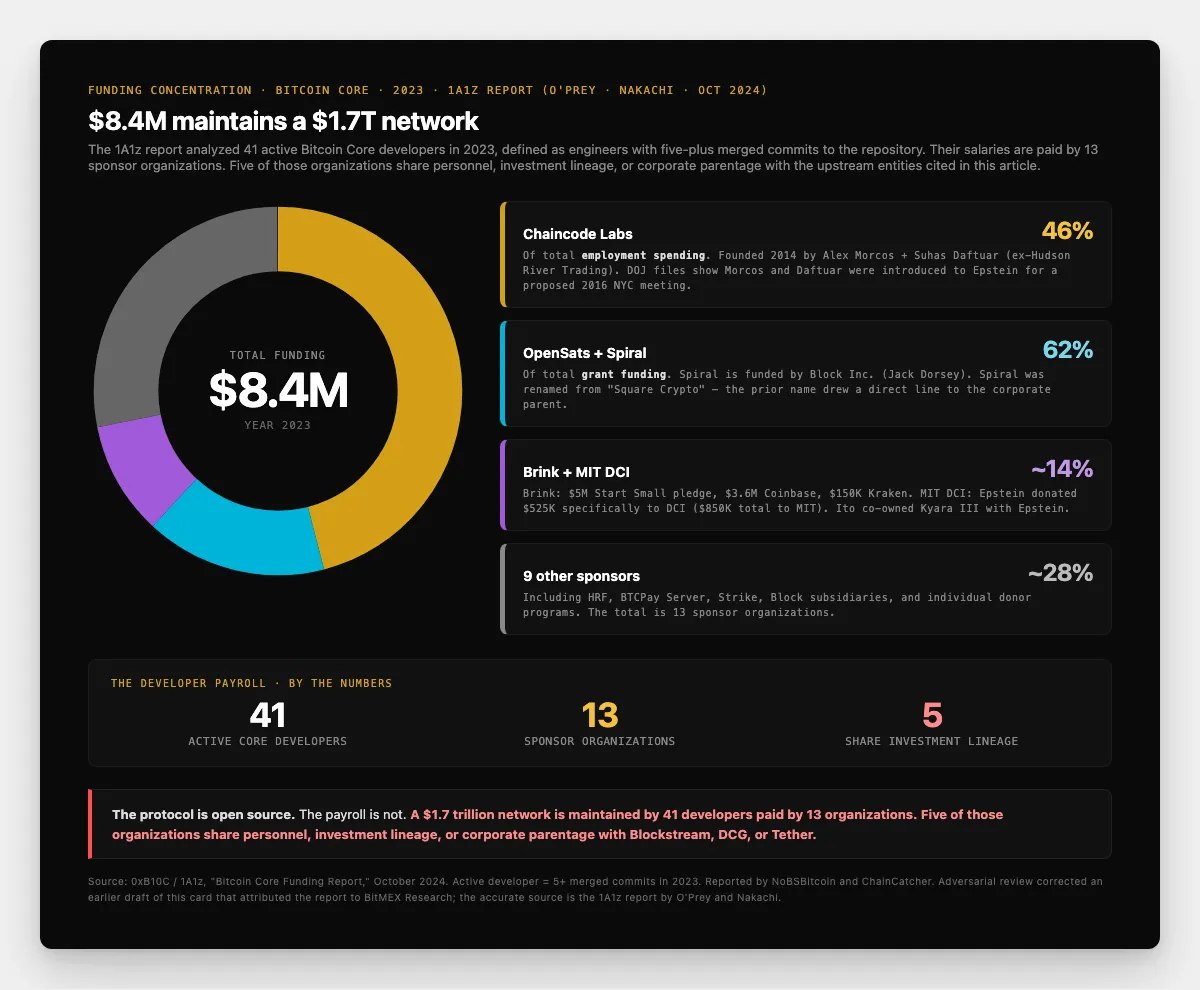
Chaincode Labs was founded in 2014 in Manhattan by Alex Morcos and Suhas Daftuar, both former Hudson River Trading co-founders. Hudson River Trading is a high-frequency trading firm. Morcos and Daftuar funded Chaincode out of their personal wealth from HRT. No external donors. The structure was unusual: a privately held Bitcoin Core research lab funded by quant-trading money.⁶⁴
By 2023, Chaincode was responsible for 46 percent of all Bitcoin Core employment spending.⁶⁵
Chaincode also ran the Chaincode Residency, the elite training program for new Bitcoin Core developers. The residency was one of the primary pipelines into the maintainer ranks.
In 2016, according to DOJ-released emails, the founders of Chaincode Labs were introduced to Jeffrey Epstein for a proposed meeting in New York.⁶⁶ Whether the meeting occurred is unknown. The introduction is documented. The DOJ files do not contain a follow-up confirmation.
But that is a number we will return to in Part 5. The 46 percent. We will come back to what it means that one organization, whose founders were introduced to a convicted sex offender for a proposed meeting in New York, pays nearly half of the active Core developer payroll.
Brink launched in 2020 in London. The founders were John Newbery, formerly of Chaincode, and Mike Schmidt. Brink was effectively Chaincode's nonprofit spinout, designed to recruit and fund developers more openly than Chaincode could under its private structure.⁶⁷
Brink's funding came from a five-million-dollar pledge from Jack Dorsey's Start Small Foundation, paid out as one million dollars per year over five years.⁶⁸ Brink also received three and a half million dollars from Coinbase, one hundred and fifty thousand dollars from Kraken, and a pledge from VanEck of five percent of profits from its spot Bitcoin ETF.⁶⁹ Brink funded more than twenty developers over its first five years. Its first fellow was Gloria Zhao, who became Bitcoin Core's first female maintainer before resigning in February 2026 amid controversy.⁷⁰
Spiral was founded in 2019 as Square Crypto and renamed in 2021. It is funded by Block Incorporated, Jack Dorsey's holding company.⁷¹ Spiral pays for protocol research, Layer 2 development with a focus on Lightning Network, and some open-source tooling.
In 2023, OpenSats and Spiral together accounted for 62 percent of all grant funding for Bitcoin Core.⁷²
The name change from "Square Crypto" to "Spiral" was reportedly motivated by a desire to break the visible link to the corporate parent.
The MIT Digital Currency Initiative is the apex of the triangle.
DCI was founded in 2015 at the MIT Media Lab by Joichi Ito. Its stated purpose was to fund Bitcoin Core developers after the Bitcoin Foundation entered bankruptcy that same year. DCI hired Gavin Andresen, Wladimir van der Laan, and Cory Fields. It became, for a time, the most prestigious source of public funding for Core development.⁷³
Jeffrey Epstein donated five hundred and twenty-five thousand dollars specifically to DCI, as part of a total of eight hundred and fifty thousand dollars he gave to MIT.⁷⁴
Here is the triangle.
Epstein co-owned Kyara Investments III with Joichi Ito. Kyara took a position in Blockstream, the company that employed most of the Core maintainers. Ito founded MIT DCI, which paid the salaries of Core developers including Gavin Andresen. Epstein donated more than half a million dollars directly to DCI. Epstein's money was in the company employing developers and in the university paying them.
Ito resigned from MIT on September 7, 2019, after a New Yorker article by Ronan Farrow disclosed the structure of his fundraising relationship with Epstein.⁷⁵ The DCI continued operating after his departure.
The Crypto Open Patent Alliance was founded in 2020. The founder was Square, before it was renamed to Block.⁷⁶ Blockstream joined the day after the launch announcement.⁷⁷
COPA's platinum members include Block, Coinbase, Meta, and MicroStrategy. Its other members include Chaincode Labs, Kraken, and SatoshiLabs. COPA's most public action was its successful 2024 litigation in the United Kingdom in which Craig Wright was found, on what the court described as "overwhelming" evidence, not to be the person behind the Satoshi Nakamoto pseudonym.⁷⁸
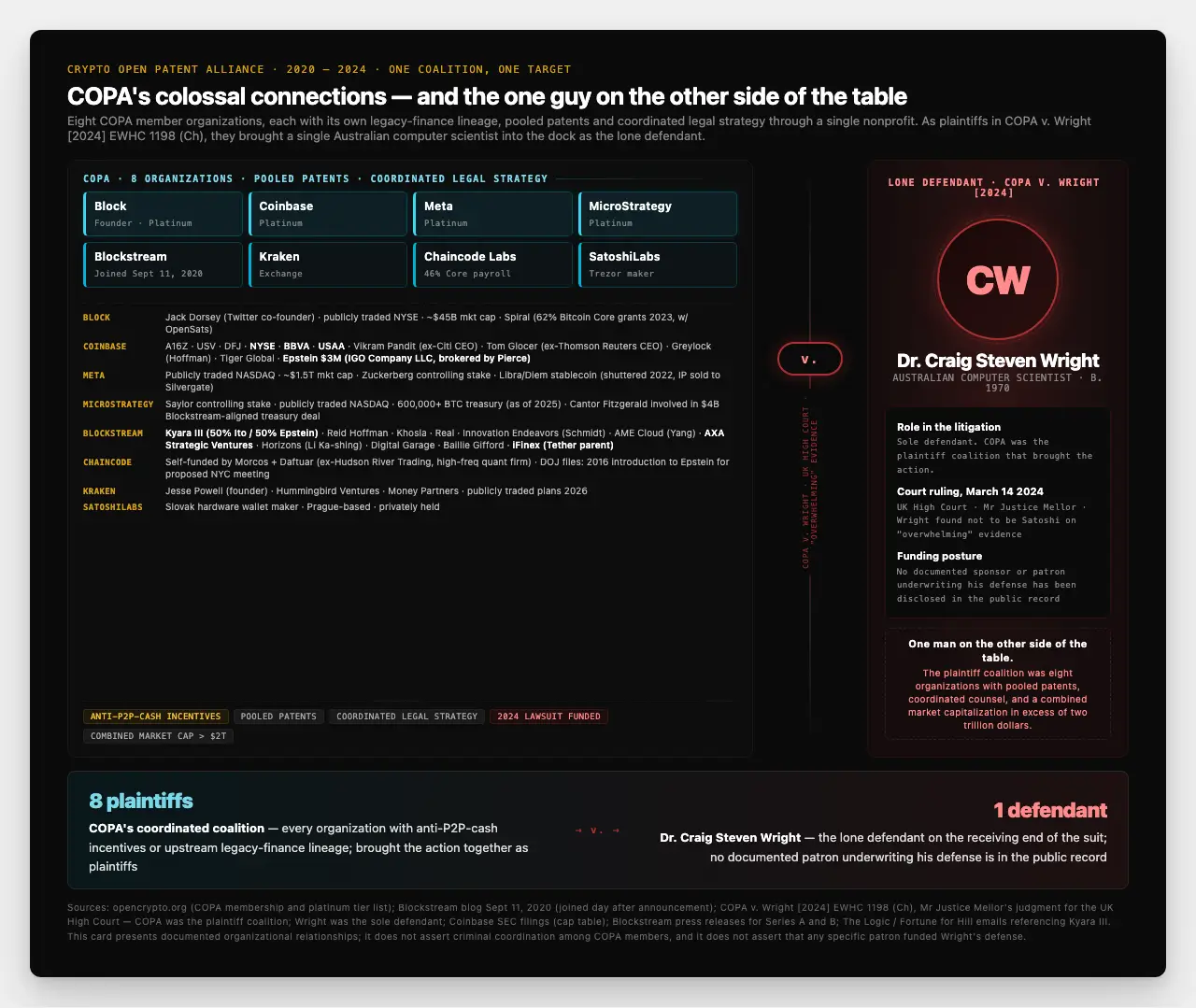
The structural curiosity of COPA is that it forces companies that compete in every commercial dimension to coordinate on protocol governance and legal strategy through a single nonprofit. Coinbase competes with Kraken. Block competes with both. Yet on the question of who can patent a Bitcoin technique, or which legal claims about Satoshi can be tested in court, they sit on the same side of the table with a massive pile of investors and anti-P2P-Cash incentives while laser-focused on one guy on the other side of the table who will get his own story eventually.
The eight-point-four-million-dollar number deserves a moment.
A network with a market capitalization estimated at one and three-quarter trillion dollars in 2026 is maintained by forty-one developers. Those forty-one developers are paid by thirteen organizations. Five of those organizations share personnel, investment lineage, or corporate parentage with the upstream entities funded by AXA, MasterCard, CME, iFinex, Pierce, and the network's other named institutional backers.
The protocol is open source.
The payroll is not.
And they all agree on two things: they should collectively share patents, and one Australian guy is definitely not part of the club.
Howard Lutnick
The story has a recent chapter that is hard to read without a long pause.
Jeffrey Epstein lived at 9 East 71st Street in Manhattan, the Herbert N. Straus House.⁷⁹ The mansion was a gift from Leslie Wexner of Victoria's Secret fame. Epstein owned it from 1996 until his death in 2019.
In 1998, Howard Lutnick, the chief executive of the bond brokerage Cantor Fitzgerald, purchased 11 East 71st Street.⁸⁰
They were next-door neighbors for years.
In a late 2024 podcast appearance, Lutnick claimed he had cut ties with Epstein in 2005 after an uncomfortable visit involving a massage table in the residence.
DOJ file releases in January 2026 contradicted this account.
The released emails included a 2012 exchange about lunch plans and a 2018 exchange about whether expansion at the Frick Collection might block the shared park views from their respective townhouses.⁸¹ The contact spanned at least thirteen years after Lutnick's claimed cutoff.
In 2012, Lutnick, his wife, four children, a nanny, and one other family chartered a yacht to Little Saint James. Lutnick has described the visit as an hour-long lunch.⁸² In 2017, Epstein donated fifty thousand dollars to a New York charity in Lutnick's honor.⁸³ In February 2026, in Senate testimony, Lutnick acknowledged ten emails with Epstein and two in-person meetings after Epstein's 2008 conviction.⁸⁴
On May 6, 2026, Lutnick testified before the House Oversight Committee for more than four hours behind closed doors. Multiple representatives, in subsequent on-record statements, characterized his testimony as evasive, nervous, and dishonest.⁸⁵
That is the personal record worth noting. The corporate record gets its own paragraph.
Cantor Fitzgerald is one of twenty-five primary dealers authorized to trade directly with the Federal Reserve Bank of New York. This designation grants Cantor, and through it Cantor's clients, direct access to the United States Treasury markets.⁸⁶
Cantor also holds custody of approximately 80 to 99 percent of Tether's reported Treasury reserves. Those reserves exceeded one hundred and thirty-two billion dollars by 2025.⁸⁷
The chain of custody runs from the stablecoin co-founded by Brock Pierce, through the bond brokerage owned by Epstein's next-door neighbor, into the Treasury market operated by the Federal Reserve Bank of New York.
In November 2024, the Wall Street Journal and other outlets reported that Cantor had acquired a 5 percent equity stake in Tether for approximately six hundred million dollars.⁸⁸ Cantor earns tens of millions of dollars annually in custody fees on the arrangement.⁸⁹
In 2025, a separate vehicle called 21 Capital was reported. Brandon Lutnick, Howard's son and the new chairman of Cantor, partnered with Tether, SoftBank, and Bitfinex to assemble a three-billion-dollar Bitcoin acquisition vehicle. Tether contributed one and a half billion dollars in bitcoin.⁹⁰ A separate four-billion-dollar Bitcoin treasury deal with Blockstream was reported by Bitcoin Magazine.⁹¹
Howard Lutnick became United States Secretary of Commerce on February 18, 2025, confirmed by a Senate vote of 51 to 45.⁹² He was co-chair of the Trump transition team.
After confirmation, Lutnick divested his Cantor equity. He transferred it into a vehicle called Dynasty Trust A, which benefits his four children. The day after the transfer was filed, Tether provided a loan to Dynasty Trust A. The arrangement was reported by CoinDesk and DL News based on credit filings.⁹³
Senators Elizabeth Warren and Ron Wyden sent formal letters in April 2026 demanding answers about the structure.⁹⁴
We do not need to editorialize.
Cantor Fitzgerald is one of twenty-five firms authorized to trade directly with the Federal Reserve. Its client is the stablecoin co-founded by Brock Pierce. Its former chief executive is the Secretary of Commerce. His house was next door to Jeffrey Epstein's.
That is the architecture.
To be precise about what is not in this article: Howard Lutnick has not been charged with anything. He has not been documented as having had any direct relationship with Brock Pierce. The connection between Lutnick and Pierce in this account runs through the corporate structure of Tether's reserve custody. It is structural, not personal.
The structure is enough for people to draw their own conclusions.
Glenn Hutchins
Glenn Hutchins co-founded Silver Lake Partners in 1999. Silver Lake is one of the largest technology-focused private equity firms in the world, with portfolio holdings including Dell, Skype, and Alibaba at various points.
Hutchins served as a director of the Federal Reserve Bank of New York from 2011 to 2020. He chaired its Audit and Risk Committee.⁹⁵ The New York Fed is the most powerful of the twelve regional Federal Reserve banks. It runs the System Open Market Account through which the Fed conducts monetary policy operations, and it supervises the largest Wall Street firms.
During the same period that he sat on the New York Fed's board, Hutchins also sat on the board of directors of Digital Currency Group.⁹⁶ Remember, DCG controls Grayscale, Genesis, CoinDesk, and holds stakes in more than one hundred and sixty crypto companies, including Blockstream.
He was also a director of Nasdaq Incorporated. A director of AT&T. A member of the Council on Foreign Relations. A board member of the Obama Foundation. The co-chairman of the Brookings Institution. He funded and lent his name to the Hutchins Center on Fiscal and Monetary Policy at Brookings, which is one of the most-cited think tanks in Federal Reserve and Treasury policy discussions.⁹⁷
A man sitting on the board of the New York Federal Reserve, the institution that supervises Wall Street and executes monetary policy, simultaneously sat on the board of the holding company that controls the largest BTC asset manager, the most-read crypto news outlet, and one hundred and sixty crypto portfolio companies. He also co-chairs the Brookings Institution, the think tank that shapes Fed and Treasury policy discussions.
This is not a conspiracy.
It is a résumé.
Do with it what you will.
Henri de Castries
We have already encountered Henri de Castries in the Series A section. He is worth a closer look.
De Castries is the French former chief executive officer and chairman of AXA. He held the unified chairman-CEO role at AXA from approximately 2010 until his retirement on September 1, 2016. He had been chief executive officer since May 2000.⁹⁸
In the fiscal year of Blockstream's Series A investment, AXA reported revenue of one hundred billion euros, total assets of eight hundred and ninety-three billion euros, and assets under management of one and a half trillion euros. AXA operated in fifty-one countries. It served ninety-three million clients.⁹⁹
The world's largest insurance company by revenue.
From 2012 to 2019, Henri de Castries was simultaneously the chairman of the Bilderberg Group Steering Committee. He succeeded Étienne Davignon and was succeeded by the co-chairs Henri Halberstadt and Marie-Josée Kravis.¹⁰⁰
What is the Bilderberg Group, for a reader who does not know.
The Bilderberg Meeting is an annual invitation-only conference of roughly one hundred and twenty to one hundred and fifty participants. The participants are heads of state, central bankers, intelligence officials, military leaders, media executives, and corporate chief executives. The first meeting was held in 1954 at the Hotel de Bilderberg in the Netherlands. The organization is named after that hotel.
The conference operates under the Chatham House Rule. Attendees may use what they hear but cannot attribute statements to specific speakers. No resolutions are issued. No communiques are published. No transcripts exist. The official stated purpose is to facilitate off-the-record dialogue between Western political and business leaders. The unofficial purpose, depending on whom you ask, is to pre-build policy consensus before it reaches democratic institutions.
This is not a fringe characterization. The Bilderberg Group has been the subject of mainstream investigative reporting in the Financial Times, the Guardian, and the BBC. The participant lists are published on the group's own website at bilderbergmeetings.co.uk.
In February 2016, AXA Strategic Ventures co-led Blockstream's Series A. At that moment, Henri de Castries was simultaneously chairman and chief executive officer of AXA and chairman of the Bilderberg Steering Committee. Both roles remained active until his AXA retirement in September of that year.
The Bilderberg participant lists from the same period are public. Other attendees with Bitcoin and crypto investment exposure included Peter Thiel, who is a Steering Committee member and a major Bitcoin investor with a position reported in excess of one and three-quarters of a billion dollars through Founders Fund.¹⁰¹ Reid Hoffman is a regular attendee and a Blockstream investor.¹⁰² Faryar Shirzad, Coinbase's chief policy officer, was listed as a 2026 participant.¹⁰³ Eric Schmidt is a regular attendee and a crypto infrastructure investor through Innovation Endeavors and his family office.¹⁰⁴
The chairman of the world's largest insurance company, who simultaneously chaired the most exclusive private forum for Western political and financial elites, sat at the top of the institutional structure that funded the company that employed most of Bitcoin's developers and that advocated keeping Bitcoin's base layer constrained.
The question is not why AXA invested.
Insurance companies protect assets. That is what they do. A peer-to-peer cash system that disintermediates the largest payment networks in the world is, for an insurance company, an asset class with very interesting volatility characteristics. It is not, in their portfolio universe, a competitor.
The question that nobody has sufficiently answered is why bitcoiners accepted the money.
The Vipers' Ball
A short tour of the unusual money is in order before the closing argument.
QueensBridge Venture Partners, the hip-hop investment fund co-founded by the Queens-born rapper Nas, took a position in Coinbase's Series B in December 2013. The investment was somewhere between one hundred thousand and five hundred thousand dollars. Nas's return on the Coinbase IPO has been reported at approximately forty million dollars.¹⁰⁵
A-Grade Investments, the celebrity vehicle of Ashton Kutcher and Guy Oseary, invested in BitPay in 2013 and BitGo in 2014.¹⁰⁶
HCM International, the venture arm of Foxconn, the Taiwanese electronics manufacturer that assembles the iPhone, invested in DCG in Round 2. It also took positions in Galaxy Digital and Swan Bitcoin. The question of why a contract manufacturer of consumer electronics was investing in the financialization layer of Bitcoin is left to the reader.
Solon Mack Capital, the family office of the Jacoby and Mack families in Greenwich, Connecticut, invested in DCG in Round 1. Also in Paxos. Greenwich old money. The same Greenwich neighborhoods that have produced the partners of Bridgewater, Tudor, and a generation of hedge fund management.
Not just Wall Street.
Not just Silicon Valley.
Hip-hop money, Hollywood money, Taiwanese manufacturing money, Greenwich old money.
Everyone wanted in.
None of them wanted peer-to-peer cash.
They wanted an asset class and a return on investment.
The Closing Argument
This is the section where the documentary narrator steps aside and Kurt speaks frankly.
Do not blame the ruling class for doing their jobs. I don't. It is what it is until further notice.
MasterCard's job is to protect its nine-hundred-billion-dollar payment volume. That is what shareholders pay them to do. AXA's job is to protect assets. That is what policyholders pay them to do. The Bilderberg attendees coordinate policy among Western elites because they believe they are the people best equipped to do so. Maybe they are... The Federal Reserve directors supervise finance because someone has to, right? Maybe. Maybe not. The chief executives of the New York Stock Exchange and CME Group invest in derivative products on bitcoin because their entire business model is making markets in tradeable instruments.
These people did exactly what their incentive structures demanded.
That is not the crime any more than it is for a lion to eat a gazelle.
The crime, in my opinion, is that bitcoiners let them in.
Bitcoin was designed as peer-to-peer electronic cash. A payment system. A remittance network. A tool that could displace Western Union and compete with Visa and render the intermediary class obsolete. The whitepaper says it. The original code shows it. Satoshi's words on the forum show it. There is no version of the historical record in which the original design was an asset class.
Barry Silbert said the quiet part out loud. Speaking to a Bloomberg interviewer:
"We are still far away from Bitcoin being a functional currency. First it's going to function as a speculative investment."
That was not a prediction. That was a business plan. And the bitcoiners who took his money helped him execute it.
There is an analogy here from another corner of my work that fits exactly.
Many years ago, I explained the following in a CoinGeek article:
McDonald's franchisees are contractually required to buy their ice cream machines from a manufacturer called Taylor. The Taylor machines break constantly. The cleaning cycles require specialized Taylor-certified repairs that the franchisees cannot perform themselves. McDonald's corporate does not fix the machines. McDonald's corporate sells the maintenance contract.
The system works on intentional breakage.
Blockstream's commercial architecture is the same architecture. The base layer is constrained. The developers paid by Blockstream argue that one megabyte is the correct size for blocks. Layer 2 solutions are then sold as the fix.
Liquid. Lightning Network infrastructure. Various second-layer routing networks.
This is not a hidden strategy. It is the entire strategy.
The franchisees are the bitcoiners who accepted this arrangement. The question is why they did it. Three answers, in order of importance.
They got paid. Blockstream paychecks were funded by AXA, by Hoffman, by Khosla, by Pierce's and Epstein's vehicles, by iFinex. The developers who cashed those checks were not making a clean intellectual decision about what bitcoin should be. They were making a decision about what their employers wanted.
They got status. Conferences gave DCG-funded companies and Blockstream-funded researchers the keynote slots. CoinDesk, owned by DCG, decided which projects got covered favorably. The developers who toed the line got famous. The ones who did not got marginalized.
They got the seat. The promise was always implicit: cooperate with the institutional capital, and the institutional capital will let you sit at its table. Speak at its conferences. Brief its policy people. Get cited in its trade press.
In exchange for that seat, the small-block faction surrendered the one thing that made Bitcoin dangerous. Its ability to move value, in commerce, at scale, without permission from anyone at that table.
Brock Pierce is the hinge.
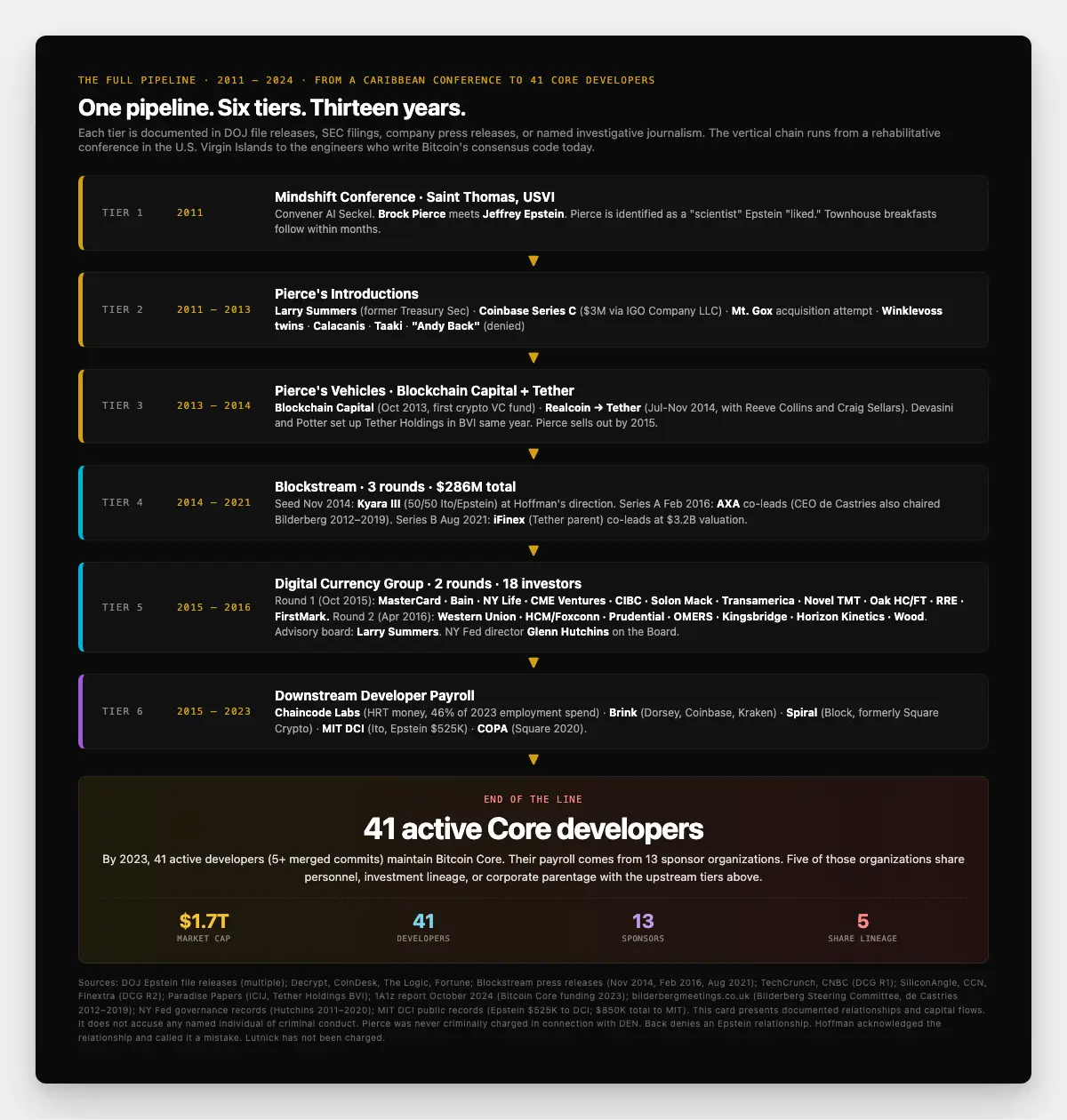
He opened the door. From a rehabilitative conference in the Caribbean in early 2011, he ran a pipeline that brought Jeffrey Epstein to Larry Summers, Coinbase, Mt. Gox, the Winklevoss twins, and the wider network of Bitcoin's early commercial deal flow. He co-founded Tether, the instrument that would prop up BTC's price while Blockstream's developers kept its blocks small. He co-founded Blockchain Capital, the first crypto venture fund, which invested in Blockstream's seed round.
Pierce is where the blame starts.
But the blame does not end with Pierce.
Pierce brought the money, and tons of bitcoiners (in name) accepted it.
Every developer who cashed a Blockstream paycheck funded by AXA money chose to do that. Every node operator who deferred to a Bitcoin Core release maintained by Chaincode employees chose to do that. Every conference organizer who gave DCG-funded companies the keynote slot chose to do that. Every miner who pointed hashrate at Foundry's pool chose to do that.
They had a choice.
They chose the seat at the table.
To dig deeper, check out Invisible Plantations, BTC Was Hijacked, Everyone Knows It, and The MasterCard-Bitcoin Conspiracy.
The people who built bitcoin wanted to change the world.
The people who arrived to own it wanted to charge the world a fee.
And the people who handed them the keys did it for a paycheck and a lanyard that says "VIP" and offers little crackers with caviar at the conferences.
Part 5 is where we watch them use those keys, and where bitcoin turns into a warzone.
Footnotes
¹ Kyara Investments III operating agreement, registered September 4, 2014. Documented in DOJ Epstein file releases and analyzed in The Logic, "Hoffman's role in Blockstream-Kyara allocation," 2024, Blockspace coverage, and Fortune, "Newly Released Epstein Files Show Reid Hoffman's Bitcoin Bet".
² Joichi Ito and Southern Financial LLC parties to Kyara Investments III. Southern Financial LLC was an Epstein-controlled vehicle. DOJ file releases. The Logic, Fortune, Blockspace.
³ Blockstream seed round of $21 million announced November 17, 2014. Blockstream announcement, "Blockstream Closes $21M Seed Financing". Hire of multiple active Bitcoin Core contributors documented in Blockstream team archives.
⁴ Reid Hoffman directive to Austin Hill to increase the Kyara allocation from $50,000 to $500,000. Email contents reported by Fortune and The Logic from DOJ file releases, 2024.
⁵ Brock Pierce mining timeline self-reported in HackerNoon, "Brock Pierce Interview: Tales from the Bitcoin Floor," January 2, 2019. Mindshift conference attendance and the Epstein introduction documented in DOJ file releases reported by Decrypt, "Brock Pierce's Relationship with Jeffrey Epstein Went Deeper Than Anyone Knew".
⁶ Lesley Groff email identifying Brock Pierce. DOJ file EFTA02319701, reported by Decrypt.
⁷ Manhattan townhouse breakfast March 2011 scheduling: DOJ file EFTA02721955. September 2011 confirmation: DOJ file EFTA02543351. Reported by Decrypt.
⁸ December 2011 island invitation extended through Sarah Kellen. DOJ file EFTA02297143 and EFTA02297356. Reported by Decrypt.
⁹ Pierce 2012 email referencing Eastern Europe travel. DOJ files EFTA01889221 and EFTA00710096. Reported by Decrypt.
¹⁰ Epstein-Calacanis email of June 2011 requesting introductions to "the bit coin guys." DOJ file releases. Reported by Fortune and Decrypt.
¹¹ Epstein-Amir Taaki email of July 2011. DOJ file releases. Reported by DL News, "Jeffrey Epstein Emailed an Anarchist Bitcoiner" and Decrypt.
¹² Brock Pierce-arranged Manhattan townhouse meeting at which Epstein met Larry Summers and discussed bitcoin. Yahoo Finance, "Epstein emails reference Bitcoin meeting". DOJ files summarized by Decrypt.
¹³ Pierce attempts to broker Mt. Gox acquisition for Epstein, 2013. DOJ files EFTA00962332 and EFTA00991279. Reported by Decrypt.
¹⁴ Pierce offer to introduce Winklevoss twins to Epstein documented in DOJ files. Reported by Decrypt.
¹⁵ Epstein's December 2014 Coinbase Series C investment of approximately $3 million via IGO Company LLC, a U.S. Virgin Islands entity. CoinDesk, "Newly Unsealed DOJ Files Link Jeffrey Epstein to a 2014 Investment in Coinbase," February 2026.
¹⁶ Blockchain Capital statement to Decrypt that the Coinbase investment was independent of the fund. Decrypt, "Jeffrey Epstein Was an Early Investor in Coinbase".
¹⁷ Amir Taaki reply and public distancing. Reported by DL News and Decrypt.
¹⁸ "Andy Back" reference in DOJ-released email of April 2014. Reported by Decrypt. Adam Back has publicly denied a relationship with Epstein.
¹⁹ Vincenzo Iozzo-Epstein exchange regarding Adam Back, November 2014. DOJ file releases, reported by Decrypt.
²⁰ Realcoin (later Tether) founded July 2014 in Santa Monica by Brock Pierce, Reeve Collins, and Craig Sellars. Wikipedia: Tether (cryptocurrency). CoinDesk archives.
²¹ First 100 USDT minted on the Omni Layer, October 6, 2014. Omni Layer block explorer.
²² Realcoin renamed Tether on November 20, 2014. Wikipedia. Press release archive.
²³ Paradise Papers disclosure of Tether Holdings Limited incorporation in the British Virgin Islands in 2014 by Giancarlo Devasini and Philip Potter. International Consortium of Investigative Journalists, Paradise Papers archive.
²⁴ Pierce and Reeve Collins sell their stakes in Tether to Devasini and Potter, circa 2015. Wikipedia. Forbes profile of Tether.
²⁵ Tether wholly owned by iFinex Incorporated, which also owns Bitfinex. Wikipedia. Tether and Bitfinex public disclosures.
²⁶ Giancarlo Devasini elevation to chairman of iFinex, March 2025. Devasini holds approximately 45 percent of iFinex. Former plastic surgeon. Forbes and CoinDesk profile.
²⁷ Paolo Ardoino estimated net worth of $38 billion, April 2026. Forbes Billionaires List.
²⁸ Stuart Hoegner served as general counsel of Tether and Bitfinex from 2014 until January 2025. Bitfinex announcement.
²⁹ Blockstream seed round of $21 million, November 17, 2014. Blockstream blog announcement.
³⁰ Named investors in Blockstream seed round include Reid Hoffman, Khosla Ventures, Real Ventures, Innovation Endeavors (Eric Schmidt), AME Cloud Ventures (Jerry Yang), Crypto Currency Partners, FuturePerfect Ventures, Mosaic Ventures, Ribbit Capital, Max Levchin, Danny Hillis, Ray Ozzie, and Nicolas Berggruen. Blockstream blog and CrunchBase.
³¹ Reid Hoffman directs Austin Hill to increase Kyara allocation from $50,000 to $500,000. The Logic and Fortune.
³² Blockstream seed round was ten times oversubscribed. Reported by The Logic and CoinDesk.
³³ Hill email indicates some Blockstream co-founders pushed back on the Kyara allocation citing a Stellar conflict. The Logic.
³⁴ Reid Hoffman appears 2,658 times in DOJ-released Epstein files. Business Today, "Reid Hoffman in Epstein Files".
³⁵ Blockstream Series A of $55 million, February 3, 2016. Co-leads: Horizons Ventures, AXA Strategic Ventures, and Digital Garage. Blockstream press release, February 3, 2016.
³⁶ AXA financial data for 2015-2016 from AXA Annual Report 2015 and Wikipedia. World's largest insurance company by revenue.
³⁷ Henri de Castries chief executive of AXA from May 2000; chairman-CEO from approximately 2010; retired September 1, 2016. Wikipedia: Henri de Castries.
³⁸ Henri de Castries chairman of the Bilderberg Group Steering Committee from 2012 to 2019. bilderbergmeetings.co.uk participant lists and governance archives, Wikipedia.
³⁹ Blockstream Series B of $210 million at a $3.2 billion valuation, August 24, 2021. Co-leads Baillie Gifford and iFinex. Blockstream blog, "Blockstream Closes $210M Series B Funding Round".
⁴⁰ Blockstream co-founders. Wikipedia: Blockstream and Blockstream team page archives.
⁴¹ Digital Currency Group founded October 27, 2015 in Stamford, Connecticut by Barry Silbert. TechCrunch, "Digital Currency Group Raises $30M", CNBC.
⁴² DCG Round 1 investors: MasterCard, Bain Capital Ventures, New York Life, Transamerica Ventures, CME Ventures, FirstMark Capital, RRE Ventures, Oak HC/FT, CIBC, Solon Mack Capital, Novel TMT. TechCrunch, CNBC.
⁴³ DCG Round 2 investors (April 2016): Western Union, HCM International (Foxconn), Gibraltar Ventures (Prudential), OMERS Ventures, Horizon Kinetics, Kingsbridge Wealth Management, Wood Investment Partners. SiliconAngle, CCN, Finextra.
⁴⁴ DCG subsidiaries Grayscale, CoinDesk, Genesis, Foundry, TradeBlock. DCG corporate website archives and Wikipedia.
⁴⁵ DCG portfolio of more than 160 companies. CrunchBase, Wikipedia, DCG public disclosures.
⁴⁶ Genesis Global Holdco files Chapter 11 bankruptcy January 19, 2023. Reuters, court documents.
⁴⁷ CoinDesk sold to Bullish Group for approximately $125 million, November 2023. Bullish press release.
⁴⁸ Larry Summers on DCG advisory board. DCG announcement and multiple contemporary sources.
⁴⁹ Coinbase funding history from CrunchBase, Coinbase blog, and contemporaneous TechCrunch coverage of each round.
⁵¹ Lightning Labs funding history. CrunchBase, Lightning Labs blog, CoinDesk.
⁵¹ Blockchain Capital portfolio history. Blockchain Capital corporate site, CrunchBase.
⁵² Visa investment in Chain Incorporated $30 million Series B, September 2015. Chain press release via PR Newswire.
⁵³ Visa investment in Blockchain Capital Fund V, $300 million, June 2021. Ledger Insights, CoinDesk, Blockchain Capital press release.
⁵⁴ MasterCard ranked third globally in blockchain patent filings as of 2018, with 80-plus filings. American Banker, CoinDesk.
⁵⁵ MasterCard Crypto Partner Program with 85-plus partners, and 2026 reporting on stablecoin acquisition discussions. CoinDesk and The Block.
⁵⁶ Western Union remittance market data. Fortune, FXStreet, World Bank remittance reports.
⁵⁷ Western Union launch of USDPT dollar-pegged stablecoin on Solana, 2026. The Block and Western Union press release.
⁵⁸ Visa annual payment volume in excess of $14 trillion. Visa annual reports.
⁵⁹ CME Group launch of cash-settled Bitcoin futures, December 18, 2017. CME press release.
⁶⁰ Bitcoin all-time high of approximately $19,783.21 reached December 17, 2017 on the CoinDesk Bitcoin Price Index. CoinDesk historical archives.
⁶¹ Galina Hale, Arvind Krishnamurthy, Marianna Kudlyak, and Patrick Shultz, "How Futures Trading Changed Bitcoin Prices," FRBSF Economic Letter 2018-12, May 7, 2018. Federal Reserve Bank of San Francisco. The paper concluded the timing "does not appear to be a coincidence."
⁶² Bain Capital Ventures crypto fund of $560 million. Bain Capital announcement.
⁶³ Bitcoin Core developer funding analysis. 0xB10C, "Bitcoin Core Funding Report," 1A1z Research, October 2024. Reported by NoBSBitcoin and ChainCatcher.
⁶⁴ Chaincode Labs founders Alex Morcos and Suhas Daftuar, both formerly of Hudson River Trading. Chaincode Labs corporate site. HRT corporate archives.
⁶⁵ Chaincode Labs employed 46 percent of Bitcoin Core developer payroll in 2023. 1A1z report, October 2024.
⁶⁶ Released Epstein emails show 2016 introduction of Alex Morcos and Suhas Daftuar to Jeffrey Epstein for a proposed New York meeting. news.bitcoinprotocol.org analysis of DOJ file release and DOJ files.
⁶⁷ Brink founded in 2020 in London by John Newbery and Mike Schmidt. Brink corporate site.
⁶⁸ Jack Dorsey's Start Small Foundation $5 million pledge to Brink, paid as $1 million per year over five years. The Block, Decrypt.
⁶⁹ Brink funding from Coinbase, Kraken, and VanEck. Brink funding page and corporate announcements from each sponsor.
⁷⁰ Gloria Zhao first Bitcoin Core female maintainer, first Brink fellow. Brink blog, January 2025.
⁷¹ Spiral founded in 2019 as Square Crypto, renamed to Spiral in 2021. Funded by Block Incorporated. Spiral corporate site.
⁷² OpenSats and Spiral together accounted for 62 percent of Bitcoin Core grant funding in 2023. 1A1z report.
⁷³ MIT Digital Currency Initiative founded 2015 at MIT Media Lab by Joichi Ito. MIT DCI corporate site. Hires include Gavin Andresen, Wladimir van der Laan, Cory Fields.
⁷⁴ Epstein donated $525,000 to the MIT Digital Currency Initiative, as part of a total of $850,000 to MIT. Quartz, "Jeffrey Epstein's Money at MIT" and DL News. DOJ files.
⁷⁵ Joichi Ito resigned from MIT September 7, 2019 following Ronan Farrow's New Yorker exposé. The New Yorker.
⁷⁶ Crypto Open Patent Alliance (COPA) founded by Square in 2020. opencrypto.org corporate site.
⁷⁷ Blockstream joined COPA the day after the founding announcement. Blockstream blog, September 11, 2020.
⁷⁸ COPA v. Craig Wright 2024 ruling in the United Kingdom. Court judgment.
⁷⁹ Jeffrey Epstein owned 9 East 71st Street, Manhattan (the Herbert N. Straus House) from 1996 to 2019. New York property records. Newsweek, "Lutnick and Epstein, Neighbors".
⁸⁰ Howard Lutnick purchased 11 East 71st Street in 1998. New York property records, Newsweek.
⁸¹ DOJ January 2026 file releases including 2012 lunch plans and 2018 Frick Collection exchange between Lutnick and Epstein. NBC News and CNN.
⁸² Lutnick 2012 yacht visit to Little Saint James with his wife, four children, a nanny, and another family. DOJ file releases. Lutnick admission to NY Post podcast. NBC News.
⁸³ Epstein 2017 donation of $50,000 to a New York charity in Lutnick's honor. DOJ files. NBC News.
⁸⁴ Lutnick Senate testimony, February 2026, acknowledging 10 emails and two in-person meetings after Epstein's 2008 conviction. Senate transcript.
⁸⁵ Lutnick House Oversight Committee testimony, May 6, 2026. Multiple representatives' on-record characterizations. NBC News, CBS News, CNN.
⁸⁶ Cantor Fitzgerald is one of 25 primary dealers authorized by the Federal Reserve Bank of New York. NY Fed primary dealer list.
⁸⁷ Cantor custody of approximately 80 to 99 percent of Tether's Treasury reserves. Howard Lutnick CNBC interview. Ledger Insights, "Cantor and Tether".
⁸⁸ Cantor acquisition of 5 percent equity stake in Tether at approximately $600 million valuation, November 2024. Wall Street Journal, CoinTelegraph, Fortune.
⁸⁹ Cantor annual custody fees on the Tether arrangement reported in tens of millions of dollars annually. Fortune.
⁹⁰ 21 Capital partnership of Brandon Lutnick, Tether, SoftBank, and Bitfinex for a $3 billion Bitcoin acquisition vehicle. Tether contributed $1.5 billion in bitcoin. Crypto Briefing.
⁹¹ $4 billion Bitcoin treasury deal with Blockstream reported. Bitcoin Magazine.
⁹² Howard Lutnick confirmed as United States Secretary of Commerce February 18, 2025 by Senate vote 51 to 45. Senate records.
⁹³ Tether loan to Dynasty Trust A filed the day after Lutnick's Cantor equity divestiture. CoinDesk, DL News, credit filings.
⁹⁴ Senator Elizabeth Warren and Senator Ron Wyden letters to Commerce Department and other agencies, April 2026. Senate office press releases.
⁹⁵ Glenn Hutchins served on the Federal Reserve Bank of New York Board of Directors from 2011 to 2020 and chaired its Audit and Risk Committee. NY Fed public records and governance archives.
⁹⁶ Glenn Hutchins on the Digital Currency Group Board of Directors. DCG announcement and archived corporate records.
⁹⁷ Glenn Hutchins co-chairman of the Brookings Institution and funder of the Hutchins Center on Fiscal and Monetary Policy. Brookings Institution corporate site.
⁹⁸ Henri de Castries CEO and chairman of AXA (cited above). Wikipedia.
⁹⁹ AXA 2015-2016 financial data. AXA Annual Report and Wikipedia.
¹⁰⁰ Henri de Castries chairman of Bilderberg Steering Committee from 2012 to 2019. Bilderberg participant and governance archives.
¹⁰¹ Peter Thiel Bitcoin position via Founders Fund estimated at $1.8 billion. Wall Street Journal, Bloomberg, and Founders Fund disclosures.
¹⁰² Reid Hoffman Bilderberg attendance, multiple years. Bilderberg participant lists.
¹⁰³ Faryar Shirzad listed as Bilderberg 2026 participant. Bilderberg participant list 2026.
¹⁰⁴ Eric Schmidt Bilderberg attendance, multiple years. Bilderberg participant lists.
¹⁰⁵ QueensBridge Venture Partners investment in Coinbase Series B, December 2013. CBInsights, Hip Hop Wired. Coinbase IPO return reporting.
¹⁰⁶ A-Grade Investments (Ashton Kutcher, Guy Oseary) portfolio. CityAM and CrunchBase entries for BitPay and BitGo.
¹⁰⁷ Barry Silbert quote: "We are still far away from Bitcoin being a functional currency. First it's going to function as a speculative investment." Cited in Kurt Wuckert Jr., "The MasterCard-Bitcoin Conspiracy," CoinGeek, and Bloomberg interview archives.
Be good to each other. And read the footnotes.
Kurt Wuckert Jr. is the world's foremost Bitcoin Historian. The Written History of Bitcoin is published one installment at a time at kurtwuckertjr.com.