The Silk Road and the Senators: The Written History of Bitcoin, Part 4
By Kurt Wuckert Jr.
The Library
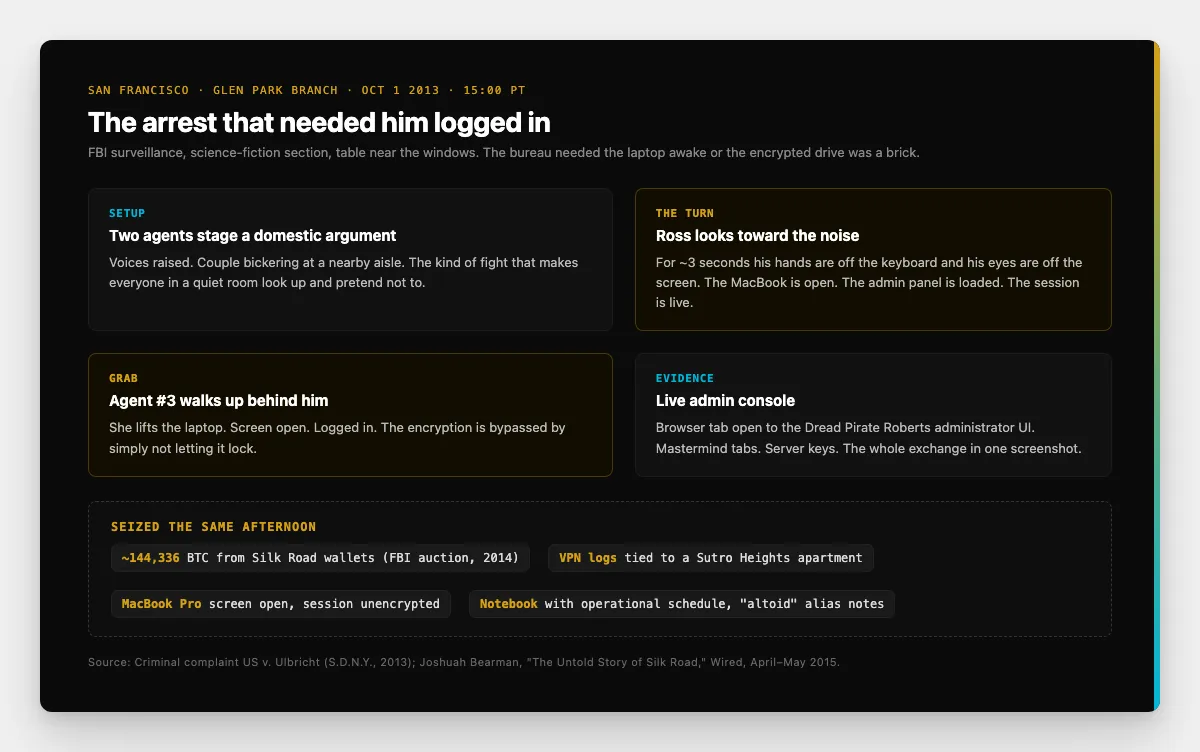
On the afternoon of October 1, 2013, the science-fiction section of the Glen Park branch of the San Francisco Public Library got noisy.¹
A couple started arguing. Voices raised. The kind of fight that makes everyone in a quiet room look up and pretend they aren't looking. At a table near the windows, a twenty-nine-year-old in a faded t-shirt and jeans looked up too. He had a MacBook open, a tea cooling beside it, and a browser tab loaded into the administrator console of the largest illegal marketplace in the world.
When he turned to see the argument, a woman wearing an FBI jacket walked up behind him and took the laptop. Open. Logged in. Screen up.
If you'd rather watch this article as a video, it's available after May 12, 2026.
That was the part the bureau had to get right. If they had grabbed him on the street, he could have slammed the lid. If they had kicked in his apartment door, he could have unplugged the machine. The drive was encrypted. Without a live session, they had a brick. So they ran a kid's play. Two undercover agents staged a domestic argument loud enough to make him turn. A third walked up while his hands were off the keyboard.
The laptop in her arms belonged to Ross Ulbricht. The browser tab belonged to Dread Pirate Roberts. The marketplace was called Silk Road, and for two and a half years he had run it from coffee shops and libraries on a thirty-dollar-a-month VPN.
That is where this story ends.
It starts in a libertarian bookstore in Austin, with a group of young men who believed code could do what politics couldn't.
Where We Left Off
In Part 3, Satoshi faded out across five months in 2011.² He handed commit access to Gavin Andresen. He handed off the alert key. He answered one last email to Mike Hearn on April 23, 2011, saying he had moved on to other things. Four days later, Gavin announced he was going to brief the Central Intelligence Agency.
Part 3 ended with a sentence. The CIA presentation Gavin gave on June 14, 2011, was not the end of government attention to bitcoin. It was the beginning.
Part 4 is what came next.
The benevolent dictator was gone. The code had moved to GitHub. The BIP process gave anyone a procedural seat at the table. A generation of twenty-somethings showed up with their first salaries and their first companies. And then the real world arrived. Drug markets. Senators. Hackers. Convicted sex offenders sending emails from a private island.
In a single thirty-month window, bitcoin gets its first marketplace, its first regulatory framework, its first chain fork, its first foundation, its first halving, its first Senate hearing, and its first FBI takedown. The community spent 2011 to 2013 producing the consequences of every architectural choice Satoshi had made and every governance choice he hadn't.
This article covers the explosion.
Part 5 covers the shrapnel.
Brave New Books
Late 2010. Burnet Road, Austin, Texas. A few miles north of the University of Texas campus.³
A man named Harlan Dietrich runs a bookstore called Brave New Books. He started it out of the 9/11 truth movement and grew it into something stranger. It is part bookstore, part meeting hall, part safe house for ideas that the rest of the country has decided are weird. Ron Paul stickers in the window. Mises in the philosophy aisle. Rothbard's Man, Economy, and State on a low shelf where anyone can pick it up. A back room where speakers come in on weeknights to talk about Austrian economics, central banking, 3D printing, encryption, jury nullification, and the moral philosophy of secession.
Catherine Bleish runs the day-to-day. Locals call it BNB. Out-of-town libertarians treat it like a pilgrimage stop.
This is where the Silk Road begins.
Not the website. The website is a Tor hidden service launched on or about February 6, 2011, that grew out of Ross Ulbricht's apartment.⁴ The website is the artifact. The Silk Road began, in the way many ideas begin, in a network of like-minded thinkers who all attended the same readings, drink the same coffee, and believe the same ideas. In this place, they believe three propositions: that the state is a violent institution, that money is a tool of state control, and that voluntary exchange between consenting adults is a moral act regardless of what the state says about the goods.
Ross was in that orbit. He had moved to Austin in 2010 to live with his sister and run a small online used-books business called Good Wagon Books with his friend Donny Palmertree.⁵ He read Mises. He posted long pro-Ron Paul comments on his college's alumni board. He was part of the same circuit of meetups and reading groups that ran out of BNB and the UT campus.
There is no documented evidence that Ross ever directly cohorted with Cody Wilson, Daniel Krawisz, or Pierre Rochard... What is documented is the ecosystem. The same bookstores. The same speaker series. The same handful of names in the same handful of group photos at the same handful of Mises Circle nights at Garrison Hall on the UT campus.⁶
In 2011, it was a small scene. Everyone knew everyone.
Some of them built marketplaces. Some of them built guns. Some of them built think tanks. All of them believed code could route around the state.
The press version of Silk Road is "evil genius builds a drug market." The Austin version is something else. A kid in a bookstore listened to Rothbard talks for two years and decided that if the principle was true, somebody had to act on it.
He acted on it.
And the government was watching to see what would incubate.
June 2011: Four Worlds Collide
For a single month in the summer of 2011, four completely unconnected worlds all looked at bitcoin at the same time.⁷
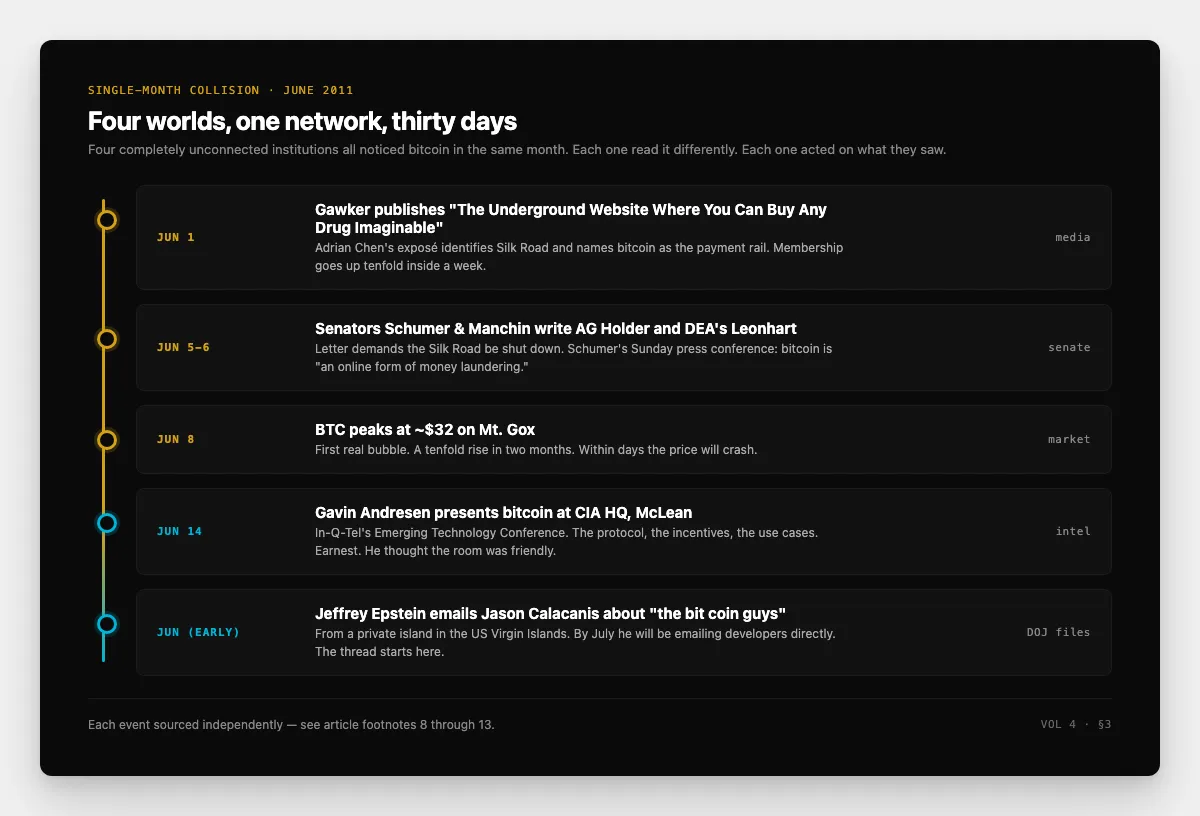
On June 1, 2011, Adrian Chen at Gawker published "The Underground Website Where You Can Buy Any Drug Imaginable."⁸ The piece described Silk Road in detail and named bitcoin as the payment rail. Membership on Silk Road went up roughly tenfold inside a week.
On June 5 and 6, 2011, Senators Chuck Schumer of New York and Joe Manchin of West Virginia wrote a letter to Attorney General Eric Holder and DEA Administrator Michele Leonhart demanding the site be taken down.⁹ Schumer told reporters at a Sunday press conference that bitcoin was "an online form of money laundering" and called for its prosecution alongside the marketplace. It was the first time a sitting United States senator had used the word bitcoin in a sentence on the record.
On June 8, 2011, the price of bitcoin on Mt. Gox peaked at about $32, capping the first real bubble in bitcoin's history.¹⁰ It was a tenfold rise in two months and an order of magnitude beyond anything the early miners had imagined. Within days, it would crash.
On June 14, 2011, Gavin Andresen walked into CIA headquarters in McLean, Virginia, and gave a presentation about bitcoin at the In-Q-Tel Emerging Technology Conference.¹¹ He explained the protocol, the incentives, the architecture, and the use cases. He was earnest. He thought he was educating a friendly audience. That evening, he tweeted about it.
¹⁰²My talk at the CIA went well today. The hallways there are REALLY wide, and full of interesting stuff.
— Gavin Andresen (@gavinandresen) June 14, 2011
A few hours earlier, on the same day, while Gavin was inside Langley, another account had also tweeted about bitcoin.
¹⁰³WikiLeaks now accepts anonymous Bitcoin donations on 1HB5XMLmzFVj8ALj6mfBsbifRoD4miY36v
— WikiLeaks (@wikileaks) June 14, 2011
Six months earlier, Satoshi had personally and publicly asked WikiLeaks not to use bitcoin (Part 3). WikiLeaks had done it anyway, on the exact day the man who had inherited Satoshi's project was standing in front of the CIA. There is no record of how Satoshi reacted. There is no record of Satoshi reacting to anything in 2011. But if he was reading, that day would have hurt.
And in the same month, on the island of Saint Thomas in the United States Virgin Islands, a fifty-eight-year-old convicted sex offender named Jeffrey Epstein sent an email to the venture capitalist Jason Calacanis. Epstein wanted to be connected to, in his own phrasing, "the bit coin guys."¹²
By July, he was emailing developers directly.¹³
That is a thread we will pull, slowly, at the end of this article and across the next three. For now, hold the date. June 2011. Four worlds. The Gawker thread, the Senate letter, the CIA briefing, and a man on a private island sending emails to venture capitalists about a payment network that had existed for thirty-one months.
Schumer was reading drug markets.
Gavin was reading academic protocol literature.
Epstein was reading something else entirely.
The Austin Circle and Its Tools
While the senators were drafting letters, Austin was building things.
The Mises Circle met on Tuesday nights at Garrison Hall on the University of Texas campus.¹⁴ The convener was Michael Goldstein, an undergraduate who would later go by Bitstein on the internet. Regulars included Daniel Krawisz, a Rice physics graduate who had read his way through the Austrian school, plus Pierre Rochard, George McHugh, and a rotating list of guests. The agenda for any given night ran from Mises and Hayek to Bitcoin and back to encryption and 3D printing. They were college kids reading Rothbard at night and arguing about Austrian capital theory until the building closed.
In November 2013, Krawisz and Goldstein incorporated the Satoshi Nakamoto Institute as a 501(c)(3).¹⁵ Krawisz as Director of Research. Goldstein as President. The Institute's stated purpose was to preserve the writings of Satoshi Nakamoto and the cypherpunk tradition that produced bitcoin. It is the reason most readers today can look up Satoshi's forum posts in a searchable, archived form. The Institute, more than any single publication, is why we still have the primary source record this series is built on.
A different branch of the same scene went a different direction.
In 2012, a University of Texas law student named Cody Wilson founded a project called Defense Distributed.¹⁶ Its goal was to design and release the world's first fully 3D-printed firearm. Wilson framed it explicitly as a free-speech project. Code is speech. Blueprints are code. Therefore blueprints for a working pistol are constitutionally protected speech, regardless of whether a state agency would prefer that they not be.
On May 5, 2013, Defense Distributed test-fired the Liberator at a range near Austin.¹⁷ The blueprints went online. The State Department demanded they come down. Indiegogo and PayPal cut him off. Wilson started accepting bitcoin. Then, in late 2013, he and the British developer Amir Taaki announced Dark Wallet, the first project explicitly designed to make bitcoin transactions harder to surveil.¹⁸
It is worth pausing here, because the press version of this period flattens it.
There were not "criminals" and "developers" and "investors" in 2011 Austin. There was a single scene of college-age libertarians who believed three things at the same time. That voluntary exchange between adults was a moral right. That code that enabled voluntary exchange was therefore a moral good. And that the state's monopoly on violence ended at the point where you stopped asking its permission.
Some of them built bookstores. Some of them built think tanks. Some of them built guns. One of them built a drug market.
They were not the same people. But they were all reading the same authors, and they were all asking the same question. If the state is the problem, what does an actual private alternative look like?
Research did not confirm that Ross Ulbricht ever loaded the Defense Distributed blueprints onto the bitcoin blockchain.¹⁹ It also did not confirm that the Dark Wallet team and the Silk Road operator ever worked together. What is documented is a shared culture. A shared set of authors. A shared belief that the protocol Satoshi had written was a tool for human autonomy.
The Senate would not draw those distinctions. To Schumer's office, code was code and crime was crime.
To Austin, in 2011, code was the argument.
Mt. Gox and the Failing Infrastructure
While Austin was reading Rothbard and Washington was drafting letters, the actual financial plumbing of bitcoin was on fire.
On June 13, 2011, 25,000 BTC were stolen from 478 user accounts on Mt. Gox.²⁰ Roughly $375,000 at the going rate. The largest single theft, to date, in bitcoin's short history. Investigators believed a single attacker had compromised a customer database and used the credentials to drain wallets one at a time.
Six days later, on June 19, the network experienced its first flash crash.²¹ An attacker used auditor credentials from an admin account to dump bitcoin onto the order book. The Mt. Gox price collapsed from about $17.50 to $0.01 in minutes. Bots scooped up bitcoin at sub-penny prices. The exchange suspended trading and announced a rollback. Trust was already brittle, and now there was a public price chart showing bitcoin trading at one cent.
In the middle of the crash, Karpelès posted in IRC.
"the btc withdrawal limit saved us" MagicalTux (Mark Karpelès), Mt. Gox IRC log, June 19, 2011¹⁰⁴
On July 29, 2011, a wallet service called MyBitcoin vanished from the internet.²² The operator, who used the handle Tom Williams, claimed in a parting note that the service had been hacked. About 78,000 BTC went missing. There has never been a confirmed identity for Williams and there has never been a recovery. It was the first major wallet exit scam, and the community had no infrastructure to investigate it.
By November 2011, the price of bitcoin had bottomed at about $2.14.²³ Mining was unprofitable for most operators. The forums went quiet. The press lost interest. The "is bitcoin dead?" article became a recurring genre for the first (but definitely not the last) time.
And inside Mt. Gox, something worse was happening that nobody outside the company knew.
Later forensic accounting, eventually disclosed in court documents during the bankruptcy, would establish that as of October 2011 the exchange was already missing 85,109 BTC from its cold storage. Either stolen, mismanaged, or both. Karpelès had taken over from Jed McCaleb in March of that year, eight months earlier. The thefts had begun under McCaleb's tenure. They had continued under Karpelès. And the exchange was operating, taking deposits, processing withdrawals, and publishing a quoted price every minute while a hole the size of a Connecticut suburb sat under its balance sheet.²⁴
By October 2011, 85,109 bitcoin were already missing from Mt. Gox.
Nobody outside the company knew.
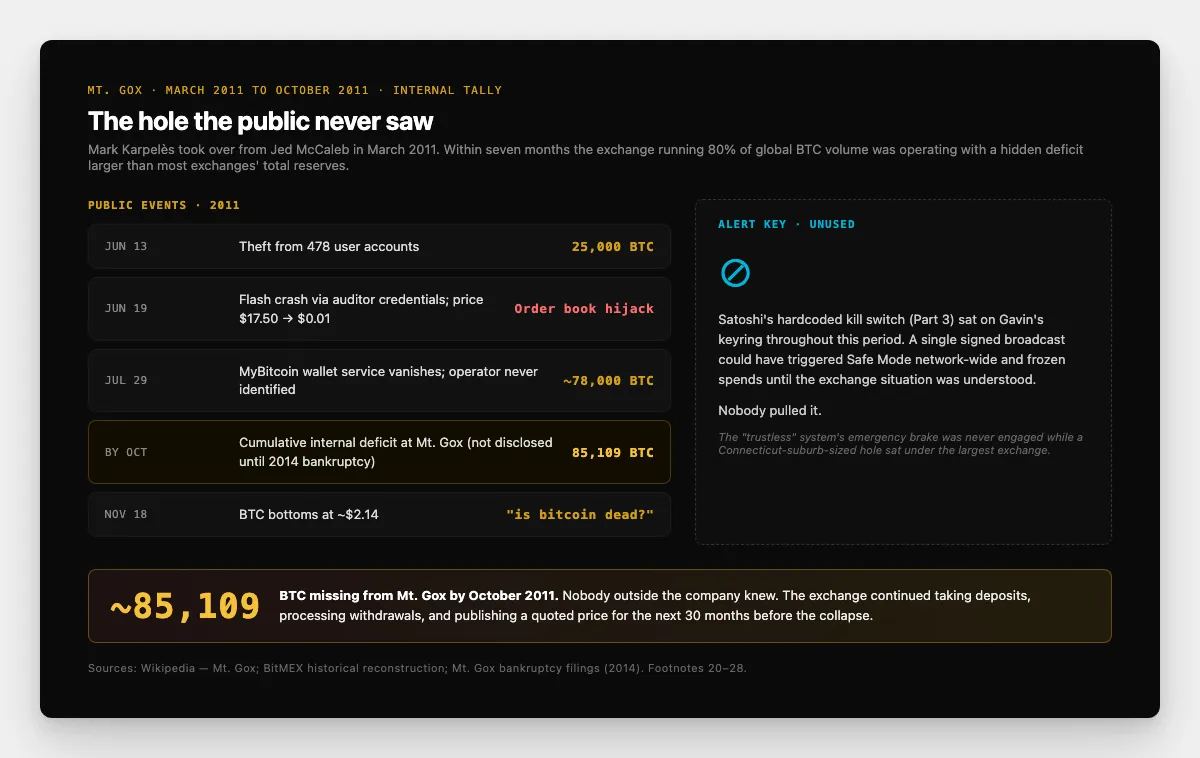
The alert key Satoshi had built into the client and handed to Gavin (Part 3) was the emergency brake of a "trustless" system. A signed message could disable spends across the entire network. It was the one feature that could have flagged catastrophic failure at the largest exchange.²⁵
It was never pulled.
Other exchanges started failing too. Bitcoinica, run by an Australian teenager named Zhou Tong, was hacked in March 2012 for 18,547 BTC. Hacked again in May for 38,000 BTC. By August it was insolvent.²⁶ TradeHill, the second-largest exchange after Mt. Gox, shut down on February 13, 2012, citing payment processor problems.²⁷ The infrastructure was being held together by a half-dozen twenty-something operators who had learned how to run financial systems by running financial systems.
By 2012, Mt. Gox was handling roughly 80% of all global bitcoin trades.²⁸
That is the level of concentration the community would ride into 2013.
The Cambrian Explosion
While the existing infrastructure was burning, the next layer was being built.
Between mid-2011 and the end of 2012, more bitcoin companies were founded than in all the previous years combined. A short list of the ones that mattered, with founding dates, because the dates are what tell the story.
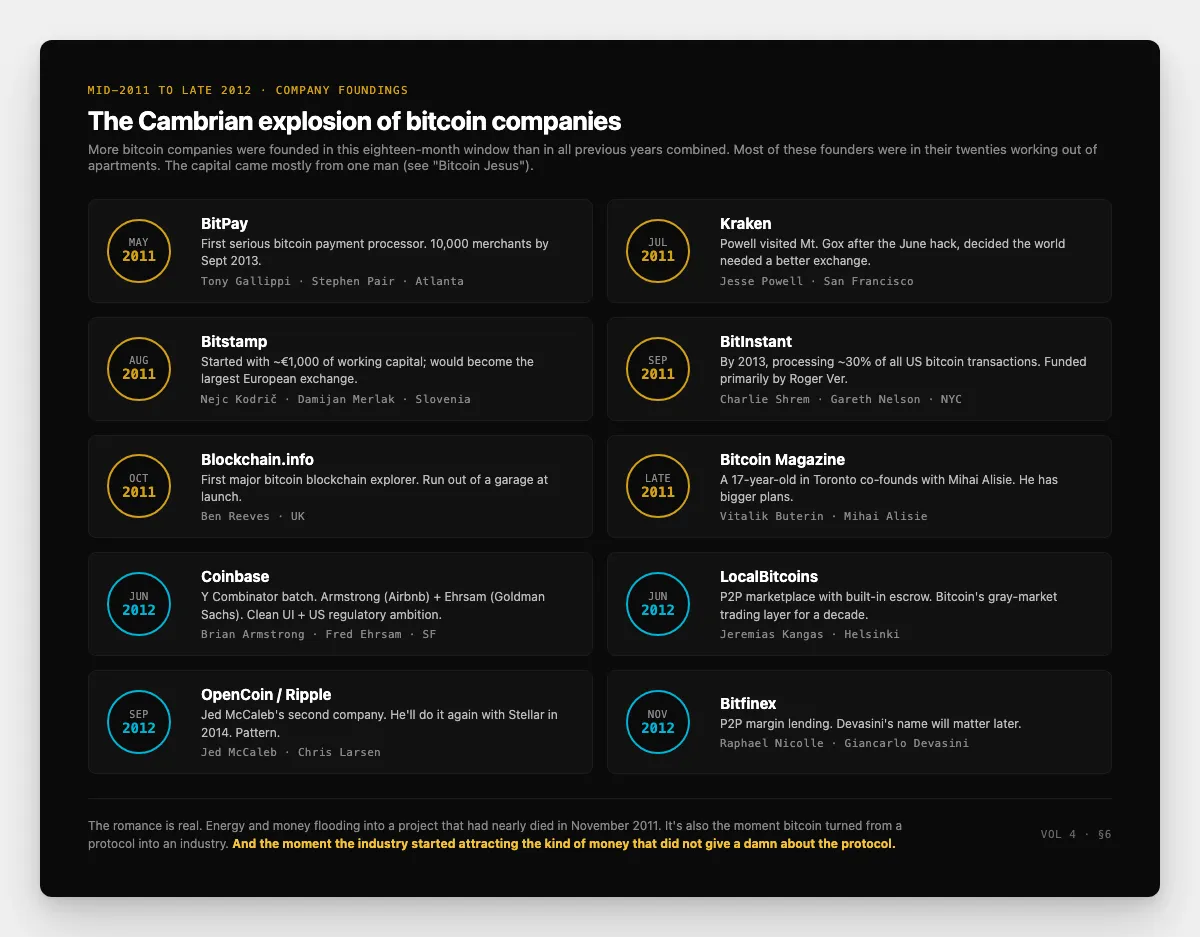
In May 2011, Tony Gallippi and Stephen Pair launched BitPay out of Atlanta.²⁹ It was the first serious bitcoin payment processor for merchants. By September 2013, they would have signed up ten thousand merchants.
In July 2011, Jesse Powell flew to Tokyo after the Mt. Gox hack and spent a week trying to help Karpelès stabilize the exchange.³⁰ Powell came home and decided the world needed a better exchange. He founded Kraken on July 28, 2011. It launched publicly in September 2013.
In September 2011, Charlie Shrem and Gareth Nelson launched BitInstant out of Brooklyn.³¹ By 2013, BitInstant was processing roughly 30% of all bitcoin transactions in the United States. Shrem was twenty-one years old. His investor was a man named Roger Ver.
In August 2011, Nejc Kodrič and Damijan Merlak founded Bitstamp out of Slovenia with the equivalent of about one thousand euros in working capital.³² Within three years, it would be the largest European exchange.
In October 2011, Ben Reeves launched Blockchain.info as the first bitcoin blockchain explorer.³³ It was a small project run out of a garage. By 2013, every journalist and trader on earth used it as the canonical reference for whether a transaction had been confirmed.
Also in late 2011, a seventeen-year-old in Toronto co-founded a publication called Bitcoin Magazine with the Romanian developer Mihai Alisie.³⁴ The first print issue dropped in May 2012. The teenager's name was Vitalik Buterin. He was writing articles and working on bigger plans.
In June 2012, Brian Armstrong and Fred Ehrsam launched Coinbase out of a YC batch in San Francisco.³⁵ Armstrong had been at Airbnb. Ehrsam was a Goldman Sachs trader. The combination of clean UI and US regulatory ambition turned Coinbase, inside three years, into the most-used bitcoin company in the country.
Also in June 2012, a Finnish developer named Jeremias Kangas launched LocalBitcoins as a peer-to-peer marketplace with built-in escrow.³⁶ It would serve as bitcoin's gray-market trading layer for the next decade.
In November 2012, Raphael Nicolle and Giancarlo Devasini founded Bitfinex as a peer-to-peer margin lending platform.³⁷ Hold that name. These guys are going to matter with increasing importance through this series.
A separate thread: Jed McCaleb, the founder of Mt. Gox, did not go quietly after he sold the exchange to Karpelès in March 2011. He started building a new payment network with David Schwartz and Arthur Britto. In September 2012, McCaleb incorporated OpenCoin with Chris Larsen.³⁸ The project was Ripple. The same Jed McCaleb who had walked away from one exchange founder seat in 2011 was now founding the company that would become his second. He would do it again with Stellar in 2014. The pattern is worth marking.
Most of these companies were founded by people in their twenties working out of apartments. Most of their initial capital came from one man. We will get to him.
The Cambrian explosion is the part of this period everyone romanticizes. New companies. New jobs. New magazines. Energy and money flooding into a project that had nearly died in November.
The romance is real, and it deserves to be remembered for what it was.
It is also the moment bitcoin turned from a protocol into an industry. And the moment the industry started attracting the kind of money that did not give a damn about the protocol.
The Bitcoin Foundation
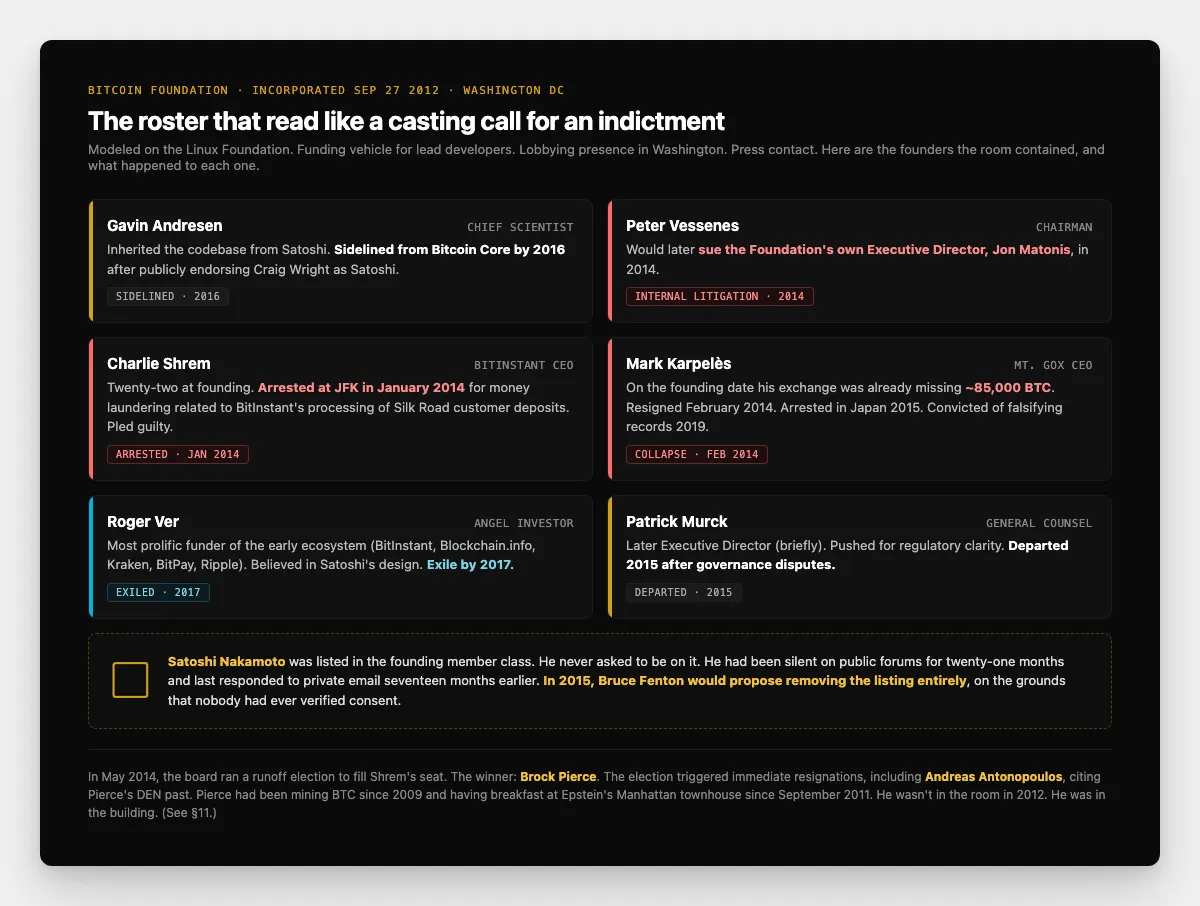
On September 27, 2012, in Washington, D.C., a nonprofit organization called the Bitcoin Foundation was incorporated.³⁹ Jon Matonis, the Foundation's Executive Director, tweeted the Forbes coverage that day.
"Bitcoin Foundation Launches To Drive Bitcoin's Advancement - Forbes" @jonmatonis, September 27, 2012¹⁰⁵
The stated mission was clean. Standardize, protect, and promote the use of bitcoin cryptographic money for the benefit of users worldwide. Modeled on the Linux Foundation. A funding vehicle for the lead developers. A lobbying presence in Washington. A press contact when a senator called.
The board included Gavin Andresen as Chief Scientist. Peter Vessenes as Chairman. Charlie Shrem of BitInstant. Mark Karpelès of Mt. Gox. Roger Ver. Patrick Murck as General Counsel. Jon Matonis served as Executive Director from inception, though his name does not appear on the founding board list.
The founding member roster also listed one other name.
Satoshi Nakamoto.
He had not asked to be on it. He had been silent on the public forums for twenty-one months and last responded to private email seventeen months earlier. The Foundation, in its founding document, claimed his name as a member of the group it was founded to represent. In 2015, Bruce Fenton would propose removing the listing entirely, on the grounds that no one had ever verified consent.⁴⁰
In hindsight, the founding member list reads less like a foundation and more like a casting call for an indictment.
Roger Ver, the most prolific angel investor in bitcoin history, would be exiled by 2017, and later serve time for tax evasion. We will get to him.
Mark Karpelès was running an exchange that, on the date the Foundation incorporated, was already missing more than a hundred thousand bitcoin. By February 2014, his exchange would collapse. He would be arrested in Japan in August 2015 and convicted of falsifying records in 2019.
Charlie Shrem was the youngest board member at twenty-two. In January 2014, federal agents would arrest him at JFK on charges of money laundering related to BitInstant's processing of Silk Road customer deposits. He would plead guilty.
Peter Vessenes would later sue the Foundation's own Executive Director, Jon Matonis, in 2014. The Foundation's first big PR problem in June 2013 would be a California cease-and-desist order alleging it was operating as an unlicensed money transmitter.⁴¹
Gavin Andresen would, within four years, find himself removed from leading the Bitcoin codebase he had inherited from Satoshi, in part because he publicly endorsed a different man as Satoshi.
And in May 2014, the board would hold a runoff election to fill the seat vacated by Shrem's resignation. The winner would be a former child actor named Brock Pierce. The election would trigger immediate resignations, including from Andreas Antonopoulos, who would cite Pierce's documented past as the reason he could no longer associate his name with the Foundation.⁴²
But that is May 2014. We will get to Pierce soon too.
In September 2012, the room contained the most idealistic angel investor in bitcoin (Ver), the operator of an exchange that had already lost more than a hundred thousand BTC (Karpelès), a man who would be arrested for money laundering (Shrem), a chairman who would sue his own executive director (Vessenes), a software engineer who had just inherited a global payment network from a ghost (Gavin), and the founding name of a man who had not consented to be there (Satoshi).
That was not a foundation.
That was a time bomb.
Roger Ver, sitting in that room, was the most networked person in bitcoin. He had funded BitInstant, Blockchain.info, Kraken, BitPay, and at least half a dozen others.⁴³ He was a true believer. He had paid for the room, and he was deeply committed to seeing it grow.
But there was someone else watching this period unfold.
Brock Pierce claims he had been mining bitcoin since 2009. He had attended a private conference in the United States Virgin Islands the previous year and had been having breakfast at Jeffrey Epstein's Manhattan townhouse since September 2011.⁴⁴ He was not in the room in September 2012.
But he was in the building.
The First Bitcoin War
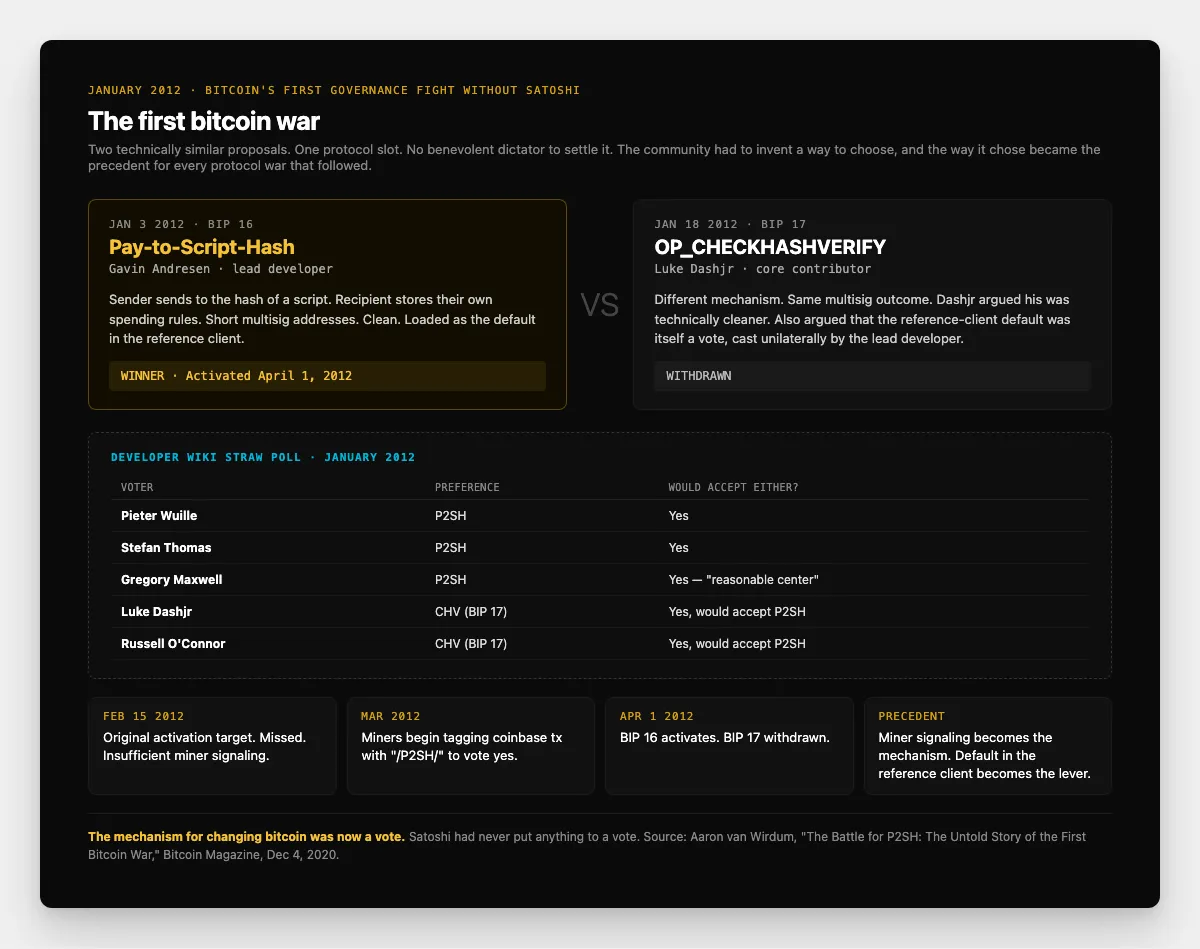
In January 2012, the Bitcoin community held its first real governance fight without Satoshi in the room.⁴⁵
The technical issue was multi-signature transactions. Up to that point, sending bitcoin to a 2-of-3 multisig (the kind of address that requires multiple signatures to spend) required pushing a long, complicated script onto the sender. The sender had to write the recipient's spending rules into the transaction. It was clunky, error-prone, and almost no one used it.
On January 3, 2012, Gavin Andresen proposed BIP 16. Pay-to-Script-Hash, or P2SH. The idea was simple. Instead of sending bitcoin to a long script, you send it to a hash of a script. The recipient stores their own spending rules and reveals them only when they spend. The sender's job becomes trivial. Send to a short, hash-based address that looks like a normal one.
BIP 16 enabled multisig at scale. It was a clean and important upgrade.
Two weeks later, on January 18, 2012, a developer named Luke Dashjr proposed BIP 17.⁴⁶ A competing alternative called OP_CHECKHASHVERIFY. It did the same thing in a different way and Dashjr argued that his was technically cleaner.
The two proposals were not the war. The war was about process, governance and budding politics among Bitcoin developers.
Dashjr accused Gavin of using the default settings in the reference client to railroad BIP 16 to victory. The reference client was the codebase Satoshi had handed Gavin (Part 3). The lead developer of the reference client could effectively choose which proposal got pre-loaded into every new node on the network. Dashjr argued that the choice of default was itself a vote, and that the lead developer had unilaterally cast it.⁴⁷
Aaron van Wirdum, writing about this for Bitcoin Magazine in 2020, called it "The Battle for P2SH" and "the first Bitcoin war."⁴⁸ It is the right framing. It was the first time the community had to resolve a protocol-level disagreement without the man who had written the protocol.
The resolution mechanism was miner signaling. Miners would put "/P2SH/" in their coinbase transactions to vote yes. Once support hit a threshold, the rule would activate. The original target was February 15, 2012. It missed. The activation slipped to April 1, 2012.⁴⁹ BIP 17 was withdrawn.
The developer wiki captured the voting positions of the active contributors at the time. Pieter Wuille preferred P2SH but would accept either. Stefan Thomas preferred P2SH but would accept either. Dashjr and Russell O'Connor preferred OP_CHECKHASHVERIFY but would accept P2SH.⁵⁰
One of the names on that list was Gregory Maxwell. He preferred P2SH but would accept either. He was the model of a reasonable compromise voice at the time.
What BIP 16 actually established was not multisig adoption. It was a precedent. Two precedents, really. The first was that protocol changes would now be ratified by miner signaling rather than lead developer fiat. The second, less spoken, was that the lead developer's preferred proposal would win anyway, because the default in the reference client was now the mechanism of consent.
The mechanism for changing bitcoin was now a vote.
Satoshi had never put anything to a vote, so Bitcoin was wading into new waters where fresh predators were lurking.
BIP 32 and BIP 34
Two more BIPs landed in 2012 that shape everything we do today.
BIP 32, proposed by Pieter Wuille on February 11, 2012, defined Hierarchical Deterministic Wallets.⁵¹ A single master seed could derive an arbitrary tree of key pairs. One backup phrase protected every address you would ever generate. Every modern wallet, from the cheapest mobile app to the most expensive hardware device, is built on top of BIP 32 or its derivatives.
Wuille is the quiet architect of this era. He shows up in the BIP 16 debate as the reasonable technical voice. He produces BIP 32 as a clean infrastructural upgrade. He commits to libsecp256k1, the cryptographic library that nearly every bitcoin implementation today depends on. He does not pick fights. He does not write blog posts. He produces code, and the code is usually correct, and always elegant, so the community absorbs his work without arguing about it.
His reputation is also a kind of quiet power.
BIP 34, proposed by Gavin on July 6, 2012, did something subtle and consequential.⁵² It required every new block to include the block height in the coinbase transaction. It upgraded the block version from 1 to 2. It then specified an activation mechanism. Once 75% of recent blocks were version 2 or higher, the height-in-coinbase rule became mandatory. Once 95% of recent blocks were version 2, version-1 blocks would be rejected outright.
The activation thresholds were hit at block 224,413 on March 5, 2013 (75%) and block 227,931 on March 25, 2013 (95%).⁵³
BIP 34 is technically a minor upgrade. It makes coinbase transactions unique and prevents some classes of replay confusion. Most readers will have never heard of it.
What it actually established is that miners now had a formal mechanism to ratify protocol upgrades by signaling support in the block version field. The same mechanism would be reused for BIP 65, for BIP 66, and eventually, in much-modified form, for the activation of Segregated Witness in 2017.⁶⁵ BIP 34 was the moment the miner became, formally, the gatekeeper of protocol change.
In a sense, BIP 34 is the technical instrument that made the Block Size War possible.
But that is Part 7 and Part 8.
The First Halving
On November 28, 2012, at block 210,000, the block reward dropped from 50 BTC to 25 BTC.⁵⁴
No vote was held. No BIP was filed. No developer pushed a patch. No miner signaled approval. The supply schedule had been written into the source code by Satoshi in 2009 and locked in at the genesis block.
The price at the moment of the halving was about $12.25.
Within five months, it was $230.
Within twelve months, it was $1,075.
That is an 8,778% increase from the halving price inside the same calendar year, and the most spectacular bitcoin price move that had ever happened. Most of it would be retraced by the end of 2014. But the halving itself, the moment Satoshi's supply schedule executed itself, was something Satoshi had built and walked away from and trusted his own code to run.
In an article full of governance fights and human failures, the halving is the one thing that worked exactly as Satoshi designed it.
The code did not need him to be in the room.
A young developer named Jameson Lopp tweeted the moment in real time.
"Bitcoin block reward has successfully halved; so begins the great test of Keynesian economic theory. No effects yet." @lopp, November 28, 2012¹⁰⁶
Gregory Maxwell
This section is a profile.
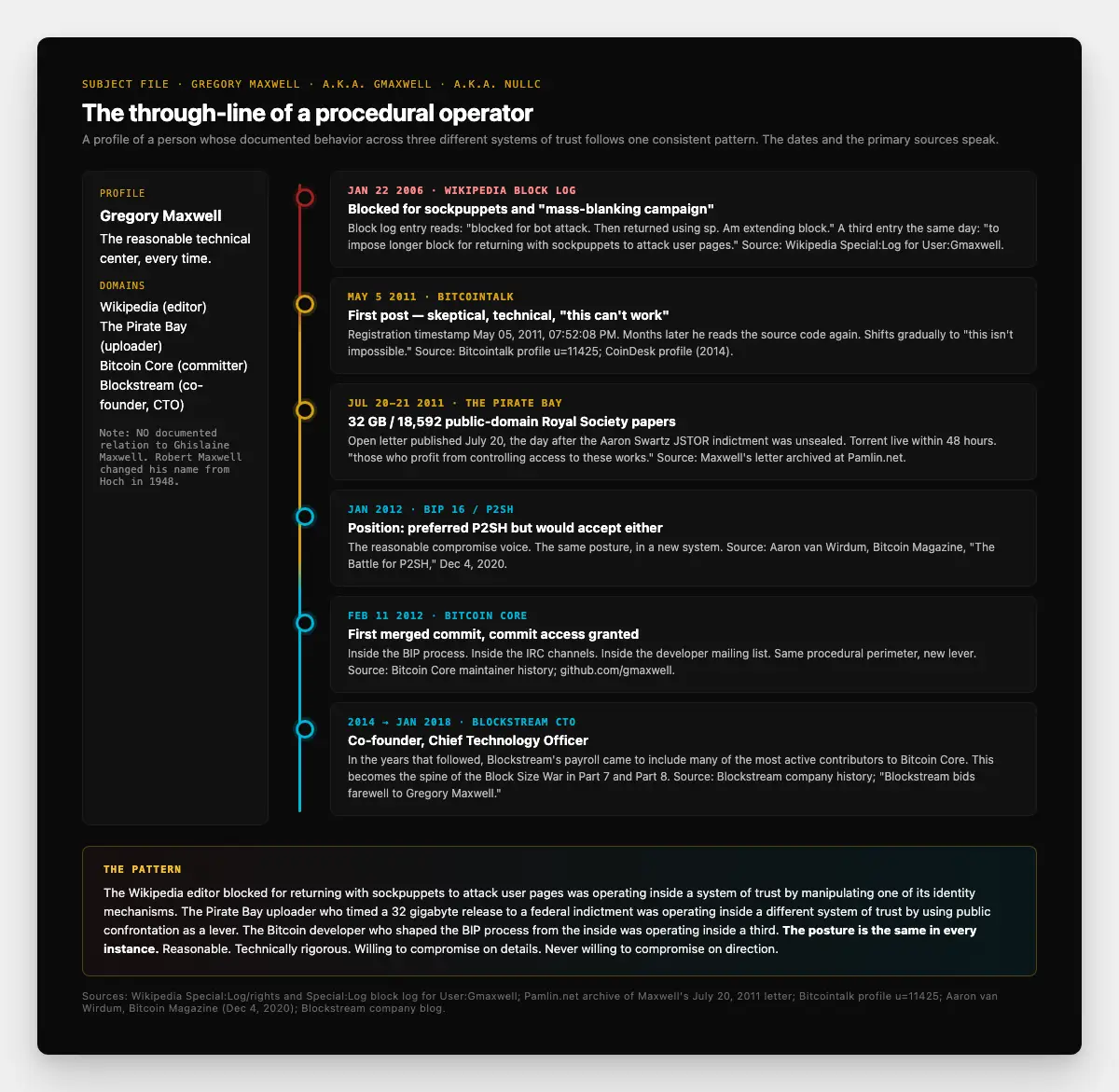
It is here because Gregory Maxwell is, by many measures, the most significant contributor to Bitcoin's overall vision in the post-Satoshi era until its most consequential era ends, and because understanding what he did and how he did it is the single biggest interpretive key to the next four articles in this series.
Before we jump in, I want to start with a piece of disambiguation that will irritate conspiracy theorists and big blockers.
A deep dive on Gregory Maxwell showed no documented connection to Ghislaine Maxwell.
Gregory's family, and that Maxwell family name, has an anchor in Florida for generations.
Robert Maxwell, Ghislaine's father, was born Ján Ludvík Hyman Binyamin Hoch in Czechoslovakia and changed his surname to Maxwell by deed of change of name on June 30, 1948.⁵⁵
The shared name is a coincidence. Note it because you have already heard the rumor. It is wrong.
That being said, what follows is documented.
Wikipedia, 2006
Gregory Maxwell has edited Wikipedia under the username Gmaxwell since late 2004.⁵⁶
On January 22, 2006, the Gmaxwell account was blocked by a Wikipedia administrator. The original log entry recorded the reason as "mass-blanking campaign, incivility, bad behaviour." A few minutes later the block was extended, with the noted reason "blocked for bot attack. Then returned using sp. Am extending block." On Wikipedia, "sp" is administrator shorthand for sockpuppet. A third log entry the same day recorded the longer block as imposed "to impose longer block for returning with sockpuppets to attack user pages."⁵⁷
The blocks were temporary. The account was unblocked within the week and has continued to contribute to Wikipedia in the years since.
The block log entry stays on the public record.
Hold that detail.
The JSTOR Moment, July 2011
On July 19, 2011, the federal indictment of Aaron Swartz was unsealed in U.S. District Court for the District of Massachusetts. Swartz had downloaded 4.8 million academic articles from the JSTOR database through an open network port at MIT. The unsealing put the charges on the public record.
The next day, on July 20, Greg Maxwell published an open letter explaining what he was about to do. Within forty-eight hours his torrent went live on The Pirate Bay. Roughly 32 gigabytes of scientific papers, 18,592 of them, all from the Philosophical Transactions of the Royal Society, all of them legitimately in the public domain.⁵⁸
Maxwell's letter, archived in full on Dennis Pamlin's site, read in part: "I've had these files for a long time, but I've been afraid that if I published them I would be subject to unjust legal harassment by those who profit from controlling access to these works."⁵⁹
A free-information idealist saw an information paywall, broke it on principle, and timed the action publicly forty-eight hours after a friend of the movement was charged for doing something similar.
It takes a specific kind of personality to walk toward institutional confrontation on a 48-hour timer.
Bitcoin, 2011 and Forward
His first Bitcointalk post under the gmaxwell account dates to May 5, 2011, six weeks before the Pirate Bay upload.⁶⁰ He was, at that point, skeptical of bitcoin. He questioned whether the system could really work. He posted technical critiques. He noted that the proof-of-work model had failure modes that the existing documentation did not address.
In a 2014 profile by CoinDesk, Maxwell described his entry to the project as a gradual capitulation.⁶¹ He kept noticing bitcoin was still running months after he had decided it couldn't. He read the source code. He read the consensus mechanism more carefully. He shifted, over months, from "this can't work" to "okay, this might work."
By the BIP 16 debate of January 2012, he was already on the developer wiki as a recognized voice. He preferred P2SH but would accept either. The model compromise voice. The reasonable technical center.
He received commit access to Bitcoin Core on February 11, 2012.⁶²
The Pattern
There is a through-line.
In 2006, on Wikipedia, the documented incident is a sockpuppet block. A second account was used to do something the primary account could not do under the system's normal rules.
In 2011, on The Pirate Bay, a 32 gigabyte torrent went live forty-eight hours after a federal indictment in a related case. The release was timed for maximum institutional attention.
In 2012, on the Bitcoin Core mailing list and developer wiki, a measured voice arrived as the reasonable technical center of a contentious vote, while accepting either outcome.
In each case, the posture is the same. Reasonable. Technically rigorous. Willing to compromise on details. Never willing to compromise on direction.
This is not a moral judgment. It is a pattern observation. The same person who, on Wikipedia in 2006, used a second account as a lever, and who in 2011 used a public protocol violation as a lever, is the person who in Bitcoin would later use the BIP process, the developer mailing list, the IRC channels, and ultimately the commit access of a single repository as levers in a different argument.
The technical influence that followed is documented and immense.
In 2014, Maxwell co-founded Blockstream with Adam Back, Austin Hill, Pieter Wuille, Matt Corallo, Mark Friedenbach, Jorge Timón, and others. He became its Chief Technology Officer, a role he held through January 2018.⁶³ In the years that followed, Blockstream's payroll came to include many of the most active contributors to Bitcoin Core, a fact documented in independent contributor-overlap analyses of the codebase.⁶⁴
That is the part that becomes the spine of the Block Size War in Part 7 and Part 8.
In January 2012, Gregory Maxwell was just another voice on a mailing list who preferred P2SH but would accept either.
Within three years, his company would employ most of the people writing Bitcoin's code, and his opinions would dominate BTC in ways that still echo today.
2013: The Consequences Arrive
Everything that had been building since 2011 detonated in 2013.
In February, bitcoin's price crossed $32 for the first time since the June 2011 crash. The forums woke up.
On March 11, 2013, the network experienced its first accidental chain fork.⁶⁶ Bitcoin 0.8 had migrated its block database from BerkeleyDB to LevelDB. The new client, with the new database, could process a block that the old client refused. Two valid chains ran in parallel for about six hours, with miners and merchants on different sides of the fork. The community resolved it by asking the largest pools to manually downgrade. BIP 50 would later codify the lesson. It remains the most serious operational incident in the network's history.
The developer community processed the fork in public, on Twitter, as it happened.
"This is how Bitcoin alerts look (if you missed yesterday's disaster :-)" @oleganza, March 12, 2013¹⁰⁷
On March 18, 2013, the Financial Crimes Enforcement Network issued Guidance FIN-2013-G001.⁶⁷ It classified bitcoin exchanges and miners as Money Services Businesses under the Bank Secrecy Act. KYC. AML. Recordkeeping. Reporting. The first major US regulatory framework. The Cambrian explosion's regulatory cost just got priced in.
On March 26, 2013, Cyprus seized depositor funds as part of its banking crisis. Bitcoin surged on the "safe haven" narrative. The price ran toward $266 within two weeks.
On April 9, 2013, the first 2013 bubble peaked at about $266 on Mt. Gox. By the end of the week it was $50.⁶⁸
In May, the Bitcoin Foundation held its first conference in San Jose. Gavin Andresen spoke. Erik Voorhees spoke. Brian Armstrong spoke. Roger Ver spoke. The hallway track was thick with developers, exchange operators, and a new arrival: lawyers.
On June 4, 2013, the Bitcoin Foundation received a cease-and-desist letter from the California Department of Financial Institutions, alleging the organization itself was operating as an unlicensed money transmitter.⁶⁹ The Foundation pushed back. The episode revealed how thin the regulatory ground actually was.
In August, a federal magistrate in Texas ruled that bitcoin was "a currency or a form of money" in the SEC's case against Trendon Shavers, the operator of a Bitcoin Savings and Trust Ponzi.⁷⁰ It was the first federal court ruling that bitcoin was money for legal purposes.
On October 1, 2013, the FBI arrested Ross Ulbricht in the Glen Park branch of the San Francisco Public Library. The Silk Road servers were seized. The site went dark. A few weeks later, the bureau would auction off approximately 144,336 BTC from Ulbricht's wallets. The cold open at the top of this article is the moment we just walked back into. The reader who started here now knows what was behind it.⁷¹
On October 29, 2013, the world's first bitcoin ATM was activated at Waves Coffee Shop in Vancouver. Eighty-one transactions were processed on day one.⁷²
On November 18, 2013, the Senate Committee on Homeland Security and Governmental Affairs held a hearing titled "Beyond Silk Road: Potential Risks, Threats, and Promises of Virtual Currencies."⁷³ Witnesses included FinCEN Director Jennifer Shasky Calvery, DOJ Acting Assistant Attorney General Mythili Raman, and Secret Service Deputy Special Agent Edward Lowery. The Washington Post described the hearing as "a Bitcoin lovefest."⁷⁴ The same federal government whose senators had called bitcoin "online money laundering" thirty months earlier was now openly discussing how the asset class could fit into the legitimate financial system.
The government was not afraid of bitcoin in November 2013.
It was figuring out how to use it.
On November 29, 2013, bitcoin hit $1,242 on Mt. Gox. The price would hold above $1,000 for less than two weeks. Subsequent academic research, particularly the Gandal et al. study on Mt. Gox trading patterns, would link the late-2013 rally to suspicious automated trading inside Mt. Gox.⁷⁵ The price discovery the market had been celebrating was, in part, the price discovery of a failing exchange faking its own volume.
Everyone who arrived in 2013 thought they had found an asset.
Most of what they found was a marketing surface for the people who had arrived in 2011.
Bitcoin Jesus
Before the outside money showed up, there was Roger Ver.
In late 2010, Ver, the founder of a Silicon Valley electronics reseller called Memory Dealers, heard about bitcoin from a podcast. He read the white paper. He read the source code. He read the forums. By early 2011, he was buying bitcoin at about $1 and his company had become the first established business to accept it as payment.⁷⁶
Then he started writing checks.
From 2011 through 2013, Roger Ver was the most prolific early-stage investor in the bitcoin ecosystem. The investment list is documented in his own statements, Wikipedia, and contemporary AMAs. BitInstant. Blockchain.info. Kraken. BitPay. Ripple. Bitcoin.com (he bought the domain). Purse.io. Memory Dealers Bitcoin Store. Bitcoin Foundation founding sponsorship.⁷⁷ Over a million dollars of his own capital, by his own accounting, across the companies that built the first generation of bitcoin infrastructure.
If you wanted to launch a bitcoin company between 2011 and 2013, you called Roger Ver.
He didn't ask for board seats. He didn't ask for control. He didn't ask for governance rights. He gave money and connections and credibility to people he believed in. He went on YouTube and gave away bitcoin to passersby on the street. He bought billboards in San Francisco. He was loud about it. He earned the nickname Bitcoin Jesus because he was running around the world with a missionary's energy, telling anyone who would listen that this thing was going to change the relationship between citizens and money.
He also put it on the permanent record. In 2011, Ver registered a bet on the Long Bets registry. His proposition, on file at longbets.org/611:
"I'm willing to bet $10,000 USD or equivalent in Bitcoins, that over the next 2 years, Bitcoins will not only outperform the stock market, Gold, Silver, and the US dollar, but Bitcoins will do it by more than 100 times." Roger K Ver, Long Bets #611, 2011¹⁰⁸
He believed in Satoshi's design. He read it as peer-to-peer electronic cash for the world. Payment rail. Daily commerce. The kind of bitcoin you can use to buy a sandwich.
In July 2013, after spending time with Mark Karpelès, he recorded a video vouching for Mt. Gox's solvency.⁷⁸ He went on camera, on the record, to defend an exchange that was, by that date, missing hundreds of thousands of bitcoin. He had been deceived. He apologized later. But it tells you something about the period that the most networked man in the ecosystem was being lied to by an exchange operator who sat on the same Foundation board.
This is the world Satoshi left behind working as intended. A community of believers funding tools for adoption. A network of mostly-young founders trying to ship infrastructure. An angel investor who poured his time and money into the project because he believed in the protocol.
Ver was at the center of that social graph.
In 2013, Roger Ver was the most important investor in Bitcoin.
By 2017, he would be an exile.
That is a story for Part 7 and Part 8.
What Was Building Underneath
Now we turn the temperature down.
This section deals with documented facts about living people. It does not accuse anyone of tricks or crimes. It presents what is in DOJ-released emails, court filings, and on-the-record interviews. The reader is welcome to interpret. Our job is to keep the temperature low and the citations clean.
Brock Pierce is a former child actor. He appeared in Disney's Mighty Ducks films in the early 1990s.⁷⁹ At seventeen, he co-founded a streaming video startup called the Digital Entertainment Network (DEN) with Marc Collins-Rector and Chad Shackley. DEN collapsed in 1999 after Collins-Rector was indicted for transporting minors across state lines for sex. Collins-Rector later pled guilty to eight counts of child enticement. Pierce was named in civil suits arising from DEN but was never charged.⁸⁰
The post-DEN years are sparse in the public record. Pierce worked in streaming and digital goods. He moved into virtual currency in online games. He was, in his own description, gold-farming in World of Warcraft.
Then, by his own account in a 2019 HackerNoon interview, Pierce was mining bitcoin when the network went live in 2009. His phrasing: "In 2009, when the Bitcoin network went live, Pierce tinkered with mining and amassed his early wealth in Bitcoin."⁸¹
So Pierce had been in bitcoin since 2009. Two years before Roger Ver. Six months before Laszlo bought the pizzas.
In early 2011, Pierce attended a private conference held at a hotel on Saint Thomas in the US Virgin Islands. The conference was organized by Al Seckel and was called Mindshift.⁸² Al Seckel was a science writer and conference impresario. The Mindshift conference, by documentation released later through the DOJ Epstein file dumps, was organized in part to rehabilitate Jeffrey Epstein's public image after his 2008 conviction.
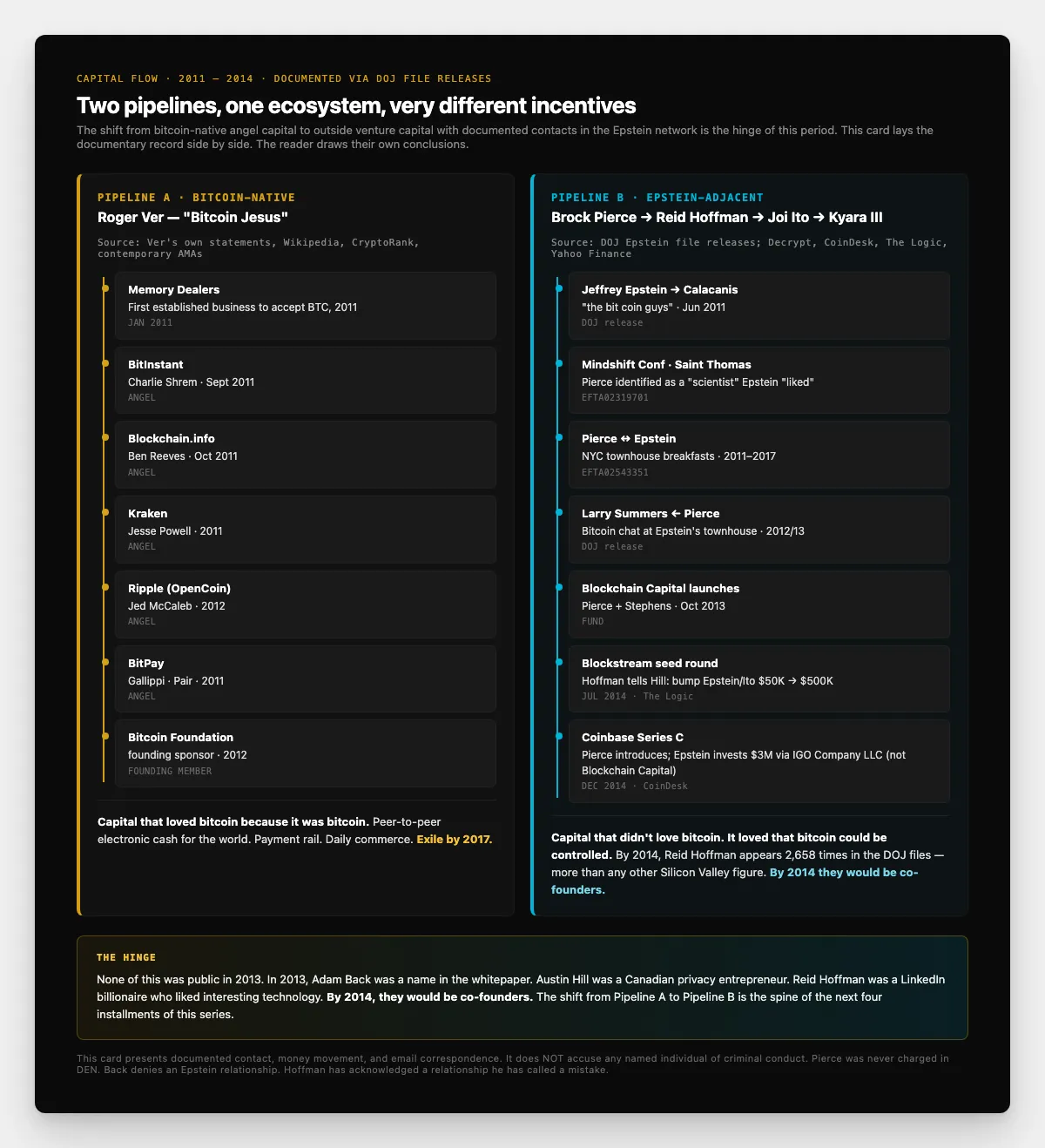
After the Mindshift conference, Epstein's executive assistant, Lesley Groff, identified Brock Pierce as one of "the scientists" that Epstein "liked." She passed Pierce's contact information to Epstein. The exchange is documented in DOJ file EFTA02319701.⁸³
In March 2011, by scheduling correspondence preserved in DOJ file EFTA02721955, Pierce was set to meet Epstein at his Manhattan mansion. The actual attendance has minor scheduling ambiguity but the meeting was on the books.⁸⁴
In September 2011, Pierce was confirmed for breakfast at "the house," meaning Epstein's Manhattan townhouse, per DOJ file EFTA02543351.⁸⁵
In December 2011, Pierce was on a flight with an Epstein associate referred to as "Alice." He was invited to Epstein's island by Sarah Kellen, Epstein's longtime fixer, with Pierce writing back that he would be ready at "the dock." DOJ files EFTA02297143 and EFTA02297356.⁸⁶
In 2012, Pierce was instructed by Epstein to "take photos" while traveling in Moscow, Kiev, and Odessa, ostensibly to find Epstein "a present." Pierce, in separate correspondence the same year, thanked Epstein for "a great time with the girls." DOJ files EFTA01889221 and EFTA00710096.⁸⁷
In 2012 or 2013, Pierce introduced Epstein to former Treasury Secretary Larry Summers at Epstein's Manhattan townhouse. The topic of conversation, per the DOJ files and Yahoo Finance's reporting on them, was Bitcoin.⁸⁸ Summers would later sit on the advisory board of Digital Currency Group...
In 2013, Pierce looped Epstein into efforts to acquire Mt. Gox before its implosion. He offered to introduce Epstein to the Winklevoss twins. DOJ files EFTA00962332 and EFTA00991279.⁸⁹
In October 2013, Pierce co-founded Blockchain Capital (originally Crypto Currency Partners) with Bart and Brad Stephens.⁹⁰ The fund was the first dedicated cryptocurrency venture fund. The following year, in December 2014, Pierce introduced Epstein to Coinbase's Series C round. Epstein invested roughly $3 million at a $400 million valuation, but did not go in through Blockchain Capital. He invested directly through his own USVI vehicle, a limited liability company called IGO Company. Blockchain Capital, when later asked about it, said the investment was independent of the fund.⁹⁰ᵇ
Also in 2013, Pierce co-founded Mastercoin, the project that ran the first Initial Coin Offering in bitcoin history. He also co-founded Tether, the stablecoin company that would, a decade later, be operating one of the largest unaudited dollar-denominated balance sheets on earth.⁹¹
In 2014, Brock Pierce was elected to the board of the Bitcoin Foundation. His election triggered resignations from members citing the DEN past.⁹²
In 2017, Pierce invited Epstein to stay at his home: a Masonic Temple in Puerto Rico.⁹³
Contact between Pierce and Epstein continued in DOJ-documented form into the spring of 2019. Epstein died in federal custody in August 2019, but their bitcoin-related relationship started in 2011, according to the record.
After Epstein's death, Pierce's spokesperson told the Hollywood Reporter that their relationship was benign and professional, stating, "the few communications that Mr. Pierce had with Epstein related to cryptocurrency" at "industry events, where many other prominent people were present."⁹⁴
The DOJ email releases run several thousand pages and document personal correspondence, romantic entanglements, island visits, photographing women in Eastern Europe, and years of intimate communication. The spokesperson's framing is not consistent with the documentary record.
The Wider Pipeline
The Pierce relationship is not the whole story. The DOJ files document a wider pipeline of contact between Epstein and the early bitcoin world.
June 2011. Epstein emails Jason Calacanis about "the bit coin guys."⁹⁵
July 2011. Epstein emails Amir Taaki directly.⁹⁶
In April 2014, an Epstein email references "Andy Back" being on his island that weekend. Adam Back has stated he has no recollection of meeting Epstein and has denied any relationship. The reference exists in the DOJ files. He is the same Adam Back whose Hashcash proof-of-work was cited in the bitcoin whitepaper, and who would, four months after this email, co-found Blockstream with Gregory Maxwell, Austin Hill and others.⁹⁷
In November 2014, the Italian venture capitalist Vincenzo Iozzo emailed Epstein asking about Adam Back. Epstein replied "like him."⁹⁸
In the same period, Austin Hill, the Blockstream co-founder, emailed Jeffrey Epstein and Joi Ito to tell them that Reid Hoffman, the LinkedIn founder, had instructed Hill to increase their Blockstream seed allocation from $50,000 to $500,000.⁹⁹ The funds flowed to Blockstream via a vehicle called Kyara Investments III, co-owned by Joi Ito and partially funded by Epstein.
By Business Today's analysis of the DOJ files, Reid Hoffman's name appears 2,658 times across the released documents, more than any other Silicon Valley figure.¹⁰⁰
Reid Hoffman would later invest $21 million in Blockstream's first round, and asked Epstein, in writing, "how hard to play" the Coinbase funding round.¹⁰¹
What This Section Is and Is Not
This section is a documented timeline of contact, money movement, and email correspondence between specific named individuals and Jeffrey Epstein in the 2011-2017 period.
It is not an accusation that any of these named individuals participated in Epstein's criminal conduct. Pierce was named in civil suits arising from DEN but never charged with a crime. Adam Back has denied any meaningful relationship with Epstein. Reid Hoffman has acknowledged a relationship but has stated he was unaware of Epstein's conduct at the time. Joi Ito resigned from the MIT Media Lab in 2019 after his fundraising history with Epstein became public.
What it is is the documentary record of a specific shift in the source of capital in the bitcoin world.
Through 2011 and 2012 and most of 2013, the dominant funder of the bitcoin ecosystem was Roger Ver. Bitcoin-native money from a man who wanted to see Bitcoin conquer the old world of elite banking and finance. Ver liked bitcoin because it was bitcoin. Ver funded BitInstant and Blockchain.info and Kraken and Bitpay because those companies used bitcoin as bitcoin.
Beginning in 2013, and accelerating through 2014, a different source of capital starts entering the same companies. Money from Sand Hill Road. Money from a townhouse on the Upper East Side. Money routed through Joi Ito's vehicle. Money that, in some documented cases, had a return address on a private island in the United States Virgin Islands.
That money did not love bitcoin because it was bitcoin.
That money loved bitcoin because it could be controlled.
By 2014, Adam Back, Austin Hill, and Reid Hoffman would be co-founders of Blockstream. By 2014, Brock Pierce would be on the board of the Bitcoin Foundation. By 2014, Epstein's vehicle would be a Blockstream seed investor. By 2014, the founders' room and the funders' room would not be the same room they had been in September 2012.
None of this was public in 2013.
In 2013, Adam Back was a name in the whitepaper. Austin Hill was a Canadian privacy entrepreneur. Reid Hoffman was a LinkedIn billionaire who liked interesting technology.
By 2014, they would be something else entirely...
If you want to go deeper into my prior reporting on this thread, the companion pieces are The Craziest Stuff You Haven't Heard about Epstein, BTC Was Hijacked, Everyone Knows It, Invisible Plantations, and Beyond Fraud: Tether's Secret Plan to Replace the Fed. The shape of the pipeline outlined above is documented across those four pieces in much more detail.
In 2013, this was a thread.
By 2017, it would be the spine.
Next Time
February 2014. Mt. Gox goes offline. 850,000 bitcoin are missing from the exchange, including 750,000 belonging to customers. Mark Karpelès, the man Jed McCaleb had handed the keys to in March 2011, stands in front of the Tokyo press corps and bows. The exchange that had been handling 80% of the world's bitcoin trades is bankrupt. The price collapses. Charlie Shrem is arrested at JFK. Andreas Antonopoulos resigns from the Foundation. The Cambrian explosion ends.
In the same year, a company called Blockstream incorporates in Montreal. It raises a seed round of $21 million from a list of investors that includes the cryptographer Adam Back, the Canadian privacy entrepreneur Austin Hill, LinkedIn billionaire Reid Hoffman, MIT Media Lab director Joi Ito, and a vehicle that traces back to Jeffrey Epstein. Within six months, Blockstream will hire most of the active Bitcoin Core developers, including the man whose Wikipedia history we just walked through.
The people who arrived in 2011 are no longer just making decisions.
They are taking control of the codebase.
Part 5 is called "The Gatekeepers."
Footnotes
¹ Ross Ulbricht arrest, Glen Park Library, San Francisco, October 1, 2013. Confirmed in Wikipedia: Ross Ulbricht and KQED, "How the FBI Caught Silk Road's Ross Ulbricht". The staged-argument detail is from the criminal complaint and is reproduced in Joshuah Bearman's two-part Wired feature, "The Untold Story of Silk Road," April-May 2015.
² Five-month fade and CIA timeline covered in detail in Part 3 of this series.
³ Brave New Books, Burnet Road, Austin, Texas. Operated 2006 to approximately 2017 under Harlan Dietrich with Catherine Bleish as managing partner. Austin Chronicle profile and Texas Observer coverage.
⁴ Silk Road launched on or about February 6 to 8, 2011. Wikipedia: Silk Road (marketplace).
⁵ Good Wagon Books, Austin, partnership of Ross Ulbricht and Donny Palmertree. Confirmed via FreeRoss.org family archive and Wikipedia: Ross Ulbricht.
⁶ Mises Circle at UT Austin. Michael Goldstein, "The Mises Circle at UT Austin". Themisescircle.org. Active 2012 to 2014 in the period this article covers.
⁷ The single-month convergence of June 2011 events is reconstructed from each individual event's primary sources, listed in subsequent footnotes.
⁸ Adrian Chen, "The Underground Website Where You Can Buy Any Drug Imaginable," Gawker, June 1, 2011. The original Gawker piece is archived at the Wayback Machine; secondary discussion at Wikipedia: Silk Road.
⁹ Senators Schumer and Manchin letter to AG Holder and DEA Administrator Leonhart, June 5 to 6, 2011. Reported by Techdirt and American Banker. Schumer's "online form of money laundering" quote was at a Sunday press conference.
¹⁰ Bitcoin price peak on Mt. Gox of approximately $32, June 8, 2011. BitMEX historical reconstruction and Wikipedia: Mt. Gox.
¹¹ Gavin Andresen presentation at the In-Q-Tel Emerging Technology Conference, CIA headquarters, June 14, 2011. Wikipedia: Gavin Andresen. Covered in Part 3.
¹² Jeffrey Epstein email to Jason Calacanis about "the bit coin guys," June 2011. Documented in the DOJ Epstein file releases and reported by Fortune, Decrypt, and others.
¹³ Epstein direct email to Amir Taaki, July 2011. DL News coverage of the DOJ file releases.
¹⁴ Mises Circle convener Michael Goldstein (Bitstein), regular attendees Daniel Krawisz, Pierre Rochard, George McHugh. Medium: bitstein.
¹⁵ Satoshi Nakamoto Institute founded as 501(c)(3) by Daniel Krawisz (Director of Research) and Michael Goldstein (President), November 2013. nakamotoinstitute.org/about.
¹⁶ Defense Distributed founded by Cody Wilson in Austin, 2012. Wikipedia: Cody Wilson. Texas Observer profile.
¹⁷ Defense Distributed Liberator test-fire, May 5, 2013. Wikipedia: Liberator (gun).
¹⁸ Dark Wallet announced by Cody Wilson and Amir Taaki, late 2013. Wired, "Dark Wallet". cryptoanarchy.wiki.
¹⁹ Research did not establish that Defense Distributed's blueprints were inscribed on the bitcoin blockchain during 2012-2013. Distribution was via Defense Distributed's website with bitcoin accepted for donations.
²⁰ Mt. Gox June 13, 2011 theft of 25,000 BTC from 478 accounts. Wikipedia: Mt. Gox. BitMEX historical analysis.
²¹ Mt. Gox flash crash, June 19, 2011. BitMEX and Wikipedia: Mt. Gox.
²² MyBitcoin disappearance, July 29, 2011. Reported in The Merkle and contemporary forum coverage. The operator "Tom Williams" has never been identified.
²³ Bitcoin price low of approximately $2.14 on November 18, 2011. CoinMarketCap historical and Wikipedia: Bitcoin.
²⁴ 85,109 BTC missing from Mt. Gox by October 2011 (internal exchange knowledge, not publicly disclosed until 2014 bankruptcy proceedings). Wikipedia: Mt. Gox.
²⁵ Alert key mechanism and its non-use during Mt. Gox events covered in Part 3.
²⁶ Bitcoinica hacks of March and May 2012, totaling approximately 56,547 BTC. Bitcoin Magazine timeline.
²⁷ TradeHill closure, February 13, 2012. Bitcoin Magazine.
²⁸ Mt. Gox approximately 80% of global BTC trading volume by 2012. Wikipedia: Mt. Gox.
²⁹ BitPay founded May 2011 by Tony Gallippi and Stephen Pair. Wikipedia: BitPay.
³⁰ Kraken founded July 28, 2011, by Jesse Powell. Powell's Mt. Gox visit after the June 2011 hack is documented in his own public statements and the Wikipedia: Kraken (company) entry.
³¹ BitInstant founded September 2011 by Charlie Shrem and Gareth Nelson. Wikipedia: Charlie Shrem.
³² Bitstamp founded August 2011 in Slovenia by Nejc Kodrič and Damijan Merlak. Wikipedia: Bitstamp.
³³ Blockchain.info launched October 2011 by Ben Reeves. Wikipedia: Blockchain.com.
³⁴ Bitcoin Magazine co-founded by Vitalik Buterin and Mihai Alisie in late 2011; first print issue May 2012. Wikipedia: Bitcoin Magazine.
³⁵ Coinbase founded June 2012 by Brian Armstrong and Fred Ehrsam. Wikipedia: Coinbase.
³⁶ LocalBitcoins founded June 2012 in Helsinki by Jeremias Kangas. Wikipedia: LocalBitcoins. Service shut down February 2023.
³⁷ Bitfinex founded November 2012 by Raphael Nicolle and Giancarlo Devasini. Wikipedia: Bitfinex.
³⁸ OpenCoin (later Ripple Labs) incorporated September 2012 by Jed McCaleb and Chris Larsen. Wikipedia: Ripple Labs.
³⁹ Bitcoin Foundation founded September 27, 2012. Wikipedia: Bitcoin Foundation.
⁴⁰ Bruce Fenton proposal to remove Satoshi as a listed founding member, 2015. CoinDesk coverage.
⁴¹ California Department of Financial Institutions cease and desist letter to the Bitcoin Foundation, June 2013. CryptoSlate and CoinDesk.
⁴² Brock Pierce elected to Bitcoin Foundation board in May 2014 runoff with Bobby Lee; resignations followed. CoinDesk coverage.
⁴³ Roger Ver investment portfolio 2011 to 2013 documented in his own statements, rogerver.com/bio, Wikipedia: Roger Ver, and historical CryptoRank entries.
⁴⁴ Brock Pierce mining timeline self-reported in HackerNoon interview, January 2019. Mindshift conference and Manhattan townhouse breakfast documented via DOJ file releases reported by Decrypt.
⁴⁵ The first Bitcoin war framing is from Aaron van Wirdum, "The Battle for P2SH: The Untold Story of the First Bitcoin War," Bitcoin Magazine, December 4, 2020.
⁴⁶ BIP 17 (OP_CHECKHASHVERIFY) proposed by Luke Dashjr, January 18, 2012. bips.dev/17.
⁴⁷ Dashjr accusations regarding default settings detailed in van Wirdum, Bitcoin Magazine, December 2020.
⁴⁸ Van Wirdum, Bitcoin Magazine, December 2020. Same source.
⁴⁹ BIP 16 activation, April 1, 2012. bips.dev/16.
⁵⁰ Developer wiki voting positions reproduced in van Wirdum, Bitcoin Magazine, December 2020.
⁵¹ BIP 32 Hierarchical Deterministic Wallets proposed by Pieter Wuille, February 11, 2012. GitHub: bip-0032.
⁵² BIP 34 proposed by Gavin Andresen, July 6, 2012. bips.dev/34.
⁵³ BIP 34 activation, March 5, 2013 (75% at block 224,413) and March 25, 2013 (95% at block 227,931). bips.dev/34 and Bitcoin Optech.
⁵⁴ First halving, block 210,000, November 28, 2012. Reward dropped from 50 BTC to 25 BTC. Bitcoin Wiki: Controlled supply. Price data via Kraken historical and CoinTelegraph.
⁵⁵ Robert Maxwell, born Ján Ludvík Hyman Binyamin Hoch on June 10, 1923 in Czechoslovakia, changed his name to Ian Robert Maxwell by deed of change of name on June 30, 1948. Wikipedia: Robert Maxwell. No documented connection between Gregory Maxwell and the Robert Maxwell family has been established.
⁵⁶ Gregory Maxwell Wikipedia user page, contributing under username "Gmaxwell" since late 2004. User.
⁵⁷ Wikipedia block log for User, January 22, 2006 entries. Special block log for User.
⁵⁸ Greg Maxwell, Pirate Bay upload of 18,592 Royal Society papers (approximately 32 GB), torrent live July 21, 2011. The indictment of Aaron Swartz for the JSTOR downloads was returned July 11, 2011 and unsealed July 19, 2011. Contemporaneous report: Kashino, "A user called Greg Maxwell just uploaded a torrent...".
⁵⁹ Greg Maxwell, open letter, July 20, 2011, archived at Pamlin.net, "Full letter from Greg Maxwell".
⁶⁰ Gregory Maxwell Bitcointalk profile, registration date May 5, 2011, 07:52 PM. Bitcointalk profile u=11425.
⁶¹ Gregory Maxwell, CoinDesk profile, 2014. CoinDesk.
⁶² Gregory Maxwell, first Bitcoin Core merged commit, February 11, 2012. Bitcoin Core maintainer history; github.com/gmaxwell.
⁶³ Blockstream founded 2014. Co-founders include Adam Back, Gregory Maxwell, Pieter Wuille, Matt Corallo, Mark Friedenbach, Jorge Timón, Austin Hill, Jonathan Wilkins, Francesca Hall, and Alex Fowler. Wikipedia: Blockstream. Maxwell served as Chief Technology Officer through January 2018: Blockstream, "Blockstream bids farewell to Gregory Maxwell".
⁶⁴ Contributor composition of Bitcoin Core during Maxwell's Blockstream tenure can be reconstructed from the Bitcoin Core GitHub contributors graph cross-referenced against Blockstream's archived team pages.
⁶⁵ SegWit activation on Litecoin, May 10, 2017. Bitcoin's SegWit activation occurred August 24, 2017. Activation date sources: Litecoin GitHub release notes and Bitcoin Optech.
⁶⁶ BIP 50 accidental chain fork, March 11, 2013. bips.dev/50 and Bitcoin Magazine.
⁶⁷ FinCEN Guidance FIN-2013-G001, March 18, 2013. fincen.gov.
⁶⁸ April 9, 2013 price peak of approximately $266 on Mt. Gox. CoinTelegraph historical.
⁶⁹ California Department of Financial Institutions cease and desist, June 4, 2013. CryptoSlate.
⁷⁰ SEC v. Trendon Shavers, federal magistrate ruling on bitcoin as money, August 2013. SEC press release.
⁷¹ Ross Ulbricht arrest, October 1, 2013, and subsequent FBI auctions of seized BTC. Wikipedia: Ross Ulbricht.
⁷² First bitcoin ATM, Waves Coffee Shop, Vancouver, October 29, 2013. CBC News coverage. TIME magazine.
⁷³ Senate Homeland Security hearing, "Beyond Silk Road: Potential Risks, Threats, and Promises of Virtual Currencies," November 18, 2013. Senate HSGAC archives.
⁷⁴ Washington Post coverage of the November 18, 2013 hearing characterizing it as "a Bitcoin lovefest." Washington Post archives.
⁷⁵ Gandal, Hamrick, Moore, and Oberman, "Price manipulation in the Bitcoin ecosystem," peer-reviewed analysis of Mt. Gox trading patterns linking suspicious automated trading to the late-2013 price rally. Summarized in Bitcoin Magazine.
⁷⁶ Roger Ver early bitcoin biography. Wikipedia: Roger Ver. rogerver.com/bio.
⁷⁷ Roger Ver investment portfolio cited above. Self-reported and corroborated by CryptoRank and the BitcoinWiki entry on Memory Dealers.
⁷⁸ Roger Ver Mt. Gox solvency video, July 17, 2013. Recording was widely circulated and discussed in subsequent coverage of the Mt. Gox collapse, including Nathaniel Popper, "Digital Gold," Harper, 2015.
⁷⁹ Brock Pierce, child-acting career and DEN co-founding. Wikipedia: Brock Pierce.
⁸⁰ Marc Collins-Rector indictment and plea, Wikipedia: Marc Collins-Rector. Pierce was named in DEN-related civil suits but never charged criminally.
⁸¹ Brock Pierce, "tinkered with mining and amassed his early wealth in Bitcoin." HackerNoon interview with Martine Paris, January 2, 2019.
⁸² Mindshift conference organized by Al Seckel on Saint Thomas, USVI. DOJ file EFTA02417540 references reported by Decrypt.
⁸³ Lesley Groff email identifying Pierce as a "scientist" Epstein "liked." DOJ file EFTA02319701, reported by Decrypt.
⁸⁴ Pierce-Epstein Manhattan mansion meeting, March 2011 scheduling. DOJ file EFTA02721955, reported by Decrypt.
⁸⁵ Pierce-Epstein townhouse breakfast confirmation, September 2011. DOJ file EFTA02543351, reported by Decrypt.
⁸⁶ Pierce flight with "Alice" and December 2011 Epstein island invitation via Sarah Kellen. DOJ files EFTA02297143 and EFTA02297356, reported by Decrypt.
⁸⁷ Pierce Eastern Europe travel and "great time with the girls" correspondence, 2012. DOJ files EFTA01889221 and EFTA00710096, reported by Decrypt.
⁸⁸ Pierce introduction of Larry Summers to Epstein, Manhattan townhouse, conversation about Bitcoin. Yahoo Finance and DOJ file releases summarized by Decrypt.
⁸⁹ Pierce attempts to broker Mt. Gox acquisition for Epstein, 2013. DOJ files EFTA00962332 and EFTA00991279, reported by Decrypt.
⁹⁰ Blockchain Capital co-founded by Brock Pierce, Bart Stephens, and Brad Stephens, October 2013. HackerNoon interview, January 2019.
⁹⁰ᵇ Epstein's Coinbase Series C investment of approximately $3 million via IGO Company LLC (USVI), December 2014. CoinDesk, "Newly Unsealed DOJ Files Link Jeffrey Epstein to a 2014 Investment in Coinbase," February 2026. Blockchain Capital told Decrypt the investment was independent of the fund. Decrypt, "Jeffrey Epstein Was an Early Investor in Coinbase".
⁹¹ Mastercoin first ICO, 2013. Tether co-founded by Brock Pierce, Craig Sellars, and Reeve Collins, with Bitfinex executives, in 2014 (the precursor "Realcoin" project launched in 2014; Mastercoin foundation work in 2013). Wikipedia: Tether. See also Kurt's earlier reporting in Beyond Fraud: Tether's Secret Plan to Replace the Fed.
⁹² Brock Pierce 2014 Bitcoin Foundation board election and ensuing resignations. CoinDesk coverage.
⁹³ Pierce invitation to Epstein to stay at his Masonic Temple, Puerto Rico, 2017. DOJ file releases reported by Decrypt.
⁹⁴ Brock Pierce spokesperson statement to Hollywood Reporter, 2019. Subsequent DOJ file releases contradicted the "industry events" framing.
⁹⁵ Epstein-Calacanis email, June 2011, source above.
⁹⁶ Epstein-Taaki email, July 2011, source above.
⁹⁷ DOJ email referencing "Andy Back" on Epstein's island, April 2014. Reported by Decrypt. Adam Back has publicly denied a relationship with Epstein.
⁹⁸ Vincenzo Iozzo to Epstein query about Adam Back, with Epstein reply "like him," November 2014. DOJ file releases reported by Decrypt.
⁹⁹ Reid Hoffman directs Austin Hill to increase Epstein/Ito Blockstream allocation from $50K to $500K. Fortune and The Logic summaries of DOJ file releases.
¹⁰⁰ Reid Hoffman appears in DOJ Epstein files 2,658 times. Business Today analysis.
¹⁰¹ Reid Hoffman query to Epstein regarding Coinbase funding round. DOJ file releases summarized by CoinDesk.
¹⁰² Gavin Andresen, @gavinandresen tweet, June 14, 2011. Status ID 80785477342478336. Confirmed live on X.
¹⁰³ WikiLeaks, @wikileaks tweet, June 14, 2011. Status ID 80774521350668288. Posted hours before Gavin's CIA tweet the same day. Satoshi's December 2010 public appeal to WikiLeaks not to adopt bitcoin is covered in Part 3 and archived at Satoshi Nakamoto Institute post 523.
¹⁰⁴ MagicalTux (Mark Karpelès) IRC log, June 19, 2011, reproduced in BitMEX Research, "The June 2011 Bitcoin Flash Crash". Source is IRC, not Twitter.
¹⁰⁵ Jon Matonis, @jonmatonis tweet announcing the Bitcoin Foundation launch, September 27, 2012. Sourced via Jameson Lopp's Annals of Bitcoin Twitter compilation.
¹⁰⁶ Jameson Lopp, @lopp tweet, November 28, 2012. Sourced via Annals of Bitcoin Twitter.
¹⁰⁷ Oleg Andreev, @oleganza tweet, March 12, 2013. Sourced via Annals of Bitcoin Twitter.
¹⁰⁸ Roger K Ver, Bitcoin bet registered at Long Bets #611, 2011. Permanent dated public archive.
Be good to each other. And remember the difference between the people who built something and the people who arrived to own it.