The Written History of Bitcoin: A Tale of 2 Bitcoins, and Then 3!
By Kurt Wuckert Jr.
The Impossible Number
On the evening of December 19, 2017, a new market flickered to life on GDAX, the professional trading arm of Coinbase, and within seconds it printed a number that could not exist.
Bitcoin Cash at $8,500.¹ Some screens caught prints reaching toward $9,500.² The same asset was trading around $3,500 everywhere else on earth at that exact moment.³ Not in another country. Not on some illiquid backwater. On the same internet, in the same minute, an asset had two prices, and the gap between them was a fortune.
Trading lasted about three minutes before Coinbase pulled the plug.⁴
Three minutes.
Here is the detail that turns a glitch into a story. The price of Bitcoin Cash had been climbing for hours before Coinbase announced it was listing the coin. The buying started before the news. Somebody was early. We are going to come back to who knew, what the chief executive said he would do about it, and what a federal judge eventually said about those three minutes, because the answer tells you everything about the machine that Bitcoin had been fed into by the winter of 2017.
But you cannot understand how a coin ended up with two prices at once, and was about to have three, until you go back to the summer, to the morning after the divorce, when one Bitcoin became two and nobody yet knew which one was real.
So hold the anomaly. We will return to it. Rewind to August 2017.
One Chain Becomes Two Markets
In Part 6, the chain split. Block 478,558 was the last block the two camps ever shared.⁵ The small blockers kept Bitcoin (BTC), with its activated SegWit, its ticker, its press, its exchanges, and its name. The big blockers walked into exile with a new chain called Bitcoin Cash (BCH), eight-megabyte blocks, and a conviction that they were carrying the original design into the wilderness. And the man from Sydney, Craig Wright, who had stood on the Arnhem stage telling the room they were with him or against him, was not done either. None of them were.
Part 7 is the fork wars. The fight you are about to read is not big blocks against small blocks. That war is over. This is a war between people who all wanted big blocks, who all said they believed in Satoshi's design, and it will tear them apart so completely that by the end of it there will be three Bitcoins where there had been one, and each new one will be smaller than the last, in fiat price value, but successively bigger in scope and technical vision.
It starts with a chain that almost died at birth.
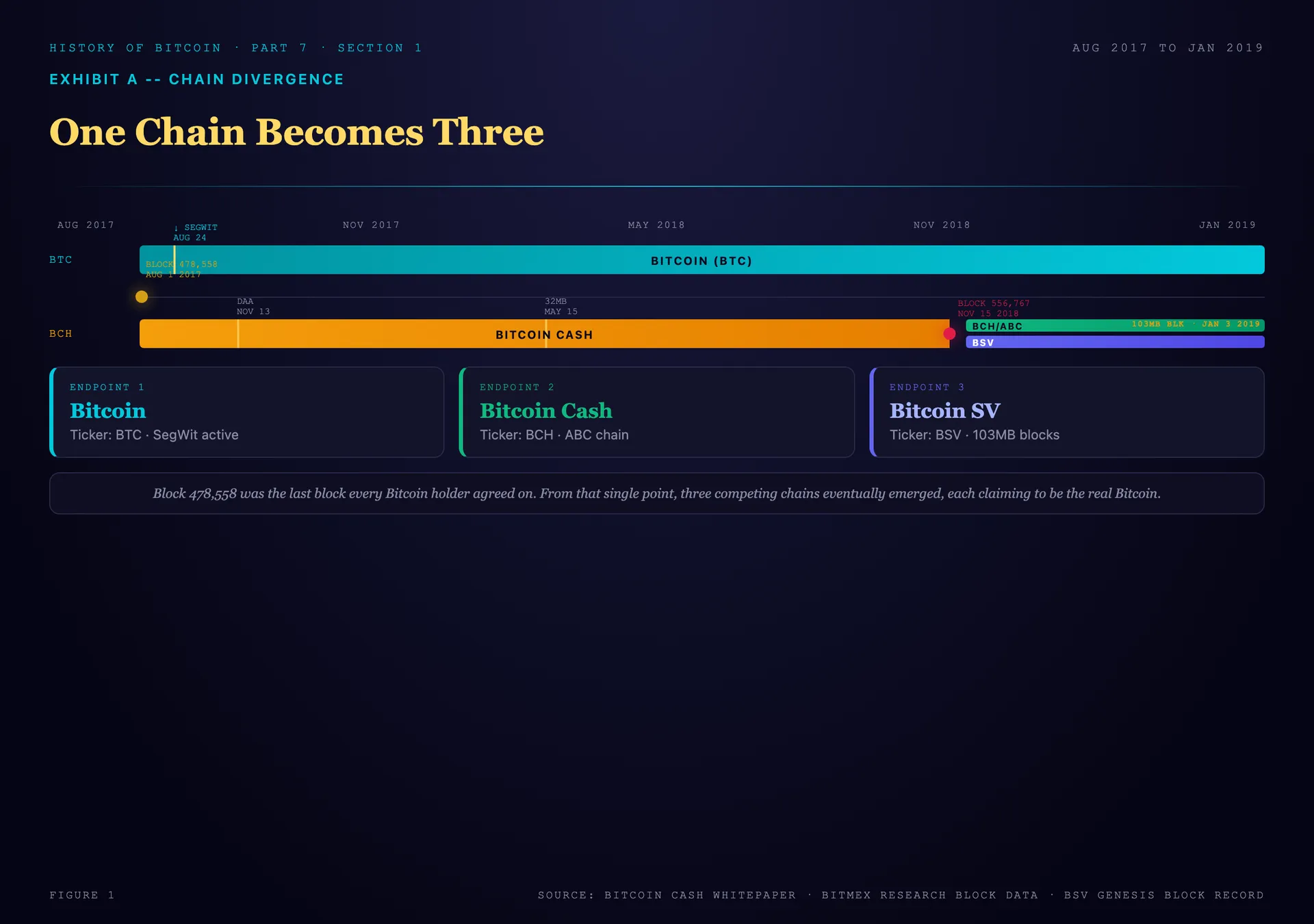
When Bitcoin Cash forked away, it inherited Bitcoin's full mining difficulty with almost none of Bitcoin's hash rate pointed at it.⁶ A chain with high difficulty and low hashpower is a chain where blocks come slowly, sometimes catastrophically slowly, and a coin that cannot confirm transactions is a coin that dies. So the BCH developers had bolted on an Emergency Difficulty Adjustment, an EDA, that slashed difficulty by about twenty percent whenever six blocks took longer than twelve hours to mine.⁷ It was a defibrillator. It kept the patient alive. It also made the patient convulse.
Here is what the EDA actually did once miners figured out how to game it. When difficulty dropped low enough, mining BCH became wildly more profitable than mining BTC, so hashpower flooded in from the bigger chain. Blocks that had been crawling now came in bursts. On October 12, 2017, Bitcoin Cash went from producing roughly one block every four hours to producing sixty-one blocks in a single hour.⁸ Blocks arriving twenty seconds apart. Then the difficulty would readjust upward, mining would become unprofitable again, the rented hashpower would flee back to BTC, and the chain would freeze until the EDA kicked in and started the cycle over.⁹
It was a roller coaster, and it had a cost on both chains. Every time the profit-chasing miners jumped to Bitcoin Cash, Bitcoin's own blocks slowed down, its mempool backed up, and its fees climbed.¹⁰ The accelerated, oscillating issuance also meant Bitcoin Cash minted its coins far faster than schedule; by the time the bug was fixed, the BCH chain had raced thousands of blocks ahead of where a steady ten-minute cadence would have put it.¹¹ Critics on the BTC side watched the convulsions and pronounced the patient terminal. They had a point. A money that emits in seizures is not a money.
So the exile chain did something the chain it left behind would not do for years. It fixed its protocol.
On November 13, 2017, Bitcoin Cash executed a planned hard fork and replaced the EDA with a new difficulty adjustment algorithm that smoothed difficulty over a 144-block moving average, the work of a developer named Amaury Séchet and tested by Bitprim and nChain.¹² Bitcoin ABC, Séchet's implementation, stated the goal plainly: "Avoid oscillations from feedback between hash rate and difficulty."¹³ The convulsions stopped. And in case you are counting, that was the second consensus-level upgrade the exile chain had shipped in roughly a hundred days.
Now look at what the original chain shipped in the same window.
Nothing. Worse than nothing. BTC's one and only consensus event of that autumn was a cancellation. SegWit2x, the second half of the New York Agreement, the two-megabyte hard fork that the big blockers had been promised in exchange for activating SegWit, was killed on November 8 by an email from Mike Belshe, eight days before it would have activated.¹⁴ I covered the mechanics of that betrayal in Part 6; the short version is that the small-block side agreed to everything, delivered the half it wanted, and buried the half it didn't.¹⁵
The market did something honest that week, for a moment. On the day SegWit2x died, BTC printed a then-record $7,879, and then fell about thirty percent over the next four days.¹⁶ Bitcoin Cash, freed of the suspicion that a bigger-block BTC was coming, ran the other way. It went from around $600 to an intraday high of $2,477.65 on Sunday, November 12.¹⁷ For one weekend, on the order books of the world's exchanges, the question "which one is the real Bitcoin?" was priced as genuinely open.
Then it closed again. By Monday, BCH had been cut roughly in half.¹⁸ The window shut. But it had been open. Remember that, because almost everything that follows is the story of the big-block side trying to pry that window back open, and breaking its own fingers in the frame.
The Empire of Settlement
While Bitcoin Cash was convulsing and recovering, something quieter and more permanent was happening on BTC. The thing it had spent three years fighting for finally arrived, and the moment it arrived, the project stopped.
SegWit had activated on August 24, 2017, at block 481,824.¹⁹ With it locked in, consensus-layer development on Bitcoin effectively ended. There would be no block size increase. There would be no restoration of the disabled features. The base layer was, in the words the Blockstream camp had been using for two years, a settlement layer now, and you do not let people use a settlement layer as cash.²⁰ The roadmap moved to a newly launched network with its own nodes and policies, marketed as a "second layer" that would carry the payments the base layer was no longer allowed to.
That second layer was the Lightning Network, and 2018 was the year it was supposed to prove itself.
Three implementations reached mainnet in quick succession. Lightning Labs shipped lnd 0.4-beta on March 15, 2018.²¹ ACINQ's Eclair followed on March 28.²² And on June 25, Blockstream shipped c-lightning 0.6.²³ Sit with that last one. The company that had spent three years arguing the base layer must be kept small, expensive, and settlement-only, the company funded by the very financial incumbents whose business peer-to-peer cash threatened, was now shipping the off-chain product you were supposed to use instead. They constrained the base layer and then sold you the upstairs. I walked through that business model in Part 4B; here it is, shipping.²⁴
And how did the flagship work, in practice, in 2018?
There is a perfect emblem for the answer, and it is a pizza.
On February 25, 2018, Laszlo Hanyecz bought two pizzas over the Lightning Network.²⁵ If that name sounds familiar, it should. Laszlo is the man who, on May 22, 2010, bought two pizzas for 10,000 bitcoin in the transaction that gave Bitcoin its first real-world price, the day we still celebrate as Pizza Day.²⁶ Eight years later, the same man, buying the same lunch, was the test pilot again. He paid 0.00649 BTC, about sixty-two dollars, and to prove the payment had reached the driver he read back the first and last four characters of the payment preimage like a hostage reading a serial number.²⁷ The transaction required a friend in London running a node with an open channel, manual coordination, and prepayment.²⁸
Laszlo, to his credit, believed in it. "The lightning network promises to bring back that functionality of being able to buy pizza with bitcoin," he told CoinDesk.²⁹ But he also named the problem out loud to Fortune: "If it's a $50 pizza and a $100 transaction fee, that doesn't work."³⁰
The first pizza proved Bitcoin could be money. The second pizza proved a payment could route, sometimes, if you knew a guy.
This time the pizza was the demo.
And the demo was rough. A study by the research firm Diar in June 2018 found that Lightning payments routed successfully about seventy percent of the time for the smallest amounts, and that the success rate fell toward one percent as the payment size climbed toward the network's practical ceiling.³¹ The early mainnet users wore the danger as a badge; the meme of the moment was "reckless," and Lightning Labs answered it with its own hashtag, "craeful gang," while its release notes begged people to "experiment with only small amounts."³² Elizabeth Stark, the chief executive of Lightning Labs, put it bluntly in January: "I'm not fine leading the way on mainnet with known very buggy software that will give us all a bad name."³³
This is not a hit piece on Lightning, which would mature into something eventually, although their promises of "in 18 months" became the big blockers' meme about Lightning for the better part of the next half-decade. Either way, the chain that had won the war could no longer reliably buy a pizza on its own base layer, and the people building the replacement were telling you, in writing, not to trust it with real money yet. Pretty soon, I'll ask you to weigh that against what the exile chain was about to do with its own blocks, because the contrast is the whole argument.
Chicago Builds a Door
I am from Chicago. So let me tell you about my hometown's oldest trick, because Bitcoin walked straight into it in December 2017 and most of the people who claim to understand Bitcoin still do not understand what happened.
Chicago makes markets out of anything. Pork bellies, starting in 1961.³⁴ Weather, starting in 1999, the first exchange-traded weather derivatives on earth, so you could literally bet on how cold the winter would be.³⁵ The city's traders once made a market in onions so aggressively that two of them cornered ninety-nine percent of all the onions in Chicago, drove the price from $2.75 a bag down to ten cents, and dumped so many onions in the Chicago River that Congress passed a law, signed in 1958, banning onion futures forever. Onions remain the only commodity in America you are not allowed to trade as a future, thanks to Chicago.³⁶ So there's the backdrop of the place where I grew up, and where Bitcoin was about to get beat up.
It built two, eleven days apart.
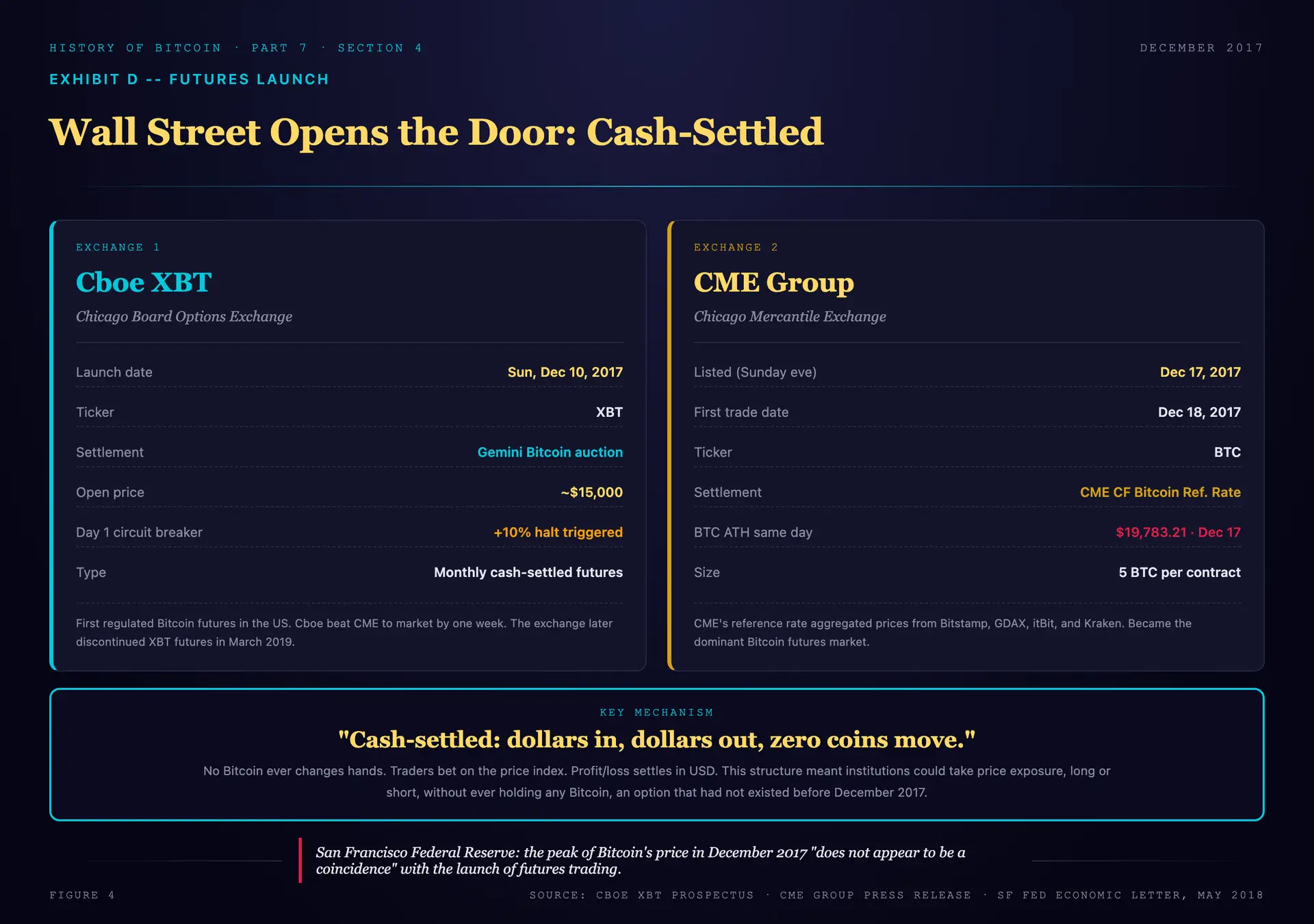
Cboe went first. On Sunday, December 10, 2017, at 5 p.m. Chicago time, the Cboe began trading XBT, a Bitcoin futures contract.³⁷ The website crashed almost immediately under the traffic.³⁸ The contract opened around fifteen thousand dollars and triggered its volatility circuit breakers, one halt at a ten percent move and another at twenty, on its first night.³⁹
Then the heavyweight. On the evening of Sunday, December 17, for the official trade date of Monday, December 18, the CME Group, the largest derivatives exchange in the world, opened its own Bitcoin futures on the Globex system.⁴⁰
Now hold two dates next to each other. The CME contract went live the evening of December 17. Bitcoin's price peaked at $19,783.21 on December 17, in the hours before that contract opened.⁴¹ It would not see that number again for three years. The all-time high of the greatest bull run in Bitcoin's history printed on the same calendar day that the world's largest futures exchange opened a way to bet against it.
The Federal Reserve Bank of San Francisco said the quiet part in an Economic Letter the following May: "The rapid run-up and subsequent fall in the price after the introduction of futures does not appear to be a coincidence."⁴²
Here is the mechanism, and it is the most important sentence in this section. These contracts were cash-settled. No bitcoin ever changed hands. You could go long or short, win or lose fortunes, and not one satoshi moved on the blockchain. The futures created a parallel Bitcoin, a paper Bitcoin, whose price could be pushed around by people who never had to touch the real thing.
Remember the paper Bitcoin. It comes back, much bigger, in the era of the exchange-traded fund.
I have to be fair to Chicago here, because the blame in this series goes to a specific group and Chicago is not it. The futures desks understood Bitcoin better than most of the coiners did. The proprietary trading firms were first in line; Akuna Capital posted some of the first Cboe quotes, DRW's Cumberland desk had been trading bitcoin since 2014, and the CME had been building its reference rate since late 2016.⁴³ One Chicago family even sits at the strange center of this story. William Mallers Sr. was elected chairman of the Chicago Board of Trade in 1969 at the age of thirty-nine, the youngest ever to hold the post, and went on to found a futures brokerage called First American Discount in 1984.⁴⁴ His son, William Mallers Jr., served as that firm's first president.⁴⁵ And the son introduced his own boy to Bitcoin in 2013. That boy, Jack Mallers, born in 1994, had just shipped a Lightning wallet called Zap in August 2017.⁴⁶
Remember Jack Mallers. He matters enormously later, in a country called El Salvador, but that is a story for a future installment.
The top was in. Chicago built the door, and the bull market walked out of it. But do not blame the carpenters. Markets are what Chicago does; at least when it isn't doing the most [REDACTED] on earth!
The Casino Era
So now I have to show you the terrain, because the big blockers in exile were not fighting on neutral ground. They were fighting inside a casino, and the casino was new, and it was enormous, and it had been built, in large part, out of the wreckage of the battle they had just lost in a war that is only starting to make sense in hindsight.
Let me start with the scoreboard, because Bitcoin people hate this number and you need to see it.
For the first two years of its life, Bitcoin was one hundred percent of the digital currency market, because it was the only one.⁴⁷ When CoinMarketCap began tracking the field in April 2013, Bitcoin was about ninety-four percent of all blockchain assets by value.⁴⁸ The first wave of altcoins, Litecoin and Dogecoin and the forgotten corpses of 2014, dented that to the high seventies, but it recovered to around ninety percent by early 2016, because that first wave never built anything Bitcoin could not do.⁴⁹
Then came the civil war, and watch what happens to the number.
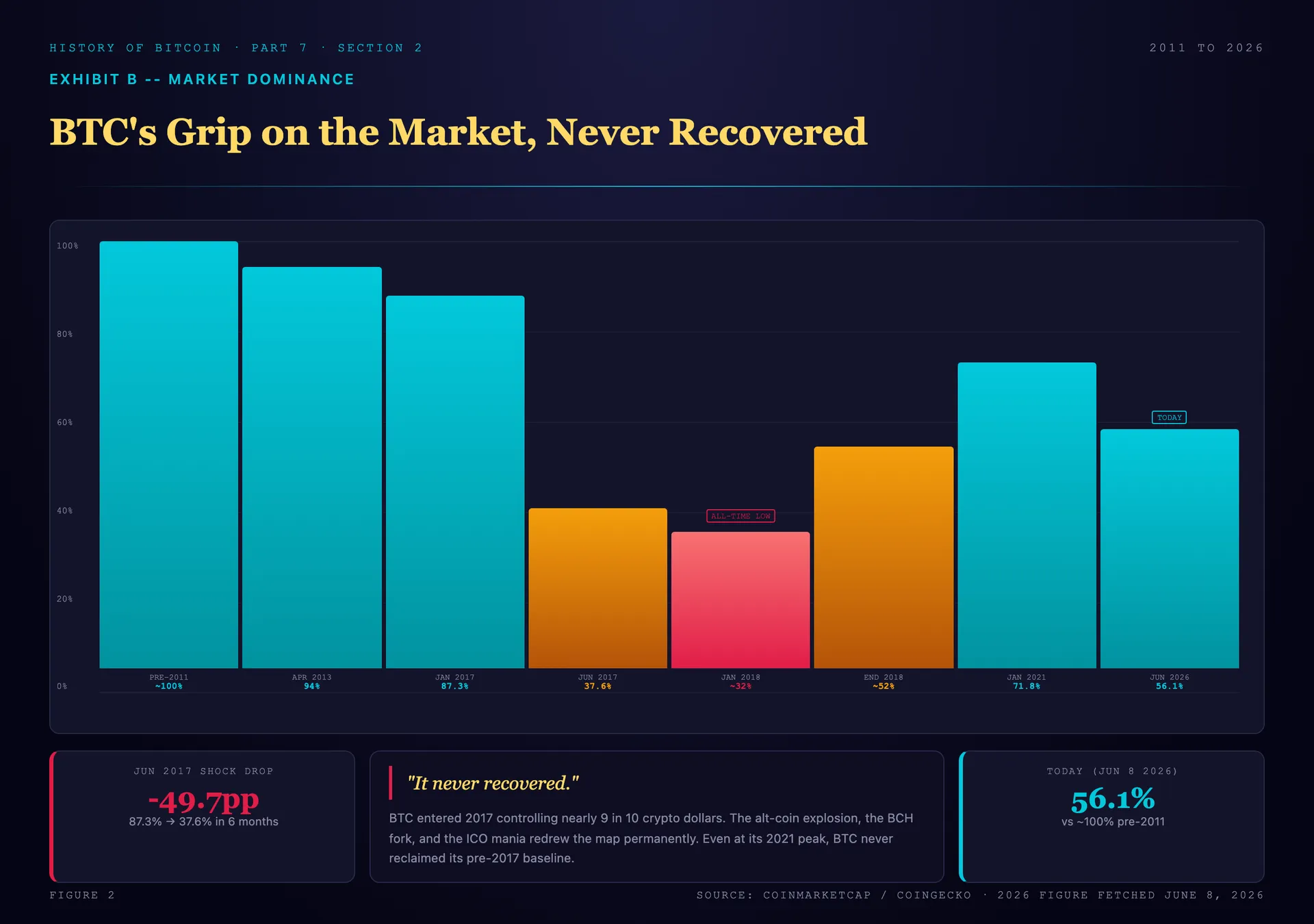
January 1, 2017: Bitcoin is 87.3 percent of the whole market.⁵⁰ By June 19, 2017, in the middle of the scaling war, it had collapsed to 37.6 percent.⁵¹ By mid-January 2018 it bottomed near thirty-two percent, the lowest it has ever been.⁵² And here is the part that should stop you. It never went back. The post-war maximum was about 71.8 percent in January 2021, and as I write this in June 2026, Bitcoin's dominance sits around fifty-six percent.⁵³ A decade later it has never again been the thing it was before the war: the overwhelming, unquestioned default.
That is not an accident of technology. It is the invoice for the civil war. The first altcoin wave failed because Bitcoin still did everything. The second wave, the one that took a third of the market and kept it, fed on exactly the use cases Bitcoin's stewards had spent three years declaring to be spam and engineering the protocol to forbid: tokens, data, contracts, applications. I called this the brain drain in Part 6.⁵⁴ Here is the receipt. The builders did not stop building. They built somewhere else, and "somewhere else" is now one or two thirds of the industry, depending how you measure it.
What did they build? In 2017 and 2018, mostly, they built a casino. Let me walk you through the floor, fast, because the panorama is the point and the individual games are not.
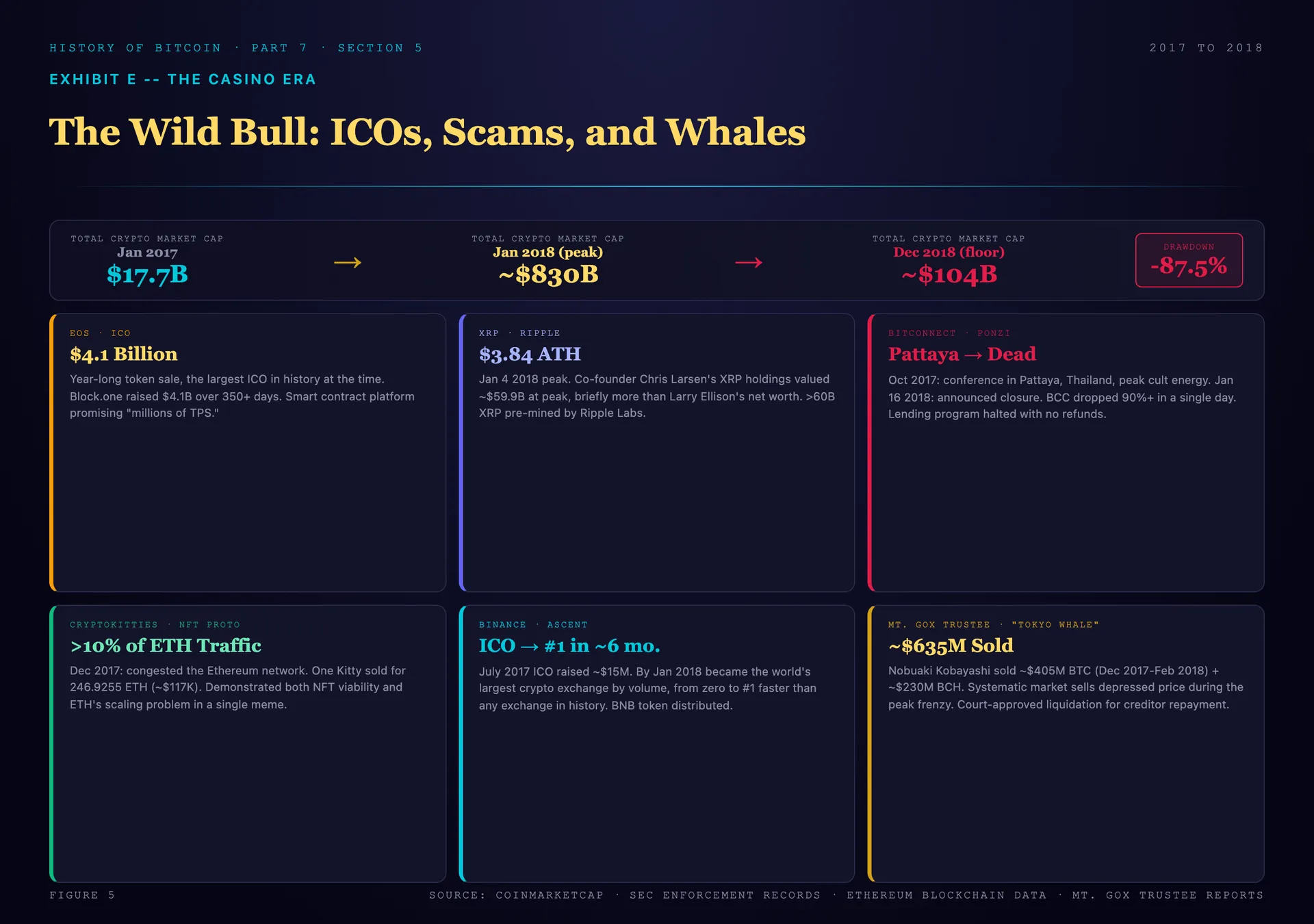
There was Ethereum's ICO machine, the initial coin offering boom, raising billions for whitepapers. There was EOS, which ran a year-long token sale from June 2017 to June 2018 and collected roughly $4.1 billion for a blockchain that did not yet exist, complete with a jumbotron in Times Square.⁵⁵ The SEC later settled with its issuer for twenty-four million dollars, a rounding error on the raise.⁵⁶
There was XRP, which on December 29, 2017, briefly passed Ethereum to become the second most valuable cryptocurrency on earth, and which at its peak of $3.84 on January 4, 2018, made its co-founder Chris Larsen worth around $59.9 billion on paper, briefly placing him just ahead of Larry Ellison among the richest people alive.⁵⁷
There was CryptoKitties, a game about breeding cartoon cats as collectible tokens, which launched in late November 2017 and within a week was consuming over ten percent of all traffic on the Ethereum network, spiking pending transactions sixfold and proving, accidentally, that there was enormous real demand for putting data and applications on a chain, in the same month Bitcoin's price peaked for doing nothing but sitting still.⁵⁸
There was Binance, an exchange that did not exist before July 2017, ran a token sale and opened its doors that month, and by January 2018 was the largest exchange on the planet by volume, reportedly adding two hundred forty thousand new users in a single hour at the peak.⁵⁹ Its founder, Changpeng Zhao, was on the cover of Forbes by February 2018.⁶⁰ Remember Binance. The exchange that came from nowhere becomes a referee in this very article, and a weapon in the next.
And there was BitConnect, the purest distillation of the culture of the era, a lending platform promising returns that only a Ponzi can promise, whose annual ceremony in Pattaya, Thailand, in October 2017 produced the immortal image of a man named Carlos Matos screaming the company's name into a microphone to a roaring crowd.⁶¹ Texas issued a cease-and-desist on January 4, 2018, North Carolina followed on the ninth, and the platform collapsed on the sixteenth, its token falling more than ninety percent in a day on its way to zero.⁶²
Under all of it, holding up the floor, was the wreckage of the last casino. The trustee winding down the failed Mt. Gox exchange, Nobuaki Kobayashi, disclosed in March 2018 that he had sold roughly 35,841 BTC and 34,008 BCH, about four hundred five million dollars' worth, into the rising market.⁶³ On-chain analysts noticed that eighteen thousand of those coins moved on February 5, 2018, the day the market cut in half.⁶⁴ The market called him the Tokyo Whale. His own explanation was simple: "I made efforts to sell BTC and BCC at as high a price as possible."⁶⁵
This is the terrain. Cash-settled futures above, run by professionals. Unregulated spot exchanges in the middle, run by twenty-somethings. Outright Ponzis at street level. The whole structure was a global network of bucket shops, and the total value of all of it rode from under eighteen billion dollars at the start of 2017 to a peak around eight hundred thirty billion in early January 2018, and back down to roughly a hundred and four billion by that December.⁶⁶
It was the best of times and the worst of times, and the big blockers had to go to war, again, in the middle of it.
A Tale of Two Bitcoins
Because for a brief, real window, they were not weak. This is the part of the story that gets forgotten, and it is the part that makes everything afterward a tragedy instead of a farce.
By the middle of 2018, the big-block side was not a ragtag minority. It was a coalition, and it was formidable.
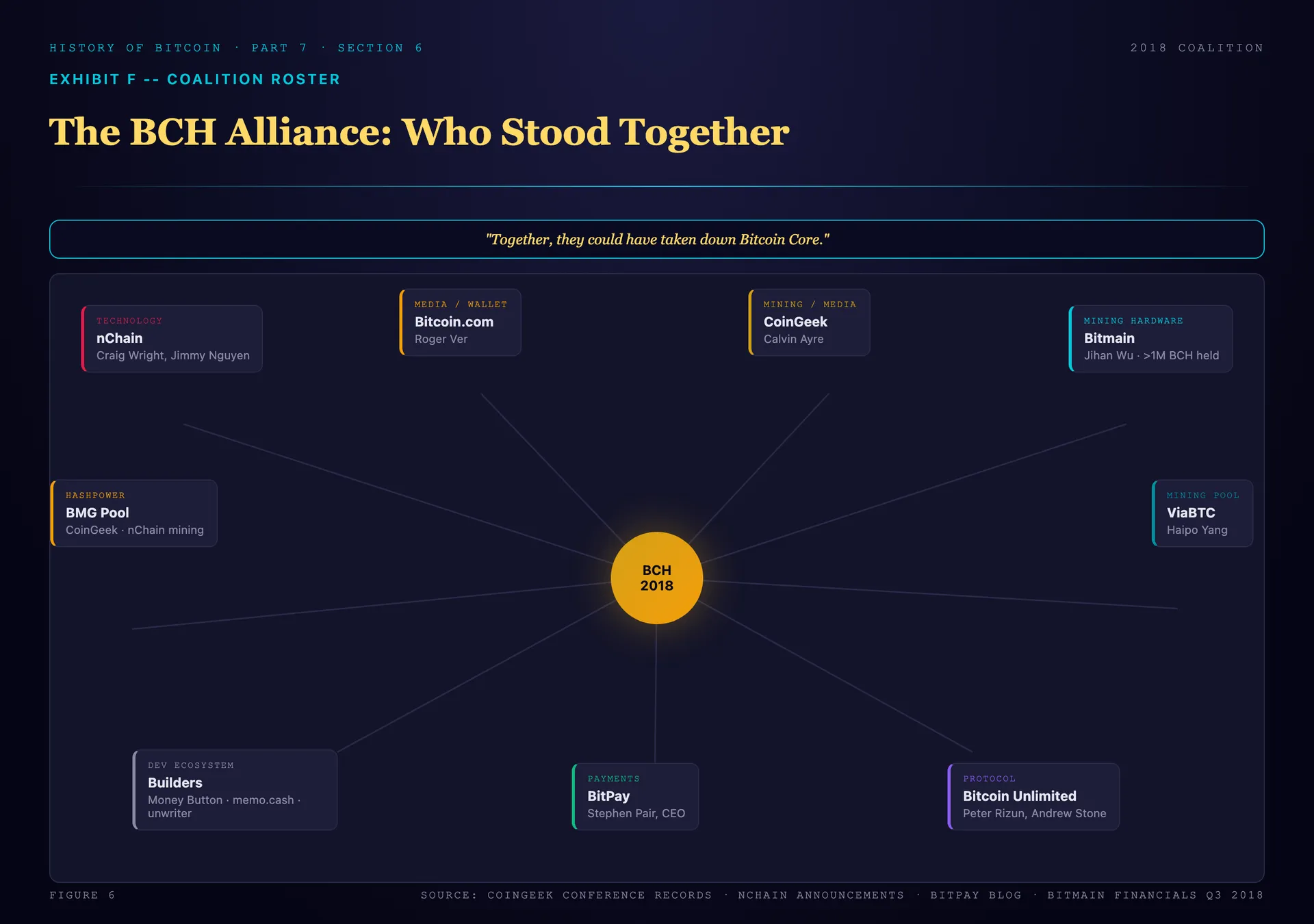
There was nChain, Craig Wright's research company, with Jimmy Nguyen as its public face.⁶⁷ There was Bitcoin.com, Roger Ver's platform, with a wallet, a media operation, and a mining pool. Ver was its public face, and he was a formidable voice in Bitcoin.⁶⁸ There was CoinGeek, Calvin Ayre's media and mining operation. Ayre was one of the most successful, disruptive entrepreneurs of a generation, and one of the richest men in the world.⁶⁹ There was Bitmain, Jihan Wu's company, the largest manufacturer of mining ASICs in the world, which by its own pre-IPO disclosures was holding more than a million BCH, over five percent of the entire supply.⁷⁰ There was ViaBTC, and Bitcoin Unlimited with Peter Rizun and Andrew Stone, and the payments processor BitPay, which began accepting Bitcoin Cash in March 2018.⁷¹ And there were hundreds of developers building an actual ecosystem: Ryan X. Charles's Money Button enabled tons of bitcoin applications to work with a simple swipe, the on-chain social network memo.cash enabled publications on chain, the developer tools shipped by the pseudonymous "unwriter" made those applications incredibly rich, interconnected and open for the world to build.⁷² There were dozens more significant players, but this article needed to be cut off at 15,000 words.
They held conferences. The Satoshi's Vision Conference in Tokyo in March 2018; the first CoinGeek Conference at the Four Seasons in Hong Kong in May, with Jimmy Nguyen as master of ceremonies.⁷³ This was a movement with money, hashpower, developers, apps, users, merchants, and momentum.
I am going to be direct, because I was there for this part. I was in this camp. And the thesis I want you to hold is this: that coalition, aligned, was strong enough to have legitimately taken down Bitcoin Core. Together, the manufacturers and the miners and the merchants and the builders could have kept fighting for the main chain, or built the exile chain into something the market could not ignore. The pieces were on the board, and it's funny because no other history of this era will tell you the truth here, but the two men most associated with big block bitcoin or the two major forks did not want the splits that created them.
Roger Ver had bet on the main chain. His chips were on the New York Agreement and SegWit2x, on forcing bigger blocks onto BTC itself; he had wagered a thousand bitcoin, around four million dollars at the time, that the 2x chain would be worth more than the original.⁷⁴ Bitcoin.com only went "100 percent Bitcoin Cash" after SegWit2x died in November 2017.⁷⁵ His strategy had been to win the real chain first.
And Craig Wright had said the same thing, louder, at Arnhem in June 2017. "Segwit is not scale," he told the room.⁷⁶ And then the dare: "Very simple: you don't like it, find an altcoin and compete with me. Split off Bitcoin and compete with me. And we're going to compete hard."⁷⁷ His position was to fight for the main consensus, not to flee it. He thought splitting the network was a strategic error.
For what it is worth, I agreed with them, and I have said so on the record: I was in that same camp, and only came around to supporting Bitcoin Cash after it was clear my allies would no longer rally to fight for BTC.⁷⁸ My view then is my view now. Deliberately splitting the network was a net negative. It took a big-block movement that could have fought for the whole prize and sent it into exile to fight, with a fraction of the resources, against a bank-funded takeover of the original chain, on the hostile terrain of the casino I just described. It was a losing battle entered with open eyes.
And it was about to get worse, because the coalition that could have won if we stayed aligned was about to discover it could not stop fighting itself.
Every split made us smaller.
The Anomaly, Resolved
Now we go back to the three minutes.
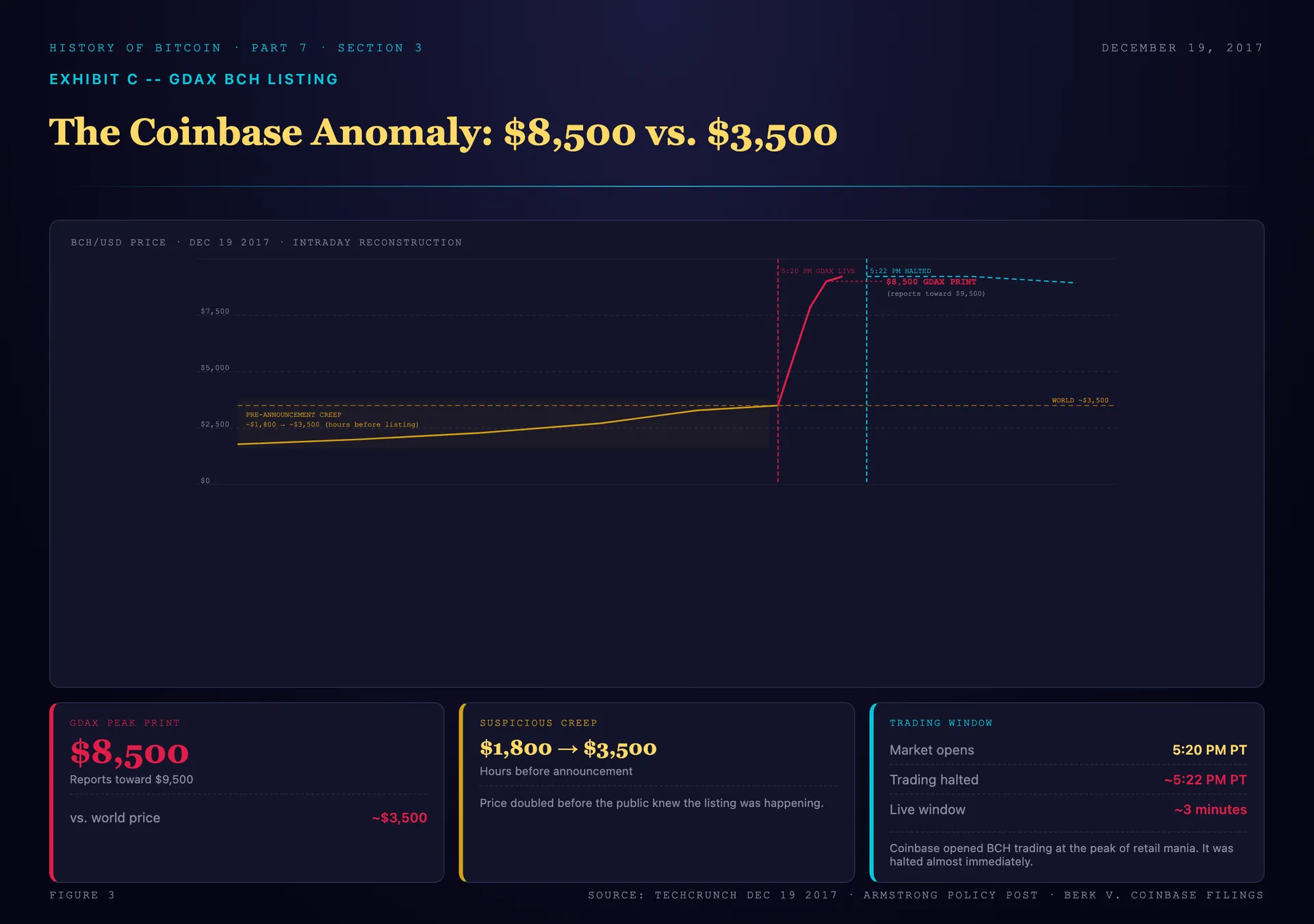
December 19, 2017. The peak of the mania, two days after the all-time high, in the middle of Cboe-and-CME week. Coinbase, the largest American exchange, abruptly announced it was listing Bitcoin Cash, and opened trading on its professional platform GDAX.⁷⁹ The order book broke instantly: prints at $8,500, reports reaching toward $9,500, against a real-world price near $3,500.⁸⁰ Coinbase halted trading within about three minutes and moved the book to cancel-only.⁸¹
And the price had been climbing for hours before the announcement.⁸² Three days earlier, a Reddit user had even spotted Bitcoin Cash quietly appearing in Coinbase's API permissions, and posted the discovery.⁸³ When the listing went live and the chart showed that pre-announcement ramp, the accusation was immediate and obvious: somebody inside had front-run the news.
The chief executive, Brian Armstrong, posted a policy statement that same night. Employees and contractors, he wrote, had been "explicitly prohibited from trading Bitcoin Cash and from disclosing our launch plans over a month ago," and he promised an investigation: "If we find evidence of any employee or contractor violating our policies, directly or indirectly, I will not hesitate to terminate the employee immediately and take appropriate legal action."⁸⁴
The investigation, run by outside law firms, concluded around July 2018 that there was no evidence of wrongdoing.⁸⁵ A class-action lawsuit, Berk v. Coinbase, followed. It was dismissed in October 2018, then partly revived in August 2019 when Judge Vince Chhabria allowed a negligence claim to proceed, with a line that has aged well: "the fact that Coinbase halted trading within three minutes of the launch is indicative of dysfunction."⁸⁶ In December 2020 the Ninth Circuit ordered the dispute into individual arbitration, which quietly ended the class action.⁸⁷ No one was charged. Nothing was proven. The book just closed.
Bitcoin Cash's all-time high, $4,355.62, printed into that chaos on December 20, 2017, and has never been beaten.⁸⁸
This is what it means to be listed on a casino's terms. The reveal mechanism of the entire era is right here in miniature: the insiders are early, the halt comes after, and the investigation clears the house. The exchanges were not neutral venues. They were players.
Someone always knows. File that away, because the exchanges, dirty as they are, are about to referee a war.
The 32MB Spring
While BTC's flagship was a pizza you needed a friend in London to buy, the exile BCH chain spent the spring of 2018 doing the thing the entire war had been about.
On May 15, 2018, Bitcoin Cash executed a hard fork that did two things the original chain had refused to do.⁸⁹ First, it raised the block size cap from eight megabytes to thirty-two. Second, and this is the part that matters more than the size, it began turning Satoshi's protocol back on.
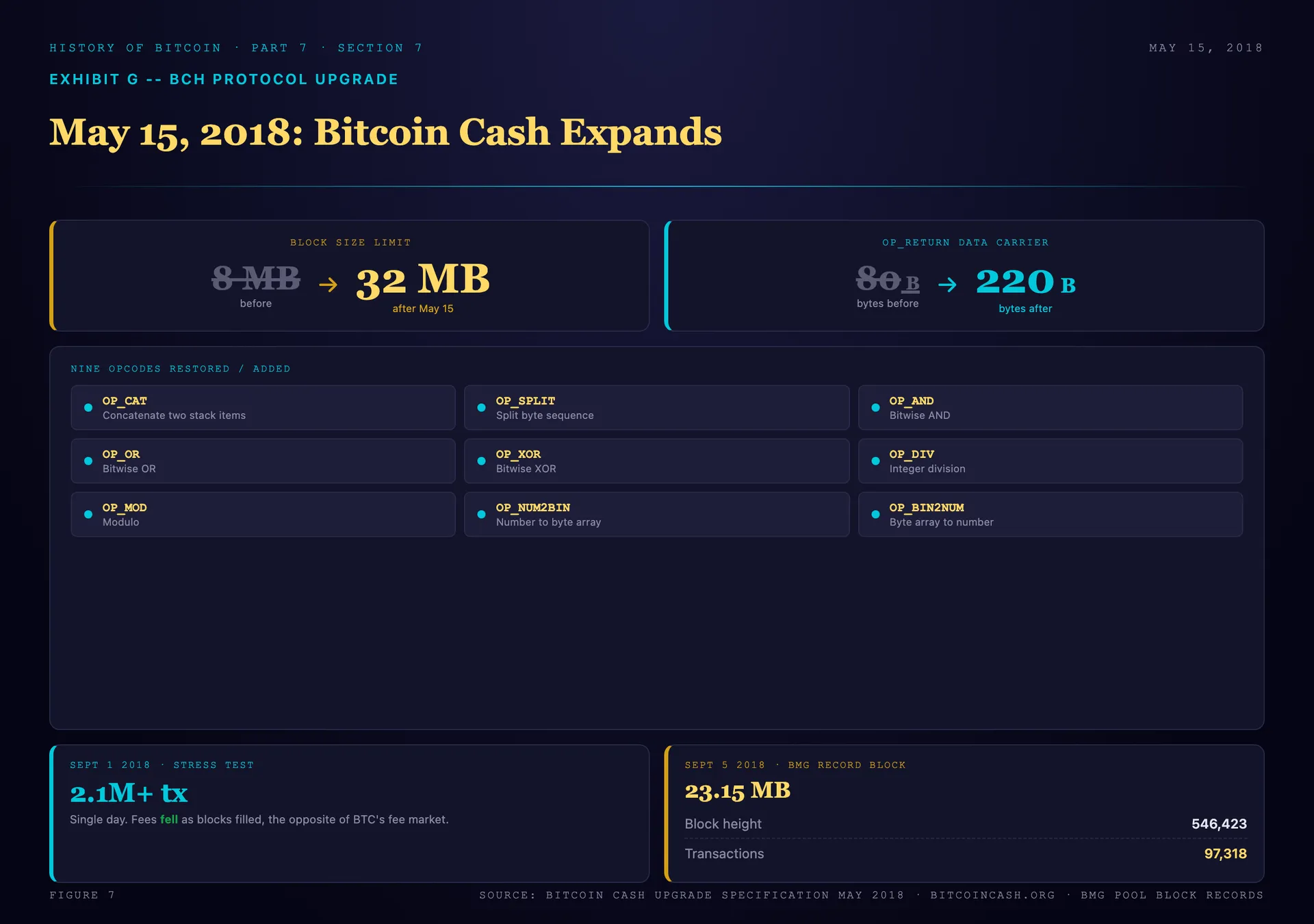
It re-enabled a suite of script operations that had been disabled in the 2010 and 2011 era: OP_CAT, OP_SPLIT, OP_AND, OP_OR, OP_XOR, OP_DIV, OP_MOD, OP_NUM2BIN, and OP_BIN2NUM.⁹⁰ It raised the OP_RETURN data carrier limit from eighty bytes to two hundred twenty.⁹¹ If you read Part 5, you know these names. These are the opcodes whose removal I documented as the deliberate crippling of Bitcoin's programmability, the change that sent the builders to Ethereum.⁹² Restoring them is not a slogan. "Restoring the protocol" is a changelog, and this was the changelog.
Then they tested it. On September 1, 2018, a coordinated stress test pushed more than two million transactions through the Bitcoin Cash network in twenty-four hours, the largest single-day transaction count any Bitcoin chain had ever produced, and the median fee during the flood was about a tenth of a cent, and it was falling as the load rose.⁹³ Let that sink in. Under the heaviest load it had ever seen, the chain got cheaper. Four days later, on September 5, nChain's BMG Pool mined a single block of 23.15 megabytes carrying 97,318 transactions, the largest Bitcoin block in history to that point.⁹⁴
There was a faction inside Bitcoin Cash that said this was reckless. The orphan-rate research that had set the thirty-two-megabyte cap, work by Peter Rizun and others on how fast big blocks could propagate before they started getting orphaned, was read by some to mean that blocks much larger than about twenty-two megabytes could not be safely mined.⁹⁵ The way I remember the discourse, twenty-two megabytes was treated as a kind of ceiling. BMG mined a 23-megabyte block four days after the stress test and the network kept running.
The whitepaper was being proven correct in public, in real time, on a chain the rest of the world had already decided to ignore. That is the tragedy in one sentence. The proof of concept worked, and almost nobody was watching, and the people who were watching were about to start fighting each other.
Ten Billion Reasons
On Valentine's Day 2018, the past walked into a Florida courtroom and put a number on Craig Wright's head.
On February 14, 2018, Ira Kleiman, acting as the personal representative of the estate of his dead brother Dave Kleiman, sued Craig Wright in the Southern District of Florida.⁹⁶ Dave Kleiman, the American computer forensics expert who had been part of the Australian circle around Wright that I traced in Parts 5 and 6, had died in 2013. Now his estate claimed that Dave and Craig had together mined and controlled a vast fortune in early bitcoin, and it wanted its share.
The numbers in the complaint were staggering. It referenced "evidence Dave and Craig owned and controlled over 1,100,000 Bitcoins" and put the value of the claim at "approximately $10,236,532,855.00."⁹⁷ Ten billion dollars. The estate of a dead man was suing the man who says he is Satoshi for half of Satoshi's coins.
Wright's only public response at the time was a single word, widely reported: "Greed."⁹⁸
I am not going to resolve this lawsuit here, because it does not resolve here. The trial is years away, and when it comes, we will be in that courtroom together. For now, hold the filing in your mind alongside everything else landing on this one man in 2018, because Craig Wright is now fighting on two fronts. One war is with a chain. The other is with a ghost.
The Cracks
Through the summer and fall of 2018, the aligned coalition I described, the one strong enough to win, began to come apart along a fault line that should have been familiar to everyone standing on it.
The first crack was a token scheme. In July 2018, developers connected to Bitmain introduced Wormhole, a protocol for issuing tokens on Bitcoin Cash.⁹⁹ Mechanically, it was a fork of the Omni Layer, the same system that issues Tether on BTC, and it worked by proof-of-burn: you destroyed Bitcoin Cash by sending it to an unspendable address, and in exchange you minted Wormhole tokens.¹⁰⁰ I want to be precise here, because the politics and the mechanics got tangled at the time and have stayed tangled. Wormhole used OP_RETURN and the enlarged data carrier from the May upgrade. It did not use OP_CHECKDATASIG, an operation that did not yet exist.¹⁰¹
Craig Wright and nChain attacked Wormhole with everything they had. Wright called it "Worm-a-nomics" and "Vampire Securities from beyond the Wormhole," and characterized the burn mechanism as a scheme that "takes Bitcoin, and uses this to mislead users," a "SHAM" and a "bait and switch."¹⁰²
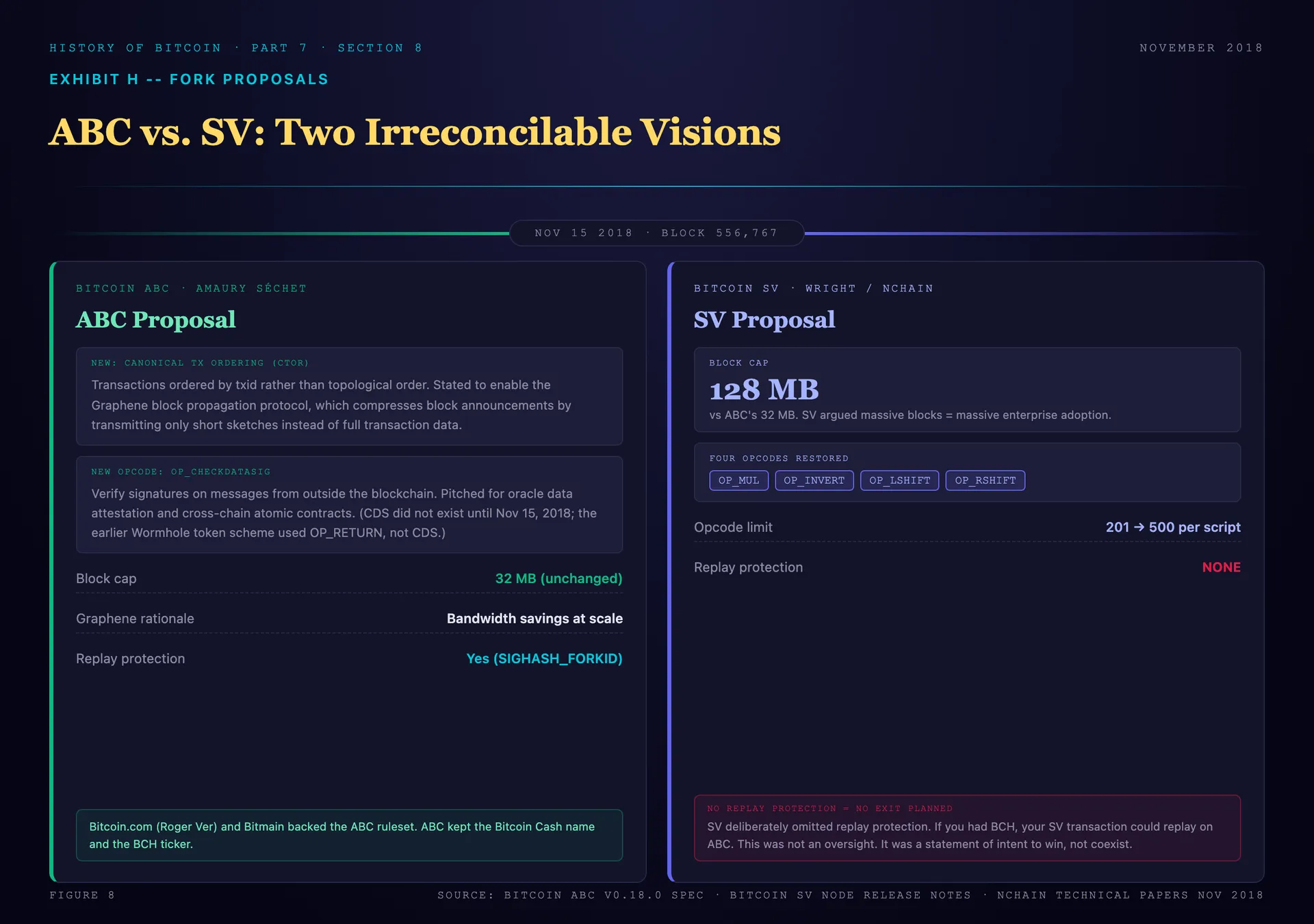
The second crack was deeper, because it was in the protocol itself. On August 20, 2018, Bitcoin ABC, Amaury Séchet's implementation, announced its plan for the November upgrade.¹⁰³ It contained two contentious changes. The first was Canonical Transaction Ordering, CTOR, which changed the rule for how transactions are ordered inside a block. The second was OP_CHECKDATASIG, a new operation that ABC said would "permit the validation of messages from outside the blockchain," enabling oracles and cross-chain contracts.¹⁰⁴
ABC's stated justification for CTOR was a block-propagation technology called Graphene. In its own words: "This is what Graphene [4] does, and it works very efficiently with CTOR."¹⁰⁵ Remember that sentence. The entire case for breaking the way blocks were ordered rested on a benefit that Graphene was supposed to deliver. We are going to check on Graphene later.
And in the background, casually, a third thing. In May 2018, a pseudonymous group calling itself "Team Rocket" had published a whitepaper for a new family of consensus protocols called Avalanche, work that the Cornell professor Emin Gün Sirer had co-developed and publicly championed.¹⁰⁶ An Avalanche-flavored idea called pre-consensus started drifting into the Bitcoin ABC roadmap conversation. File Avalanche away. It does not detonate until the very end of this story, four years from now.
The camps crystallized at a closed-door meeting in Bangkok at the end of August 2018. CoinGeek sponsored it; there was security at the door.¹⁰⁷ Vitalik Buterin, the founder of Ethereum, turned up at the venue and was not admitted to the full session; Jihan Wu later said only that "we invited Vitalik to come by and have a brief chat."¹⁰⁸ Calvin Ayre summarized the real divide afterward, and it was not technical: "There was a lot of technical debate in these meetings but I submit that much of this is not a technical issue at all, this is a practical business issue. The other side wants to lock down the battle-tested base protocol."¹⁰⁹
What happened inside that room is contested even by the people who were in it. Roger Ver's account is that Craig Wright left early, that "as soon as any sort of technical discussion was about to happen, Craig Wright physically got up and left the room."¹¹⁰ My sources (and there are five of them) at the event stated that Séchet conveyed that he had written the software, that Bitcoin Cash was his project, and wished everyone good luck with their "new coin."¹¹¹ I cannot prove that second account, and I am telling you that plainly. Both versions are partisan. That is the fog of this war: the eyewitnesses are all combatants.
But strip away the personalities and the disagreement was the oldest one in this whole series, transplanted one chain over. One camp, ABC, believed the protocol needed constant active management by its developers. The other camp believed the protocol needed to be locked down and scaled. That is the small-block argument and the big-block argument, the exact fight from 2015, being run again inside the chain that had been founded by the people who won that fight the first time.
They had been on the other side of this argument before. Now they were about to be on both sides of it.
The SV Gambit
On August 16, 2018, nChain answered Bitcoin ABC. It announced Bitcoin SV, "a new full node implementation of the original Bitcoin protocol," created, the announcement said, "at the request of leading BCH mining enterprise CoinGeek and other miners."¹¹² SV stood for Satoshi's Vision. Its lead developer was Daniel Connolly; its technical director was Steve Shadders; and its code was based on Bitcoin ABC version 0.17.2, the version from before CTOR and OP_CHECKDATASIG.¹¹³
When the software was released on October 15, it did the big-block thing without apology.¹¹⁴ It re-enabled four more original opcodes, OP_MUL, OP_INVERT, OP_LSHIFT, and OP_RSHIFT. It raised the limit on operations per script from 201 to 500. It set the default cap on accepted blocks to 128 megabytes. Shadders and Connolly stood the whole thing up in roughly six weeks.¹¹⁵
And it removed automatic replay protection.¹¹⁶
That last decision is the tell, and you have to understand it to understand everything that follows. Replay protection is the mechanism that makes a chain split clean, that keeps transactions on one chain from being valid on the other. Bitcoin Cash had used it to separate cleanly from BTC in 2017. Bitcoin SV deliberately left it out. A chain with no replay protection is not a chain that intends to leave. It is a chain that intends to contest the same ground under Nakamoto consensus, to win the existing chain by out-mining it, not to create a new coin beside it.
I want to say this as plainly as I can, because it is the heart of the tragedy: nobody on the SV side was trying to create a third Bitcoin. There was no plan for a separate SV coin. The plan was to win Bitcoin Cash outright, and for us to all shake hands and move forward. Roger, Jihan, Amaury... All of us.
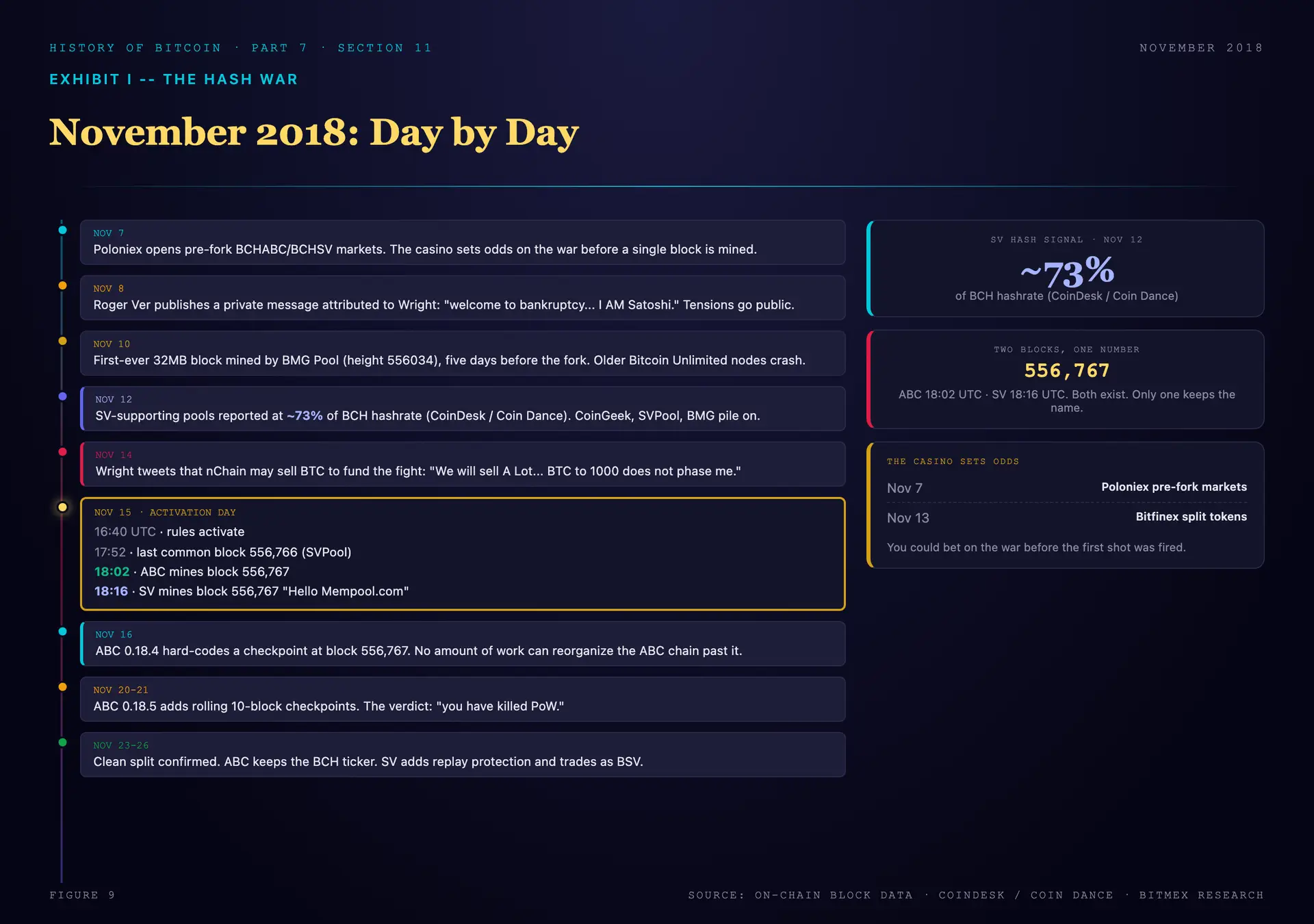
And for a while it looked like they would. By November 12, the mining pools backing the SV ruleset, CoinGeek, SVPool, BMG, okminer, and Mempool, controlled what CoinDesk, citing Coin Dance, reported as at least seventy-three percent of the Bitcoin Cash hashrate.¹¹⁷ Roughly seventy percent and climbing. On November 10, five days before the fork, BMG mined the first thirty-two-megabyte block in Bitcoin's history, at over 166,000 transactions, and then mined four more the same day; older Bitcoin Unlimited nodes, the 1.3 and 1.4 versions, crashed trying to process them.¹¹⁸ The record fell on the chain the SV miners were about to be locked out of.
Then the rhetoric arrived, and it was not subtle. On November 8, Roger Ver published a video showing a private message he said came from Craig Wright. I am reproducing it as a document, with its provenance, and I am neither endorsing it nor mocking it. You have been watching this man since Part 5. Read it and carry what you carry:
"If you want a war, I will do 2 years of no trade. Nothing. If you want ABC, you want shitcoins, welcome to bankruptcy. Bitcoin will die before ABC shits on it. I will see BCH trade at 0 for a few years. Will you? Side with ABC, you hate bitcoin, you are my enemy. You have fucking no idea what that means. You will. I AM Satoshi. Have a nice life. You will now discover me when pissed off. And, no. You Could have had proof. Your choice. Fuck you, Craig."¹¹⁹
Ver's public reaction was measured. It was "not the sort of thing that a forty-something-year-old man, that a mature businessman would say," he said, and then, more quietly, "maybe I've been fooled, maybe."¹²⁰
To a reporter at Decrypt on November 12, Wright was just as stark on the record. "They will go bankrupt," he said. "I'm very happy to bankrupt them. We will bleed them."¹²¹ And then a metaphor that tells you the spirit of the thing: "You get yourself into a nice, big, solid old Land Cruiser, you cut the brakes and you lock the accelerator down as fast as it will go. Then you put a blindfold on and wait until either everyone's dead, or you win."¹²²
Two days later, in a separate communication, a tweet on November 14, Wright turned to the wider market: "To all BTC miners, if you switch to mine BCH, we may need to fund this with BTC, if we do, we sell for USD and, well, we think BTC market has no room, it tanks. Think about it. We will sell A Lot. BTC to 1000 does not phase me."¹²³ Two messages, six days apart, and threatening the doom of BTC and the biggest advocate of BCH.
The casino, meanwhile, was taking bets on the war before a single shot was fired. Poloniex opened pre-fork trading in chain-split tokens on November 7; Bitfinex listed its own around the 13th.¹²⁴ And Bitmain, according to reports from Chinese outlets that were never officially confirmed, brought something like ninety thousand mining machines online in Xinjiang ahead of the fork.¹²⁵
The market had already priced the divorce.
November 15
At 16 UTC on November 15, 2018, the new rules activated, and the chain that had been founded to carry one vision split into two chains that each claimed it.¹²⁶
The last block both sides agreed on was 556766, mined by SVPool at 17 UTC.¹²⁷ Then the chains diverged, and here is the detail I planted at the very start of this article without telling you why. Both chains mined a block numbered 556767. On the ABC chain, block 556767 came at 18:02 UTC, mined by Bitcoin.com's pool, running hashpower that Bitcoin.com had openly redirected off of BTC for the occasion.¹²⁸ On the SV chain, block 556767 came at 18:16 UTC, and its coinbase carried a message: "Hello Mempool.com."¹²⁹
Two blocks. One number. Both real. Only one would be allowed to count.
I watched this live, like tens of thousands of other people, because the war was streamed. CoinSpice ran a livestream that drew enormous numbers; Roger Ver appeared on it, and so did Andreas Brekken of shitcoin.com, and so did Emin Gün Sirer.¹³⁰ Bitcoin.com ran its own stream. KeyPort TV carried the SV side, where I was personally participating in the conversation. For a few days in November 2018, you could watch grown men set tens of millions of dollars on fire in real time, with commentary.
Because that is what was happening. The two sides poured hashpower at each other in a contest of pure attrition; Bitcoin Cash's share of total SHA-256 hashpower jumped from around nine and a half percent to over fifteen percent in a week as exahashes crossed over from BTC to fight over a minority fork.¹³¹ BitMEX Research, measuring the first twenty-four hours on electricity costs alone, estimated the ABC side lost about $277,875 and the SV side about $324,904, and the bleeding only continued from there.¹³²
And then ABC did the thing that ended the pretense that this was a hash war at all.
Within about a day of the fork, Bitcoin ABC shipped version 0.18.4, which hard-coded a checkpoint at block 556767, the fork block, nailing its own chain in place.¹³³ A few days later, version 0.18.5 added rolling checkpoints every ten blocks, which meant that no amount of accumulated proof of work, no matter how large, could reorganize the ABC chain more than ten blocks deep.¹³⁴
Think about what that is. The entire premise of Nakamoto consensus is that the chain with the most work wins, that you do not need to trust anyone because you can verify the heaviest chain yourself. Checkpoints override that. They replace "the most work wins" with "the developers decided." BitMEX Research said it cleanly: the change "increases the risk of consensus chain splits and provides new opportunities for a would-be attacking miner," and it now "requires nodes to be online 24x7," abandoning the whitepaper's design in which a node can leave and rejoin.¹³⁵ One contemporaneous community verdict put it less politely: "Well done ABC, you have killed PoW. Nothing stopping you from mining 100% of blocks and checkpointing. What a parody of bitcoin."¹³⁶
The way I remember the stream, when the rolling checkpoints were understood for what they were, you could watch the realization move across the faces of the people who had been winning the hash fight that the hash fight no longer mattered. Andreas Brekken's reaction is one I have told for years; I will say honestly that the exact words live in my memory and my own later account rather than in a clean archive, so take it as my testimony, not a transcript.¹³⁷
But I watched him say "We Fucked Up" live on the air when he realized what ABC had done.
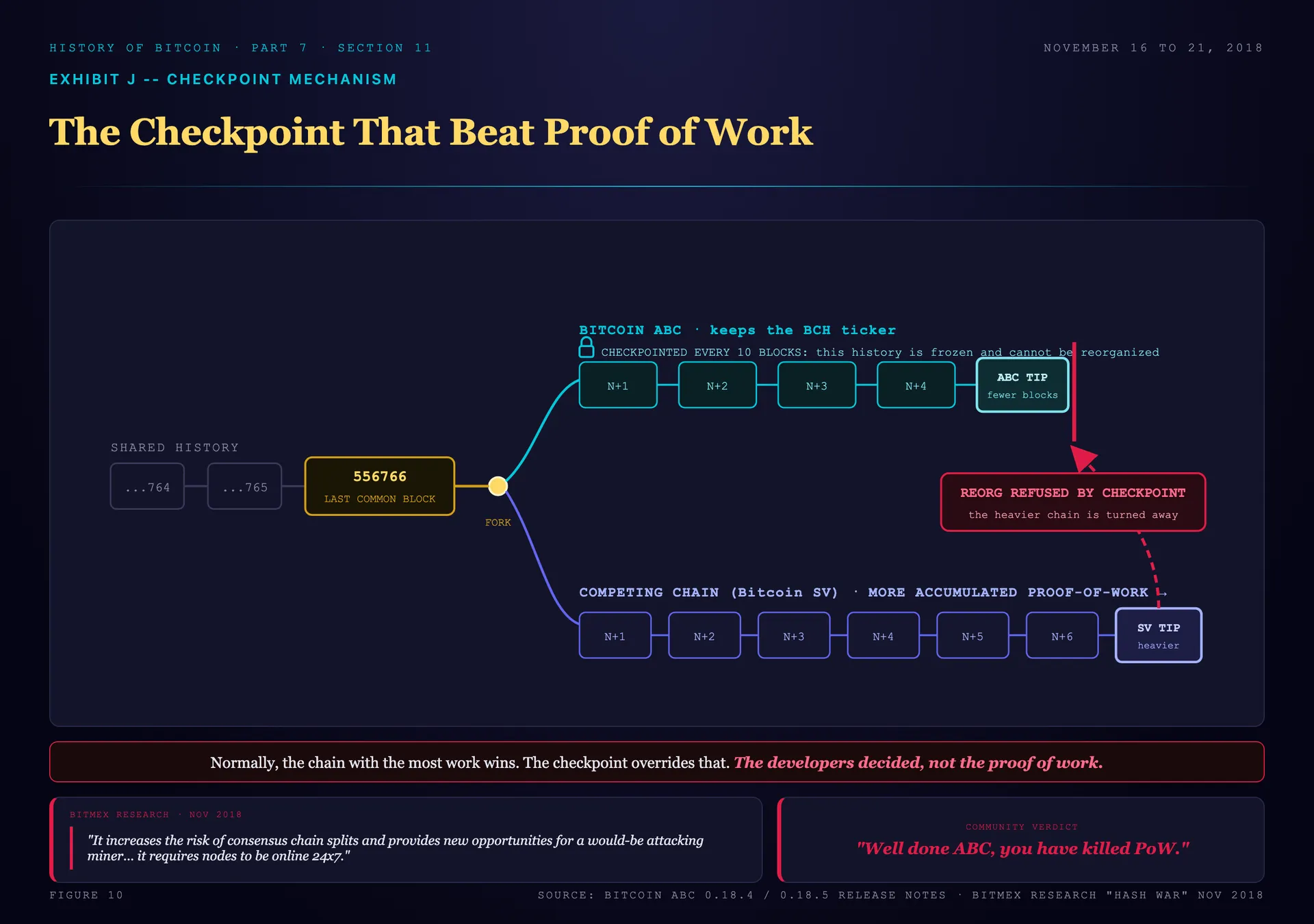
Because the hash never decided it. The exchanges did.
Kraken, which had said before the fork that the BCH ticker would follow the ABC chain, credited the new coin as BSV and listed it around November 18 with an extraordinary warning label, the like of which I had never seen on a listing: "Bitcoin SV does NOT meet Kraken's usual listing requirements. It should be seen as an extremely high risk investment," noting that "some large holders have indicated they'd be dumping everything ASAP," that miners were "mining at a loss," and that "Kraken cannot guarantee perfect custody of BSV."¹³⁸ Binance opened trading in both forks on November 16 but did not assign the plain "BCH" ticker to the ABC chain alone until November 2019, a full year later.¹³⁹ CoinMarketCap kept "BCH" on the ABC chain. The name war of 2017, BTC versus BCH, was being run again at smaller scale, BCH versus BSV, and once again the referees were the casino operators.
The exchanges, as referees, picked a winner. I will give you my own assessment, and label it as mine: between the hard-coded checkpoints and the exchange decisions about tickers and listings, no amount of hashpower could have changed the outcome. The election was decided off-chain. You do not have to take my read on it. The checkpoint code and the ticker decisions are documented, and they are damning on their own.
The whole market paid the bill. BTC broke through a price floor it had held for months on November 14 and fell to its lowest level in more than a year; the CNBC commentator Brian Kelly named "uncertainty around bitcoin cash" as a cause on air.¹⁴⁰ November closed down thirty-seven percent, the worst month since April 2011, with roughly seventy billion dollars erased from the market, and the bottom did not arrive until $3,122 on December 15.¹⁴¹ I will be honest that a crash that size has many parents, the Gox overhang and the futures and the bursting of the whole 2017 bubble among them. But the timing tells its story.
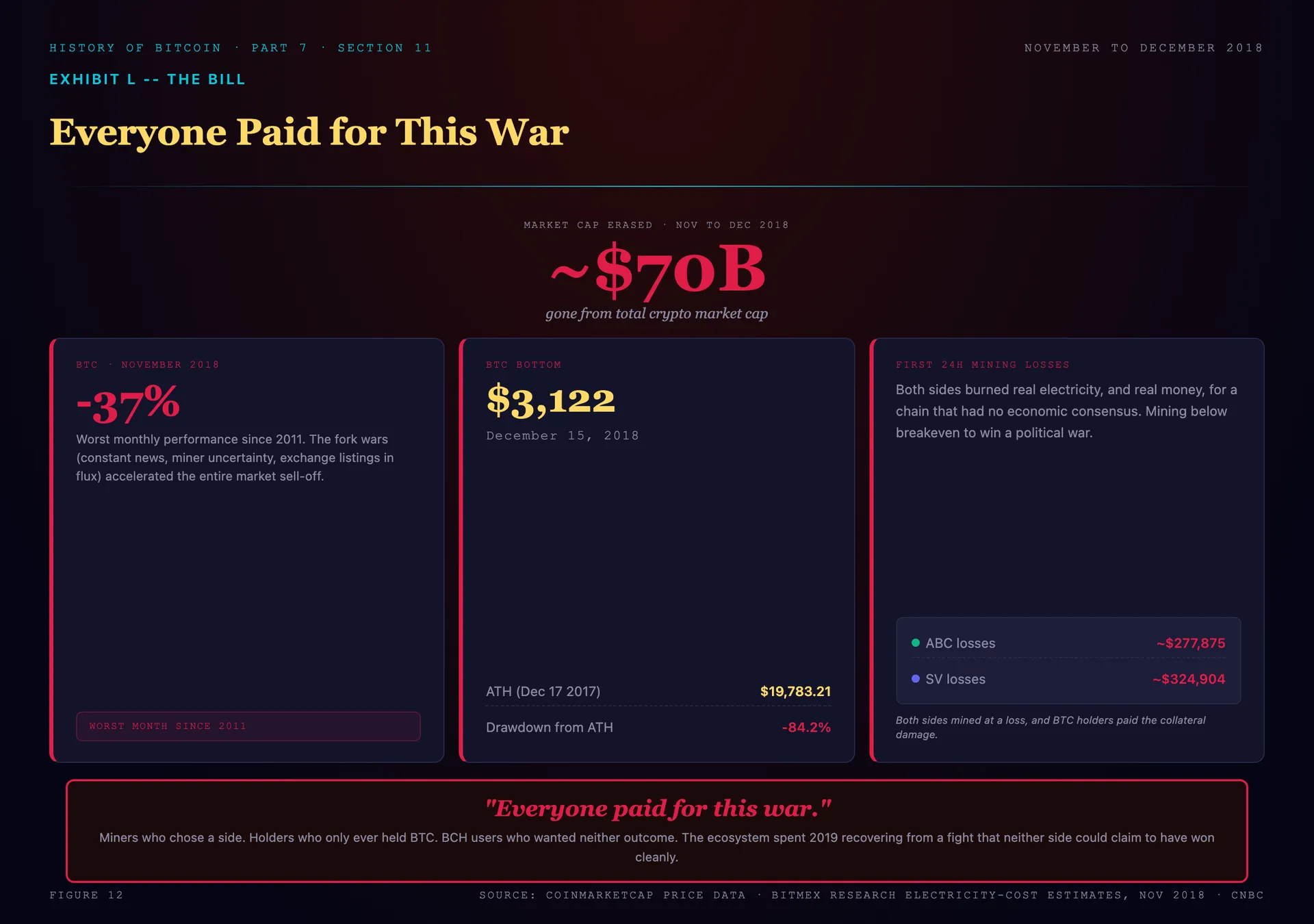
Everyone paid for this war. Including the people who only ever held BTC.
The Clean Split
By late November, the SV side faced the fact the checkpoints and the tickers had created: they could not take the Bitcoin Cash name, no matter how much hash they had because Bitcoin Cash was governed by Bitcoin ABC, not by proof of work. So they took the only thing left, which was a clean exit.
On November 23, Calvin Ayre and CoinGeek proposed a permanent split: the SV side would add the replay protection it had pointedly left out, and let the ABC side keep the Bitcoin Cash name and the BCH ticker.¹⁴² On November 26, CoinGeek published the surrender-that-was-also-a-birth: "Original Bitcoin is Reborn with Bitcoin SV (BSV); BCH Hash War Ends."¹⁴³ Steve Shadders committed to the replay protection. Bitcoin Magazine, a week later, called the declaration "an 'official' end to the hash war."¹⁴⁴
And there it is, the title of this article, arriving on schedule and a year late. A tale of two Bitcoins, and then three. One chain became two in 2017. The second chain became two more in 2018. Three Bitcoins where there had been one, and every faction smaller than the one before it, and not one of the people who built the third chain had wanted a second or a third chain to exist at all.
But watch what the third chain did the moment it was born, because this is the part that makes the tragedy bite. While the industry was writing Bitcoin SV's obituary, the SV miners ran a Professional Stress Test. On November 20, CoinGeek mined a 64-megabyte block, block 557335, carrying 334,074 transactions, the largest block on any public blockchain to that date.¹⁴⁵ On Christmas Day 2018, the Mempool pool mined a 65-megabyte block.¹⁴⁶ And on January 3, 2019, Bitcoin's tenth birthday, the exact tenth anniversary of the genesis block, Mempool mined a 103-megabyte block, block 563638, carrying 460,400 transactions.¹⁴⁷
The chain born from the war, in its first seven weeks of life, did the thing the entire war had been about. It scaled, on-chain, in public, while the world looked away.
Welcome to the world, again, bitcoin.
What Was CTOR For?
Remember Graphene?
This is the closing argument, and I am going to be careful about the line between what I can show you and what I can only suspect. I cannot show you intent. I can show you the sequence, but there's something to it that I think tells the story behind the story.
Start with the honest part, the part that cuts against me. CTOR is still in Bitcoin Cash today. OP_CHECKDATASIG is still active.¹⁴⁸ They shipped, and they stayed.
But every justification offered for the contentious changes of 2018 evaporated.
Graphene, the propagation technology that was the entire stated reason for breaking transaction ordering, never became the network's standard. It shipped only as a default in Bitcoin Unlimited's minority client and never displaced the existing relay method; the stress-test data gathered by the developer Jonathan Toomim documented the prototype's unreliability.¹⁴⁹ The scaling payoff that CTOR was actually for did not arrive. Ever.
Wormhole, the token scheme that had triggered Wright's "Worm-a-nomics" war, was dead within months. When Bitmain's fortunes turned and the layoffs came, the Wormhole team was disbanded and the project was declared over around January 2019.¹⁵⁰ The flagship application of the new Bitcoin Cash died within weeks of the war that had been fought, in part, over it.
Pre-consensus, the Avalanche-flavored idea that had drifted into the roadmap, never shipped on Bitcoin Cash at all.¹⁵¹
And OP_CHECKDATASIG, the urgent new operation that justified half the November upgrade? Its "urgent use cases" never materialized. Real but modest applications arrived quietly, years later. The opcode stayed; the urgency that had been used to justify a chain split simply vanished the moment the dissidents were gone.¹⁵²
Here is the sequence, and then I will tell you what I suspect of it. A set of contentious, division-creating proposals were pushed through in 2018. The people who objected to them were driven onto a separate chain. And then the proposals' justifications quietly dissolved, while the dissidents stayed gone.
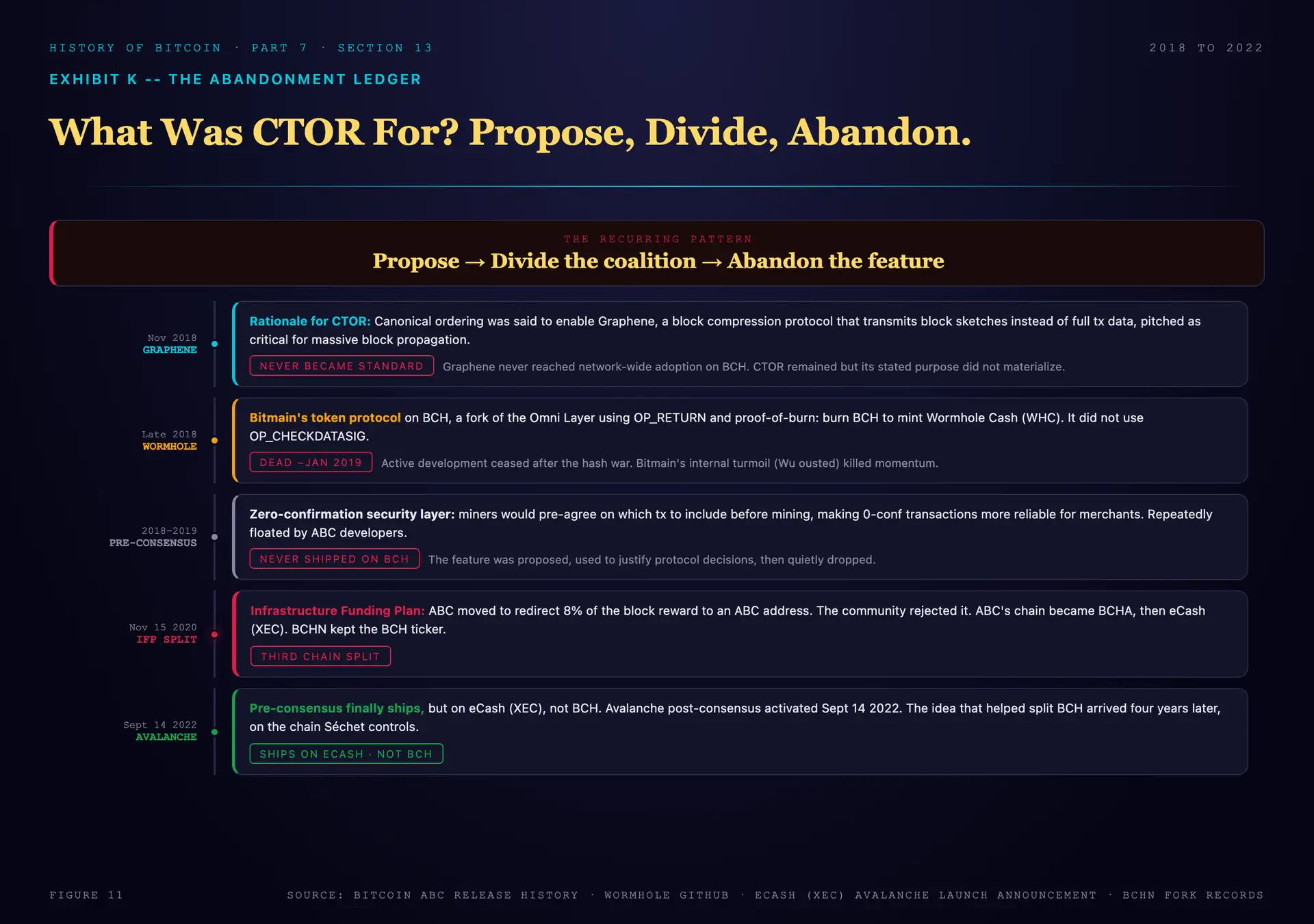
And then the pattern ran again, with no SV camp left to blame.
In 2020, Bitcoin ABC proposed the Infrastructure Funding Plan: a rule that would route eight percent of the Bitcoin Cash block reward to an address controlled by ABC, to fund development. Séchet announced it in his own words, and they are worth reading slowly: "While some may prefer that Bitcoin ABC did not implement this improvement, this announcement is not an invitation for debate. The decision has been made and will be activated at the November upgrade. [...] All newly mined blocks must contain an output assigning 8% of the newly mined coins to a specified address."¹⁵³
This announcement is not an invitation for debate. The benevolent dictator of Arnhem, the man the audience had applauded as a liberator in Part 6, was now telling an entire community that he would be taking a cut of their money and that their consent was not required.¹⁵⁴ The community revolted. On November 15, 2020, two years to the day after the SV fork, Bitcoin Cash split again. The side that rejected the tax, Bitcoin Cash Node, kept the BCH ticker. Séchet's chain became BCHA, and then rebranded itself "eCash."¹⁵⁵ Amaury Séchet was out of Bitcoin Cash, exiled from the chain he had founded by the same kind of revolt he had set in motion against the SV camp two years earlier.
And the seed I planted in the Bangkok section finally detonates here. On September 14, 2022, Avalanche pre-consensus, the idea that had alarmed the SV camp in 2018, the idea whose drift into the roadmap was part of what split the coalition, finally went live, as Avalanche Post-Consensus, on Séchet's own eCash chain.¹⁵⁶ The thing that helped split Bitcoin Cash shipped four years later, on the third chain down, the one Séchet fully controlled.
I cannot show you intent. But I have written before that I believe further subterfuge by Séchet led to that second split, and I will say here what the sequence suggests: it is possible that the contentious proposals of 2018 were never really about Graphene or oracles or transaction ordering. It is possible they were wedges, raised not to ship a roadmap but to divide a coalition.¹⁵⁷ In Part 6, the small-block pattern was agree, buy time, renege. Here, on the big-block side, the pattern may have been propose, divide, abandon.
Now pull back and look at the whole board. Three Bitcoins where there was one. Every faction smaller than the last, and a movement that had once been strong enough to take down Bitcoin Core dividing itself into pieces too small to focus disruption on anything. The dominance chart I showed you in the casino section is the tombstone of the unified vision: a thing that was once the whole market, broken into a third of it and never made whole again.
The only consolation, and it is a real one, is that the chain carrying the original protocol finally got to find out what it could do. The 103-megabyte block on Bitcoin's tenth birthday was a promise, and the chain spent the years after this story making good on it, scaling toward the Teranode architecture and millions of transactions per second, doing in relative silence the thing the whole war had been fought over. For my part in all of it, my friends and I mined a 4,000 megabyte block on BSV, and another and another. But we'll tell that story in a future article. The story is bananas...
What Comes Next
The war for the ticker was over. ABC kept the name Bitcoin Cash. SV took its exit and its replay protection and its records, and went off to build.
But the exchanges that played referee in November 2018 had learned something. They had discovered they could pick winners, and they were about to discover a sharper version of the same weapon. Not a ticker decision. Delistings.
In the spring of 2019, a Twitter troll with a cartoon cat for an avatar will pick a fight, the man from Sydney will start swearing affidavits into courtrooms on two continents, and the exchanges of the world will line up, almost in unison, to remove one coin from the menu entirely. The restoration roadmap will get a name out of the Old Testament: Genesis. And the question will stop being which chain gets to be called Bitcoin Cash, and start being who gets to be called Satoshi Nakamoto.
That fight, and a whole bunch more across BTC, BCH, BSV and the rest of the blockchain space, is coming in Part 8.
You read this far. You know by now that the receipts are in the footnotes.
Be good to each other. And read the footnotes.
Kurt Wuckert Jr. is the world's foremost Bitcoin Historian. The Written History of Bitcoin is published one installment at a time at kurtwuckertjr.com.
Footnotes
¹ The $8,500 print on GDAX is documented in contemporaneous coverage. Coinbase Halts Bitcoin Cash Trading as Price Briefly Hits $8,500, TechCrunch, December 19, 2017.
² Reports of prints reaching toward $9,500 circulated via CNNMoney and Charlie Lee's commentary; the precise top print is disputed, and whether trades executed at those levels was never confirmed by Coinbase.
³ Bitcoin Cash was trading around $3,500 on other venues at the time of the GDAX listing. TechCrunch, op. cit.
⁴ Coinbase's own timeline shows live trading enabled at 5 p.m. PST and halted at 5 p.m.; Judge Vince Chhabria later characterized it as a halt "within three minutes of the launch." Bitcoin Cash Trading Update, Coinbase, December 2017; Berk v. Coinbase order, August 2019.
⁵ Last common block 478,558, found approximately 12 UTC on August 1, 2017. See Part 6; The Birth of BCH, Bitcoin Magazine.
⁶ Bitcoin Cash launched with BTC's full difficulty and minimal hashrate, producing slow initial blocks. Fork Watch: First Bitcoin Cash Block Mined, Bitcoin.com.
⁷ The Emergency Difficulty Adjustment reduced difficulty roughly 20% when six blocks took longer than twelve hours. Replay-Protected SIGHASH and EDA, reference.cash.
⁸ On October 12, 2017, Bitcoin Cash went from roughly one block every four hours to sixty-one blocks in the following hour as the EDA oscillation peaked. Bitcoin Cash Hard Fork Plans Updated, New Difficulty Adjustment Algorithm Chosen, Bitcoin.com, November 2017.
⁹ For the seven-step oscillation cycle and miner profit-switching behavior, see Jimmy Song, Mining BTC/BCH: Past, Present and Future, Bitcoin Tech Talk.
¹⁰ During peak miner defection to BCH, BTC block times slowed and mempool congestion rose; this contributed to the high-fee environment of late 2017. The Bitcoin Cash Mining Difficulty Algorithm Remains Highly Controversial, The Merkle.
¹¹ The oscillating EDA caused Bitcoin Cash to mine blocks far ahead of a steady schedule before the November fix. Bitcoin.com, op. cit. (note 8). The precise count of "extra" coins is debated; the directional fact is documented.
¹² The DAA hard fork activated November 13, 2017 (median-time-past 1510600000), using a 144-block moving average; the proposal is associated with Amaury Séchet and was tested by Bitprim and nChain. The Difficulty Adjustment Algorithm, Bitcoin ABC.
¹³ "Avoid oscillations from feedback between hash rate and difficulty." Bitcoin ABC, op. cit. (note 12).
¹⁴ Mike Belshe (CEO, BitGo), SegWit2x suspension email, November 8, 2017. 2x Called Off, CoinDesk.
¹⁵ On the New York Agreement and the "agree, buy time, renege" pattern, see Part 6 and BTC Was Hijacked, Everyone Knows It.
¹⁶ BTC printed a then-record near $7,879 on November 8, 2017, then fell roughly 29-30% over the following days (CoinDesk BPI).
¹⁷ Bitcoin Cash ran to an aggregate intraday high of $2,477.65 on Sunday, November 12, 2017 (CoinMarketCap); some Korean exchanges printed higher.
¹⁸ Bitcoin Cash fell roughly in half by Monday, November 13, 2017 (CoinMarketCap).
¹⁹ SegWit locked in August 9 and activated at block 481,824 on August 24, 2017. SegWit lock-in, Bitbo.
²⁰ On Gregory Maxwell's "settlement layer" framing, relayed via Mike Hearn, see Part 6 and Follow The Money.
²¹ Lightning Labs announced lnd 0.4-beta, its first Lightning mainnet release, on March 15, 2018. Announcing lnd 0.4-beta, Lightning Labs.
²² ACINQ released its Eclair implementation to mainnet on March 28, 2018.
²³ Blockstream released c-lightning 0.6 on June 25, 2018.
²⁴ On Blockstream's funding and the base-layer-constraint business model, see Follow The Money and Jane Street's Bitcoin Heist.
²⁵ Laszlo Hanyecz bought two pizzas over the Lightning Network on February 25, 2018. Bitcoin Pizza Day 2: How a Lightning Payment Made History, CoinDesk.
²⁶ On the original May 22, 2010 pizza transaction, see The Year of the Pizza, Part 3.
²⁷ The payment was 0.00649 BTC (about $62), verified to the delivery party via the first and last four characters of the payment preimage. CoinDesk, op. cit. (note 25).
²⁸ The purchase required a cooperating party in London running a node with an open channel. Laszlo Hanyecz, Who Bought Pizza With 10,000 Bitcoin, Is Back at It, Fortune.
²⁹ Laszlo Hanyecz, quoted in CoinDesk, op. cit. (note 25).
³⁰ Laszlo Hanyecz, quoted in Fortune, op. cit. (note 28).
³¹ The Diar study (June 26, 2018) found routing success around 70% for the smallest payments, falling toward 1% as amounts approached the network's practical maximum. Diar's Response to Lightning Labs; Lightning Network Transactions, TNW.
³² On the "reckless" meme, the "craeful gang" response, and the "experiment with only small amounts" guidance, see Bitcoin Lightning Payments Are Slowly Becoming Less Reckless, CoinDesk, and Lightning Labs, op. cit. (note 21).
³³ Elizabeth Stark, quoted January 2018. Lightning Has a Problem: People Are Already Using It, CoinDesk.
³⁴ The Chicago Mercantile Exchange launched frozen pork belly futures in 1961.
³⁵ The CME launched the first exchange-traded weather derivatives in September 1999.
³⁶ Two traders cornered roughly 99% of Chicago onion supply in 1955, collapsing the price; the Onion Futures Act was signed in 1958 and onions remain the only commodity banned from US futures trading. Onion Futures Act, Wikipedia.
³⁷ Cboe XBT futures began trading at 5 p.m. CT on Sunday, December 10, 2017, cash-settled against the Gemini auction price. Cboe Launches Bitcoin Futures, Cointelegraph.
³⁸ The Cboe website crashed under traffic at launch. Cointelegraph, op. cit. (note 37).
³⁹ Cboe XBT triggered volatility halts at 10% and 20% moves on its debut. Bitcoin Futures Open, Bloomberg.
⁴⁰ CME Group Bitcoin futures became available on Globex the evening of Sunday, December 17, 2017, for trade date Monday, December 18, cash-settled against the CME CF Bitcoin Reference Rate.
⁴¹ BTC's all-time high of $19,783.21 (CoinDesk BPI) printed December 17, 2017, the same day the CME contract opened; the intraday top came in the hours before the Globex open.
⁴² Federal Reserve Bank of San Francisco, How Futures Trading Changed Bitcoin Prices, Economic Letter 2018-12, May 7, 2018.
⁴³ Akuna Capital posted early Cboe XBT quotes; DRW's Cumberland desk had traded bitcoin since 2014; the CME began building its Bitcoin Reference Rate in late 2016. (The stronger claim that Chicago trading families "brought bitcoin to the exchanges" is the author's analysis, not a cited fact.)
⁴⁴ William J. Mallers Sr. was elected chairman of the Chicago Board of Trade in 1969 at age 39 and founded First American Discount Corporation in 1984; he was inducted into the FIA Futures Hall of Fame in 2024. William J. Mallers Sr., FIA.
⁴⁵ William Mallers Jr. served as the first president of First American Discount Corporation. William Mallers Jr., MarketsWiki.
⁴⁶ Jack Mallers (born 1994) announced the Zap Lightning wallet in August 2017 and later founded Strike. Jack Mallers, MarketsWiki.
⁴⁷ Before Namecoin's April 2011 launch, Bitcoin was effectively 100% of the cryptocurrency market because no other chain existed.
⁴⁸ Bitcoin dominance was approximately 94% when CoinMarketCap began tracking in late April 2013.
⁴⁹ The first altcoin wave reduced Bitcoin dominance to the high 70s in 2014 before it recovered to roughly 90% by early 2016 (CoinMarketCap data).
⁵⁰ Bitcoin dominance was 87.3% on January 1, 2017 (CoinMarketCap).
⁵¹ Bitcoin dominance fell to 37.6% on June 19-20, 2017, amid "flippening" speculation. The #Flippening, CoinDesk.
⁵² Bitcoin dominance reached an all-time low near 32.4% in mid-January 2018 (CoinMarketCap); CoinGecko's series bottoms near 31.1% on January 16, 2018.
⁵³ The post-2017 dominance maximum was about 71.8% on January 3, 2021. As of June 8, 2026, dominance was approximately 56.1% per CoinGecko and about 58% per CoinMarketCap (methodologies differ). Bitcoin Dominance, CoinGecko; Bitcoin Dominance, CoinMarketCap.
⁵⁴ On the brain drain and the ICO boom as an externality of the civil war, see Part 6 and Part 5.
⁵⁵ Block.one's EOS token sale ran roughly June 26, 2017 to June 1, 2018, raising about $4.1 billion, and ran a Times Square billboard. A Blockchain Startup Just Raised $4 Billion Without a Live Product, CNBC.
⁵⁶ The SEC settled with Block.one for $24 million on September 30, 2019. SEC Order 33-10714.
⁵⁷ XRP passed Ethereum to become the second-largest cryptocurrency on December 29, 2017, and at its $3.84 peak on January 4, 2018, Chris Larsen's paper wealth was estimated near $59.9 billion. Ripple Soars, CNBC; Chris Larsen's Wealth, PYMNTS.
⁵⁸ CryptoKitties launched November 28, 2017, and by early December accounted for over 10% of Ethereum network traffic, spiking pending transactions roughly sixfold. (Contemporaneous coverage via ETH Gas Station and the BBC, December 2017.)
⁵⁹ Binance ran its token sale and launched in July 2017 and was the largest exchange by volume by early 2018, reportedly adding 240,000 users in an hour at peak. Binance 2018 Recap, Binance. (A 2023 Forbes investigation suggested the ICO may have raised under $5 million against an official $15 million figure.)
⁶⁰ Changpeng Zhao was featured by Forbes in February 2018.
⁶¹ Carlos Matos's "BITCONNEEEECT" performance took place at the company's only annual ceremony, in Pattaya, Thailand, on October 28, 2017. BitConnect Carlos, Know Your Meme.
⁶² Texas issued a cease-and-desist on January 4, 2018, North Carolina on January 9, and BitConnect shut down on January 16, with its token falling more than 90% in a day. US State Regulators Hit BitConnect with Second Cease and Desist, CoinDesk.
⁶³ Mt. Gox trustee Nobuaki Kobayashi disclosed on March 7, 2018, that he had sold roughly 35,841 BTC and 34,008 BCH for about ¥43 billion (~$405 million). (Trustee reports via CoinDesk and Bloomberg.)
⁶⁴ On-chain analysis indicated 18,000 BTC moved on February 5, 2018, the day the market halved.
⁶⁵ Nobuaki Kobayashi: "I made efforts to sell BTC and BCC at as high a price as possible." (Trustee statement, 2018.)
⁶⁶ Total cryptocurrency market capitalization rose from under $17.7 billion on January 1, 2017, to a peak around $830 billion in early January 2018, and fell to roughly $104 billion by mid-December 2018 (CoinMarketCap archives).
⁶⁷ nChain is Craig Wright's blockchain research company; Jimmy Nguyen was its public-facing leader in 2018.
⁶⁸ Roger Ver's Bitcoin.com operated a wallet, media presence, and mining pool backing Bitcoin Cash.
⁶⁹ CoinGeek is Calvin Ayre's media and mining operation. See Calvin Ayre / CoinGeek.
⁷⁰ Bitmain's leaked pre-IPO deck (reported August 2018) and its HKEX prospectus (September 26, 2018) disclosed holdings of more than 1 million BCH, over 5% of supply.
⁷¹ BitPay announced that merchants could accept Bitcoin Cash payments on March 27, 2018, with settlement in BCH following in late August 2018.
⁷² memo.cash, an on-chain social network using OP_RETURN, launched in April 2018; Ryan X. Charles previewed Money Button in September 2018; the pseudonymous "unwriter" shipped BitDB and related tools through 2018. A Wave of Apps, Bitcoin.com coverage, 2018.
⁷³ The Satoshi's Vision Conference was held in Tokyo, March 23-25, 2018; the first CoinGeek Conference was held at the Four Seasons, Hong Kong, on May 18, 2018, with Jimmy Nguyen as master of ceremonies.
⁷⁴ Roger Ver wagered 1,000 BTC that the SegWit2x chain would be worth more than the original chain.
⁷⁵ Bitcoin.com declared itself "100% Bitcoin Cash" only after SegWit2x was canceled in November 2017.
⁷⁶ Craig Wright, "Segwit is not scale," The Future of Bitcoin conference, Arnhem, June 30, 2017. Transcript notes, David Harding.
⁷⁷ Craig Wright, Arnhem, June 30, 2017: "[...] you don't like it, find an altcoin and compete with me. Split off Bitcoin and compete with me. And we're going to compete hard." Harding, op. cit. (note 76).
⁷⁸ Kurt Wuckert Jr., A Retrospective: The Bitcoin Big Split, CoinGeek, August 1, 2023.
⁷⁹ Coinbase announced Bitcoin Cash support and opened GDAX trading on the evening of December 19, 2017. Coinbase, op. cit. (note 4).
⁸⁰ The GDAX order book printed to $8,500 (TechCrunch) with reports toward $9,500 (CNN), against a real-world price near $3,500. TechCrunch, op. cit. (note 1).
⁸¹ Coinbase halted trading within about three minutes and moved to cancel-only. Coinbase, op. cit. (note 4).
⁸² Bitcoin Cash had been rising for hours before the announcement, prompting front-running accusations.
⁸³ A Reddit user identified Bitcoin Cash in Coinbase's API permissions days before the listing. Coinbase BCH API Leak, TechCrunch.
⁸⁴ Brian Armstrong, Our Employee Trading Policy at Coinbase, December 19-20, 2017.
⁸⁵ Coinbase's outside-counsel investigation found no evidence of wrongdoing. Coinbase Finds No Insider Trading, Fortune, July 24, 2018.
⁸⁶ Judge Vince Chhabria allowed a negligence claim in Berk v. Coinbase to proceed on August 6, 2019: "the fact that Coinbase halted trading within three minutes of the launch is indicative of dysfunction." Coinbase Must Face Negligence Suit, CoinDesk.
⁸⁷ The Ninth Circuit ordered the dispute into individual arbitration on December 23, 2020, ending the class action. Berk v. Coinbase, 9th Cir., Justia.
⁸⁸ Bitcoin Cash's all-time high of $4,355.62 printed on December 20, 2017 (CoinMarketCap).
⁸⁹ The Bitcoin Cash hard fork of May 15, 2018 (median-time-past 1526400000) raised the block cap from 8MB to 32MB.
⁹⁰ The May 2018 upgrade re-enabled and added the opcodes OP_CAT, OP_SPLIT, OP_AND, OP_OR, OP_XOR, OP_DIV, OP_MOD, OP_NUM2BIN, and OP_BIN2NUM. May 2018 Re-enabled Opcodes spec, bitcoincash.org.
⁹¹ The OP_RETURN data carrier limit rose from 80 bytes to 220 bytes (223 total relay bytes) in the May 2018 upgrade.
⁹² On the disabling of opcodes and the OP_RETURN restriction in 2010-2011, and the resulting migration to Ethereum, see Part 5 and What Is the Difference Between Bitcoin and Ethereum?.
⁹³ The September 1, 2018 stress test pushed more than 2 million transactions in 24 hours (about 2.06 million per Fork.lol), with median fees around a tenth of a cent. Stress Test: Big Blocks BCH Network Confirms 2M Transactions in 24 Hours, Bitcoin.com.
⁹⁴ nChain's BMG Pool mined a 23.15MB block at height 546423 on September 5, 2018, carrying 97,318 transactions. nChain's BMG Pool Mines 23MB Block, CoinGeek.
⁹⁵ Peter Rizun's 2016 propagation research estimated a safe block-size ceiling around 22MB; Jonathan Toomim's later stress-test analysis put the orphan-safe practical ceiling near 10-19.5MB. Towards Massive On-Chain Scaling, Peter Rizun; Block Propagation Data from Bitcoin Cash's Stress Test, Jonathan Toomim. (The "22MB is impossible" framing is the author's recollection of the discourse, not a sourced quotation.)
⁹⁶ Ira Kleiman, as personal representative of the estate of David Kleiman, filed suit against Craig Wright on February 14, 2018, in the Southern District of Florida (Case 9). Kleiman v. Wright complaint.
⁹⁷ The complaint references "evidence Dave and Craig owned and controlled over 1,100,000 Bitcoins" and values the claim at "approximately $10,236,532,855.00." Kleiman v. Wright, op. cit. (note 96).
⁹⁸ Craig Wright's reported one-word response to the suit was "Greed," widely reproduced in contemporaneous coverage. Self-Proclaimed 'Satoshi' Craig Wright Sued, Cointelegraph, February 2018; the original tweet is no longer live.
⁹⁹ Wormhole, a token protocol for Bitcoin Cash introduced by Bitmain-affiliated developers, debuted in July 2018. Wormhole, Cointelegraph.
¹⁰⁰ Wormhole was a fork of the Omni Layer (the protocol that issues Tether) and minted tokens via proof-of-burn. On the Omni Layer and Tether, see Beyond Fraud: Tether's Secret Plan to Replace the Fed.
¹⁰¹ Wormhole used OP_RETURN and the enlarged data carrier from the May 2018 upgrade; it did not use OP_CHECKDATASIG, which did not exist until November 15, 2018. (Wormhole whitepaper, July 2018; OP_CHECKDATASIG specification, November 2018.)
¹⁰² Craig Wright characterized Wormhole as "Worm-a-nomics," "Vampire Securities from beyond the Wormhole," and a scheme that "takes Bitcoin, and uses this to mislead users," calling it a "SHAM" and a "bait and switch" (nChain/CoinGeek commentary, August-September 2018).
¹⁰³ Bitcoin ABC announced version 0.18.0 on August 20, 2018, for November 15 activation, introducing CTOR and OP_CHECKDATASIG.
¹⁰⁴ OP_CHECKDATASIG was described as permitting "the validation of messages from outside the blockchain," enabling oracles and cross-chain atomic contracts (Bitcoin ABC, 2018).
¹⁰⁵ "This is what Graphene [4] does, and it works very efficiently with CTOR." The Benefits of Canonical Transaction Ordering, Bitcoin ABC, August 15, 2018.
¹⁰⁶ The Avalanche whitepaper was published pseudonymously by "Team Rocket" in May 2018; Emin Gün Sirer co-developed and publicly championed the protocol and is a named co-author on the June 2019 academic version. Cornell Professor Unveils Consensus Protocols, CoinDesk; Avalanche paper, arXiv, June 2019.
¹⁰⁷ The CoinGeek-sponsored Satoshi Vision Miners Choice Meeting was held at the W Hotel, Bangkok, around August 30-31, 2018, behind closed doors with security. Bangkok meeting announcement, PR Newswire.
¹⁰⁸ Vitalik Buterin appeared at the venue but was not admitted to the full session; Jihan Wu said "we invited Vitalik to come by and have a brief chat." Vitalik Buterin Shows Up at the Bitcoin Cash Miners Meeting, Trustnodes.
¹⁰⁹ Calvin Ayre, Bangkok, August 2018: "much of this is not a technical issue at all, this is a practical business issue. The other side wants to lock down the battle-tested base protocol." (CoinGeek/PR Newswire.)
¹¹⁰ Roger Ver's account that Craig Wright left the meeting early. (Ver, later interviews, 2018-2019.)
¹¹¹ The account that Amaury Séchet wished dissenters good luck with their "new coin" comes from attendees who related it to the author; the closed-door meeting left no public transcript. See also Kurt Wuckert Jr., Hash War History, CoinGeek, November 12, 2020.
¹¹² nChain announced Bitcoin SV on August 16, 2018, "at the request of leading BCH mining enterprise CoinGeek and other miners." Bitcoin SV Full Node Implementation Launched, PR Newswire.
¹¹³ Bitcoin SV's lead developer was Daniel Connolly and its technical director was Steve Shadders; the code was based on Bitcoin ABC v0.17.2.
¹¹⁴ Bitcoin SV v0.1.0 was released October 15, 2018. Release notes v0.1.0, bitcoin-sv.
¹¹⁵ Bitcoin SV v0.1.0 re-enabled OP_MUL, OP_INVERT, OP_LSHIFT, and OP_RSHIFT; raised the opcode-per-script limit from 201 to 500; and set a default 128MB accepted-block cap. Release notes, op. cit. (note 114).
¹¹⁶ Bitcoin SV v0.1.0 removed automatic replay protection. Release notes, op. cit. (note 114). On replay protection generally, see What Is a Bitcoin Fork?.
¹¹⁷ By November 12, 2018, SV-supporting pools controlled at least 73% of Bitcoin Cash hashrate per CoinDesk, citing Coin Dance; individual snapshots varied.
¹¹⁸ BMG mined the first ~32MB block in Bitcoin's history at height 556034 on November 10, 2018, with over 166,000 transactions, followed by four more the same day; older Bitcoin Unlimited nodes (versions 1.3 and 1.4) crashed. Bitcoin Cash Miners Break Records Processing Multiple 32MB Blocks, Bitcoin.com.
¹¹⁹ Wright message as published by Roger Ver, November 8, 2018, transcribed from the video. The "I AM Satoshi" line is reproduced as a document with its provenance; the author neither endorses nor disputes it here.
¹²⁰ Roger Ver's responses to the message: "not the sort of thing that a forty-something-year-old man, that a mature businessman would say"; "maybe I've been fooled, maybe." (Ver video and interviews, November 2018.)
¹²¹ Craig Wright to Decrypt, November 12, 2018: "They will go bankrupt. I'm very happy to bankrupt them. We will bleed them." Craig Wright on the Bitcoin Cash Hard Fork, Decrypt.
¹²² Craig Wright to Decrypt, November 12, 2018: the "Land Cruiser" metaphor. Decrypt, op. cit. (note 121).
¹²³ Craig Wright (@ProfFaustus), tweet, November 14, 2018, quoted in full in the body above; in part: "We will sell A Lot... BTC to 1000 does not phase me." This is a separate communication from the November 8 message.
¹²⁴ Poloniex opened pre-fork BCHABC/BCHSV trading on November 7, 2018; Bitfinex listed chain-split tokens around November 13.
¹²⁵ Bitmain reportedly brought roughly 90,000 Antminer S9 units online in Xinjiang ahead of the fork, per Chinese outlet DeepChain via 8btc and Cointelegraph; the report was never officially confirmed.
¹²⁶ The Bitcoin Cash fork activated at median-time-past 1542300000, 16 UTC, on November 15, 2018.
¹²⁷ The last common block, 556766, was mined by SVPool at approximately 17 UTC (on-chain data).
¹²⁸ The first ABC-chain block 556767 was timestamped 18:02 UTC with coinbase tag /pool.bitcoin.com/, mined with hashpower Bitcoin.com redirected from BTC (on-chain data; Bitcoin.com statements).
¹²⁹ The first SV-chain block 556767 was timestamped 18:16 UTC with the coinbase text "Hello Mempool.com" (on-chain data).
¹³⁰ The CoinSpice hash-war livestream drew tens of thousands of viewers, with Roger Ver, Andreas Brekken, and Emin Gün Sirer appearing. Hash War Day 1: 40,000 Strong for Epic Livestream, CoinSpice.
¹³¹ Bitcoin Cash's share of total SHA-256 hashpower rose from roughly 9.5% to over 15.4% across November 10-17, 2018, as hashpower crossed from BTC.
¹³² BitMEX Research estimated first-24-hour electricity-only losses of about $277,875 (ABC) and $324,904 (SV). The Bitcoin Cash Hashwar, BitMEX Research, November 2018.
¹³³ Bitcoin ABC 0.18.4 (November 16, 2018) hard-coded a checkpoint at block 556767.
¹³⁴ Bitcoin ABC 0.18.5 (November 20-21, 2018) added rolling 10-block checkpoints, preventing any reorganization deeper than ten blocks.
¹³⁵ BitMEX Research on the rolling checkpoints: it "increases the risk of consensus chain splits and provides new opportunities for a would-be attacking miner" and "requires nodes to be online 24x7." Bitcoin Cash ABC's Rolling 10 Block Checkpoints, BitMEX Research.
¹³⁶ Contemporaneous community verdict on the checkpoints: "Well done ABC, you have killed PoW. Nothing stopping you from mining 100% of blocks and checkpointing. What a parody of bitcoin."
¹³⁷ The author watched Andreas Brekken react live on the CoinSpice stream (note 130); the words "We Fucked Up" are the author's firsthand recollection of the broadcast, not a published transcript. See Kurt Wuckert Jr., Hash War History, CoinGeek, November 12, 2020.
¹³⁸ Kraken's BSV listing warning, around November 18-19, 2018: "Bitcoin SV does NOT meet Kraken's usual listing requirements. It should be seen as an extremely high risk investment," with notes that large holders "indicated they'd be dumping everything ASAP," that miners were "mining at a loss," and that "Kraken cannot guarantee perfect custody of BSV." (Kraken blog/CoinDesk.)
¹³⁹ Binance opened BCHABC/BCHSV trading on November 16, 2018, but did not assign the "BCH" ticker to the ABC chain alone until November 2019.
¹⁴⁰ Brian Kelly, CNBC, named "uncertainty around bitcoin cash" among the causes of the November 2018 BTC decline.
¹⁴¹ BTC fell roughly 37% in November 2018, the worst month since April 2011, with about $70 billion erased; the bottom of $3,122 came on December 15, 2018. Bitcoin's Worst Month, CNBC, November 30, 2018.
¹⁴² Calvin Ayre and CoinGeek proposed a permanent "clean split" on November 23, 2018, with the SV side adding replay protection.
¹⁴³ Original Bitcoin is Reborn with Bitcoin SV (BSV); BCH Hash War Ends, CoinGeek, November 26, 2018.
¹⁴⁴ Aaron van Wirdum, the declaration "was considered an 'official' end to the hash war." Bitcoin Magazine, December 1, 2018.
¹⁴⁵ CoinGeek mined a 64MB block, height 557335, carrying 334,074 transactions, on November 20, 2018, billed as the largest block on a public blockchain to that date. CoinGeek Delivers Record-Breaking 64MB Block, CoinGeek.
¹⁴⁶ The Mempool pool mined a 65MB block on Christmas Day, December 25, 2018, at height 562257, carrying 288,233 transactions. Mempool Mines 65MB Block on Bitcoin SV, CoinGeek.
¹⁴⁷ Mempool mined a 103MB block, height 563638, carrying 460,400 transactions, on January 3, 2019, the tenth anniversary of the Bitcoin genesis block. Bitcoin SV Mines World-Record 103MB Block, CoinGeek.
¹⁴⁸ CTOR and OP_CHECKDATASIG both remain active in Bitcoin Cash consensus today.
¹⁴⁹ Graphene shipped as a default only in Bitcoin Unlimited's client and never became the network standard; Compact Blocks remained standard, and Jonathan Toomim's data documented the prototype's unreliability. Toomim, op. cit. (note 95).
¹⁵⁰ The Wormhole project was disbanded amid Bitmain's layoffs and declared over around January 2019; its last repository activity was in late 2019.
¹⁵¹ Avalanche-style pre-consensus never shipped on Bitcoin Cash.
¹⁵² OP_CHECKDATASIG remained active but its urgent 2018 use cases largely failed to materialize; modest applications (blind escrow, CashScript covenants, and later AnyHedge) arrived years later.
¹⁵³ Amaury Séchet, Bitcoin ABC's Plan for the November 2020 Upgrade, Medium, August 6, 2020. The quoted sentences span two paragraphs in the original.
¹⁵⁴ On Séchet as the self-described "benevolent dictator," see Part 6; the label was used publicly by mid-2018.
¹⁵⁵ Bitcoin Cash split again on November 15, 2020 (block 661,448); Bitcoin Cash Node retained the BCH ticker, while ABC's chain became BCHA and rebranded as eCash (XEC) on July 1, 2021.
¹⁵⁶ Avalanche Post-Consensus went live on the eCash mainnet on September 14, 2022. Avalanche Post-Consensus Launch, Bitcoin ABC.
¹⁵⁷ The characterization of the 2018 proposals as deliberate wedges is the author's stated inference, not a documented fact; on the 2020 split, see Kurt Wuckert Jr., A Retrospective: The Bitcoin Big Split, CoinGeek, August 1, 2023.