The Written History of Bitcoin: The Biggest Frauds in Bitcoin
By Kurt Wuckert Jr.
In February 2019, in a private work chat at a technology company, the chief compliance officer and one of his colleagues were discussing a customer who had been flagged for moving money connected to Hamas.
The compliance chief was not alarmed. He explained to his colleague, in writing, that terrorists usually send "small sums," because "large sums constitute money laundering."¹
His colleague wrote back a joke: "can barely buy an AK47 with 600 bucks."¹
That is the whole exchange. A terror-financing flag, a professional clarification, and a punchline. A year later, in February 2020, the same compliance chief looked at a different slice of his customer base, the Russian slice, and typed out a franker assessment: "Like come on. They are here for crime." The company's money laundering reporting officer, the employee whose entire job is telling the government about crime, replied in agreement: "we see the bad, but we close 2 eyes."²
They were not hiding it. They were laughing about it.
Before I tell you whose chat room that was, take a guess. A darknet market's back office? A laundering crew on some encrypted channel with a skull for an avatar? A shell bank on an island you couldn't find on a map?
If you would like to follow this story in video form, check it here!
It was Binance.
Binance: the largest cryptocurrency exchange in the history of the world, the exchange the United States Treasury would call the largest in the virtual-asset world, handling at its peak roughly sixty percent of the planet's crypto spot trading by market-data counts, which made it, functionally, the machine that set the price of every coin you have ever heard of.³ And those chat messages are not leaks, not rumors, not a disgruntled employee's screenshots. They are quoted, with case numbers and paragraph numbers, in the complaint a United States federal regulator filed against the company, part of a record Binance chose not to fight.
In November 2023, Binance pleaded guilty to federal crimes: conspiracy to violate the Bank Secrecy Act, failure to register as a money transmitting business, and violating the International Emergency Economic Powers Act. It agreed to pay $4,316,126,163.⁴ I am writing the number out once in full because rounding it to "$4.3 billion" launders the precision out of it: a forfeiture of $2,510,650,588, plus a criminal fine of $1,805,475,575, for crimes the company signed its name to. Its founder and chief executive, Changpeng Zhao, the man the industry calls CZ, personally pleaded guilty to a felony, resigned, and eventually went to prison.⁵ And in a signed consent order with the Treasury Department's Financial Crimes Enforcement Network, the record of what had actually been happening on the platform was spelled out in the government's own words: more than 200 direct bitcoin transactions with Al-Qaeda "associated" wallets. Direct transactions with accounts used by ISIS. The military wing of Hamas fundraising in bitcoin. Over fifteen thousand direct transactions with the Russian darknet market Hydra, worth more than $250 million in aggregate. Over a thousand transactions with child-exploitation wallets, including marketplaces dealing in child sexual abuse material. Ransomware proceeds from at least two dozen strains. And, through all of it, a suspicious activity report count of exactly zero.⁶
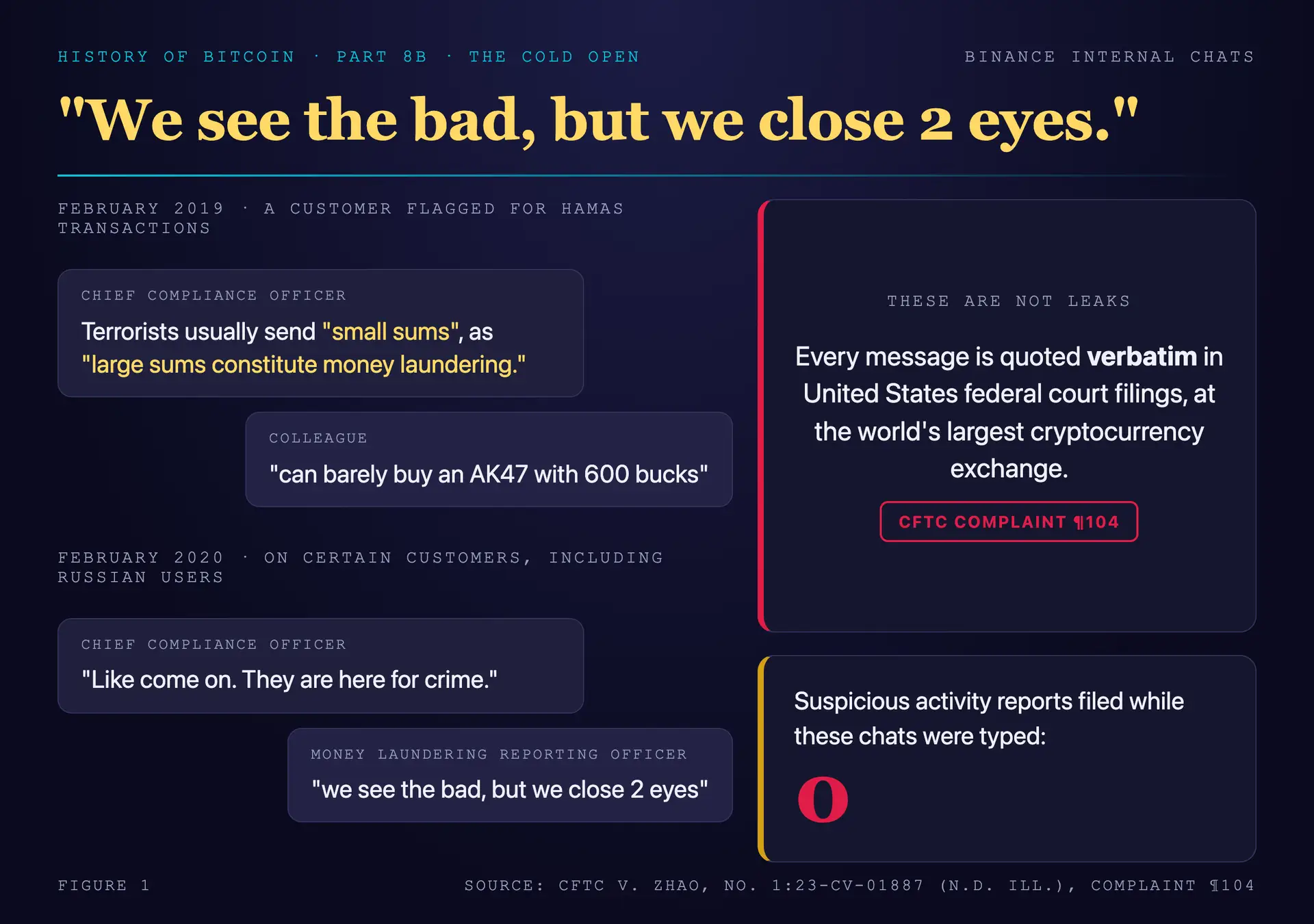
The compliance department of the largest exchange on earth, in its own words. Every message is quoted verbatim in the federal record. Source: CFTC v. Zhao, Complaint ¶104
Now let's file the above away as context, because while it is juicy enough as raw data, zooming out to see what else was going on in the world at the time should make your skin crawl.
In April 2019, this same exchange erased a major Bitcoin chain from its listings. Its CEO announced the decision on Twitter, mid-feud, in the words I quoted at the top of Part 8: "Craig Wright is not Satoshi. Anymore of this sh!t, we delist!"⁷ The stated justification, repeated by CZ personally and echoed by half the industry inside a week, was that the man behind the chain was "a fraud."
And in that exact month, April 2019, per the signed federal record, Binance was receiving reports from its own compliance vendor identifying Hamas-associated transactions on its platform, and it filed nothing.⁸
The referee who threw a player out of the game for "fraud" was, in that same hour, by its own later admission, operating one of the largest unreported crime conduits in the history of money. The record pins the concealment on the company's former compliance chief rather than on CZ personally, and that distinction will matter later. We will come back to April 2019 in its proper place. It is the pin that holds this whole article together.
This is the story of how the crypto casinos that become dark market proxy banks got built in broad daylight.
The Two Bitcoins
Part 8 ended with the builders in court and the house open for business. The civil war had moved from hashwar to lawfare; the chain trying to restore Satoshi's original design had been quarantined off the exchanges; and in the vacuum where peer-to-peer electronic cash was supposed to be, something else was growing at industrial speed. This article is about that something else. Part 4B followed the money into the companies that captured Bitcoin's protocol. This one follows it into the casino that captured Bitcoin's price, and laundered the collective Zeitgeist into thinking that price was the whole point.
Some ground rules first, because this article makes serious allegations about real, living, named people and companies, and the way I keep your trust is by telling you, sentence by sentence, what kind of claim you are reading. When I write "pleaded guilty," "convicted," "settled," or "a court found," that is the adjudicated record stated plainly. When I write "court filings show," "the consent order says," or "she testified," you are reading a primary document or sworn testimony that no jury ever tested. When an outlet reported it, I will name the outlet. And when a claim is mine, my synthesis, running out ahead of what any court has ruled, I will own it in the first person and tell you it is an argument, a first person account or an informed hunch.
So, tiered exactly. It is documented, exhaustively and from multiple independent directions, that the crypto market's reported size and vibrancy in these years was substantially manufactured. It is proven, by guilty plea and settlement, that the largest venues and instruments pricing the asset class were operated criminally. And it is my argument, no court has ruled it, that the machine you are about to watch assemble itself did not merely decorate Bitcoin's price but substantially produced it. I will show you every component and its paperwork. You decide how far up that ladder or down the rabbit hole you climb with me.
One more thing: None of what follows lived on a Bitcoin protocol. No stablecoin printer, no wash-trading bot, no shadow bank ever needed a protocol's permission, and no protocol rule was broken by any of it. The crime lived in the casino built on top: the exchanges, the stablecoins, the self-issued tokens. I am not going to stand my own chain on a pedestal about it either; the argument for the original Bitcoin was never that its people were saints, but rather that it was that a working system should not require saints. The point is the location of the crime. The crime lived at the casino, and the casino is what the world was told Bitcoin was always supposed to be, and retail investors bought the story!
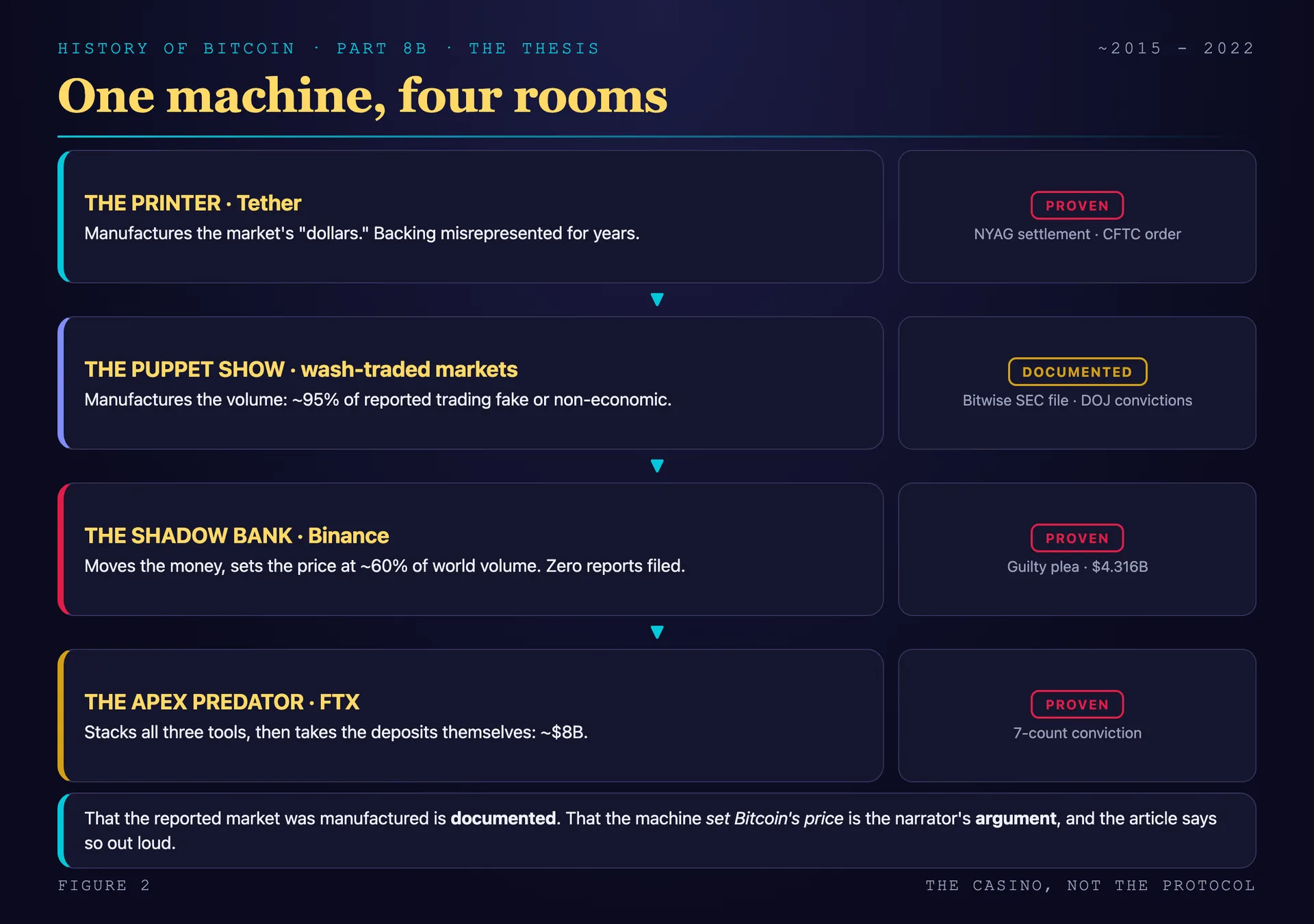
The casino took three tools to build. A printer, to manufacture the dollars. A theater, to manufacture the trading. And a bank, a real one in function, criminal in operation, to move the money and set the price. Then came a fourth thing, an apex predator that stacked all three tools, scaled them past anything before, and added the one crime the others had not yet been caught committing in the open.
We will take them in order, and we will do it the way the record does: dated, sourced, and cold.
The Printer
Start with the sentence that held up the whole sky.
"Every tether is always backed 1-to-1, by traditional currency."
That sentence, or wording materially similar to it, sat on Tether's website for years, through the 2017 mania and beyond, and it was the load-bearing totem of the entire crypto economy.⁹ Tether's token, USDT, is a "stablecoin": a digital chip that is supposed to be worth exactly one dollar because, the issuer promises, a real dollar sits in a real account behind every single one. By the late 2010s USDT was the de facto settlement dollar of the whole casino, the unit that traders on unbanked offshore exchanges used as cash, the quote currency against which Bitcoin's price was actually discovered on the venues that mattered. If you bought BTC in 2018 or 2019 or 2021, odds are the "dollars" on the other side of that trade were tethers. I have written about this company before, at length, and traced its birth out of Brock Pierce's Realcoin in Part 4B. What matters for this chapter is narrower: what was actually behind the peg, and when the company's own paperwork says the story changed.
Because the sentence did change. Quietly, with no press release, in late February 2019, the promise on the website was rewritten. "Backed 1-to-1 by traditional currency" became backed by "Tether's Reserves," which the new fine print conceded "may include other assets and receivables from loans made by Tether to third parties, which may include affiliated entities."¹⁰
The fine print, translated: the dollar behind your dollar may be a loan. Also, the borrower may be us.
Two months later the reason surfaced, under oath. On April 30, 2019, responding to the New York Attorney General, Tether's own general counsel, Stuart Hoegner, filed an affidavit stating that the reserves held cash and equivalents of "approximately $2.1 billion, representing approximately 74 percent of the current outstanding tethers."¹¹
Seventy-four percent. The company's own lawyer, in the company's own court filing. The token the entire market treated as a dollar was, at that moment and by its issuer's sworn arithmetic, three-quarters of a dollar.
How did it get there? The banking history tells you. Tether and its sister company, the exchange Bitfinex (same executives, same parent, iFinex), spent years being thrown out of the conventional banking system, which, to be totally fair, was a problem that wasn't necessarily their fault: Wells Fargo cut off their correspondent accounts in April 2017, and the companies sued and then dropped the suit within a week.¹² They drifted through Noble Bank in Puerto Rico.¹³ By November 2018 they had landed at Deltec Bank & Trust in the Bahamas, whose chairman, Jean Chalopin, is a man with one of the great career arcs in this entire saga: before he was the banker holding Tether's reserves, he co-created the cartoon "Inspector Gadget." (Really!)¹⁴ On November 1, 2018, Deltec issued a letter attesting that Tether held roughly $1.8 billion, enough to back every tether then outstanding, and Chalopin later confirmed the letter was authentic.¹⁵ The New York Attorney General's filings then supplied a critical fact that heavily implies that the balance was a veneer, because the very next day, hundreds of millions of dollars started moving out of Tether's account to Bitfinex.¹⁶
Why did Bitfinex need Tether's reserves? Because Bitfinex had a hole. The exchange had been using a shadow payment processor called Crypto Capital Corp, an entity with no license, and roughly $850 million of funds routed through it had been frozen and lost across accounts in multiple countries.¹⁷ One of Crypto Capital's operators, Reggie Fowler, a former NFL ownership investor, was eventually indicted; he pleaded guilty in April 2022 and was sentenced in June 2023 to 75 months in prison, with a forfeiture order of $740 million.¹⁸ To paper over the hole, Tether extended Bitfinex a $900 million line of credit against the reserves, of which roughly $750 million was drawn.¹⁹ The customer-facing promise said "every tether is backed by our reserves." The internal reality was "our already-questionable reserves are propping up our insolvent sister company's exchange."
Then the referees arrived, and the whispers become the permanent record.
On February 23, 2021, the New York Attorney General, Letitia James, settled with Bitfinex and Tether: an $18.5 million penalty, a ban on doing business in New York, and mandatory disclosures.²⁰ Settlements often come wrapped in mush. This one came with a sentence that really should be quoted verbatim in every article ever written about this company, and I intend to do my part:
"Tether's claims that its virtual currency was fully backed by U.S. dollars at all times was a lie."²⁰
That is not me. That is not a blogger with a grudge. That is the chief law enforcement officer of the State of New York, in her office's official statement, using the word "lie."
Eight months later the federal regulator landed on the same square. On October 15, 2021, the Commodity Futures Trading Commission fined Tether $41 million (and Bitfinex $1.5 million) and put a number on the fiction that no one in the industry has ever managed to spin away. Per the CFTC's order, Tether held sufficient fiat reserves to back the tethers in circulation "for only 27.6% of the days in a 26-month sample time period from 2016 through 2018."²¹
Twenty-seven point six percent of the days. Not a bad week. Not a stressful quarter. For roughly three out of every four days across twenty-six months, by the federal government's count, the "fully backed" dollar of the crypto economy was not fully backed, not by a longshot. The same order documented reserves commingled with corporate funds, undocumented arrangements, and a transfer of over $382 million from Bitfinex into Tether's account shortly before a reserve review; it also noted, dryly, that "Tether has not completed an audit."²²
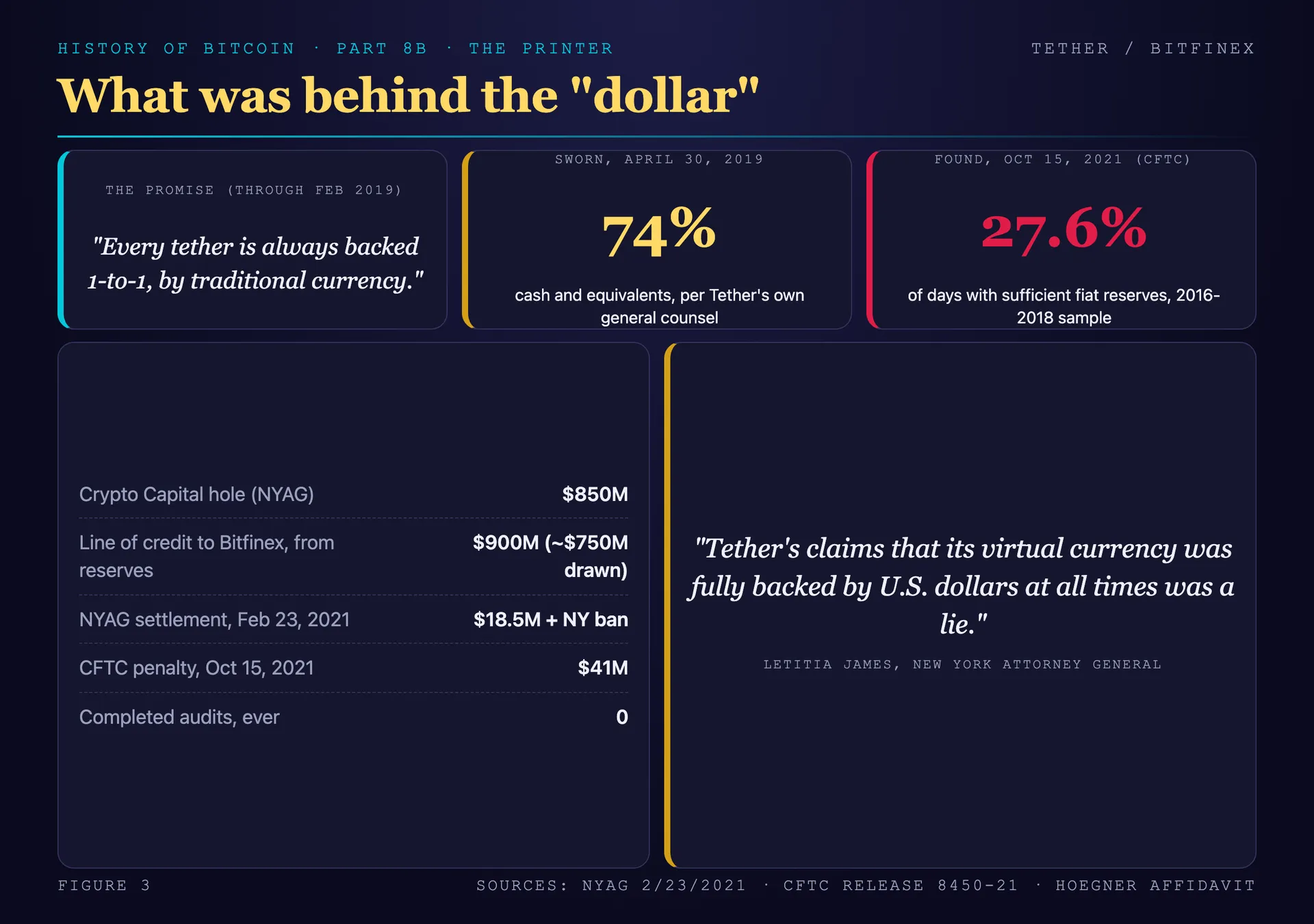
The backing story, told by the paperwork: a promise of 1-to-1, a sworn 74 percent, and a federal finding of 27.6 percent of days. Source: CFTC Release 8450-21
The dollars behind the biggest dollar-substitute in the world were, for years, imaginary.
Now, let's expand their compliance scandal into a market-structure scandal: what was all that imaginary money doing? The record hands us a peer-reviewed answer:
In 2018, finance professor John Griffin and his co-author Amin Shams began circulating a study of Tether's flows during the 2017 bubble; the revised version was published in 2020 in the Journal of Finance, one of the discipline's flagship journals, under the title "Is Bitcoin Really Un-Tethered?"²³ Their finding: Tether issuance was "timed following market downturns," flowed to exchanges, and was followed by "sizable increases in Bitcoin prices," with the flows "attributable to one entity" on the Bitfinex platform.²³ Griffin told reporters that roughly one percent of the hours in their sample, concentrated moments of tether-fueled buying, could account for something like half of Bitcoin's entire 2017 rise.²⁴ The Securities and Exchange Commission went on to cite the paper repeatedly in its orders rejecting Bitcoin ETF applications.²⁵
Tether has always denied manipulation, stating that it has never used tethers to move Bitcoin's price, and it has, since 2021, published quarterly attestations by the accounting firm BDO (attestations, mind you, not audits; the audit remains uncompleted to this day), it reported holding well over a hundred billion dollars in US Treasuries by 2024 with billions in annual profit, and in its entire history there is no documented instance of Tether failing to honor a redemption.²⁶ Nic Carter, a critic of the critics, has attacked Griffin's methodology at length.²⁷
What is true is that Tether has never collapsed or had a failure-level bank run. Good for them! What is proven is that their backing was misrepresented for years, in the words of New York's Attorney General a lie, and that the reserves were commingled and lent to an insolvent affiliate while the market was told otherwise. That a printer of partly-imaginary dollars, timed after downturns, set the price of Bitcoin is what I believe the evidence shows, and the best financial scholarship points the same direction, but no court has ruled it, no regulator has proven intent to manipulate, and you should make up your own mind on the matter.
One thing needs no argument at all: the printer never stopped. As I write this in mid-2026, there are roughly 184 billion tethers outstanding, an all-time high, more than double the figure from the collapse year this series is marching toward.²⁸ The respectable custodian of Tether's Treasury portfolio since 2021 has been Cantor Fitzgerald, whose chief executive, Howard Lutnick, stood up at Davos in January 2024 to vouch: "they have the money they say they have."²⁹ Cantor took a roughly five percent stake in Tether around a $600 million convertible arrangement, per the Wall Street Journal.³⁰ And Lutnick, whose deeper history we traced in Part 4B, is no longer just a friendly banker: since February 2025 he has been the sitting United States Secretary of Commerce.³¹ The company that spent years misrepresenting its reserves now has its paper custodied by the family firm of a cabinet secretary. Keep that thread in your hand or your pocket because it gets pulled again before this article is done.
That is the printer: a machine that could conjure the appearance of dollars, whose operators are proven by settlement to have lied about the backing, feeding the venues where Bitcoin's price was made.
A printer alone does not make a market, though. Somebody has to make the trading look real.
The Puppet Show
How do you know a market is real?
You look at the trading. Price is, in most regards, an opinion expressed in numbers, but volume is supposed to be a fact: somebody sold, somebody bought, money moved. In 2019, the whole world could look up crypto's volume on an aggregator called CoinMarketCap and see tens of billions of dollars changing hands every day, across hundreds of exchanges, and conclude that whatever else you thought of these coins, an enormous number of human beings were trading them.
In March 2019, an asset manager called Bitwise walked into the Securities and Exchange Commission and dismantled that fact in a couple hundred slides.
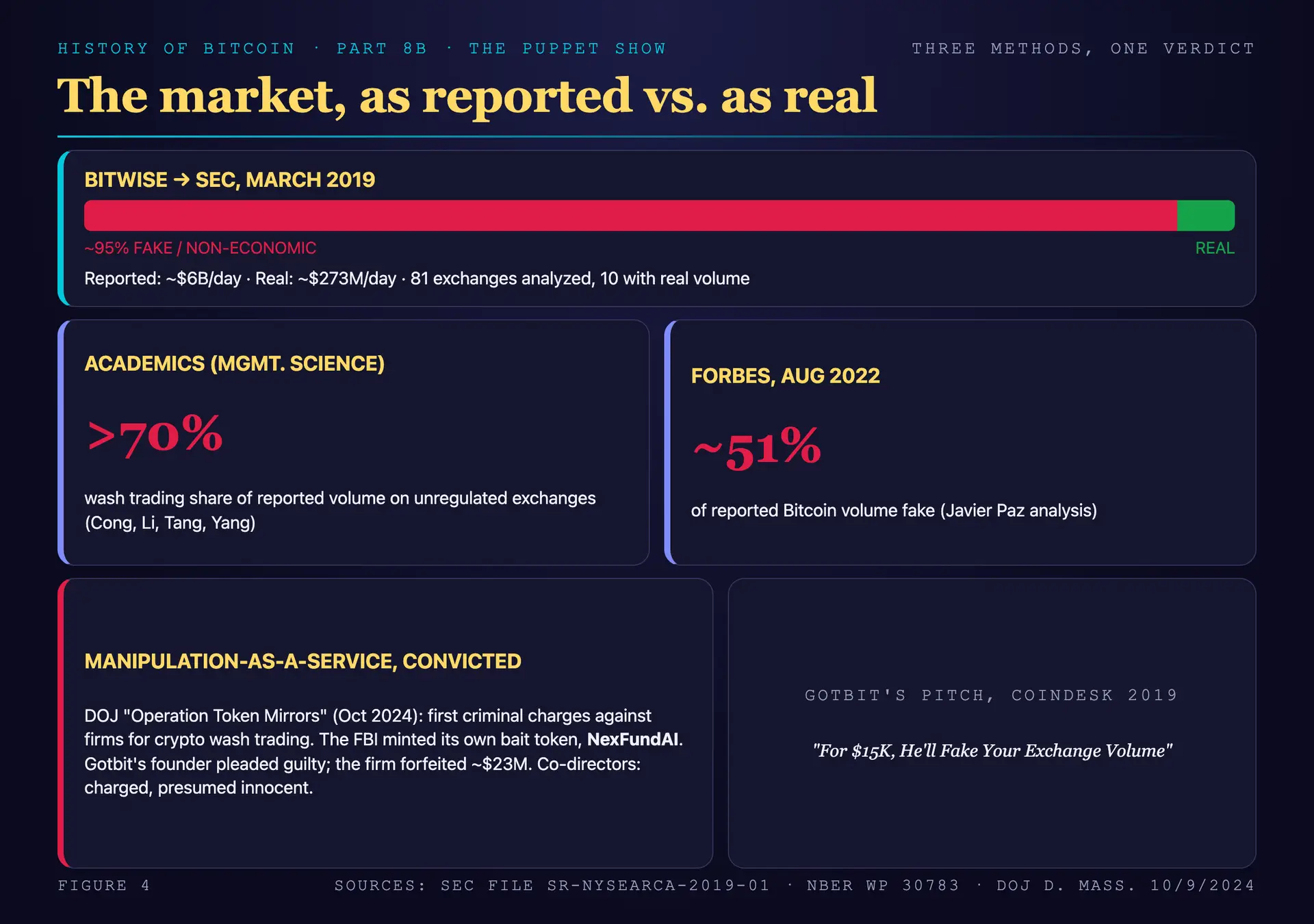
Bitwise wanted approval for a Bitcoin ETF, and its pitch to the regulator took an unusual shape: before you reject us over market manipulation, let us show you what the market actually is. The firm analyzed 81 exchanges, every venue reporting more than a million dollars a day in volume. Its conclusion, delivered in writing into the SEC's public file: "approximately 95% of this volume is fake and/or non-economic in nature."³² Of roughly six billion dollars a day in reported Bitcoin trading, Bitwise found about $273 million that was real.³³ Ten exchanges, out of the eighty-one, had volume that behaved like actual trading, real spreads, real order-book depth, volume that rose and fell with human hours. The other seventy-one were printing numbers.
Ninety-five percent. Not a small percent or a rounding disagreement. The market, as reported, was a Potemkin city dressed to look crowded.
And in fairness to the record, Bitwise's own argument cut in a direction the headlines skipped: the firm maintained that the ten real exchanges priced Bitcoin efficiently, that the fakery inflated the market's apparent size rather than its price.³³ The documented finding is that the reported market was overwhelmingly fabricated; whether the fabrication reached the price itself is a further step that I'm not taking just yet.
The academics arrived next and made it worse. A team of finance researchers (Lin William Cong, Xi Li, Danxia Tang, and Yang Yang) built statistical fingerprints for authentic trading and ran them across exchange data; their study, "Crypto Wash Trading," later published in Management Science, found wash trading averaging over seventy percent of reported volume on unregulated exchanges.³⁴ Forbes ran its own examination in 2022 and put the fake share of reported Bitcoin volume at roughly half.³⁵ Three different methodologies, three different years, one conclusion with different decimals: most of what the world called "the crypto market" was largely a theater set.
The mechanics are pretty simple, because wash trading is an old crime wearing new clothes. A wash trade is a trade you make with yourself: one hand sells, the other buys, no economic reality changes, but the tape records activity. Do it a few million times with bots and your empty exchange looks like the busiest venue on earth. Why bother? Because rankings ran on volume: a high slot on CoinMarketCap meant real users, and real users meant you could charge token projects six or seven figures for a listing.³⁶ Volume was the signage on the storefront. And the storefront was actually a painting of a storefront.
Now descend with me one layer, because under the fake retail volume sits the part almost nobody looks at: the "professionals" who make crypto's markets, the firms that quote the prices everyone else takes.
In a stock market, "market makers" are regulated broker-dealers with disclosed books. In crypto, the firms performing that function are private, mostly offshore, and disclose nothing. You cannot look up their balance sheets. You learn their names only when something breaks. When the Wintermute trading firm lost $160 million to a hack in September 2022, the industry got a rare glimpse of how much of the market ran through one company few civilians had ever heard of.³⁷ When Robinhood, a publicly traded American broker, filed its quarterly report in 2025, it disclosed that two crypto market makers, Wintermute and B2C2, each accounted for roughly a tenth of ALL of Robinhood's transaction-based revenue, eleven and twelve percent respectively, across its whole business.³⁸ Two private firms most Americans could not name, as the foundation for one of America's most popular brokerage apps.
The whole layer is like that: a small set of names (Wintermute, GSR, Cumberland, B2C2, Amber, Jump, Genesis, and one more I am going to hold back for a few sections) quoting the prices for an asset class the world was told was decentralized. How small? The cleanest measurement ever taken was involuntary. In November 2022, one single trading firm abruptly vanished from the market, and the research firm Kaiko watched the order books of the entire industry thin out in real time: "A week after the collapse, global crypto liquidity had halved," Kaiko wrote, "and thus was born the phrase 'The Alameda Gap.'"³⁹
Half the market's depth. One firm.
Alameda.
We'll come back to them because they are like the shark that doesn't show its true size until the third act of a movie about the ocean.
Who founded these firms? Wintermute was founded by Evgeny Gaevoy, who grew up in Moscow, studied at the Higher School of Economics, and cut his teeth at the Dutch trading house Optiver.⁴⁰ DWF Labs, one of the most aggressive market makers of the 2020s, is fronted by Andrei Grachev: born in Uzbekistan, built in the Russian and CIS crypto scene, and carrying a 2015 fraud conviction from a Moscow court (a suspended sentence, from his logistics days) that he does not advertise on conference stages.⁴¹ In 2024, the Wall Street Journal reported that Binance's own internal surveillance team had concluded DWF executed more than $300 million of wash trading, and that Binance responded by firing the investigator; DWF denied wrongdoing, and the finding was internal, never adjudicated, so it stays tagged as exactly that.⁴² Gotbit was founded by Aleksei Andriunin, a Moscow State University student who explained his business model to CoinDesk in 2019 with a candor that reads today like a signed confession; the profile was headlined "For $15,000, He'll Fake Your Exchange Volume."⁴³ Andriunin pleaded guilty in a United States federal court in March 2025 and was sentenced that June; the Gotbit entity was ordered to forfeit approximately $23 million.⁴⁴ Two Gotbit co-directors, Fedor Kedrov and Qawi Jalili, were charged as well; they are charged only, not convicted, and are presumed innocent.⁴⁵
Curiously, the crypto market-making layer is disproportionately Russian and CIS-founded. Not entirely, but a heavy helping. B2C2 was founded by a Belgian, Max Boonen; GSR by Goldman Sachs alumni; Amber is a Hong Kong operation; Cumberland is the crypto arm of DRW, a Chicago trading institution. But the concentration of founders from one particular post-Soviet talent pipeline, quant-trained and offshore-domiciled, in the private layer that quotes the prices, is a documented feature of this market, and it took the United States Department of Justice until 2024 to treat it as one.
That was Operation Token Mirrors. In October 2024, federal prosecutors in Boston brought what they described as the first-ever criminal charges against financial services firms for market manipulation and wash trading in the crypto industry, and the method of the sting was pretty interesting: the FBI created its own cryptocurrency token, NexFundAI, put it on the market as bait, and recorded which "market makers" offered to fake its volume for a fee.⁴⁶ Gotbit was one of the firms charged, alongside CLS Global, ZM Quant, and MyTrade. Market-manipulation-as-a-service, proven at the token level, with guilty pleas: not a theory, a product category, and the defendants' own recorded pitches captured the industry in two lines: one boasted that rivals "keep clients in the dark," and another that the wash trades stay "very hard to track."⁴⁶
Two boundaries before we stir the pot... First: the criminal plumbing of the Russian-language internet, the darknet market Hydra and the Moscow exchange Garantex, both sanctioned by the U.S. Treasury in April 2022, is a separate documented fact that we will meet again in the Binance section, and I am keeping it distinct from the market-maker story on purpose.⁴⁷ Guilt by shared geography is not an argument, but it is a curiosity. Second: the loudest early voice about all of this was an anonymous analyst called Bitfinex'ed, who spent 2017 through 2020 documenting what he argued was systematic manipulation on Bitfinex, a whale or coordinated actor he nicknamed "Spoofy."⁴⁸ That was attributed analysis, opinion, and the "industry" unanimously dismissed him as a crank. Then Bitfinex itself admitted, in an August 2017 statement, that certain accounts had engaged in "wash trading and self-funding shorts" around a token distribution, and years later the New York Attorney General and the CFTC confirmed the broader institutional dishonesty he had been pointing at.⁴⁹ That crank aged better than his critics did.
Thank you for your bravery, Bitfinex'ed!
I lived this layer of the story in real time: through these exact years I was doing a near-daily livecast, and the position I took on it, over and over, was that the reported market was a fiction and the venues were not honest brokers, and the standard response from the industry was that I was a bitter conspiracy theorist from a delisted chain. You have now read what the SEC file, the Journal of Finance, Management Science, Forbes, and the Department of Justice found. I will let you assign the word "conspiracy theorist" where you see fit, but I'm happy to still be here sharing hard truths.
So, the synthesis, at its correct tiers. Documented: the reported crypto market was substantially manufactured, by exchange self-inflation, by volume-as-a-service shops now carrying federal convictions, by affiliated market makers operating with no disclosure and no firewall between market-making, proprietary trading, and venture stakes in the same illiquid tokens. Documented: the entire asset class's liquidity rested on a set of private firms small enough that the disappearance of one of them cut global market depth in half. My argument, running ahead of the record and flagged as such: a market with manufactured dollars and manufactured volume does not merely misreport its size, it misreports its price, because price discovery happens on the margin and the margin was where the machines lived.
Most of the trading you were watching was a puppet show.
The puppets needed a stage with a cashier's window. That brings us to the bank.
The Shadow Bank
Every casino needs a cage, the barred window where chips become money and money becomes chips. From 2017 onward, the biggest cage in crypto was Binance: founded by Changpeng Zhao in the summer of 2017, offshore by design, migrating jurisdictions the way other companies migrate offices, and within eighteen months of its founding the largest cryptocurrency exchange on earth.⁵⁰ At its peak it handled more spot volume than its next several competitors combined, roughly sixty percent of the world's total by market-data counts, which means the global price of Bitcoin, the number on every ticker on every screen on every trading desk on earth, was to a first approximation whatever the order books of Binance said it was.³
You already know, from the cold open, what was in the chat logs. What you need now is the timeline, because the iceberg only weighs what it weighs when you watch it accumulate year by year, entry by entry, each one dated in the government's filings. This section is [PROVEN] and [DOCUMENTED] material almost wall to wall: a guilty plea, a consent order the company signed, and a federal complaint whose quotes Binance never contested at trial because it settled everything on the same November day. The record of what was happening at the world's price-setting venue, in order:
January 2018. Trades between U.S. users and users in Iran begin flowing through the platform in earnest. By the time the counting stops in May 2022, the Justice Department's plea documents put the figure at over $898 million in trades that Binance "willfully caused" between Americans and customers ordinarily resident in a comprehensively sanctioned country.⁵¹
September 2018. Hackers loot the Japanese exchange Zaif and push the stolen coins through Binance in chunks small enough to duck the exchange's own thresholds. A Binance manager, watching it happen, describes the technique in an internal chat with clinical accuracy: "It's a type of standard money laundering."⁵² No report is filed.
Late 2018. A consultant produces the document that Forbes will later expose under the name "Tai Chi": a plan, presented inside Binance, for standing up a nominally independent American entity to absorb U.S. regulatory attention while the real business and the real revenue stay offshore.⁵³ When Forbes published the story in October 2020, Binance sued the magazine for defamation, then quietly dropped the suit; the 2023 federal findings would corroborate the substance of what the document proposed.⁵³
December 2018. Samuel Lim, the chief compliance officer, puts the company's regulatory posture in writing for posterity: "there is no fking way in hell I am signing off as the cco for the ofac shit."⁵⁴ OFAC is the Treasury office that administers sanctions. He signed off on the job anyway, in the sense that he kept it.
February 2019. The month of the AK47 chat you have already read.¹ The same season, employees joke in writing about the customer base: "we need a banner 'is washing drug money too hard these days - come to binance we got cake for you.'"⁵⁵ In the same window, per the FinCEN consent order, the al-Qassam Brigades, the military wing of Hamas, begin their public cryptocurrency fundraising campaign, advertising on Twitter: "Donate to Palestinian Resistance via Bitcoin."⁵⁶
April 2019. Stop the tape.
This is the month I opened the article with, and the month Part 8 was built around, and this is where the two stories become one story, so lay the two columns side by side and let the calendar do the work.
In column one: on April 12, 2019, CZ tweets that "Craig Wright is not Satoshi. Anymore of this sh!t, we delist!" On April 15, Binance formally announces it is delisting BSV, the chain backing the man CZ calls "a fraud," and the industry cascades behind him inside ninety-six hours: ShapeShift, then Kraken with its Twitter poll, the whole purge I documented in Part 8.⁵⁷ The publicly stated moral logic, cheered by the entire crypto press, was that an exchange has standards, and a "fraud" fails them.
In column two: in April 2019, per the consent order Binance itself signed with FinCEN, "Binance received reports from its third-party service provider in April 2019 identifying Hamas-associated transactions and filed no SARs with FinCEN. Instead, Binance's former Chief Compliance Officer attempted to influence how its third-party service provider reported on Binance's conduct."⁸
Same company. Same month.
In column one, an accusation of fraud, adjudicated by tweet, punished within days, to global applause. In column two, reports of terrorist financing on its own platform, buried, massaged, and reported to no one, for years.
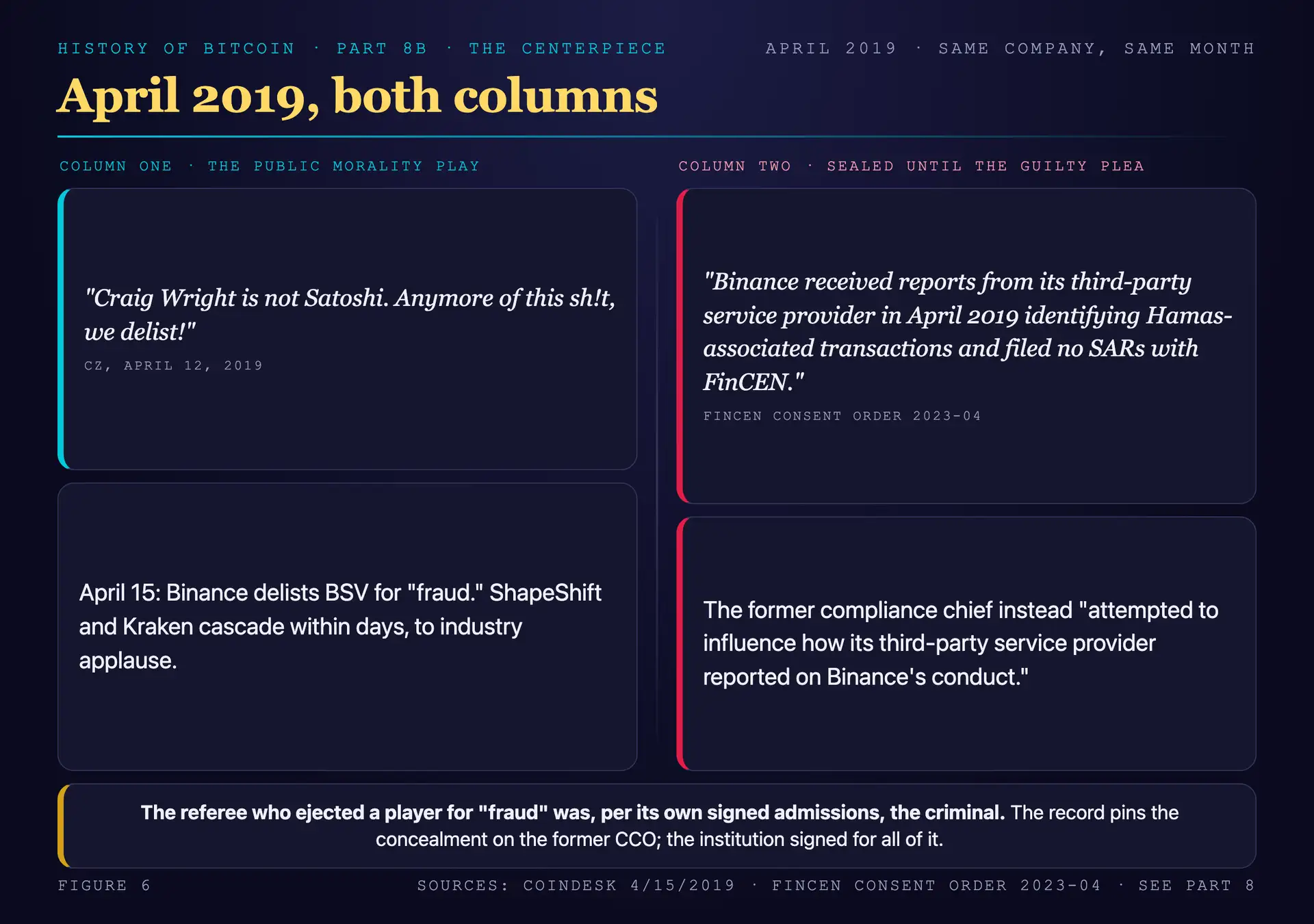
April 2019, both columns. The delisting made every front page in crypto; the other column stayed sealed until the guilty plea. Source: FinCEN Consent Order 2023-04
The temptation to overdraw this is enormous, and the record is dense with spicy specifics. The FinCEN order attributes the SAR concealment to Binance's former chief compliance officer, not to CZ personally, and no filing I have seen establishes that CZ read a Hamas report in the same week he was tweeting about Craig Wright. So the claim is not "CZ chose the Wright feud over the Hamas report." The claim, and the record carries it in full, is about the institution: in the month the world's largest exchange found the distinct moral clarity to erase a Bitcoin chain from the market over an unproven accusation of fraud against one man, that same institution could not find a single form's worth of moral clarity about terror financing moving through its own machines.
The delisting was a values statement, they told us. I agree. It stated their values loud and clear.
The chain that got thrown out that month, whatever you think of it, was not the thing moving money for al-Qaeda. The venue doing the throwing, by its own signed admissions, was.
And since the industry's stated concern that month was "fraud": in the very season CZ was positioning Binance among the honest venues (he had publicly welcomed the Bitwise fake-volume report that March, calling such transparency useful for the industry⁵⁸), his own house would soon, per the SEC's later complaint, manufacture its American storefront's opening act. When Binance.US launched in September 2019, the SEC alleged, a trading firm called Sigma Chain, owned by CZ himself, wash-traded the new exchange's markets from day one, at moments supplying the large majority of first-hour volume in a listed asset; Sigma kept at it, per the complaint, into 2022.⁵⁹ The SEC's case was dismissed with prejudice in May 2025, in the middle of a change of political weather we will get to in a later article, so these allegations were never adjudicated and probably never will be, which is a shame. The man who delisted a chain over "fraud" was accused by the United States securities regulator of running fake volume through his own affiliate on his own exchange, and the accusation died not on the facts but with the case.
June 9, 2019. CZ, in a recorded internal meeting, on the company's relationship with American law: "We are already doing a lot of things that are obviously not in line with the United States." In the same period he notes that twenty to thirty percent of Binance's traffic comes from the U.S., and his finance chief supplies the policy: "we will never admit that we openly serve US clients."⁶⁰
February 2020. "Like come on. They are here for crime." "we see the bad, but we close 2 eyes."² You have read this one. Now you know it came a full year AFTER the Hamas reports.
March 2020. Dutch and American authorities take down Dark Scandals, a site trafficking in filmed sexual abuse, including of children, and indict its operator; the flows had touched Binance, and Binance, per the federal record, still files nothing.⁶¹
July 2020. A vendor flags accounts associated with ISIS and Hamas. The chief compliance officer's documented reaction is not horror at the customer; it is horror at the exposure: "[e]xtremely dangerous for our company." His documented instruction: check whether the account is a VIP, and if so, "[o]ffboard the user but let him take his funds and leave."⁶²
Let the money leave quietly. Just get the terrorist off the books before anyone official notices him.
October 2020. The message discipline arrives. Per the CFTC's complaint, U.S.-related communications move to the auto-deleting messenger Signal, "as mandated by cz."⁶³ When a company's compliance history is a liability, the compliant thing to do, apparently, is to stop generating history.
Three more years of this, and then the reckoning, which you already know from the cold open: November 21, 2023, the guilty plea, the $4,316,126,163.⁴ For the ledger, the other agencies' numbers, FinCEN's $3.4 billion, OFAC's $968,618,825, the CFTC's $2.85 billion, overlap and credit the Justice Department's figure and each other, so resist the internet's habit of adding them into an eleven-billion-dollar headline; the real aggregate is the $4.3 billion, and it was already the largest resolution of its kind in Treasury history.⁶⁴ The consent order's summary of the operating policy came from the compliance chief himself, reporting what he had been told: "the senior management policy was to never report any suspicious transactions."⁶⁵ The Justice Department found Binance had made over $1.6 billion in profit from its U.S. users alone while filing, in its entire existence, not one suspicious activity report.⁶⁶ CZ's own recorded philosophy, quoted in the government's papers, was that it is "better to ask for forgiveness than permission."⁶⁷
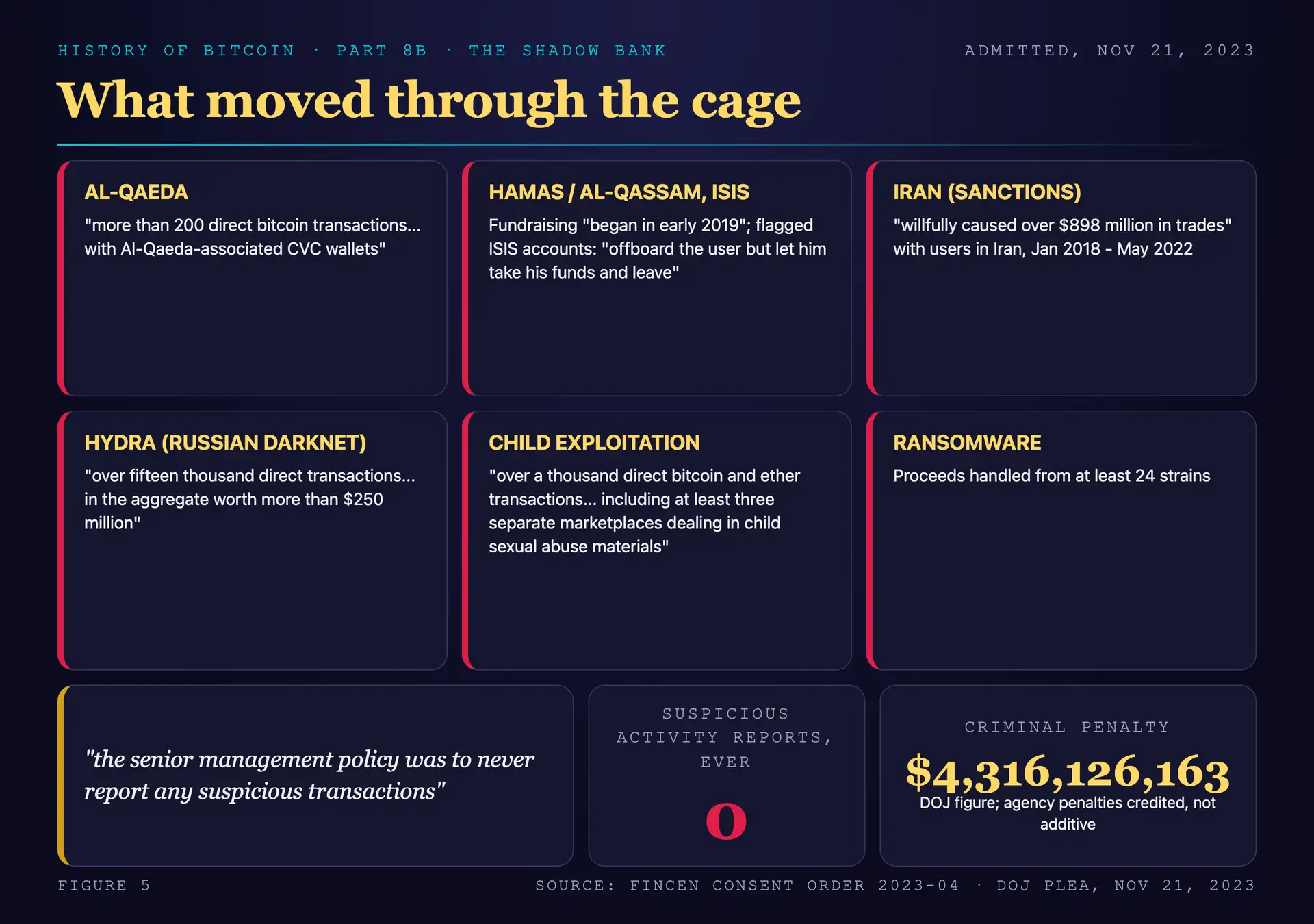
Not allegations: admissions. Every spoke of this wheel appears in the consent order Binance signed. Source: FinCEN Consent Order 2023-04
Attorney General Merrick Garland, announcing the plea: "using new technology to break the law does not make you a disruptor, it makes you a criminal."⁶⁸ Treasury Secretary Janet Yellen, same day: Binance's "willful failures allowed money to flow to terrorists, cybercriminals, and child abusers through its platform."⁶⁹
Wild that this industry gave us a 2019 sermon about protecting users from a "fraud."
One separate figure, kept separate on purpose: Reuters investigated Binance's Hydra exposure independently and estimated around $780 million in total flows linked to the Russian darknet market, a broader measure including indirect hops; Binance disputed that reporting.⁷⁰ The number Binance signed is the $250 million in direct Hydra transactions from the consent order, and the discipline of this article is that the signed number leads.⁶ Alongside Hydra, the sanctions ledger: per OFAC, more than 1.67 million trades involving sanctioned jurisdictions, Iran, Cuba, Syria, Crimea, and elsewhere, while employees at times suggested VPNs to help users hop the company's own geofences.⁷¹
So what did it cost, personally, to have run all of that?
The Justice Department asked for three years. On April 30, 2024, Judge Richard A. Jones sentenced Changpeng Zhao to four months.⁷² He served it in a low-security facility in California and walked out in September 2024, still one of the richest men on the planet. And on October 21, 2025, the President of the United States signed, in the pardon warrant's own words, "A FULL AND UNCONDITIONAL PARDON" of the felony he had pleaded guilty to.⁷³ The pardon was not announced; it leaked two days later, and when a reporter eventually asked Trump about the beneficiary, the President of the United States said, "I don't know" him.⁷⁴ By then, Binance had lent its software support to World Liberty Financial, the Trump family's own crypto venture, a fact reported across the financial press and which I present to you as exactly that, a reported fact.⁷⁵
The largest exchange on earth pleads guilty to operating, in effect, an unlicensed global bank whose management policy was to report nothing to anyone. It pays a fine that amounts to a toll. Its founder serves less time than a shoplifter, keeps the fortune, and is subsequently pardoned by a president whose family business his company had reportedly supported.
Four months. For that.
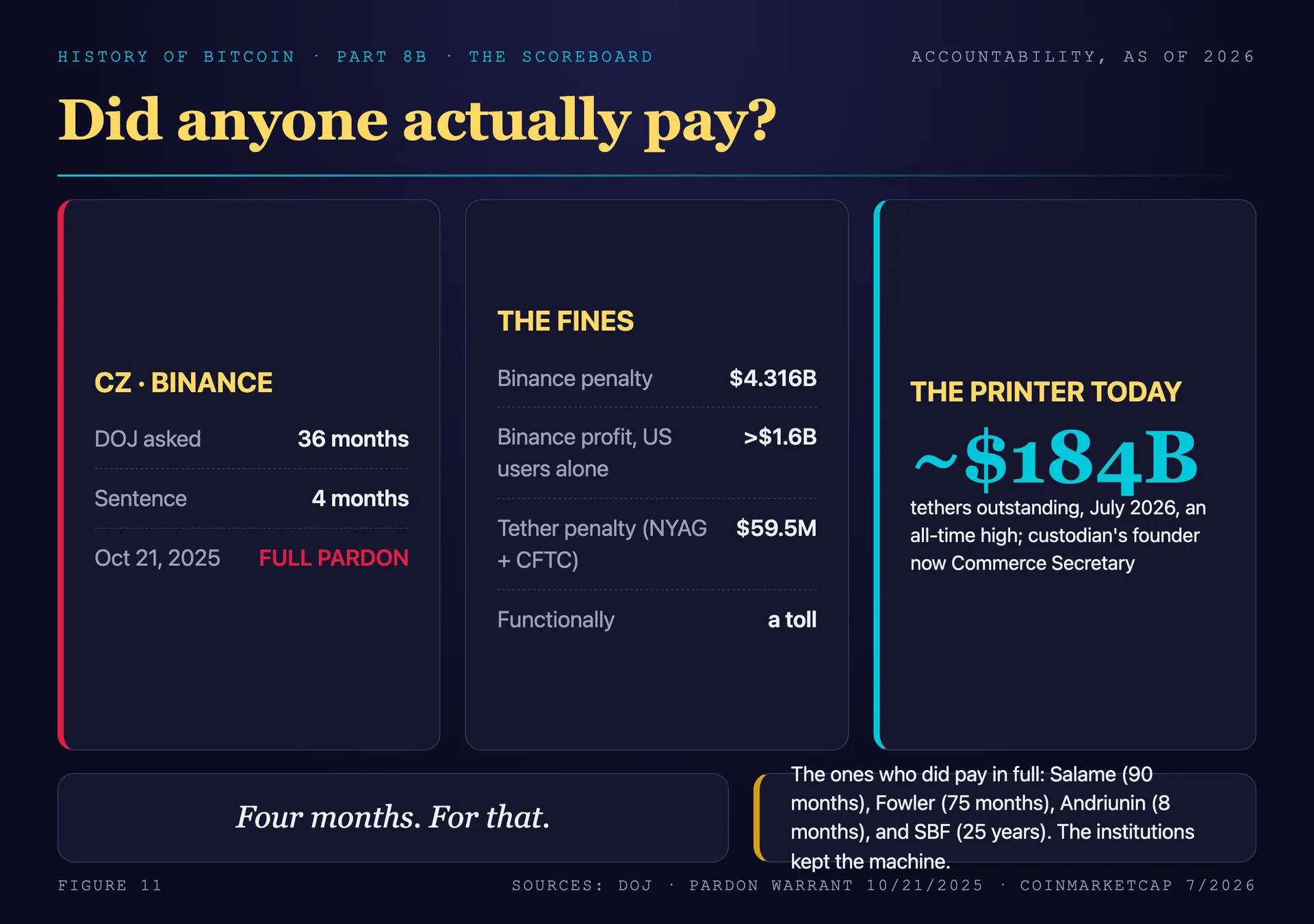
The printer made the dollars. The puppet show made the volume. The bank moved the money and set the price, and the record now shows what it was while it did. All three tools were lying on the table in plain sight by the summer of 2019.
Which is exactly when a twenty-seven-year-old with a physics degree and a philosophy about doing the greatest good picked all three of them up at once.
The Apex Predator
Sam Bankman-Fried was supposed to be the opposite of everything you have read so far.
The pedigree glowed in exactly the places crypto pedigrees were dark. A physics degree from MIT, class of 2014. A stint at Jane Street, one of the most respected quantitative trading firms on Wall Street. And a philosophy: as an undergraduate, Bankman-Fried had been recruited into "effective altruism," a movement of philosophers and quants organized around doing measurable good, by one of its founders, the Oxford philosopher William MacAskill, who personally sold him on a career plan called "earn to give," make billions so you can donate billions.⁷⁶ The press could not get enough of it. Here, at last, was the vegan wunderkind in cargo shorts who was in it to save humanity.
In the fall of 2017 he founded a trading firm and named it, with the first documented lie of the enterprise, Alameda Research. There was no research. It was a crypto arbitrage shop, co-founded with fellow effective altruist Tara Mac Aulay; a Jane Street colleague named Caroline Ellison joined in early 2018.⁷⁷ And in the spring of 2019, in the same season Binance was delisting BSV and receiving those April terror-financing reports, Bankman-Fried launched his own exchange: FTX, incorporated offshore, co-founded with his MIT roommate Gary Wang, who wrote the code.⁷⁸
You have already heard the name Alameda once, in the puppet-show section, on the list of the private market-making firms that quote crypto's prices. That was not sloppy of me. The apex innovation of FTX was precisely this: the exchange and the market maker were the same organism. The house that ran the casino also sat at every table, and both answered to the same twenty-seven-year-old.
Within days of FTX's launch came the token. FTT was an "exchange token," a coin FTX invented, issued to itself, and listed on itself, whose value proposition was, roughly, loyalty points for the casino.⁷⁹ Because FTX controlled the float and the venue, FTT's price could be curated, and the trial record states it clearly: at Bankman-Fried's criminal trial, the government proved that Alameda's balance sheet was propped up by billions of dollars of FTT and similar self-issued coins, marked at market prices that Alameda could never have realized by selling, because the selling itself would have crushed the price. Caroline Ellison testified under oath that with the insider tokens stripped out, Alameda's books at one point ran nearly three billion dollars negative.⁸⁰
An empire whose collateral was its own printed loyalty points. Tether built a printer for fake dollars; Bankman-Fried built a printer for fake collateral, which is the same machine one abstraction higher.
Now the date that should be carved over the entrance gate of this whole story.
On July 31, 2019, less than three months into FTX's existence, Gary Wang wrote a special flag into the exchange's code: "allow_negative." It was applied to exactly one customer, ever: Alameda Research. The flag let Alameda's account go below zero, effectively without limit; alongside it, Alameda received a line of credit that swelled to roughly sixty-five billion dollars and an exemption from the auto-liquidation engine that closed out every other customer who fell behind.⁸¹ Wang testified that Alameda was drawing on FTX customer funds "as early as 2019."⁸² In plain banking language: from its infancy, the exchange's house trading firm could spend the depositors' money, invisibly, at will.
And on that same day, July 31, 2019, Sam Bankman-Fried logged onto Twitter to reassure the market about conflicts of interest: "Alameda is a liquidity provider on FTX but their account is just like everyone else's."⁸³
The tweet is still there, a museum piece now:
The backdoor and the denial of the backdoor, committed on the same date. When people ask me why I write history with such tedious attention to timestamps, this is why. Fraud is rarely a single dramatic act; it is a thousand small acts. But every so often the record hands you a single day where the whole scheme sits in one frame, the code on one screen and the tweet on the other.
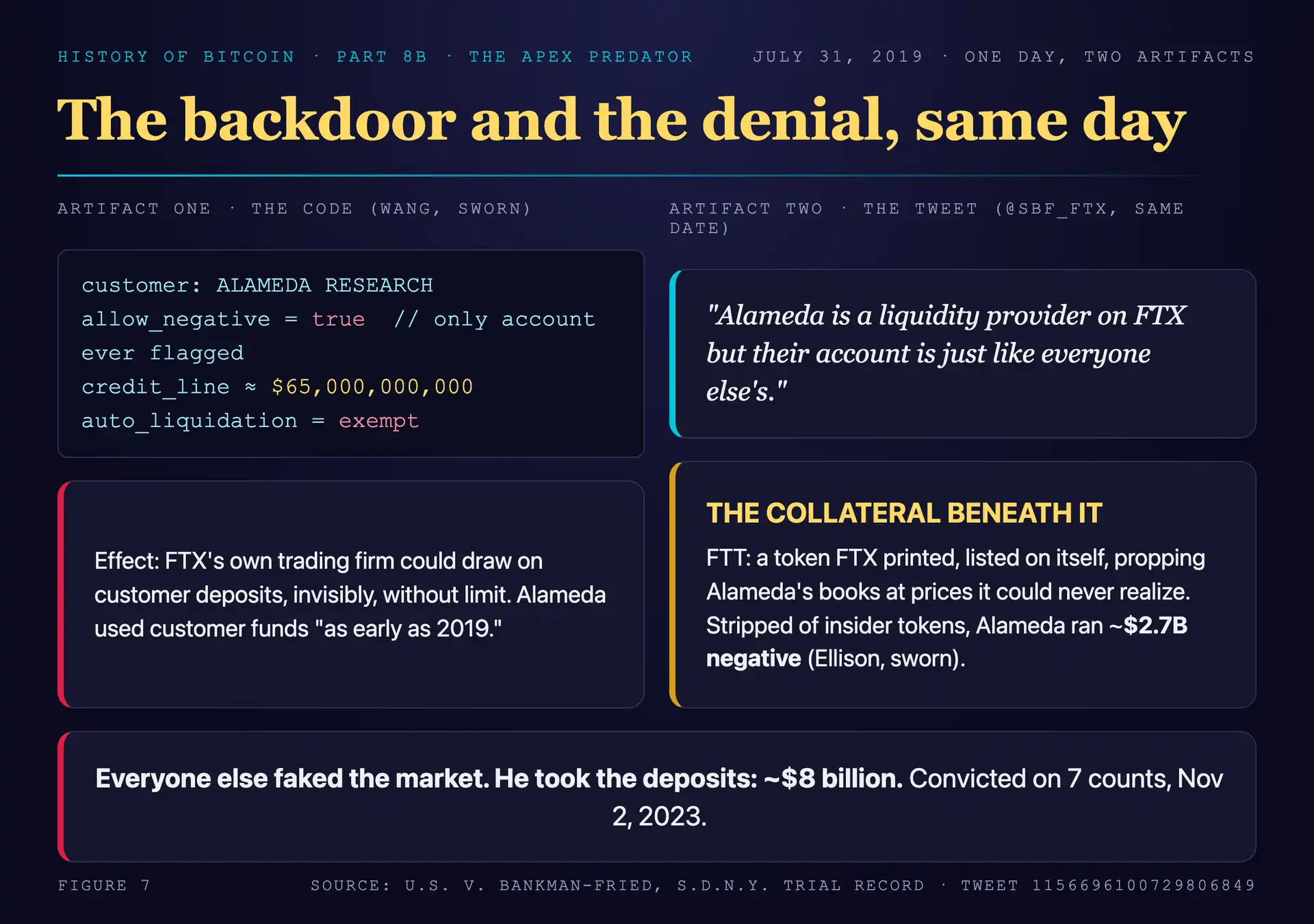
One day, two artifacts: the code and the tweet. Gary Wang walked the jury through the first; the second speaks for itself. Source: United States v. Bankman-Fried, S.D.N.Y. trial record
The machine worked. FTX grew faster than any exchange in history, and the money began to behave the way money behaves in the third act of every fraud ever prosecuted. In September 2021 the operation moved to the Bahamas, beyond the reach of American regulators and into a $30-to-40 million penthouse (the reported range) in a resort called Albany, where Bankman-Fried lived with a cluster of colleagues and co-founders.⁸⁴ The living arrangement launched a thousand lurid headlines; the verified core is that several of the housemates running a multi-billion-dollar financial group were paired off romantically with each other, and that Bankman-Fried and Ellison, his top lieutenant at Alameda, were in an on-again, off-again relationship; the Rolling Stone reporter who actually went and looked wrote that she saw no evidence of the orgiastic commune of legend.⁸⁵ The relevant scandal was never the bedrooms. It was that the CEO of the exchange and the CEO of the house market maker, two firms whose separation was the entire public promise, shared a penthouse and, intermittently, a bed.
The buying spree ran on the same calendar. In March 2021, FTX put its name on the Miami Heat's arena, $135 million for nineteen years.⁸⁶ Tom Brady endorsed and took equity that Bankman-Fried later agreed was worth around $55 million, Gisele Bündchen around $20 million.⁸⁷ In February 2022, a Super Bowl audience watched Larry David reject every great invention in history and then FTX, under the tagline "Don't Miss Out"; David later summarized his own due diligence for the ages: "So, like an idiot, I did it."⁸⁸ And in April 2022, FTX quietly made an investment that reads differently now than it did then: $500 million into a young artificial intelligence startup called Anthropic, money the government would later establish had come from FTX customer deposits. (In one of the grimmest ironies on the ledger, that stolen stake turned out to be the estate's best trade; the bankruptcy later sold most of it for roughly $884 million.)⁸⁹
Behind the sponsorships, the record shows the money doing stranger things, and each item is dated, sworn, or charged, so take them in order. In November 2021, Chinese authorities froze roughly a billion dollars of Alameda money on two exchanges. Ellison testified, under oath and under a cooperation agreement, about the escalation that followed: first the firm tried to trade its way out through accounts opened, in her words, using the identities of people she believed were "Thai prostitutes"; when that failed, she was told the funds were eventually unfrozen after a payment of well over a hundred million dollars, a figure her own contemporaneous spreadsheet recorded with the laconic entry "-150m from the thing."⁹⁰ The Justice Department charged the episode as an approximately $40 million bribe of Chinese officials under the Foreign Corrupt Practices Act; the count was severed for a later trial that never happened, so it stands as an allegation, and Judge Lewis Kaplan instructed the jury that Bankman-Fried was "not charged in this case with bribery."⁹¹ Alleged, testified, never tried: three different tiers inside one anecdote, and now you have all three.
By the summer of 2022 the hole had a paper trail. On June 28, 2022, with lenders demanding Alameda's financials, Bankman-Fried, per Ellison's sworn testimony, directed the preparation of what became seven alternative balance sheets, seven versions of the same firm's reality, and the version sent to the lender Genesis was the one that concealed roughly ten billion dollars Alameda had taken from FTX customers.⁹² Ellison also gave the trial one of its defining documents: a Google doc titled "Things Sam Is Freaking Out About," a to-do list of the anxieties of a man running out of road, which included raising money from the Saudi crown prince, "getting regulators to crack down on Binance," and buying the stock of Snap.⁹³ That middle item is the tell. The apex predator's plan for his biggest rival was not to out-compete it. It was to aim the government at it. Ellison likewise testified about her boss's self-assessment: he believed there was a five percent chance he would someday be President of the United States.⁹⁴
And the whole empire, per the on-chain accounting in Protos's Tether Papers, ran on the rails this article has already built: Alameda Research was the single largest recipient of newly minted USDT in the world, almost $36.7 billion of it, roughly 37 percent of everything Tether had ever issued.⁹⁵ The printer from section two fed the market maker from section three, which was the same firm as the exchange in this section, which was entangled, as you are about to see, with the shadow bank from section four. It was never four stories. It was one machine with four rooms.
After the events of the next chapter, Bankman-Fried would sit for a late-night direct-message interview with Vox's Kelsey Piper and casually incinerate his own halo. The ethics, he typed, were "just PR"; his years of righteous talk about regulation and doing good had been part of "this dumb game we woke westerners play where we say all the right shibboleths and so everyone likes us."⁹⁶
The most celebrated moral brand in the history of finance, appraised by its owner: a shibboleth game.
So, the ledger on the man, tiered exactly. It is proven, by jury verdict on seven counts, that Sam Bankman-Fried committed fraud; proven by sworn testimony and code that his exchange's customer deposits were secretly spendable by his own trading firm from 2019; documented in his own executives' files that the books shown to the world were curated fictions. And it is my framing, argued on top of those proven parts, that what FTX represents in this history is convergence: the captive token (Tether's move), the captive market maker (the puppet-show move), the offshore opacity (Binance's move), stacked into one corporate organism and pushed one crime further, to the direct taking of roughly eight billion dollars of customer money.⁹⁷ The others faked the casino's books.
Everyone else faked the market. He took the deposits.
The Match and the Paper
One more, massive, load-bearing beam and the machine is complete, and it is the strangest one: the two biggest operations in this story owned pieces of each other.
In 2019, when FTX was six months old, Binance invested roughly $100 million for about a fifth of it.⁹⁸ The kingpin bought into the prodigy. For two years the industry's two most aggressive empires grew intertwined, and then, in July 2021, they divorced: FTX bought Binance out of its stake. The price was on the order of two billion dollars, and we know the composition because CZ himself would state it publicly sixteen months later, in a message you will read in full in the next installment: the buyout was paid "in cash (BUSD and FTT)."⁹⁹
Holy Moly!
BUSD was Binance's own dollar token. FTT was, as you now know, FTX's self-issued loyalty coin, the same asset propping Alameda's balance sheet. FTX bought back its independence, in substantial part, with billions of dollars of its own printed scrip, and the FTX bankruptcy estate later sued over the transaction, alleging the buyout was a constructive fraudulent transfer funded substantially with customer deposits.¹⁰⁰ Binance's exit payment, in other words, may have been the depositors' money, converted into the departure of the one shareholder big enough to see the books.
The divorce left something behind. Sitting in Binance's treasury, after the buyout: roughly 23 million FTT tokens, worth on the order of $580 million at the prices of the following autumn.¹⁰¹
Walk through the geometry with me, because this is where the story gets really ridiculous. Alameda's solvency rested on the price of FTT. FTT's price rested on a thin, curated float. And the single largest external pile of FTT on the planet now sat in the treasury of Changpeng Zhao, a convicted-felon-to-be who had watched FTX's founder spend 2022 telling regulators, politicians, and journalists to crack down on Binance, and whose own files, per Ellison's testimony, were on Sam's freak-out list as a target.⁹³
One of them was holding a match. The other was made of paper.
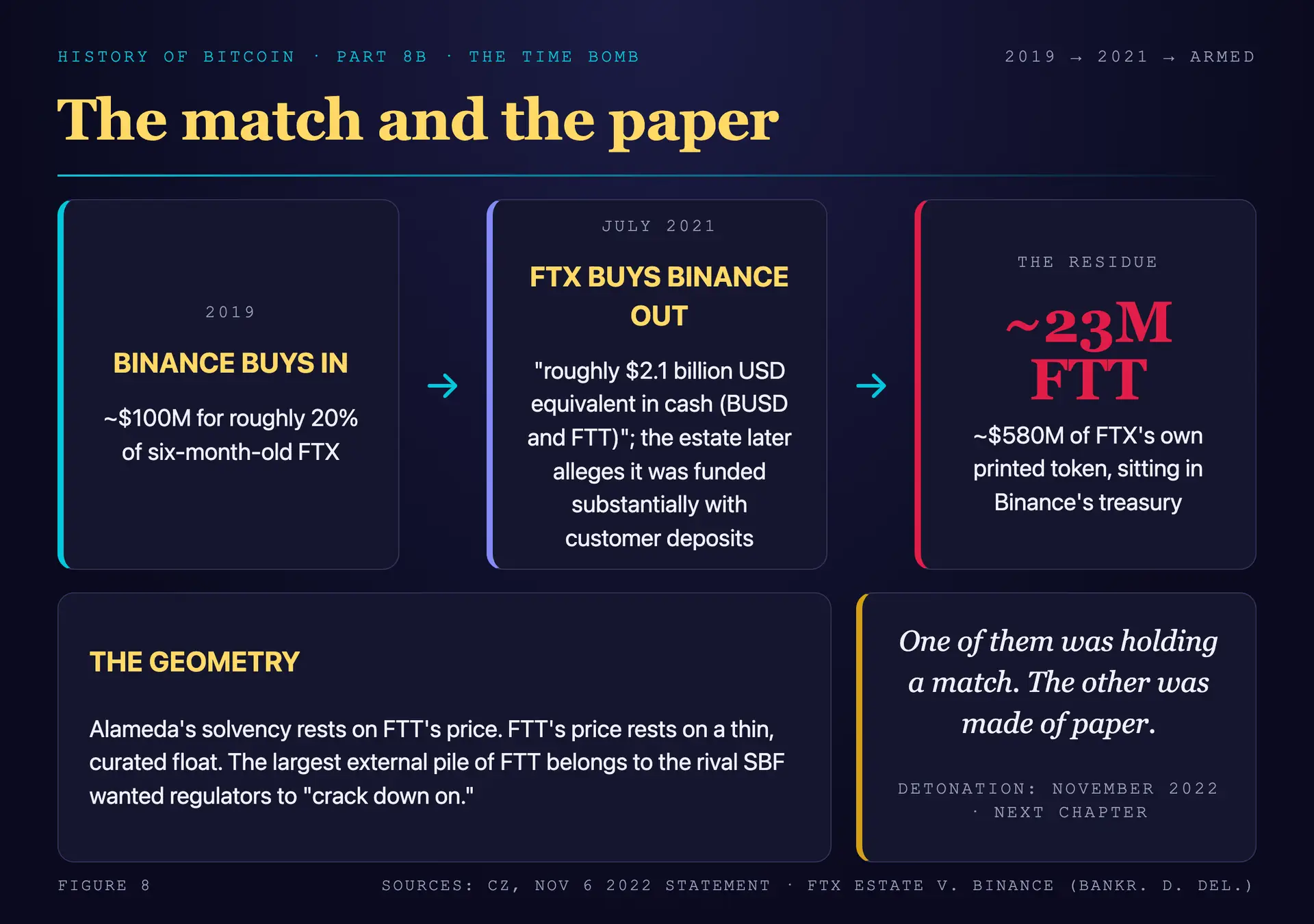
Two fake empires bound by a coin made of nothing, in the spring of 2022, at the absolute peak of the machine's power. What one typed at the other in November of that year, and what fell down when he did, is the next article.
There is one more room in the machine to walk through first, and it is the one the industry least wants walked: who was standing around these men while they did it, whose money moved through theirs, and who, in Washington and Cambridge and Manhattan, got paid.
The Network: Buying Washington
Every machine this size runs inside a protective casing. FTX's casing was made of two materials: a philosophy, and a purchase order for the American political class. Both are documented to a degree that should embarrass everyone involved, and neither looks the way the partisan versions of this story claim.
Start with the philosophy, because it is the connective tissue the money moved through. Effective altruism gave Bankman-Fried more than a brand; it gave him a network of true believers in institutional Washington-adjacent philanthropy. William MacAskill, the Oxford philosopher who had recruited him, sat as an adviser to the FTX Future Fund until he resigned two days into the collapse.¹⁰² The movement's largest funder, Facebook co-founder Dustin Moskovitz's Open Philanthropy, shared a worldview, and a funder, with the political operation closest to Sam's family: Moskovitz is a named backer of Mind the Gap, the quiet Democratic donor-routing super PAC co-founded in 2018 by Stanford Law professor Barbara Fried.¹⁰³
Barbara Fried is Sam Bankman-Fried's mother.
The family political machine was real and it was documented: mother co-founds a Democratic money-routing operation; brother Gabe runs Guarding Against Pandemics, a lobbying shop funded from the family fortune; father, Stanford Law professor Joseph Bankman, draws a $200,000-a-year adviser's salary through FTX US.¹⁰⁴ When it all fell down, the FTX estate sued both parents, and its complaint carries the domestic details: a $16.4 million property in the Bahamas in their names, a $10 million cash gift, $5.5 million in FTX money to Stanford (which the university returned).¹⁰⁵
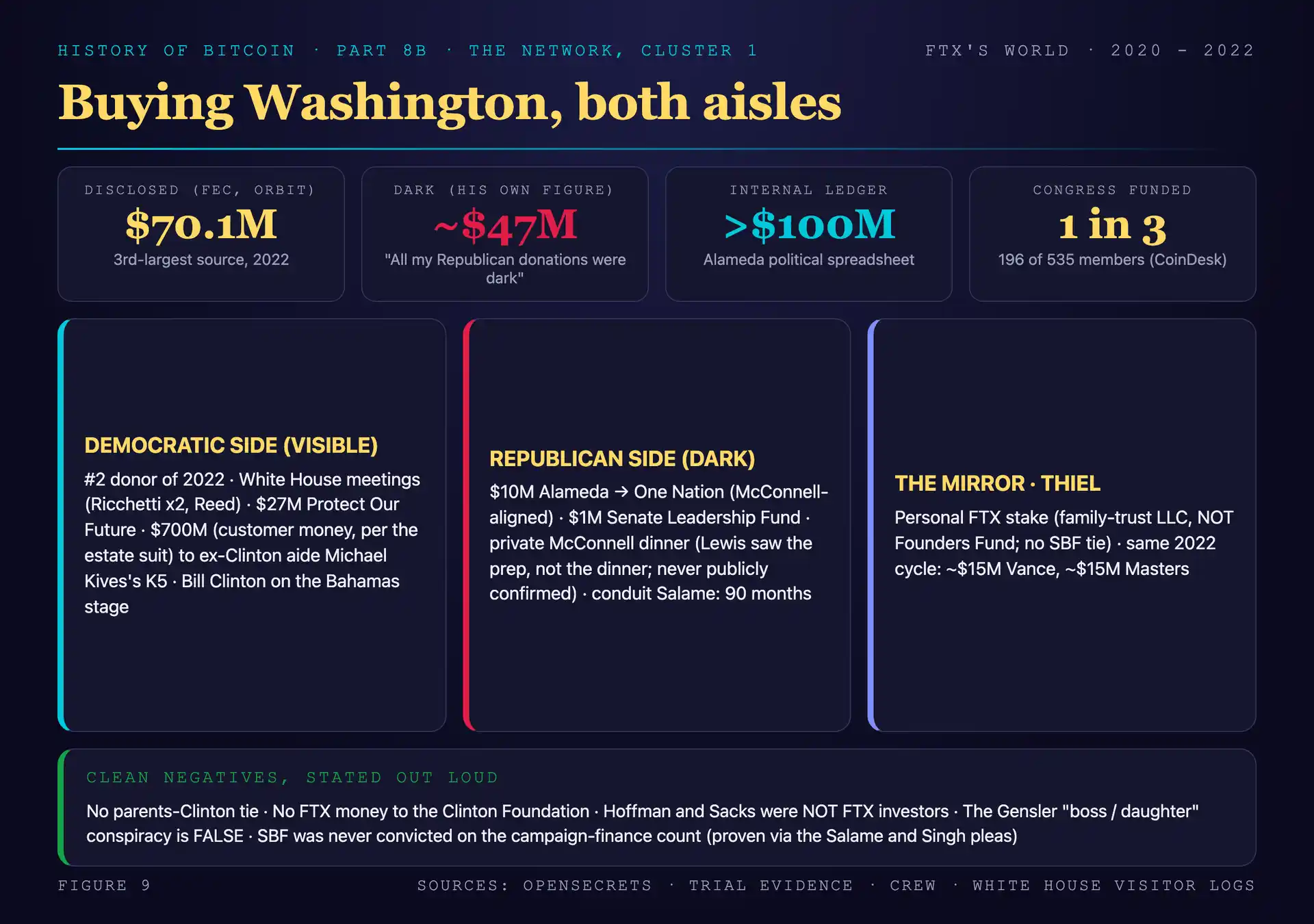
Now the purchase order itself. Disclosed, on the federal record: the FTX orbit (Bankman-Fried, Ryan Salame, and Nishad Singh) gave $70.1 million in the 2022 cycle, the third-largest source of political money in the entire country that cycle, per OpenSecrets.¹⁰⁶ Undisclosed: Bankman-Fried's own dark-money giving, which he later put at roughly $47 million. And internally: an Alameda spreadsheet cited in the superseding indictment tracked a political-influence budget of more than $100 million.¹⁰⁶
Where did it go? Both parties' top floors, and I mean the very top.
The Democratic half was the visible half. Bankman-Fried was the second-largest Democratic donor of the 2022 cycle, behind only George Soros, and had been the second-largest donor to Joe Biden's 2020 effort, behind only Michael Bloomberg, at roughly $5.2 million.¹⁰⁷ His personal super PAC, Protect Our Future, deployed about $27 million into Democratic primaries.¹⁰⁷ The access followed the checks. White House visitor logs show him meeting Counselor to the President Steve Ricchetti on April 22 and May 12 of 2022, and Deputy Chief of Staff Bruce Reed the next day, May 13; four documented White House visits in 2022 in all.¹⁰⁸ He testified before Maxine Waters's House Financial Services Committee in December 2021 and Debbie Stabenow's Senate Agriculture Committee in February 2022, the same Senate Agriculture Committee whose crypto bill, the DCCPA, FTX lobbied for harder than any legislation in its history.¹⁰⁹ The bill would have handed crypto oversight to the friendlier regulator and, not incidentally, hobbled FTX's rivals. Not everyone bit; Senator Cynthia Lummis, the chamber's loudest Bitcoin advocate, opposed the FTX-backed draft.¹¹⁰
And then there was Clinton-world, which deserves care, because the internet version of this story is muddied. The documented tie is not the Clintons; it is a man named Michael Kives. Kives is a genuine former Clinton aide (he worked for Bill Clinton's post-presidential office and in Senator Hillary Clinton's operation, and became a major Hillary 2016 bundler; the Clintons spoke at his wedding), who reinvented himself as Hollywood's superconnector through his firm K5 Global.¹¹¹ Bankman-Fried, after one dinner party, wrote an internal memo describing Kives as "probably the most connected person I've ever met," and then directed roughly $700 million of what the FTX estate later alleged was substantially customer money into K5 and related vehicles; the estate sued to claw it back, the suit settled in January 2025, and no wrongdoing by Kives was ever adjudicated.¹¹² That February 2022 dinner's guest list survives because Sam himself wrote it down: by his own account, the table included Hillary Clinton, Doug Emhoff, Katy Perry, Orlando Bloom, Leonardo DiCaprio, and Jeff Bezos.¹¹² Two months later, at the Crypto Bahamas conference in April 2022, Bankman-Fried sat on stage moderating a discussion with Bill Clinton and Tony Blair, and the photographs of the boy-king between the two former heads of government became the era's defining image of purchased legitimacy; the New York Post reported, alone among outlets, that FTX allegedly paid Clinton north of $250,000 for the appearance, a figure Clinton's office has never confirmed.¹¹³ That fall, the Clinton Foundation listed Bankman-Fried as a participant at the Clinton Global Initiative's September 2022 meeting; his lawyers' calendar evidence from the trial shows a scheduled one-on-one with Clinton on September 20, 2022, contents unknown.¹¹⁴
The Republican half is the half his own party's critics never mention, and it was hidden by design, on his own recorded word. Speaking to the citizen journalist Tiffany Fong in a recorded call published November 29, 2022, Bankman-Fried said it out loud: "All my Republican donations were dark," explaining that "reporters freak the f*** out if you donate to a Republican," and claiming he was likely the Republicans' "second or third biggest" donor that cycle.¹¹⁵ The trial record put receipts under the boast. Ten million dollars flowed from an Alameda account to One Nation, the dark-money nonprofit aligned with Mitch McConnell, in August 2022, with another $5.5 million from Salame; a million more went to McConnell's Senate Leadership Fund super PAC; $750,000 of FTX money and $2 million of Salame's went to the McCarthy-aligned Congressional Leadership Fund.¹¹⁶ For symmetry, note that the dark money flowed left too: $8.5 million to the Schumer-aligned Majority Forward.¹¹⁶
And in late September 2022, weeks before the end, Sam Bankman-Fried had a private dinner scheduled with Mitch McConnell himself. Michael Lewis, who was embedded with Bankman-Fried for his book, witnessed the preparation, an airport scene built around the crisis of finding the founder a suit, because, as Lewis recounts Sam explaining, "Mitch McConnell really cares what you wear when you meet with him."¹¹⁷ Lewis witnessed the wardrobe, not the dinner; the meeting was first reported by Puck's Theodore Schleifer; and McConnell's office has never publicly confirmed it and did not respond to requests for comment when the book made it famous.¹¹⁷ No favor is documented on either side of that table. What is documented is who was scheduled to sit at it, in the last autumn of the fraud.
The scheme's two bagmen removed any doubt about intent, because both pleaded guilty. Ryan Salame, the Republican-side conduit, moved roughly $24 million in straw donations and got 90 months.¹¹⁸ Nishad Singh, the engineer groomed as the operation's "center-left face," pleaded guilty as the Democratic-side conduit and cooperated his way to time served.¹¹⁹ When the Southern District of New York announced the charges, U.S. Attorney Damian Williams told the press conference, in words that belong in the epitaph of the era, that the disguised money was aimed at buying "bipartisan influence."¹²⁰ And the breadth of the buy was the point: by CoinDesk's count, when FTX fell, one in three members of the incoming United States Congress, 196 of 535, had taken money from the FTX orbit.¹²¹
Curiously, Sam Bankman-Fried was never convicted of a campaign-finance crime. The count was dropped in mid-2023 because the Bahamas had not consented to it as part of his extradition, a treaty formality, not an exoneration; the scheme itself stands proven through Salame's and Singh's guilty pleas.¹²²
Now widen the lens one click, because I don't want you walking away thinking one disheveled fraudster bought Washington. Rather, crypto money was buying Washington wholesale that cycle, from both directions, and the mirror image of Bankman-Fried was standing on the other side of the aisle. Peter Thiel, the Founders Fund billionaire, personally held a stake in FTX through a family-trust vehicle called 2021-015 Investments LLC, an entity reporting traces to Thiel's orbit.¹²³ In the same 2022 midterms that Bankman-Fried was flooding, Thiel spent roughly $30 million of his own money installing two hand-picked former employees in the United States Senate: about $15 million behind JD Vance in Ohio and about $15 million behind Blake Masters in Arizona.¹²⁴ Vance won; Masters lost; you may have noticed where Vance's career went from there. That April, Thiel stood on the Bitcoin 2022 stage in Miami reading an "enemies list" of the asset's doubters, calling Warren Buffett the "sociopathic grandpa from Omaha," while his own fund, per later reporting, had quietly sold some $1.8 billion of its crypto near the top weeks earlier.¹²⁵
Two crypto billionaires: one buying the top of the Democratic Party and renting its Republican leadership after dark, the other openly bankrolling Senate campaigns for the New Right, in the same election, in the same asset class, in the same year the machine this article describes was running at maximum output. None of this is conspiracy theory.
There was one circulating, however, that SEC chairman Gary Gensler was compromised because Caroline Ellison's father was "his boss at MIT." Based on my digging, this is flatly false: Gensler taught at MIT's Sloan School of Management, Glenn Ellison is an economist in a different school of the university entirely and a former department head, no reporting line between them existed, and the related claim that an FTX executive was Gensler's daughter was rated false by PolitiFact.¹²⁶
The Linchpin
One thread is left to tie off, and the man holding it has been in this article since the Davos vouch. The other elite money network in Bitcoin's story, Jeffrey Epstein's concealed cash in the MIT Media Lab that stood up Bitcoin Core's paymaster, and in Blockstream's seed round through the Kyara vehicle, is a story this series already told in Part 4B and Part 6, and the released Epstein files never put that world anywhere near SBF, FTX, or Alameda; no documented Epstein connection to any of them exists.¹²⁷ What the files supply instead is the man standing between the protocol-capture world and the casino: Howard Lutnick. Per the DOJ-released documents, Lutnick and Epstein signed on as business partners through their companies at the end of 2012 and were still corresponding about the venture in 2018, and Epstein put $50,000 toward the 2017 dinner honoring Lutnick, writing the organizer, "50k from me, hope pr is ok."¹²⁸ Lutnick has been charged with nothing, and the ties are business and social. But this is the same Lutnick whose Cantor Fitzgerald custodies Tether's Treasury reserves, took the roughly five percent stake, and vouched for the printer at Davos, the printer whose single largest customer was Alameda, whose dollars fed Binance's order books, and whose paper the whole casino settled in.⁹⁵ The old money that captured Bitcoin's protocol and the new money that ran its casino do not share a founder, a fraud, or a cap table. They share a custodian, and he is now the United States Secretary of Commerce.³¹
Two networks. One custodian.
The full story of whose money built Bitcoin Core, all thirteen sponsor organizations of it, is its own reckoning, and we will tell it in a dedicated installment.
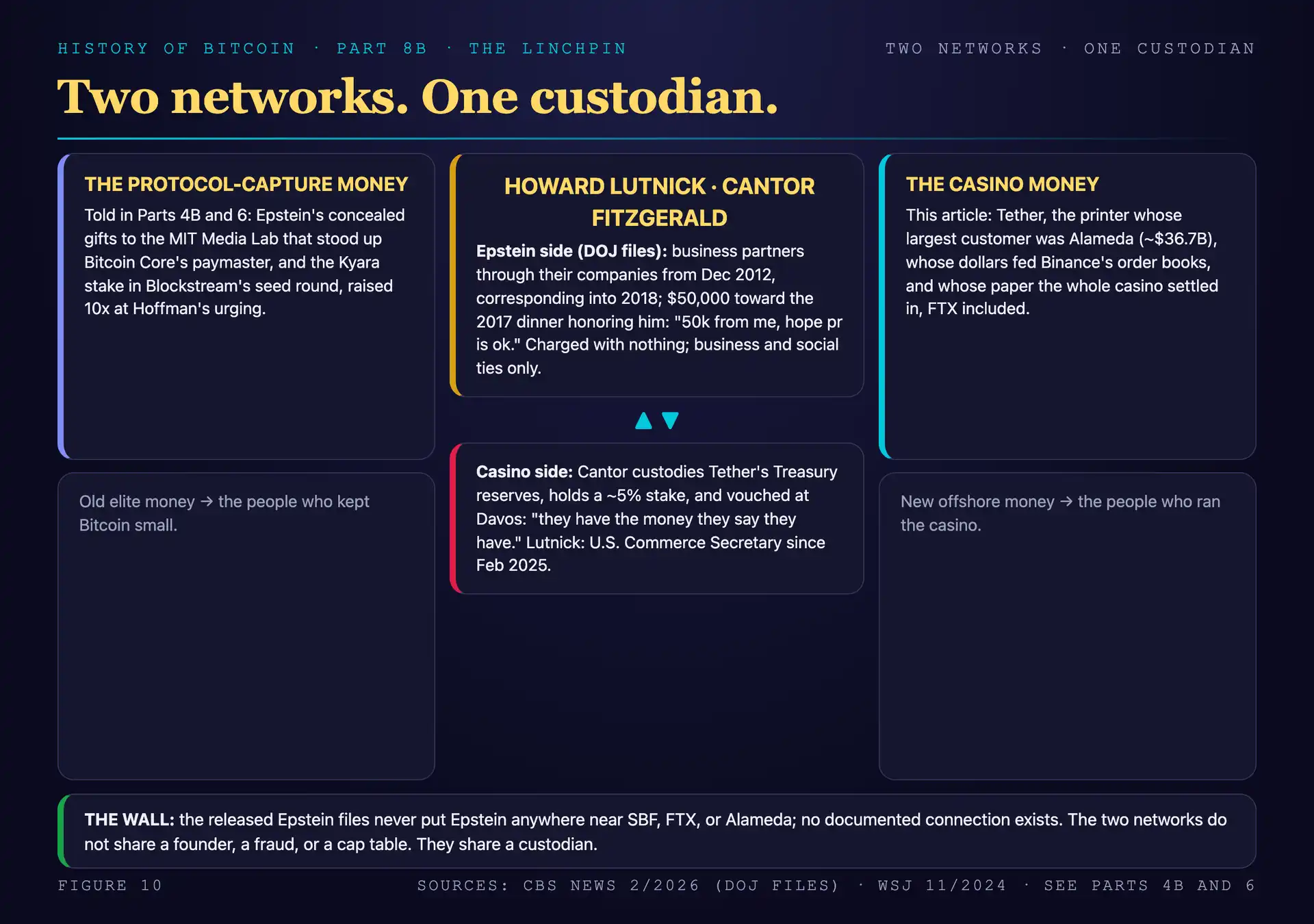
One man stands in both columns of this story: Epstein's business partner in the files, and the printer's custodian at Davos. Source: CBS News, February 2026
The Machine, Fully Built
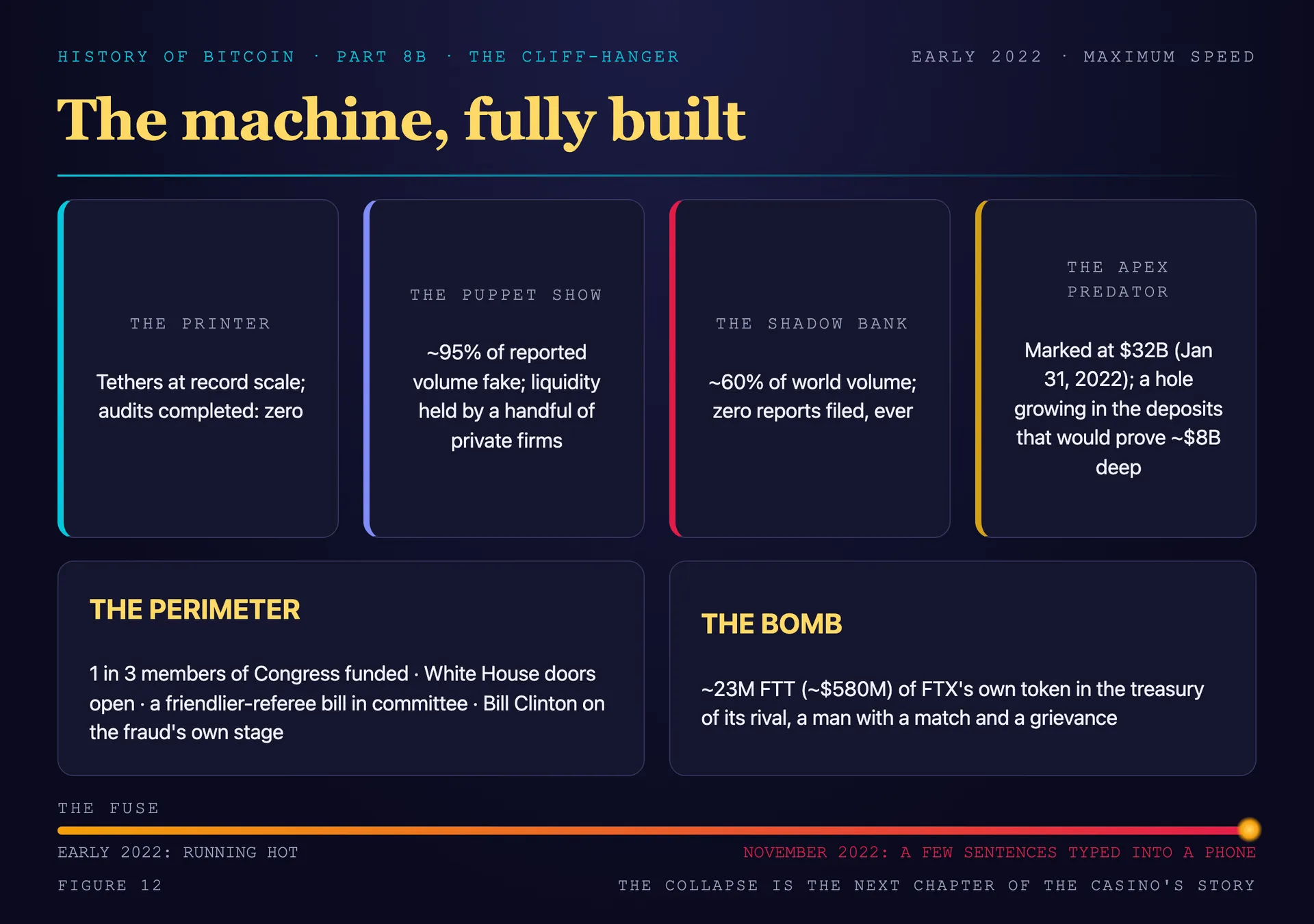
Stand back from the scaffolding now and look at the whole thing, because by the early months of 2022 it was complete, and it was the most systematized fraud architecture in the history of money. I say that as an argument, mine, built on the proven parts you have now read; no court has convicted "the machine." But walk it end to end and tell me what word you would use.
A printer, Tether, stood ready to manufacture the market's dollars: proven by settlement to have lied for years about what stood behind them, printing against the promises of a company banned from the State of New York, its reserves vouched for by a bank chaired by the co-creator of Inspector Gadget and custodied by the future Commerce Secretary of the United States.
A theater, the wash-traded exchange layer, made the casino look crowded: ninety-five percent of the visible activity fake by the Bitwise math sitting in the SEC's public file, the real liquidity held up by a handful of private offshore firms, disproportionately founded out of one post-Soviet talent pool, with a volume-for-hire tier beneath them now carrying federal convictions for manipulation-as-a-service.
A shadow bank, Binance, moved the money and set the price: guilty by its own signed plea, and bound by its own signed consent order, running the largest exchange on earth as an unregistered money-transmitting operation whose management policy was to report no one, not the terrorists, not the ransomware crews, not the child-abuse marketplaces, to any government on the planet.
And an apex predator, FTX, stacked all three tools, the captive token, the captive market maker, the offshore cage, and pointed the whole assembly at the one pile everyone else had left alone: the customers' deposits, which were quietly draining into penthouses and political parties and Super Bowl ads, toward a hole that would prove to be roughly eight billion dollars deep, though not one depositor knew it yet.
Wrapped around all of it: a purchased political perimeter, seventy million dollars disclosed and tens of millions dark, one in three members of Congress funded, the White House doors open, the world's most famous ex-president on the fraud's own stage, the dark-money apparatus aligned with the Senate Republican leader fed from an Alameda account, a bill moving through committee to hand the whole casino a friendlier referee.
In January 2022, investors marked the apex predator at thirty-two billion dollars.¹²⁹ In February, it bought the Super Bowl. That spring its founder sat between Bill Clinton and Tony Blair in the Bahamas; weeks later his balance sheets, all seven versions of them, would metastasize in a Google Drive. The machine had never run hotter, never been more admired, never been closer to regulatory consecration.
And it was about to eat itself.
Because remember what the divorce of the two kingpins left on the table: the biggest external pile of FTX's own loyalty token, sitting in the treasury of the one man on earth with both the means and the motive to burn it. In November of 2022, that man will open his phone and type a few sentences, and roughly eight billion dollars of ordinary people's money will be revealed to be simply gone, and the wreckage will take down half the industry and put the century's defining financial trial on the docket of the Southern District of New York.
But that is the next chapter of the casino's story, and this series tells its stories in order. The chronicle resumes with Part 9 and the year 2020: a bonded courier, a Genesis upgrade that finally takes the limits off the original design, and a virus that closes the world and opens the money printer wider than any tether ever dreamed. The machine you just watched them build will still be running when we get back to the main timeline.
They built a printer for the dollars, a puppet show for the volume, a laundromat for the world's worst money, and a political shield for all of it, and they called the whole thing "Bitcoin."
It wasn't.
Footnotes
¹ Internal Binance chat, February 2019, quoted in the CFTC's complaint at ¶104: after receiving information "regarding HAMAS transactions," compliance chief Samuel Lim explained that terrorists usually send "small sums" as "large sums constitute money laundering"; a colleague replied "can barely buy an AK47 with 600 bucks." CFTC v. Zhao, Binance Holdings Ltd., et al., No. 1:23-cv-01887 (N.D. Ill.), Complaint, March 27, 2023.
² Internal Binance chat, February 2020, quoted in the same complaint at ¶104: Lim, of certain customers including Russian users, "Like come on. They are here for crime."; Binance's money laundering reporting officer replied "we see the bad, but we close 2 eyes." CFTC v. Zhao, Complaint ¶104.
³ The U.S. Treasury Department described Binance as the world's largest virtual asset exchange in announcing the largest settlement in Treasury history; contemporaneous market data placed Binance's share of global crypto spot volume at roughly 60 percent. FinCEN, "FinCEN Announces Largest Settlement in U.S. Treasury Department History with Virtual Asset Exchange Binance," November 21, 2023.
⁴ Binance pleaded guilty to conspiracy to violate the Bank Secrecy Act and to fail to register as a money transmitting business, failure to register as a money transmitting business, and violating the International Emergency Economic Powers Act; criminal penalty of $4,316,126,163 ($2,510,650,588 forfeiture plus $1,805,475,575 fine). U.S. Department of Justice, "Binance and CEO Plead Guilty to Federal Charges in $4B Resolution," November 21, 2023.
⁵ Changpeng Zhao pleaded guilty to failing to maintain an effective anti-money-laundering program, resigned as CEO, agreed to pay a $50 million fine, and was sentenced on April 30, 2024 to four months in prison by Judge Richard A. Jones. DOJ, November 21, 2023; CNBC, "Binance founder Changpeng Zhao sentenced to four months in prison," April 30, 2024.
⁶ FinCEN Consent Order No. 2023-04, In the Matter of Binance Holdings Limited, November 21, 2023: "more than 200 direct bitcoin transactions, in the aggregate worth several hundred thousand dollars, with Al-Qaeda-associated CVC wallets"; direct transactions with ISIS-associated accounts; al-Qassam Brigades fundraising; "over fifteen thousand direct transactions with Hydra Market addresses, each worth more than $2,000, and in the aggregate worth more than $250 million"; "over a thousand direct bitcoin and ether transactions... with child exploitation-associated CVC wallet addresses, including at least three separate marketplaces dealing in child sexual abuse materials"; ransomware proceeds from at least 24 strains; no suspicious activity reports filed. FinCEN Consent Order 2023-04.
⁷ Changpeng Zhao, Twitter, April 12, 2019: "Craig Wright is not Satoshi. Anymore of this sh!t, we delist!"; Binance announced the BSV delisting April 15, 2019. CoinDesk, "Binance Delists Bitcoin SV, CEO Calls Craig Wright a 'Fraud,'" April 15, 2019.
⁸ FinCEN Consent Order 2023-04: "Binance received reports from its third-party service provider in April 2019 identifying Hamas-associated transactions and filed no SARs with FinCEN. Instead, Binance's former Chief Compliance Officer attempted to influence how its third-party service provider reported on Binance's conduct." FinCEN Consent Order 2023-04.
⁹ Tether's website carried the "Every tether is always backed 1-to-1, by traditional currency" representation through approximately February 2019. Internet Archive captures of tether.to; see also the New York Attorney General's findings, note 20 below.
¹⁰ Tether's website terms were revised in late February 2019 to state that tethers are backed by "Tether's Reserves," which "may include other assets and receivables from loans made by Tether to third parties, which may include affiliated entities." Internet Archive captures of tether.to, February-March 2019.
¹¹ Affidavit of Stuart Hoegner, General Counsel of Bitfinex and Tether, April 30, 2019, filed in the New York Attorney General proceeding: cash and equivalents of "approximately $2.1 billion, representing approximately 74 percent of the current outstanding tethers." Hoegner affidavit, In re iFinex Inc., N.Y. Sup. Ct. (April 30, 2019).
¹² Bitfinex and Tether sued Wells Fargo over cut-off correspondent banking in April 2017 and withdrew the suit within about a week. Bitfinex et al. v. Wells Fargo & Co., N.D. Cal., filed April 5, 2017; CoinDesk coverage, April 2017.
¹³ On Tether and Bitfinex's banking through Noble Bank International in Puerto Rico, see Bloomberg, "Crypto's Billion-Dollar Bank Run Puts Puerto Rico's Noble in Peril," October 1, 2018.
¹⁴ Tether and Bitfinex moved their principal banking to Deltec Bank & Trust (Bahamas) in November 2018; Deltec chairman Jean Chalopin co-created the animated series "Inspector Gadget." Forbes, "Meet The Man Behind Inspector Gadget And Crypto Bank Deltec," and contemporaneous profiles.
¹⁵ Deltec's November 1, 2018 letter attested Tether's portfolio value of roughly $1.8 billion; Chalopin subsequently confirmed the letter's authenticity to reporters. Bloomberg/Forbes coverage of the Deltec letter, November 2018.
¹⁶ New York Attorney General's court filings: beginning November 2, 2018, the day after the Deltec letter, Tether transferred hundreds of millions of dollars from its account to Bitfinex. NYAG, In re iFinex Inc., petition and supporting papers, April 25, 2019.
¹⁷ NYAG, April 25, 2019: the office's petition described a cover-up "to hide the apparent loss of $850 million dollars of co-mingled client and corporate funds" routed through Crypto Capital Corp. NYAG press release, April 25, 2019.
¹⁸ Reggie Fowler pleaded guilty in April 2022 to bank fraud and operating an unlicensed money transmitting business in connection with Crypto Capital's shadow banking; sentenced June 2023 to 75 months, with a $740 million forfeiture order. DOJ SDNY, "Arizona Man Sentenced To 75 Months In Prison," June 5, 2023.
¹⁹ Tether extended Bitfinex a $900 million revolving line of credit against reserves, of which approximately $750 million was drawn; documented in the NYAG proceeding and the CFTC's 2021 order. NYAG, February 23, 2021; CFTC Release 8450-21.
²⁰ New York Attorney General Letitia James, February 23, 2021 settlement announcement: $18.5 million penalty, prohibition on New York trading activity, and the quoted statement "Tether's claims that its virtual currency was fully backed by U.S. dollars at all times was a lie." NYAG press release, February 23, 2021.
²¹ CFTC Release 8450-21, October 15, 2021: Tether ordered to pay $41 million; the order found Tether held sufficient fiat reserves "to back USDT tether tokens in circulation for only 27.6% of the days in a 26-month sample time period from 2016 through 2018." CFTC Release 8450-21.
²² Ibid.: commingled reserves, undocumented arrangements, the transfer of over $382 million from Bitfinex's account to Tether's account, and the statement that "Tether has not completed an audit." CFTC Release 8450-21.
²³ John M. Griffin and Amin Shams, "Is Bitcoin Really Un-Tethered?", The Journal of Finance, Vol. 75, No. 4 (2020), pp. 1913-1964: Tether purchases "timed following market downturns" followed by "sizable increases in Bitcoin prices," with flows "attributable to one entity." Journal of Finance; SSRN working paper first circulated June 2018.
²⁴ Griffin's estimate that concentrated buying in roughly 1% of the sample period (on the order of 87 hours) could account for approximately half of Bitcoin's 2017 rise was made in contemporaneous press interviews about the study. Bloomberg/WSJ coverage of Griffin & Shams, 2018-2019.
²⁵ The SEC cited Griffin & Shams in multiple orders disapproving bitcoin ETF listing applications. SEC disapproval orders, 2018-2020, e.g. Release No. 34-88284.
²⁶ Tether publishes quarterly attestations by BDO (not audits); reported holdings exceeding $113 billion in U.S. Treasuries and approximately $13 billion in 2024 profit; the company denies ever using tethers to manipulate markets and has no documented failed redemption. Tether attestations and statements.
²⁷ Nic Carter's methodological criticism of Griffin & Shams. Nic Carter, "The Bitcoin Manipulation Meme," and related essays.
²⁸ USDT in circulation reached approximately $184 billion as of early July 2026. CoinMarketCap, Tether; CoinGecko, Tether.
²⁹ Howard Lutnick, World Economic Forum, Davos, January 2024: "they have the money they say they have." Bloomberg interview coverage, January 2024.
³⁰ Cantor Fitzgerald agreed to acquire an approximately 5% stake in Tether in a deal valuing the position around $600 million. Wall Street Journal, November 2024.
³¹ Howard Lutnick was confirmed as U.S. Secretary of Commerce on February 18, 2025, by a Senate vote of 51-45. U.S. Senate roll call vote, February 18, 2025.
³² Bitwise Asset Management, presentation to the SEC, March 2019, submitted to the public file for SR-NYSEArca-2019-01: "approximately 95% of this volume is fake and/or non-economic in nature." Bitwise presentation, SEC File No. SR-NYSEArca-2019-01.
³³ Ibid.: roughly $273 million per day of real volume against approximately $6 billion reported; 81 exchanges analyzed; 10 exchanges with substantially real volume; Bitwise's companion argument that the real venues priced bitcoin efficiently. Bitwise presentation.
³⁴ Lin William Cong, Xi Li, Danxia Tang, and Yang Yang, "Crypto Wash Trading" (NBER Working Paper 30783, December 2022; Management Science, 2023): wash trading averaging over 70% of reported volume on unregulated exchanges. NBER WP 30783.
³⁵ Javier Paz, "More Than Half Of All Bitcoin Trades Are Fake," Forbes, August 26, 2022. Forbes.
³⁶ On volume-driven exchange rankings and listing-fee economics as the motive for fake volume, see the Bitwise presentation (note 32) and contemporaneous coverage. CoinDesk, "Bitwise Tells SEC 95% of Bitcoin Volume Is Fake," March 2019.
³⁷ Wintermute disclosed a $160 million hack of its DeFi operations in September 2022. Reuters/CoinDesk coverage, September 20, 2022.
³⁸ Robinhood Markets, Form 10-Q for Q1 2025 (filed May 2025): crypto market makers Wintermute (~11%) and B2C2 (~12%) each exceeded 10% of total transaction-based revenues; the FY2024 Form 10-K separately lists Wintermute at 10% of total revenues. The Block, "Robinhood lists B2C2 and Wintermute as market makers for the first time in latest SEC filing," May 2025; Robinhood Form 10-K, FY2024.
³⁹ Kaiko Research: "A week after the collapse, global crypto liquidity had halved, and thus was born the phrase 'The Alameda Gap.'" Kaiko, "Looking Back on FTX's Impact"; see also CoinDesk, "'Alameda Gap' in Liquidity Persists," November 3, 2023.
⁴⁰ On Evgeny Gaevoy's Moscow upbringing, Higher School of Economics education, and Optiver background. Financial Times / Fortune profiles of Wintermute and Gaevoy.
⁴¹ On Andrei Grachev's Uzbek birth, career in the Russian/CIS crypto scene, and 2015 Moscow fraud conviction (suspended sentence). The Block / CoinDesk reporting on DWF Labs and Grachev's history; New York Magazine/Intelligencer, "The Crypto Whale Nobody Can Explain," 2024.
⁴² Wall Street Journal, May 2024: Binance's internal surveillance team concluded DWF Labs had executed more than $300 million in wash trades in 2023; Binance fired the lead investigator; DWF denied wrongdoing. The finding is an internal, unadjudicated allegation. WSJ, "Crypto Exchange Binance Fired Investigator Who Uncovered Market Manipulation," May 2024.
⁴³ CoinDesk, "For $15K, He'll Fake Your Exchange Volume," July 2019 (profile of Gotbit and Aleksei Andriunin). CoinDesk, July 24, 2019.
⁴⁴ United States v. Andriunin: guilty plea March 2025; sentenced June 12, 2025 to 8 months; Gotbit ordered to forfeit approximately $23 million. DOJ, District of Massachusetts, United States v. Gotbit Consulting LLC et al..
⁴⁵ Fedor Kedrov and Qawi Jalili were charged in the same matter and are presumed innocent. DOJ, D. Mass., October 9, 2024 charging announcement.
⁴⁶ DOJ, District of Massachusetts, October 9, 2024 ("Operation Token Mirrors"): first-ever criminal charges against financial services firms for market manipulation and "wash trading" in the cryptocurrency industry; the FBI created the token NexFundAI as part of the operation; Gotbit, CLS Global, ZM Quant, and MyTrade charged; defendants' own descriptions of the service quoted in the charging documents. DOJ press release, October 9, 2024.
⁴⁷ OFAC sanctioned the Hydra darknet market and the Garantex exchange on April 5, 2022. U.S. Treasury, "Treasury Sanctions Russia-Based Hydra, World's Largest Darknet Market, and Ransomware-Enabling Virtual Currency Exchange Garantex," April 5, 2022.
⁴⁸ The pseudonymous analyst "Bitfinex'ed" documented alleged Bitfinex/Tether manipulation from 2017 onward, including the whale pattern nicknamed "Spoofy." Bitfinex'ed, Medium archive.
⁴⁹ Bitfinex acknowledged in August 2017 that certain accounts had engaged in "wash trading and self-funding shorts" in connection with the BCH token distribution. Bitfinex statement, August 2017; contemporaneous CoinDesk coverage.
⁵⁰ Binance was founded in July 2017 and became the world's largest crypto exchange by early 2018. CFTC v. Zhao, Complaint; DOJ, November 21, 2023.
⁵¹ DOJ: "Between January 2018 and May 2022, Binance willfully caused over $898 million in trades between U.S. users and users ordinarily resident in Iran." DOJ, November 21, 2023.
⁵² Internal Binance communication on the September 2018 Zaif-hack proceeds: "It's a type of standard money laundering." Quoted in the federal record of the Binance resolution. DOJ plea documents, United States v. Binance Holdings Limited, November 21, 2023.
⁵³ Michael del Castillo, "Leaked 'Tai Chi' Document Reveals Binance's Elaborate Scheme To Evade Bitcoin Regulators," Forbes, October 29, 2020; Binance sued Forbes over the story and later dropped the suit. Forbes, October 29, 2020.
⁵⁴ Internal Binance chat, December 2018, quoted in the CFTC complaint: "there is no fking way in hell I am signing off as the cco for the ofac shit." CFTC v. Zhao, Complaint.
⁵⁵ Internal Binance chat, February 2019, quoted in the federal filings: "we need a banner 'is washing drug money too hard these days - come to binance we got cake for you.'" SEC v. Binance Holdings Ltd., No. 1:23-cv-01599 (D.D.C.), Complaint, June 5, 2023.
⁵⁶ FinCEN Consent Order 2023-04: "The al-Qassam Brigades' CVC fundraising began in early 2019 with advertisements on Twitter to 'Donate to Palestinian Resistance via Bitcoin.'" FinCEN Consent Order 2023-04.
⁵⁷ On the April 2019 delisting cascade (Binance April 15; ShapeShift; Kraken's poll and April 16 delisting), see Part 8 and CoinDesk, April 15, 2019.
⁵⁸ CZ publicly characterized the March 2019 fake-volume findings as useful transparency for the industry. Cointelegraph, "Binance CEO CZ: Fake Volume Reports Are Useful for Crypto Industry to Move Forward," March 27, 2019.
⁵⁹ SEC v. Binance Holdings Ltd. et al. (D.D.C., filed June 5, 2023): allegations that Sigma Chain AG, a trading firm owned by Zhao, wash traded on the Binance.US platform from at least September 2019 through June 2022, including on and around the platform's September 2019 launch. The SEC dismissed the case with prejudice on May 29, 2025; the allegations were never adjudicated. SEC press release 2023-101; SEC v. Binance complaint.
⁶⁰ CFTC v. Zhao, Complaint: Zhao at a June 9, 2019 meeting: "We are already doing a lot of things that are obviously not in line with the United States"; "20% to 30% of our traffic comes from the US"; Binance's finance executive: "we will never admit that we openly serve US clients." CFTC v. Zhao, Complaint.
⁶¹ DOJ, March 12, 2020: indictment of the Dark Scandals operator; the FinCEN consent order records that Binance received funds associated with the site and filed no suspicious activity reports. DOJ, "Dutch National Charged in Takedown of Obscene Website," March 12, 2020; FinCEN Consent Order 2023-04.
⁶² FinCEN Consent Order 2023-04: July 2020, after a vendor flagged ISIS- and Hamas-associated accounts, the former Chief Compliance Officer called the situation "[e]xtremely dangerous for our company" and instructed staff to "[o]ffboard the user but let him take his funds and leave." FinCEN Consent Order 2023-04.
⁶³ CFTC v. Zhao, Complaint: "we do all U.S. comms via signal as mandated by cz" (October 2020). CFTC v. Zhao, Complaint.
⁶⁴ The parallel resolutions (FinCEN $3.4 billion civil money penalty; OFAC $968,618,825; CFTC $2.85 billion) overlap with and are credited against the DOJ criminal penalty; they are not additive. FinCEN, November 21, 2023; DOJ, November 21, 2023.
⁶⁵ FinCEN Consent Order 2023-04: "The former Chief Compliance Officer reported to other Binance personnel that the senior management policy was to never report any suspicious transactions." FinCEN Consent Order 2023-04.
⁶⁶ DOJ: Binance earned over $1.6 billion in profit from U.S. users while never filing a suspicious activity report with FinCEN. DOJ, November 21, 2023.
⁶⁷ Changpeng Zhao's "better to ask for forgiveness than permission" posture is quoted in the federal record of the resolution. DOJ plea documents.
⁶⁸ Attorney General Merrick Garland, November 21, 2023: "using new technology to break the law does not make you a disruptor, it makes you a criminal." DOJ, November 21, 2023.
⁶⁹ Treasury Secretary Janet Yellen, November 21, 2023: Binance's "willful failures allowed money to flow to terrorists, cybercriminals, and child abusers through its platform." U.S. Treasury, November 21, 2023.
⁷⁰ Reuters' independent estimate of approximately $780 million in Hydra-linked flows through Binance is a broader measure including indirect transfers; Binance disputed the reporting. Reuters, "How crypto giant Binance became a hub for hackers, fraudsters and drug traffickers," June 6, 2022.
⁷¹ OFAC settlement, November 21, 2023: over 1.67 million virtual currency trades involving sanctioned jurisdictions or blocked persons; internal communications suggesting VPN use to circumvent controls. OFAC enforcement release, November 21, 2023.
⁷² The government sought 36 months; Judge Richard A. Jones imposed four months on April 30, 2024. CNBC, April 30, 2024.
⁷³ Executive Grant of Clemency, "A FULL AND UNCONDITIONAL PARDON" of Changpeng Zhao (United States v. Zhao, 23CR00179RAJ-001, W.D. Wash.), signed October 21, 2025. DOJ Office of the Pardon Attorney, warrant.
⁷⁴ The pardon became public approximately two days after signing; asked about Zhao in a subsequent interview, President Trump said "I don't know" him. Axios, November 3, 2025; CBS News/60 Minutes.
⁷⁵ On Binance's software support for the Trump-family crypto venture World Liberty Financial preceding the pardon, see CBS News and Slate, October 2025. Reported; no finding of a quid pro quo exists.
⁷⁶ On MacAskill's recruitment of Bankman-Fried into effective altruism and "earn to give" around 2012 at MIT, and SBF's Jane Street background. Sequoia Capital's (since-deleted) profile, archived; The New Yorker, "Sam Bankman-Fried, Effective Altruism, and the Question of Complicity," 2023.
⁷⁷ Alameda Research founded fall 2017 by Bankman-Fried with Tara Mac Aulay; Caroline Ellison joined in 2018. Bloomberg/Fortune reporting on Alameda's founding.
⁷⁸ FTX founded spring 2019 (exchange live May 2019) by Bankman-Fried and Gary Wang. FTX company history; United States v. Bankman-Fried, S.D.N.Y. trial record.
⁷⁹ FTT launched with the exchange in May 2019 as FTX's self-issued exchange token. CoinDesk, "Divisions in Sam Bankman-Fried's Crypto Empire Blur on His Trading Titan Alameda's Balance Sheet," November 2, 2022 (Ian Allison).
⁸⁰ Caroline Ellison, sworn trial testimony, United States v. Bankman-Fried (S.D.N.Y., October 2023): excluding insider-issued tokens, Alameda's net position ran approximately $2.7 billion negative. Trial coverage, e.g. CNBC/Reuters, October 10-12, 2023.
⁸¹ Gary Wang, sworn trial testimony: the "allow_negative" flag added July 31, 2019 and applied only to Alameda; a credit line of approximately $65 billion; exemption from auto-liquidation. Slate, "Gary Wang said that Sam Bankman-Fried ordered Alameda to use FTX customer funds," October 2023; DOJ SDNY trial record.
⁸² Wang testified Alameda used FTX customer funds "as early as 2019." Trial coverage, October 2023.
⁸³ @SBF_FTX, Twitter, July 31, 2019: "Alameda is a liquidity provider on FTX but their account is just like everyone else's." Tweet, status 1156696100729806849; Yahoo Finance, "The same day SBF promised his hedge fund wasn't getting special treatment, FTX gave it an unlimited line of credit".
⁸⁴ FTX's move to the Bahamas (September 2021) and the "Orchid" penthouse at Albany reported at $30-40 million. Reuters/Bloomberg coverage of FTX's Bahamas properties, November 2022.
⁸⁵ Rolling Stone, September 27, 2023: the reporter embedded in the FTX Bahamas scene "saw no evidence of a 'polycule'"; the verified core is paired-off housemates and the on-off Bankman-Fried/Ellison relationship. Rolling Stone, September 27, 2023.
⁸⁶ FTX's naming-rights deal for the Miami Heat arena: $135 million over 19 years, approved March 26, 2021. Miami Herald/ESPN, March 2021.
⁸⁷ Bankman-Fried agreed at trial that Tom Brady's endorsement equity was worth approximately $55 million and Gisele Bündchen's approximately $20 million. Trial coverage, October 2023.
⁸⁸ FTX's February 13, 2022 Super Bowl commercial starring Larry David ("Don't Miss Out"); David later: "So, like an idiot, I did it." The Athletic/AP interview coverage, 2023.
⁸⁹ FTX's April 2022 purchase of a $500 million stake in Anthropic, made with customer funds per the government; the estate sold most of the stake in 2024 for approximately $884 million. DOJ SDNY; CNBC, "FTX estate sells majority of Anthropic stake," March 2024.
⁹⁰ Ellison's sworn testimony on the November 2021 Chinese account freeze (~$1 billion), the attempted workaround using accounts she believed were opened with the identities of "Thai prostitutes," and her spreadsheet entry "-150m from the thing." Trial coverage, October 10-11, 2023.
⁹¹ The superseding indictment charged an approximately $40 million FCPA bribery count over the same episode; the count was severed and never tried; Judge Lewis Kaplan instructed jurors that Bankman-Fried was "not charged in this case with bribery." United States v. Bankman-Fried, S.D.N.Y.; Reuters, October 2023.
⁹² Ellison's sworn testimony: on June 28, 2022, seven alternative Alameda balance sheets were prepared at Bankman-Fried's direction; the version sent to Genesis concealed roughly $10 billion effectively borrowed from FTX customers. Trial coverage, October 2023.
⁹³ The "Things Sam Is Freaking Out About" document, entered at trial: raising from the Saudi crown prince, "getting regulators to crack down on Binance," and acquiring Snap stock. Trial exhibits and coverage, October 2023.
⁹⁴ Ellison testified Bankman-Fried put his odds of someday becoming U.S. President at five percent. Trial coverage, October 2023.
⁹⁵ Protos, "Tether Papers: This is exactly who acquired 70% of all USDT ever issued," November 2021: Alameda Research received almost $36.7 billion in USDT, roughly 37% of all outbound volume. Protos, November 2021.
⁹⁶ Kelsey Piper, "Sam Bankman-Fried tries to explain himself," Vox, November 16, 2022: the ethics were "just PR"; "this dumb game we woke westerners play where we say all the right shibboleths and so everyone likes us." Vox, November 16, 2022.
⁹⁷ Bankman-Fried was convicted on all seven counts on November 2, 2023; the Justice Department described the offense as "stealing over $8 billion" from customers; sentenced March 28, 2024 to 25 years. DOJ SDNY, sentencing announcement, March 28, 2024.
⁹⁸ Binance's 2019 strategic investment in FTX (~20% for roughly $100 million). CoinDesk/Fortune reporting on the 2019 investment and 2021 exit.
⁹⁹ Changpeng Zhao's public statement of the buyout consideration: "Binance received roughly $2.1 billion USD equivalent in cash (BUSD and FTT)." @cz_binance, November 6, 2022.
¹⁰⁰ FTX Trading Ltd. v. Binance et al. (Bankr. D. Del., adversary proceeding filed November 2024): the estate values the July 2021 share repurchase at approximately $1.76 billion and alleges a constructive fraudulent transfer funded substantially with customer deposits. Protos/Reuters coverage of the clawback suit, November 2024.
¹⁰¹ Binance's residual position of roughly 23 million FTT (on the order of $580 million at autumn 2022 prices) followed from the 2021 buyout consideration. CoinDesk/Bloomberg, November 2022.
¹⁰² William MacAskill advised the FTX Future Fund and resigned November 10, 2022. MacAskill's public resignation statement; The New Yorker, 2023.
¹⁰³ Dustin Moskovitz is a named backer of Mind the Gap, the Democratic donor-routing super PAC co-founded by Barbara Fried in 2018; Moskovitz and Cari Tuna's Open Philanthropy is effective altruism's largest funder. Vox/Recode reporting on Mind the Gap; The New Yorker, 2023.
¹⁰⁴ Barbara Fried co-founded Mind the Gap (2018); Gabe Bankman-Fried ran Guarding Against Pandemics; Joseph Bankman received $200,000 per year through an FTX US employment agreement. FTX Trading Ltd. v. Bankman and Fried (Bankr. D. Del., complaint filed September 18, 2023).
¹⁰⁵ FTX estate complaint against Joseph Bankman and Barbara Fried, September 18, 2023: the $16.4 million Bahamas property, a $10 million gift, and $5.5 million directed to Stanford University, which the university returned. Reuters, September 19, 2023.
¹⁰⁶ OpenSecrets: the FTX orbit (Bankman-Fried, Salame, Singh) disclosed $70.1 million in 2022-cycle giving, the third-largest source of political money that cycle; Bankman-Fried's own account put his undisclosed "dark" giving near $47 million; the superseding indictment cited an internal spreadsheet tracking over $100 million in planned political spending. OpenSecrets, "FTX's spending spree"; United States v. Bankman-Fried, superseding indictment, S.D.N.Y., 2023.
¹⁰⁷ Bankman-Fried was the second-largest Democratic donor of the 2022 cycle after George Soros and gave roughly $5.2 million to pro-Biden efforts in 2020, second after Michael Bloomberg; his Protect Our Future PAC deployed about $27 million. OpenSecrets donor rankings, 2020 and 2022 cycles.
¹⁰⁸ White House visitor logs, 2022: meetings with Counselor Steve Ricchetti on April 22 and May 12, 2022, and Deputy Chief of Staff Bruce Reed on May 13, 2022; four documented visits in all. White House visitor logs; Bloomberg, "Bankman-Fried's White House Meetings," 2022.
¹⁰⁹ Bankman-Fried testified before the House Financial Services Committee on December 8, 2021 and the Senate Agriculture Committee on February 9, 2022; FTX's principal legislative priority was the Digital Commodities Consumer Protection Act (introduced August 3, 2022 by Senators Stabenow and Boozman). Committee records; CoinDesk coverage of the DCCPA.
¹¹⁰ Senator Cynthia Lummis publicly opposed the FTX-backed DCCPA draft. CoinDesk/Blockworks coverage, autumn 2022.
¹¹¹ On Michael Kives's Clinton-world background (Clinton post-presidential office; Senator Hillary Clinton's operation; 2016 bundler) and K5 Global. Puck/Bloomberg profiles of Kives.
¹¹² FTX estate v. K5 Global, Kives, and Baum (adversary complaint filed June 22, 2023; settled January 31, 2025): approximately $700 million directed to K5 vehicles, which the estate alleged was funded substantially with customer money; Bankman-Fried's internal memo calling Kives "probably the most connected person I've ever met" and listing the February 2022 dinner guests, by his own account including Hillary Clinton, Doug Emhoff, Katy Perry, Orlando Bloom, Leonardo DiCaprio, and Jeff Bezos. Reuters, June 23, 2023; trial exhibit coverage.
¹¹³ Bankman-Fried moderated a Crypto Bahamas stage discussion with Bill Clinton and Tony Blair, April 28, 2022; the New York Post reported, single-source, that FTX allegedly paid Clinton north of $250,000; Clinton's office has not confirmed a figure. New York Post, November 2022.
¹¹⁴ The Clinton Foundation listed Bankman-Fried among Clinton Global Initiative 2022 participants (August 30, 2022 release); his counsel's calendar evidence at trial showed a scheduled September 20, 2022 meeting with Bill Clinton; Clinton's camp has said he was "never on stage" at CGI. Clinton Foundation release; trial calendar coverage.
¹¹⁵ Tiffany Fong's recorded call with Bankman-Fried (recorded November 16, published November 29, 2022): "All my Republican donations were dark"; "reporters freak the f*** out if you donate to a Republican"; his claim to have been the second or third biggest Republican donor. Tiffany Fong, "Sam Bankman-Fried Admits Secret GOP Donations," November 29, 2022; CoinDesk coverage.
¹¹⁶ Trial evidence and nonprofit disclosures: $10 million from an Alameda account to the McConnell-aligned One Nation (August 2022) plus $5.5 million from Salame; $1 million to the Senate Leadership Fund; $750,000 (FTX) and $2 million (Salame) to the Congressional Leadership Fund; $8.5 million to the Schumer-aligned Majority Forward. Citizens for Responsibility and Ethics in Washington, investigation of FTX-linked dark money flows to leadership nonprofits.
¹¹⁷ Michael Lewis, "Going Infinite" (2023), recounting the pre-dinner preparation and Bankman-Fried's line "Mitch McConnell really cares what you wear when you meet with him"; Lewis witnessed the preparation, not the dinner; the dinner was first reported by Puck's Theodore Schleifer; McConnell's office has never publicly confirmed it and did not respond to requests for comment. 60 Minutes interview transcript, October 2023; Puck, Theodore Schleifer.
¹¹⁸ Ryan Salame pleaded guilty September 7, 2023 (including a campaign-finance conspiracy involving roughly $24 million in straw donations); sentenced May 28, 2024 to 90 months. DOJ SDNY, May 28, 2024.
¹¹⁹ Nishad Singh pleaded guilty February 28, 2023, including campaign-finance charges as the Democratic-side conduit; sentenced to time served after cooperation. DOJ SDNY, February 28, 2023; Reuters, October 30, 2024.
¹²⁰ U.S. Attorney Damian Williams, press conference, December 13, 2022: the disguised donations served Bankman-Fried's effort to buy "bipartisan influence." Press conference coverage, e.g. AP/Bloomberg, December 13, 2022.
¹²¹ CoinDesk: 196 of 535 members of the 118th Congress-elect, roughly one in three, received money from Bankman-Fried, Salame, or Singh. CoinDesk, "Congress' Problem With FTX Cash Goes Far Beyond Sam Bankman-Fried," January 2023.
¹²² The campaign-finance count against Bankman-Fried was dropped in mid-2023 because the Bahamas had not consented to trying it under the extradition treaty's rule of specialty; it was not adjudicated on the merits. Reuters, "US drops campaign finance charge against Bankman-Fried," July 2023.
¹²³ FTX bankruptcy equity filings list "2021-015 Investments LLC" among shareholders (245,000 West Realm Shires shares and 57,230 FTX Trading shares); reporting tied the vehicle's filing address to Peter Thiel's family-trust orbit (Rivendell/Thiel Capital); Founders Fund did not invest in FTX. FTX equity holder filings, Bankr. D. Del.; The Information/Fortune reporting on Thiel's personal FTX stake.
¹²⁴ Thiel's 2022 super PAC spending: approximately $15 million to Protect Ohio Values (JD Vance) and approximately $15 million to Saving Arizona (Blake Masters). OpenSecrets; The Washington Post, 2022.
¹²⁵ Thiel's Bitcoin 2022 keynote (Miami, April 7, 2022) and its "enemies list," including Warren Buffett as the "sociopathic grandpa from Omaha"; Founders Fund had reportedly closed out roughly $1.8 billion in crypto positions by late March 2022. CNBC, April 7, 2022; Reuters/FT reporting on Founders Fund's crypto sales.
¹²⁶ Reid Hoffman and David Sacks do not appear among FTX's investors; the "Gensler worked for Caroline Ellison's father" and "FTX executive is Gensler's daughter" claims are false: Gensler taught at MIT Sloan, Glenn Ellison is in the separate Economics Department, and PolitiFact rated the daughter claim False. PolitiFact, November 2022; FTX investor lists (note 123).
¹²⁷ Compiled rosters of crypto figures appearing in the released Epstein files (Ito, Pierce, the Blockstream orbit, Andresen, Buterin's circle, the Winklevosses, Tether's founding cast, Summers), with no appearance by Bankman-Fried, FTX, Alameda, or Caroline Ellison. Blockspace Media and Bitcoin.com News file-roster analyses, 2025-2026; Byline Times, December 4, 2025.
¹²⁸ DOJ-released Epstein files: an agreement dated December 28, 2012, signed by Lutnick and Epstein through their respective companies, to acquire stakes in the ad-tech firm Adfin; correspondence about the venture as late as 2018; Epstein's $50,000 contribution toward the 2017 UJA-Federation of New York dinner honoring Lutnick, with his note to organizer John Paulson, "50k from me, hope pr is ok." Lutnick has been charged with nothing; he addressed the ties in Senate testimony (February 2026) and before House Oversight (May 6, 2026). CBS News, "Lutnick and Epstein were in business together, Epstein files show," February 2026; see also Part 4B.
¹²⁹ FTX closed a $400 million Series C on January 31, 2022 at a $32 billion valuation. CoinDesk, January 31, 2022; FTX Trading Ltd. release.
Be good to each other. And check the receipts; they are all in the footnotes.
Kurt Wuckert Jr., the world's foremost Bitcoin Historian, publishes The Written History of Bitcoin one installment at a time at kurtwuckertjr.com.