The Written History of Bitcoin: The Bitcoin Civil War Gets Legal
By Kurt Wuckert Jr.
In April 2019, the chief executive of the largest cryptocurrency exchange on earth typed a single line into Twitter, and within forty-eight hours a major Bitcoin chain was gone from the market.
The line was this: "Craig Wright is not Satoshi. Anymore of this sh!t, we delist!"¹
That was it. No vote. No bug. No network-level event. No proof of fraud entered into evidence anywhere. A man named Changpeng Zhao, who runs Binance, was annoyed about a social situation becoming toxic (on crypto twitter!), and so he reached for the one weapon an exchange has that no miner and no node possesses, and he pointed it at a chain.
Then the cascade. Erik Voorhees, who runs ShapeShift, posted within hours: "We stand with @binance and CZ's sentiments."² Jesse Powell, who runs Kraken, did something stranger. He put the question to a public vote, a Twitter poll asking the crowd whether his exchange should erase a chain from its listings, the way a homeowners' association might poll the block on whether a neighbor gets to keep his house. Seventy-one percent of more than seventy thousand votes said burn it down.³
A delisting does not kill a chain. I want to be precise about that from the first page, because the technical reality and the emotional reality of April 2019 are two different things. Bitcoin SV kept producing blocks the entire time; the network never stopped. What a delisting removes is the market: the on-ramp, the off-ramp, the price discovery, the liquidity, the ability of an ordinary person to ever touch the thing. The chain lived. The market for it was taken out to the shed and shot.
And the lesson the whole industry absorbed that week was the one that matters for everything in this article.
In a world that uses the fiat price of an asset as its only measuring stick of value, exchanges could delist a Bitcoin chain out of public existence.
Here is the part the official story leaves out. This did not start with a market. It did not start with a hack, or a bug, or a price chart. It started with a cartoon cat, and the collectivists who adopted him.
To understand how a children's-cartoon-styled astronaut-cat ended up with a five-thousand-dollar bounty on its head, and how three men who agreed on nothing in the world, who despised each other, who were on three different sides of a three-way war, all agreed on this one thing, you have to go back to a quiet January, to a feel-good experiment that was supposed to show Bitcoin at its very best.
From Hash War to Lawfare
In Part 7, one Bitcoin became three.⁴ The hash war of November 2018 ended with the most proof of work winning, the way Nakamoto consensus is supposed to work, but also with the soon-to-be-regretted albatross of Bitcoin ABC hard-coding checkpoints into its own chain and the exchanges of the world collusively deciding which ticker belonged to whom. The ABC implementation of Bitcoin Cash kept the name. Bitcoin SV took its replay protection and its records and walked off to build. I closed that article on a promise: the war for the ticker was over, and the war for the name "Satoshi Nakamoto" was just beginning.
This is that war.
The thing you need to understand about 2019 is that the weapons changed. In 2017 and 2018, the civil war was fought with hash power and de facto developer control of the repo. Men pointed exahashes at each other and burned six figures a day in electricity, while node operators signalled software versions as a sort of Sybil/social consensus, but the question was always physical: always a matter of who could mine more blocks faster and on what software version. That war is over. The combatants learned, in November 2018, that hash power and software flags was not actually what decided anything. In a world where people believe price determines validity, the exchanges decided. The checkpoints decided. And so in 2019 the smart money stopped fighting on the chain and started fighting where the power actually lived: the order book and then, the courtroom.
The battlefield moved from the mempool to the listing page and the federal docket. The weapon stopped being a mining rig and the Raspberry Pi, and it became a delisting, a bounty, and a lawsuit. This is the year the Bitcoin civil war went legal.
I was inside the camp that was about to get quarantined out of the general crypto economy, so let me tell you exactly where I stood before I tell you what my side did, because some of what my side did was a mistake, and a historian who hides that is not a historian. I was Bitcoin SV by conviction. My path to that conviction ran through the whole scaling debate, through Mike Hearn and Gavin Andresen, through Roger Ver, and eventually to the people building on the chain that was trying to restore Satoshi's original protocol. But I was a builder and a competitor, not a litigator. In 2019 I had a full-time job in cybersecurity; Bitcoin was a side gig, a stack of articles and podcasts and a near-daily livecast under the Crypto Traders brand, and a meetup I hosted in Chicago. And my position then was the same as it is now: you win this by out-building the other guy, acquiring real customers, by scaling the chain and bringing real transactions to it, not by dragging Twitter arguments into a federal courthouse.
My side did not all agree with me about that. And that is where the cat comes in.
The Cat
On January 19, 2019, a Norwegian Bitcoiner with a cartoon astronaut-cat for an avatar started a game.⁵
The account was called "hodlonaut." The game was the Lightning Torch, also tagged #LNTrustChain, and it was the most charming thing BTC did that year. The idea was simple. Hodlonaut sent a small Lightning Network payment to someone he trusted, who added a little to it and passed it on to someone they trusted, who added a little and passed it again. A torch of sats, relayed hand to hand across the internet, each carrier adding a few thousand satoshis before handing it forward, all on the trust that the next person would keep it moving rather than pocket it.
It worked. The torch passed through more than fifty countries and through some of the most famous hands in the industry, Jack Dorsey and Andreas Antonopoulos among them, and at one point it even passed through the hands of Changpeng Zhao, the same CZ who would, three months later, type the line that opened this article.⁶ For a few weeks in early 2019, the torch was a small, genuine proof that BTC could still be what it was supposed to be: communal, playful, person to person, the same spirit that put two pizzas on the chain back in Part 3.⁷
The man holding the original torch, hodlonaut, became a folk hero for a season. A cat with a goofy space helmet, lighting a fire and handing it around the world.
Then, in March, the torch-bearer picked up a different weapon.
Hodlonaut had opinions about Craig Wright, and he was not quiet about them. Across March 2019 he tweeted that Wright was a "fraud," a "scammer," and "mentally ill," and he helped push a hashtag that did exactly what hashtags are built to do, which is travel: #CraigWrightIsAFraud.⁸ This was not a measured legal accusation. It was a pile-on, the ordinary cruelty of Twitter spoken by anonymous critics, the kind of thing that gets said about public figures ten thousand times a day and usually forgotten by lunch.
I am not going to pretend the insults were gentle, because they were not. Hodlonaut went after Wright hard and personally. The man being called "mentally ill" on a global platform did not enjoy it, and if he is actually, clinically, mentally ill, it begs a few questions about cyberbullying that might be relevant to explore in the context of the public treatment of the mentally ill in society.
But what came next changed the shape of the entire year. The account that had embodied Bitcoin's best week in 2019 was about to become the target of its worst.
The torch-bearer had a name now, and someone wanted it.
The Bounty
On March 29, 2019, the law firm Ontier, acting for Craig Wright, sent hodlonaut a letter.⁹ It demanded he retract the "fraud" accusations and apologize, on threat of a defamation suit. The same week, Calvin Ayre, the billionaire behind CoinGeek and one of Wright's most powerful allies, tweeted his position in plain language: "Dr Craig Wright is Satoshi," and "BSV is the only real Bitcoin."¹⁰
And then the move that turned a legal threat into a manhunt. A bounty went up: five thousand dollars, paid in BSV, for hodlonaut's real-world identity.¹¹ Find the man behind the cat, collect the reward.
I need to stop and tell on myself, because one small piece of this is mine. When someone asked me to comment on the effort to unmask hodlonaut, I gave a flippant, under-informed answer: that it is legal to seek information about an anonymous person who is bullying you. It is truly legal to do such a thing, but my statement landed as an endorsement of the hunt. I also gave it without the full context, from a hospital, where my wife was in the final trimester of a high-risk pregnancy with our first son, born shortly thereafter by emergency C-section.¹² Admittedly, I wasn't up on all the drama, and I figured cooler heads would exchange a few form letters and it would blow over. I was wrong, and I underestimated the guile of what was being set in motion on all sides. A friend, Matt Zietzke, walked me through who hodlonaut actually was, and I reversed my position that same day.
I have apologized for it since, including in a handshake conversation with his attorney, and an attempt to hodlonaut directly, which he rejected.¹³
The bounty and the lawsuits were Craig's, not mine, and I thought they were a mistake when they happened, strategically and morally. But I was in the BSV camp, culturally guilty by association, so I will own the piece that was actually mine and hold everyone else in this story to the same standard (all small blockers are guilty in the Bitcoin XT DDoS attacks and threats! [kidding...])
My settled view is simple: name-calling on Twitter is ugly, but short of a real threat of violence it has no business in a courtroom, and it should never come with a bounty on a man's name.
Because here is what the bounty actually did to a real human being.
Hodlonaut later described what the manhunt felt like from the inside in his own words. He said a private investigator tracked down his workplace, then telephoned his employer while impersonating a police officer to extract his personal details, and then approached him claiming to have documents for him to sign.¹⁴ He declined. By the middle of May, his legal name was public. The man behind the cat had been hunted down in the name of defending Satoshi.
The community did not take it quietly. Bitcoiners across Twitter swapped their avatars for the space-cat and adopted a collectivist hashtag of their own: #WeAreAllHodlonaut.¹⁵ Elizabeth Stark of Lightning Labs launched a crowdfunded legal defense, which pulled in roughly thirty thousand dollars in bitcoin from more than a thousand backers, with the line, "In the bitcoin community we stand up for each other."¹⁶ A lawyer named Preston Byrne took him on pro bono.¹⁷ The cat became an army of cats.
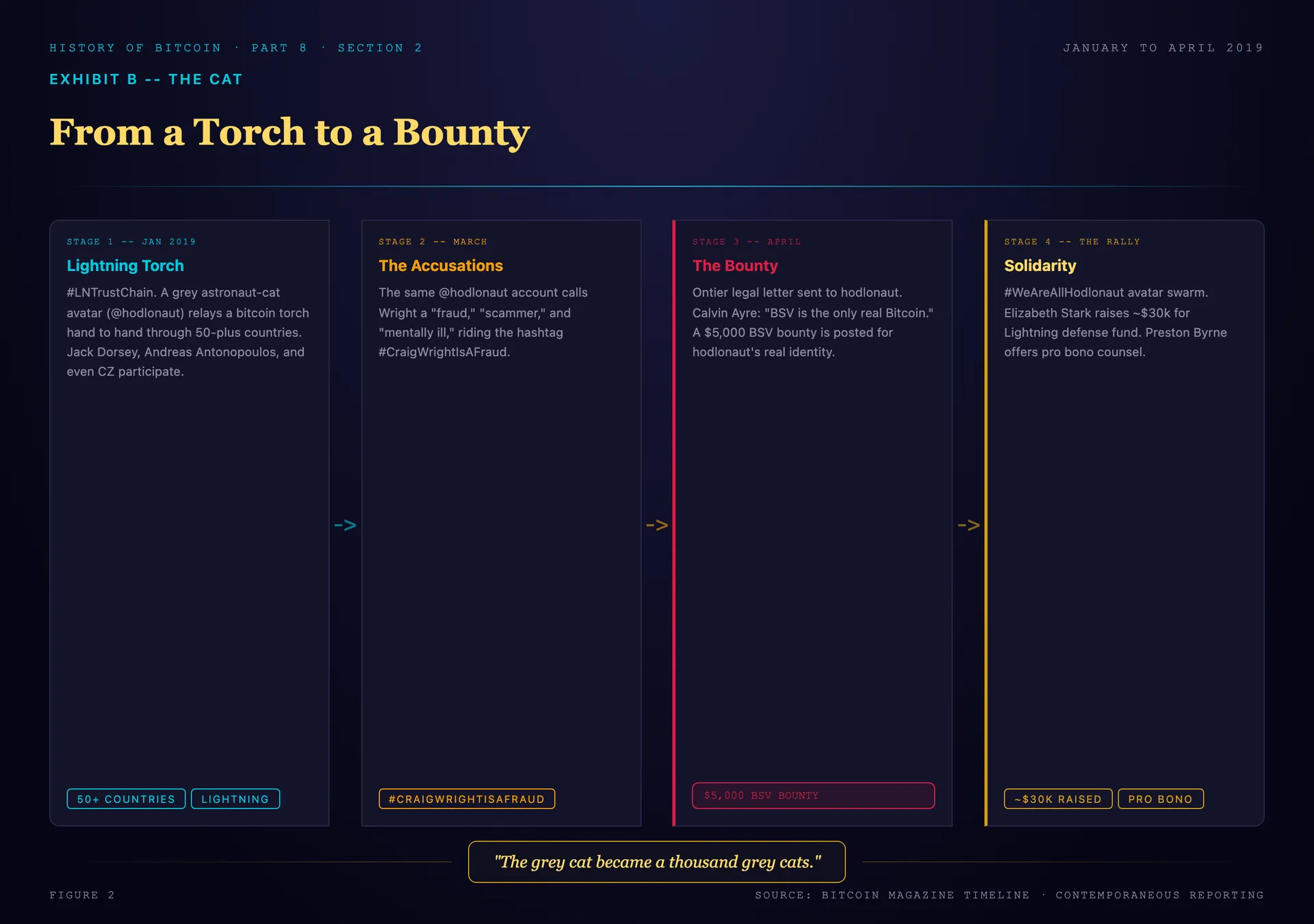
And the cartel, the men who were about to delist BSV, could not have asked for a better gift. The bounty handed them a villain and handed the generally toxic small blockers a halo. One badly aimed legal campaign had turned a guy with a cat avatar into a martyr, and martyrs are the one thing you can never out-argue.
They had made the critics and villains of the Bitcoin Civil War into a collective of martyrs, and they still won't let the world forget it!
The Purge
So now we are back at the cold open, and we can see the whole machine.
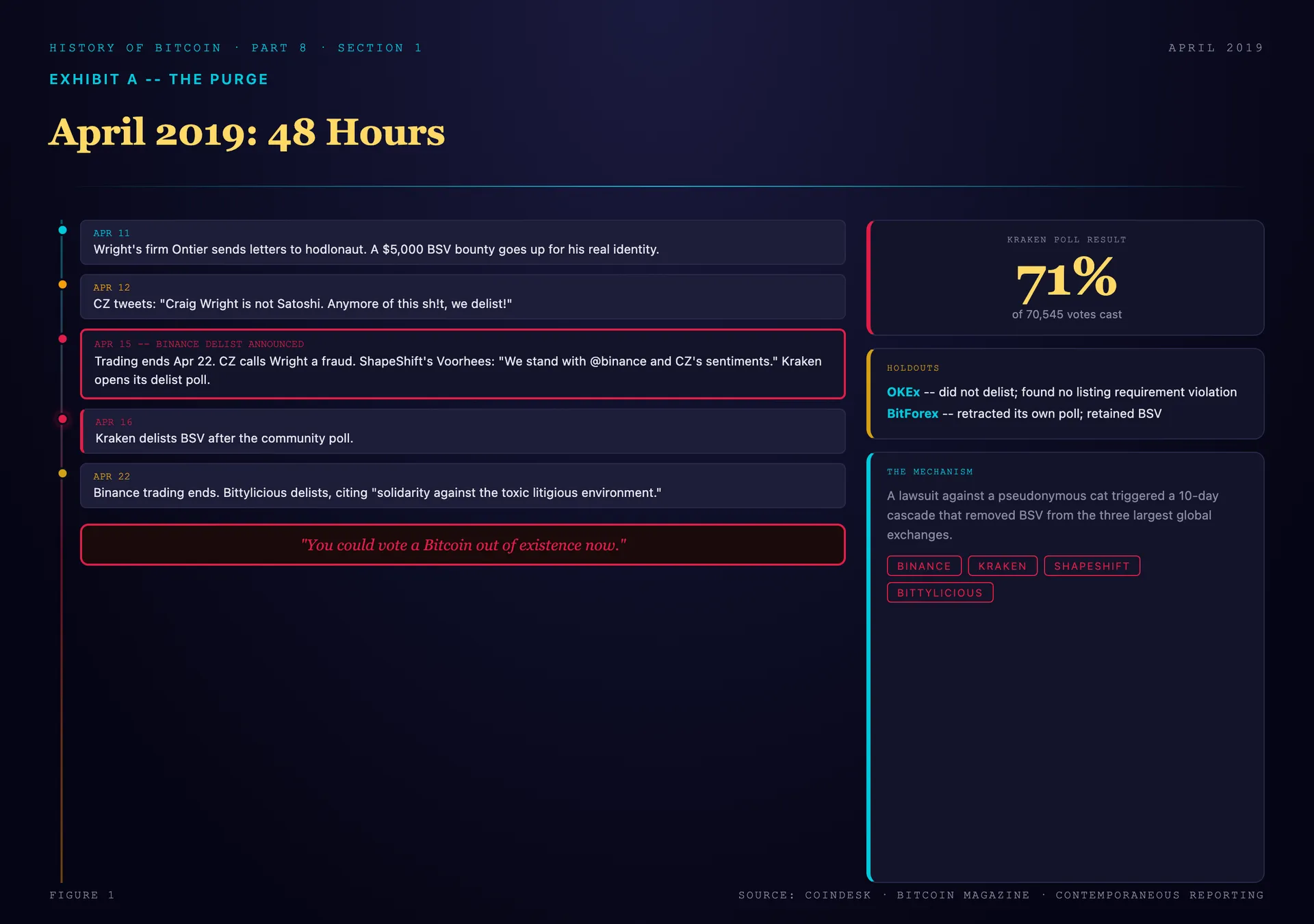
On April 12, CZ fired the opening shot, the line you already read.¹⁸ On April 15, Binance made it official, announcing that BSV would be delisted, with trading to cease on April 22, on the grounds that the coin "no longer meets" the exchange's listing standards.¹⁹ CZ piled on with follow-ups, now deleted but preserved in the reporting of the day, calling Wright a fraud and taunting that "everyone is Satoshi, except Craig Wright."²⁰ The same April 15, Voorhees brought ShapeShift in behind Binance, and ShapeShift announced it would drop BSV within forty-eight hours.²¹ Kraken opened its poll. On April 16, with seventy-one percent of 70,545 votes in favor, Kraken delisted too, and a British exchange called Bittylicious followed a week later, citing "solidarity against the toxic litigious environment."²²
Now read the stated reason out loud, because the official story rests on it, and the official story is lying to you by omission.
Jesse Powell of Kraken did not say he delisted BSV because it was fraudulent, or because the market was being manipulated, or because of any technical failure. He said the opposite. In his own words, preserved from a since-deleted tweet: "We didn't delist on technical merits. BSV never met our listing requirements but we supported it because everyone wanted their 'free money' from the fork. What pushed us to delist was the frivolous lawsuits from leaders in the BSV community against us, our partners and clients."²³
Read that again. The most-cited justification for erasing a Bitcoin chain from the world's exchanges was not that the coin was bad. It was that the coin's backers had filed lawsuits, and the exchanges decided to punish the lawsuits by killing the coin. Powell said elsewhere that the BSV camp seemed to "use the law system to abuse it, suing anyone who says anything against them."²⁴ Whatever you think of Wright's legal campaign, and I will get to how much I disliked it, notice what is happening. A market is being closed as retaliation. The punishment for going to court was being erased from commerce.
Not everyone went along with it. This matters, because the story usually gets told as if "the industry" unanimously cast BSV out, and it did not. OKEx ran its own review and concluded BSV "did not violate" its listing requirements, and kept it.²⁵ BitForex put up a delisting poll, then pulled it and retained the coin "in consideration of users."²⁶ Jimmy Nguyen, the public face of the Bitcoin Association, named the thing for what it was: the delistings, he said, were "caused by personal dislike of Craig Wright," and it was "absolutely ridiculous that any business, let alone a cryptocurrency exchange, would use Twitter polls to make a serious business decision like delisting an asset." He warned that it set "a terrible precedent."²⁷
He was right about the precedent. But notice the deeper thing, the one that detonates a seed I planted back in Part 6.
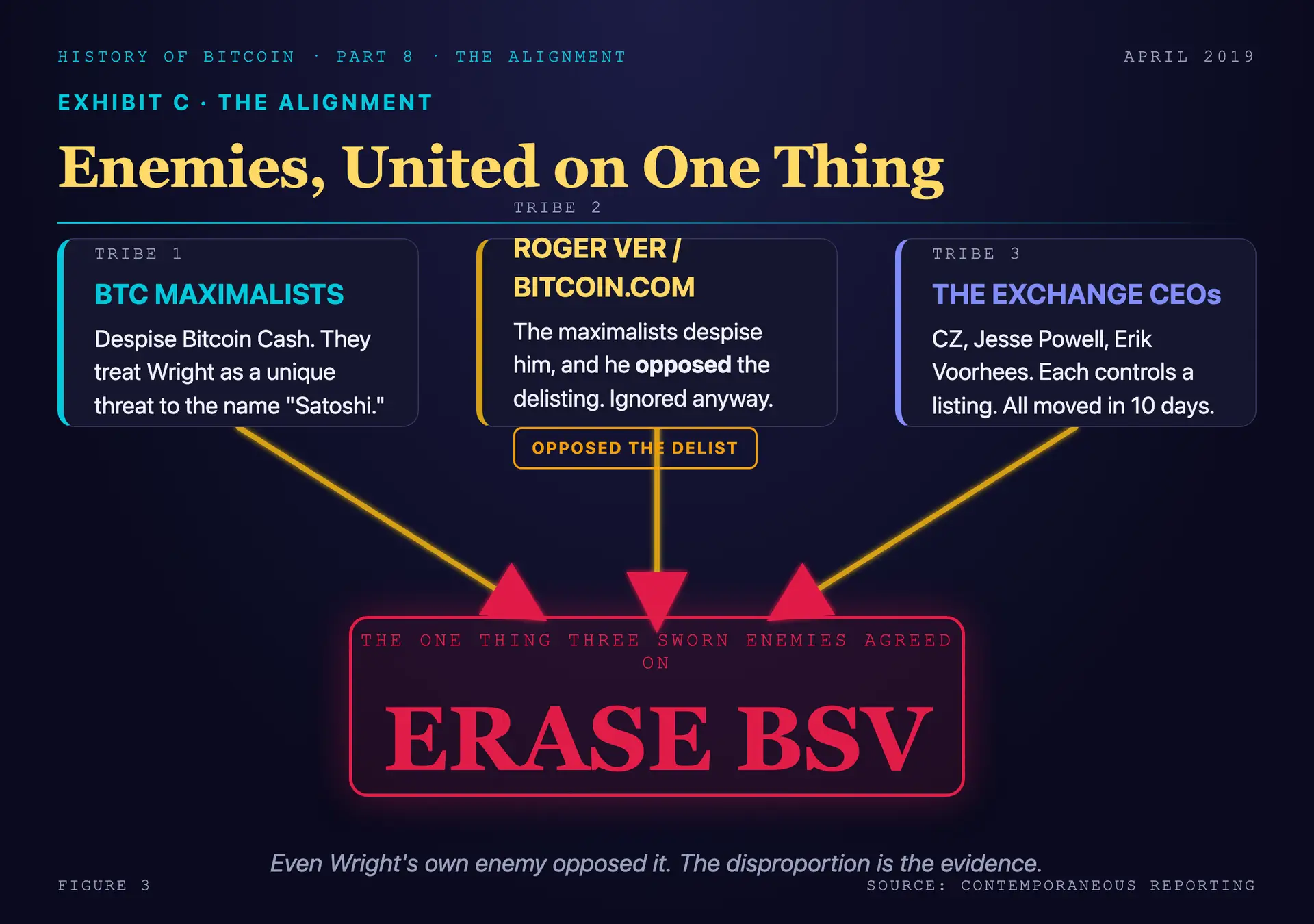
For two years I had been documenting a civil war with at least three sides that hated each other. There were the BTC maximalists, who held that Bitcoin Cash was a scam and a heresy. There was Roger Ver and the Bitcoin Cash camp, whom the maximalists treated as the enemy. And there were the exchange operators, the casino bosses, who had spent the hash war discovering they could pick winners. These people agreed on nothing. A BTC maximalist and Roger Ver could not be in the same Telegram channel without a fight.
And in April 2019 they agreed on exactly one thing. Erase BSV.
That is the tell. When sworn enemies who cannot agree on the time of day suddenly link arms to destroy one specific target, the target is not what they say it is. The story they told was that Wright was just a scammer, a clown, a nothing. But you do not assemble a coalition of your worst enemies to step on a clown. I argued the existential-threat version of this in Part 6, and I will not re-run it here: the short version is that the chain trying to restore the original protocol and scale it without limit was a threat to everyone whose business model depended on Bitcoin staying small.²⁸
The disproportion is the evidence.
And then the detail that breaks the official story in half. Roger Ver, a man Craig Wright was literally suing, the man who had every personal reason on earth to celebrate BSV getting strangled, came out against the delisting.²⁹ He said it on the record in early May, reacting to the April purge, at a Bitcoin Cash meetup in London, at the same event where Wright's people walked up and served him with the libel papers:
"I don't think it was a good thing. If people want to trade it, I think people should be able to trade it. Free the market, free the world. If you want to trade Bitcoin SV, go for it."³⁰
Ver despised Wright. Ver was being sued by Wright. Ver had been served at that very meetup. And he still said that erasing the coin was wrong. The Wright camp tells it the other way, and I will be fair to it: CoinGeek has long argued that Ver, through his closeness to the exchange bosses, was not an opponent of the delisting but its hidden nexus, a framing that later anchored a lawsuit.³⁰ I cannot read the man's heart, and I am not going to pretend the dispute is settled. But his words on the record, at a meetup where he was being sued that same night, were that the delisting was wrong and people should be free to trade. Even Wright's enemy said so.
The one chain trying to restore Satoshi's original protocol got quarantined by a coalition of its enemies, using corporate listing power as a weapon, for the stated crime of filing lawsuits.
They could not out-hash it. So they de-listed it.
The Blitz
The lawsuits Powell complained about were real, and there were a lot of them, and I thought most of them were a catastrophe.
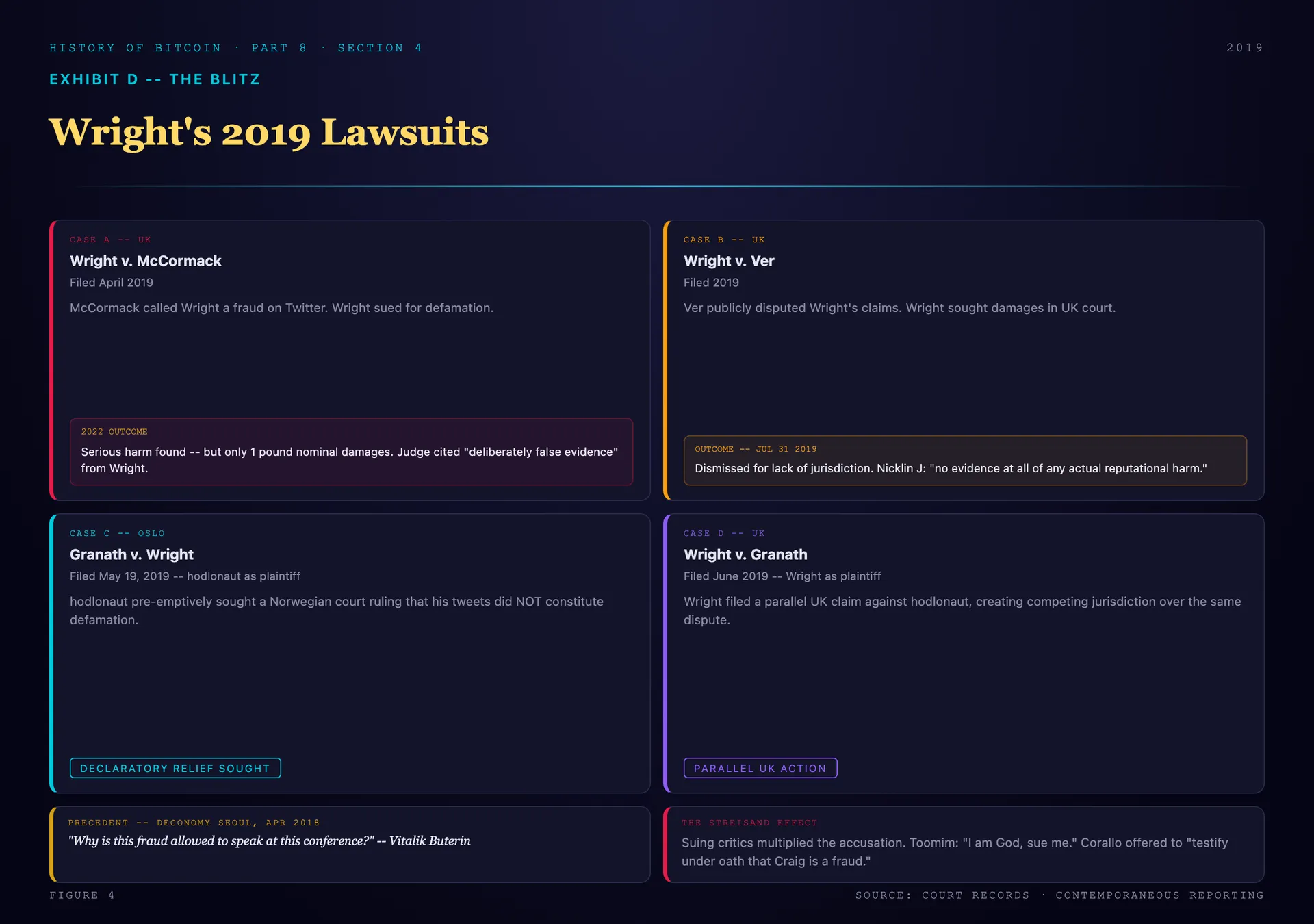
Across 2019, Craig Wright sent legal letters or filed suit against a remarkable roster of his critics: Peter McCormack, Roger Ver, Vitalik Buterin, Adam Back, and others.³¹ The engine of the year, on the legal front, was Wright's decision to answer the accusation that he was not Satoshi by trying to litigate the accusers into silence.
Take the McCormack case, because it is the cleanest example of why this strategy was doomed. Peter McCormack, host of the "What Bitcoin Did" podcast, after specifically begging to be sued, got one of the legal letters, and instead of folding, he responded with one of the great acts of public defiance in Bitcoin history. He pointed out that anyone can simply claim to be Satoshi, and then he did exactly that, in writing: "However, anyone can do this, look, 'Hey, I Peter McCormack am Satoshi Nakamoto, I created Bitcoin.' See, I just did it."³² He followed up with a formal statement for the record: "Craig Wright is not Satoshi," "Craig Wright is a fraud," and a request that as many people as possible retweet it.³³ He told Wright's lawyers that the claim he had damaged Wright's reputation "mistakenly states that he has any reputation left."³⁴
Wright sued him in the UK anyway. Flash Forward: years later, in 2022, a British court would find that McCormack's tweets did cause serious harm to Wright's reputation, and would then award Wright the grand total of one British Pound, because the court found Wright had "advanced a deliberately false case" about being dis-invited from academic conferences.³⁵ A nominal pound. We will get there. For now, just hold the shape of it.
Then there was Wright versus Ver. Wright sued Roger Ver in the UK over a video in which Ver called him a fraud. On July 31, 2019, Justice Nicklin dismissed it for lack of jurisdiction, with a line that stung: there was "no evidence at all of any actual reputational harm" in England.³⁶
And then the case that the rest of the world got backwards, and that I want to get exactly right, because the details matter. There were two hodlonaut lawsuits, in two countries, and they ran in opposite directions. In Oslo, on May 19, 2019, it was Magnus Granath who filed first, as the plaintiff, asking a Norwegian court to declare that he had not defamed Wright.³⁷ In London, the following month, it was Wright who filed, as the plaintiff, suing Granath for defamation.³⁸ The man with the cat avatar sued Wright to clear his own name in his home country; the man claiming to be Satoshi sued to punish him in England. Two courts, two continents, the same fight, pointed in opposite directions. Years later, the Norwegian court would find Granath not liable, and Wright would eventually drop his appeal.³⁹ Again, a flash-forward; again, put it away.
The real problem that a PR firm in a similar situation would flag is that suing critics usually has specific blowback: the Streisand effect. Every lawsuit Wright filed multiplied the accusation it was meant to suppress. The harder he swung the legal hammer, the louder the nail got. There was a precedent for the futility of it, too. At a Seoul conference in 2018, Vitalik Buterin had stood up and asked, from the floor, "Why is this fraud allowed to speak at this conference?"⁴⁰
Nobody sued Buterin, and the line only stuck harder. The parody pile-on was immediate and merciless. The developer Jonathan Toomim publicly declared, in effect, "I am God, sue me for defamation."⁴¹ Matt Corallo offered to testify "under oath that Craig is a fraud."⁴² The accusation Wright was trying to erase became a meme, then a movement, then a hashtag worn as a badge of honor by people swapping cat avatars.
The critics, and most of the press, called these suits SLAPPs, strategic lawsuits against public participation, lawsuits filed not to win but to bleed a critic dry with legal costs until he shuts up.⁴³ The Wright camp called it something else: a legitimate defense against a coordinated, "rabid and toxic" mob that had crossed the line from criticism into harassment, doxxing, and abuse.⁴⁴ Both of those framings contain some truth. Hodlonaut's tweets were genuinely vicious, and they amplified criticism of Wright, a man who the cat stated was mentally ill. And the response was disproportionate (perhaps because of the mental illness of the target of the attacks) and genuinely did multiply the harm it was meant to stop. You are allowed to hold the truths of both sides of the fight.
The BSV camp was brought into the swinging of a legal hammer, and every swing made the nail louder. It was mean to criticize Wright. It was dumb to sue the critics.
And I can prove the alternative existed, because I lived it. In October 2019, amid the Peter McCormack drama, I met Peter McCormack. Not in a courtroom. On a stage, sort of: a debate on Hotep Jesus's show, me partnered with Connor Murray, arguing BTC versus BSV against McCormack and a Bitcoiner who goes by Shinobi.⁴⁵ It got heated. McCormack told me BSV was "dead, the market's voted, it's dead." I told him that "one hundred percent, we don't know who Satoshi Nakamoto is," which was my position then.⁴⁶ We argued, viciously. Nobody sued anybody. The man Wright was dragging through the English courts was the same man I met in open debate that lasted over three hours, and it ended with this quote from McCormack to me:
"...the most annoying thing is I've come out of this really liking you, Kurt, and it really [expletive] annoys me because I'd want to just call you an egghead and hate you but I actually come out this really liking you."
There were two ways to fight that year, and I chose the one that did not require a writ.
That debate, as it happens, is what led CoinGeek to eventually offer me a contract role as their Chief Bitcoin Historian. But I did not take it then, and I want to be careful not to collapse the timeline, because a lot of people do. In 2019 I was still a cybersecurity professional working as a penetration tester, and other than a smallish mining operation, kept Bitcoin as a social hobby. I did not leave that career until the end of October 2020, and I did not announce the CoinGeek role until November 19, 2020, more than a year after the debate.⁴⁷ In 2019 I was an independent guy with a livecast and a strong opinion, fighting on the merits, watching my own side reach for weapons I would not touch.
"Inconceivable"
Everything so far has been loud. Tweets, bounties, delistings, debates. Now the camera moves to a quiet room, and the room is a federal courthouse in the Southern District of Florida where the temperature drops for a time, because this is where the year's noise ran into something that does not care about hashtags.
The case was Kleiman versus Wright. I introduced it at the end of Part 7: the estate of a dead American computer forensics expert named David "Dave" Kleiman, run by his brother Ira, had sued Craig Wright in February 2018, claiming Dave and Craig had together mined and controlled a vast early-bitcoin fortune, and demanding the estate's share.⁴⁸ Dave Kleiman was part of the circle around Wright that I traced back in Parts 5 and 6.⁴⁹ He died in 2013 under circumstances both mysterious and grim enough to feed years of speculation. The Palm Beach County medical examiner ruled it a natural death, coronary disease compounded by the chronic infection that had wracked his final years, but the scene that greeted the friend who found him days later contained a loaded pistol nearby, a bullet hole in the mattress, no shell casing, and no obvious wound on his decaying body. The scene was strange enough that investigators weighed it carefully before closing the case.⁵⁰
There is also a thread here worth pulling, because it runs somewhere you would not expect. Back in 2007, Dave Kleiman, a former cop and decorated computer-forensics examiner, had been hired by the Florida attorney Roy Black, Jeffrey Epstein's lead defense lawyer, to forensically image three computers; the sworn declaration describing that job sits today in the Epstein grand-jury files the Justice Department released.⁵¹ This makes Kleiman, who was known to be working with Wright at the time, quite possibly the first non-insider to peer into the dark world of Jeffrey Epstein. Hold that. It comes back when the judge walks in. And now Kleiman's estate had put a number on Wright's head: over 1.1 million bitcoin, which the complaint valued at more than ten billion dollars.⁵²
In 2019, that case turned into the courtroom center of gravity for the entire civil war, because the discovery process forced a question that all the tweets in the world could not: show us the bitcoin.
The court ordered Wright to produce a list of his bitcoin holdings. Wright said he could not. The coins, he explained, were locked in an encrypted file controlled by a structure he called the Tulip Trust, and he did not have the keys. The keys, he testified, would be delivered to him by a "bonded courier," who would arrive "in or about January 2020."⁵³
Read that sentence again, because it is a seed and it is going to detonate in Part 9. A bonded courier. Arriving in January. With the keys to over ten billion dollars worth of bitcoin.
Magistrate Judge Bruce Reinhart did not believe a word of it. And here that thread comes back, because Reinhart has a very curious, early Epstein chapter of his own.
He spent more than a decade as a federal prosecutor in this district, left on the first day of 2008, and the next day went into private practice representing Jeffrey Epstein's employees, the scheduler Sarah Kellen and the pilots among them, all granted immunity under the deal that let Epstein walk. A suit by Epstein's victims accused him of "switching sides in the middle of the Epstein case"; the Miami Herald's "Perversion of Justice" reporting, and the podcasts that followed it, cast prosecutors like him as having "crossed to Epstein's side"; and his former supervisors filed a court declaration contradicting his sworn claim that he had never, as a prosecutor, accessed confidential information about the Epstein matter. Reinhart has denied any conflict, and a later fact-check stressed that he represented Epstein's associates, not Epstein himself.⁵⁴ I am not going to tell you what the web of Wright, Kleiman, Epstein and the judge means, because I do not know that it means anything. I am telling you that it is there, in the public record, painfully curious, but that I can't tie them all neatly together.
He did share correspondence with Epstein and associates though, and one of the email threads asks why Reinhart was late to being paid...
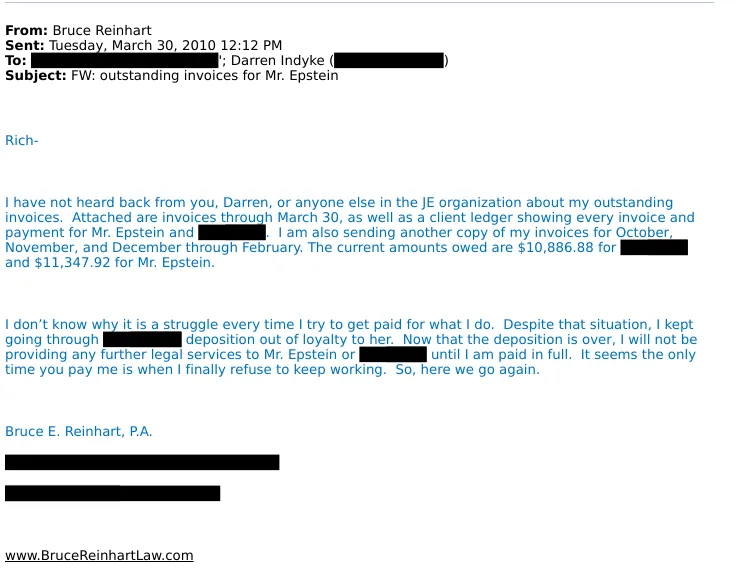
Source: https://www.justice.gov/epstein/files/DataSet%209/EFTA00760640.pdf
And so we have to ask, did Bruce Reinhart know Dave Kleiman? They both worked in and around the Epstein defense, and both worked at Palm Beach County Court for their careers. Did he work, perhaps unwittingly, with Wright on the Epstein case before the bitcoin era? Was there an undisclosed conflict of interest among Reinhart, Ira Kleiman and Craig Wright?
We may never know...
In August 2019, though, Reinhart wrote a sanctions order that is one of the most quietly devastating legal documents in this whole saga, and I am going to quote it at length, because the language does the cutting on its own.
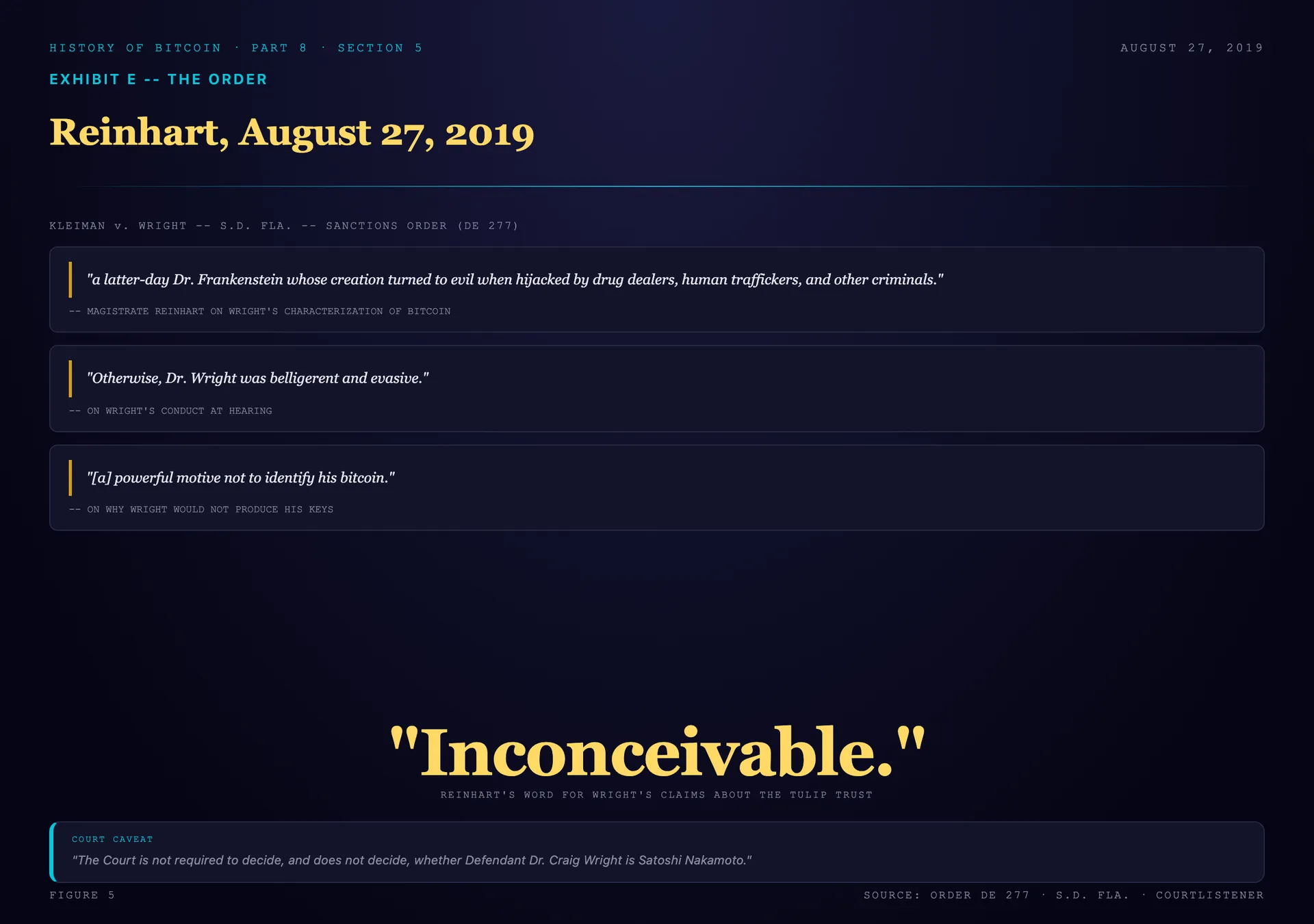
On Wright's demeanor as a witness: "During his testimony, Dr. Wright's demeanor did not impress me as someone who was telling the truth."⁵⁵ And more pointedly: "When it was favorable to him, Dr. Wright appeared to have an excellent memory and a scrupulous attention to detail. Otherwise, Dr. Wright was belligerent and evasive."⁵⁶
On why Wright might be lying about the coins: the order found that Wright "stands to lose billions of dollars if the plaintiffs succeed on their claims, which gives him a powerful motive not to identify his bitcoin."⁵⁷ The press shorthanded this as "powerful motive to lie," and that exact phrase is not in the order; the court's actual words are "a powerful motive not to identify his bitcoin." The precision matters in a section about a man being held to account for imprecision.
On Wright's account of how Bitcoin had supposedly slipped from his control, the judge reached for "The Princess Bride" and for Mary Shelley in the same breath. He rejected Wright's narrative that he was, in the order's words, "a latter-day Dr. Frankenstein whose creation turned to evil when hijacked by drug dealers, human traffickers, and other criminals."⁵⁸ And on the bonded courier, on the whole story of the encrypted file and the keys arriving from the shadows in January, the judge gave it a single word, alone, the way you would deliver a verdict on a fairy tale:
"Inconceivable."⁵⁹
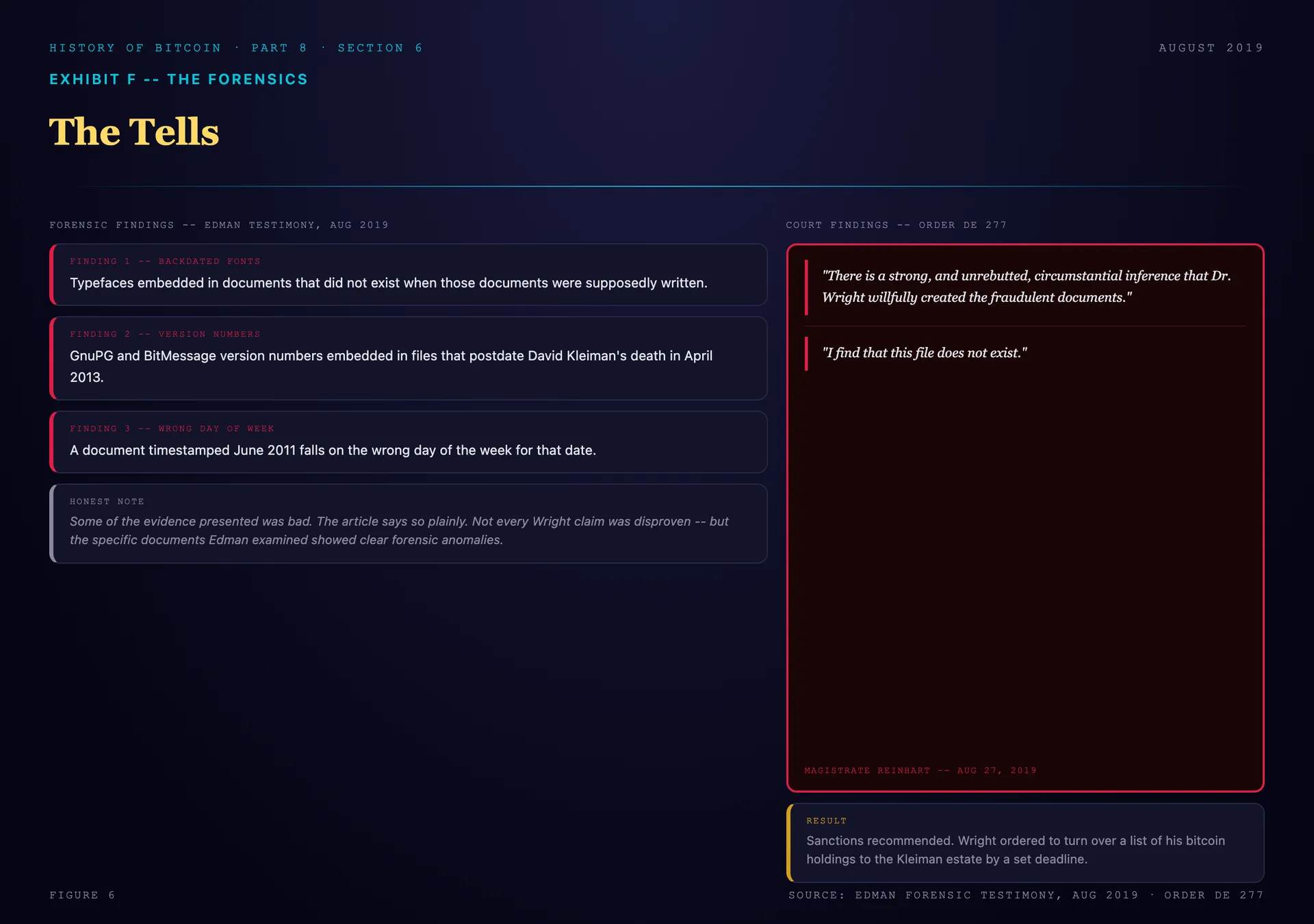
Now the hard part for Wright's supporters: I am not going to minimize the forgeries, because there were forgeries, there will be more later. The plaintiffs' forensic expert testified, and the court accepted, that documents Wright had produced were fraudulent. The "Dave to Craig" emails and a Deed of Trust were shown to be backdated: fonts that did not exist when the documents were supposedly written, encryption-software version numbers that postdated Dave Kleiman's death, a timestamp on a 2011 document that landed on the wrong day of the week.⁶⁰ The judge's finding was blunt: "There is a strong, and unrebutted, circumstantial inference that Dr. Wright willfully created the fraudulent documents."⁶¹ On the encrypted file that supposedly held the keys, the judge wrote, "I find that this file does not exist."⁶² He found that Wright had engaged in "a willful and bad faith pattern of obstructive behavior," including filing a false declaration and giving "perjurious testimony."⁶³
It is reasonable, on this record, to read Wright as the forger. That is the ordinary inference, and Reinhart all but drew it. What keeps me from treating it as the end of the story is a caveat the judge wrote into his own order: there was, he said, "no direct evidence that Dr. Wright was responsible for the alterations or fabrications" of the documents, only that "no evidence before the Court" showed anyone else had a motive to falsify them.⁶⁴ An inference from motive is a powerful thing in a courtroom. It is not the same thing as a witness to the hand that did it.
Much of the evidence Craig Wright put in front of that court was bad, and a narrator who tells you otherwise is selling you something. But the honesty has to cut in both directions this year, so stay with me into the part almost nobody who covers this case is willing to sit with, because it muddies a clean verdict.
The documentary trail around Satoshi Nakamoto was already poisoned years before Wright produced a single page. In September 2014, Satoshi's own digital footprint was hijacked: an unknown intruder seized his GMX email account, his P2P Foundation profile, and the Bitcoin SourceForge page, and perhaps other things that we can't verify from this vantage point. That hacker demanded twenty-five bitcoin to stay quiet.⁶⁵ Whatever clean proof of Satoshi's identity once lived in those accounts passed, for a window, through a malicious stranger's hands. Set that beside Wright's own years: an Australian tax fight that ended with federal police raiding his Sydney home in December 2015, the week he was first outed, after which he left for London within days.⁶⁶ Anyone trying to reconstruct a clean, timestamped paper trail out of that wreckage a decade later is working with contaminated material, and Wright has insisted, in every court he has stood in, that various compromised systems and not his own hand explain the anomalies.
That is a reasonable defense.
I have to be straight with you here, because this is where the honesty cuts hardest: every court that has weighed that explanation has rejected it and found Wright personally responsible for the forgeries, and the courts that came after Reinhart, on two continents, ruled against his Satoshi claim more decisively, not less.⁶⁷ I am not going to wave those rulings away. But I am also not going to pretend the record is tidier than it is. Not everything in this case was forged. Dave Kleiman and Craig Wright were partners in a real company, W&K Info Defense Research, with real corporate filings, real tax returns, real bids on real government contracts, and roughly two hundred pages of genuine text messages between them running from 2009 to the day before Dave died, none of it part of the forgery finding.⁶⁸ What was forged or possibly contaminated were the specific documents that tried to prove the creation of Bitcoin itself. And when the case finally reached a jury in 2021, that jury crowned no one Satoshi: it found Dave was not Wright's partner in inventing Bitcoin, awarded his old company a multi-million dollar settlement for converted intellectual property, and handed the estate not a single coin.⁶⁹ While the verdict didn't explicitly define the IP, the argued property was a tranche of Satoshi's testnet bitcoins, whitepaper(s), hard drives and supercomputers. So, they didn't create bitcoin, but the IP, essentially Satoshi's IP were converted? Make of that what you will.
And please hold two things at once, because the truth of 2019 lives in the tension between them.
First, look at what the order actually did, because the headlines got this wrong too. Reinhart's remedy was a Rule 37 discovery sanction. It deemed certain facts established for the rest of the case: that Wright and Dave Kleiman had been 50/50 partners, and that the estate had an ownership interest in their pre-2013 bitcoin and intellectual property. It struck some of Wright's defenses and awarded the plaintiffs their attorney's fees.⁷⁰ That is what a Rule 37 sanction does: it deems facts established as a punishment for discovery misconduct. It did not order Wright to hand over a dollar, and it did not order him to forfeit a single coin. The "ordered to pay five billion dollars" and "ordered to forfeit half his bitcoin" headlines that circulated that August were extrapolation, not the order.⁷¹ Say it correctly or do not say it.
Second, and this is the irony that turns the Kleiman case from a verdict into a tragedy, look at the trap Wright was standing in. Both sides in that lawsuit had stipulated, for the purposes of the case, that Wright was Satoshi.⁷² Which means Wright was caught in a vise of his own making. If he maintained the claim, he was potentially on the hook for half of a stash worth billions in 2019, and one that, by the time the case reached a jury in 2021, would be argued in that courtroom at north of sixty billion dollars, all owed to the estate of a dead man.⁷³ If he recanted, if he stood up and said he was not Satoshi after all, he would be confessing to years of perjury and fraud. Maintain the claim and owe billions. Drop the claim and confess the crime. There was no door out of that room that did not cost him dearly.
And the court, for all its scorn, was careful about one line, and I am going to give the series' standing point to the judge himself, because he said it better than I could. After all the Frankenstein language and the "Inconceivable," Reinhart wrote: "The Court is not required to decide, and does not decide, whether Defendant Dr. Craig Wright is Satoshi Nakamoto."⁷⁴
The court that called his documents forgeries and his story inconceivable still refused to rule on whether he invented Bitcoin. That question stayed open. It is open in this article too. I am not closing it, and I am not asking you to close it. I am asking you to hold the contradiction, because it is real, and because the year was made of it.
And since I am asking you to hold an open question, I owe you where I personally land, labeled clearly as what it is: a conviction, not a finding. I think there is truth in the claim that Craig Wright is Satoshi Nakamoto, but I also think he's withholding information. I think Ian Grigg, Uyen Nguyen, Joseph Vaughn-Perling and others in that orbit are also withholding information. I don't know why, but I think the clean "proof of Satoshi" was thin from the start, because Satoshi was a careful, deliberate person who spent years erasing his own tracks, and I think what little remained was likely lost for good when Dave Kleiman died, and corrupted further when those accounts were maliciously seized in 2014. I think a man who actually built this thing, and then watched the proof of it rot and scatter, might do something desperate and stupid and fraudulent to rebuild an evidence trail he could no longer honestly produce, and that this is a different failing than inventing the whole lie from nothing. I cannot prove a word of it, at this time. The courts have ruled the other way. A reasonable person reading the same record can land exactly opposite me, and the majority of people do.
All I ask is that you weigh the entire pile, forgeries and all, notice that it is genuinely harder than the headline, look at the immense cost of the entire saga, and then make up your own mind.
The full trial that would put all of this to a jury was still two years off, and we will sit through it properly when the series gets there. I sat through it, physically, in person. For now, leave Craig Wright where 2019 left him: in a Florida courtroom, his documents in ruins, his story rejected, and his entire defense resting on a courier who was supposed to walk out of the shadows in January with the keys to everything.
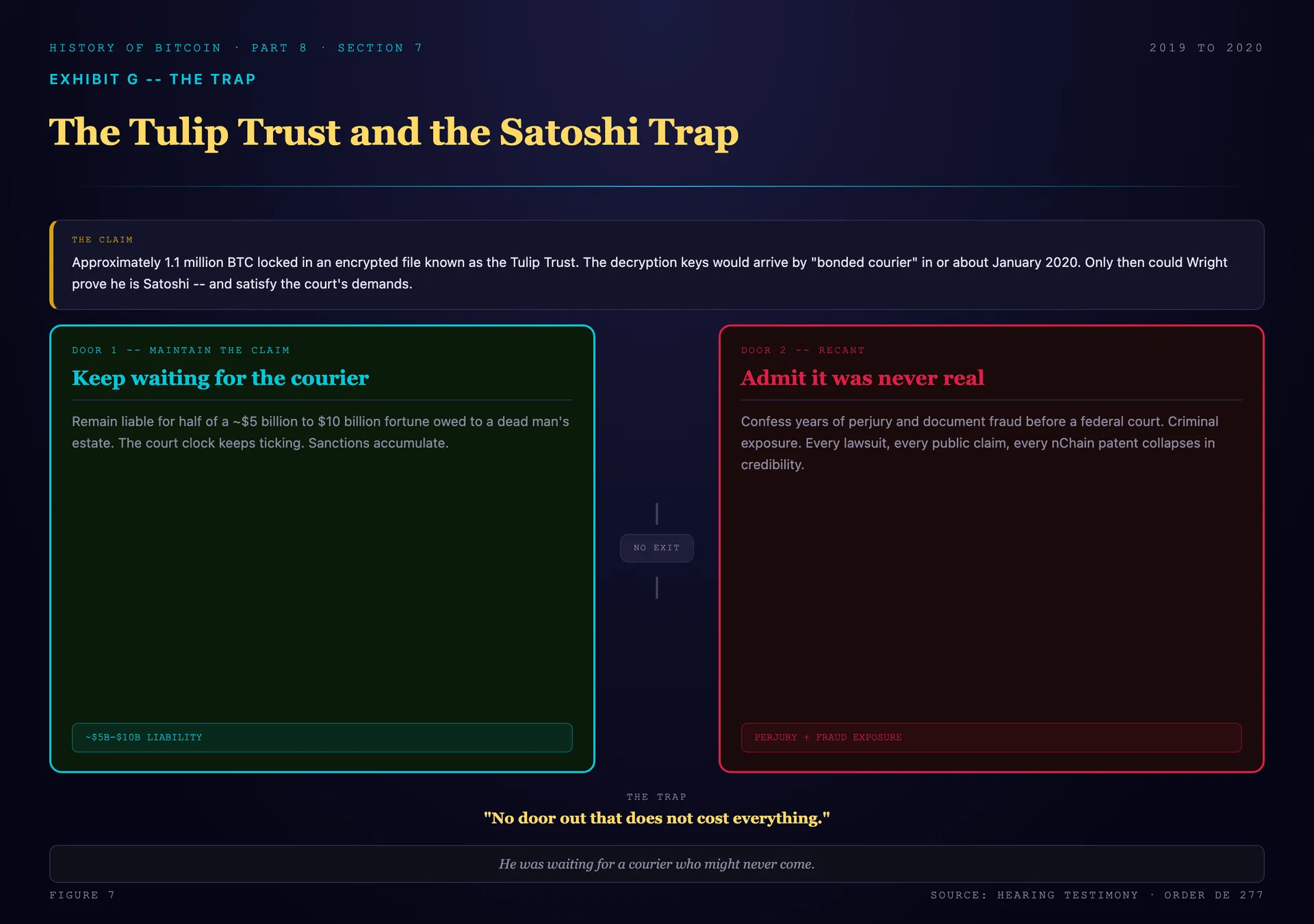
He was waiting for a courier who might never come.
Meanwhile, the Casino
While the builders were burning their year in courtrooms and on Twitter, the money moved in.
I have to keep this section tight, because the macro story of 2019 could swallow the whole article if I let it, and it is not the main event. But you cannot understand the cost of the civil war without seeing what filled the space the builders vacated. Peer-to-peer cash was supposed to go into that space. Instead, the casino did. I walked the floor of the early version of this casino in Part 7; by 2019 the house had gotten bigger, more institutional, and in some corners, more openly fraudulent.⁷⁵
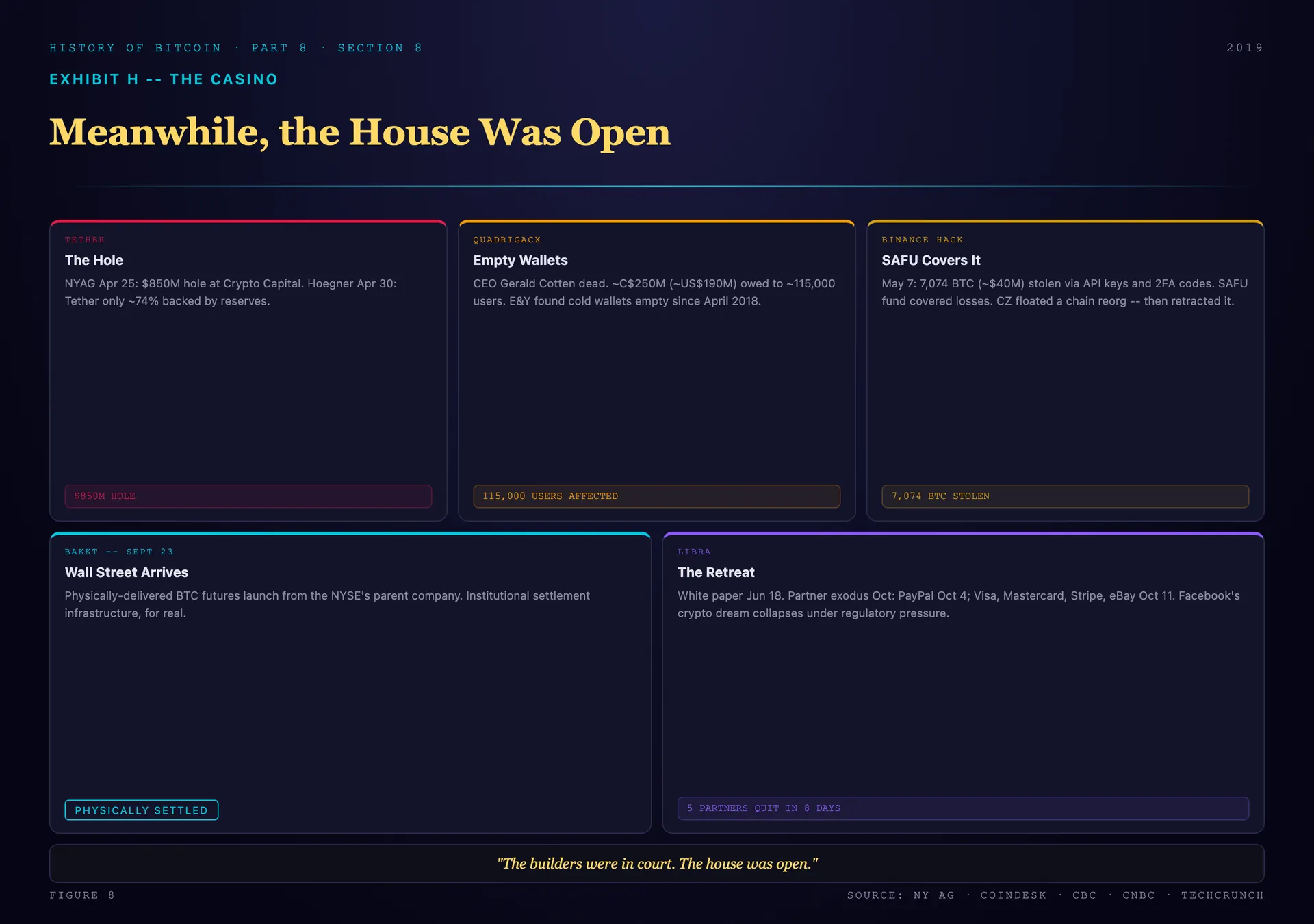
Start with Tether, the stablecoin that had quietly become the dollar settlement layer of the entire crypto economy. On April 25, 2019, the New York Attorney General, Letitia James, announced a court action against Tether's parent company, alleging a "cover-up to hide the apparent loss of $850 million" of co-mingled client and corporate funds at a payment processor called Crypto Capital.⁷⁶ Five days later, Tether's own general counsel, Stuart Hoegner, filed an affidavit admitting that the supposedly dollar-for-dollar stablecoin was, at that moment, only about 74 percent backed by cash and equivalents.⁷⁷ The token that the entire market used as a stand-in for dollars was three-quarters of the way to being real. And the whole casino was settling its bets in it.
Then QuadrigaCX, which is the darkest story of the year and the one that turned a Bitcoin slogan into a headstone. QuadrigaCX was Canada's largest crypto exchange. Its CEO, Gerald Cotten, reportedly died in December 2018 in India, and the exchange announced that Cotten had been the sole holder of the keys to its cold wallets, and that roughly a quarter of a billion Canadian dollars, owed to about 115,000 users, was now locked away forever.⁷⁸ Then it got worse. When Ernst & Young came in as monitor and traced the wallets, they found that the six identified cold wallets had been effectively empty since April 2018, months before Cotten died.⁷⁹ The money was not locked in a dead man's laptop. The money was gone, and had been gone for a long time. "Not your keys, not your coins" stopped being a slogan that year and became an epitaph for 115,000 people who had trusted an exchange to hold their private keys for them.
It's a spicy story itself!
Then the Binance hack, which is its own small parable about who actually controls these chains. On May 7, 2019, attackers pulled 7,074 bitcoin, about forty million dollars, out of a Binance hot wallet.⁸⁰ Binance covered the loss in full from an insurance fund. But CZ, the same CZ from the cold open, floated something extraordinary in a livestream right afterward: the possibility of convincing miners to reorganize the Bitcoin blockchain itself to claw the stolen coins back.⁸¹ He walked it back within about a day, after a wave of backlash pointed out that a single exchange casually proposing to rewrite Bitcoin's ledger was a far scarier event than a forty-million-dollar theft.⁸² The man who erased BSV from his exchange in April had, by May, mused about rewriting Bitcoin's history when his own money was on the line. File that contrast away.
Then Wall Street arrived, wearing a nicer suit than the futures desks I described in Part 7. On September 23, 2019, Bakkt launched, a Bitcoin futures venue from the parent company of the New York Stock Exchange.⁸³ And this time the futures were physically delivered, which is the detail that matters: where the 2017 CME and Cboe contracts were cash-settled, paper bitcoin that never touched a real coin, Bakkt delivered actual bitcoin out of a regulated warehouse.⁸⁴ I told you in Part 7 to remember the paper bitcoin; here is the next turn of that screw, real coins this time, custodied and cleared by the same financial establishment that peer-to-peer cash was built to route around.⁸⁵
And then the giant. In June 2019, Facebook unveiled Libra, a global digital currency backed by a basket of national currencies and run by a Geneva association of corporate heavyweights.⁸⁶ For a moment it looked unstoppable: Visa, Mastercard, PayPal, Stripe, eBay, all signed on. And then Washington swarmed it. By October, after months of congressional hostility, the partners fled in a single fortnight: PayPal first, on October 4; Visa, Mastercard, Stripe, and eBay together on October 11; Booking on the 14th.⁸⁷ The lesson Washington taught Silicon Valley that autumn was simple and the whole industry heard it: you may not mint money. That is the bank-state's chair, and they will not share it.
Put it all together and you have the frame for the whole macro movement. The civil war created a vacuum where peer-to-peer electronic cash was supposed to be, and the casino rushed in to fill it: a three-quarters-backed stablecoin holding up prices, an exchange that lost its customers' coins before its CEO even died, an exchange boss musing about rewriting the ledger, Wall Street building the on-ramps, and Facebook trying to mint a currency until the government slapped it down.
The builders were in court. The house was open.
Three Bitcoins, Three Roads
Step back from the noise, because underneath the delistings and the lawsuits and the casino, the three chains that came out of the civil war were quietly choosing three different destinies in 2019, and the divergence is the real story of where Bitcoin actually went.
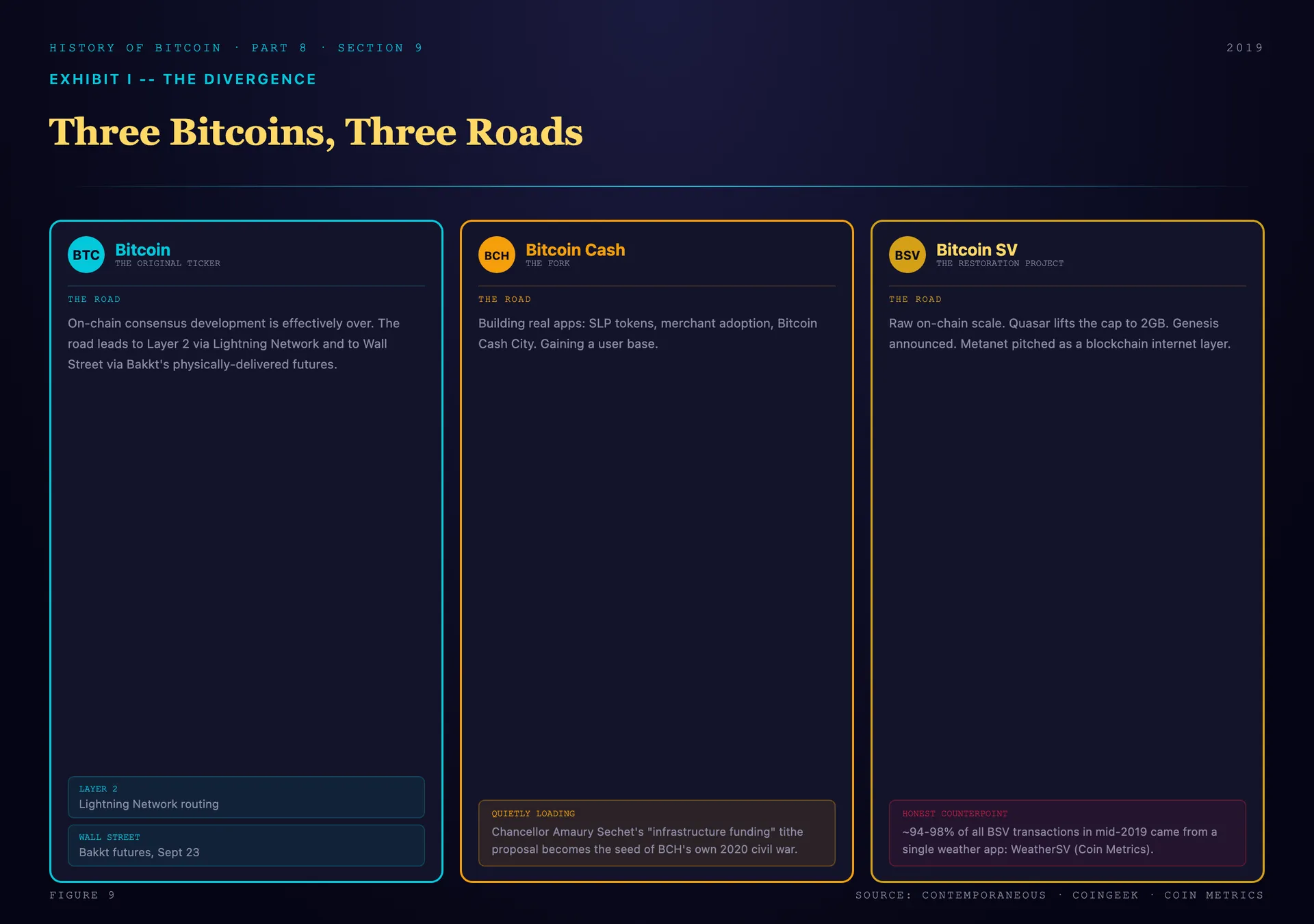
BTC took the road to Wall Street and the second layer. Consensus development on the base chain was finished; the block size was settled, the protocol was frozen, and the roadmap pointed up and out, to the Lightning Network and to the institutional rails that Bakkt was laying. The Lightning Torch that opened this article was the perfect emblem of that road: charming, communal, genuinely clever, and also a hand-relayed experiment that proved the base layer was no longer where ordinary payments were supposed to happen. BTC's future was a settlement layer with a payments network bolted on top and a futures exchange bolted on top of that.
BCH took the road of applications, and started quietly loading the gun for its own next civil war. Through 2019, Bitcoin Cash built: a token protocol called the Simple Ledger Protocol that spun up thousands of tokens, a merchant push, a "Bitcoin Cash City" conference in Townsville, Australia.⁸⁸ It was real building, and it was the closest thing the big-block world had to consumer traction. But underneath it, the same fault line that had split every previous chain was opening again, this time over money. There was no sustainable way to fund Bitcoin ABC's development, and in 2019 an ABC developer named Shammah Chancellor started arguing publicly that the lack of dev funding was a "market failure," and floated the idea of a "tithe."⁸⁹ Hold that word, tithe, because it is a seed. In January 2020 that argument would harden into the Infrastructure Funding Plan, a proposal to divert eight percent of the block reward to developers, and that plan would split Bitcoin Cash again, in November 2020, exactly two years after the SV fork.⁹⁰ The chain that won the name in 2018 was already, in 2019, building toward the fight that would cost it Amaury Séchet. But that is Part 9 and beyond.
And BSV took the road of raw on-chain scale, which is the road this series has always argued was Satoshi's original design, and which I am going to describe with the same honesty I have used on everyone else, including the part that hurts.

On July 24, 2019, the SV Node Quasar upgrade lifted BSV's default block cap from 128 megabytes to two gigabytes.⁹¹ Quasar raised a default cap that the node software ships with; miners still set their own accepted-block size limit, and in practice many initially set theirs lower, around 512 megabytes, and grew into the headroom.⁹² The capacity was real, and it was orders of magnitude beyond anything BTC or BCH would countenance. And the roadmap pointed further still: in April 2019, the BSV developers announced Genesis, an upgrade that would remove the default cap entirely and restore most of the original Satoshi opcodes and limits. Genesis was announced in 2019, but it did not activate until February 4, 2020.⁹³ It is a 2020 event with a 2019 announcement, and I am planting it here precisely because it pays off in Part 9. Wright's broader vision, Metanet, an on-chain "internet of data," floated above all of it, mostly still a concept.⁹⁴
By the middle of 2019, a single application, a weather-data app called WeatherSV, was writing somewhere between 94 and 98 percent of all transactions on the BSV chain, and the rest of crypto Twitter had a field day: a two-gigabyte chain, they laughed, and all it does is log the weather.⁹⁵ The number is real, and on its face it looks thin. But sit with what that app was actually doing, because I argued this at the time and I will argue it again now.⁹⁶ Those transactions were not financial, and the people sneering at them were purposely measuring the wrong thing. WeatherSV was writing the temperature and barometric pressure of places on earth, permanently, immutably, with a timestamp that no government and no corporation and no later revisionist could quietly alter during an era where "climate change" was one of the most contentious scientific and political debates. Data is money. Timestamped, provable, tamper-proof data is arguably worth more than money, because it is the one thing our institutions keep failing to give us: a record that cannot be edited after the fact to suit whoever holds power this year. A chain that can carry the weather can carry the audit trail of a supply chain, a medical record, a property title, a climate dataset that neither side of a political fight can cook. The world looked at WeatherSV and saw a toy. What it actually was, was a demonstration, proof that a public ledger could become the immutable backbone of human record-keeping, one boring temperature reading at a time. The usage was rhetorically thin according to the critics. The category it was pointing at was the size of the world.
BSV was showing that a bitcoin chain could carry the world. The world was not on it yet.
What the Year Cost
So let me tally the year, the way you tally a war when the shooting stops for the season.
The chain that was trying to restore Satoshi's original protocol spent 2019 quarantined off the major exchanges, sued into a corner, and turned into a punchline. It had been pumped to roughly two hundred and fifty dollars in the spring on the news of some of Wright's copyright registrations, then bled most of that back; it ended the year around ninety-seven dollars, off the big exchanges, a fraction of its spring peak, its capacity real and its users thin.⁹⁷ I should note, because the honesty runs both ways here too, that BSV actually closed 2019 a little higher than it opened, which surprises people who only remember the delisting; the damage was not mainly in the year-end price, it was in the quarantine, the reputation, and the courtrooms.⁹⁸ The copyright story was its own small lesson: Wright registered the Bitcoin whitepaper and the version 0.1 code with the US Copyright Office in 2019, registration numbers TXu 2-136-996 and TX 8-708-058, and CoinGeek trumpeted it as government recognition that Wright was Satoshi.⁹⁹ The Copyright Office then issued a public statement noting that registration "is not a determination of the truth of any claim" and that the office "does not investigate the truth" of what an applicant asserts; anyone can register a claim to a work for about thirty-five dollars.¹⁰⁰ The pump did not hold.
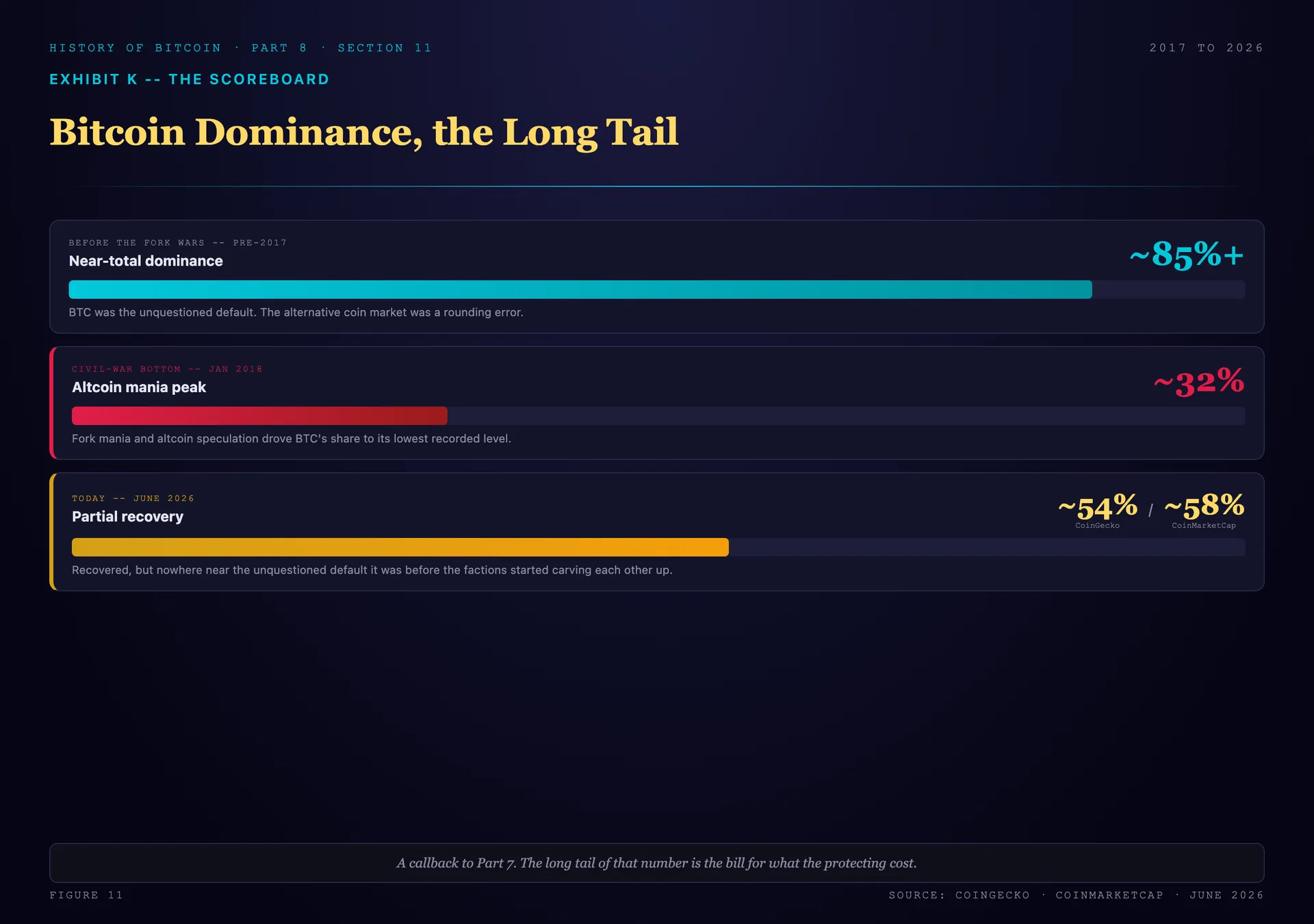
And the invoice for the whole civil war was still being paid by Bitcoin itself, in a number I showed you in Part 7 and want to close the loop on here. Before the scaling war, Bitcoin was the overwhelming, unquestioned default, the better part of the entire market. The war cratered its dominance and it never fully recovered. As I write this in 2026, BTC's share of the total market sits around fifty-four percent by one major tracker and around fifty-eight percent by another, still nowhere near what it was before the factions started carving each other up.¹⁰¹ The delistings and the lawsuits were supposed to protect Bitcoin. The long tail of that number is the bill for what the protecting actually cost.
Meanwhile the casino it was all supposed to replace had its best year of legitimization yet. Wall Street built the futures. The stablecoin everyone settled in admitted it was three-quarters backed and the market shrugged and kept settling in it. The war for the name "Satoshi Nakamoto" was now being fought in courtrooms on two continents, and the man at the center of it was waiting on a courier that a federal judge had already declared inconceivable.

And here is where I put the blame, because this series has always had a specific theory of blame and 2019 is where it comes fully into focus.
Do not blame the exchanges for being exchanges. CZ and Powell and Voorhees did what casino operators do, which is protect the house and rally the crowd, and expecting otherwise is naive. Do not blame Wall Street for building futures; that is what Wall Street does. Do not blame Facebook for trying to mint money; that is what an empire does when it sees an open throne.
Blame the Bitcoiners. Blame the people who were supposed to be carrying Satoshi's idea and who taught an entire industry that the way to win an argument is to delist it, sue it, and erase it, instead of out-building it. And blame, honestly and specifically, the side that handed the cartel its pretext and its halo by putting a bounty on a critic and a writ on a podcaster. Everyone in this story reached for a weapon that was not code or commerce. The maximalists reached for the delisting. Wright reached for the lawsuit. He reached for a bounty on a man's name, and it made everything worse. That is the indictment, and it does not spare anyone, including the people I agreed with.
The battlefield had moved. In 2017 you won by mining a bigger block or by proof of hat. By the end of 2019 you won by getting a coin removed from the menu and one man's name dragged into a federal docket. That is what it means for a civil war to go legal, and once an industry learns that trick it never unlearns it.
But the year was not over, and neither was the courier's story.
Because here is what was waiting in the envelope that 2020 was about to open. The bonded courier was supposed to arrive in January, or so Craig Wright had sworn, and a judge had given him until early February to produce the keys or be exposed. The Genesis upgrade was set to activate on February 4, 2020, and finally take the cap off the chain entirely. Bitcoin Cash's funding fight was about to harden into a tithe and split the chain a second time. And out beyond all of it, unseen by everyone arguing about Satoshi on Twitter, a virus was getting ready to close the world, lock people in their homes across the globe and kick off a chain of events that led to the largest money-printing event in world history.
The keys were supposedly in the mail. The world was about to find out what was in the envelope.
That, and a great deal more, is Part 9.
Be good to each other. And remember: the receipts are in the footnotes.
Kurt Wuckert Jr. is the world's foremost Bitcoin Historian. The Written History of Bitcoin is published one installment at a time at kurtwuckertjr.com.
Footnotes
¹ Changpeng Zhao (@cz_binance), tweet, approximately April 12, 2019: "Craig Wright is not Satoshi. Anymore of this sh!t, we delist!" The original tweet was later deleted; the wording is reproduced across contemporaneous reporting. Binance Delists Bitcoin SV, CEO Calls Craig Wright a 'Fraud', CoinDesk, April 15, 2019; Binance's CZ Threatens to Delist BSV, U.Today, April 12, 2019.
² Erik Voorhees (@ErikVoorhees), tweet, April 15, 2019: "We stand with @binance and CZ's sentiments." Deleted; reproduced in contemporaneous reporting. List of Crypto Exchanges That Delisted Bitcoin SV, Coinfomania.
³ Kraken's delisting poll closed with 71% of 70,545 votes in favor of delisting BSV (7% to keep, 21% indifferent). Kraken Delists Bitcoin SV Following Online Poll of Over 70,000 Users, Bitcoin Magazine. A mid-poll snapshot showing ~73% circulated but was not the final figure.
⁴ On the November 2018 hash war, the ABC checkpoints, and the three-way split, see A Tale of 2 Bitcoins, and Then 3, Part 7.
⁵ The Lightning Torch (#LNTrustChain) began on or around January 19, 2019, started by @hodlonaut (Magnus Granath), who used a grey astronaut-cat avatar. Timeline of the hodlonaut vs. Craig Wright Case, Bitcoin Magazine.
⁶ The Lightning Torch passed through more than fifty countries and notable participants including Jack Dorsey and Andreas Antonopoulos, and at one point Changpeng Zhao. (Contemporaneous coverage of the #LNTrustChain relay, early 2019.)
⁷ On the May 22, 2010 pizza transaction and the communal spirit of early Bitcoin, see The Year of the Pizza, Part 3.
⁸ Across March 2019, @hodlonaut tweeted that Craig Wright was a "fraud," "scammer," and "mentally ill," and amplified the hashtag #CraigWrightIsAFraud. Bitcoin Magazine timeline, op. cit. (note 5).
⁹ On March 29, 2019, the law firm Ontier (SCA Ontier), acting for Craig Wright, sent @hodlonaut a letter demanding a retraction and apology under threat of a defamation suit. Bitcoin Magazine timeline, op. cit. (note 5).
¹⁰ Calvin Ayre publicly stated that "Dr Craig Wright is Satoshi" and that "BSV is the only real Bitcoin" in the same period (late March 2019), via Twitter and CoinGeek. (Contemporaneous CoinGeek/Twitter coverage.)
¹¹ A $5,000 bounty, payable in BSV, for hodlonaut's real-world identity was offered on or around April 11, 2019, promoted via CoinGeek. Bitcoin Magazine timeline, op. cit. (note 5); News: Craig Wright Sues to Be Called Satoshi, David Gerard, April 18, 2019.
¹² Kurt Wuckert Jr. (@kurtwuckertjr), statement on the 2019 hodlonaut comment, X, 2024: "I was actually in the hospital that day with my wife who was a high-risk pregnancy with my first son who was born shortly thereafter in an emergency C-section, and I was admittedly not up to speed on everything that had been going on... I figured cooler heads would exchange some form letters and be done with it. I was wrong, and I underestimated the guile of the situation."
¹³ Wuckert, op. cit. (note 12): "I remember discussing this with @MZietzke on the day it happened in 2019, and he helped me understand the full context of who Hodlonaut was... and I actually reversed my opinion on the situation that same day... If @hodlonaut reads my posts, I hope you know that I never meant you harm, and I'm sorry."
¹⁴ Magnus Granath's self-reported account of the manhunt, as relayed in journalism: a private investigator located his workplace, telephoned his employer while impersonating a police officer to obtain his details, and approached him claiming to have documents for him to sign. Labeled self-reported. Who Can Say Who Is Not Satoshi? Hodlonaut and Wright Go to Trial, CoinDesk, September 12, 2022; Bitcoin Magazine timeline, op. cit. (note 5).
¹⁵ The #WeAreAllHodlonaut campaign saw Bitcoiners swap avatars for the grey space-cat in solidarity. Bitcoin Magazine timeline, op. cit. (note 5).
¹⁶ Elizabeth Stark (Lightning Labs) launched a crowdfunded legal defense that raised roughly $30,000 in bitcoin from more than 1,000 backers (goal $20,000), stating "In the bitcoin community we stand up for each other"; surplus was pledged to Bitcoin Venezuela. Hodlonaut Crowdfunding Campaign Against Craig Wright, Coinspeaker; Crowdfunding Campaign Against Lawsuit From Craig Wright, BeInCrypto.
¹⁷ Preston Byrne represented hodlonaut pro bono from 2019. David Gerard, op. cit. (note 11).
¹⁸ CZ tweet, op. cit. (note 1).
¹⁹ Binance announced on April 15, 2019, that BSV would be delisted with trading ceasing April 22, citing that the coin "no longer meets" its listing standards. Binance Will Delist Bitcoin SV, Coinspeaker; CoinDesk, op. cit. (note 1).
²⁰ CZ follow-up tweets, April 15, 2019, since deleted and reproduced in reporting, including: "The real Satoshi can digitally sign any message to prove it... everyone is Satoshi, except Craig Wright!" CZ: Craig Wright Is Not Satoshi Nakamoto, But He's a Fraud, CryptoPotato. The exact phrasing of the "fraud" tweet varies slightly across reproductions ("is fraud" vs. "is a fraud").
²¹ ShapeShift, via Erik Voorhees, announced it would delist BSV within 48 hours on April 15, 2019. Coinfomania, op. cit. (note 2); ShapeShift Decides to Delist Bitcoin SV, Cryptonews.
²² Kraken delisted BSV on April 16, 2019, following its poll (deposits disabled April 22, trading ending April 29, withdrawals ending May 31); Bittylicious delisted on April 22, 2019, citing "solidarity against the toxic litigious environment." Kraken Exchange Joins Binance, ShapeShift in Delisting Bitcoin SV, CoinDesk; Coinfomania, op. cit. (note 2).
²³ Jesse Powell (@jespow), tweet, April 2019, since deleted and reproduced in reporting: "We didn't delist on technical merits. BSV never met our listing requirements but we supported it because everyone wanted their 'free money' from the fork. What pushed us to delist was the frivolous lawsuits from leaders in the BSV community against us, our partners and clients." Kraken Disables BSV Deposits; 'Frivolous Lawsuits,' Says Jesse Powell, Cryptonews.
²⁴ Jesse Powell, quoted in CoinDesk, April 16, 2019: the BSV camp seemed to "use the law system to abuse it, suing anyone who says anything against them." CoinDesk, op. cit. (note 22).
²⁵ OKEx reviewed BSV and determined it "did not violate" its listing requirements, retaining it. Coinfomania, op. cit. (note 2).
²⁶ BitForex posted a delisting poll, then retracted it and retained BSV "in consideration of users." Coinfomania, op. cit. (note 2).
²⁷ Jimmy Nguyen (Bitcoin Association), on the delistings: "the delisting of BSV by certain exchanges was caused by personal dislike of Craig Wright"; "It's absolutely ridiculous that any business, let alone a cryptocurrency exchange, would use Twitter polls to make a serious business decision like delisting an asset"; "This has set a terrible precedent." The Bitcoin SV Delistings: A Conversation with Jimmy Nguyen, sFOX; The Great Delisting, Finance Magnates.
²⁸ On the existential-threat thesis, that the chain trying to restore and scale the original protocol threatened every business model dependent on Bitcoin staying small, see The Written History of Bitcoin, Part 6: "The Button".
²⁹ Roger Ver publicly opposed the #DelistBSV campaign despite being sued by Wright. He was served with Wright's UK libel claim on May 2, 2019, at a hastily arranged Bitcoin Cash meetup at the Hoxton Square Bar and Kitchen in London, and used the occasion to restate his opposition to the delistings. Roger Ver Vows to Fight New Libel Lawsuit From Craig Wright, Decrypt, May 2, 2019.
³⁰ Roger Ver, at the May 2, 2019 London Bitcoin Cash meetup, on the BSV delistings: "I don't think it was a good thing. If people want to trade it, I think people should be able to trade it. Free the market, free the world. If you want to trade Bitcoin SV, go for it." Decrypt, op. cit. (note 29); the quote was reproduced across contemporaneous coverage including Cointelegraph and CryptoSlate. The Wright and CoinGeek camp frames Ver oppositely, as a driver of the delistings rather than an opponent, a characterization later used to anchor the BSV Claims antitrust action; see Roger Ver: The Notorious Nexus in Exchanges' BSV Delisting Campaign, CoinGeek, August 18, 2022. The substance of Ver's public opposition is documented; the competing readings of his private role are not resolved here.
³¹ Across 2019, Wright sent legal letters or filed suit against Peter McCormack, Roger Ver, Vitalik Buterin, Adam Back, and others. (Contemporaneous coverage; see notes 32-39.)
³² Peter McCormack, public response to Wright's legal letter, April 2019: "However, anyone can do this, look, 'Hey, I Peter McCormack am Satoshi Nakamoto, I created Bitcoin.' See, I just did it." Reproduced in the 2022 UK High Court judgment. Wright v McCormack Final Judgment, Judiciary of England and Wales; Peter McCormack Faces a High-Stakes Legal Battle With Craig Wright, Decrypt.
³³ Peter McCormack, tweet, April 2019: "I would like to formally state that, 1. Craig Wright is not Satoshi, 2. Craig Wright is a fraud, 3. I hope as many people ReTweet this as possible." Decrypt, op. cit. (note 32).
³⁴ Peter McCormack, letter to Wright's lawyers, April 2019: the assertion that he had harmed Wright's reputation "mistakenly states that he has any reputation left." Decrypt, op. cit. (note 32).
³⁵ Wright v McCormack [2022] EWHC 2068 (QB), August 1, 2022: the court found McCormack's publications caused serious harm to Wright's reputation, but awarded only £1 in nominal damages after finding Wright had "advanced a deliberately false case as to the dis-invitations from academic conferences." Craig Wright v Peter McCormack: Wright Put Forward False Evidence, Will Receive Damages of £1, CoinDesk; Judiciary of England and Wales, op. cit. (note 32).
³⁶ Wright v Ver was dismissed for lack of jurisdiction on July 31, 2019, by Justice Nicklin ([2019] EWHC 2094 (QB)), who found "no evidence at all of any actual reputational harm" in England. (Contemporaneous coverage of the judgment.)
³⁷ Granath v Wright was filed in Oslo, Norway, on May 19, 2019, with Magnus Granath (hodlonaut) as plaintiff, seeking a declaratory judgment that he had not defamed Wright. Bitcoin Magazine timeline, op. cit. (note 5).
³⁸ Wright v Granath was filed in the UK in June 2019, with Craig Wright as plaintiff suing Granath for defamation. Bitcoin Magazine timeline, op. cit. (note 5).
³⁹ The Norwegian court found Granath not liable (2022); Wright later dropped his appeal (2024). Bitcoin Magazine timeline, op. cit. (note 5); CoinDesk, op. cit. (note 14).
⁴⁰ Vitalik Buterin, Deconomy conference, Seoul, April 2018, from the floor: "Why is this fraud allowed to speak at this conference?" (Widely reported; video circulated April 2018.)
⁴¹ Jonathan Toomim, parody of Wright's defamation strategy, 2019, declaring himself "God" and inviting a defamation suit. (Contemporaneous Twitter coverage.)
⁴² Matt Corallo offered to testify "under oath that Craig is a fraud" in 2019. (Contemporaneous Twitter coverage.)
⁴³ Critics characterized Wright's suits as SLAPPs (strategic lawsuits against public participation), intended to impose legal costs on critics rather than to win. (Characterization; widely used in contemporaneous coverage.)
⁴⁴ The Wright/Ayre camp framed the litigation as a defense against a "rabid and toxic" mob engaged in harassment and doxxing. (Mirror framing; CoinGeek-aligned coverage, 2019.)
⁴⁵ Kurt Wuckert Jr. and Connor Murray debated Peter McCormack and "Shinobi" on Hotep Jesus's show, October 2019, BTC vs. BSV. BTC vs BSV debate, YouTube.
⁴⁶ In the October 2019 debate, McCormack said BSV was "dead, the market's voted, it's dead"; Wuckert said "one hundred percent, we don't know who Satoshi Nakamoto is." YouTube, op. cit. (note 45).
⁴⁷ Kurt Wuckert Jr. left his cybersecurity career at the end of October 2020 and announced his CoinGeek role on November 19, 2020. Kurt's Personal Blog: An Announcement, CoinGeek, November 19, 2020.
⁴⁸ Ira Kleiman, as personal representative of the estate of David Kleiman, sued Craig Wright on February 14, 2018, in the Southern District of Florida (Case 9:18-cv-80176). See A Tale of 2 Bitcoins, and Then 3, Part 7; Kleiman v. Wright complaint.
⁴⁹ On David Kleiman and the Australian circle around Wright, see The First Shots of the Bitcoin Civil War, Part 5 and Part 6. David Kleiman died April 26, 2013.
⁵⁰ The Palm Beach County Medical Examiner ruled David Kleiman's death (on or about April 26, 2013, in Palm Beach Gardens, Florida) natural, attributed to coronary artery disease and compounded by years of chronic MRSA infection; he had been wheelchair-bound since a 1995 accident. The scene was reviewed in part as a possible suicide, given a loaded handgun, a bullet hole in his mattress with no recovered casing, and no wound on the body, before the autopsy closed it as a natural death. The Strange Life and Death of Dave Kleiman, Gizmodo, December 2015; The Strange Death of the Man Craig Wright Says Helped Him Create Bitcoin, Modern Consensus.
⁵¹ A sworn declaration by a Palm Beach County Sheriff's Office computer-forensics detective, filed in the Epstein grand-jury matter (In re Grand Jury Subpoenas FGJ 07-103(WPB)), states that on July 25, 2007, David Kleiman, described as "former law enforcement," reported that he had been hired by attorney Roy Black to make bit-stream copies and EnCase images of three computers. Roy Black was Jeffrey Epstein's lead defense attorney. The declaration is among the Epstein files released by the U.S. Department of Justice. DOJ Epstein Files, EFTA00222965; EFTA00178967.
⁵² The complaint referenced over 1,100,000 bitcoin and valued the claim at more than $10 billion. Kleiman v. Wright, op. cit. (note 48).
⁵³ At a June 28, 2019 hearing and in related filings, Wright testified that the keys to his bitcoin holdings would arrive via a "bonded courier" "in or about January 2020." Wright Loses Big to Kleiman, David Gerard, August 28, 2019; Kleiman v Wright, Part 5, WizSec.
⁵⁴ Bruce Reinhart was an Assistant U.S. Attorney in the Southern District of Florida until January 1, 2008, and entered private practice the next day, representing Jeffrey Epstein's employees and associates, including the scheduler Sarah Kellen and Epstein's pilots, who received immunity under the 2008 non-prosecution agreement. A 2011 Crime Victims' Rights Act lawsuit accused him of "switching sides" in the Epstein case; his former supervisors filed a declaration contradicting his sworn statement that he had not, as a prosecutor, learned confidential information about the Epstein matter; and he and Epstein attorney Jack Goldberger were reported to be regular companions. Reinhart has denied any conflict, and a fact-check noted he represented Epstein's associates, not Epstein himself. Miami Herald reporting on Reinhart and Epstein; Perversion of Justice, Miami Herald via Seattle Times; Bruce Reinhart and the Prosecutors Who Crossed to Epstein's Side, The Diddy Diaries; Bruce Reinhart Unsealed, CBS News; PolitiFact, September 26, 2022.
⁵⁵ Order, Kleiman v. Wright, ECF No. 277 (S.D. Fla. Aug. 27, 2019): "During his testimony, Dr. Wright's demeanor did not impress me as someone who was telling the truth." Reproduced in David Gerard, op. cit. (note 53), and contemporaneous coverage.
⁵⁶ ECF No. 277: "When it was favorable to him, Dr. Wright appeared to have an excellent memory and a scrupulous attention to detail. Otherwise, Dr. Wright was belligerent and evasive." David Gerard, op. cit. (note 53); Man Claims He Invented Bitcoin, Is Ordered to Pay Billions, Gizmodo.
⁵⁷ ECF No. 277: Wright "stands to lose billions of dollars if the plaintiffs succeed on their claims, which gives him a powerful motive not to identify his bitcoin." Note: the widely circulated paraphrase "powerful motive to lie" is journalistic shorthand and not the order's wording. Craig Wright Has 'Powerful Motive' to Lie, Says Ruling Judge, BeInCrypto (headline paraphrase); David Gerard, op. cit. (note 53) (order text).
⁵⁸ ECF No. 277: rejecting Wright's narrative that he was "a latter-day Dr. Frankenstein whose creation turned to evil when hijacked by drug dealers, human traffickers, and other criminals." Craig Wright Will Appeal Ruling, Modern Consensus; David Gerard, op. cit. (note 53).
⁵⁹ ECF No. 277: "Inconceivable." (Borrowing from "The Princess Bride" to describe Wright's account of the Tulip Trust and the bonded courier.) David Gerard, op. cit. (note 53); Modern Consensus, op. cit. (note 58).
⁶⁰ Forensic testimony (Dr. Matthew Edman, plaintiffs' expert, August 2019 evidentiary hearing) established that key "Dave to Craig" emails and a Deed of Trust were backdated, with fonts, GnuPG/BitMessage version numbers postdating Kleiman's 2013 death, and a 2011 timestamp falling on the wrong day of the week. David Gerard, op. cit. (note 53); WizSec, op. cit. (note 53).
⁶¹ ECF No. 277: "There is a strong, and unrebutted, circumstantial inference that Dr. Wright willfully created the fraudulent documents." David Gerard, op. cit. (note 53).
⁶² ECF No. 277, on the claimed encrypted file holding the Tulip Trust keys: "I find that this file does not exist." David Gerard, op. cit. (note 53).
⁶³ ECF No. 277: Wright engaged in "a willful and bad faith pattern of obstructive behavior, including submitting incomplete or deceptive pleadings, filing a false declaration, knowingly producing a fraudulent trust document, and giving perjurious testimony at the evidentiary hearing." David Gerard, op. cit. (note 53).
⁶⁴ Order, Kleiman v. Wright, ECF No. 277 (S.D. Fla. Aug. 27, 2019): the court found "no direct evidence that Dr. Wright was responsible for the alterations or fabrications" of the documents, but "no evidence before the Court that anyone else had a motive to falsify them," and deemed them fraudulent and willfully so. David Gerard, op. cit. (note 53); Kleiman Estate Asks Judge to Overrule Craig Wright's Objections, Bitcoin Insider.
⁶⁵ On approximately September 8-9, 2014, Satoshi Nakamoto's online accounts were compromised, including the satoshin@gmx.com email, the P2P Foundation forum profile, and the Bitcoin SourceForge project page; an unidentified intruder demanded roughly 25 bitcoin in ransom. Satoshi's 2014 Email Hack, BitMEX Research; Hacker Hijacks Satoshi Nakamoto's Email, CoinDesk, September 9, 2014.
⁶⁶ Wright's companies were under Australian Taxation Office scrutiny over disputed GST and income-tax claims through 2013-2015. On December 9, 2015, the day after Wired and Gizmodo named him as a likely Satoshi, Australian Federal Police raided his Sydney home; the AFP stated the action was "unrelated to recent media reporting regarding the digital currency bitcoin" and concerned the tax matter. Wright relocated to London within days, by Christmas 2015. The ATO Raided Alleged Bitcoin 'Billionaire', Delimiter; Reports: Police Raid Home of Possible Bitcoin Creator, Gizmodo, December 9, 2015.
⁶⁷ Across the Kleiman proceedings (2019), the 2021 trial, and the UK COPA v Wright trial (2024), Wright attributed document anomalies to compromised or hacked systems, a "complex Citrix environment," and third-party tampering; the courts rejected these explanations. In Crypto Open Patent Alliance v Wright [2024] EWHC 1198 (Ch), Mr Justice Mellor found that "Dr Wright engaged in the deliberate production of false documents to support false claims" and ruled that he is not Satoshi Nakamoto. Kleiman v. Wright, Part 3, WizSec; COPA v Wright: High Court Finds Dr Wright Is Not Satoshi Nakamoto, AIPPI; COPA vs. Craig Wright: The Identity Trial, Jameson Lopp.
⁶⁸ W&K Info Defense Research LLC was incorporated by David Kleiman in Florida on February 14, 2011; its corporate filings and tax returns were entered as evidence and not contested as forged, and roughly 200 pages of text messages between Kleiman and Wright (2009 to April 2013) were presented at the 2021 trial. By contrast, key documents purporting to prove Bitcoin's co-creation were found to be forged, including a 2008 email sent from a domain (rcjbr.org) not registered until 2011. Kleiman v. Wright: A Story of Physical and Financial Tribulation, CoinDesk; Was Craig Wright's 2008 Bitcoin Email Just an Elaborate Forgery?, HackerNoon.
⁶⁹ On December 6, 2021, a federal jury in the Southern District of Florida found that David Kleiman was not Wright's partner in creating Bitcoin and rejected the estate's claims, but awarded W&K Info Defense Research LLC $100 million in compensatory damages for conversion of intellectual property (and $0 in bitcoin); the estate received none of the coins. Craig Wright Found Not Liable for Breach of Kleiman Business Partnership, CoinDesk, December 6, 2021.
⁷⁰ ECF No. 277 imposed Rule 37(b) sanctions: it deemed established that Wright and David Kleiman formed a 50/50 partnership and that the estate retained an ownership interest in their pre-2013 bitcoin and intellectual property, struck certain defenses, and awarded attorney's fees. It did not order a monetary payment or a specific coin forfeiture. David Gerard, op. cit. (note 53); Latest Court Ruling Is Not a Win for Craig Wright, Bitcoin Magazine.
⁷¹ Headlines such as "ordered to forfeit 50% of his bitcoin" and "ordered to pay $5 billion" (e.g., some August 2019 coverage) were journalistic extrapolations of what the deemed-established facts implied, not the literal remedy in ECF No. 277. Bitcoin Magazine, op. cit. (note 70).
⁷² For purposes of the litigation, both parties stipulated that Wright was Satoshi Nakamoto, which created the estoppel trap described. (Case record; contemporaneous analysis.)
⁷³ The roughly 1.1 million bitcoin at issue were worth about $5-15 billion across 2019's price swings (around $8.87 billion at the January 2020 reversal); by the November-December 2021 trial, with bitcoin near its highs, the full stash was discussed in court at figures north of $60 billion (roughly $64-65 billion at about $58,000 per coin). Kleiman v. Wright, op. cit. (note 48).
⁷⁴ ECF No. 277: "The Court is not required to decide, and does not decide, whether Defendant Dr. Craig Wright is Satoshi Nakamoto, the inventor of the bitcoin cybercurrency." [reproduced in CCN and Bitcoin Magazine]; Bitcoin Magazine, op. cit. (note 70).
⁷⁵ On the 2017-2018 "casino era" of ICOs, cash-settled futures, and unregulated exchanges, see A Tale of 2 Bitcoins, and Then 3, Part 7.
⁷⁶ New York Attorney General Letitia James announced a court action on April 25, 2019, alleging a "cover-up to hide the apparent loss of $850 million" of co-mingled client and corporate funds at Crypto Capital Corp. Attorney General James Announces Court Order Against 'Crypto' Currency Company, Office of the NY Attorney General.
⁷⁷ Tether general counsel Stuart Hoegner's affidavit, filed April 30, 2019, stated Tether held cash and equivalents of about $2.1 billion, "approximately 74 percent of the current outstanding tethers." Tether Lawyer Admits Stablecoin Now 74% Backed by Cash and Equivalents, CoinDesk. On Tether more broadly, see Beyond Fraud: Tether's Secret Plan to Replace the Fed.
⁷⁸ QuadrigaCX CEO Gerald Cotten reportedly died in December 2018; the exchange said roughly C$250 million (about US$190 million) owed to ~115,000 users was inaccessible because Cotten was the sole keyholder. $180M in Cryptocurrency Still Missing as Quadriga's Cold Wallets Come Up Empty, CBC News.
⁷⁹ Ernst & Young, as monitor, found that the six identified Quadriga cold wallets had been effectively empty since April 2018, months before Cotten's death. CBC News, op. cit. (note 78).
⁸⁰ On May 7, 2019, attackers withdrew 7,074 BTC (about $40 million) from a Binance hot wallet; Binance covered the loss from its SAFU insurance fund. Binance Security Breach Update, Binance.
⁸¹ Following the hack, CZ publicly floated the possibility of a Bitcoin blockchain reorganization to recover the stolen funds. CZ: Binance Has Decided NOT to Pursue the Re-Org Approach, CryptoGlobe.
⁸² CZ retracted the reorg idea within about a day after community backlash. CryptoGlobe, op. cit. (note 81).
⁸³ Bakkt, owned by Intercontinental Exchange (parent of the NYSE), launched on September 23, 2019. NYSE Owner ICE Launches Deliverable Bitcoin Futures Contracts, CNBC.
⁸⁴ Bakkt's contracts were physically delivered, settling in actual bitcoin from a regulated warehouse, distinct from the cash-settled CME and Cboe contracts of 2017. CNBC, op. cit. (note 83).
⁸⁵ On the "paper bitcoin" of cash-settled futures introduced in December 2017, see Part 7, op. cit. (note 75).
⁸⁶ Facebook unveiled the Libra white paper on June 18, 2019, backed by a Geneva-based association of corporate partners. Facebook Announces Libra Cryptocurrency, TechCrunch.
⁸⁷ Libra's corporate partners exited in October 2019: PayPal on October 4; Visa, Mastercard, Stripe, eBay, and Mercado Pago on October 11; Booking Holdings on October 14. PayPal Drops Out of Facebook's Libra, Axios; Visa, Mastercard, eBay, Stripe Follow PayPal in Quitting Facebook's Libra, CoinDesk.
⁸⁸ Bitcoin Cash's 2019 ecosystem included the Simple Ledger Protocol (SLP) tokens (thousands issued by year end), a merchant adoption push, and the Bitcoin Cash City Conference in Townsville, Australia, September 4-5, 2019. (Contemporaneous coverage.) On token protocols, contrast the SLP and Metanet approaches discussed across this series.
⁸⁹ In 2019, Bitcoin ABC developer Shammah Chancellor argued that the lack of development funding was a "market failure" and floated a "tithe" model of voluntary contributions, the documented precursor to the January 2020 Infrastructure Funding Plan. BitcoinABC Developer Discusses Development Funding Issues, Calls for 'Tithe', DashNews; We Could See Another Bitcoin Cash Hard Fork in 2020, CoinCodex.
⁹⁰ The Infrastructure Funding Plan (IFP), proposing to divert about 8% of the block reward to development (associated with Jiang Zhuoer of BTC.TOP), was announced in January 2020 and led to the November 15, 2020 split of Bitcoin Cash into BCH (Bitcoin Cash Node) and BCHA (later eCash). CoinCodex, op. cit. (note 89).
⁹¹ The Quasar protocol upgrade activated July 24, 2019, lifting BSV's default block cap from 128MB to 2GB. Bitcoin SV (BSV) 'Quasar' Protocol Upgrade Continues Massive Blockchain Scaling, PR Newswire; 2GB Blocks Achieved as BSV Quasar Upgrade Proves Successful, CoinGeek.
⁹² Quasar raised the node software's default accepted-block cap; individual miners still set their own limits, and many initially set theirs around 512MB. CoinGeek, op. cit. (note 91).
⁹³ The Genesis upgrade was announced via a roadmap published April 17, 2019, but did not activate until February 4, 2020 (block 620,538), when it removed the default block cap and restored original opcodes and limits. The Roadmap to Genesis Part 1, bitcoinsv.io; Bitcoin SV Network Completes Historic Genesis Hard Fork, CoinGeek, February 2020.
⁹⁴ Craig Wright's Metanet concept, an on-chain "internet of data," was unveiled in late 2018 and remained largely conceptual through 2019.
⁹⁵ By mid-2019, the weather-data application WeatherSV generated the overwhelming majority of BSV transactions: Coin Metrics reported over 94% as of mid-July 2019, while earlier coverage cited up to 98%. Coin Metrics State of the Network, Issue 8, Coin Metrics, July 16, 2019; 98% of BSV Transactions Used for Writing Weather Data on Blockchain, Cointelegraph, June 24, 2019.
⁹⁶ Kurt Wuckert Jr., How the 'Inconvenient' WeatherSV App Can Change Climate Debate History, CoinGeek, 2019: "For the first time in human history, anyone on earth can audit the source, storage and interpretation of worldwide climate data for themselves because it was recorded in perpetuity for almost no cost... No third party, no nefarious actor and no incompetent fool can ever tamper with the evidence again."
⁹⁷ BSV reached roughly $250 in late spring 2019 amid the copyright-registration news (the exact peak varies by exchange, in the ~$140-$260 range), then retraced; it closed 2019 around $97 (per CoinGecko/CoinLore/BestCryptoChecker series, which agree closely). Note: the ~$459-$490 figure sometimes attributed to 2019 is actually BSV's April 2021 all-time high, not a 2019 price. The capacity-versus-usage gap is documented in note 95.
⁹⁸ BSV opened 2019 around $84 and closed around $97, a modest calendar-year gain despite the April delisting and a roughly 60% decline from its spring peak; the lasting damage was the exchange quarantine and the litigation, not the year-end price. (CoinGecko historical series; aggregators conflict on the exact January 1 figure, which ranges $83-$97 by measurement convention.)
⁹⁹ Wright registered the Bitcoin white paper (registration TXu 2-136-996, effective April 11, 2019) and version 0.1 of the Bitcoin code (registration TX 8-708-058, effective April 13, 2019) with the US Copyright Office, announced May 21, 2019, filed as "Satoshi Nakamoto, pseud. of Craig Steven Wright." Bitcoin Creator Craig S. Wright Granted US Copyright Registrations, PR Newswire.
¹⁰⁰ The US Copyright Office issued a public statement that registration "is not a determination of the truth of any claim," that the office "does not investigate the truth of any statement made," and that it does not investigate a provable connection between a claimant and a pseudonymous author; registration costs roughly $35. Copyright Office Weighs In After Wannabe-Satoshi Craig Wright Registers Copyright, Techdirt, May 21, 2019.
¹⁰¹ On the collapse of Bitcoin's market dominance during the civil war, see A Tale of 2 Bitcoins, and Then 3, Part 7. As of mid-June 2026, BTC dominance was approximately 54% per CoinGecko and approximately 58% per CoinMarketCap (the methodologies differ in how many smaller assets they count). Bitcoin Dominance, CoinGecko; Bitcoin Dominance, CoinMarketCap.