The Written History of Bitcoin: Contagion
By Kurt Wuckert Jr.
Some numbers are not supposed to move.
The number on the screen this particular evening belongs to a token called UST, and its entire job is to say 1.00. UST is a stablecoin: a digital token engineered to trade at exactly one United States dollar, every hour of every day, so that money can sit inside crypto markets without riding crypto prices. Terra's version came with a twist that its fans called elegant and its critics called a fuse. Nothing backed it. No dollars in a bank account, no treasury bills in a vault. UST held its dollar peg with an algorithm and a sister token called LUNA, and with the market's confidence that the algorithm would always work.¹
Billions of dollars of it sat in one place. A savings protocol called Anchor paid 19.5 percent a year on UST deposits, and by the first week of May 2022 Anchor held roughly $16.7 billion, up from $8.5 billion at New Year.² Nineteen and a half percent, on a synthetic dollar, in an economy where your bank paid you a rounding error's worth of value as interest.
On May 1, Anchor trimmed the rate to 18 percent.² The money stayed.
On the evening of May 7, 2022, UTC, the number that is supposed to say 1.00 reads roughly 98 and a half cents.³
A cent and a half. On any other asset that is noise. On a token whose single promise is that it never moves, a cent and a half is a heart murmur in a patient who swears he feels fine.
It had wobbled before and always snapped back. This time it did not. Through Sunday the eighth, UST traded about two cents off its peg. On Monday the ninth it slid to roughly sixty cents. By Tuesday the tenth it was in the thirties. By Thursday the twelfth, LUNA, the sister token being minted in exploding quantities to absorb the shock, was effectively worth zero, and exchanges were halting trading in it.³ Roughly $60 billion in value was erased, per widely repeated contemporaneous estimates. No audited total exists.⁴
Everything in 2022 breaks in the same order it was leveraged.
If you were with me for the story of 2021, you already know the shape of what is coming, because I ended that installment with a promise: the bubble does not deflate. It detonates, in sequence, over eleven months. Terra was the first charge. It was not the largest.
To understand why a stablecoin slipping two cents in May ends in December with Bahamian police, acting on a request from Washington, arresting the man in the penthouse, the one the profiles had been calling the adult in the room,⁵ you have to understand what the money had been doing since the printer turned on, and what happened when it turned off. The bubble was a monetary phenomenon. The collapse is going to be one too.
So rewind to January.
The printer turns off
The first casualty of the new year was a word.
For most of 2021, "transitory" was the Federal Reserve's official adjective for inflation: a supply-chain hiccup, a reopening quirk, a thing that would pass on its own. On November 30, 2021, in a Senate Banking Committee hearing, Chairman Jerome Powell retired it on live television: "I think it's probably a good time to retire that word and try to explain more clearly what we mean."⁶
The taper was already running. The last installment of this history ended on exactly that: the free money was ending on a published schedule, in public, with a date attached.
The data is what made the schedule non-negotiable. Inflation entered 2022 officially at 7.5 percent year over year and kept climbing through the spring.⁷ I was writing about it in real time, with a miner's bias and a January deadline. On January 24, 2022, in a CoinGeek column titled Bear with me, Bitcoin, I put it this way:⁸
Unfortunately, low interest rates and quantitative easing cannot go on forever, because even though assets have been appreciating, so has the price of raw materials and then trickling down to consumer goods and many other things in the economy, so as inflation hit a 40-year high in December, the Federal Reserve confirmed announcements that they would be raising interest rates to curb inflation.
And a warning for the people treating the coin itself as a bunker:
Despite memes to the contrary, Bitcoin is not a hedge against inflation. In fact, the more that it is treated primarily as a store of value by the economy, the more correlated to inflation that it will become.
That was January, with the federal funds rate still parked at zero. The first hike was seven weeks out.
It landed on March 16: 25 basis points, to a range of 0.25 to 0.50 percent, with the statement promising that "ongoing increases in the target range will be appropriate." James Bullard dissented because he wanted double.⁹ The same statement paused, in the Fed's flattest institutional prose, to note something we will come back to: "The invasion of Ukraine by Russia is causing tremendous human and economic hardship."⁹
On May 4 the Fed hiked 50 and published the other half of the plan: starting June 1, the balance sheet itself would begin to shrink, with monthly runoff caps of $30 billion in Treasuries and $17.5 billion in mortgage-backed securities, doubling after three months to $60 billion and $35 billion.¹⁰ Quantitative easing had been the printer. Quantitative tightening was the printer running in reverse, on a timer, with the caps published in advance.
Then came the number that ended the argument. Consumer prices for June rose 9.1 percent year over year, the largest twelve-month increase since November 1981. Energy was up 41.6 percent on the year. Food was up 10.4.¹¹ Nobody was defending "transitory" anymore; the debate had moved on to how much pain the cure was allowed to inflict.
The Fed answered by administering it in 75-basis-point doses. June 15 brought the first, the largest single hike since 1994; this time the dissent, Esther George's, wanted less, not more.¹² July 27 brought another. September 21 brought a third. November 2 brought a fourth, with the statement now aiming for a stance "sufficiently restrictive to return inflation to 2 percent over time."¹³ December 14 closed the year with 50 more, leaving the target range at 4.25 to 4.50 percent.¹⁴ Zero to four and a half in ten months: 425 basis points across seven meetings. Commentators reached back to the Volcker era for a comparison, and it holds: measured against every tightening cycle since the early 1980s, nothing else moved this fast.¹⁵
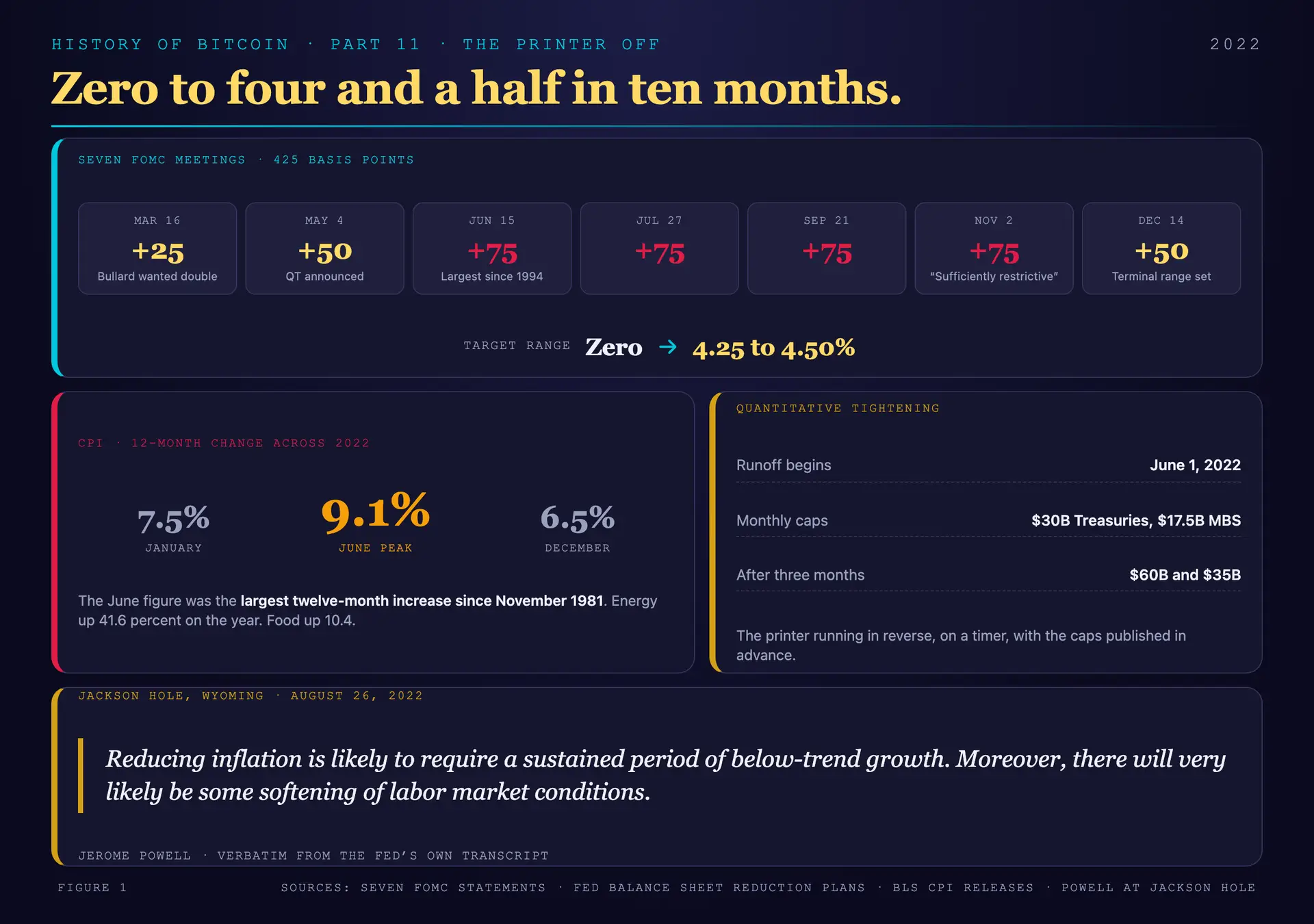
The plainest statement of intent came in late August, in the mountains. At the Kansas City Fed's annual symposium in Jackson Hole, Wyoming, on August 26, Powell said this, verbatim:¹⁶
Restoring price stability will take some time and requires using our tools forcefully to bring demand and supply into better balance. Reducing inflation is likely to require a sustained period of below-trend growth. Moreover, there will very likely be some softening of labor market conditions. While higher interest rates, slower growth, and softer labor market conditions will bring down inflation, they will also bring some pain to households and businesses. These are the unfortunate costs of reducing inflation. But a failure to restore price stability would mean far greater pain.
In the same speech he warned: "The longer the current bout of high inflation continues, the greater the chance that expectations of higher inflation will become entrenched." And he reached back four decades for his authority, quoting Paul Volcker in 1979: "Inflation feeds in part on itself, so part of the job of returning to a more stable and more productive economy must be to break the grip of inflationary expectations."¹⁶ He closed with a sentence that markets would spend months testing: "We will keep at it until we are confident the job is done."¹⁶
Some pain.
From a podium, that is a forecast. From a leveraged balance sheet, it is a sentence.
Here is the read I carried out of the last two installments of this history. The bubble of 2020 and 2021 was a monetary phenomenon. The stimulus, the zero rates, the asset purchases: that was the fuel, and everything downstream of it, the SPACs and the NFT mints and the 19.5 percent savings accounts, was combustion. Free money did not just inflate prices. It trained people. It taught an entire cohort of investors that the correct response to risk was more of it, that yield was something you were owed rather than something somebody had to generate, and that the borrowed dollar was the smart dollar. Two years of that training built a stack: leverage on top of leverage, each layer collateralized by the layer below it, each promising a payout the layer below had to keep making.
If the bubble was a monetary phenomenon, then the crash is one too. Leverage unwinds in the reverse order it was stacked. The newest, highest, most confident yield goes first, and the institutions that look most like banks go last, and the calendar of 2022 is going to follow that rule with a precision that still unsettles me.
Because none of this was a crypto story yet. The S&P 500 lost 19.4 percent in 2022, its worst calendar year since 2008.¹⁷ The Bloomberg U.S. Aggregate, the benchmark of boring American investment-grade bonds since 1976, had the worst year in its recorded history, down roughly 13 percent.¹⁸ The Nasdaq lost about a third.¹⁹ American tech companies cut more than 93,000 jobs.²⁰ Crypto did not fall alone in 2022. Nothing else, though, was stacked quite the way crypto was stacked.
The tide went out on everything at once.
Money stops being neutral
The year's first lesson about money did not come from the Federal Reserve, and it did not come from a blockchain. It came from a line of parked trucks in Ottawa.
In early 2022, a convoy of Canadian truckers rolled into the capital to protest vaccine mandates, parked, and refused to leave. Whatever you think of the protest, the money is the lesson here. Supporters had pushed millions of dollars into a GoFundMe campaign, and on February 4 and 5 the platform froze the fundraiser, saying it violated terms of service that prohibit the promotion of violence and harassment.²¹ Donors moved to other rails, including bitcoin, and the state moved with them. On February 14, the Canadian federal government invoked the Emergencies Act. It revoked it nine days later, on February 23.²²
In between, the money got turned off. When Parliament's finance committee later took testimony on what exactly had happened, the Canadian Bankers Association counted 180 frozen accounts, the RCMP counted 257, and Finance Canada put the frozen funds at roughly $7.8 million.²² Three official bodies, three different numbers. The RCMP also circulated a blacklist of roughly 34 cryptocurrency wallet addresses tied to convoy fundraising, for financial institutions and exchanges to act on.²²
Told plainly, that is the sequence: a crowdfunding platform froze the donations under its terms of service, then an emergency statute turned off bank accounts, then a police force handed the industry a list of addresses. All this aimed at the supposedly free citizens of a G7 country. For a decade, "they can just turn your money off" was a hypothetical in Bitcoin essays and a punchline everywhere else. In February 2022 it was an observable fact!
Ten days after the Emergencies Act was invoked, Russia invaded Ukraine.
Two days after that, on February 26, the United States, the European Commission, France, Germany, Italy, the United Kingdom and Canada jointly pledged to remove selected Russian banks from SWIFT, the messaging system that international bank payments run on, and to block Russia's central bank from deploying its international reserves.²³
How can they do that, though? Curious...
In the days that followed, roughly $300 billion of Russian central bank reserves were frozen where they sat, in Western custody, a figure Russia's own finance minister has acknowledged.²⁴ Reserve assets, the safest line on any balance sheet on earth, switched off by counterparties over a weekend.
The same weekend, the other side of the ledger opened. On February 26, Ukraine's Vice Prime Minister and Minister of Digital Transformation, Mykhailo Fedorov, posted wallet addresses to Twitter under the message: "Stand with the people of Ukraine. Now accepting cryptocurrency donations. Ethereum, Bitcoin and Tether (USDTtrc20)."²⁵ A sovereign government, at war, publishing raw wallet addresses on social media. Over the course of 2022, tracked crypto donations to Ukrainian government wallets ran somewhere between $54 million and $70 million, depending on which analytics firm was counting and which wallets counted as the government's.²⁶
Washington's first instinct was to see crypto as the hole in the sanctions wall. FinCEN issued an alert on March 7 listing thirteen red flags for Russian evasion attempts and telling financial institutions to watch the exits.²⁷ Senators warned. Headlines warned louder. Then the on-chain forensics came in. Chainalysis, the analytics firm that contracts with the very agencies doing the warning, ran the liquidity math and published its conclusion on April 13: "By nearly any measure, cryptocurrency markets don't have the liquidity to support Russian sanctions evasion en masse."²⁸ The supporting arithmetic was not close. Russian oligarchs were estimated to hold roughly $800 billion offshore; the free-floating supply of the three largest cryptocurrencies combined was about $296 billion; and all the world's mixers together were processing under $30 million a day.²⁸ The panic assumed a firehose, but the plumbing was a straw.
The mixers got the hammer anyway.
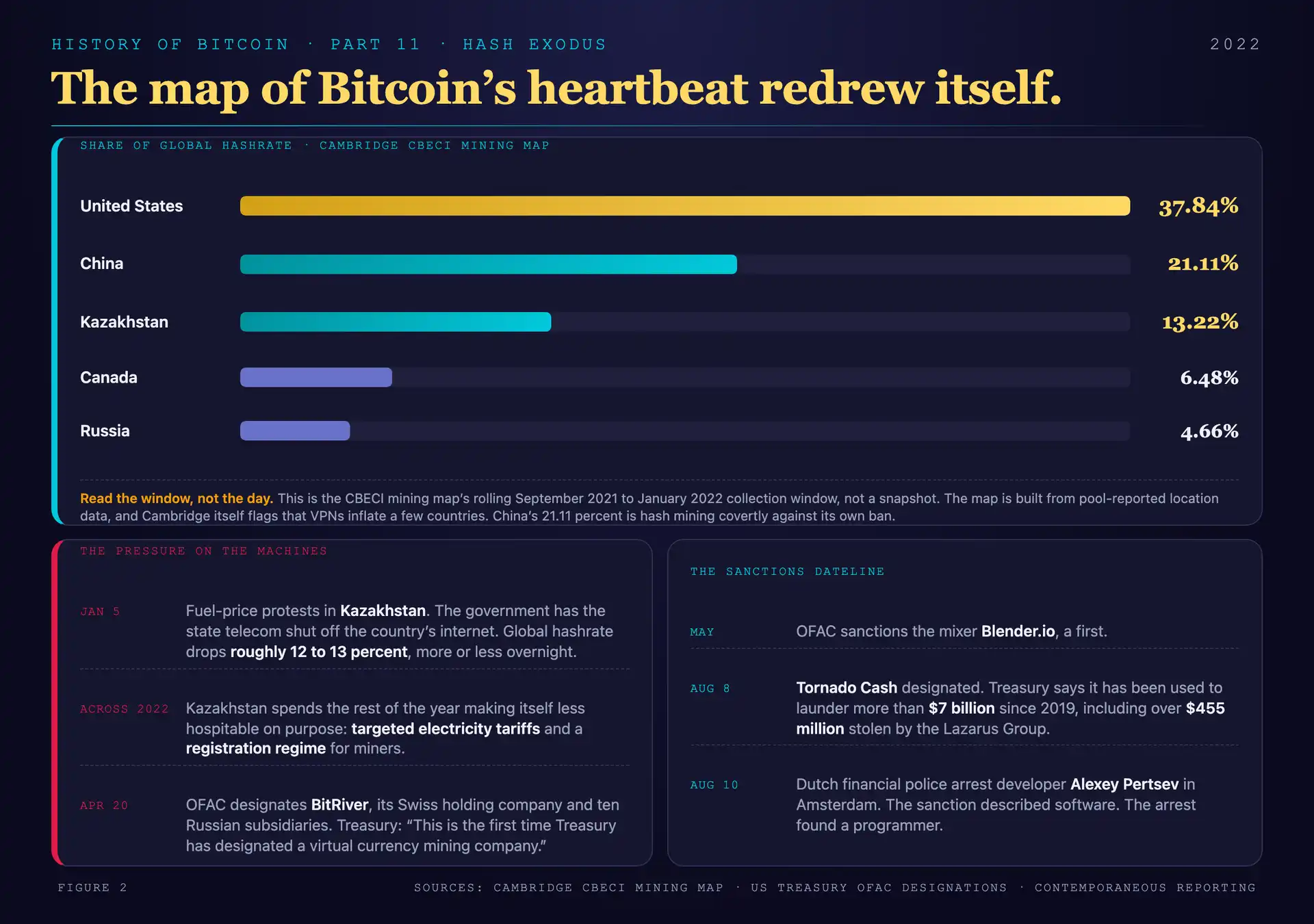
In May, OFAC sanctioned a mixer called Blender.io, a first. On August 8 it went further, designating Tornado Cash, which Treasury said "has been used to launder more than $7 billion worth of virtual currency since its creation in 2019," including "over $455 million stolen by the Lazarus Group," the sanctioned North Korean state hacking outfit.²⁹ Blender was a service run by people. Tornado Cash was closer to a vending machine: non-custodial, immutable contracts that no one could modify or shut down, designated functionally, as a thing, under the same executive order used against hackers and their front companies.²⁹ Coin Center and the Electronic Frontier Foundation, among others, argued that Treasury had just put autonomous software itself on a blacklist, something sanctions law had never been asked to digest, and a Coinbase-backed lawsuit followed.³⁰ Inflows to the mixer reportedly fell by about two-thirds after the designation. The contracts themselves kept running, because that is what immutable contracts do.³⁰ And when Chainalysis later scored the year's crypto designations, the pattern was jurisdictional, not technical: Hydra, the Russian darknet market, died in a coordinated law-enforcement takedown, while Garantex, a Russian exchange sanctioned in April, kept operating with volume up, because, in the analysts' words, Russia "has declined to enforce sanctions" at home.³⁰ The blacklist reached exactly as far as somebody with jurisdiction was willing to carry it.
Then, on August 10, two days after the designation, Dutch financial police arrested Alexey Pertsev, one of Tornado Cash's developers, in Amsterdam, on suspicion of facilitating money laundering through the tool he had helped write.³¹ The sanction described software. The arrest found a programmer.
Step back and look at the year to that point. Between February and August, a fundraiser, a few hundred bank accounts, a central bank's reserves and a set of smart contracts had all gone onto somebody's blacklist. Money's neutrality had stopped being hypothetical in every direction at once: the truckers and the oligarchs, the donors and the developers. Note what did not appear anywhere in that sequence: a court. Every one of those switches was thrown administratively, by a platform, a ministry, a police force, or a sanctions office, and every one of them worked, at least inside the jurisdiction that threw it. This series has been arguing since its first installment that money is a protocol question. In 2022, the protocols answered back.
While the lawyers were redefining what money could do, the machines were already moving.
When China banned mining in mid-2021, the single largest concentration of hash power on earth had to physically relocate, and the scramble to house it reshuffled the whole map. Kazakhstan was the first big winner, ranked by contemporaneous coverage as the world's second-largest mining jurisdiction. Then, on January 5, 2022, fuel-price protests there boiled over into nationwide unrest, and the government answered by having the state telecom shut off the country's internet. Bitcoin's global hashrate dropped roughly 12 to 13 percent, more or less overnight.³² A nation's worth of mining vanished from the network because one carrier flipped a switch. Kazakhstan spent the rest of the year making itself less hospitable on purpose, with targeted electricity tariffs and a registration regime for miners.³²
Russia was the other refuge. Its share of global hashrate had run as high as 11 percent in the August 2021 snapshot, and the United States Treasury itself would describe Russia's mining industry as "reportedly the third largest in the world."³³ That description comes from a sanctions designation. On April 20, 2022, OFAC designated BitRiver, a mining company founded in Russia in 2017, along with its Swiss holding company and ten Russian subsidiaries, and Treasury's own press release marked the milestone: "This is the first time Treasury has designated a virtual currency mining company."³⁴ The reasoning is worth quoting exactly, because it contains an entire theory of what mining is: "By operating vast server farms that sell virtual currency mining capacity internationally, these companies help Russia monetize its natural resources. Russia has a comparative advantage in crypto mining due to energy resources and a cold climate. However, mining companies rely on imported computer equipment and fiat payments, which makes them vulnerable to sanctions."³⁴
The United States Treasury, in an official designation, describing bitcoin mining as a way for a state to monetize energy.
China had banned the machines. Kazakhstan had starved them and then licensed them. Russia had gotten them sanctioned. The Cambridge mining map's last full collection window, September 2021 through January 2022, showed where they all went: the United States at 37.84 percent of global hashrate, China at 21.11 percent (mining covertly against its own ban), Kazakhstan at 13.22, Canada at 6.48, Russia at 4.66.³⁵ More than a third of the heartbeat of the network now originated in one country, and it was the one with deregulated power markets, public stock exchanges, and a financial industry that had just spent two years learning to securitize anything with a cash flow.
And the hash that landed in America did not plug back into the business it had left. It plugged into the American power grid, and the grid, it turned out, had its own ideas about what those machines were for.
The map of Bitcoin's heartbeat redrew itself in eighteen months.
Paid not to mine
The hash landed in America.
Is this the end of a migration story about the American dream in the land of opportunity? It is the beginning of an increasing problem that has yet to fully play out, because what America did with all that hash power is the real story of Bitcoin in 2022, and almost nobody was watching it happen. Everybody was still just watching the prices.
The calendar business
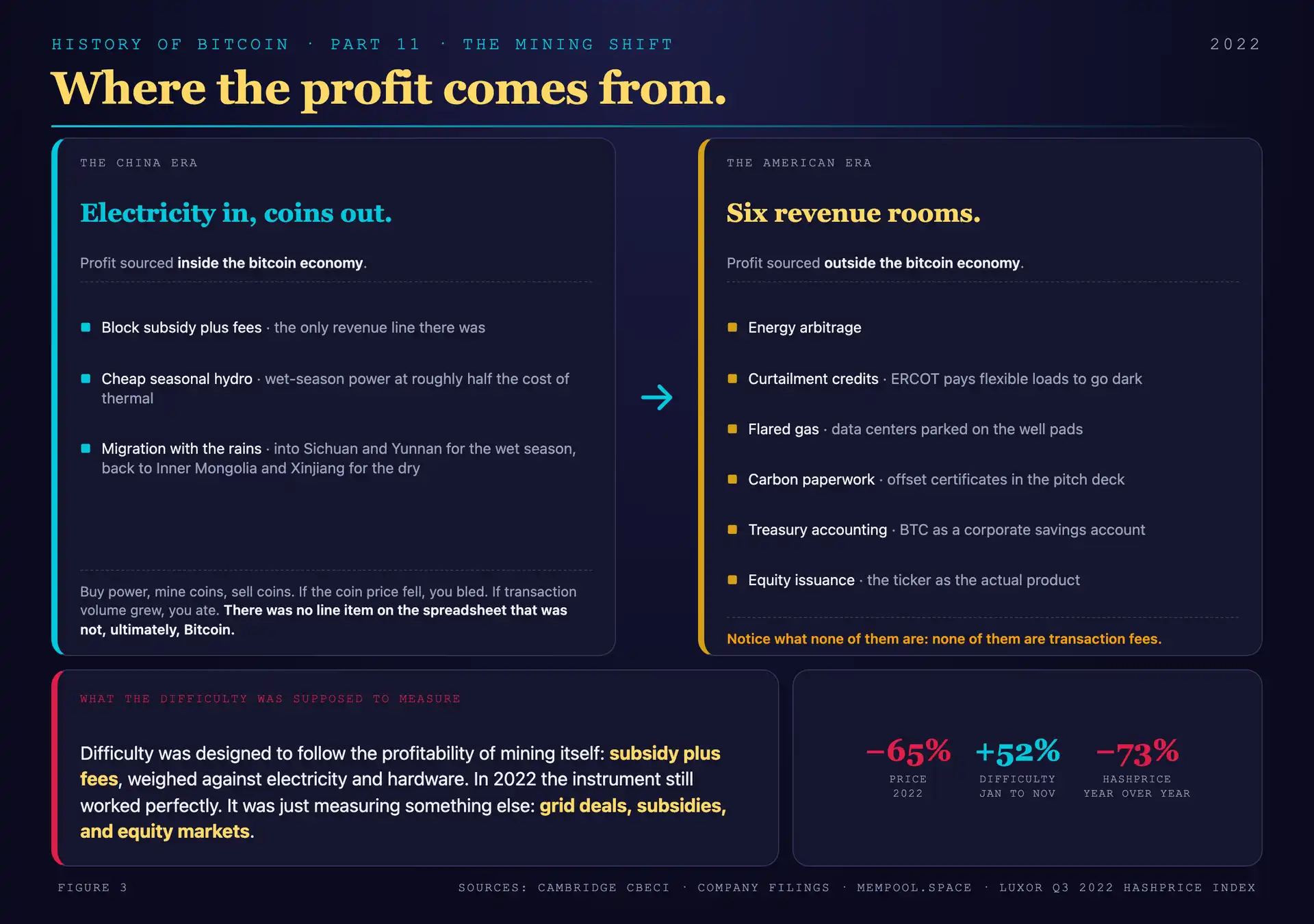
For most of Bitcoin's life, the center of gravity sat in China, and mining there ran on a rhythm you could set a calendar by. Every spring, when rain and snowmelt swelled the rivers of Sichuan and Yunnan, miners trucked their machines into the mountains to drink cheap hydropower for the wet season. Every autumn they hauled them back toward the thermal regions, Inner Mongolia and Xinjiang, and waited for the rivers to rise again.³⁶ Wet-season hydro ran at roughly half the cost of thermal power, so an entire industry migrated twice a year like a herd following grass.
It was crude, it was seasonal, and it involved an ungodly number of diesel trucks. But look at what the business actually was: electricity in, coins out. A Sichuan miner's profit lived entirely inside the bitcoin economy. Buy power, mine coins, sell coins. If the coin price fell, you bled. If transaction volume grew, you ate. There was no line item on the spreadsheet that was not, ultimately, Bitcoin.
Then Beijing banned the industry outright, and by July 2021 Cambridge's tracked share of Chinese hashrate read zero.³⁷ The machines went looking for outlets. When the Cambridge mining map took its next clean measurement, the United States held 37.84 percent of global hashrate, China's officially invisible remnant 21.11 percent, Kazakhstan 13.22 percent, per the CBECI mining map's rolling September 2021 to January 2022 collection window.³⁸ The methodology needs an asterisk though: the map is built from pool-reported location data, and Cambridge itself flags that VPNs inflate a few countries on the list. But the direction was not subtle. In about two years, the American share had gone from a rounding error to the largest on earth!
America did not adopt the Chinese business model.
America improved it, the way a hedge fund improves a farm or how private equity improved your favorite childhood chain restaurant...
What the grid pays for
The American miner of 2022 was less a guy with a warehouse and a power bill than a publicly traded energy company that happened to compute, and its income statement had grown rooms the Sichuan model never dreamed of.
Start with the strangest room: getting paid to stop.
Then the oil patch. Crusoe Energy built a business parking mobile data centers on well pads where natural gas would otherwise be flared, burned off as waste for lack of a pipeline, and using that stranded gas to mine bitcoin instead. In April 2022, mid-crash, Crusoe raised a $350 million Series C, with credit facilities pushing the total package toward half a billion dollars.⁴⁰ And in March, Bloomberg reported that ExxonMobil had been quietly running a pilot with Crusoe in North Dakota's Bakken shale since 2021, feeding up to 18 million cubic feet of flared gas per month into mining rigs, and was weighing an expansion to four countries. Exxon never confirmed it; the story traces to Bloomberg's unnamed sources, and every outlet that repeated it was repeating Bloomberg.⁴¹ The largest descendant of Standard Oil, reported to be mining bitcoin off waste gas, and declining to say so out loud.
Then the branding department. Marathon Digital had pledged that its operations would be "100% carbon neutral by year-end 2022," and in April announced it would move its Hardin, Montana operation off a coal-fired plant toward what it called more sustainable sources.⁴² Whether the pledge was actually met by New Year's Eve is a question Marathon's own year-end reporting declines to answer cleanly; the record shows the promise, and then it shows adjectives. A carbon credit, for the uninitiated, is a tradable certificate that says somebody, somewhere, offset a ton of emissions on your behalf. In 2022 it became part of a mining pitch deck.
Then the vault. Following the MicroStrategy mold, public miners held their mined bitcoin on the balance sheet as a treasury asset, a corporate savings account denominated in the thing they produced. Marathon hodled everything it mined and had not sold a coin since October 2020, sitting on roughly 10,055 BTC by July.⁴³ Hut 8 grew its stack 64.7 percent across the bear year to 9,086 BTC.⁴⁴ The pitch to shareholders was simple: we are a bitcoin fund with generators attached.
Which brings us to the actual product. The stock. In 2021, Riot sold about $600 million of new shares into the market at an average of $29.53 apiece under an at-the-market equity program. In 2022 it ran the same play and raised roughly $304.8 million gross, at an average of $8.23, per its own annual filing. Nearly twice the shares for half the money.⁴⁵ The machine that printed capital was the ticker, not the ASIC. I have written elsewhere about how Wall Street captures revolutions; this was the mining wing of that same annexation.
Energy arbitrage, curtailment credits, flared gas, carbon paperwork, treasury accounting, equity issuance. Six revenue rooms, and notice what none of them are: none of them are transaction fees. None of them live inside the bitcoin economy at all!
The Riot quarter
If you want the whole shift in one month, Riot handed it to us, in its own press release, with visible pride.
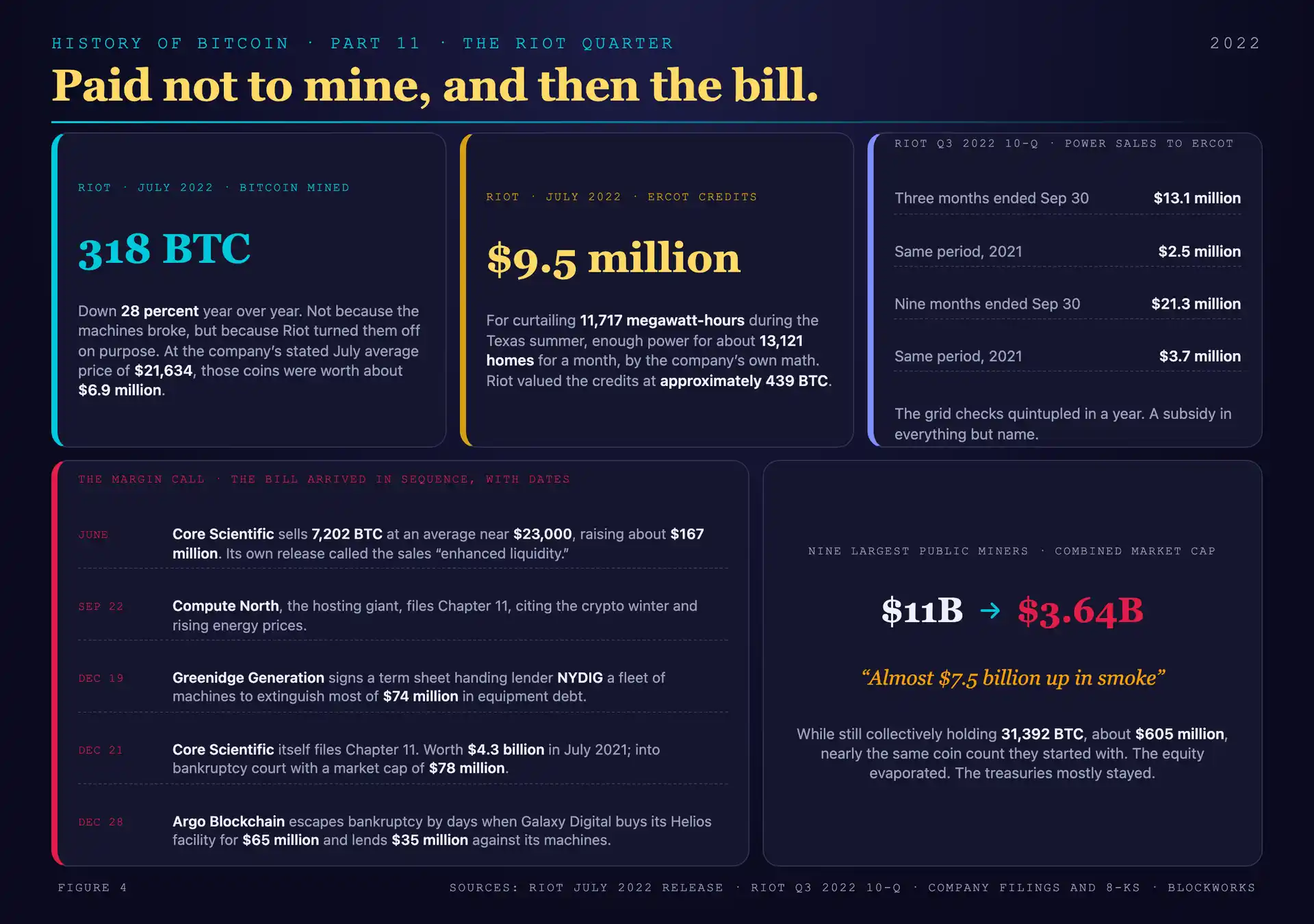
July 2022. Riot mined 318 BTC, down 28 percent from the same month a year earlier. Not because the machines broke. Because Riot turned them off on purpose, curtailing 11,717 megawatt-hours during the Texas summer, enough power for about 13,121 homes for a month, by the company's own math. In exchange, ERCOT credited Riot an estimated $9.5 million. CEO Jason Les, in the release: "By providing power back into the ERCOT grid during periods of peak demand, the Company estimates that power credits and other benefits from curtailment activities totaled an estimated $9.5 million, significantly outweighing the reduction in BTC mined."⁴⁶
Now run Riot's own numbers back at it. At the company's stated July average bitcoin price of $21,634, the 318 coins it actually mined were worth about $6.9 million. The credits for not mining came to $9.5 million, which Riot itself valued at "approximately 439 BTC."
In July 2022, the most profitable thing one of America's flagship bitcoin miners did was not mine bitcoin.
This was not a one-month curiosity. Riot's quarterly filing with the SEC reports that power sales to ERCOT "totaled $13.1 million and $21.3 million" for the three and nine months ended September 30, 2022, against $2.5 million and $3.7 million for the same periods a year before.⁴⁷ The grid checks quintupled in a year. The same filing shows those credits materially lowering Riot's effective cost of mining. A subsidy in everything but name, flowing from the power market into the hashrate.
And here is where the year stops making sense, unless you have been paying attention to those six rooms.
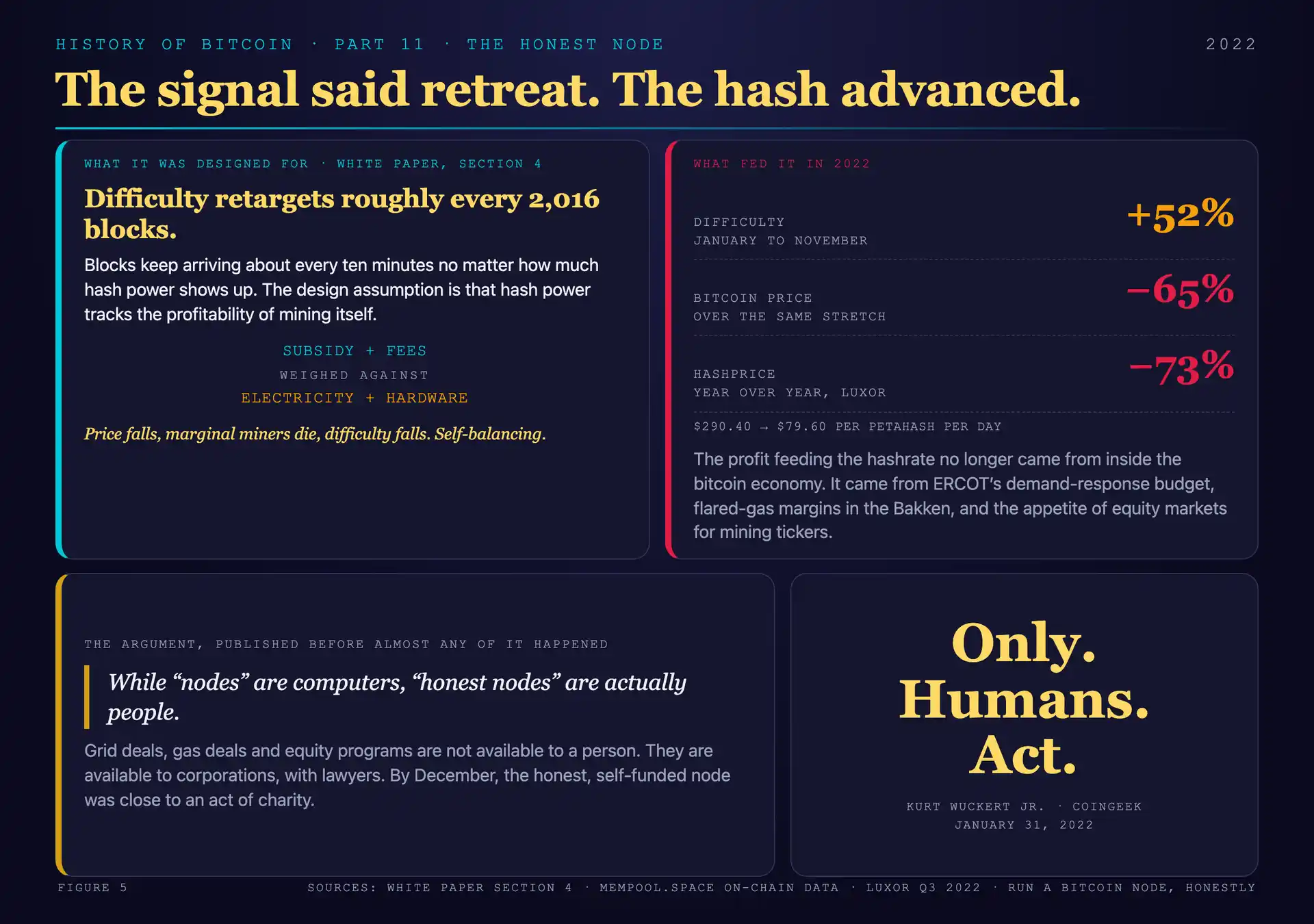
Bitcoin's difficulty retargets roughly every 2,016 blocks so that blocks keep arriving about every ten minutes no matter how much hash power shows up. The design assumption, right there in Section 4 of the white paper, is that hash power tracks the profitability of mining itself: subsidy plus fees, weighed against electricity and hardware.⁴⁸ Price falls, marginal miners die, difficulty falls. Self-balancing. That is the whole elegance of the infrastructure side of bitcoin.
In 2022, bitcoin's price fell about 65 percent. Difficulty rose about 52 percent!⁴⁹
On October 10, with bitcoin around $19,333, difficulty jumped 13.55 percent to an all-time high, the largest single move in over a year; hashrate stood near 257 exahash, up roughly 84 percent from the year before.⁵⁰ November 20 set another record. Luxor's hashprice index, the industry's measure of what a unit of hash power actually earns, collapsed from $290.40 per petahash per day at the end of Q3 2021 to $79.60 a year later. Down 73 percent, into what Luxor's own report called all-time-low territory.⁵¹
The signal said retreat. The hash advanced. Something other than mining economics was feeding the machines, and by now you know its names: the grid, the gas flare, the carbon certificate, the treasury story, the stock offering.
The margin call
You cannot subsidize your way out of math forever. The bill for 2022 arrived in sequence, with dates.
June: Core Scientific, the biggest of the American miners, sold 7,202 BTC at an average near $23,000, raising about $167 million to cover operating costs, equipment payments, and debt service, per its own disclosure as reported at the time. It ended the month holding 1,959 coins and about $132 million in cash.⁵² The hodl-forever treasury doctrine, meeting a margin clerk. The company's own release called the sales "enhanced liquidity."
August: 1,125 more coins gone at $23,014 average.⁵³
September 22: Compute North, the hosting giant whose data centers held machines for Marathon and others, filed Chapter 11, citing the crypto winter and rising energy prices.⁵⁴
December 19: Greenidge Generation, burning roughly $8 million a month by its own disclosure, signed a term sheet handing its lender NYDIG a fleet of machines to extinguish most of $74 million in equipment debt.⁵⁵
December 21: Core Scientific itself filed Chapter 11 in the Southern District of Texas. Its stock was down roughly 98 percent on the year; a company worth $4.3 billion in July 2021 went into bankruptcy court with a market cap of $78 million. Among the causes Core named: falling bitcoin prices, soaring energy costs, and the bankruptcy of Celsius Mining, its largest hosting customer, a name we are not finished with. The machines, CNBC noted, would keep mining straight through the proceedings.⁵⁶ Even bankruptcy could not switch off the hash.
December 28: Argo Blockchain, whose London shares had been suspended earlier that month, escaped bankruptcy by days when Galaxy Digital bought its Helios facility in Texas for $65 million and extended a $35 million loan against Argo's machines.⁵⁷
Add it up the way Blockworks did: the nine largest public bitcoin miners entered 2022 worth a combined $11 billion and ended it at $3.64 billion, "almost $7.5 billion up in smoke," while still collectively holding 31,392 BTC, about $605 million worth, nearly the same coin count they started with.⁵⁸ The equity evaporated. The treasuries mostly stayed. Shareholders ate the difference.
And underneath it all, the machines changed hands without ever cooling down. The industry had borrowed an estimated $2 to $4 billion against the ASICs themselves, at average rates above 10 percent; when the defaults came, well over $200 million worth from public miners alone in 2022, the lenders did not recover dollars. They recovered hardware. NYDIG, Galaxy, and Foundry ended the year owning fleets and facilities that had belonged to the borrowers in January.⁵⁹
The hash never left. It just acquired new landlords, and the landlords were finance.
What the difficulty was supposed to measure
Satoshi's difficulty adjustment is an instrument that measures one thing: how profitable it is to secure this network. It was built on the assumption that the profit being measured comes from the network, from the coin's purchasing power and, over time, from the fees on an ever-growing volume of transactions. On that assumption, difficulty is a vital sign. When mining pays, the network is being used and valued, and security rises to meet it.
In 2022, that instrument was still working perfectly. It was just measuring something else. It was measuring ERCOT's demand-response budget. It was measuring flared-gas margins in the Bakken and the appetite of equity markets for mining tickers. Difficulty hit all-time highs in the teeth of a 73 percent hashprice collapse because the profit feeding the hashrate no longer came from inside the bitcoin economy at all, and a system that consumes power-grid subsidies and stock offerings does not shrink when bitcoin does.
Now follow the consequence one more step. Grid deals, gas deals, carbon paperwork, and at-the-market equity programs are not available to a person. They are available to corporations, at scale, with lawyers. So the externally subsidized model does not just distort the difficulty signal; it decides who can afford to mine at all, and the answer consolidates upward, into a handful of balance sheets, while every small operator gets to compete against revenue streams they cannot touch.
I was writing all of this down while it happened, in real time, on the record.
In "Bitcoin mining economics" (June 23, 2022), while Core Scientific was liquidating its stack: "The guaranteed (read: subsidized) revenue per BTC block is about $130,000.00 per block, and the guaranteed revenue per BSV block is about $415.00, which many people think is a metric that tells the whole story. But they are wrong!" And the warning underneath it: "The Bitcoin subsidy is a ticking time bomb that demands to be replaced. On average, blocks are nowhere near replacing the subsidy, measured in satoshis."⁶⁰
In "Mine about it" (October 31, 2022), the operator's view: "Mining itself is profitable, but not necessarily on paper in an easy reconcilable fashion. It took me two cycles to fully realize this. Mining during bull markets should be nearly 100% about selling for fiat, and mining during bear markets should be about buying hardware assets and stacking coins." And the deadline nobody can name: "Transaction fees must outstrip subsidies in our lifetimes, but nobody knows exactly when."⁶¹
And in "BTC hash power centralization" (December 29, 2022), eight days after Core Scientific's filing, the year-end verdict: "Hash power distribution has been consolidating heavily over the Bitcoin bear market of the last year. With numerous major hash power players going bankrupt, and hash rate piercing through all-time highs while BTC coin price has been tanking, there has been an absolute slaughter of any hashing company that did not have a strong cash position and low debt." That column ends with a census: "This is the state of BTC. 1 guy in charge of the Editor's desk for BTC software 1 company in charge of the hardware, and 2 pools with the majority of hash power—1 of which is the largest customer of the other… Very, very centralized."⁶²
One of those two dominant pools, Foundry, belongs to Digital Currency Group. The same Foundry that spent 2022 collecting defaulted mining facilities. The consolidation was not just a side effect of the crash. The crash was the mechanism of the consolidation.
Where I stood while I wrote that
You should know what I had on the table while I was making this argument, because I was not writing it from the press box.
I co-founded a mining pool.
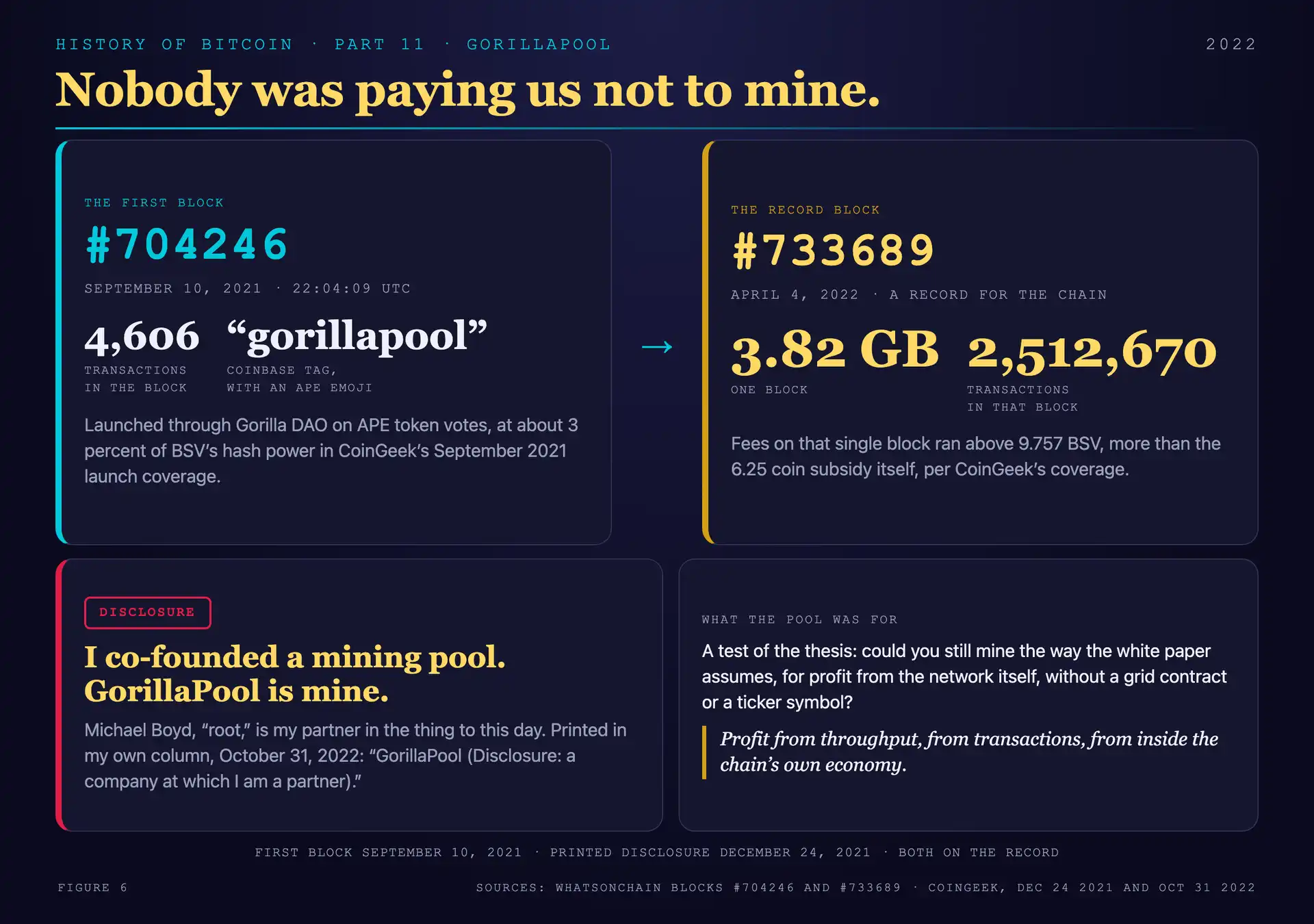
GorillaPool's first block is #704246, mined September 10, 2021, at 22:04:09 UTC, coinbase tagged "gorillapool" with an ape emoji, 4,606 transactions inside.⁶³
My disclosure in print came that December, in my year-in-review column of December 24, 2021: "Well, "root" and I were happy to get the GorillaPool proposal passed by the DAO and launched on the mainnet, and the pool has been mining blocks since #704246."⁶⁴ Root is Michael Boyd, my partner in the thing to this day. The proposal went through Gorilla DAO, an on-chain organization whose APE tokens voted it into existence, and CoinGeek's launch coverage that September put the young pool at about 3 percent of BSV's hash power.⁶³
Why do it at all? My own words from that same December column: "One thing that stood out to me in the era of 'attacks' and criticisms that 'BSV is just TAAL,' I thought it would be pretty cool to learn about what it really takes to run an honest node on BSV." The founding of the pool was not a business plan so much as a test of the thesis: could you still mine the way the white paper assumes, for profit from the network itself, without a grid contract or a ticker symbol? The tuition was real machines and real electricity; by October 2022 I was telling readers the price of admission out loud, about $3,000 for 100 to 110 terahashes pointed at BSV, and disclosing in the same column: "GorillaPool (Disclosure: a company at which I am a partner) provides 3-5% of network hash rate while being the exclusive "BSV only" pool and the only public pool accepting independent hash."⁶¹ By June I had put it more bluntly: "new hashers will join the only remaining public pool: GorillaPool."⁶⁰
And what was the pool for? On April 4, 2022, GorillaPool mined block #733689 on BSV: 3.82 gigabytes, 2,512,670 transactions, a record block for the chain.⁶⁵ CoinGeek's coverage put the transaction fees on that single block above 9.757 BSV, more than the 6.25 coin subsidy itself.⁶⁵ One block where fees beat the subsidy is not a business model, and I will not pretend 2022 BSV economics made anyone rich. But that block is the other answer to the difficulty question: profit from throughput, from transactions, from inside the chain's own economy.
Nobody was paying us not to mine, and it was bananas.
Which is why the moral center of the year's mining story was published before almost any of it happened. On January 31, 2022, months before Riot's July release or Core Scientific's June fire sale, I wrote a column called "Run a Bitcoin node, honestly." Its observation was small and its implication was not: "Curiously, Satoshi Nakamoto uses the word "honest" 16 times in the Bitcoin white paper to describe security and attack vectors." And its center: "In realizing that Byzantine Generals are people, I realized too that while "nodes" are computers, "honest nodes" are actually people. A node will do whatever it is programmed to do. It cannot choose to be honest or dishonest any more than a car can cause an accident, or a gun can shoot a person."
"Only. Humans. Act."
The column closes: "But an honest node and an attacker node are both steered by human action, and the Bitcoin white paper assumes this human action in the protocol! So we should embrace it, and perhaps run a Bitcoin node, honestly."⁶⁶ Read against the year that followed, that January piece turned out to be the question 2022 kept answering. The white paper's security model assumes honest nodes, and honest nodes are people, and by December the economics of the largest chain had made the honest, self-funded node something very close to an act of charity: a thing you do because you believe in the network, while the entities setting the difficulty get paid by the grid, the flare stack, and the stock exchange.
There was one more thread I pulled that year, in a July 20, 2022 column called "Maintaining power: A Core story," about a quieter kind of concentration: "Critics of the BIP process have claimed for years that the roles of "Editor" and "Maintainer" are dangerous points of centralization. What is to stop these people from being bought, bribed or threatened?"⁶⁷
The occasion was a live fight, conducted in public on GitHub, over a pull request to hand commit access to a new Bitcoin Core maintainer, a developer named Gloria Zhao, known there as glozow. If it merged, one contributor objected on the request itself, "there will be 7 maintainers and 3 funded by Brink." James O'Beirne worried about "a pretty large plurality of young maintainers" so tightly linked "in terms of funding, personal life, etc." that contributors saw "a 'virtuous circle' of mutual ACKs" forming. And Luke Dashjr, the BIP editor himself, objected that her role "might muddy the waters, and cause others to be more likely to defer to her proposals on the basis of perceived hierarchy."⁶⁷ Hierarchy was the tell. None of this was about Zhao, who was by every account a capable engineer. It was about the shape of the thing: seven people with commit access, three on a single sponsor's payroll, deferring to each other in a circle, deciding what the reference software of a supposedly neutral commodity does by default.
The editor's desk shows up again in my December 29 column, and the question of who controls node policy does not stay quiet for long.
The miners stopped asking what the network needed and started asking what the grid would pay.
That is where American mining stood as 2022 closed: difficulty at all-time highs, hashprice at all-time lows, the machines humming through their owners' bankruptcies under new landlords. But the December filings were only the far end of a chain that started snapping months earlier, in the spring, in a place that had nothing to do with megawatts. To watch the chain snap in order, we have to go back to May, to the number that was supposed to say 1.00.
Everything else in 2022 follows from what happened to that number.
Steady lads
Spring arrived on a Saturday evening.
May 7, 2022. The number that was supposed to say 1.00 and said 0.98 instead belonged to TerraUSD. UST, to its friends. And the reason it said 0.98 is that people had started asking the machine for their money back, all at once.
Here is the machine. UST was an algorithmic stablecoin, which means there were no dollars behind it. There was a promise instead: one UST could always be traded for a dollar's worth of freshly minted LUNA, the system's other token, and arbitrage would hold the two in balance forever. It worked as long as LUNA was worth something. The whole edifice stood on that one condition.
The demand side of the machine was a savings protocol called Anchor, and Anchor is the number the last installment ended on: about 19.5 percent, paid on UST deposits, backed by nothing but the market's confidence in an algorithm. Anchor held $8.5 billion at the end of 2021. By early May 2022 its total value locked had peaked around $16.7 billion, which meant a huge share of all the UST in existence was sitting in one product, collecting one impossible number. On May 1, the protocol cut the rate to 18 percent to slow the drain on its yield reserve.⁶⁸
Six days later, the run began.
On the evening of May 7, with Terraform Labs midway through shuffling UST liquidity between trading pools, a series of large UST sales hit a thin market, and the peg slipped to roughly $0.985. Anchor withdrawals started within hours, hundreds of millions of UST in the first day. What was a two-cent wobble on Sunday became a slide through the sixty-cent range by Monday, May 9, and into the thirties by Tuesday.⁶⁹
On May 9, with the peg broken and breaking further, Do Kwon addressed the market in five words and a hyphen.⁷⁰
"Deploying more capital - steady lads"
The mechanism then did exactly what it was designed to do, which is the horror of it. To absorb the fleeing UST, the system minted LUNA. The more UST fled, the more LUNA it minted; the more it minted, the less each token was worth; the less each was worth, the more it had to mint. Within days, LUNA's supply inflated from hundreds of millions of tokens into the trillions. By Thursday, May 12, LUNA was effectively worthless and exchanges were halting trading in it.⁷¹
Terra had a war chest for exactly this scenario. The Luna Foundation Guard had spent months accumulating bitcoin as a reserve of last resort, and on May 7 it disclosed holdings of 80,394 BTC. More than 50,000 BTC went out the door on May 8 to defend the peg. Another 30,000 were sold on May 12. On May 16, LFG published its ending balance: 313 BTC, a figure confirmed on-chain.⁷² A reserve that took months to assemble lasted nine days in the field.
Count it all up and roughly $60 billion was erased, per the estimates repeated across contemporaneous coverage. No audited total exists, because nobody was ever in a position to audit Terra in the first place.⁷³ On May 10, with UST trading in the thirties, Treasury Secretary Janet Yellen sat before the Senate Banking Committee and delivered the epitaph in regulator-speak: "A stablecoin known as TerraUSD experienced a run and declined in value. I think that this simply illustrates that this is a rapidly growing product and there are rapidly growing risks."⁷⁴
Kwon's own year ended the way you would expect. By mid-September a South Korean court had issued an arrest warrant for him and five associates, Interpol's help was requested, and Kwon insisted from wherever he was that he was not hiding.⁷³ The rest of his story belongs to later chapters.
That was the first domino.
Celsius Network was the lender the last installment left you holding: a company that went from roughly a billion dollars in assets to a claimed twenty-five billion in about sixteen months, paying depositors yields that had to come from somewhere.⁷⁵ On Sunday evening, June 12, the somewhere ran out. Celsius froze withdrawals for its 1.7 million users, and its statement carried a line that some of us still feel heavy when we hear: "We are taking this action today to put Celsius in a better position to honor, over time, its withdrawal obligations."⁷⁶
"Over time" is the tell. Money that is actually there does not need time.
One month later, on July 13, Celsius filed Chapter 11 in the Southern District of New York with a roughly $1.2 billion hole in its balance sheet.⁷⁷ On September 27, Alex Mashinsky resigned as CEO, writing: "I regret that my continued role as CEO has become an increasing distraction, and I am very sorry about the difficult financial circumstances members of our community are facing."⁷⁸ His criminal reckoning came years later.
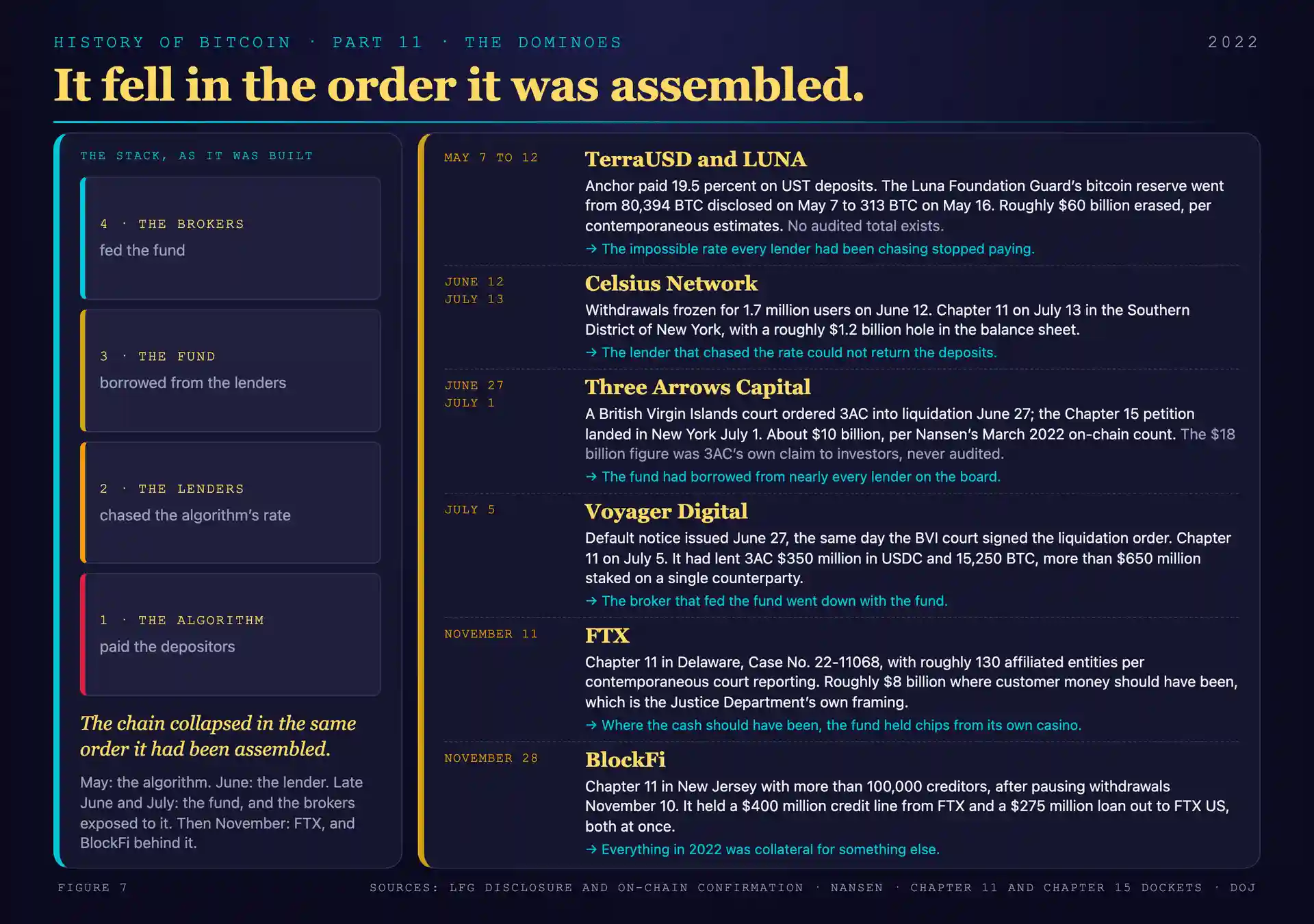
Three Arrows Capital was the domino almost nobody outside the industry had heard of and almost everybody inside it had lent money to. Su Zhu and Kyle Davies had built the fund's reputation on one great trade: hand bitcoin to Grayscale, receive GBTC shares at net asset value, wait out the six-month lockup, sell the shares at the premium the market paid for regulated bitcoin exposure. Free money, while the premium lasted. Much of the bitcoin going in was reportedly borrowed from Genesis, the lending desk in the same corporate family as Grayscale itself, which left one company exposed on both ends of the same trade. The premium died, flipped to a discount, and by mid-June 2022 GBTC traded more than 30 percent below the bitcoin inside it, which turned the trade that built the firm into a crater with leverage in it. Add a large position in stETH, a staked-ether token that slipped its own peg in June and had to be sold at a haircut in the scramble for liquidity. Add Terra exposure. Add borrowed money under all of it, from nearly every lender on the board.⁷⁹
How big was 3AC? Nansen, an analytics firm that actually counted the on-chain assets, estimated about $10 billion in March 2022. The $18 billion you may have seen elsewhere was 3AC's own last claimed figure to its investors, relayed by Bloomberg that July and never audited.⁸⁰ In 2022, a fund's size was whatever the fund said it was, right up until the liquidators arrived.
The liquidators arrived in June. A British Virgin Islands court ordered 3AC into liquidation on June 27, the court-supervised process of seizing whatever remains and selling it for the creditors, and the Chapter 15 petition landed in New York on July 1.⁸¹ The founders went quiet: by early July the Singapore office was reported abandoned, court papers said their whereabouts were unknown, and their lawyers explained the silence as a response to threats. Su Zhu and Davies surfaced on July 22, speaking to Bloomberg from an undisclosed location, where Zhu offered this: "if we were more on our game, we would've seen that the credit market itself can be a cycle and that, you know, we may not be able to access additional credit at the time that we need it."⁸²
That is the man who ran a fund counted at ten billion dollars, explaining that he had not considered credit might tighten.
Voyager Digital had lent 3AC $350 million in USDC and 15,250 BTC, a combined loan of more than $650 million staked on a single counterparty. Voyager issued its default notice on June 27, the same day the BVI court signed the liquidation order, and filed its own Chapter 11 on July 5.⁸³ A retail brokerage holding more than a billion dollars of customer crypto went down because a hedge fund could not pay it back, because a stablecoin broke, because a savings rate was impossible.
That is what the word contagion means.
Now stand back, and let's take a good, long look at the order of the bodies. The free money of 2020 and 2021 had been stacked in layers: an algorithm paid the depositors, the lenders chased the algorithm's rate, the fund borrowed from the lenders, the brokers fed the fund. The chain collapsed in the same order it had been assembled. May: the algorithm. June: the lender. Late June and July: the fund, and the brokers exposed to it.
Every "yield" was someone else's leverage.
And underneath the dominoes, all year long, the ordinary carnage never stopped. In March, attackers drained the Ronin bridge, the rails beneath the game Axie Infinity, for roughly $625 million. The theft sat undiscovered for six days until a user could not withdraw, and in April the FBI attributed it to North Korea's Lazarus Group.⁸⁴ Wormhole had already been hit for about $325 million in February; the trading firm behind it wrote a check and refilled the bridge. In August the Nomad bridge lost roughly $190 million to, functionally, everyone: a botched upgrade made every withdrawal message look valid, the exploit was copy-pasteable, and hundreds of unrelated wallets joined the draining.⁸⁵ Chainalysis's ledger for the year: $3.8 billion stolen, a record, with about $2 billion of it pulled from bridges.⁸⁶
The NFT bubble deflated on the same schedule as everything else. Trading volume across the major marketplaces fell 97 percent, from roughly $17 billion in January to $466 million by September, per Dune Analytics data.⁸⁷ Yuga Labs, the company behind the Bored Apes, compressed an entire market cycle into a single calendar year: a BuzzFeed story in February that put real names on its pseudonymous founders, the ApeCoin token launched March 17, a $450 million raise at a $4 billion valuation announced March 22, and the Otherside land sale at the end of April that grossed about $310 million in primary proceeds while burning historic gas fees, the network's per-transaction tolls, on the chain underneath it.⁸⁸ By autumn the apes were still there. The bids were not.
Then, in the middle of all of it, Ethereum did the thing it had been promising since 2015.
On September 15, 2022, at 06:42 UTC, block 15,537,394 arrived, and it was not mined. It was proposed and attested by validators who had staked ether rather than burned electricity; the block before it was the last proof-of-work block Ethereum will ever have.⁸⁹ The Merge, years late and endlessly rehearsed, executed cleanly on the first attempt, live, on a chain carrying hundreds of billions of dollars in value. Whatever you think of Ethereum, that is one of the most impressive engineering operations in this industry's history.
What changed: consensus moved from proof of work to proof of stake, the Ethereum Foundation's own estimate put the energy reduction at roughly 99.95 percent, and new issuance fell by roughly 90 percent, from about 13,000 ETH per day to about 1,600, which, combined with the fee burn already in place, ran the supply net negative in stretches that autumn.⁹⁰ What did not change, in the Foundation's own pre-Merge words, published to cool its own celebrating fans: "Gas fees are a product of network demand relative to the network's capacity. The Merge deprecates the use of proof-of-work, transitioning to proof-of-stake for consensus, but does not significantly change any parameters that directly influence network capacity or throughput."⁹¹ Same fees, same throughput, same congestion.
Basically, the engine was swapped, but the road was not widened.
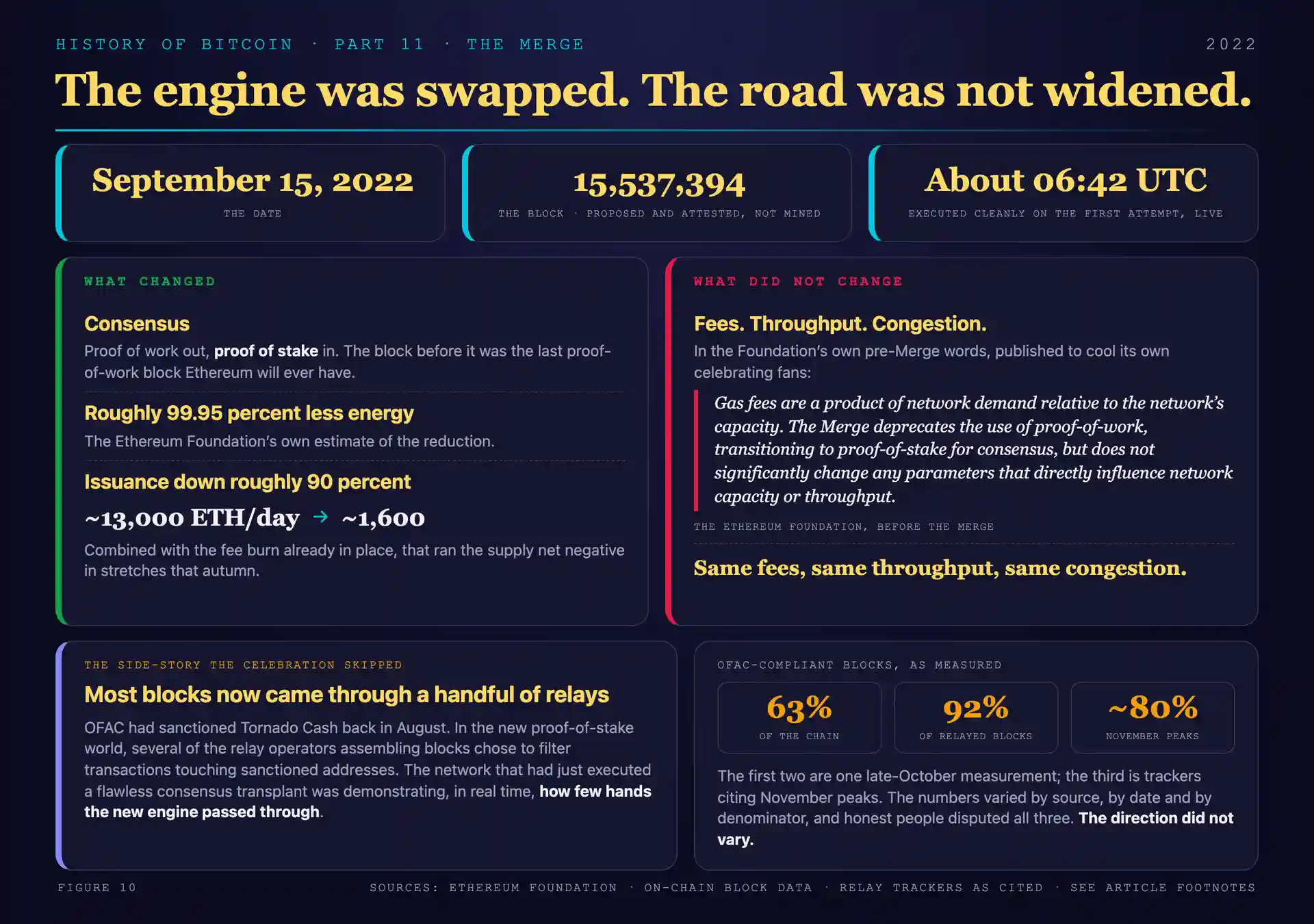
And then the side-story that the celebration skipped: OFAC had sanctioned Tornado Cash back in August, and in the new proof-of-stake world most blocks were assembled by a handful of relay operators, several of whom chose to filter transactions touching sanctioned addresses. By late October, one measurement put OFAC-compliant blocks at 63 percent of the chain, and 92 percent of the blocks that came through relays; by November, trackers cited peaks near 80 percent. The numbers varied by source, by date, and by which denominator you measured, and honest people disputed all three.⁹² The direction did not vary. The network that had just executed a flawless consensus transplant was demonstrating, in real time, how few hands the new engine passed through.
One more thing about that date. Block 15,537,394 arrived at 06:42 UTC, which was 8:42 in the morning where I was standing.
I was in Oslo, Norway.
The cat gets his day in court
Ten months after Miami, I packed the notebook again.
The last courtroom was a federal building in downtown Miami, a line on the sidewalk before six in the morning, and a jury deciding what Craig Wright owed the estate of his dead best friend. This one was Oslo District Court. Different continent, different legal system, different question, same man at the center of it. My second Satoshi courtroom in under a year, and this time the fight had come to the cat's home turf.
If you have been with this series a while, you know the cat. Part 8 told the story in full: the Norwegian Bitcoiner with a children's-cartoon-styled astronaut-cat avatar who spent March 2019 tweeting that Wright was a "fraud," a "scammer," and "mentally ill," and helped push #CraigWrightIsAFraud around the world. The Ontier letter demanding a retraction. The bounty, five thousand dollars paid in BSV, for the man behind the cat's real-world identity, and the community that answered it by becoming the cat, swapping thousands of avatars to the grinning astronaut. And the strange dual-track litigation that followed: on May 19, 2019, Magnus Granath filed first, in Oslo, asking a Norwegian court to declare that he had not defamed Wright, while Wright sued him for defamation in England the following month.⁹³ Two cases, two countries, pointed in opposite directions. Back in Part 8 I called the Norwegian outcome a flash-forward and told you to put it away.
Take it back out.
Getting to Oslo capped a travel year that had already worn out my passport. In late May I had flown to Dubai for the Global Blockchain Convention, where the death of the UAE's president had put the country into forty days of mourning and swept the pre-event calendar clean; I spent the quiet days catching up with colleagues and building a GorillaPool booth that the desert heat had partially delaminated in transit, and we handed out something like 150 pounds of bananas. Peter McCormack, simultaneously in a London courtroom opposite Wright, found time to quote-tweet my attendance photo with a review of his own: "There were more people queuing for a piss at #bitcoin 2022 than attending this."⁹⁴
Two days later I posted the crowd shot and a correction: "I'm so proud to have participated in the BSV Global Blockchain Convention in Dubai. With 100,000,000 participants, it was definitely the largest bitcoin convention ever. Debunk this, @PeterMcCormack!"⁹⁴
We will come back to him. And the week Terra died, I had published a column asking people in this industry to be good to each other, built around the last days of Dave Kleiman as I heard them recounted in Miami.⁹⁴ A historian crossing a burning industry with a notebook: that was the year. Oslo was the last long haul of it.
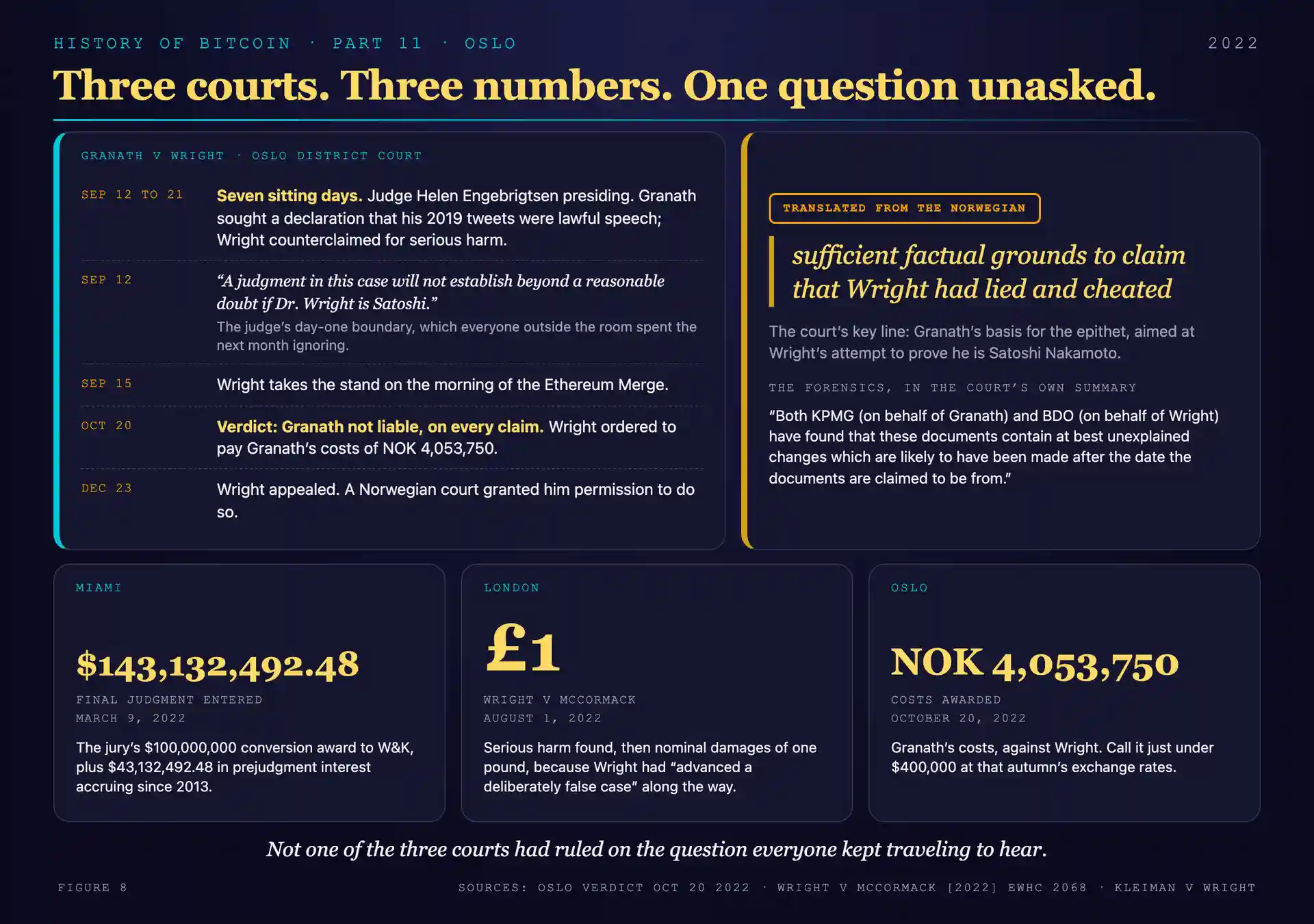
The trial ran September 12 to 21, seven sitting days, Judge Helen Engebrigtsen presiding.
The Oslo courtroom was simple. It felt more like a junior college classroom that had been furnished entirely by IKEA.
We were allowed digital devices, including photography equipment, but the whole case would be in Norwegian, so I wore a headset and listened to translations spoken by a few delightful folks who were stowed in an observation booth.
On day one, the Judge drew the boundary that everyone outside the courtroom would spend the next month ignoring: "A judgment in this case will not establish beyond a reasonable doubt if Dr. Wright is Satoshi." The question on the table was narrower and stranger, whether one man could lawfully call another a fraud on Twitter. Granath sought a declaration that his 2019 tweets were lawful speech. Wright counterclaimed that the hashtag campaign had done him serious harm. Both men testified, and by the accounts of the day it was the first time the two had ever been in the same room.⁹⁵
The day before Wright testified, his lawyers told the court that cryptographic proof alone would not be conclusive anyway; the case they intended to make rested on his academic and professional history and on what credible witnesses had believed, not on a signature.⁹⁶
Wright took the stand on September 15, the morning of the Ethereum Merge, and gave the testimony the trial is remembered for. He told the court he had "stomped on the hard drive" containing key slices needed to access Satoshi's private keys, in the wake of what CoinDesk's report described as a suicide attempt in May 2016. Asked whether the destruction was deliberate, he said it was: "I didn't want to encourage the arguments that you need keys." He called destroying the drive "the most important thing I've done in my life," because providing cryptographic proof would hand his critics "the easy way out." He argued that "identity is not related to keys," and, pressing the technical frame he wanted the court to adopt: "The whole point I'm trying to make, and that I'm going to make, is that Bitcoin is not encrypted."⁹⁶
If you have read this series from the beginning, you can hold two true things about that testimony at once. It is consistent with the position Wright had held publicly since 2016, that signing with a key proves possession of a key and nothing more. It is also precisely the shape a story takes when there are no keys to sign with.
I noted, at the time, that Granath could not hide his contempt for Wright. Nearly every word spoken brought Granath to sneer, chuckle and wince. The cat had a genuine, visceral dislike of Wright's very existence, and I presumed that his behavior would influence the Judge as to the kind of man that he was.
The court was going to have to weigh it all.
Granath's turn on the stand was shorter and flatter. He owned every tweet, and his evidentiary basis, offered repeatedly, was the crowd's settled judgment: "There was a consensus, and there still is a consensus, that Craig Wright is a fraud."⁹⁷ One side heard an admission that the insult was crowdsourced. The other heard a plain description of how reputation actually works. The judge heard both.
The next day, expert witnesses for Granath walked the court through how the famous 2016 private signing sessions could have been staged: a controlled network, a modified wallet, a prepared machine. Gavin Andresen's own retrospective words about those sessions, "bamboozled" and "funky proof," entered the record secondhand.⁹⁸ Andresen was not in Oslo. His 2016 certainty and his later doubt have both appeared in this series before, and in that courtroom both were evidence, passed forward from the sworn testimony during the Kleiman trial. Wright's defense leaned into the human version of the question rather than away from it, arguing that "proof is people": that convincing Andresen face to face in 2016 was itself the demonstration.⁹⁸
It was noted that Andresen had been convinced in part by private conversations between the two men, conversations touching details that only Satoshi Nakamoto could have been aware of.
Then the forensics. KPMG, retained by Granath's side, and BDO, retained by Wright's, had each examined the documents Wright offered in support of his history, and the court's eventual summary of what they found runs one sentence: "Both KPMG (on behalf of Granath) and BDO (on behalf of Wright) have found that these documents contain at best unexplained changes which are likely to have been made after the date the documents are claimed to be from."⁹⁹ A long stretch of that testimony was delivered in Norwegian, untranslated, while I sat in the gallery following almost none of it. By then my routine had settled into the Miami pattern, the courtroom as daytime office and the hotel room as evening studio for the livestream roundups, and the same week my internet connection died mid-broadcast and the night's coverage finished in tweets.
My verdict on the forensics segment, on the record: "I think this was the single worst segment of the entire time I've been in court here in Oslo."¹⁰⁰
Some of what I carry from that gallery is mine alone. I remember the cat avatars, Hodlonaut's grinning astronaut turning up around the room on the side of his supporters, the 2019 solidarity meme sitting in a Norwegian courtroom three years later. No outlet wrote that detail down, so it lives here as my recollection and nothing more. The reporting that week did record my reactions: CoinGeek's account describes me finding one stretch of the trial genuinely humanizing, the testimony of Dr. Ami Klin, an autism specialist who pushed back under cross-examination on the casual conflation of autism with narcissism. That is the outlet's account of what I felt, and I will let it stand.¹⁰⁰
The other was a mix of Wright's witnesses. They were personable, credible and told the stories of Wright from the early 2000s until around the time he would have been working on bitcoin, if he was indeed Nakamoto. Their stories were of, not only a competent technologist, but that of an extremely talented and visionary creator of network systems, security systems, game theory and other relevant commercial successes at major institutions in Australia.
These things weren't "proof," but they showed the prerequisite skillset of a polymath who could have quietly built bitcoin to solve various computer science problems that he clearly cared about.
The verdict came on October 20, a month after closing arguments. Granath: not liable, on every claim. The court's key line, translated from the Norwegian, is the one that traveled: Granath had "sufficient factual grounds to claim that Wright had lied and cheated" in his attempt to prove he is Satoshi Nakamoto. Wright was ordered to pay Granath's costs of NOK 4,053,750, call it just under $400,000 at that autumn's exchange rates. Granath's public reaction, posted the same day, ran four words, a callback the reporting tied to a legal threat from 2019: "I won. Welcome to law," which is a call-back to a common phrase associated with Wright.
Wright's Norwegian attorney, Halvor Manshaus, answered for his side: "Regrettably, the court found after a broad assessment taking into account that Dr. Wright is a public figure in the Bitcoin community, that Granath's communications were not defamatory in a legal sense," and confirmed the intent to appeal.¹⁰¹
Now let's balance the two courtrooms side by side: In Miami, the jury rejected the claim that a Wright-Kleiman partnership owned Satoshi's coins, awarded $100 million against Wright for conversion of W&K's intellectual property, and was never once asked to decide whether the man was Satoshi.¹⁰² In Oslo, a judge ruled that the evidence for that same man's central claim was weak enough that calling him a fraud had sufficient factual grounds. Miami left his origin story standing and made him pay for converting a company's intellectual property. Oslo blessed the epithet and made him pay again. I sat in both rooms, I took notes in both rooms, and I am not going to pretend the record says one clean thing, because it does not.
Oslo was not even the year's only Wright ruling. On August 1, the English High Court decided Wright v McCormack: it found that McCormack's tweets had caused serious harm to Wright's reputation, and then awarded Wright exactly one British pound, because Wright had "advanced a deliberately false case" about conference dis-invitations along the way.¹⁰³ Part 8 told you to remember a few things. Now you have them: the man needling me from a London courtroom during the Dubai conference had, by summer's end, technically lost and functionally won. A pound.
And the year's third Wright number had come earliest and cost the most. Back in March, in Miami, Judge Beth Bloom entered final judgment on the verdict Part 10 walked you through: the jury's $100 million conversion award to W&K, plus $43,132,492.48 in prejudgment interest that had been quietly accruing since 2013. The final judgment, entered March 9: $143,132,492.48.¹⁰⁴ A pound in London. Four million kroner in Oslo. A hundred and forty-three million dollars in Miami. That was the ledger of being Craig Wright in 2022, and not one of the three courts had ruled on the question everyone kept traveling to hear.
Wright appealed the Oslo judgment; a Norwegian court granted permission for the appeal that December, and years later he dropped it, which is a story for a later chapter.¹⁰⁵
October died down, the notebook went back in the drawer, and out in the Bahamas the biggest domino of the year was still standing.
A few sentences from a rival
October went quiet the way a tide goes quiet. The lenders were dead, the funds were in liquidation, the courtrooms had emptied, and the survivors were telling each other the worst was over. The loudest voice saying so belonged to the exchange that had spent June playing lender of last resort.
November opens with a spreadsheet.
On the afternoon of November 2, 2022, CoinDesk published a story by a reporter named Ian Allison. It was built on a private financial document: a balance sheet for Alameda Research, the trading firm owned by FTX founder Sam Bankman-Fried. The full anatomy of that machine already has its own installment in this series, and if you skipped it, one sentence will carry you through what follows: FTX printed its own loyalty token, called FTT, and the solvency of its founder's trading firm depended on nobody ever trying to sell that token at size.
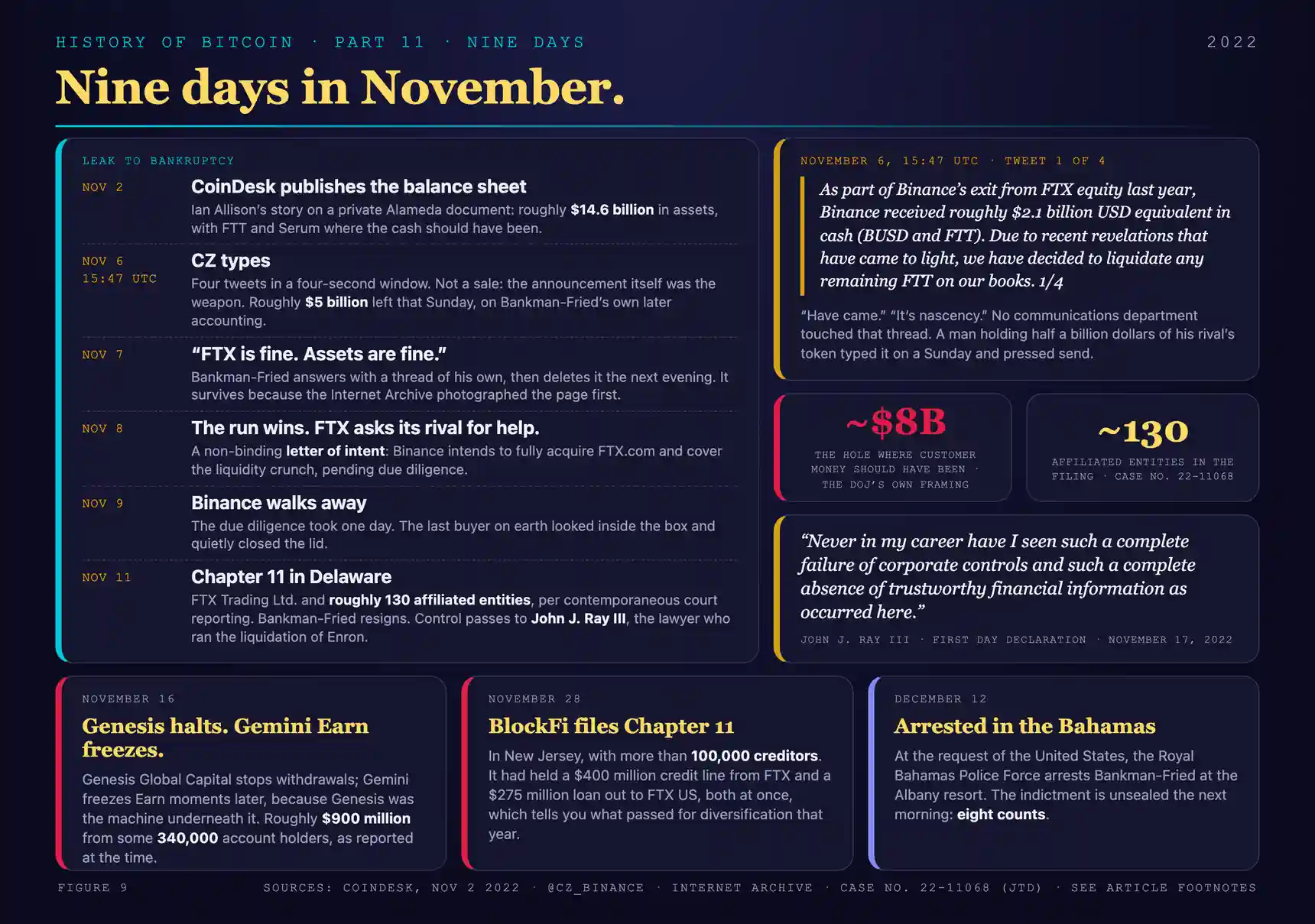
Allison's numbers were simple enough to read on a phone. Alameda claimed roughly $14.6 billion in assets as of June 30. Of that, $3.66 billion was "unlocked FTT" and another $2.16 billion was "FTT collateral," with billions more parked in Solana and Serum, tokens from FTX's own orbit. Against it: roughly $8 billion in liabilities, $7.4 billion of that in loans.¹⁰⁶ Where the cash should have been, the fund was holding chips from its own casino.
In January of that same year, investors had marked FTX at thirty-two billion dollars.¹⁰⁷
One reader mattered more than every other reader on earth. When Binance sold its stake in FTX back to Bankman-Fried in July 2021, the buyout left roughly 23 million FTT sitting in Binance's treasury, worth on the order of $580 million at that autumn's prices.¹⁰⁸ The single largest external pile of FTX's token belonged to Changpeng Zhao, the rival its founder had spent the year telling regulators to crack down on, as the frauds installment laid out. That installment put the geometry plainly: "One of them was holding a match. The other was made of paper."
For four days, nothing moved in public.
Then, on Sunday, November 6, at 15:47 UTC, CZ typed. Part 10 told you this exchange would be destroyed by "a few sentences from a rival on Twitter." The frauds installment quoted five words of those sentences, "in cash (BUSD and FTT)," and promised you would read the message in full in this installment. Here it is: four tweets, posted within a four-second window, rendered exactly as they appeared.¹⁰⁹
As part of Binance's exit from FTX equity last year, Binance received roughly $2.1 billion USD equivalent in cash (BUSD and FTT). Due to recent revelations that have came to light, we have decided to liquidate any remaining FTT on our books. 1/4
We will try to do so in a way that minimizes market impact. Due to market conditions and limited liquidity, we expect this will take a few months to complete. 2/4
Binance always encourages collaboration between industry players. Regarding any speculation as to whether this is a move against a competitor, it is not. Our industry is in it's nascency and every time a project publicly fails it hurts every user and every platform. 3/4
We typically hold tokens for the long term. And we have held on to this token for this long. We stay transparent with our actions. 4/4
"Have came." "It's nascency." No communications department touched that thread. A man holding half a billion dollars of his rival's token typed it on a Sunday and pressed send.
Now notice guile and strategic thinking on that thread. It is not a sale. Binance had not moved a single token; the announcement itself was the weapon. When the largest exchange on earth tells the market it intends to unload half a billion dollars of a thinly traded token "in a way that minimizes market impact," the market does not wait around to find out how considerate the selling turns out to be. Everyone holding FTT now knew the biggest seller alive was coming, on an unhurried schedule, and the only rational move was to run first.
About six hours later, still Sunday, a separate standalone tweet answered the speculation about motive:¹¹⁰
Liquidating our FTT is just post-exit risk management, learning from LUNA. We gave support before, but we won't pretend to make love after divorce. We are not against anyone. But we won't support people who lobby against other industry players behind their backs. Onwards.
The run began that day. By Bankman-Fried's own accounting four days later, customers pulled roughly five billion dollars out of FTX that Sunday, the largest withdrawal day in the exchange's history by a huge margin.¹¹¹
On Monday, November 7, Bankman-Fried answered with a thread of his own. You cannot read it on Twitter, because he deleted it the next evening. It survives because the Internet Archive photographed the page hours before he killed it, and it is rendered here exactly as archived.¹¹²
A competitor is trying to go after us with false rumors. FTX is fine. Assets are fine. Details:
FTX has enough to cover all client holdings. We don't invest client assets (even in treasuries). We have been processing all withdrawals, and will continue to be. Some details on withdrawal speed: [link to an @FTX_Official post on withdrawal speed] (banks and nodes can be slow)
It's heavily regulated, even when that slows us down. We have GAAP audits, with > $1b excess cash. We have a long history of safeguarding client assets, and that remains true today.
I'd love it, @cz_binance, if we could work together for the ecosystem.
FTX is fine. Assets are fine. The thread lasted a little over a day.
He typed "we don't invest client assets" into a phone while the run was proving otherwise in real time. Whether he believed it that Monday is a question for a jury in a later installment. What the record holds is the date, the words, and the deletion.
On Tuesday, November 8, the run met the balance sheet, and the balance sheet lost. That afternoon, CZ posted again:¹¹³
This afternoon, FTX asked for our help. There is a significant liquidity crunch. To protect users, we signed a non-binding LOI, intending to fully acquire [FTX.com] and help cover the liquidity crunch. We will be conducting a full DD in the coming days.
Six days earlier, the trouble was a spreadsheet in a news story. Now the exchange was asking its rival to buy it, and the rival announced the rescue with the enthusiasm of a man signing for a package. Part 10 reminded you that every profile written in 2021 described this exchange as the adult in the room. The adult in the room had just asked its rival for lunch money. Bankman-Fried deleted the "FTX is fine" thread that evening.
The due diligence took one day. On Wednesday, November 9, Binance's corporate account posted the walk-away:¹¹⁴
As a result of corporate due diligence, as well as the latest news reports regarding mishandled customer funds and alleged US agency investigations, we have decided that we will not pursue the potential acquisition of [FTX.com].
The last buyer on earth had looked inside the box and quietly closed the lid.
On Thursday, November 10, the Securities Commission of The Bahamas froze the assets of FTX Digital Markets, saying it was "aware of public statements suggesting that clients' assets were mishandled, mismanaged and/or transferred to Alameda Research."¹¹⁵ The same day, Bankman-Fried posted a 22-tweet apology thread. It opened like this:¹¹⁶
I'm sorry. That's the biggest thing. I fucked up, and should have done better.
In the middle of the thread he put numbers on his own blindness: he had believed the exchange carried zero leverage and enough ready dollars to cover twenty-four times an average day's withdrawals. The actual figures, by his own telling, were 1.7x leverage and eight tenths of one Sunday's withdrawals. And near the end, in tweet twenty, he addressed the man with the match:
At some point I might have more to say about a particular sparring partner, so to speak. But you know, glass houses. So for now, all I'll say is: well played; you won.
"Well played; you won."
SBF conceded it like a chess match. The customers whose money was gone do not appear in that sentence.
On Friday, November 11, FTX Trading Ltd. and roughly 130 affiliated entities, per contemporaneous court reporting, filed for Chapter 11 in Delaware, Case No. 22-11068.¹¹⁷ Bankman-Fried resigned. Control passed to John J. Ray III, the lawyer who ran the liquidation of Enron.
Ray spent his first days inside the books, and on November 17 he filed his First Day Declaration with the court.¹¹⁸ The frauds installment held one of its sentences back for this year:
Never in my career have I seen such a complete failure of corporate controls and such a complete absence of trustworthy financial information as occurred here.
The man who unwound Enron was impressed and troubled...
The hole where customer money should have been came to roughly $8 billion. That is the Justice Department's own framing, not a critic's.¹¹⁹
And because everything in 2022 was collateral for something else, the crater spread exactly the way the year had taught it to spread. On November 16, Genesis Global Capital halted withdrawals; a DCG spokesperson said the pause responded to "the extreme market dislocation and loss of industry confidence caused by the FTX implosion," while interim CEO Derar Islim separately told customers on a call that FTX's collapse had spurred withdrawal requests exceeding Genesis's liquidity.¹²⁰ Gemini froze its Earn program the same day, moments later, because Genesis was the machine underneath it: roughly $900 million belonging to some 340,000 account holders locked, as reported at the time.¹²¹ BlockFi, which had paused withdrawals on November 10 citing a "lack of clarity" about FTX, filed Chapter 11 in New Jersey on November 28 with more than 100,000 creditors.¹²² At the moment it froze, BlockFi held a $400 million credit line from FTX and a $275 million loan out to FTX US, both at once, which tells you what passed for diversification that year.¹²³
The wreckage even attracted flies with real estate licenses. On November 13, an account called Autism Capital surfaced a for-sale listing for Bankman-Fried's Albany penthouse: identical photos to the 2021 listing, the same $39.5 million ask, attributed to a brokerage called Seaside Real Estate. Fortune ran it down by November 17 and got the actual firm on the phone: "We don't have a listing for them and we never did." Somebody had faked a luxury listing for a frozen asset in the middle of the biggest bankruptcy in the industry's history, and the reporting never established who, or why.
That is the kind of week it was.
Then December. On December 12, at the request of the United States, the Royal Bahamas Police Force arrested Sam Bankman-Fried at the Albany resort, the compound where his penthouse had been listed at just under forty million dollars.¹²⁴ The indictment was unsealed the next morning: eight counts. Wire fraud on customers and wire fraud on lenders, with a conspiracy count attached to each. Conspiracy to commit commodities fraud. Conspiracy to commit securities fraud. Conspiracy to commit money laundering. And conspiracy to defraud the United States and violate campaign finance law.¹²⁵ That same morning in Washington, John Ray sat before the House Financial Services Committee and told Congress what he had found.¹²⁶
Step back and look at it whole, because you just watched every room of the machine burn in the order it was built. The frauds installment argued that FTX was the apex predator of the offshore casino economy: the empire that stacked the self-printed token, the captive market maker and the offshore cage, and pointed the whole assembly at its customers' deposits. Here is the epitaph. The apex predator, built entirely out of the casino's own tools, was eaten by the casino's biggest kingpin, in public, in nine days. No regulator dismantled it. No auditor caught it in time. A rival with a large position and a long memory typed what he knew, and the market did the rest.
It took three tweets and nine days.
What was left
Let's add up the year.
Bitcoin started 2022 at roughly $46,300, the December 31, 2021 close, and finished it at $16,547.50, per CoinMarketCap's December 31, 2022 snapshot.¹²⁷ The total crypto market went from about $2.3 trillion at the start of the year to $829 billion at the end, by CoinGecko's own annual accounting.¹²⁸ The obituary trackers, and I give them exactly the weight they deserve, counted Bitcoin declared dead somewhere between 21 and 27 times in 2022, depending on which month you asked.¹²⁹ For scale, the same methodology counted 124 obituaries in 2017. Even the gravediggers were tired.
Parts 9 and 10 told you what the free money taught people: that doing nothing was a strategy, that yield was a birthright, that the adult in the room would handle custody. 2022 graded the homework. Part 10 closed by predicting that "the people who lose the most will be the ones who did exactly what 2021 taught them to do," and that is precisely who lined up as unsecured creditors in Delaware, in New York, in New Jersey.
My own year is in the archive, dated, which is the only reason I trust it. In January I published a column called "Bear with me, Bitcoin," and the pun was the whole forecast.¹³⁰ On May 18, still carrying the Kleiman courtroom around with me, I published the piece that gave this series its benediction:¹³¹
When the dust settles, when the winds change, and when we look back on our life's work, I intend to be remembered for being good to people. That's why I've increasingly adopted "be good to each other" as a closing thought in my shows and appearances.
The column closed with the challenge itself: "So I challenge you: 'be good to each other.'" I wrote that in May, before Celsius, before the funerals, before November. It got harder to say every month, which is how I knew it was the right thing to keep saying.
And on November 8, the same Tuesday FTX asked its rival for help, I published a column called "Nothing is over!" It was about my own corner of the industry, and I did not spare it:¹³²
From nChain getting removed as a sponsor at events to Craig Wright being asked not to attend others, an untimely loss to a weak opponent in Norway, devs leaving to other blockchains, others spinning up competing big block implementations, companies failing to launch...
The same column carried a volley I still get quoted back at me: "Do they hate us? Yes. Do we know they hate us? Yes. Is their tech better than bitcoin? No." And it closed with four words.
Not on my watch!
The fraud collapsed. The protocol did not. Everything that failed this year, the algorithm, the lenders, the funds, the exchange, was a company or a promise or a balance sheet stacked beside the protocol, and the press called all of it "crypto," and most of the obituaries said "Bitcoin." The thing Satoshi actually built, the difficulty-adjusted ten-minute heartbeat, never missed a block in 2022. Not on BTC, not on BSV, not on any chain that runs his design. BTC's hash rate punched through all-time highs while its coin price fell by nearly two thirds; I wrote about the consolidation behind that at the end of December.¹³³ The wreckage was total, and none of it was wreckage of the protocol. The machine just kept stamping time.
And here is the detail the obituaries never print. Every freeze of 2022 was a corporate act. Celsius closed a withdrawal window; Genesis closed a withdrawal window; FTX ran out of other people's money to honor one. The protocol has no withdrawal window to close and no Chapter 11 to file. Everyone whose funds got frozen in 2022 had them frozen by a company holding the keys on their behalf. That distinction is the reason Bitcoin exists, and 2022 priced it.
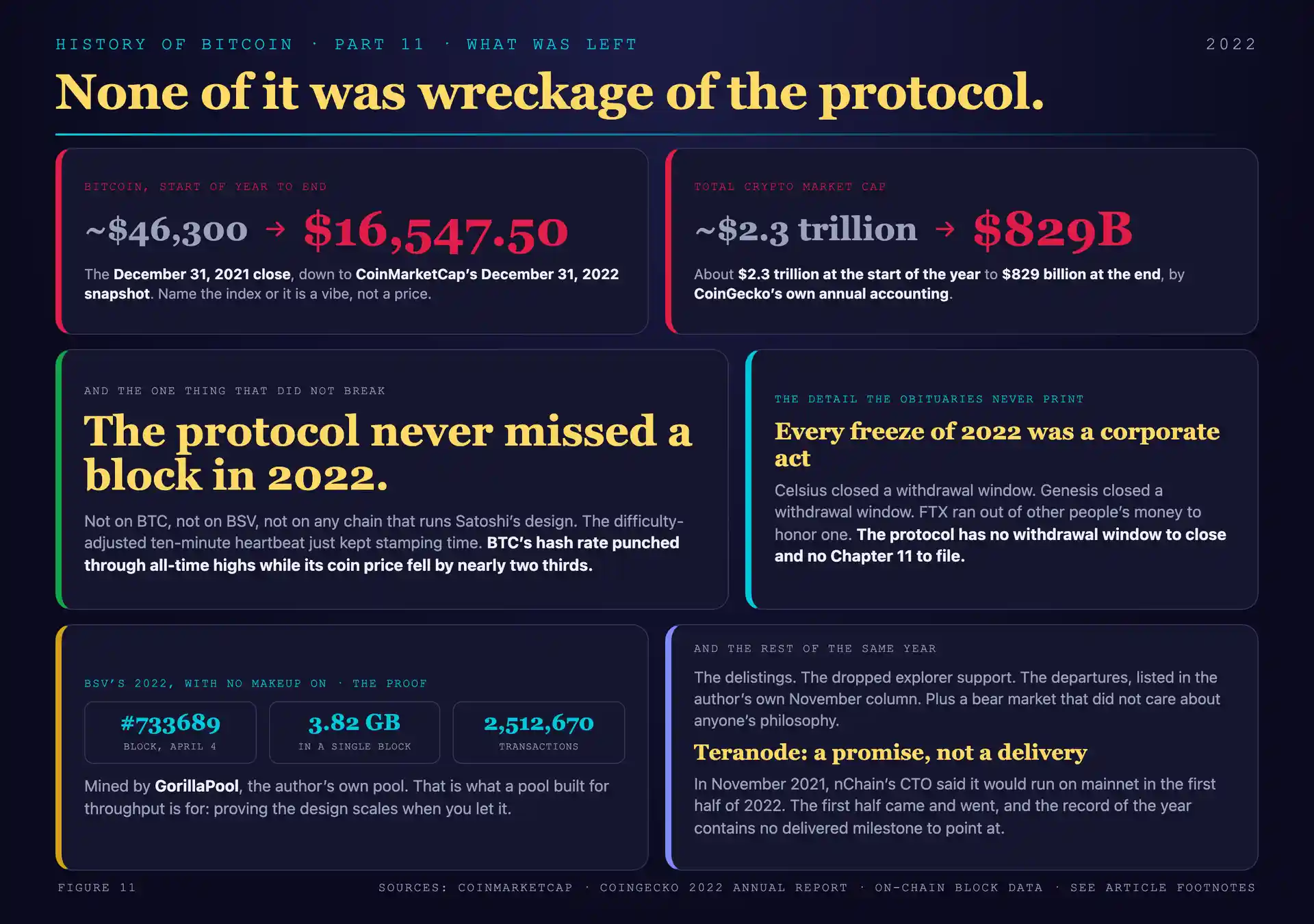
And because I have never once pretended to be neutral about which chain carries the original design, here is BSV's 2022 with no makeup on. On April 4, GorillaPool, my own pool, mined block 733689: 3.82 gigabytes, 2,512,670 transactions in a single block.¹³⁴ That is what a pool built for throughput is for: proving the design scales when you let it. The same year handed us the delistings, the dropped explorer support and the departures you just read in my own November column, plus a bear market that did not care about anyone's philosophy. And Teranode, the scaling engine this ecosystem had been promised? In November 2021, nChain's CTO said it would run on mainnet in the first half of 2022. The first half of 2022 came and went, and the record of the year contains no delivered milestone to point at.¹³⁵ Teranode's 2022 story was a promise, not a delivery. He ended up being "history" himself...
One more thread, and then I will let 2022 go. This one I am going to walk up to the doorstep and leave there.
Through everything you just read, the depeg, the freezes, the liquidations, the arrest, a programmer named Casey Rodarmor was building something in public. He created his repository on December 12, 2021, one year to the day before Bankman-Fried's arrest. He renamed it "ord" that January. In February 2022, before the Fed had fired its first hike, a draft BIP went up and was merged into the repo on February 10.¹³⁶ In June, by his own later timeline, he gave a workshop on the scheme in Austin, four days before Celsius slammed its withdrawal window shut. On July 21, in the dead middle of the wreckage, between Celsius's bankruptcy and the Merge, he published an essay called "Ordinal Theory," proposing that individual satoshis could be numbered, tracked and transferred.¹³⁷ On October 25 he shipped a 0.1.0 release: an ordinal-aware wallet, working software, on mainnet.¹³⁸ And on December 14, 2022, at 20:32 UTC, two days after the arrest in the Bahamas, a small PNG, a pixel-art skull, was inscribed into block 767430 as a test.¹³⁹
Nobody noticed. There was a lot going on.
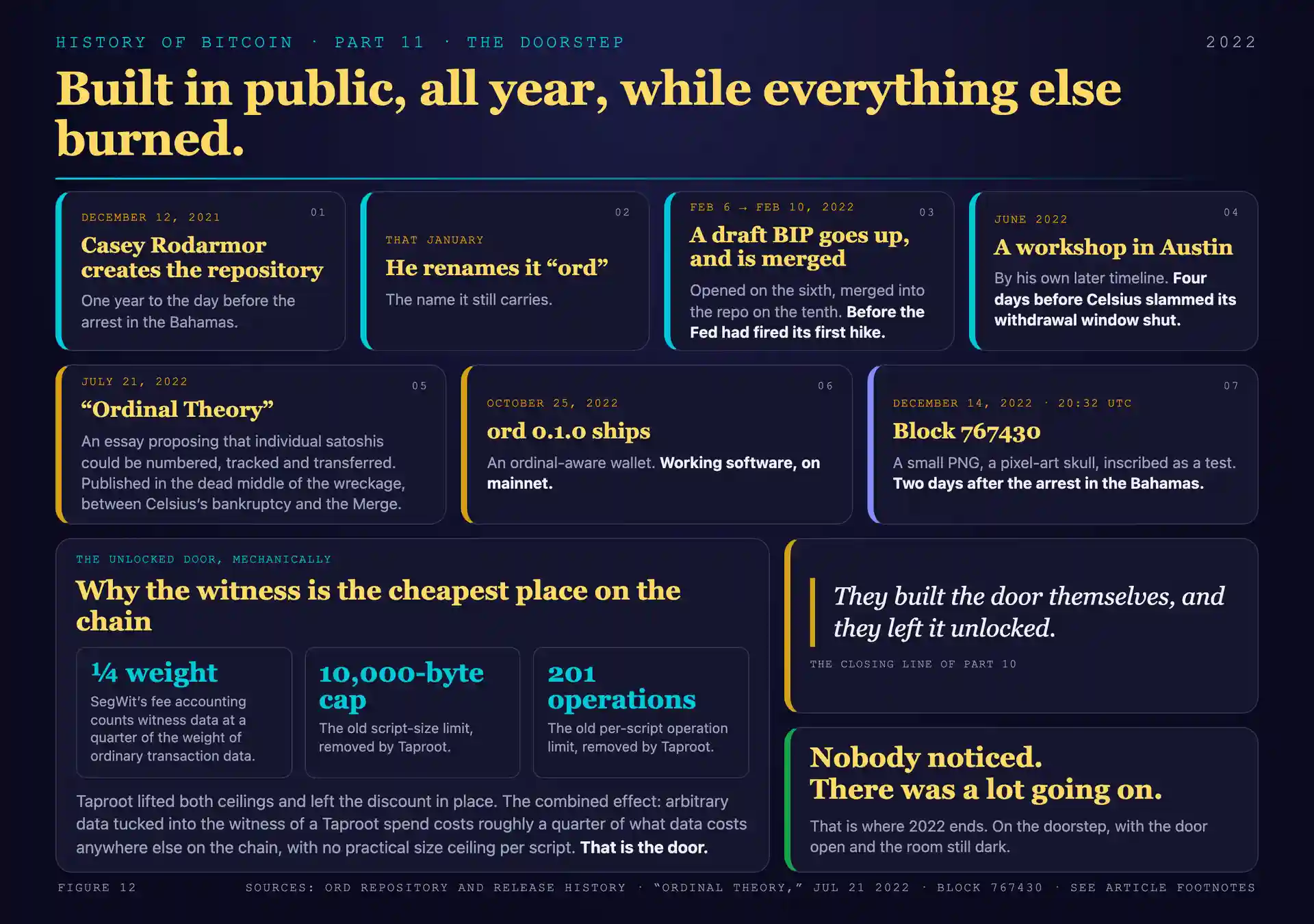
Part 10 ended with a sentence about a door, and I am not going to explain it again, because if you have come this far you can probably already feel it:
They built the door themselves, and they left it unlocked.
In January, Rodarmor ships it. And the chain that spent a decade calling data spam fills up with pictures, and goes to war with itself over what its own blockspace is for. That war starts in the next installment.
And one more shadow was already on the calendar. In London, COPA v Wright spent September 2022 in case management, grinding toward a trial date, and the reckonings of 2023 and 2024 were quietly being scheduled.¹⁴⁰
2022 burned the paper empires and left the protocol standing. The first thing anyone did with the quiet was pick a new war. Next year there is no printer to blame and no fraud big enough to hide behind. Next year the fight is about what a blockchain is actually for, and it happens inside the only building left standing.
That is the next installment. Bring your sense of humor. Where we are going, it is the only tool that still works.
Be good to each other. And stay curious.
Footnotes
¹ The UST/LUNA peg mechanism: UST held its dollar peg by minting and burning the sister token LUNA algorithmically, with no external collateral, the standard contemporaneous characterization of Terra's design, Terra Luna Crash Analysis, The Ledger Mind, 2022.
² Anchor Protocol's advertised 19.5 percent annual yield on UST deposits, cut to 18 percent on May 1, 2022; Anchor TVL roughly $16.7 billion at its early-May 2022 peak, up from $8.5 billion at year-end 2021, per DefiLlama historical TVL data; yield figures per Anchor Protocol Review, Seedly, 2021, and Daily Market Update for May 06, 2022, CoinCodex, May 6, 2022.
³ The depeg's day-level milestones: UST first slipped to roughly $0.985 on the evening of May 7, 2022 (UTC) as large Anchor withdrawals began; the roughly two-cent depeg of Sunday, May 8 slid to roughly $0.60 by May 9 and into the $0.30s by May 10; LUNA was effectively worthless by May 12, with exchanges halting trading, How Terra's UST and LUNA Imploded, Decrypt, May 2022.
⁴ The roughly $60 billion combined value erased across UST and LUNA is a widely repeated contemporaneous estimate, not an audited total; the figure was still in use in September 2022 arrest-warrant coverage, Crypto founder of $60 billion collapse says he is not hiding, NBC News, September 2022; see also The Terra Luna Implosion, Coin Edition, 2022.
⁵ Sam Bankman-Fried was arrested in the Bahamas on December 12, 2022 at the request of the United States government; the SDNY indictment unsealed December 13 carried eight counts, Indictment against SBF unsealed, Cointelegraph, December 13, 2022. His penthouse residence at the Albany resort, New Providence, is documented in As FTX crumbled, Sam Bankman-Fried's Bahamas penthouse was put up for sale. The listing was a fake, Fortune, November 17, 2022.
⁶ Powell's November 30, 2021 Senate Banking Committee appearance; the "retire that word" line came in the question-and-answer session, not his prepared remarks, and is corroborated verbatim across contemporaneous reports, Powell testimony of November 30, 2021, Federal Reserve, November 30, 2021; Powell: we can retire the term transitory, Blockworks, November 30, 2021.
⁷ The monthly year-over-year CPI path across 2022: 7.5 percent in January rising to the 9.1 percent June peak, ending at 6.5 percent in December, Current US Inflation Rates, US Inflation Calculator (BLS CPI series data), cross-checked against Consumer Price Index: 2022 in review, U.S. Bureau of Labor Statistics, January 2023.
⁸ Kurt Wuckert Jr., Bear with me, Bitcoin, CoinGeek, January 24, 2022. Both quoted passages are verbatim from the published column.
⁹ FOMC statement of March 16, 2022: 25-basis-point hike to 0.25-0.50 percent, the "ongoing increases in the target range will be appropriate" language, James Bullard's dissent in favor of a 50-basis-point move, and the statement's verbatim sentence on the invasion of Ukraine, Federal Reserve press release, Federal Reserve, March 16, 2022.
¹⁰ FOMC statement of May 4, 2022 (50-basis-point hike; balance-sheet reduction to begin June 1) and the accompanying Plans for Reducing the Size of the Federal Reserve's Balance Sheet ($30 billion Treasury and $17.5 billion agency MBS monthly caps, doubling after three months to $60 billion and $35 billion), Federal Reserve press release and balance sheet reduction plans, Federal Reserve, May 4, 2022.
¹¹ CPI for June 2022 rose 9.1 percent year over year, the largest twelve-month increase since the period ending November 1981, with energy up 41.6 percent and food up 10.4 percent; released July 13, 2022, Consumer prices up 9.1 percent over the year ended June 2022, U.S. Bureau of Labor Statistics, July 2022; CPI news release archive, July 13, 2022, U.S. Bureau of Labor Statistics.
¹² FOMC statement of June 15, 2022: 75-basis-point hike to 1.50-1.75 percent, the largest single increase since 1994, Federal Reserve press release, Federal Reserve, June 15, 2022.
¹³ FOMC statements of July 27, September 21, and November 2, 2022, each a 75-basis-point increase; the November statement carries the "sufficiently restrictive to return inflation to 2 percent over time" language, July 27 statement, September 21 statement, November 2 statement, Federal Reserve, 2022.
¹⁴ FOMC statement of December 14, 2022: 50-basis-point hike to the terminal 2022 range of 4.25-4.50 percent, with balance-sheet runoff continuing as described in the May plans, Federal Reserve press release, Federal Reserve, December 14, 2022.
¹⁵ The cumulative 425 basis points across seven hikes is cross-referenced from the seven FOMC statements above. The "fastest tightening cycle in four decades" comparison is commentator framing applied to the Fed's published data, not a Fed claim, Comparing the speed of U.S. interest rate hikes, World Economic Forum, October 2022; Interest rate hikes in past tightening cycles, Statista, 2022.
¹⁶ Jerome Powell, "Monetary Policy and Price Stability," delivered at the Federal Reserve Bank of Kansas City's economic policy symposium, Jackson Hole, Wyoming; both the "some pain" passage and "We will keep at it until we are confident the job is done" are verbatim from the Fed's own transcript, speech transcript, Federal Reserve, August 26, 2022.
¹⁷ The S&P 500's 2022 price-return decline of approximately 19.4 percent, its worst calendar year since 2008, S&P 500 logs its worst annual performance since 2008, S&P Global Market Intelligence, January 2023; CNBC market coverage, CNBC, December 29, 2022.
¹⁸ The Bloomberg U.S. Aggregate Bond Index fell approximately 13 percent in 2022, its worst calendar year since the index's 1976 inception, 2022 was the worst-ever year for US bonds, CNBC, January 7, 2023.
¹⁹ The Nasdaq Composite fell approximately 33.1 percent in 2022 on a price-return basis, its worst year since 2008, Just how badly did stock markets perform in 2022?, Nasdaq, 2023.
²⁰ More than 93,000 jobs cut at U.S. tech companies in calendar 2022, per Crunchbase News's Tech Layoffs Tracker, Tech layoffs tracker, Crunchbase News, 2022-2023.
²¹ GoFundMe froze the "Freedom Convoy 2022" fundraiser on February 4, 2022, stating the campaign violated its terms of service prohibiting the promotion of violence and harassment, and reversed to automatic donor refunds on February 5, GoFundMe Statement on the Freedom Convoy 2022 Fundraiser, GoFundMe via Medium, February 2022; refund reversal reported by CBC News, February 5, 2022.
²² The Emergencies Act was invoked February 14, 2022 and revoked February 23, 2022. Frozen-account figures as given in testimony before the House of Commons Standing Committee on Finance: 180 accounts per the Canadian Bankers Association, 257 per the RCMP, and roughly $7.8 million per Finance Canada, FINA Committee Report No. 5 testimony record, House of Commons of Canada, 2022. Roughly 34 cryptocurrency wallet addresses were blacklisted per contemporaneous coverage of the RCMP order to financial institutions.
²³ Joint statement of February 26, 2022 by the United States, the European Commission, France, Germany, Italy, the United Kingdom and Canada, pledging removal of selected Russian banks from SWIFT and restrictive measures on the Russian central bank's international reserves, EU, UK, Canada, US pledge to remove selected Russian banks from SWIFT, CNBC, February 26, 2022; CNN coverage, CNN, February 26, 2022.
²⁴ Approximately $300 billion of Russian central bank foreign-exchange reserves frozen by coordinated Western action beginning in late February 2022, a figure publicly acknowledged by Russia's finance minister, What is the status of Russia's frozen sovereign assets?, Brookings; Sanctions have frozen around $300 billion of Russian reserves, finance minister says, The Tribune, 2022.
²⁵ Mykhailo Fedorov's tweet of February 26, 2022, with the accompanying wallet addresses posted by Ukraine's official government account, the tweet, Twitter/X, February 26, 2022; Ukrainian government is seeking crypto donations, CoinDesk, February 26, 2022.
²⁶ Tracked 2022 crypto donations to Ukrainian government wallets: Elliptic counted over 102,000 donations totaling $54.7 million to government and Come Back Alive addresses by early March; Chainalysis later put the government-wallet total near $70 million; totals vary by tracker and wallet scope, Crypto donations to Ukraine and Russia: breaking down the numbers, Elliptic, 2022; Ukraine raises $54 million as bitcoin donations surge amid Russian war, CNBC, March 3, 2022; Nearly $70,000,000 worth of crypto donations have flowed into Ukraine's government wallets, The Daily Hodl (citing Chainalysis), February 2023.
²⁷ FinCEN Alert FIN-2022-Alert001 of March 7, 2022, warning financial institutions of potential Russian and Belarusian sanctions-evasion attempts and listing thirteen red flags, FinCEN alert PDF, FinCEN, March 7, 2022.
²⁸ Chainalysis's April 13, 2022 liquidity analysis, quoted verbatim, with its supporting figures: roughly $800 billion in estimated Russian oligarch offshore holdings (citing a 2017 NBER study), approximately $296 billion in combined free-floating supply of the three largest cryptocurrencies, and under $30 million per day in average combined mixer inflows over the preceding year, Crypto market liquidity and Russia sanctions, Chainalysis, April 13, 2022.
²⁹ OFAC sanctioned Blender.io on May 6, 2022 and Tornado Cash on August 8, 2022; the quoted laundering figures and the designation's functional description of the mixer are verbatim from Treasury's own release, which notes the action was taken pursuant to Executive Order 13694 as amended, U.S. Treasury Sanctions Notorious Virtual Currency Mixer Tornado Cash, U.S. Department of the Treasury, August 8, 2022.
³⁰ The characterization that OFAC had sanctioned autonomous code was advanced by industry and civil-liberties groups including Coin Center and the Electronic Frontier Foundation and in the Coinbase-backed Van Loon litigation against Treasury. Tornado Cash inflows reportedly fell about 68 percent after designation while the underlying smart contracts remained technically accessible; the same analysis found Hydra shut down by coordinated law enforcement and OFAC action while the sanctioned Russian exchange Garantex continued operating with increased volume because Russia "has declined to enforce sanctions" domestically, How 2022's crypto sanction designations affected crypto crime, Chainalysis, 2023.
³¹ Alexey Pertsev was arrested in Amsterdam on August 10, 2022 by the Dutch Fiscal Information and Investigation Service (FIOD) on suspicion of involvement in concealing criminal financial flows and facilitating money laundering through Tornado Cash, Tornado Cash developer arrested in Amsterdam, Benzinga, August 2022; Alleged Tornado developer Pertsev must stay in jail, Dutch judge rules, CoinDesk, August 24, 2022.
³² Kazakhstan's government shut down internet access nationwide beginning around January 5, 2022 via state operator Kazakhtelecom amid nationwide unrest; Bitcoin's global hashrate dropped approximately 12-13 percent, with contemporaneous coverage ranking Kazakhstan the world's second-largest mining jurisdiction; the year's subsequent tariff and registration crackdown is per financial-press reporting, Kazakhstan's hashrate drops as internet blackout persists, CoinDesk, January 6, 2022; Bitcoin network power slumps as Kazakhstan crackdown hits crypto miners, NBC News, January 2022; Kazakhstan's bitcoin paradise may be losing its lustre, Investing.com (Reuters), 2022.
³³ Russia's share of global hashrate reached roughly 11 percent in the Cambridge Bitcoin Electricity Consumption Index's August 2021 snapshot, up from 6.8 percent at the end of April 2021; Treasury's April 2022 release independently characterizes Russia's mining industry as "reportedly the third largest in the world," Bitcoin mining's geographic shift, Cambridge Judge Business School, 2021; U.S. Treasury Designates Facilitators of Russian Sanctions Evasion, U.S. Department of the Treasury, April 20, 2022.
³⁴ OFAC's April 20, 2022 designation of BitRiver AG and ten Russia-based subsidiaries; all quoted passages, including "This is the first time Treasury has designated a virtual currency mining company" and the mining-rationale paragraph, are verbatim from Treasury's own press release, U.S. Treasury Designates Facilitators of Russian Sanctions Evasion, U.S. Department of the Treasury, April 20, 2022.
³⁵ Cambridge Centre for Alternative Finance Bitcoin Mining Map, September 2021 through January 2022 collection window: United States 37.84 percent, China 21.11 percent (re-emergent against its own June 2021 ban), Kazakhstan 13.22 percent, Canada 6.48 percent, Russia 4.66 percent, CBECI mining map methodology, Cambridge Centre for Alternative Finance; Bitcoin mining electricity update, Cambridge Judge Business School, 2022.
³⁶ Reporting on China's seasonal hydro mining migration between Sichuan/Yunnan (wet season) and Inner Mongolia/Xinjiang (dry season), Cryptocurrency miners tap Sichuan's cheap hydropower, South China Morning Post, 2019; also The great mining migration: power-hungry Bitcoin leaves China, Dialogue Earth, 2021.
³⁷ CBECI methodology and tracked data showing China's share at 0% from July-August 2021 after the mining crackdown, Cambridge Bitcoin Electricity Consumption Index mining map methodology, Cambridge Centre for Alternative Finance, accessed 2022.
³⁸ Country hashrate shares (US 37.84%, China 21.11%, Kazakhstan 13.22%) from the January 2022 snapshot of the rolling September 2021 to January 2022 collection window, including the pool-reported-data and VPN caveats, Bitcoin mining electricity update: new data, Cambridge Judge Business School, May 2022; underlying map at CBECI mining map, Cambridge Centre for Alternative Finance.
³⁹ ERCOT Four Coincident Peak and demand-response mechanics for bitcoin miners, A Deep Dive into BTC Mining & ERCOT's Four Coincident Peak Program (4CP), Foundry Digital, 2022; also 4CP for Bitcoin Miners, Hashrate Index.
⁴⁰ Crusoe Energy's $350 million Series C (with credit facilities bringing the package toward $505 million) for flared-gas bitcoin mining, Flared Gas Bitcoin Miner Crusoe Energy Raises $350M Series C, CoinDesk, April 21, 2022.
⁴¹ Bloomberg's report of ExxonMobil's flared-gas bitcoin mining pilot with Crusoe in North Dakota's Bakken, up to 18 million cubic feet of gas per month, with expansion under consideration; Exxon did not publicly confirm, Exxon Considers Taking Gas-to-Bitcoin Pilot to Four Countries, Bloomberg, March 24, 2022; corroborating coverage CNBC, March 26, 2022.
⁴² Marathon's announced transition of its coal-powered Hardin, Montana operation and its "100% carbon neutral by year-end 2022" pledge, Marathon Digital Holdings Announces Intent To Transition Hardin, Montana Bitcoin Mining Operations to More Sustainable Power Sources, GlobeNewswire, April 5, 2022.
⁴³ Marathon's hodl-everything treasury strategy, roughly 10,055 BTC held and no sales since October 2020, Marathon Digital Continues to Hodl All Bitcoin but Hints at Strategy Change, CoinDesk, July 7, 2022.
⁴⁴ Hut 8's bitcoin holdings rising 64.7 percent during 2022 to 9,086 BTC at year-end, Hut 8 Reports Operating and Financial Results for 2022, PRNewswire, 2023.
⁴⁵ Riot's at-the-market equity programs: approximately $600 million gross raised in 2021 at a $29.53 average share price versus approximately $304.8 million gross in 2022 at $8.23, per the company's own annual report, Riot Platforms Form 10-K for fiscal year 2022, SEC EDGAR, filed 2023.
⁴⁶ Riot's July 2022 production update: 318 BTC mined (down 28% year over year), 11,717 MWh curtailed (approximately 13,121 homes for a month), an estimated $9.5 million in power credits described as "equivalent to approximately 439 BTC" at Riot's stated $21,634 July average price, with CEO Jason Les's statement quoted verbatim, Riot Blockchain Announces July 2022 Production and Operations Updates, GlobeNewswire/Riot Blockchain, August 3, 2022.
⁴⁷ Riot's Q3 2022 Form 10-Q: ERCOT power sales "totaled $13.1 million and $21.3 million" for the three and nine months ended September 30, 2022 (versus $2.5 million and $3.7 million in the 2021 periods), recorded as power curtailment credits and reducing net mining costs, Riot Blockchain Form 10-Q, quarter ended September 30, 2022, SEC EDGAR, 2022.
⁴⁸ The difficulty-adjustment design premise, Satoshi Nakamoto, Bitcoin: A Peer-to-Peer Electronic Cash System, Section 4 (Proof-of-Work), October 2008.
⁴⁹ On-chain difficulty adjustments for 2022: 24.37 trillion (January 8) to 36.95 trillion (November 20), a rise of about 52 percent while bitcoin's price fell about 65 percent over the same stretch; December 6 brought the year's sharpest drop (-7.32%) and January 29, 2023 a fresh all-time high, mempool.space difficulty adjustment data, mempool.space (Bitcoin on-chain data), 2022-2023.
⁵⁰ The October 10, 2022 difficulty adjustment (+13.55% to an all-time high with bitcoin near $19,333) and hashrate near 257 EH/s versus roughly 140 EH/s a year earlier, Bitcoin Mining Difficulty Surges to All-Time High, Putting Additional Squeeze on Miners, CoinDesk, October 10, 2022.
⁵¹ Hashprice falling from $290.40 per PH/day (end of Q3 2021) to $79.60 (end of Q3 2022), a 73 percent year-over-year collapse into all-time-low territory, Hashrate Index Q3 2022 Report: Gradually, Then Suddenly, Luxor/Hashrate Index, 2022.
⁵² Core Scientific's own June 2022 update, filed as an 8-K exhibit: "During the month of June, the Company sold 7,202 bitcoins at an average price of approximately $23,000 per bitcoin for total proceeds of approximately $167 million," with month-end holdings of 1,959 bitcoins and approximately $132 million in cash, Core Scientific June Update, 8-K Exhibit 99.1, SEC EDGAR, filed July 5, 2022.
⁵³ Core Scientific's August 2022 update: 1,125 BTC sold at an average of $23,014 for approximately $25.9 million, holding 1,409 BTC and about $47.2 million cash at August 31, Core Scientific August 2022 update, Form 8-K exhibit, SEC EDGAR, 2022.
⁵⁴ Compute North's Chapter 11 filing on September 22, 2022, citing the crypto winter and rising energy prices, Bitcoin Mining Data Center Firm Compute North Files for Bankruptcy, Decrypt, September 2022.
⁵⁵ Greenidge Generation's December 19, 2022 term sheet with NYDIG restructuring approximately $74 million in equipment debt, with the company disclosing a roughly $8 million monthly burn in October-November 2022, Greenidge Generation Executes Term Sheet with Secured Lender NYDIG, Greenidge 8-K exhibit, SEC EDGAR, December 2022.
⁵⁶ Core Scientific's Chapter 11 filing on December 21, 2022 in the Southern District of Texas; the roughly 98 percent one-year stock decline and the fall from a $4.3 billion market cap (July 2021) to $78 million; the company's stated causes including falling bitcoin prices, energy costs, and the bankruptcy of hosting customer Celsius Mining; continued mining through bankruptcy, Bitcoin miner Core Scientific is filing for bankruptcy, will keep mining, CNBC, December 20, 2022; also Core Scientific Files for Bankruptcy as Crypto Winter Lingers, Bloomberg, December 21, 2022.
⁵⁷ Argo Blockchain's December 28, 2022 rescue: Galaxy Digital's $65 million purchase of the Helios facility plus a $35 million loan secured by mining equipment, allowing Argo to avoid bankruptcy, Bitcoin miner Argo to avoid bankruptcy with $100M deal from Galaxy Digital, TechCrunch, December 28, 2022.
⁵⁸ The nine largest public bitcoin miners' combined market cap falling from $11 billion to $3.64 billion during 2022, "almost $7.5 billion up in smoke," while still holding 31,392 BTC (~$605 million) at year-end, 5 Charts Showing How Brutal 2022 Was for Public Bitcoin Miners, Blockworks (archived), January 2023.
⁵⁹ Industry ASIC-collateralized debt estimated at $2-4 billion, average 2022 loan rates of 10.46 percent, known public-miner defaults of $227.4-238.4 million, and NYDIG, Galaxy, and Foundry recovering machines and facilities through defaults, Unsustainable Bitcoin Mining Debt Led to Record Defaults, Buyouts in 2022, Hashrate Index, 2023.
⁶⁰ Kurt Wuckert Jr.'s contemporaneous column on subsidy-versus-fee mining economics, Bitcoin mining economics: Past, present and future, CoinGeek, June 23, 2022.
⁶¹ Kurt Wuckert Jr.'s contemporaneous mining column, including the bull/bear operating framework, the fees-versus-subsidies deadline, the roughly $3,000 per 100-110 TH/s hardware figure, and the GorillaPool partner disclosure, Mine about it, CoinGeek, October 31, 2022.
⁶² Kurt Wuckert Jr.'s year-end column on hash power consolidation, including the closing software/hardware/pools indictment, BTC hash power centralization, CoinGeek, December 29, 2022.
⁶³ GorillaPool's first block, #704246, September 10, 2021, 22:04:09 UTC, coinbase tagged "gorillapool" with the ape emoji, 4,606 transactions, WhatsOnChain block record, WhatsOnChain, 2021; launch as a Gorilla DAO member project governed by APE token votes, at about 3 percent of BSV hash power, Distributed GorillaPool begins mining blocks on BSV blockchain, CoinGeek, September 16, 2021.
⁶⁴ Kurt Wuckert Jr.'s printed GorillaPool disclosure and founding account, Kurt's personal blog: 2021 in BSV, CoinGeek, December 24, 2021.
⁶⁵ Block #733689, mined by GorillaPool on April 4, 2022: 3.82GB, 2,512,670 transactions, WhatsOnChain block record, WhatsOnChain, 2022; transaction fees above 9.757 BSV against the 6.25 BSV subsidy per CoinGeek's contemporaneous coverage of the record block, CoinGeek, April 2022.
⁶⁶ Kurt Wuckert Jr.'s honest-node essay, source of the white paper word counts, the "honest nodes are actually people" passage, "Only. Humans. Act.", and the closing line, Run a Bitcoin node, honestly, CoinGeek, January 31, 2022.
⁶⁷ Kurt Wuckert Jr.'s column on Bitcoin Core's BIP editor and maintainer governance concentration, Maintaining power: A Core story, CoinGeek, July 20, 2022.
⁶⁸ Anchor Protocol advertised an approximate 19.5% annual yield on UST deposits through 2021 and cut the earn rate to 18% on May 1, 2022; total value locked grew from $8.5 billion at year-end 2021 to a peak of roughly $16.7 billion in early May 2022 per DefiLlama. Anchor Protocol Review, Seedly; Daily Market Update for May 06, 2022, CoinCodex; DefiLlama historical TVL data.
⁶⁹ The depeg sequence: Terraform Labs' Curve pool liquidity migration and the large UST sales of May 7, the first slip to roughly $0.985 that evening (UTC), the slide through the $0.60s on May 9 and into the $0.30s on May 10, reconstructed by Kaiko and reported contemporaneously by Decrypt. Predicting the UST Collapse With DEX Liquidity Pool Data, Kaiko, 2022; How Terra's UST and LUNA Imploded, Decrypt, May 2022.
⁷⁰ Do Kwon (@stablekwon) on Twitter, May 9, 2022, quoted verbatim with the source's own punctuation and no trailing period. Archived snapshot, web.archive.org, May 10, 2022.
⁷¹ LUNA's circulating supply hyperinflated from hundreds of millions of tokens into the trillions within days in mid-May 2022 (exact supply snapshots vary by source; the order of magnitude does not), and the token traded at effectively zero by May 12, 2022, as exchanges halted trading. What Happened to LUNA?, CoinCodex; How Terra's UST and LUNA Imploded, Decrypt, May 2022.
⁷² Luna Foundation Guard disclosed reserves of 80,394 BTC as of May 7, 2022; more than 50,000 BTC were deployed on May 8 and 30,000 more sold May 12; LFG's May 16 statement put the remaining balance at 313 BTC, an ending balance independently confirmed on-chain via the Blockstream API. Luna Foundation Guard Left With 313 Bitcoin After UST Crash, CoinDesk, May 16, 2022.
⁷³ The roughly $60 billion combined UST/LUNA figure is the most widely repeated contemporaneous estimate (approximately $40 billion LUNA plus $18 billion UST market value); no audited total exists. A Seoul court issued the arrest warrant for Do Kwon and five associates on September 14, 2022, with Interpol cooperation sought. The Terra Luna Implosion, Coin Edition; South Korea court issues arrest warrant for Terraform founder Do Kwon, CNBC, September 14, 2022; Crypto founder of $60 billion collapse says he's not hiding as Interpol issues arrest notice, NBC News, September 2022.
⁷⁴ Janet Yellen, testimony before the Senate Banking Committee, May 10, 2022. Janet Yellen: TerraUSD Run Illustrates Need for Stablecoin Regulation, Benzinga, May 2022; Yellen: Terra's Fall Shows Stablecoin Dangers, PYMNTS, May 2022.
⁷⁵ Celsius Network's self-reported assets under management rose from roughly $1 billion in mid-2020 to over $20.3 billion by August 13, 2021 and a claimed $25 billion by October 2021; these are company press-release figures, not independently audited, as noted when this series first cited them in the previous installment.
⁷⁶ Celsius Network statement announcing the pause of withdrawals, Swap, and transfers for its 1.7 million users, Sunday, June 12, 2022; the quoted line is the fragment preserved in TechCrunch's same-day report (the original Celsius blog is no longer online). Crypto lender Celsius pauses withdrawals, transfers, citing 'extreme market conditions', TechCrunch, June 12, 2022.
⁷⁷ Celsius Network filed Chapter 11 in the U.S. Bankruptcy Court for the Southern District of New York on July 13, 2022, disclosing approximately $5.5 billion in liabilities against $4.3 billion in assets, a roughly $1.2 billion balance-sheet hole. Celsius Bankruptcy Filing Shows $1.2B Hole, Decrypt, July 2022; The Fall of Celsius Network: A Timeline, CoinDesk, July 15, 2022.
⁷⁸ Alex Mashinsky resigned as Celsius CEO effective immediately on September 27, 2022, mid-bankruptcy; the resignation-letter line is quoted verbatim. Celsius Network CEO Alex Mashinsky Resigns, CoinDesk, September 27, 2022; Celsius CEO Alex Mashinsky Resigns, Forbes, September 27, 2022.
⁷⁹ Per a January 2021 SEC filing, Three Arrows owned almost 39 million GBTC units at the end of 2020; GBTC's premium inverted to a discount that reached roughly 34% below net asset value on June 17, 2022. The Genesis-to-Grayscale double exposure on the borrowed-BTC leg of the trade is reported reconstruction, not a court-certified figure. The stETH token traded at roughly a 6% discount to ETH in June 2022 amid forced selling, and 3AC swapped approximately $33 million of stETH for ETH on Curve during the depeg. The $3.5 Billion GBTC Arbitrage That Destroyed Three Arrows Capital, Medium (Navnoor Bawa); Three Arrows Capital, Wikipedia (citing the SEC filing); stETH Depegging: What Are the Consequences, Huobi Research, 2022; Three Arrows Dumps $33M Staked Ethereum, CoinGape, June 2022.
⁸⁰ Nansen's independently sourced on-chain estimate of about $10 billion dates to March 2022; the $18 billion figure was 3AC's own last claimed net asset value to investors, relayed by Bloomberg in July 2022 and never audited. Three Arrows Capital, Wikipedia (citing Nansen and Bloomberg).
⁸¹ The British Virgin Islands High Court of Justice ordered Three Arrows Capital liquidated on June 27, 2022, appointing Teneo as liquidators; the foreign representatives filed for Chapter 15 recognition in the Southern District of New York on July 1, 2022 (Case No. 22-10920 (MG)). Three Arrows Capital Files for Bankruptcy in New York, CoinDesk, July 1, 2022.
⁸² Court liquidation papers stated the founders' whereabouts were unknown as of July 8, 2022; their lawyers cited threats of violence to explain the silence. Su Zhu's quote is from his July 22, 2022 interview, given with Kyle Davies from an undisclosed location. Three Arrows Founders En Route to Dubai Describe LTCM Moment, Bloomberg, July 22, 2022; Three Arrows Founders Su Zhu and Kyle Davies Pull a Do Kwon, BeInCrypto, July 2022.
⁸³ Voyager's loan to 3AC comprised $350 million in USDC and 15,250 BTC, more than $650 million combined; the default notice went out June 27, 2022, and Voyager Digital filed Chapter 11 in the Southern District of New York on July 5, 2022 (Case No. 22-10943 (MEW)), reporting more than $1.3 billion of customer crypto on platform. Voyager Digital Commences Financial Restructuring Process, PR Newswire, July 2022; Voyager Issues Notice of Default to 3AC, CryptoSlate, June 2022.
⁸⁴ The Ronin bridge theft (transactions executed March 23, 2022, disclosed March 29) drained 173,600 ETH and 25.5 million USDC, roughly $625 million; the FBI attributed the theft to Lazarus Group and APT38 on April 14, 2022. Axie Infinity's Ronin Network Suffers $625M Exploit, CoinDesk, March 29, 2022; FBI Statement on Attribution of Malicious Cyber Activity Posed by the Democratic People's Republic of Korea, FBI, April 14, 2022.
⁸⁵ Wormhole was exploited for approximately 120,000 wrapped ETH (~$325 million) on February 2, 2022, with Jump Crypto replacing the funds; the Nomad bridge lost roughly $190 million beginning August 1, 2022, in a copy-paste free-for-all across hundreds of wallets. Hackers steal $320 million in crypto from Wormhole, Fortune, February 3, 2022; Nomad Token Bridge Raided for $190M in Frenzied Free-for-All, Blockworks, August 2022.
⁸⁶ Chainalysis's 2022 Crypto Crime Report (covering calendar 2022) counted a record $3.8 billion stolen, with cross-chain bridges accounting for roughly $2 billion. 2022 Biggest Year Ever for Crypto Hacking, Chainalysis, February 2023.
⁸⁷ NFT trading volumes across major marketplaces fell 97% from roughly $17 billion in January 2022 to $466 million in September 2022, per Dune Analytics data reported by Bloomberg. NFT Volumes Tumble 97% From 2022 Highs, Bloomberg, September 28, 2022.
⁸⁸ BuzzFeed News identified the pseudonymous BAYC founders on February 4, 2022; ApeCoin launched March 17, 2022; Yuga Labs announced a $450 million round at a $4 billion valuation on March 22, 2022; the Otherside land sale (April 30 to May 1, 2022) grossed roughly $310 million in primary-sale proceeds (16.7 million APE), with larger totals existing only as contested estimates. BAYC Founders Doxxed by BuzzFeed, Decrypt, February 2022; Token Linked to Bored Ape Yacht Club Launches, CoinDesk, March 2022; Bored Apes Owner Yuga Labs Raises $450M Led by a16z, CoinDesk, March 22, 2022; Yuga Labs' Otherside land sale turns into a giant gas war, Amy Castor, May 1, 2022.
⁸⁹ The Merge executed September 15, 2022 at block 15,537,394, at 06:42 UTC (rounded to the minute; explorers differ on the second); block 15,537,393 was the final proof-of-work block, mined by F2Pool. Crypto Miner F2Pool Mined the Last-Ever PoW Ether Block Before Merge, CoinDesk, September 15, 2022; Mainnet Merge Announcement, Ethereum Foundation, August 24, 2022.
⁹⁰ The ~99.95% energy-reduction figure is the Ethereum Foundation's own pre-Merge estimate, published by researcher Carl Beekhuizen in May 2021, not an independently audited measurement; new issuance fell from roughly 13,000 ETH per day under proof of work to roughly 1,600 ETH per day after the Merge. Ethereum's energy usage will soon decrease by ~99.95%, Ethereum Foundation, May 18, 2021; Ethereum Token Issuance Plummets Following Merge, Decrypt, 2022.
⁹¹ Ethereum Foundation pre-Merge clarification on gas fees and throughput, quoted verbatim from ethereum.org and reported contemporaneously. Ethereum Foundation clarifies that the upcoming Merge upgrade will not reduce gas fees, Cointelegraph, August 2022.
⁹² OFAC-compliant block share measurements varied by source, date, and methodology: 63% of all Ethereum blocks and 92% of relayed blocks by October 26, 2022 per The Block, with cited November peaks near 79-80% per MEV-Boost relay trackers. 63% of Ethereum Transaction Blocks Are Now OFAC-Compliant, The Block, October 26, 2022; Ethereum MEV-Boost Relay Censorship Falls Back Under 50%, Crypto Briefing; MEV Watch, Labrys.
⁹³ The Hodlonaut origin arc (the March 2019 tweets, the Ontier letter of March 29, 2019, the $5,000 BSV bounty, the #WeAreAllHodlonaut avatar movement, and the dual-track filings: Granath in Oslo on May 19, 2019, Wright in the UK in June 2019) is covered in full, with sources, in Part 8 of this series. Craig Wright Vs. Hodlonaut: A Timeline of the Legal Battle, Bitcoin Magazine.
⁹⁴ Kurt Wuckert Jr.'s contemporaneous 2022 columns: Kurt's personal blog: Be good to each other, CoinGeek, May 18, 2022; Kurt's personal blog: GBC and beyond, arrivals and setting up, CoinGeek, June 3, 2022 (the Dubai account, including the McCormack episode, the booth, and the bananas); the McCormack exchange itself is preserved in the follow-up, Kurt's personal blog: GBC and beyond, the BIG show, CoinGeek, June 6, 2022, which embeds both tweets: Peter McCormack (@PeterMcCormack), May 24, 2022, status 1529006622525227008, archived the same day, quote-tweeting Kurt's attendance post (its trailing link is the quote-tweet reference, omitted above); and Kurt's May 26, 2022 reply, status 1529840619467710466. Both verified live via X's embed endpoint, August 2026.
⁹⁵ Trial of Granath v Wright, Oslo District Court, September 12-21, 2022 (seven sitting days), Judge Helen Engebrigtsen presiding; her day-one framing and the first in-person meeting of the parties were reported contemporaneously. Crypto Twitter Took Center Stage During the First Day of Hodlonaut vs. Craig Wright, CoinDesk, September 12, 2022; Granath v Wright: Satoshi Trial 2022 begins in Norway, CoinGeek, September 13, 2022.
⁹⁶ Craig Wright's September 15, 2022 testimony, all quotes verbatim as reported; his lawyers' September 14 position that cryptographic proof alone would not be conclusive is paraphrased from the same outlet's prior-day coverage. Craig Wright Tells Court He 'Stomped on the Hard Drive' Containing Satoshi Wallet Keys, CoinDesk, September 15, 2022; Craig Wright Won't Give Cryptographic Proof He's Satoshi, His Lawyers Say at Hodlonaut Trial, CoinDesk, September 14, 2022.
⁹⁷ Magnus Granath's trial testimony as quoted in CoinDesk's year-end profile. The Bullied Takes the Bully to Court, CoinDesk, December 5, 2022.
⁹⁸ Expert witnesses on the 2016 signing sessions, and Gavin Andresen's own "bamboozled" and "funky proof" characterizations entered secondhand. Craig Wright Could Have 'Bamboozled' Andresen During Private 'Satoshi' Signing Session: Trial Witnesses Explain, CoinDesk, September 16, 2022.
⁹⁹ The KPMG/BDO forensic finding as rendered in English-language coverage of the October 20, 2022 judgment. Hodlonaut Wins Norwegian Lawsuit Against Self-Styled 'Satoshi' Craig Wright, CoinDesk, October 20, 2022.
¹⁰⁰ Kurt Wuckert Jr.'s direct quote from the week-one wrap of CoinGeek's trial coverage; the Klin observation is the reporter's third-person account of Kurt's reaction, attributed here as the outlet's account. Week 1 of Granath vs Wright trial in Norway concludes with more witness testimony, CoinGeek (byline Gavin Lucas), September 19, 2022.
¹⁰¹ Verdict of October 20, 2022: Granath not liable; the "lied and cheated" line is translated from the Norwegian original ("Fyllestgjørende faktisk grunnlag for å hevde at Wright hadde løyet og jukset," as carried by Dagens Næringsliv); costs of NOK 4,053,750 awarded against Wright (dollar conversions vary by date); Granath's same-day reaction as reported. Hodlonaut Wins Norwegian Lawsuit Against Self-Styled 'Satoshi' Craig Wright, CoinDesk, October 20, 2022; Dagens Næringsliv, October 22, 2022; Hodlonaut Declares Victory Against Craig Wright in Norwegian Defamation Case, CryptoSlate, October 20, 2022; the Manshaus statement per Decrypt's verdict coverage, Decrypt, October 20, 2022.
¹⁰² Kleiman v. Wright jury verdict, December 6, 2021 (S.D. Fla.): no partnership found, $100 million awarded to W&K Info Defense Research LLC on the conversion claim, and the Satoshi question never among the questions put to the jury, per the verdict form (ECF 812) as covered in the previous installment of this series. Craig Wright Found Not Liable for Breach of Kleiman Business Partnership, CoinDesk, December 6, 2021.
¹⁰³ Wright v McCormack [2022] EWHC 2068 (QB), judgment of August 1, 2022: serious harm found, nominal damages of £1 awarded, with the court finding Wright had "advanced a deliberately false case" regarding conference dis-invitations.
¹⁰⁴ Final judgment in Kleiman v Wright, No. 9:18-cv-80176 (S.D. Fla.): order granting prejudgment interest signed March 8, 2022, final judgment of $143,132,492.48 to W&K Info Defense Research LLC entered March 9, 2022, comprising the $100,000,000 jury award and $43,132,492.48 in prejudgment interest, docket document 888 via Justia; figures corroborated by Kleiman v Wright: Court adds interest to W&K's $100M judgment, CoinGeek, March 2022.
¹⁰⁵ A Norwegian court granted Wright permission to appeal on December 23, 2022; Wright dropped the appeal in April 2024, making the Oslo judgment final. Craig Wright Can Appeal Satoshi Defamation Finding, Norwegian Court Rules, CoinDesk, December 23, 2022; Craig Wright Drops Appeal Against Hodlonaut in Norway, CoinDesk, April 11, 2024.
¹⁰⁶ Ian Allison, Divisions in Sam Bankman-Fried's Crypto Empire Blur on His Trading Titan Alameda's Balance Sheet, CoinDesk, November 2, 2022. The reviewed balance sheet showed roughly $14.6 billion in Alameda assets as of June 30, 2022, including $3.66 billion of "unlocked FTT" and $2.16 billion of "FTT collateral," against roughly $8 billion in liabilities, $7.4 billion of it loans.
¹⁰⁷ FTX Reaches $32B Valuation With $400M Fundraise, CoinDesk, January 31, 2022.
¹⁰⁸ The roughly 23 million FTT (on the order of $580 million at autumn 2022 prices) remaining in Binance's treasury from the July 2021 buyout is documented, with sourcing, in The Written History of Bitcoin: The Biggest Frauds; the buyout's size and composition are stated in CZ's own November 6, 2022 tweet, quoted in full above.
¹⁰⁹ CZ (@cz_binance), four-tweet thread, November 6, 2022, beginning 15:47:49 UTC, statuses 1589283421704290306 through 1589283435407118339, all four posted within a four-second window. Archived conversation view showing all four tweets: web.archive.org, November 6, 2022 snapshot. Independently corroborated by Thread Reader App's November 9, 2022 unroll and, for the fourth tweet, by CoinDesk's same-day report. "Have came" and "it's nascency" appear in the originals exactly as printed here.
¹¹⁰ CZ (@cz_binance), standalone tweet, November 6, 2022, status 1589374530413215744, posted about six hours after the thread, as cited by Cointelegraph's contemporaneous report.
¹¹¹ Bankman-Fried's own figure, from the sixth tweet of his November 10, 2022 thread (archived; see note 116): roughly $5 billion of withdrawals on Sunday, November 6, "the largest by a huge margin."
¹¹² SBF (@SBF_FTX), four-tweet thread, November 7, 2022, statuses 1589598284322328579 through 1589598289120309248, deleted around 22:30 UTC on November 8, 2022 per contemporaneous reporting. The full thread survives in an Internet Archive conversation-view snapshot captured November 8, 2022 at 05:29:58 UTC, hours before the deletion: web.archive.org snapshot. The deletion is independently corroborated by The Tie's November 15, 2022 list of 118 deleted SBF tweets. The second tweet embedded a link to an FTX status on withdrawal speed, rendered above as a bracketed note.
¹¹³ CZ (@cz_binance), November 8, 2022, status 1590013613586411520, archived the same day; three separate same-day snapshots match. The archived page renders the FTX.com link in its shortened t.co form; it appears above as a bracketed note.
¹¹⁴ Binance (@binance), November 9, 2022, status 1590449161069268992, archived; five separate snapshots between November 9 and 10 match exactly. The FTX.com link is rendered as in note 113.
¹¹⁵ FTX Digital Markets Assets Frozen by Bahamian Regulator, CoinDesk, November 10, 2022, carrying the Securities Commission of The Bahamas' statement that it was "aware of public statements suggesting that clients' assets were mishandled, mismanaged and/or transferred to Alameda Research." The November 13 fake relisting of the Albany penthouse and Seaside Real Estate's Alvan Rolle saying, "We don't have a listing for them and we never did," are documented in As FTX crumbled, Sam Bankman-Fried's Bahamas penthouse was put up for sale. The listing was a fake, Fortune, November 17, 2022.
¹¹⁶ SBF (@SBF_FTX), 22-tweet thread, November 10, 2022, thread root status 1590709166515310593. Full thread archived in a single conversation-view snapshot, November 11, 2022, 05:08:28 UTC: web.archive.org snapshot. Tweets quoted above are the first and the twentieth; the leverage and liquidity figures are paraphrased from the sixth.
¹¹⁷ In re FTX Trading Ltd., Case No. 22-11068 (JTD), U.S. Bankruptcy Court for the District of Delaware, filed November 11, 2022. The "roughly 130 affiliated entities" figure is per contemporaneous court reporting; the full debtor list is enumerated on the Kroll claims-agent docket.
¹¹⁸ Declaration of John J. Ray III, In re FTX Trading Ltd., Case No. 22-11068 (JTD) (Bankr. D. Del.), Docket No. 24, filed November 17, 2022. The quoted sentence appears verbatim in the declaration.
¹¹⁹ "Roughly $8 billion" is the U.S. Department of Justice's own framing of the FTX customer shortfall (Southern District of New York); later estate accountings refined the figure, but the contemporaneous framing is the one printed here.
¹²⁰ Genesis Crypto Lending Unit Is Halting Customer Withdrawals in Wake of FTX Collapse, CoinDesk, November 16, 2022. The quoted sentence is from a written statement by Amanda Cowie, DCG's vice president of communications and marketing; interim CEO Derar Islim separately addressed the suspension on a customer call the same day.
¹²¹ Genesis, Gemini suspend withdrawals as FTX contagion spreads, BeInCrypto, November 2022. The roughly $900 million and 340,000-user figures for Gemini Earn are as reported at the time.
¹²² BlockFi files for Chapter 11 bankruptcy following FTX collapse, Engadget, November 28, 2022. BlockFi Inc. and eight affiliates, U.S. Bankruptcy Court for the District of New Jersey, Case No. 22-19361 (MBK), more than 100,000 creditors. The November 10 withdrawal pause citing a "lack of clarity" about FTX: NPR, November 28, 2022.
¹²³ The $400 million revolving credit facility from FTX: The Block, July 2022. The $275 million loan from BlockFi to FTX US: NPR, November 28, 2022.
¹²⁴ SBF was arrested December 12, 2022 by the Royal Bahamas Police Force at the request of the U.S. government on a sealed indictment out of the Southern District of New York. The Albany penthouse and its just-under-$40 million listing: Fortune, op. cit. (note 115).
¹²⁵ Indictment against SBF unsealed, contains 8 counts of financial and elections fraud, Cointelegraph, December 13, 2022, enumerating the eight counts summarized above.
¹²⁶ Written testimony of John J. Ray III before the House Financial Services Committee, December 13, 2022, the same day the indictment was unsealed.
¹²⁷ BTC's December 31, 2021 close of roughly $46,300 per contemporaneous market summaries; the December 31, 2022 figure of $16,547.50 per CoinMarketCap's historical snapshot for that date.
¹²⁸ CoinGecko 2022 Annual Crypto Industry Report: "the total crypto market capitalization of $829 billion, which is 64.1% lower than the $2.3 trillion at the start of year."
¹²⁹ Bitcoin-obituary counts of 21 to 27 for 2022, and 124 for 2017, per 99Bitcoins-style media trackers as compiled by Watcher.Guru; a self-described methodology, cited here as color, not as data.
¹³⁰ Kurt Wuckert Jr., Bear with me, Bitcoin, CoinGeek, January 24, 2022.
¹³¹ Kurt Wuckert Jr., Kurt's personal blog: Be good to each other, CoinGeek, May 18, 2022.
¹³² Kurt Wuckert Jr., Nothing is over!, CoinGeek, November 8, 2022. All quoted passages, including the closing "Not on my watch!", appear verbatim in the column.
¹³³ Kurt Wuckert Jr., BTC hash power centralization, CoinGeek, December 29, 2022: hash rate "piercing through all-time highs while BTC coin price has been tanking."
¹³⁴ BSV block #733689, mined April 4, 2022 (on-chain timestamp 11:48:47 UTC) by GorillaPool: 3.82GB, 2,512,670 transactions. WhatsOnChain block record.
¹³⁵ Teranode to launch in 2022, Steve Shadders confirms on CoinGeek Backstage, CoinGeek, November 18, 2021: "the Teranode will run on the main net in the first half of 2022." No dated 2022 delivery milestone appears in the documented record.
¹³⁶ GitHub's API dates the creation of Casey Rodarmor's repository (originally named bitcoin-atoms, later ordinals/ord) to December 12, 2021, and records the draft BIP pull request (#117) opened February 6 and merged February 10, 2022. The January 5, 2022 rename to ord and the June 8, 2022 Austin workshop are from Rodarmor's own dated timeline (linked in note 139).
¹³⁷ Casey Rodarmor, Ordinal Theory, rodarmor.com, July 21, 2022.
¹³⁸ Casey Rodarmor, Ord Alpha, rodarmor.com, October 25, 2022, announcing ord version 0.1.0.
¹³⁹ The genesis inscription, December 14, 2022, 20:32 UTC, block 767430, per Rodarmor's own dated timeline and retrospective Ordinals timelines; the inscribed file was a small pixel-art skull PNG.
¹⁴⁰ COPA v Wright, Case and Case Management Conference before Master Clark, September 1-2, 2022, with directions given down to trial: vLex case record.