The Written History of Bitcoin: Genesis and the Curveball
By Kurt Wuckert Jr.
On February 21, 2020, I was standing in a departure lounge at a London airport with the best two days of my professional life still ringing in my ears, and every television bolted to the ceiling was showing the same thing.
Not markets, and not the conference I had just left, but footage from China, shaky and repetitive, running under a word crawling along the bottom of the screen that I had never once had to think about before that month.
Watch the video if you prefer to watch rather than read!
I had spent the previous forty-eight hours at Old Billingsgate watching entrepreneurs demonstrate working applications on a Bitcoin chain that, seventeen days earlier, had quietly had its handcuffs removed. Nearly a thousand people were in that hall.¹ Nobody was talking about price. People were talking about what they were going to build in the spring.
Nobody in that room knew it, but the best day of the ecosystem's life, to date, had already happened.
I want to be careful with that sentence, because I am not claiming anybody in that hall had a premonition. We did not, and we were mostly making dinner plans. What I am telling you is that the thing we were all celebrating and the thing about to erase the conditions for it were already both in motion, and they missed each other by about three weeks.
Part 8 ended with an envelope in the mail.² Craig Wright had sworn to a federal court that a bonded courier would arrive in January 2020 carrying the keys to a fortune, a judge had written a single word about that story, and I left you waiting on the doorstep with the rest of us. We are going to open that envelope. I promise you it does not go the way either side wanted.
But the courier is not the story of 2020, and neither is the virus.
The story of 2020 is that Bitcoin got its full instruction set back in February and the world spent the next ten months making it illegal to use a payment network in person, started printing money at a scale without modern precedent, and quietly rewriting what Bitcoin was for. By December, the winning answer was no longer "spend it." The winning answer was "sit on it and wait," and the people who benefited most from that answer had spent the year acquiring it by the billion.
To understand how badly the timing landed, you have to start seventeen days before that airport, at thirty-five minutes past one in the morning, GMT.
The handcuffs came off in the middle of the night
On February 4, 2020, at 01:35:06 UTC, a block numbered 620,538 was mined, and the Bitcoin SV protocol stopped being a thing developers could adjust.³
The upgrade was aptly called "Genesis." It had been announced the previous April, promised for eleven years, one month and one day after Satoshi mined the first block, and it did the one thing that the entire scaling war had been fought over.⁴ It took the block size cap out of the consensus rules in the software and handed it to the miners as policy settings.
Bitcoin SV didn't raise the limit, but removed it as a developer-set number entirely, and replaced it with a value that each mining operation now configures for itself.
If you have read Part 7, you know how much blood that sentence cost.⁵ The 1MB limit that Satoshi called temporary in 2010 had by then consumed a decade, split one chain into three, ended friendships, launched a hash war, and produced the delisting campaign I documented last time. And on a Tuesday night in February, with almost nobody outside the ecosystem paying the slightest attention, it simply switched off.
Genesis did more than the cap. It restored most of the original Satoshi opcodes, the arithmetic and string operations that had been disabled in 2010 and left disabled for a decade: OP_MUL, OP_DIV, OP_CAT, OP_LSHIFT and many others.⁶ It lifted the ceiling of 201 operations per script, lifted the limits on stack element sizes and data pushes, and returned nLockTime and nSequence to the behavior Satoshi originally wrote. And it was explicitly designed to be the last such change until the difficulty adjustment was ready to restore. We were finally at the point at which the rules stop moving and businesses can build against them without wondering what a developer meeting will do to their product next year.
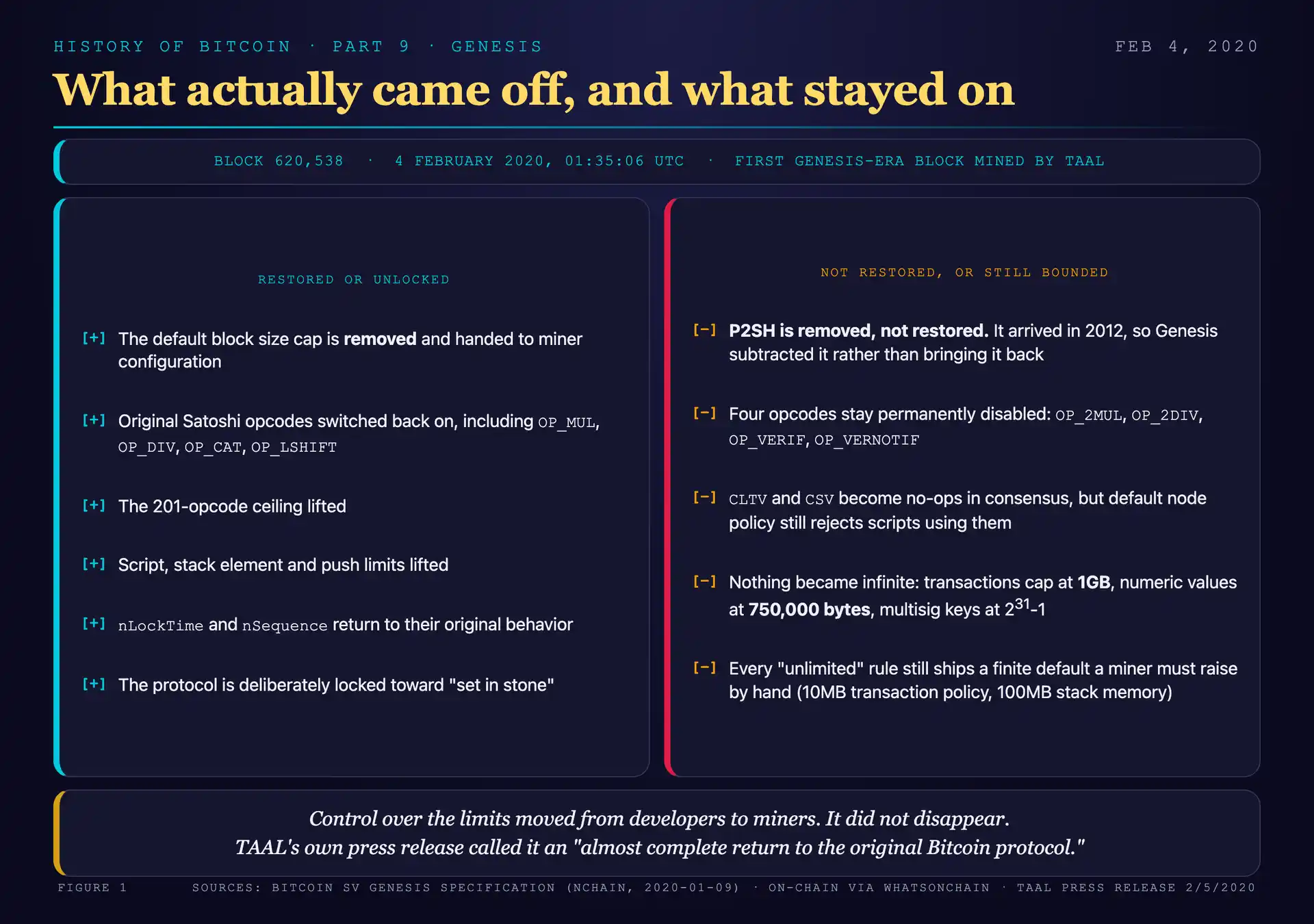
Every line on the right-hand side of that figure comes out of the upgrade's own specification, not out of a critic's blog post. The people who built Genesis wrote down exactly what they did not restore. Source: github.com/bitcoin-sv-specs/protocol
Now the part that many people writing about this get wrong, including people on my side.
Genesis did not restore everything, and the company that mined the first block under the new rules said so itself. TAAL's own press release the following day called it an "almost complete return to the original Bitcoin protocol."⁷ Almost is doing real work in that sentence, and since this series does not skip the inconvenient paragraph when the subject is somebody else, it does not get to skip one here either.
Read the specification and you find five places where the word earns itself.⁸
Pay to Script Hash was removed rather than restored, because P2SH arrived in 2012, years after Satoshi was gone, which means Genesis did not bring it back at all; it took it away for new transactions. Four opcodes stayed permanently disabled: OP_2MUL, OP_2DIV, OP_VERIF and OP_VERNOTIF. OP_CHECKLOCKTIMEVERIFY and OP_CHECKSEQUENCEVERIFY became no-ops at the consensus level, but the default policy shipping in node software still refuses scripts that use them. Nothing actually became infinite: transactions cap at one gigabyte, numeric values at 750,000 bytes, multisig keys at 2³¹-1. And every rule described as "unlimited" at the consensus layer still ships with a finite default that a miner has to raise by hand, a ten-megabyte transaction policy here, a hundred-megabyte stack memory policy there.
So: control over the limits moved from developers to miners. It did not evaporate. Somebody still sets a number. The argument Genesis actually settled was not whether Bitcoin has limits, but who gets to choose them and whether that person has money at risk when they choose badly.
That is a considerably smaller claim than "Bitcoin was set free," and it is also the only version that survives contact with the specification, so I would rather hand you the smaller true thing than the bigger one you can check in an afternoon to send me "actually, Kurt" posts on X...
The work was led by Steve Shadders and Daniel Connolly at nChain, with the Bitcoin Association carrying the standard publicly, and TAAL mined the first block under the new rules.⁹ ¹⁰ And on the night it activated, the total number of mainstream financial journalists who noticed was, as far as I can tell, zero!
Then came the part I actually flew to London for.
The best room we ever had
CoinGeek London opened at Old Billingsgate on February 20, 2020, and I have been to a lot of these things since.¹¹
That one was different, and the difference was not atmospheric but structural, because what actually separated that hall from every other conference floor I have walked was the ratio. At most crypto conferences, the ratio of people selling a token to people shipping a product is grim. In London that February the ratio inverted, and it inverted because seventeen days earlier the constraint that had made most of those products impossible had been removed.
Daniel Connolly previewed Teranode, the engine meant to take the chain from "the cap is gone" to "the software can actually use that."¹² Remember that name. It has a long way to run in this series and it does not pay off for years.
Ryan X. Charles demoed new modes for Money Button that let a developer make payments automatic or invisible inside an application.¹³ HandCash showed Connect, which turned wallet integration into something a competent developer could finish in an afternoon.¹⁴ Jack Liu unveiled Output Capital, a fund pointed at the companies in the room.¹⁵ Centbee launched Personal Paymail.¹⁶ A small network-monitoring outfit called UptimeSV walked on stage under a brand new name, Bitping, which is the name it still trades under.¹⁷ Twetch, the on-chain social network, showed an invite system, an SDK and private messaging.¹⁸ UNISOT launched a seafood supply-chain product.¹⁹ nChain, PDX and EHR Data announced a plan to move forty-one years of healthcare records onto the chain.²⁰
Tom Lee of Fundstrat and the economist George Gilder gave keynotes.²¹ Craig Wright delivered his "Satoshi Vision" address and did an on-stage session with Jimmy Wales, the founder of Wikipedia.²² Thomas Moser, an alternate member of the governing board of the Swiss National Bank, was on the program, which tells you something about who was willing to be seen in that building in February 2020.²³
The house organ covering its own event wrote that "the era of fear is over," and joked that 2020 was shaping up to be the year of the SDK wars, since something like a third of the presentations were developer kits.²⁴
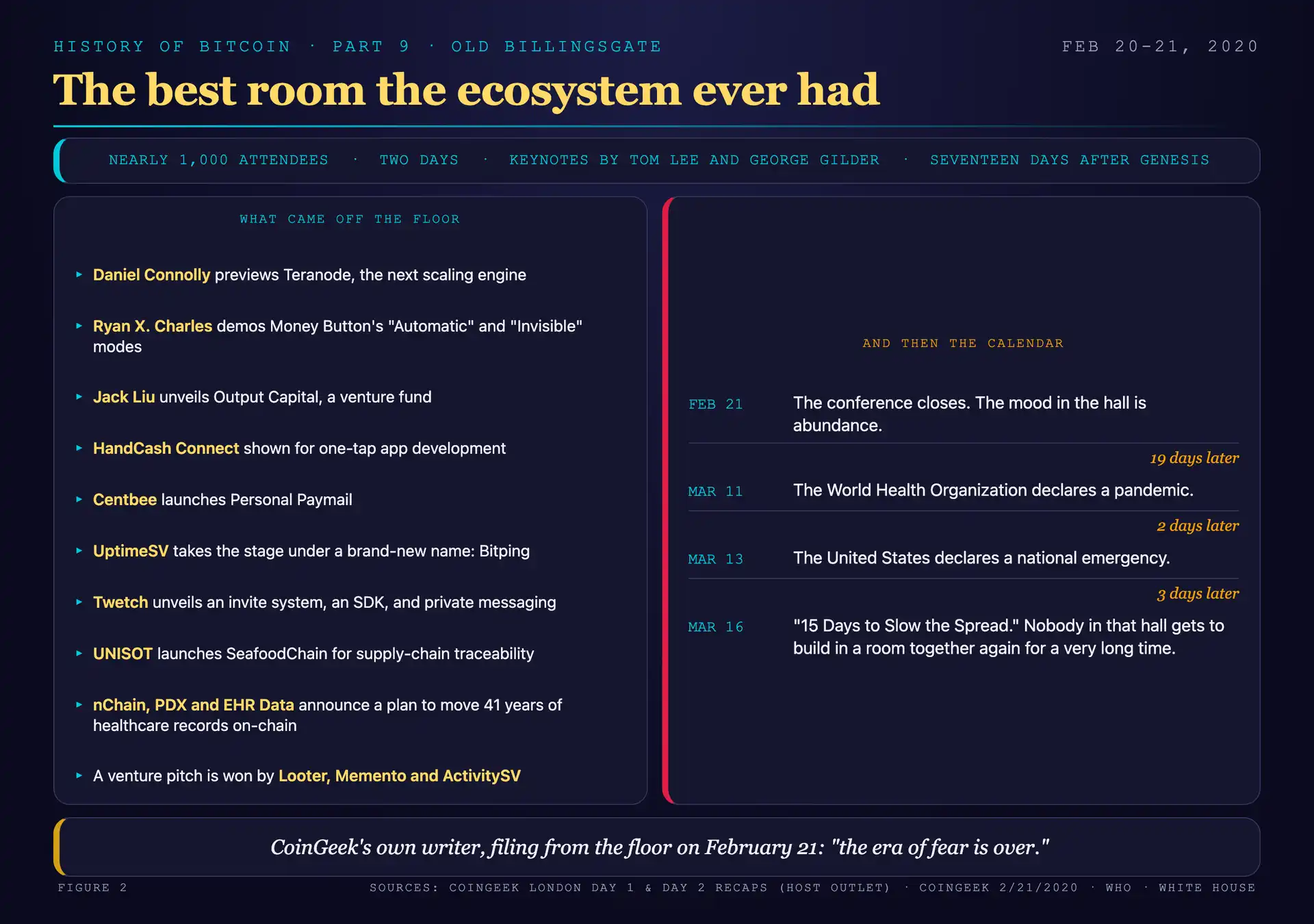
What I actually took away from those two days was narrower than the mood, and it has stayed with me for six years.
Every single one of those products needed the same two things: data on a public ledger for a price that rounds to near nothing, and payments small enough and fast enough that a normal person would not think about them. Not one of them needed the price of the coin to go up. Several of them worked better if it did not. That is what a builder economy looks like from the inside, and for about a month and a half, in one hall in London and in a few hundred offices scattered around the world, it existed.
I flew home on February 21 believing the bitcoin scaling argument was finally over and the building could start.
It was February 21. The world we grew up in had about three weeks left.
The curveball
The dates land like artillery, one after another, and they land faster than anybody standing underneath them understood at the time.
Wuhan, a city of eleven million people, was sealed on January 23.²⁵ The World Health Organization declared a public health emergency of international concern on January 30.²⁶ The disease got its name on February 11.²⁷ Genesis activated on February 4 and the London conference ran on the 20th and 21st, both of them inside that window, both of them booked by people reading the same headlines as everyone else and concluding it was a regional problem that wouldn't impact the West.
Then March. Global Pandemic declared on the 11th.²⁸ American national emergency on the 13th.²⁹ "15 Days to Slow the Spread" on the 16th.³⁰
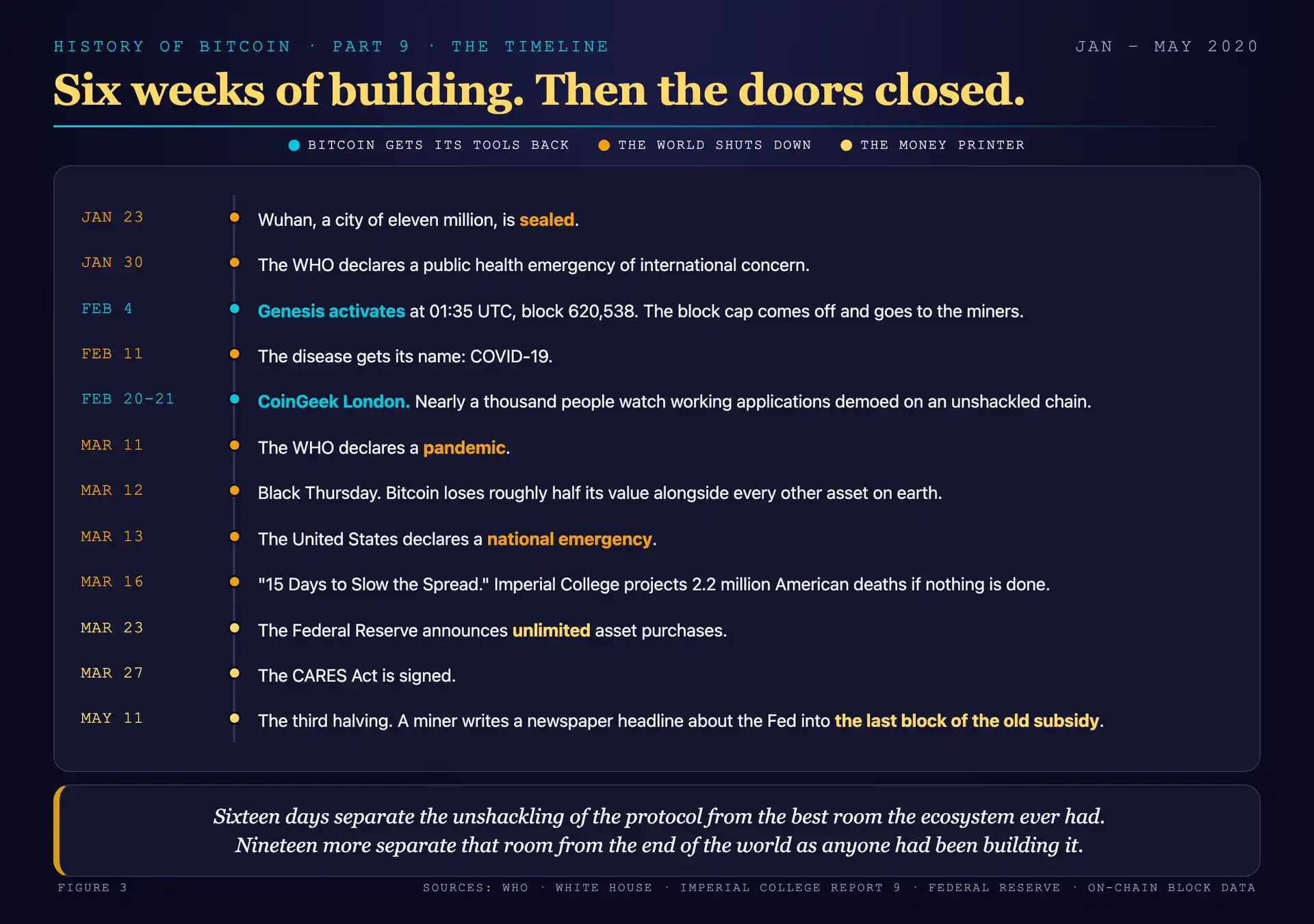
That same day, Neil Ferguson's team at Imperial College published Report 9, the modeling document that did more than any other to set policy in the English-speaking world. Its headline number was that an unmitigated epidemic would produce "approximately 510,000 deaths in GB and 2.2 million in the US."³¹ The caveat traveled with the number in the report itself and got stripped off almost everywhere it was quoted: that scenario assumed the "(unlikely) absence of any control measures or spontaneous changes in individual behaviour," and it was generated on a baseline reproduction number of 2.4.³² A projection of what happens if eight billion people are told nothing and change nothing became, in about seventy-two hours, the projection of what would happen.
And underneath the official timeline ran the other thing, the one I remember more vividly than any press conference.
The videos: people collapsing in the street in China, filmed on phones, reposted a thousand times, arriving on my feed in January already wearing captions that told me exactly what I was supposed to be watching. Snopes went through them at the end of that month and found what you would expect: the footage was largely real, shot in various locations around China in January 2020, originally posted by ordinary citizens who said they had witnessed what they filmed.³³ What was not real was the certainty in the captions. No authority ever confirmed that any specific person in any of those clips had the virus. Two of the collapses Snopes traced turned out to be a traffic accident and a head injury, and a WHO spokesman called sudden collapse an atypical presentation of the disease.³⁴
Genuine footage, unconfirmed cause, recaptioned by strangers, distributed globally in days. That is the texture of how the dread got manufactured, and the dread is what made the rest of the year possible.
Now the part that has aged strangely:
Every American intelligence agency assessed that SARS-CoV-2 was NOT developed as a biological weapon. ³⁵ Not one dissent. Should we trust US Three-Letter-Agencies? Maybe. Maaaaybe.
What the agencies actually split on is hard to dismiss, though, in hindsight: whether the pandemic began with a laboratory accident. There, they genuinely disagree, and each of them carries a confidence level that almost never survives being repeated on the internet. The FBI assesses a lab incident as most likely, at moderate confidence.³⁶ The Department of Energy assesses a lab leak at low confidence.³⁷ The CIA said in January 2025 that a research-related origin is more likely than a natural one, at low confidence, and was explicit that this rested on a fresh look at existing reporting rather than new intelligence.³⁸ The National Intelligence Council and several other agencies favor natural origin, also at low confidence.³⁹ Two or three agencies cannot pick.
Not exactly a clean post-mortem report.
Nobody has closed this, and that is not a rhetorical hedge on my part but the actual state of the declassified record as it stands in 2026.
What is more importantly not unresolved is the money. American taxpayer funds went, through the NIH, to EcoHealth Alliance under Peter Daszak, and from EcoHealth to coronavirus research at the Wuhan Institute of Virology, under grant R01AI110964.⁴⁰ In January 2025 the Department of Health and Human Services formally debarred both Daszak and EcoHealth Alliance from receiving federal funding for five years.⁴¹
And then there is the paper.
On January 31, 2020, the virologist Kristian Andersen emailed Anthony Fauci that he and his colleagues found the genome "inconsistent with expectations from evolutionary theory."⁴² The next day Jeremy Farrar, director of the Wellcome Trust, convened a call: Fauci, Francis Collins, Andersen, Eddie Holmes, Andrew Rambaut, Robert Garry, Ian Lipkin, Patrick Vallance and several European virologists.⁴³
On February 2, Andersen opened a private Slack channel titled "Project Wuhan Engineering" and wrote that "the furin cleavage site is very hard to explain," and that "the lab escape version of this is so friggin' likely to have happened because they were already doing this type of work and the molecular data is fully consistent with that scenario."⁴⁴
Two days later, on February 4, he wrote to the National Academies of Sciences that the engineered-virus idea should be publicly characterized as "crackpot" and "fringe."⁴⁵
Two days, from privately friggin' likely to publicly crackpot!
On February 17, the day the paper first posted, Farrar asked Andersen for one edit. The request is on the congressional record, in his own words: "Sorry to micro-manage/microedit! But would you be willing to change one sentence? From: It is unlikely that SARS-CoV-2 emerged through laboratory manipulation of an existing SARS-related coronavirus. To: It is improbable that SARS-CoV-2 emerged through laboratory manipulation of an existing SARS-related coronavirus."⁴⁶
Andersen's reply, in full: "Sure, attached."
On March 17, Nature Medicine published "The Proximal Origin of SARS-CoV-2," which told the world that "our analyses clearly show that SARS-CoV-2 is not a laboratory construct or a purposefully manipulated virus," and that "we do not believe that any type of laboratory-based scenario is plausible."⁴⁷ Forty-six days after the private alarm.
The authors say their view changed because the data changed, and there is a dated event supporting them. On February 24, Holmes shared an unpublished bat coronavirus, RmYN02, carrying a partial insertion at the same genomic location that had been troubling them, and wrote: "I'm now very strongly in favour of a natural origin."⁴⁸ A writer named Kevin Drum who went through the entire released Slack archive concluded it showed "scientists doing science and having private conversations," and found no evidence of improper behavior.⁴⁹
But notice what the same archive shows on February 25, three weeks after Andersen told the National Academies the idea was crackpot. Andersen, privately, still: "At this stage we unfortunately just can't rule out a potential accidental infection."⁵⁰
Both things happened at once: new data arrived and genuinely changed minds, and the public message hardened three full weeks before the private uncertainty did. The House Select Subcommittee spent two years on this sequence and concluded in December 2024 that the pandemic most likely emerged from a laboratory, which is that committee's finding and not a scientific consensus or a judicial one.⁵¹
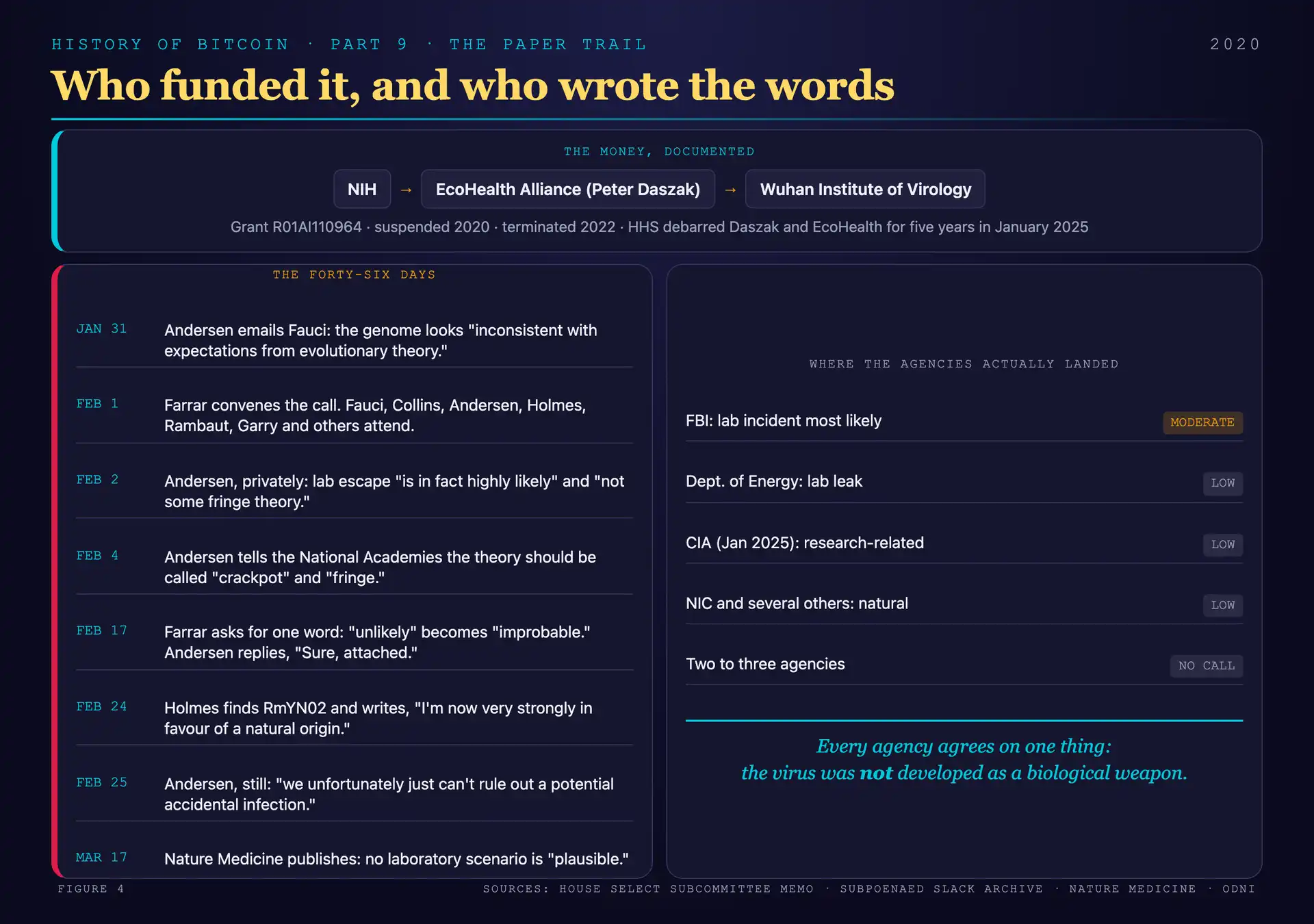
I am not going to tell you what happened in that lab. Nobody reading this knows, and the people who say they know with certainty, in either direction, are telling on themselves.
What I will tell you is fully documented. The institution that funded the research helped shape the language of the paper that told the public the research was irrelevant. The man who convened the call asked for the word to be softened, and the word was softened.
That is as far as it goes, because the pandemic is the backdrop, not the subject, but it was the biggest backdrop of a generation, and we all had to deal with it.
What matters for Bitcoin is the lockdowns, and it is very simple. The world stopped producing things. Then it started printing money.
Black Thursday
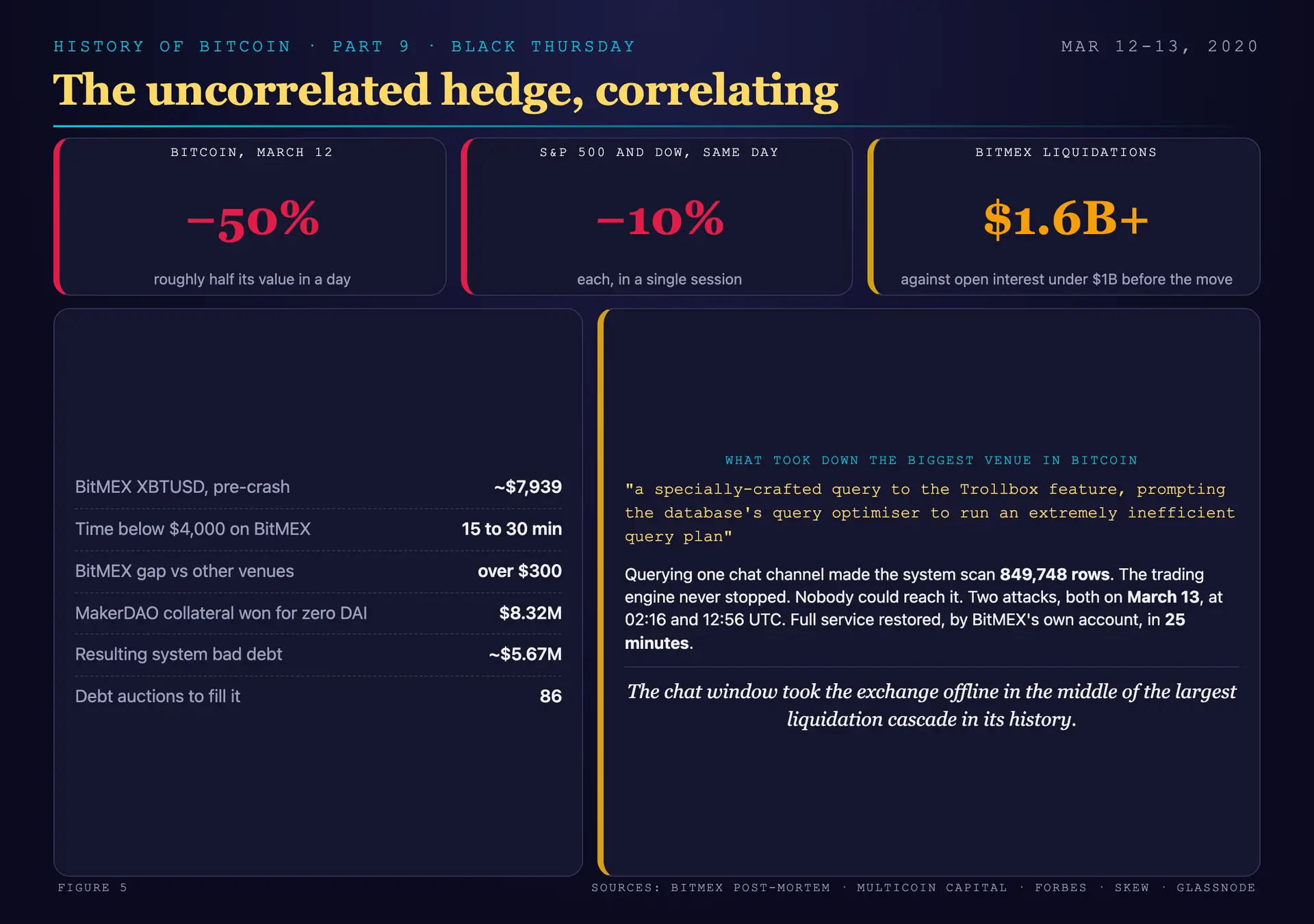
On March 12, 2020, the S&P 500 and the Dow both fell roughly ten percent in a single session, and BTC lost about half its value.⁵²
The asset that had been sold for a decade as the uncorrelated hedge, the thing you hold precisely because it does not care what Wall Street is doing, correlated perfectly with Wall Street on the first genuine macro shock it had ever faced. Everything went down together, because in a real liquidation everything is the same asset: the one you can sell.
The mechanics of that day are a fascinating case-study, because what they actually teach is a lesson about leverage and market structure rather than anything about Bitcoin itself.
Most of the damage happened on BitMEX, the derivatives exchange where traders could take positions at up to a hundred times leverage. On its XBTUSD perpetual contract, price fell from around $7,939 toward the low four thousands.⁵³ I am going to decline to give you a single dramatic bottom figure, because there isn't one: different venues printed different lows minutes apart, and the market maker Multicoin Capital, writing five days later, recorded that BitMEX spent fifteen to thirty minutes below $4,000 while trading more than $300 beneath other exchanges.⁵⁴ When someone quotes you a precise Black Thursday low without naming a venue, they are quoting a screenshot, for better or worse.
The cascade was self-feeding. Long positions got liquidated, which meant forced selling, which pushed price lower, which liquidated more longs. On BitMEX alone the liquidations ran past $1.6 billion across the two days.⁵⁵ The derivatives-data firm Skew noted that open interest in that contract had been under $1 billion before the move, which means the forced selling exceeded the entire position base that existed when the day started.⁵⁶
And then, in the middle of it, on March 13, the biggest venue in Bitcoin went dark.
BitMEX was hit by two attacks that day, at 02:16 and 12:56 UTC.⁵⁷ The exchange's own post-mortem is worth reading because the vector is almost comic: the attacker sent "a specially-crafted query to the Trollbox feature, prompting the database's query optimiser to run an extremely inefficient query plan."⁵⁸ The Trollbox was the chat window. Querying the Spanish-language channel made the system scan 849,748 rows to find enough matching messages, which exhausted the resources of the authentication layer sitting in front of the trading engine. The engine itself kept working. Nobody could reach it. BitMEX says it restored full service within twenty-five minutes and later refunded 156 accounts a total of 40.297 BTC for stop orders that fired wrongly.⁵⁹
For twenty-five minutes, the biggest venue in Bitcoin simply switched off.
A number of analysts have argued since that the outage is the only reason the price found a floor. Sam Trabucco, then of Alameda Research, put it about as strongly as it can be put, saying it was "quite likely" Bitcoin "would've printed at zero" on that venue absent the interruption.⁶⁰ That may have been hyperbolic, but there was absolutely a cascade running out of bids, a chat box knocking the venue offline, and a market that stopped falling while it was gone.
Ethereum's DeFi ecosystem had its own version of the same lesson. As gas fees spiked, MakerDAO's liquidation auctions stopped functioning properly, and some closed with a single bidder winning collateral for zero DAI: roughly $8.32 million of ETH taken for nothing, leaving somewhere around $5.67 million in system bad debt that had to be covered by minting and auctioning governance tokens.⁶¹ Eighty-six auctions raised over 4.3 million DAI to fill the hole.⁶²
The takeaway that mattered for the rest of the year had nothing to do with the price recovering, which it did. It was that the entire apparatus built on top of Bitcoin between 2017 and 2020, the leverage, the perpetual swaps, the hundred-to-one positions, was not a hedge against the financial system. It was a higher-beta copy of it, and the first time the real economy sneezed, it fell harder than the thing it claimed to replace.
Twelve days later the Federal Reserve announced it would buy assets without limit.
The printer and the pivot
The Federal Reserve publishes its own balance sheet every week, which means you do not have to take anybody's word for what happened next.
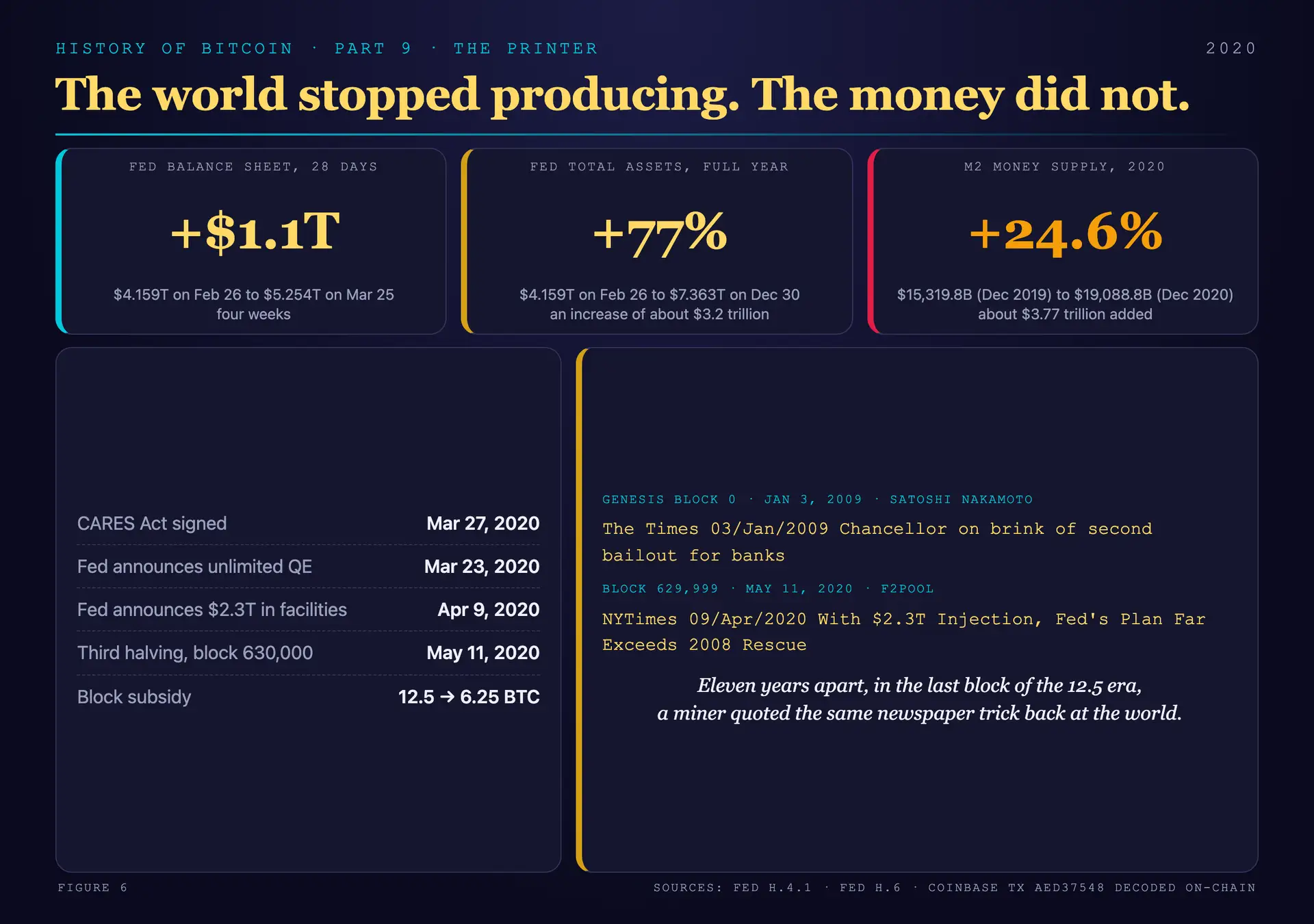
On February 26, 2020, four days before the world started closing, the Fed held total assets of $4,158,637 million.⁶³ On March 25, twenty-eight days later, it held $5,254,278 million.⁶⁴
Roughly $1.1 trillion, in four weeks!
By December 30 the number was $7,363,351 million, an increase of about $3.2 trillion across the year, roughly seventy-seven percent.⁶⁵ The broad money supply told the same story from the other end: M2 went from $15,319.8 billion in December 2019 to $19,088.8 billion in December 2020, about $3.77 trillion added, a rise of 24.6 percent.⁶⁶ The CARES Act was signed on March 27 with a headline figure around $2.2 trillion.⁶⁷ On April 9 the Fed announced a further $2.3 trillion in lending facilities.⁶⁸
Somewhere in March a meme appeared showing a wild-eyed man beside a currency printer, captioned "money printer go brrr," and for once the internet's shorthand was more accurate than the commentary it displaced.
Now, the even crazier part:
Governments made it illegal by decree, in most of the developed world, to go to work, open a shop, or hand a stranger anything in person. Productivity collapsed. And into an economy that had been ordered to stop producing, the monetary authorities pushed the largest one-year expansion of the modern era.
If you had been arguing since 2015 that Bitcoin was a hedge against exactly this, 2020 handed you the most vivid possible proof. And if you had been arguing that Bitcoin was a payment network for commerce, 2020 outlawed the commerce.
Both arguments were about to be tested, and only one of them had a marketing budget.
On May 11, at block 630,000, the block subsidy halved from 12.5 to 6.25 BTC.⁶⁹ Twenty seconds earlier, in block 629,999, the last block ever mined under the old subsidy, the pool F2Pool wrote something into the coinbase transaction.
I decoded the raw script myself rather than trust a screenshot, and the bytes say this:
NYTimes 09/Apr/2020 With $2.3T Injection, Fed's Plan Far Exceeds 2008 Rescue⁷⁰
Eleven years and four months earlier, in the first block of the chain, Satoshi Nakamoto had written The Times 03/Jan/2009 Chancellor on brink of second bailout for banks.⁷¹
Verify it yourself
The coinbase transaction is aed3754889f65dff83504fd0a8b78e1b69fc22c5396c67df23b0e607bf4e0d67, in block 629,999. Pull the scriptSig hex from any block explorer and decode it to ASCII. You do not have to trust a screenshot, and you should not.
Same joke, same target, eleven years apart: a different bailout an order of magnitude larger, and this time the person making it was not the inventor but a Chinese mining pool that had tucked a small fish emoji into the bytes right before the headline!
That coinbase message is the best artifact of the year, and it is also the last moment in this story where the two readings of Bitcoin are still standing side by side. Because from May onward, one of them starts winning big in the zeitgeist, and it wins for reasons that have almost nothing to do with the protocol.
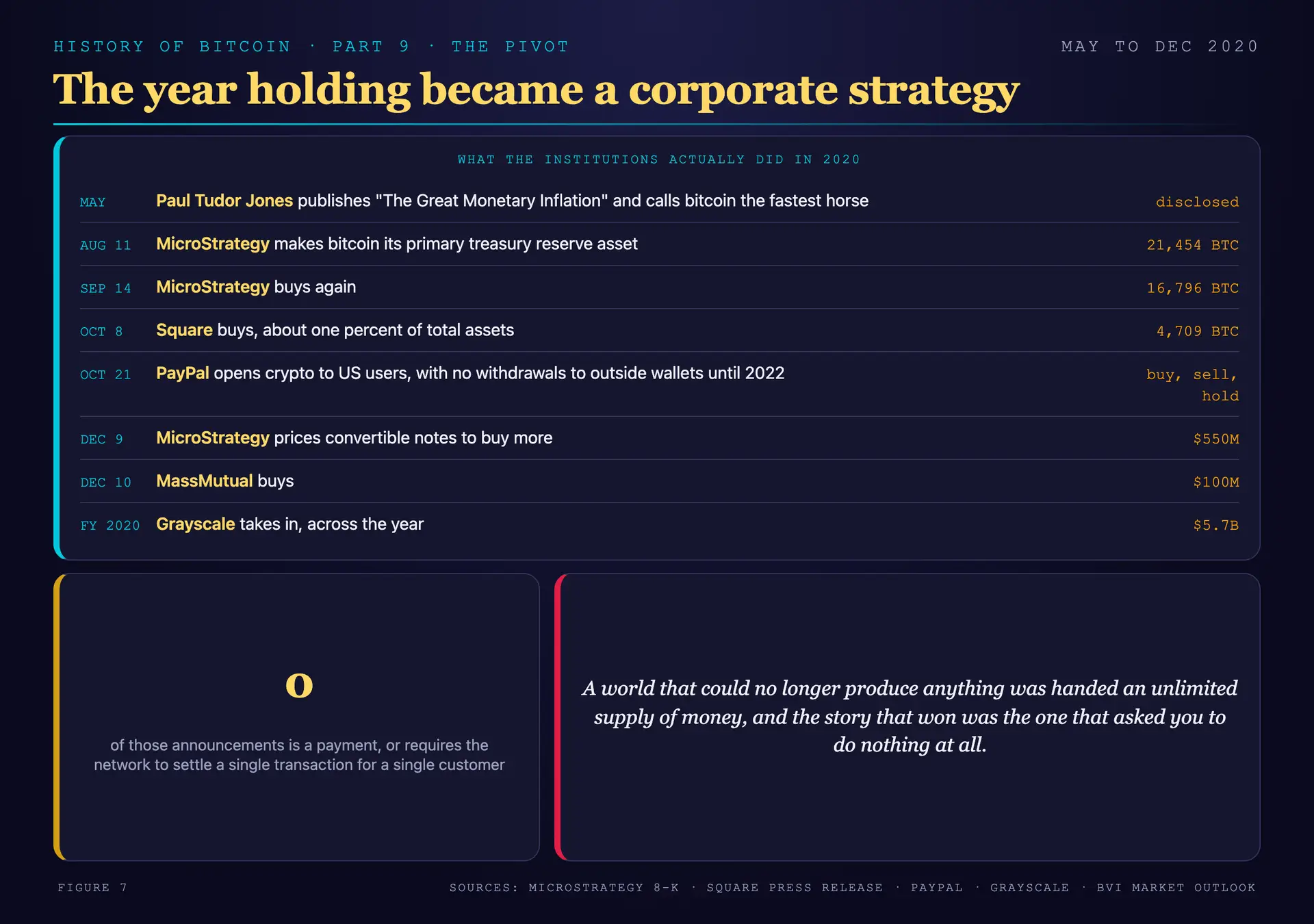
In May, the hedge fund manager Paul Tudor Jones circulated a market outlook titled "The Great Monetary Inflation" and disclosed that he held bitcoin, describing it as "the fastest horse" in the race against monetary debasement.⁷² It was the first time a Wall Street name of that size had said it out loud in a client letter.
Then the corporate treasuries arrived.
On August 11, MicroStrategy announced it had bought 21,454 BTC for $250 million and made it the company's primary treasury reserve asset.⁷³ In September it bought another 16,796 BTC for $175 million.⁷⁴ In December it priced $550 million of convertible senior notes, with another $100 million available to the underwriters, specifically to buy more.⁷⁵ A publicly traded software company had begun borrowing money to acquire bitcoin, and its chief executive Michael Saylor became the loudest voice in the asset's history.
On October 8, Square announced it had bought 4,709 BTC for $50 million, about one percent of the company's assets.⁷⁶ On October 21, PayPal opened crypto to its American user base, and the detail that matters most is the one that got the least attention: at launch, you could buy it, sell it and hold it, but you could not move it out to your own wallet. That restriction stayed in place until 2022, when PayPal announced the unlock with a phrase that admits the whole thing, telling customers they could not move crypto off the platform "until now."⁷⁷ In December, MassMutual bought $100 million.⁷⁸ Grayscale took in $5.7 billion across the year.⁷⁹
Now look at what every one of those announcements has in common:
Not one of them is a payment, and not one of them requires the network to process a single transaction for a single customer. Every one of them is an acquisition followed by storage, and in PayPal's case the customer was structurally prevented from ever taking possession of the thing they had bought.
This is the year "do nothing and get rich" stopped being a retail attitude and became institutional strategy, and it happened in the exact twelve months when building anything that required people to be in a room together was against the law. I do not think that is a coincidence.
A payment network needs merchants, and every merchant was shut. A store of value needs nothing except somebody willing to sit still, and sitting still was the only legal activity left. The narrative that required the world to be open had lost for the foreseeable future, and the narrative that required the world to be closed won, and then the winners spent the following four years explaining that it had won on the merits.
The world stopped working, and an asset that was designed to be spent quietly became an asset that existed to be held.
Meanwhile
While Bitcoin was being repriced as a savings product, the rest of the industry spent 2020 rediscovering, at great expense, the argument this series has been making since Part 3.
It started in June, when Compound launched a governance token called COMP and began distributing it to anyone who borrowed or lent on the protocol.⁸⁰ The mechanic was simple enough to be dangerous: deposit assets, receive a token, and if the token was worth more than the interest you were paying, you were being paid to borrow. Within weeks people were routing capital through elaborate loops to farm those emissions, and the whole thing acquired a name.
DeFi summer.
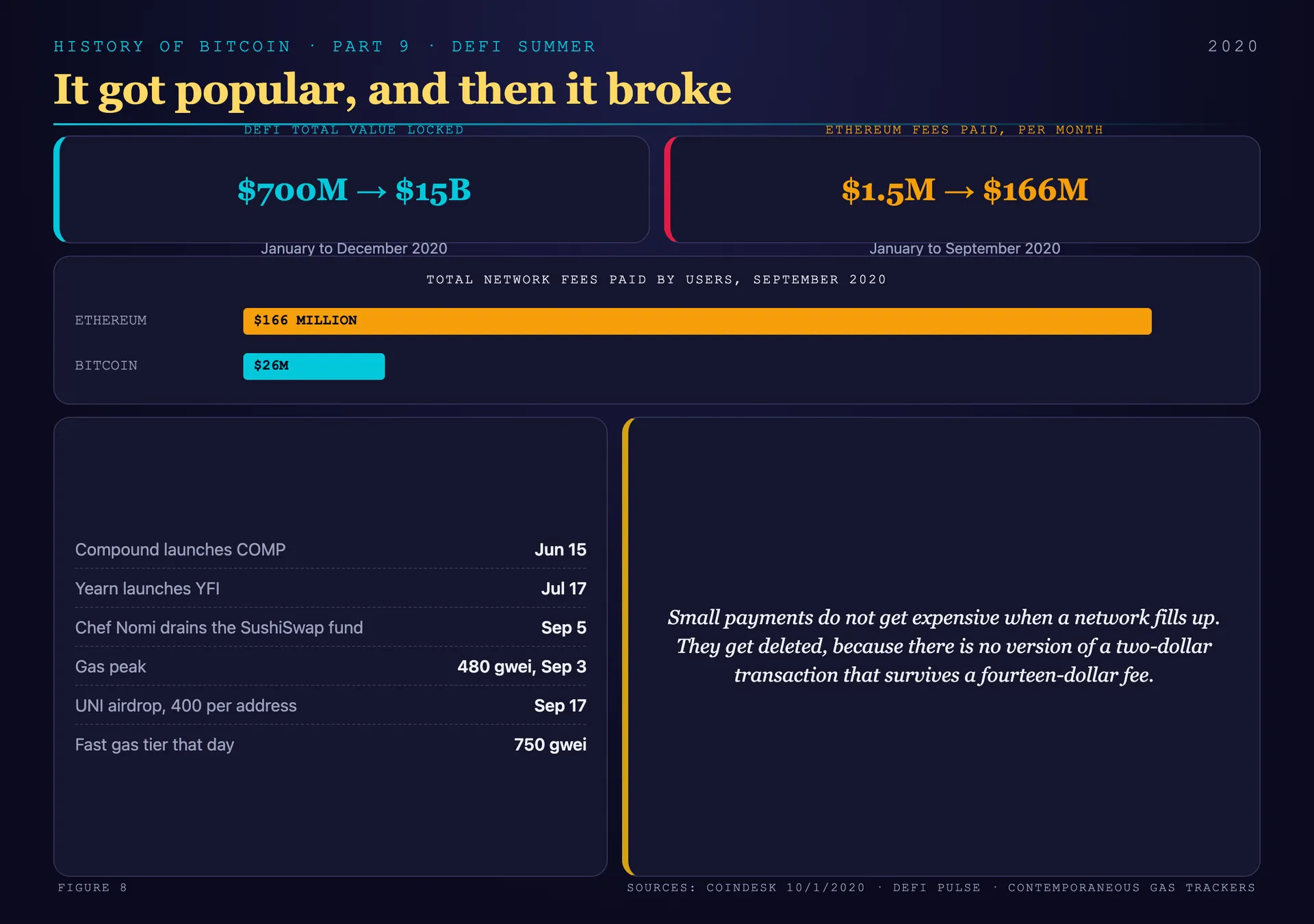
Total value locked across decentralized finance went from roughly $700 million at the start of 2020 to around $15 billion by the end of it.⁸¹ Yearn Finance launched YFI in July with its founder Andre Cronje explicitly describing the token as financially worthless, which the market took as a challenge.⁸² In late August a pseudonymous developer calling himself Chef Nomi forked Uniswap's code into SushiSwap and pointed its emissions at Uniswap's own liquidity providers, an attack so on-the-nose it got called a vampire attack.
On September 5, Chef Nomi drained the development fund, 20,039 ETH and 2,558,644 SUSHI, roughly fourteen to fifteen million dollars, and the token fell eighty-eight percent.⁸³ The next day Sam Bankman-Fried publicly intervened and was handed the keys to the protocol.⁸⁴ On September 11 Chef Nomi returned the fourteen million.⁸⁵ Control of one of the largest new protocols in the industry passed to the founder of FTX, who moved the admin keys to a multisig and carried on.
Readers of Part 8B already know what Sam was quietly building underneath all of this, and 2020 is the year his fingerprints get onto very nearly everything.⁸⁶
Uniswap answered SushiSwap on September 17 by airdropping 400 UNI to every address that had ever used it, which at the time was several thousand dollars for having once swapped a token.⁸⁷ Free money, delivered to a few hundred thousand wallets at once, on a network that was already running flat against its own ceiling.
And that is where the whole thing broke, in the most instructive way possible.
Ethereum in 2020 got genuinely, undeniably popular. Real users, real products, real volume, the thing every chain says it wants, and the moment it arrived the network turned around and priced its own users straight back out of it. Total fees paid on Ethereum went from about $1.5 million in January 2020 to about $166 million in September.⁸⁸ In the same month, every fee paid by every user of the Bitcoin network came to $26 million.⁸⁹ Gas prices peaked above 480 gwei in early September, and on the day of the UNI airdrop the fast tier hit 750.⁹⁰
A protocol that had spent five years telling Bitcoiners that blocks were an implementation detail hit its ceiling, and ordinary users discovered that using it cost more than the thing they were trying to do.
This is the argument. Not mine, not Craig Wright's, not a position paper. It is a natural experiment that ran on somebody else's chain, in public, with the numbers published daily. When a network with a hard capacity limit becomes popular, the limit becomes a toll, the toll becomes a filter, and the filter selects for people moving large sums. Small payments do not get expensive. They get deleted, because there is no version of a two-dollar transaction that survives a fourteen-dollar fee.
The rest of the field filled in around it. Solana's mainnet beta went live on March 16 under Anatoly Yakovenko and Raj Gokal, and in August it acquired its defining relationship when Sam Bankman-Fried launched the Serum exchange on it, with FTX and Alameda as its principal backers.⁹¹ Polkadot, Cardano's Shelley upgrade, Binance Smart Chain, Avalanche and Filecoin all shipped between May and October.⁹² Ethereum's own long-promised proof-of-stake beacon chain finally reached its deposit threshold with hours to spare and went live on December 1.⁹³
And Tether, the subject of much of Part 8B, grew from about $4 billion in supply to about $20 billion across the same twelve months.⁹⁴ The private printer scaled alongside the public one, in the same year, and almost nobody in crypto treated that as a thing requiring explanation.
He did it again
Then, on November 15, 2020, Bitcoin Cash split in half for the second time.
The proximate cause was a developer funding proposal.
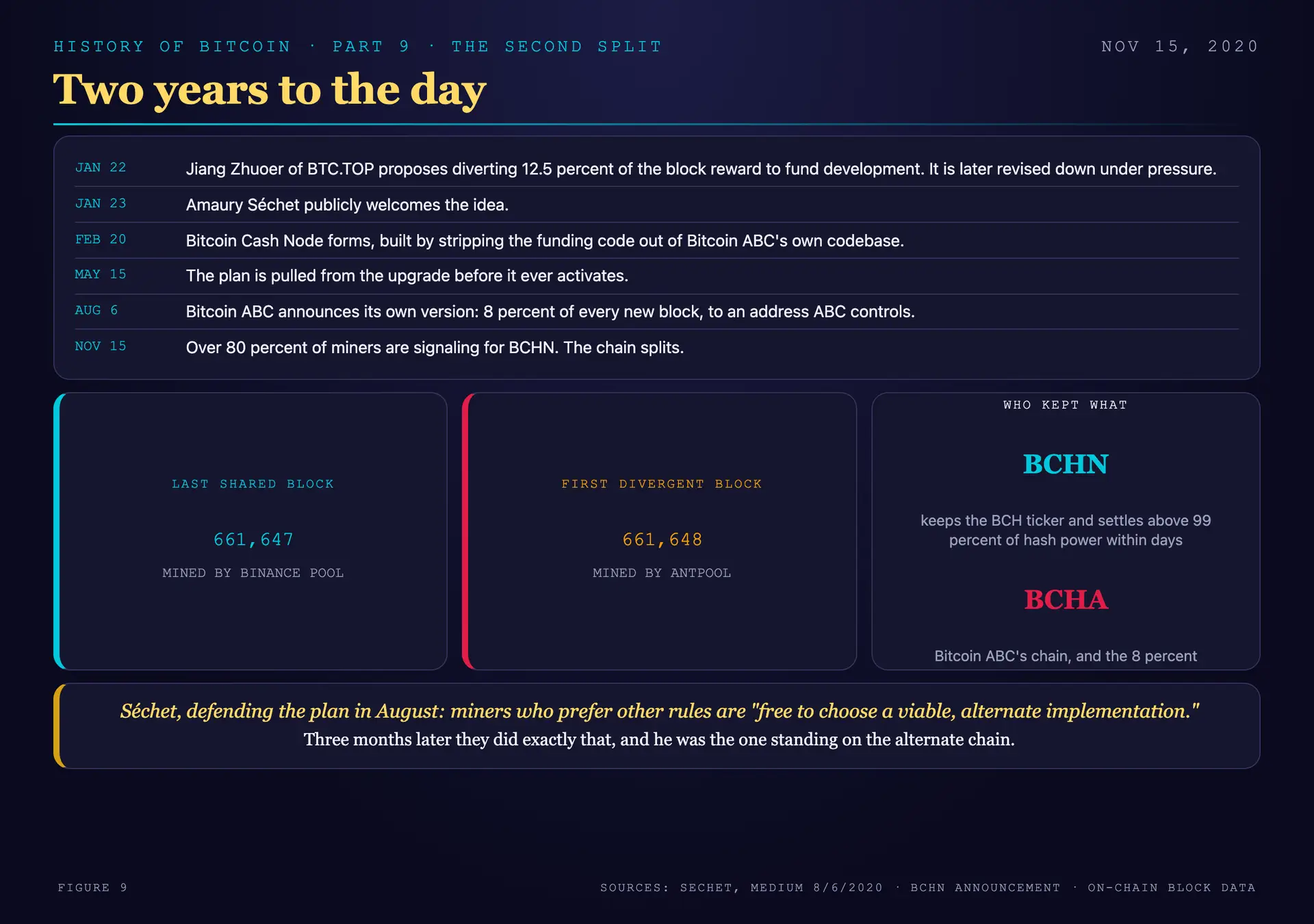
It did not seem to start with Amaury Séchet this time. On January 22, 2020, Jiang Zhuoer, who ran the mining pool BTC.TOP, published a plan to divert 12.5 percent of the block reward to fund development, later revised downward under pressure.⁹⁵ Séchet publicly welcomed the idea the next day.⁹⁶ That version got pulled from the May upgrade before it ever activated.⁹⁷
The version that actually split the chain came seven months later. On August 6, 2020, Séchet announced Bitcoin ABC's own plan, and its mechanism was harder-edged than Zhuoer's: "All newly mined blocks must contain an output assigning 8% of the newly mined coins to a specified address."⁹⁸ The address was controlled by Bitcoin ABC.
Séchet deserves credit for the argument, because he had a real one. His case was that developers funded by outside money are captured by that money, and that the only honest fix is to pay them from the block reward so that they "risk the immediate loss of their own wealth" when they damage the network.⁹⁹ He warned that node implementations had developed a "financial reliance on powerful interests such as mining corporations, venture capital funds, and angel investors."¹⁰⁰ Anyone who read Part 6 of this series knows I think he was describing a real disease.¹⁰¹
He was also proposing that the cure be paid into an address he controlled, on a chain whose entire origin story was a revolt against developers who thought they were the protocol; which is its own problem that he conveniently ignored.
The revolt was immediate and it was everybody: node teams, businesses, exchanges, and above all the miners, who were being asked to hand over eight percent of their revenue for the privilege of running software they had not asked for. Bitcoin Cash Node had already formed in February, built by removing the funding code from ABC's own codebase, and its stated purpose was to be "a safe and professional node implementation that will neutrally follow the longest chain without contributing to the risk of a chain split."¹⁰² By the eve of the fork, more than eighty percent of Bitcoin Cash miners were signaling for it.¹⁰³
The chain split at block 661,648, mined by AntPool, a few minutes after the last shared block 661,647, mined by Binance Pool.¹⁰⁴ BCHN kept the ticker and settled above ninety-nine percent of the hash power within days.¹⁰⁵ Bitcoin ABC's chain became BCHA, and it was rebranded eCash the following year.¹⁰⁶
Séchet's own August announcement had contained the line that reads best in hindsight. Defending the plan, he wrote that it was fine, because miners who preferred other rules were "free to choose a viable, alternate implementation."¹⁰⁷
Three months later the miners took him up on it, and the man who wrote the sentence was the one left standing on the alternate chain!
Now check the date against Part 7.¹⁰⁸
The Bitcoin SV fork, the hash war, the thing that produced the chain this whole article has been following, happened on November 15, 2018. The Bitcoin Cash split happened on November 15, 2020.
The man who had been the immovable center of the first split found himself, on its second anniversary, holding the minority chain and the eight percent. Fascinating...
The builders in the plague year
While all of that was happening, the people from the London hall went home, sat down in spare bedrooms, and kept building for an audience that was now legally confined to its houses.
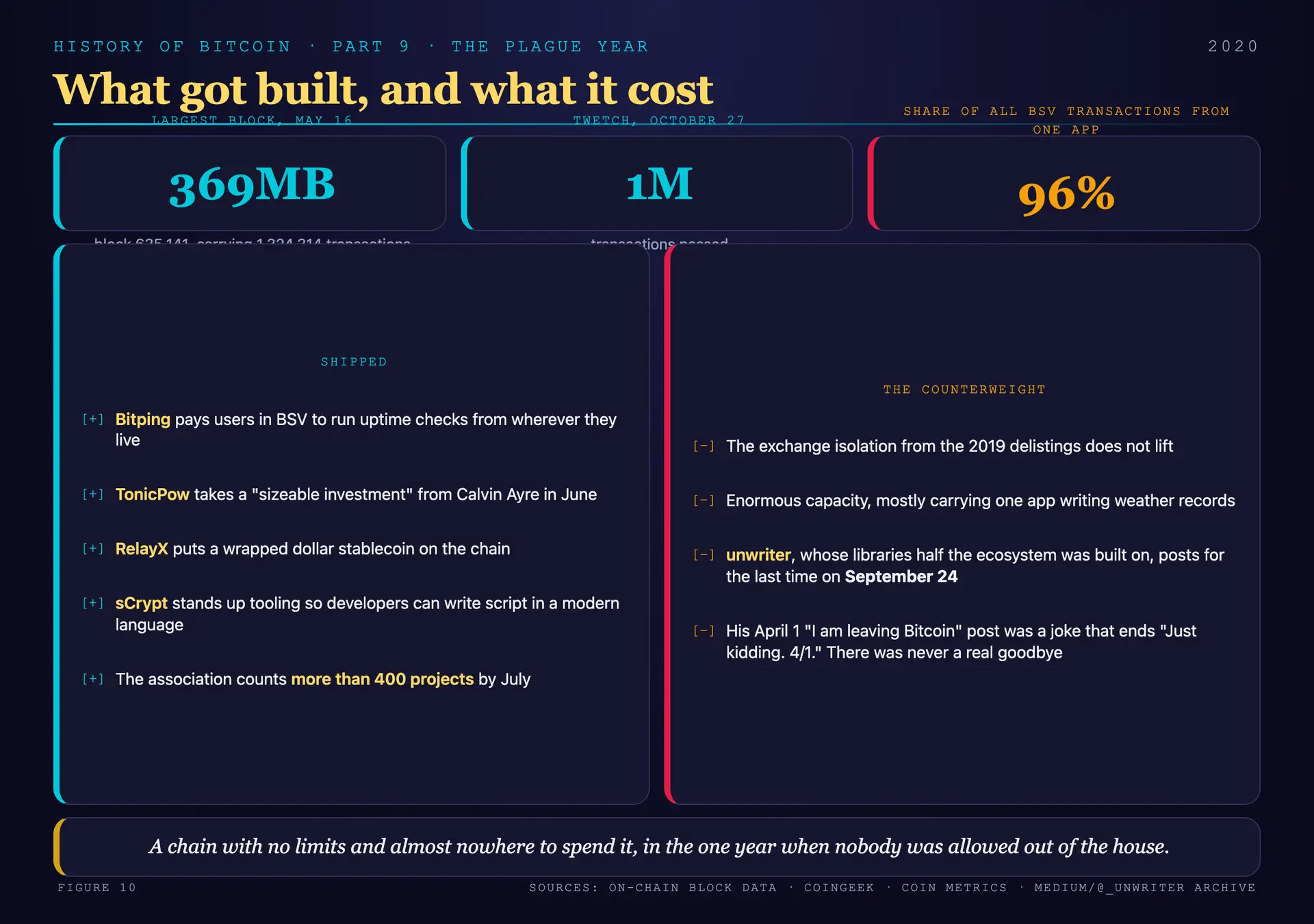
Some of it worked. On May 16, 2020, a single BSV block came in at 369 megabytes carrying 1,324,314 transactions, which was, at that moment, the largest block ever mined on any Bitcoin chain anywhere.¹⁰⁹ Three months after Genesis, the capacity was not theoretical.
Twetch passed a million transactions on October 27.¹¹⁰ Bitping, fresh off its rebrand in London, was paying ordinary users in BSV to run uptime checks against customers' websites from wherever they happened to live, which is a genuinely novel thing to do with micropayments.¹¹¹ TonicPow, built by Luke Rohenaz, Austin Rappaport and Attila Aros out of the association's first hackathon, took a "sizeable investment" from Calvin Ayre in June.¹¹² RelayX shipped wrapped USDC, putting a dollar stablecoin on the chain for the first time.¹¹³ sCrypt stood up its tooling org in May so developers could write Bitcoin script in something resembling a modern language.¹¹⁴ By July the association counted more than four hundred projects in the ecosystem.¹¹⁵
And now the counterweight.
The exchange isolation that Part 8 documented did not lift in 2020.¹¹⁶ The chain that had just removed every limit was still absent from most of the venues where normal people buy things, and being technically unshackled while being commercially quarantined is a difficult combination to build a consumer business on.
Worse, and more honestly: the usage was thin. In January 2020, an analysis circulated showing that as much as ninety-six percent of BSV's on-chain transactions traced back to a single application, WeatherSV, which wrote weather data to the chain.¹¹⁷ While the use case is novel, and people were actually generating lots of genuinely economic transactions, it wasn't enough to move the needle for self-sustainability.
I believed then and believe now that the capacity had to exist before the applications could, and that you cannot fault a road for being empty the month it opens. But the empty road was empty, and anyone who told you in 2020 that BSV had product-market fit was being very colorful with the sales pitch.
Then the loss that hurt most, and it did not happen the way people remember it.
There was a pseudonymous developer called unwriter whose libraries half the ecosystem was built on: Planaria, Bitbus, Bitsocket, the B:// and C:// protocols, Datapay. If you were writing an application on that chain in 2019, you were almost certainly writing it on top of his work.
The version of this story that circulates is that he announced he was leaving in April 2020. He did not. I have seen that repeated as fact ever since, and it is wrong. On April 1, 2020, he published a post titled "The Resolution of the Bitcoin SV Experiment" containing the line "I am leaving Bitcoin," followed immediately by "Just kidding. 4/1."¹¹⁸ It was an April Fools' joke, and it has been quoted straight ever since by people who read the headline.
What actually happened is quieter and worse. He kept publishing through the spring, put out his last post on September 24, 2020, and then stopped.¹¹⁹ No announcement, no explanation, no goodbye.
My own year turned here too, and I will keep it short.
Through all of the above I was not a Bitcoin professional. I was a cybersecurity guy with a mining operation, a near-daily livecast and strong opinions, doing this on nights and weekends the way I had since 2013. I actually caught the virus at the London CoinGeek event, and quarantined in my own house for two weeks while my wife raised our infant without me. Then, at the end of October 2020 I left that cybersecurity career because I believed THAT MUCH in Bitcoin SV. On November 19, 2020, I announced I was joining CoinGeek as Chief Bitcoin Historian¹²⁰ to help "right the wrongs of the Bitcoin Civil War."
The year the world shut down is the year I went all in on this, from a house I was not allowed to leave, in an industry that had just been told its main use case was staying still.
Crazy? Maybe. But definitely committed.
The man in the dock
Which brings us back to the envelope.
On January 6, 2020, Craig Wright produced a document in discovery: the deed to a third trust, Tulip Trust III.¹²¹ The plaintiffs told the court he had offered no explanation for why it arrived so late.¹²²
On January 10, Judge Beth Bloom ruled on the appeal of the sanctions that closed Part 8, and she did two things at once. She vacated the harshest parts of Magistrate Reinhart's order, the deemed facts and the struck defenses, which was a genuine win for Wright and sent the partnership question to a jury rather than deciding it by punishment.¹²³ She upheld the attorney's fees. And on the courier, she wrote this:
"the Court questions whether it is remotely plausible that the mysterious 'bonded courier' is going to arrive, yet alone that he will arrive in January 2020 as the Defendant now contends. However, given that the Defendant maintains that he should at least be afforded this opportunity, the Court will indulge him this much."¹²⁴
She gave him until February 3 to say whether the courier had appeared.¹²⁵ She also noted, on the harm his conduct had caused, that "the Court has no doubt that the Plaintiffs were prejudiced by the Defendant's antics," and dismissed the contrary argument as "entirely devoid of merit."¹²⁶
On January 14, Wright filed notice that the courier had come. The filing said "a third party has provided the necessary information and key slice to unlock the encrypted file, and Dr. Wright has produced a list of his bitcoin holdings."¹²⁷
The market believed it. BSV roughly doubled intraday, from about $194 to about $438.¹²⁸
Then people looked at what had actually been delivered. It was a list of 16,404 bitcoin addresses.¹²⁹ Public addresses. The equivalent of proving you own a house by writing down its street number.
Within days, Wright's own attorney, Andres Rivero, conceded the point to the press: the file "did not include private keys."¹³⁰
The courier arrived, and he brought a list of addresses that anybody with a block explorer could have written down in an afternoon. The keys were not in it, as far as the public record is concerned.
However, despite the grandiosity and perhaps absurdity of it all, the reason for lack of production of a "Satoshi proof" happened for reasons that have been lived in infamy ever since.
Tulip Trading alleged that on or about February 5, discovered on the 8th, hackers accessed Wright's home computers and removed the encrypted keys to two addresses holding roughly four billion dollars of bitcoin.¹³¹ That allegation belongs to English proceedings that begin in 2021 and it has never been adjudicated. I report it as what it is: a claim, made later, about a thing that supposedly happened three weeks after the courier failed to deliver.
On March 9, Magistrate Judge Bruce Reinhart ruled on Wright's privilege claims, and this is where 2020 stops being a bad year and becomes a permanent record.
Wright had asserted attorney-client privilege over approximately 11,000 documents on behalf of seventeen corporations, all of which the court noted were "either dissolved or in liquidation."¹³² To support the courier story he had submitted a sworn declaration from Denis Bosire Mayaka.¹³³ Reinhart rejected it:
"I disregard the Mayaka Declaration because it has not been adequately authenticated. Particularly given my prior finding that Dr. Wright has produced forged documents in this litigation, I decline to rely on this kind of document, which could easily have been generated by anyone with word processing software and a pen."¹³⁴
And then the sentence that follows him still:
"I give no weight to sworn statements of Dr. Wright that advance his interests but that have not been challenged by cross-examination... I have previously found that Dr. Wright gave perjured testimony in my presence."¹³⁵
A week later the court awarded the plaintiffs $165,800.09 in fees and costs, against the $658,581.78 they had asked for.¹³⁶
Then, on May 24, 2020, someone anonymously posted a message signed with the private keys of 145 addresses taken from Wright's own filed list.¹³⁷ The message began: "Craig Steven Wright is a liar and a fraud."¹³⁸ It ended: "We are all Satoshi."¹³⁹
Why a signed message settles something a document cannot
Signing a message with a private key proves possession of that key at that moment. It cannot be forged, backdated, or generated with word processing software and a pen. It does not depend on anybody's credibility.
There are exactly two explanations. Either Wright had shared, on purpose or by some nefarious circumstance, the private keys to 145 addresses he had sworn under oath he could not access, or he had never controlled them.
Meanwhile the English courts were closing on to him. In January, Mr Justice Jay dismissed his claim against Magnus Granath on jurisdictional grounds, because the Norwegian court had been seised first.¹⁴⁰ In May, the Court of Appeal dismissed his appeal in the Ver case, with Lord Justice Dingemans finding that "England and Wales is not clearly the most appropriate place to bring this action for defamation," noting that the question of who invented Bitcoin is a global one and that there had been four times as many publications in the United States.¹⁴¹ He had already quietly discontinued his claim against Adam Back in January, paying Back's costs.¹⁴² Peter McCormack, resident in England and therefore impossible to shake on jurisdiction, remained the one defendant who could actually drag the truth of the Satoshi claim in front of an English judge.
And on September 10, 2020, with no reference to Craig Wright anywhere in its founding materials, Square announced the Cryptocurrency Open Patent Alliance, an organization formed to pool cryptocurrency patents and keep them from being used as weapons.¹⁴³ Coinbase joined as a founding board member.¹⁴⁴
COPA would file suit against Wright in April 2021. But in September 2020 it was a patent pledge pool, and, officially, nobody involved was thinking about him at all.
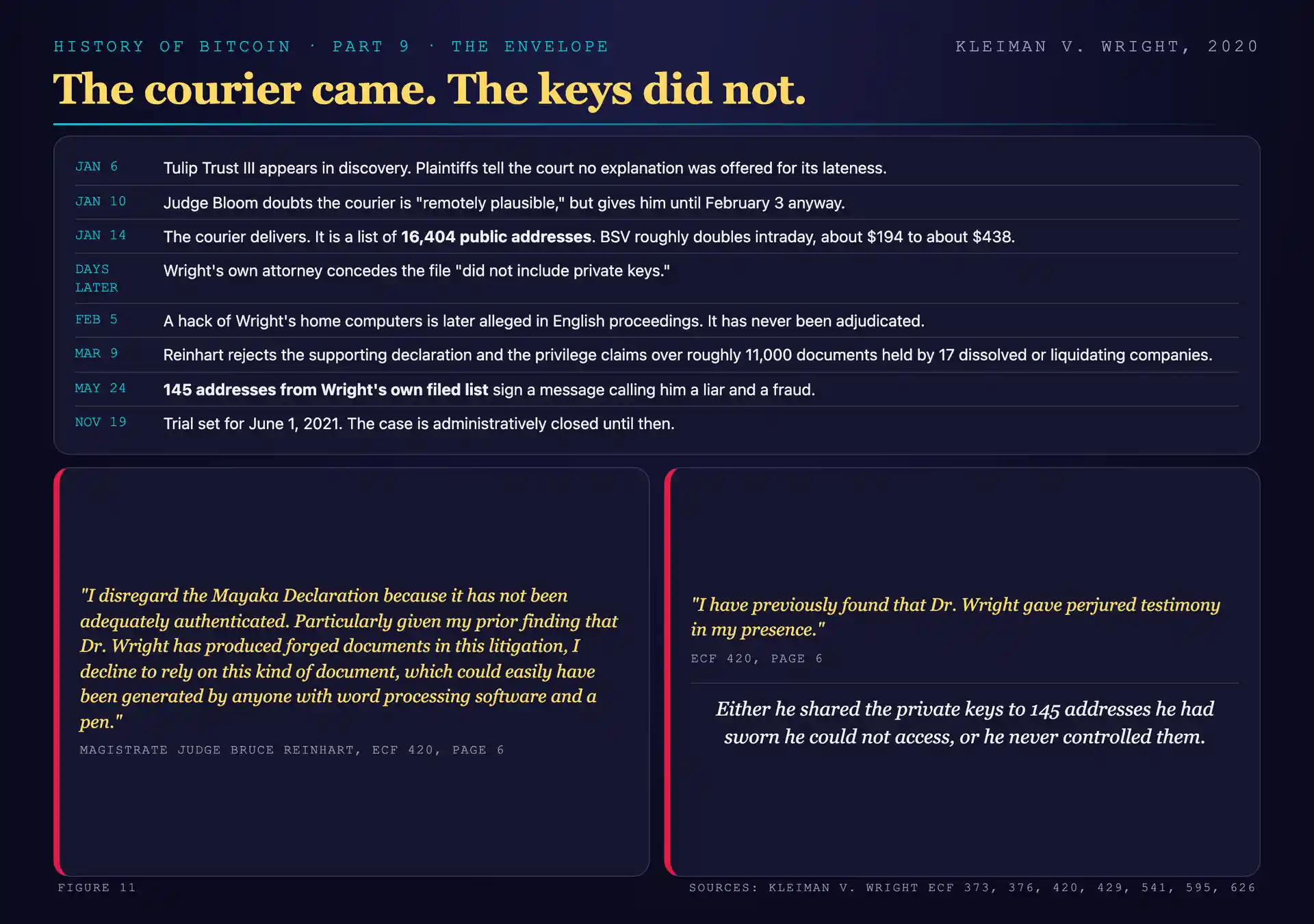
Every quotation in this section was checked against the filed order rather than against press coverage of it. The forged-documents and perjury findings are on page 6 of ECF 420. Source: CourtListener docket, Kleiman v. Wright
Underneath all of it, the pandemic kept moving the Kleiman trial. The date slid across the calendar all year, and on November 19, 2020, Judge Bloom set it firmly and closed the file until then:
"THIS CAUSE is specially set for Jury Trial beginning on June 1, 2021, at 9:00 a.m.... The Clerk of Court shall ADMINISTRATIVELY CLOSE the case."¹⁴⁵
The pandemic even rescheduled the Satoshi trial.
I have said in every installment of this series that I am not closing the identity question, and I am not closing it here. My own position has not changed and I am not going to pretend it is a finding rather than a conviction: I still think there is truth in the claim, I think Craig is Satoshi, and I also think he has withheld information, as have others around him, for reasons I cannot see from where I stand. A reasonable person reading the same record lands somewhere else, and most of them do.
What I will not do is soften the 2020 record, because it is the record. A federal magistrate found he produced forged documents and gave perjured testimony. The courier delivered addresses instead of keys. And 145 of those addresses signed a message calling him a fraud.
Hold that against the man on the stage in London in February, talking about the future of the protocol to a room of people building on it, and you have the whole of Craig Wright's 2020 in one frame. The conference stage and the federal docket, running in parallel, all year, but never touching.
What was teed up
So here is the tally.
In February, Bitcoin got its full instruction set back for the first time since 2010, and the best builder economy the ecosystem ever assembled was in one room in London three weeks before the world closed. The capacity was real, the applications were real, and the 369-megabyte block that carried more than a million transactions in May was as real as anything in this series.
And then productivity was outlawed, the Federal Reserve's balance sheet grew by $1.1 trillion in twenty-eight days, and the story that won was: buy it, hold it, do nothing, get rich.
I do not blame the virus for that, and I do not really blame the printer either. Governments print when they are frightened; that is what they have always done. Blame the people who saw a global emergency and used it to convert a payment network into a savings product, then spent four years explaining that this had been the plan all along. Blame the institutions that funded the research and then helped write the paper certifying there was nothing to look at. And blame, honestly, the man who spent the year in courtrooms he did not need to be in.
Everything was teed up. Everything! And then the WHO threw the biggest curveball in over a hundred years.
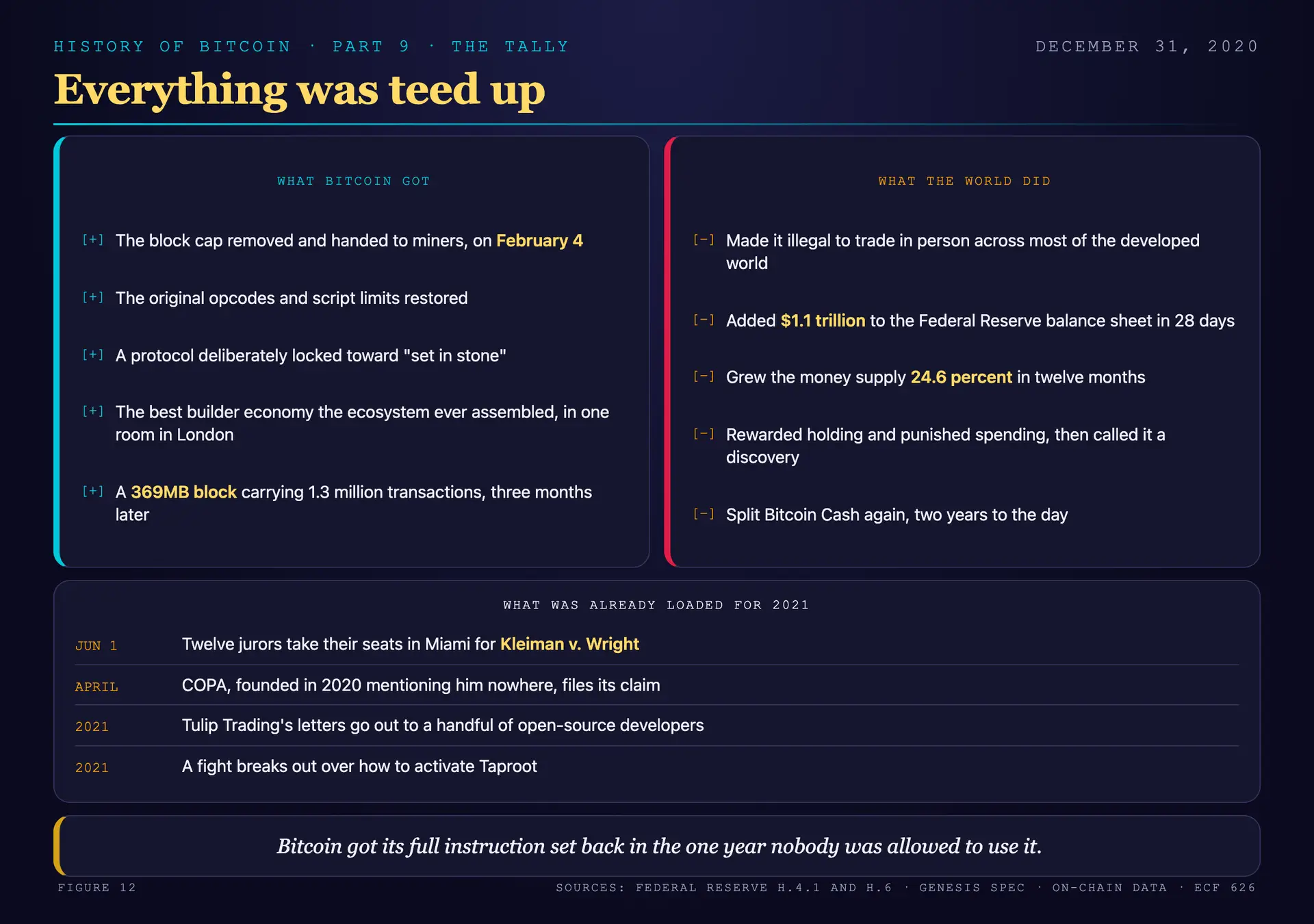
Next time: a jury takes its seats in Miami, set for June 1 and finally seated in November 2021, with me sitting in the room to observe and report. An organization founded in 2020 to pool patents files a claim in April that will take four years to answer. Letters go out to a handful of open-source developers on behalf of a company called Tulip Trading. A fight breaks out over how to activate Taproot. And an asset that almost nobody was using for anything but savings runs to sixty thousand dollars.
That, and a great deal more, is Part 10.
Be good to each other. And remember: the receipts are in the footnotes.
Kurt Wuckert Jr. is the Chief Bitcoin Historian, founder of GorillaPool and Open Protocol Labs, and host of Kurt's Podcast. He writes weekly on Bitcoin, geopolitics, faith, and the long fight for human sovereignty at kurtwuckertjr.com. Catch him live every Tuesday at 2 PM EST.
The Written History of Bitcoin is published one installment at a time.
Footnotes
¹ Attendance figure from the host outlet's own event coverage: CoinGeek London Conference 2020 Day 1 Recap, CoinGeek, February 2020. Noted in the text as house coverage of its own conference rather than independent reporting.
² On the bonded courier, the Kleiman sanctions, and the 2019 delisting campaign, see The Bitcoin Civil War Gets Legal, Part 8.
³ Block 620,538, timestamped 2020-02-04 01:35:06 UTC, verified on-chain via the WhatsOnChain block API. Corroborated by the primary specification and by TAAL's contemporaneous announcement.
⁴ The "11 years, 1 month and 1 day" framing dates to nChain's April 2019 roadmap announcement of the Genesis upgrade, not to a February 2020 statement.
⁵ On the 1MB limit, the hash war, and the three-way split, see A Tale of 2 Bitcoins, and Then 3, Part 7.
⁶ Bitcoin SV Genesis upgrade specification, nChain Ltd, version dated 2020-01-09, published at github.com/bitcoin-sv-specs/protocol. All opcode and limit changes in this section are taken from the specification text directly.
⁷ TAAL press release, February 5, 2020, describing Genesis as an "almost complete return to the original Bitcoin protocol." Note that TAAL is a commercially interested, publicly traded mining company and is the sole source for this phrasing.
⁸ Genesis specification, op. cit. (note 6). The five limits described are, in order: the removal of P2SH for new transactions; the permanently disabled opcodes OP_2MUL, OP_2DIV, OP_VERIF and OP_VERNOTIF; the consensus-versus-policy split on OP_CHECKLOCKTIMEVERIFY and OP_CHECKSEQUENCEVERIFY; the 1GB maximum transaction size, 750,000-byte numeric limit and 2^31-1 multisig key cap; and the finite default policy values (10MB maximum transaction, 100MB stack memory) that ship with rules described as unlimited at the consensus layer.
⁹ Steve Shadders was nChain's Technical Director and Daniel Connolly its lead developer at the time; the Bitcoin Association acted as the public standard-bearer for the upgrade.
¹⁰ TAAL, op. cit. (note 7).
¹¹ CoinGeek London ran February 20-21, 2020, at Old Billingsgate. Program details in this section come from the host outlet's Day 1 and Day 2 recaps, Day 1 and Day 2, CoinGeek, February 2020.
¹² CoinGeek Day 1 recap, op. cit. (note 11): "Daniel Connolly previewed the Teranode project for enterprise-level applications."
¹³ CoinGeek Day 1 recap, op. cit. (note 11). Money Button's "Automatic" and "Invisible" modes.
¹⁴ CoinGeek Day 1 recap, op. cit. (note 11). HandCash Connect.
¹⁵ CoinGeek Day 1 recap, op. cit. (note 11). Jack Liu and Output Capital.
¹⁶ CoinGeek Day 1 recap, op. cit. (note 11). Centbee Personal Paymail.
¹⁷ Imagine not having a buzz about CoinGeek Conference in London, CoinGeek, February 21, 2020, referring to "Dean Little of the newly rebranded Bitping (formerly UptimeSV)."
¹⁸ CoinGeek Day 2 recap, op. cit. (note 11). Twetch invite system, SDK and private messaging.
¹⁹ CoinGeek Day 2 recap, op. cit. (note 11). UNISOT SeafoodChain.
²⁰ CoinGeek Day 2 recap, op. cit. (note 11). nChain, PDX Inc. and EHR Data Inc. healthcare records collaboration.
²¹ Speaker lineup confirmed in the official pre-event release, "CoinGeek London 2020 Blockchain Conference Features Global Speaker Lineup," PRNewswire, January 2020, and in the Day 2 recap.
²² CoinGeek Day 2 recap, op. cit. (note 11). Wright's "Satoshi Vision" address and the session with Jimmy Wales.
²³ PRNewswire release, op. cit. (note 21). Thomas Moser, Alternate Member of the Governing Board, Swiss National Bank.
²⁴ CoinGeek, February 21, 2020, op. cit. (note 17).
²⁵ The Wuhan lockdown began January 23, 2020.
²⁶ WHO Director-General's statement on the second meeting of the International Health Regulations Emergency Committee, January 30, 2020.
²⁷ WHO named the disease COVID-19 on February 11, 2020.
²⁸ WHO Director-General's opening remarks at the media briefing on COVID-19, March 11, 2020.
²⁹ Proclamation on Declaring a National Emergency Concerning the Novel Coronavirus Disease Outbreak, March 13, 2020.
³⁰ "15 Days to Slow the Spread," White House guidance issued March 16, 2020.
³¹ Neil M. Ferguson et al., Report 9: Impact of non-pharmaceutical interventions (NPIs) to reduce COVID-19 mortality and healthcare demand, Imperial College COVID-19 Response Team, March 16, 2020. Verbatim: "In total, in an unmitigated epidemic, we would predict approximately 510,000 deaths in GB and 2.2 million in the US, not accounting for the potential negative effects of health systems being overwhelmed on mortality."
³² Ferguson et al., op. cit. (note 31). The unmitigated scenario assumes the "(unlikely) absence of any control measures or spontaneous changes in individual behaviour." The report's baseline assumption is R0 = 2.4, examined across a range of 2.0 to 2.6; the headline figures rest on the 2.4 baseline.
³³ Dan Evon, Are People Collapsing in the Street from Coronavirus?, Snopes, January 30, 2020: "It appears that these videos were truly taken in January 2020 in various locations around China... originally posted by random citizens who had witnessed these events."
³⁴ Evon, op. cit. (note 33). Snopes traced two of the collapses to a traffic accident and a head injury and quoted a WHO spokesperson describing sudden collapse as an atypical presentation.
³⁵ Office of the Director of National Intelligence, declassified assessment on COVID-19 origins, June 2023: all Intelligence Community agencies assess that SARS-CoV-2 was not developed as a biological weapon. The ODNI document itself is served behind an edge block that refused automated retrieval; the finding is corroborated identically by Lawfare and CIDRAP, two independent named outlets summarizing the same declassified document.
³⁶ FBI Director Christopher Wray, February 28, 2023: "The FBI has for quite some time now assessed that the origins of the pandemic are most likely a potential lab incident in Wuhan." CNN, February 28, 2023. The FBI's assessment carries moderate confidence.
³⁷ The Department of Energy's assessment favoring a lab leak, at low confidence, was reported in February 2023. See CIDRAP, op. cit. (note 35).
³⁸ CIA statement, January 25, 2025: "CIA assesses with low confidence that a research-related origin of the COVID-19 pandemic is more likely than a natural origin based on the available body of reporting." The agency stated the assessment rested on a fresh analytic look at existing reporting rather than new intelligence. CBS News, January 2025.
³⁹ The National Intelligence Council and several other agencies continue to favor a natural origin, at low confidence; two to three agencies have not reached either conclusion. See CIDRAP, op. cit. (note 35).
⁴⁰ NIH grant R01AI110964 to EcoHealth Alliance, with a subaward supporting coronavirus research at the Wuhan Institute of Virology. The grant was suspended in 2020 and terminated in 2022.
⁴¹ The Department of Health and Human Services formally debarred Peter Daszak and EcoHealth Alliance from federal funding for five years in January 2025.
⁴² Kristian Andersen to Anthony Fauci, January 31, 2020, released via FOIA: "after discussions earlier today, Eddie, Bob, Mike and myself all find the genome inconsistent with expectations from evolutionary theory."
⁴³ The February 1, 2020 teleconference was convened by Sir Jeremy Farrar of the Wellcome Trust. Attendees are corroborated across multiple independent accounts of the released emails and Farrar's own memoir.
⁴⁴ Kristian Andersen, Slack, February 2, 2020, from the archive produced under subpoena to the House Select Subcommittee on the Coronavirus Pandemic. See US Right To Know, Visual timeline: "Proximal Origin", which reproduces the primary screenshots.
⁴⁵ Kristian Andersen, email to the National Academies of Sciences, February 4, 2020, addressed to Peter Daszak and copied to Ralph Baric, Trevor Bedford and National Academies staff. The email characterizes the engineered-virus theory as "crackpot" and "fringe." Note: a separate "not crackpot" formulation circulating in coverage of this episode belongs to Robert Garry, on February 3, not to Andersen.
⁴⁶ Jeremy Farrar to Kristian Andersen, February 17, 2020, quoted in the Select Subcommittee on the Coronavirus Pandemic majority staff memorandum, March 5, 2023. The request and Andersen's "Sure, attached" reply are reproduced in the memo.
⁴⁷ Kristian G. Andersen, Andrew Rambaut, W. Ian Lipkin, Edward C. Holmes and Robert F. Garry, The proximal origin of SARS-CoV-2, Nature Medicine 26, 450-452, published March 17, 2020. Full text verified via PMC7095063. The note was first posted to Virological.org on February 16, 2020.
⁴⁸ Edward Holmes, Slack, February 24, 2020, on the RmYN02 bat coronavirus sequence: "I'm now very strongly in favour of a natural origin." US Right To Know timeline, op. cit. (note 44).
⁴⁹ Kevin Drum, reviewing the full released Slack archive, concluded it showed "scientists doing science and having private conversations" and found no evidence of improper behavior. jabberwocking.com.
⁵⁰ Kristian Andersen, Slack, February 25, 2020: "At this stage we unfortunately just can't rule out a potential accidental infection." US Right To Know timeline, op. cit. (note 44).
⁵¹ Select Subcommittee on the Coronavirus Pandemic, After Action Review of the COVID-19 Pandemic: The Lessons Learned and a Path Forward, final report, December 2, 2024. The conclusion that the pandemic most likely emerged from a laboratory is the committee majority's finding, not a scientific consensus or a judicial determination.
⁵² On March 12, 2020, the S&P 500 and Dow Jones Industrial Average each fell approximately ten percent; Bitcoin fell by roughly half across the March 12-13 window. CNBC, March 13, 2020.
⁵³ Billy Bambrough, Here's What Caused Bitcoin's "Extreme" Price Plunge, Forbes, March 19, 2020, citing on-exchange data for the BitMEX XBTUSD perpetual contract.
⁵⁴ Multicoin Capital, March 12: The Day Crypto Markets Broke, March 17, 2020: BitMEX traded below $4,000 for fifteen to thirty minutes and more than $300 beneath other venues at the trough. Reported lows across other venues and indices differ materially; no single canonical figure exists.
⁵⁵ Liquidation totals on BitMEX across March 12-13, 2020, reported at over $1.6 billion, comprising roughly $1.17 billion on March 12 and $485 million on March 13. These figures are BitMEX-specific; no verified market-wide total across all derivatives venues was located.
⁵⁶ skew., March 2020 Review: approximately $1.5 billion in sell liquidations on the XBTUSD perpetual swap, against total open interest below $1 billion before the move.
⁵⁷ BitMEX, DDoS attack, 13 March 2020. Two attacks, at 02:16 and 12:56 UTC on March 13, 2020.
⁵⁸ BitMEX, How We Are Responding to the 13 March DDoS Attacks. The attacker sent "a specially-crafted query to the Trollbox feature, prompting the database's query optimiser to run an extremely inefficient query plan," which "scanned 849,748 rows before it found enough that matched the criteria."
⁵⁹ BitMEX, op. cit. (notes 58 and 59): full service resumed "within 25 minutes" following the second attack, and 156 accounts were refunded a total of 40.297 XBT. A 75-minute figure appears in some contemporaneous trade coverage and could not be reconciled with the exchange's own account.
⁶⁰ Sam Trabucco, then of Alameda Research, argued it was "quite likely" Bitcoin "would've printed at zero" on BitMEX absent the interruption. Presented here as an attributed counterfactual argument, not an established fact.
⁶¹ Analyses of MakerDAO's Black Thursday liquidations record approximately $8.32 million of ETH collateral won in zero-bid auctions and roughly $5.67 million in resulting system bad debt. See Glassnode Research, What Really Happened To MakerDAO? and Whiterabbit, "Black Thursday for MakerDAO: $8.32 million was liquidated for 0 DAI." A commonly cited contemporaneous headline figure of roughly $4 million describes the bad debt that triggered the emergency auction; the three numbers describe different things and should not be conflated.
⁶² MakerDAO's first debt auction minted and sold MKR in 50,000 DAI increments, raising over 4.3 million DAI across 86 auctions.
⁶³ Board of Governors of the Federal Reserve System, H.4.1 Factors Affecting Reserve Balances, February 27, 2020, Consolidated Statement of Condition of All Federal Reserve Banks: total assets $4,158,637 million as of Wednesday, February 26, 2020.
⁶⁴ Federal Reserve, H.4.1, March 26, 2020: total assets $5,254,278 million as of Wednesday, March 25, 2020.
⁶⁵ Federal Reserve, H.4.1, December 31, 2020: total assets $7,363,351 million as of Wednesday, December 30, 2020.
⁶⁶ Federal Reserve, H.6 Money Stock Measures, February 23, 2021: M2, seasonally adjusted, $15,319.8 billion in December 2019 and $19,088.8 billion in December 2020.
⁶⁷ The Coronavirus Aid, Relief, and Economic Security Act was signed March 27, 2020. The headline figure circulates as both $2.2 trillion and $2.3 trillion; CBO scored the deficit impact at approximately $1.759 trillion over a decade.
⁶⁸ Federal Reserve announcement of up to $2.3 trillion in additional lending facilities, April 9, 2020.
⁶⁹ Block 630,000, mined May 11, 2020, at which the block subsidy fell from 12.5 to 6.25 BTC.
⁷⁰ Coinbase transaction of block 629,999, transaction id aed3754889f65dff83504fd0a8b78e1b69fc22c5396c67df23b0e607bf4e0d67, block hash 0000000000000000000d656be18bb095db1b23bd797266b0ac3ba720b1962b1e, mined by F2Pool at 19:23:23 UTC on May 11, 2020, twenty seconds before block 630,000. The scriptSig hex was retrieved and decoded to ASCII directly for this article; the message reads NYTimes 09/Apr/2020 With $2.3T Injection, Fed's Plan Far Exceeds 2008 Rescue, preceded in the same field by the bytes f09f909f, the UTF-8 encoding of F2Pool's fish emoji. Verified via the mempool.space block and transaction API.
⁷¹ Genesis block coinbase, January 3, 2009: The Times 03/Jan/2009 Chancellor on brink of second bailout for banks.
⁷² Paul Tudor Jones, "The Great Monetary Inflation," BVI Market Outlook, May 2020. The widely reproduced characterization of bitcoin as "the fastest horse" is well attested as a phrase; the surrounding sentence could not be verified verbatim from the letter itself and is not quoted here.
⁷³ MicroStrategy Incorporated, Form 8-K, August 11, 2020: purchase of 21,454 BTC for $250 million and adoption of bitcoin as the company's primary treasury reserve asset.
⁷⁴ MicroStrategy announced the purchase of an additional 16,796 BTC for $175 million in September 2020. No dedicated SEC filing was located for this specific purchase; the figures rest on the company's own announcement.
⁷⁵ MicroStrategy priced $550 million of convertible senior notes on December 9, 2020, with an additional $100 million available to the initial purchasers. A December 7 document describes the earlier proposed $400 million offering; the priced figures appear in the associated exhibit.
⁷⁶ Square, Inc., press release, October 8, 2020: purchase of 4,709 BTC for $50 million, approximately one percent of the company's total assets as of the end of the second quarter of 2020.
⁷⁷ PayPal launched crypto buying, selling and holding for US customers on October 21, 2020. The company's own 2022 announcement enabling external transfers confirms the earlier restriction, telling customers they could not move crypto off the platform "until now."
⁷⁸ MassMutual's $100 million bitcoin purchase was reported in December 2020.
⁷⁹ Grayscale reported approximately $5.7 billion of inflows across full-year 2020.
⁸⁰ Compound launched its COMP governance token and began distributing it to protocol users on June 15, 2020.
⁸¹ Total value locked in decentralized finance rose from roughly $700 million at the start of 2020 to approximately $15 billion by year end, per DeFi Pulse. Figures above $20 billion belong to 2021.
⁸² Yearn Finance launched YFI on July 17, 2020, with founder Andre Cronje describing the token as having no financial value.
⁸³ On September 5, 2020, Chef Nomi withdrew 20,039 ETH and 2,558,644 SUSHI from the SushiSwap development fund, roughly $14-15 million, and the token fell approximately eighty-eight percent.
⁸⁴ Sam Bankman-Fried publicly intervened on September 6, 2020 and was handed control of the protocol.
⁸⁵ Chef Nomi returned approximately $14 million in ETH to the SushiSwap treasury on September 11, 2020. A separate and unverified later theory that Bankman-Fried was himself Chef Nomi is not the same claim and is not asserted here.
⁸⁶ On FTX, Alameda Research and the structure underneath them, see The Biggest Frauds in Bitcoin, Part 8B.
⁸⁷ Uniswap distributed 400 UNI to every address that had previously interacted with the protocol on September 17, 2020.
⁸⁸ Ethereum Fees Hit $166M in September, More Than Six Times Bitcoin's, CoinDesk, October 1, 2020: total Ethereum network fees rose from approximately $1.5 million in January 2020 to approximately $166 million in September 2020.
⁸⁹ CoinDesk, op. cit. (note 89): Bitcoin network fees totaled approximately $26 million in September 2020.
⁹⁰ Ethereum gas prices peaked at approximately 480 gwei on September 3, 2020, with a September monthly average near 220 gwei; on the day of the UNI airdrop, September 17, the fast tier reached approximately 750 gwei.
⁹¹ Solana's mainnet beta launched March 16, 2020, founded by Anatoly Yakovenko and Raj Gokal. The Serum decentralized exchange launched on Solana in August 2020, backed by FTX and Alameda Research.
⁹² Polkadot's mainnet launched in May 2020; Cardano's Shelley upgrade in July 2020; Binance Smart Chain and Avalanche in September 2020; Filecoin in October 2020.
⁹³ The Ethereum 2.0 deposit contract opened November 4, 2020, reached its 524,288 ETH threshold shortly before the deadline, and the Beacon Chain launched December 1, 2020.
⁹⁴ Tether's circulating supply rose from approximately $4.1 billion at the start of 2020 to approximately $20 billion by year end, crossing the $20 billion mark around December 17-18, 2020.
⁹⁵ Jiang Zhuoer, CEO of BTC.TOP, "Infrastructure Funding Plan for Bitcoin Cash," Medium, January 22, 2020, initially proposing a 12.5 percent diversion of the block reward, later revised downward under pressure.
⁹⁶ Amaury Séchet published supportive commentary on the proposal on January 23, 2020.
⁹⁷ The infrastructure funding plan was removed from the May 15, 2020 upgrade before activation. See the pull request "Remove the Infrastructure Funding Plan from 15 May 2020 upgrade," bitcoincashorg/bitcoincash.org #453.
⁹⁸ Amaury Séchet, Bitcoin ABC's plan for the November 2020 upgrade, Medium, August 6, 2020: "All newly mined blocks must contain an output assigning 8% of the newly mined coins to a specified address."
⁹⁹ Séchet, op. cit. (note 99): developers should "gain their income directly from block rewards" so that they "risk the immediate loss of their own wealth."
¹⁰⁰ Séchet, op. cit. (note 99): node implementation teams had developed a "financial reliance on powerful interests such as mining corporations, venture capital funds, and angel investors."
¹⁰¹ On developer funding, Blockstream, and the capture of protocol development, see The Bitcoin Civil War Heats Up, Part 6.
¹⁰² Announcing Bitcoin Cash Node, February 20, 2020: the project would provide "a safe and professional node implementation that will neutrally follow the longest chain without contributing to the risk of a chain split."
¹⁰³ Miner signaling for BCHN exceeded eighty percent on the eve of the November 2020 fork.
¹⁰⁴ The last common block was 661,647, mined by Binance Pool; the chain diverged at block 661,648, mined by AntPool. Block 661,647 was mined at 14:13:29 UTC and block 661,648 at 14:16:57 UTC, both on November 15, 2020. The 12:00 UTC figure quoted in exchange notices refers to the scheduled activation threshold rather than the block times.
¹⁰⁵ BCHN retained the BCH ticker and settled above ninety-nine percent of combined hash power within days of the split.
¹⁰⁶ Bitcoin ABC's chain became BCHA and was rebranded eCash (XEC) in July 2021, outside the period covered here.
¹⁰⁷ Séchet, op. cit. (note 99): the plan allowed "Bitcoin ABC to make this much needed improvement while miners who may prefer other rules are free to choose a viable, alternate implementation."
¹⁰⁸ On the November 15, 2018 Bitcoin SV fork and the hash war, see A Tale of 2 Bitcoins, and Then 3, Part 7.
¹⁰⁹ Block 635,141 on the BSV chain, mined May 16, 2020, at approximately 369MB and containing 1,324,314 transactions. The 638MB block frequently cited alongside it was mined March 14, 2021 and falls outside the year covered here.
¹¹⁰ Twetch passes 1 million transaction milestone, CoinGeek, October 27, 2020.
¹¹¹ BitPing, formerly UptimeSV, won the first Bitcoin Association hackathon in May 2019 and paid distributed users in BSV to run network monitoring jobs. See note 17 on the February 2020 rebrand.
¹¹² Calvin Ayre Makes Sizeable Investment in TonicPow, PRNewswire, June 2020. Founders Luke Rohenaz, Austin Rappaport and Attila Aros. The amount was not disclosed.
¹¹³ RelayX released wrapped USD Coin on BSV in late September and early October 2020.
¹¹⁴ The sCrypt GitHub organization was created May 8, 2020.
¹¹⁵ The Bitcoin SV ecosystem was reported at 394 known projects as of January 19, 2020, growing past 400 by July 2020. PRNewswire, January 2020.
¹¹⁶ On the April 2019 delistings and their consequences, see The Bitcoin Civil War Gets Legal, Part 8.
¹¹⁷ Analysis circulated January 31, 2020, drawing on Coin Metrics data, reporting that as much as ninety-six percent of BSV on-chain transactions traced to the weather-data application WeatherSV.
¹¹⁸ unwriter, The Resolution of the Bitcoin SV Experiment, Medium, April 1, 2020. The post contains the line "I am leaving Bitcoin," followed immediately by "Just kidding. 4/1." It is an April Fools' post and is not a departure announcement.
¹¹⁹ unwriter, "How to Publish Bitcoinized Content to Wordpress, Medium, or any other publishing platform," Medium, September 24, 2020, the last known public post from the account. No departure statement, in 2020 or since, was located in his Medium archive, his GitHub activity, or elsewhere.
¹²⁰ Kurt Wuckert Jr. left his cybersecurity career at the end of October 2020 and announced the CoinGeek Chief Bitcoin Historian role on November 19, 2020.
¹²¹ Kleiman v. Wright, No. 9:18-cv-80176 (S.D. Fla.), ECF 420 at 4: "On or about January 6, 2020, Dr. Wright produced in discovery the deed for a third trust ('Tulip Trust III')."
¹²² ECF 373 at 10 n.5: "Plaintiffs advise that the Defendant has not provided any explanation as to the document's late disclosure."
¹²³ ECF 373 at 22-23: the magistrate's order was "AFFIRMED IN PART AND REVERSED IN PART," vacated as to the imposition of the Deemed Facts and the striking of affirmative defenses, and affirmed as to attorneys' fees and costs.
¹²⁴ ECF 373 at 21-22 (Bloom, J., January 10, 2020).
¹²⁵ ECF 373 at 22: the court permitted the defendant "through and including February 3, 2020" to file notice.
¹²⁶ ECF 373 at 21.
¹²⁷ ECF 376, Notice of Compliance, January 14, 2020, quoted directly in ECF 595 at 10: "a third party has provided the necessary information and key slice to unlock the encrypted file, and Dr. Wright has produced a list of his bitcoin holdings, as ordered by the Magistrate Judge[.]"
¹²⁸ BSV rose intraday from approximately $194 to approximately $438 on January 14, 2020.
¹²⁹ The list produced comprised 16,404 bitcoin addresses.
¹³⁰ Andres Rivero, counsel for Wright, quoted in contemporaneous reporting: "The file that he's received did not include private keys." Reported via Decrypt and reproduced across multiple outlets; secondary accounts date the statement to January 17 or 18, 2020.
¹³¹ Tulip Trading Ltd v Bitcoin Association for BSV & others, English proceedings commenced in 2021, alleging that on or about February 5, 2020, discovered February 8, hackers accessed Wright's home computers and removed encrypted private keys to the 1Feex and 12ib7 addresses. The allegation has never been adjudicated.
¹³² ECF 420 at 8: Wright "provided a privilege log that asserts attorney-client privilege over approximately 11,000 documents on behalf of 17 corporations, all of which are either dissolved or in liquidation."
¹³³ ECF 420 at 5. The order refers throughout to "Denis Bosire Mayaka" and does not itself state his corporate affiliation; the Abacus (Seychelles) Limited association is documented in his own professional listing and in contemporaneous press coverage.
¹³⁴ ECF 420 at 6 (Reinhart, Mag. J., March 9, 2020).
¹³⁵ ECF 420 at 6. The full sentence reads: "Nevertheless, I give no weight to sworn statements of Dr. Wright that advance his interests but that have not been challenged by cross-examination and for which I cannot make a credibility determination. I have previously found that Dr. Wright gave perjured testimony in my presence."
¹³⁶ ECF 429, March 2020: $165,800.09 awarded, comprising $113,760.00 in fees and $52,040.09 in expenses, against $658,581.78 requested.
¹³⁷ ECF 541 at 1: "On May 24, 2020, someone anonymously posted a message at this link https://paste.debian.net/plain/1148565." The message was signed with the private keys of 145 addresses appearing on Wright's own filed list.
¹³⁸ ECF 541 at 1.
¹³⁹ ECF 541 at 1. The docket filing elides the middle portion of the message with its own ellipsis; the intervening sentences concerning the Lightning Network and on-chain capacity are widely reproduced in contemporaneous reporting but are not reproduced in the court record.
¹⁴⁰ Wright v Granath [2020] EWHC 51 (QB), January 16, 2020 (Jay J), dismissed on jurisdictional grounds under the Lugano Convention because the Norwegian court was seised first.
¹⁴¹ Wright v Ver [2020] EWCA Civ 672, May 29, 2020 (Flaux, Popplewell and Dingemans LJJ), per Dingemans LJ: "I find that England and Wales is not clearly the most appropriate place to bring this action for defamation."
¹⁴² Wright discontinued his claim against Adam Back in January 2020 and paid Back's costs; the discontinuance was reported by Decrypt in April 2020. This preceded the Ver appeal judgment by several months.
¹⁴³ Square announced the Cryptocurrency Open Patent Alliance on September 10, 2020. Per the organization's own site, COPA "stands for an open financial system and was formed to remove barriers that would stifle innovation and deter mass-adoption." Nothing in its 2020 founding materials refers to Craig Wright.
¹⁴⁴ Coinbase joined Square as a founding board member of COPA in December 2020.
¹⁴⁵ ECF 626 at 1-2 (Bloom, J., November 19, 2020): "THIS CAUSE is specially set for Jury Trial beginning on June 1, 2021, at 9:00 a.m. Calendar Call will be held at 1:45 p.m. on Tuesday, May 11, 2021... The Clerk of Court shall ADMINISTRATIVELY CLOSE the case." The November 2021 trial date arose from a joint continuance motion filed by both parties in 2021; no 2020 order sets it.