The Written History of Bitcoin: The Verdict and the Bubble
By Kurt Wuckert Jr.
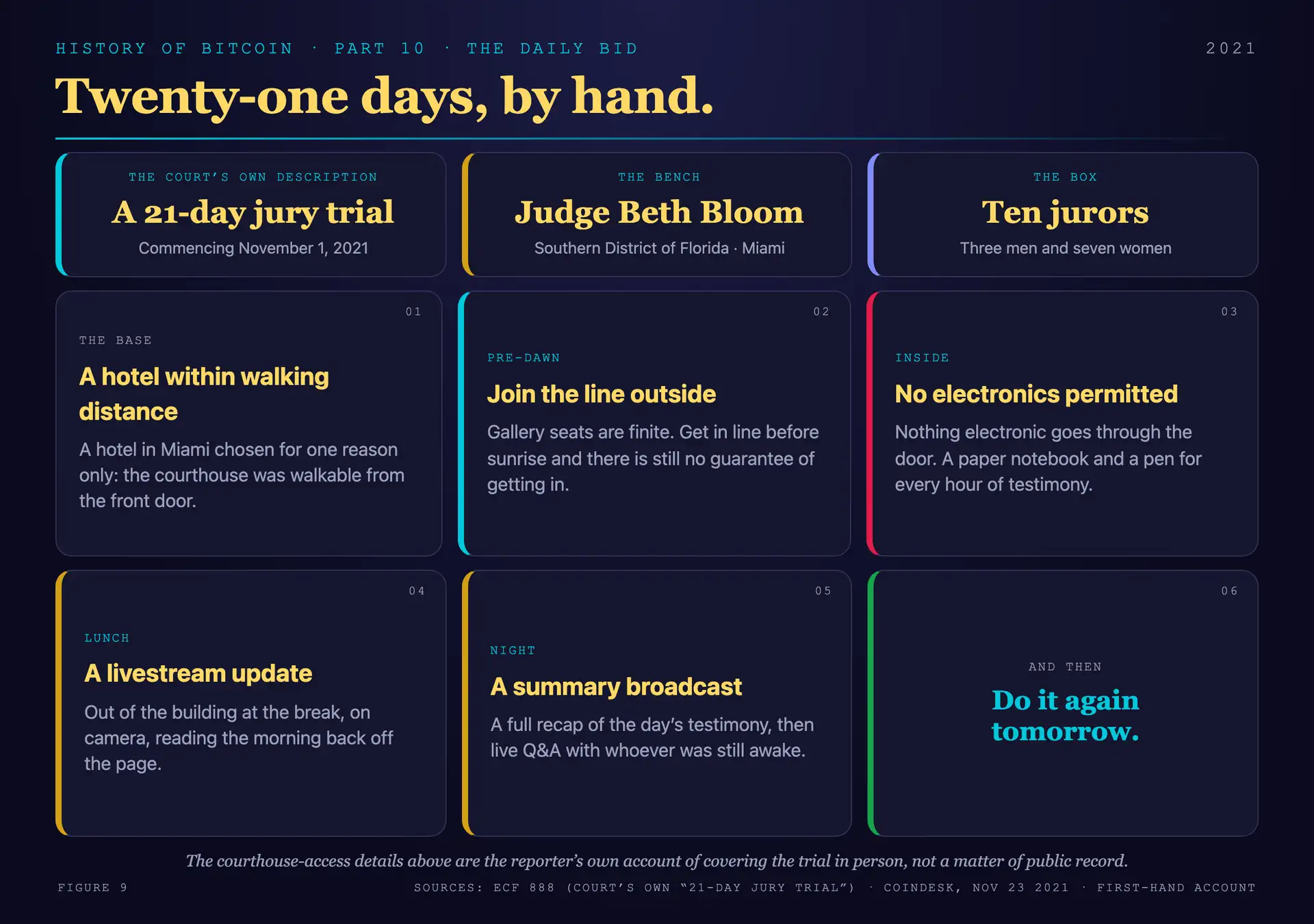
Downtown Miami, sometime before six in the morning, November 2021. There is a line on the sidewalk outside the federal courthouse, and I am standing in it with a paper notebook and two pens.
The notebook is not an affectation. The building will not let me carry a laptop or a phone past security, so for the length of the trial I have no recorder, no camera, and no way to check a fact against anything except my own handwriting. There are a finite number of chairs in the gallery, more people want them than can have them, the pandemic protocols have cut the number down further, and every morning turns into a small auction settled by whoever got up earliest.
Every morning, I might not get in.
I wrote the whole trial down by hand, like it was 1935.
Watch the video if you prefer to watch rather than read!
Inside, ten strangers, three men and seven women, are being asked to settle a narrow question about a business partnership between two men, one of whom has been dead since 2013.¹ The court's own docket calls it a twenty-one day jury trial commencing on November 1, 2021.² Outside the building, a decade of internet argument is waiting for those ten people to answer a completely different question, one that appears nowhere on the verdict form and never will.
I booked a hotel I could walk from. I did that on purpose. I did not want a car, a garage, or a traffic jam standing between me and a chair.
And every night, after the gavel, I went back and told a few thousand people on a livestream what I had written down that day, then took questions until they ran out. Then I slept, and then I got back in the line.
That is the end of 2021. To understand why ten people in Miami were the least strange thing that happened that year, start in January, when the money supply did something no living American had watched happen before.
The year money broke
When we left this story, the case had a date on it. Judge Beth Bloom's order of November 19, 2020, specially set the jury trial for June 1, 2021, at 9:00 a.m., and administratively closed the case in the meantime, which is exactly the sort of dull clerical sentence that decides where a reporter will be living in six months.³ Part 9 ended on that date. And on June 1, 2021, nothing happened.
What happened instead was a joint motion, filed April 23, 2021 by both sides, and granted four days later. Trial reset to November 1. The reasons were the year itself: "At the moment, travel from the U.K. to the United States remains prohibited, which could prevent Dr. Wright, a U.K. resident, from attending the trial in person," plus scheduling conflicts on both sides, plus the fact that "a number of both parties' counsel observe the Jewish High holidays that occur the month of September." The district had already continued every jury trial past July 6 by administrative order.⁴
So the biggest question in Bitcoin got pushed five months by a pandemic travel rule and a religious calendar. That is how history actually works. It is never as clean as the retelling.
Which brings us to the reason the whole world was acting insane that year.
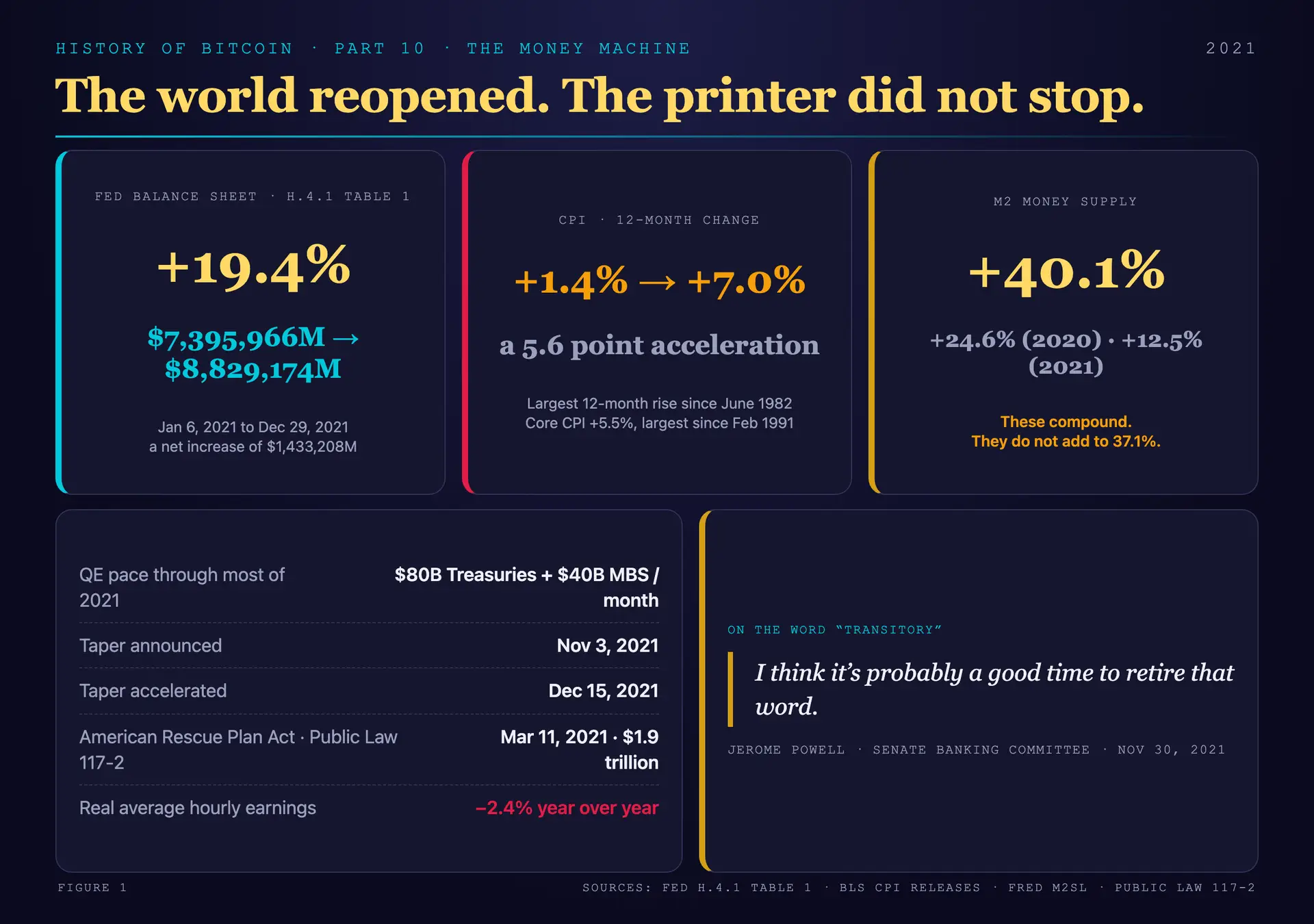
Both endpoints are read off the Federal Reserve's own weekly H.4.1 release, Table 1, not off a chart aggregator. Note that FRED's WALCL series mirrors Table 5 and will give you slightly different numbers for the same two dates. Source: Federal Reserve H.4.1
On January 6, 2021, the Federal Reserve's weekly H.4.1 release put total factors supplying reserve funds at $7,395,966 million.⁵ On December 29, 2021, the same line in the same release read $8,829,174 million.⁶ That is an increase of $1,433,208 million in twelve months.
Call it a trillion and a half dollars, or 19.4 percent, appearing on a balance sheet inside one calendar year, in peacetime, in a country whose stock market was setting records the entire time.
The mechanism has a technical name and a very simple body. Quantitative easing means the central bank creates dollars that did not previously exist and uses them to buy bonds, mostly government debt and mortgage-backed securities, from banks and funds. The sellers do not get bonds anymore. They get cash, and cash has to go somewhere. Through most of 2021 the Fed was doing this at a pace it stated openly in its own January 27 policy statement: at least $80 billion a month in Treasury securities and at least $40 billion a month in agency mortgage-backed securities.⁷
A hundred and twenty billion dollars a month, on schedule, announced in advance, for most of a year.
Congress was running the same play from the other direction. The American Rescue Plan Act, H.R. 1319, became Public Law 117-2 when it was signed on March 11, 2021, carrying a headline cost of $1.9 trillion and sending $1,400 checks to most American households.⁸
Add it up on the money-supply side and the picture gets hard to look away from. M2, the broad measure of American money, grew 24.6 percent in 2020 and another 12.5 percent in 2021. Those two rates do not add together, they compound, which is worse: measured end to end, from December 2019 to December 2021, the money stock grew 40.1 percent.⁹
Two years. Forty percent more money.
Now watch what it bought. In January 2021 the Consumer Price Index was up 1.4 percent over the prior twelve months, which is a boring, healthy, nobody-writes-an-article-about-it number.¹⁰ By December, the all items index was up 7.0 percent over twelve months, "the largest 12-month increase since the period ending June 1982," with core inflation at 5.5 percent, "the largest 12-month change since the period ending February 1991."¹¹ Same year. Start to finish.
And the number that never makes the headline: real average hourly earnings, which is what your paycheck actually buys, fell 2.4 percent from December 2020 to December 2021.¹²
Everybody got a raise. Everybody got poorer.
The official position on all of this, for most of the year, was one word. Jerome Powell used "transitory" across FOMC press conferences from March through the summer, and in July he explained precisely what he meant by it: "The concept of 'transitory' is really this: It is that the increases will happen. We're not saying they will reverse. That's not what 'transitory' means... So what I mean by 'transitory' is just something that doesn't leave a permanent mark on the inflation process."¹³ By the September press conference the word had vanished from his prepared remarks entirely. And on November 30, 2021, in front of the Senate Banking Committee, answering Senator Pat Toomey, he finally buried it: "I think it's probably a good time to retire that word and try to explain more clearly what we mean."¹⁴
The policy turned within six weeks of the vocabulary. Tapering was announced November 3 and then accelerated on December 15, doubling the pace of the wind-down.¹⁵ The word went first. The money followed.
A lot of this was decided under real pressure. People were sick. Businesses that had been ordered closed by their own governments were not coming back. There was no clean, costless option available to anybody in a policy chair in early 2021, and I am not going to pretend from a comfortable desk in 2026 that there was, although some of the most resistant parties to things like lockdowns and vaccine mandates seem like visionaries and prophets, in hindsight.
The argument is not that the money was spent. The argument is about where it landed, and who decided that, and who got to touch it first.
This is the part the libertarians have been right about since before I was born. Richard Cantillon was an Irish-French banker who died in 1734, and his Essai sur la Nature du Commerce en Général was published posthumously in 1755.¹⁶ His observation was that new money does not arrive everywhere at once. It enters the economy at particular points, through particular hands, and the people closest to the spigot get to spend it at yesterday's prices while everyone downstream spends it at the new ones. Proximity to the printer is itself a form of income. Economists call this the Cantillon effect, and 2021 was the cleanest natural experiment in it that any of us are likely to see. <!-- lint:allow spelling -->
Trace the pipe. The Fed bought bonds from a short list of primary dealers, who got cash, and it bought forty billion dollars a month of mortgage-backed securities, which pushed mortgage rates down, which pushed home prices up for whoever already owned a home and out of reach for whoever did not. The $1,400 checks went to households, and a household that was already solvent put a good share of them into brokerage accounts, and a household that was not solvent spent them at a grocery store where prices were rising 6.3 percent a year.
Same policy. Two completely different experiences of it, sorted almost entirely by what you owned on the day it started.
The Fed's own distributional data tells on the Fed. The top one percent's share of American household net worth went from 29.2 percent in the first quarter of 2020 to 30.7 percent in the first quarter of 2021, a gain of 1.5 percentage points in a single year, almost all of it coming from the revaluation of stocks.¹⁷
And the assets ran away from the groceries. Consumer prices rose 7.0 percent in 2021, American home prices rose 18.8 percent on the S&P CoreLogic Case-Shiller national index, the largest calendar-year gain in that index's thirty-four year history, and the S&P 500 returned about 26.9 percent.¹⁸
So if you owned things, 2021 was the best year of your life. If you worked for a living and rented, 2021 quietly took two and a half percent of your labor and handed it to somebody who already owned a house.
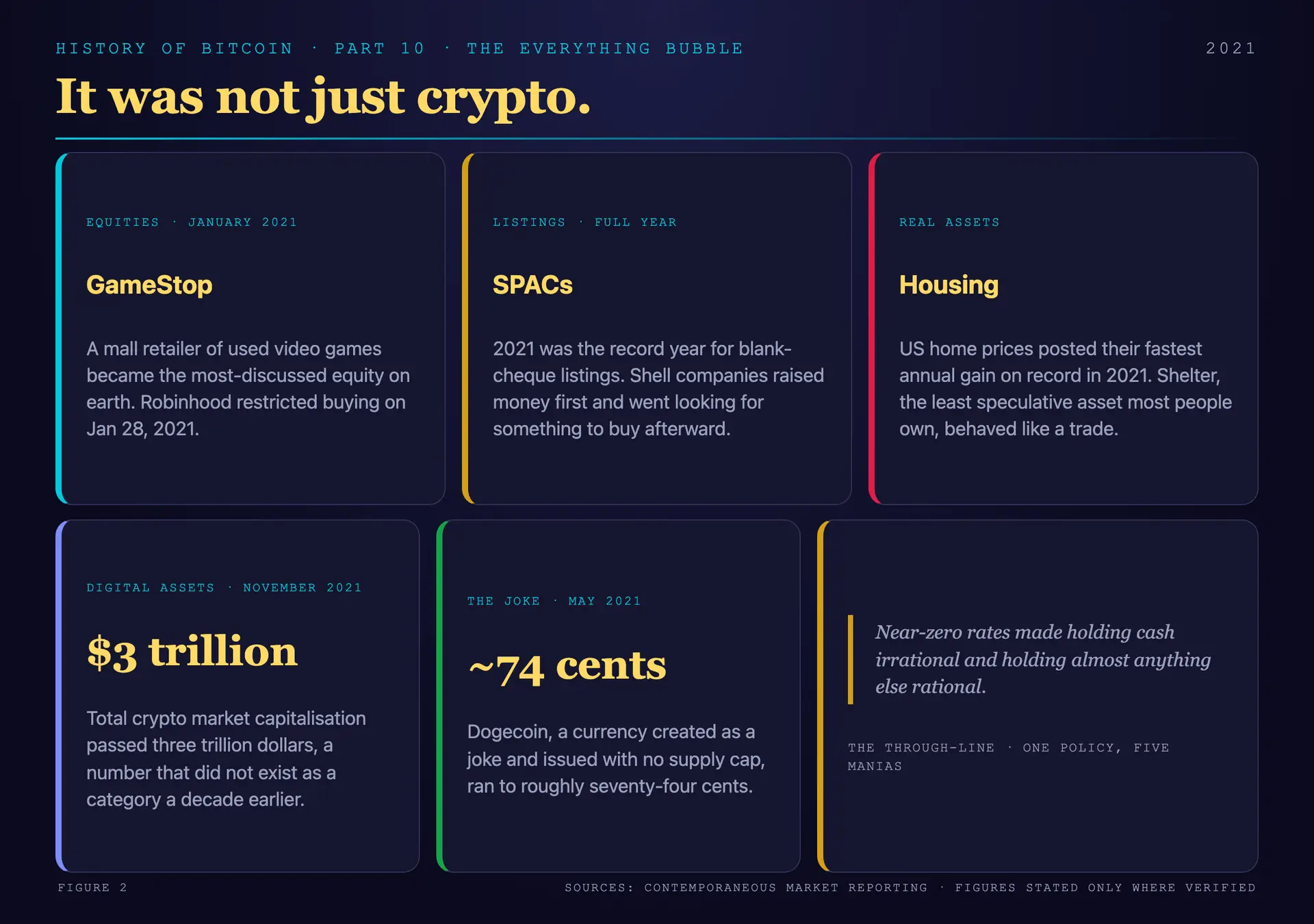
The mania was not subtle, and it was not confined to crypto. GameStop, a mall retailer of used video games, touched $483.00 intraday on January 28, 2021, and then several retail brokerages restricted buying in it on the same day, which produced a bipartisan political explosion and congressional testimony and a genuine, lasting, entirely justified belief among millions of young Americans that the market has one set of rules for them and another set for everyone else.¹⁹ Blank-check companies had a record year: one widely cited tally counted roughly 613 U.S. SPAC listings raising about $144.5 billion.²⁰ Total crypto market capitalization crossed a trillion dollars for the first time in early January and touched roughly three trillion on November 9.²¹
A joke coin built in 2013 as a parody of Bitcoin reached about seventy-four cents in May, which briefly made a punchline worth more than most of the companies in the Russell 2000.
None of that was irrational, exactly. Put yourself in it. You are twenty-six, you have a stimulus check and a brokerage app on your phone, your rent went up, your savings account pays you effectively nothing, the price of a starter home in your city moved further away from you in eighteen months than your salary will move in ten years, and the chairman of the Federal Reserve is on television saying the inflation you can see with your own eyes at the gas pump is temporary. What is the responsible thing to do with that money?
Genuinely. What?
People did the math and bought something. Anything. And most of the country's commentary class spent that year sneering at them for it, which I found and still find repulsive. The indictment belongs to the people who set the incentives, not to the people who read them correctly.
2021 was the year that speculation stopped being a part of the market and became the entire product.
One small thing before we go anywhere else, and it will not look like much.
On January 20, 2021, at height 666,833, the BTC network produced two competing blocks at nearly the same moment. SlushPool's version won the race, F2Pool's version went stale, and a transaction that had been confirmed in the losing block was reversed on the network and superseded on the blockchain. The amount involved was 0.00062063 BTC. About twenty-one dollars.²²
Twenty-one dollars, and the entire industry spent a week arguing about which word applied to it.
It was a classic double-spend, in bitcoin terms, but the pumpers threw interference at it in triple-time. I published my own piece on it two days later, and I put an epigraph at the top of it:
**"But if thought corrupts language, language can also corrupt thought."**²³
Taproot, and the man who came back
November 14, 2021, at 05:15:27 UTC, at block height 709,632, the BTC network activated the largest change to its consensus rules since Segregated Witness in 2017.²⁴ It had a name that sounded like a garden feature and a reputation as the quiet upgrade, the one everybody agreed on, the one that finally proved the network could improve itself without another civil war.
Taproot is three Bitcoin Improvement Proposals that activated together as a single soft fork. BIP 340 specifies Schnorr signatures over the secp256k1 curve, authored by Pieter Wuille, Jonas Nick and Tim Ruffing.²⁵ BIP 341, "Taproot: SegWit version 1 spending rules," is Wuille, Nick and Anthony Towns.²⁶ BIP 342, the validation rules for the new script system that everyone calls Tapscript, is the same three men.²⁷
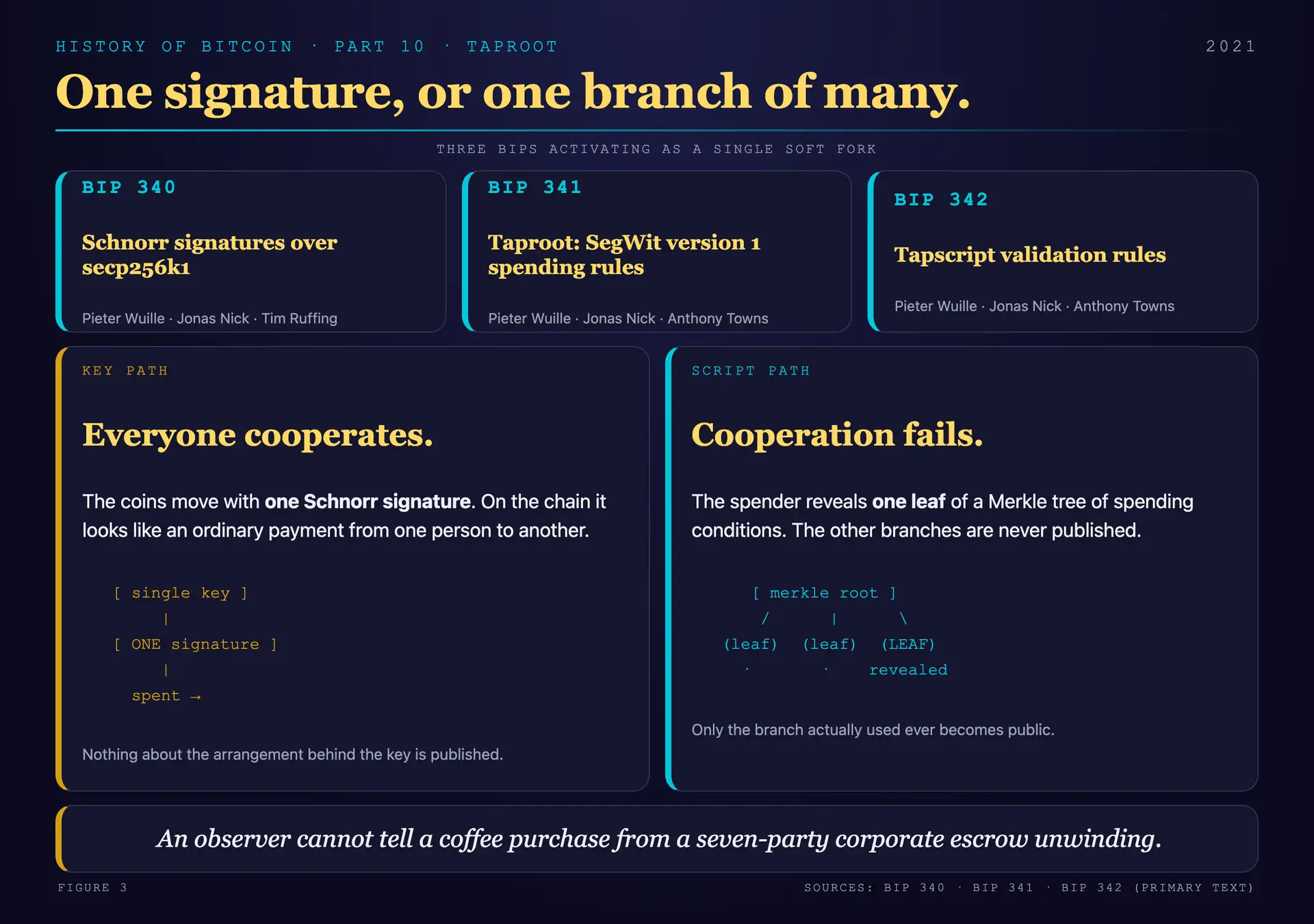
Every limit named in this figure is quoted from the proposal text itself rather than from secondary explanation, including the 520-byte push limit that survived and is widely misremembered as having been lifted. Source: BIP 341 and BIP 342
What it does is genuinely elegant. Under the old rules, if you locked coins behind a complicated set of conditions, every one of those conditions had to be published on the network when you spent them, whether you used them or not. The whole contract went public. Taproot organizes all the possible spending conditions into the leaves of a Merkle tree, and commits to that tree inside a single public key. If everyone involved cooperates, the coins move with one Schnorr signature that looks exactly like an ordinary payment from one person to another. That is the key path.
Nobody watching the blockchain can tell whether they just saw a coffee purchase or a seven-party corporate escrow unwinding.
If cooperation fails, you take the script path: you reveal the one branch you actually needed, prove it belongs to the committed tree, and leave every other branch permanently hidden. You publish what you used. You never publish what you did not use.
The efficiency claim followed from the privacy claim. Less data published means less block space consumed, which means lower fees for complex spends. Schnorr's linearity also made multi-party signature aggregation practical, so a group of signers could produce one signature under one aggregated key, and the resulting spend would be indistinguishable on the blockchain from any other single-signer payment.
The intended beneficiaries were obvious: corporate treasuries with multi-signature custody, Lightning channels closing cooperatively, and anybody running a contract who did not want the terms of that contract published to every competitor with a block explorer.
Good engineering, honestly. I have no complaint with the cryptography.
But the rest is about who proposed it.
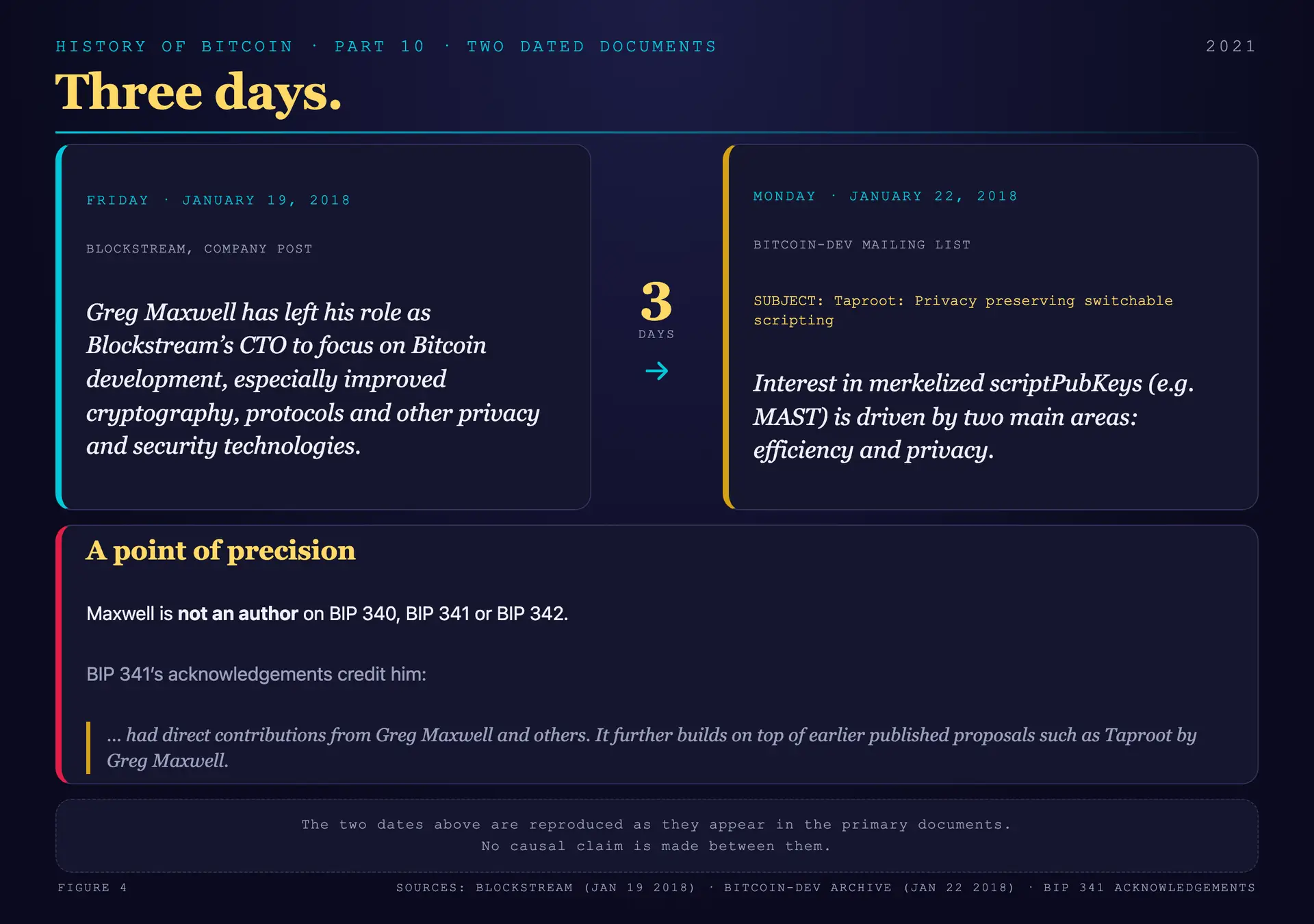
Two dated primary documents, three days apart, reproduced without a causal claim between them. Source: Blockstream's own announcement and Maxwell's bitcoin-dev post, January 22, 2018
On January 19, 2018, a Friday, Blockstream published a farewell post on its own company blog. "Greg Maxwell has left his role as Blockstream's CTO to focus on Bitcoin development, especially improved cryptography, protocols and other privacy and security technologies."²⁸
On January 22, 2018, the following Monday, Gregory Maxwell posted to the bitcoin-dev mailing list under the subject line "Taproot: Privacy preserving switchable scripting."²⁹
Three days.
You have known this man since Part 3. He is the developer Mike Hearn described as having "an unusual set of views," including a claim that he had mathematically proven Bitcoin to be impossible. He is the chief technology officer of the company that hired much of the development team, whose stated ambition was for Bitcoin to stop being a payment network and become a settlement layer for something else that did not exist yet. He is the man who did not sign the Hong Kong Agreement and led the project's rejection of it. He is Part 6, from beginning to end.
And what he wrote on that Monday in 2018 is worth reading in his own words, because it is a clear technical argument by somebody who was very good at this:
"Interest in merkelized scriptPubKeys (e.g. MAST) is driven by two main areas: efficiency and privacy. Efficiency because unexecuted forks of a script can avoid ever hitting the chain, and privacy because hiding unexecuted code leaves scripts indistinguishable to the extent that their only differences are in the unexecuted parts."
Maxwell did not author BIP 340. He did not author BIP 341. He did not author BIP 342. His name appears on none of the three, and if you have read a hundred articles saying "Maxwell's Taproot," a hundred articles were being sloppy. What BIP 341 says about him, in its own acknowledgements, is this:
"This document is the result of discussions around script and signature improvements with many people, and had direct contributions from Greg Maxwell and others. It further builds on top of earlier published proposals such as Taproot by Greg Maxwell, and Merkle branch constructions by Russell O'Connor, Johnson Lau, and Mark Friedenbach."
He proposed the idea. Other people built it.
I do not know whether stepping down on the Friday and posting the proposal on the Monday were connected.
The biggest upgrade BTC had shipped in four years began as a proposal from the person who had spent the previous six years arguing that Bitcoin should not be used for payments.
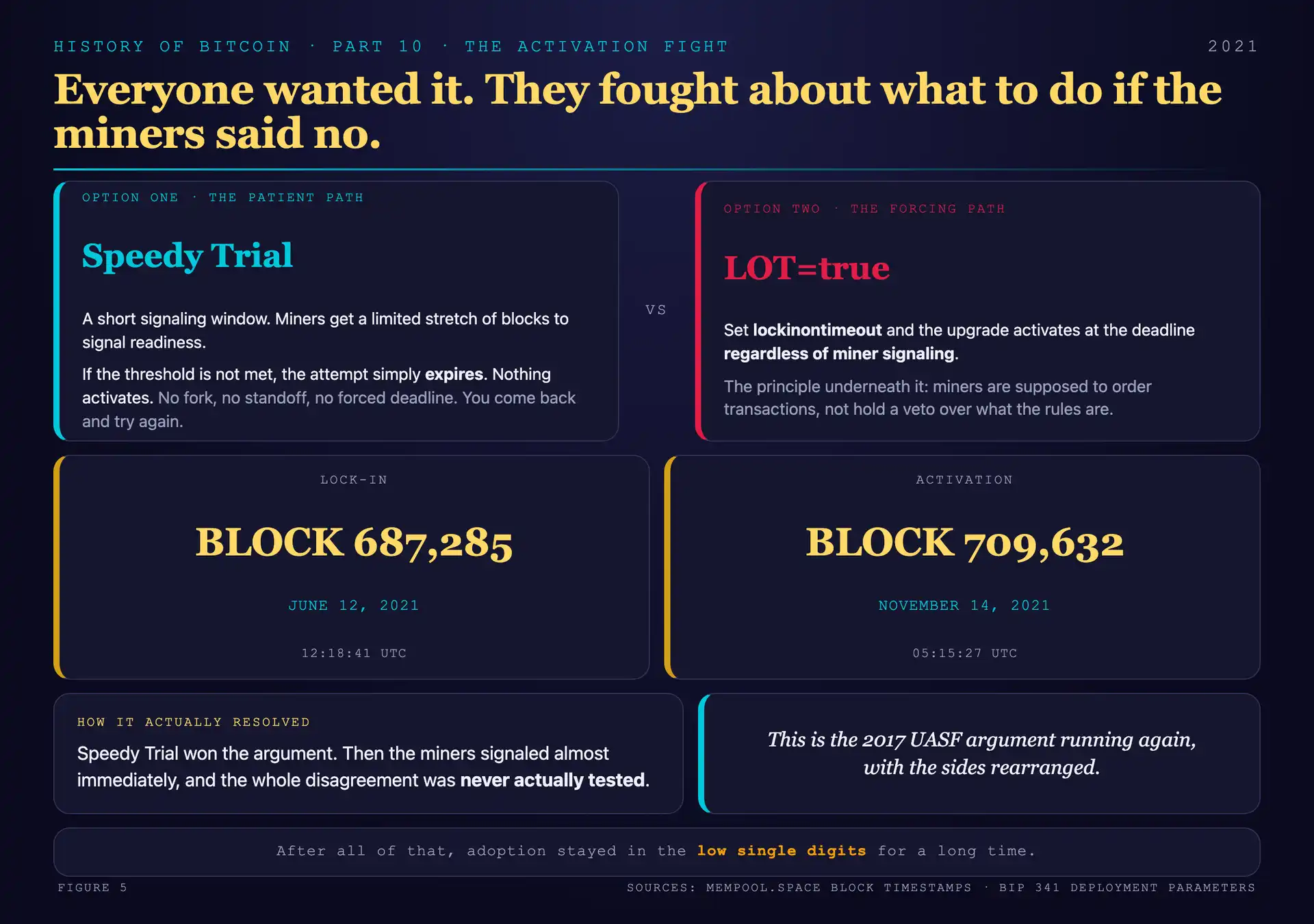
Then came the fight about how to turn it on, which was a deeply procedural and governance-touching debate, and that is where the scar tissue from 2017 shows.
Two camps. One wanted BIP 8 with the lock-in-on-timeout parameter set to true, which meant: signal for this upgrade or the upgrade activates anyway at the end of the window and your node gets left behind. That is the machinery of the 2017 user-activated soft fork, formally specified for Taproot in BIP 343 by Shinobius and Michael Folkson. The other camp wanted what got called Speedy Trial: a short signaling window with a 90 percent miner threshold and no forced fallback at all. If it failed, it simply did not activate, and the argument could start over.
The technical vocabulary hides what was actually being argued about. Lock-in-on-timeout is a threat. It says the change is happening whether the people running the machines consent or not, and the people who do not upgrade will find themselves following a chain that the economically dominant nodes no longer accept. That is not a bug in the mechanism. That is the entire point of the mechanism, and it worked in 2017, and everybody in the room in 2021 remembered that it worked. The majority preference that emerged was almost elegant in its logic: if this upgrade is genuinely uncontroversial, we do not need the threat, and if it is controversial, we should not be using the threat.
So they took the threat off the table and left it in the drawer, loaded, where everyone could see it.
Speedy Trial won, shipped in Bitcoin Core 0.21.1 on May 1, 2021, and the signaling window opened on April 24.³⁰ On June 12, 2021, at 12:18:41 UTC, block 687,285 carried Taproot past the threshold and locked it in. Five months later, block 709,632 enforced it.³¹
Compare that to 2017, when the same network split in half over a capacity increase and half the industry signed an agreement in Hong Kong that the developers then refused to honor. Part 7 covered how that ended. In 2021, the fight was over the activation mechanism rather than the upgrade, it stayed on a mailing list, and it took about four months. And the reason is obvious enough to say out loud: by 2021 there was nobody left to fight with. Everyone who would have objected had already been driven off, forked away, or told to go start their own coin. Consensus is easy when the room has been cleared.
And after all that, almost nobody used it.
Taproot adoption stayed in the low single digits of daily transactions for over a year after activation. In late January 2023, more than fourteen months in, it was still being reported as an all-time high at roughly four percent.³² The privacy upgrade nobody could agree on how to activate turned out to be an upgrade nobody had much reason to use.
The reasons are unglamorous and worth saying anyway. Wallets had to be rewritten to support a new address format and a new signature scheme, and wallet developers do that work when users demand it. Users did not demand it, because for an ordinary person sending an ordinary payment, Taproot changed approximately nothing they could perceive. The privacy gain only materializes if enough people use the key path that a key-path spend stops standing out, and the efficiency gain only materializes on complicated spends that most people never make.
It was a feature built for institutions and protocol engineers, shipped to a user base whose primary activity was buying and holding with a custodian, and never thinking about making a payment.
Until somebody found a different reason...
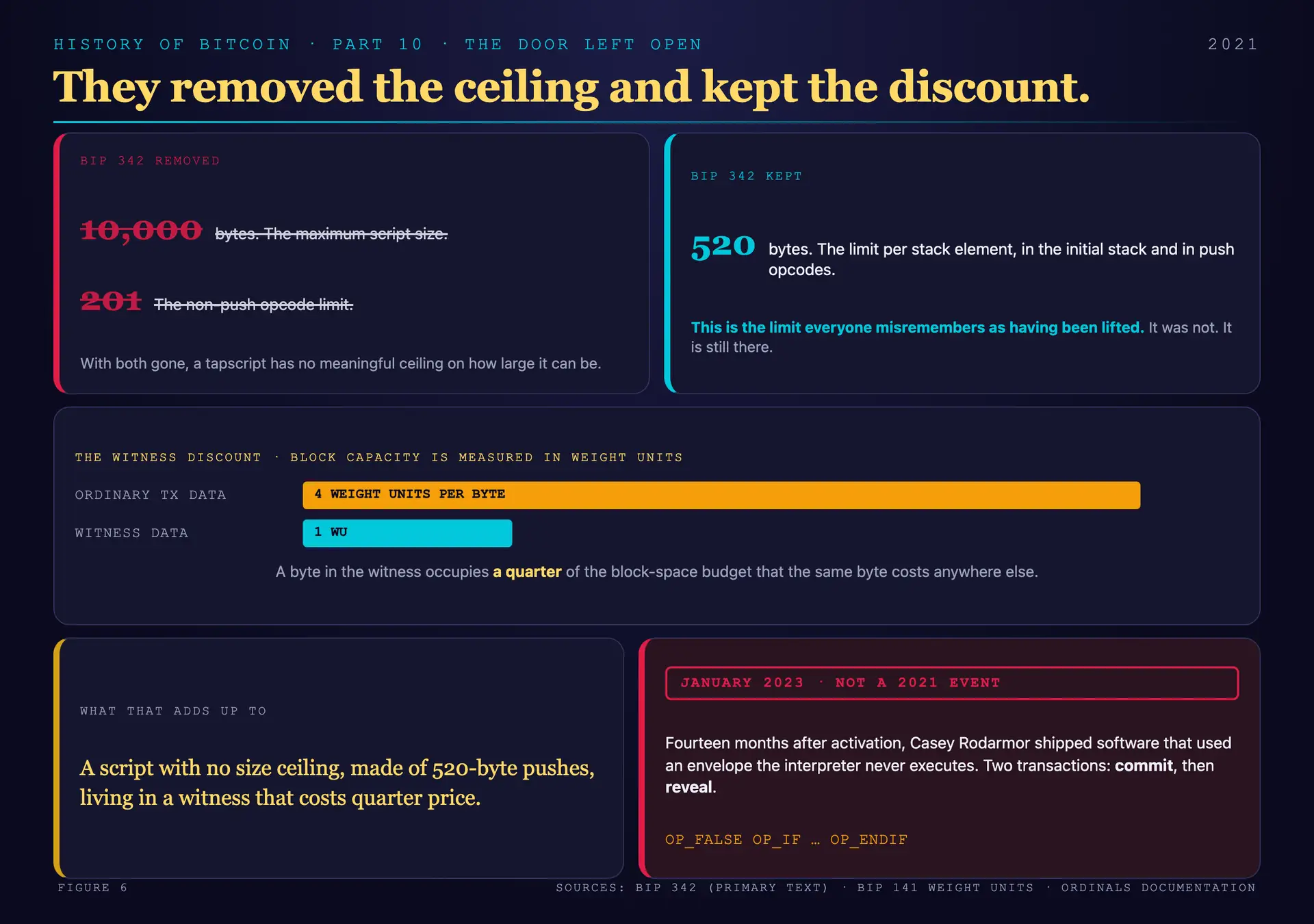
BIP 342 changed three limits, and the reason it changed them was defensible: in Tapscript, the CPU cost of checking a signature no longer scales with the size of the script, so the old caps that existed to prevent denial-of-service attacks were no longer doing the job they were written for. In the BIP's own words:
"The maximum script size of 10000 bytes does not apply. Their size is only implicitly bounded by the block weight limit." Removed.
"The maximum non-push opcodes limit of 201 per script does not apply." Removed.
"The existing limit of maximum 520 bytes per stack element remains, both in the initial stack and in push opcodes." Kept.
That third line is the one that gets misreported constantly. The 520-byte limit on any individual piece of data never went anywhere, and people who tell you Taproot "removed the data limits" are describing something that did not happen.
What went away was the ceiling on the script as a whole.
Then add the discount. Segregated Witness, back in 2017, moved signature data into a separate witness structure and priced it at one weight unit per byte while everything else in a transaction costs four. Data placed in the witness therefore consumes roughly a quarter of the block-space budget that the identical data would consume anywhere else. That is the witness discount, and Taproot spends are witness spends, so Taproot inherited it whole.
Put those together. A script with no size ceiling, made of individual data pushes capped at 520 bytes each, living in a witness that costs a quarter price. Anything you can chop into 520-byte pieces will fit, and it will fit cheaply.
Ordinals' own documentation describes it without any editorializing at all: inscription content lives in taproot script-path spend scripts, which "have very few restrictions on their content, and additionally receive the witness discount, making inscription content storage relatively economical."³³
In January 2023, fourteen months after activation, a developer named Casey Rodarmor shipped software that used exactly this. The data goes inside an OP_FALSE OP_IF ... OP_ENDIF envelope, which the interpreter never executes, so it changes nothing about how the script behaves and everything about what the blockchain permanently contains. Two transactions: one to commit, one to reveal.
What that produced, what it did to fees, and the years-long war it started inside BTC's own development community between two competing node implementations, all of that gets its own installment. I have written about where that road ends elsewhere. For now, one fact.
The network that spent 2015 through 2017 insisting blocks must stay small because block space is sacred and data must never be stored on the blockchain had just made arbitrary data storage cheaper than it had ever been, on purpose, in the name of privacy, with almost no one objecting.
They built the door, they left it unlocked, and now they have spent years fighting about why people walked in.
The bubble machine
Free money has to land somewhere, and in 2021 it did not land in a factory.
The destination is the whole argument, and it starts on somebody else's network, because Ethereum spent 2021 running the experiment this series has been describing since Part 3, at full scale, in public, with real people's savings, and then published the results.
On August 5, 2021, at block 12,965,000, timestamped 12:33:42 UTC, Ethereum activated the London upgrade. The headline change was EIP-1559, a rewrite of how you pay to use the network.³⁴
A gas fee is what it costs to get a transaction executed, and it is worth holding it next to how fees behave on a network that does not cap its capacity. Before London, you paid it by guessing: you named a price in a unit called gwei, miners took the highest bidders first, and if you guessed low your transaction sat there. It was a blind auction where nobody could see the other paddles. EIP-1559 replaced the guess with a protocol-set base fee that rises when blocks run more than half full and falls when they do not, plus an optional tip on top that actually goes to the miner. And the base fee, every last gwei of it, gets burned. Destroyed. Sent to no address at all, removed from the supply forever.³⁵
Guess which half of that the market cared about.
The burn became a scarcity story within about a week. Fee reform got rebranded as monetary policy, and a technical patch on a congested auction turned into a reason to hold the token. Nobody was lying, exactly. It is simply that the part of the upgrade with a chart got all the attention.
The fees did not get smaller. On May 10, 2021, the average Ethereum transaction cost $53.16.³⁶ When Time magazine launched its NFT collection on September 23, buyers reportedly spent almost four times as much on transaction fees as they did on the things they were buying.³⁷ Vitalik Buterin said so himself, to a news magazine, in late November: fees are "a huge problem for Ethereum's usability, especially for things other than some of the financial applications that have dominated recently."³⁸
Part 9 watched this network's fees break under its own success. Now its founder is telling Time magazine that the only applications that survive the fee market are the financial ones. That is not an accident of engineering.
That is a network whose economics select for speculation and price out everything else, and it happened on someone else's network, at someone else's expense, exactly the way the block size argument said it would.
I was doing a weekly livestream about this industry the whole year, which means I watched it in real time and had to say something intelligent about it every seven days. And the thing I could not get past, week after week, was the arithmetic of a fifty-dollar transaction fee. Fifty dollars kills the tip jar. It kills the metered API call, the pay-per-article, the ten-cent in-game item, the machine paying another machine for a weather reading. It kills every small thing, which is to say it kills every new thing, and leaves you with a network that can only afford to move large sums of money between people who already have large sums of money.
That is not a scaling inconvenience, and it's certainly not a positive disrupter. It is a filter, and it decides what gets built on technology that should have been changing the world for the better.
On October 27, 2021, at epoch 74240, the Beacon Chain took its first mainnet upgrade, called Altair.³⁹ The Beacon Chain was the proof-of-stake consensus layer running in parallel with the old mining network. Proof of stake swaps electricity for collateral. Instead of burning power to earn the right to propose a block, you lock coins up as a deposit, the protocol picks proposers in proportion to what is locked, and it confiscates the deposit if you cheat. Work anybody outside can measure becomes money you have promised not to move. Altair tightened the penalties and added light-client support, and the actual Merge was still ten months away, in September 2022.
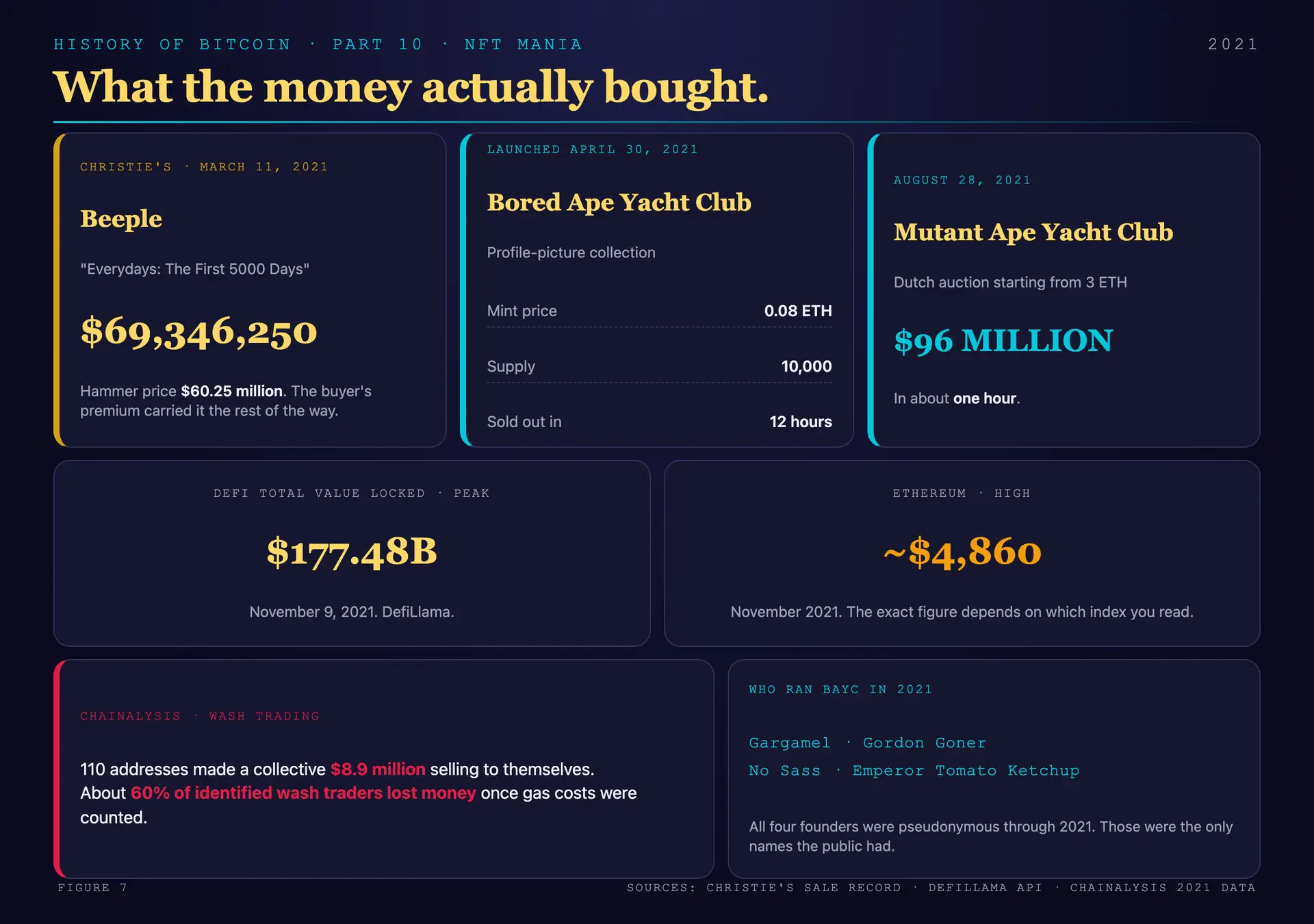
ETH peaked at roughly $4,860 on November 10, 2021, per Yahoo Finance's daily bar for ETH-USD, and the exact figure moves by a few dollars depending on which index you pull.⁴⁰ Money locked into Ethereum's lending and trading protocols, the number the industry calls total value locked, peaked at $177.48 billion on November 9, according to DefiLlama's own data.⁴¹
Total value locked measures deposits. It does not measure revenue, or customers, or anything that got built. It counts what came in.
Sixty-nine million dollars for a JPEG
On March 11, 2021, at Christie's, a digital collage by the artist Mike Winkelmann, who works as Beeple, took a winning bid just after 10:00 a.m. Eastern of $60.25 million. The buyer's premium pushed the final price to $69,346,250.⁴²
What actually changed hands was an ERC-721 token. That is a line in a smart contract on Ethereum saying a particular address controls a particular serial number, and the serial number points at a file that almost always lives somewhere else entirely. The token is the receipt. The art is usually a link. That distinction is going to matter enormously in a later installment.
The buyer went by MetaKovan and revealed himself a week later, on March 18, as Vignesh Sundaresan, with his partner "Twobadour" surfacing as Anand Venkateswaran.⁴³
Then the floodgates. Christie's sold nine CryptoPunks as a single lot in May for $16,962,500,⁴⁴ and Sotheby's sold a single alien Punk, number 7523, in June for $11,754,000, to Shalom Meckenzie, the largest shareholder of DraftKings.⁴⁵ On April 30, a project called Bored Ape Yacht Club minted 10,000 cartoon apes at 0.08 ETH apiece, about $190 at the time, generated by shuffling 172 traits. Sales were slow for a few hours. Then a trader called Pranksy bought a batch and posted about it, and the whole supply was gone inside twelve hours.⁴⁶
All four of the people behind it were pseudonymous. Gargamel, Gordon Goner, No Sass, and Emperor Tomato Ketchup.⁴⁷ Nobody outside their circle knew who any of them were, and nobody buying seemed to mind.
Ten thousand people bought a status symbol from four anonymous cartoon accounts, and the status symbol worked.
On August 28, the same team ran a Dutch auction of 10,000 Mutant Apes starting at 3 ETH and descending, plus an airdrop of "mutant serum" to existing holders so they could mutate the ape they already had. It moved $96 million in about an hour.⁴⁸ Steph Curry bought an ape that same day for 55 ETH, about $180,000. Jimmy Fallon bought one in November for 46.6 ETH, about $216,000, and showed it off on television. Eminem closed out the year on December 30 with 123.45 ETH, about $452,000, for an ape that looked like him.⁴⁹
OpenSea, the marketplace where most of this cleared, did $325 million in July, which was its best month ever at that point. In August it did about $3.4 billion, and in December about $3.25 billion.⁵⁰
A tenfold month, on a venue almost nobody outside this industry could have named in June, selling pictures.
Meanwhile, in the Philippines, people were playing a game called Axie Infinity for a living. The economics ran on a scholarship system: managers who owned the starting creatures rented them to players called scholars, who ground the game and split the token yield. At the peak, reporting put daily active users in the millions, with the Philippines supplying something like half of them, and the reward token hit its all-time high of $0.41 on May 1.⁵¹ Over on Flow, NBA Top Shot cleared more than $200 million in a single month in February, and its parent company Dapper Labs raised $250 million at a $2 billion valuation, then another $300 million at north of $7 billion, inside a few months.⁵²
That is the boom, but what was smoldering underneath it?
Chainalysis went back through 2021 on the network afterward and found 110 addresses that made a collective $8.9 million wash trading NFTs. Wash trading is selling something to yourself. You control both wallets, you bid your own item up, the sale prints on the public record as a real trade, and everybody watching the floor price sees demand that does not exist. A wider group of 262 accounts had done it more than 25 times each. And the punchline, which I love, is that nearly 60 percent of them lost money doing it once you counted the gas!
The single most prolific one made 830 self-financed sales and never turned a profit.⁵³
The same analysis found at least $44.2 billion sent to NFT smart contracts on Ethereum in 2021, against roughly $106 million the year before.
The people who bought apes were not idiots. They were behaving rationally inside a monetary environment that had gone insane. When the government hands you a stimulus check, the central bank buys $120 billion of bonds a month, your savings account pays nothing, and every asset you can see has gone vertical, the rational move is to buy the thing going up fastest. That is not greed. That is arithmetic under conditions somebody else chose. I have never blamed a guy for taking the trade the policy was screaming at him to take.
Again, the indictment belongs upstream.
It belongs to a monetary policy that made capital free and production optional. It belongs to the promoters who figured out that a status ladder ships faster than a product, and that a ladder with 10,000 rungs and a Discord is worth more than a company with customers. It belongs to the venues that let manufactured demand print as real volume on a public record and then quoted that record back to the next buyer as evidence. And it belongs, a little, to all of us who spent a decade saying this technology was going to bank the unbanked and then spent 2021 watching the smartest capital in the industry underwrite cartoons.
None of this was new, which is the depressing part. Tulip contracts in Haarlem, the South Sea Company selling a monopoly on trade nobody was conducting, Florida swampland, the pink sheets, the dot-com IPO where the prospectus admitted there was no revenue and the stock tripled anyway. Every one of those manias had the same two ingredients: too much money looking for a home, and a story about why this asset could not go down. 2021 supplied both in industrial quantities. The only genuinely modern part was the settlement speed.
It used to take a season to lose your money, now you can do it inside of a few Ethereum blocks!
Bitcoin was designed to let a business put a service on the network, charge a fraction of a cent for it, and get paid instantly by a stranger it would never meet. That is the invention. Almost nobody was building services in 2021. Everybody was minting inventory, and then selling the inventory to each other, and then charting the sales.
A JPEG of a bored monkey cost more than a house in Ohio.
Going mainstream
2021 is also the year the suits arrived, and most of it looks like victory to the Hodl cultists.
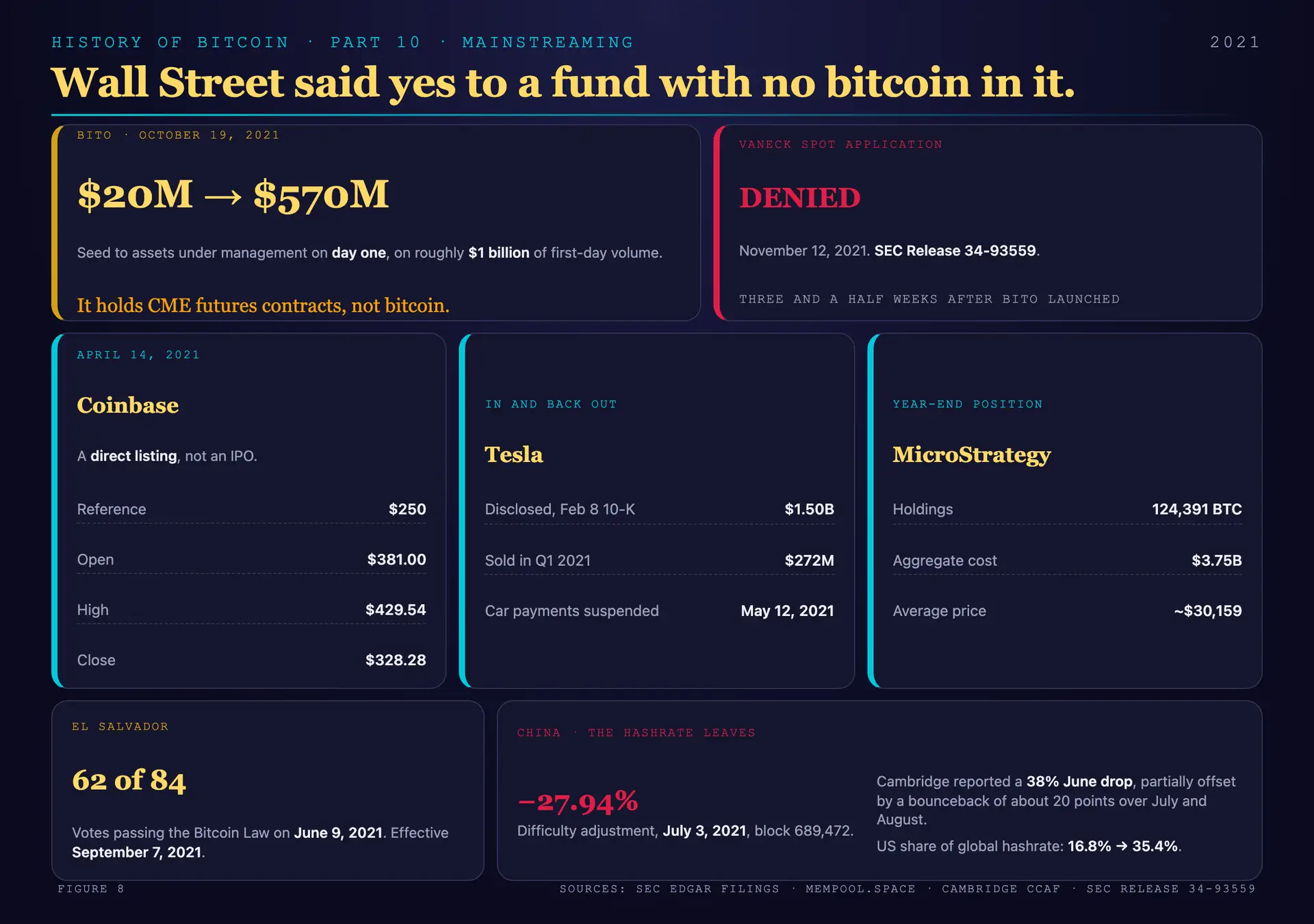
On April 14, Coinbase went public on Nasdaq. Not an IPO. A direct listing, which means no new shares were sold, no underwriters priced an offering, and no money was raised. Existing shareholders simply got a public market to sell into. Nasdaq set a reference price of $250 the night before, a figure derived from private secondary trades that explicitly was not an offering price.⁵⁴ The stock opened at $381.00, ran to $429.54, and closed the day at $328.28 on 81 million shares.⁵⁵
Note what got validated that morning. Not Bitcoin. A brokerage. The public markets put a hundred billion dollar valuation on a company whose revenue came from charging retail customers a spread to buy an asset, which is a toll booth business, and a very good one. Wall Street did not fall in love with peer-to-peer electronic cash in April 2021. It fell in love with the fee.
The same day, the Senate confirmed Gary Gensler as chairman of the Securities and Exchange Commission.⁵⁶ Four months later, on August 3, he stood up at the Aspen Security Forum and said the quiet part into a microphone: "Right now, we just don't have enough investor protection in crypto. Frankly, at this time, it's more like the Wild West."⁵⁷
Corporate treasuries got in too. Tesla's 10-K, filed February 8, 2021, disclosed that "we invested an aggregate $1.50 billion in bitcoin," and said the company would begin taking bitcoin for cars.⁵⁸ Two and a half months later its Q1 10-Q disclosed the other half of the trade: "In the first quarter of 2021, we also sold an aggregate $272 million in bitcoin." Elon Musk's explanation was that the sale demonstrated bitcoin's liquidity as a treasury alternative to cash.⁵⁹
As of March 31, 2021, the disclosed fair market value of Tesla's bitcoin was $2.48 billion. The carrying value on the balance sheet was $1.33 billion. Both numbers are true. American accounting rules at the time treated bitcoin as an indefinite-lived intangible asset, which meant you wrote it down when it fell and were forbidden from writing it back up when it recovered.
A company could hold an asset that had doubled and be required to keep reporting the loss.
Then on May 12, Musk suspended bitcoin payments for vehicles: "We are concerned about rapidly increasing use of fossil fuels for bitcoin mining and transactions, especially coal, which has the worst emissions of any fuel."⁶⁰ The window in which a person could actually buy a Tesla with bitcoin opened that spring and closed on May 12. That was the whole experiment.
MicroStrategy went further and borrowed to do it. A $1.05 billion offering of zero-coupon convertible notes closed February 19, and a $500 million offering of 6.125 percent senior secured notes closed June 14, both explicitly to buy bitcoin, the second secured on substantially all of the company's assets.⁶¹ Its December 30 filing gives the year-end position in the company's own words: "As of December 29, 2021, the Company held approximately 124,391 bitcoins that were acquired at an aggregate purchase price of $3.75 billion and an average purchase price of approximately $30,159 per bitcoin."⁶²
A software company borrowed half a billion dollars at 6.125 percent, secured on nearly everything it owned, to buy an asset it had publicly committed to never selling. That position comes back in the next installment.
Remember the paper Bitcoin
Part 7 of this series ended its Chicago chapter with a promise, and I am here to keep it.
That chapter walked through the launch of cash-settled bitcoin futures in December 2017, and the mechanism that made them matter: no bitcoin ever changed hands. You could go long or short, win or lose fortunes, and not one satoshi moved on the network or was validated on the blockchain. It created a parallel instrument, a paper Bitcoin, whose price could be shoved around by people who never had to touch the real thing. Part 7 closed the section by telling you to remember it, because it comes back much bigger in the era of the exchange-traded fund.
Here it is.
On October 19, 2021, the ProShares Bitcoin Strategy ETF began trading in New York under the ticker BITO.⁶³ It launched with $20 million of seed money and finished its first session holding $570 million, on roughly a billion dollars of volume, which Bloomberg's ETF analysts ranked as the second-heaviest first day any new ETF had ever posted.⁶⁴ The financial press called it the day Bitcoin got its Wall Street ticket.
What BITO holds is CME bitcoin futures contracts. ProShares says so on the fund's own product page, in the plainest English available: "BITO invests in futures and swaps and does not directly invest in bitcoin."⁶⁵
Futures contracts expire, which means a fund built on them has to roll: sell the contract that is about to die, buy the next month out, over and over, forever. When the further-out month costs more than the near one, and in a rising market it usually does, the fund sells low and buys high every single time it rolls, on purpose, as a structural condition of existing. The investor eats that. It does not show up as a fee, it shows up as a quiet gap between what bitcoin did and what your fund did, widening every month you hold it.
So the retail buyer who wanted bitcoin in a retirement account got a wrapper around a derivative of an index of an asset, and paid for the privilege in a way the fact sheet does not itemize.
Spot applications, funds that would actually buy and hold coins, had been landing at the SEC since 2013, and every single one had been denied or withdrawn. Three and a half weeks after BITO opened, on November 12, 2021, the Commission denied another one, VanEck's, in Release No. 34-93559, File No. SR-CboeBZX-2021-019, on the grounds that the spot bitcoin market was not adequately surveilled against fraud and manipulation.⁶⁶
So the regulator's position, stated in two documents weeks apart, was that the underlying market was too manipulable to build a fund on, and that a fund built on derivatives of that same market was fine.
And Part 7 already handed you the counterargument, from the Federal Reserve Bank of San Francisco's own economists, writing about what happened when bitcoin futures launched in 2017: "The rapid run-up and subsequent fall in the price after the introduction of futures does not appear to be a coincidence."⁶⁷
The ETF they finally approved did not contain a single bitcoin.
The kid who gave away his stage time
The first weekend of June, at a conference in Miami, a young founder from Chicago had a headline speaking slot and did not use it for himself. He played a pre-recorded video instead.
In the video, the president of El Salvador, Nayib Bukele, announced that he would send his legislature a bill making bitcoin legal money.⁶⁸ The founder called it the shot heard round the world, and he had earned the right to say it, because he had spent months on the ground in that country with his payments company and, according to the Salvadoran investigative outlet El Faro, had a hand in the plan that produced the bill.
The kid was Jack Mallers.
Part 7 introduced him as a footnote to somebody else's story. His grandfather, William Mallers Sr., was elected chairman of the Chicago Board of Trade in 1969 at thirty-nine. His father ran the family's clearing firm as its first president, and handed his son Bitcoin in 2013. Part 7 told you to remember that name, because he mattered enormously later, in a country called El Salvador.
Both of those debts were incurred in the same corner of Part 7, and both of them run through Chicago. The futures pits that manufactured the paper Bitcoin, and the family that produced the man who put the real one into a national currency. Same city, same trade floor, one generation apart!
The case for it was not stupid. El Salvador does not have its own currency. It abandoned the colón for the US dollar in 2001, which means its monetary policy is set in Washington by people who have never heard of it, and a very large share of its national income arrives as remittances from Salvadorans working abroad, routed through wire services that take a cut of every transfer sent home to a grandmother. A country in that position looking at a payment network that settles in minutes and does not care about borders is not being reckless. It is doing the math.
The Legislative Assembly passed the Bitcoin Law on June 9, 2021, by 62 votes of 84, roughly five hours after seeing it.⁶⁹ Legal tender is a specific legal thing: it means the state compels acceptance of that money in settlement of a debt. Article 7 of the law says so directly: "Every economic agent must accept bitcoin as payment when offered to him by whoever acquires a good or service." It took effect on September 7.
Every citizen who signed up for the government's Chivo wallet got $30 in bitcoin. That was the adoption engine and it worked; sort of... People showed up for $30. Everything else went badly. Logins failed, ATMs failed, identity verification failed, and the app refreshed its bitcoin price only once a minute, which is an eternity in a volatile market and an open invitation to anybody with a fast finger and sixty seconds of certainty about the future!
One Salvadoran human rights organization logged 755 fraud reports tied to Chivo in a single week that October, most of them people whose national ID numbers had been used to claim the bonus by somebody else.⁷⁰
An NBER working paper later surveyed what actually happened, and fewer than 60 percent of Salvadorans with an internet-capable phone downloaded Chivo. Of those who did, about 20 percent kept using it after spending the $30, and fewer than 10 percent kept using it for bitcoin transactions specifically. The bonus was the adoption. Almost nothing survived it.⁷¹
People also objected, loudly. There were protests on the launch date itself, including a Chivo ATM set on fire. Around 15,000 people marched on September 15 against the law and against Bukele's constitutional maneuvering, and thousands more on October 17.⁷² On November 20, at a bitcoin conference on the coast, Bukele announced Bitcoin City, a circular tax-free city near the Conchagua volcano, to be powered by geothermal energy and funded by a $1 billion, ten-year, 6.5 percent bond, half of which would be spent buying bitcoin.⁷³ Two days later, the IMF's Article IV mission published a concluding statement warning of "large risks associated with the use of Bitcoin on financial stability, financial integrity, and consumer protection," and recommended narrowing the law's scope.
I do not think this is a triumph story, but I do not strictly think it is a farce. A small, dollarized country with an enormous remittance bill did something no state had done, badly, in a hurry, with a wallet that did not work and a mandate its own president spent the next year walking back. That it happened at all is the historical fact. That it happened like that is the other one.
The hashrate leaves home
On May 21, 2021, the Financial Stability and Development Committee of China's State Council, chaired by Vice Premier Liu He, held its fifty-first meeting and announced a crackdown on bitcoin mining and trading. It was the first time the top level of the Chinese government had said it out loud, and the provincial shutdowns followed through May and June.⁷⁴
The size of what followed is genuinely hard to pin down.... What I can stand behind is on the network itself. On July 3, 2021, at block 689,472, Bitcoin's difficulty adjustment came in at negative 27.94 percent, the largest downward adjustment in the protocol's history to that date.
The Cambridge Centre for Alternative Finance, which surveys mining pools directly, recorded a 38 percent drop in global hashrate in June, partially offset by a bounceback of roughly 20 percentage points across July and August as the machines came back on somewhere else. Somewhere else meant, mostly, the United States, which went from 16.8 percent of global hashrate at the end of April to 35.4 percent by the end of August. Kazakhstan went from 8.2 percent to 18.1 percent. Russia went from 6.8 percent to 11 percent.
An industry that had spent a decade being lectured about Chinese control of the hashrate watched that control end inside a single summer, and then went right back to worrying about something else.
Bitcoin's price high for the year printed on November 10 at $68,789.63 on CoinMarketCap-style index data, and at $69,045 on CoinGecko's. The year closed at $46,306.45 on December 31.⁷⁵
Washington was paying attention by then, though not in the way anybody in the industry wanted. The Infrastructure Investment and Jobs Act passed the Senate 69 to 30 on August 10, passed the House 228 to 206 on November 5, and was signed on November 15.⁷⁶ Buried in it was Section 80603, which extended tax-reporting rules to digital assets and defined a "broker" as any person who, for consideration, is responsible for regularly providing any service effectuating transfers of digital assets on behalf of another person. Written that broadly, it arguably swept in miners, node operators, and people who write wallet software, none of whom ever hold a customer's assets or know a customer's name.
A bipartisan amendment to narrow it died on the Senate floor over an unrelated procedural fight about the military budget.
That is how the industry got its first real federal statute. Not through hearings about what the technology does. Through a pay-for in an infrastructure bill.
And the money underneath all of it, the stablecoin plumbing I traced in Part 8B, got its own verdict that October. The Commodity Futures Trading Commission found that Tether held sufficient fiat reserves to back its tokens for only 27.6 percent of the days in a 26-month sample from 2016 through 2018, and fined Tether $41 million and Bitfinex $1.5 million.
Nobody sold. The chart went up. In 2021, the fine was a rounding error and the reserve finding was a Tuesday.
Look at what the year handed the industry, all told. A stock exchange listing for the toll booth. A car company that took bitcoin for cars for part of one spring and then quit over coal. A software company mortgaged to its coins. An exchange-traded fund with no bitcoin in it, approved in the same season a fund with bitcoin in it was refused. A country that made it legal tender with an app that did not work. A hashrate map redrawn by a committee in Beijing. And a price that touched sixty-nine thousand dollars and then spent the rest of the year drifting down toward forty-six.
Every one of those is a headline about acceptance. Not one of them is a business that could survive the money getting expensive again.
Twenty-one days in Miami
The trial was supposed to start on June 1, 2021.
That is where Part 9 left it. Specially set, on the calendar, nine in the morning. It did not happen then, and the reason is boring in the way that real reasons usually are.
On April 6, 2021, the Southern District of Florida issued Administrative Order 2021-33, continuing every jury trial in the district until after July 6.⁷⁷ June 1 was dead before anybody argued about it. Seventeen days later the parties filed a joint motion to reset the date, ECF 649, and its stated reasons are worth reading in their own words, because they date the pandemic better than any retrospective can:
"At the moment, travel from the U.K. to the United States remains prohibited, which could prevent Dr. Wright, a U.K. resident, from attending the trial in person."⁷⁸
The rest is duller and more human. Counsel on both sides had trials and arbitrations booked through July, August and October, one lawyer was moving a daughter into college in August, and then this, verbatim: "a number of both parties' counsel observe the Jewish High holidays that occur the month of September."⁷⁹
Judge Beth Bloom signed the order on April 27 and reset the trial for November 1, 2021, at 9:00 a.m.⁸⁰
A border closure, a college move-in, an arbitration calendar and the Jewish holidays. That is the entire reason the most-watched lawsuit in Bitcoin's history happened in November instead of June. I have heard at least four theories about what the delay really meant. It meant flights from London were closed.
The daily bid
I booked a hotel I could walk to the courthouse from, and it was the best decision I made all year.
Everything in this next part is mine, and none of it is on a docket.
The building was still running pandemic protocols in November 2021, and the practical effect was that the gallery held a fraction of the people who wanted to be in it.⁸¹ There is no lottery for a seat in a federal courtroom, and there is no press credential that conjures a chair out of a room that does not have one. There is a line. So I got up before dawn, every day, and stood outside a federal courthouse in Miami with reporters and paralegals and Bitcoiners and the occasional person who had flown in from somewhere just to look at the guy, and on any given morning there was no guarantee that I was getting through the door.
That is what I mean when I say I bid for a chair. The currency was sleep.
No electronics inside. Not a laptop, not a phone, not a recorder, not a smartwatch. So the entire trial exists, in my possession, as ink in a paper notebook: every hour of testimony, every objection I could catch, every name and every number, written by hand at roughly the speed a litigator talks. I have never written that many words with a pen in my life, and I hope I never have to again.
At the lunch break I walked out, collected my phone from the security desk, and went live to explain the morning to the people who could not be in the room. Then I went back in and did the afternoon. Then, at night, I did a full summary of the day and took live questions until the questions ran out, which was usually later than I wanted it to be. Then I slept a little and stood in the line again.
Twenty-one trial days of that, which took over a month because of weekends and the Thanksgiving holiday.
There were also cameras, a lot of them, and I do not have to ask you to take my word for it, because I wrote it down at the time. From my own year-end column, published December 24, 2021, while all of it was still fresh:
"As the case heated up, there was increasing media presence, multiple documentary crews (which means you'll be seeing a lot of Craig on your favorite subscription service over the next year or two) and a good amount of local news."⁸²
Reader, you did not.
I was one of the people those crews kept pointing a camera at. Nearly every day of that trial, somebody was filming me talking about that trial. And the film they were shooting has never been released, and it has never even been given a name. Not withheld, not lost, not quietly shelved under some title you could go look up. It does not have one. As I write this in 2026, four and a half years later, it is still in production.
My own read on why: the lawsuits that ran from 2021 through 2024 were supposed to be the centerpiece of that film, and the way they actually played out made them a poor way to tell the story.⁸³ Everybody in that building, me very much included, was treating December as a climax. It was not one. You cannot cut a third act out of a document that answers seven questions and declines to answer the eighth.
I also spent time in Miami talking with Christopher Cannucciari, who directed Banking on Bitcoin in 2016, about a follow-up he was working on.⁸⁴ I am not naming that one either, for the plainest possible reason: I do not know where it stands.
Two films about this story, filmed in part around me, and I cannot name either of them. That tells you more about the media apparatus that grew up around Craig Wright than any title I could have gone digging for.
Now the part where I tell on myself
I was covering a man I occasionally ate dinner with.
Twice during that trial I went out to Miami restaurants with Craig Wright to blow off steam, because weeks of federal litigation will do that to everyone involved in it, including the defendant. I was simultaneously being filmed for a documentary about him. And every night I was broadcasting to an audience that had made up its mind about this case years earlier and was not tuning in for balance. None of that mattered when we were sharing drinks at "El Tucan" and talking about what it was like growing up in Australia.
I also had cordial hallway conversations with Vel Freedman, who was lead counsel on the other side and was, in those conversations, an entirely decent person trying hard to win a case he believed in.
None of that is a defense, it is a disclosure, and you should have it in hand before you weigh anything I say about that room.
So I made rules for myself. I wrote down what was said rather than what it meant, and I kept those two things in separate columns of the same notebook so that I could not blur them later. I reported testimony that hurt the side I am publicly on, including the answer you are about to read, on the day it happened, before anybody knew which way the trial would break. I did not characterize a witness's motives on air.
And when I did not know something, I said that I did not know it, which is a phrase my audience found deeply unsatisfying and which I used constantly for the duration of the trial.
The notebook was the discipline. It is genuinely hard to spin a proceeding you are transcribing by hand in real time and reading back out loud six hours later to a few thousand people who are perfectly capable of checking you.
None of which made anybody happy. An audience that tunes in for a nightly victory lap does not particularly want a man reading his own handwriting back to them and reporting that the morning went badly for the side they are on. I gave them the bad mornings anyway, because the alternative is to become a person whose coverage you can predict without watching it, and at that point there is no reason for anyone to watch it.
If you ever sense that a writer is hiding his access from you, stop trusting him immediately. I would rather hand you the conflict at the top and let you discount me by whatever amount you think is fair. Not one fact I report here softens by a single degree because I had dinner with the defendant, and if any of them did, you should throw out this entire series and go read somebody else.
Ten people
The court's own words for what happened next: "a 21-day jury trial commencing on November 1, 2021."⁸⁵
Judge Beth Bloom presiding, in Miami.
There were ten jurors. Three men and seven women.⁸⁶
Federal civil juries are not criminal juries. The rules allow anywhere from six to twelve, and this one seated ten.
For the plaintiffs: Vel Freedman, Kyle Roche, Andrew Brenner, Maxwell Pritt and Stephen Zack. For the defense: Andres Rivero, Amanda McGovern, Zaharah Markoe and Schneur Kass. Small detail with a long shadow, since it dates the firm's own history: the plaintiffs signed the April filings as Roche Cyrulnik Freedman LLP and were Roche Freedman LLP by the time the AP quoted them in December.⁸⁷
The firm has since dissolved, and Roche ended up being the victim of what I can only guess was a deliberate operation by a villain who will enter the story in a later installment.
Strip away the decade of internet argument and the case was narrow. Two men worked together. One of them, David Kleiman, died in April 2013. The plaintiffs were his estate and a Florida company the two men had been jointly associated with, W&K Info Defense Research, described by the AP as a joint venture between them.⁸⁸
The question was whether a partnership had existed to mine or to create Bitcoin, and if so, what the estate was owed out of it.
What the plaintiffs were asking for was half of roughly 1.1 million bitcoin, along with a share of the intellectual property the two men had produced together. At the prices of November 2021, that is a civil claim in the tens of billions of dollars, and the wire services were describing it as a fifty-billion-dollar dispute in their headlines. That is why a courtroom in Miami had a line outside it before sunrise.
Craig Wright testified for four consecutive days, ending November 17, and was recalled to the stand on November 23.⁸⁹ I have watched a lot of people get cross-examined and I have never watched anything like it, and that is memory rather than record: he answers the precise question that was asked, at a level of specificity that turns a simple yes into a four-minute seminar on the thing adjacent to the question, and you can feel a courtroom lose the thread of its own inquiry in real time.
It was both a sight to behold, as a longtime bitcoiner, and something of a train-wreck when watching a Cuban-American grandma fall asleep in the jury box.
On day seven he told the jury that Kleiman had only ever mined bitcoins on testnet, which is the developer's sandbox and is worth nothing at all.⁹⁰ Outside the courtroom he told CoinDesk that the disputed assets are "in my wife's name," and that "she's the multibillionaire."⁹¹
His own attorney introduced him to the jury as the inventor of Bitcoin.⁹² I distinctly recall the timbre and the cadence of Amanda McGovern speaking as if on stage in a dramatic, theatrical production: "The man you're about to meet IS. A. GENIUS."
The cleanest testimony in the whole trial was one syllable long.
A defense witness named Kimon Andreou, a former colleague of David Kleiman, was asked whether during Kleiman's lifetime he had ever said that he had formed a business partnership with Craig Wright to either mine or invent bitcoin.
"No."⁹³
On cross he conceded that after the later news reports it had seemed "very plausible" to him, while maintaining that he did not believe Kleiman had done Bitcoin work. That is what an honest witness sounds like, and both sides got to use him.
Then came the quietest piece of testimony in the trial, which I thought at the time was the most damaging thing anyone said in that room. Carter Conrad testified that when Wright and Kleiman formalized an actual business together, Computer Forensics LLC, a third man joined it, and there were operating agreements, and the paperwork exists.⁹⁴ When these two made a partnership, in other words, they made a partnership the ordinary way, with documents.
The case was about a partnership for which no such documents were ever produced.
An infectious-disease specialist, Dr. D. Stewart MacIntyre Jr., testified about Kleiman's medical condition in his last years, and on cross-examination acknowledged that he had not been asked to evaluate Kleiman's brain.⁹⁵ Ira Kleiman testified about his brother, his family and the years after the death.⁹⁶
Ramona Watts, Wright's wife, did not appear. Her deposition was read into the record aloud by two people, which is a strange thing to sit through: a marriage discussed in the past tense, in a federal courtroom, performed by strangers.⁹⁷
And running underneath all of it, as it had run underneath this case since Part 8, was the bonded courier. The explanation for why the keys could not be produced. A person who was going to arrive one day with the last of it, and whose name has never been made public, in any filing or proceeding, from that day to this.⁹⁸
Then came the part nobody remembers, because the ending overwrote it.
On December 1, 2021, the jury reported that it could not reach a unanimous decision. The court gave an Allen charge, which is the instruction that tells a deadlocked jury to go back and keep trying, and sent them in again.⁹⁹
Five days before the verdict, this trial was one stubborn juror away from being nothing at all. Twenty-one days of testimony, a decade of accumulated internet argument, several million dollars of legal work, and the most likely outcome on the afternoon of December 1 was a mistrial and a do-over.
Andres Rivero spilled his drink on his notes in the opening of his closing statements, but was not granted more time. Instead, we got a very Baptist-minister-inspired repetition of "THAT, doesn't make sense... and if it doesn't make sense, you go with the defense!"
December 6
The verdict form runs ten pages and asks twenty-five questions.¹⁰⁰ Read it, not the coverage of it.
Seven claims went to the jury. Each was answered once.
Breach of Partnership. No.
Conversion. Yes, and checked for W&K Info Defense Research only.
Civil Theft. No.
Fraud. No.
Constructive Fraud. No.
Breach of Fiduciary Duty. No.
Unjust Enrichment. No.
Six no's and one yes.
Then the damages question, which has two separate lines on it.
From intellectual property: $100,000,000.00. From bitcoin: **zero.**¹⁰¹
The jury found that intellectual property had been converted. It did not find that any coins had been.
That distinction is the sharpest fact in the whole case, and almost nobody carried it. Every headline that December described a hundred-million-dollar bitcoin verdict, and the form says the opposite in two adjacent lines: the thing taken was intellectual property belonging to a company, and the amount of bitcoin involved in the taking, as found by the jury, was none.
The Estate of David Kleiman took nothing. Not reduced, not partial: zero on every line it could have recovered on, including its own conversion claim and the partnership claim that was the entire theory of the case.
Question 20 asks for the amount of bitcoin awarded, and the answer entered for both plaintiffs is zero.¹⁰²
Half of 1.1 million coins was the ask. The number written on the coins line was nothing, twice, and the brother of the dead man walked out with nothing at all.
Punitive damages were not skipped, and they were not "never reached," which is how you will usually see it written. Having found liability on conversion, the jury was required to decide them. It decided them. It wrote zero for both plaintiffs.¹⁰³
They were asked whether to punish him, and they answered no.
The affirmative defenses of statute of limitations and laches came back "Not Barred" on every claim, and the foreperson signed it "this 6 day of December, 2021."¹⁰⁴ Judge Bloom entered final judgment the following day, December 7, in the amount of $100,000,000.00, in favor of W&K.¹⁰⁵
That hundred million is the entire 2021 number. The interest that turns it into the larger figure you have probably seen quoted was added in March 2022, and it belongs to next year's story.¹⁰⁶
What I can tell you distinctly is that when the verdict was read, Craig and his team were celebrating while Ira's team hung their heads and the juniors on the team were scrambling through their notes. I remember watching Freedman grab the bridge of his nose and rub repeatedly, trying to keep his composure in what looked like emotive sadness, while Roche turned red in the face with visible anger.
**There is no question anywhere in those twenty-five that asks whether Craig Wright is Satoshi Nakamoto.**¹⁰⁷
Not phrased that way, not phrased any other way, not implied by a special interrogatory, not buried inside a damages instruction. The most argued question on the internet for six straight years went to a federal courthouse in Miami, sat through twenty-one days of trial, was spoken out loud in front of the jury by the defendant's own attorney, and was never actually put to the people who had been assembled there to decide things.
I am not going to tell you the jury found that he is Satoshi because I can't. I am not going to tell you it found that he is not, for the same reason. Both of those sentences have been written thousands of times since December 2021, and both are false in exactly the same way: they describe an answer to a question that does not appear on the form. A verdict cannot settle what it was never asked.
That is not a technicality, it is the entire architecture of a jury trial, and it is why the coverage that followed was so confidently wrong in both directions at once.
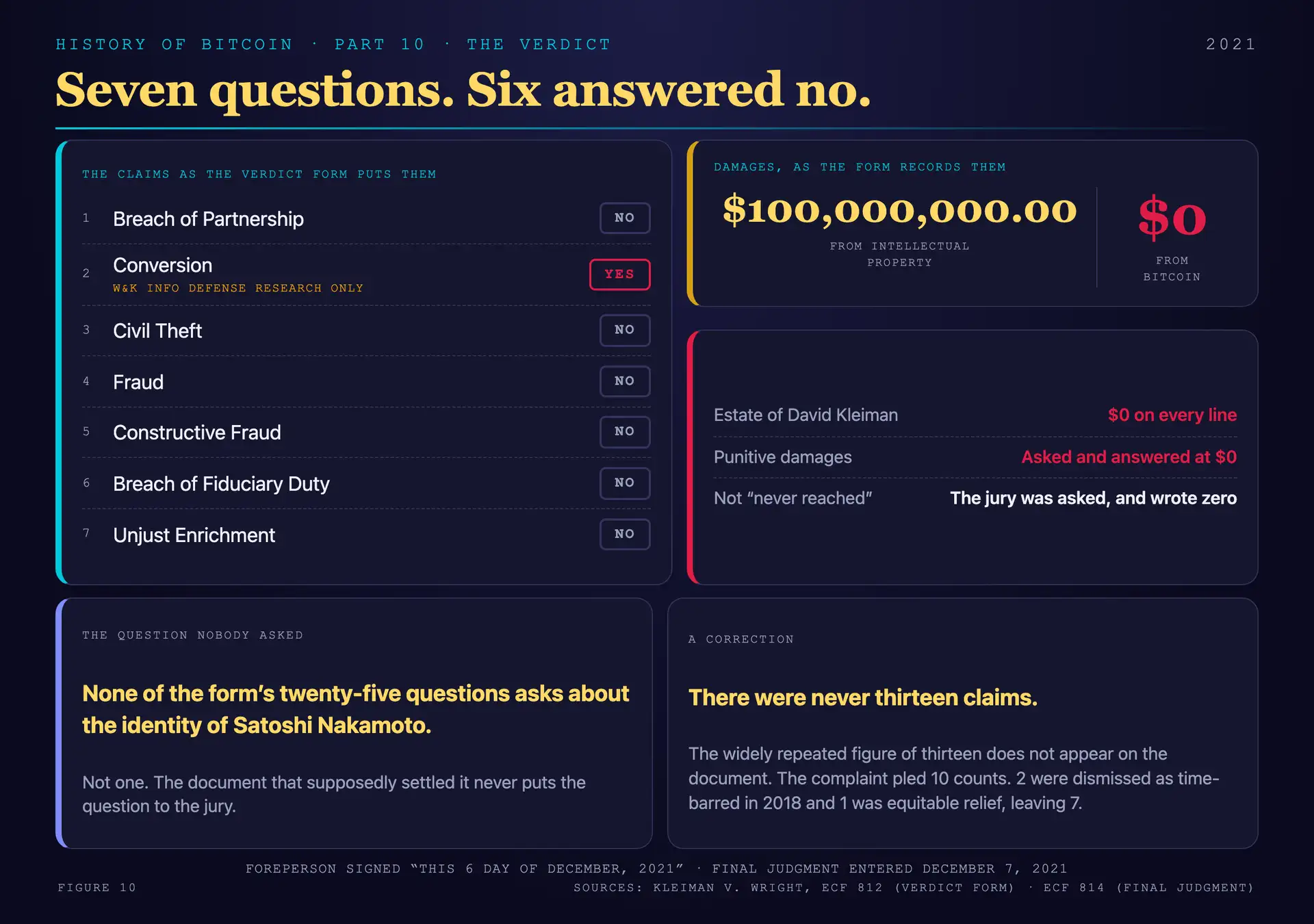
This figure reproduces the verdict form's own structure, question by question, rather than any outlet's summary of it. The widely repeated figure of thirteen claims does not appear on the document. Source: Kleiman v. Wright, No. 9:18-cv-80176 (S.D. Fla.), ECF 812, via the CourtListener docket
Outside the building, everybody won.
Andres Rivero, for the defense, to the AP wire: "This was a tremendous victory for our side."¹⁰⁸
Freedman, Roche and Brenner, jointly, to the same wire: "Wright refused to give the Kleimans their fair share of what (David Kleinman) helped create and instead took those assets for himself." The misspelling of Kleiman's name is the wire's own, in a sentence about what he was owed.¹⁰⁹
Craig Wright, in the courthouse hallway, to CoinDesk: "I feel remarkably happy and vindicated. I am not a fraud, and I never have been."
Vel Freedman, to the same reporters: "We just won $100 million!"¹¹⁰
Both sides walked out to the same cameras and declared victory, and the strange part is that each of them was telling the truth about the piece of the form he happened to be looking at. The plaintiffs got a hundred million dollars, which is a real number and a real win.
The defense beat six claims out of seven, kept every coin, and sent the estate of David Kleiman home with nothing at all.
The room emptied out. I had a notebook full of ink and one more livestream to do.
Ten people answered a question nobody had asked, and the one everybody wanted answered went home with them.
The other front
Miami had the cameras. It also had me, a notebook, and a line outside a federal building before sunrise.
It did not have the year.
While ten people in Florida worked through seven questions about a partnership, the same defendant was a party to London proceedings that would outlive the Miami verdict by years. Five of them, running at once, in courts that had never heard of each other's calendars. And twice in the same twelve months, on two different networks, a ledger got reorganized and the industry could not agree on what to call it.
That is the other front.
Meanwhile, in London
Start on January 15, 2021, because the year did.
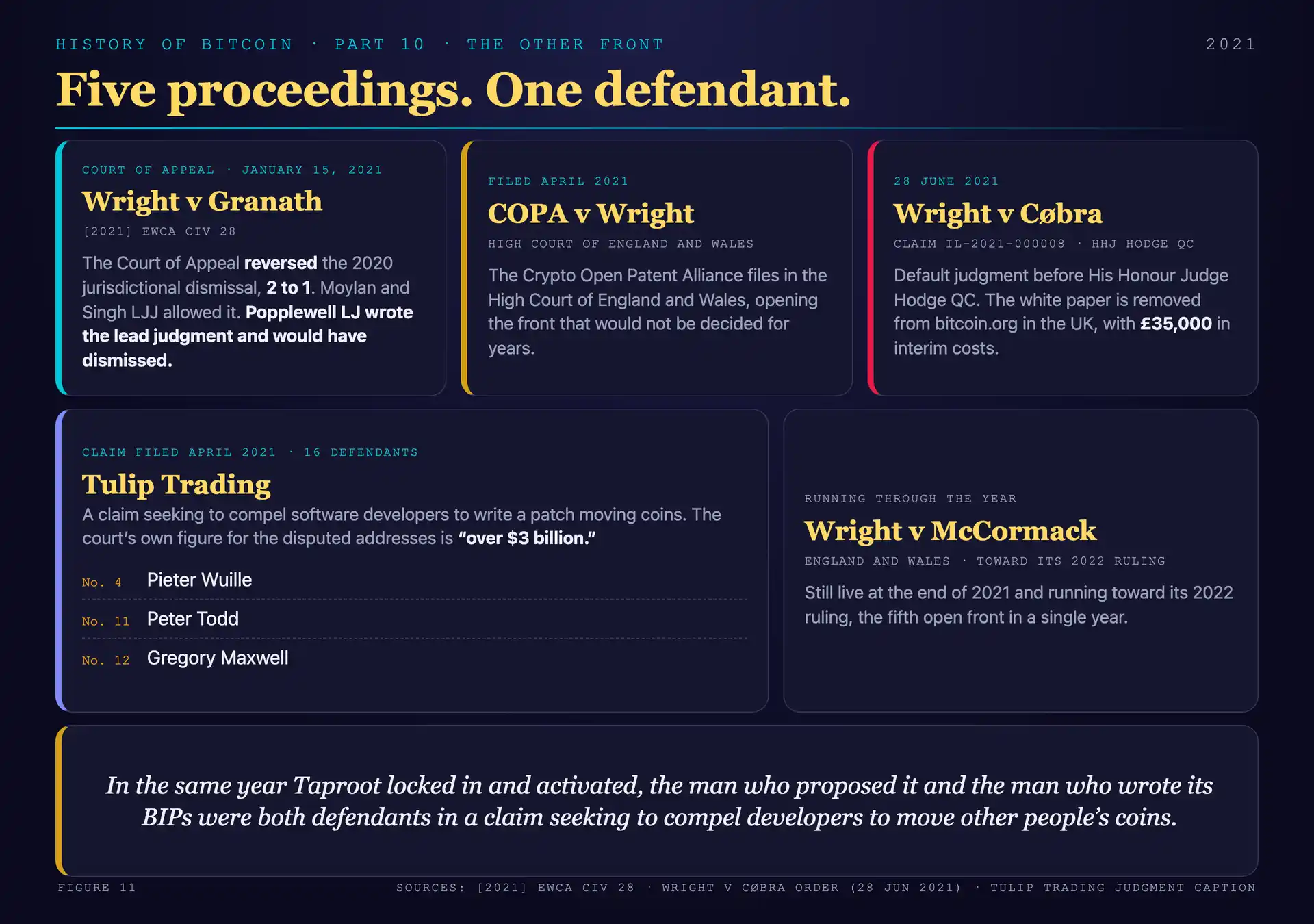
That morning the Court of Appeal handed down Wright v Granath [2021] EWCA Civ 28, reversing the ruling Part 9 left you with.¹¹¹ The 2020 High Court decision had thrown the English libel claim out on jurisdiction, because Magnus Granath had gotten to a Norwegian court first and the Lugano Convention says the second court stands down when both hear the same cause of action. The Court of Appeal said they were not the same cause of action. England could hear it after all.
The vote was two to one.
Lord Justice Popplewell wrote the lead judgment and would have dismissed the appeal. Moylan and Singh LJJ went the other way, and because two is more than one, the man who wrote the reasoning lost. Nothing about the merits was touched.
It was a fight about which building the fight happens in, and it took a year and a half to resolve.
Then April, which was busy.
On April 12, the Crypto Open Patent Alliance filed in the High Court of England and Wales, seeking a declaration that Craig Wright is not the author of the Bitcoin white paper and holds no copyright in it.¹¹² The trigger was a cease and desist letter Wright's side had sent Square on January 21, demanding it stop hosting the paper.¹¹³ Square was a COPA member. COPA answered by asking a court to settle the underlying question for everybody.
Remember what Part 9 established about that organization. COPA was founded in September 2020 by Square, for patent reasons, in a world where large companies were quietly stockpiling blockchain patents. Nothing in its 2020 founding materials refers to Craig Wright.¹¹⁴
Seven months later it exists primarily as the vehicle for a lawsuit about who wrote a nine-page PDF.
Institutions get repurposed, but this seemed deliberate. That is not a conspiracy, but we have to look (at least) twice when a patent alliance does little else but focus on a single person that the whole industry wishes would just go away.
Nine days after COPA filed, on April 21, Mr Justice Mann made an order permitting service on a defendant who did not have a legal name.¹¹⁵ The defendant was Cøbra, the pseudonymous operator of bitcoin.org, and the claim was that hosting the white paper for download infringed Wright's copyright in it.
Cøbra had a choice with no good branch. Defend and lose the anonymity that was the entire point of being Cøbra, or do not defend and lose.
On Monday, June 28, 2021, His Honour Judge Hodge QC entered default judgment in claim IL-2021-000008.¹¹⁶ The order barred the defendant from making the white paper available for download in the United Kingdom "or in any other way," directed an inquiry as to damages, required a notice of the order to sit on bitcoin.org's homepage for six months starting no later than July 19, and ordered £35,000 including VAT in interim costs.
So in the summer of 2021 the canonical home of the Bitcoin white paper took the Bitcoin white paper down, in the United Kingdom, and posted a notice explaining why. Nobody had to hack anything. Somebody just filed.
And then there is the fourth one.
The best coincidence in the year, and it is not a coincidence
Tulip Trading Limited is a Seychelles company controlled by Wright. Part 9 covered its claim: a February 2020 hack in which the private keys to two large addresses were said to have been stolen and destroyed, an allegation never adjudicated. In April 2021, Tulip's amended claim form, particulars and application to serve out were filed in England.¹¹⁷
The theory was that the developers of the networks owed fiduciary or tortious duties to a coin owner, and that those duties obliged them to write and ship a patch moving the disputed coins to an address Tulip controlled. The court's own figure for the assets at the two addresses, which it calls 1Feex and 12ib7, is "over $3 billion."¹¹⁸
Sixteen defendants. Number one is the Bitcoin Association for BSV. Numbers two through thirteen are the BTC developers. Fourteen is Roger Ver, and fifteen and sixteen are the Bitcoin Cash ABC side.
Look at the middle of that list.
**Defendant number 4 is Pieter Wuille. Defendant number 11 is Peter Todd. Defendant number 12 is Gregory Maxwell.**¹¹⁹
In 2021, Taproot locked in at block 687,285 and activated at block 709,632, the largest change to BTC in four years. Gregory Maxwell proposed it in January 2018, three days after he stepped down as CTO of Blockstream. Pieter Wuille wrote all three of its BIPs.
In the same calendar year, both men were named defendants in a lawsuit demanding that developers move other people's coins.
The activation fight that ate BTC's spring was, underneath, an argument about how much power a developer holds over a running network. A claimant in London was betting the other way, for three billion dollars, with the same names on the caption. How the English courts eventually handled it is a later installment.
There was a fifth, in the background: Wright v McCormack had a pre-trial review before Mr Justice Julian Knowles on October 8, 2021.¹²⁰ The trial itself is 2022. In 2021 it was paperwork.
Five proceedings. One defendant. Not one ruling on the merits of anything.
The lawyers were now the protocol's most active developers.
What the network was doing while the lawyers worked
Meanwhile, the thing itself kept running.
On March 13, 2021, at 21:45:27 UTC, block height 678301 was found on the BSV network and validated on the blockchain at 638,053,393 bytes, carrying 2,674 transactions.¹²¹ TAAL Distributed Information Technologies mined it, and I can say that with confidence because TAAL says so in its own coinbase transaction, through a Miner ID payload that writes the miner's name and contact endpoint into the block it produced.¹²²
Six hundred and thirty-eight megabytes.
That block was a coordinated stress test.¹²³ Fewer, larger transactions, pushed through deliberately to see what would break. It is a capacity demonstration, which is a real thing worth demonstrating, but it is not evidence that six hundred megabytes of the world's commerce showed up that afternoon.
Anyone who told you otherwise in 2021 was doing marketing.
The demonstrations continued anyway. On August 6 the network produced heights 699097 and 699154 a few hours apart, at 999,743,208 and 999,959,302 bytes, and on August 16, height 700606 came in at 1,999,941,397 bytes.¹²⁴ Roughly a gigabyte, twice, then roughly two.
In June, at CoinGeek Zurich, nChain's CTO and head of the BSV node team, Steve Shadders, demonstrated Teranode, the ground-up rewrite meant to replace the node software with something that scales horizontally instead of vertically. I wrote it up that August: "In June, nChain CTO and head of the BSV Node team Steve Shadders showed a public demonstration of Teranode doing about 50,000 transactions per second (in contrast to BTC at 5-7 and BCH at 150-200)."¹²⁵ Teranode is a much longer story and it belongs to a later chapter.
And there was an application layer, which surprised the people who had written the obituary in 2020 when unwriter went quiet and took a chunk of the developer tooling with him. In the same August piece I named the survivors: CryptoFights minting NFTs by the hundreds of thousands per week, MetaID, RelayX running an on-chain decentralized exchange in Bitcoin Script, Twetch, Haste Arcade, and kompany doing on-chain corporate KYC.¹²⁶
Some of those companies are gone now. Their endings are their own installments. In 2021 they were shipping, which is more than most of the ecosystem could say.
The word, again
Back in January, I left a small number on the table.
On January 20, 2021, there was a stale block on BTC at height 666,833. SlushPool beat F2Pool in a race, the losing block was discarded, and one transaction inside it was replaced by a competing spend of the same coins. The amount was 0.00062063 BTC. About twenty-one dollars.¹²⁷
Twenty-one dollars. A rounding error inside a rounding error, and I wrote fifteen hundred words about it two days later, because the fight was never about the money.
The fight was about whether the word applied.
Andreas Antonopoulos spent the following day explaining that it was not a double spend, on the grounds that no new coins had been created. Anthony Pompliano, January 21: "There was no double spend. Calm down."¹²⁸ CoinDesk held both positions inside one article, first reporting that "no bitcoin was 'double-spent' because no new coins were added to Bitcoin's supply," and then, later in the same piece, that "Technically, the same bitcoin was spent twice in this scenario."¹²⁹
I called it double-speak at the time and I will stand on that.
And then Peter Todd, of all people, broke ranks with his own camp.
"Andreas is incorrect here. A double spend *did* happen. Bitcoin's double-spend protection is probabilistic: after one confirmation, if the sender is attempting to double spend, the probability of success is extremely low. But still non-zero."¹³⁰
Hold that name. He is defendant number 11.
The definition was never actually in dispute, because the person who wrote the software settled it in public twelve years earlier. On the metzdowd cryptography list, November 8, 2008, answering Hal Finney, Satoshi Nakamoto described exactly this scenario: "If someone tries to double spend like that, one and only one spend will always become valid, the others invalid."¹³¹
And then, in the same message, the mechanism:
"The attacker isn't adding blocks to the end. He has to go back and redo the block his transaction is in and all the blocks after it, as well as any new blocks the network keeps adding to the end while he's doing that. He's rewriting history. Once his branch is longer, it becomes the new valid one."¹³²
Rewriting history. Not inflating the money supply.
The original author defined the attack by what it does to the ledger, not by what it does to the coin count, and in January 2021 an industry with a great deal of money riding on the answer decided he had meant something else.
I published that argument on January 22, 2021, under a headline about magic numbers, and the closing line was the best sentence I wrote that year: "The story broke on the 21st day at 21:21 UTC, in the 21st year of the 21st century on a network of 21 quadrillion units, there was a magically small exploit of US$21 on the BTC network, and nobody seems to care—at least not yet."¹³³
I still like it. It is also not quite right, and I know that because I went back and pulled the block. Height 666,833 is timestamped January 20 on the main chain, so the reorg was the 20th and the argument about what to call it was the 21st. Good line, one day off.
Five months later, the same class of event happened on BSV, and I found out what it feels like from the other side.
Now do it to the other one
The Bitcoin Association's own FAQ says it plainly: "On June 24, 2021 and then again on July 1, 6 and 9, an unknown miner operating (as an apparent impersonator) under the 'Zulupool' moniker engaged in malicious block re-organisation attacks."¹³⁴
An actor with enough rented hash power was mining private chains, then publishing them to displace blocks the network had already accepted. Deposits went into exchanges on one version of history and the coins came back on another. Exchanges started pausing withdrawals. The recommendation went out to wait twenty confirmations instead of one.
What I actually wrote on July 19 is not what either side would guess.
"So, the ledger was reorganized, there was no theft, but this malicious actor was able to reorganize his own portion of the UTXO set. But again, he didn't take anything from anyone… So is that a double spend? I'll be honest. I really don't know, and the answer has become political because we live in a postmodern world where facts are fluid."¹³⁵
That was an analyst's answer. It was also, at the time, an accurate one: "The coins of exactly zero BSV users have been reported missing, moved or vandalized by some criminal messing with the coins in his own wallet."¹³⁶
Then came August 3.
The attack that started that morning was bigger than the June and July attempts, and how much bigger has never been settled. Nikita Zhavoronkov of Blockchair said the reorg was "100 (!) blocks deep wiping out 570k transactions."¹³⁷ Lucas Nuzzi of Coin Metrics, watching from monitoring nodes, said "Over a dozen blocks are being reorgd & up to 3 versions of the chain being mined simultaneously across pools."¹³⁸
A hundred blocks and a dozen blocks are not the same event. Five years later there is still no reconciliation, and I am not going to invent one by picking the number that flatters the history.
The response deserves an argument rather than a defense.
On August 4, Alex Speirs published the Bitcoin Association's statement naming three fraudulent chains by hash and height, 698642, 698737 and 698815, and instructing node operators to run invalidateblock against them. The instruction, in its own words, "will immediately return your node to the chain supported by honest miners and have the effect of locking the attacker's fraudulent chain out."¹³⁹
Now. Nobody in the record made the obvious objection with their name attached, and I looked twice, so I will make it myself.
An ecosystem that has spent a decade saying the protocol is set in stone, that the whole point is a system no committee can reach into, responded to a longer chain by telling operators to reject it by hand, at the instruction of an association, on a Wednesday. If the longest valid chain wins, it won.
If it does not always win, then somebody decides, and the identity of that somebody is the whole thing everyone has been fighting about since 2015.
That objection is real and it does not go away because it is inconvenient.
The answer I had already published, sixteen days earlier, before I knew I would need it:
"This is why the proverbial '51% attack' does not exist. If a malicious actor gains majority hash power and uses it to break a bitcoin rule, the minority hash rate of honest nodes on the network becomes the majority by virtue of the fact that they are honest, and they cease acceptance of the blocks of the malicious actor regardless of how much power he brings."¹⁴⁰
And the line I would put on a wall:
"During a war, are the invading barbarians the rightful kings if they win? No. No they are not. Much the same in bitcoin."
The core of it is a correction to a story everyone in this industry thinks they know. The Byzantine Generals problem gets retold as though the generals are the untrustworthy part. They are not. They know each other; they came up together; they want to coordinate. What they cannot trust is the messenger.
It is the communications channel that is unreliable, and if the generals could talk directly, they would take the city.
Apply that to a network with a small number of large, identified, legally accountable miners who have each other's phone numbers, and invalidateblock stops looking like a committee overriding the protocol and starts looking like honest nodes refusing to work on a chain built to defraud. Satoshi described that too, in Section 12 of the white paper: nodes vote with their processing power, "expressing their acceptance of valid blocks by working on extending them and rejecting invalid blocks by refusing to work on them."
That is the argument. I made it in 2021 with my name on it and I have not abandoned it.
I also understand exactly why the other side does not buy it, because the whole thing rests on the word "honest," and "honest" is not something you can compute. Somebody has to decide who qualifies. In August 2021 that somebody was an association in Switzerland sending instructions to a group chat of miners.
If that makes you nervous, your instinct is working, but instinct is not always the whole picture.
What I will insist on is the symmetry. On one network a user lost twenty-one dollars and the industry spent a week explaining why the word "double-spend" did not apply because BTC is an unstoppable force. On the other, an attacker shuffled coins inside his own wallet and the same industry wrote obituaries for BSV. Same class of event. Not the same coverage, and I said so at the time, which is why this is an argument and not a grievance.
Nineteen hours
Now my own turn in the barrel.
On August 3, 2021, I published a four-year anniversary retrospective called "Bitcoin liberation: A retrospective." It is a victory lap. It walks through the 2017 split, the 2018 fight, the Genesis upgrade in 2020, the block size records, the Teranode demo, the surviving apps. It closes: "Thank you, Satoshi Nakamoto, and Happy Anniversary, big blockers!"¹⁴¹
The same day, the Bitcoin Association tweeted that the network was under an ongoing reorganization attack and told node operators to mark the attacker's chain invalid.
The next morning I published "The empire strikes back."¹⁴² It opens on the Sith (yes, I'm a Star Wars fan). It calls the reorg attacks "an act of terrorism meant to scare away investors and dry up liquidity by closing down exchange hubs." It lists the enemies by name: "From COPA to Binance, Cobra to Tether, the 'double spend' attackers and the entirety of the crypto media: they want us gone. Dead. Obliterated."
That is what a bad week looks like from the inside. On the Tuesday I was celebrating four years of being right about block size. By the Wednesday I was writing about a coalition of enemies, in Star Wars metaphors, while the chain I like the most was being rewritten by somebody I could not name.
Read the two back to back and you can watch an analyst become a partisan in real time, under fire, with no idea how it ends.
The enemies list is the tell, and it is genuinely useful as history. In one sentence I named COPA, which had filed in April; Cøbra, who had lost by default in June; Tether, which was ten weeks from a CFTC order it had not yet received; and Binance, which had spent the summer being warned or restricted by regulators on three continents. Four threads of this year, listed by a guy having the worst week of his professional life, with every outcome still unwritten.
That is the value of contemporaneous copy. It is also its cost.
The part that did not age well
And then there is the sentence I got wrong.
"The coins of exactly zero BSV users have been reported missing, moved or vandalized." I wrote that on July 19 and it was true on July 19.
In August, after the bigger attack, the exchange BitMart went to court seeking a restraining order and stated that 43 of its users had been defrauded through double-spent deposits, with the proceeds sold and traced to eight exchanges.¹⁴³
That is an allegation of exactly the loss my July piece said had not happened.
It is an allegation in one exchange's filing, not an adjudicated finding. It is also the specific thing I had told readers to look for, and it showed up two weeks later.
Both networks got reorganized in 2021. Both times, somebody lost something. Both times, the loudest voices in the room reached for the definition that protected their own bag.
I was one of them for about a day. Put it in the record.
What the year was made of
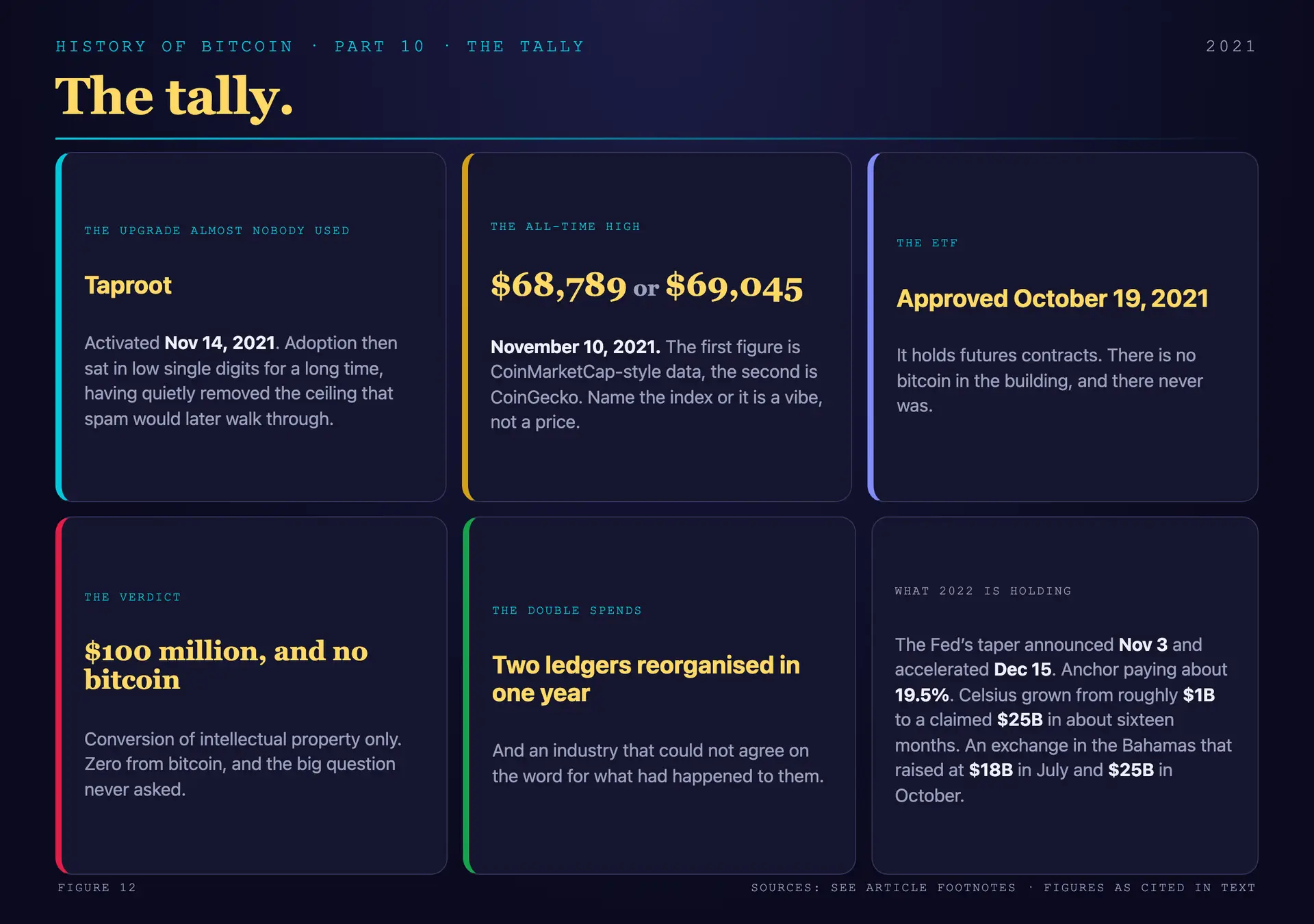
So what did 2021 actually decide?
Almost nothing it looked like it decided, and a great deal that nobody was watching.
BTC got its biggest upgrade in four years, argued about the activation method for six months, locked it in, activated it in November, and then barely used it. But the upgrade had quietly removed a ten-thousand-byte cap on script size and a limit of 201 non-push operations, kept the 520-byte push limit that everyone now misremembers as having been lifted, and left the witness discount in place, which meant data stuffed into a script cost a quarter of what data costs anywhere else.
Fourteen months later a developer named Casey Rodarmor walked through that door, and the war that followed is still going.
They built the door themselves, and they left it unlocked.
The all-time high, $68,789.63 on November 10, was built on free money. Not on adoption. Not on a product. On the Federal Reserve's balance sheet going from roughly $7.4 trillion to roughly $8.8 trillion in twelve months while the government mailed out $1.9 trillion more, and on a generation discovering that the way to get rich was to buy something and refuse to sell it.
Wall Street finally said yes, and what it said yes to was a fund holding futures contracts. BITO launched October 19 and took in more money on day one than almost any exchange-traded fund in history. It does not hold bitcoin. Three and a half weeks later the SEC denied VanEck's application for a fund that would have. The paper Bitcoin that Part 7 warned you about came back wearing a ticker symbol.
Ten strangers in Miami answered seven questions about a business partnership from 2011, awarded a hundred million dollars for intellectual property and zero dollars in bitcoin, and were never once asked who Satoshi Nakamoto is. The internet reported it as a verdict on that question anyway.
Both sides declared victory the same afternoon, which is usually a sign that nobody really won, and the tone was set by lawyers.
And in London, five proceedings spent the year on procedure while, on two networks, the ledger got rewritten and the industry could not agree on the word.
And what the year taught, more than anything else, is that the point of the technology was to buy something and wait. That is the single most expensive lesson in this series so far, because it is the one that felt best while you were learning it.
Now the exits.
The Federal Reserve announced the taper on November 3 and accelerated it on December 15.¹⁴⁴ The free money was ending on a published schedule, in public, with a date attached. Everybody could see it. Almost nobody repositioned.
A protocol called Anchor was paying about 19.5 percent on a stablecoin backed by nothing but the market's confidence in an algorithm, and Terraform Labs was topping up the reserve to keep the number from moving. A lender called Celsius had gone from roughly a billion dollars in assets to a claimed twenty-five billion in about sixteen months, and was paying depositors yields that had to come from somewhere.¹⁴⁵
And an exchange in the Bahamas raised at an eighteen billion dollar valuation in July, then at twenty-five billion in October, put its name on an arena in Miami, and was described in every profile written that year as the adult in the room.¹⁴⁶
It is going to be destroyed in November 2022 by a few sentences from a rival on Twitter.
The bubble does not deflate. It detonates, in sequence, over eleven months, and it takes the lenders, the algorithms and the exchange with it. The people who lose the most will be the ones who did exactly what 2021 taught them to do.
That is the next installment. Bring a strong stomach.
Be good to each other. And stay curious.
Footnotes
¹ Jury composition and the question before it, Deirdra Funcheon, Kleiman v. Wright trial coverage, CoinDesk, November 23, 2021.
² The court's own characterization of the trial's length and start date, Kleiman v. Wright, No. 9:18-cv-80176 (S.D. Fla.), ECF 888, docket via CourtListener, March 8, 2022.
³ Order specially setting jury trial for June 1, 2021, Kleiman v. Wright, ECF 626 (Bloom, J.), docket via CourtListener, November 19, 2020.
⁴ Joint motion to continue trial (ECF 649, filed April 23, 2021) and order granting it (ECF 651, April 27, 2021), resetting trial to November 1, 2021 and citing S.D. Fla. Administrative Order 2021-33, docket via CourtListener, 2021.
⁵ Total factors supplying reserve funds, Table 1, Federal Reserve statistical release H.4.1 for the week ended January 6, 2021, H.4.1 release, Board of Governors of the Federal Reserve System, January 7, 2021.
⁶ Total factors supplying reserve funds, Table 1, Federal Reserve statistical release H.4.1 for the week ended December 29, 2021, H.4.1 release, Board of Governors of the Federal Reserve System, December 30, 2021.
⁷ Monthly purchase pace of at least $80 billion in Treasury securities and at least $40 billion in agency mortgage-backed securities, FOMC statement, Federal Reserve, January 27, 2021.
⁸ American Rescue Plan Act of 2021, H.R. 1319, Public Law 117-2, date approved March 11, 2021, official Public Law record, U.S. Government Publishing Office, 2021.
⁹ M2 money stock, December 2019 ($15,347.5B), December 2020 ($19,115.7B) and December 2021 ($21,498.7B), sourced from the Federal Reserve's H.6 release, FRED series M2SL, Federal Reserve Bank of St. Louis, accessed 2026.
¹⁰ All items CPI up 1.4 percent over twelve months, Consumer Price Index, January 2021, USDL-21-0226, U.S. Bureau of Labor Statistics, February 10, 2021.
¹¹ All items CPI up 7.0 percent and core up 5.5 percent over twelve months, Consumer Price Index, December 2021, USDL-22-0018, U.S. Bureau of Labor Statistics, January 12, 2022.
¹² Real average hourly earnings down 2.4 percent, Real Earnings, December 2021, USDL-22-0019, U.S. Bureau of Labor Statistics, January 12, 2022.
¹³ Powell's own definition of "transitory," FOMC press conference transcript, Federal Reserve, July 28, 2021.
¹⁴ Powell retiring the word before the Senate Banking Committee in response to Sen. Pat Toomey, as reported from the hearing, Powell: Fed was wrong, inflation not transitory, Fox Business, November 30, 2021. The line came during live questioning and does not appear in the Fed's posted prepared testimony.
¹⁵ Taper announcement, FOMC statement, Federal Reserve, November 3, 2021, and the doubled pace of reduction, FOMC statement, Federal Reserve, December 15, 2021.
¹⁶ Richard Cantillon, Essai sur la Nature du Commerce en Général, written around 1730 and published posthumously in 1755, Liberty Fund edition, Online Library of Liberty. <!-- lint:allow spelling -->
¹⁷ Share of net worth held by the top 1 percent, 29.2 percent in 2020 Q1 rising to 30.7 percent in 2021 Q1, from the Federal Reserve's Distributional Financial Accounts, FRED series WFRBST01134, Federal Reserve Bank of St. Louis, accessed 2026.
¹⁸ Full-year 2021 national home price gain of 18.8 percent, S&P CoreLogic Case-Shiller Index release, S&P Dow Jones Indices, February 22, 2022. The S&P 500's 2021 total return of roughly 26.9 percent is the standard figure reported across market-data providers.
¹⁹ GameStop's January 28, 2021 intraday high and the same-day retail brokerage trading restrictions, Staff Report on Equity and Options Market Structure Conditions in Early 2021, U.S. Securities and Exchange Commission, October 2021.
²⁰ 2021 U.S. SPAC listing count and proceeds, one widely cited tally derived from SPACInsider data, SPAC statistics, SPACInsider, accessed 2026. Source figures vary between U.S.-only and global counts.
²¹ Total cryptocurrency market capitalization crossing $1 trillion, Total Cryptocurrency Market Value Hits Record $1 Trillion, CoinDesk, January 6, 2021, and reaching roughly $3 trillion, Cryptocurrency market cap hits $3T, Fortune, November 9, 2021.
²² The stale block at height 666,833, the SlushPool and F2Pool race, and the 0.00062063 BTC amount, Kurt Wuckert Jr., Double spend, newspeak, and the case for magic numbers, CoinGeek, January 22, 2021.
²³ George Orwell, Nineteen Eighty-Four, Secker & Warburg, 1949, quoted as the epigraph to Kurt Wuckert Jr., Double spend, newspeak, and the case for magic numbers, CoinGeek, January 22, 2021.
²⁴ Taproot activation at block 709,632, timestamped 2021-11-14 05:15:27 UTC, block 709632, mempool.space, accessed 2026.
²⁵ Schnorr signature specification and authorship, BIP 340, Schnorr Signatures for secp256k1, Bitcoin Improvement Proposals repository.
²⁶ Taproot spending rules, authorship, and the acknowledgements crediting Greg Maxwell, BIP 341, Taproot: SegWit version 1 spending rules, Bitcoin Improvement Proposals repository.
²⁷ Tapscript validation rules and the script-limit changes quoted later in this section, BIP 342, Validation of Taproot Scripts, Bitcoin Improvement Proposals repository.
²⁸ Blockstream's announcement of Maxwell's departure as CTO, Blockstream bids farewell to Gregory Maxwell, Blockstream, January 19, 2018.
²⁹ Gregory Maxwell, Taproot: Privacy preserving switchable scripting, bitcoin-dev mailing list, January 22, 2018.
³⁰ BIP 8 lock-in-on-timeout deployment as specified for Taproot, BIP 343, Mandatory activation of taproot deployment, Bitcoin Improvement Proposals repository, and the Speedy Trial activation logic shipped in Bitcoin Core 0.21.1, May 1, 2021.
³¹ Taproot lock-in at block 687,285, timestamped 2021-06-12 12:18:41 UTC, block 687285, mempool.space, accessed 2026.
³² Taproot adoption reported at an all-time high of roughly 4 percent more than fourteen months after activation, Bitcoin's Taproot Adoption Reached an All-Time High of 4% In 2023, BanklessTimes, January 31, 2023.
³³ The witness discount, the 520-byte push limit, and the envelope construction, in the Ordinals project's own documentation, Inscriptions, Ordinals, accessed 2026.
³⁴ London upgrade activation confirmed on-chain at block 12,965,000, 2021-08-05 12:33:42 UTC; contemporaneous coverage at Ethereum Launches London Hardfork Including EIP-1559, Crypto Briefing, August 5, 2021.
³⁵ Base fee, burn, and priority tip mechanics, What Is EIP-1559?, Trust Wallet, 2021.
³⁶ Average Ethereum transaction fee of $53.16 on May 10, 2021, Ethereum Transaction Fees and Gas Prices: Trends and Insights, CoinLedger.
³⁷ Chaotic Time Magazine NFT Launch Sends Gas Fees Spiraling, CoinDesk, September 23, 2021.
³⁸ Buterin's remark to Time, reported alongside his EIP-4488 proposal of November 29, 2021, Vitalik Buterin Admits Fees Are a "Huge Problem" for Ethereum's Usability, Finbold, November 2021.
³⁹ Altair activation at epoch 74240, October 27, 2021, Altair Mainnet Announcement, Ethereum Foundation, October 5, 2021.
⁴⁰ ETH-USD daily high of approximately $4,860 on November 10, 2021, Yahoo Finance ETH-USD historical data. Cents-level figures vary by index.
⁴¹ DeFi total value locked peak of $177.48 billion on November 9, 2021, DefiLlama historical series, retrieved via its public API.
⁴² Beeple NFT Sold for Record-Setting $69.3M at Christie's Auction, CoinDesk, March 11, 2021.
⁴³ Pseudonymous $69M Beeple NFT Buyer MetaKovan Reveals True Identity, CoinDesk, March 18, 2021.
⁴⁴ Nine CryptoPunks sold as a single lot for $16,962,500, Christie's Will Offer a Series of CryptoPunks at Auction, Artnet News, May 2021.
⁴⁵ CryptoPunk Alien NFT Sells for $11.8m at Sotheby's Auction, Al Jazeera, June 10, 2021.
⁴⁶ Bored Ape Yacht Club launch of April 30, 2021: 10,000 supply, 0.08 ETH mint, 172 traits, twelve-hour sellout, Bored Ape, Wikipedia, cross-referenced against contemporaneous press accounts.
⁴⁷ The four founders operated publicly as Gargamel, Gordon Goner, No Sass, and Emperor Tomato Ketchup throughout 2021. None of their legal names were public until February 2022.
⁴⁸ Bored Ape Yacht Club Sells $96 Million of Mutant Ape NFTs in One Hour, Decrypt, August 29, 2021.
⁴⁹ Curry, 55 ETH, Daily Hodl, August 31, 2021; Fallon, 46.6 ETH, Benzinga, November 2021; Eminem, 123.45 ETH on December 30, 2021, NME.
⁵⁰ OpenSea monthly volume, July and August 2021, How NFT Giant OpenSea's $3 Billion Month Compares to Amazon, eBay and Etsy, Decrypt, September 2021.
⁵¹ Smooth Love Potion's all-time high of $0.41 on May 1, 2021, and the scholarship economy, Axie Infinity Token Price Doubles in 2 Days, CoinDesk, July 23, 2021. Player-count figures are reported estimates and vary by source.
⁵² $230 Million Has Been Spent on NBA Top Shot, CNBC, February 28, 2021, and contemporaneous reporting of Dapper Labs' 2021 raises.
⁵³ Chainalysis analysis of calendar-year 2021 NFT activity, published February 2022, NFT Money Laundering and Wash Trading. The same report puts a minimum of $44.2 billion into ERC-721 and ERC-1155 contracts during 2021, against approximately $106 million in 2020.
⁵⁴ Direct-listing mechanics and the $250 reference price, Coinbase Announces Effectiveness of Registration Statement, Coinbase Investor Relations, and Coinbase Reference Price Set at $250, CNBC, April 13, 2021.
⁵⁵ COIN open $381.00, high $429.54, close $328.28, volume 81,065,700, from Yahoo Finance OHLC for April 14, 2021; see also Coinbase Direct Listing Gets $100B Valuation, CoinDesk, April 14, 2021.
⁵⁶ Gary Gensler Confirmed to Lead the SEC, CNBC, April 14, 2021.
⁵⁷ Gary Gensler, Remarks Before the Aspen Security Forum, U.S. Securities and Exchange Commission, August 3, 2021.
⁵⁸ Tesla, Inc. Form 10-K for fiscal year 2020, filed February 8, 2021, SEC EDGAR CIK 0001318605; reported same day at Tesla Buys $1.5 Billion in Bitcoin, CNBC.
⁵⁹ Tesla, Inc. Form 10-Q for the quarter ended March 31, 2021: "In the first quarter of 2021, we also sold an aggregate $272 million in bitcoin." Fair market value of $2.48 billion versus a carrying value of $1.33 billion, per the same filing and Tesla's Bitcoin Speculation Helped Boost Profits This Quarter, CNBC, April 26, 2021.
⁶⁰ Elon Musk Says Tesla Is Suspending Bitcoin Payments Over Environmental Concerns, CoinDesk, May 12, 2021.
⁶¹ MicroStrategy Completes $1.05B Offering of Convertible Senior Notes, February 19, 2021, and MicroStrategy Completes $500M Offering of Senior Secured Notes Due 2028, June 14, 2021.
⁶² MicroStrategy Incorporated, Form 8-K filed December 30, 2021, SEC EDGAR CIK 0001050446, d261142d8k.htm.
⁶³ ProShares to Launch the First U.S. Bitcoin-Linked ETF, ProShares press release, October 2021.
⁶⁴ First-day AUM, volume and ranking, ProShares Bitcoin ETF Enters as Second Most Traded ETF in History, ETF Stream, October 20, 2021.
⁶⁵ ProShares product-page language for BITO, ProShares Bitcoin Strategy ETF, retrieved July 2026. This is current product-page text, not a quotation from the October 2021 prospectus; the underlying fact that BITO has never held spot bitcoin is undisputed.
⁶⁶ Securities and Exchange Commission, Release No. 34-93559, File No. SR-CboeBZX-2021-019, order disapproving the proposed rule change to list and trade shares of the VanEck Bitcoin Trust, November 12, 2021; reported the same day at SEC Rejects VanEck's Spot Bitcoin ETF Proposal, CoinDesk.
⁶⁷ Galina Hale et al., How Futures Trading Changed Bitcoin Prices, FRBSF Economic Letter 2018-12, Federal Reserve Bank of San Francisco, May 7, 2018.
⁶⁸ Bukele's pre-recorded announcement during Jack Mallers' slot at Bitcoin 2021 in Miami, El Salvador Becomes First Country to Adopt Bitcoin as Legal Tender, CNBC, June 5, 2021; on Strike's role and the drafting, How El Salvador Adopted Bitcoin in Five Hours, El Faro, June 2021.
⁶⁹ Vote of 62 of 84 on June 9, 2021, El Salvador Congress Approves Bitcoin as Legal Tender, Al Jazeera; Article 7 text as quoted in El Salvador's Bitcoin Law: Contemporary Implications of Forced Tender Legislation, Princeton Legal Journal, Fall 2021.
⁷⁰ Chivo login, ATM, verification and price-lag failures, and 755 fraud reports logged October 9 to 14, 2021, Glitches, Fraud and High Fees Upset El Salvador's Bitcoin Chivo Wallet Users, PYMNTS.
⁷¹ Fernando Alvarez, David Argente and Diana Van Patten, Are Cryptocurrencies Currencies? Bitcoin as Legal Tender in El Salvador, NBER Working Paper No. 29968.
⁷² El Salvador Protest Reflected Concerns Over Democracy and Bitcoin, NPR, September 17, 2021, and Thousands Protest in El Salvador Against Bukele Government, Al Jazeera, October 18, 2021.
⁷³ El Salvador Plans "Bitcoin City," Aims to Raise $1 Billion via Bitcoin Bond, CNBC, November 22, 2021. The bond was announced in 2021 and not issued in 2021. The IMF warning of the same week is from the Staff Concluding Statement of the 2021 Article IV Mission to El Salvador, International Monetary Fund, November 22, 2021.
⁷⁴ Fifty-first meeting of the Financial Stability and Development Committee of China's State Council, May 21, 2021, China Says It Will Crack Down on Bitcoin Mining, Trading Activities, AP via U.S. News. The negative 27.94 percent difficulty adjustment at block 689,472 on July 3, 2021 is protocol-verifiable on the network. Migration and hashrate-share figures from the Cambridge Centre for Alternative Finance, Geographic Shift, Cambridge Judge Business School, October 2021.
⁷⁵ Bitcoin's November 10, 2021 high of $68,789.63 on CoinMarketCap-style index data, mirrored by Yahoo Finance BTC-USD historical data; CoinGecko printed $69,045 for the same day, a real cross-index divergence rather than an error. Year-end close of $46,306.45 per Bitcoin Closes 2021 at $46,300, Crypto Briefing, January 2022.
⁷⁶ Senate roll call 69-30 on August 10, 2021, from the Senate's own roll-call index; House 228-206 on November 5; signed November 15, 2021. Section 80603's broker definition and its reach, Infrastructure Bill's New Reporting Requirements May Have Sweeping Implications for the Cryptocurrency Ecosystem, Gibson Dunn, November 2021. Tether and Bitfinex penalties and the 27.6 percent reserve finding, CFTC press release 8450-21, October 15, 2021.
⁷⁷ Administrative Order 2021-33 (S.D. Fla., issued April 6, 2021), continuing all jury trials in the district until after July 6, 2021. The order is recited and relied on in the parties' joint continuance motion: Kleiman v. Wright, No. 9:18-cv-80176 (S.D. Fla.), ECF 649 at 1-2 (April 23, 2021).
⁷⁸ Kleiman v. Wright, No. 9:18-cv-80176 (S.D. Fla.), ECF 649 (joint motion to re-set trial date, re-set calendar call, extend the due date for demonstrative and summary exhibits, and request status conference, filed April 23, 2021). Quotation verbatim from the motion.
⁷⁹ ECF 649, op. cit. (note 78). The motion identifies each counsel conflict by name and month, and footnotes the 2021 dates of Rosh Hashanah, Yom Kippur and Sukkot.
⁸⁰ Kleiman v. Wright, ECF 651 (order on joint motion to re-set trial date, signed April 27, 2021), resetting the jury trial to November 1, 2021 at 9:00 a.m. and calendar call to September 14, 2021.
⁸¹ The Southern District of Florida's COVID-era masking and courthouse-access requirements are documented in its administrative orders, including Administrative Order 2021-12. The specific gallery-capacity and electronics restrictions described here are my own recollection of the November and December 2021 trial dates and are not stated in any public order I have been able to locate. Treat them as a witness account rather than a citation.
⁸² Kurt Wuckert Jr., "Kurt's personal blog: 2021 in BSV," CoinGeek, December 24, 2021.
⁸³ My own account, given in 2026, of what that production was built around and why the litigation stopped serving as its spine. No document supports it and none contradicts it. It is offered as firsthand knowledge and labeled as such in the text.
⁸⁴ Banking on Bitcoin, directed by Christopher Cannucciari, 2016. The follow-up project is deliberately not named here: I do not know its current status, and this series does not print titles it cannot verify.
⁸⁵ Kleiman v. Wright, ECF 888 at 1 (Bloom, J., March 8, 2022), describing the proceeding in the court's own words as "a 21-day jury trial commencing on November 1, 2021."
⁸⁶ Deirdra Funcheon, "Jury Deliberations Begin in Kleiman vs. Wright Trial," CoinDesk, November 23, 2021: "The 10 jurors now must decide whether Craig Wright had a partnership with the late Dave Kleiman," and "the jury of three men and seven women will have to determine the value of the assets." Federal Rule of Civil Procedure 48(a) permits a civil jury of six to twelve members.
⁸⁷ Trial counsel for both sides per the docket's minute entries for the November 2021 trial dates and contemporaneous trial-week reporting; the defense team appeared for Rivero Mestre LLP, and Andrew Brenner appeared as a partner at Boies Schiller Flexner. On the firm name: the April 2021 filings are signed "Roche Cyrulnik Freedman LLP," while the Associated Press copy of December 6, 2021 identifies the firm as "Roche Freedman LLP."
⁸⁸ Ken Sweet, Associated Press, December 6, 2021, as carried by Courthouse News Service, describing W&K Info Defense Research as a joint venture between the two men and reporting that the jury "found that Wright did not owe half of 1.1 million Bitcoin to the family of David Kleiman." The same outlet headlined the case as a dispute over $50 billion in bitcoin.
⁸⁹ "Kleiman v. Wright Trial: Craig Wright's Flinty 4-Day Testimony Comes to an End," CoinDesk, November 17, 2021, and "Kleiman v. Wright: Craig Wright Takes Stand Again in Final Day of Testimony," CoinDesk, November 23, 2021.
⁹⁰ "Day 7 of Kleiman v. Wright: Wright Tells Jury Kleiman Only Mined 'Testnet' Bitcoins," CoinDesk, November 10, 2021.
⁹¹ CoinDesk, November 23, 2021, op. cit. (note 86), reporting Wright's remarks to its reporter outside the courtroom.
⁹² Kurt Wuckert Jr., "Did I hear that right? 20 surprises from a Miami courtroom," CoinGeek, 2021. My own contemporaneous account of the trial, written while it was in progress.
⁹³ "Kleiman v. Wright: A Story of Physical and Financial Tribulation," CoinDesk, November 19, 2021. The question as put to the witness: "During Dave Kleiman's lifetime, did he ever tell you that he had formed a business partnership with Dr. Craig Wright to either mine or invent bitcoin?" The cross-examination concession is reported in the same piece.
⁹⁴ CoinDesk, November 19, 2021, op. cit. (note 93), reporting Carter Conrad's testimony that when Kleiman and Wright formalized Computer Forensics LLC, "a third person, Patrick Paige, joined their business, too," with documented operating agreements.
⁹⁵ CoinDesk, November 19, 2021, op. cit. (note 93), reporting the testimony of Dr. D. Stewart MacIntyre Jr. and his acknowledgement on cross-examination that he "was not asked to evaluate" Kleiman's brain.
⁹⁶ Kurt Wuckert Jr., "Revealing Ira Kleiman examination sets up gripping end to Kleiman v Wright trial first week," CoinGeek, November 2021.
⁹⁷ Wuckert, op. cit. (note 92), describing Ramona Watts's deposition being read aloud in the courtroom rather than played on video.
⁹⁸ On the bonded courier and the pre-trial history of the key-production dispute, see The Bitcoin Civil War Gets Legal, Part 8. No courier has ever been publicly identified by name in any filing or proceeding in this case.
⁹⁹ "Jury in Kleiman v. Wright Civil Suit Says It 'Cannot Come to a Decision,'" CoinDesk, December 1, 2021, reporting the jury's note of that date and the court's instruction to continue deliberating.
¹⁰⁰ Kleiman v. Wright, No. 9:18-cv-80176 (S.D. Fla.), ECF 812 (verdict form, December 6, 2021). Everything in this subsection is taken from the form itself rather than from reporting about it. The seven claims are those surviving from the ten counts pled in the operative Second Amended Complaint: two counts were dismissed with prejudice as time-barred on December 27, 2018, and the permanent-injunction count is equitable relief that never goes to a jury. That procedural history is recited in ECF 888.
¹⁰¹ ECF 812, Question 5.
¹⁰² ECF 812, op. cit. (note 100), the damages lines entered for the Estate of David Kleiman, and Question 20.
¹⁰³ ECF 812, Question 25. Having found liability on conversion, the jury was instructed to determine punitive damages, and entered zero for both plaintiffs.
¹⁰⁴ ECF 812, Questions 21 through 24, and the foreperson's signature block.
¹⁰⁵ Kleiman v. Wright, ECF 814 (final judgment, entered December 7, 2021), in the amount of $100,000,000.00 in favor of W&K Info Defense Research, LLC.
¹⁰⁶ Prejudgment interest was awarded separately, by an order signed March 8, 2022: Kleiman v. Wright, ECF 888 (Bloom, J.). A 2022 event, and out of scope for this installment, which reports the 2021 record only. No notice of appeal was filed by either side before the end of 2021; the plaintiffs' notice, ECF 892, was filed April 8, 2022.
¹⁰⁷ ECF 812, op. cit. (note 100). The form's twenty-five questions contain no question, direct or indirect, concerning the identity of Satoshi Nakamoto.
¹⁰⁸ Sweet, op. cit. (note 88).
¹⁰⁹ Sweet, op. cit. (note 88). The parenthetical spelling "(David Kleinman)" appears in the wire copy as published and is reproduced here unaltered.
¹¹⁰ Both post-verdict quotations in this passage are taken from Cryptonews, December 6, 2021, which credits CoinDesk for Wright's remarks in the courthouse hallway and reports Freedman's directly: "Vel Freedman, an attorney for the plaintiffs, said his team, too, was happy with the verdict: 'We just won $100 million!'" Note that Wright's "vindicated" quotation does not appear anywhere in the Associated Press account of the verdict and must not be attributed to that wire.
¹¹¹ Wright v Granath [2021] EWCA Civ 28, Court of Appeal (Civil Division), judgment handed down January 15, 2021, on appeal from Wright v Granath [2020] EWHC 51 (QB) (Jay J). Panel: Moylan, Singh and Popplewell LJJ. Appeal allowed by a majority of two to one; Popplewell LJ, who wrote the lead judgment, would have dismissed it. Moylan LJ: "I would allow this appeal on the basis that article 27 does not apply because... the proceedings in Norway and the proceedings in England do not involve the same cause of action."
¹¹² Danny Nelson, Square-Led COPA Sues Craig Wright Over Bitcoin White Paper Copyright Claims, CoinDesk, April 12, 2021. Claim No. IL-2021-000019, High Court of England and Wales, Chancery Division, as recited in later judgments in the same proceedings.
¹¹³ Cease and desist letter dated January 21, 2021, sent on Wright's behalf to Square regarding its hosting of the Bitcoin white paper, as reported in CoinDesk's April 12, 2021 account of COPA's filing.
¹¹⁴ Kurt Wuckert Jr., The Written History of Bitcoin: Genesis and the Curveball, kurtwuckertjr.com, footnote 143: COPA was founded September 10, 2020 by Square, with Coinbase joining in December 2020, and nothing in its 2020 founding materials refers to Craig Wright.
¹¹⁵ Order of Mr Justice Mann, April 21, 2021, permitting service on the pseudonymous defendant, recited in the sealed order in Wright v Cøbra, Claim No. IL-2021-000008, published PDF.
¹¹⁶ Wright v Cøbra, Claim No. IL-2021-000008, High Court of Justice, Chancery Division, His Honour Judge Hodge QC sitting as a judge of the High Court, Monday 28 June 2021. Default judgment; injunction against making the white paper available for download from the bitcoin.org website "or in any other way" within the United Kingdom; inquiry as to damages; notice of the order to be published on the site's homepage for six months beginning no later than July 19, 2021; interim costs of £35,000 including VAT payable by July 12, 2021.
¹¹⁷ Tulip Trading Ltd v Bitcoin Association for BSV & Ors [2022] EWHC 667 (Ch) (Falk J, March 25, 2022): "TTL's amended claim form, particulars of claim and application to serve out were filed in April 2021."
¹¹⁸ Ibid.: "TTL maintains that it is the owner of digital assets valued at over 3 billion at two addresses on the Networks, which I will refer to as '1Feex' and '12ib7.'"
¹¹⁹ Ibid., case caption, full defendant roster: 1. Bitcoin Association for BSV; 2. Wladimir van der Laan; 3. Jonas Schnelli; 4. Pieter Wuille; 5. Marco Falke; 6. Samuel Dobson; 7. Michael Ford; 8. Cory Fields; 9. George Dombrowski; 10. Matthew Corallo; 11. Peter Todd; 12. Gregory Maxwell; 13. Eric Lombrozo; 14. Roger Ver; 15. Amaury Séchet; 16. Jason Cox.
¹²⁰ Wright v McCormack, pre-trial review before Mr Justice Julian Knowles, ruling of October 8, 2021, establishing that the issue for trial would be whether the defendant's publications caused serious harm to the claimant's reputation. The serious-harm trial itself was heard in May 2022.
¹²¹ Block height 678301, BSV mainnet, WhatsOnChain block API: size 638,053,393 bytes, 2,674 transactions, block time 1615671927 (March 13, 2021, 21:45:27 UTC), hash 000000000000000004d9db96c6100086b85459a2ce0d834da71e26422852801c. <!-- lint:allow spelling -->
¹²² Coinbase transaction 9996c1ff10ea641b4e02e5cf596d577fab41cef5449b4da7cf0e5520b6224880, WhatsOnChain transaction API. The Miner ID protocol payload carries "name":"TAAL Distributed Information Technologies" and the merchant API endpoint https://merchantapi.taal.com/. <!-- lint:allow spelling -->
¹²³ 638MB block advances Bitcoin SV journey to be world money and everything else too, CoinGeek, March 2021, characterizing the block as the product of a community-driven stress test consisting of fewer, larger transactions rather than organic network load.
¹²⁴ Block heights 699097 (999,743,208 bytes, 11,785 transactions, August 6, 2021, 04:04:11 UTC), 699154 (999,959,302 bytes, 10,136 transactions, August 6, 2021, 13:34:11 UTC) and 700606 (1,999,941,397 bytes, 5,869 transactions, August 16, 2021, 15:20:11 UTC), all pulled from the WhatsOnChain block API.
¹²⁵ Kurt Wuckert Jr., Bitcoin liberation: A retrospective, CoinGeek, August 3, 2021. The demonstration was given at CoinGeek Zurich, June 8-10, 2021.
¹²⁶ Ibid.
¹²⁷ BitMEX Research, January 20, 2021, quoted in Kurt Wuckert Jr., Double spend, newspeak, and the case for magic numbers, CoinGeek, January 22, 2021: "There was a stale Bitcoin block today, at height 666,833. SlushPool has beaten F2Pool in a race. It appears as if a small double spend of around 0.00062063 BTC ($21) was detected."
¹²⁸ Anthony Pompliano, January 21, 2021, quoted in Wuckert, CoinGeek, January 22, 2021.
¹²⁹ CoinDesk, January 21, 2021, quoted in Wuckert, CoinGeek, January 22, 2021 and again in Wuckert, CoinGeek, July 19, 2021.
¹³⁰ Peter Todd, January 21, 2021, quoted in Kurt Wuckert Jr., BTC was double spent this year—was BSV?, CoinGeek, July 19, 2021. <!-- lint:allow dash:em-en -->
¹³¹ Satoshi Nakamoto, metzdowd.com cryptography mailing list, Sat Nov 8 20:58:48 EST 2008, replying to Hal Finney.
¹³² Ibid.
¹³³ Wuckert, CoinGeek, January 22, 2021. The block at height 666,833 is timestamped January 20, 2021, 01:17:24 UTC on the main chain; the line is quoted here as written rather than restated as a verified timestamp.
¹³⁴ Bitcoin Association, FAQs: July 2021 block withholding / re-organisation attack on the BSV network: "On June 24, 2021 and then again on July 1, 6 and 9, an unknown miner operating (as an apparent impersonator) under the 'Zulupool' moniker engaged in malicious block re-organisation attacks." The same document recommends exchanges require at least 20 confirmations and does not mention invalidateblock.
¹³⁵ Wuckert, CoinGeek, July 19, 2021.
¹³⁶ Ibid.
¹³⁷ Nikita Zhavoronkov, founder of Blockchair, August 4, 2021, quoted in Bitcoin SV Chain Suffers 51% Attack, Bitcoin.com News.
¹³⁸ Lucas Nuzzi, Coin Metrics, August 3, 2021, quoted in the same report: "BSV is going through a massive 51% attack... some serious hashing power was unleashed today at 11:46AM and attackers are succeeding. Over a dozen blocks are being reorgd & up to 3 versions of the chain being mined simultaneously across pools."
¹³⁹ Alex Speirs, Statement on August 2021 block re-organisation attack on the Bitcoin SV network, Bitcoin Association, August 4, 2021, naming heights 698642, 698737 and 698815 with their block hashes and instructing node operators to run invalidateblock.
¹⁴⁰ Wuckert, CoinGeek, July 19, 2021. The Byzantine Generals passage and the "invading barbarians" line appear in the same article.
¹⁴¹ Wuckert, CoinGeek, August 3, 2021. The Bitcoin Association's tweet of the same date, reproduced in the following day's article, reads: "In response to the ongoing re-organisation attack on the #BSV network, Bitcoin Association recommends that node operators mark the fraudulent chain as invalid. This will immediately return your node to the chain supported by honest miners and lock the attacker's chain out."
¹⁴² Kurt Wuckert Jr., The empire strikes back, CoinGeek, August 4, 2021.
¹⁴³ Bitcoin SV suffers 51% attack, Protos, August 2021, reporting BitMart's application for a restraining order and its claim that 43 users were defrauded through double-spent deposits traced to eight exchanges. Reported as an exchange's allegation in a legal filing, not as an adjudicated finding.
¹⁴⁴ Federal Open Market Committee statements of November 3, 2021 (announcing reductions in the monthly pace of net asset purchases) and December 15, 2021 (doubling the pace of the reduction).
¹⁴⁵ Anchor Protocol advertised an approximate 19.5% annual yield on UST deposits through 2021, with Terraform Labs topping up the yield reserve to keep it funded. Celsius Network's self-reported assets under management rose from roughly $1 billion in mid-2020 to over $20.3 billion by August 13, 2021 and a claimed $25 billion by October 2021, alongside a funding round valuing the company at $3 billion. Celsius figures are company press-release numbers, not independently audited.
¹⁴⁶ FTX announced a $900 million Series B at an $18 billion valuation on July 20, 2021, and a $420,690,000 Series B-1 at a $25 billion valuation on October 21, 2021. The $400 million Series C at a $32 billion valuation closed in January 2022 and belongs to the following year.