The Written History of Bitcoin: How Bitcoin Was Financialized
By Kurt Wuckert Jr.
At 01 UTC on Sunday, July 26, 2026, an exchange that had operated for nine years and claimed millions of users published a notice. New registrations and deposits stopped that minute. New trading orders too. Futures accounts flipped to reduce-only mode while most of the world slept. The announcement itself read the way these things always read, in language engineered to lie perfectly still on the page: "After a careful evaluation of the company's operating conditions, market environment, and future strategic direction, [the company] has made the difficult decision to commence an orderly wind-down of its trading platform operations."¹
There were no hearings, no receivership, no perp walk. Just deadlines and a support inbox.
Two days before the notice went up, the exchange had terminated its own global CEO. When the wind-down became news, he stated publicly that he was "not involved in the decision announced today, not consulted on it, and not informed of it. I learned of it when it became public." The chief executive of a platform holding other people's money, finding out with the customers.
When a bank fails, there is an autopsy. Examiners take the hard drives, somebody testifies under oath, and a report eventually explains where the money went, name by name. When an offshore exchange fails, there is a shrug.
The mystery isn't what happened. The mystery is that nobody expected to find out.
That exchange gets its own chapter later in this article, name and all. Between here and there is the story of how a shrug like that became normal: how a technology invented to make money transparent ended up domiciled where nobody ever has to explain anything, and why you stopped being able to buy a sandwich with it along the way. When The Written History of Bitcoin: Contagion closed, the dominoes of 2022 had finished falling and the survivors swore the lesson was learned; this is what the survivors built instead.
Watch the video if you prefer to watch rather than read!
The road not taken
There was a version of this economy that existed in the real world, with receipts. In November 2012, an event called Bitcoin Black Friday launched with 20 merchants willing to sell you things for bitcoin; the next year, 600 signed up.² BitPay, the young economy's biggest payment processor, counted 1,100 active merchants in October 2012, 10,000 by September 2013, and 30,000 by May 2014, when it was processing roughly a million dollars of payments every day. By 2015 it claimed 60,000 retailers.³
Then the logos got big. Dell turned on bitcoin checkout for U.S. online purchases on July 18, 2014.⁴ Microsoft enabled it for Xbox and Windows digital content the same year, and Expedia started taking it for hotel bookings in 2014.⁵ In April 2016, Steam, the biggest PC game store on the planet, added bitcoin at checkout.⁶ The man who bought the famous pizzas spent roughly 80,000 BTC on ordinary purchases in 2010 alone.⁷ People bought computers, hotel rooms, and video games with this thing, and the industry bragged about it in press releases!
Now put 2026 next to that.
Glassnode, the analytics firm the institutions themselves cite, opened its Q4 2025 report with a number that sounds like total victory: "Bitcoin has settled around $6.9T in value over the past 90 days, placing it on par with, or above, the quarterly volumes processed by networks such as Visa and Mastercard. When adjusted for internal movements using Glassnode's entity-adjusted heuristics, economic settlement still reaches approximately $0.87T per quarter, or $7.8B per day."⁸
I read the second sentence several times. $6.9 trillion gross against $0.87 trillion real means roughly 87 percent of the headline number is coins shuffling between an exchange's own pockets: custodians rebalancing hot and cold wallets, inventory moving between accounts that all belong to the same company. The Visa comparison survives only if you count a bank trucking cash between its own vaults as commerce.
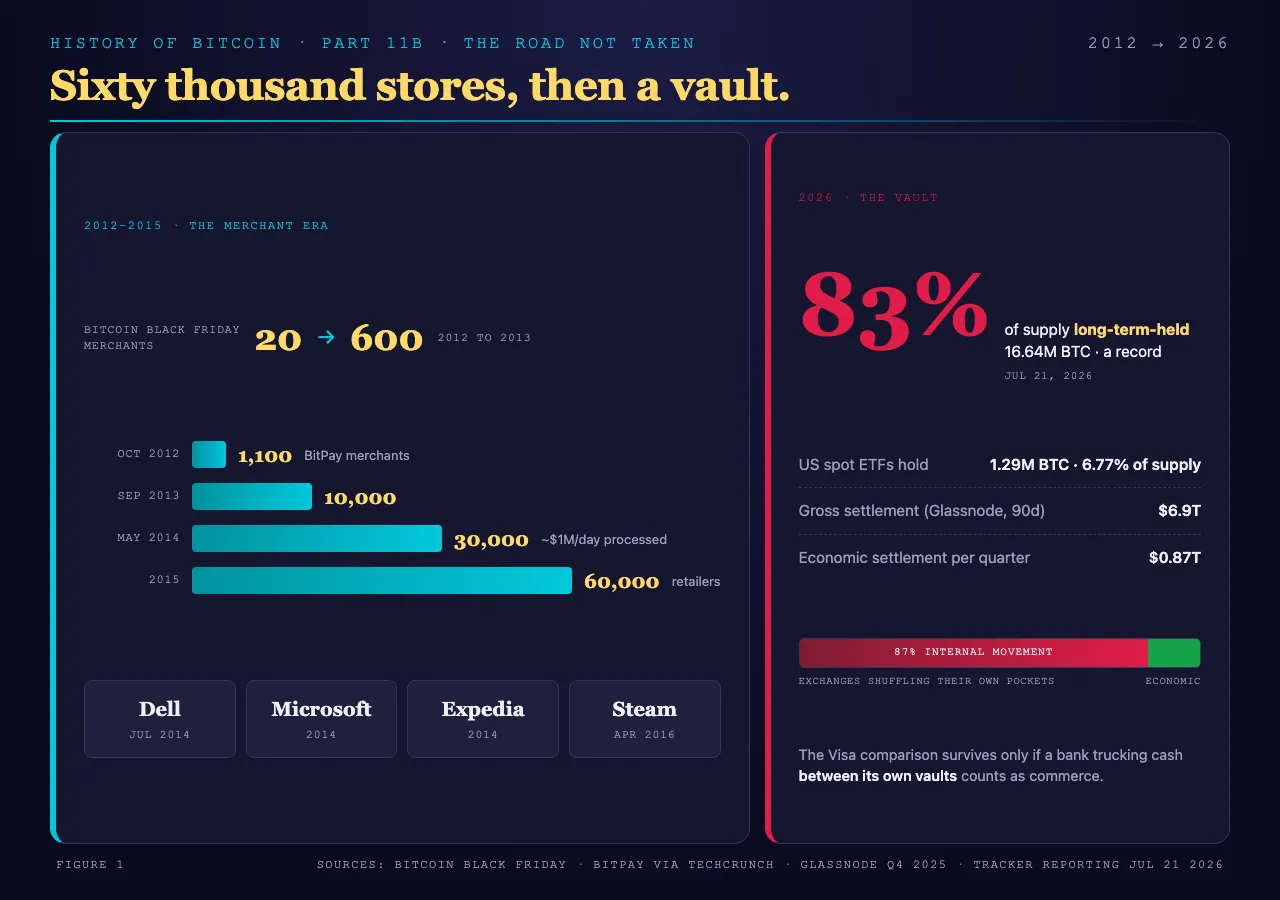
The road not taken, measured: 60,000 retailers at the merchant era's peak, 83 percent of the coin sitting motionless now. Source: TechCrunch, Bitcoin.com News
The Federal Reserve went and asked actual households. As reported in the Kansas City Fed's payments-research briefing, the Fed's own survey found bitcoin-for-payments use fell from nearly 3 percent of consumers in 2021 and 2022 to under 2 percent in 2023 and 2024, while investment use climbed; by the 2025 wave, investment use had reached 9 percent of adults while payments sat at 2.⁹ The government asked America what it does with this stuff. "Buy things" was the answer that shrank.
So where did the coins go? Into the vault, and the vault keeps setting records.
The pitch, from the beginning, was self-custody: your coins, your private key, nobody's permission required. Here is where the institutional version of that pitch landed. In April 2026, Forbes reported that Coinbase Custody holds 84 percent of all US spot Bitcoin ETF assets, and analyst Marc Baumann put it in two sentences: "Coinbase Custody holds 84% of all US spot Bitcoin ETF assets. That's $77 billion with a single custodian." Then he added: "For an industry built on decentralization, the most important product category has a single point of failure. Regulators will notice."¹²
The merchants did not wander off out of boredom. They wrote down their reasons on the way out. Valve, announcing Steam's exit on December 6, 2017: "Historically, the value of Bitcoin has been volatile, but the degree of volatility has become extreme in the last few months, losing as much as 25% in value over a period of days. This creates a problem for customers trying to purchase games with Bitcoin." And on fees: "transaction fees that are charged to the customer by the Bitcoin network have skyrocketed this year, topping out at close to $20 a transaction last week (compared to roughly $0.20 when we initially enabled Bitcoin)".¹⁵ A twenty-dollar fee to buy a twenty-dollar game!
The internal support tickets must have been wild to read in late 2017...
The bookend came in February 2024, and it came from inside the industry. Coinbase Commerce, crypto's own flagship product for merchants who wanted to accept bitcoin, removed native bitcoin support entirely and steered its merchants onto smart-contract chains and stablecoins. Coinbase Head of Product Lauren Dowling explained: "Delivering these same capabilities on the bitcoin blockchain without smart contracts and stablecoins was challenging & we therefore made the difficult decision to remove native bitcoin & other UTXO support."¹⁶ The company that sells Bitcoin to America all day concluded that taking bitcoin as payment was not worth the trouble.
Stripe had already written the era's epitaph on January 23, 2018, when product manager Tom Karlo announced the end of bitcoin support with a cold, blunt and damningly frank thought: "Bitcoin has evolved to become better-suited to being an asset than being a means of exchange."¹⁷
The ledger was public. The business moved somewhere it wasn't.
The sorted-out scandals that teach us all something
On the evening of December 19, 2017, two days after Bitcoin's all-time high and in the middle of Cboe-and-CME futures week, Coinbase abruptly announced it was listing Bitcoin Cash and opened trading on its professional platform, GDAX. The order book broke on contact. Prints hit $8,500, with reports reaching toward $9,500 that were never confirmed, against a real-world price near $3,500, and trading was halted within about three minutes.¹⁸
The chart told its own story. The price had been climbing for hours before the announcement, and three days earlier a Reddit user had spotted Bitcoin Cash sitting in Coinbase's API and posted the discovery.¹⁹ The accusation: somebody inside had front-run the news.
Brian Armstrong published the company's employee trading policy while the fire was still burning, and an investigation by outside law firms concluded around July 2018 that there was no evidence of wrongdoing.²⁰ A class action, Berk v. Coinbase, was dismissed, then partly revived in 2019 when Judge Vince Chhabria let a negligence claim through with a line that has aged well: "the fact that Coinbase halted trading within three minutes of the launch is indicative of dysfunction".²¹ In December 2020, the Ninth Circuit sent the whole dispute into individual arbitration.²² Nobody was charged. Nothing was proven. I told that story in full in A Tale of 2 Bitcoins, and Then 3!, and it still reads like a fire alarm with no fire ever located on the permanent record.
Was it covered up, or were they too incompetent to run the audit?
Then there is Charlie Lee, whose episode deserves its own article, but I'll keep it concise. Lee created Litecoin, and by his own account, "I joined Coinbase in 2013 as the second engineer and helped build Coinbase to become what it is today."²³ He rose to Director of Engineering. On May 3, 2017, Coinbase listed Litecoin despite it being an otherwise uninteresting project to the broader ecosystem at the time.
That June, Lee left to work on Litecoin full-time.²⁴
On December 19, 2017, Litecoin hit its all-time high of $375.29. The next day, Lee posted to r/litecoin that he had sold and donated all of it.²⁵ His reasoning, in his own words:
"Over the past year, I try to stay away from price related tweets, but it's hard because price is such an important aspect of Litecoin growth. And whenever I tweet about Litecoin price or even just good or bads [sic] news, I get accused of doing it for personal benefit. Some people even think I short LTC! So in a sense, it is conflict of interest for me to hold LTC and tweet about it because I have so much influence."
"For this reason, in the past days, I have sold and donated all my LTC."²⁶
To the obvious question, he answered in advance: "Please don't ask me how many coins I sold or at what price. I can tell you that the amount of coins was a small percentage of GDAX's daily volume and it did not crash the market." And in an update appended the same day, he tied his story to the one you just read: "UPDATE: I wrote the above before the recent Bcash on GDAX/Coinbase fiasco. As you can see, some people even think I'm pumping Bcash for my personal benefit. It seems like I just can't win."
The timing was what it was. The man who created the coin, and who had helped build the exchange that listed it, sold everything within a day or two of the top. A pseudonymous critic named Bitfinex'ed, who I have praised in the past, published the accusation under the title "Coinbase Insider Trading: Litecoin Edition," alleging insider trading, which means trading on confidential information learned on the inside before the public can.²⁷ That was the critic's allegation, and it stayed an allegation. Controversy is the precise word though, because while no charge was ever filed, and no regulator ever found wrongdoing, the rumors and accusations persist because of the convenience of it all, and a long history of scamming by so many insiders across the industry.
By April 2018, with the price down hard, Lee reflected: "I think in the long run it was the right move but in the short term while the price is down... it just feels like it's not the right decision," as reported at the time.²⁸ Selling the exact top and then regretting it is not what a mastermind's diary looks like, for whatever that observation is worth.
Because when a Coinbase insider actually did front-run listings, the machine produced a prosecution.
From at least June 2021 to April 2022, Ishan Wahi, a Coinbase product manager who helped coordinate listing announcements, tipped his brother Nikhil and his friend Sameer Ramani on what was coming before it came. The SEC's July 21, 2022 release said the scheme "generated illicit profits totaling more than $1.1 million".²⁹ The Department of Justice titled its parallel case "Three Charged In First Ever Cryptocurrency Insider Trading Tipping Scheme."
Until then, no one had ever been criminally charged over insider trading in cryptocurrency markets.³⁰
The brothers pleaded guilty. On May 9, 2023, Ishan Wahi was sentenced to 24 months in federal prison; Nikhil got 10.³¹ Ramani ran, and he remains a fugitive with a final civil judgment entered against him on March 1, 2024: $817,602 in disgorgement and a $1,635,204 penalty.³²
And Coinbase itself? It had gone public on Nasdaq on April 14, 2021, with every disclosure obligation a ticker symbol drags behind it. Its listing process now runs in phases built to prevent a rerun of December 2017 and the other controversies
- Transfer-only. The asset can move in and out of the exchange, but nobody can trade it yet.
- Auction. Limit orders build a real order book and discover a price before anything executes.
- Trading. The market opens against a book that already knows what the asset costs.
The SEC's corporate case against Coinbase, the one alleging it operated as an unregistered exchange, was dismissed with prejudice in February 2025.³⁴ It's important to note that this was a policy-era dismissal by a newly postured Commission under the new Trump Administration, not a court vindicating Coinbase on the merits. Coinbase still draws heavy complaint volume over frozen accounts and blocked withdrawals,³⁵ and in April 2026 New York's attorney general sued over its prediction-markets product, a suit we will meet again before this article is done.
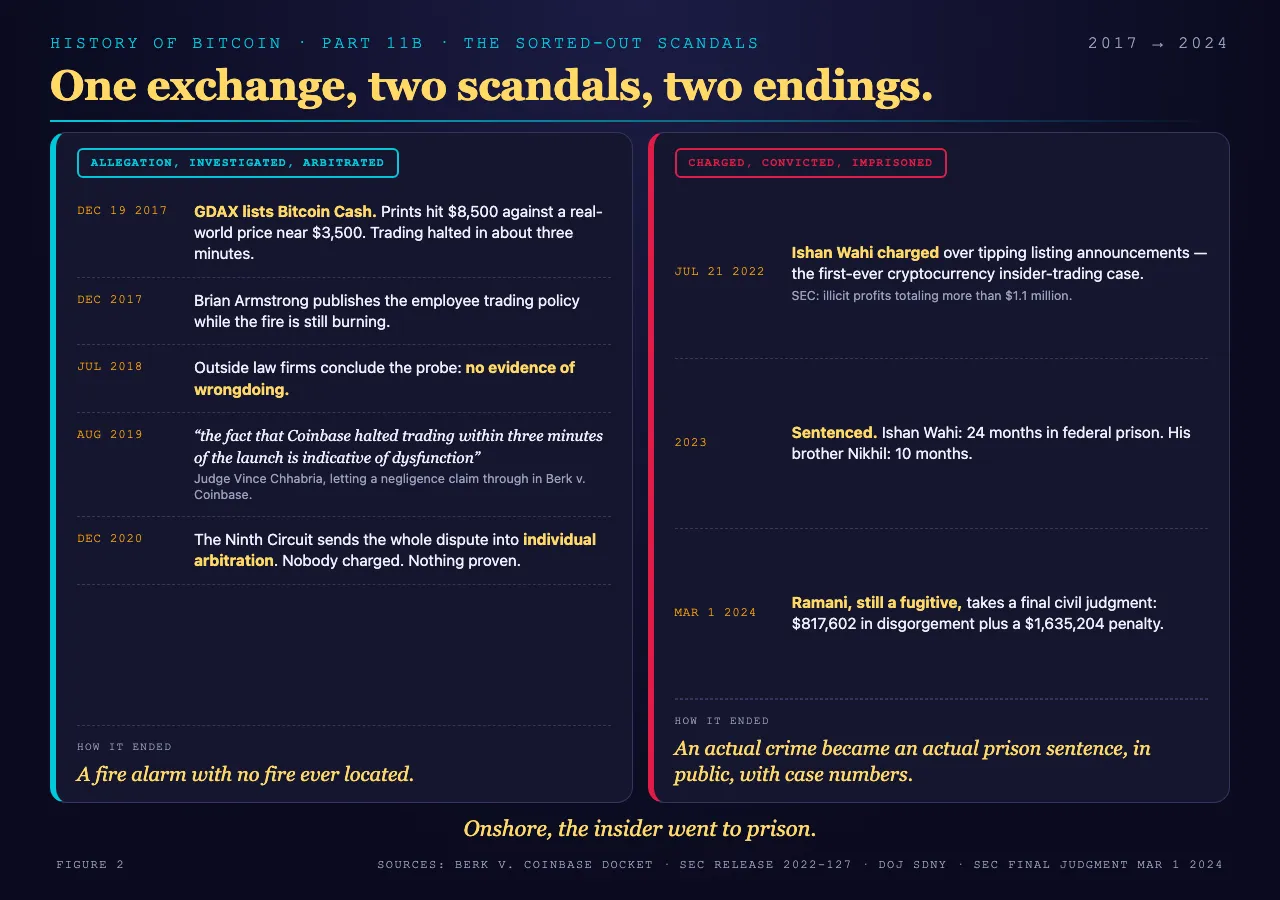
One company, two scandals, two outcomes: the 2017 listing chaos ended in arbitration with nothing proven; the 2022 insider went to prison. Source: SEC
None of that makes Coinbase clean. It makes Coinbase legible, which is what a jurisdiction with subpoenas, dockets, and a stock ticker can do to a scandal. Accusations turned into investigations, an actual crime turned into an actual prison sentence, and the whole record sits in public, in English, with case numbers.
Onshore, the insiders went to prison, which is the way of the Western world.
The shore where nobody goes to prison
The Coinbase insiders went to prison because the crime lived onshore: a Nasdaq listing, American accounts, regulators who could walk in through the front door.
Now leave the country.
The offshore machine got its own full installment in The Biggest Frauds in Bitcoin. The floor of it: in February 2021, Tether settled with the New York Attorney General for $18.5 million, and the AG compressed her office's findings into one sentence: "Tether's claims that its virtual currency was fully backed by U.S. dollars at all times was a lie."³⁶ Eight months later, the CFTC fined Tether $41 million after finding the company had held sufficient reserves to back the token "for only 27.6% of the days in a 26-month sample time period from 2016 through 2018."³⁷ In November 2023, Binance pleaded guilty to federal crimes and agreed to pay $4,316,126,163.³⁸ Its founder pleaded guilty personally and served four months of federal time.
Then, on October 21, 2025, he was pardoned by President Trump. The grant sits on the DOJ Pardon Attorney's own website.³⁹ CBS and Axios reported the context around it: a President who, asked about Zhao, said he did not know him, and a Binance software donation to a Trump-family crypto venture.
The machine's newer franchises came to the same courthouse. On January 27, 2025, Peken Global, the Seychelles company that operates KuCoin, pleaded guilty in the Southern District of New York to operating an unlicensed money-transmitting business. Reporting put the penalties near $300 million; the exchange agreed to stay out of the American market for two years, and its founders, Chun Gan and Ke Tang, were removed from any management role.⁴⁰ The CFTC's parallel case closed in March 2026 for a $500,000 civil penalty, its own release crediting the DOJ resolution in setting the figure. Four weeks after KuCoin, Aux Cayes Fintech, the Seychelles company that operates OKX, pleaded guilty to the same charge, with reported penalties around $504 million. Underneath that number sits the government's finding: over $1 trillion in U.S.-customer transactions, run through an exchange whose own stated policy said Americans were not allowed on it.⁴¹ A trillion dollars of customers it said it did not have!
Now, what did all of that enforcement change about where this industry lives?
Nothing. When CoinGecko studied the top 30 exchanges by volume and trust score, it found 70 percent of them, 21 of 30, incorporated in offshore financial centers, with the Seychelles the single most popular flag.⁴² KuCoin and OKX are Seychelles companies to this day; the pleas rewrote their compliance obligations, but not their addresses. Binance, which spent years refusing to name a headquarters at all, ended the mystery in December 2025 by landing in Abu Dhabi.⁴³ Nobody landed in New York. And the Philippines SEC spent 2025 and 2026 blacklisting the same venues, Bybit, OKX, MEXC, Bitget, as unregistered operators inside its borders.⁴⁴
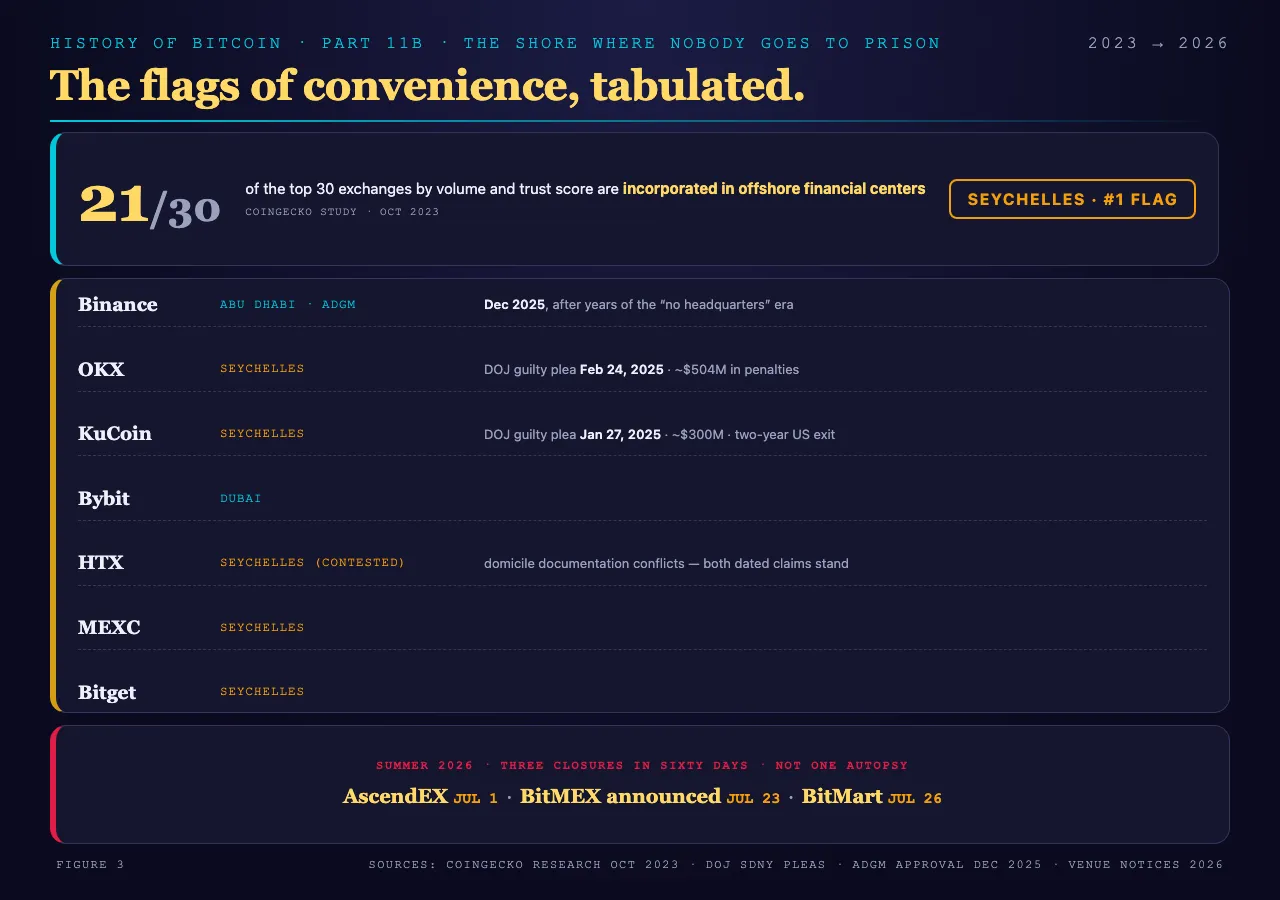
Twenty-one of the top 30 exchanges are incorporated offshore, and the Seychelles is the favorite flag. The three venues that closed in the summer of 2026 all lived on this map. Source: CoinGecko Research
So what is the product? Strip the branding and the offshore exchange is a bank with none of a bank's obligations, and its mechanics are documented door by door. Custody first: your deposit pools into omnibus wallets the exchange controls, with no on-chain record of which coins are yours. From that moment, what you hold is a claim on a company.⁴⁵
Yield next. Gemini Earn froze roughly $900 million belonging to about 340,000 customers in November 2022; the last of it came back on June 20, 2024, nineteen months later.⁴⁶ Then the exit, which is where the mechanics stop being abstract. In July 2026, AscendEX moved every withdrawal to "manual review" and published its own warning that "the timing or amount of withdrawals cannot be guaranteed." The on-chain investigator ZachXBT looked at its hot wallets and found less than $13.5 million in them.⁴⁷
And when a customer asks an offshore exchange to prove the money is still there, he gets proof of reserves, a format whose own referees quit. Mazars, the accounting firm doing the industry's attestations, paused all crypto proof-of-reserves work on December 16, 2022, weeks after FTX fell, and Binance's Mazars report disappeared from the internet.⁴⁸ The PCAOB's investor advisory says such reports "do not provide any meaningful assurance to investors or the public."⁴⁹ Senators Warren and Wyden, writing to that same regulator, called them "sham audits."
My Money & Banking series spent time with the Knights Templar, who also built vaults beyond the reach of kings; the Templars at least kept books a king could audit. Of course, that got them disbanded and largely martyred...
Then came this summer. AscendEX ceased operations on July 1, 2026. On July 23, BitMEX, the Seychelles-domiciled exchange credited with inventing the perpetual futures contract, announced it would close after eleven years.⁵¹ And on July 26, the exchange from the top of this article posted its wind-down notice.
Three offshore exchanges closed in sixty days. Not one produced an autopsy.
The men who sold the vault
October 10, 2021. A user asks the official COLDCARD hardware-wallet account what a "retirement attack" is.
The company answers: "It's when the project makers could have a 'bug' in the entropy generation for later retrieval."⁵²
The tweet is still archived, word for word.
Notice who is speaking. Coldcard is the hardware wallet people buy when they are done trusting the exchanges or anybody else: a sealed signing device, keys generated inside, nothing custodial anywhere near it. And here is that company, on its own account, naming the one nightmare self-custody cannot engineer away. The wallet maker as the thief. Plant a weakness in the randomness that builds the customer's keys, sell the device, wait some years, then quietly "retrieve." Coldcard's answer in that same thread was its dice-roll option: supply your own entropy, and even the maker cannot rob you.
It is a genuinely good answer. It names the threat honestly, and it sells an honest defense. Curious how it played out though!
- Ship. A weakness rides into the firmware that builds customers' keys.
- Sell. The devices go out for years, trusted precisely because nobody else can touch them.
- Wait. The coins pile up behind keys the maker could regenerate.
- Retrieve. One sweep, years later, takes everything at once.
On March 1, 2021, a compile-time error shipped in Coldcard's own firmware. During a migration to a new, in-house, cryptographic library, a guard read #ifndef where it should have read #if, so the build quietly proceeded with the hardware random-number generator out of the loop, and new seeds fell back to a far weaker software generator.⁵³ On affected models, the randomness behind a fresh wallet dropped from an intended 128 or 256 bits to roughly 40 or 72.
March 1, 2021 is seven months before that tweet. When the company defined the retirement attack, the bug it was describing had already been shipping in its own firmware.
In between those two dates sits a third artifact. On September 8, 2021, Coinkite co-founder Rodolfo Novak, known industry-wide as NVK, replied to a developer in a thread about hardware randomness: "For what's worth, I really like what we did with COLDCARD's RNG. The more user choice, the better."⁵⁴
That one is archived too.
Nothing in any of this shows intent. A flag flipped the wrong way, a compiler did exactly what it was told, and every archived statement reads like men who believed in their own legends.
Five years passed.
On July 30, 2026, attackers who had done the same arithmetic swept the weakened wallets in a burst that took under an hour. Initial reporting put the first window at roughly 594 BTC; CoinDesk's first tally, published July 31, called it about $38 million.⁵⁵ By August 4, Forbes was reporting losses past $116 million, and within days Protos had the count climbing toward $130 million. The number kept moving because the counting was still happening.
Coinkite shipped fixed firmware on July 31, and the same day NVK posted: "I'm sorry and I'm devastated. Our team is heartbroken about yesterday's news." And then: "We take full accountability for the firmware bug."⁵⁶
Coinkite offered one theory about the timing: that modern AI code-scanning, pointed at old public source, surfaced what five years of human review had missed. That is the company's own hypothesis, and it comes with a hole the company itself reported, because its retrospective AI testing failed to rediscover the flaw. How the attackers actually found it is not established.⁵⁷
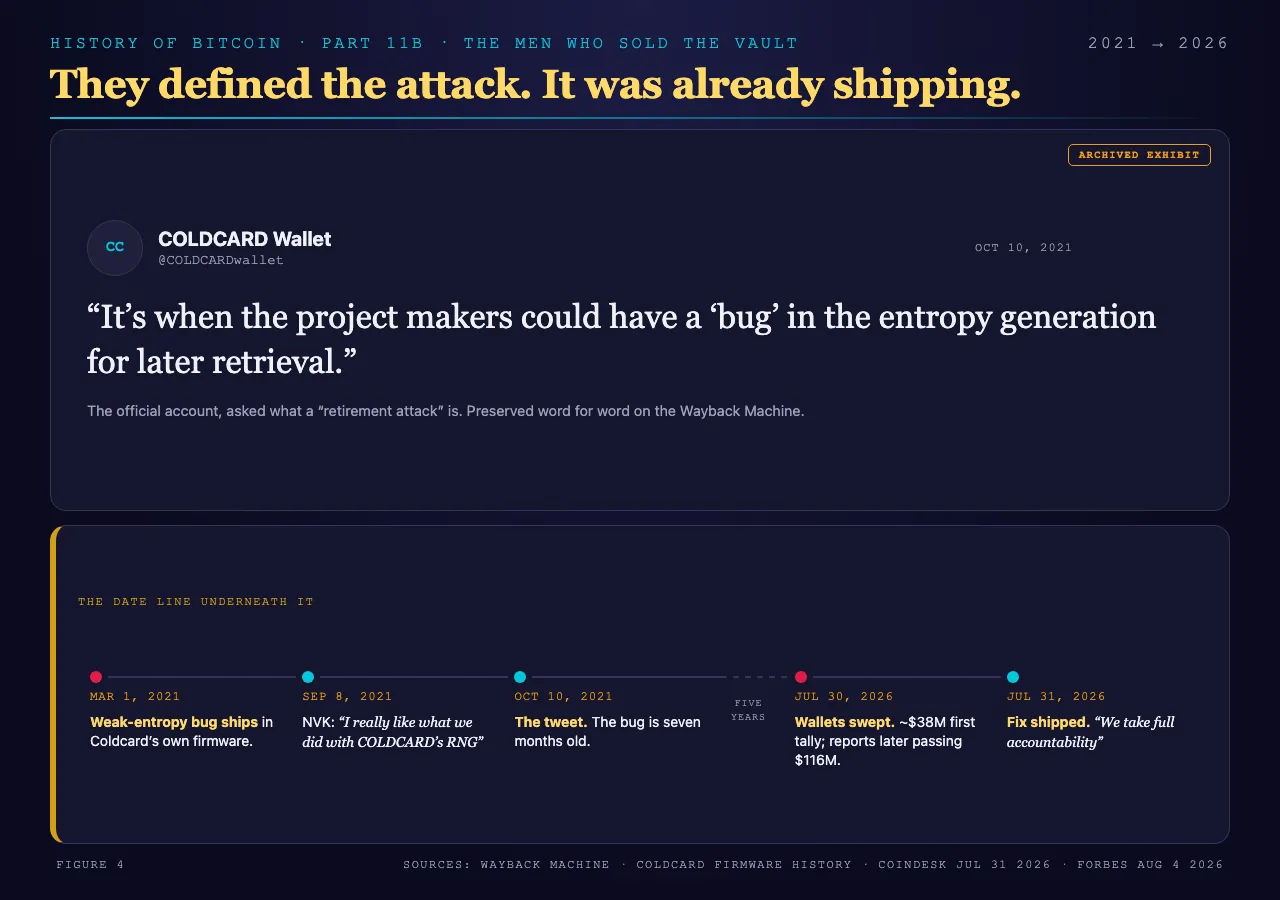
The company defined the attack in public. The date line ran underneath it the whole time. Source: Wayback Machine
If this were one vendor's bad year, it would be a footnote. In May 2023, Ledger, the other giant of hardware self-custody, announced Recover, a subscription that splits an encrypted backup of your seed among third-party custodians.⁵⁸ While customers revolted, Ledger's support account tweeted that it had "always" been technically possible for Ledger to write firmware extracting user keys, a message the company then deleted. Ledger delayed the launch under the backlash that May, promised to open-source the code first, and shipped Recover anyway in October 2023.⁵⁹
The custodial side of the same ledger is already adjudicated. Trust Wallet's browser extension shipped in 2022 generating wallets from 32 bits of effective entropy, a flaw caught by Ledger's own security team, of all people.⁶⁰ QuadrigaCX, the Canadian exchange whose customers were owed roughly $190 million, was concluded by the Ontario Securities Commission to be "an old-fashioned fraud wrapped in modern technology."⁶¹ FTX is the terminus, where the customer coins were simply used as the firm's own money, and the founder is serving 25 years for it.⁶²
In a financialized system, every intermediary reverts to being a counterparty, and every counterparty is a risk. The exchange is a counterparty. So is the auditor. So, it turns out, were the men selling the alleged exit from counterparty risk. No record explicitly shows malice anywhere in the Coldcard story, but it is possible.
What the record shows, for sure, is that, at the very least, the ordinary gravity of shipping products quickly is more than a little risky.
Either way, they defined the attack in 2021 while the bug had already been in their firmware for seven months.
The treasury machine
On the morning of August 24, 2026, Strategy filed its weekly 8-K with the SEC: 840,447 BTC held as of August 23, acquired for an aggregate $63.36 billion, and, for the week of August 17 through 23, no purchases and no sales.⁶³ A quiet week at the largest corporate bitcoin treasury on earth.
The company used to be called MicroStrategy. It made business-intelligence software. In 2020 it began holding bitcoin as its treasury asset, the reserve a corporation keeps on its balance sheet in place of cash, and the software company slowly became a vault with a ticker symbol. Coldcard's customers wanted to hold their own keys. Strategy's investors wanted the opposite: let the company hold everything, and just buy the company as a sort of leverage play on BTC.
To understand what happened in the summer of 2026, you have to see how the vault was financed. The stack, instrument by instrument, comes straight from the filings.
Six series of convertible notes, $6.71 billion outstanding as of June 30, 2026, most of it borrowed at coupons between 0% and 0.875%.⁶⁴ Nearly free money, as borrowing goes. The 2029 notes began life at $3.0 billion; Strategy repurchased half of them at a discount in May 2026 and booked a $113.9 million gain on retiring its own debt.⁶⁵ The converts are the cheap half of the machine.
The expensive half is the preferred stock: five perpetual series, launched one after another across 2025. STRK pays 8.00%. STRF pays 10.00%. STRD pays 10.00%, with dividends the 10-Q calls "discretionary and not cumulative." STRC pays a variable rate that resets monthly. STRE pays 10.00% and is denominated in euros.⁶⁶ Perpetual means: no maturity, no repayment date, dividends forever.
The promise grew fast. The aggregate liquidation preference on the preferred stock, the amount those holders stand in line for ahead of common shareholders, ran from $8.03 billion on December 31, 2025 to $10.00 billion on March 31, 2026 to $15.46 billion on June 30, 2026, with STRC alone accounting for $10.49 billion of it.⁶⁷ This is leverage in its plainest form, fixed promises stacked on a volatile asset, and the promises nearly doubled in six months!
The bills arrived on schedule. Strategy paid $229.5 million in cash preferred dividends in the first quarter of 2026 and $400.2 million in the second.⁶⁸ On the second-quarter earnings call, the company's CFO said its $3.75 billion USD reserve provides "2.1 years of dividend and interest coverage."⁶⁹ Divide $3.75 billion by 2.1 and the company has done the arithmetic for us: roughly $1.8 billion a year in fixed obligations, owed by a treasury that produces no income.
Note STRC in particular. It launched in July 2025 paying 9.00%, and its rate resets with a single job: keep the stock trading near its $100 par. The resets have gone one direction. By July 2026 the rate stood at 12.00%.⁷⁰ Thirteen months of raises to keep a hundred-dollar security worth a hundred dollars!
The premium is what funded everything. At the November 2024 peak, market-data trackers put Strategy's mNAV around 3.4x, which meant every new share sold bought more bitcoin per existing share than it gave away.⁷¹ On November 12, 2025, Bankless reported the multiple slipping below 1.0 for the first time since January 2024.⁷² By August 3, 2026, trackers had basic mNAV at 0.68x. The flywheel ran on selling paper above the value of the coins behind it, and that trade is gone.
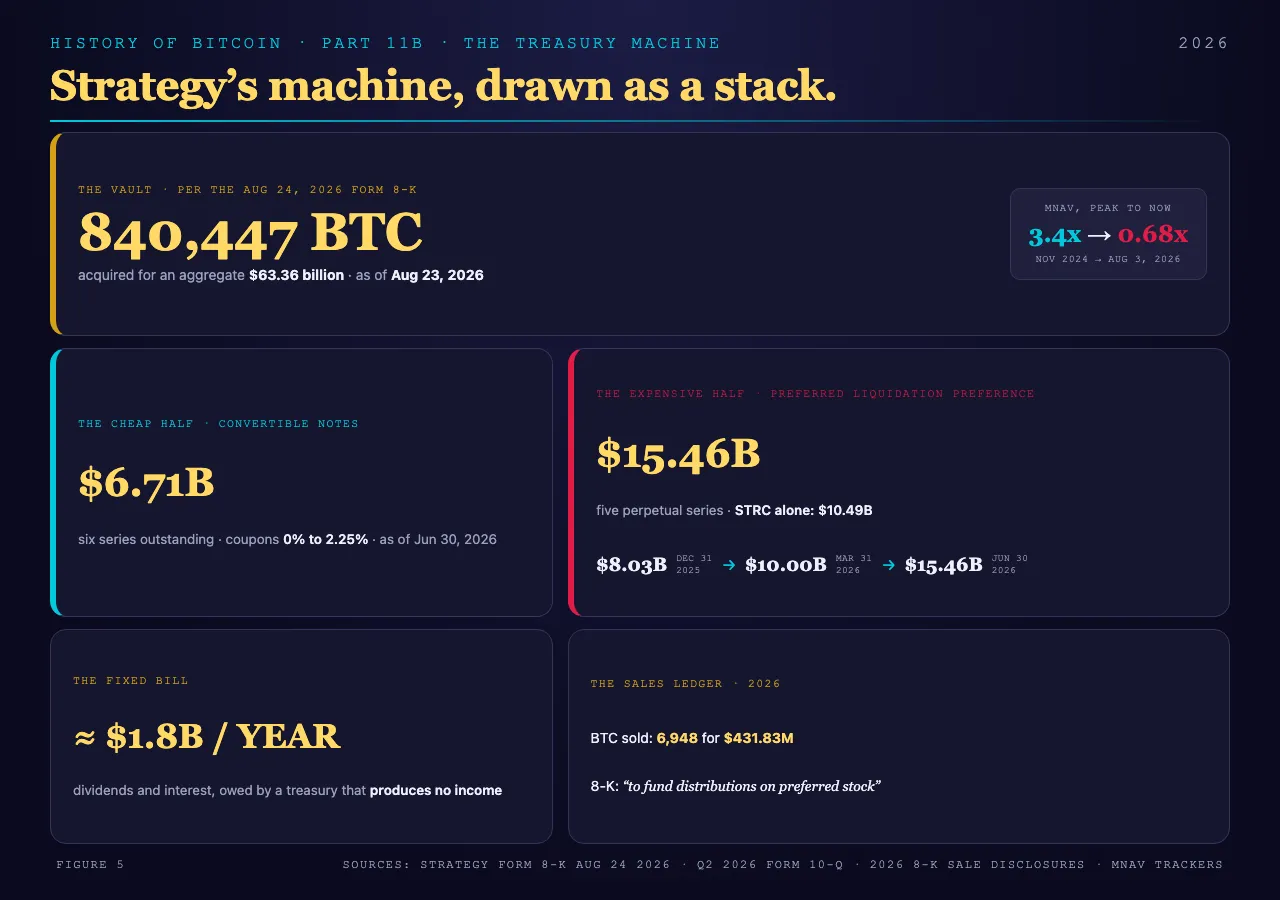
The machine, drawn to scale: $6.71 billion in converts, $15.46 billion in preferred liquidation preference, and a fixed bill of roughly $1.8 billion a year against a treasury that earns nothing. Source: Strategy Inc Q2 2026 Form 10-Q
Not one satoshi
For four years, the company's public identity rested on two words: never sell. Then came the 8-K covering May 26 through 31, 2026. Thirty-two BTC sold, Strategy's first net bitcoin sale since 2022, and the filing's own words on what the money was for: "Proceeds from the bitcoin sales are expected to be used to fund distributions on preferred stock."⁷³
Admittedly, thirty-two coins is a rounding error against 840,000, but an avalanche in the spring starts with a single snowflake in the autumn.
June 29 through July 5: 3,588 more BTC sold for about $216 million, the filing stating that proceeds "were used to fund payment of distributions on preferred stock and to replenish the portion of the USD reserve used for this purpose."⁷⁴ The August 3 filing split the purpose in half: "$52.4 million in proceeds from the bitcoin sales were used to fund dividends on Strategy's preferred stock and $52.3 million in proceeds from the bitcoin sales were used to fund repurchases of STRC Stock".⁷⁵
August 3 through 9: another 1,690 BTC, proceeds to STRC repurchases.⁷⁶ Total disclosed sales for 2026: 6,948 BTC for $431.83 million.⁷⁷
The same week as that August filing, Michael Saylor posted this:
"When I say 'Never Sell Your Bitcoin,' I speak as one saver to another. I have never sold mine. Not one satoshi. Strategy is a public company, not my wallet. Since 2020, it has disclosed it may buy or sell $BTC to manage capital. Our shared conviction in Bitcoin remains unchanged."⁷⁸
On February 28, 2025, as the price sagged below $80,000, the same account had posted: "Sell a kidney if you must, but keep the Bitcoin."⁷⁹
Is Mikey on dialysis? Couldn't confirm on the record...
The word "forced" appears in no filing, and it is my word, not Strategy's. What the filings show is a documented sequence: obligations that did not exist in 2024 now consume sales of the one asset the company exists to hold. The kidney advice was seemingly just for you.
The die-off
Strategy is big enough to sell slowly. The companies that copied it were not.
Sequans Communications, a French semiconductor company, pivoted its treasury to bitcoin in July 2025, peaked above 3,200 BTC at an average cost near $116,000, and sold its way down to 314 BTC by June 30, 2026 before exiting the strategy entirely to refocus on chips.⁸⁰ Bitdeer emptied its bitcoin treasury on February 21, 2026 to fund a pivot into AI data centers.⁸¹ Satsuma Technology's shareholders voted on July 20, 2026, more than 90 percent in favor, to liquidate all 668 BTC and delist from the London Stock Exchange.⁸² Semler Scientific no longer exists as an independent company; it was absorbed into Strive in a merger that legally closed on January 16, 2026.⁸³ Metaplanet, the third-largest corporate holder, went from a 237 percent premium in July 2025 to a discount by early 2026, its stock falling from ¥1,895 to ¥405. Heck of a round trip!⁸⁴
By January 2026, roughly 37 of the 100 largest bitcoin treasury companies traded below net asset value, as reported by the trackers that follow the sector.⁸⁵ And MSCI opened a consultation on excluding bitcoin-treasury companies from its indexes under a non-operating-asset test that would treat the coins themselves as disqualifying. Strategy's CEO publicly disputed the proposal, and the consultation is still open as I write this...⁸⁶
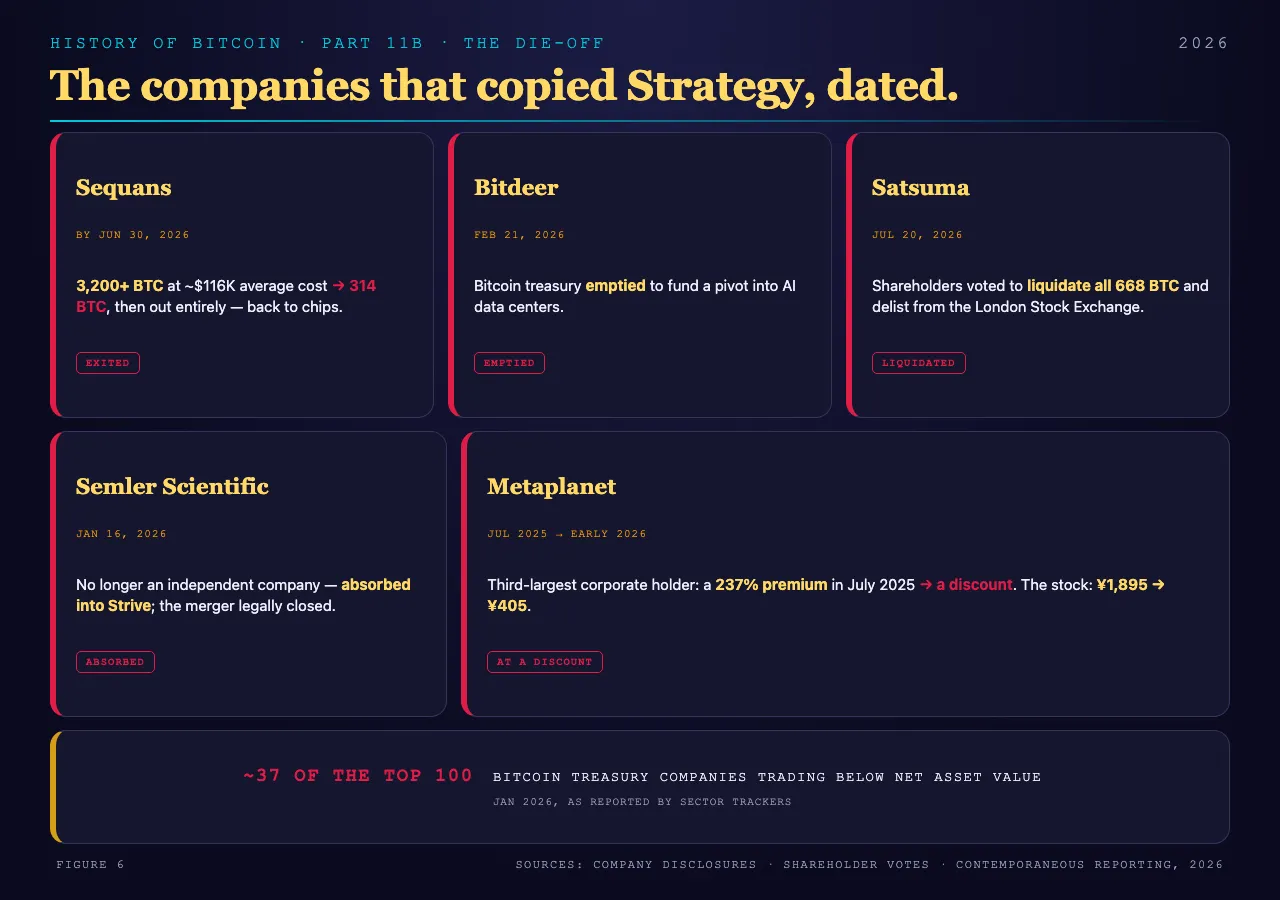
The roster, dated: Sequans out, Bitdeer out, Satsuma liquidated by shareholder vote, Semler absorbed, Metaplanet at a discount, and roughly 37 of the top 100 valued below their own coins. Source: company disclosures and contemporaneous reporting, 2026.
In Genesis and the Curveball I traced how the 2020 era turned doing nothing into the business model itself. The treasury machine is that idea in its terminal, securitized form: a company that mines nothing, builds nothing, and settles nothing, holding coins that move nothing, financed by paper that promises everything. I wrote it up twice this year at CoinGeek, in Saylor's magic beans and BTC Treasury companies really are going to zero!, and the filings since have not made either column look wrong.
The best-performing Bitcoin business of the era never used Bitcoin once for anything except leverage and talking points.
The exchange that begged the question
The exchange that evaporated at the top of this story has a name. Nine years of operation, millions of claimed users, a wind-down notice published on a Sunday: BitMart.
It was founded in 2017 and spent nearly a decade describing itself as headquartered in the Cayman Islands, with a money-services registration filed with FinCEN in the United States in 2018.⁸⁷ For most of its life it was a mid-tier venue with a long tail of listed tokens and a short list of headlines. The headlines it did make are the story.
On the night of December 4, 2021, the blockchain-security firm PeckShield flagged massive outflows from BitMart's hot wallets and estimated the damage at roughly $196 million.⁸⁸ BitMart's own figure, announced the next day, was roughly $150 million.⁸⁹ CEO Sheldon Xia pledged the company would cover the losses from its own funds: "No user assets will be harmed." Five weeks later, CNBC was profiling victims still waiting to be paid, with reimbursement inconsistent from token to token.⁹⁰
Then the regulators came asking. In August 2022, the Federal Trade Commission's first-ever crypto investigative demand became public, aimed at BitMart's US operators, Spread Technologies and Bachi.Tech, covering allegations that consumers were denied access to their accounts. BitMart petitioned to quash the demand; the FTC denied the petition and ordered compliance by August 19, 2022.⁹¹ A later dismissal of the matter has been reported, but I have not found a primary record confirming it.
BitMart survived all of it, including the wider offshore collapse I documented in Contagion.
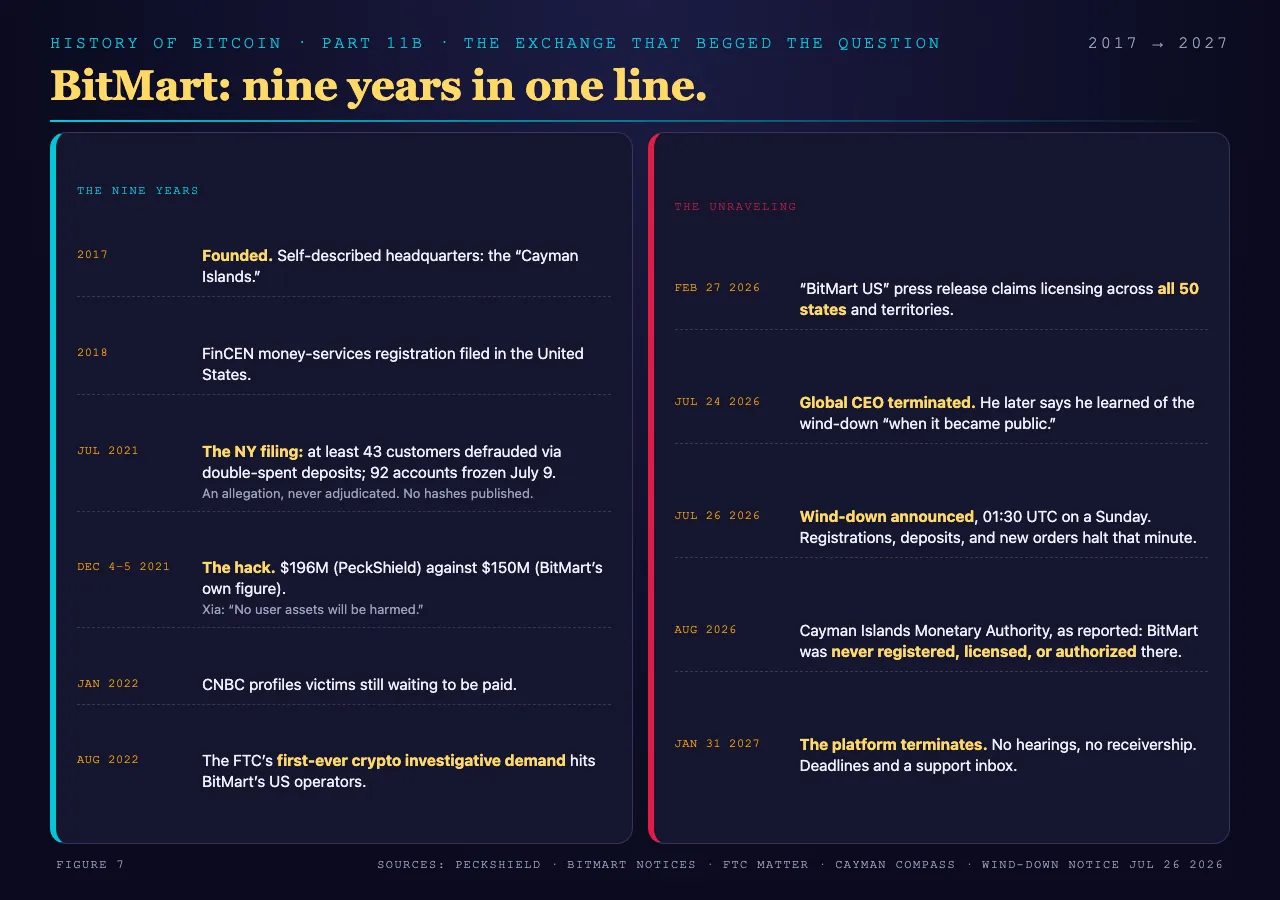
Nine years in one line: a hack with two damage figures, a pledge, a federal probe, a lawsuit that vanished, and a wind-down its own global CEO learned about with the public. Source: linked reporting, 2021 to 2026.
The proof that never arrived
Months before the hack, BitMart had played a different role: the accuser. In the summer of 2021 the BSV network absorbed a series of reorganization attacks, a reorganization being a rewrite of recent blocks that replaces one version of the chain's recent history with another. I covered those attacks in The Verdict and the Bubble. What matters here is what BitMart did about them.
Its parent company, GBM Global Holdings, went to a New York court claiming that at least 43 BitMart customers had been defrauded through double-spent deposits, a double spend being the same coins spent a second time on a competing version of the chain. The filing said 92 affected accounts had been frozen on July 9, 2021, and that the proceeds had been traced to Binance, Huobi, and OKEx.⁹² That is an exchange's allegation in a legal filing, but it was never adjudicated.
The Bitcoin Association analyzed the attacks, published the block hashes of the fraudulent chains, and gave node operators instructions for invalidating them.⁹³ Nobody was ever publicly identified. And the one thing that would have settled the matter never arrived: public proof.
I was not watching this from a distance. On December 24, 2021, five months after the filing, I put my own assessment on the record in my year-end column for CoinGeek
"Officially, Bitcoin Association took a close look at the hypotheses posited by BitMart Exchange and determined that a large double spend had indeed occurred. However, the coins of exactly zero users have been reported missing, and the nature of the attacks looks to me like it was done for PR reasons. I withhold that I could absolutely be wrong on this point, but all these months later, BitMart has not provided public hashes to prove the theft, so are we to just trust them when verification would be so trivially simple?"
That was my position on Christmas Eve 2021, published where anyone could argue with it. Five years later, the questions have only sharpened.
Was anyone actually robbed? A court filing says 43 customers were. There has been no verdict, no reported settlement, no forensic confirmation, and no transaction hashes, in five years, on a public ledger where publishing them would take an afternoon.
And the second question: why does a company that says it was robbed never show the receipts?
Pretty fishy...
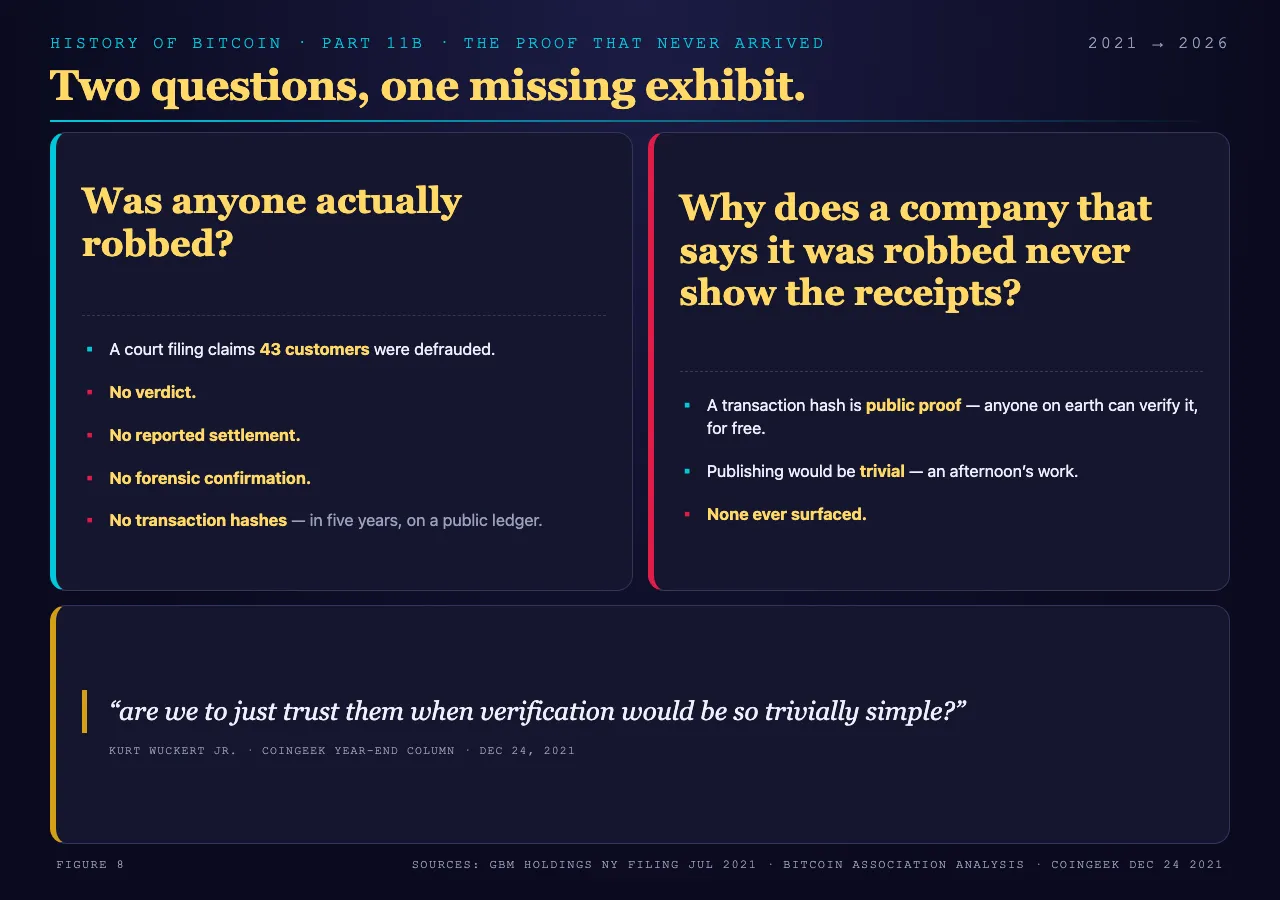
Two questions, five years apart, resting on the same missing exhibit: the transaction hashes BitMart never published. Source: CoinGeek
"An orderly wind-down"
Which brings the story back to Sunday, July 26, 2026, at 01 UTC, and the notice this article opened on, now with the name restored: "After a careful evaluation of the company's operating conditions, market environment, and future strategic direction, BitMart has made the difficult decision to commence an orderly wind-down of its trading platform operations."⁹⁵
- July 24, 2026 : Global CEO Nenter Chow is terminated.
- July 26, 2026, 01 UTC : The wind-down is announced. New registrations, deposits, and new trading orders halt.
- August 26, 2026, 01 UTC : All spot and derivatives trading ends.
- January 31, 2027 : The platform terminates.
Chow, terminated two days before the announcement, said he was "not involved in the decision announced today, not consulted on it, and not informed of it. I learned of it when it became public."⁹⁶ The global CEO of a nine-year-old exchange, finding out with the rest of us.
Then the jurisdiction question, nine years overdue. In August 2026, per reporting in the Cayman Compass, the Cayman Islands Monetary Authority stated that BitMart, including under the names GBM Foundation Company and GBM Global, was never registered, licensed, or authorized there.⁹⁷ Meanwhile, a "BitMart US" entity had issued a press release in February 2026, five months before the wind-down, claiming licensing across all fifty US states and territories.⁹⁸
Nine years is a long time to be from a place that says it never knew you.
The withdrawals told their own story. On August 10, a co-founder of the OpenGradient project publicly claimed that his team's market-maker balances were frozen on BitMart and that the exchange was insolvent. No insolvency has been confirmed by any regulator, court, or filing.⁹⁹ On August 17, an account presenting itself as speaking for BitMart users and employees published an open letter to founder Sheldon Xia demanding verifiable proof of reserves, an explanation of who authorized the withdrawal restrictions, payment of back wages owed to staff, and a concrete repayment plan.¹⁰⁰ Xia dismissed the letter as "fabricated rumors" from a "hacked account," said he would pursue legal action against its source, and released no reserve figures and no repayment schedule.¹⁰¹
And on X, a self-described victim claiming a multimillion-dollar stranded balance has spent August cataloging stuck withdrawals and organizing complaints to regulators across jurisdictions. Those claims are the claims of an interested party, none of them independently verified.¹⁰² What needs no verification is the smoke rising on the horizon: a crowd asking an exchange where its money is, and an exchange answering with a legal threat.
In 2021, this exchange said its customers were robbed, filed a lawsuit in New York, and never published the proof that sat one query away on a public ledger. In 2026, its own users say they are being robbed, and the company calls them rumors. Both stories end the same way: an allegation, a filing, and silence.
They said their customers were robbed. They never published the hashes that would prove it.
The insiders' table
BitMart is one door in a long hallway. Open the rest and the same arrangement repeats: the people who run the game eat before the people who play it, and almost none of it is against the rules.
Start with listings. A listing is the moment an exchange adds a coin to its tradeable menu, and it works like an IPO pop you can schedule. You already met the one proven case: Ishan Wahi, the Coinbase product manager, went to federal prison for tipping trades ahead of those announcements.¹⁰³ The academic record shows what that information was worth. Lennart Ante's 2019 event study of 327 exchange listings found average abnormal returns of 5.7 percent on listing day, up to 25.5 percent on the highest-impact venues.¹⁰⁴ Messari's "Coinbase Effect" analysis reported an average 91 percent return in the days after listing.¹⁰⁵ So what was the market pricing? The door.
Then the venues printed their own chips. FTT, the token FTX issued to itself and listed on itself, already has its anatomy on record in The Biggest Frauds in Bitcoin. What the SEC's complaint against Binance preserved is the same business model described from the inside, in the company's own words.
The same complaint records the CEO having "brought [BAM CEO A] to the room to strongarm a [BNB] listing" over the US chief executive's objection (paragraph 164), and US employees calling the parent company's control "shackles" (paragraphs 7 and 194). One procedural fact belongs next to those quotes: the SEC dismissed that case with prejudice in May 2025, before any trial, so these remain a regulator's filed quotations of internal chats, never adjudicated.¹⁰⁷ Nobody has ever claimed the chats say something else though.
Then the unlocks. In May 2024, Binance's own research arm published a report titled "Low Float & High FDV: How Did We Get Here?" and answered itself with numbers: roughly $155 billion in tokens scheduled to unlock from 2024 through 2030, new tokens floating at an average 12.3 percent of their fully diluted value, and 80 percent of new Binance listings down within six months.¹⁰⁸ Keyrock's 2025 data put $18.77 billion of insider unlocks into a year when 85 percent of newly launched tokens traded below their launch price.¹⁰⁹ Chainlink Labs' Zach Rynes called the structure "predatory tokenomics" that is "now a standard playbook" with "zero upside for retail investors."¹¹⁰ That is a man inside the industry describing its default product.
When the games moved on-chain, so did the table. On-chain analysts at Bubblemaps traced roughly 41.5 million UNI across wallets linked to the venture firm a16z, more than the 4 percent quorum needed to decide any Uniswap governance vote.¹¹¹ At a House hearing on June 4, 2025, Rep. Sean Casten asked Uniswap's chief legal officer whether the foundation's ability to act unilaterally weakens any claim of decentralization. Her answer, verbatim: "I am fairly certain that the Uniswap Foundation cannot make any unilateral government[al] governance change."¹¹² Read it twice; it does not get more certain. And in the one case that reached a jury, the finding was explicit: in April 2024, jurors found Do Kwon personally liable as a "control person" of Terraform Labs, a $4.47 billion resolution resting on the conclusion that one man controlled the decentralized thing.¹¹³
The freshest table is the prediction market, and the record there genuinely splits. New York's attorney general sued Kalshi in July 2026, seeking roughly $36 billion. A federal judge in Ohio ruled in March 2026 that state gambling law reaches its contracts. Massachusetts won an injunction in January 2026. And in April 2026 the Third Circuit, the highest court to reach the question, held that the CFTC's jurisdiction preempts state gambling law entirely.¹¹⁴ New York's April suit against Coinbase's prediction markets belongs to the same war. Notice what nobody in any of those courtrooms disputes: what the product IS. The entire fight is over which regulator's costume it wears.
The influence is real, it is concentrated, and it is mostly legal in the venues where it operates. That last part is the indictment of the venues. Researchers Erica Pimentel and Mélissa Fortin, studying who actually steers these systems, wrote that "who has a final say on which line of code will prevail depends on a social hierarchy dominated by insiders," and that "public blockchains...do not actually replace trust with transparency."¹¹⁵
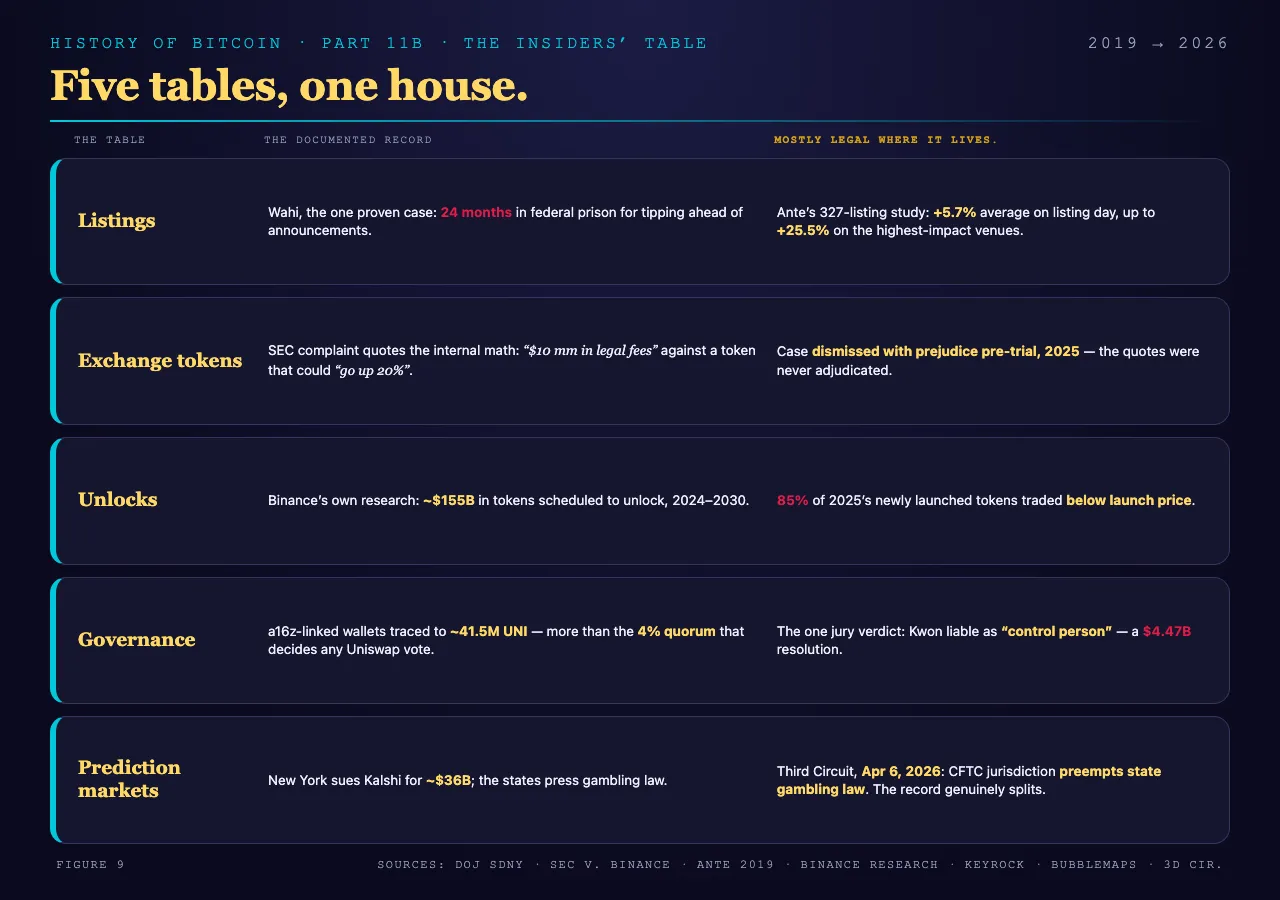
Five tables, one house: listings, exchange tokens, unlocks, governance, and prediction markets, each documented from filings and named research. Source: the records cited above.
The whole pitch was decentralization while eighty-four percent of the ETF coins sit with one custodian.¹¹⁶
Why we stopped
I promised you an answer to the question that started all this: why did we stop using the technology for commerce and start using it almost exclusively for financial games and illicit activities? The answer has four parts, and every one of them is on the record.
Commerce was throttled. The capacity ceiling and the fee spikes did the first cull, and the mechanics fill the civil war articles; when a $20 network fee ended Steam's checkout in December 2017, that was the design constraint talking, in Valve's own accounting.¹¹⁷
Speculation was subsidized. A decade of free money made buy-and-wait the rational trade. Then the wrappers arrived: ETFs, treasury companies, perpetual futures. In 2025, $111.5 trillion in crypto derivatives notional traded against $25.3 trillion in spot, by Cboe's own report.¹¹⁸ The network built for payments, Lightning, holds low single-digit billions in total capacity, as its public trackers report it.¹¹⁹ Even the stablecoins that ate the payments story run 67 percent trading and DeFi against 5 percent merchant payments, as the industry's own aggregations split it.¹²⁰