The Written History of Bitcoin: Inscriptions and Convictions
By Kurt Wuckert Jr.
At 18 UTC on January 20, 2023, a piece of free software called ord ticked over to version 0.4.0.¹ No token. No company. No venture round. A release page, a short blog post, and a tweet.
To feel the weight of that, you have to remember what January 2023 smelled like. The industry was a crime scene. The year of contagion had just ended, the lawyers were still sorting the bodies, and the sober consensus of respectable finance was that this whole experiment had finally embarrassed itself to death. Venture money was gone. Headcount was gone. The conferences had the energy of a funeral luncheon with a little bit of respectful solemnity, but ultimately everyone wondering how we would move on...
Into that silence, one man shipped a version bump.
The author was a programmer named Casey Rodarmor. The blog post was titled "Inscribing Mainnet," and it opened with two sentences that would reroute the entire year: "ord version 0.4.0 has been released. Inscriptions are finally ready for Bitcoin mainnet."² At 22 UTC, he posted the launch tweet:
Inscriptions are finally ready for Bitcoin mainnet.
Inscriptions are like NFTs, but are true digital artifacts: decentralized, immutable, always on-chain, and native to Bitcoin. 🧵
The distinction he was drawing: the NFTs of the last cycle were mostly hashed pointers to files hosted somewhere else, and an inscription carries the thing itself.
If you read Part 11, you already know this man. You watched him build the thing in public through the entire crash year: the repository grinding along through 2021 and 2022, the "Ordinal Theory" essay in July, a working wallet in October, and a pixel-art skull inscribed into block 767430 on December 14, 2022, two days after an arrest in the Bahamas swallowed every headline on earth.³ Nobody was watching him then. Everybody was watching the fraud trials form up. And that is precisely why the launch hit the way it did: while the industry's loudest men were being fitted for ankle monitors, its next fight was being compiled, tested, and versioned in public by a guy nobody considered important.
Part 11 closed on the rubble of 2022 with one observation: the exchanges failed, the funds failed, the lenders failed, and the blockchain itself was the only building left standing. In 2023, the fight moved inside that building. The question stopped being whether Bitcoin would survive its custodians and became something older and stranger: what is a blockchain actually for?
That question was not new. It was the original question, the one the Bitcoin Civil War was fought over, the one that split the network into competing pieces and scattered its people into hostile tribes. For six years, BTC's answer had been settled doctrine: a blockchain is for holding, and anything else is an attack.
In 2023, the doctrine met a market.
Here's a detail most people missed at the time: the switch had already been flipped. Rodarmor quietly enabled mainnet inscribing in ord on January 9, eleven days before the announcement, and almost nobody noticed.⁴ Then came the post, and within weeks the chain that had spent a decade treating data as spam (and excommunicating the people who put it there) was filling its blocks with pictures at premium fees, while its own elders demanded filters.
The spam was coming from inside the house.
And before this year ends, a question about one man's litigation is going to surface inside a filing from the largest asset manager on earth; the whole paragraph is waiting for you deeper in this installment.
Premium spam
Let's start with the door Rodarmor walked through, because the mechanism carried the whole year.
Taproot activated on BTC on November 14, 2021, sold to the network as a privacy and efficiency upgrade; Part 10 told that story while the bubble inflated around it. Fourteen months later, its script rules were carrying cartoon wizards.
Nobody who shipped Taproot advertised this outcome. The upgrade's designers built a cleaner, roomier place to put script data, relaxed the old limits inside it, and assumed the room would stay tidy because their culture disapproved of mess. Rodarmor read the actual rules instead of the culture, and the rules said the room was enormous and the rent was discounted.
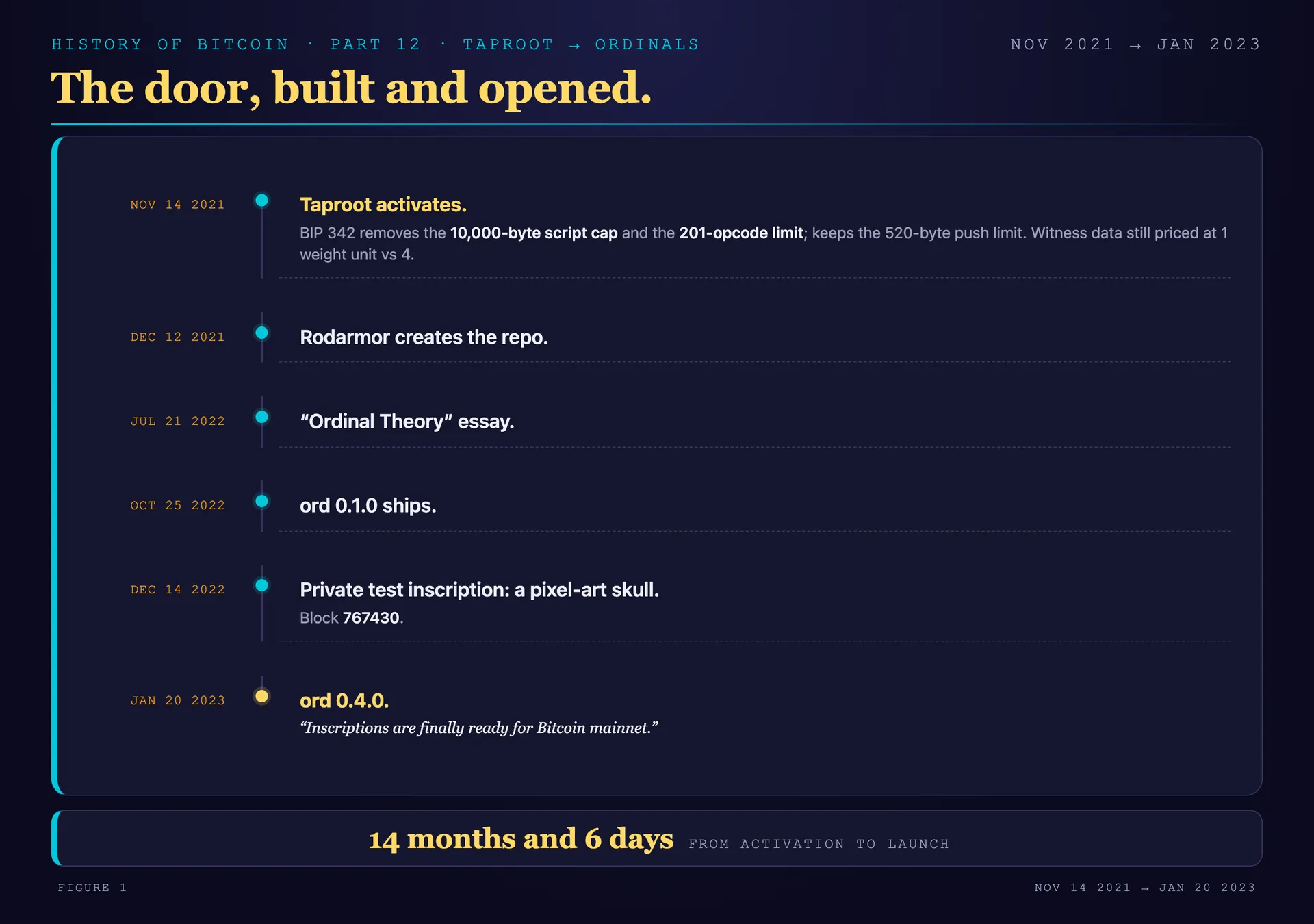
On the chain that fought a civil war to keep blocks small so that ordinary payments would stay pure, a monetary transaction pays full freight while a JPEG rides at 75 percent off. The discount was not an accident and not a hack; it was the published fee schedule, signed off by the same review culture that spent years calling data on the chain an attack.
Opinions replaced with incentives, and honestly, I was pretty pumped about it! Someone was going to teach the small blockers about the hidden powers of bitcoin.
On launch day, Rodarmor also did something almost courtly. He opened pull request #1408 against the bitcoin/bips repository, proposing "New BIP: Ordinal Numbers" through the front door of BTC's formal standards process.⁷ The registry never assigned it a number.
The side door, meanwhile, was already jammed with traffic.
Rodarmor had a word ready for what was coming through it. His launch post drew the line carefully: "Inscriptions are digital artifacts, and digital artifacts are NFTs, but not all NFTs are digital artifacts. Digital artifacts are NFTs held to a higher standard, closer to their ideal. For an NFT to be a digital artifact, it must be decentralized, immutable, on-chain, and unrestricted..."⁸ Here's a funny one: the phrase itself came out of a ChatGPT brainstorming session, and when the machine offered it, Rodarmor's reaction was "I was like, fuck yes, that's it".⁹ He also understood exactly what the outrage was doing for him. Of the people discovering inscriptions through the backlash, he said "they saw exactly what they wanted — on-chain, immutable NFTs that are there forever."¹⁰
The elders moved fast, and it matters who moved first, because the man who reached for the filter in week two of the boom is the same man whose name will keep surfacing through this installment and the ones after it, each time with higher stakes. On February 1, Luke Dashjr, one of Bitcoin Core's longest-serving developers, published a filter patch he named "Ordisrespector" as a GitHub gist, topped with a warning in his own hand: "WARNING: This has NOT been tested. Use at your own risk..."¹¹ The patch's announcement circulated under his name across the Bitcoin press.¹²
The next day, the culture answered him. On February 2, a roughly 3.94MB inscription of a hand-drawn wizard went into a block with the cooperation of the Luxor mining pool: nearly an entire block, one cartoon, mined on purpose.¹³
For a decade, putting arbitrary data on Bitcoin got you throttled, filtered, and run out of the building; I documented that purge in BTC was hijacked, and everyone knows it. In 2023, the same act became BTC's hottest product.
The difference was not the data. The difference was the door it came through.
On February 14, Dashjr escalated from code to doctrine.¹⁴
PSA: Ordinals aren't just a spam attack; they are also an attack on Bitcoin's fungibility, and if accepted would break at least Lightning and CoinJoin.
The market answered the doctrine with a bid. On February 27, Yuga Labs, the company behind the Bored Apes and the closest thing NFT culture had to a royal house, announced TwelveFold, a generative art collection inscribed on BTC.¹⁵ The 24-hour auction over March 5 and 6 moved 288 of 300 pieces for 735.371 BTC, about $16.6 million, as reported across the trade press at the time.
Six weeks after a version bump, the biggest brand in NFTs was selling art on the chain that banned art. Nobody asked the elders for permission. That was the real news, and everyone in the priesthood knew it: the veto had stopped working, and the only tool left was the sermon.
Then the boom found its casino. Late on March 8, spilling into March 9 UTC, a pseudonymous builder going by domo posted an idea so casually it barely reads as a launch.¹⁶
An experiment into "brc-20's" and fungibility on bitcoin with ordinals 1/x
BRC-20 was a convention for treating inscribed text as the deploys, mints, and transfers of a fungible token. That is the whole invention. And the inventor, to his lasting credit, told everyone precisely what he thought of it the same day.¹⁷
gm. I'm glad that some people like the experiment. Some additional notes.
These will be worthless. Please do not waste money mass minting.
Due to how some inscription tools are set up, the 'balance' may be minted to the intermediary address used in [...]
These will be worthless.
The creator of the asset class, on day one, in public, in writing. You could not ask for a cleaner disclosure if a securities lawyer had drafted it. And you already know what happened next, because you have read eleven parts of this series and you know what this industry does with a warning label.
The first BRC-20 token was called ORDI. All 21,000,000 of it minted out in roughly 18 hours, as reported at the time.¹⁸ The disclaimer did nothing. Warnings never do, in this industry; they get screenshotted later, for the retrospectives.
The infrastructure arrived on schedule. Magic Eden, the dominant Solana NFT marketplace, launched a BTC Ordinals marketplace on March 21, and by April 1 it had processed 39,817 trades from 18,462 unique users, more than $16.5 million in volume.¹⁹ By May 1, the collective BRC-20 market cap crossed $100 million, as CoinGeek reported, sixty days into the experiment's life.²⁰
Notice the rhythm of the thing. January was a tool. February was a culture war. March was a token standard and a marketplace. By spring, it was an economy, and economies do not care what the priesthood thinks of them.
And then the pipes clogged.
Over May 7 and 8, the BTC mempool backed up past 400,000 unconfirmed transactions and kept climbing toward half a million. Binance, the largest exchange on earth, paused BTC withdrawals for about 90 minutes on May 7, then paused them again roughly twelve hours later, blaming network congestion; it raised its withdrawal fees and started work on a Lightning integration to route around its own settlement rail.²¹ The average transaction fee had hit $9.62 the prior Friday, a roughly two-year high.²²
The network built to route around banks got so congested with collectibles that the biggest exchange in the world had to stop letting people leave, twice in twenty-four hours. Peer-to-peer electronic cash, now boarding by ticket number. And every one of those stuck transactions was bidding for blockspace against text files whose own author had declared them worthless two months earlier.
Heck of a fee market!
The cleanest snapshot of what four months had built came on May 21, from Dune Analytics and ordinals.com data: 8,376,936 cumulative inscriptions; 24,677 distinct BRC-20 tokens; a BRC-20 market cap of $483 million; and 1,448.84 BTC in inscription fees paid to miners, about $39.14 million.²³
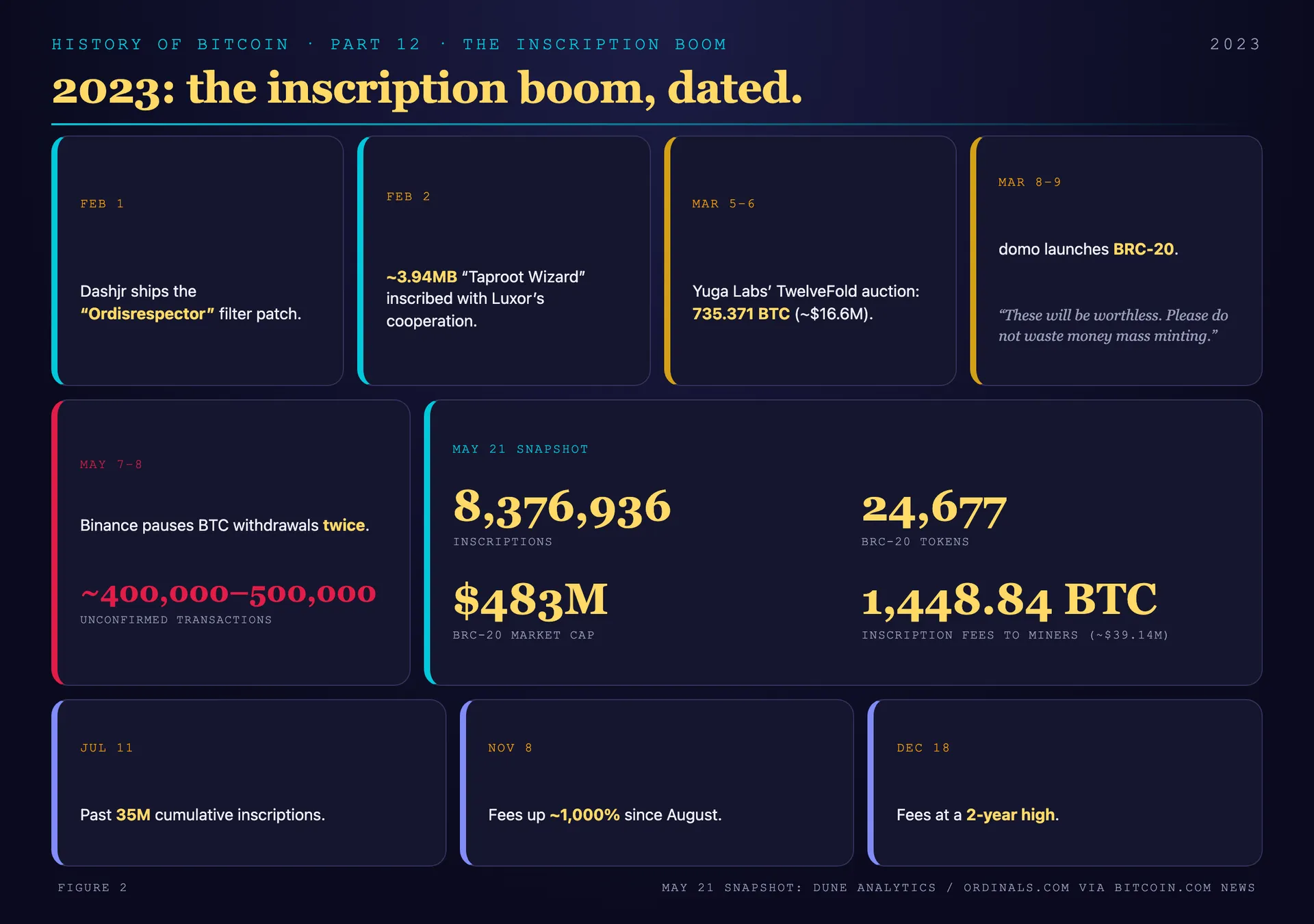
It did not slow down. By July 11, the cumulative count passed 35 million inscriptions, running at more than 350,000 per day.²⁴ After a quiet late summer, the wave came back: by November 8, fees were up roughly 1,000 percent since August as inscription demand returned, and by December 18 they sat at a two-year high, a straight windfall for miners.²⁵ When the aggregators closed the books on the year, BTC's total 2023 transaction fees came to roughly $500 million, against less than $200 million in all of 2022, per Glassnode data as aggregated in year-end coverage; Messari attributed about 21 percent of the year's fees to inscriptions.²⁶
The small-block wing had spent a decade promising that a real fee market would one day replace the block subsidy, carried by high-value settlement: a global economy of banks and nations bidding for final settlement in the hardest money ever made. The fee market finally arrived, and it was made of cartoons and meme tokens.
The miners won: the windfall was real, and they cashed it. The speculators won and lost in the usual proportions. The losers were the people the whitepaper was addressed to: anyone trying to move ordinary value peer to peer on the chain, who now stood in line behind a wizard JPEG at a two-year-high toll. The elders had built a cathedral and were shocked to find a carnival paying better rent.
The fees came back. The commerce didn't.
And Luke Dashjr, who fired the first patch on February 1 and drew the doctrinal line on February 14? His year ends louder than it began, and the loud part has a stretch of this installment waiting for it.
Enter the Nomads
At the end of 11B, I teased that some friends of mine from BSV would walk into this story. This is where they walk in.
I spent the Bitcoin Civil War on the big-block side, and the people you are about to meet spent it there with me. We watched the same delistings, absorbed the same mockery, and kept building on a chain the rest of the industry had agreed to pretend did not exist. So when the BTC Ordinals boom broke open, I was not surprised by what happened next. I had spent years watching these particular people practice.
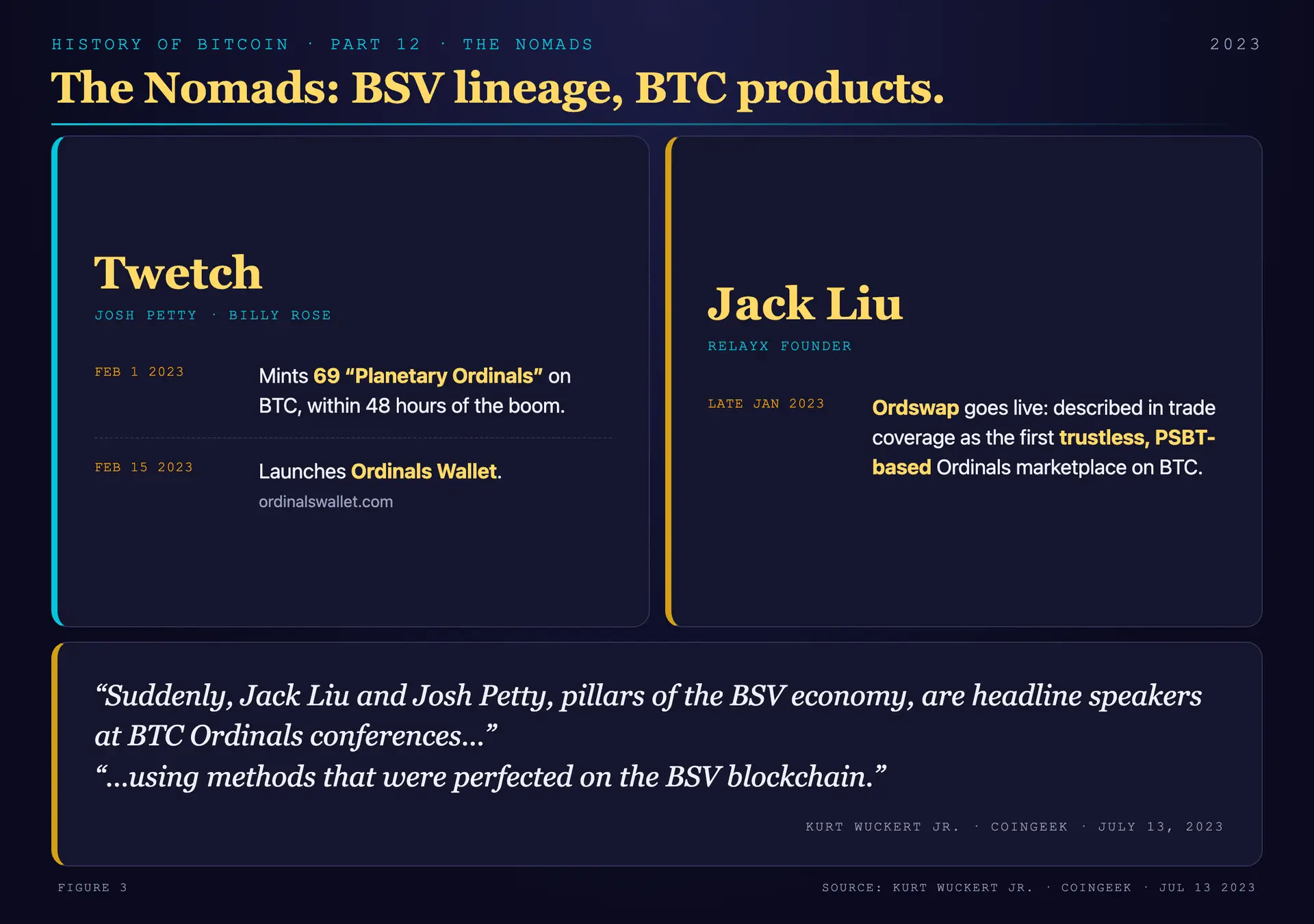
While BTC's elders were writing filter patches, the fastest builders in the new inscription economy turned out to be people BTC's culture had already thrown away. Twetch was a social app born on the BSV blockchain, where posting itself was an on-chain act; its co-founders, Josh Petty and Billy Rose, had spent years shipping exactly the thing BTC had just discovered. On February 1, within 48 hours of the boom breaking open, Twetch minted 69 "Planetary Ordinals" on BTC.²⁷
Petty, the CEO, described the decision like it was muscle memory: "We have always been blockchain agnostic, so if people want NFTs on BTC, we just want to give the best experience. As soon as we heard the news, I let the team know we were pulling an all-nighter to get a product out."²⁸ Rose told CoinDesk with his trademark shrug: "When we saw the Ordinals stuff come out, we were just excited to hop onto the 'NFTs on BTC' train... We've been doing data on the blockchain for about five years now, so we're just ready to go."²⁹ The same piece carried my favorite detail of the whole episode: Twetch's lead developer sending BTC ordinals transactions at 5AM to catch the quiet mempool windows, because on BTC you have to schedule your commerce around the congestion.³⁰
Five years of practice.
The people who got banned for putting data on Bitcoin were the best in the world at putting data on Bitcoin.
Rodarmor himself handled the arrivals with more grace than his network's culture usually musters: he expressed reservations about the BSV association and welcomed the interest anyway, hoping they'd keep building on BTC.³¹ It was a small gesture, but in an ecosystem where guilt by chain association had been official etiquette for the better part of a decade, a founder openly welcoming BSV builders instead of performing disgust at them was its own data point about how much the ground had shifted.
Two weeks after the Planetary Ordinals, the same orbit shipped again. On February 15, a new product announced itself.³²
Introducing Ordinals Wallet 🤯🚀
Receive, store, and view Ordinals right now on http://ordinalswallet.com ...
It was live the next day, built by the Twetch team, an attribution the record carries through a company profile naming Rose as founder, Rose's own resume, and the trade press naming the Twetch principals, rather than through any press release.³³ While Bitcoin Core's veterans debated whether users should be allowed to want this, a BSV team put a consumer wallet for it in browsers within 27 days of the launch post.
Then there was Jack Liu, the RelayX founder. His resume ran through OK Group as chief strategy officer, OKLink as co-founder, and Circle's Asia OTC desk before he built RelayX, a BSV wallet and payments company. In late January 2023, days after Rodarmor's announcement, Liu's Ordswap went live, described in trade coverage as the first trustless, PSBT-based Ordinals marketplace on BTC.³⁴ The man who built one of the first functioning marketplaces of the BTC Ordinals economy was the founder of a BSV wallet company.
The expertise came from somewhere.
A consumer wallet from the Twetch orbit. A marketplace from the RelayX founder. Sixty-nine inscribed planets from a BSV social app inside the boom's first two days. Before Magic Eden's machine arrived in March, the earliest working storefronts of BTC's hottest new economy were disproportionately built, shipped, and staffed by people from the chain BTC had spent years laughing at.
I watched all of this happen in real time, and these were not strangers to me; they were people I had shared stages, group chats, and grudges with through the ugliest years of the Bitcoin Civil War. In July, I wrote it down. My CoinGeek piece of July 13, 2023 named the pattern and the people
Suddenly, Jack Liu and Josh Petty, pillars of the BSV economy, are headline speakers at BTC Ordinals conferences, and "BTC only" enterprises are working with BSV blockchain-born teams to implement technology that creates real economic value. This is a seismic shift in culture!
Jack Liu and Josh Petty. Headline speakers. At BTC conferences. There were years when naming BSV in those rooms was a good way to lose your speaking slot, and I say that as someone who watched it happen to people I know as well as people who are me! Haha
I called them the "Ordinals Nomads." What they carried across the border mattered more than the trip itself: they were attracting users from different tribes on BTC, as I wrote then, "using methods that were perfected on the BSV blockchain."³⁶ "As a veteran of the Bitcoin Civil War, I can attest that this is a breath of fresh air."³⁷
And underneath the culture story sat the economic one, which I considered the bigger deal: "The token represents the real-world opportunity to do business on chain—which is the lesson that folks in the big blocker tribe have been pushing for years now. This is a victory!"³⁸ Not a victory of price. A victory of premise: for one strange year, the market forced BTC to behave like the thing we always said Bitcoin was.
I hedged the thing, too: I told readers up front that this was a novel, emergent phenomenon I was exploring, not ruling on. Thirteen years into this story, you learn to leave yourself room.
But I was not writing a peace treaty either, and I said so in the same piece: "The Bitcoin ecosystem remains fragmented. Small blockers are still vile and malicious toward big blockers who remain suspicious and resolute."³⁹ Both halves were true then, and remain true now. The Nomads were not welcomed; they were tolerated, the way a town tolerates the only electrician who will answer the phone.
I published that piece on July 13, 2023, and here is a small joke history played on me: the same day my unification thesis went out the door, the wider record was busy printing a landmark securities ruling in one courtroom and an arrest warrant's execution somewhere else, both of which you will meet later in this installment.⁴⁰ File the date away.
And my close held no sentimentality either, because thirteen years of watching this protocol eat its rivals and its children alike will cure you of sentimentality about market structure: "The ordinals protocol is a fractal addition to the already complicated SHA256 landscape, and I think that while it represents a new variable, there can only be one. And for reasons of pragmatism, the Ordinals Nomads benefit in all outcomes."⁴¹
There can only be one. I meant that as market physics, not tribal cheerleading: SHA256 economies compete for the same miners, the same entrepreneurs, and eventually the same users, and the arbitrage between a chain where data rides through a discounted side door and a chain where data was the design brief does not stay open forever.
Somebody was going to close it, from one direction or the other.
The Nomads had proven the exiles could out-build BTC's natives on BTC's own chain, at BTC's prices, inside BTC's ceiling. What their home chain did with the same twelve months is a different kind of number entirely, and it starts with a single satoshi.
Across the trench line
On March 17, 2023, a mining pool account posted three sentences to X: "A fair launch matters. Pay attention. This is launching fairly soon."⁴²
No roadmap. No presale, no whitelist, no venture allocation. Three sentences and a promise about fairness.
That account was GorillaPool's, and GorillaPool is my pool. I founded it with my buddy "Root." The engineers in what follows are my team, and they designed, indexed, and launched the protocol at the center of it. I was not a spectator to any of this, so weigh my words and recollection accordingly.
Rodarmor's inscriptions had gone live on BTC on January 20. In under two months, the concept crossed the trench line of the Bitcoin Civil War and landed on BSV, the chain the hard forks of 2017 and 2018 had pushed to the far side of the wire. The BSV version was called 1Sat Ordinals (BSV), and it launched the way the March 17 post promised: a spec published ahead of time, a fair-release plan on GitHub, and a starting gun that was nothing more than a block height.⁴³
The pitch was austere on purpose. This series just spent two installments burying the token launches of the bubble years, so notice what is missing from that plan: no insider window, no reserved supply, no allocation to anyone at all. If you wanted a 1Sat ordinal, you inscribed one.
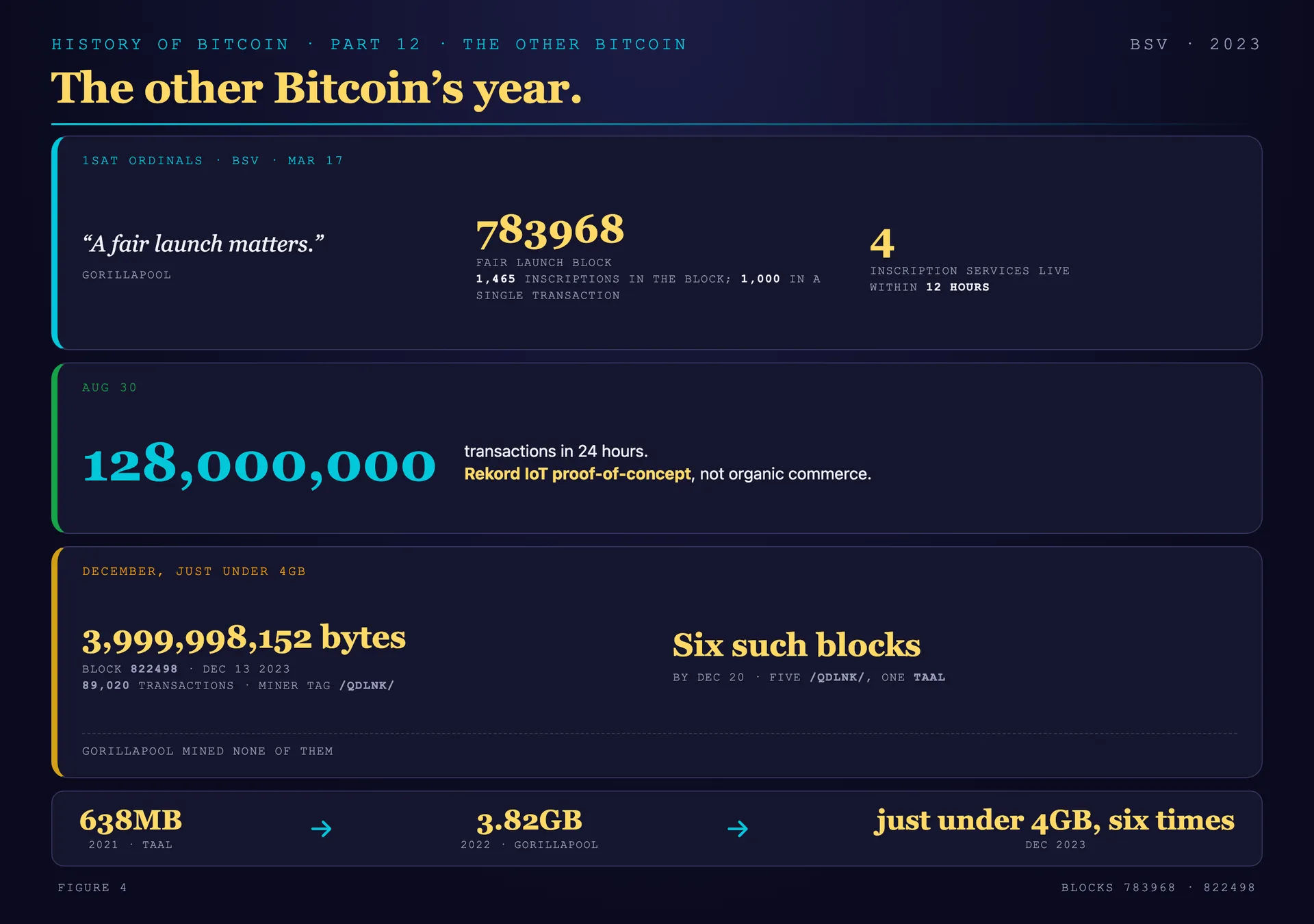
The gun went off at block 783968, on March 20, and the community treats the inscriptions in that block as the first. I watched that block come in the way some men watch a rocket launch. When you run a pool, a launch is not just a party; it is mempool pressure and indexer load and the hope that the thing your team built does not fall over in front of the whole internet. My friend and colleague David Case, who posts as "shruggr," counted the opening block in public on X that same day: "Block 783968 contained 1465 Ordinal Inscriptions, with 1000 of those in 1 transaction."⁴⁴
The first 24 hours ran hot. By CoinGeek's accounting the next morning, four inscription services were live inside twelve hours: RelayX's inscribe page, Aym.world, 1SatOrdinals.com, and AskHAPI. The tally CoinGeek put at "likely over 50,000" inscriptions arrived in less than a day, and four of the post-launch blocks organically cleared 500MB each.⁴⁵ RelayX, you will notice, is the same shop whose founder you just watched go build on BTC. The Nomads worked both sides of the line in the same season.
And the first inscription, serial number zero? An enhanced Pepe.
Some traditions cross every trench.
A month later, the engineering went on the record. A protocol like this lives or dies on its indexers, the software that crawls the chain and decides which satoshi owns which artifact, and indexing a chain that produces half-gigabyte blocks on launch day is its own engineering discipline. David Case, formerly the CTO of FYX Gaming, worked with a protocol spec that was kicked off by Luke Rohenaz (screen name "wildsatchmo") and was named the lead builder.
He wrote OrdinalLock, an on-chain listing script that let a 1Sat ordinal be offered for sale without a custodian, and he gave away the design philosophy in one sentence: "By limiting the current indexer to only indexing 1 Satoshi outputs, we can greatly reduce the amount of data we need to process."⁴⁶ Behind the indexers sat JungleBus, GorillaPool's data service, feeding inscription data to anyone who wanted to build. Case got the byline; GorillaPool's engineers carried the plumbing.
On March 21, 2023, I posted my own read of the launch to X, evidence of what we thought we were building at the time: "It's not just JPEGS. @1SatOrdinals integrates with @BitcoinSchema - natively! This makes ordinals a great tool for access keys, auth handshakes, publishing, Bitchat, or as part of any unbounded tape of transactions. Build the new internet of ownership!"⁴⁷ The point was never the pictures. An inscription that speaks a schema is a database row anyone can own, and a chain with no practical ceiling can hold a lot of database.
The ecosystem filled in around it through the year. In October, Dan Wagner shipped Panda Wallet, later renamed Yours Wallet, a non-custodial browser extension with 1Sat support built in.⁴⁹
Then there was the other half of BSV's 2023, the half measured in raw tonnage. On August 30, the network processed 128 million transactions in 24 hours.⁵⁰ The day was driven by Rekord, a BSV ecosystem client running an IoT proof-of-concept. Essentially, a machine wrote 128 million receipts to a public ledger in a day, and the rails held. Read it as an engineering result and it is more impressive than the marketing version, not less.
December was stranger. On December 13, at 22 UTC, block 822498 arrived carrying 89,020 transactions in 3,999,998,152 bytes, just under four gigabytes. By December 20 there were six blocks that size. Five were mined by an entity tagged /qdlnk/, whose operator is not publicly identified, and one by TAAL at height 822889, that one packing 533,427 transactions.⁵¹ GorillaPool mined none of them.
The block size irony is better than the blocks. TAAL had raised its configured cap to four gigabytes back in January 2022, twenty-three months before any demand showed up to fill it.⁵² On BSV the ceiling is a miner's configuration, a business decision made by someone with capital at stake, and for nearly two years that particular decision looked like optimism. Then one December, it didn't. The series ledger extends in one line: 638MB in 2021, 3.82GB in 2022, and just under four gigabytes, six times over, in December 2023.
Teranode, the rebuilt node software meant to make numbers like these boring, spent 2023 in development with no public milestone in the dated record; but that would change soon. Until then, the architecture is explained here if you want it.
Six blocks a shade under four gigabytes in one December, and none of them were mine. Source: WhatsOnChain
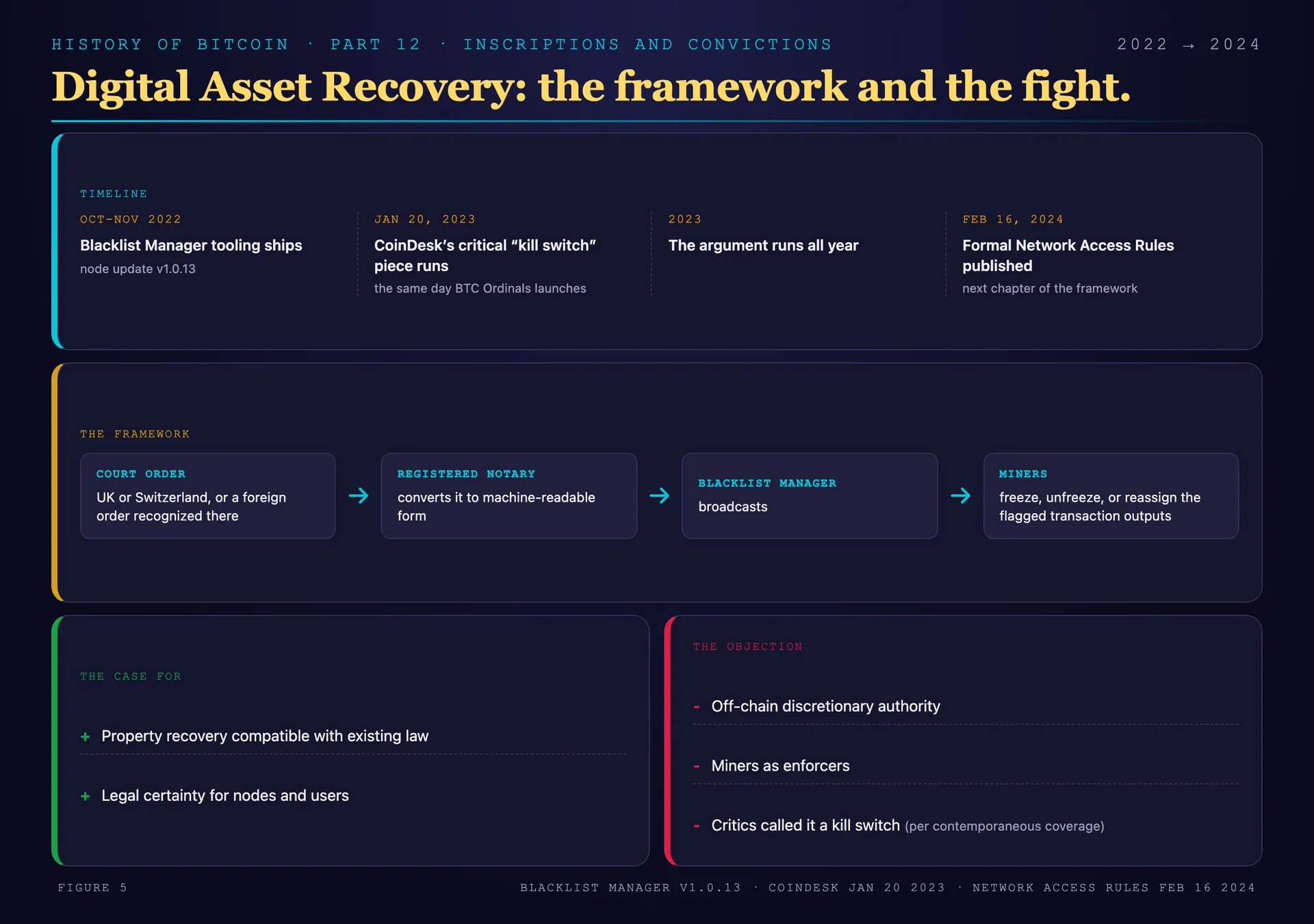
Now rewind to January 20, because BSV's year also opened with a fight, and the calendar arranged it with a novelist's timing. January 20, 2023, was the day Rodarmor's launch tweet opened BTC's door to data. It was also the day CoinDesk published its attack on BSV's recovery tooling, under the headline "Craig Wright's Blacklist Resembles Bitcoin 'Kill Switch' Satoshi Never Followed Through On."⁵³ One chain opened a door for data that day. The other took fire, the same day, for opening a door to courts. The split-screen tells you which risks each tribe actually fears.
The timeline needs straightening before anyone argues, because the tooling was not 2023 news. The Blacklist Manager and the node update that supports it, v1.0.13, had shipped in late 2022.⁵⁴ What 2023 held was the fight over what they meant.
The mechanics: a claimant obtains a court order in the United Kingdom or Switzerland, or a foreign order recognized in one of those places. A registered notary converts the order into machine-readable form and broadcasts it through the Blacklist Manager. Miners then freeze the flagged coins. The Association's own definition of the Network Access Rules is dry as toast: "The set of rules regulating the relationship between the BSV Association and the nodes on BSV. It details their duties and obligations to the network and their relationship with the Association." And its Alert System publishes "either notifications (e.g., software update announcements) or directives (e.g., freeze, unfreeze, or reassign commands for transaction outputs)."⁵⁵ Note those last three words: "for transaction outputs." Directives operate on specific coins named in a court order. Not on the protocol.
The case for it is the least romantic sentence in this series: property law exists. Bitcoin was designed to operate within the law, not above it, and a network that can honor a freeze order is a network that can custody other people's property without pretending courts are optional. Legal certainty for the nodes, a recovery path for theft victims. That is the whole pitch.
The criticism arrived wearing CoinDesk's headline. "Kill switch." If miners will freeze coins when an association relays a court order, the objection runs, then someone can eventually be made to freeze yours: one association, one alert key, discretionary power sitting off-chain where you cannot audit it. Exchanges and users objected loudly at the time, though the 2023 record hands me no named critic to quote. And the objection is not stupid; it is the serious one. Every recovery lever is also a seizure lever, and the difference between the two is whoever holds the paperwork.
Where do I stand? I don't love it, and I can see a few ways it leads to abuse. But we also live in a world where Satoshi Nakamoto created the alert key in 2010, the same year he coordinated an emergency rollback. We also saw a coordinated rollback of bitcoin in 2013, managed by Pieter Wuille and others because it was the right thing to do.
Only humans act, and only a human can direct an honest node.
So while I'm not enthusiastic about the idea, I am for it, especially since it was implemented so strictly, and plainly, I was for it when saying so cost social capital. Money for the whole world has to survive contact with property law, or it is only money for people who never get robbed. But the critics are describing a real power, and real powers get tested eventually. So: build it, document it, and watch it like a hawk. The formal rulebook, the published Network Access Rules, arrived on February 16, 2024, and this series will get there.⁵⁶
The quietest BSV story of 2023 happened in classrooms. sCrypt, Dr. Xiaohui Liu's framework for writing Bitcoin smart contracts in TypeScript, spent the year teaching: a hackathon at the University of Exeter ran June 5 through 8 with roughly 80 students, and Fudan University hosted another on August 13.⁵⁷ Not a Telegram raid, not an airdrop farm: universities! Undergraduates writing programs that settle on a public blockchain...
Then October made expressive computation a two-chain story. On October 9, a researcher named Robin Linus posted a sentence that BTC's smartest people could not stop rereading: "Any computable function can be verified on Bitcoin." CoinDesk picked it up on the 11th,⁵⁸ and the canonical whitepaper, "BitVM: Compute Anything on Bitcoin," is dated December 12. The abstract in full: "BitVM is a computing paradigm to express Turing-complete Bitcoin contracts. This requires no changes to the network's consensus rules. Rather than executing computations on Bitcoin, they are merely verified, similarly to optimistic rollups."⁵⁹
I recall Craig Wright being criticized out of more than one room for explaining Bitcoin's Turing completeness, but when Linus said it, it finally clicked. Pyrrhic victory for Dr. Wright, and not the last one of the year or the series.
The detail that made me laugh sits in Linus' own constraints, where it leans on the fact that "scripts can be up to about 4 MB in size. Thus, we can implement substantially more than a single NAND instruction per leaf script." Big scripts as a load-bearing feature! On the chain whose loudest partisans spent years insisting data had no business in a block.
These are parallel tracks, not a collaboration. sCrypt writes large expressive contracts on-chain because BSV's protocol never took those tools away. BitVM contorts brilliantly around BTC's limits, moving computation off-chain and settling disputes on-chain the way an optimistic rollup does. In 2023 the documented concept-flow between the chains ran in one direction, BTC to BSV, ordinals to 1Sat, in under two months; there is no documented return trip for the computation work. What the record does show is convergence: two research cultures, starting from opposite constraints, arriving at the same old claim.
Bitcoin can compute.
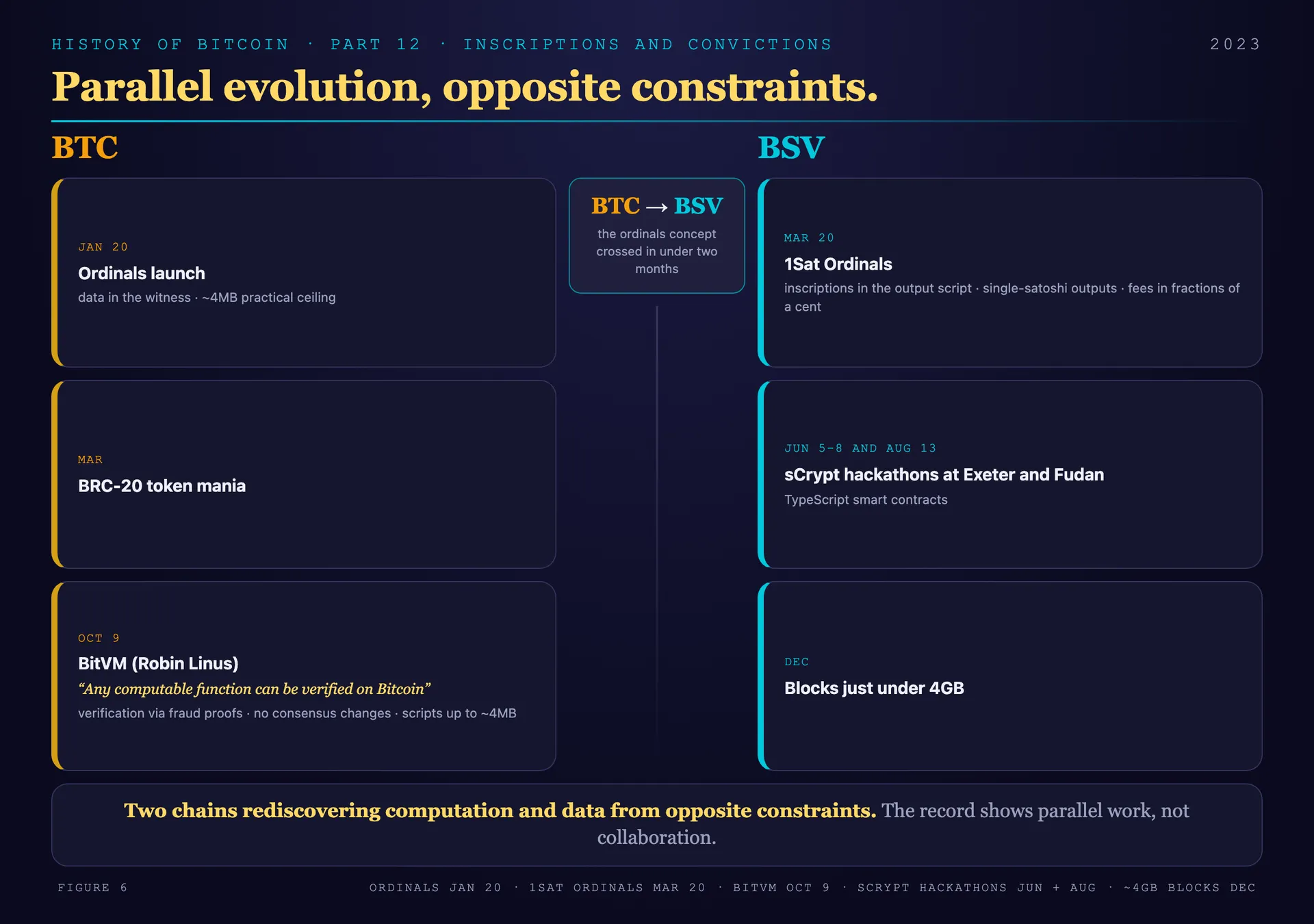
The trench lines held. The ideas didn't respect them.
The posture of 2023 is the part nobody on either side wanted to say out loud. I spent six years of this story in courtrooms, delisting announcements, hashwar dashboards, and conference halls, a lot of it in person, watching lawyers do what engineers should have been doing. In 2023, both chains spent their best energy on Bitcoin work: inscribing data, filling blocks, indexing outputs, proving computation. After all the war, the work on both sides looked suspiciously like Bitcoin.
For the record
Ok, so both tribes built all year. The rest of 2023 happened anyway, so here is the clerk's version: dates, dockets, dollar figures.
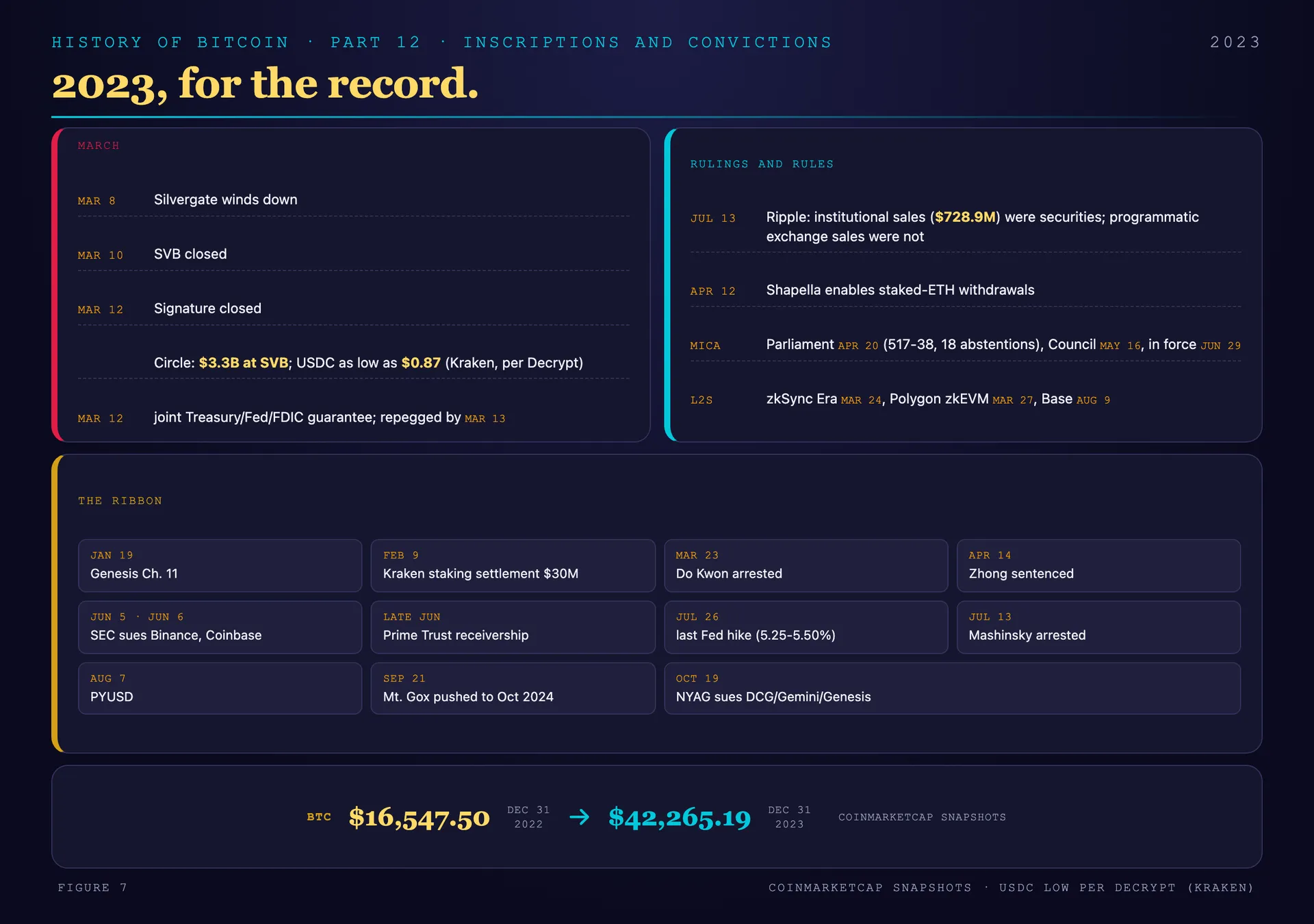
Silvergate Bank announced a voluntary wind-down on March 8. Two days later the FDIC's release opened with the sentence regulators hope never to write: "Silicon Valley Bank, Santa Clara, California, was closed today by the California Department of Financial Protection and Innovation," with the FDIC appointed receiver.⁶⁰ On March 12, New York's Department of Financial Services closed Signature Bank. Three banks in five days.⁶¹
Crypto was standing in the blast radius. Circle disclosed on the night of March 10 that $3.3 billion of USDC's reserves, about eight percent, sat inside Silicon Valley Bank, and the stablecoin broke its peg: on March 11, USDC traded as low as $0.87 on Kraken per Decrypt's reporting, with CoinMarketCap's index recording a low of $0.8774.⁶² At 6 on March 12, the Treasury, the Federal Reserve, and the FDIC issued a joint statement with the load-bearing line: "All depositors of this institution will be made whole."⁶³ USDC repegged by March 13, and Circle said its piece the same day: "The $3.3B USDC reserve deposit held at Silicon Valley Bank, about 8% of the USDC total reserve, will be fully available when U.S. banks open tomorrow morning."⁶⁴
The mechanics are the whole sermon: the dollar-pegged token was rescued by an emergency guarantee from the government that issues the dollar. If you wanted the decade's best argument for money that does not live inside a bank, March 2023 wrote it in five days, free of charge! And the industry that had spent fourteen years auditioning for that exact moment was off minting collectibles.
Three banks died in a week, and the industry mostly argued about jpegs.
On July 13, Judge Analisa Torres of the Southern District of New York handed down summary judgment in the Ripple case, with the holding everyone traded on: "XRP, as a digital token, is not in and of itself a 'contract, transaction[,] or scheme' that embodies the Howey requirements of an investment contract." The split was surgical: $728.9 million of institutional sales were unregistered securities offerings; programmatic sales on exchanges were not.⁶⁵ The same day, Alex Mashinsky was arrested, closing the criminal deferral Part 11 left open when Celsius froze.⁶⁶
Ethereum's Shapella upgrade landed April 12 and enabled staked-ETH withdrawals for the first time since December 2020.⁶⁷ Staking, if the term is new to you, is locking coins with the network to earn the right to validate blocks and collect rewards; until that day, the lock had been a one-way door. A protocol that can change what your coins are allowed to do is a soft protocol. This promise, at least, it kept.
Europe finished its rulebook first. The European Parliament passed MiCA 517 to 38, with 18 abstentions, on April 20; the Council approved it May 16; it entered into force June 29.⁶⁸ The first comprehensive crypto regulation from a major jurisdiction arrived while American agencies were still suing their way toward a policy.
Ethereum's scaling map fractured on schedule: zkSync Era opened its mainnet March 24, Polygon zkEVM followed March 27, and Coinbase's Base opened to the public August 9.⁶⁹ Three new places for liquidity to live, one ecosystem now billed in fragments.
Five days in March, exactly as the regulators wrote them. Source: FDIC
The rest of the year, in order. Genesis Global Capital, whose frozen withdrawals closed Part 11, filed Chapter 11 on January 19.⁷⁰ Kraken paid $30 million on February 9 to settle SEC charges over its staking service.⁷¹ Do Kwon was arrested March 23 in Montenegro carrying falsified travel documents, closing another deferral from Part 11.⁷² James Zhong, who had exploited Silk Road's withdrawal system a decade earlier, drew a year and a day on April 14.⁷³ The SEC sued Binance on June 5 and Coinbase on June 6, consecutive business days.⁷⁴ Nevada hit the custodian Prime Trust with a cease-and-desist on June 21 and petitioned for receivership on June 26, the regulator's own filing using the word "insolvent."⁷⁵ The Federal Reserve raised its target range to 5.25 to 5.50 percent on July 26; nobody knew it that afternoon, but the hiking cycle was over.⁷⁶ PayPal launched PYUSD, its own dollar stablecoin, on August 7.⁷⁷ Mt. Gox pushed its repayment deadline to October 31, 2024, on September 21, and the oldest ghost in this series shuffled forward another year...⁷⁸ And on October 19, New York's Attorney General sued DCG, Gemini, and Genesis on a $1.1 billion claim, keeping the Genesis tail alive into 2024.⁷⁹
For the record's own sake, the price: BTC entered the year at $16,547.50 (CoinMarketCap's December 31, 2022 snapshot) and left it at $42,265.19 (CoinMarketCap's December 31, 2023 snapshot).⁸⁰ The chart called 2023 a comeback. The docket calls it something more complicated.
The quiet war
One storyline ran under the whole year like a fuse, and in 2023 it was barely a story at all.
It bookends on one man. On January 1, before the year had done anything else, Luke Dashjr posted that his PGP key had been compromised and, in his words, "at least many of my bitcoins stolen." Contemporary reports put the loss north of 216 BTC.⁸¹ The year opened with the purist robbed.
He didn't say how, and people have speculated that he was being dishonest for reasons unknown.
By February 1 he had published Ordisrespector, a filter patch to reject inscriptions at the node level.⁸² The inscription counts earlier in this article tell you exactly how much it slowed the boom down.
On September 5, the fight reached Bitcoin Core's own repository. Dashjr opened pull request #28408, "datacarriersize: Match more datacarrying," to extend the node's data-carrier policy to cover witness data, which is where BTC Ordinals live. Peter Todd objected on the ground that actually moves miners: the targeted transactions were "a very significant source of fee revenue for miners." Stalemate; the request died unmerged in January 2024.⁸³ Underneath the code review sat the oldest argument on BTC: which data counts as Bitcoin, which counts as "spam," and who gets to say. I have written the history of that word before.
On November 28, the filter got infrastructure. A new mining pool called OCEAN launched at the Future of Bitcoin Mining Conference in rural South Carolina, beside Barefoot Mining's 150-year-old hydroelectric dam, with a $6.2 million seed round led by Jack Dorsey: "I think it's a phenomenal team. I know Luke; I've interacted with him for some time."⁸⁴ The pool ran Dashjr's Bitcoin Knots instead of Bitcoin Core and filtered inscriptions from day one. Within the week, critics were calling it censorship.
And on December 6, Dashjr said the quiet part at maximum volume.⁸⁵
PSA: "Inscriptions" are exploiting a vulnerability in #Bitcoin Core to spam the blockchain. Bitcoin Core has, since 2013, allowed users to set a limit on the size of extra data in transactions they relay or mine (
-datacarriersize). By obfuscating their data as program code, Inscriptions bypass this limit.This bug was recently fixed in Bitcoin Knots v25.1. It took longer than usual due to my workflow being severely disrupted at the end of last year (v24 was skipped entirely).
Bitcoin Core is still vulnerable in the upcoming v26 release. I can only hope it will finally get fixed before v27 next year.
Knots shipped the filter Core would not: one man maintaining his own node software to fix what the reference client refuses to call broken, while a Dorsey-funded pool in the South Carolina countryside mined his conviction from day one. That is the entire war in miniature.
The 2023 version of this fight had no number and no name. No BIP, no manifesto, no faction branding; it ran through a relay policy option and a patch, argued in a pull request and settled nowhere. Wars that start that way do not stay that small, and this one gets a full installment later in this series. The lever both sides were reaching for is Bitcoin Core's governance itself, and I have already written about who holds it.
June belonged to a filing in Washington, and the name on its cover was BlackRock.
The race for the coins
That June filing deserves to be met the way it actually arrived: quietly, in a database. On June 15, 2023, an entry appeared in the SEC's EDGAR system under accession number 0001437749-23-017574, filed by something called the iShares Bitcoin Trust.⁸⁶
iShares is BlackRock. BlackRock is the largest asset manager on earth.
There was no keynote and no countdown clock. EDGAR does not do drama; it logs filings the way a county clerk logs deeds, timestamped and indifferent, and this one sat in the queue looking like every other registration statement filed that Thursday. The most consequential Bitcoin document of the year arrived as a database row.
The document was a Form S-1, a registration statement: the paperwork a company files when it wants to sell securities to the American public. This one proposed a spot bitcoin exchange-traded fund in everything but name, a trust holding actual coins, with shares trading on Nasdaq. Not futures. Not a wrapper around a wrapper. The coins.
And the filing named the vault, right up front in the summary of the trust's structure: "Coinbase Custody Trust Company, LLC (the 'Bitcoin Custodian') is the custodian for the Trust's bitcoin holdings; and Bank of New York Mellon is the custodian for the Trust's cash holdings..."⁸⁷ Elsewhere in the same document, Coinbase, Inc. appears again as the trust's "Prime Broker." Custody of the coins, in other words, went to Coinbase. And as filed, the model was in-kind: the phrase "in-kind creations and redemptions of Baskets" runs through the document, meaning the big trading firms servicing the fund would deliver and receive actual bitcoin in exchange for shares, the way physical gold products work.⁸⁸ That detail has a December payoff coming.
Two weeks later, the second instrument moved. On June 29, Nasdaq filed the proposed rule change, the 19b-4, asking the Commission's permission to actually list and trade the thing, and the SEC's own notice kept the record straight: "notice is hereby given that on June 29, 2023, The Nasdaq Stock Market LLC... filed with the Securities and Exchange Commission the proposed rule change."⁸⁹ Retrospectives love to compress those two filings into one thunderclap. The record says two instruments, two filers, fourteen days apart: the S-1 is the issuer talking to the public, and the 19b-4 is the exchange talking to the regulator, which means the June 15 date belongs to BlackRock and the June 29 date belongs to Nasdaq. When a story gets retold enough times, the first casualty is usually the paperwork.
Then the field moved. At the registration-statement level, where EDGAR stamps every date, WisdomTree amended on June 20 and Valkyrie on June 21, and the rest of the wave stretched into fall: VanEck on August 4, Ark/21Shares on September 7, Invesco Galaxy on October 13, Fidelity on October 17, Bitwise on October 25.⁹⁰ (The famous week when the whole industry seemed to refile at once was real, but it lived at the exchange-filing and press-release layer, which is louder and less precise.)
Seven more issuers followed the biggest one into the water inside four months. Whatever BlackRock's lawyers knew or guessed, the rest of the field treated June 15 as the starting gun.
Nobody files that much paperwork on a hunch.
Larry Fink runs BlackRock, and Larry Fink has an on-the-record history with this asset. October 13, 2017, at an Institute of International Finance meeting: "Bitcoin just shows you how much demand for money laundering there is in the world. That's all it is."⁹¹ July 5, 2023, on Fox Business, twenty days after his own trust's filing: "It's digitalizing gold in many ways... Bitcoin is an international asset."⁹² Shown BlackRock's 575-1 win record on ETF applications during the same appearance, he answered, "Our record speaks for itself."⁹³
Five years, eight months, and twenty-two days from money-laundering index to international asset, and the man reciting his own win record in between.
Conviction takes time, I suppose.
The gate still had a keeper, though. The SEC had been denying spot bitcoin products while approving funds built on bitcoin futures, and Grayscale, which wanted to convert its giant bitcoin trust into a spot ETF, had taken the Commission to court over exactly that distinction. On August 29, the D.C. Circuit ruled. The panel was Chief Judge Srinivasan, Judge Rao, and Senior Judge Edwards; the opinion was Rao's, unanimous, and its first sentence gave away the ending: "It is a fundamental principle of administrative law that agencies must treat like cases alike."⁹⁴
Grayscale had put a number in front of the panel that would not move: a 99.9 percent correlation between bitcoin's spot market and the CME futures prices underneath the products the SEC had already approved. Like products, unlike treatment, and the court said so in exactly those terms: "In the absence of a coherent explanation, this unlike regulatory treatment of like products is unlawful." Then the disposition: "The denial of Grayscale's proposal was arbitrary and capricious because the Commission failed to explain its different treatment of similar products. We therefore grant Grayscale's petition and vacate the order."⁹⁵
Note the verbs, because most of the press did not. Vacate is not approve. The court threw out the SEC's denial order; it commanded nothing onto any exchange. The Commission was left holding a listing application with no valid refusal underneath it and two honest options: write a new denial that could survive the same panel, or stop denying. It declined to seek further review,⁹⁶ and every issuer in the race could do the arithmetic from there.
For long stretches of this series, "Wall Street and Bitcoin" has meant paper: the futures contracts that arrived in Part 7, the trusts and proxy products that piled up in Part 10, price exposure engineered precisely so that nobody respectable ever had to touch a coin. How Wall Street captures revolutions is its own article. And now, in the summer of 2023, the authors of the paper era were filing to hold the asset itself. The seed this series planted years ago paid off inverted: Wall Street finally wanted the actual coins.
It is a strange sentence to type after eleven installments. The institutions did not come for the ledger, or the data, or the peer-to-peer cash system described in the white paper their own filings would later shrug at. They came for the scarce object, wrapped in the most familiar wrapper American finance sells. Whether that is victory or capture depends entirely on which Bitcoin you believed in, and this series has never pretended to be neutral on that question.
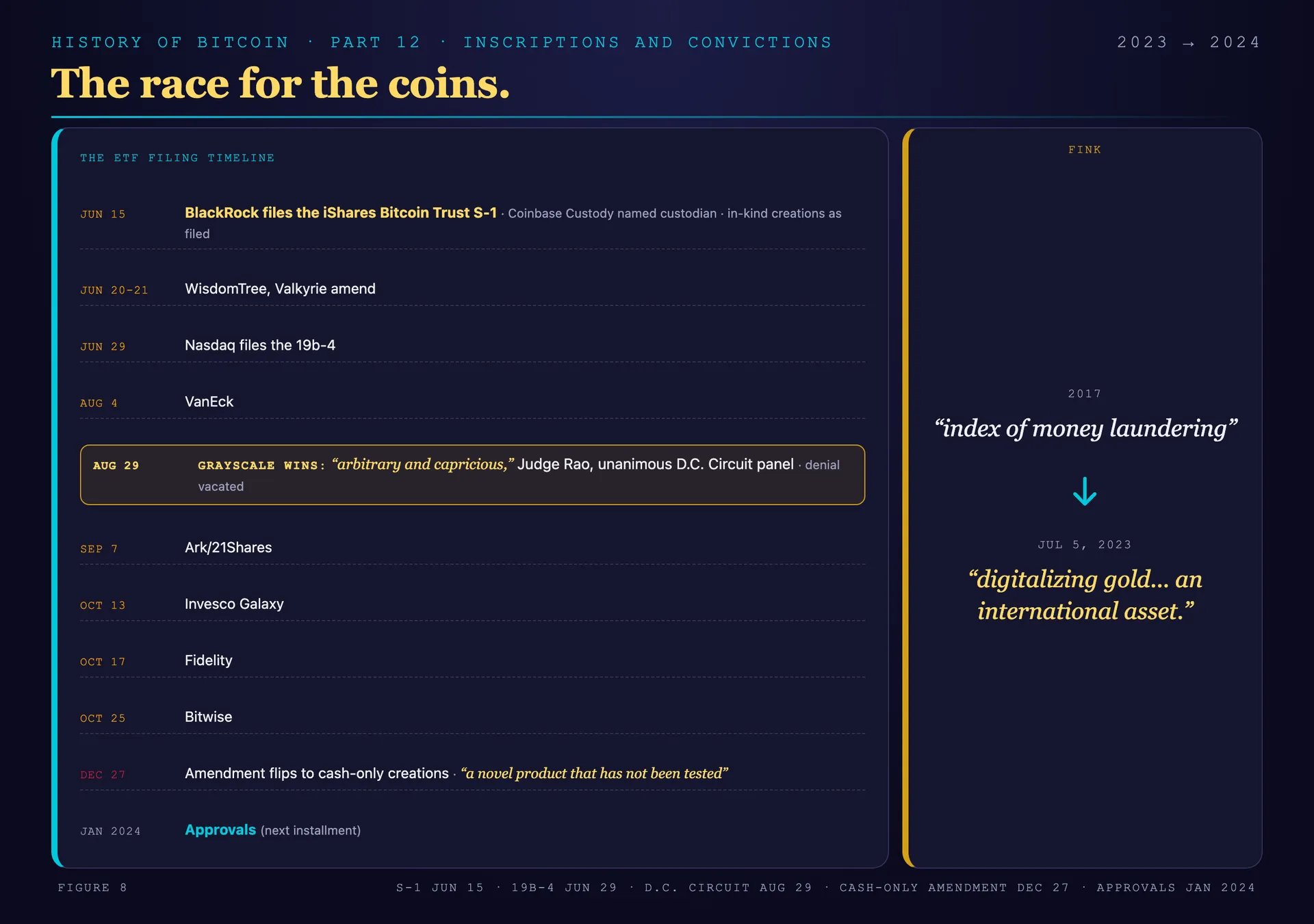
The race ran on EDGAR's clock, not the press cycle's. Source: SEC EDGAR
Now go back inside the June 15 document, because the paragraph this series cares about most has nothing to do with custody or creations. It sits deep in the risk factors, under a heading about regulatory changes and actions in foreign jurisdictions. Nearly everyone who has written about it since has paraphrased it, and the paraphrases are how it got bent. So here it is whole, with nothing added:
"Furthermore, legal claims have been filed in the United Kingdom by an entity associated with an individual named Craig Wright. The entity alleges that the private keys to bitcoin purportedly worth several billion dollars were rendered inaccessible to it in a hack, and advances a series of novel legal theories in support of its request that the court compel certain core developers associated with the Bitcoin network to either somehow transfer the bitcoin out of the bitcoin address to which the entity no longer can access the private keys to a new bitcoin address that it currently does control, or alternatively amend the source code to the Bitcoin network itself to restore its access to the stranded bitcoin. In 2022, the High Court dismissed the claims, finding that the entity had not established a serious issue to be tried. However, in February 2023, the Court of Appeals unanimously overruled the High Court's decision, holding that there was a serious issue to be tried. If a court decides to grant the relief requested, it is possible that wide-ranging and fundamental changes to the source code, operations, and governance of, and basic principles underlying, the Bitcoin network might be required, and a loss of public confidence in the Bitcoin network could result. Alternatively, bitcoin could face obstacles to use or in the United Kingdom, which could reduce adoption. Courts in other jurisdictions could take similar positions. These or other possible outcomes could lead to a decrease in the value of bitcoin, which could negatively impact the value of the Shares."⁹⁷
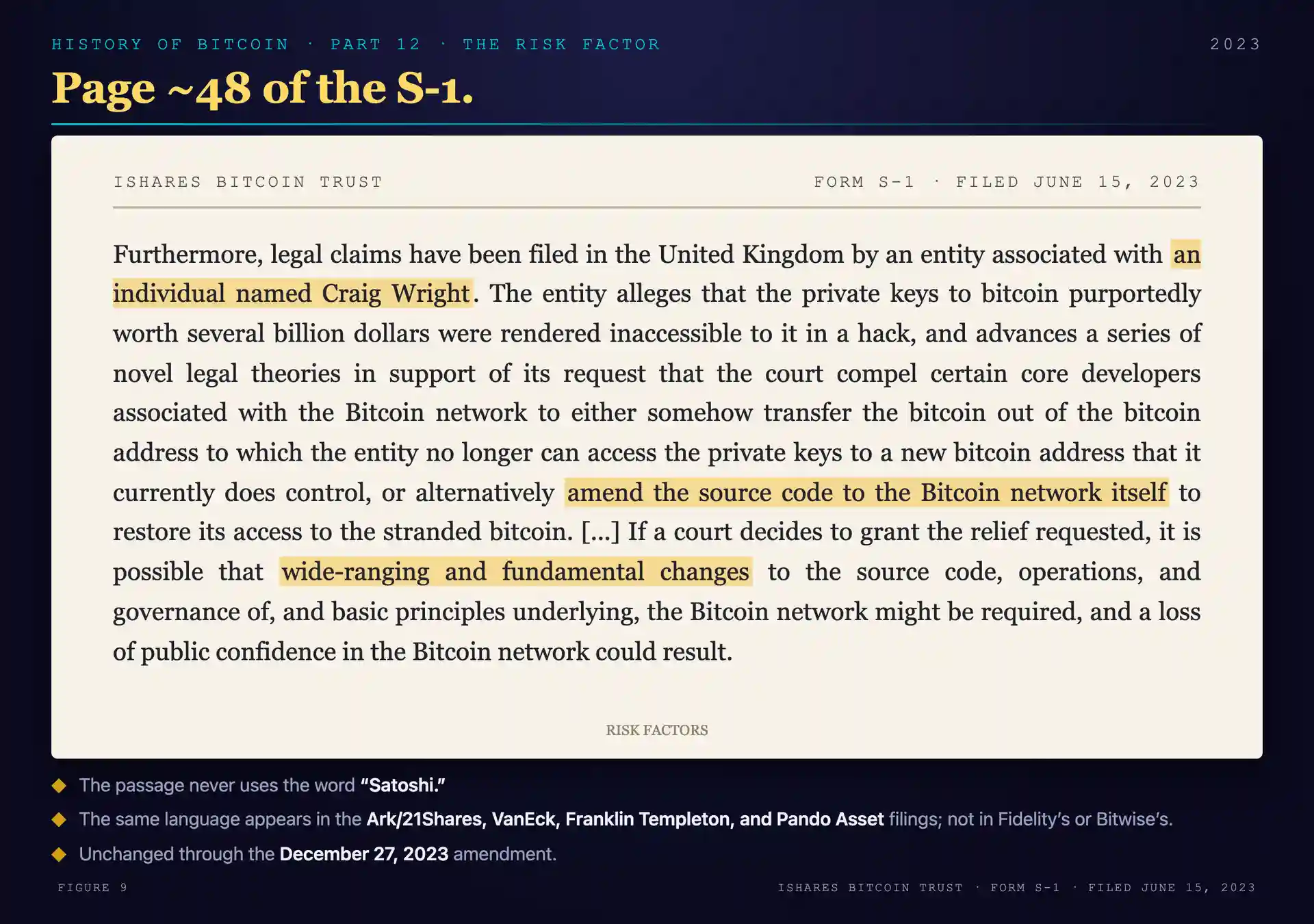
The paragraph as filed on June 15, 2023, and unchanged through December. Source: SEC EDGAR
Note what is actually on the page. The paragraph sits inside a foreign-jurisdictions risk factor, filed alongside worries about other countries' regulators. The filing never names the case. It names "an individual named Craig Wright" and an entity associated with him, and then it stops naming things.
Notice the temperature of the drafting while you are in there. The theories are "novel." The developers would be compelled to "somehow transfer" the coins. Securities lawyers do not spend adverbs by accident; that "somehow" is the closest thing to an opinion the whole passage allows itself. And then the same passage turns around and spends four sentences gaming out what happens if the court says yes: changes to the source code, changes to governance, changes to the "basic principles underlying" the network itself. Skeptical in the adjectives, dead serious in the contingency planning.
How many times does the word Satoshi appear in that passage?
Zero.
Satoshi Nakamoto does appear in the filing, in an unrelated paragraph about the white paper, carrying the same boilerplate nearly every bitcoin trust carries: "The white paper was purportedly authored by Satoshi Nakamoto. However, no individual with that name has been reliably identified as bitcoin's creator, and the general consensus is that the name is a pseudonym for the actual inventor or inventors."⁹⁸ BlackRock's lawyers put a several-billion-dollar claim against Bitcoin's developers and the authorship question in the same document, and never introduced the two paragraphs to each other.
The language traveled, too. The same Wright paragraph appears in the 2023 filings of Ark/21Shares, VanEck, Franklin Templeton, and Pando Asset. It appears in neither Fidelity's nor Bitwise's.⁹⁹ And when BlackRock amended its S-1 in late December, the paragraph survived word for word, unchanged.¹⁰⁰ Risk factors get rewritten constantly in an amendment cycle; this one was apparently finished the day it was born.
If you have been with this series since Part 6, and through the letters of Part 9 and Part 10, you need no help from me here, so you will get none. The case inside that paragraph has a name, and February 2023 had already handed it new life. We will get there...
One more thing moved between June and December, and the filings documented it themselves. The June S-1 was built on in-kind creations: real bitcoin in, real bitcoin out. By the late-December amendment, in-kind was gone, replaced by cash-only creations and redemptions, and the amendment graded its own homework: "a spot commodity exchange-traded product that only employs cash creations and redemptions and does not permit in-kind creations and redemptions is a novel product that has not been tested."¹⁰¹ In the June version, the firms that create and destroy ETF shares would have handled bitcoin themselves. In the December version, they handle dollars, and the only place actual coin moves is inside the issuer's own custodial pipeline. A spot bitcoin product where the spot is quarantined: Wall Street's fund would hold the coins while keeping nearly everyone in the workflow from ever touching one.
And the custodian, across roughly ten of the fourteen spot filers of that window, was the same company: Coinbase. Fidelity, which custodies through its own affiliate, was the loudest exception.¹⁰² Where that concentration ends up, this series has already followed the money.
How's that for peer-to-peer electronic cash?
The approvals came in January 2024, all at once, but that is a later installment's business. Before any of it could matter, the year had to get through November.
November
Sam Bankman-Fried finished the runway to his trial in a Brooklyn jail cell. Part 11 ended with his December 2022 indictment; 2023 was the year the machinery of that indictment closed around him, and he helped it close. On July 26, prosecutors told Judge Lewis A. Kaplan that he had shared Caroline Ellison's private writings with a reporter, and they called it witness tampering.¹⁰³ On August 11, Kaplan revoked his bail and sent him to the Metropolitan Detention Center in Brooklyn to wait.¹⁰⁴
The trial opened October 3 in the Southern District of New York, Kaplan presiding; twelve jurors and six alternates were sworn the next day, and openings began the same day.¹⁰⁵ Then the government ran the machine's own operators at the jury, one after another. This series spent an entire installment on how the machine worked; the trial was the machine explaining itself, under oath, in its own words.
Gary Wang, the co-founder who wrote the code, testified October 4 through 6. The special privileges that code granted Alameda Research already have their own installment in this series. Asked how disagreements between the founders got settled, Wang said: "Sometimes we talked [disagreements] out, but in the end, it's Sam's decision."¹⁰⁶
Caroline Ellison, who ran Alameda, testified October 10 through 12 and needed no adjectives: "He directed me to commit these crimes."¹⁰⁷ She told the jury Bankman-Fried directed taking "around $14 billion" from FTX customers to repay Alameda's lenders.¹⁰⁸ She also allowed that a tweet from Binance's chief executive back in November 2022 had "contributed" to the run that finished the exchange.¹⁰⁹
That name has its own November coming.
Nishad Singh, the director of engineering, testified October 16 and gave the trial its most cinematic scene: a rooftop meeting, back when the inner circle first stared into the hole. "Caroline is really freaked out about the NAV situation, and so am I," Singh recalled telling Bankman-Fried. The reply, per Singh: "I'm not sure what there is to worry about," because the net asset value was "super positive," and then, on the shortfall itself: "Right, that, we are a little short on deliverables."¹¹⁰
A little short on deliverables.
Singh described a later meeting too. "He glared at me with some intensity," he testified, and Singh asked him: "Dear god, what else is there?" He had, he told the jury, "felt betrayed" that it all "turned out to be so evil."¹¹¹
On October 26 came the strangest session of the trial, convened with the jury out of the room: a dry run, so Kaplan could sort out how much of the planned testimony a jury would be allowed to hear. By the end of it, the judge offered his review from the bench: "The witness has what I'll simply call an interesting way of answering questions."¹¹²
The jury got him October 27 through 30. On direct, the theme arrived early: "I made a number of small mistakes and a number of large mistakes." The biggest, in his telling: "By far, the biggest mistake was that we didn't have a team dedicated to risk management." He agreed that "a lot of people got hurt." He maintained that he "never set out to steal from people."¹¹³
Then Assistant U.S. Attorney Danielle Sassoon stood up for the cross, asked plain questions, and collected answers like "Depends how you define trading" and "I don't have a recollection of seeing it, no," while the gallery broke into laughter at points.¹¹⁴ By The Block's count, he produced roughly 150 variations of "I don't recall" across the cross-examination.¹¹⁵
The jury had spent weeks listening to his deputies remember everything.
The closings, November 1 and 2, were short sentences all the way down. After a month of balance sheets and blockchain plumbing, both sides reached for the oldest tools in the room. Sassoon, on the no-risk-team defense: "That's not a defense. That was a strategy." Prosecutor Nicolas Roos: "He took the money. He knew it was wrong. He did it anyway, because he thought ... he could walk his way out of it." Defense counsel Mark Cohen told the jury, "Time and again, the government has sought to turn Sam into some sort of villain, some sort of monster," and reached for Hemingway on the way out: "Gradually, then suddenly."¹¹⁶
The jury got the case on November 2 and came back the same evening, after roughly four and a half hours of deliberation.¹¹⁷ Guilty on all seven counts: in the Justice Department's own category language, he was "convicted of two counts of wire fraud conspiracy, two counts of wire fraud, and one count of conspiracy to commit money laundering... He was also convicted of conspiracy to commit commodities fraud and conspiracy to commit securities fraud."¹¹⁸ An eighth count, over campaign finance, had been severed before trial and was never tried; when a retelling counts eight, that is the indictment talking, not the verdict.
He stood for the reading in a gray suit and purple tie. His father dropped his head into his hands. His mother gazed up at the ceiling. The Ringer's writeup from the room ended him in three words Cohen himself had teed up: he "was gradually, suddenly gone."¹¹⁹
U.S. Attorney Damian Williams: "Sam Bankman-Fried perpetrated one of the biggest financial frauds in American history – a multibillion-dollar scheme designed to make him the King of Crypto..." And: "This case has always been about lying, cheating, and stealing, and we have no patience for it." And: "This is what relentless looks like."¹²⁰ Attorney General Merrick Garland's statement opened with two sentences: "Sam Bankman-Fried thought that he was above the law. Today's verdict proves he was wrong."¹²¹ Kaplan set sentencing for March 28, 2024.
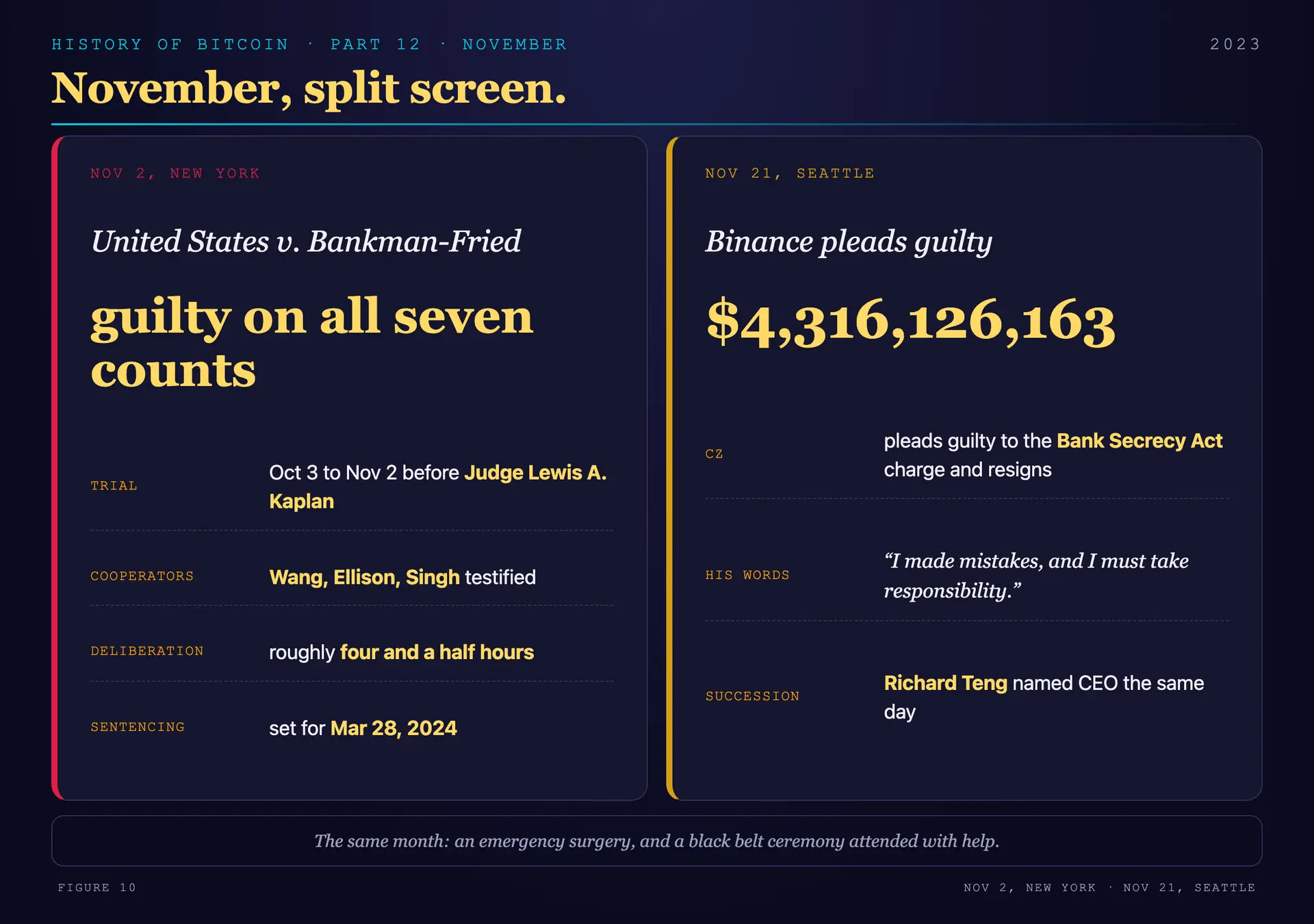
Nineteen days later, in a federal courtroom in Seattle, the other giant walked in on his own feet. Nobody had arrested Changpeng Zhao. The founder and chief executive of Binance, the largest cryptocurrency exchange in the world, came to the United States to take his deal in person: on November 21 he appeared before Magistrate Judge Brian A. Tsuchida and pleaded guilty to one felony count of failing to maintain an effective anti-money-laundering program. One conviction that November came from a jury after a month of testimony. The other one walked up to the bench and asked for it. Per the wire report out of the courtroom, the magistrate put it to him directly: "You knew you didn't have controls in place." Zhao answered, "Yes, your honor." And then: "I want to take responsibility and close this chapter in my life. I want to come back. Otherwise I wouldn't be here today."¹²²
The machine behind that plea was dissected in the frauds installment, so here is only the day's arithmetic: $4,316,126,163, a $2,510,650,588 forfeiture plus a $1,805,475,575 fine,¹²³ from an exchange that had filed zero suspicious activity reports.¹²⁴ Not few. Zero! Garland: "using new technology to break the law does not make you a disruptor, it makes you a criminal." Treasury Secretary Janet Yellen: Binance's "willful failures allowed money to flow to terrorists, cybercriminals, and child abusers through its platform." Deputy Attorney General Lisa Monaco, minting the era's rule: "A corporate strategy that puts profits over compliance isn't a path to riches; it's a path to federal prosecution."¹²⁵
The same day, Zhao posted his resignation.¹²⁶
"Today, I stepped down as CEO of Binance. Admittedly, it was not easy to let go emotionally. But I know it is the right thing to do. I made mistakes, and I must take responsibility." Further down: "Binance is no longer a baby. It is time for me to let it walk and run." He noted, and it is true as far as it goes, that the resolutions "do not allege that Binance misappropriated any user funds." That distinction is real, and it is the whole difference between his November and Bankman-Fried's: one man pleaded to running the machine without controls, the other was convicted of reaching into it. And then CZ signed off the only way he ever would: "Funds are SAFU!"
Binance handed the chair that same day to Richard Teng, a career regulator out of Abu Dhabi Global Market's financial watchdog, the Singapore Exchange, and the Monetary Authority of Singapore.¹²⁷ The exchange that spent six years running from regulators ended the year run by one.
One more artifact, because the year deserves its bookend, and CZ wrote it himself before the year even started. On January 2, 2023, he had posted his resolutions: education, compliance, product and service, and a fourth item, "Ignore FUD, fake news, attacks, etc." He asked the world to link back to that post whenever he tweeted the number 4 on its own, a single digit designed in advance to answer every accusation before it arrived.¹²⁸
The second item on that list, for the record, was "Compliance."
The year he asked the whole internet to ignore FUD ended with his own guilty plea.
And this series can add one receipt of its own, because it carried both halves here. On April 12, 2019, CZ tweeted, "Craig Wright is not Satoshi. Anymore of this sh!t, we delist!" and threw BSV off his exchange; Part 8 told that story, and the frauds installment showed what Binance's own insides looked like while its founder was handing down verdicts on other people's integrity. The man who appointed himself the arbiter of other people's legitimacy in 2019 spent November 2023 confirming, under oath, what his own operation had been. Two receipts, side by side.
Everybody fell down in November.
That same November, a hernia about two inches above my belly button tore open at the gym before sunrise as I did my second set of cable flyes, and my intestines incarcerated inside it. I couldn't speak at all or breathe very well until it was fixed. The surgery was an emergency. Days later came my Brazilian Jiu-Jitsu black belt ceremony, and I was there for it, with help, because I could not stand or walk on my own due to near total inability to engage my core muscles.
It is a strange thing, receiving the belt you cannot stand up to accept... But this article isn't about me.
Every verdict in this chapter landed in an American courtroom. The case that would define the next year was waiting in London, already on the calendar.
The man in the filings
Sam Bankman-Fried's year ended in front of a jury. Changpeng Zhao's ended in front of a magistrate. Craig Wright's 2023 had no jury, no plea, and no perp walk, because his year happened almost entirely on paper: judgments, orders, schedules, stays. That sounds boring until you actually read the paper, because 2023 is the year the paper started agreeing with itself. Four different proceedings in two countries spent twelve months being folded, one ruling at a time, into a single question with a single court date attached to it.
If you want to understand the case that was waiting in London when November closed, you have to read that paper backward, all the way to February.
It starts with a win.
On February 3, 2023, the Court of Appeal handed down Tulip Trading Ltd v Bitcoin Association for BSV & Ors. Lord Justice Birss wrote the judgment, and Lord Justices Lewison and Popplewell agreed with it, which made the decision unanimous and reversed the High Court's 2022 dismissal of the whole case.¹²⁹ If the case name sounds familiar, it should. This is the payoff of a seed planted back in Part 9 and Part 10: the letters that went out to the developers on behalf of a company associated with Wright, claiming billions of dollars of bitcoin locked behind private keys lost in a hack, and demanding the developers restore access. Sixteen named defendants. Fifteen of them were individual developers, and the sixteenth was an association, the Bitcoin Association for BSV, which is why the case carries the name it does.
Birss framed the entire dispute in his first paragraph: "The question in this appeal is whether the developers who look after bitcoin may arguably owe fiduciary duties or duties in tort to an owner of that cryptocurrency."¹³⁰
The heart of the judgment is paragraph 86, which may be the most consequential passage any judge wrote about Bitcoin in 2023, and almost nobody read it honestly:
"Pulling all this together, I recognise that for Tulip's case to succeed would involve a significant development of the common law on fiduciary duties... there is, it seems to me, a realistic argument along the following lines. The developers of a given network are a sufficiently well defined group to be capable of being subject to fiduciary duties... The developers therefore are fiduciaries."¹³¹
Note the hedges before the last sentence. "Realistic argument" is a term of art. Birss was not ruling that developers are fiduciaries. He was ruling that a competent lawyer could argue it without getting laughed out of the building, which is the low bar a claim must clear to earn a trial.
He said so himself, five paragraphs later: "The conclusion is not that there is a fiduciary duty in law in the circumstances alleged by Tulip, only that the case advanced raises a serious issue to be tried." And then he wrote the sentence that makes the whole judgment worth the filing fee: "If the decentralised governance of bitcoin really is a myth, then in my judgment there is much to be said for the submission that bitcoin developers, while acting as developers, owe fiduciary duties to the true owners of that property."¹³²
So let's be precise about February 3, because almost nobody else was. The court did not decide that developers owe fiduciary duties. It did not decide that Tulip owned the coins or that the hack happened. It did not decide that decentralized governance is a myth. It decided that those questions deserved a trial on the actual facts, in front of a judge, with evidence and cross-examination, instead of dying at the doorstep. That alone put fifteen developers back on the hook after they thought they had walked away, and it put one very uncomfortable "if" into the bloodstream of English law.
Now hold February up against the section you already read. By June, this same revived case sat inside BlackRock's registration statement as a risk factor: an entity, an individual named Craig Wright, "novel legal theories," a serious issue to be tried. The filing never names the case. Commentators identified it as Tulip Trading. The largest asset manager on Earth described this lawsuit to the SEC four months after three judges in London brought it back to life.¹³³
Which brings us to the main event.
Crypto Open Patent Alliance v Craig Steven Wright had been grinding toward trial since 2021, one interim skirmish at a time, the way big English litigation does. In 2023 it stopped grinding and started converging. On June 15, the same date BlackRock's S-1 landed at the SEC in Washington, Mr Justice Mellor held a case management conference in London and performed the single most consequential piece of judicial housekeeping in this entire saga. He ruled that the common question, "whether Dr. Wright is/was Satoshi Nakamoto... characterised as the 'identity issue', should be decided once and once only."¹³⁴
Once and once only. Wright was, at that point, a man with parallel claims running against exchanges, developers, and individual critics across more than one jurisdiction, and nearly every one of those disputes leaned on the same load-bearing premise. Mellor's order took that premise away from all of them and handed it to one trial. The architecture followed from that. The Coinbase, Kraken, and Block-related claims were stayed, bound to whatever the answer turned out to be. The individual developers, along with Blockstream and Chaincode, were joined into a preliminary-issue Joint Trial alongside COPA. Stayed, in plain English, means frozen: those claims would not move again until the Identity Issue was answered, and then they would move according to the answer. One question, one trial, listed for January 2024.¹³⁵
September brought a quieter hearing, spread across three days, on Dr Wright's application for accommodations at trial. The reliance documents are exactly what the name suggests: the records Dr Wright himself had identified as the principal support for his claim. And the judgment from that September hearing contains one sentence that tells you the shape of everything that followed: COPA "challenge the authenticity of every one of the 107 principal reliance documents which Dr Wright has identified."¹³⁶
Not some of them. Every one.
That sentence set the terms of everything downstream. Whatever anyone believed about signatures, witnesses, or memories, the case COPA was actually bringing would be fought document by document, on paper, against the very records Wright had chosen as his proof.
The documents war then ran on a schedule you could set a watch by. On September 1, COPA's forensic document examiner, Patrick Madden, served a report that ran roughly 970 pages. On October 24, Mellor allowed COPA to amend its case to plead "wholescale forgery," and capped the ambition: "I propose to allow COPA to plead forgery of a total of 50 additional documents... they must choose wisely."¹³⁷ Whether His Lordship intended the Grail Knight reference is not in the record.
Then December. English procedure makes opposing experts meet before trial and put their agreements and disagreements in a joint written statement, so the court knows going in what is actually contested. On December 8, the two sides' forensic document experts filed theirs: Madden for COPA, Dr Placks for Wright. Of 47 reliance documents they examined together, they agreed that 32 had been manipulated to non-contemporaneous dates or were otherwise unreliable. Of the 28 reliance documents on COPA's forgery list, they agreed on all 28.¹³⁸
Both sides' experts. Before trial. In writing.
On December 14, COPA served its schedule of 20 focus documents, the shortlist it would actually run at trial, delivered in Bird & Bird's third letter.¹³⁹ And on December 20, at the pre-trial review, Wright sought an adjournment. Mellor refused it: "a fair trial can take place if the trial is set to commence on 5th February 2024." The opening moved three weeks, from the January listing to February 5. The forgery case was fixed at the schedule of 20 plus up to 20 more from the additional documents, and the developers' security for costs, the money a claimant posts so that the other side's legal bills are covered if the claim fails, was raised to £900,000 in total.¹⁴⁰ The order restated the stakes in its own words: the Joint Trial concerns "the 'Identity Issue' namely whether Dr Craig Wright is the pseudonymous 'Satoshi Nakamoto'".¹⁴¹
One more thing about COPA itself, because the internet rarely states it. The alliance was founded on September 10, 2020 by Square, with Coinbase joining as a founding board member that December, and Meta was aboard by early 2022. Here is the detail I find most telling as a historian: the membership page did not add one name in all of 2023. The December 2, 2022 snapshot and the November 11, 2023 snapshot are identical.¹⁴² The platinum tier reads: Aquarius, Block, BtcTurk, Coinbase, Meta, MicroStrategy.¹⁴³ And the claim's own December 2023 caption says COPA sued "for itself and as Representative Claimant on behalf of Square, Inc., Payward Ventures, Inc. (DBA Kraken), Microstrategy, Inc., and Coinbase, Inc."¹⁴⁴
Nobody new boarded in 2023; everyone on it was already aboard when the year began, some of them for three years. Look at the list for as long as you like.
Meanwhile, the McCormack file, the defamation case that produced the strangest damages award in this series, generated its own 2023 entries. Recall the shape of that award: Wright had won the claim on the law and been handed exactly one pound for it. The reason for the pound is in the finding. On July 26, the Court of Appeal dismissed Wright's appeal against the one-pound award, and in doing so endorsed the trial judge's finding that "Dr Wright's original case on serious harm, and the evidence supporting it, both of which were maintained until days before trial, were deliberately false."¹⁴⁵ In December, the Supreme Court declined to hear the case, per the chambers' report.¹⁴⁶ The pound was final at every altitude of the English court system, and so was the sentence attached to it.
And then there is the strange one, from April. It was a contempt proceeding that the court itself initiated, not McCormack. On the evening in July 2022 when the draft judgment circulated under embargo, Wright had posted about it on Slack. Two judges reviewed the matter, declared themselves "satisfied there is prima facie evidence of a breach by Dr Wright of the embargo on the draft judgment," and then discharged the proceedings anyway, on proportionality: "the costs of the process would outweigh any tangible benefit to the administration of justice."¹⁴⁷
A prima facie breach, shelved as not worth the candle. That is the kind of year it was in this file.
Norway closed its own loop. The Granath appeal was sitting at the Borgarting Court of Appeal, the next round of the Oslo case I flew out to sit through in 2022. It never ran, and neither side forced the issue. On July 26, the same calendar day the McCormack appeal was dismissed in London, Wright asked Granath to agree to a stay, and Granath accepted on August 7. The stay ran from six months up to two years, and its stated basis was to wait on exactly one thing: the Identity Issue.¹⁴⁸ The parallel English claim between the same two men had already been stayed separately on July 7, by order of Master McCloud.¹⁴⁹ Nothing was resolved in Norway in 2023.
Norway was waiting too.
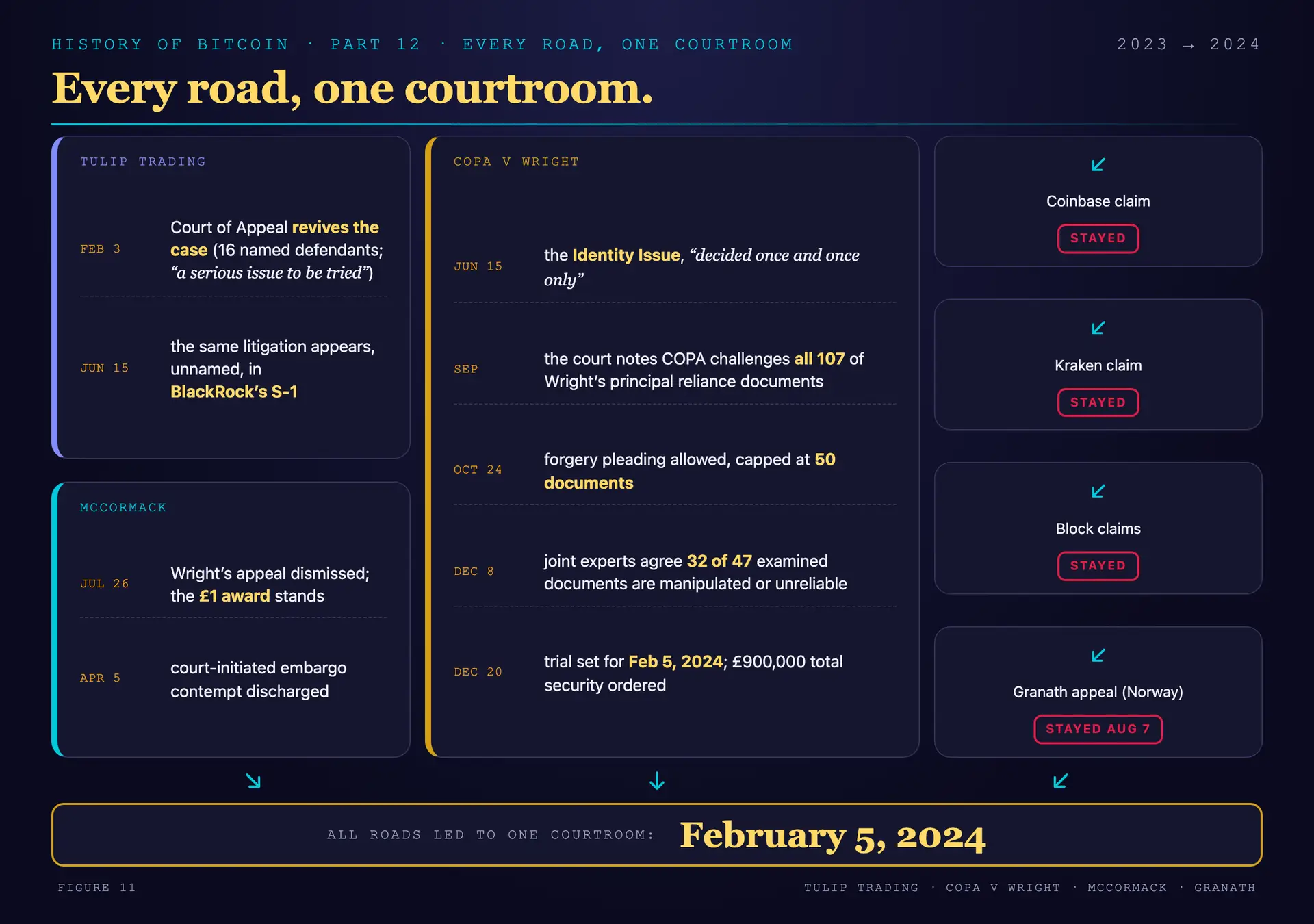
Four proceedings folded into one court date, in the courts' own orders. Source: BAILII
Now stack the year: The Coinbase claims: stayed, bound to the Identity Issue. The Kraken claims: stayed. The Block-related claims: stayed. The Norwegian appeal: stayed by the parties' own agreement, waiting on the Identity Issue. Tulip Trading: revived in February, priced into a Wall Street prospectus by June, aimed at the same underlying question from a different angle. And at the center of it all, one Joint Trial with full documentary disclosure, a forgery schedule capped and chosen, experts already in written agreement about what the documents show, security posted, doors opening February 5, 2024.
Years of argument about one man, distilled by the machinery of English procedure into a single set of court dates.
Every road in this story now led to the same courtroom.
Longtime readers know I carry convictions about the identity question, and they know I label them as convictions rather than findings. I also believe the full story has never been told by anyone, including the principals, for reasons I cannot fully see from where I stand... This installment is a history, and in 2023 the history is a record of orders, schedules, stays, and quotes. You have now read them, which puts you ahead of most people who argued about this case online that year. What they meant belongs to the year the trial actually ran, and to the installment that covers it. That trial deserves the room of its own that it is going to get, not a paragraph of spoilers at the end of this one.
What 2023 was
Weigh the year before we shelve it, because I think 2023 gets remembered wrong. It gets remembered as a recovery year, the quiet stretch between the collapse and the bull market, and that framing misses everything this installment just showed you.
2023 was the year the door swung open: the chain that called data spam spent twelve months carrying jpegs at a premium, and the fee market said thank you.
It was the year the exiles turned out to be the best in the world at the thing they were exiled for, first through the door they had been thrown out of years earlier. And once the shock of that wore off, both chains simply went back to work: inscriptions running on two chains, computation research advancing on both, a single day that carried 128 million transactions, blocks a shade under four gigabytes. The argument about whether data belongs in Bitcoin ended the only way it was ever going to end, with the data showing up.
It was the year the kingpins fell in a single November, and the month other men were carried out of their empires was the month I was carried into a ceremony I could not stand up for.
And it was the year Wall Street quit filing for paper and filed for the actual coins, with one man's London lawsuit folded quietly into the risk factors, unnamed but unmistakable.
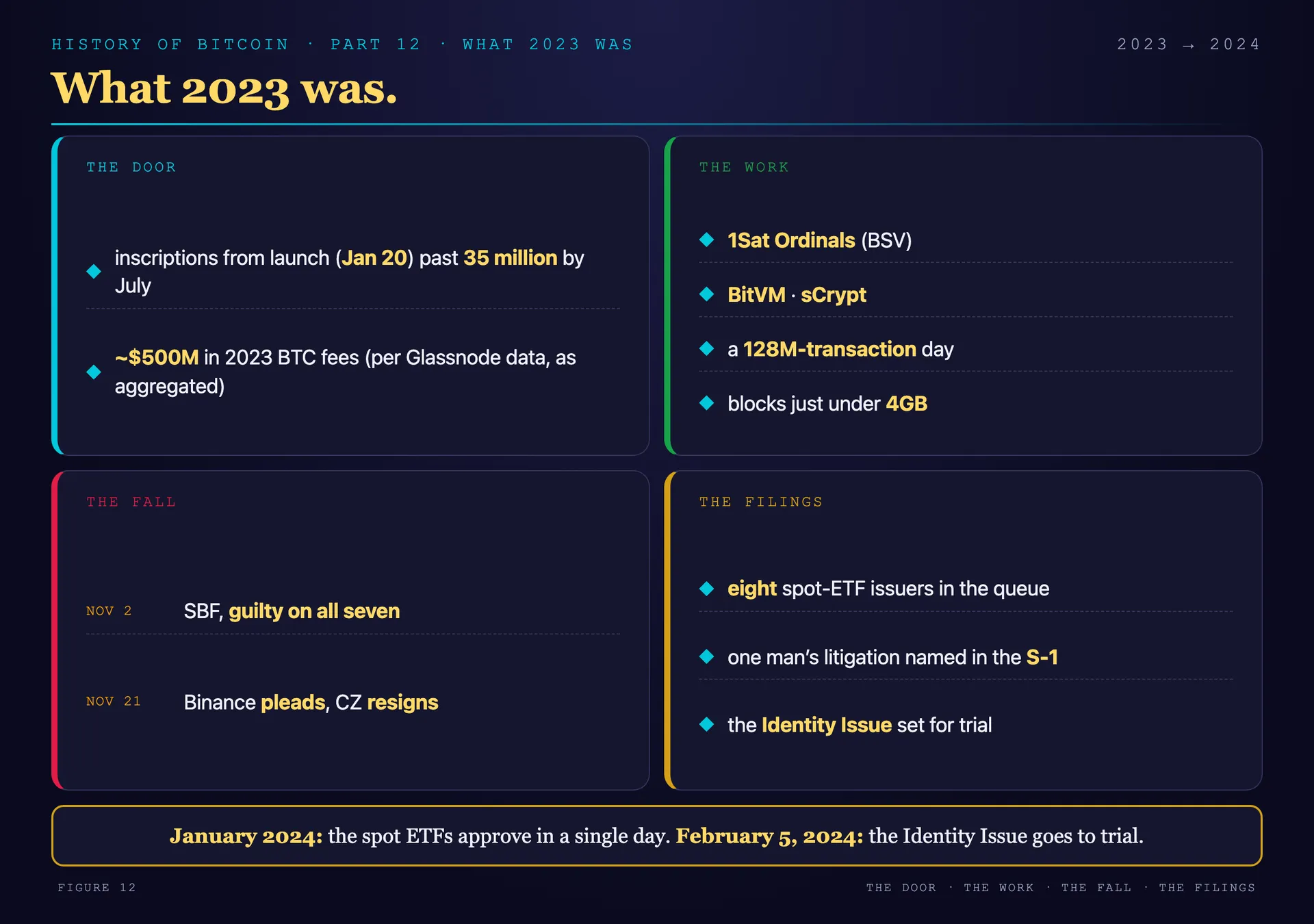
Here is what the record already had on the calendar when the champagne went up on December 31. In the second week of January 2024, the spot ETFs approve, in a single day. Twenty-six days after that, a London courtroom opens the Identity Issue: full documentary disclosure, a forgery schedule chosen wisely or not, and experts who already agree on what the documents show. One winter, one asset, and the two questions this series has been circling for twelve installments, each with a date attached.
This series has an appointment with both. Bring your reading glasses, because Part 13 keeps them.
Footnotes
¹ ord 0.4.0 release announced in Casey Rodarmor's launch post, Inscribing Mainnet, rodarmor.com, January 20, 2023.
² launch post verbatim, Inscribing Mainnet, rodarmor.com, January 20, 2023.
³ the pre-launch timeline from Rodarmor's own retrospective, How Ordinals Came to Be, rodarmor.com.
⁴ the January 9 quiet enablement of ord wallet inscribe on mainnet, per Rodarmor's retrospective, How Ordinals Came to Be, rodarmor.com.
⁵ BIP 342 script-limit language, verbatim, BIP 342, bips.dev.
⁶ envelope construction and first-sat binding per the launch post, Inscribing Mainnet, rodarmor.com, January 20, 2023.
⁷ the same-day BIP submission, bitcoin/bips pull request #1408, GitHub, January 20, 2023.
⁸ the digital-artifacts definition, verbatim, Inscribing Mainnet, rodarmor.com, January 20, 2023.
⁹ Rodarmor on the ChatGPT origin of "digital artifacts," Ordinals creator views his Bitcoin-centric creation as digital artifacts, not just NFTs, TechCrunch, February 16, 2023.
¹⁰ Rodarmor on backlash-driven adoption, Ordinals creator views his Bitcoin-centric creation as digital artifacts, not just NFTs, TechCrunch, February 16, 2023.
¹¹ the Ordisrespector patch and warning, verbatim, Ordisrespector gist, GitHub, February 1, 2023.
¹² attribution of Dashjr's patch announcement, What is Ordisrespector?, The Bitcoin Manual.
¹³ the Taproot Wizard inscription with Luxor's cooperation, Giant Bitcoin 'Taproot Wizard' NFT Minted in Collaboration With Luxor Mining Pool, CoinDesk, February 2, 2023.
¹⁴ Dashjr's February 14 statement, verbatim, tweet, Twitter/X, February 14, 2023.
¹⁵ TwelveFold announcement, Yuga Labs Announces Generative 'Ordinals' NFT Collection on Bitcoin Blockchain, CoinDesk, February 27, 2023.
¹⁶ domo's BRC-20 launch thread, verbatim, tweet, Twitter/X, March 9, 2023 (UTC).
¹⁷ domo's same-day clarification, quoted in part (the thread continues past this excerpt), tweet, Twitter/X, March 9, 2023.
¹⁸ ORDI's deployment as the first BRC-20 and its full mint-out within roughly 18 hours, contemporaneous trade reporting, March 2023.
¹⁹ Magic Eden's Bitcoin marketplace launch and first-week figures, Magic Eden's New Bitcoin NFT Marketplace Dominates Ordinals Market, Decrypt, April 2023.
²⁰ BRC-20 market capitalization crossing $100 million, BRC-20 tokens reach $100 million marketcap in 60 days, CoinGeek, May 2023.
²¹ the Binance withdrawal pauses and congestion figures, Binance Pauses Bitcoin Withdrawals, Blames Network Congestion, Decrypt, May 2023; and the second pause within 24 hours and the fee response, Binance Pauses Bitcoin Withdrawals for the Second Time in 24 Hours, CoinDesk, May 8, 2023.
²² the $9.62 average fee, YCharts data cited in the same congestion coverage, Binance Pauses Bitcoin Withdrawals for the Second Time in 24 Hours, CoinDesk, May 8, 2023.
²³ the May 21 cumulative figures, Dune Analytics and ordinals.com data as compiled in Bitcoin Blockchain Continues to See Growth in Ordinal Inscriptions and BRC20 Tokens, Bitcoin.com News, May 21, 2023.
²⁴ cumulative inscriptions crossing 35 million with 350,000+ daily, CoinDesk reporting, July 11, 2023.
²⁵ the November fee surge and the December two-year fee high with its miner windfall, CoinDesk reporting, November 8 and December 18, 2023.
²⁶ year-end fee totals per Glassnode data as aggregated in year-end coverage; inscriptions' roughly 21 percent share of 2023 fees per Messari analysis as reported, 2023-2024.
²⁷ Twetch's 69 Planetary Ordinals within 48 hours, Inordinate Ordinals for ordinary Bitcoiners, CoinGeek, February 2023.
²⁸ Josh Petty on the all-nighter, Inordinate Ordinals for ordinary Bitcoiners, CoinGeek, February 2023.
²⁹ Billy Rose on Twetch's five years of on-chain data, Bitcoin's Newfound NFT Hype Attracts Interest of BSV Developer Twetch, CoinDesk, February 8, 2023.
³⁰ the 5AM mempool-window detail, Bitcoin's Newfound NFT Hype Attracts Interest of BSV Developer Twetch, CoinDesk, February 8, 2023.
³¹ Rodarmor's reservations-but-welcome posture toward Twetch, Twetch steps into the NFT arena on BSV, crypto.news, February 8, 2023.
³² the Ordinals Wallet launch announcement, tweet, Twitter/X, February 15, 2023.
³³ the Twetch attribution for Ordinals Wallet, triangulated from the Tracxn company profile, Billy Rose's LinkedIn, and contemporaneous trade coverage of the Twetch principals' BTC ordinals work, February 2023.
³⁴ Ordswap's late-January launch and its description as the first trustless, PSBT-based Ordinals marketplace on BTC, contemporaneous trade coverage, January-February 2023.
³⁵ Kurt Wuckert Jr.'s contemporaneous analysis, The Ordinals Nomads: Unifying the Bitcoin tribes, CoinGeek, July 13, 2023.
³⁶ the methods clause, verbatim, The Ordinals Nomads: Unifying the Bitcoin tribes, CoinGeek, July 13, 2023.
³⁷ the veteran-beat line, verbatim, The Ordinals Nomads: Unifying the Bitcoin tribes, CoinGeek, July 13, 2023.
³⁸ the victory passage, verbatim, The Ordinals Nomads: Unifying the Bitcoin tribes, CoinGeek, July 13, 2023.
³⁹ the balance passage, verbatim, The Ordinals Nomads: Unifying the Bitcoin tribes, CoinGeek, July 13, 2023.
⁴⁰ the Nomads piece's July 13, 2023 publication date, coinciding with the Ripple summary judgment and the Mashinsky arrest, The Ordinals Nomads: Unifying the Bitcoin tribes, CoinGeek, July 13, 2023.
⁴¹ the Red Queen close, quoted in part (the passage opens with a sentence on Bitcoin absorbing less efficient trade, omitted here), The Ordinals Nomads: Unifying the Bitcoin tribes, CoinGeek, July 13, 2023.
⁴² GorillaPool's launch teaser posted from the pool's @MineLikeAnApe account, X, March 17, 2023.
⁴³ The 1Sat Ordinals fair-release plan, 1Sat Ordinals fair release documentation, GitHub (BitcoinSchema), 2023.
⁴⁴ shruggr's post of March 20, 2023, verbatim, as embedded and dated in The 1 Sat Ordinals story so far: The first 24 hours, CoinGeek, March 21, 2023.
⁴⁵ The first-24-hours report: four services inside twelve hours, the reported 50,000 inscriptions, the 500MB blocks, and the first inscription, The 1Sat Ordinals story so far: the first 24 hours, CoinGeek, March 21, 2023.
⁴⁶ David Case on building the 1Sat indexer and OrdinalLock, David Case talks implementing 1Sat Ordinals on Bitcoin SV, CoinGeek, April 26, 2023.
⁴⁷ Kurt Wuckert Jr.'s post of March 21, 2023, verbatim, as embedded and dated in The 1 Sat Ordinals story so far: The first 24 hours, CoinGeek, March 21, 2023.
⁴⁸ The 1Sat protocol mechanics: output-script envelope, single-satoshi binding, no push limit, 1Sat Ordinals documentation, 1Sat Ordinals, 2023.
⁴⁹ Panda Wallet's initial release as a non-custodial browser extension with 1Sat Ordinals support, October 2023.
⁵⁰ BSV's 128 million transactions in 24 hours on August 30, 2023, driven by Rekord's IoT proof-of-concept, CoinGeek, 2023.
⁵¹ The near-4GB December blocks: height 822498 (December 13, 2023, 22 UTC, 89,020 transactions) and the five that followed, one by TAAL at height 822889, WhatsOnChain block 822498 and block 822889, WhatsOnChain, December 2023.
⁵² TAAL raising its configured maximum block size to 4GB, TAAL likes big blocks: increases its max to 4GB and urges others to follow, CoinGeek, January 26, 2022.
⁵³ The contemporaneous critical coverage of the recovery framework, Craig Wright's Blacklist Resembles Bitcoin 'Kill Switch' Satoshi Never Followed Through On, CoinDesk, January 20, 2023.
⁵⁴ The Digital Asset Recovery tooling, Blacklist Manager and node update v1.0.13, shipped October-November 2022, per contemporaneous ecosystem coverage.
⁵⁵ The BSV Association's published definitions of the Network Access Rules and the Alert System, BSV Association documentation.
⁵⁶ Formal publication of the BSV Network Access Rules, PR Newswire, February 16, 2024.
⁵⁷ The sCrypt hackathons at the University of Exeter (June 5-8, 2023, roughly 80 students) and Fudan University (August 13, 2023), CoinGeek and bsvblockchain.org.
⁵⁸ Robin Linus's October 9, 2023 post introducing BitVM and the first major coverage, Bitcoin Might Get Ethereum-Style Smart Contracts Under BitVM Plan, CoinDesk, October 11, 2023.
⁵⁹ The BitVM whitepaper, abstract and script-size passage, BitVM: Compute Anything on Bitcoin, bitvm.org, December 12, 2023.
⁶⁰ The FDIC's press release on the closure of Silicon Valley Bank, FDIC, March 10, 2023.
⁶¹ Silvergate's voluntary wind-down announcement (March 8) and the NYDFS closure of Signature Bank (March 12), 2023.
⁶² Circle's SVB exposure disclosure and USDC's depeg, $0.87 on Kraken with CoinMarketCap's low of $0.8774, Decrypt, March 11, 2023.
⁶³ The joint statement by the Treasury, Federal Reserve, and FDIC on Silicon Valley Bank and Signature Bank, March 12, 2023.
⁶⁴ Circle's statement on the availability of its SVB reserve deposit, Circle, March 13, 2023.
⁶⁵ SEC v. Ripple Labs summary judgment order, Judge Analisa Torres, S.D.N.Y., July 13, 2023.
⁶⁶ The arrest of Celsius founder Alex Mashinsky, July 13, 2023.
⁶⁷ Ethereum's Shapella upgrade enabling staked-ETH withdrawals, April 12, 2023.
⁶⁸ MiCA's passage, Council approval, and entry into force, European Parliament and Council of the EU, April-June 2023.
⁶⁹ The 2023 L2 launches: zkSync Era (March 24), Polygon zkEVM (March 27), and Base (August 9), 2023.
⁷⁰ Genesis Global Capital's Chapter 11 filing, In re Genesis Global Holdco, LLC, No. 23-10063 (Bankr. S.D.N.Y.), January 19, 2023.
⁷¹ The Kraken staking settlement, SEC press release 2023-25, U.S. Securities and Exchange Commission, February 9, 2023.
⁷² Do Kwon's arrest in Montenegro with falsified travel documents, March 23, 2023.
⁷³ James Zhong's sentencing to a year and a day for the Silk Road theft, U.S. District Court, S.D.N.Y. (Judge Paul G. Gardephe), April 14, 2023.
⁷⁴ The SEC's suits against Binance, SEC press release 2023-101, June 5, 2023, and Coinbase, SEC press release 2023-102, June 6, 2023.
⁷⁵ The Nevada Financial Institutions Division's cease-and-desist (June 21, 2023) and receivership petition (June 26, 2023) for Prime Trust, the regulator's own release, Nevada FID, June 27, 2023.
⁷⁶ The FOMC's rate decision raising the target range to 5.25-5.50 percent, Federal Reserve press release, Federal Reserve, July 26, 2023.
⁷⁷ The launch of PYUSD, PayPal Launches U.S. Dollar Stablecoin, PayPal Newsroom, August 7, 2023.
⁷⁸ The Mt. Gox repayment deadline extension to October 31, 2024, trustee announcement, mtgox.com, September 21, 2023.
⁷⁹ The New York Attorney General's $1.1 billion suit against DCG, Gemini, and Genesis, Attorney General James Sues Cryptocurrency Companies Gemini, Genesis, and DCG for Defrauding Investors, Office of the New York State Attorney General, October 19, 2023.
⁸⁰ BTC year-end closes, CoinMarketCap historical snapshots, December 31, 2022 and December 31, 2023.
⁸¹ Luke Dashjr's compromise disclosure and the reported loss figures, contemporaneous coverage, January 1-2, 2023.
⁸² The Ordisrespector filter patch, Luke Dashjr's gist, GitHub, February 1, 2023.
⁸³ Bitcoin Core pull request #28408 and Peter Todd's fee-revenue objection in its discussion thread, PR #28408, GitHub, September 2023.
⁸⁴ OCEAN's launch, the $6.2 million Dorsey-led seed round, and the venue, PR Newswire, November 28, 2023, with CoinDesk coverage, November 29, 2023.
⁸⁵ Dashjr's December 6, 2023 statement, verbatim, tweet, X, December 6, 2023.
⁸⁶ BlackRock's registration statement for the iShares Bitcoin Trust, filed under accession no. 0001437749-23-017574, Form S-1: iShares Bitcoin Trust, SEC EDGAR, June 15, 2023.
⁸⁷ The custodian designations in the trust structure summary of the original filing, Form S-1: iShares Bitcoin Trust, SEC EDGAR, June 15, 2023.
⁸⁸ The in-kind creation and redemption model as originally filed, Form S-1: iShares Bitcoin Trust, SEC EDGAR, June 15, 2023.
⁸⁹ The SEC's notice of Nasdaq's proposed rule change SR-NASDAQ-2023-016 to list and trade shares of the iShares Bitcoin Trust, Release No. 34-97905, U.S. Securities and Exchange Commission, July 13, 2023.
⁹⁰ S-1 amendment dates stamped by EDGAR for each trust: WisdomTree June 20, Valkyrie June 21, VanEck August 4, Ark/21Shares September 7, Invesco Galaxy October 13, Fidelity October 17, and Bitwise October 25, 2023, SEC EDGAR full-text search, U.S. Securities and Exchange Commission, 2023.
⁹¹ Fink's 2017 remarks at an Institute of International Finance meeting, BlackRock CEO Larry Fink calls bitcoin an 'index of money laundering', CNBC, October 13, 2017.
⁹² Fink's Fox Business interview, BlackRock CEO Larry Fink likens crypto to 'digitizing gold,' praises Bitcoin as an 'international asset', CryptoSlate, July 5, 2023.
⁹³ The 575-1 figure as Fink's own on-air characterization of BlackRock's ETF application record, Larry Fink says Bitcoin is 'digitalising gold' in another sign BlackRock is all-in on crypto, DL News, July 5, 2023.
⁹⁴ The unanimous panel opinion by Judge Rao, Grayscale Investments, LLC v. SEC, No. 22-1142, U.S. Court of Appeals for the D.C. Circuit, August 29, 2023.
⁹⁵ The correlation evidence, the like-products holding, and the disposition, Grayscale Investments, LLC v. SEC, No. 22-1142, U.S. Court of Appeals for the D.C. Circuit, August 29, 2023.
⁹⁶ The D.C. Circuit's ruling became final after the SEC declined to pursue an appeal, Grayscale Court Victory Over SEC in Spot Bitcoin ETF Case Made Final, CoinDesk, October 23, 2023.
⁹⁷ The Craig Wright risk-factor paragraph, quoted in full from the risk factor covering regulatory actions in foreign jurisdictions, Form S-1: iShares Bitcoin Trust, SEC EDGAR, June 15, 2023.
⁹⁸ The separate white-paper authorship passage, unconnected to the Wright risk factor, Form S-1: iShares Bitcoin Trust, SEC EDGAR, June 15, 2023.
⁹⁹ Full-text search for "Craig Wright" across S-1 filings in the 2023 window, matching Ark/21Shares, VanEck, Franklin Templeton, and Pando Asset alongside BlackRock, with Fidelity's and Bitwise's filings carrying no such language, SEC EDGAR full-text search, U.S. Securities and Exchange Commission, 2023.
¹⁰⁰ The identical Wright paragraph in the December amendment, Form S-1/A: iShares Bitcoin Trust, SEC EDGAR, December 2023.
¹⁰¹ The shift from in-kind to cash-only creations, described in the amendment's own risk language, Form S-1/A: iShares Bitcoin Trust, SEC EDGAR, December 2023.
¹⁰² Full-text search for "Coinbase Custody" across the window's S-1 filers, naming roughly ten of fourteen issuers, with Fidelity's filing naming its own Fidelity Digital Asset Services instead, SEC EDGAR full-text search, U.S. Securities and Exchange Commission, 2023.
¹⁰³ Prosecutors' witness-tampering allegation over Ellison's private writings, US judge tightens Bankman-Fried's bail, considers jail until trial, Al Jazeera, July 27, 2023.
¹⁰⁴ Bail revoked and Bankman-Fried remanded to MDC Brooklyn, FTX founder Sam Bankman-Fried jailed after judge revokes bail in crypto fraud case, PBS NewsHour, August 11, 2023.
¹⁰⁵ Jury selection opening the trial before Judge Kaplan, Sam Bankman-Fried trial begins; jury should be selected by Wednesday, CNBC, October 3, 2023.
¹⁰⁶ Wang's testimony on the founders' decision-making, Alameda had a $65B line of credit and 'unlimited withdrawals', TechCrunch, October 5, 2023.
¹⁰⁷ Ellison's testimony on the witness stand, SBF 'Directed Me' to Commit Fraud: ex-Alameda CEO Caroline Ellison, Crypto Briefing, October 2023.
¹⁰⁸ Ellison's testimony on the roughly $14 billion taken from customers, SBF 'directed me' to take $14bn from FTX customers — who is Caroline Ellison?, DL News, October 2023.
¹⁰⁹ Ellison's characterization of the Binance CEO's November 2022 tweet, Changpeng Zhao's tweet 'contributed' to collapse of FTX, claims Caroline Ellison, Cointelegraph, October 2023.
¹¹⁰ Singh's rooftop-meeting testimony, Former FTX engineer tells jury about panicky rooftop meeting with SBF, CNBC, October 16, 2023.
¹¹¹ continuation of Singh's rooftop-meeting testimony, Former FTX engineer tells jury about panicky rooftop meeting with SBF, CNBC, October 16, 2023.
¹¹² Kaplan's remark during the October 26 session held without the jury, In Bizarre Twist, SBF Finally Testifies—But With No Jury, The Daily Beast, October 2023.
¹¹³ Bankman-Fried's testimony before the jury, FTX's Bankman-Fried admits 'mistakes', denies fraud at trial, Al Jazeera, October 28, 2023.
¹¹⁴ Sassoon's cross-examination and the courtroom's reaction, Prosecution tries to paint Sam Bankman-Fried as a liar, TechCrunch, October 30, 2023.
¹¹⁵ The reported count of Bankman-Fried's deferrals under cross, Inside SBF's Trial: Sam 'wasn't sure' nearly one hundred and fifty times, The Block, October 2023.
¹¹⁶ Closing arguments from Sassoon, Roos, and Cohen, 'A Clear Message': Sam Bankman-Fried Is Found Guilty on All Seven Counts, The Ringer, November 3, 2023.
¹¹⁷ The deliberation window and same-evening verdict, 'A Clear Message': Sam Bankman-Fried Is Found Guilty on All Seven Counts, The Ringer, November 3, 2023.
¹¹⁸ The count breakdown in the U.S. Attorney's own release, Statement Of U.S. Attorney Damian Williams On The Conviction Of Samuel Bankman-Fried, U.S. Department of Justice, November 2, 2023.
¹¹⁹ The courtroom scene at the verdict, 'A Clear Message': Sam Bankman-Fried Is Found Guilty on All Seven Counts, The Ringer, November 3, 2023.
¹²⁰ Williams' verdict-day statement, Statement Of U.S. Attorney Damian Williams On The Conviction Of Samuel Bankman-Fried, U.S. Department of Justice, November 2, 2023.
¹²¹ Garland's statement on the verdict, Attorney General Merrick B. Garland Statement on Guilty Verdict in Jury Trial of Sam Bankman-Fried, U.S. Department of Justice, November 2, 2023.
¹²² The plea hearing before Magistrate Judge Tsuchida, as carried by wire-syndicated coverage of the Seattle courtroom, Binance crypto CEO Changpeng Zhao pleads guilty in Seattle courtroom, NBC affiliate wire report, November 21, 2023.
¹²³ The financial terms of the resolution, Binance and CEO Plead Guilty to Federal Charges in $4B Resolution, U.S. Department of Justice, November 21, 2023.
¹²⁴ Treasury's parallel settlement documenting Binance's suspicious-activity-reporting failures, U.S. Treasury Announces Largest Settlements in History with World's Largest Virtual Currency Exchange Binance, U.S. Department of the Treasury, November 21, 2023.
¹²⁵ The officials' statements in the Justice Department's release, Binance and CEO Plead Guilty to Federal Charges in $4B Resolution, U.S. Department of Justice, November 21, 2023.
¹²⁶ CZ's resignation post, verbatim, @cz_binance, X, November 21, 2023 (archived).
¹²⁷ Richard Teng named CEO effective November 21, 2023, with his regulatory background, Binance Announcement: Reaching Resolution With U.S. Regulators, Binance, November 21, 2023.
¹²⁸ CZ's January 2, 2023 post, verbatim, @cz_binance, X, January 2, 2023 (archived).
¹²⁹ Court of Appeal judgment allowing Tulip Trading's appeal from the 2022 dismissal, Tulip Trading Ltd v Bitcoin Association for BSV & Ors [2023] EWCA Civ 83 (Birss LJ, Lewison and Popplewell LJJ agreeing), bailii, Court of Appeal of England and Wales, February 3, 2023.
¹³⁰ Paragraph 1 of the leading judgment, Tulip Trading Ltd v Bitcoin Association for BSV & Ors [2023] EWCA Civ 83, bailii, Court of Appeal of England and Wales, February 3, 2023.
¹³¹ Paragraph 86 of the leading judgment, Tulip Trading Ltd v Bitcoin Association for BSV & Ors [2023] EWCA Civ 83, bailii, Court of Appeal of England and Wales, February 3, 2023.
¹³² Paragraph 91 of the leading judgment, Tulip Trading Ltd v Bitcoin Association for BSV & Ors [2023] EWCA Civ 83, bailii, Court of Appeal of England and Wales, February 3, 2023.
¹³³ The Wright-litigation risk factor in the iShares Bitcoin Trust Form S-1, which describes the case without naming it, SEC EDGAR filing, U.S. Securities and Exchange Commission, June 15, 2023.
¹³⁴ Case management ruling defining the Identity Issue, from the June 15, 2023 CMC, Crypto Open Patent Alliance v Wright [2023] EWHC 1894 (Ch), bailii, High Court of England and Wales, 2023.
¹³⁵ The hybrid order staying the Coinbase, Kraken, and Block-related claims as bound and joining the developer parties to a preliminary-issue Joint Trial, Crypto Open Patent Alliance v Wright [2023] EWHC 1894 (Ch), bailii, High Court of England and Wales, 2023.
¹³⁶ Ruling on the September 2023 hearings, recording COPA's challenge to all 107 principal reliance documents, Crypto Open Patent Alliance v Wright [2023] EWHC 2408 (Ch), bailii, High Court of England and Wales, September 2023.
¹³⁷ October 24, 2023 ruling permitting COPA's forgery amendment, capped at 50 additional documents, following service of Madden's forensic report, Crypto Open Patent Alliance v Wright [2023] EWHC 2642 (Ch), bailii, High Court of England and Wales, October 24, 2023.
¹³⁸ The December 8, 2023 joint expert statement of Madden and Placks, as summarized in the pre-trial review judgment, Crypto Open Patent Alliance v Wright [2023] EWHC 3287 (Ch), bailii, High Court of England and Wales, December 20, 2023.
¹³⁹ COPA's December 14, 2023 schedule of 20 focus documents, per the pre-trial review judgment, Crypto Open Patent Alliance v Wright [2023] EWHC 3287 (Ch), bailii, High Court of England and Wales, December 20, 2023.
¹⁴⁰ Pre-trial review refusing adjournment, moving the trial to February 5, 2024, capping the forgery case, and raising the developers' security for costs to £900,000, Crypto Open Patent Alliance v Wright [2023] EWHC 3287 (Ch), bailii, High Court of England and Wales, December 20, 2023.
¹⁴¹ The pre-trial review's statement of the Joint Trial's subject, Crypto Open Patent Alliance v Wright [2023] EWHC 3287 (Ch), bailii, High Court of England and Wales, December 20, 2023.
¹⁴² COPA members page, December 2, 2022 capture, archive.org snapshot, Internet Archive, December 2, 2022; and COPA members page, November 11, 2023 capture, identical roster to December 2022, archive.org snapshot, Internet Archive, November 11, 2023.
¹⁴³ Platinum member listing on the archived COPA members page, archive.org snapshot, Internet Archive, November 11, 2023.
¹⁴⁴ Case caption as recorded in the Eighteenth Witness Statement of Philip Nathan Sherrell (Bird & Bird, for COPA), Claim No. IL-2021-000019, filed December 7, 2023.
¹⁴⁵ Court of Appeal dismissal of Wright's appeal on the nominal damages award, Wright v McCormack [2023] EWCA Civ 892 (Singh, Andrews, Warby LJJ), bailii, Court of Appeal of England and Wales, July 26, 2023.
¹⁴⁶ Report of the Supreme Court's December 21, 2023 refusal of permission to appeal, Supreme Court refuses permission to appeal in Wright v McCormack, Matrix Chambers, December 2023.
¹⁴⁷ The court-initiated embargo proceedings, prima facie breach found and proceedings discharged on proportionality, Wright v McCormack [2023] EWHC 1030 (KB) (Warby LJ, Nicklin J), bailii, High Court of England and Wales, April 5, 2023.
¹⁴⁸ The mutual stay of the Norwegian appeal, requested by Wright on July 26, 2023 and accepted by Granath on August 7, 2023, pending the Identity Issue, per the Eighteenth Witness Statement of Philip Nathan Sherrell (Bird & Bird, for COPA), Claim No. IL-2021-000019, filed December 7, 2023.
¹⁴⁹ The July 7, 2023 stay of the parallel English Granath claim, per the Eighteenth Witness Statement of Philip Nathan Sherrell (Bird & Bird, for COPA), Claim No. IL-2021-000019, filed December 7, 2023.
Be good to each other. And stay curious.