The Written History of Bitcoin: The Year of the Verdict
By Kurt Wuckert Jr.
Two days before the biggest trial in Bitcoin's history opened in London, I posted a photograph of myself on narcotics.
Saturday, February 3, 2024. 15 UTC. "Update now that I've been off the drugs for about 24 hours and back on my feet a little," the post began, which is not the sentence you want to be writing in the week of the story you have chased for four years.¹
In November 2023 my abdominal muscle tore while I was working out, my small intestine came through my belly button, and I had emergency surgery. Longtime readers watched that one happen in Part 12. Then, a month before the trial, a bad cough turned into "a massive pressure issue low in my pelvis." Another hernia. While the doctor was examining it, it impacted in front of her: "10/10 pain again." So it was not a patch job. It was "full exploratory surgery," and what they found was "3 big hernias and another small one, so I got a mesh put in on Tuesday." Tuesday was January 30.²
And then the sentence that decided my year:
**"I wanted to wait this surgery out to go to London, but my doctor said the risk of flying or risk of having another random impaction while out of town was too great."**³
She was right. It turned out to be "one of the biggest hernia repairs the doctor had ever done." For the first few nights I could not move. "I slept in my office chair because I couldn't get in or out of any other position." By God's grace, WGMI.
Monday came anyway.
On February 5, 2024, in the Rolls Building on Fetter Lane, Mr Justice Mellor opened COPA v Wright, the case this series has been walking toward for ten chapters.⁴ I was four thousand miles away with tacks in my abdomen. At 18 UTC that same day I posted a video anyway: "The show MUST go on! Here's my brief Day 1 Recap of The Satoshi Trial™ COPA vs Wright."⁵
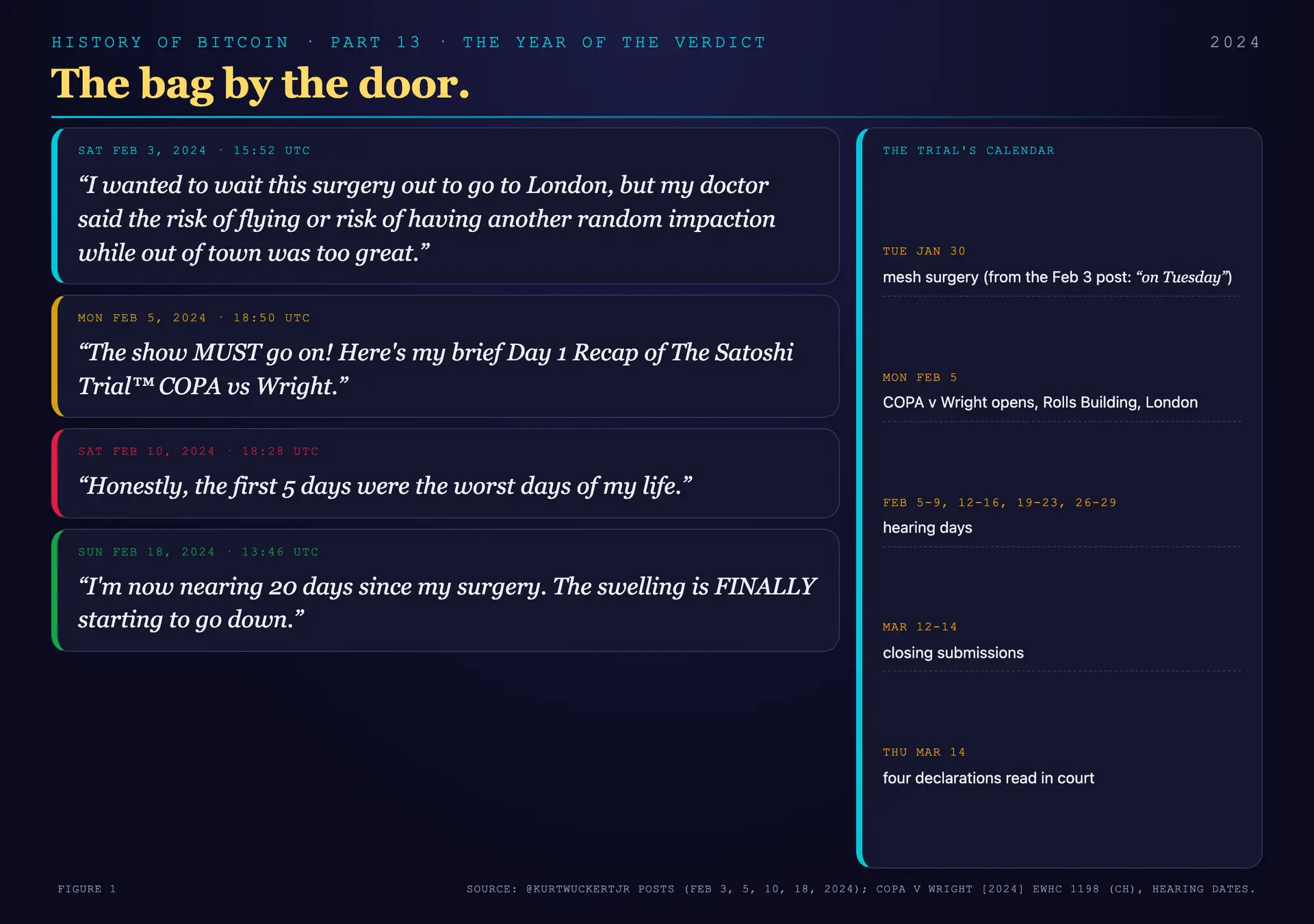
Four posts are the only contemporaneous record of where the reporter was while the case he had covered since 2020 was tried. Source: the author's posts of February 3, 5, 10 and 18, 2024, and the hearing dates in COPA v Wright [2024] EWHC 1198 (Ch).
The biggest trial in Bitcoin's history opened on a Monday, and I watched it from the chair I had been sleeping in.
Part 12 closed with two appointments already on the calendar: the spot ETF decision in the second week of January, and a London courtroom twenty-six days later. It told you to bring your reading glasses. Both appointments were kept.
This is the year everything came due. The ETFs approved, all at once. The subsidy halved. The men who ran the last cycle's biggest failures were sentenced inside five weeks of each other. A judge read four declarations into the record, then wrote nine hundred and forty-four paragraphs explaining them. A candidate who called Bitcoin a scam in 2021 promised in Nashville never to sell the government's coins, and in November he won. At the middle of it sits a courtroom this installment walks past on purpose, because next week we go DEEP inside.
Watch the video if you prefer to watch rather than read!
Before we get to the courtroom, there is a story about an office in London in September 2023.
Approved
4 in the afternoon, Eastern time, January 9, 2024. The @SECGov account posted that the Securities and Exchange Commission "grants approval for #Bitcoin ₿ ETFs for listing on all registered national securities exchanges," over a graphic with Gary Gensler's name on it.⁶
It was not the SEC.
By the agency's own account, an unauthorized party took control of the phone number tied to the account shortly after four o'clock, posted the approval at 4, posted "$BTC" two minutes later, and held it until somewhere between 4 and 5 pm. No evidence, the Commission said, that anyone reached its systems or its data.⁷ It also disclosed, twelve days later, that multi-factor authentication had been switched off since July 2023, when SEC staff asked X Support to remove it and nobody turned it back on.⁸
The financial regulator for the largest capital market on earth ran its public channel with the seatbelt unbuckled for six months. That is not a hacking story. That is a housekeeping story!
Commenters floated an inside job, and no first post making that claim can be traced to a name.
The real thing happened the next afternoon.
On January 10, 2024, the Commission issued Release No. 34-99306 approving eleven spot bitcoin exchange-traded products at once, and trading opened the next morning across eleven tickers: ARKB, BITB, IBIT, FBTC, EZBC, GBTC, DEFI, BTCO, BRRR, HODL and BTCW.¹⁰
The chairman signing the biggest approval in the asset's history spent his paragraph explaining that he did not care for it. Metals products, he wrote, hold assets that "have consumer and industrial uses, while in contrast bitcoin is primarily a speculative, volatile asset that's also used for illicit activity including ransomware, money laundering, sanction evasion, and terrorist financing," and then: "While we approved the listing and trading of certain spot bitcoin ETP shares today, we did not approve or endorse bitcoin."¹¹
Merit neutral, he called that.
Bloomberg counted more than $4.6 billion of turnover on day one, roughly half of it in Grayscale's converted trust as ten years of trapped holders found a door, and BlackRock's iShares Bitcoin Trust crossed $10 billion in assets on March 1, thirty-nine trading days in, faster than any exchange-traded fund in American history.¹² By year end the eleven had pulled in roughly $35 billion net, according to a year-end synthesis of Farside's flow data.¹³
Skeptics called it paper bitcoin, and you can date that argument to a January 26 thread on r/Bitcoin asking where the proof of reserves was when eight of eleven used one custodian, while the trust's own prospectus represents segregated coins at Coinbase Custody and discloses the custody risks beside them.¹⁴ A legal representation is not a cryptographic proof, and 2024 spent twelve months refusing to hold both facts in one hand.
Part 12 showed you the June 2023 registration statement in which the largest asset manager on earth wrote an unnamed London lawsuit into its risk factors. That paragraph was not quietly dropped when the fund went live. It sits in the iShares Bitcoin Trust's final prospectus, filed on January 10, 2024, the day of the approval: "Furthermore, legal claims have been filed in the United Kingdom by an entity associated with an individual named Craig Wright."¹⁵
Trading in that fund began on January 11.
The fund that named Craig Wright as a risk factor was live for twenty-five days before he took the stand.
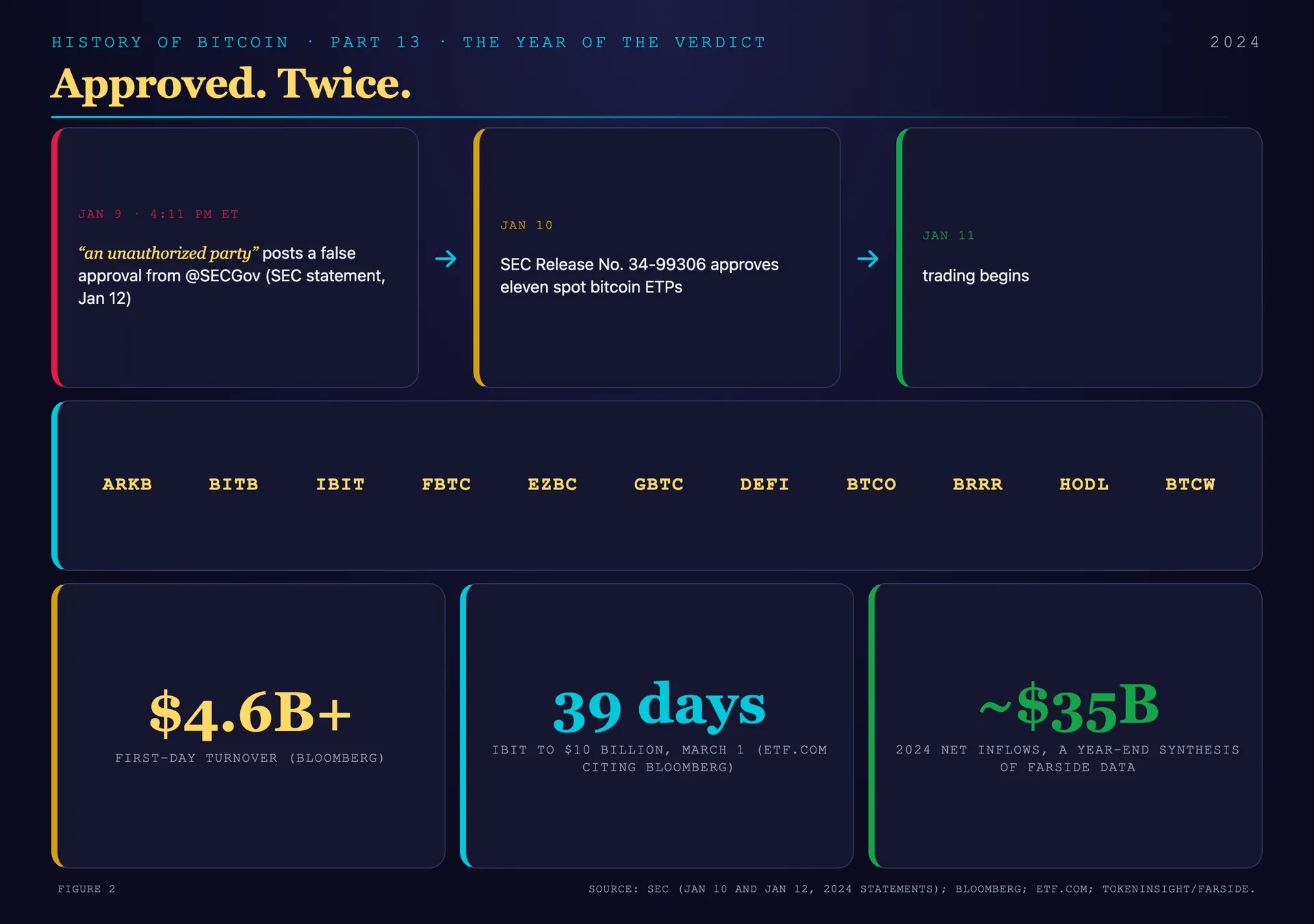
Three consecutive January afternoons carried a forged approval, a real one, and the open, and the answer the industry had waited for since 2013 arrived with a British court case in the fine print. Source: SEC Release No. 34-99306, the SEC's @SECGov statements, and Farside data via TokenInsight.
I published, on January 9, the day before the approval, with that on the scale: "2024 stands as a year of reckoning."¹⁶
I have never been so right for so many reasons I did not see coming.
The autumn before
To understand what walked into the Rolls Building in February, go back five months, to a London office with a server room in it.
Christen Ager-Hanssen is a Norwegian investor who runs Custos, and who has described his own methods to reporters in terms most executives avoid: staff including former intelligence officers from the CIA, MI6 and Mossad, and meetings attended wearing a hidden microphone.¹⁷ Wikipedia's entry on him, citing an October 2023 profile in the Norwegian business daily Dagens Næringsliv, says he claims to have worked with Black Cube since that firm's earliest days, while working for the businessman Vincent Tchenguiz. Black Cube is the Israeli private-intelligence outfit founded around 2010 by former intelligence officers, made famous in 2017 when Ronan Farrow reported that Harvey Weinstein had hired it against his accusers.¹⁸ On November 22, 2022, nChain announced him as its group chief executive.¹⁹
Before that, there was Kyle Roche.
Roche was one of the lawyers who won the $100 million Kleiman verdict against Craig Wright in Miami in 2021. In late January 2022 he took meetings in London with Ager-Hanssen. That August an anonymous site called Crypto Leaks published video of them.²⁰ Roche answered in his own words: the clips were "illegally obtained, highly edited" and "spliced out of context," produced through "a deliberate scheme to intoxicate, and then exploit me, using leading questions."²¹ He did not use the word drugged, but it was heavily implied... The New York Times reported that he woke groggy with no proof of what happened, and within days he withdrew from four class actions.²² No court or regulator has ever made a finding against him.
Asked in 2023 whether he had run the operation, Ager-Hanssen told the Times it "was run by someone else." Asked again months later by the Norwegian paper, he said: "It was me."²³ Who held the camera depends on who you ask. The Guardian says only "a former Mossad operative posing as an Argentinian businessman." AgerHanssenExposed.com, an anonymous site devoted to him and openly hostile, says he told that paper the man was a former Mossad agent then working for Black Cube, and concedes that no evidence for this was provided.²⁴
That is the man nChain hired. Now the autumn.
Mellor found five grounds of contempt proved beyond reasonable doubt. On December 18, "Dr Wright declined to appear at this hearing and was not represented"; the judge noted his whereabouts "(in the Far East, possibly Thailand)" and his claim that he could not afford the air fare, then found that "it is clear to me that Dr Wright has voluntarily absented himself from this Contempt Hearing."⁵¹
Commenters on r/btc and r/bsv that week said he had fled the jurisdiction; the judge's own word was that he had voluntarily absented himself, and the judgment places him in the Far East, possibly Thailand.⁵²
He did appear the next day. The sentencing judgment records it in eight words: "Dr Wright appeared in person by remote link."⁵³
The sentence, verbatim: "I imposed on Dr Wright a sentence of imprisonment of 12 months, suspended for 2 years." The New Claim was struck out as an abuse of process, and £145,000 was ordered on account of costs.⁵⁴ The condition is that he commits no further breach of the July 16 order, and the judge was precise about the clock: "To be clear, the two year period runs from 19 December 2024."⁵⁵
Opened February 5, declared March 14, written May 20, ordered July 16, closed with a suspended prison term read to a screen.
There is a reason the judge wrote "from wherever he now is," and the next installment is where that sentence gets its answer.
Halved
Block 840,000 arrived at 00:09 UTC on April 20, 2024. In the United States it was still Friday evening, April 19, ten past eight on the East Coast, which is why half the internet remembers the halving on the wrong date. UTC counts, so from here it is April 20.⁵⁶
ViaBTC found it, and it carried three thousand and fifty transactions. The block reward fell from 6.25 BTC to 3.125, which is the whole mechanism of the halving and the most reliably boring thing in this entire history.
Except for the fees. Block 839,999 collected 1.045 BTC in fees, a completely ordinary evening. Block 840,000 collected 37.6256 BTC, worth about $2,399,135 at the time.⁵⁷
The subsidy halved at nine minutes past midnight, and the fees in that one block were worth more than the subsidy.
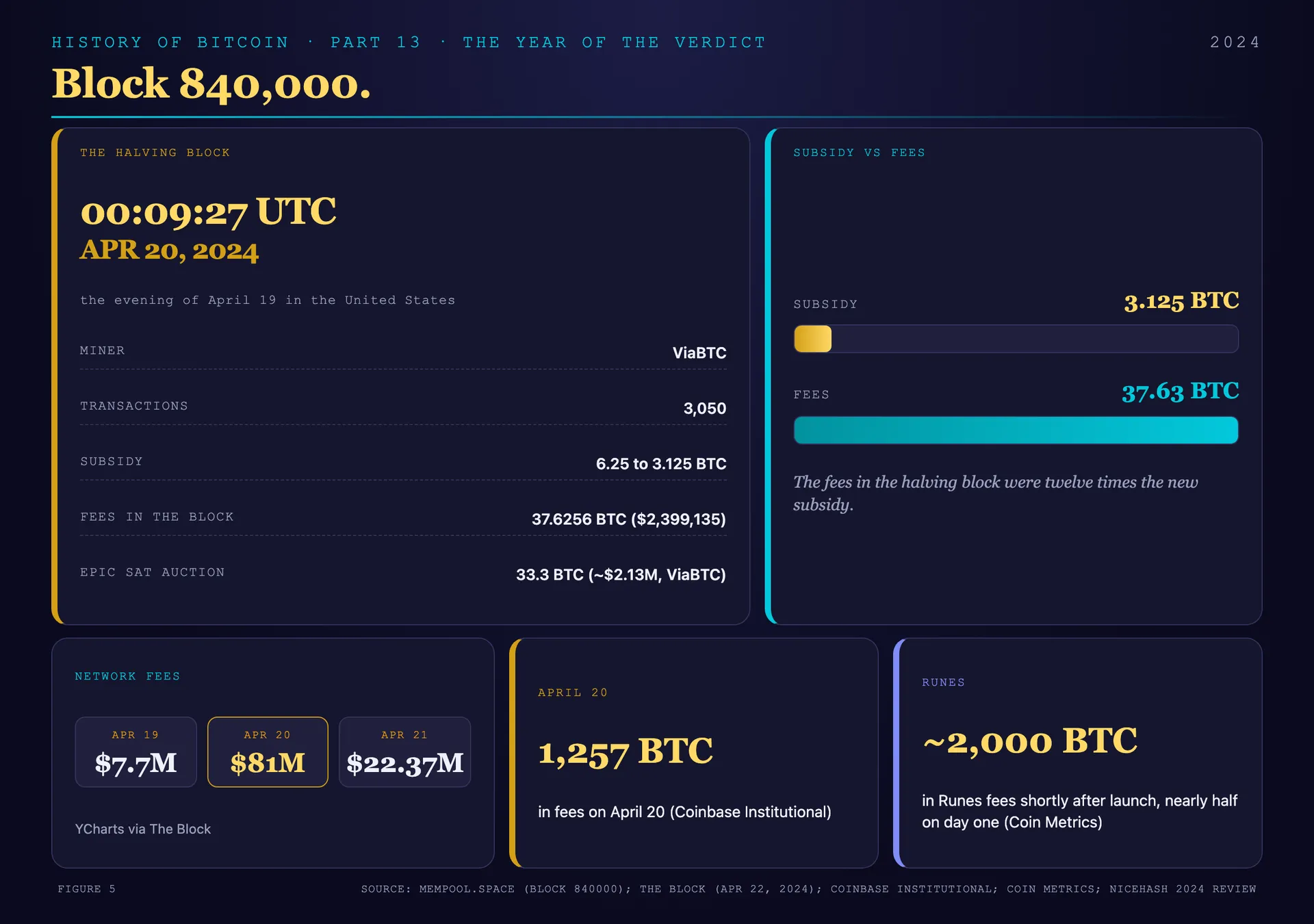
The blocks on either side collected about one BTC in fees each. Block 840,000 collected 37.63, and the next twenty stayed elevated for hours. Source: mempool.space block API, heights 839,990 to 840,020.
The reason was a protocol that launched inside the halving block on purpose. Casey Rodarmor, whose inscriptions walked through the door Taproot left open and opened BTC to data in 2023, activated Runes at exactly height 840,000. Rune number zero, UNCOMMON•GOODS, began minting there and is coded to stop at block 1,050,000.⁵⁸
Everybody wanted into that block. Coinbase Institutional counted 1,257 BTC in total network fees across April 20, and YCharts figures put the day at $81 million against $7.7 million the day before.⁵⁹ ViaBTC then auctioned the "epic sat," the first satoshi of the new epoch, for 33.3 BTC, about $2.13 million.⁶⁰
Two million dollars for one satoshi. A satoshi is a hundred-millionth of a coin.
It faded fast, the way these things do. Coin Metrics counted about 2,000 BTC in Runes fees shortly after launch, nearly half on day one, plateauing inside five days.⁶¹ Binance Research counted monthly inscriptions falling from 6.0 million in January to 0.8 million in June, and CoinGecko put the second quarter's marketplace-volume decline at $213 million, or 81 percent.⁶²
The mania moved on. The argument it started did not.
Part 12 introduced you to Ordisrespector, Luke Dashjr's February 2023 patch to reject inscriptions at the node level, and to OCEAN, the pool that launched that November running Bitcoin Knots and filtering them from day one. In 2024 that fight became infrastructure.
In February, OCEAN offered miners three block templates: Knots, filtering inscriptions and capping OP_RETURN at 42 bytes; Core plus Ordisrespector; and unmodified Core. The unmodified option carried a 2 percent fee. The filtered ones were promotionally free.⁶³
Nobody censored anything. They priced it.
On the Core side the same argument ran through the pull-request queue. PR #28408, opened in September 2023 to apply datacarrier policy to inscription patterns, closed unmerged on January 5, 2024, with a cluster of related issues and PRs closing on October 15.⁶⁴ By October, OCEAN shipped DATUM, which let miners build their own templates on their own node instead of taking the pool's.⁶⁵
That was the 2024 shape of it: a policy argument fought in fee schedules, template menus and closed pull requests. It had no BIP number that year. The number people retroactively attach to it, BIP-110, went to an entirely different proposal on December 3, 2025.⁶⁶
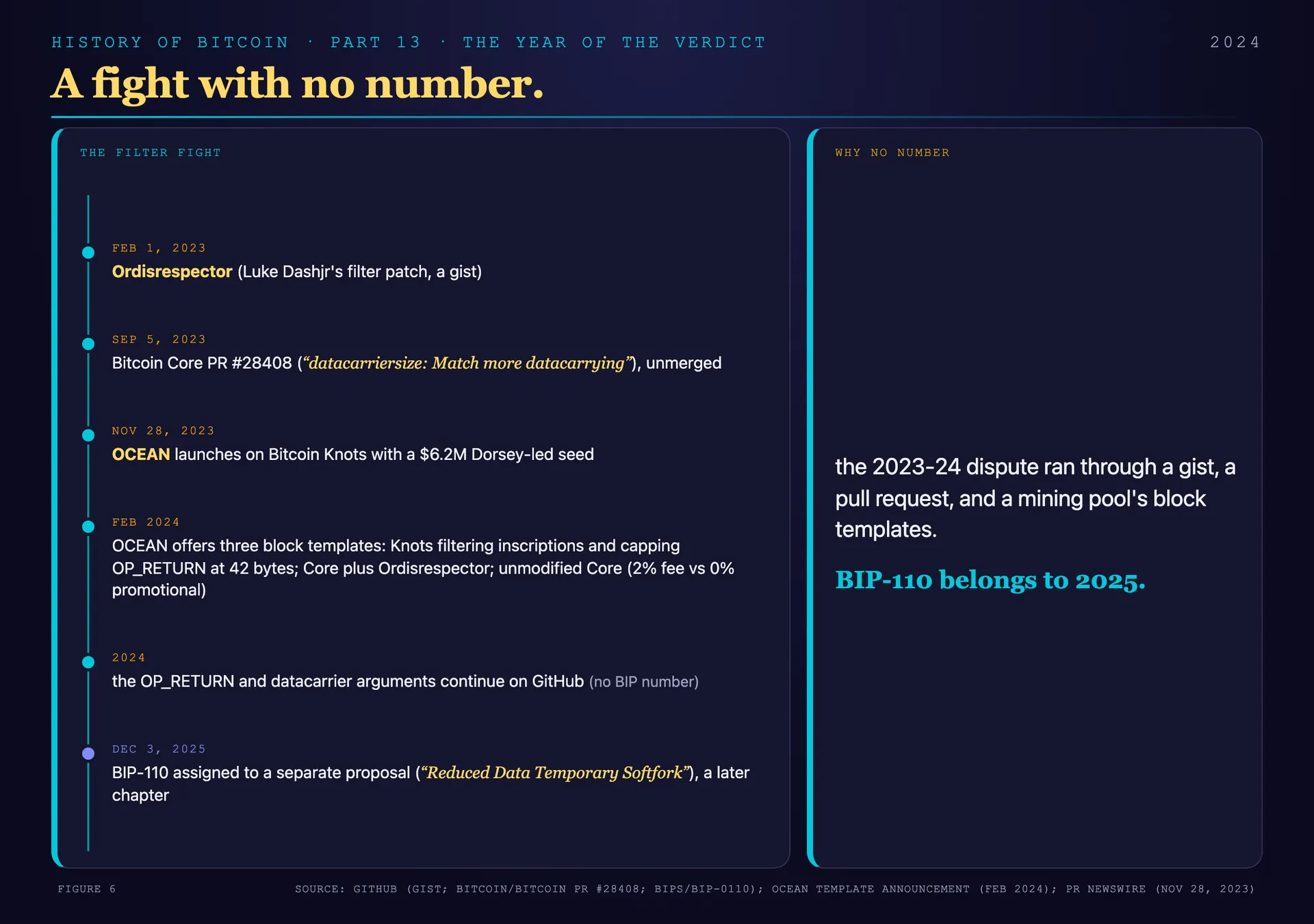
Three years of argument about what a node should relay, and the only BIP number in the picture belongs to a later, separate proposal. Source: GitHub (bitcoin/bitcoin, bitcoin/bips, OCEAN-xyz) and OCEAN's documentation.
That fight has a number now. It gets its own chapter.
Sentenced
March 28, 2024, in a Manhattan courtroom, Judge Lewis A. Kaplan sentenced Samuel Bankman-Fried to 300 months in federal prison, three years of supervised release, and forfeiture of $11,020,000,000.⁶⁷
Twenty-five years. Part 8B told you how the machine worked and November 2023 gave you the seven guilty verdicts. March 2024 gave you the number.
The U.S. Attorney's office put the scale in one sentence: "Samuel Bankman-Fried orchestrated one of the largest financial frauds in history, stealing over $8 billion of his customers' money."⁶⁸ Kaplan found that he had committed perjury on the stand and treated his attempted witness tampering as relevant conduct, and AP transcribed the judge saying the sentence reflected the risk that he "will be in position to do something very bad in the future. And it's not a trivial risk at all," with "never a word of remorse for the commission of terrible crimes."⁶⁹ TIME's transcription of the same hearing has him on the testimony: "When he wasn't outright lying, he was often evasive, hairsplitting, dodging questions."⁷⁰
The lieutenants got the discount that cooperation buys. Ryan Salame, 90 months on May 28. Caroline Ellison, 24 months on September 24, with Kaplan calling her cooperation "remarkable" and "very, very substantial." Nishad Singh, time served, October 30. Gary Wang, time served, November 20.⁷¹
In Seattle a month later, the other man from that chapter got a very different afternoon. On April 30, Judge Richard A. Jones sentenced Changpeng Zhao to four months for failing to maintain an effective anti-money-laundering program at Binance. Prosecutors had asked for 36.⁷² The $50 million personal criminal fine was not new that day; it came out of his November 2023 plea, and the April sentence incorporated it as agreed.⁷³
Jones said the line that reads well on a press release: "No person — regardless of wealth — is immune from prosecution or above the laws of the United States." He also said, of the man standing in front of him, "Everything I see about your history and characteristics are of a mitigating nature and a positive nature."⁷⁴ Zhao's own allocution was three short sentences: "I failed here. I deeply regret my failure, and I am sorry."⁷⁵
He reported to a low-security facility at Lompoc by June 3 and was out of custody on Friday, September 27.⁷⁶ In 2019 he delisted a chain over an argument about who Satoshi was. In 2024 he did four months and went home.
A different kind of defendant was being introduced to the money-transmitting statutes, and this series has already walked that lineage back to Title III.
On April 24, Samourai Wallet's Keonne Rodriguez was arrested in Pennsylvania and William Lonergan Hill was arrested in Portugal, both charged with conspiracy to commit money laundering and conspiracy to operate an unlicensed money-transmitting business.⁷⁷ The indictment alleged more than 80,000 BTC had passed through Whirlpool and Ricochet, worth over $2 billion at transaction-date rates, of which at least $100 million was alleged criminal proceeds.⁷⁸
Allegations, in 2024. Both men pleaded guilty in July 2025, and the figure SDNY ultimately proved was over $237 million, a great deal smaller than the number in every April headline.⁷⁸
Three weeks after those arrests, on May 14, the East Brabant District Court in the Netherlands convicted Alexey Pertsev of money laundering for his work on Tornado Cash and sentenced him to 64 months.⁷⁹
The man who ran the world's largest exchange served four months. The man convicted for his work on a mixer got sixty-four.
The American courts split the difference, then split themselves. On September 26, Judge Katherine Polk Failla orally denied Roman Storm's motions to dismiss, sending three charged conspiracies toward trial.⁸⁰ On November 26 the Fifth Circuit decided Van Loon v. Treasury and told the government it had run past its own statute. Judge Don R. Willett, writing for the court: "Contrary to the Department's arguments, the immutable smart contracts are not services. So even when we consider OFAC's regulatory definitions, the immutable smart contracts are not property because they are not ownable, not contracts, and not services." And on the limits of the emergency powers act: "IEEPA grants the President broad powers to regulate a variety of economic transactions, but its language is not limitless. Mending a statute's blind spots or smoothing its disruptive effects falls outside our lane."⁸¹
Same year, same technology. One man in a Dutch prison, and one sanctions designation reversed in New Orleans.
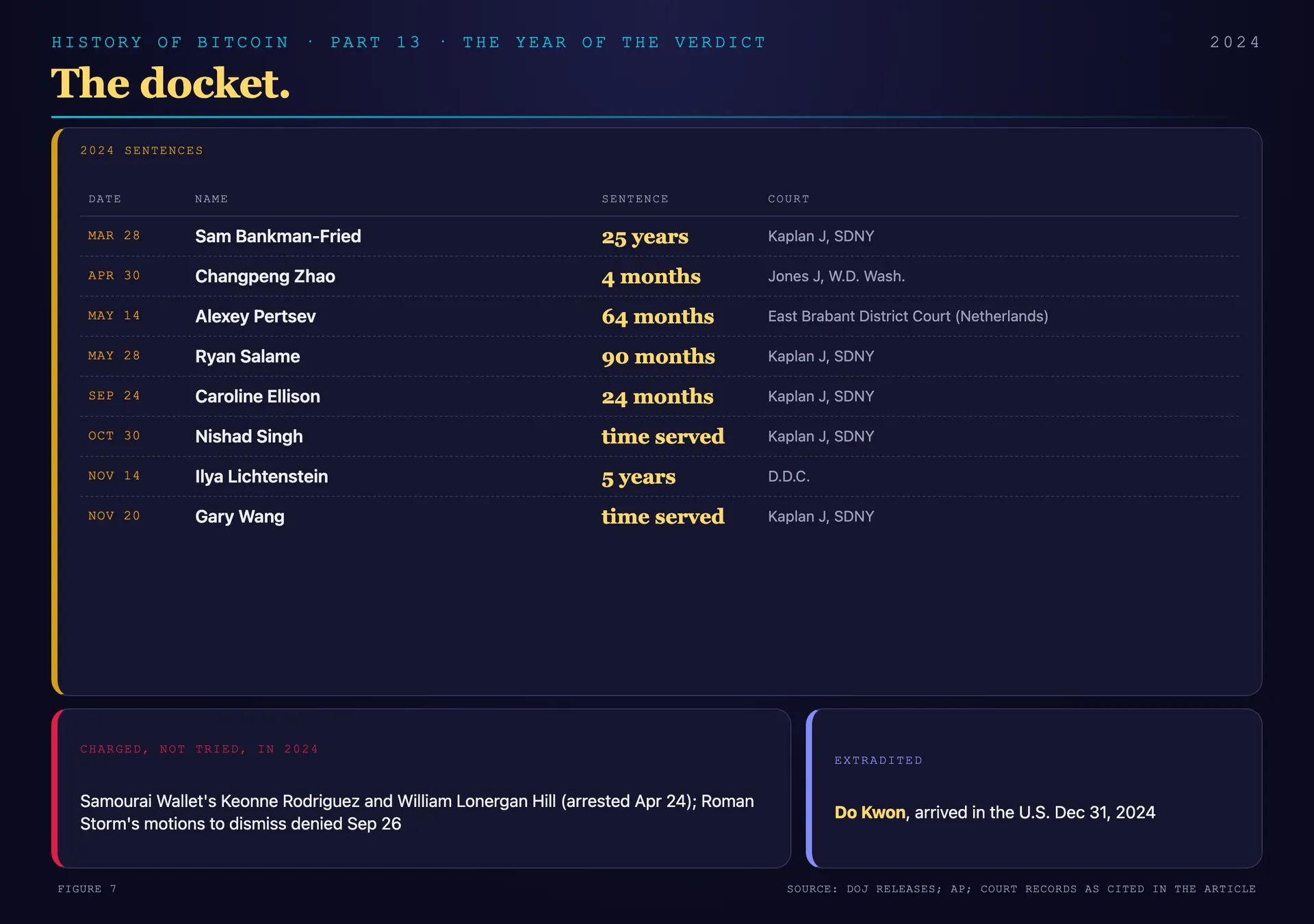
Every 2024 sentence handed to a named figure from the 2022 collapse or the mixer prosecutions. Source: DOJ releases, the East Brabant District Court, and contemporaneous court reporting.
The rest of the docket, in order. Montenegro's courts spent the year passing Do Kwon back and forth; on December 27 the justice minister, Bojan Božović, chose the United States, and Kwon landed there on December 31 and pleaded not guilty in Manhattan two days later.⁸² On June 13 the SEC announced a settlement of over $4.5 billion with Terraform Labs and Kwon, following April's civil fraud verdict.⁸³
Alex Mashinsky pleaded guilty on December 3 to one count of commodities fraud and one of securities fraud, agreeing to forfeit over $48 million; the 12-year sentence belongs to 2025.⁸⁴ The company he founded, whose freeze opened Part 11, had emerged from Chapter 11 on January 31 and begun distributing over $3 billion.⁸⁵
Ilya Lichtenstein got five years on November 14 for laundering the 119,754 BTC hacked out of Bitfinex, Heather Morgan got 18 months on November 18, and Avraham Eisenberg was convicted on April 18 over the $110 million Mango Markets exploit.⁸⁶
Add it up and 2024 is the year the bill arrived for 2022. Every name in the wreckage got a number, in a courtroom, read out loud by a judge.
While the court sat, the machine kept buying
On March 14, 2024, a judge in London read four declarations into the record.
The same afternoon, bitcoin traded above $73,800, the highest price it had ever reached, and Reuters had it on the wire before New York opened.⁸⁷
Two rooms, one day.
I had the court feed in one window and a price chart in the other, from a chair I could not get out of in a hurry. The market did not know the Rolls Building existed. 2024 is the year our industry got comfortable explaining every candle with a headline.
Start with the sellers, because supply is the strange half of this story.
Two of the year's most consequential sellers were not traders at all. One was a German prosecutor's office. The other was the trustee of an exchange that has been dead since 2014.
Between June 19 and July 12, the General Prosecutor of Saxony sold approximately 49,858 BTC through Bankhaus Scheich, assisted by the Federal Criminal Police Office, for gross proceeds of exactly €2,639,683,413.92.⁸⁸ The coins had been provisionally secured in the Movie2k proceeding, and the prosecutor's release calls the sale an emergency measure under the criminal procedure code, taken because of the risk of substantial loss in value.⁸⁹
Traders called it a panic sale. Saxony's prosecutor called it an emergency sale under the code.
Only one of those sentences was written by the seller.
Then July arrived, and with it the oldest ghost in this series. On June 24 the Mt. Gox trustee announced that repayments in BTC and BCH would begin in early July, and distributions went out through designated exchanges on July 5, 16, 24, and 31.⁹⁰ The Block, citing Arkham, counted 47,228.7 BTC moving on-chain on July 5, including 1,545 BTC delivered to Bitbank.⁹¹ Axios, also citing Arkham, had put the estate above 141,000 BTC the week before.⁹²
A transfer is not a sale. The market priced a dump before anyone knew how much creditors sold.
We met that estate in Part 3, back when it was a trading card exchange, and left it in Part 12 as a deadline pushed to October 2024.
The coins from the exchange that died in 2014 started moving the summer the ETFs were buying everything.
Three weeks later the yen carry trade came apart. CoinDesk measured bitcoin down roughly 15 percent against the yen on August 5, worse than its fall against the dollar.⁹³ I have no verified intraday dollar low for that morning, so you get none. An asset marketed all year as an uncorrelated hedge spent that Monday trading like a leveraged bet on Japanese interest rates.
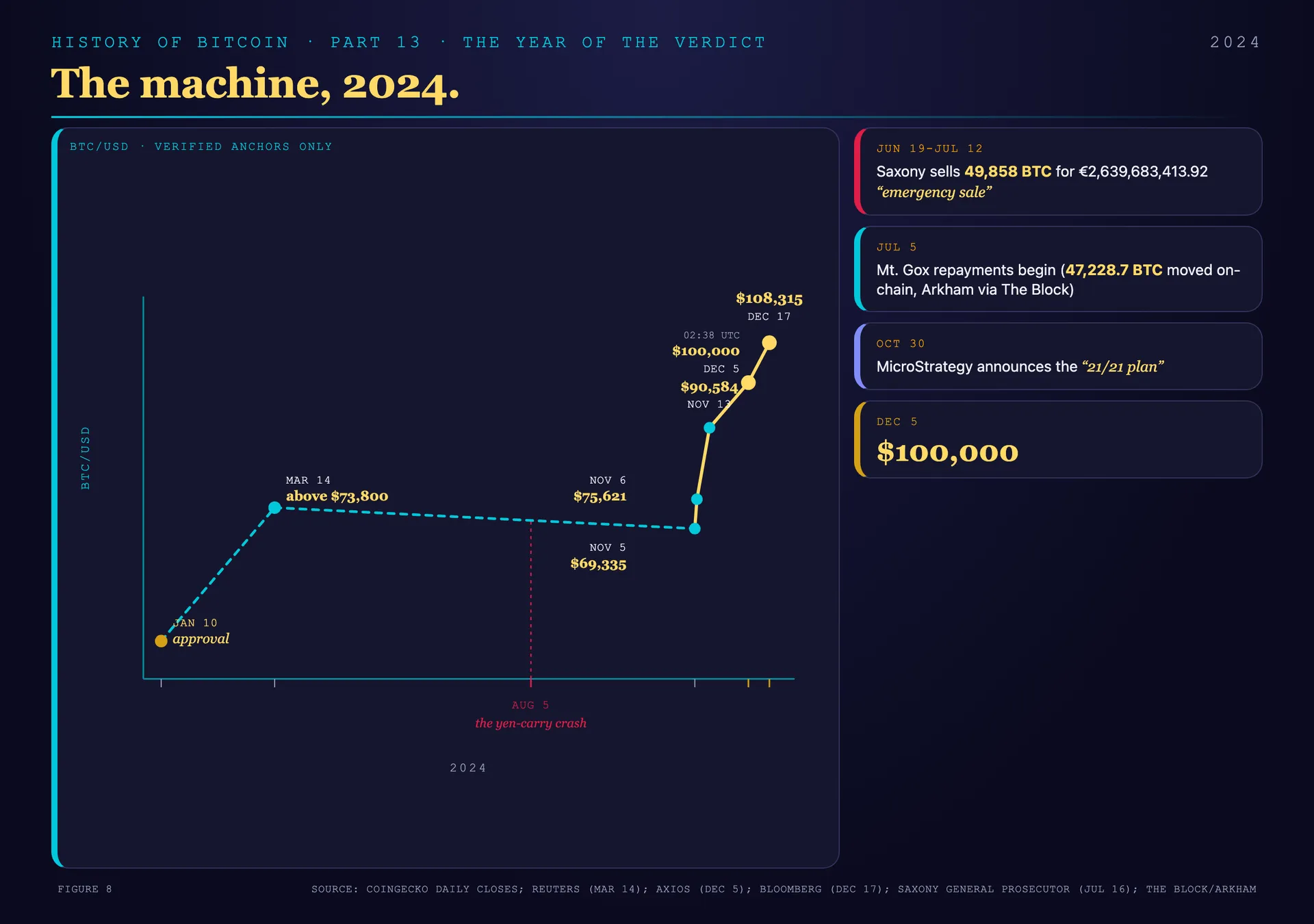
Every mark on this line has a document underneath it, and the price is the least interesting thing on the chart. Source: SEC Release No. 34-99306; Reuters; mempool.space; CoinDesk; Axios; Bloomberg.
On October 30, MicroStrategy announced what it called the 21/21 Plan. Its CEO Phong Le put it this way: "Today, we are announcing a strategic goal of raising $42 billion of capital over the next 3 years, comprised of $21 billion of equity and $21 billion of fixed income securities, which we refer to as our '21/21 Plan.'"⁹⁴
Forty-two billion dollars of other people's money aimed at one asset, announced as a slogan with a nice ring to it!
Part 11B took that machine apart bolt by bolt. I will only note that nobody asked what happens when the equity stops being worth more than the coins.
Meanwhile the people who make the blocks were having a worse year.
Luxor's Hashrate Index put the USD hashprice at $44.43 per petahash per day on May 1 and $44.31 on July 5, closing the second quarter at $49.16, down 56 percent on the quarter and 53 percent on the year.⁹⁵ Seven-day hash rate stood at 604 exahash on May 6, and December closed with hashprice back at $54.29.⁹⁶
The wage halved and the work went up.
Part 11 already told you how that ends. When mining stops paying from inside the network, somebody outside starts paying, and whoever pays sets the terms. In 2022 it was the grid and the equity market. In 2024 it was artificial intelligence.
On June 3, Core Scientific signed contracts with CoreWeave covering about 200 megawatts over twelve years, with estimated cumulative revenue above $3.5 billion.⁹⁷ By November the disclosed commitment had grown to roughly 500 megawatts and $8.7 billion in potential revenue.⁹⁸ Others followed. Core Scientific itself had filed Chapter 11 in December 2022 with its stock down 98 percent. Eighteen months later it was selling megawatts to a cloud company instead of hashes to a blockchain.
Same buildings. Same substations. Different customer.
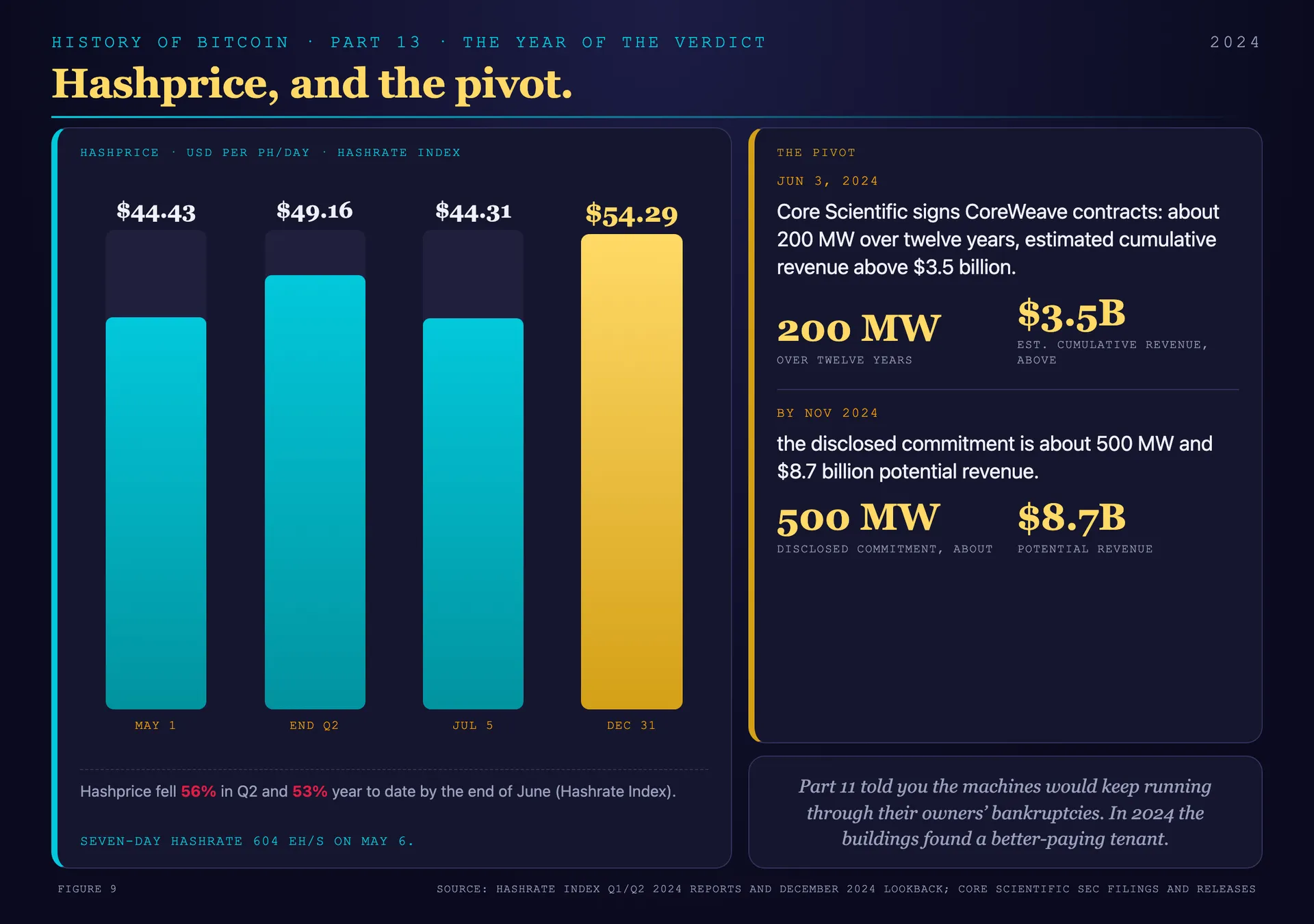
The miner's wage fell by more than half in the second quarter, and the industry's answer was to rent the buildings to somebody else. Source: Luxor Hashrate Index; Core Scientific SEC filings.
Disclosure: I co-founded GorillaPool, which mines BSV.⁹⁹ I have skin in the question of whether a block can pay for itself out of transactions instead of subsidies. 2024 did not settle it.
Then the price did what prices do when sellers run out.
BTC first crossed $100,000 at about 02 UTC on December 5, by Axios' timing.¹⁰⁰ Bloomberg recorded a fresh record of $108,315 on December 17.¹⁰¹ CoinGecko closed the year at $93,508, up 121.5 percent.¹⁰²
A German prosecutor and a Japanese bankruptcy trustee sold billions of dollars of bitcoin into that year. It still doubled.
Enter the candidate who called it a scam
The regulatory year opened in a courtroom, with the government losing pieces of its own case.
On March 27, Judge Katherine Polk Failla let the SEC's exchange, broker and staking claims against Coinbase proceed, and dismissed the claim over its self-custody Wallet in a sentence: "As a consequence, the Complaint does not plausibly allege that Coinbase is a broker with respect to its Wallet service."¹⁰³ On June 28, Judge Amy Berman Jackson let the bulk of the SEC's Binance case move forward while dismissing the claims over third-party secondary BNB sales, BUSD and Simple Earn.¹⁰⁴
Then August 7. Judge Analisa Torres ordered Ripple to pay a civil penalty of $125,035,150. The SEC had asked for $876,308,712 in disgorgement, $198,150,940 in prejudgment interest, and an $876,308,712 civil penalty.¹⁰⁵
The agency asked for nearly two billion dollars and collected six percent of it.
The Wells notices kept going out anyway, each public because the company said so: Uniswap on April 10, Robinhood in a May 6 Form 8-K, OpenSea on August 28, Crypto.com in October when it sued.¹⁰⁶ A company saying it got a Wells notice proves the company said it. The SEC confirms nothing.
Congress, meanwhile, discovered opinions. The House passed H.J.Res.109 on May 8 to kill the SEC's custody accounting bulletin, the Senate followed May 16, and President Biden vetoed it on May 31.¹⁰⁷ On May 22 the House passed FIT21, the first market structure bill ever to clear a chamber, 279 to 136, with 71 Democrats voting yes.¹⁰⁸
Somebody was watching those votes, and he had been on the other side of this issue his whole public life.
Part 9 has the receipts. On July 11, 2019, the sitting President posted: "I am not a fan of Bitcoin and other Cryptocurrencies, which are not money, and whose value is highly volatile and based on thin air. Unregulated Crypto Assets can facilitate unlawful behavior, including drug trade and other illegal activity...."¹⁰⁹ On June 7, 2021, out of office, he told Fox Business: "Bitcoin, it just seems like a scam."¹¹⁰
Both of those sentences have a July appointment with destiny, or density, depending who you ask...
The turn started at a dinner. On the evening of May 8, 2024, at Mar-a-Lago, at an event for buyers of his NFT collection, Trump talked about crypto in a way nobody had heard. CoinDesk, quoting attendee video, has him saying "If you're in favor of crypto you're gonna vote for Trump because they want to end it."¹¹¹
Thirteen days later the campaign began taking crypto donations through Coinbase Commerce, billed as a first for a major-party nominee.¹¹² Robert F. Kennedy Jr. had been taking crypto for months, so Trump's statement is a superlative, not a fact, and maybe it doesn't matter since RFK joined the Trump camp anyways.¹¹³
On May 25, at the Libertarian National Convention in Washington, Trump promised that on day one he would commute Ross Ulbricht's sentence to time served.¹¹⁴
That is where the Ulbricht promise originates. Nashville was the encore.
July 27, 2024, Music City Center, the Bitcoin 2024 stage. From CoinDesk's contemporaneous partial transcript: "On day one, I will fire Gary Gensler," and then, after the room detonated, "I didn't know he was that unpopular. Let me say it again: on day one, I will fire Gary Gensler."¹¹⁵
Then the promise the year had been walking toward: "But for too long our government has violated the cardinal rule that every bitcoiner knows by heart: Never sell your bitcoin. … it will be the policy of my administration, United States of America, to keep 100% of all the bitcoin the U.S. government currently holds or acquires into the future, we'll keep 100%. … This will serve, in effect, as the core of the strategic national bitcoin stockpile."¹¹⁶
The candidate who called it a scam in 2021 promised in 2024 never to sell it.
He told the room the United States would be "the crypto capital of the planet and the Bitcoin superpower of the world," and repeated the Ulbricht promise.¹¹⁷
So how does a man who called it a scam end up delivering that speech to that room?
David Bailey, chief executive of BTC Inc, which owns the conference, said on the Galaxy Brains podcast on July 17 that he and his associates secured the appearance; Bloomberg Law reported his account.¹¹⁸ Trump thanked Bailey for the invitation from the stage.¹¹⁹ Alongside it ran a fundraiser, and DL News reported the advertised top price: $844,600 for a roundtable seat, the maximum legal combined contribution, with photographs at $60,000, or $100,000 per couple.¹²⁰ Bailey said the weekend raised $25 million; The Block reported $21 million.¹²¹
The $844,600 bought a seat at the fundraiser, not the speaking slot. No source establishes a speaking fee.
The questions are fair anyway, built entirely out of the documents above. What is the going rate for a policy commitment from a presidential nominee? If there is no rate, and he simply changed his mind about an asset he called thin air five years earlier, what changed it? When a conference delivers a candidate to a stage and a fundraiser delivers him to a donor on the same weekend in the same city, what did the industry buy?
I asked a version of that three days later, in my CoinGeek column of July 30, 2024: "The recent BTC 2024 Conference in Nashville became a platform for political grandstanding, adding to the troubling trend of leveraging Bitcoin and 'crypto' rhetoric for electoral gains and creating another entrenched special interest group in the process."¹²²
That was my opinion then, and it is now.
On July 31, Senator Lummis introduced S.4912, the BITCOIN Act: the Treasury would purchase not more than 200,000 bitcoin per year for five years, one million coins in all, held at least twenty years.¹²⁵
One million coins, bought by the same institution that spent the previous decade seizing them!
The money followed the mouth. Fairshake and its affiliated PACs put more than $133 million into 68 congressional races, with reported receipts running from $162 million to $203 million depending on whether you count Andreessen Horowitz contributions twice.¹²⁶ In Ohio, the affiliate Defend American Jobs spent about $40 million against Sherrod Brown, chairman of the Senate Banking Committee, who lost.¹²⁷
Whether crypto money bought the election is an opinion, a popular one, not a finding. Documented is the spend, the races, and the chairman who is no longer the chairman.
Trump won on November 5.¹²⁸ Bitcoin closed that day at $69,335 and closed November 13 at $90,584 on CoinGecko's daily series.¹²⁹
Then the personnel, where a promise becomes an institution.
Cantor custodies Tether's Treasury reserves, a relationship Part 8B and the 9/11 special edition walked through in detail.
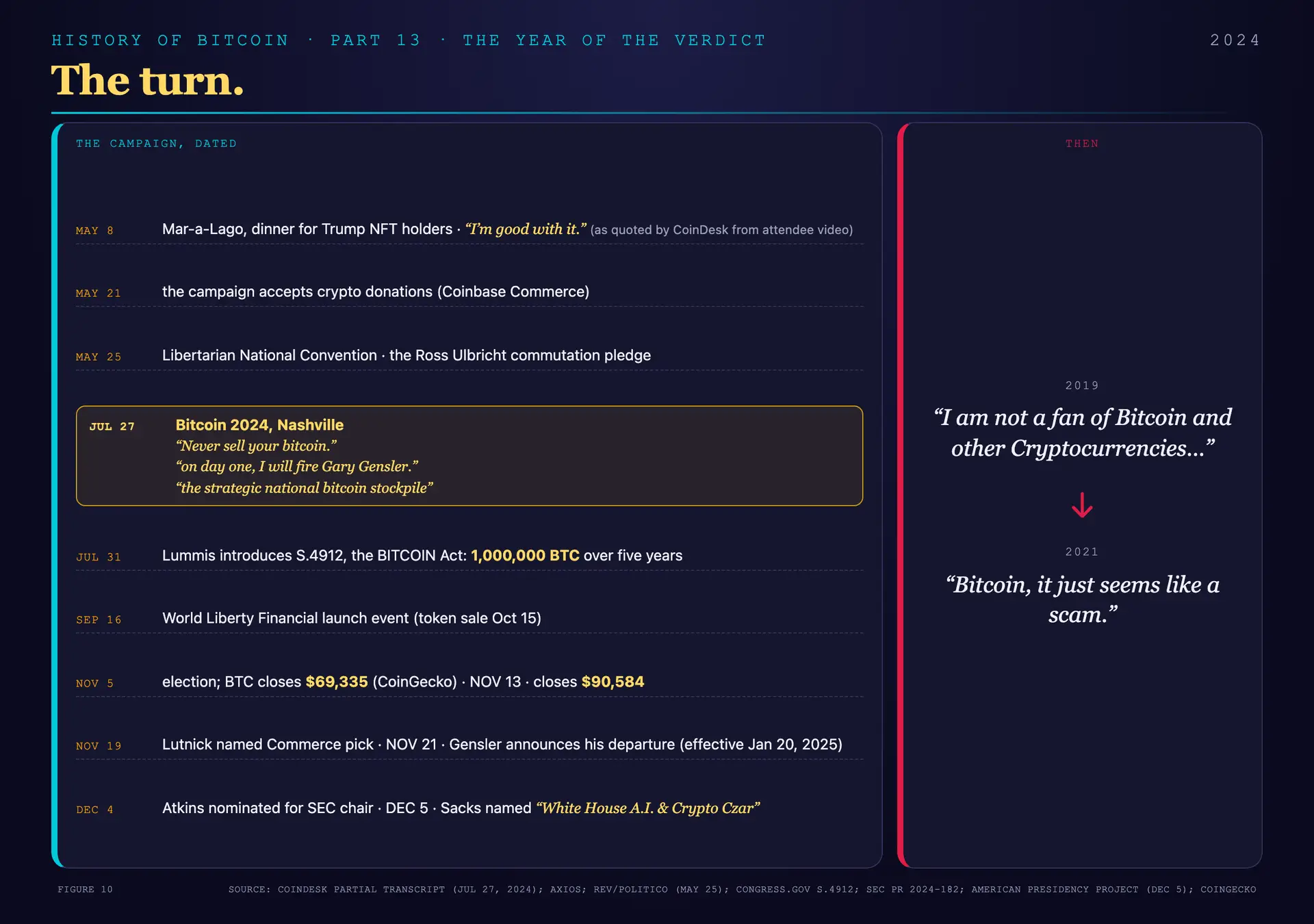
Seven months from an NFT dinner to a White House job title, every promise on the record. Source: CoinDesk's Nashville partial transcript; C-SPAN; House roll calls; the American Presidency Project.
In eleven months, an asset class went from being sued by the government to staffing it.
Bitcoin has never been captured by the people who attacked it in public. It gets captured by the people who arrive with a check and a compliment.
So we keep asking, and we keep the receipts. Who paid for the room. Who got the seat. Who gets 75 percent of what.
BSV, BCH, and everything else
Eleven days after the trial opened in London, the other Bitcoin published a rulebook.
Part 12 left you with that promise and a date. On February 16, 2024, the BSV Association announced the implementation of the Network Access Rules, Digital Asset Recovery, and a reimplemented Alert System. The Association's own definition of the rules is dry as toast: "The Network Access Rules is the set of rules regulating the relationship between the BSV Association and the nodes on BSV. It details their duties and obligations to the network and their relationship with the Association."¹³⁴ The same release said Alert System directives could include "freeze, unfreeze, or reassign commands for transaction outputs," and quoted Stewardship Director Connor Murray: "These updates represent a significant milestone in our journey to stay true to the vision of BSV Blockchain."¹³⁵
I gave you my position on all of that last installment and I have not moved off it. Build it, document it, watch it like a hawk.
Six days later, the Association announced it was testing the thing the whole argument was supposed to be about.
On February 22, 2024, it said Teranode had entered technical testing and would let BSV operate at "upwards of 1.1m transactions per second (TPS)," with an alpha goal of sustaining "one million BSV transactions per second (1M TPS) throughout the testing duration" for two to six months "in preparation for the production rollout."¹³⁶ A March 20 Association article promised "a full node release later in 2024."¹³⁷ On May 31 it reported six AWS-hosted nodes in Ireland, Central Canada, Seoul, North Virginia, Oregon, and Mumbai, running on more than 500 machines, and said the setup "sustained an impressive average throughput exceeding 1 million transactions per second (TPS) throughout the testing period" for two weeks.¹³⁸
The same write-up calls that setup a "private network environment."
The closest thing to an outside account came later, from the vendor. In March 2026 AWS published an engineering write-up of the build on its own Web3 blog, under the name of one of its solutions architects: six AWS Regions on three continents, a two-week benchmark, "zero transaction loss at a sustained 1 million TPS across the global network of competing nodes," and a comparison to the old reference node's tested peak of 13,614 TPS, which it put at 66.67 times.¹³⁹ That is a supplier describing its customer's result, with the customer's CTO quoted in it, so it is not an audit. It is the first account of the machine from anyone outside the Association, and it matches the Association's numbers.
Those are the Association's numbers, produced by the Association, in a lab the Association built. That is a benchmark, and benchmarks are how engineering gets done. But nobody observed a million transactions per second on the BSV network in 2024, because no such software was running on it. What shipped by December 31 was private alpha testing. The Association would later call October 14, 2025 the "first public release," nineteen months after the press release that started the countdown.¹⁴⁰
The chain kept running on the software it already had, and people kept putting things on it. Disclosure first: 1Sat Ordinals was created by my team, and the public 1sat-server was maintained by GorillaPool.¹⁴¹ CoinGeek, where I was Chief Bitcoin Historian, reported on July 31, 2024 that the 1Sat Ordinals Discord had crossed a thousand users that week, and embedded a July 28 GorillaPool post saying transactions were "creeping up because of POW20 mining on @1SatOrdinals."¹⁴² On December 2, WhatsOnChain announced beta NFT API support for the standard.¹⁴³
And now, a block:
On September 26, 2024, at 18:23 UTC, TAAL mined block 863,817. It carried 873 transactions and displays as four gigabytes, the only September 2024 entry among the hundred largest blocks ever mined on the network.¹⁴⁴ Hold that next to December 2023's block 822,498, which packed 89,020 transactions into 3,999,998,152 bytes. Same displayed size, one percent of the transaction count! Four gigabytes across 873 transactions is roughly four and a half megabytes apiece, which means whatever rode in that block, it was not payments. Likely JPEGs in the frenzy of 1Sat Ordinals.
The ceiling was never the interesting part. What people choose to put under it is.
Then the ruling, and the question of who said what afterward. I could not find a first-party Association statement on March 14 or on May 20. What I could find is a sentence WIRED added to its judgment story the next day, from Cyrille A. Albrecht, managing director at the Association: "We will always value the contributions Dr Craig Wright has made as a leading expert on blockchain technology. However, our focus is, and always has been, to promote and sustain the enterprise-grade evolution of the BSV blockchain."¹⁴⁵ Reddit users spent May saying nChain was quietly scrubbing Wright material from its site; no archived before-and-after comparison turned up, so it stays where it started.¹⁴⁶ Critics also said the capable developers had all left. No roster, no departure notices, no causal evidence.
What I did write, seventeen days after the March declarations, was a column called "Resurrection." That is me, at Easter, in the worst professional month of my life: "Being a BSV advocate has felt a lot like being a martyr for the last few years. Hated by the small blockers, hated by the mainstream, mocked for believing Bitcoin was always scalable and uninvited from all the seats at the high table. But we persist because we believe Bitcoin was always supposed to be for more than just obtaining more wealth and more power."¹⁴⁷
Every chain got a verdict in 2024. Only one got it from a judge.
Bitcoin Cash spent the year answering the question the whole civil war was fought over, and it answered with an algorithm.
CHIP-2023-04, "Adaptive Blocksize Limit Algorithm for Bitcoin Cash," was owned by the pseudonymous bitcoincashautist and implemented in Bitcoin Cash Node by Calin Culianu, whose merge request opened on September 23, 2023 and merged that December.¹⁴⁸ Activation was not set at a height. It was set at a clock: the rules took effect once the median time past of the most recent eleven blocks reached Unix timestamp 1715774400, which is May 15, 2024 at 12:00 UTC.¹⁴⁹
By the end of that spring, both surviving big-block chains had done the same thing. BSV took the cap out of the consensus rules and handed it to miners as a policy setting. BCH took it out and handed it to a formula. Neither one settled the argument Part 7 opened when 8MB became 32MB became a schism. They just both got out of the business of having it in public. Seven years late!
BCH also halved first. Its block 840,000 arrived on April 4, 2024, cutting the subsidy from 6.25 to 3.125 BCH, sixteen days before BTC reached the identical height, and it closed the year around $434 by one aggregator's December 31 listing, which I will name rather than dress up as an exchange close: Best Crypto Checker.¹⁵⁰
Everything else, in the time it deserves.
Ethereum shipped Dencun at epoch 269568 on March 13, 2024 at 13 UTC, and the rollups got cheap overnight.¹⁵¹ Median transaction costs on the major layer twos fell by an order of magnitude within days, by every dashboard the trade press was quoting that week.¹⁵²
The SEC approved the spot ether ETF listings on May 23 and the funds began trading on July 23.¹⁵³ On Solana, a launchpad called pump.fun teased itself into existence on January 10 with a post promising a coin "instantly tradeable without having to seed liquidity," and by December 19 Decrypt reported, citing Dune, that it had generated more than $317 million; over on Base, L2Beat put total value secured at $7.54 billion in October.¹⁵⁴
The regulators kept swinging and mostly kept missing. Uniswap Labs disclosed a Wells notice on April 10 and told the Commission in May that "The SEC's legal theories are weak, and wrong."¹⁵⁵ Consensys sued the SEC on April 25; the SEC's staff closed its "Ethereum 2.0" investigation on June 18 without recommending charges, which is not the same thing as the Commission holding that ether is not a security; and on June 28 the SEC sued Consensys anyway over MetaMask staking and swaps.¹⁵⁶ Those are allegations and filings, not findings.
Elsewhere: Hong Kong listed six spot bitcoin and ether ETFs on April 30 to roughly HK$87.6 million, about US$11.2 million, of first-day turnover.¹⁵⁷ MiCA's stablecoin titles took effect across the European Union on June 30 and the rest of the regulation applied from December 30.¹⁵⁸ And on December 18, El Salvador reached a staff-level agreement with the IMF on a facility of about $1.4 billion, under which "Acceptance of Bitcoin by the private sector will be voluntary and public sector's participation in Bitcoin-related activities will be confined."¹⁵⁹
Three years after a central American president made bitcoin legal tender from a stage, the loan came with a clause about confining it. Nobody in the United States noticed. They were busy.
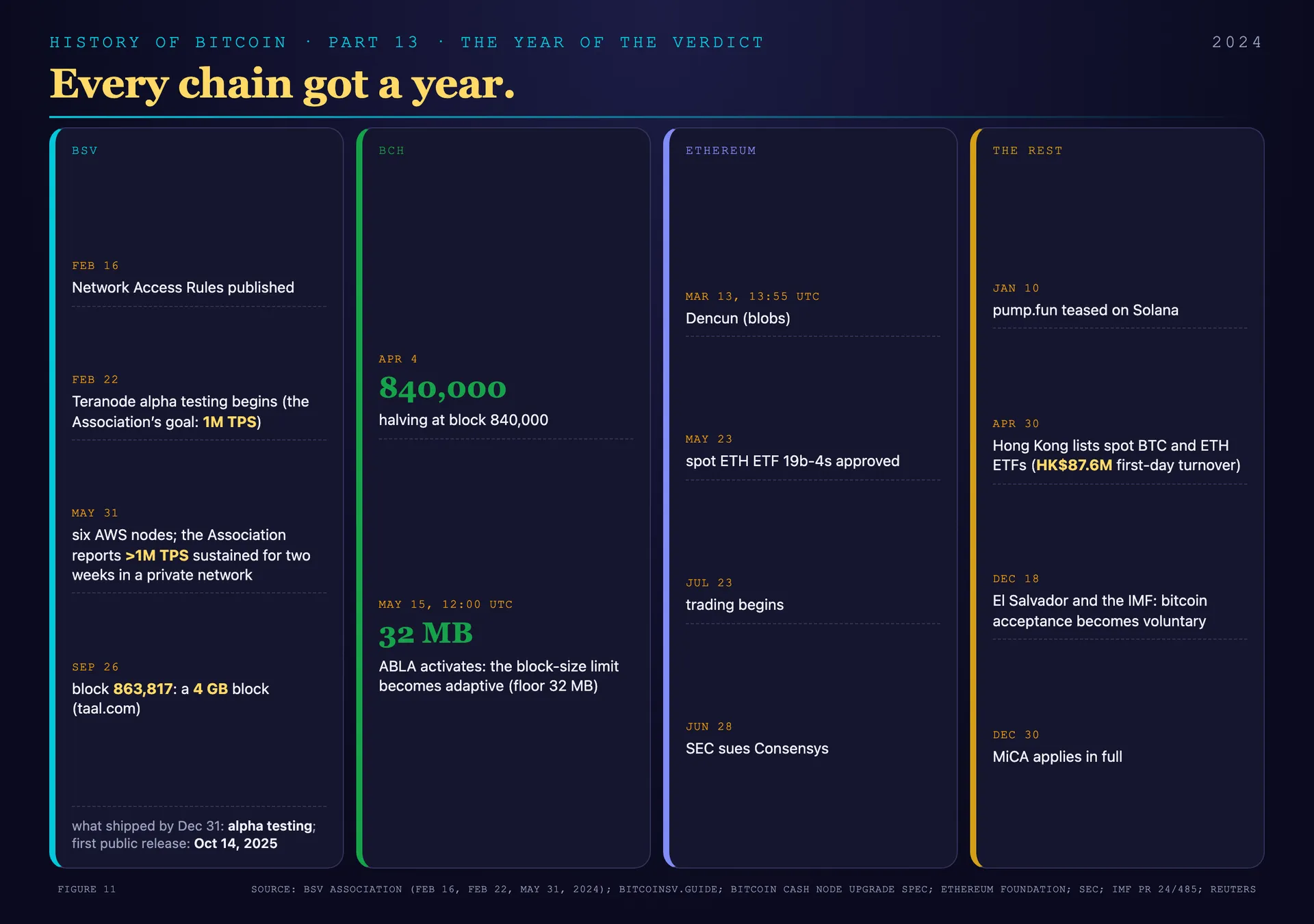
Five ledgers, five different mechanisms for settling the same argument about who sets the rules: a rulebook, an algorithm, a hard fork, a regulator, and a parliament. Source: BSV Association, February 16, 2024; Bitcoin Cash Node 2024-05-15 upgrade specification; Ethereum Foundation Dencun announcement; Regulation (EU) 2023/1114, Article 149.
Everything came due
Twelve installments of this series spent their time lighting fuses. This is the year they reached the powder.
Part 12 closed on a registration statement that named an individual as a risk factor without ever explaining why a London lawsuit belonged in a prospectus. In January the fund went live. Twenty-five days later the man it named was on the stand in London.
Every road in this series led to that courtroom. Parts 4B through 12 built the docket: the Australian tax proceedings, the Kleiman suit, the Norwegian trial, the libel actions, the database rights claim. In March a judge said four sentences out loud, in May he wrote them down, in July he sent the papers to the prosecutors, and in December he suspended a prison sentence. Ten chapters of buildup, one calendar year of consequence.
Part 10 told you about a door Taproot left open in 2021, and Part 12 told you who walked through it in 2023. In 2024 the halving block itself carried a new token protocol, which is about as loud as a chain can say that the argument is over. The filter fight that Ordisrespector started is still going, and it has a number now. That is a 2025 chapter.
Part 8B described a machine: exchanges, tokens, leverage, and men who believed the machine was them. This year the operators got their sentences, and the spread between them is the whole moral of the story.
Parts 2 and 3 introduced an exchange in Tokyo that died in 2014 and never quite finished dying. Ten years later the trustee started paying people back, and the market panicked about coins that moved and mostly were not sold.
Part 11 argued that mining was drifting toward whoever could buy power at industrial scale. The subsidy halved, hashprice collapsed, and the industry found a customer with deeper pockets than Bitcoin: artificial intelligence. Part 11B showed you the convertible-note machine that lets a software company buy coins with other people's money. In October it announced it would run the machine again, at ten times the size!
Part 9 has a man on the record in 2021 calling bitcoin a scam. In July 2024 the same man promised a Nashville arena he would never sell the government's coins, and in November he won. Names from 8B and from the 9/11 special edition turned up in his cabinet, and the surveillance lineage from that special edition turned up in the charges against the people who wrote privacy code.
Part 7 told the story of a block size argument that split a chain twice. In May 2024 one of the survivors handed the number to a formula and stopped arguing.
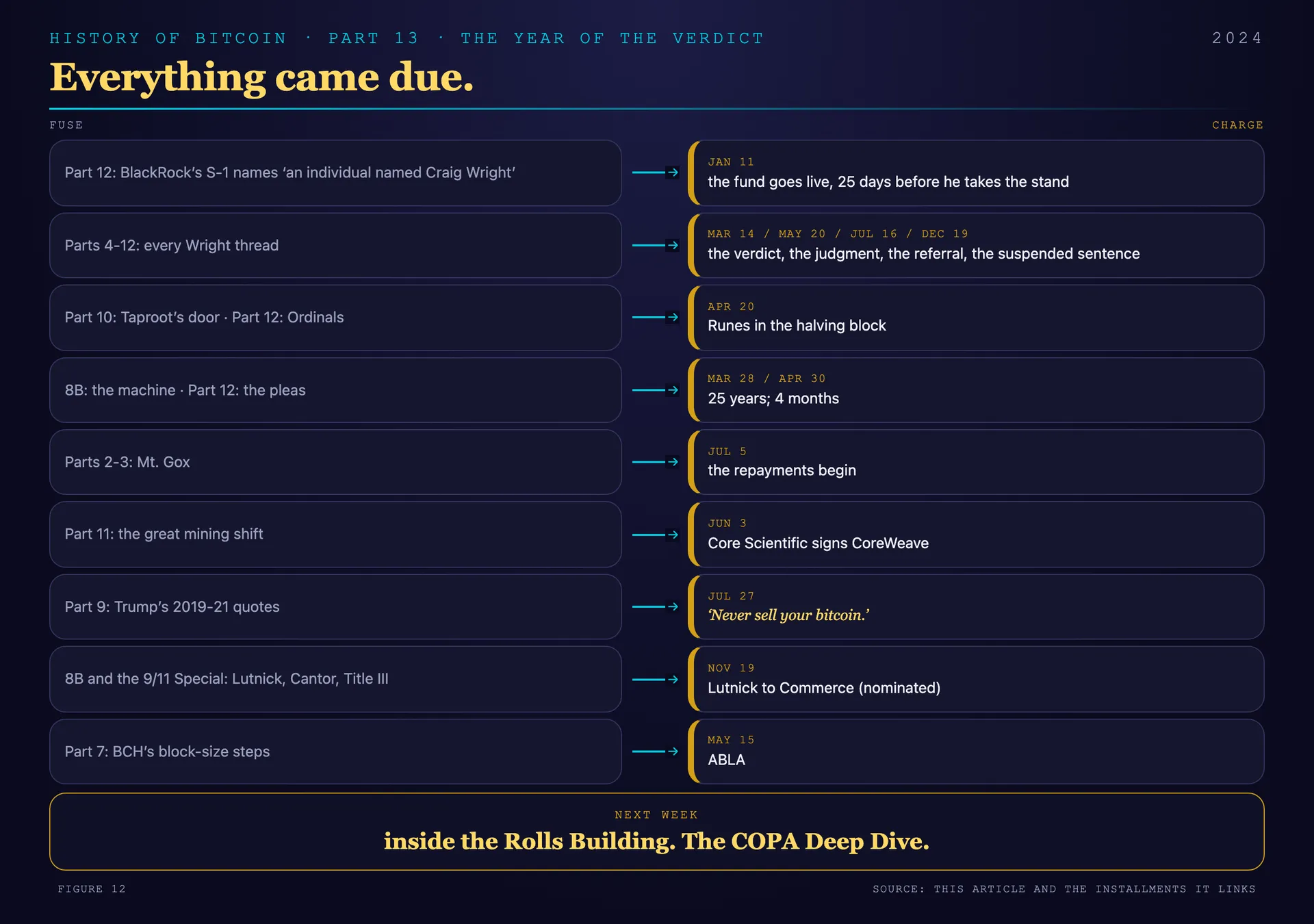
Every line pairs a setup from an earlier installment with the 2024 event that paid it off. The verdict is the only one that needed a judge. Source: The Written History of Bitcoin, Parts 2 through 12, and the 2024 record as cited throughout this installment.
Which leaves the fuses lit in this chapter and still burning. A strategic stockpile promised on a stage and not yet defined in law. A filter fight with a new number. Pardons hinted at in Nashville and delivered later. And the story I have been walking past for this entire installment, because it does not fit inside a survey of a year...
I have written a lot of Bitcoin history by now, and no year has ever handed me this much at once. 2024 did not introduce a single new idea. It just collected on everything the previous sixteen years had promised or threatened, all at once.
Next week we go inside the Rolls Building: the drives, the CCTV, the 47 documents, and the man who was not in the room. The COPA Deep Dive.
Footnotes
¹ the surgery thread, verbatim, post, X, February 3, 2024.
² the cough, the impaction, the surgery and the mesh, verbatim, post, X, February 3, 2024.
³ the canceled London trip in his own words, verbatim, post, X, February 3, 2024.
⁴ venue, judge and the February 5, 2024 opening, [2024] EWHC 1198 (Ch), National Archives, May 20, 2024.
⁵ the day one recap, verbatim, post, X, February 5, 2024.
⁶ the deleted post transcribed, SEC's account hacked to push fake ETF news, The Register, January 9, 2024.
⁷ the takeover, the timings and the finding of no system access, Statement on the @SECGov X account, U.S. Securities and Exchange Commission, January 12, 2024.
⁸ the disabled multi-factor authentication and the 2023 staff request, SEC statement on the @SECGov X account, U.S. Securities and Exchange Commission, January 22, 2024.
⁹ the unsealed indictment and the charges, FBI arrests Alabama man over the SEC hack, U.S. Department of Justice, October 17, 2024.
¹⁰ the approval order, Release No. 34-99306, U.S. Securities and Exchange Commission, January 10, 2024; and the eleven products and the January 11 open, SEC approves bitcoin ETFs, Associated Press, January 10, 2024.
¹¹ the chairman's statement, verbatim, Statement on the approval, U.S. Securities and Exchange Commission, January 10, 2024.
¹² first-day turnover including the GBTC share, Bitcoin ETF trades top $4 billion, Bloomberg Law, January 11, 2024; and IBIT reaching $10 billion in 39 trading days, IBIT hits $10B faster than any ETF, ETF.com, March 2024.
¹³ 2024 cumulative net inflows on Farside data, Crypto Market Report Q4 2024, TokenInsight, Q4 2024.
¹⁴ the custody-concentration thread as the origin of the "paper bitcoin" complaint, r/Bitcoin discussion, Reddit, January 26, 2024; and the custody representation and disclosed risks, iShares Bitcoin Trust prospectus, Form 424B3, SEC EDGAR, filed January 10, 2024.
¹⁵ the risk-factor paragraph naming Craig Wright, verbatim, iShares Bitcoin Trust prospectus, Form 424B3, SEC EDGAR, filed January 10, 2024.
¹⁶ the eve-of-approval forecast, verbatim, A glimpse into the future of Bitcoin, CoinGeek, January 9, 2024.
¹⁷ his accounts of intelligence staff and hidden microphones as quoted, The street fighter, The Guardian, April 5, 2024.
¹⁸ his claimed association, Christen Ager-Hanssen, Wikipedia, citing Dagens Næringsliv, October 27, 2023; and the firm's founding and the Weinstein operation, Harvey Weinstein's Army of Spies, The New Yorker, November 6, 2017.
¹⁹ the appointment, nChain appoints Ager-Hanssen group CEO, PRNewswire syndicate, November 22, 2022.
²⁰ the Kleiman verdict, Roche Freedman secures $100 million verdict, PR Newswire, December 6, 2021; and the meetings and the recordings, Roche's response, reported, Cointelegraph, August 29, 2022.
²¹ Roche's statement, verbatim as reproduced the same day, Roche's response, reported, Cointelegraph, August 29, 2022.
²² the groggy account, the lack of proof and the withdrawals, Crypto Investors Play Rough, The New York Times, June 18, 2023.
²³ the denial and the later account of the same operation, Crypto Investors Play Rough, The New York Times, June 18, 2023; and The street fighter, The Guardian, April 5, 2024.
²⁴ the operative described, The street fighter, The Guardian, April 5, 2024; and the site's Black Cube account and its concession, Kyle Roche was not the first, AgerHanssenExposed.com, January 31, 2024.
²⁵ the mock trial, the mock judgment and the Ayre email, verbatim from paragraph 64, [2024] EWHC 1198 (Ch), National Archives, May 20, 2024.
²⁶ nChain's two statements, verbatim, Statement on departure and nChain Company Statement, nChain via Internet Archive, September 29 and 30, 2023.
²⁷ his posts, verbatim from the archived captures, @agerhanssen and @agerhanssen, X via Internet Archive. <!-- lint:allow presence:tweet-embed (footnote citation of an archived post, not a tweet discussed in the prose; no embed intended) -->
²⁸ Matthews' sworn testimony as reported, verbatim, Matthews' testimony reported, CoinGeek, February 26, 2024; and paragraph 67, [2024] EWHC 1198 (Ch), National Archives, May 20, 2024.
²⁹ the site's account of September 27, 2023, The failed nChain coup, AgerHanssenExposed.com, March 8, 2024.
³⁰ the earliest located post describing the server room, @ager_hanssen, X, February 28, 2024, with no matching post found in September to December 2023. <!-- lint:allow presence:tweet-embed (footnote citation of a parody account, not a tweet discussed in the prose; no embed intended) -->
³¹ the "Bad Actor" allegation, its rejection and the finding, paragraphs 414 to 418, [2024] EWHC 1198 (Ch), National Archives, May 20, 2024.
³² the contempt findings and sentence, [2024] EWHC 1230 (Comm), National Archives, May 3, 2024.
³³ the solicitors and the timing, paragraphs 27 and 28, [2023] EWHC 3287 (Ch), National Archives, December 15, 2023.
³⁴ The hearing-date line, COPA v Wright [2024] EWHC 1198 (Ch), National Archives, May 2024.
³⁵ Counsel as listed on the face of the judgment, COPA v Wright [2024] EWHC 1198 (Ch), National Archives, May 20, 2024.
³⁶ Paragraph 7, verbatim, COPA v Wright [2024] EWHC 1198 (Ch), National Archives, May 20, 2024.
³⁷ Kurt Wuckert Jr.'s post, verbatim, status 1756384645413847514, X, February 10, 2024.
³⁸ Kurt Wuckert Jr.'s post, verbatim, status 1759212796846248322, X, February 18, 2024.
³⁹ Kurt Wuckert Jr., "Clash of cultures", CoinGeek, February 20, 2024.
⁴⁰ Kurt Wuckert Jr., "Experts agree", CoinGeek, February 27, 2024.
⁴¹ The judgment's appendix PDF, Judiciary of England and Wales, May 20, 2024.
⁴² Paragraph 2, verbatim, COPA v Wright [2024] EWHC 1198 (Ch), National Archives, May 20, 2024.
⁴³ Paragraph 921, verbatim, COPA v Wright [2024] EWHC 1198 (Ch), National Archives, May 20, 2024.
⁴⁴ The closing words of paragraph 928, verbatim, COPA v Wright [2024] EWHC 1198 (Ch), National Archives, May 20, 2024.
⁴⁵ Paragraphs 116 and 117, COPA v Wright (Rev1) [2024] EWHC 1809 (Ch), National Archives, July 16, 2024.
⁴⁶ The publication order at paragraph 182, COPA v Wright (Rev1) [2024] EWHC 1809 (Ch), National Archives, July 16, 2024.
⁴⁷ Costs and interest at paragraphs 184 to 190, COPA v Wright (Rev1) [2024] EWHC 1809 (Ch), National Archives, July 16, 2024.
⁴⁸ Paragraph 199, verbatim, COPA v Wright (Rev1) [2024] EWHC 1809 (Ch), National Archives, July 16, 2024.
⁴⁹ Arnold LJ's refusal, sealed November 29, 2024 and certified totally without merit, at paragraph 33 of COPA v Wright [2024] EWHC 3315 (Ch), National Archives, December 19, 2024.
⁵⁰ Claim BL-2024-001495 and its pleaded value at paragraph 56, COPA v Wright [2024] EWHC 3315 (Ch), National Archives, December 19, 2024.
⁵¹ The five grounds, the non-attendance, and the absence finding, verbatim, COPA v Wright [2024] EWHC 3315 (Ch), National Archives, December 19, 2024.
⁵² The "fled" framing traced to r/btc and r/bsv commentary of December 18 and 19, 2024, set beside COPA v Wright [2024] EWHC 3315 (Ch), National Archives, December 19, 2024.
⁵³ "Dr Wright appeared in person by remote link," verbatim, COPA v Wright [2024] EWHC 3316 (Ch), National Archives, December 20, 2024.
⁵⁴ The strike-out, the suspended term, and the £145,000 costs order, verbatim, COPA v Wright [2024] EWHC 3316 (Ch), National Archives, December 20, 2024.
⁵⁵ Paragraph 79, verbatim, COPA v Wright [2024] EWHC 3316 (Ch), National Archives, December 20, 2024.
⁵⁶ Block 840,000, timestamp 1713571767, mempool.space block API, April 20, 2024.
⁵⁷ ViaBTC as miner, the subsidy step, and fees of 37.6256 BTC worth $2,399,135, Bitcoin's average transaction fee comes down, The Block, April 22, 2024; and the fee series for heights 839,990 to 840,020, mempool.space, April 2024.
⁵⁸ Runes activating at block 840,000 and Rune #0's mint window, the ord repository, GitHub, 2024.
⁵⁹ 1,257 BTC in network fees on April 20, Weekly Market Commentary, Coinbase Institutional, April 26, 2024; and the YCharts day totals, The Block, April 22, 2024.
⁶⁰ The epic sat auction, 2024 Bitcoin Mining Review, NiceHash, 2024.
⁶¹ The Runes fee total and its five-day plateau, State of the Network, Issue 259, Coin Metrics, 2024.
⁶² The monthly inscription counts, 2024 Half-Year Report, Binance Research, 2024; and the Q2 marketplace-volume decline, 2024 Q2 Crypto Industry Report, CoinGecko, 2024.
⁶³ The three templates and their fees, OCEAN adds block template selection option, Medium, February 2024.
⁶⁴ PR #28408 opened September 5, 2023, closed unmerged January 5, 2024, with #29187, #29520, #28217 and #29942 closed October 15, 2024, pull request 28408, GitHub, 2024.
⁶⁵ DATUM's local template construction, datum_gateway, GitHub; and OCEAN pool's DATUM is live, Blockspace Media, October 16, 2024.
⁶⁶ BIP-110, "Reduced Data Temporary Softfork," bip-0110.mediawiki, GitHub, December 3, 2025.
⁶⁷ The 300-month sentence and the $11,020,000,000 forfeiture judgment, Samuel Bankman-Fried Sentenced to 25 Years, DOJ, March 28, 2024.
⁶⁸ Damian Williams, verbatim, Samuel Bankman-Fried Sentenced To 25 Years, SDNY, March 28, 2024.
⁶⁹ The findings and Kaplan's remarks, as transcribed by the Associated Press, March 28, 2024.
⁷⁰ Kaplan on the testimony, as transcribed by TIME, March 28, 2024.
⁷¹ Salame's 90 months, SDNY release, May 28, 2024; Ellison's 24 months and Kaplan's words on her cooperation, AP, September 24, 2024; Singh time served, Axios, October 30, 2024; Wang time served, November 20, 2024.
⁷² The four-month sentence against the government's 36-month request, AP, April 30, 2024.
⁷³ The fine's origin in the November 2023 plea, Axios Crypto, 2024.
⁷⁴ Judge Richard A. Jones, as transcribed by AP; and by Axios, April 30, 2024.
⁷⁵ Zhao's allocution, as transcribed by AP, April 30, 2024.
⁷⁶ The June 3 report date, Bloomberg Law; and the September 27 release, Fortune, 2024.
⁷⁷ The arrests and the charged conspiracies, Founders And CEO Of Cryptocurrency Mixing Service Arrested, SDNY, April 24, 2024.
⁷⁸ The allegations of 80,000 BTC and $100 million in claimed proceeds, the SDNY indictment, 2024; and the July 2025 pleas, the November 2025 sentences, and the proved figure of over $237 million, Founders of Samourai Wallet cryptocurrency mixing service sentenced to five and four years in prison, U.S. Attorney's Office, SDNY, November 2025.
⁷⁹ The conviction and 64-month sentence, ECLI:NL:RBOBR:2024, Rechtspraak.nl, East Brabant District Court, May 14, 2024.
⁸⁰ The oral denial of Storm's motions, Tornado Cash motion to dismiss denied, Blockworks, September 26, 2024.
⁸¹ Judge Don R. Willett, slip op. 33, Van Loon v. Treasury, No. 23-50669, Fifth Circuit, November 26, 2024.
⁸² Božović's decision, Government of Montenegro, December 27, 2024; and the arrival and plea, Do Kwon Extradited, SDNY, January 2025.
⁸³ The settlement of more than $4.5 billion, SEC Press Release 2024-73, SEC, June 13, 2024.
⁸⁴ The guilty plea and $48 million forfeiture, Alexander Mashinsky Pleads Guilty, SDNY, December 3, 2024.
⁸⁵ The Chapter 11 exit and the distributions, Celsius Emerges from Chapter 11, Nasdaq, January 31, 2024.
⁸⁶ Lichtenstein's five years, Bitfinex Hacker Sentenced, DOJ, November 14, 2024; Morgan's 18 months, CoinDesk, November 18, 2024; Eisenberg's conviction, DOJ, April 18, 2024.
⁸⁷ Reuters on the record price, Bitcoin hits record high, MarketScreener, March 14, 2024.
⁸⁸ Saxony's own statement, Medieninformation, Freistaat Sachsen, July 2024.
⁸⁹ The legal basis, Medieninformation, Generalstaatsanwaltschaft Dresden, July 16, 2024.
⁹⁰ Trustee notices, Repayment announcement, MtGox Civil Rehabilitation Trustee, June 24, 2024; and the July 31 notice, July 31, 2024.
⁹¹ First repayment day, Mt. Gox starts repayment, The Block, July 5, 2024.
⁹² Pre-repayment estimate, Mt. Gox creditors get paid, Axios, June 24, 2024.
⁹³ The August 5 unwind, Bitcoin drops 15% against the yen, CoinDesk, August 5, 2024.
⁹⁴ The announcement, MicroStrategy announces $42 billion capital plan, MicroStrategy, October 30, 2024.
⁹⁵ Post-halving hashprice, Q1 2024 and halving report, Luxor Hashrate Index, 2024; and Q2 2024 report, Luxor Hashrate Index, 2024.
⁹⁶ Hash rate and December close, Hashrate markets lookback, December 2024, Luxor Hashrate Index, January 2025.
⁹⁷ The first CoreWeave contracts, Core Scientific HPC agreements, Core Scientific SEC filing, June 3, 2024.
⁹⁸ The expanded commitment, Core Scientific filing, Core Scientific, November 2024.
⁹⁹ Author's disclosed interest, Kurt Wuckert Jr., author page, CoinGeek ("CoinGeek's Chief Bitcoin Historian… co-founded GorillaPool in 2021").
¹⁰⁰ The crossing, Bitcoin tops $100,000, Axios, December 5, 2024.
¹⁰¹ The December record, Bitcoin sets record for second straight day, Bloomberg, December 17, 2024.
¹⁰² Annual close, 2024 annual crypto report, CoinGecko, January 2025.
¹⁰³ The Coinbase ruling, SEC v. Coinbase, ECF 105, S.D.N.Y., March 27, 2024.
¹⁰⁴ The Binance ruling, SEC v. Binance Holdings, ECF 248, D.D.C., June 28, 2024.
¹⁰⁵ Remedies and the sums sought, SEC v. Ripple Labs, ECF 973, S.D.N.Y., August 7, 2024.
¹⁰⁶ The companies' own disclosures, Fighting for DeFi, Uniswap Labs, April 10, 2024; and Robinhood Form 8-K, SEC EDGAR, May 6, 2024.
¹⁰⁷ Passage and veto, House Roll Call 189, Office of the Clerk, May 8, 2024; and H.J.Res.109 actions, Congress.gov, 2024.
¹⁰⁸ The FIT21 vote, House Roll Call 226, Office of the Clerk, May 22, 2024.
¹⁰⁹ The 2019 post as carried in contemporaneous reporting, Trump comments on Libra and bitcoin, The Block, July 11, 2019.
¹¹⁰ The 2021 remark, Trump: bitcoin a scam, Fox Business, June 7, 2021.
¹¹¹ Remarks quoted from attendee video, Trump's pro-crypto bluster at NFT gala, CoinDesk, May 11, 2024.
¹¹² The donation announcement, Trump campaign starts taking crypto donations, CNBC, May 21, 2024.
¹¹³ Kennedy suspended his campaign and endorsed Trump in Phoenix on August 23, 2024, RFK Jr. endorses Trump and suspends presidential campaign, CBS News, August 23, 2024.
¹¹⁴ The Libertarian convention pledge, Trump speaks at Libertarian event, Rev transcript, May 25, 2024.
¹¹⁵ Nashville keynote partial transcript, In Donald Trump's own words, CoinDesk, July 27, 2024.
¹¹⁶ The stockpile passage, User clip: strategic national bitcoin stockpile, C-SPAN, July 27, 2024.
¹¹⁷ The closing promises, In Donald Trump's own words, CoinDesk, July 27, 2024.
¹¹⁸ Bailey's claimed account, Dispatch from Trump Bitcoin 2024, Bloomberg Law, July 2024.
¹¹⁹ The on-stage thanks, Nashville speech transcript, Roll Call Factbase, July 27, 2024.
¹²⁰ Advertised fundraiser prices, Trump to raise money alongside Bitcoin2024, DL News, July 20, 2024.
¹²¹ Competing totals, Trump raises $25M at Bitcoin conference, Benzinga, July 2024; and Campaign raises $21 million, The Block, July 30, 2024.
¹²² The author's contemporaneous view, Politicizing Bitcoin, CoinGeek, July 30, 2024.
¹²³ The sale and its early results, WLFI public sale to start Oct. 15, The Block, October 11, 2024; and why the project flopped, The Block, October 20, 2024.
¹²⁴ The disclosed economics, Between the lines of the gold paper, Axios, October 17, 2024.
¹²⁵ The bill as introduced, S.4912, 118th Congress, Congress.gov, July 31, 2024.
¹²⁶ Spending and the double-counting caveat, 2024 story of the year, Decrypt, December 11, 2024; and Why Fairshake has less money than people think, DL News, 2024.
¹²⁷ Ohio spending, Crypto PACs dominate Ohio Senate race, CoinDesk, September 26, 2024.
¹²⁸ Official result, Statistics of the presidential and congressional election, Office of the Clerk, U.S. House, 2025.
¹²⁹ Post-election daily closes, 2024 annual crypto report, CoinGecko, January 2025.
¹³⁰ The Commerce pick, Trump picks Lutnick for commerce secretary, CNN, November 19, 2024.
¹³¹ Departure announcement, Gensler to depart January 20, U.S. Securities and Exchange Commission, November 21, 2024.
¹³² The SEC pick, Trump picks Atkins to lead the SEC, NPR, December 4, 2024.
¹³³ The appointment statement, Statement announcing David O. Sacks, The American Presidency Project, December 5, 2024.
¹³⁴ Definition, verbatim, Association release, PR Newswire, February 16, 2024.
¹³⁵ Directives and Murray, verbatim, Association release, PR Newswire, February 16, 2024.
¹³⁶ Teranode testing release, PR Newswire, February 22, 2024; and alpha goal, BSV Association, February 22, 2024.
¹³⁷ Release promise, BSV Association, March 20, 2024.
¹³⁸ Result, verbatim, Six Nodes Success, BSV Association, May 31, 2024.
¹³⁹ Jordan Kramsky (Senior Solutions Architect, AWS), How the BSV Association built a million-TPS blockchain node using AWS, AWS Web3 Blog, March 31, 2026 (six Regions; two-week benchmark; "zero transaction loss at a sustained 1 million TPS"; SVNode peak 13,614 TPS; "66.67 times").
¹⁴⁰ Public release, PR Newswire, October 2025.
¹⁴¹ 1Sat Ordinals documentation, 2024.
¹⁴² Discord milestone and GorillaPool post, CoinGeek report, July 31, 2024.
¹⁴³ WhatsOnChain 1Sat API, CoinGeek, December 2, 2024.
¹⁴⁴ Block 863,817 data, top 100 largest blocks, bitcoinsv.guide, from WhatsOnChain.
¹⁴⁵ Albrecht statement, WIRED report, May 20, 2024, updated May 21.
¹⁴⁶ Origin of the claim, r/bsv thread, Reddit, May 17, 2024.
¹⁴⁷ Kurt Wuckert Jr., Resurrection, CoinGeek, March 31, 2024, his own stated view.
¹⁴⁸ CHIP-2023-04 and BCHN merge request 1782, GitLab, merged December 7, 2023.
¹⁴⁹ Condition, verbatim, 2024-05-15 upgrade specification, Bitcoin Cash Node, December 12, 2023.
¹⁵⁰ Halving notice, ViaBTC, 2024; and December 2024 prices, Best Crypto Checker.
¹⁵¹ Epoch and time, verbatim, Dencun Mainnet Announcement, Ethereum Foundation, February 27, 2024.
¹⁵² The Defiant, March 15, 2024; and DL News, March 14, 2024, both citing Dune and GrowThePie.
¹⁵³ Release No. 34-100224, SEC, May 23, 2024; and Grayscale Mini Trust 10-K, SEC EDGAR.
¹⁵⁴ Project of the Year 2024, Decrypt, December 19, 2024; and Base transactions, BeInCrypto, October 13, 2024.
¹⁵⁵ Fighting for DeFi, April 10, 2024; and The Fight for DeFi Continues, Uniswap Labs, May 21, 2024.
¹⁵⁶ Consensys sues the SEC, PR Newswire, April 25, 2024; and investigation closure, Consensys, June 18, 2024; and the SEC's complaint against Consensys, SEC Charges Consensys Software Inc., SEC Press Release 2024-79, June 28, 2024.
¹⁵⁷ Turnover, HKEX news release, April 30, 2024.
¹⁵⁸ Article 149, Regulation (EU) 2023/1114, Official Journal L 150, June 9, 2023.
¹⁵⁹ Conditions, verbatim, Press Release 24/485, IMF, December 18, 2024.
Be good to each other. And stay curious.